After Action Report: Tinker Titan Rebel Spy, Session 1

I wrapped up the first session of Tinker Titan Rebel Spy a couple of weeks ago, and I don’t have to give you a session report, because loads of my players already did that.  You can see them here:

I also have some commentary from Kalzazz, which I’ll include a the tail end of this post.
Today’s post, thus, will not be about what happened, but why I did what I did and what I thought about things.

Prep: Creating the Mystery and Why Grist?

The first thing I needed for a my session was a location and a plot around which my adventure could turn.  I chose Grist because it’s the most detailed world I have.  Between existing personalities, a detailed insurgency and interesting macguffins, I had plenty of material to work with.  I had originally intended to come up with an entirely new world, but after much reflection, I wondered why I wanted to do the work twice.
One of the implicit complaints I’ve seen about the Psi-Wars setting thus far is that I’ve left it too generic.  My thought process was that most people operate like me: I tend to identify the underlying patterns of a setting, discard existing setting elements, and then create my own material.  So, I tried to offer up the patterns, but I can already see that clearly defined things make for easier session planning.  Even if you play like I do and discard the material after identifying the underlying pattern, you can simply do that using worked examples. That said, the patterns I’ve designed definitely worked for creating the mystery. I had to create the imperial characters out of nothing, and that was easy to do with my work on the imperial organizations, so I’m moving in the right direction, I’m just not done yet.
An Imperial game doesn’t run like a typical Star Wars game.  The average Star Wars game focuses on the hard-scrabble life of a rag-tag band of rebels desperately fighting against an overwhelmingly powerful Empire.  Here, you’re the overwhelmingly powerful Empire.  So… uh, how do you challenge them?  The same way you challenge Americans or the British in an action film.
The name is an obvious riff on Tinker Tailor Soldier Spy, which focuses on the uncovering of a mole within British intelligence, but I also drew inspiration from films like the Peacekeeper, Atomic Blonde or James Bond.  What you need for an Imperial game is the fantastic resources of a super-power that are an ill-fit for taking on the task in front of you.  Your enemy is too small, too quick, too subtle to easily catch, and you find yourself opposed by the unwieldy arms of your own vast organization and, possibly, by outright treachery (“Enemies of the Revolution!”) or, more likely, corruption
What we have, then, is not your typical action scenario, but a spy thriller.  Imperial games can be war games, focused on, say, the horror of battling the Cybernetic Union, or dealing with some major extra-galactic threat, but I think the “spy” game is probably your best bet: infiltrating enemy cells, investigating criminal activity, and then carefully directing your vast resources to obliterate the problem without causing more trouble in the process than you solve.
The best resource for creating a spy thriller is Kenneth Hite’s Nights Black Agents (which also draws on Blowback), though there’s a good Pyramid Article on Action! Conspiracies, and GURPS Espionage is also an excellent work for this sort of game.  The idea, here, is to have sufficient layers of mystery that you can dole out information generously while the players delve more deeply into the mystery.  (It may well be worth discussing that in a “How to run Psi-Wars” set of posts, but currently I’m not sure how to go about writing such a thing, so we’ll push the pause button on that idea.)
So that’s what I spent most of my limited prep time focusing on.  I ended up planning out far more than the players dealt with, which is typical of how my games tend to go.

The Opening Scene

“Star Wars generally believes in plunging things right into action.   Action stuff in general believes in plunging things right into action.   The ‘sit around talking’ portion usually comes after the initial action.   While instead we started out following a meeting in a conference room.   Which was a bit curious of a choice to start things off.  Admittedly it was an Imperial conference room, and we had versions of Tarkin and Vader as PCs!   Still came across a bit curious.”–Kalzazz

I started, as people have commented, with a cute lieutenant talking about the briefing she was going to give a briefing, turned out to be late, then rushed in to give her briefing.  Why do this?  Why not start with guns blazing?  Why not start in media res?  I had a friend who once started a game by shouting “Everyone roll Dodge.”  What a brilliant way to start a game!  So why not do that here?
First, I like to start with NPC focused intro-vignettes because it creates a slow build and allows me to get into the right headspace without putting the players on the spot, but it also lets me frame the story and to place the players in the right context.  What I wanted to accomplish with this scene was to humanize the Empire and to emphasize the power of the PCs.

First, the Empire in Star Wars is a brutal, oppressive regime of masked bad-guys.  But we’re playing the Empire, so we can’t be mooks.  Instead, we have cute bridge bunnies who show up a little late and apologize, we have gruff, scarred veterans of previous wars, we have medical officers who complain that the Commodore pushes himself too hard, etc.  I didn’t have time to show all of that, but I did have time to show a bridge bunny, which would never fit in the Star Wars’ Empire, which everyone is already picturing, and thus softens their image of the Empire.  Not completely, of course (she’s terrified when she realizes she’s late), but it’s not the sort of organization one would run screaming from.
Next, the fact that she’s subordinate to them, that she fears and admires them, that they hold her fate in their hands (“How do you react to her being late” was an important question I wanted players to answer for themselves: most were fairly kind), that emphasizes how important and powerful they are, which is important for setting the tone of the rest of the game.
I gave them Star Destroyer Imperial Dreadnought for a reason.  It seems to me that this is the sort of ship players are going to want in an imperial game, but it comes equipped with a small army of soldiers and a small fleet of fighters, and an orbital cannon.  Can you still challenge a group like that?  I think I would argue that you can, but I regularly run games where player characters command armies or are literal gods, so I’m pretty adept at this.  It’ll be nice to show how it works.

The Briefing

We learn basically everything is wonderful, but humanitarian supplies are going missing do the thieves and insurrectionists, but the rebellion is crushed.   Gideon Vos sounds like Evil Santa Claus and is in charge of the planet.  Shah Starlane who gave up his title is the Sub Admiral (how is he a Shah without a title? Is his name Shah?) and doesn’t like the Commodore.   I am asked for any questions, and I was curious about prisons and criminal justice.   Turns out the planet follows shoot first, ask questions later policy so badguys tend to be either dead or undiscovered, apparently no desire for reintergrating the rebels into society.–Kalzazz

(It’s “Shaw” and it’s his name, like Sebastian Shaw).

So, then onto the briefing.  The players noticed right away that there’s “little in the reports,” but I find it important to think about not only what information is given, but where that information comes from, and why, which is a theme you’ll see again and again in the campaign, I expect, as forged transmission, deceptive reports and outright lies will abound.  Each tries to push an agenda, and the idea behind these reports wasn’t to read the reports, but to read the intent behind the reports, to see them as clues, which I think the players rather picked up on.  They then dove into additional questions.

Now, if Gumshoe has taught me anything, it’s to give your players the information necessary to move forward, and the necessary information is this:

  • There is or was a rebellion
  • Gideon Vos is the governor of the colony
  • Shaw Starlane runs the fleets
  • Director Thorn has discovered something important
Then if they make they seek out additional information and make the rolls, give it to them.  Thus, they were able to uncover some signs of corruption, some scandals, etc.  The idea here, of course, is to see if they can ferret out who the traitor is and obviously there’s not enough information to work that out yet, but I wanted to point them in a few directions.  They didn’t uncover all the “bonus” information I had, but that’s fine, they’ll undoubtedly figure things out as we go.
Again we return to Kalzazz’s question of “Why start with a slow burn?”  As a spy thriller, the main thrust of the adventure will be the fact that they’re coming into a new situation full of uncertainties and clues that they need to unravel what’s coming up (Action actually suggests starting with a briefing, though not necessarily in this format).  Mind you, you can do all of this after a dramatic action scene to get people going, but I wanted to start in a comfortable place.  Imperial characters get to walk around in nice uniforms having a morning tea before they battle. Being powerful means you get to pick and choose the place of war, rather than being forced into it.

Kaboom: The First Action Scene

And then they come out of hyperspace and their ship is rocked by an explosion!  Rebel fighters swarm a nearby yacht with Alliance (?) markings!  They shout commands, rush to hangars and deploy, and what follows is a space fight scene.
Which, in my opinion, fell flat.  I worry about space fight scenes because I fear that players not involved will be bored by them, but that didn’t happen here.  Kalzazz’s bounty hunter was quite competent, the Commodore was able to issue commands and our fighter ace was able to blow away an enemy.  Only our Imperial Knight and Spy were left on the sidelines, and they prepped for the arrival of the yacht.
No, the reason it fell flat is that I didn’t prep it enough.  I had worried more about the mystery than the action scene, and I think I can justify that by arguing that I had limited time and the mystery is more important, but part of the reason for this playtest is to see how things play out. Did it play alright “Off the cuff” the way we played it?  I suppose.  But GURPS in my experience feels boring if you play it “off the cuff” like that.  You know, “Roll to hit the guy with your amazing gun skill.  Oh you do, he’s dead.  Okay, do it again. Yawn.”
Space combat needs to be revisited anyway, and we’ll have more space combat coming up later, of that I have no doubt, but I think I should allow myself to take the time and to insert the right descriptions and interesting complications necessary to make it sing.

Encounter: The Princess

Feels familiar, somehow
So, they pull the yacht aboard and within, they find a Shinjurai princess who seems to be called to the planet by Director Thorn, but given that she has forged codes, that doesn’t sound right.
This scene, like the scene with our bridge bunny, serves to ask the question of “How do you see the Empire?” and puts them, again, in a position of power.  Any RPer has been through a scene where he is invited to stand before royalty and receive a quest.  This inverts that typical scene.  The princess is royal, regal and composed, but she is not in charge (but hoping the Empire doesn’t realize that).  She is, in fact, entirely at their mercy.  What will they do?
They invite her in for tea!  My, what a polite Empire!  They also thoroughly interrogate her crew.  They immediately grasped that they were in a position of power, but didn’t use that power in a hamfisted way (though they clearly weren’t going to put up with any shenanigans, so her very delicate approach likely saved the life of her crew)
The princess is really the opening salvo of the mystery.  The reports represent what we expect, some ho hum details that clearly cover-up some corruption, etc, but her presence is an anomaly.  She doesn’t belong here, and there’s no mention of her involvement, and she seems to believe she has every right to be here, but all of her credentials are wrong.  Why?
And that’s where we left off.

Looking Back; Looking Forward

Do I think it was a successful session? Yes, though not unequivocally.  I needed better emphasis on the fighting scene, especially since the next session will likely lack combat (though after that, I expect combat to pick up rapidly as the whole scenario rapidly deteriorates).  The players who I feel got their “money’s worth” were the Commodore and the Space Knight, and the Fighter Ace seemed to enjoy himself.  Our Prison-Soldier Sherry Grace seemed on the edges of things (Kalzazz barely spoke the entire game), but hopefully the next session will involve him more as we start frequenting bars and talking to normal, non-political people.  The spy seemed on the fence, able to get some information and able to interact nicely with our princess.
So, moving forward, I’d like some more red meat for the spy and the bounty hunter.  I also need to put more careful emphasis on combat, though that likely won’t come up in the next session, alas.  My characters, characterizations and mystery plot seem well-received, but not universally so, so I’ll have to be careful to try to hit the right tone for all players.
I want to make a special note of our Bounty Hunter and Fighter Ace as they’re non-Patrons, which gives them a special role as “not totally involved in all nuance of the setting,” so some of their complaints about character creation I found especially illuminating (for example, Kalzazz complained about the difficulty of coming up with a character name, to which I thought “Why not use the Names of Humanity? Oh right, you don’t have that!”).  I really need to collate some documents and get them back out.  Iteration 5 was fine for toss-together games, but these more detailed games need finer documentation.
Some of the players complained about dropped connections, but honestly, I’ve had far worse experiences with VoiP, so this is decent enough.
I’ve also received praise for my choice of players, but I want to note that I didn’t choose my players, my players chose me.  It was first come first serve and I’ve had terrible experiences with that before, so it came down to sheer luck and excellent player maturity that it turned out so well.  Really, credit for good camaraderie and helping one another should go to the players themselves.

The Final Word: Kalzazz’s Thoughts

We learn we have an Imperial Mandate, which like Siuan Sanche’s mandate in Wheel of Time that ‘could make a Warder dance’, so that is pretty cool!
We start with a couple NPCs chatting in a bar, then the cute NPC bridge bunny (So Yen?) is late to the meeting and has to dash, which seems very anime and suitable for say Nadesico (or Elfen Lied . . . . I really hope this isn’t Elfen Lied!  But cute characters dealing with coffee and dashing is just how Elfen Lied starts).   Sherri isn’t invited to the meeting, but her handler is and is assumed will relay so I am supposed to pay attention.
We learn basically everything is wonderful, but humanitarian supplies are going missing do the thieves and insurrectionists, but the rebellion is crushed.   Gideon Vos sounds like Evil Santa Claus and is in charge of the planet.  Shah Starlane who gave up his title is the Sub Admiral (how is he a Shah without a title? Is his name Shah?) and doesn’t like the Commodore.   I am asked for any questions, and I was curious about prisons and criminal justice.   Turns out the planet follows shoot first, ask questions later policy so badguys tend to be either dead or undiscovered, apparently no desire for reintergrating the rebels into society.
Then pirates flying Uglies (well, some kind of junkball fighters, they sound like Star Wars Uglies) show up and there is a Taj Mahal space yacht under attack.   The pirates show considerable desire for suicide by Empire as they go toe to toe with a dreadnaught and its squadrons.   Nal duels the boss and Sherri zaps a couple spear carriers.   With their leader slain the surviving spear carriers flee and the Commodore tractor beams the yacht and captures it.
Shah Starlane hails the Commodore and asks him to hand stuff over,  the Commodore tells the Shah this is not happening.   Damari and Rook and a small army storm the yacht, discovering a secretary droid, a princess, and a Equilibrium Rationalist Gunman.   The yacht is actually very sterile white and Empire friendly seeming, and is using forged transponder codes.  Damari and Rook invite the princess to be an honored guest as the friendly spear carriers tear the ship apart.
The Princess says she is a guest of Thorn, and wants Thorn to teach her Neo Rationalism.   Rook earns props for not being of the blood with her.  The Princess hands over the Marrowheart, an ancient machine Thorn wants.
The spear carriers flee, the Warmain toasts 1, and Nal and a squad of Omegas pursue.   Sherri asks Nal if she can play to.   The enemies split up, Nal chases one and tells Sherri to chase another with the Omegas as they head into the Space Rust Belt.   Sherri uses Shadowing and awesomely critically ventilates one as it tries to hide from her, and Nal captures the other by terrorizing him after disabling his ship.  He has a partially shaven head which reminds me of Wheel of Time some warriors have such.

Additional Kalzazz Commentary

1.   Names often are difficult, but, due to MajorTom typoing ‘sherri g’ a name came pretty instantly, Sherri Grace.
2.   My top three character concepts were 1 ‘Dreadnought Captain’,  2 ‘Sword and board, force sword and force buckler user’ and  3 ‘Ranged fighter’.
3.   Since my top two choices were already filled, Ranged Fighter it was. (MajorTom actually let me have the Officer for a bit, so I tried to make an Officer, but then he wanted it back).
3b.  Notably I couldn’t get numbers to line up when I was trying to make an officer
4.   I really didn’t want Gunslinger (Full) and wanted Gunslinger (Accessibility something), so I saw that Frontier Marshall had it for blaster pistols or blaster rifles, and that Bounty Hunter had it for pistols.  Since I wanted to see whether or not pistols really would work (I normally think of pistols as feeble sources of papercuts at best, but Psi Wars seems to operate under the idea they are useful) and because remembered seeing Kendra the Dual Wielding Bounty Hunter being built, decided why not try a Dual Wielding Bounty Hunter.   People in the chat also thought a prison soldier bounty hunter was an amusing idea.
I felt happy that my forum suggestion about Gunslinger (Accessibility X) made it onto the advantage list!

(It was a good suggestion)

5.   Scanning bounty hunter, I saw Gunner Beams and Pilot Starship were on the skills list.   I know one of the playtest objectives was to see how a Fighter Ace would handle himself on the ground.   I wanted to see if a Non Fighter Ace could survive in space rather than just stack dice towers (a very common issue in D6 Star Wars, since Space Combat used the Mechanical attribute, which . . . people other than pilots tended to be horrible at).

(I also thought this went well)

6.   Advantages . . . the required advantages seemed fine, though I admit I am not so sure about Tough Guy.   Combat Reflexes and Luck make for good survival, and you can’t be a Bounty Hunter without a Bounty Hunter license.
7.   Optional Advantages.   Gunslinger (Blaster Pistols only) was a core reason to choose this template!   Other than that, nothing specifically resonated with awesomeness.   I took more Luck, because A – it was 15 points and I had 15 advantage points, and B – more Luck is always good.
7b.  It was not clear what you are supposed to do if you take Non Pentaphilia friendly advantages so you cannot add up to 25points.

(The same thing you do in any other game with a template.  Also, note that your background lens explicitly says “Spend your unspent template advantage points here.”)

8.   Disadvantages – Due to earlier working on the Officer build, I knew that Background lens factored in here.  Also, from discussion on Discord and the Tinker Titan Rebel Spy writeup I knew I wanted to be a Prison Soldier.   Looking at the Backgrounds,  Outcast seemed great for a Bounty Hunter since it featured two skills I really wanted (Beam Weapons (Pistol) and Streetwise).  My character concept thus was broadened to ‘Outcast Bounty Hunter’, and since Outcast is ‘people driven by bad choices or hardship to far off lands’ so I thought of the Grapes of Wrath and being from Space Oklahoma. Also, I was really happy to see Intolerance (Criminal Scum) made the cut, it is a favorite I suggested on the forum.
9.  Primary Skills – Beam Weapons (Pistol),  Streetwise and Criminology were ones I knew I wanted.   Gunner (Beams) I wanted as wanted to be able to play the Starship game to!  (though it did feel painful to sink a whole 4 points into it).  Law (Galactic) is one it was good it was on the template or I would have forgotten about it.  Fast Draw (Pistol) is cool, I hope I get into a gun duel!  Shadowing, Brawling and Wrestling I am not so sure about.
10.  Secondary Skills – Stealth seems a waste that high, and Acrobatics to low.  I would have definitely swapped those.   Urban Survival definitely fit the idea of ‘Space Oklahoma to the Space Big City’.   Pilot Starship is cool, the others whatever.

(An interesting thought on Stealth and Acrobatic)

11.  Background Skills – Since I had already picked a background and such the Background skills were not so bad.  Raised Beam Weapons (Pistol) and Streetwise and a few other things.
Note – when I was trying to build an officer earlier, this part was a gut punch!  So. Many. Skills and suddenly had to deal with a background package of . . . more skills!  AUGH! 
I might put background package up near the top of the template so people see it sooner.  It helps pick skills and disads to  fit your background.
12.  Guns and Martial Arts – Off Hand Weapon Training, want!  Dual Weapon Attack and Fast Firing Pistol – also want.  Uhm, 1 more, Quick Sheathe?  Why not.   Seemed would have been easier if instead of one big lump the gun stuff and the not gun stuff was split out.   I needed to revisit this since well, learned Techniques are half price and so needed to redo.
13.  Power Up – This part REALLY fell flat to me.   None of the Kewl Powerz TM or options seemed to fit.  Femme Fatale?  Well, I did envision my character being cute (my image by now was like Virginia from Wild Arms 3), but, definitely victory through gunplay not wiles.   Heavy Hitter?  No, wanted a Kensai of the Gun, not battle armor.  Really I was seeing a DF Swashbuckler, except with a gun.  And some crime fighting stuff.   So went with Experienced basically by default, and raised DX (prime attributes make everyone happy), Speed (dodge and init are good), and some miscellany skills including Beam Weapons (Pistol) since was my favorite skill.
I really would have liked the option to buy Every One’s a Critical from DF Swashbucklers.
Martial Arts Power Up sounded really cool, but, Way of the Galaxy was the only Martial Art I found for sidearms, and it did not seem 50pts of excitement.

(I think copying the gunslinger option from Smuggler over to Bounty Hunter might fix that)

14.  Picture – already imagined the character looking like Virginia from Wild Arms 3, so easy.
15.  Backstory – more or less already had this, just had to go through the painful process of converting it into a form able to be committed to electrons.   It felt rather mad libs style and formulaic as had already chosen key inputs like ‘Bounty Hunter’ ‘Prison Soldier’ and ‘Outcast’ so just had to connect the dots.
16.  Gear – Light armor and a pair of guns.   Well, more detail than that, but basically thats it.  Also Action 1 has the Space Pen!  Any item with ‘Space’ in the name must be vital.   Noticed that Holdout blaster pistols weigh significantly less than holsters.   Was definitely confusion regardin holsters.   Also, armor weights.   From Basic Set, clothes are already factored into armor weight, but Kendra had clothes and armor seperately as encumbrance.
17.  Was minor fiddling after I was done and such, to move things around.   Of Importance was that the DM actually wanted to discuss the Minder and how I saw the involuntary duty going down, and presented the option to buy said minder as an ally.   So I decided to take the DM up on it.   Also I wanted to see how the DM handled having all the PCs have associated NPCs, that is a great way to stress test! (Seriously, 2 Allies, a Contact, and an Ally Group without counting my contribution, so why not make it 5 for 5?)
18.  Picking a spaceship . . . . this part was a bit fuzzy, I didn’t have a strong idea what I wanted.   I picked a Typhoon Delta, because, well?
Session 1 commentary
1.  Shocked I killed two spear carriers.  Really did not think Skill 16 was anywhere near that great in space combat.   I figured I could kill spear carriers, but not process two in one turn, figured maybe duel one ver a few turns.  That was cool.
1b.  Did not get a stronger feel of space combat.
2.  Did not say much, I think I said 3 lines to Nal, 1 line to Kyra, and 1 line to Abbot.   Would like to talk more.
3.  Party getting scattered over was a bit confusing to me.   Also a ‘Dramatis Personae’ list would really help since is voice based, so no text log to reference.
4.  I think this was first time I can remember rolling Shadowing, that was cool!
5.  The bodyguard seems cool, I hope Sherri gets to duel him!
6.  We got all herded into the room and chatting by only say 20 past nine, that was good!
7.  First time doing a voice chat game and it was pretty cool!
8.  Did not yet get to see whether could actually accomplish cool stuff with a sidearm.

Aeon-D Season 1: Episode 1

Our Heroes:

  • Nichodemus Faust — The Devil in a Suit
  • “Eddie” — A mysterious, time-travelling gadgeteer
  • “Doc” — A deeply christian healer with a floating rainbow cat
  • “Kurst” — Totally not a wendigo, he promises.
  • Alexander Ini-Herit — Philosophical brick

Preliminary

The world has already ended.  Vampires roam the world, dark fogs herald the coming of dread beings, and the average person huddles in the shelter of their desolate homes, knowing two things: that they are doomed, at that metahumans did this to them.

The Session

Our heroes find themselves in media res on the run from the Saviors of the Heartland, a group of vampire-stomping, metahuman-enslaving Christian fanatics who know what we did last month.  Whatever it was, it was pretty dramatic, but not important.  What mattered is that some 30 of these guys, including several guys in some advanced combat gear (TL 9 power-armor) and two chained metahumans, were just a few hours behind us, doggedly tracking us to the ends of the Earth, almost literally as we were bouncing back and forth over a narrow strip of country full of thick glaciers and bordering on dreaded Wendigo territory.
Thus, we found ourselves in a desolate wasteland covered in dusty snow, frigid winds and a speckling of hardy trees.  Great cliffs of ice jut out of the landscape, grinding slowly against one another, the occassional glacial “crack” shattering the snow-blanketed silence that was only ever otherwise disturbed by the murmur of the wind and the crunch of snow beneath our feet.  Literal cliffs also jutted out of the landscape too, stony grey peaking out from behind the monotonous white of ice.
It was there, as my character reached down to help pull Nicodemus up the last bit of cliff (his suit still perfectly impeccable and utterly out of place in this arctic wasteland) that we found our destination: a squat castle lurking at the top of this cliff wall.

“My name is Nichodemus. Perhaps you’ve heard of me.”

It seemed that Nichodemus had been through the area before. A huntsman hopped from the wall of his castle, slung his rifle over his shoulder and heartily greeted the sinisterly handsome figure of Nichodemus.  Our devil had cast a great spell to make their fields bountiful, and another illusion to hide the castle from outsider eyes (how we found it seems a fortunate mystery, perhaps because Nichodemus led us here deliberately).
This solved the problem of the Saviors, but we nonetheless secured our tracks.  With his weird, ungainly gait, the over-dressed Kurst scrambled back over our tracks and created a new set of tracks that led away from the castle.  Given the invisibility of the castle and the change to our tracks, we felt confident this would keep us safe.
Nyan Cat approves of rainbow aerobatics
By “We” of course, I mean everyone but Eddie, who was in absolute panic that we might bring harm upon those who had let us into their haven.  While the rest of us enjoyed the hospitality of our surprisingly friendly hosts (who didn’t seem to mind metahumans at all, and had a cute redheaded child who seemed to be metahuman herself), while Eddie rushed about ensuring that the castle was sufficiently fortified.  Meanwhile, Kurst devoured meat buns, Nichodemus showed off how great and wonderful he was, I turned coal into a diamond and gave it to the little girl, and Doc’s cat dazzled all with its rainbow aerobatics.

“Do unto others…”

The appointed hour came.  If the Saviors of the Heartland were to find us, they would find us now.  Thus, donning my long coat and goggles, I joined Eddie and Kurst on the wall to keep watch.  And, sure enough, Kurst’s deception held true and they meandered in the wrong direction.

Nichodemus, not to be trifled with, also watched their passage via his magic powers, and when they were sufficiently far away, created an illusory smell of blood.  See, he knew they were in Wendigo territory and wanted to make sure they never messed with him again.  And sure enough, the Wendigo screamed and howled as they descended upon the Saviors.  “Good riddance,” thought Nichodemus.

Eddie didn’t agree.  Using his senses, he could see their plight, and expressed it.  “The wendigo have them.”

“Where?” I asked.  Eddie pointed me in the right direction and I did the only thing I could: I went to rescue them.  While Nichodemus’ player fumed (and his character reveled in self-congratulation).  I arrived too late to help any but a single boy who lay dying, his arm chewed off.  Kurst and Eddie had followed me (though I’m not sure if it was to protect me from my foolish idealism or to join me in my rescue mission).  Kurst rages at the remaining Wendigo and showered them with silvery arrows, like a glass rain, and then upon seeing the rest of the human carnage, began to devour the corpses of the fallen, which is weird because he’s totally not a wendigo, though Eddie managed to drag him away from the worst of it.  Meanwhile, I returned to the sanctuary, bringing the Savior-boy into our midst and placing him before Doc, who exhausted himself healing the boy (who showed miraculous recovery, including a healed arm).

Retrospective

It was a servicable session.  Your first session should involve characters getting to see one another in action, and get a chance to try some stuff out, and get a chance to look at the world.
I’m personally left with a few basic questions, like how powerful is my character compared to the world (If I had been there, could I have defeated all those Wendigo?  Could I take on one?  Would one kick my butt?  Should I have feared the Saviors or would I have kicked their butts).  And how will our characters interact?  Thus far, I think we make a fairly good team, though Eddie and Kurst seem to be intentionally a little on the edges of things for now.

I suspect, though, that I am “powerful enough.” What struck me as interesting in the session was the implicit moral choice of how to handle the Saviors.  The obvious answer was Nichodemus’ “Kill them all.”  That’s how most murder-hobos work, after all.  But the rest of the group chose to save them.  That will often be the case with my character: I could win, but do I want to?  Is it the right thing?

For my part, I largely remained silent during the session.  Right now, it seems important for the other players to find themselves, so I’m waiting for that phase to be over.  It’s also difficult to get a word in edgewise on a call (two people talking over each other on an internet call is difficult to handle).  I do think I should probably make more use of the chat function next time.  I’m also personally struggling with the role of philosopher.  I struck up a conversation with Eddie where I essentially told him he was “doing it wrong,” which suits one kind of philosopher well enough, but I think in the future I should try to be more Socratic and ask questions.  Asking questions gives players a chance to define their characters a little better, for us and for themselves, and I can be sufficiently probing with my questions that the other players will think “Oh, hey, he’s a philosopher.”
I’d like to see some combat, less because I’m totally excited to fight, but more to get my bearings, both in the game, and with the infrastructure we use to play.  How well will hangouts handle combat, and how will it play?  But that’s one session down.

Aeon Team D: Building the White Son (with bonus playlist)

So, I dig out my ancient phone and open up my facebook messenger because I want to specifically message someone when I see that I have a message waiting for me from two months ago.  Turns out that when someone you don’t know sends you a message, it gets shunted off to some hard-to-find place.  Christopher Rice explicitly invited me to join his Aeon campaign in Team D, his post-apocalyptic campaign. I apologized, telling him I had just found the message.  He accepted the apology, but noted there was still a spot open.  Flattered, I accepted.

I am no player!

I do not often play, though I play a lot more lately than I used to.  In the beginning, I couldn’t play because nobody else would GM (or could GM properly).  Now, I’m so used to it, I have a hard time not GMing, which makes me leery of playing in someone else’s game.  I tend to burst with ideas, and I need to make an extra effort to not try to take over another person’s game.
I have, over time, found an appropriate outlet for this.  There’s a certain sort of player that I call the “supporting player.”  They tend to take a mentor role towards the less experienced players, and they try to work with the GM to create the game world.  A good GM is a leader: He does not dictate what the game will be, but rather, he helps facilitate the players in getting the game that they want.  But a good player can do the same thing.  By subordinating (or coordinating!) his desires to the group and to the GM, he can apply his creativity in the service of the game.  Done right, you end up being a very valued player.
The first step in this process is to ask questions.  You need to understand what the GM wants, what his vision is.  It also helps to talk to the other players, to get a feel for what they’re like, what sort of game they’d like. You soak in the feel of GM and player until you have a good vision of how you can serve.  Then you offer.  You create ideas and lay them at the feet of others and see what they will take and what they don’t, just as a GM would, but you do this with your PC concept.  A PC can actually ba powerful tool of world-shaping, in that his background, nature and themes will begin to shape the game world (playing a combat princess in GURPS Dungeon Fantasy pushes the game in a different direction than, say, playing a dark warlock who is trying to unlock the secrets to immortality), so it’s important that the direction you push is a direction that everyone already basically wants, which means you have to be willing to accept (even encourage!) the answer of “No,”  which means you need to be ready to make new offers of ideas.

First Impressions

Chris is quite open to questions and will happily serve up piles of documentation, which will take me awhile to sift through.  The general impression I have is this: Chris wants a post-apocalyptic knock-off of the Marvel Cinematic Universe with Iron Age themes.
Chris has a pretty solid grasp of supers as a genre (he also seems to hit most of the points I would fret about in a supers GURPS game, though I think if I were running it, I’d be even stricter in my power definitions, but I get the impression I’m much more gamist than Chris… or the vast majority of the GURPS population).  
First of all, he understands that comics are fundamentally interconnected, which is what he’s building here with Aeon. Each team should interlock with another team, just as the Marvel Cinematic Universe interlocks with each other, though I think a better example in this case would be the difference between the Netflix Marvel Universe and its relation to the Cinematic universe: it has some crossover, but largely explores fundamentally different themes.  Team D is the culmination of the mistakes and tragedies of the three (four?) teams that precede us, living in a world where supers failed.
Second, he understands the movements of the super-hero genre.  Where team A looks distinctly silver-age to my eye, we’re decidedly iron age.  We’re the bitter, dark and gritty world of Watchmen and Daredevil and the Punisher.  That’s also, in my opinion, a better power-level for GURPS, which tends to favor the gritty detail of that genre than the broad strokes of more silver age comics.
The team he’s selected is very European, and some hard-hitters from the forums: Kuroshima, Anders, Wavefunction, and some guy named Richard.  The characters that popped out sounded pretty thoughtful, and all of them either tragic (Anders and Richard’s) or anti-heroes (Wavefunction) or both (Kuroshima’s),  As a group, we seem to have a stronger focus on telling a good story, with a focus on narrative over mechanics, and we don’t mind the gritty nature (given how dark everyone’s character is), but we want hope.  This is not the death of the world, but rather, we represent the hope of an otherwise dying world.

So what do you want to play?

Luke Cage, crossed with Daredevil.  Ooo, ooo, and shades of Iron Fist. This characters all fit the gritty/cinematic world that Chris was trying to build, almost literally since he’s drawing a lot of his inspiration from those series.  I particularly like Luke Cage as he was one of my first super-hero comics, and I have a fondness for the restrained brick.  I also like exploring martial arts and having extremely detailed signature moves at my disposal, but this can be done with nearly any character, and so isn’t a major concern.

But this isn’t want I said.  I just kept asking questions and kept listening, trying to see where I could help add to the game.  When Chris mentioned his interest in having each campaign tie into another, two thoughts immediately struck me.  First, where possible, I should try to tie my character directly to another campaign.  Nothing says “Interconnection” and “Building up a game” like saying “Let me do something that interacts with your character, fellow player.”  The second was that I had been reading Metabarons, which reminded me of the Ibar lineage, and how much I liked exploring legacy as a concept.  Dynasty is a fascinating concept, but especially dynasties of super-heroes.  Marvel doesn’t often get into that, but DC has been exploring that more and more in its more successful franchises (the films blatantly ignore this sort of thing, which is one of the reasons they’re not as good as, for example, the Flash TV series).

The finest example of this is Super-Boy from Young Justice (A series not on Chris’s recommended viewing list, but it totally should be).  In this incarnation (like his ’90s version), he’s a teenage clone of Superman, genetically modified and force-grown so he has few memories, the rage of a boy without a father figure, and weaker power, making him eternally the pale shadow of his father.

I liked the idea for a few reasons.  First, the weaker power level would fit well with his conception.  Whatever character I borrowed from another campaign would naturally be more powerful than mine.  Secondly, this sort of cloning and genetic engineering represents a violation of the idea of supers: they cannot be controlled or built on demand.  They represent a deeper look at what makes supers supers and the beginning of a deconstruction.  Superboy is a darker character than Superman, which fits the iron age ethos.  Finally, it bound my character directly to another. It allows me to build legacy and legend.  Simply the fact that my character exists lends additional narrative heft to another character.  He’ll learn that his actions impact my character, and my ideas will naturally filter back and impact his.  We end up “playing together” despite the fact that neither of us are in the other’s campaign.  It also means he can brag and tell the story of his legacy, and if I love anything, it’s giving people an RPG war story to share with others.

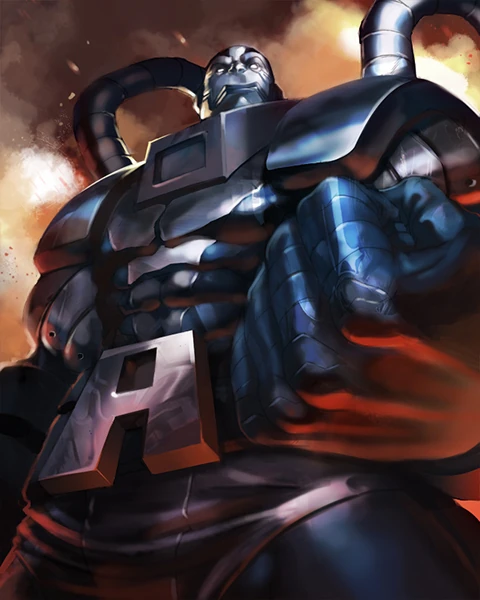
But which character?  Well, there’s a reason Superboy is a clone of Superman and not, say, Batman: Superman is really powerful.  If you’re going to clone someone, you clone someone badass.  Who’s the most badass?  It turns out that Team A has the highest point values, so if anyone was going to be cloned, it would be one of them.  But which one to take?  Ideally, I’d want someone with strong physical powers, as those are the most obviously cloneable.  One character, Hobs Ini-Herit, the Alchemist, is super-strong, very attractive and has matter control.  That’s two out of three physical powers.  I asked Chris what sort of name “Ini-Herit” was. It turns out the character is Egyptian.  Oh man, shades of Apocalypse!  Do want!  After a quick discussion with the player, I had permission to make his clone.

Let me tell you about my character!

And… that’s as far as I’ve got.  It’s important in this phase to be flexible and to work with your fellow players and the GM to make sure that everything fits.  There’s also a lot of things I do not yet understand about how the campaign works (random point totals?) so the final picture will vary.  He might be a very weak, minor shadow of the original character, or he might be a surprisingly powerful avatar that approaches the original.  I’ve already begun basic negotiation, so what follows is almost certain to change over time.
First, my character will be a genetically engineered clone.  That means he has unusual biology, unique genetic concerns, and associations with some conspiracy that attempted to make him.  That suggests a level of naivete, as well as a group of enemies trying to hunt him, and special medical concerns that other characters don’t have.  It also suggests that I’ll have secret problems that I don’t know about at the start of the game.
Second, my character is the legacy of the Alchemist.  That means I’ll have similar powers to the Alchemist.  Now, my powers don’t have to be the same.  If this were a comic, my character would be another writer/artists reinterpretation of the original Alchemist.  Superboy is a more down to Earth, gritty and broodier take on Superman, for example.  My character should make his own mark, but at the same time, definitely refer back to the original concept.  That means super strength (or at least very strong), good looks, and matter control.  For this final, though, I want to shift it down a few steps.  Where he can manipulate any matter around him, I want to limit my character to manipulating his own body.  His father is an “external” alchemist, while I am an “internal” alchemist.  It also lets me be more like the shape-shifting Apocalypse, which I like.  Of course, I also have less points/power than the original Alchemist, so I should definitely have less strength.  I’d also like to be rather tough, both because it fits being a brick, and it’ll be useful in a post-apocalyptic landscape.
Third, my character is the relic of the bygone age.  Building a clone requires more technology than a post-apocalyptic setting generally has. Plus, if you dropped a clone of Superman into a post-apocalyptic setting, he’d be quickly seen (at least by some) as a messiah. I’d like to explore that.  In particular, I see him as seeing himself as made for a purpose, and that purpose is to fix the world.  I also want to represent a callout to an older ideal in a darker world.  I’d like to give him Charisma and Public Speaking to represent his ability to give hope to others, and Code of Honor (Comics Code) to make him an exemplar of Silver Age ethics in an Iron Age world.  This would also tie me to Richard’s character, who is a time traveller, and thus very literally a Silver Age character who has been cast into the Iron Age.  We’re both men out of time, and thus have a reason to connect and strike up a friendship.
Finally, my character bears the themes of occult enlightenment.  He is the work of the Alchemist.  He seeks self-perfection.  He is strongly spiritual, and created by a conspiracy.  He must, thus, explore mysteries to uncover his own secrets, the secrets of the Alchemist, and the secrets of the world around him.  This ties him to Nicodemus, Wavefunction’s character, who is also a very occult character (though more with leanings towards demonic power, more dark John Constantine).  This also suggests a skill at Archaeology and History and Philosophy, making him a warrior-poet, which I like.
But how these themes ultimately get expressed with vary based on input from Chris, the other players in question, and what pops out of character creation.  I’ll keep you appraised as the character evolves.

A Post-Apocalyptic Soundtrack

Chris has suggested listening, and I like having a soundtrack that I associate with a particular campaign to help me when I’m working on my backstory, posts or character design.  His music differs from mine, but his suggested music is fairly broad, so I’m sure I’ll have plenty of options.  Thus, I’ve put together a playlist that you can listen to, if you also have spotify.  It’ll change as I decide which music I like and which I don’t, and the final result will be more about what I want to listen to than really a reflection of Chris’ taste, but see it as my take on his playlist.

Cherry Blossom Rain: Session 2 and the yips

Do you know what the yips are?  It’s when someone who’s really good at something, usually sports, suddenly loses his touch.  A perfect pitcher suddenly throws homers, a wide receiver suddenly can’t catch, and so on.  When I was in highschool, I had the yips really badly in my summer year: I went from one of the best discus throwers on my team to the guy who literally couldn’t get a throw out of the ring at a single competition.  It was terrible, and to this day, I don’t know what I was doing wrong.

I’ve found myself wondering if I’d have the yips as a GM lately.  Some of my players will look at me like I’m mad, but the truth is, I’m certain my WoD: Witchcraft game wasn’t great, and my WotG game wasn’t what I wanted it to be.  I know the techniques, and I can talk the talk, but I find myself wondering if, perhaps, I’ve lost the ability to walk the walk.  On the one hand, it might be absurdly high expectations: I want all my games to be “great” while greatness is ultimately subjective (Most people will agree when something is bad, or when it’s good, but greatness goes a little beyond that, and it’s often in the eyes of the beholder), and so when I fail to get a jump up-and-down reaction from my more experienced players, I feel like I’m doing something wrong, when I’m probably not.  So perhaps it’s in my head.

Well, if I had the yips, they’re gone now.  I hit every note I needed to in this last session, and more than that, I proved to myself that the techniques I’ve been studying have been paying off.

First, I’ve felt for some time that if you have sufficient advanced material, that prepping and planning the game itself should be relatively easy.  Now, while I had plenty of time to put this game together, I procrastinated (as I usually do when my focus is elsewhere), and ended up spending 30 minutes right writing out some thoughts I’d had the other night before I zipped off to the game.  Despite my almost complete lack of preparation, I still had a really good game.

The players started off in the Kurosawa Castle, guests of Ren and Lord Kurosawa again.  I reintroduced Sano (rudely), and then brought the characters together.  Hitting the high points:

  • After seeing a doctor for his wounds, Kenta (Raoul) went to train with Yudai and then (spectacularly) lost a duel to Yoshiro, the Senshin Swordmaster.  Sakura (Maartje) also practiced with Yoshiro, but was too busy fluttering her eyelashes at him and blushing to actually fight, and lost twice.  
  • Meanwhile, Yukiko (Desiree) slipped and fell while waking down the hallway and smacked her face against a wall while alone with Ren.  It totally happened! (It did!  Desiree had been cursed by the “Mud Girl” as she keeps calling her (she’s noted down in my notes as “the Witch of Jukai”), and so I made her take a “Walking down the hallway” roll, at DX +10, and then used the curse to turn her success into a failure and give her a point of damage).  Naturally, nobody believed her, so Shinji, resident Nice Guy of the Mitsurugi Dragon Guard flew to her defense and was going to challenge Ren before Kenta socked him in the face and told him not to screw up negotiations.  It’s good to be Daimyo, I suppose.
  • Yamato (Hugo) negotiated an alliance with Lord Kurosawa in the face of Tsao Bei (evil Chinese diplomat!), who brought Dark Shota and the Executioner with him.  In addition to agreeing to give Lord Kurosawa some important position in the future shogunate, he also arranged to marry someone to his youngest son (Sano).
  • Desiree decided to have a tea ceremony, so obviously everyone had to come.  She got to play dress up (Fashion Sense gives a +1 reaction modifier if you dress yourself or others well, and I required descriptions.  She was more than happy to oblige), and she even made Kyo look really pretty.  At the Tea Ceremony
    • Someone tried to poison Yoshiro, but Ren protected him.
    • Kenta agreed to marry Kyo to Sano, much to her dismay.
    • Yoshiro reacted… passionately to this revelation, leading Sakura to suspect that he was in love with Kyo, must to her dismay (Sakura’s dismay, not Kyo, we don’t know how Kyo feels about that, she was too busy freaking out about being married off).
    • There was much drama.
  • That night, ninjas attacked!  Fortunately, Kenta, Sakura, and Senshin no Oni (!) showed up to defend him.  Senshin no Oni revealed that Tsao Bei was attempting to grievously wound the swordmaster, knowing that the Senshin would never leave him behind and it would slow down their movement.  He also revealed what he had learned while prowling the city, giving them some clues on where they might find Kimiko.
  • Desiree found the carefully preserved bedroom of Akane, Ren’s older sister who was executed for treason against the emperor.  When he discovered her, he wasn’t angry, as his servants expected, merely very sad, and asked her to play her samisen for her.  She agreed.
Naturally, I’m leaving out some of the details.  A few important things came out of this session.  First, I’ve been trying to explain the importance of beauty and elegance in the setting, but this session served as an excellent demonstration of that, with a sudden focus on Desiree’s tea ceremony skills, her make-up skills, her fashion sense, and Maartje’s calligraphy, and everyone’s savoir-faire (only Kenta screwed up his roll).  Second, I wanted this game to very much be an exploration of Japanese culture, and Hugo’s demonstration of tea ceremonies for the rest of us did a good job at that. Finally, I’ve taken Walter’s sage advice to heart.  You see, I’m terribly fond of having multiple, interwoven stories and that often involves separate scenes for each character.  This can have wonderful results, but as he once said “Dan, your stories are great to watch, but they’re even more fun to interact with.”  I made a point of allowing anyone to jump in on anyone else’s scene, and the result was that you got crossover much faster while nobody lost their moment in the spotlight.  You could see the multiple threads and interact with them, which I think partially explains the success of the session.
What stuck out to me was the interaction I had with the players.  Normally, you don’t see players this invested in characters and storylines until midway through the campaign.  This campaign shows the dividends of my work to make sure that I can have “maximum impact in minimum sessions,” and I thought I had failed (it turns out that there’s a certain “minimum” players need to grasp what the hell is going on), but clearly, I hadn’t.  I can’t stuff “the feel” of a full campaign into a single session, but apparently I can reach that point in two.  Raoul argues that it’s because I have an all-star cast of players, and that’s certainly a contribution.  Raoul himself, for example, has deeply studied my setting and my characters and is highly invested in the game, and Desiree is used to falling into character for one-shot LARPs, but I’d like to think that the work I’ve put into the setting helped.
Once, during the development of 4e, a D&D designer invited his wife to sit in on a D&D playtest and watch.  He asked her opinion, and she said “It looks like 4 hours of work for 30 minutes of fun.”  I’ve been trying for a long time to improve that ratio, so players don’t feel like they have to slog through 4 hours of crap to have a little fun at the end.  After I realized that we’d played for 4 hours and I’d only had 30 minutes of prep, I commented to Bee “I had 4 hours of work that only cost me 30 minutes of work.” 🙂
I think the lessons learned here are clear: Pick your players and match them well to your game.  All the work you do in advance will save you work in the long run, and the fact that I can simply run with little to no prep means I’m not stressed before the session.  Allow PCs to interact with one another, and encourage them to stay in the vicinity of one another so that they can do so.
This is what I wanted from my sessions, and now my players can see where I’m going with it.  And it passed the “player gab” test, since people were apparently chatting about it the next day.  Cherry Blossom Rain has officially taken flight.
Just a shame that Rene and Raymond couldn’t be there to see it… on the other hand, they were sold on the game in session 0. 🙂

Cherry Blossom Rain: Session 1

I’ve noticed that when I “mean to” put something on my blog, it almost never goes up unless I do it while the ideas, the events, are still fresh in my mind, so I’m going to post this right away, lest it fall in the dustbin of history.

So!  As you may remember, I ran my samurai one-shot over the Summer Weekend a month or so ago, thus completing my vision of a GURPS Samurai game wherein I could really explore martial arts.  That was enough… but in the process of creating my game, I created an entire world that really demanded more exploration!  And so, I offered to further the game as a campaign.  Today, I ran the first session of that campaign.

Planning the game turned out easier than I expected.  I fretted that I hadn’t spent a week putting session material together and, indeed, I would have liked to have statted a particular ninja out before hitting the table.  However, I put together a skeleton of a session that relied a great deal on what I had already written (not really a problem, as the whole point of all this fore-planning was the fact that I could use it to make the rest of my game easier to toss together).  The results worked great!  I think this whole “intense work putting together a world so that actually putting the sessions together is a snap” strategem really works well for me.

As to the actual session, I wanted a chance to introduce the new characters, bring everyone up to speed on what was going on, have a big, interesting fight that served as a combat tutorial, and then move on to solving the rest of the story.  I got everything up to solving the rest of the story.  I hate it when a session is 90% combat, but I find that’s just the pulse of my GURPS games: This session, a really interesting fight with lots of combat, the next two sessions aftermath and building the context for the next big fight.  Everyone seemed to enjoy the fight.  I fret that Desiree, who certainly enjoys roleplaying more than beating the crap out of people, might have been a little bored, but she didn’t seem bored, she got to stab someone in the eye with her hairpin, and she said she had fun, so I’ll take her at her word.  And we started late, around 7 pm, so we only had 3-4 hours to play, thus it’s natural that we wouldn’t get much done.

The session began where the last ended: The imperial princess snatched from the home of Taro, the heroic Yakuza, with Yukiko, Daisuke and Hayate there to see the carnage.  They gathered up Taro and moved to leave, when suddenly, ninjas attacked! This gave Hayate a chance to reconnect with his past (an element that had been sorely missing thus far), and showed just how lethal ninjas can be.  Meanwhile, Goro made his move against Taro, bringing his hardest hitters to attack the club and finish off his rival once and for all.  The three players (along with Satomi, the doctor secretly in love with Taro, and Taro, our heroic Yakuza) faced a force of five ninjas, an elite ninja, twenty bandits and the Ox brothers.

Fortunately, the cavalry came (in Maartje’s case, literally).  The other players had their own scenes of arriving at the city or realizing that half their party had vanished, and set off in pursuit, only to arrive at the club just in time to see the carnage unfolding.  Each player had a moment to shine, and quite a few NPCs.  Hayate talked the ninjas down (thus saving the doctor’s life), and through teamwork, Daisuke (by drawing their fire), Hayate (by wounding them with a flash-step-gut-stab), Desiree (by pinning one in the eye) and Taro (by finishing the final one off with a grab-and-smash) managed to put down both of the terrifying Ox Brothers.  And then the players took the time to get to know one another and decide on where they wanted to go next… and we ran out of time.

So, like I said, I didn’t get much done, but the players enjoyed the battle, and I think they needed this sort of “reintroduction.”  All in all, given the enthusiasm shown, I think it went well, but I still look forward to digging into the meat of the role-playing in the next session.

Black Friday

As per tradition, I always try to run something when I visit the states, so my players can see me in running a game in person (plus it’s far easier to get this group of luddites together in person than online).  This time around, I was inspired by twin revelations: Iron Man + L4D2.  First, I have a friend named Walter whom I have gamed with for years (friend?  I should probably call him my step-brother now ^_^ but one can be both, hmm?) and we often have a hard time gaming with one another.  Specifically, I had been misreading his gaming style for years, and watching Iron Man finally let me grasp what he wanted.  For example, he often wanted to play an inventor character, but hated the grunt work involved.  After seeing Iron Man, I grasped that he wanted to be like Tony Stark (one of his favorite characters) or Doctor Who (another favorite): To be a clever super-hero who solves his problems with his mind, but is always central to the action.

Playing L4D2 got me thinking about zombies.  Normally, I see zombie horror stories and post-apocalyptic scenarios as gritty and a struggle of survival.  You play low powered characters and see if you can handle the situation or not, right?  Walter loved these genres as well, but never really meshed with my vision of them.  It wasn’t until I read this article (warning: Cracked.com is known to devour your time!!) that I saw another vision, another way to tackle those genres, and I was reminded of the appeal of Rifts.

With these ideas in mind, I set out to create a character Walter would love in a world that would appeal to my group.  In a continuation of my experiment to stuff as much awesome into a single session as I could, I wanted to give the players this feel of an entire world with just a snippet of character and a single session.  I also wanted to experiment with strong, highly cinematic characters with unique play styles, and to do that, I borrowed from the more cinematic options found in GURPS (and suggestions from the forum).  Those systems tend to involve the expenditure of character points, which I don’t disagree with, but once you call them character points, players are less likely to use them.  So I called them “Action Points” and gave them 5 at the start.

For the world, I drew a core inspiration from Rifts, creating a post-apocalyptic world that combined magic and technology, with dystopian dictatorships fighting monstrous madness with the players and survivors caught in between.  I drew further inspiration from L4D2, tossing in crazy assortments of zombies and leaving whispers and hints that the dystopia was created from the corrupt remnants of the CDC, and then added a Supernatural vision of a post-apocalyptic world: Demons as possessing spirits rather than titanic beasts of fire and shadow, subtle rituals meant to fend off monsters, and with tough-but-ordinary men fending off the night.  Finally, I layered a good dose of GURPS sensibilities, including a tech level disparity of 7 (the survivors) and 9 (the remnants of civilization that have moved on) and adding a grand conspiracy for the Illuminated, and then leapt with both feet into the session.

Hunter Clark

 The first character was for Walter and sort of a core inspiration for the setting.  I created Hunter to be a survivalist, a sniper, and a genius. I gave him Quick Gadgeteer and, to forgo any problems with spending too much time at a work bench when he needed to get into the action now, I gave him an “Instant Invention” cinematic ability: He could spend an action point to forgo creation time (provided I didn’t think it was too crazy).  Often, Walter finds himself frustrated when the pacing notches up into action scenes that move faster than he can think, and then comes up with an idea that frustrates me.  So, I granted his character the ability to “take a breather” and ask me to step aside, talk things out, figure out what both of us are trying to do.  To make sense of the fact that his various abilities would give him a great deal of insight into my game, I just went ahead and gave him Illuminated (and why not?  He loves conspiracies!  Why not be a part of them?).  The result was a wandering teacher, “the Man of Letters” who understood technology better than anyone else, carried advanced rounds of his own invention for his massive payload rifle, and had the capacity to bring back civilization, if he played his cards right and defeated the other “players of the game.”

John Franklin
Does he look familiar?  Byler picked him out, and I think he looks pretty good.  I noticed that Byler really enjoyed  being a politically powerful figure in Vampire, and so I thought I’d give him another taste of it, giving him a military leader.  Knowing his love of Space Marines, I wanted to give him a badass, patriotic ubermensch.  The result was John Franklin (I wanted someone a little more Nordic looking, but Josh Holloway will do), a super-soldier created in America’s waning days, who woke up after the fall with no memories but the propaganda and indoctrination given to him while “in the tube,” (giving him some very exaggerated ideas about America’s glory days), supreme military training and TL 9 equipment, including a combat hardsuit and an enchanted, superfine bastard sword built to his stature.  I also gave him a small army called the Old Guard, and two powerful lieutenants, the Black Agent and the Witch.  The result was a cross between Captain America, a Space Marine and King Arthur.  He certainly enjoyed it.
Kyriel
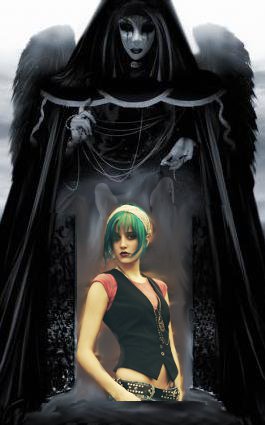
Cassandra has a love of creative characters and playing with NPCs.  One of her favorite games of all time was Valkyrie Profile, a game where you collect interesting NPCs and make them into an army to fight the final battle, and I wanted to give her that same experience in a table-top game.  Thus, Kyriel was a fallen angel, expelled from Heaven by an unknown enemy after the collapse, but still determined to gather the souls of the righteous for a final battle.  I gave her this “pact” ability as a cinematic power (I can’t fathom how I would stat it as an actual advantage, but it’s mostly a story-element anyway), so she can make a ghost substantial and give it “another chance” to train and fight (not really resurrection as the ability to remove the Insubstantial advantage at the ghost’s request).  I also gave her magic, and the cinematic ability to spend a character point and gain 25 energy points for a single spell.  Oh, and I made the picture myself (it represents the angel possessing some hapless teenage girl whose soul was burned out by the unearthly power of the angel).
Cook
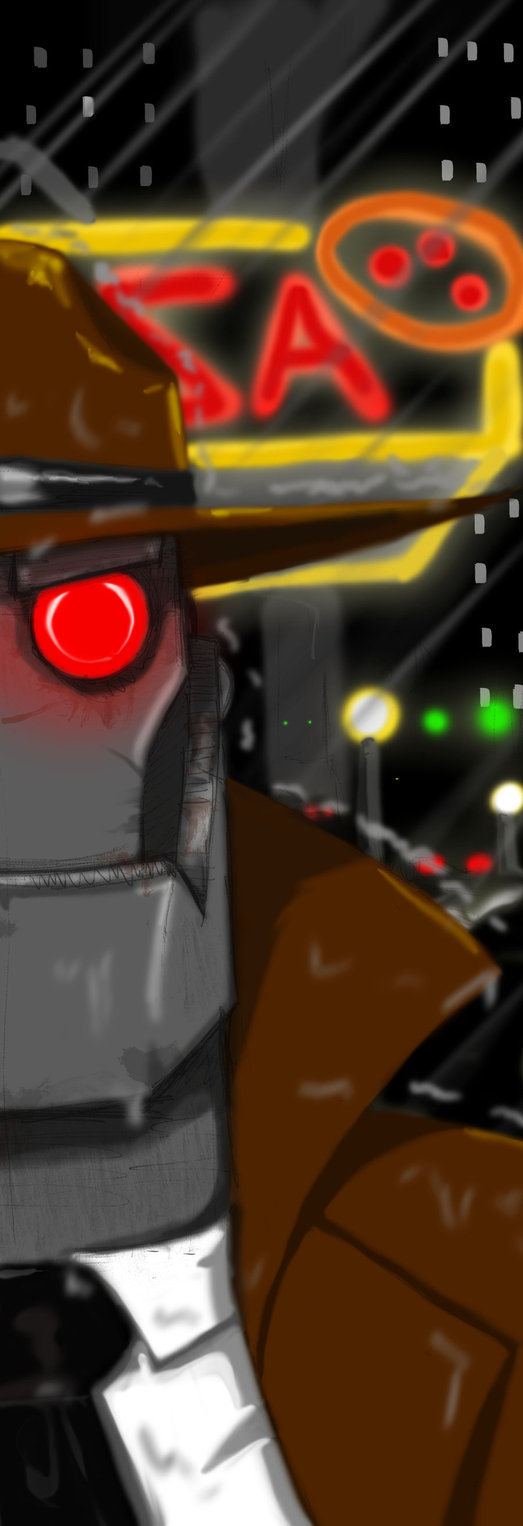
Dave was a bit of a challenge.  He basically plays the same character again and again: a big, tough guy who kicks much ass.  There’s nothing wrong with that, but I was hoping to challenge my players a little with their characters.  A combat robot fit the bill: still tough, but with speed, grace and excellent sensors.  I made him a full-conversion cyborg and a noir detective (a play on the old “cyborg bounty hunter” from Rifts) and then I added an element of mystery to his conversion, giving him Partial Amnesia, with only faint memories of “the Crying Woman” (his femme fatale) and a mission to kill “Conner Johnson.”  I’m not sure he appreciated the other elements, but he liked being a DR 20 robot in a zombie apocalypse.
(I had more characters, but I won’t bore you with all the details).
We had a relatively quick session: A detailed battle against a swarm of zombies, a miscommunication and then a meeting with a group of survivors, an ominous gathering of more zombies and the sudden interference of the Authority before we had to close up for the night.  I’m not sure it was my best session, but the group clamoured for more, so it certainly wasn’t a failure ^_^
The lessons I learned?  I can design GURPS characters in sweeping cinematic strokes, and I really liked my “specialized for your character” cinematic options. The players certainly used the heck out of their cinematic abilities.  The cinematic options felt like a completely different sort of game, one more narrative than simulationist. I’m not sure I liked that feel for that particular genre, but I like knowing that such a game is possible.  Oh, and even in a cinematic game when you’re 450 points, sufficient zombies can still be frightening.
I have a lot to do, so I probably can’t get back to Black Friday quickly, but as an experiment, I learned a great deal.  A good game, all around.

HotBlooded: After Action Thoughts, part 1

I’m posting from the distant hinterlands of America, so I’m afraid I can’t post all that often, but I thought I’d at least take a little time to talk about my very first LARP while my impression was relatively fresh.  I don’t have pictures yet (they’re coming), so I’ll hold off on the actual report until I do.  But I can at least discuss my thoughts and theories behind the design of the game, why I think it worked despite the concerns of my editors, and what I learned from the experience.

I seldom LARP (very, very seldom), but I often listen to people discuss their experience.  I personally find that the greatest foe to LARPing (and RPing in general) is boredom.  Players need something to do and wandering about saying “How do you do?” and “My isn’t the weather lovely” makes for a terrible game.  Someone once argued that RPGs are 4 hours of work to get 1 hour of fun, and I don’t want that.  I want the players to hit the ground running, and so I tried to create a game that would explode as soon as it came into contact with the players. 

My editors found my approach overwrought.  “Are you writing a one-shot or a campaign?” they asked.  They pointed out that there was no way all of those story elements would come out, and that my details would overwhelm the players.  In some ways, I felt they completely missed what I was trying to do, and the general success of my LARP proves me right.  First, a campaign needs less work than a one-shot, not more.  In a campaign, we build story, layer by layer, session by session.  We can start with nothing and slowly build context.  In a one-shot, we don’t have the time for that.  Players need to know who they are and what they’re doing NOW.  Second, it’s true that not all my story elements would come out (thought at least one thought that large strokes would fall through, and that didn’t happen: Every major element showed up in the game), but that as the point.  I don’t know what players will like and what players won’t, and I don’t know how their interactions will shift the story.  NOTHING happened like I anticipated, but because of the ruggedness of my design, it remained terribly interesting.  For example, Rianne’s character was supposed to be the target of romance, but instead, all of the boys fixated on Sabrina and Desiree’s character.  And yet, Rianne’s association with the murder of Fyx Steele turned into a huge story element for her.  Some people have asked how I would know these things would happen, but the point is that I didn’t, and I wrote knowing that I had no control.  I gave everything enough material to keep them busy, and if one line of story failed, they had two more they could pick up, and that’s exactly how it worked out.  Finally, I too was concerned I would overwhelm the players (Erik Kamerman’s game certainly did, and I produced as much word-count as he did).  I tried to avoid this by carefully explaining how the system worked several times, and by making much of what they had to read optional.  However, I found that the players dug right into the game and weren’t confounded at all by the complexity.  I expect this was the result of two things, neither of which I had actually anticipated: First, I spoke a great deal with my players, asked them what they wanted and generally stoked interest in the game (entirely by accident).  Second, I put the LARP characters out about a month ahead of time.  This proved critical: Apparantly, the main problem with Erik’s LARP wasn’t necessarily the detail, but the fact that people only had two days(!!) to read it all up.

So, the LARP was a grand success.  I mean, really, a huge success.  I can’t tell how it rates in the grand pantheon of LARPs (I’m tempted to say that Jimmy’s LARPs are generally better, but I really have no idea).  I do feel it’s safe to say that “It was a success.”  I’ve outlined why I felt it worked, but I thought I’d touch on a few elements that were mixed or could be improved.

First, the system.  The more veteran players looked at me like I was crazy for including a system and, in general, it went well, but almost nobody used the “contest” system.  I think that’s John Wick’s intention: He included that not as something players would use all the time, but as something the players would touch on only if needed.  Still, there are elements of the Contest system I don’t like: If I spend 3 style persuading you, or 3 style contesting you, I’m still out 3 style either way.  Second, the contest can force players to do something they don’t want to do, and I’m not sure I like that.  At one point, Loes tried to force Hugo’s character to do something he simply wouldn’t do, knowing what he knew (she wanted him to kill someone he was allied with over something that Hugo knew that the character wasn’t involved with).  What if she had succeeded?  I could have declared Bad Form, or simply told her not to do it (which is what I did), but it would be nice if the system simply prevented things like that from happening.

Related to the system were the characters.  I found that players both loved and hated going over their character sheets and choosing.  Raoul argues that it’s a great mechanic as it encourages players to think about their characters in more detail than they normally would, and I think that’s true.  On the other hand, several players strained against their limitations, wanting to bring everything, and others couldn’t be asked to figure it out, and resented dealing with mechanics at all.  I doubt I could ever please both the mechanic and the fluff side of an RPG, though this system was a great compromise.  Still, most interestingly, I found that players didn’t care much for Aspects except as neat little additions to their character (I think players would have enjoyed them more if they didn’t have a simple list: they liked things like Heartbroken and Madness), but they really enjoyed the Special Powers aspect of their character.  If I had to write a new system, I’d probably make the kewl powerz front and center of the game, as players used those more than they used anything else except spies and soldiers.

The only complaints I really recieved were the servants.  Ironically, I had chosen to follow the advice of my editors and simplify, partially with the assumption that the servants would interface with their lords and work together.  This turned out to be partially untrue: the newer players felt they had no right to speak to their lords, to interrupt them.  Interestingly, the veteran players had no problem shifting their focus based on what was going on around them.  I could have given them even less material and they would have done just fine.  I think this is what my editors were talking about, as they generally run games for veterans.

The trading game was also very, very well recieved.  Having little pieces of paper helped a lot, I think.

The game began very slow.  There’s this sort of feigned stateliness that I just hate in LARPs.  People walk in with lifted chin and speak slowly and quietly, saying things like “Ahhh, how do you do?” and “Oh, it’s so lovely to meet you,” and it’s all a giant tea-party.  That’s lovely, if it’s what you’re looking for, but we want soemthing to happen.  We want drama and shocking revelations and tragedy!  For the first hour, this seemed to be all that was going on (though several disagreed and pointed out that they made big trades early on, and I certainly missed some elements of the game), and I worried that my game was going to devolve into mindless conversation, a sure sign that I had failed.  But once Raoul announced the murder of Fyx Steele, the game quickly accelerated into high gear, and when I closed out the game, I had several players giving me puppy-dog eyes asking for the game to keep going.  I still can’t decide if I made the right decision closing it out, but I certainly left them wanting more.  Still, there has to be some way to kick-start a game more quickly.  Those I ask are of two opinions: Some agree with me and think there must be a way to go faster, but most think that players need about an hour to “get into character” and to feel one another out.  Maybe that’s true

I’ve been bitten by the bug, and within a day, I was inventing an even better system (cough).  I think I need more exposure to LARPs before I try again, but I must say, I was very very pleased to make such ripples in the LARP community with my first effort ^_^

Weapons of the Gods: Session 6

Rounding out my hell week, I’ve finished the 6th session of WotG.  I’m too exhausted to give you the sort of cool exploration of what we did that I like to do, but I can hit the highlights.

We were missing our shaky player again, and he’s having a hard time fitting in.  It wouldn’t surprise me if he dropped out entirely, and I wouldn’t be sure if he would be making the wrong choice if he did (but I will say I would miss him if he left.  I missed him in the game).  One of the players, after finally grasping what the game was really about, changed his character, and I think the new character is a wonderful fit.

We hadn’t played for two months, so you’d think fitting back in would be slow, but this time, I focused on one of my strengths: Character.  I have numerous characters and a somewhat complex plot, but by simplifying it and reiterating it, and then showing the world from the perspective of those characters, I was able to bring some neglected NPCs back to the fore:

  • Prince Hei: The heir to the Dong Clan who struggles with his sexual orientation and the obvious love interest of one of our player characters.  I’ve wanted to highlight that scandal, that element of forbidden love, the tragedy and love/hate of the stereotypical kung-fu relationship, and this session, I got it in spades with Jimmy’s beauty and the truth of his profession triggered a tantrum that cost Hei the tournament and made it appear that Jimmy had set up Hei (when he had not).
  • Fen-Fen: Bee’s handmaiden has a tragic back-story, and I’d never really touched on it, as it’s important for later story elements involving her.  Finally, I wrenched the story to the side and showed people her story.  It’s turning her into a bit of a woobie, but I suppose that’s fair.  She lives a hard life and faces it stoically.  She’s never relied on others to take care of her, but that doesn’t mean they don’t want to give her a big hug.
  • “Littlest” Ping and Li: The “crown prince” of Southern Liang draws a great deal of inspiration from Prince Tai, though I’m working hard to make them distinct.  Where Tai was a cunning little bastard, Ping is growing into an irresponsible but contagious idealist, and Li is, while not bright, terribly practical, and asks uncomfortable questions (when Li ran off to help Ping with his madcap adventure and was later criticized for it, he pointed out that Ping is a prince, and thus Li is obligated to follow his commands.  When the player couldn’t answer that, another player pointed out “You’re losing a debate to a little boy.”  Priceless).  WotG fares so well when you point out the differences in generation, so bringing the kids in with the adults helps a lot.
  • Evil Sage: (one of) the big bads of the game has been referred to, but we haven’t seen him.  So he played a song with one player character, and then casually murdered another (it’s ok, he got better).  He’s not etched onto the consciousness of the players (“Uhhhh, that kung-fu’s not very nice…”), and that’s good.
  • Jun Zhi: The King’s brother, ambitious, competent and powerful, needed to be more than a brooding-but-awesome guy lurking in the background.  We brought him to the fore as a powerful ally of the players, so they should be looking to him more often, making his role as a major player in the politics of the region more sensible.

We finally had the beginning of our tournament (only one player made it to the second round by pummeling a very inexperienced character on his way to more important things), while the other forfeited in favor of protecting his princess.  I didn’t actually get a chance to reveal more about the mystery, but the pieces are set into place so that the players will know more in the next session.  All in all, we had a nice, tight game that felt like it flowed and I felt “in control,” in the sense that I wasn’t scrambling or terrified about the game.  It was easy.  This is the way a game is supposed to feel: I’m where I need to be.  At last.

After Action Report: Andromeda Incident, Session 6.5

The sixth session ran long, and given the limited time I have left to finish this campaign, I wanted to get the fighting out of the way before the role-playing intensive session I had planned next.  So, the players agreed to have “mini sessions” between the previous session and this one, and we had a sprinkling of one-hour/two-hour sessions throughout the week (and by “throughout the week” I mean “all on Tuesday, right before the next session”)

Overall, each fight went quickly and smoothly and everyone played well.  Each player achieved their mission, and I failed to kill as many characters as I had hoped (but I did manage to get one), and Icarus finally met his princess.

Mission 1: Rescue and Retrieval

Smoke billows from the fuselage of the dropship as it spirals through the air, alarms shrieking.  The pilot shouts out for everyone to brace themselves, and then, with a stomach-lurching stop, smashes into a building.  All goes dark.

The soldiers wake, the impossibly tough Rayner first.  His night vision visor displays the world in hues of green while scrolling lines of text on his HUD report the status of his computer as it reboots, following swiftly by the shifting lines of a status report.  His sleek, black cybernetic limbs hum as he shifts aside the rubble and hunts for the rest of his comrades, to find Bishop well and Strider already standing outside, his white-eyed sentinels watching over him while a small swarm of laser-pistol armed goblins explore the terrain.  In the distance, the flash of gunfire and tracers light up the skyline, with the distant booms of artillery reminding them of the battle that surrounds them.

“We must move.”  Stride removes his helmet, his glossy armor glimmering darkly in the night, his white hair fluttering in the wind.  “The princess cannot wait.  Cannot wait.  This is the…”

“Please…” The pilot hammers on the door between her compartment and the rest of the ship.  “Can someone help me?  I can’t get out.”  A quick glance in her direction reveals the buckled, broken slabs of metal between her.  The ships warmth grew ominous at the flow diagnostic display beside the door that suggested instabilities in the fusion reactor.  The group fell silent for a moment, and she called out “Is… is anyone out there?”

“…the highest priority.”  Strider coldly resumed, swiveling his gaze back to the two human soldiers.  “Let’s go.”

Sergeant Jack Bishop finished resealing his armor and readjusting his rifle on its strap, and then pointed a finger at Strider.  “No.  This is my command, my mission.  Nobody gets left behind.  Thompson, open the door.”

“Sir.” Rayner acknowledged with a snapped salute.

“Fine.”  Strider sniffed and replaced his own helmet.  “Do as you wish.  I am not under your command, and I will not forget the ultimate purpose of this mission.”  As one, the Tennin forces turned and moved out, quickly swallowed by the shadows of the abandoned section of the city.

With a quick heave, Raynor’s new, powerful arms make quick work of the door, forcing it open to reveal the bloodied pilot on the other side.  An unpleasant wound seeps through the rent in her combat suit.  Raynor finishes shifting the rest of the debris, and helps her to her feet.

“I heard what the elf said.”  She grumbles, trying not to lean on Raynor as she favors her uninjured leg.  “I won’t slow you down.  I’ll keep up, just don’t… don’t leave me behind.”  She coughs and pulls away the visor to her rounded, pilot-helmet, and wipes her mouth with the back of her hand.

Sergeant Bishop shakes his head and offers her his sidearm.  “You’ll be fine.  Raynor, carry her.”

“Sir.”  Thompson acknowledges once more and then takes the woman over his shoulder.

Bishop stepped out and surveyed the broken landscape around them.  A towering statue loomed above, it’s head broken and toppled by their crashing ship, and debris and broken glass crunched under foot.  Their drop ship had come to a stop in a large, ominous white building.  While Bishop watched it through narrowed eyes, a snarling growl alerted him to the presence of a large quetzali male staggering out of the ruins.  Thick, black fluid dribbled from blackened teeth, and he wore a smudged, white lab-coat.  Suddenly, the quetzali unsheathed its claws and charged and, casually, Jack lifted his rifle and fired a three-round burst into the male, killing him instantly…

… or not.

As though it had felt nothing, the quetzali continued its charge, howling ferociously.  Bishop fell back and fired a full spray of bullets, tearing the quetzali apart just as it was reaching him.  Thompson stepped out, carrying the pilot, and looked at the gore covered Bishop as he wiped his visor.

“What was that?”

“I don’t know.  I didn’t like it.  Let’s move.”

Bishop moved to take cover behind the debris of the statue, the pings on his radar warning him of incoming mobs rushing at their position down the winding alleys of the abandoned, city streets.  Bishop signaled for Raynor to go, and then erupted from his position.  The underbarrel grenade launcher thumped as it sent its deadly packaging arcing through the air at the first swarm of quetzali militia, poorly armed and armored insurgents rushing at them with all of their predatory speed.  His perfect shot blew away the first of the males, and then he laid down a hail of withering suppressive fire that tore through their ranks.

Raynor lifted his hand to salute his sergeant when the crack of not one but two portable railgun shots echoed through the air.  The first cracked against rock, but the second made Bishop jerk.  Bishop’s diagnostic hit red in a split second, and Raynor’s eyes widened as Jack slumped against the debris.

“Sir!”

“It’s fine.”  Bishop growled.  “Go.”

Private Thompson nodded and turned to go.  As he ran, he heard the hail of gauss rifle fire as the dying Bishop laid down more fire.  Finally, after long, silent seconds, he heard the detonation of several grenades, flare grenades arcing into the sky as Bishop ended his life in a fantastic fireworks display that took his foes with him.  Raynor squeezed his eyes shut as Bishop’s diagnostics flatlined.

“Goodbye, Sarge.”  He whispered.

(Sometimes, when you get hit in the torso, the GM rolls a 1 on a D6, and it means it was a vitals shot and it sucks to be you.  Jack had the Dramatic Death perk, and so went out with a bang).

Mission 2: Escort

Maddie, still riled from her “failed” date with Emerson joined Mackenzie (who flexed and played with her cybernetic limb, eager to prove her worth in battle), Amy (also emotionally uncertain), Sage (Surprisingly sober) in her IFV, Chaos and (of course) Seleya, and Snow, with Roughneck at the head of the column.  The tank rumbled to life down the winding boulevards of Grrarrashe-Ya, wending its way towards the central palace.  Tall buildings lined the sides of the streets, looming over the group.

Suddenly, swarms of quetzali militia erupt on the rooftops wielding old, chemical slughthrowers and heavy grenade launchers.

“Move move move.” comes Roughnecks command across the comm system, and everyone flows into motion.  Preternaturally aware of their surroundings, Maddie and Chaos move first.  Chaos shouts at Snow to top the building, shaking the marine from his surprise and sending his huge, power-armor clad form bounding up the side of the building with alarming speed.  Maddie’s gauss LMG charges with a whine and she lays down a torrential hail of bullets which spark against stone and shred uprotected flesh while the rest of the column moves forward quickly, the group trying to get behind the cover of the tank while the quetzali on a third, smaller building lay down fire.

(“This doesn’t seem so bad,” comments Maddy’s player.)

“Gonna blow the building.  Cover me.”  Mackenzie announces.  Chaos and Selena hit the ground, their twin portable railguns aimed at the third group while Snow and Maddie make quick work of the other two groups.  A few moments later, the third building explodes, with Mackenzie outrunning the blast radius, showering brick and mortar, removing the third group….

But not the threat.

From another side street, a quetzali assault craft and a squad of heavies charge forward.  The leader wears armor covered in baroque gold and murmurs prayers or poetry into his speakers.  Another group ambushes them from atop another set of rooves and lays down yet more fire, taking down one of the unnamed soldiers in a spurt of blood and spasms.  Amy rounds on the attacking force and, without thinking, fires her grenade launcher at one of the power-armored assault troops and, surprisingly accurate for the young novice, managed to kill him in one shot.  An instant later, starfire splits the sky in a terrible, thunderous roar as the tank destroys the assault craft in a shower of burned, metal parts.  Maddie’s ears ring for a second, but Chaos clutches at his ears, unable to hear anything and nearly floored by the pain.

The Assaulters sprint forward, impossibly agile and swift, leaping onto and over the tank, their long legs eating up the distance, except for the gold-clad leader, who turns his eyeless, dour gaze on Amy Carver.  Rushing forward, he catches her helmet and faceplate in his claws, lifts her from the ground, and runs with her, rushing across the street at full speed, directly at a wall, while she clutches at his claws and screams.

Maddie moves in slow motion, dropping her machine gun and reaching inexorably for her missile launcher.  She manages to have it on her shoulder just as the quetzali races across her sights.

(“Do you aim?” I ask.  “I can’t, I don’t have time!  They’re too fast!” she replies.  I nod “Then roll, but you’re at -6 for their IR cloaking).

The fire and fury rush out of the barrel, but zip helplessly past the rushing quetzali, unable to find her target.

(“You have luck, you can roll twice more.”  “I did, those missed too.”)

Amy’s head slams into the far wall with a sudden crack.  Blood spatters against her faceplate, which cracks under the pressure of the superhuman strength offered by the power armor.  Her vitals fluctuate rapidly and she whimpers over the comm systems as the quetzali raises his claws for the final blow.  Chaos struggles to shake himself free of his stupor, to aim down his sights at the quetzali, but can’t focus.  Maddie cannot reload in time.  They watch, helpless…

(“Right, so, that missile is still in flight and it might lock on to another target.  Roll.”  She rolled a three.  I kid you not.  So I sigh and say “So, who do you want it to hit, you can pick anyone.”  “I know just the target.”  She replies.)

Suddenly, a crash and an explosion rips the quetzali heavy.  The missile merely needed a moment to lock, spun a u-turn, and then zipped back, blowing away the surprised quetzali.  Amy slowly slid down the wall to the ground, sobbing in terror with the severed hand of the quetzali still grasping her helmet.

Mackenzie’s freshly set-up turret begins to lay down heavy suppressive fire, and Chaos manages to draw an EMP grenade and throw it at the base of the tank.  The moment it hits, it explodes in an electronic flash, killing the systems of several human soldiers, but also those of one quetzali heavy and actually causing the armor of a second to seize up so that he collapses to the ground.  Behind them, a new squad of quetzali militia sprint down the street, but they ignore the humans except to stop by Amy and patch up her wounds as best as they can, and to lay down fire against the other quetzali, momentarily confusing the human soldiers.

To deal with the final group on a rooftop firing at the squad, the tank turns and fires its plasma cannon once more, its roar threatening to damage the hearing of those nearby again, so that they can barely make out Roughneck shouting “No, no stop your fire!”

He rushes at the destroyed building, flames liking up its sides, and indeed, the shadows of small, childlike shapes writhe in the fire.  He pulls at the boards covering the windows and doors, trying to get at the innocent quetzali civilians.  Maddie and Chaos quickly join him, and when the innocents within refuse to go with the “alien” heroes, Chaos’ skill in Tyrannic quickly convinces them to trust the humans and flee the inferno.

Mission 3: Who Says Being In Reserves Is Boring?

Moments after the drop ship fell from the sky, command signals the reserve forces to ready themselves.  Icarus dons his powerful armor as swiftly as he can, but an officer informs him that he cannot bring his massive plasma cannon with him on a “rescue mission” as it would cause too much collateral damage.  After an “interesting” encounter with the supply clerk, Icarus arrives at the next drop ship carrying a supply of limpet mines and a dinky little pistol (dwarfed by his over sized gauntlets)

Ducky and Dr. Emerson wait for him, the latter once more surprisingly comfortable in his tacsuit, wielding his rifle skillfully. 

“Is this going to be a problem?  You and I, on the same team.” Emerson asks with a lifted eyebrow.  Icarus scowls and replies to the negative.

“Oh god, I’m going to die.”  Ducky rocks back and forth, clutching his rifle in his hands, the inside of his faceplate already steaming up from his insecurity.

“Hey!” Emerson growls.  “Don’t talk like that.  We have a duty to the rest, to your sister, to get through this.  No fear.  Just get the job done.”

Ducky calms, thinking of Mackenzie in battle, and resolves to stay strong “for her.”

Before long, the drop ship lifts off and speeds over the city, offering the heroes the vision of the war-torn city below, with pockets of resistance lighting up the night with sprays of tracer rounds, followed by the clap and flash of plasma fire or artillery ordnance.  Below, the beautiful, too-delicate Tennin embassy swings into view, it’s fragile pillars toppled, it’s elegant walls broken, and the rough shapes of the reptilian quetzali stalking through its halls.

“Pilot!” Icarus shouts.  “Swing low, I think I can just jump in.”  The pilot suddenly swerves and Icarus times his jump and then, after flying through the air, the familiar sensation of joyous freefall pleasing the spacer, he crashes through a hole in one of the walls, and rolls to a stop before three surprised quetzali soldiers.  Bouncing to his feet, he smashes the first through a wall and chases the second two away.  Outside, the drop ship slowly stabilizes, dropping cord so the soldiers within can disembark.

Icarus makes his way deeper into the embassy, limpet mine in hand, ignoring the desecrated beauty of the embassy and letting his computer system guide him through the schematics of the building.  He bursts into a once lovely chamber with an anti-gravity fountain sending sparkling beads of water up and down around spiraling, geometric shapes, with panes of frosted glass obscuring various parts of the large, vaulted room.

Quetzali gauss bullets shatter glass panes and bounced off of Icarus’ armor like rain off a tin roof, he sweeps the room with his radar, picking up multiple pockets of resistance, and charges the first like a steel-clad rhino.  The enemy scatter like leaves on the wind, and Icarus slams a limpet mine on the faceplate of the first male quetzali he can find.  After the terrible bang, the headless quetzali drops.  Icarus struggles with the remaining enemy when a HEMP grenades shatters a glass pane near him and, fearing for his safety, Icarus breaks through the delicate, internal walls of the embassy, accidentally crushing a burned Tennin corpse along the way.  Enjoying the cover, he scans the building and looks for a good route around the attackers, flanks through by charging through a variety of walls and then bursts back into the room just as Emerson and Ducky and the rest of the soldiers arrive on the scene.

“We’ve got this.  Go go!” Emerson shouts as his grenade launcher kills another quetzali.

Icarus agrees and charges deeper into the Embassy, hunting for the prized Ambassador.  Finally, he tears through a door to find her trembling form.  The light of artillery explosions outside paint her long, silken, silvery hair with the colors of fire.  A flowing, silken white dress accentuates and covers her soft, supple blue skin, and her liquid black eyes widen when she sees him.  He throws his hand towards her and shouts “Ambassador?” the echo of his loudspeakers booming through the room.  She rises to her delicate toes and flees the room as fast as he can.  He pursues her, smashing through inconvenient doors, his heavy armor thundering behind her.  Finally, he breaks open the door to her safe room to find her unconscious, fainted, on the floor.

Suddenly a small shape drops on him from above, it’s chubby, goblin legs wrapped around his neck and plants a limpet mine on his helmet.  Thinking quickly, Icarus removes his helmet and discards it, only to earn a knife stab directly where his neck and shoulder meet.  Shouting in pain, Icarus seized the goblin, ripping him from his position and dangling him above the floor.  The goblin glared back with feral teeth, a scar across one black eye, and long, ragged ears quivering with rage.  Then, suddenly, the goblin stops dead, staring at him.

“It’s you.”  He says.

Icarus narrows his eyes.  “What do you mean?”

The goblin squirms from his grip and drops to the floor, and then rushes to a fallen sketchbook.  Flipping through the pages, he brings it to the marine.  A sudden flash of a distant explosion briefly illuminates the ambassador’s artwork: a sketch of his own face.

“She’s been waiting for you.”  The gobling growls.  “What kept you?”

After Action Report: Andromeda Incident, Session 6

I’ve held off on reporting this one for over a week because our gaming schedule grew… complicated, and I wasn’t sure how to tackle it. Now that we’ve resolved everything, I can post in confidence. Also, there’s no consensus on detail vs summary, so I’ll do a little of both: A tight but detailed description of the game (after the jump) with my thoughts up here, for those who want to know how it all went down quickly.

I have a very limited time, as my class will be on Tuesday and Thursday, the ideal days for gaming, so I wanted to push this game through, touch on just a little bit of roleplaying and then zip right to the missions. Oh but no, the players had to roleplay all night! Even so, it was probably the best “roleplay” session of the entire campaign. I have something of a reputation of a railroader, not in the sense that I force players down a predetermined path, but that I often have tightly designed stories that inevitably draw players down the path I’ve envisioned. This is an accurate description of a given session (more or less) and perhaps the overall shape of a campaign (though it grows less and less true by the end of a campaign, to the point where I generally don’t plan the final session at all, because there is so much weight and player ambition that I just ride the wave at that point), but in between sessions, I change alot based on what players say and what they want, and this was a classic example. Nothing in this entire session “fit my plan.” All of it was player-driven, with players wanting to confront this person, or deal with that, and I just tossed interesting, plot-related elements in there to make the mix a little spicier, and then enjoyed the rich roleplaying stew that resulted.

In short, despite the fact that it cost me an entire evening, it’s my favorite sort of session.

As a result of it running so long, we agreed to run “mini sessions” with individual missions for the characters throughout the week. This fell apart and turned into “Dover running double duty on one day” literally running a game from 3 in the evening till 11 at night. That’s not “meet at 3, get started at 5, wrap up at 9 and chit chat for two hours.” That’s “I was running at 3, and didn’t stop except for dinner until 11.”

I guess that means they like the game.
—-


It all begins with a dream: Icarus dreaming that he floats in space while a familiar and comforting presence asks him if he’s a creature of the heavens, a being uncomfortable in the earthly realm. The dream slowly grows stranger, with references to greeks and monsters and a hero begged to save a princess from the wrath of the gods, and the sense of heat from his re-entry that began his career with the rest of the Hell Divers.

“There ain’t a single member of your unit that hasn’t been shot, and a couple that shouldn’t be walking, much less fighting.” Colonel Samson growled, “You call this reinforcements?”

The Hell Divers finally arrive at the grand city of Grarrashe-Ya, with its limestone walls and sand-swept streets. The boom of artillery echoes across the Alliance encampment as human forces lay siege to the great, old city. Meanwhile, the well-rested Lieutenant Abrams finds her authority eroded by a gruff commanding officer who views her command style as “reckless” and Strider, former ally, now rival as he brings in Tennin reinforcements, the inscrutable blue space elf demanding diplomatic considerations and going over her head with command decisions. There’s even talk of sending some of her soldiers home — her soldiers. She stalks away in disgust.

Our two most heavily wounded characters wake up not in the care of Dr. Emerson, the squad medic, but in the care of some generic army doctors. They inform Rayner that, after his limpet mine wound, he “gets to go home.” His heart has been wounded and will fail him, requiring an artificial replacement that will allow him to live, but not fight (a superior, cybernetic heart is against Alliance policy on transhuman soldiers). When Maddie asks after Dr. Emerson, the doctors point out he was never officially a military physician, and that they have no intention of allowing an “ex-con” into their medical tent. Rayner leaves (in crutches), to meet a worried Amy Carver half way, bringing him food and worrying over him, especially the military’s desire to cut his service short. He has nothing to tell her, also depressed at the thought of failing his comrades. Ducky (Alexander Buckley) flutters around the pair, trying to edge out Rayner in an effort to win Amy’s attention, but only when Rayner leaves does she finally agree to give him additional marksmanship lessons.

(“Marksmanship?” Scoffs Pascal “How about you teach him where the safety is first.”)

More happily, Mackenzie Buckley squirms into Jack Bishops bed and, once she has him thoroughly pinned, shows off her shiny new cybernetic arm.

“I remember the last time I had you pinned.” She grinned ferally, tossing her shaggy brown hair over her shoulder, referring to their first practice boxing bout on the transport ship.

“I seem to remember reversing that hold,” a tired Jack Bishop yawned, rubbing his sleepy eyes.

“Well, I’m always up for a rematch,” she slams her metal hand into her flesh palm meaningfully.

Having spent the past two weeks in surgery and in recovery, she’s eager to return to play, so drags the reluctant Jack Bishop to an illegal moonshine “bar” that some soldiers set up on the edge of the military encampment, where they are joined by Sergeant Roughneck (complaining about the Brass’ treatment of the Lieutenant) and then, improbably and somewhat awkwardly, by the Lieutenant herself who orders a drink rather than reprimanding them.

At Emerson’s personal tent on the border of the encampment, Icarus finds the brooding, handsome doctor in conversation with a mysterious, golden-scaled quetzali woman. Icarus puts in plain words his feelings about the doctor placing illegal combat drugs in the marine’s trauma maintenance system with a solid right hook… Emerson retaliates with cold, defiant words.

“You may not like my approach to saving your life, but let me make clear to you, soldier, I will do anything it takes to keep you alive. Anything.”

Icarus leaves in disgust, and when Maddie arrives, she discovers the bruise blooming on Emerson’s jaw (he dismisses it as “a disagreement over his bedside manner.”) She asks him about the military’s treatment of him, and he dodges her questions with an invitation to join him at the banquet that the brass is holding for the soldiers that night. She’s floored by the request (I think it was his pretty eyes) and agrees. Moments later, Lieutenant Abrams arrives with a request for a legally questionable procedure on Rayner to bring him back to fighting fitness. Emerson, naturally, agrees, and then before long has mysteriously acquired authorization for the treatment from a general. Lieutenant Abrams does not ask him where he acquired it from, or if he fabricated it, merely signs off on it, and orders Rayner to appear in Emerson’s tent for surgery.

Maddie unleashes a torrent of unladylike words on Icarus (who is beating out his frustrations on a punching bag in a small gym) and demands to know why he punched Emerson. He explains the activation of the illegal combat drug while he was on a mission (back in Cat and Mouse). Furthermore, the slinky Kobayashi approaches the now uncertain Maddie and whispers to her “Why don’t you ask the good doctor about the people he’s killed.” Maddie misses the jealous flash in the venemous commando’s eyes. Doubts gnaw at Maddie’s heart.

Lost in confusion, Maddie returns to her tent, where Sage is working on Icarus’ armor. Her explanation of her doubt and the invitation to the banquet inspired ferocious jealousy in Sage (Chaos hadn’t invited her to the banquet, nor even mentioned it to her), but the young mechanic sets aside her feelings long enough to confess that the doctor might actually be a gentleman, and so Maddie should just enjoy the date. Maddie, relieved, decides to go on the date. Meanwhile, a very drunk Mackenzie wobbles through the street, leaning on Bishop for support (“Hee hee, my cybernetic hand matches your cybernetic eye, see?” *ting ting ting*), and Bishop stops by Maddy’s tent to give Sage a bottle of moonshine (a canister, actually) in exchange for her improving the balance of his rifle, just as she’d improved Chaos’ weapon. She agrees.

Meanwhile, Lieutenant Sam Abrams interviewed the captured/rescued quetzali commando (Seleya) and decides that her interest in learning about humans and her feelings for Chaos are genuine, and so agrees to her release and directs her to Chaos’s tent (knowing full well the drama that would erupt if Sage found an alien woman in Chaos’ bed and relishing it), then, emboldened by the General’s authorization and her restored confidence, she storms into the command tent and demands a say in where her soldier’s go. Impressed by her balls (so to speak), Colonel Samson allows her to divide her squad between the rescue of the Ambassador and an escort mission of a tank to the heart of the city. Strider vociferously disagrees with her decision to place Icarus on the rescue mission and wants him placed on reserve, claiming he believes he’s “a risk to the mission.” Samson finally allows Strider to have his way, overriding Lieutenant Abrams, and Icarus is placed in reserves, along with Emerson and Ducky.

Emerson finishes up on Rayner, who now sports synthetic organs, a boosted heart and two cybernetic arms, matte black and menacing. He’s faster, stronger, and even harder to kill than before. Emerson taps on his chest and says “Now that you don’t have a heart, we’ll have to call you the tin man.” Rayner’s player heartily agreed.

(One of the players pointed out “What kind of crappy doctor goes to fix someone’s heart and ends up amputating both arms?” Heh. It was just a balanced point value, and we’d decided that Rayner had to have some kind of surgery, or accept a penalty reflecting the tremendous wounds he’d taken. Also, we let him recover awfully quickly, but he also has Rapid Healing and absurd amounts of Health, so this isn’t altogether unreasonable)

The banquet begins. The boys arrive in dress uniform, Bishop with his shiny pistol at his side, Icarus with his marine saber, and Snow sporting two dates (“I had to turn down the third. She wasn’t really a ten…”). Mackenzie wears a little black dress and heels (“I feel like a transvestite,” she complains), Amy was pretty in pink (of course), and Maddie astonishingly and uncharacteristically beautiful in a long gown. Emerson, wearing tails and a pair of snowy gloves (“Oooooo” says Maddie’s player), has his breath stolen by the sight of the normally rough soldier in her elegant garb.

Instead of attending the banquet, Abrams takes her own cannister of moonshine, finds Strider in his tent (protected by his “creepy” white-eyed “blind” Tennin), and offers him booze and… companionship. In her words “Tomorrow, either of us could die, so why not resolve this tension between us?” After a long moment of thought, the surprised, white-haired space elf (and very surprised GM: “Loes! You broke Dover!”) agree.

During the party commences, Icarus stands alone (as he has been for most of the campaign). Rayner refers to Amy’s father as “Palladino Carver,” and when she corrects him, he (finally) asks why, if her father’s last name was Palladino, her last name was Carver? Suddenly, a bloom of embarrassment floods her cheeks and she explains that Palladino is her maiden name. In the last minutes of her deployment, she married her highschool sweet heart (“We didn’t even have time for… a wedding night.”) She grows increasingly flustered as she tries to explain this to the man who has saved her life so many times and then suddenly flees the scene, as though ashamed. Meanwhile, Maddie finally confronts Emerson with what Kobayashi said. All color leaves his face and he cannot speak.

“I like you.” Maddie caught his hand, struggling with the plain words, her eyes intent on the doctor, “I really do. But I need to know I can trust you. Please, tell me what happened.”

For a moment, it looked like he would. The icy silence melted, his shoulders eased and he opened his mouth.

And then the alarms rang. The Quetzali had made a final push on the Tennin Embassy in an attempt to take the ambassador hostage. All soldiers were to report immediately to their posts for a sudden push rescue the Ambassador. Strider leaps from Abram’s side and dons his sleek power armor as quickly as he can. Mackenzie kicks her heels off and races off, and Emerson’s hand slips from Maddie’s. In minutes, the drop ship carrying Rayner and Jack Bishop along with Strider and his Tennin forces to rescue the Ambassador takes off, and above the flashing firefights of sandstone Grrarrashe-ya, they take anti-aircraft fire and fall out of the sky. As they spiral down towards the rapidly approaching city, Strider growls “She knew. Dammit, she knew.”

And then the base hears word that the first rescue attempt has failed. Now, it’s up to Icarus, Emerson and Ducky to rescue the Ambassador.

And that’s where we ended the session.