Wiki Week Update: Politics, Engines of War, and Bonus Beasties

I had a friend, Jose, offer to upload wiki entries. It still required some fine tuning on my part, but the most time consuming aspect of the task is the formatting of everything. I’ve considered writing a script/code to convert a libre office document to a wikidot article. The only tools I can find are to media wiki (alas, if only I had chosen that as my primary format), but it might be possible to write code to convert media wiki to wikidot or vice versa.

In any case, he did most of the work, and asked for additional content, so we got some extra material this week. Here’s what we got:

Alliance Vehicles

Imperial Vehicles

The Two Senates

Stygian Clade

Continue reading “Wiki Week Update: Politics, Engines of War, and Bonus Beasties”

Wiki Showcase: ARC Robots Part 2

I’m on vacation, so you’ll have to forgive me for missing my posting schedule.  With the announcement of a coming playtest, I’ve been busy putting all sorts of things on my wiki, so sometimes I forget to pop onto the blog and give you an update.

I have three ARC robots available to you on the wiki.  I discussed some of the the theory previously, but some commonalities:

  • All ARC robots are attractive in some capacity. These robots are as much fashion accessories as tools, so naturally a noble would want them to look good.
  • All ARC robots can talk.  Similar to their being attractive, ARC robots need to interface with people more than they need to interface with other machines.
  • All ARC robots are humanoid.  Similar to the above issues, ARC robots need to relate to humans, so they need humans to relate to them.  Thus, even when they look odd, they have an identifiable humanoid quality to them.  That said, they’re always sculpted and one would never mistake an ARC robot for a human.
ARC often uses fighters with an tech-bot slot.  Hobnobs fit into that slot and serve as the “co-pilot” on most fighters, with the ability to interface with the hyperdrive to navigate through space.  In addition to that role, the Hobnob is tasked with maintaining their fighter, and so excel and maintenance and repair.
The Hobnob is “cute,” and has stubby legs to help facilitate this theme, but there’s also a logic to it: by being small and “dwarf-like,” Hobnobs can more easily fit into ducts and tunnels.  The downside is greatly reduced move (smaller robots should have a reduced move anyway) and an inability to really fight well while running.
In my head, I see Hobnobs as switching their hands out with their toolsets, rather than having a toolkit erupt from their chest as it seems to in Star Wars.  Thus, a Hobnob might be wielding a plasma torch instead of a hand, or a fire extinguisher or a set of wrenches. If it needs to switch to a hand, it withdraws the tools and its hand emerges.  This greatly reduced the point cost of its torch and created what I thought was an interesting image.

The Squire-Pattern Armory Aide Robot

When I was thinking about robots for the Alliance, I had to think a lot about what sorts of robots they would have.  Including a Tech-bot and a Medi-bot was obvious, but what else might they have? I hit on the idea of a “squire” robot pretty early on (and I could never come up with a more apt name for them).  ARC primarily concerns itself with nobles, and modern nobles concern themselves with the twin issues of fashion and war.  This reminds me of the typical fantasy gamer, who tries to wear armor at all times; in a D&D-style game, this makes sense, as there’s little social pressure not to, but it “looks wrong” to have a fully armored knight going to a party.  Psi-Wars has more of a social focus and so it makes sense that a knight would want to switch out of his armor when attending a gala, but want to switch back into it as quick as possible.
Enter the Squire.  It can house a full set of armor, or a small wardrobe of dashing, fashionable clothes, and it excels at switching the character out between both.  This means you can go to your gala in your nice outfit, and when the inevitable assassins show up, your Squire-bot Iron-Mans you into your full diamondoid armor in mere seconds.
Everything else comes down to “What does the robot do the rest of the time?” Thus they make competent combatants and butlers to assist the noble in either role of gentleman or elite warrior.

The Nightingale-Pattern Medi-Bot

The last, obvious robot to include was a medical robot.  The Alliance wants to be seen as caring, and thus it seeks to provide medical assistance where possible. More cynically, though, it places a high value on its elite warriors, and doesn’t want to discard them as soon as they’re hurt.  Many of their vehicles sport emergency medical facilities, and one can almost make out how they see their vehicles and materiel operating: a space knight goes out (on a Charger, for example) on some quest, and gets injured.  He signals to his ship (such as a Regal-Pattern cruiser, which comes with extensive medical facilities), which dispatches a shuttle (such as a Prestige-Pattern shuttle) which itself dispatches a Sancutary-Pattern medivac vehicle.  The vehicle rushes to the wounded character and someone needs to provide triage, and then stabilize the character, put him on the medivac vehicle, get back to the shuttle, get to the cruiser, and then get him to the proper, mobile hospital.
That “someone” would be a medi-bot.  They could know all the details of the character in and out, and be passable doctors and thus excellent paramedics.
As with all ARC robots, they need to look attractive.  That, paired with the extensive imaging software in their head and the need to have a “mouth” for chemical sensors (though you can also use those chemical sensors on sensitive fingertips, allowing them to “taste with their hands), tends to make them look like children, as they have large heads and small mouths.

Wiki Showcase: Aristocratic Lens – Maradonian Noble

Ahh, here it is, the one you’ve likely been waiting for.  Since I started working on the Alliance, I think the Maradonian nobility are second only to Communion itself for interest from the community, thus they likely need no introduction, but here we go anyway: the lingering remnants of a psychic aristocracy, bred to save the Galaxy from some great apocalypse coming in the future, are the main force standing up against the Emperor.  They present themselves as heroic defenders of democracy, while quietly seeking to secure their own power over the galaxy.  The Emperor’s empire was founded on removing their aristocracy from the Galaxy and bringing equality with him (though, perhaps, he has not succeeded at that as well as his propagandists say).

I created the Maradonian aristocracy for a few reasons, but primarily I wanted real opposition to the Empire.  Star Wars presents the rebellion as a plucky group of rag-tag farmers and adventurers who just happen to have their own fleet. This is based on a very optimistic and romantic notion of what a “rebellion” looks like.  To be sure, the American revolution saw the Americans with their own fleet, and the American civil war likewise saw the Confederation sport their own fleet, but in both cases, these were fully fledged states waging war on one another, rather than a band of guerrillas.  You need shipyards and workers to maintain a fleet, you need training grounds to train your pilots, you need to perform exercises to get your fleet to work well with one another.  George Lucas based a lot of his vision of the rebellion on a romantic view of the Viet Cong, but they didn’t need to fight naval battles on the scale of what we saw on WW2 and, even if they did, they had the backing of a state (North Korea, which itself had the backing of China).

So, if you want to have large, sweeping naval battles in space, you need a state.  If Psi-Wars is WW2, and the Empire is Germany, then the Alliance is Britain.  Other good inspirations would be Napoleon vs the monarchies of Europe, or the aristocratic arm of the Roman civil war that led to the rise of Augustus Caesar.

I also created them because we need space princesses.  Space opera is based heavily on the “fiction of the day,” and the fiction of the day that inspired works like Star Wars were fantasy works and, especially, the Ruritanian Romance, stories that involve swashbuckling adventures in small, valley kingdoms with very 19th century aristocrats. One needn’t look that hard at Star Wars, with its princesses and heroic space knights rushing to rescue them from a grasping, napoleonic Empire.  We like stories about prim princesses who need a good scolding, or who heroically rebel against their gilded cage, or princes who seek to earn their father’s favor and who must bear the crushing responsibilities of the state and the needs of the people at a tender, youthful age.  And, of course, everyone must know how to duel.

To make such an aristocracy work, we need to embed them in the setting and create a mythology around them. In large part, aristocracy is built on mythology, the story that some people are better than others, and that they’re the better people.  They trace ancient, prestigious lineages, and they explain that their bloodline gives them greater right to rule. In Psi-Wars, we manifest this with their eugenic bloodlines and their ancestor veneration.  This gives them a reason to be picky about whom they marry, or to look down their noses at one another (“Bloodline purity 0? Seriously? Were your parents even trying to retain their dignity, or did they just give up when they decided to have you?”). Their heritage as space knights gives them a reason to retain their martial lineage, but the lack lack of warfare has turned it into something ceremonial, a game that focused duelists seek to win, rather than a way of war.

Thus, if you’re thinking of Psi-Wars Aristocracy, chances are, you’re thinking of one of them.  So, check them out here.  If you find my varieties of aristocracy confusing, just ignore the rest and focus on these, because they’re the ones people seem to know best. Currently, I have four houses, four lineages.  You can make your own, and I have four more available in the Lost Book of Houses if you’re a patron.

Notes on Revisiting Templates: the Diplomat

In an effort to revise and distill my rules on the Wiki, I asked my patreons which template they’d like me to revisit and you’ll never guess what they chose… or you wouldn’t if you hadn’t just read the title, but I sure was surprised to see the Diplomat top the chart!

I see the average player of Psi-Wars as seeking an action-oriented character: a space knight, a bounty hunter, a smuggler, a commando.  Yet they chose for the most political, least action-oriented character they could. Why?  A few patrons chimed in on why, and it seems to boil down to:

  • It’s the closest we’ll get to a “princess” class and some people really like princesses
  • It’s the most culturally bound template, which means working on it will necessarily require me digging into the culture of Psi-Wars.
This last is key.  I don’t really have a problem with the Templates as they stand, for the most part.  I’m sure I could nitpick at them.  However, the old, Iteration 5 templates were generic. They were “a” space knight and “a” diplomat, and you can still play that way.  But Iteration 6 and 7 seek to build up a detailed, specific setting.  We’ve gone from the generic templates of GURPS Action and Monster Hunters to the more specific templates of GURPS Cabal, Transhuman Space and Banestorm.  I want to maintain the idea of fairly generic templates (a diplomat is a diplomat), but I’d like to be able to ground them in a specific culture of concept native to Psi-Wars.
To do this, I needed to dive into the cultures of Psi-Wars, at least a bit.  I’d like, at some point, to write down these cultures in more detail, more akin to the level of detail I’ve posted about Aristocratic Culture and Imperial Culture, as well as the Patreon Special on the Traders.  These are, of course, subject to change, and will likely be revisited once I do settle down and dig into the cultures of these various groups.  Of course, the Diplomat would only tackle a specific subset of those cultures: the things he needs to know to survive those cultures (language, how to avoid dangers) and ways of collecting reaction modifiers with the right sorts of people (the right social skills, connoisseur, current affairs, etc).
I also needed to double check the template itself, to see if any of the various changes I’ve made impact the Template itself.  Of course, I find I lose track of some of the more specific changes, so this might require another revisit once all the rules get collated, but I doubt it’ll be much.
You can find the current state of the Diplomat Template here on the wiki.

Cliffnotes on the Cultures of Psi-Wars

In regards to the Diplomat, I needn’t go over every specific Culture possible in the setting. As a “core” template, the Diplomat serves the “powers that be,” and so a diplomat’s interests focus primarily on powerful cultures with whom one might negotiate a treaty.  We have cultures like the pirates of the Orochi Belt, or the wanderers of Richat or the scattered tribes of the Keleni that, while they might matter to you and I, they matter little to Imperial Politics or Maradonian machinations.  So, for starters, I picked out 6 major groups: the Valorian Empire, the Galactic Alliance, the Shinjurai peoples, the Potentates of the Umbral Rim, the Cybernetic Union and the Traders.  Of these, the Cybernetic Union proved the most difficult, as we know so little about them.

The Valorian Empire

We know a great deal about the Empire already, so this requires little work.  The Empire uses diplomats, but they tend to be a silk glove over the mailed fist of the Imperial Navy. The purpose of the Ministry of Affairs is to keep the population inline, to keep other powers from collecting against the Empire itself, and to rule through puppet leaders.  The main difference from the rest of the diplomats is that if you serve the Empire, you really serve them and you have little personal life.  Your time becomes defined by your profession, so as we revisit templates, expect to see this trend towards intense duties become common.
When serving as a Diplomat of another power to the Empire, we need to be familiar with generic human culture and language, but most fellow humans will already have this.  The main differences would be that we need to concern ourselves with the ever-changing political landscape of the Empire (the ministers we deal with today might not be the ministers we deal with tomorrow if Valorian’s favor suddenly shifts).  For high-class skills, we need to concern ourselves with the typical things: art (especially monuments, which the Empire is quite fond of), cuisine and wine.  For games, I see the Empire inheriting a lot of common games from the Maradonian nobility: 
  • Stratagem (a sort of space-war MMO that I mentioned in Aristocratic Culture)
  • Alexian Trumps (a betting game also mentioned in Aristocratic Culture, though I’ll likely update it to include more team-forming, a bit less poker and a bit more bridge).
  • Mirava (or “Holo-Chess.” I’ve been toying with this one in my head for awhile since I came across an alternative to Holo-Chess in the Black Ocean book series which combined the strategy of chess with the collectible nature of games like Magic: the Gathering or modern hero-collecting games).
I toyed with Neo-Rationalism as a suggestion, but nixed it: many in the Empire are Neo-Rationalist, but it’s not really a defining philosophy for the Empire. Beyond that, the Empire doesn’t need much detail: it’s pretty generic, which is its intention.  The Empire should feel familiar and obvious and grounded.
I suspect most players don’t think about Imperial diplomats much, and I don’t blame them.  It’s not something we see often from any Sci-Fi Empire.  For an idea as to how they might behave, I highly recommend looking up the behavior of Roman diplomats (My favorite is a story of a Roman diplomat to, I think, Egypt who, when the King could not make up his mind as to whether or not to side with the Romans in a war, the diplomat drew a circle around him in the sand, and said “Have your mind made up before you cross this line” really highlighting who was the more powerful of the two; another place to look might be some of the scandals of the worst-behaved diplomats of military power-house countries who know they can get away with nearly anything that’s to their political dominance; American diplomats leap to mind, but surely others exist).  These are more likely to be bad-guys, or play less like peaceniks than high-pressure negotiators who offer a treaty to a planet while dreadnoughts float overhead and an army stands behind him.

Maradonian Aristocracy and the Galactic Alliance

The Alliance consists of more than just the aristocracy, but the aristocracy certainly dominate it enough that it’s easy to treat it as synonymous.  The Alliance also really likes diplomacy, as that’s its lifeblood (The easiest modern-day comparison would be the EU, which is as defined by treaties as it is by governmental documents).  Thus, we have no less than three different types of Alliance diplomats: the actual diplomats serve the Alliance senate and represent the Alliance en masse; each Maradonian house has one or more “Heralds” that represent them to other houses (and other interested parties), though I currently have the rank of a Herald set to 5 when it should be 4; and the Alliance Senator, who isn’t actually a diplomat at all, but their legal immunities and special position within the Alliance grant them diplomat-like benefits, and they have a similar enough skill-set.
Those who represent their organization to the Alliance can and do interact with more than just the aristocracy, but for simplicity, I focused on them.  Aristocratic Culture is a little outdated, but it mostly works and provided the basis for what we need.  We have our games (the three mentioned above, plus “Courtly games”), and in addition to the usual Connoisseur(Art, Cuisine and Wine), we can add Fashion, because you must look fabulous if you walk among the aristocracy.  Dueling matters too, so we add that to the games (to know the rules) and a smart diplomat at least understands something of Force Swords.  
While not strictly necessary, I’d added some Akashic elements: Akashic theology and I toyed with adding Eugenics knowledge, representing the useful skill of recognizing a member of a House just from their phenotype.  I’ve also added a perk that needs a quick note: “Akashic Stud” reflects someone with a genome of interest to the Akashics, who would, if bred with a noble, strengthen their line. It’s sort of like the Bloodline trait (a reaction modifier to those interested in bloodlines), but generic (useful to everyone) and without any benefits of granting you a prerequisite.  It also, to my mind, represents a neat sort of story hook that speaks to the current weaknesses of Maradonian bloodlines and their obsessions with genetics and marriage, and it might be fun to have, say, an Imperial character who the Empire recognized as having useful DNA to the Akashics and sending the unwitting bastard into a courtly, romantic tangle as a Diplomat, knowing that his DNA would send multiple nobles scurrying in interest and leave him free to work out whatever nefarious thing the Empire needs him to do.
The Galactic Alliance is probably what people think of when they think of a “Diplomat,” and fair enough.  They produce some great diplomats and have a lot of reason to use them.  They’ll feature in pretty much any game with a deep focus on the aristocracy, and likely what those Patrons really mean when they say “they like princesses,” because a lot of people like the Maradonian aristocracy for their own sake, and while many will play as Space Knights, a lot will want to explore the politics and romance of the aristocracy directly and there’s no better way to do that than with a Diplomat.  That said, I encourage you to think about Alliance Diplomats as more than just aristocrats having tea with other aristocrats.  They attend the courts of Sovereign too, and speak to the dread Council of Terminus in the Cybernetic Union too!

The Shinjurai

This doubtless seems like an odd choice, but I wanted to draw additional attention to the Shinjurai, especially since we basically had a Shinjurai Diplomat (a representative of the royal family who wished to negotiate with the Empire) as an NPC.  I feel like I don’t do the Shinjurai justice, as they’re a great receptacle for all the sort of techno-weirdness that I feel is one of the elements that sets Psi-Wars apart from Star Wars and begins to make it feel more like sci-fi rather than just “space fantasy.”
The Shinjurai have a few powerful states that would actually benefit from a diplomat, such as the Clone World of Xen or the House of Tan-Shai.  Many of the worlds of the Shinjurai are subjugated by others: House Grimshaw controls Denjuku and the Empire controls Stannis and the Kybernian Constellation, while the Cybernetic Union seized the Borean Stars.  Even so, they all have represenatives that one could negotiate with, and they have sufficient power and influence that if they were to switch sides, the Shinjurai could shift the balance of power in the Galaxy.
There’s nothing specific that sets a Shinjurai diplomat apart from a “generic” diplomat, but those who would speak to the Shinjurai can benefit from learning about Shinjurai culture.  While their culture doesn’t require a new familiarity, they do tend to have a deep focus on Neo-Rationalism and its ways, which means that one would benefit from understanding it.  You also benefit from a deeper understanding of technology, as the Shinjurai tend to be more advanced than the rest of the Galaxy, and make heavier use of robotics and cybernetics than the rest of the Galaxy.
I gave them a language which I’ve called “Logica” for now, but I may revisit it.  This is not a “native” language, they speak the same language as everyone else; rather, it’s a constructed language meant to better and more quickly facilitate technical discussions, having a highly precise grammar and being very quick to speak.  Those who know it would be able to express much more information to one another in combat (a “Battle language”) in the time they have, though nothing compared to Klik, but it sucks at expressing anything romantic, poetic or about relationships.
One reason to include the Shinjurai as a target for diplomacy is to highlight their nature in the setting and to encourage players to depart from the familiar “Empire vs Alliance” storylines and explore some of the weirder nooks of the setting, at least once they get bored of Empire vs Alliance.

The Umbral Rim

I had a hard time coming up with how to describe this group.  The Umbral Rim acts as a “catch all” for the weird, alien cultures, and this is by design.  While the Psi-Wars galaxy brims with weird aliens (Sparrials, Asrathi, Nehudi, Sathrans), they have little unity, so I can’t create a million little templates for diplomats and, anyway, these minor races tend not to play a very big role on the stage of Galactic Politics (this is the same reason I haven’t talked about Westerly culture here: it’s not that the Westerly lack a culture, it’s that it’s not very relevant to the Empire or the Alliance).  The Umbral Rim has a unified alien culture inspired by real-world “melting pot” cultures.  This allows one to learn not the specifics of a race, but the specific culture of an ancient empire that lingers on in this part of the Galaxy.
I probably spent most of my time working on this culture.  Naturally, they do require a language (Lithian), and a Cultural Familiarity.  It might also be useful to learn the basics of the Divine Masks, the religion of the Umbral Rim.  Then one must navigate the complex and dangerous culture of the Umbral Rim.  The aliens there have a laser-like focus on the Id of sapients: they offer dopamine hits with sex, drugs and gambling and seek to undermine honor and virtue in favor of dependence upon the masters of this Dark Arm of the Galaxy.  Thus, Diplomats would be wise to pick up Will, Indomitable, resistance to disease and/or poison, but these are already part of the Diplomat package.  I have added a resistance against drugs (which, in addition to helping one resist the effect of narcotics, should also help resist gaining an addiction).   Additionally, being a connoisseur of drugs is useful in the Dark Arm; connoisseur of cuisine gains an added bonus here in resisting being revolted by Slaver cuisine (you can also take Cast Iron Stomach).
The point of the Umbral Rim is to invoke the “alien weirdness” trope of space opera, so naturally their culture needs to be as wild as possible.  I see their money as backed by specific, local resources, such as Hyperium, Slaves or specific biochemical resources used by the Slavers to create their drugs.  The values of these varied currencies can vary wildly depending on the markets, which adds to the sense of chaos within the Dark Arm; the skills of Accounting and Merchant should help the diplomat make sense of this.
Naturally, the denizens of the Umbral Rim love gambling, so we need to give them some games that allows them to gamble.  Obviously, we need gladiatorial battles, pitfighting, that we can gamble on, but we need some actual games the characters can play. The most obvious and pertinent, given its religious significance, would be “Lots,” where the characters would just select stones or runes from a bag, or throw some dice, to “see the will of the Gods.”  I see this game being entirely luck based, and the player would just roll against a static value to see if he won or not (obviously, luck would help, which is rather the point of the game, though TK can help, for changing the outcome, or ESP, for knowing the outcome in advance).  I called this one “Delaum,” which translates as “Throwing.”  I also want “Chess” in the game, and like in the real world where Chess had non-European origins, I wanted to give our holochess non-Human origins, so I created “Vituna Mitavaruna” which means “living game pieces:” obviously the Ranathim and Slavers played their “Chess” with slaves who actually fought.  They still play it this way today.
Finally, I wanted a “ridiculous” game, the sort of whacky “What the hell is going on” game that reminds you that you’re in a truly alien world, similar to the scene above from HIMYM (which seems to be based loosely on Mah Jong, with all sorts of crazy tossed in).  For this, I created “Deluna va Sevana” or just “Deluna” which translates to “Crowns and Slaves.” The idea here is you have an advanced form of Lots, where the stones or runes are dealt to every player, who then selects which runes he wants, gives them to the dealer, and then everyone bets on the expected outcome, so it becomes something like a lottery draw except everyone is trying to sway the lottery their way.  To add additional wrinkles, we have moments of random chance from external elements, and we add a gambling partner, a “slave,” who can assist by with drawing a single rune from the set delivered to the dealer, but the partner can also switch allegiance to other players, usually from extravagant promises from the gamblers as to what their winnings will be, or as part of a strategy to influence other gamblers.  I’ll need to detail it more, but the result should be a weird game that leave players a little disoriented as to what’s going on, and typically has beautiful hanger-ons floating around the table, adding to the chaos (and giving the casino an excuse to “rent you” the services of one of its servants).  Naturally, this is sort of game rich, Slaver-owned Casinos love to run, especially for Imperials who don’t understand a thing about Lithian culture.
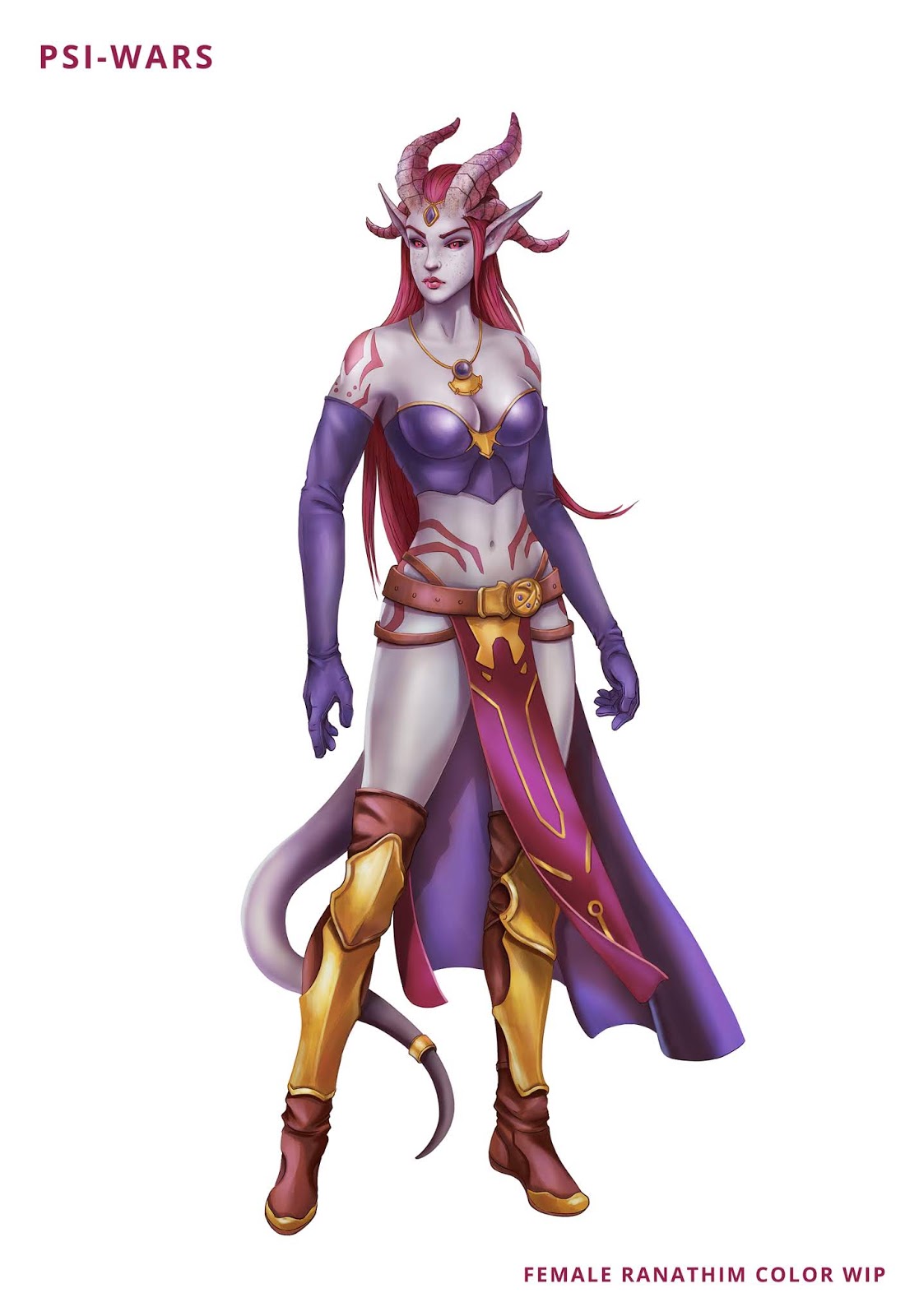
I suspect most readers of Psi-Wars don’t give much thought to the diplomacy of the Umbral Rim, but in a lot of ways, I see it as a dark twin of the Maradonian Alliance.  The Umbral Rim is balkanized between the Empire (which controls, or “controls” the Hydrus Constellation), the Tyranny of Sarai in the Corvus Constellation (a puppet regime of the Empire… maybe), and the various infighting factions and cartels of the Slavers.  Naturally, they would want to swap diplomats with one another and with the Empire.  So, I pondered the sort of diplomats they would send and, naturally, concluded they would send slaves.  The slavery of the Umbral Rim is worth a post on its own, and more closely resembles that of the ancient world than more modern examples of slavery (which is not to say that it’s not got its own sort of horrors).  Thus one can see slave as more of a class of people, a special category that has nothing to do with status, and I though a slave-diplomat would highlight that well: obviously a Slaver wouldn’t represent himself to the Empire, as the Empire would kill him on sight, but a beautiful, scantily clad Ranathim or wise and sagacious Keleni would have much better luck, and their slavery would give them a keen interest in the negotiations going well, lest they displease their master and face a fate worse than slavery, and would create an interesting contrast between the obvious low-power of the slavery and the seeming high power he or she seems to wield.
The Diplomacy from and to the Umbral Rim also highlights that the Diplomat character is an excellent way to inject an outsider into a world.  Sure, if you’re playing a game set in the Glorian Rim, you can play an aristocratic diplomat attending the court of another house, but you can also play as a Ranathim diplomat representing the Temkorathim Worm-Lord of Gor to the Alliance, to play as something truly unexpected.  Similarly, if your game is set in the Umbral Rim and you want to play as a Sabine princess, she can be a diplomat far from home trying to forge an alliance with the Ranathim of Sarai.

The Cybernetic Union

I have a lot of thoughts about the Cybernetic Union, but I’ve not really explored them, and so they also took a lot of thought, and I think they’ll see a revisit once I dive deeper into them.
The Cybernetic Union is truly alien, though it doesn’t have its own unique language (but being filled with robots, Beep Fluency is wise).  It has a cultural familiarity. Like the overwrought, ideological dictatorships that inspired it, knowing the ideology is crucial to survival, thus I’ve added Neo-Rationalism as a philosophy that the Diplomat can explore.  Like with the Shinjurai that spawned them, being a connoisseur of cybernetics or robotics will help a lot.  Where most Diplomats learn psychology, a wise diplomat speaking to the Union will know Computer Programming (AI) as that serves the same purpose.  I’ve also added High Pain Threshold and Urban Survival, in case the AI of the union takes a malicious or experimental interest in the diplomat, or fail to adequately provide for him.
The Union itself likely doesn’t send out many robotic diplomats because people won’t react to them as well as to organic diplomats.  This brings us to the other set of “slave diplomats,” as the organic they would send would, naturally, be a cyborg with some sort of controls planted in him to prevent him from betraying his AI masters.
I think most of my readers are pretty aware of the need for diplomacy to and from the Union, as they fight wars with the Empire and would serve as a natural ally to the Alliance in the sense of “The Enemy of my Enemy is my Friend,” though they would make for strange bedfellows.  Thus, I wanted to at least offer some thoughts on what such diplomacy might look like.

Traders

I didn’t want to hit every alien race in the game, but the Traders (and honestly, the Mug once we work them out in sufficient detail) represent a key race worth having diplomatic ties with. Similarly, as Traders rely on the tender mercies of their host worlds, they would want to have excellent diplomatic ties with everyone around them.
Trader society, being an alien society, works differently and their diplomats would function differently. Instead of having rank within a diplomatic association, they have rank within their Guildfleet, which doubles as status.  Those who want to act as diplomats to the Traders would need a cultural familiarity with them; normal species can’t learn Klik, the language of the Traders, as it’s far too quick for most species to even notice beyond the characteristic “click” sound made by the Traders as they converse with it, often sprinkling entire paragraphs of dialogue with one another in a single sentence to a member of a “slower thinking” species, but I’ve added a perk “Ear for Klik” which acts as one-way fluency but reduces it to “broken” in that you have to make an IQ roll to understand what’s being said, and it limits you to a rough gist (“I think they’re insulting us, but it’s not clear.”), since it would behoove a diplomat to have at least a rough idea of what’s being said behind his back.
We have their culture in pretty good detail.  We know they’re often (but not exclusively) Neo-Rationalist, obsessed with math, and have gambling games like Rikarik and higher dimensional strategy games like Tika, both of which could act as talking points for the diplomat.  Finally, given their space-bound nature, I thought it useful to suggest facility with a Vacc-Suit.
I find Traders often overlooked by my readers. They sort of float over the whole of the setting: people know they are there, but dismiss them as background, which is fine: they and the gaunt are great examples of weird aliens you find smoking hookah pipes in the back of a cantina in a hive of scum and villainy.  But I personally find their ability to be anywhere as one of the glues that hold the setting together.  This makes them a wonderful example of a character one can inject anywhere: a Trader diplomat might show up in a Maradonian court, an Imperial city, attending a Slaver, or begging mercy from the Council of Terminus.  Thus, I had to highlight them in the Diplomat template, as diplomacy is ultimately a key element of their concept.

The Key to Galactic Relations

Not necessarily useful to directly call out in the Template (though maybe I should!), I wanted to touch on some of the typical combinations you might see between various powers in the Psi-Wars Galaxy:
  • The Valorian Empire can reasonably send Diplomats to anyone, but never sends diplomats to itself (why would it?).  It focuses mainly on the Alliance, the Cybernetic Union and the Potentates of the Umbral Rim.
  • The Alliance focuses most of its diplomatic efforts on itself (which sounds weird, but Maradonian nobles send heralds to one another, and senators attend various worlds, forging trade agreements and mutual defense pacts). Externally, they mostly concern themselves with the Empire and the Cybernetic Union.
  • The Shinjurai are a minor player, but often interact with their oppressors, typically the Alliance, the Cybernetic Union or the Empire.
  • The Potentates of the Umbral Rim mostly send diplomats to one another, and focus as much on trade deals as they do political alliances.  The political situation in the Umbral Rim is as murky as the Umbral Rim itself!  They also tend to concern themselves with the Empire, and are one of the few that would make a concentrated effort to deal with Traders, as well as other minor alien races (especially the slave-hungry Sathrans and Mug).
  • The Cybernetic Union mostly focuses its diplomatic attention on the Empire and the Alliance.
  • The Traders send Diplomats everywhere, to whomever will listen.  They tend to have fewer diplomats coming to talk to them, however.

Alliance Space Vehicles – Allegiance-Pattern Carrier

ST/HP: 7000

Hand/SR:5/6

HT: 13

Move:1/50(+8)

LWt.: 340,000

Load:150,000

SM: +13

Occ.:7100ASV

DR:2500*

Range:5jumps

Cost:$225B

Loc.: gGs22t

Stall: 0

Total Chase Roll:+3

*The Allegiance-Pattern Carrier has 2500 Carbide Composite DR on all sides (double DR vs plasma attackes). It also has a force screen with 10,000 ablative, hardened DR.

Notes

Alliance Capital Equipment:

  • Capital-Scale Tactical Ultra-Scanner: 4000-mile scan, 400-mile imaging/bioscan; 360°;
  • Targeting Macroframe: +5 to hit target with a scan-lock.
  • Night Vision Sensors: +9 nightvision, ×8 magnification (up to +3 to aimed attacks, if the vehicle aims for three turns).
  • Large Area Jammer: -4 to target with missiles for all allied ships within 25 miles.
  • Distortion Scrambler: May contest Electronics Ops (Comms) rolls with Electronics Ops (EW); 25 mile range.
  • Large Holographic Radio: 10,000 mile range; “conference” sized holographic projector. All communications encrypted.
  • Very Large FTL Communication Array: 300-parsec range.
  • Hyperdrive: Rating 2; 5 jumps.
  • Fusion Reactor: 50-year lifespan.
  • Security: Simple Electronic Locks and security cameras at regular intervals; complex biometric locks for secured facilities meant for the aristocrat alone; Lifepods.

Alliance Carrier Accommodation and Facilities:

  • Full Life-Support: up to 7500 people
  • Accommodations: 1 aristocratic luxury suite, 100 luxury cabins, 600 full cabins, 6500 bunks, 3 months of stored, refrigerated food.
  • Facilities: 100-person diplomatic establishment; 100-person entertainment establishment; 10-person negotiation office (+1 Diplomacy and Law); 10-person Akashic Shrine (+1 ESP and sensory deprivation chambers); 30-person gym; 1000-bed and 5 operating theater hospital;
  • Cargo: a secured arsenal capable of sufficient gear to arm 4000 men; Additional cargo can carry 5000 tons.
Alliance Cruiser Complement:

  • Shuttles: 5 Prestige-Class (or variant) Shuttles.
  • Fighters: Up to 20 squadrons of 25 fighters (Generally at least 10 squadrons of Valiants and 5 squadrons of Raptors)

AllianceCruiserArmaments

  • 6 Capital Turrets (Total RoF 12);
  • 8 Corvette-scale Light Turrets (Total ROF 24);
  • 8 mounted Plasma Flak Turrets (F/L/R/T);
Weapon

Dmg

Acc

Range

Ewt

RoF

Shots

ST

Bulk

Rcl

Capital-scale cannon

6d×75(5) burn

9

60mi/180mi

500t

1

NA

M

-10

2

Corvette-scale cannon

6d×30(5) burn

9

10mi/30mi

25t

1

NA

M

-10

2

Plasma Flak

6dx10 burn

NA

2000/6000

100t

20

NA

M

-10

1

Look and Feel

Like the Regal-Pattern Heavy Cruiser, the Allegiance-Pattern Carrier exudes a beautiful, art-deco elegance with often gleaming white or silver color and swooping, elegant curves. The main body, like most Alliance capital ships, is taller than it is wide, but has a fairly stubby length and is dominated by the bridge that rises from it. Its weaponry have been divided to bristle from either side: 3 capital-scale turrets, 4 corvette-scale turrets, and 4 plasma flak cannons line either side, just below the observation decks and gleaming windows of the superstructure. Two, long launch decks extend from the main body like two, forward swept wing; these launch decks make up the single largest visible structure of the vehicle and dominate one’s impression of the vehicle.

Those who land on one of the two launch decks, which are large enough for even light corvettes to medium (up to SM +8) corvettes to land on, step out into a well-lit and spacious hangar bay. The flight decks themselves have broad openings into space that are “force locked,” allowing one to view the starry sky through the shimmer of the screens. Travel from the hangar bays and flight decks to the rest of the ship is handled with interior shuttles, resembling clean and cozy subways. These shuttles bring one to the habitation section of the ship. The lower part of the habitation section has numberous cabins and bunks, all fairly well-appointed and attractive, though not as nice or roomy as those found in the Regal-Pattern Heavy Cruiser. A great and spacious hospital, as large as any found planetside, dominates this area, and a special “hospital” shuttle equipped with paramedical gear has a straight shot from the flight decks to this hospital, allowing for emergency care of wounded brought in by shuttle. Blow this, one can find the bowels of the ship and the great and bare infrastructure that runs the ship, where numerous servants and technicians scuttle through the machine-cathedral interior to ensure the operation of the great capital ship.

As one travels higher in the ship, into the super-structure, one finds the “Hotel” of the Allegiance: a great collection of luxury cabins, observation decks protected by transparent diamondoid, and large entertainment establishments that vary from Allegiance to Allegiance: gardens, spas, restaurants and casinos. A great diplomatic hall, ready for dinners and dances, can also be found in this section of the ship. The top of the superstructure has the bridge, and three separate luxury suites, the size of two luxury cabins put together with sufficiently nice interiors to garner a +1 reaction. One typically houses the governing noble, while the other two are supplied to guests of honor. The interior decoration of this luxurious part of the ship has romantic lighting provided by recessed glow-lights, contragravity crystal chandeliers, curving banisters and soft carpeting.

High Admiral Lowellin Cole designed the Allegiance to work with the Valiant and Raptor in an effort to create a new model of warfare for the Galactic Federation. His design has a more spartan feel, similar to the Sword-Pattern Battleship, but the aristocracy made adjustments for their own comfort and prestige. Still, his touches can be found in the lower decks, where the considerable number of soldiers and pilots rest in cabins and the great hospital attends to their needs. The “hotel” resembles that found on the Regal, only larger and more impressive. The combined effect of the two designs creates a powerful warship with two primary roles.

In war, the Allegiance carries the fighters of the Alliance to the enemy. The Allegiance might go straight to the enemy, especially if it carries Valkyries, and spill forth its fighters and strike-craft while it hangs back and relies on its powerful force screens to deflect enemy attack. Alternatively, it can fly to a system close to the enemy, and its hyper-drive capable fighters make the leap to attack the enemy, and then jump back to the carrier, preventing the carrier from suffering direct attack. In a full military confrontation, the Carrier struggles against Dreadnoughts and Battleships in toe-to-toe fights; its corvette cannons and its Raptors provide a decent defense against corvettes but these can overwhelm it. Most carriers have an escort of at least a few cruisers and often a battleship or two.

In peace, the Allegiance acts as a mobile hospital, going to worlds in need and using is capacity for soldiers, doctors and technicians to provide much needed aid and care to those on beleaguered worlds. It also doubles as a diplomatic craft, able to provide an excellent location for diplomatic negotiations (especially for the surrender of a world to its new aristocratic masters), or for the aristocracy to remind the leaders of a world who their true masters are, in the most comfortable and entertaining fashion possible. The Allegiance, thus, often “shows the flag” to other worlds or other aristocrats.

Alliance Space Vehicle – Sword-Pattern Battleship

ST/HP: 7000

Hand/SR:4/6

HT: 13

Move:3/90(+9)

LWt.: 360,000

Load:23,000

SM: +13

Occ.:2000 ASV

DR:5000/2500*

Range:5jumps

Cost:$300B

Loc.: gGs21t

Stall: 0

Total Chase Roll:+5

*The Sword-Pattern Battleship has 5000 Carbide Composite DR on the front, and 2500 DR on all other sides (double DR vs plasma attacks and shaped charge missiles). It also has a force screen with 10,000 ablative, hardened DR.

Notes

Alliance Capital Ship Equipment:

  • Capital-Scale Tactical Ultra-Scanner: 4000-mile scan, 400-mile imaging/bioscan; 360°;
  • Targeting Megacomputer: +5 to hit target with a scan-lock.
  • Night Vision Sensors: +9 nightvision, ×8 magnification (up to +3 to aimed attacks, if the vehicle aims for three turns).
  • Large Area Jammer: -4 to target with missiles for all allied ships within 25 miles.
  • Distortion Scrambler: May contest Electronics Ops (Comms) rolls with Electronics Ops (EW); 25 mile range.
  • Large Holographic Radio: 10,000 mile range; “conference” sized holographic projector. All communications encrypted.
  • Very Large FTL Communication Array: 300-parsec range.
  • Hyperdrive: Rating 2; 5 jumps.
  • Fusion Reactor: 50-year lifespan.
  • Security: Simple Electronic Locks and security cameras at regular intervals; complex biometric locks for secured facilities meant for the aristocrat alone; Lifepods.

Alliance Batleship Accommodation and Facilities:

  • Full Life-Support: up to 2000 people
  • Accommodations: 1 aristocratic luxury cabin, 200 cabins, 1800 bunks. 3 months of stored, refrigerated food.
  • Facilities: 10-person strategy ops (+1 Tactics and Strategy); 10-person Akashic Shrine (Sensory Deprivation Chambers; +1 to ESP rolls); 50-person gym; 50-bed sickbay; 1 operating theater;
  • Cargo: a secured arsenal capable of sufficient gear to arm 250 men; Additional cargo can carry 50 tons.
Alliance Capital ship Complement:

  • Shuttles: 5 Prestige-Class (or variant) Shuttles.

AllianceBattleshipArmaments

  • 3 Super-heavy Turrets (Total RoF 9)
  • 10 Capital Turrets (Total RoF 20);
  • 8 mounted Plasma Flak Turrets;
Weapon

Dmg

Acc

Range

Ewt

RoF

Shots

ST

Bulk

Rcl

Super-heavy cannon

6d×120(5) burn

9

170mi/500mi

5000t

1

NA

M

-10

2

Capital-scale cannon

6d×75(5) burn

9

60mi/180mi

500t

1

NA

M

-10

2

Plasma Flak

6dx10 burn

NA

2000/6000

100t

20

NA

M

-10

1

Look and Feel

The Sword-Pattern Battleship comes from an ancient era of Maradonian warfare. They served with the Lancer-Class Assault Frigates, laying down the fire necessary to keep the enemy occupied while the lancers advanced and conquered the enemy ship. When the fleet won the battle, the Sword would turn its cannons on the planet they orbited, ready to rain fire down upon it if it did not surrender.

The Sword retains its traditional appearance. Like the Regal-Pattern heavy cruiser, the Sword is longer and taller than it is wide, though it has a far less pronounced “bridge” superstructure. The Sword bristles with firepower: a line of three, absolutely massive super-heavy turrets run along the top, and five capital-scale turrets line either side, interspersed with plasma flak cannons. Thick armor guard the vehicle, but especially the front which, like the Lancer, has a great and heavily armored prow that can, if necessary, double as a ram.

Compared to the Allegiance and the Regal, the Sword’s interior more closely resembles the older Lancer. Metal walkways clang underfoot as technicians and soldiers march through quiet carbide cathedrals of machinery. Soldiers and technicians sleep in spartan bunks and attend meals in simple mess halls. The dim glow of floating lights in recessed alcoves provide all the illumination of the ship. The bridge begins to more closely resemble modern capital ships, its harsh metal surfaces taking on familiar, art-deco curves and elegance and hanging “chandeliers” become more common, but even here, where guests can expect to stay in simple, compact cabins rather than bunks, no observation decks or entertainment establishments can be found. Instead, guests find war room, strategic ops centers, and a great Akashic shrine, more reminiscent of the Imperial dreadnoughts, which patterned some of their design elements from the fearsome Sword-Pattern battleships.

The Sword served as the centerpiece of Maradonian fleets for centuries. Today, they struggle to compete with the Allegiance carrier. They have considerable firepower, to be sure, but a squadron of raptors with isomeric torpedoes can do more damage than a single Sword and costs less. It can serve a diplomatic function, but here again, the Allegiance does it better, and the Regal does it more cheaply. The Sword, then, tends to linger in the fleets of nostalgic Houses (especially house Grimshaw), but it does serve a purpose in protecting carriers from Imperial Dreadnoughts, as it’s one of the few ships can can go toe-to-toe with one, shrugging off their hits, and having sufficient speed and maneuverability to outflank them and fire a devastating barrage with its concentrated firepower.

Alliance Space Vehicles – Regal-Pattern Heavy Cruiser

ST/HP: 3500

Hand/SR:1/6

HT: 13

Move:6/110(+10)

LWt.: 40,000

Load:6,000

SM: +12

Occ.:450ASV

DR:2500*

Range:5jumps

Cost:$12B

Loc.: gGs17t

Stall: 0

Total Chase Roll:+9

*The Regal-Pattern Heavy Cruiser has 2500 Carbide Composite DR on all sides (double DR vs plasma attackes). It also has a force screen with 4000 ablative, hardened DR.

Notes

Alliance Capital Ship Equipment:

  • Capital-Scale Tactical Ultra-Scanner: 4000-mile scan, 400-mile imaging/bioscan; 360°;
  • Targeting Macroframe: +5 to hit target with a scan-lock.
  • Night Vision Sensors: +9 nightvision, ×8 magnification (up to +3 to aimed attacks, if the vehicle aims for three turns).
  • Large Area Jammer: -4 to target with missiles for all allied ships within 25 miles.
  • Distortion Scrambler: May contest Electronics Ops (Comms) rolls with Electronics Ops (EW); 25 mile range.
  • Large Holographic Radio: 10,000 mile range; “conference” sized holographic projector. All communications encrypted.
  • Very Large FTL Communication Array: 300-parsec range.
  • Hyperdrive: Rating 2; 5 jumps.
  • Fusion Reactor: 50-year lifespan.
  • Security: Simple Electronic Locks and security cameras at regular intervals; complex biometric locks for secured facilities meant for the aristocrat alone; 125 lifepods.

Alliance Cruiser Accommodation and Facilities:

  • Full Life-Support: up to 450 people
  • Accommodations: 1 aristocratic luxury suite, 60 luxury cabins, 300 full cabins. 3 months of stored, refrigerated food.
  • Facilities: 500-person diplomatic establishment; 500-person entertainment establishment; 5-person negotiation office (+0 Diplomacy and Law); 50-person Akashic Shrine; 30-person gym; 20-bed sickbay; 1 operating theater;
  • Cargo: a secured arsenal capable of sufficient gear to arm 60 men; Additional cargo can carry 250 tons..
Alliance Cruiser Complement:

  • Shuttles: 5 Prestige-Class (or variant) Shuttles.

AllianceCruiserArmaments

  • 3 Capital Turrets (Total RoF 6);
  • 6 Corvette-scale Light Turrets (Total ROF 24);
  • 8 mounted Plasma Flak Turrets (F/L/R/T);
Weapon

Dmg

Acc

Range

Ewt

RoF

Shots

ST

Bulk

Rcl

Capital-scale cannon

6d×75(5) burn

9

60mi/180mi

500t

1

NA

M

-10

2

Corvette-scale cannon

6d×30(5) burn

9

10mi/30mi

25t

1

NA

M

-10

2

Plasma Flak

6dx10 burn

NA

2000/6000

100t

20

NA

M

-10

1

Look and Feel

The Regal-Pattern Heavy Cruiser more closely resembles a cruise liner than a cruiser, were it not for its bristling turrets. In contrast to imperial dreadnoughts, the Regal stands taller than it is wide, surmounted by a rather obvious “bridge” superstructure. The “Bridge” sports observation decks, visible form a distance as rings of illumination where guests can see the stars behind the protection of diamondoid glass. Three great capital-scale turrets cover its “deck,” two before the bridge and one behind it. To either side, a set smaller, corvette-scale turrets and plasma flack interrupt the flowing, elegant lines of the vehicle to remind onlookers of its military intent.

The Regal carries no fighters. It does, however, have a hangar bay which contains up to 5 shuttles (often Prestige-pattern shuttles or their variants). This can be accessed from either side of the relatively narrow vehicle, just beneath the bridge. Generally, one boards a Regal via one of its shuttles. The hangar bay itself is not especially large, and sports a small reception facility. Guests take an elevator up to the bridge itself, which some call “the Hotel.” The bridge contains numerous luxury cabins and fine dining establishments, as well as a large “dance hall” which can double as anything necessary for diplomatic ventures, located near a “law office” where negotiators and diplomats can hash out any specifics necessary. Each Regal has its own “entertainment” establishment, which varies from casinos to restaurants to bath houses to gardens, depending on the preferences of the aristocrat who commissioned the Regal. Regal-Pattern Heavy Cruisers also generally come with an Akashic Temple, equipped with the sensory deprivation chambers and Akashic imagery necessary to facilitate any on-board Akashic Oracle. Some aristocrats repurpose this chamber, but they have come back into fashion since the war broken out. Finally, atop the superstructure sits the bridge itself, an exceptionally spacious affair with great windows and viewscreens, and behind it, the aristrocratic suite, with a great observation deck and a sufficiently sprawling room filled with the finest of luxuries (worth a +1 reaction modifer, in addition to the amenities of a Luxury cabin, with room to easily fit 4, rather than 2, people).

In the decks below “the Hotel,” one can find the main living spaces of the crew, including the substantial service crew, a platoon of Alliance Regulars, and engineering staff. The Regal-Pattern Heavy Cruiser comes with no bunks, only full cabins, and most who journey on one consider it a very plush assignment, with fine mess halls, plenty of food, and access to the entertainment facilities in “the Hotel.” The rest of the ship dwindles into winding corridors, access panels, and the great hum of the machinery that allows the vehicle to function.

Those who board a Regal find its interior striking: in contrast to the utilitarian interiors of Imperial ships, or the more spartan, unclad interiors typical of asteroid miners’ ships, the Regal-Pattern has lushly decorated to fit the tastes of its Lord or Lady. Most ships have art-deco interiors with flowing lines and curving bannisters, while others have more stolid, baroque designs as though one had boarded a cathedral in space, but they almost always feature contragravity lights like floating chandeliers.

The Regal, as a cruiser, serves many roles. For most minor houses, it serves as the flagship of the fleet, representing the largest and most powerful vehicle they can afford. Thus, they use it as a means of communicating their prestige to others. The lengthy endurance of the vehicle allows it to tour a nobleman’s worlds, and its extensive entertainment facilities allows him to invite others on board to partake in his prestige. For many lesser lords, their Regal is their castle. Militarily, its light turrets prove effective against frigates and corvettes, and its larger, capital-scale turrets allows it to take on smaller capital ships, typically of its own size or smaller. This makes them excellent patrol vehicles, and nobles will often take one to a world harassed by pirates, where its size and firepower will quickly dissuade local brigands.

In a fleet, they usually serve either as advanced scouts or as escorts. The Regal is self-sufficient enough to not need support as long as it itself does not encounter a fleet or serious opposition. This allows it to explore and, should it find itself in a bit of trouble, it has more than enough fuel and armor to escape intact. In battle, they serve best as supporting fire for larger vessels, and as a screen against frigates. They tend to suffer against fighters, lacking a fighter escort of their own (though they do have flak cannons!), and they cannot stand up to an imperial dreadnought, which will shrug off their paltry capital-scale cannons and blow them away with super-heavy cannons. They often work closely with carriers, offering support against smaller fire, like torpedo frigates. This makes it a decent “middle-weight” capital ship, but nothing more.

Alliance Space Vehicle – The Lancer-Pattern Heavy Assault Frigate

ST/HP: 700

Hand/SR: +0/5

HT: 12

Move:2/250(+12)

LWt.: 2750

Load: 285

SM: +9

Occ.:90ASV

DR:2500/500*

Range:4jumps

Cost:$2.7B

Loc.: g3rR

Stall: 0

Total Chase Roll:+12

*The Lancer has 2500 Carbide DR on the front and 500 Carbide DR on all other locations. It also has a force screen with 1000 ablative, hardened DR.

Notes

Heavy Alliance Assault Frigate Equipment:

  • Medium Tactical Ultra-Scanner: 30-mile scan, 3-mile imaging/bioscan; 360°;
  • Targeting Computer: +5 to hit target with a scan-lock.
  • Night Vision Sensors: +9 nightvision, ×8 magnification (up to +3 to aimed attacks, if the vehicle aims for three turns).
  • Distortion Jammer: -4 ECM penalty for missiles; +2 to jam missiles.
  • Tactical ESM: +1 to dodge missiles.
  • Large FTL Communication Array: 30-parsec range.
  • Large Holographic Radio: 10,000 mile range (orbital); “palm sized” holographic console.
  • Security and Safety: Complex Locks.
  • Hyperium Reactor: 30 days endurance.

Heavy Alliance Assault Frigate Accommodation and Facilities:

  • Full Life-Support: up to 100 people
  • Accommodations: 1 Luxury Cabin, 4 full cabins, 70 bunks, 1 5-bed sickbay, 1 gym; artificial gravity.
  • Cargo: a single “arsenal” capable of carrying up to 3 tons (enough for 60 soldiers to stow 100 lbs of gear).

The Lancer has a 3-man cockpit with roomy, spacious computerized controls. Generally, this breaks down into the pilot, the co-pilot who can take over the controls and maintains comms and sensors, and a gunner.

The Lancer has a spinal-mounted, capital-scale EM disruptor and two side-mounted, corvette-scale turrets each armed with 3 cannons each (total ROF of 3 each for a grand total of 3). All on-board weapons get their power from onboard energy banks, limiting the amount of shots they have in a battle.

Weapon

Dmg

Acc

Range

Ewt

RoF

Shots

ST

Bulk

Rcl

Disruptor Cannon

6d×75(5) sur

9

60mi/180mi

500t

1

15

M

-10

2

Corvette Cannons

6d×30(5) burn

9

10mi/30mi

25t

1

100

M

-10

2

Look and Feel

The Lancer-Pattern Assault Frigate dates from an ancient era of Alexian Warfare, and their design exudes an antique atmosphere. A gleaming, often baroquely designed ram decorates the prow of the ship, and the head of the ship bulks out behind the prow like a great shield. Behind the prow, the ship extends to the rear, where the engines flare out to give the vehicle its power. Two corvette-scale turrets pivot on the rear half of the vehicle, to either side, and the bridge, well-shielded, nestles atop. A heavy, spinal-mounted EM disruptor cannon runs the entire underside of the vehicle and juts out the bottom of the prow, the Lancer’s “lance.”

A spartan interior greets those who board the vessel. A central, metal walkway runs the length of the ship and clangs underfoot. This reaches all the various bunks along the central shaft of the body, and ladders appear at regular intervals that lead one to the lower-deck, where technicians maintain the EM disruptor and other vital systems. Each bunk room consists of a stacked pair of bunk beds with an extensive locker containing the occupants equipment, generally gear. The rear of the ship has most of the accommodations, including a simple sickbay, a gymnasium and sparring room, and the mess, the command crew’s cabin, and the owning noble’s luxurious cabin. One can climb ladders to reach the “bridge” above, which is as spartan as the rest of the ship. Behind and beneath all of this runs engineering, where technicians scurry to keep the ancestral machinery of the Lancer functioning. In the far front of the vehicle, one enters a great chamber in the hard of the prow, inside the protection of the forward armor. When the ship prepares for boarding, this room seals. Once the ship has rammed the enemy ship, the frontal prow will open as it latches on, and torches will burn through the armor. Once this is finished, the forward “force lock” will drop its screen, and the chamber’s pressure will equalize with the target vessel’s pressure, and the boarders can dismount and attack. Dim lights illuminate the interior with a twilight glow, similar to the conditions of a vehicle in full battle-readiness; this is a conscious choice, to keep the soldiers acclimated to the dark.

The Lancer belongs to an ancient era of warfare, and its like made up the bulk of the fleet of Alexus Rex. They charged at the enemy under the cover of battleship fire and boarded enemy ships. Space Knights led the charge with their heavy armor and force buckler, cutting down nearby opponents with their force sword and clearing a space for the rest of the boarding crew to gain a foothold. Then the rest of the soldiers would flood in and, ideally, take the ship. This allowed Alexus Rex to not only eliminate an enemy ship, but add it to his growing fleet.

Since that Era, the Lancer has seen less and less use. The modern fighter outpaces it and can often destroy a target before the Lancer has even come close to attaching itself to the target ship. They also prove vulnerable to quick strike craft, as their armor can take hits from capital ships, but a fighter can reach their vulnerable rear armor and hit them with a torpedo, assuring their destruction.

Still, it remains a valid tactic to this day: a proper fighter escort can keep it alive, and once it reaches the enemy, a solid boarding party can capture an enemy ship rather handily. A Lancer can carry a full platoon of soldiers and typically carries at least one fully armed and armored space knight. Their presence in the Alliance fleet has forced the Empire to stock its crews with a serious military presence to fend off space knight attacks. They also double as excellent, if bulky, drop-ships, as their heavy armor allows them to shrug off attacks from anything smaller than full orbital artillery, and they can land and disgorge a full platoon of soldiers. Finally, a topic the Alliance finds distasteful to discuss, the Lancer makes an excellent addition to a pirate fleet as their preferred tactics look surprisingly like piracy. No noble would openly acknowledge using them to raid shipping lanes, but quite a few Caliban nobles have grown wealthy during the war and maintain a considerable fleet of Lancers.

Alliance Space Vehicles – Prestige-Pattern Diplomatic Shuttle

ST/HP: 210

Hand/SR: +0/4

HT: 13

Move:2/200(+12)

LWt.: 74

Load: 29

SM: +7

Occ.:2+2ASV + 12SV

DR:200*

Range:2jumps

Cost:$35M

Loc.: G3rR

Stall: 0

Total Chase Roll:+12

*The Prestige has 200 diamondoid DR on all sides; halve DR against crushing damage. It also has a force screen with 300 ablative, hardened DR.

Notes

Alliance Defensive Shuttle Electronics:

  • Medium Tactical Ultra-Scanner: 30-mile scan, 3-mile imaging/bioscan; 360°;
  • Night Vision Sensors: +9 nightvision, ×8 magnification (up to +3 to aimed attacks, if the vehicle aims for three turns).
  • Distortion Jammer: -4 ECM penalty for missiles; +2 to jam missiles.
  • Tactical ESM: +1 to dodge missiles.
  • Large FTL Communication Array: 30-parsec range.
  • Large Holographic Radio: 10,000 mile range (orbital); “palm sized” holographic console.
  • Security and Safety: Complex Biometric Locks.
  • Hyperium Reactor: 7 days endurance.
  • Hyperdrive: Rating 2, Range 2.

Light Alliance Battle-Yacht Accommodation and Facilities:

  • Full Life-Support: up to 17 people
  • Accommodations: 1 Luxury Cabin, 10 seats, 1 Sickbay
  • Cargo: a single “arsenal” capable of carrying up to 100 lbs of equipment; a second cargo compartment large enough for two people or a half ton of material that is hidden (requires a Search roll to find), Shielded (-6 to scans) and climate-controlled.
  • Vehicle Bay: Contains a single Santuary-Pattern Emergency Response Vehicle.

The Prestige has room for two pilots in the front cabin, and an installation for a robot to install himself to act as the Hyperdrive navigational system.

The Prestige appearsunarmed, but has a pop-turret with a light, anti-personnel cannon protected by a Distortion Mesh (-6 to scans).

Weapon

Dmg

Acc

Range

Ewt

RoF

Shots

ST

Bulk

Rcl

Anti-personnel Blaster Cannon

10d(5) burn

9

600/
1800

45

3

540/Fp

16M

-10

2

Look and Feel

The Prestige’s magnificent, sculpted diamondoid body rarely fails to impress. It looks luxurious. The shuttle is roughly the size of a private jet, but is far wider than it is tall or long, with a “delta” shape. One can enter via a ramp in the bank, which leads to a plush, inviting interior with carpeting, wood paneling and crystal lighting. Ten comfortable seats, which can recline and have assorted gadgets and entertainment items in the oversized arms, sit six to a side. On either side of the passenger cabin, one can find small kitchenettes, usually tended to by one or two stewards, who often accompany the Prestige on its flights. In the lane between the two sides of seats, the carpeting can be stripped back and reveal a compartment large enough for two people to fit, if rather tightly.

Two spiral staircases rise around the rear entrance and lead to a luxurious cabin which usually house the diplomat or a guest of honor, which has extensive diamandoid windows (which can be closed and shielded), charming décor, a bed large enough to comfortably fit two, and a closet capable of holding 100 lbs of combat gear.

The front of the craft has a wide pilot section for both pilot and copilot and a slot for a robot. This can be reached through the passenger cabin via a single door that can be biometrically locked. The far side of the control room has two small doors that lead to access spaces that reach the engines and fuel tanks where the pilots can engage in temporary repairs if necessary. A hatch in the floor of the control room leads directly to the Sanctuary-pattern Emergency Response Vehicle, which occupies a very tight vehicle bay that runs beneath the passenger compartment.

The Prestige is in principle a diplomatic shuttle. The Alliance has numerous patterns for such shuttles, the most notable being the Palanquin-Pattern diplomatic shuttle, which looks remarkablylike the Prestige, but with lighter armor (DR 150), and no pop-turret or smuggling hidey-holes. The Prestige is, however, far more common, and the rest of the Alliance gives a wink and a nod anytime a Prestige shows up marked as a Palanquin on its registry. Noting the difference with scanners requires roll to Electronics Operation (Sensors) -6, Engineering (Spaceships) -6 or Common Sense.

Every Alliance capital ship has several diplomatic shuttles. Their primary purpose is to bring a noble and his party to whatever planet they currently orbit, or to bring dignitaries from the planet to the capital ship, all in elegant style. The armaments, defenses and smuggling cubbies are for the harsh realities of the world and “diplomatic necessities.” Diplomats are no fools!

The Prestige also doubles as a troop transport. Its seating allows it to carry a full squad of 10 Alliance Regulars, and the surprisingly well armed, well-defended Sanctuary. In principle, a Prestige can respond to a distress call, land nearby, send out its Sanctuary to retrieve the wounded and bring them back to the Prestige for healing and stabilizing, and then bring them back to their capital ship. They can also be used as dropships, but their weak armaments and poor deployment time, not to mention their expense, makes them more of a desperate substitute for this purpose.

Finally, the Prestige can double as a personal ship. It has enough fuel to flit around the Galaxy in short hops. The intent of this design is that, in an emergency, a Prestige can flee. Alternatively, the Prestige can flit between two worlds for negotiation. Some poor nobles use it as their main transport and lie about having a capital ship in orbit.

Alliance Space Vehicle – the Ronin-Pattern Battle-Yacht

ST/HP: 150

Hand/SR: +2/4

HT: 12

Move:5/300(+13)

LWt.: 27.5

Load: 5.2

SM: +7

Occ.:4ASV

DR:200*

Range:5 jumps

Cost:$55M

Loc.: g3rR

Stall: 0

Total Chase Roll:+15

*The Ronin has 200 diamondoid DR on all sides; halve DR against crushing damage. It also has a force screen with 500 ablative, hardened DR.

Notes

Heavy Alliance Battle-YachtElectronics:

  • Medium Tactical Ultra-Scanner: 30-mile scan, 3-mile imaging/bioscan; 360°;
  • Targeting Computer: +5 to hit target with a scan-lock.
  • Night Vision Sensors: +9 nightvision, ×8 magnification (up to +3 to aimed attacks, if the vehicle aims for three turns).
  • Distortion Jammer: -4 ECM penalty for missiles; +2 to jam missiles.
  • Tactical ESM: +1 to dodge missiles.
  • Large FTL Communication Array: 30-parsec range.
  • Large Holographic Radio: 10,000 mile range (orbital); “palm sized” holographic console.
  • Security and Safety: Complex Biometric Locks. Crashweb
  • Hyperium Reactor: 30 days endurance.

Light Alliance Battle-Yacht Accommodation and Facilities:

  • Full Life-Support: up to 6 people
  • Accommodations: 1 Cabin, 2 bunks. Sufficient storage for up to 5 months of food (though usually far less). The Ronin has artificial gravity.
  • Cargo: a single “arsenal” capable of carrying up to 100 lbs of equipment; a second cargo compartment large enough for two people or 1000 lbs of gear that is hidden (requires a Search roll to find), Shielded (-6 to scans) and climate-controlled.
  • Vehicle Bay: Contains a single Charger-Pattern hovercycle.

The Ronin has room for a pilot and a co-pilot, as well as a space in the cockpit for a single robot to act as a hyperspatial navigator. All controls are computerized, and thus any crewman can take over any position; in practice, a single pilot flies and controls the craft at all times, but often a co-pilot, if present, handles communications and hyperdrive navigation

Heavily armed, the Ronin has 4 fixed, forward mounted fighter cannons (total ROF of 12) and a fixed, forward mounted missile bay with four 160mm missiles (these can be either Plasma Burst or Plasma Lance)

Weapon

Dmg

Acc

Range

Ewt

RoF

Shots

ST

Bulk

Rcl

Fighter Cannon

6d×5(5) burn

9

2700/
8000

1000

3

200/Fp

75M

-10

2

160 mm Plasma Burst Missile

6dx15 burn ex

4

1000/30mi

200

1

4i

M

-15

1

160 mm Plasma Lance Missile

6dx30 (10) burn ex

4

1000/30mi

200

1

4i

M

-15

1

Look and Feel

The Ronin-Pattern Battle-Yach looks like a gleaming, sculputed, diamondoid-sheathed arrowhead 30 feet long, 20 feet at its widest point and tall enough that one can walk its fuselage without trouble. The central fuselage is the tallest point, with the edges of the craft tapering to thin, winglike structures. When idle, the vehicle rests on three skids and the vehicle can be entered or exited via a ramp. Though snug, the insides of the vehicle allow the character to move fairly freely. The rear of the fuselage has the hyperdrive, engine components, hyperium reactor and fuel tanks, and these spaces can get quite tight, requiring careful maneuvering and benefits from repair and maintenance in a hangar bar, rather than in flight. Ahead of this are the accommodations, which amount to a single cabin technically large enough for two but, unless they’re a couple, typically houses one person, with a kitchenette, and a hallway that has access to some closet/bunks, an “arsenal” cargo closet where weaponry can be stored, and, in some vehicles, a carefully hidden, shielded and climate controlled set of cargo hideaways large enough for one ton of gear, or two stowaways. From here, the character can climb down a ladder to the vehicle bay, which will launch the Charger-pattern hovercycle from the bottom/forward portion of the Ronin, or to the control room. The controls of the vehicle are spacious, easily accessible cockpits, with the secondary controls behind and slightly above the main pilot controls. Both look out through a bubble canopy that has projected control metrics. Its contragravity lift system allows it to lift straight up, turn on a dime, and fly directly, powered by the blue glow of its ion drives.

The Ronin-Pattern Battle-Yacht is a military vehicle only in a technical sense and is the sort of vehicle that only Alliance culture could create. For the typical Alliance aristocrat, the ability to travel space is fundamental to his roleas a member of the pan-galactic elite, but few have the wealth necessary to purchase major warships, and a dedicated fighting craft, like a Valiant or a Raptor, do not appeal to a would-be adventurer. The result if the strange hybrid corvette-fighter like the Ronin. It has sufficient agility and firepower to keep up with fighters, while having far more armor. It can also double as a tramp freighter or a smuggling ship in a pinch, and quite a poor nobleswith a Ronin use it as a merchant escort. The Ronin is not the most common ship in the galaxy, but one can often find it in some remote starport far from the Glorian Rim, which signals the presence of some minor nobility or, perhaps, a questing space knight. They also see use in wartime, often as the result of “call to arms,” where an aristocrat will call to him all the nobles he knows, and they will show up in their trusty, though slightly unwieldy, Ronin battle-yachts to help out.

The Ronin is one of several “battle-yacht” designs which resemble one another, including the Gallant- and the Errant- patterns. Only the Ronin carries she shielded cargo spaces.