House Sabine, part 1

When I first knew I wanted to create noble houses, I immediately had two in mind. The first drew inspiration from Mon Mothma and Princess Leia, and represented the aristocracy of Psi-Wars as portrayed in Star Wars: elegant, egalitarian and full of noblesse oblige, but not contributing as directly to the effort as much as commanding.  If we had to have a house to root for, I wanted it to be this one.
The rest fell into place as I worked out the Oracular Order’s role in the creation of the Houses.  If the Oracular Order were the Bene Gesserit, then this was House Atreides.  When I dug around in Bio-Tech for suggestions, I stumbled across altered sex ratios (technically a radical species modification, but meh, this is space opera) and fecundity, which made them a house associated with twins and who hovers protectively over their few male members. This also made them a great house for the “Damsel in distress” that a hero needs to rescue, though naturally some would have the wherewithal to rescue themselves.  I don’t like to make a one-note house, though, so their “bene geserit-ness” gives them a manipulative, witchy vibe, at least to me.  Given that, traditionally, men fit poorly into either the “witch” or “princess” niche, that makes the rare male members an interesting puzzle to fit into the house.

Their name came from the Italian Sabine tribe, from whom the Romans acquired their first brides; House Sabine consists of the first brides of the Alexian Emperor, and were bred to be the brides of the other noble houses.

The Cadet Branch “Pavonis” is a reference to a character created by Elliot Belser, for his own Psi-Wars game.

The House Sabine

Cadet Branches: Pavonis, Starlane

Only House Alexus is older and more royal than House Sabine. House Sabine ruled Persephone, the homeworld of the Oracular Order, and believed most strongly in its goals. They bowed to the Oracular Order’s desire to forge them into the consorts of the House of Alexus, the breeding stock of aristocracy, and the source of oracles to serve and sustain the Oracular Order. Because their seat of power, Persephone, is situated in the Maradonian arm of the Galaxy, they survived the rise of the Empire largely intact, and remain one of the most powerful houses in the Alliance and because of their close connections to both the Oracular Order and the House of Alexus, they remain exceptionally well respected and pure.

House Sabine has a unique genetic legacy that means they’re more likely than most to produce twins (especially fraternal twins, a brother and sister), and they’re more likely to produce female children than male children. When a Sabine bride marries a non-Sabine, the girls she give birth to tend to remain true to the Sabine legacy, while the boys she gives birth to tend to remain true to the father’s legacy. Nonetheless, they tend to be exceptionally pure in bloodline and, even if they are not, those who belong to the Sabine bloodline tend not to diminish the purity of the children they breed, which means they are almost always excellent spouses to members of other houses.

Because of the shortage of male Sabines, the house is traditionally ruled by a Duchess, and the eldest child, regardless of sex, inherits her parent’s titles. House Sabine tends to be protective of its male members, and thus what knights it produces are as likely to be female as male, though male Sabines tend to chafe under the “mothering” they receive from the House, and those Sabine men who escape the motherly bonds of the House tend to go on to prove themselves great warriors and leaders, provided they don’t self destruct.

House Sabine members tend to be breathtakingly beautiful, even by noble standards, and those who find aristocratic features to be particularly attractive find them amongst the most beautiful men and women the galaxy has to offer. They often have white or silver hair. They move with grace and pick out (and obsess on) fine details. Some of their members tend to be blind (though they often compensate this with “sight beyond sight”) and visions of what could be often haunt them. Other side effects of their strict breeding include excessive emotional or physical sensitivity, a tendency to greatly prefer the company of people they know, and dangerously suicidal tendencies, especially among male Sabines, a trait other houses sometimes mistake for bravery.

Sabine Titles

House Sabine, thanks to its close connections to House Alexus, is a royal house. They have the Duchy of Persephone, the homeworld of the Oracular Order, and they traditionally receive the titles of Imperial Consort, Defender of the Faith, and the sons and daughters of the leader of the house (or its cadet branches) receive the title “Prince” or “Princess.”

They have numerous lesser titles, but tend to have non-martial titles: countess, viscountess and lady. Sabine women often serve as maids-in-waiting in other houses, especially if they have learned to detect psionic activity, where they serve to watch for any untoward psionic actions against their master.

Notable members of House Sabine

The Duchess Nova Sabine rules the House, and serves as the Speaker in the Senate. She is a strong force for resisting the empire, and for populism. She believes that the aristocracy’s days have largely passed, and that the Alliance needs to allow more rights and privileges to the people. She also believes that the people will rise up against the Empire, that the great sin of the Empire was not the dissolution of aristocratic privilege, but its oppression of its people. She believes that the Alliance’s duty is to assist those who want to be lifted up, to help them gain independence and then to invite them to join the Alliance of their own free will. She believes that more forceful tactics will alienate any potential allies and create more suffering in the universe.

The first Duchess, Sissi Sabine, served as the Imperial Consort and the first Alexian Empress. She married Alexus himself, and all members of house Alexus have some measure of her blood running in their veins. According to lore, she was breathtakingly beautiful and a virtuous devotee of the Oracular Order, while her enemies argue she was a cunning manipulator who used her position to advance the needs of her house, and her poison to remove her enemies. Both agree that she was amongst the most powerful oracles the House has ever produced.

House Sabine gave birth to the Federation through the twins Vance and Valria Sabine. Through Valria’s efforts, the warring houses set aside their weapons and joined together to create the Senate and the Federation. Her brother served as her knight and her protector and died defending her from an assassination attempt. The house still carries on his martial legacy, though his force sword was lost when the Empire rose to power.

Sabine Eugenic Legacy

Sabine Eugenic Power-Up 50 points

Advantages: Sabine Bloodline [1]; Spend up to 49 points on Classic Appearance (Aristocratic) [1], Sanitized Metabolism [1] or on the following packages:

  • Sabine Purity [18]
  • Sabine Grace [16]
  • Sabine Sensitivity [13]
  • Sabine Fertility [1]

Disadvantages: Replace any of your template disadvantages with the following disadvantages (If you have Bloodline Purity 2 or higher, you may choose an additional -5 points worth of the following disadvantages, increasing your disadvantage limit by -5 points!): Bad Sight (Mitigator, Lenses -60%) [-10], Blindness [-50], Distinctive Feature (White hair), Low Pain Threshold [-10], Mental Instability [Varies], Odious Personal Habit (Finnicky) [-5], Selfless [-5*], Shyness (Mild or Severe) [-5 or -10]

Sabine Purity 18 points

Advantages: Appearance (Beautiful) [12], Bloodline Purity 1 [1], Resistant to Poison +3 [5]

Sabine Grace 16

Attributes: DX +1 [20],

Secondary Characteristics: Basic Speed -0.25 [-5]

Advantages: Bloodline Purity 1 [1]

Sabine Sensitivity 13 points

Secondary Characteristics: Perception +2 [10]

Advantages: Acute Touch +1 [2], Bloodline Purity 1 [1],

Features: Per may be increased to 22 [0]

Sabine Fertility 1 point

Advantages: Bloodline Purity 1 [1]

Features: Altered Sex Ratio (2:1 females to males) [0], Extended Fertility [0], Increased Fecundity [0]

Sabine Mental Instability

The most common mental instabilities for House Sabine are Chronic Depression [-15*], Jealousy [-10] and On the Edge [-15*].

Sabine Psionic Legacy

House Sabine has latent ESP Abilities. If the character has the Sabine Bloodline perk and the requisite Bloodline Purity levels, she may take the following abilities and talents whenever she wishes:

  • Bloodline Purity 0: 20/20 Hindsight (Pyramid #3-69 p6) [1]; Combat Sense (PP 37) [24/level]; Dream Ally (Twin; Pyramid #3-69 p6) [1]; Exposition Sense (PP 42) [1]; Haunting Death (Pyramid #3-69 p6) [1]; I Feel Them Watching Me (Pyramid #3-69 p7) [1], Psi Sense (PP41) [8 to 32]; Visions (Dream, Second Sight, Aspected (Death), Overwhelming; PP 39) [5 to 15].
  • Blood Purity 1: Awareness (PP 39) [9 + 2/level]; Psidar (PP 41) [9 to 29].
  • Blood Purity 3: Prognostication(PP 37) [18 to 78]
  • Blood Purity 4: ESP Talent +1 to +4 [5/level]

Sample Sabine Psionic Power Packages

Sabine Battle Trance 25 points

Prerequisite: Sabine Bloodline

The space knights of House Sabine tend to master their battle trance, in which they know what will happen in a battle before it occurs. Roll once per turn when you are attacked (even a surprise attack!). Success lets you make an active defense against the attack with a +1 bonus; margin of success determines how many active defense rolls gain that +1 bonus this turn.

Advantages: Combat Sense 1 [24]

Skills: Combat Sense (H) IQ-2 [1];

Sabine Psi-Sense 25 points

Prerequisite: Sabine Bloodline

Advantages: Psi Sense 3 [22]

Skills: Psi Sense (H) Per-2 [1];

Techniques: Exclusion (H) Psi-Sense-1 [2]

Sabine Blindsight 25 points

Prerequisite: Sabine Bloodline, Bloodline Purity 1

House Sabine can “see without seeing.” Those with sufficient blood purity learn to see without their eyes, gaining psychic awareness of a 120° degree in front of them to a range of 20 yards.

Advantages: Awareness 5 [17]

Skills: Awareness (H) Per-1 [2]

Techniques: Choose either Deep Scan (H) Awareness-2 [4] or Extended Arc (H) Awareness-5 [4]

Sabine Aura Reading 25 points

Prerequisite: Sabine Bloodline, Bloodline Purity 1

House Sabine can “see” psionic abilities as an aura. With a successful psi-dar roll, they can “see” the nearest psionic ability, and may make a second skill roll to determine what power the psi has.

Advantages: Psidar 3 [19]

Skills: Psidar (H) Per [4]

Techniques: Extend Range (H) Psidar-4 [2]

Sabine Oracular Gift 25 points

Prerequisite: Sabine Bloodline, Bloodline Purity 1

The purest of House Sabine have the oracular gift, which allowed the Oracular Order to harvest their numbers to fill out their ranks. This ability allows the Sabine to meditate for 10 minutes and then spend 1 fatigue to make a skill roll to see the future.

Advantages: Prognostication 2 [23]

Skills: Prognostication (H) IQ-1 [2]

Patreon Post: Kung Fu Double Trouble

Hello my dear Patrons!  I have not one, but two posts for you!  When I worked on the knightly martial arts, I quickly realized that I had two problems.  First, I found it hard to justify taking more than one style given the problems GURPS Martial Arts has.  This resulted in a deep meditation on why it’s a problem and how to fix it (and a discussion of that on Discord spawned yet more thoughts on it from Douglas Cole, who offers a further take that might work for Psi-Wars as well, but it would need further study).  I also wanted to look very closely at each style, and make sure they each had a very distinct character and were useful for you even if you didn’t use a proposed fix.  This resulted in the first document, which is Martial Arts Notes 1 – Reflections.  This is available to all $1+ Patrons, so please, check it out!

I also realized I needed kung fu secrets.  What’s the point of being a master force swordsman if there’s no man on the mountain to go talk to?  No ancient kung fu manuscripts to fight over?  The only problem I have with aristocratic martial arts secrets is that the aristocracy are kind of chumps.  They don’t have to be, but many of them should be.  Some of them should be irritating ponces that you want to punch in the face, and I find them knowing ancient secrets to be a little too much.  But what about useless techniques, or techniques the exist primarily for show?  This resulted in Martial Arts Notes 2 – Secrets, which discusses a variety of expansions for the aristocratic styles, some much more useful than others.  As a preview, this is available to all $3+ Patrons, a gift to my Fellow Travelers.  I think it needs a little more work, so I’d appreciate feedback.

As usual, if you’re a patron, thank you.  If you’re not, I’d love to have you.

Support me on Patreon!

Aristocratic Culture

This is a bit of a last-minute addition.  When I wrote the Alliance, I finished it up and released it to my Patrons and then put all the posts up in advance.  Then, as my patrons read it, I got some feedback and one of the things I realized was that I lacked aristocratic culture.  What to aristocrats do with their spare time? How does one woo an aristocratic girl?  What offends and what does obligation demand you do? I’ve touched on some of these already, but I wanted to expand on those elements.

What I have turns out to be quite a bit of material, perhaps too much material.  I’d love your feedback on what you found useful and what you didn’t.  In the meantime, though, enjoy, and I hope this gives you a better vision of how the Alliance feels, at least from the perspective of an aristocrat.
After all, what’s the point of playing a space aristocrat if you can’t go to a space gala, get your space knickers in a twist because someone said something mean about one of your ancestors, then lose the girl you were trying to woo to some space jock, and then challenge him to a duel and accidentally kill him, right?

Aristocratic Culture and Character Concerns

Aristocratic Character Concerns

Legal Immunity (Alliance Aristocrat) 2 points

This advantage is the equivalent to the 10 point version of Legal Immunity (B65), but has 1/5 the cost due to being only pertinent within Alliance space. Characters with it, while in Alliance Space, are subject to one less level of Control Rating and, if accused of a crime, may demand to be tried by other aristocrats (who tend to be more sympathetic to other aristocrats). However, the character may be charged for failing to live up to his or her aristocratic obligations, including the obligation to defend his domain, the obligation to respect the titles of others, the obligation to honor duels, and the obligation to marry in such a way as to maintain the bloodline of his house.

Social Stigma (Disowned) -1 or -2 points

This is identical to Social Stigma (Disowned) [-5 or -10] but has 1/5 the cost, reflecting the fact that only fellow Alliance Aristocrats care whether or not you have been disowned. Characters with the -10 version of Social Stigma (Disowned) may not have any titles or ascribed status associated with his former house. Such exile is sometimes imposed as a punishment for a grievous crime where death is considered too extreme a punishment, or a horrible embarrassment. By disowning a member of the House, the House no longer recognizes that person and publicly repudiates their deeds.

Aristocratic Culture

Aristocratic Savoir-Faire

Knowing the general outlines of Aristorcratic Savoir-Faire merely requires Cultural Familiarity (Galactic Federation) and either 1 point of Savoir-Faire, or a Savoir-Faire roll at default. Knowing the particulars of course, is what Savoir-Faire rolls are all about!

Aristocratic Savoir-Faire turns primarily on honoring the rights and obligations of the aristocracy. Each right and obligation has customary acknowledgements associated with them. Violating Savoir-Faire is not the same as violating the law, but does carry a negative consequence with it. Characters who flout the rules of savoir-faire will certainly earn a negative reaction modifiers, and those who routinely flout the rules of polite society may find that they quickly earn a negative reputation with the aristocracy,

Right and Duty of Recognition

All nobles should be recognized by their titles. Only friends, in private conversation, may refer to one another by first name. In public and especially during formal events, the aristocracy expects others to refer to them by their titles. Generally, one only uses the full set of all of a noble’s titles when announcing the arrival of said noble (“Announcing his Highness Bale Grimshaw, Duke of Denjuku, Lord of the Shinjurai, Lord of the Grimshaw, Guardian of the Mysteries), otherwise, the basic form of address is sufficient (“Your highness.”).

The aristocracy order themselves by status. The last to arrive, the first to sit, the first to eat, the right to interrupt others (and to not be interrupted) depend on one’s status. Technically, only ascribed status matters, but in practice imputed status matters too. A wealthy and politically powerful commoner (say, an Imperial admiral who accompanies an ambassador during peace negotiations) might technically not have precedent over a mere knight, but in practice the aristocracy doesn’t want to offend a powerful potential ally. Reputation and social veneration matters to: the aristocracy might overlook the temerity of a mere knight speaking over a duchess if he just returned from a the front lines after winning a great victory.

Any character who wishes to act “out of turn” or attempt to interrupt someone, one-up someone, insult someone or otherwise assert social dominance over another may roll a quick contest of Savoir-Faire against his target, to see how well navigates the complex social situation. Add all forms of Status and any additional reaction modifiers the GM deems appropriate (typically appropriate forms of Reputation) to your savoir-faire roll. In strict circumstances (such as a highly formal ceremony), only add ascribed status. Alliance Aristocrats with Social Stigma (Disowned) for [-10] automatically lose all such contests. The character who wins may override or humiliate the other and suffers no general social backlash (people might be shocked or scandalized, but it seems appropriate given their stations and decorum); the loser must accept, or face general embarrassment (their defiance seems inappropriate, petty or out of place).

Right and Duty of Dominion

A noble must have an invitation to enter the domain of another noble, or he must ask permission (preferably in advanced, but allowances can be made for an emergency). The closer one gets to the person of a noble, the more urgently permission is needed. To slip across the border of a duchess’s territory and back without permission is worth an eye-roll, while touching a noble without permission may result in immediately drawn arms! “Permission” is this context can be anything from a formal invitation to a verbal summons to a physical beckoning t a flirtatious wink. If circumstances are uncertain, roll Savoir-Faire (with different in status as a modifier: a duke grabbing a knight without permission might be overlooked, but the opposite situation would almost never be).

When first entering the presence of a noble, especially in formal circumstances, the guest must be announced by another (one of the host’s servants, or a servant of his own, or the Master of Ceremonies in especially prestigious events), whereupon the host will acknowledge the guest, and invite them to enter. In informal circumstances, of course, this sort of thing is waived (a lover does not fill out paperwork in triplicate to slip into his mistresses bedroom and wake her with a kiss)..

Right and Duty of War

Martial nobles must be allowed to carry their arms and armor wherever they go. However, wearing full armor and a force sword in all circumstances tends to make people nervous. Unless wearing armor for ceremonial purposes, most nobles will wear only a single piece of diamondoid jewelry (which another noble might comment upon, if he wishes to praise the martial virtue of the other). Nobles typically voluntarily surrender their force sword to their host when visiting, and the host places it on a prominent display so that others may see it. As such, most nobles have elegant, attractive and distinctive force swords so that theirs can be easily picked out. The host must ensure the security of the force swords under her care, and any force swords missing at the end of the event are a black mark on her name! Nobles may keep their force sword with them; that is their right. But doing so sends a clear message to the host of mistrust, hostility or the belief that they cannot adequately protect the guest.

Right and Duty of Grace

The aristocracy must dress the part for any occasion. Showing up at a grand gala in dirty coveralls is a grave insult to the host, and a disgrace to oneself. Overdressing, though, means that one does not know their station. The aristocracy should wear no more ostentatious or fashionable an outfit than their station allows, nor should they be better dressed than their superiors. If two characters have conflicting outfits (“She’s wearing my dress!”), then seek social precedent as per the Right of Recognition. This only matters if someone wishes to assert their superiority in this matter.

Generally, outfits matter the most during an introduction. Aristocracy will often wear multi-piece outfits, and wear the full outfit for their entrance, and then slip away for a few moments to remove some of the less practical elements (for example, a knight who arrives in full armor, and then removes his helmet, in the very least, or even strips out of his armor and wears something more comfortable). This has limits though: the noble still needs to look their part.

Right and Duty of Satisfaction

An aristocrat may only reasonably challenge another noble to a duel if his rights have been besmirched. A violation of savoir-faire counts, though most people will care about the severity of the offense: challenging someone to a duel because his ship’s path technically crossed your terrain while in hyperspace and he didn’t say hello first would be a hard sell.

Treat a challenge to a duel as a Savoir-Faire roll. Apply a penalty or bonus based on the severity of the offense (most reasonable offenses, such as an insult against your person, or simply barging in without permission, are +0; clear and obvious violations, such as killing another member of your family, is up to +4. Sketchy and made-up violations generally go as low as -4; most nobles will accept even the flimsiest of reasons, provided the challenge is sufficiently polite). Add a bonus for innovative or florid public challenges. Generally, the challenger announces the crimes for which he is challenging the other; the other either accepts the charges and agrees to the challengers terms (which might be arbitrated by an aristrocratic court), or he defies the challenger, in which case the fight is on!

Right and Duty of Legacy

A noble must marry! A woman is expected to marry before she is 30 (The technology of Psi-Wars is sufficient to extend a woman’s fertility almost indefinitely, plus it can engage in artificial insemination or even cloning and the use of artificial wombs, but a woman who needs such things admits that she is an unfit mother). Failing to do so suggests that something is fundamentally with her, and she might get a negative reputation. Men who fail to marry by 50 has a similar problem.

Courtly romance is formal. The man seeks the permission of the family to “court” the woman (typically the father, but what matters is the master of the family, which may be female or, in the case of particularly young nobility, in the hands of a regent). Courtship consists of appearing at at least three formal events, publicly, as a couple and should generally take a year, long enough for people to gossip about it and get used to the idea of the new couple. Engagement involves an exchange of gifts, typically some piece of jewelry given to the woman, at least, to denote her intent to remain chaste and to be with no man other than her husband to be. The engagement also typically lasts a year, during which time everyone has sufficient time to ready for the wedding.

Most of this is mere formality, but it also provides plenty of time for jilted lovers to challenge (the aristocracy considers a broken heart ample reason to challenge, even calling it a violation of the right of legacy, but one typically challenges a member of the same gender: if a woman leaves a man for another man, then the first man challenges the second man; if a man leaves his wife for a mistress, then the wife challenges the mistress, not the man), and it allows time for people to ensure that genetic lineage, as well as social prestige, is a worthy match. Marrying below your station can cause for quite some scandal. A duke who marries a commoner won’t lose his status, but he’ll have a sufficiently low reputation that he may find exerting his full station increasingly difficult.

Aristocratic Ceremonies and Events

The aristocracy revel in festivals, party and ceremonies. They emphasize their prestige and importance, of course, but also allow them to mingle and interact. Event planning is overseen by a host and often a second, a junior aristocrat who acts as the lieutenant for the host. For formal ceremonies (especially honors and funerals), the actual events are conducted by the Master of Ceremonies, who often has high levels of skills necessary to perform the event. If the GM decides to require a roll to see if a ceremony goes without a hitch, roll against an appropriate skill with a penalty equal to the Status of the most prestigious character in attendance.

Aristocratic Celebrations

When the Alliance Senate is not in session, the “social season” begins, during which one may politely hold any sort of celebration. The most commonly celebrated events are the debut, where a young aristocrat is introduced into aristocratic society (generally on their 16th birthday for women, and on their 18th birthday for men), the wedding, and the birthday, but the aristocracy finds all kinds of reasons to celebrate.

A typical celebration begins with introductions. At the appointed hour, invited guests begin to arrive in reverse order of importance: the least important arrive the earliest and the most important arrive last. After their introductions, guests are invited into a parlor, sitting room or an event space and given refreshment and allowed to mingle.

Once the last, and most important, guest has arrived, typically the guests being celebrated (such as the bride and groom at a wedding, then the main event can commence, always conducted by the Master of Ceremonies. At a debut, or birthday the youth is publicly announced, a few speeches given, and then the youth may mingle; at a wedding, the couple exchange vows before witnesses. The ceremonial events typically last less than 15 minutes, after which anyone who wishes to give gifts to those being celebrated may do so, often accompanied with a speech. To perform a debut or a birthday without a hitch, roll Savoir-Faire. To perform a wedding, roll Religious Ritual.

After the events, the celebration moves on to dinner, where guests are seated at a grand table, or at tables sorted by importance and house, if the event is large enough, and the host offers an extravagant and creative feast. In particularly long parties, the host usually arranges for entertainment for after dinner, such a a show or a dance.

After the feast, mingling might resume and guests may reasonably excuse themselves. When the host announces that she is going to retire, that signals to everyone that the event is finished. Everyone should offer farewell to the host and depart soon (unless they’ve made arrangements to stay), unless the host passes hosting responsibilities to the second, typically by kissing their brow or informing the second explicitly that she is retiring for the night. Thereupon the second might announce an after-party, at which point the second becomes the new host for a new, less formal party, usually one full of alcohol and scandal, but any scandal (or glory) that comes from the after-party falls firmly on the shoulders of the second, not the host.

Aristocratic Accolades

During an Accolade, the aristocracy bestows recognition, an honor or a title on someone, called the “elect.” Accolades tend to be deeply formal, ritualistic ceremonies, and held most often when the Senate is still in session (as the Senate often plays a role). Sometimes an accolade is surrounded by a celebration above, such as when a debut also coincides with the conferring of titles, or when a proud parent wants to commemorate the event, but an accolade can occur on its own.

An Accolade requires someone receiving the honor, the elect, and someone who bestows the honor, the “conferrer.” The conferrer must be in a position to grant the honors or title: a lord can grant a title to a knight or a gentleman, the lord of a house may grant higher titles associated with the house, and the Speaker of the Senate may grant the title of Duke. The Senate itself appoints someone to confer the authority of the senate to a newly elected Speaker. The Master of Ceremonies conducts the actual ceremony, directing all participants in what they must do. If a roll is called for, an Accolade requires a Religious Ritual roll.

The Accolade is a simple even, usually finished in less than an hour. Upon the Master of Ceremony’s command, the elect approaches the conferrer and kneels. In the case of honor or recognition, the conferrer describes the deeds that the elect performed to earn the honor. In the case of a title, the conferrer describe the elect’s new duties and demands that the elect swears an oath to uphold them, which the elect then does (the Master of Ceremony usually states the vow, which the elect repeats). In the case of an honor or recognition, the conferrer give the elect a token of his esteem, typically a medal pinned to the chest. In the case of a new title, the conferrer gives the elect the badges of his new office: a force sword for a knight, a mantle or item of jewelry for a gentleman, or the various traditional regalia associated with a higher title (for example, the signet ring, mantle, traditional relics and the biometric keys of a duke). If no such token exists, one is created to be symbolic of the new position (for example, when making someone the grand marshal of the combined Alliance fleet, the font of honors might offer the honoree a banner). Upon receiving the token, the elect turns and raises up the token for the gathered people to see, which signals the end of the event. Most people cheer, and then rise to congratulate the elect.

Aristocratic Funerals

Funerals, like accolated, tend to be deeply formal, but far more somber. No introductions are held and while one should be appropriately fashionable, one should not wear anything that makes them stand out. Black is the traditional color for Alliance funerals. The focus of attention for the funeral is the dead, not the guests.

The funeral tends to be a simple affair where the Master of Ceremonies extols the heroism and virtues of the fallen and might invite another to speak, after which the dead is buried in the soil of his dominion, and given a final salute by spaceships either firing an arc through the atmosphere, or starfighters flying in such a way that they leave visible, ionized streams through the air. If a roll is required to see that the event goes without a hitch, roll Religious Ritual, while those giving a eulogy roll Public Speaking.

Most families have at least a mausoleum in which they can inter their dead, and the great families have entire an entire necropolis. The greatest necropoli lie on Old Maradon, and the most honored, heroes of the Alliance, are given a resting place on the now empty world. Only natives of Maradon may set foot on its soil so the funeral is held on Atrium, the moon of Maradon, whereafter the funeral workers take the body and fly it to Maradon, where they inter the body in its intended mausoleum.

Those who wish the honor the dead may continue to wear black and a sigil associated with the fallen. The Emperor wears black and the sigil of the Fallen War Hero because he honors his mentor to this day. He also has the body of the war hero carefully preserved and once Maradon has been conquered, intends to set foot on the planet and inter his mentor on that great world personally.

Aristocratic Dances

The Aristocrats have a wide variety of dances that they know, but three stand out as the most popular or culturally significant. Any character character with Cultural Familiarity (Galactic Federation) and at least one point in Savoir-Faire (High Society) can claim to be familiar with these dances.

The Persephone Waltz

The Houses regularly show their devotion to the Oracular Order with ceremonial “Plays” wherein at least one member of each House represents the symbolic role his house will play in reaching the culmination of the Golden Path and in averting the great galactic disaster. Over time, some plays have been done to music and a tradition of dancing the play out has arisen. These dances involve an entire group, at least two members from each house, and the coordination involved requires years to perfect.

The dance roll for each participant is at -2, and requires a director, who needs Group Performance (Choreography) or rolls the lower of Dance-2 and his Leadership to direct the dance. Each House has their own specific part to play, and each House has their own dance (thus learning to dance another House’s dance starts at -5 until successfully executed at least 3 times), with the exception of House Kain and other non-Maradonian houses, which are left out of the dance. A character might recover from a failure, but a single critical failure will certainly ruin the entire dance for everyone!

Because of the traditionally sacred nature of the dance, as well as the amount of room necessary to complete them, they tend to be restricted to grand events, and have fallen out of favor among most houses since the fall of the Oracular Order.

The Imperial (Alexian) Waltz

Many aristocrats enjoyed the idea of the Akashic Waltz, but wanted to strip it of its religious connotations so it could be danced in other contexts. The result is a stiffly formal, slow and stately, but an elegant dance for two that looks especially nice when an entire ballroom dances the same dance.

The Imperial Waltz imposes a -1 penalty, as it has very intricate and demanding steps. Characters may use it in place of Savoir-Faire to impress onlookers with their gentility and manners.

The (Caliban) Chase

House Kain takes love as seriously as it takes war. House Kain has danced the Chase since before they were a House, as it was a traditional dance from their homeworld, though it has fallen out of favor with the common masses and has evolved into a far more aristocratic dance in the hands of House Kain.

The Chase is a highly improvisational dance performed between a man and a woman. The dance is designed to be easy for a woman to pick up, and is only at -3 to an unfamiliar dancer (rather than -5) provided she has a skilled (at least 1 point in dance, plus familiarity) male partner. Men dance at no penalty or bonus.

The Chase has broadly five themes and movements, the greeting, the grace, the vigor, the charm and the farewell. Each dance begins with the greeting, which is a bow and a few typical opening moves initiated by the man, and thereafter the man can move into either the grace, the vigor or the charm. The woman can respond in kind, or refuse, and shift to a different movement (a “challenge”), in which case the man is expected to shift to match (“accepting the challenge”). Dancing the grace is a DX-based Dancing roll; dancing the vigor is an HT-based Dancing roll; dancing the charm is an IQ-based Dancing roll. The symbolism of the dance is that the man displays what he feels is his strongest trait, the reason the woman should love or admire him (“the chase”). If she responds in kind, this means she finds that trait appealing; if she shifts to a different form of dance, she declares that this trait interests her more and challenges him to prove that he’s capable enough to please her.

Finally, the dance ends with the farewell, which is a careful bow forward so that the faces and their hands almost touch. At no point in the dance may either physically touch the other except at the Farewell. The woman may, if she wishes, touch the hands of the man, or even kiss him (very forward!). The man may not initiate this (to do so is a gross faux pas). Touching in the farewell has different meanings, but most recently, the aristocracy has taken to seeing it as a declaration of romantic interest on the part of the woman.

The Chase has become increasingly popular across the Alliance as a romantic dance for would-be lovers. Most members of House Kain know it, but other houses have begun to take it up as well.

Aristocratic Games

The aristocracy often has a great deal of time, and needs to be seen as having a great deal of time on its hands. To maintain its prestige and to emphasize their difference from the common, working man, the aristocracy must play.

Courtly Games

Aristocrats often spend time waiting around at parties or for the decisions of more important aristocrats and need to come up with games to keep themselves amused. To pass the time, there is a large body of games that fall under the umbrella of “courtly games.” These tend to share common traits: they can be impromptu, they generally involve excuses to socialize or to be alone with one another for a few moments, and to get to know one another. Almost all such games are played with a small, disc-sized holographic communicator, which might contain pertinent data or their score. Aristocrats have been playing such games with one another since they were children and most know all the games and all the rules and how to turn them to their advantage. Most such games can be played innocuously enough during major events, so that players can have their fun under the noses of those conducting more important business (though most aristocrats are familiar with all such games and can readily identify when such a game is being played; in the very least, the giggles tend to give it away).

Courtly games tend to have simple rules, but if one wants to exploit a game for his benefit, he should roll Games (Courtly Games), which defaults to IQ-4 or Savoir-Faire-2. Most such games are sufficiently easy, granting a +2 to the roll, which means, in practice, characters roll IQ-2, Savoir-Faire or Games (Courtly Games)+2.

Some typical games include:

Inquisitor: One aristocrat announces that he’s the inquisitor and decides on a word that’s forbidden. He then begins to socialize with the rest, trying to tempt people into saying the forbidden word. If they do, he “marks” them by sending a code to their communicator that gives them a black mark. If they have three such marks, they’re out of the game. Others try to guess the word and, if they guess it, try to get others to say it while avoiding saying it themselves, and if they can do so, they report the violation to the inquisitor. The game ends when everyone has three marks or has correctly guessed the word. Games (Courtly Games) can be used to guess the word, or to try to get someone else to guess the word, or to use the game as an excuse to introduce yourself to someone.

Diplomacy: In diplomacy, each player selects a personal sigil, a holographic image that “represents them.” For a predefined time limit, players try to convince other players to give them a copy of their sigil (from holocomm to holocomm), with the winner the player who has collected the most sigils. The exchange must be done privately (so people don’t know who’s winning until the game has ended), and participants might demand whatever they want in exchange for the sigil. The simplest way to play is to simply exchange sigils but if everyone exchanges sigils equally, then everyone will tie. In practice, aristocrats swap small favors, often romantic ones (which is largely the real intent of the game), in exchange for sigils. At the end, everyone reveals what sigils they have collected (players may refrain from revealing their collected sigils, but doing so means they’re disqualified from winning). Who has what sigils often proves very illuminating, provided you can guess who belongs to which sigil. Characters may roll Games (Courtly) as an influence skill to persuade other players to exchange sigils or to offer a favor in exchange for sigils, or simply to be alone with them for a time. Characters may roll Savoir-Faire at the end of the game to “read the sigils” and see if they can define some secret liasons that might be behind the values.

Assassin: Assassin plays exactly like Diplomacy, except one or more player secretly has a “death” sigil, and all other players have an “arrest” sigil as well as their personal sigil. If the assassin gives you a “death” sigil, you’re out of the game. If you give the assassin the arrest sigil, he’s out of the game. If you give the wrong player the arrest sigil, his holocomm instantly recognizes this and throws up an alarm, and the player who wrongly accused the other is out of the game. Games (Courtly) may be used as a complementary roll to guess who the assassin is.

Stellar Dynamic’s Stratagem

The Stellar Dynamics corporation has long hosted a massively multiplayer strategy game which depicts stylized and simplified space combat on a broad, strategic level. In it, a player controls a fleet of ships and uses them to take systems with have certain resources he can use to construct more ships and continue to expand his domain. The game uses a holographic interface and can be rather expensive to run (though is easily affordable to anyone with Comfortable or better wealth). Each “campaign” runs for a year, has a buy-in cost, and at the end the winner is announced and given a prize. For those who want a quicker experience, or don’t want to participate in the total campaign, they can play quick one-on-one “battles.” Audiences can watch through holographic displays, and like to gamble on outcomes.

The full game is played with a regular contest of Games (Strategem), with Strategy acting as a complimentary skill. A quick battle is a quick contest of Games (Strategem), with Tactics (Space) acting as a complimentary skill. Characters who choose to gamble on an outcome may simply do so; the Gambling skill offers no benefits.

The game updates with new campaigns, ships and rules every year and has proven quite popular with the aristocracy. Bale Grimshaw has a huge holographic display that shows the current state of the game set in the parlor of his house, so that his guests can admire its beauty and comment on the state of the game. Sometimes, Stellar Dynamics releases historical campaigns, usually set during the Alexian Empire, or during its inception. They once released a campaign featuring a hypothetical match-up between the Empire and the Alliance, but the results proved very depressing and was quickly recalled.

Alexian Trumps

The aristocracy loves to gamble and to flaunt their wealth, and Trumps (or Alexian Trumps to the rest of the galaxy) allows them to do so with flair. Trumps is a card game that favors bold bidding and constantly upping the stakes. While it can be played with physical cards, the most common version of Alexian Trumps is played with completely randomly selected holocards transmitted to specialized holotransmitters that sit before a player and can be commanded by voice or (the especially luxurious ones) hand gestures that look like touching the cards.

Alexian Trump is a gambling game where one can win either with very careful strategic play, or simply outbidding all opponents. Each game consists of a quick contest between all participants Games (Trumps) or Gambling. Bidding is typically 1/10th of monthly living expenses, but characters can gain +1 to their rolls for each Wealth multiple they increase their bid by (2x grants +1; 5x grants +2, 20x grants +3, 100x grants +4, and so on); for a simpler version, add +1 per level of wealthy higher than average! To use Gambling the character must outbid everyone else, meaning he must be the wealthiest person at the table. Characters may bid more than they can afford, but doing so usually reveals a weakness of hand that other players can exploit: this requires a Fast-Talk or Acting roll with a penalty equal to how ever many wealth levels the character is inflating his roll (If a character with Average wealth makes bids consistent with someone who is Filthy Rich, or x100 the amount he can actually afford, he’s at -4 to convince people that he can back his bid). How much one wins varies (players tend to win and lose over the course of a game), but if a monetary value is needed, it is equal to the bid of the wealthiest character who isn’t the winner. A liar who loses and is unable to pay certainly faces dishonor or a duel challenge in the least, and may face prison time.

The game plays slowly and dramatically, with characters drawing and discarding cards to build sets and making increasingly intense bids, or revealing particularly effective card combinations to claim a hand or a bid. The most striking feature, though, is the ever increasing bid, which generally reveals the wealth of the bidder. A game of Trumps played in a public space (such as a casino) tends to attract quite an audience, especially from those who want to ingratiate themselves to the wealthy and powerful. Most aristocrats consider this part and parcel of a good game of Trumps, and after a dramatic victory, a wealthy winner generally spreads some of his winnings around to the crowd.

Knightly Force Swordsmanship

Duel by rodavlasalvador

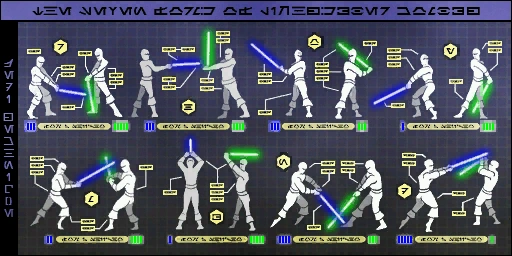
Space Knights need force swords!  It’s their signature weapon, which also means they need detailed ways to fight with them!  I’ve already written up a bunch of Force Sword styles back in Iteration 4, but now I want to revise them a little, make them a little more distinct from one another and discuss them in an aristocratic context.  I’ve chosen 4 styles, the Defensive Form (renamed the Old Way), and the Destructive, Courtly and Swift form as the “three dueling styles” most popular in the modern Alliance.

I understand that for most people, the force sword should be the domain of just the Jedi, but I see the “Jedi” of Psi-Wars as evolving out of an existing knightly tradition and blending it with other traditions.  Thus, they draw (and perfect!) their force swordsmanship from these styles, rather than the other way around.

I could also create a lot more styles, but I feel that one “old” style and three “new” styles should provide sufficient variety while being fairly easy to keep track of.  The three also offer sufficient contrast and focus on one-on-one dueling.

The Old Way

Alternate Names: The Guardian’s Form, Alexian Style Force Swordsmanship, Knightly Force Swordsmanship

When space knights helped forge the Alexian Empire, they used this style. They served as the vanguard of invasion forces, especially when boarding ships. With heavy armor and force buckler, they absorbed most incoming fire, and with force sword, they cut down their foes. The Old Way is Force Sword-And-Buckler Combat from Pyramid #3-9, with a couple of minor changes: replace Precognitive Block with Precognitive Defense, Feint becomes Beat, remove Chi Resistance. In Optional Traits, remove Psionic Talents and Forceful Chi.

The Old Way is slow, patient and powerful. It presents the force buckler to the opponent and keeps the force sword in reserve, waiting for an attack while slowly (or, when necessary, quickly) advancing. It prefers to react than to act, engaging in counter attacks and ripostes, but when it acts, the knight uses the force sword with complete commitment, relying on his force buckler to keep himself defended. The result is a slow, patient and defensive form, perfect for the classic space knight with force sword and buckler who has just boarded a ship and needs to advance on the enemy.

Most modern knights of the Alliance don’t bother to learn the Old Way anymore, except as a curiosity. Grimshaw knights often learn it out of a love of tradition, while members of House Kain like to learn it because they favor its battlefield practicality. Beyond that, the requirement to learn the ways of the force buckler strike most space knights as unnecessary, who want to perfect the art of the force sword or, better, the force saber. The Old Way also contains more than its fair share of cinematic techniques, so true weapon masters who want to master all intricacies of force swordmanship might learn this style to supplement what he already knows.

Signature Moves

Heroic Guardian Assault: Make a Move and Attack to Slam with your Force Shield. This requires a Shield (Force) roll at +0. Deal slam-damage +3, and your shield absorbs all damage from the attack. You may not block with your shield or retreat for the remainder of the turn.

Watchful Guardian Stance: Evaluate. This grants a +3 to your next attack and allows you to negate up to -3 in defense penalties from Feints or Deceptive Attacks. You may roll Tactics or Expert Skill (Hoplology) to gain some insight on your opponent’s combat approach. If taken as a trademark move, improve the Tactics or Expert Skill (Hoplology) roll. Setup: Your opponent is defensive or used a tricky move last turn.

Defiant Guardian Stance: After Blocking a Slam or a Move and Attack (including Flying Attacks or Acrobatic attacks), make a Push attack with your Shield. Roll Swing+3 damage, inflicting no wound, and doubling the knockback effect. This move requires the Special Setup Perk (Push with Shield) and the Push skill. Setup: You Blocked a Slam or a Move and Attack.

Blade Deflecting Stance: Make a rapid strike (-6 or -3) Beat opponent’s force sword (make a contest of ST-based Shield (Force) vs the better of your opponent’s ST- or DX-based combat skill), and then a rapid strike (-6 or -3) attack against your opponent’s weapon-arm (-2). Success inflicts 8d(5) cutting damage on the arm. Setup: You blocked a melee attack with your shield.

Bristling Guardian Counter-Charge: Wait, with the stipulation that if your opponent attacks, you’ll attack at the same time. If your opponent attacks, make a Stop Hit: Roll against Force Sword to hit. If you miss and your opponent hits, or you hit and your opponent hits at a larger margin, you block at -1 and dodge at -1 (with +3 from the DB of your shield). If you hit and your opponent hits with a smaller margin or misses, he defends at -1 (-3 if he wants to parry). Deal 8d(5) burn damage to the torso.

Guardian’s Retribution: Make a Committed (+2) Deceptive (-4) attack with the Force Sword (Force Sword -2). Your opponent defends at -2. Success inflicts damage on the torso. You may not parry or retreat, and you block and dodge at -2.

The New Way

Sometimes called “the Three Forms,” where the Old Way represents the past of Force Swordsmanship, the New Way represent the modern approach to force swordsmanship, with an emphasis on the force sword alone (or, sometimes, the force saber). These tend to have a focus on defeating a single, similarly skilled opponent in a one-on-one match-up. Fighters of the New Way tend to focus on honor and prestige over battlefield glory, which means they suffer somewhat from a practical perspective.

The Destructive Form

Alternate Names: Brutal Force Swordsmanship, The Reaper’s Form, Kain Style

The Destructive Form is House Kain’s answer to the dueling styles of the other Maradon houses. While others focus on pretty tricks to distract their foes and impress the audience, Kain focus on ending the fight and teaching their opponent a lesson. It has proved a decidedly unpopular dueling style, but it serves equally well in a dueling arena as on the battlefield, and so a few in other houses have given it their grudging respect.

The Destructive Form focuses on destroying one’s opponent’s ability to fight. Against opponents armed with weapons other than force swords, the stylist focuses on destroying their weapons first. Against force-sword opponents, the same tactic results in beats that batter aside their opponent’s weapon and opens them up to an attack. Against all opponents, the Reaper’s form exercises patience. It tries to demolish defenses first, through a combination of eliminating weapons, pushing aside defenses, injuries to the arms or legs, shoves and stuns, and then goes in for the kill with a simple and direct attack. It also prefers the greater power, and the improved defensiveness, of the defensive grip, in and out of which it seamlessly flows. Because of their similar focus on dismemberment, patience and defensiveness, some consider the destructive form the purest heir to the Old Way.

The Reaper’s Form places a great deal of emphasis on personal strength over mobility or internal, emotional balance. Practitioners learn strikes (and sometimes kicks) to supplement their force sword attacks (and often have a reputation for being dirty fighters). Beats and shoves also place emphasis on strength. In addition to precognitive parries, cinematic practitioners of the destructive form perform feats of great strength and utter terrifying shouts.

Students of the three forms argue that the Destructive Form’s unique strengths lie in the precision with which it targets their opponent’s limbs, and its focus on pure strength, which often unbalances lighter, quicker fighters, and its willingness to accept unconventional methods to win. They argue that its greatest weaknesses are also its reliance on strength (since power and size rarely decide a duel), it’s lack of mobility and, naturally, it’s lack of crowd-pleasing moves. It tends to have the most adherents in the house of Kain.

Skills: Force Sword, Brawling

Techniques: Beat, Elbow Strike, Force-Sword Shove, Hammer Fist, Targeted Attack (Force Sword/Arm), Targeted Attack (Force Sword/Leg), Targeted Attack (Force Sword/Weapon) Targeted Attack (Force Sword Pummel/Face), Targeted Attack (Brawling Elbow Strike/Vitals)

Cinematic Skills: Immovable Stance, Kiai, Power Blow, Precognitive Defense

Cinematic Techniques: Dual-Weapon Defense (Force Sword), Timed Defense (Force Sword)

Perks: Dirty Fighting, Finishing Move (Force Sword), Grip Mastery (Force Sword), No Nuisance Roll (Precognitive Defense), Rolling Stone, Special Setup (Power Blow works with Force Sword), Sure-Footed (Uneven), Sure-Footed (Slippery), Trademark Move.

Optional Traits: Striking ST +1 to +2 [5 or 10], High Pain Threshold [10], Weapon Master (Force Sword)

Optional Skills: Armoury (Force Sword), Fast-Draw (Force Sword), Intimidation, Karate

Optional Perks: Weapon Bond (Force Sword).

Optional Techniques: Kicking

Signature Moves

The Dignity-Killing Stroke: The Destructive Form begins on the offensive. In standard grip, make a rapid pummeling strike (Karate-1 or Hammer Fist) vs target’s face (-5). Roll Karate-6 or Hammer Fist-5. Deal thr(+karate bonuses) damage. If shock is inflicted, target must roll vs stun. You may defend normally. This counts a dirty trick.

The Blade-Killing Stroke: In standard grip, make an Attack against opponent’s weapon with Force Sword. Roll Force Sword-4 (for long polearms or rifles) to -6 (for small weapons, like force sword hilts or pistols) and inflict 8d(5) damage. You may defend normally. Setup: Your opponent is stunned.

The Patience-Killing Stroke: The Destructive Form pushes its opponent to parry or to attack, or risk losing their ability to dodge. In Defensive Grip (-2), make a deceptive (-2, though typically reduced to 14) defensive attack to the leg (-2). Roll Force Sword (-6) to hit. Deal 8d+1(5) burn damage to the leg. The stylist defends at +1 for the remainder of the turn, with an additional +1 against forward attacks(and -1 against attacks from the rear or to the side). Setup: None, though typically if one’s opponent is defensive.

The Balance-Killing Stroke: The Destructive Form turns the tables on an aggressive opponent through strength. In defensive grip, make a Force Sword Shove (-2, with +2 from the two-handed grip). Roll ST-based Force-Sword+0 in a quick contest with your opponent’s ST-based Force Sword. If successful, apply the margin of victory as a penalty to opponent’s dodge and kicking skill. If success by 5 or more, inflict one yard of knockback (including a DX roll to avoid falling). Setup: After making a successful parry.

The Spirit-Killing Stroke: The Destructive Form batters down its opponents defenses and then destroys his opponent’s ability to fight. In Defensive Grip, make a rapid-strike Beat (-6, or -3 with Weapon Master, +2 from two-handed grip). Roll ST-based force-sword skill (-4 or -1 with weapon master) with your opponent’s ST- or DX-based force-sword skill. Success applies margin of victory as a penalty to attack and defense, while success by 5 or more unreadies the weapon. Then use Grip Mastery to shift to regular grip and make a second (-6 or -3 with Weapon Master) attack against the arm (-2) of the opponent. Roll Force-Sword (-8 or -5 with weapon master). Deal 8d(5) burn damage to the arm. Setup: Your opponent successfully parries your attack.

The Reaping Stroke: The Destructive Form has destroyed its opponents defenses, and then finishes off its opponent. Take a Step (while still keeping your opponent in one of your forward hexes) and use Grip Mastery to shift from Defensive Grip to Regular Grip, and then make an All-Out Attack to the Torso. As a special effect, this attack may be described as attacking the neck (this is cosmetic, so apply no hit location penalties, nor any hit location benefits). Roll Force Sword (+0). Deal 8d+8(5) damage. This is a Finishing Move. Setup: Opponent is stunned.

New Skills and Techniques

Force Sword Shove (Hard)

Default: Force Sword-2; cannot exceed Force Sword.

The force swordsman, after connecting with another force sword, pushes that force sword, similar to a beat, but in such a way that their entire opponent is pushed off balance. After parrying or being parried by another force sword, make a Beat against the opponent’s body. This penalizes their Dodge and kicking skill, and with a margin of success of 5 or more, inflicts one yard of knockback (and the opponent must make a DX roll or fall).

The Graceful Form

Alternate Names: The Dancer’s Form, Courtly Force Swordmanship

The Graceful Form is the oldest of the dueling styles, and may have evolved side-by-side with the Guardian’s Form. It involves highly ritualistic techniques (some schools even teach their stylists to dance before they teach them the actual fighting techniques) and involves highly kinetic movement. The result is a beautiful, if wasteful, combat display largely better suited for dueling (where its impressive moves will earn the practitioner high praise) than on the battlefield. Even so, it’s high mobility helps the force swordsman close on the enemy very quickly, meaning that quite a few knights do manage to use it effectively in the battlefield.

The Graceful Form focuses on mobility and theatricality to defeat its foes. The characters remain in near constant motion, and seek to gain an advantage on their opponent by moving to points where their opponent cannot defend well. It folds its antics into its techniques, so their opponents are never sure if the duelist actually intends to attack or not. When they finish off their opponent, they generally do so as stylishly as possible and, if that is not possible, they’ll pause after victory to demonstrate an flourish artistically. This makes the style a smash hit among spectators, and is a preferred technique for gladiators, duelists, or easily-impressed young men.

The style focuses on high speed, agility and dexterity. It also relies on its opponent’s inferiority. A master of the Graceful form will tear apart a novice of another form with stylish ease, but he’ll certainly lose against someone of greater skill than his own. This does make the Graceful form an excellent means of disposing of unskilled opponents, however.

Students of the three forms argue that its greatest strengths are its high mobility, which serves it well even on the battlefield, and its unpredictability. By constantly staying in motion, a fighter can always find his opponent’s weakest point. The greatest weakness is its wasted motion, and while the style can be highly effective, it requires an intense amount of training to reach the dizzying heights of skill necessary to defeat opponents of the other two forms. House Elegans and House Sabine use this style more than most.

Skills: Acrobatics, Force Sword, Jumping

Techniques: Acrobatic Stand, Combat Art (Force Sword), Evade, Feint (Acrobatics or Force Sword), Spinning Attack (Force Sword)

Cinematic Skills: Flying Leap, Kiai, Power Blow, Precognitive Defense

Cinematic Techniques: Dual-Weapon Defense (Force Sword), Flying Strike, Timed Defense (Force Sword), Whirlwind Attack (Force Sword)

Perks: Acrobatic Feints, Flourish, Grip Mastery (Force Sword), Sure Footed (Uneven), Sure-Footed (Slippery), No Nuisance Rolls (Flying Leap), Trademark Move.

Optional Traits: Basic Move +1 to +2 [5/level]

Optional Perks: Weapon Bond (Force Sword).

Optional Skills: Armoury (Force Sword), Dancing, Fast-Draw (Force Sword), Force Saber, Intimidation, Savoir-Faire (High Society)

Signature Moves

The Flying Step: The stylist sails gracefully into the air, force sword spinning, and then descends on his foe like a terrible meteor. After making a full run, make a Flying Leap roll (-5) and make a Committed Flying Strike (-4) (base jump distance is 2x your move) using Force Sword Art (-3) for a total of Force Sword-7. Your opponent parries at -2 If you hit inflict triple damage at +1 per die (24d +24 (5) burning). For the rest of the turn, you may not parry, and you dodge at -2 and may not retreat. Setup: You concentrated for one turn. This is best done as the battle is just beginning.

The Trickster’s Step: The stylist runs at his opponent, and then suddenly flips over the top of her, and attacks her from behind. After running full move, make an Evasion roll (-0) to bypass their opponent. Then make an Evasive Attack (-6) to attack your opponent from behind. Your opponent defends at -2 (for a runaround attack). Success strikes the torso. You may not parry Your first defense is at +2, but you may not retreat. Setup: Initial attack.

The Counter Step: The Stylist parries an attack and uses that momentum to perform a pirouette, and uses that energy to create a new attack. When attacked, make an Acrobatics roll to spin around the attack and then defend against the attack (+2 from acrobatic parry) while making a side-slip (+2) with a riposte penalty (-4). Roll parry+0. On your turn, make a Spinning attack (-2) against your foe’s torso. Apply margin of success+4 as a penalty to your opponent’s defense. Setup: You are attacked.

The Playful Step: The Stylist spins or tumbles around his opponent similar to the Counter, but instead of attacking, the display turns into pure acrobatics. Roll Acrobatics as a Defensive Attack (-2) Feint. Defend at +1 for the remainder of the turn, and apply a +2 to your next defense. Setup: You have used the Counter Step or the Trickster’s step previously in the fight.

The Final Step: In the culmination of the Graceful Form, the stylist weaves a perfect four point kata that strikes all foes around him. Make a Whirlwind Attack(-5) using Force Sword Art (-3) for a total of -8. Attack each opponent that is one yard away in a clockwise order. You may not defend. Setup: You have at least three opponents one yard away from you.

The Triumph: After defeating a foe, the stylist spins his force sword artfully. Make a Force Sword Art roll+4 (Force Sword+1). This can either count as an intimidation roll (if the character has the Flourish perk) or success adds a +1 to reaction rolls. Setup: You have defeated a foe or knocked a foe down.

New Skills and Techniques

True Flying Strike (Hard )

Default: Prerequisite Skill-6; cannot exceed Prerequisite Skill.

This technique uses Chambara move-and-attack rules (MA 128) and thus requires Trained by a Master. The character must first move and then make a DX, Jumping or Flying Leap roll; they may jump their full jumping distance. They make their attack with True Flying Strike and do not have a cap of 9 or less. They may not retreat or parry with their attacking weapon (but see the Rapid Recovery Extra Effort option).

Evasive Attack (Hard )

Default: Prerequisite Skill-6; cannot exceed Prerequisite Skill.

This technique uses Chambara move-and-attack rules (MA 128) and thus requires Trained by a Master. The character must make an acrobatic movement (Evasion) at their opponent, rolling Acrobatics or Evasion (halving the penalties) to bypass their opponent and attack from the rear. They make their attack with Evasive and do not have a cap of 9 or less. They may not retreat or parry with their attacking weapon (but see the Rapid Recovery Extra Effort option).

The Swift Form 2 points

Alternate Names: The Duelist’s Form, Eleganian Style, Pure Force Swordsmanship

The Swift Form is the youngest of the Knightly Force Swordmanship forms. Created by the swordmaster Tyro Elegans, it strips force swordmanship down to its dueling essentials. It removes the force buckler, unarmed techniques, and the unnecessary motions of the Graceful Form, and it even uses a new weapon focused on faster parries and attacks: the force saber. This leaves only a simple, clean style with a dogmatic focus on winning duels, which is what most knights use force swordsmanship for in the modern Alliance.

The Swift Form focuses exclusively on aggressively defeating a single opponent with a force saber. It turns defense into offense, and it attacks whenever it can, hoping to either wear one’s opponent down or to force him to draw his defenses to the wrong point, at which point, it achieves victory either with a delicate disarm, or by ruthlessly killing its opponent. It uses Combat Sport to make maximum use of the rules of dueling

The Swift Form has two particular approaches to dueling, a right-facing, single-bladed stance called “Tyro’s stance” and a neutral stance where the fighter wields dual blades (either two force sabers, or a force saber and a force blade) called “the Mirror Stance.” Some practitioners master both and flow freely from one stance to another (they may do so freely once per turn).

Those who seek to master all three argue that the Swift Form excels at speed, defense, counter attack and feinting with an attack. It’s also the only school focused on the force saber, and that teaches Tyro’s stance and the Mirror stance. They also argue that it’s among the easiest style’s to learn. It suffers from a lack of cinematic options, mobility, power, and with adapting to battlefield circumstances. House Elegans and House Grimshaw prefer this style.

Skills: Force Saber

Techniques: Combat Sport (Force Sword), Counter Attack (Force Sword), Disarm (Force Sword), Feint (Force Sword), Retain Weapon (Force Sword), Setup Attack (Force Sword), Targeted Attack (Force Sword/Vitals).

Cinematic Skills: Mental Strength, Precognitive Defense

Cinematic Techniques: Dual-Weapon Attack (Force Sword), Dual-Weapon Defense (Force Sword).

Perks: Deny Right (Tyro’s Stance), Off-Hand Weapon Training (Force Sword), Trademark Move, Weapon Bond (Force Sword).

Optional Traits: Ambidexterity [5], Combat Reflexes [15], Enhanced Parry (Force Sword) [5/level], Basic Speed +1 [20], Unfazeable [15]

Optional Skills: Armoury (Force Sword), Fast-Draw (Force Sword), Force Sword, Intimidation, Savoir-Faire (High Society).

Optional Perk: Deny Left

Signature Moves

Instant Strike (Tyro’s Stance): The Duelist makes a Deceptive (-2) Great Lunge (Costs 1 fatigue). This increases the reach of his force saber by +1 to 1,2. He rolls Force Saber at -2 and his opponent defends at -1. Success strikes the torso. You may defend normally. If the opponent has never seen this attack before, it might surprise him; treat it as a Dirty Trick. This is usually done as a first strike in a duel, in an attempt to gain initiative and keep it.

Pointed Critique (Either): The duelist deftly (and perhaps insultingly) tests his opponent’s defenses. Make a defensive force sword art (-3) setup attack (-6). Roll Force Sword -9. If successful, opponent’s next parry against you is at -2 and his dodge/block is at -1. Deal 7d-7(5) burn damage. You defend at +1 for the remainder of the turn. Garner a +1 reaction roll from the audience. Setup: Your opponent is defensive.

Staggered Strike (Mirror Stance): The duelist makes a quick “half-strike” with both weapons, one right after the other, but neither connects. Make a dual-weapon (-4) feint as a defensive attack (-2). The first feint acts as a complimentary roll to the second (thus, success adds +1, failure adds -1, etc). Your opponent loses defense equal to your margin of success on the second feint. You defend at +1 for the remainder of the turn. Setup: Your opponent is defensive.

The Knightly Cross (Mirror Stance): The duelist dramatically crosses his sabers to defend against an attack and them immediately attacks as he uncrosses them. After making a cross-parry (using both weapons, +1 to defense) make a Dual-Weapon (-4) Counter Attack (-5). Roll Force Sword-9 twice. Opponent parries at -3 (Block Dodge at -2). If successful, each attack deals deal 7d(5) burn damage. Setup: You cross-parried your opponent’s attack.

Ribbons of Light (Mirror Stance): The Duelist launches a series of swift attacks while keeping one force saber back for defense. Make a Committed (+2) Rapid Strike (-12 or -6) against his opponent. Roll 3 Force-Sword attacks at -10 or -4. Each deals 7d(5) burn damage. You may not parry with the sword you attacked with, but you may parry with your off-hand sword at -2 (-4 if no off-hand weapon training). Setup: None.

Gentleman’s Victory (Either): With a beautiful twist of his wrist and flip of his blade, the duelist deftly disarms his opponent. Make a Combat Art (-3) Disarm (+0) against your opponent. If you successfully strike, roll a contest of DX- or ST-based Disarm vs your opponent’s DX- or ST-based Retain Weapon (he gains +2 if holding his weapon in a defensive grip). If successful, your opponent is disarmed. Gain +1 reaction from onlookers, and defend normally for the remainder of the turn. You may defend normally. Setup: Your opponent is sufficiently regal or stylish that you wish to honor them.

Dog’s Defeat (Either): Setting aside pretense, the duelist buries his force saber deep into his opponent, completely focused on defeating them. Make an All-Out (+4) deceptive (-4) force saber attack for the vitals (-3). Roll at Force Saber-3. Your opponent defends at -2. If you hit, deal 7d(5) burn, x2 for striking the vitals. You may not defend for the remainder of the turn. Setup: After Pointed Critique or Staggered Strike against an opponent unworthy of your time.

New Perks

Deny Left/Deny Right: These use the optional rules presented in GURPS Martial Arts: Gladiators on page 21. Tyro Elegans, like many Elegans, was left handed and so used Deny Right and purists use Off-Hand Weapon Training to teach right-handed force swordsman to also Deny Right, but some schools simply reverse the stance and teach Deny Left. Because of the particulars of the stance, it works inefficiently with Dual Weapon Attacks.

Dueling

When a noble feels his honor has been besmirched, or when two nobles reach an impasse, they may challenge one another to a duel. Such a duel is witnessed by at least two other nobles and one impartial noble who ensures that none violate the core rules of the duel (duels typically have far larger audiences than this and become spectacles for an entire court!).

The exact specifics of how duels must be fought vary from world to world and house to house, but most generalities stay the same. First, the duel must not involve anyone but the two duelists. Second, the duel must take place in a constrained environment (those who fall outside of that area during the duel forfeit the duel). Third, the duelists fight only with agreed upon weapons. Fourth, the duelists fight until one side or the other concedes, or until an agreed upon wound is inflicted (either “to the blood” which is 1 point of damage, or “to the handicap”, which is a Major wound). “To the death” is never allowed, though nobles may freely defend themselves if their opponent becomes overly aggressive. Anyone may roll Savoir-Faire (High Society), IQ-based Combat Sport, or Games (Dueling) know these rules. Games (Dueling) can be rolled to know exacting specifics, including generally accepted but esoteric rules, and a fighter may use it as a Complementary roll to any attacks that seek to end the duel on a technicality (for example, when shoving an opponent out of the fighting area, or when leaving an exact wound that needs to deal exactly enough damage), at the GM’s discretion. It can also be used to skirt the rules, such as bringing in a technically allowed weapon, or for expanding the area in which the fight can take place, or in killing one’s opponent (“He violated a rule but continued to fight, thus it was self-defense”).

A well-fought duel brings more than satisfaction to its participants, it can also bring glory and honor! At the end of the duel, roll a reaction roll for each combatant. In addition to normal, appropriate reaction modifiers (appearance, charisma, etc), add +1 for each particularly clever or dramatic move made during the fight, and -1 for any particularly dirty or boring moves made. Additionally, the following skills can each be used (once) during the fight as a complementary roll for the final reaction roll: Acrobatics, Combat Art (Any), Savoir-Faire (High Society), Intimidation. A roll of 18+ can justify the character purchasing a level of reputation based on his performance.


The Legacy of the Oracular Order: the Genetic and Psionic Heritage of Aristocracy

The Aristocracy of the Alliance wouldn’t be where it is today without the Oracular Order.  Their insights into the future gave them the patience, prescience and precision to breed the nobility into superior stock.  As a result, the aristocracy is better than you: prettier, smarter, more graceful and healthier.  Or, at least, they should be.  In the centuries since the fall of the Alexian Empire, and without the guidance of the Oracular Order, the Houses have drifted genetically.  The rise of the new Empire has made collecting those bloodlines together and restoring the Oracular Order’s original vision harder and harder.

The Order did all of this to create reliably psionic bloodlines.  As a result, all Alliance Aristocracy is potentially psionic.  This greatly shapes their military and espionage doctrines!

Finally, the Order did all of that to ensure everyone was in place for some great crisis it foresaw, a crisis that never came, that the Houses don’t stand ready to face.  I want to treat this as a Destiny, which represents some interesting choices for how members of a house see themselves and what path they choose to follow in the present, whether they want to adhere to the purpose that gave them life, through it all away for their own power, or set everything aside and try something gloriously new.  However, as I worked on it, it became increasingly clear that it needed a fuller treatment that would have to wait until I dived into the Oracular Order itself, so it’s been set on a back burner, but I do have notes, and those notes guided the creation of the four houses I will present, and the “notable members” within each.

The Maradonian Nobility ruled not because they had more power or prestige than everyone else, but because the Oracular Order ordained it so. With their deep insights into the future, they knew what shape humanity must take, what heroes the future would need if Maradon was to build a civilization that would last millennia and fend off the great impending threat. The Oracular Order shaped the aristocracy of Maradon into the heroes the future needed, and placed them in positions of power, to ensure their ascendancy and prowess when that appointed day came.

With the fall of the Oracular Order, the nobility of the Federation and Alliance rely more upon their prestige and power to enforce their claims to power, but their moral claims still come from this notion that the galaxy needs the noble houses of Maradon to stave off some future crisis. Many within the noble houses even still believe those old words and try to live their lives according to the principles the Oracular Order laid out for them. Others, especially those who quietly subscribe to the beliefs of True Communion, defy the chains of fate and forge their own path. But however one feels about the impact the Oracular Order made in shaping the noble houses, those marks remain.

The core reason for Oracular meddling in Maradon politics arose from the need to shape the future. Everything they did with the nobility centered on this core principle. Thus, all noble houses have a destiny that they should fulfill, a role that the Oracular Order saw for them. To fulfill this role, the Oracular Order needed the Maradon nobility to have psionic power. While this has a genetic component, the artificial and technological meddling with genetics causes some unfortunate psionic side-effects, like madness. As a result, the Oracular Order carefully bred the nobility to get the exact, psionically active bloodlines the future needed, using eugenics rather than direct genetic engineering. The genetic markers of a noble house remain, today, one of its most central features, and nobles use those distinct markers in their biometrics to prevent access to technology by anyone outside of the family.

Genetic Legacy

A house represents a carefully engineered bloodline, a genetic lineage trailing back at least 50 generations for the purest houses. Precisely what this lineage entails varies from house to house, and how that is expressed varies from individual to individual.

Characters who belong to the genetic legacy of a house must take the perk (House) Bloodline. Those with this perk register as a member of that bloodline to any genetic scanner or genetic biometric lock; furthermore, characters with this perk may purchase any abilities (whether genetic or psionic abilities or distinct forms of destiny) available to the House.

Most houses have eugenic templates, which represent the result of the centuries’ long eugenic project undertaken by the Oracular order. In principle, members of a House should have the full template, but in practice, most members have stray genetic impurities that prevent them from achieving the total vision the Oracular Order had for the House (this is especially true in the present day, centuries away from the fall of the Oracular Order).

Thus, each template should be broken up into four power-up packages. Each package has the perk Bloodline Purity which represents how close to a “pure” member of the House a character is. This acts as a trivial reputation, granting a +1 to anyone who is aware of the character’s genetic purity, and considers this a useful trait (for example, for those considering a marital match with the character and who wish as pure a bloodline as possible for any potential child). A character who takes all four power-up packages has “the complete House template” and Bloodline Purity 4, but most characters will only take 0-3, and having a lower Bloodline Purity as a result.

All of this eugenic engineering has created some potential genetic drawbacks. Characters who take the eugenic power-up template may take optional “common” disadvantages, and characters with a bloodline purity of 2+ may increase their disadvantage limit by 5, provided they take at least 5 points worth of common disadvantages from their house (treat the eugenic template as a customizable racial template).

One common eugenic disadvantage is Mental Instability. Mental Instability is a secret disadvantage (B120), a lurking “trap” in the genetics that the GM can spring upon a player whenever he, provided she takes the Mental Instability disadvantage. Allow the player to take up to between -10 and -20 points, and then assign a disadvantage worth at least five points less.

Eugenic Considerations

A character’s genetic traits must be taken at character creation, as they represent something fundamental to the character. In essence, treat their genetic power-up as a slightly customizable racial template. At the GM’s discretion, a character might have “buried” or “latent” genetic potential that a psionic healer might bring to the fore, but I offer this only as a potential excuse a GM might use to allow a player to retroactively go back and change his character (a better way to handle “hidden genetic potential” would be as a secret advantage!).

Breeding matters for inter-noble marriage. If characters want to keep their bloodline pure and ensure that their children have access to the maximum, they need to choose someone with maximum genetic compatibility with their own genome. Who exactly is compatible and why is left entirely to the GM and is primarily a narrative concern. Characters with Bioengineering (Eugenics) or certain versions of Esoteric Medicine might be allowed to roll to tell who would be genetically appropriate and why. Generally, marriage within aristocracy is superior to marriage outside of the aristocracy for maintaining bloodline purity, but outsiders sometimes (by sheer chance) have just the right make-up or would add a vital component missing from the currently fading bloodline. This only a special effect in most Psi-Wars games, as they tend not to be multi-generational; even if they were, consider allowing players to write their characters as they wish, telling a story with their choice of genetic template. Decreasing purity emphasizes the slow decline of the bloodline’s grandeur, while being an unexpectedly pure and strong member of the bloodline is exactly the sort of heroic exceptions PCs tend to be!

Characters can intermarry, of course, and have children with mixed lineages. In most cases, children tend to show traits of one parent or the other (only one Bloodline perk), but some children directly inherent the blood legacy of both houses! In such cases, the characters take both bloodline perks, and may take genetic packages from both bloodlines however they wish, but treat the Bloodline Purity perks as distinct (generally to a maximum of 4: characters may not have more than 4 points of Bloodline Purity in any combination): a scion of both House Sabine and House Elegans may have Sabine Purity 3 and Elegans Purity 1; these combine for the purpose of reaction modifiers, but not for the purposes of any prerequisites the GM might have (that is, such a character has +4 to impress people who like extreme breeding or who look for an excellent marriage match, but could not purchase an Alexian ability that requires Purity 2+).

Cadet Branches

Often, a noble will have multiple potential heirs, and when he dies, he needs some way to properly divide his estate. Traditionally, all titles and property go to the first born son (Though different houses have different traditions: Sabine, for example, offers the domain of the house to the first born child, regardless of sex). In some cases, a secondary heir has collected sufficient power and prestige that his House cannot easily dismiss his claims. In such cases, the secondary heir typically receives a lesser portion of the estate and gains a new name and is noted as a cadet branch.

Cadet branches typically act as a house within a house. They pass their titles and estates down to their first born son and, if that’s not possible, branch off their own cadet branch, and so on. They still belong to their parent house, genetically and politically, and often serve as close allies. Should the branch die off without heirs, the estates and titles revert back to the master of the House, and if the governing branch of the House die off without heir (or suffer terrible scandal that forces abdication of certain positions), a cadet branch will typically step in to rule the House.

Treat a cadet branch as genetically identical to the governing house with a few minor exceptions. They have the same (House) bloodline perk, and the same eugenic power-ups, but they may change out one or two power-ups for power-ups of their own. This allows for variety within a house, and also for players to belong to a particular house with a chance at greater customization.

Psionic Legacy

The purpose and intent of the eugenic engineering of the Maradonian aristocracy (as well as other aristocrats eventually folded into the old Empire’s nobility) was to foster psionic talent. The Oracular Order needed more psions to feed its ranks and often drew them from carefully bred aristocratic lines, but more importantly, psionic power more carefully integrated the aristocratic line into the weave of destiny and solidified their destiny, and better helped them perform destined role.

Any character with the (House) Bloodline perk may purchase any psionic ability or talent associated with their house at any point provided they meet the Bloodline Purity prerequisite. Some characters never manifest any psionic powers, as the eugenic engineering of the Houses only make these traits more common, not guaranteed, but this is a narrative factor, not mechanical one. Other characters might manifest powers outside of the House Bloodline, or stronger powers than his Bloodline Purity would suggest, for the same reasons that any human might manifest psionic powers (for example, the character takes the Psionic Power-Up Package at character creation, or chooses to purchase a Psi-Talent). The Bloodline perk not a limitation on what the PC may purchase, but rather explicit permission to purchase certain psionic abilities.

Psionic powers available to members of a genetic line break down according to Bloodline Purity. Powers available to Bloodline Purity 0 characters tend to be the most common powers in the house, and those that define its members the most strong. Bloodline Purity 1-2 tend to be more rarified, and most nobles take their presence as a sign of excellent breeding. Bloodline Purity 3-4 tend to be the rarest and most powerful abilities of the psionic legacy. If the House has a Psionic Talent in its psionic legacy, that talent tends to require Blood Purity 4, as such pure blood opens up an entire psionic power and all of its abilities to the noble.

As a rule, Houses generally only have access to abilities within a single power.

Destiny

Ultimately, the Oracular Order engaged in all of this multi-generational eugenic engineering explicitly to push members of the House down a pre-ordained path, the Golden Path, one charted for them by the Oracular Order. The aristocracy profited from the Oracular Order’s insights and endorsement, and in return, they served the Golden Path.

Gathering all of these threads of destiny and turning individual bloodlines into vital lynchpins had a price, however. An individual acting in bad faith, with the full weight of history behind him, could sabotage everything and throw everyone off of the winding and narrow Golden Path. Thus, those nobles who find themselves pressed by fate also find that they have a choice in which fate they choose to embrace.

Each house has three Destiny traits associated with them representing three possible directions the House could go. The exact nature of the Destinies vary from house to house, but they broadly follow the same themes. The first, the “True Destiny” of the House represents the Destiny members of the House would accept to further the Golden Path. This destiny is one of subordination to the (now vanished) House of Alexus and to the Oracular Order. It usually culminates in some great sacrifice. The second and third are “Corrupt Destinies,” which represent a dangerous deviation from the Golden Path. The first almost always involves a selfish path, wherein the noble profits and makes himself, his house and his family stronger, but at the cost of selfishly violating the code and morals of the Empire and possibly endangering the Galaxy. The third Destiny represents a liberation from the Golden Path, wherein the noble rejects the black and white choice placed before him by the Golden Path, and charts his own course, attempting to find a way to protect the Galaxy in his own way.

Most nobles never have Destiny, but any PC who has the appropriate Bloodline perk may freely choose one version of Destiny, but which they choose is up to them. They may also trade their chosen Destiny for a different one, but this typically involves some substantial rejection of the premise of their original Destiny in favor of the new Destiny, a narrative matter between the PC and GM. Aristocratic PCs are not “locked into” one of these three Destinies and may choose their own Destiny (say, with the Heroic power-up). Ultimately, the three Destiny traits of a house represent an interesting way of discussing the ultimate fate of the House, and the PC’s role in that fate.

Only the GM can answer whether the PC’s choice of Destiny has any impact on the setting and what, if any, impact that choice has. Perhaps the Oracular Order was simply wrong about the far future, or perhaps their predictions ran off the rails long ago and the Golden Path is no longer achievable. Or, perhaps, the Oracular Order remains critically relevant to this time and still works behind the scenes to maintain a sliver of hope to returning to the Golden Path before the increasingly imminent “great threat” that faces the galaxy. In the latter case, the GM should work out what sort of impact the PC choices make and present him with meaningful choices that pertain to his chosen fate.

I’ll return to this particular feature when I look at the Oracular Order in greater detail.

Aristocratic Personnel: Regular Infantry and Space Knights

If you’re going to fight the Alliance, you need to know what you’re up against.  Today’s post includes both typical bodyguards and soldiers who serve the aristocracy and the knights who make up a house (or an order).  For the latter, I’ve included some references to genetic, psionic and martial legacies that I’ll explain in more detail later!  I’ve simply decided to reveal the aristocracy in this particular order, because I think it makes sense to have a feel for the organization that supports the aristocracy before diving into the aristocracy itself.

Aristocratic Regulars

Regular Footman

The typical footman is extraordinarily skilled, though most are better at parade and formation than they are at adapting to the intense conditions of open battle. They serve primarily as the bodyguards of the aristocracy, the retinue of a space knight, and supplements to local militia.

ST 11

HP 11

Speed 5.25

DX 10

Will 10/12

Move: 5 (4)

IQ 10

Per 10

HT 11 (12)

FP 11

SM 0

Dodge 8 (7)

Parry 9

DR: 60/20

Startrodder SC 515 Blaster Rifle (12): 6d(5), burn, Acc 8+2, Range 1000/3000, RoF 3, Bulk -6, Rcl 2, Verify Malf.

Vibro-Bayonet (12): 2d+2 (5) imp, Reach 1,2, Parry 9

Stellar Dynamics RB5 Light Blaster Carbine: 4d+2(5) burn, Acc 8+1, Range 330/1000, RoF 10, Bulk -3, Rcl 2.

Skills: Hiking-12, Pilot (Contragravity)-12, Savoir-Faire (Soldier)-15, Soldier-12.

Traits: Battle Drills, Fearless+2, Fit.

Notes: Human; Higher DR protects torso; lower DR protects all other locations except feet (DR 60) and skull (DR 40). Helmet and visor provide radio, air and night vision 9. Acts at the same time as all other members of formation, has +2 to notice something other members of the formation have noticed and can never hit another member of the formation by accident. Light Encumbrance.

Regular Tactics

Aimed Shot (18): After aiming for one turn, make an All-Out Determined (+1) Sighted (-4; masked) shot at the target; successful hit strikes the torso. If using the RB-5, add +2 for ROF. You may not defend.

Formation Fire (6+ROF): The entire formation fires en masse at the target. Treat this as suppression fire, multiplying the ROF of the shots (3 for SC-515s and 10 for RB-5s) by the number of troops in the unit (typically five) and add the ROF bonus to 6 (thus, typically 9 for SC-515s and and 14 for RB-5s).

Sacrificial Dodge (7): If an aristocrat is targeted by a lethal attack, a footman can attempt to take the hit in his stead.

Regular Guardian

Many Regulars serve a bodyguards, including the regulars above. Most bodyguards, however, prefer melee weapons, both for their impressive display, their traditional appearance, and their superior effectiveness in close quarters. If regular footmen use melee weapons in the defense of their lords, use the stat block below.

ST 11

HP 11

Speed 5.25

DX 10

Will 10/12

Move: 5 (4)

IQ 10

Per 10

HT 11 (12)

FP 11

SM 0

Dodge 8 (7)

Parry 9

DR: 60/20


Plasma Lance
(12): 5dx2(10) burn ex, Acc 2, Range 6/60, RoF 1, Bulk -6, Rcl 3.

Force Lance (12): 6d(5) burn; Reach 2, 3*; Parry 0.

Skills: Hiking-12, Pilot (Contragravity)-12, Savoir-Faire (Soldier)-15, Soldier-12.

Traits: Battle Drills, Fearless+2, Fit.

Notes: Human; Higher DR protects torso; lower DR protects all other locations except feet (DR 60) and skull (DR 40). Helmet and visor provide radio, air and night vision 9. Acts at the same time as all other members of formation, has +2 to notice something other members of the formation have noticed and can never hit another member of the formation by accident. Light Encumbrance.

Regular Tactics

Cover Suspect (Plasma Lance) (14): After aiming for one turn, wait, wit the stipulation that if the covered suspect attacks, you’ll attack first. On an attack, make an hip-fired (+1 on cascading waits) attack. Success hits the target’s torso. You may defend normally.

Cover Suspect (Force Lance) (16): Wait, with the stipulation that if your covered suspect attacks, you’ll attack first. Make an All-Out Attack (Determined +4) attack to hit. Success strikes the target’s torso. You may not defend.

Sacrificial Dodge (7): If an aristocrat, or your protected target, is targeted by a lethal attack, a footman can attempt to take the hit in his stead.

Regular Officer

The typical footman is extraordinarily skilled, though most are better at parade and formation than they are at adapting to the intense conditions of open battle. They serve primarily as the bodyguards of the aristocracy, the retinue of a space knight, and supplements to local militia.

ST 11

HP 11

Speed 5.25

DX 10

Will 12/12

Move: 5 (4)

IQ 12

Per 12

HT 11 (12)

FP 11

SM 0

Dodge 8 (7)

Parry 9

DR: 60/20


Stellar Dynamics
RB5 Light Blaster Carbine: 4d+2(5) burn, Acc 8+1, Range 330/1000, RoF 10, Bulk -3, Rcl 2.

Skills: Hiking-12, Leadership-12, Observation 12, Pilot (Contragravity)-12, Savoir-Faire (Soldier)-15, Soldier-12, Tactics-12.

Traits: Battle Drills, Fearless+2, Fit, Military Rank 3.

Notes: Human; Higher DR protects torso; lower DR protects all other locations except feet (DR 60) and skull (DR 40). Helmet and visor provide radio, air and night vision 9. Acts at the same time as all other members of formation, has +2 to notice something other members of the formation have noticed and can never hit another member of the formation by accident. Light Encumbrance.

Regular Officer Tactics

Aimed Shot (18): After aiming for one turn, make an All-Out Determined (+1) Sighted (-4; masked) shot at the target; successful hit strikes the torso. If using the RB-5, add +2 for ROF. You may not defend.

Rally (12): Every (mook) member of the ranger’s squad (up to 10 men) gain +1 to fright checks and may ignore disadvantages harmful to combat for the duration of combat, so long as the leader lives.

Strategem (12): If the tactician wins a contest of tactics with his opponents, he may grant one free reroll to his squad

Knights of the Alliance

Aristocratic Houses

Each house has its own unique genetic and psionic heritage, which can be applied on a case-by-case basis for most characters. The rules below, however, assume that the knights presented are done as a group, a faceless squadron of knightly opponents. Thus, for simplicity, use the following alternations to represent the “typical” members of each house.

House Sabine

Sabine Grace: +1 DX (increase all attacks by +1)

Sabine Foresight: Combat Sense 2 (Skill 15; Replaces Combat Reflexes; Increase Defenses by +1)

House Grimshaw

Grimshaw Detahment: Unfazeable

Grimshaw Deflection: EK Shield 4 (DR 20 (Energy attacks only); Skill 15; Technique: Blaster Deflection -12 (Hardens DR 3 times against blasters);

House Elegans

Eleganian Ferocity: +1 Basic Speed (+1 Move, +1 dodge), +2 Will

Eleganian Terror: Instill Terror (Skill 15)

House Kain

Psi-Less: Remove Precognitive Parry.

Kainian Might: +2 ST, High Pain Threshold (For simplicity, all unarmed and shield-bash attacks gain +1 cr damage; reduce encumbrance by one level)

Kainian Cybernetics: +5 HP, DR 40 (Skull only), DR 20 (Rest of body; Crushing only). Add the following tactic:

Detonate: Activate internal bombs; Deal 5dx10 cr; die in explosion.

Traditional Alliance Knight

Most knights of the Alliance no longer use the outdated tactics and equipment of a more elegant, bygone age, and have long since moved on to Modern Alliance Knights below. That said, traditional armor provides superior protection to all but the most modern Imperial armor and the knightly force swordsmanship remains an exceptionally valid approach to combat. Lacking in psionics, Kain Knights prefer this approach, as the superior armor, paired with their own innate toughness and their cybernetics, make them a formidable force. Grimshaw, out of love of tradition, often fields this sort of knight as well, and delights in pairing it with their EK shield to simply walk through blaster fire.

Modify traditional space knights by their House and by their chosen force swordsmanship style.

ST 11

HP 11

Speed 6.0

DX 12

Will 11/13

Move: 4

IQ 11

Per 11

HT 11 (12)

FP 11

SM -0

Ddg 10 (8)

Parry 11

DR: 90


Force Sword
(15): 8d+4(5) burn; Reach 1, 2; Parry 11

Skills: Leadership-12, Precognitive Parry-15, Savoir-Faire (High Society)-15, Tactics-12, Vacuum Suit-15

Traits: Combat Reflexes, Fit.

Notes: Human; Choose a house package above! Armor gaps and chinks at -1 to target; Armor gaps provide DR 40, armor chinks provide 65 DR. Medium Encumbrance

Traditional Knightly Tactics

Choose either the Old Way (Sabine, Grimshaw, Kain) or The Destructive Form (Kain)

The Old Way

Add Force Buckler (15): 1d-1 cr; Reach C; Block 11. Force Buckler provides +3 DB and 100 DR.

Add Style Familiarity (the Old Way).

Heroic Guardian Assault (15): Make a Move and Attack to Slam with your Force Shield. This requires a Shield (Force) roll at +0. Deal 1d+2 cr, and your shield absorbs all damage from the attack. You may not block with your shield or retreat for the remainder of the turn.

Watchful Guardian Stance: Evaluate. This grants a +3 to your next attack and allows you to negate up to -3 in defense penalties from Feints or Deceptive Attacks.

Blade Deflecting Stance (11/9): Make a Committed (+2) rapid strike (-6) Beat opponent’s force sword (11), and then a rapid strike (-6) attack against your opponent’s weapon-arm (-2). Opponent parries at a penalty equal to your margin of success, or cannot parry if he loses by 5 or more. Success inflicts 8d(5) cutting damage on the arm. You may not block or parry and you may not retreat, and you dodge at -2.

The Destructive Form

Add Grip Mastery (Force Sword) and Style Familiarity (the Destructive Form). Knights will often retain Defensive Grip (+1 parry against frontal attacks, -1 parry from side/rear attacks)

The Dignity-Killing Stroke (12): In standard grip, make a rapid pummeling strike vs target’s face. Deal 1d cr damage. If shock is inflicted, target must roll vs stun. You may defend normally.

The Spirit-Killing Stroke (12): In Defensive Grip, make a Committed rapid-strike Beat (15). Success applies margin of victory as a penalty to attack and defense, while success by 5 or more unreadies the opponent’s weapon. Then make a second attack against the arm of the opponent (13). Deal 8d(5) burn damage to the arm. You may not parry or retreat and defend at -2. Setup: Your opponent successfully parries your attack.

The Reaping Stroke (15): Take a Step (while still keeping your opponent in one of your forward hexes) and use Grip Mastery to shift from Defensive Grip to Regular Grip, and then make an All-Out Attack (Strong) to the Torso. As a special effect, this attack may be described as attacking the neck (this is cosmetic, so apply no hit location penalties, nor any hit location benefits). Deal 8d+8(5) damage. This is a Finishing Move. Setup: Opponent is stunned.

Modern Alliance Knight

The Space Knights of the Alliance tend to concern themselves more with dueling than with war and rarely serve on the battlefield. Even so, a fully trained space knight in full dueling regalia can still pose an enormous challenge, especially when faced in relatively small battlefields, such as battles in the halls of a fortress, the grand chambers of a temple, or the corridors of a great warship. Their armor weighs them down less, and their combat techniques favor speed, aggression and agility over power. Every House but Kain fields Modern Space Knights, but especially House Sabine and House Elegans.

Modify the space knight below by his House lens, and choose one style below.

ST 11

HP 11

Speed 6.0

DX 12

Will 11/13

Move: 5

IQ 11

Per 11

HT 11 (12)

FP 11

SM -0

Ddg 10 (9)

Parry 11

DR: 40


Force Sword
(15): 8d+4(5) burn; Reach 1, 2; Parry 11

Force Saber (16): 7d(5) burn; Reach 1; Parry 12

Skills: Leadership-12, Precognitive Parry-15, Savoir-Faire (High Society)-15, Tactics-12, Vacuum Suit-15

Traits: Combat Reflexes, Fit.

Notes: Human; Choose a house package above! DR is flexible; weapon arm protected by 160 DR, head and feet by 80 DR. Light Encumbrance.

Modern Knightly Tactics

Choose either The Graceful Form (Elegans, Sabine) or The Swift Form (Elegans, Grimshaw)

The Graceful Form

Add Acrobatics-15, Flying Leap-15, Style Familiarity (Courtly Force Swordsmanship), Vigorous Assault.

The Sudden Step (15): Make a Heroic Charge (1 fatigue) and make a Move and Attack (+0) at his opponent. Opponent defends normally. You may defend normally (Vigorous Assault).

The Counter Step (13): When attacked, make an Acrobatics roll to spin around the attack and then defend against the attack (+2 from acrobatic parry) while making a side-slip (+2) with a riposte penalty (-4). Roll parry+0. On your turn, make a Spinning attack (-2) against your foe’s torso. Apply margin of success+4 as a penalty to your opponent’s defense.

The Triumph (19): After defeating a foe, make a Force Sword Art roll+4. This acts as an intimidation roll.

The Swift Form

Add Off-Hand Weapon Training (Force Sword or Force Saber), Style Familiarity (Pure Force Swordsmanship).

Pointed Critique (10): Make a defensive setup attack (-6). If successful, opponent’s next parry against you is at -2 and his dodge/block is at -1. Deal 7d-7(5) burn damage. You defend at +1 for the remainder of the turn.

Ribbons of Light (12/12): Make a Committed (+2) Rapid Strike (-6) against his opponent. Roll 2 Force-Saber attacks at -4. Each deals 7d(5) burn damage. You may not parry with the sword you attacked with, but you may parry with your off-hand sword at -2.

Dog’s Defeat (13): Make an All-Out (+4) deceptive (-4) force saber attack for the vitals (-3). Your opponent defends at -2. If you hit, deal 7d(5) burn, x2 for striking the vitals. You may not defend for the remainder of the turn.

Knightly Fighter Ace

While not strictly isolated to knights, many modern space knights have discarded antiquated hand-to-hand combat in favor of more exciting and fruitful starfighters, and many knights study both disciplines! Allied nobility can easily afford their own starfighters and often make up the bulk of the Alliances fighter aces. Grimshaw and Sabine, in particular, tend to field many knights-as-fighter aces.

As usual, when choosing a knightly NPC, modify them according to their house, above.

ST 11

HP 11

Speed 6.0

DX 12

Will 11/13

Move: 6

IQ 11

Per 11

HT 11 (12)

FP 11

SM -0

Ddg 10

Parry 11

DR: 20

Stellar Dynamics PB-9 Blaster Pistol: Dmg 3d+1(5) burn, Acc 4, Range 370/1100, RoF 3, Bulk -2, Rcl 2

Skills: Artillery (Guided Missile)-15, Gunner (Beams)-15, Leadership-12, Mechanic (Starship)-12, Pilot (Starfighter)-15, Savoir-Faire (High Society)-15, Tactics-12, Vacuum Suit-15

Traits: Combat Reflexes, Fit.

Notes: Human; Choose a house package above! DR is flexible; skull is protected by DR 40! No Encumbrance.

Knightly Fighter Ace Tactics

Shake, Rattle and Roll (12/16/14): Make a Stunt (-4). If you fail by 5 or less, go into an uncontrolled drift this turn. If you fail by more than 5, your engines are disabled or you crash into the nearest object (asteroid etc). If you succeed, make a Close (Aggressive Maneuver) with Pilot at +1 (+2 from Stunt, -1 from multitasking). Make a full RoF attack on a single target (Gunner (Beams) + RoF bonus, -1 from multitasking). You may defend normally.

Kickstop (12/14/14): Cut all acceleration. Make a Stunt (-4). If you fail by 5 or less, go into an uncontrolled drift this turn. If you fail by more than 5, your engines are disabled or you crash into the nearest object (asteroid etc). If you succeed, make a Reversal (Reversal Maneuver) with Pilot at -1 and using your opponent’s Acceleration Bonus. If you succeed, you are Advantaged. Make a full RoF attack on a single target (Gunner (Beams) + RoF bonus -1 for multitasking). You may defend normally.

Rock’n’Roll (16/10+ROF): Make a Dedicated (+3) Closing Maneuver (Aggressive Maneuvering) with Pilot at +1. Make a Fast-Firing (-4) Beam Weapons (-4 + RoF -2 for Multitasking). You may not defend.

Aristocratic Materiel

The aristocracy, naturally, needs its own arms and armor.  Blasters and battleweave are good enough for the rabble, but a knight needs his force sword, his force buckler and his diamondoid armor.  Or, at least, a force saber and a bit of diamonoid jewelry to remind you of the armor that his ancestors wore, preferrably with a seal.

In principle, different houses have slightly different weapons and armor and their own signature gear, but this covers the equipment of houses (and knightly orders) in general.

Aristocratic Regulars and Knights: Materiel

The material of aristocratic regulars tend to be impressive and at least nominally space-worthy. Starships and fighters make up an essential part of a noble’s arsenal, but will not be covered here. When it comes to knights, impressiveness counts double, as most knights will be deployed into leadership positions, or as the bodyguards to impressive political personages, such as senators or the leaders of houses.

Regular Arms and Armor

Regular Vacuum Suit

Aristocratic regulars traditionally faced combat in situations where they might be exposed to vacuum. While Star Wars has never featured a scene where a character has been exposed to vacuum in any of its movies, realistically we should at least make a nod to the risk posed by hard vacuum when invading a potentially disabled ship. However, we can make an allowance for the fact that by now, actual invasion of ships would be relatively rare, and that modern regular uniforms are merely shaped by that ancient tradition.

Thus, we might expect a skin-tight battleweave vacuum suit, one that allows for, perhaps, an hour of combat (most attacks on a ship will be lightning raids, and the crew might keep their life support on, only venting if they’re certain that their ship will be lost and also if they don’t mind violating the cinematic conventions on which Psi-Wars is built! And in such a case, having an hour of air gives you enough time to take out the remaining holdouts and restart life support or, failing that, return to your boarding vessels).

What we need is armor that will fit beneath whatever uniform the character might wear, thus a flexible full suit covering all hit locations with something not much thicker than a t-shirt. For battleweave, that comes to a DR of 20. A total outfit, complete with 8 hours of air and 12 hours of power costs $5000, and weighs 12 lbs and requires a b-cell. A stylish helmet with a tiny radio, air-mask, night vision 9 and hearing protection and a DR of 40 on the skull and 20 on the visor comes to 6 lbs and $1500.

This represents what a pilot might wear beneath his flight suit, or what a regular infantry man wears beneath his combat armor. On planetary duties, the latter might forgo this completely.

Regular Battle Coat

Our Regular infantry do not rely on their vacuum suit alone to protect them. They’ll wear a heavier, padded “battle coat” that doubles as a stylish and handsome parade coat. The aristocracy will make sure to festoon their regulars with their house crest and bright colors, because camouflage is pointless when invading a starship, and beautiful and identifiable uniforms matter when trying to recognize your own on a chaotic battlefield and when marching through the streets of a newly liberated city. The purpose of a regular soldier is not just to win wars, but in such a way that feed glory into the aristocratic house that rules it.

Thus, I expect regulars to wear a thick battleweave garment over their vacuum suit. These need to work together, and a flexible garment no heavier than “typical outerwear” should fit over a garment “no thicker than light inner wear” without causing a layering issue. Thus, our maximum DR is 40. A long coat, similar to a gambeson or a buff coat will cover the torso, arms and the upper legs. If regulars want the rest of their legs covered, they can wear knee length boots. The result is a garment with DR 40 that weighs 12 lbs and costs $12,000.

If we want boots that cover the legs, shins and the front of the knee with DR 40 diamondoid boots, we get boots that weigh 8 lbs and cost $2000.

A fully armored regular thus costs about $20,000, weighs 38 lbs (light encumbrance for most soldiers) and provides DR 60 to the arms, torso and legs (except for the rear knees), DR 40 to the skull, and 20 to the face, hands and the back of the knees. It also provides a +1 reaction where it matters (typically savoir-faire (Military)).

Regular Weapons

Most modern regular forces use modern weapons; they especially like the Startrodder SC-515 blaster rifle, as its long construction looks nice when marching, or the Stellar Dynamics RB-5 Light Carbine, as it has an attractive look and its small construction allows for quick deployment in ship-board operations. Both may be armed with vibro-bayonets, as regular forces often prepare for close combat.

Regular forces don’t make much use of heavy weaponry. Explosives like grenades might damage a ship they board, and in any case, they expect to be accompanied by space knights, who carry force swords, or to have militia forces at their side who may carry heavier armaments, or to have strong air support from starfighters and orbital bombardment.

Nonetheless, sometimes regulars carry traditional weapons (usually on parade or on guard duty), and space knights certainly do. The most common “traditional” weapon is the force sword, followed by the force buckler. Regulars and knights alike make use of the Force Glaive and while it has been surpassed by modern weaponry, regulars sometimes still make use of the heavy Plasma Lance.

Foundry Arms and Armor

Every industrial power-base has partially automated factories that can fabricate parts on demand. While most modern industrial bases use robotic factory lines to produce one item and produce it cheaply, Maradon nobility made more extensive use of modifiable fabrication systems and robo-facs. Thus, they could afford to create bespoke items customized directly for the noble that commissioned them. Each noble house had their own factory-cathedrals, often shortened to a “Foundry” which was keyed to the genetics of the noble line (thus an Elegans factory-cathedral would only operate with the permission of someone bearing Elegans blood). Those who operated them formed temple-guilds, semi-religious brotherhoods of engineers who learned to marry the designs of their technology with the unique biological, psionic and cultural needs of their house. Each house, thus, has its own specific technological traditions. Nonetheless, the houses taken as a whole have technological generalities between them.

Traditional Knightly Armor

Back in ye olden days when space knights directly invaded ships, they’d certainly need some kind of vacuum-proof armor for the same reason our regulars would, but they would also need heavy armor as they would represent the front-line fighters in the contest. With a focus on elite fighters over numerous fighters, the cost of such armor was no concern. Given that each noble had access to the House Foundry and to the means necessary to commission highly tailored armor, the armor that each wore was worth a veritable fortune, but provided unparalleled protection (though arguably modern laminate is lighter for the same DR).

If we take a full body covering of battleweave as our base, and then layer intricately tailored, slopwed and stylish diamonoid plate over it with a DR of 90, and then we seal it, give it LSS and enough air and power for 8-12 hours, we come up with armor that weighs 50 lbs and costs a cool $85,000. The helmet (also DR 90) might lack a visor, or have a very slim visor, to allow for maximum decoration of the faceplate, might come to 10 lbs and $5000. Such armor has -1 to target its gaps and chinks (and you’ll face DR 65 at the chinks, 40 at the gaps), and applies -1 DX to anyone it’s not tailored for.

Even better armor is possible. “Mastercraft” armor, as a fashion original with masterful tailoring is 40 lbs and costs $300,000. The helmet weighs 8 lbs and costs $15,000.

Modern Dueling Armor

All that extra weight and armor is completely unnecessary if you’re not actually fighting. Once the time of conquest had passed and the era of imperial dominion dawned, the nobility became increasingly reluctant to put itself on the front line, but still insisted on proving its martial dominance, but preferably via the safer avenue of dueling. As a result, arms and armor began to focus more intently on weapons that proved useful in one-on-one duels, leading to the rise of the force sword and dueling armor. Despite it’s impracticality, this has proven popular as it provides enough protection against a marginal blaster hit, looks stylish, and doesn’t strain the wearer nearly so much.

Dueling armor sheds the heavy diamondoid plates that cover the whole body, leaving only the DR 40 body sleeve, which remains sealed, stylish and expertly tailored. The result is DR 40 armor that covers the whole body (except face and skull), weighs 14 lbs and costs $50,000.

For harder armor, most duelists protect their head with the traditional knightly helmet, noted above.

The arm, which often served as a preferred target for certain force sword styled, gains either a dueling gauntlet or a vambrace. The gauntlet covers the hand and forearm and provides a staggering DR 120, which is sufficiently heavy and unwieldy to provide a -1 to DX to use that hand. This is preferably placed on the right hand, to protect it from force sword attack. This weighs 5 lbs and costs $5,000. The vambrace covers the entire arm, usually up to a highly stylized shoulder. It also provides a DR of 120, weighs 7 lbs and costs $6500.

To protect the feet and legs, most knights wear long boots made of diamondoid that either reach the knee or thigh. The former weigh 6 lbs and cost $7000, while the latter weigh 7 lbs and cost $8000. Both provide an additional DR of 40.

Diamondoid Jewelry

Martial prowess isn’t as fashionable in the Alliance as it once was. Nobles, especially those with a militant title (Knight, Baron, Marquis) might want to display at least symbolic martial prowess, but feel that full armor is excessive (and expensive!) and not in keeping with the times. These resort to jewelry made of diamondoid, which can have a lovely sheen to it if worked correctly. Compared to metals like gold, diamondoid is 1/20th the weight and costs a pitance. Using the Jewelry table, on LT 38, diamondoid jewelry, multiply cost by x1 and weight by 0.1 (as a result, most jewelry is much larger than the jewelry described, typically 3x to 5x the size). Cost is obviously not a major factor in this aristocratic decoration. Rather, craftsmanship and heraldry matters more; the material is largely symbolic of a military heritage (ie, the diamonoid ring is symbolic armor for the wearer).

Diamondoid Bracelet, fashion original: $400, 0.1 lb

Diamondoid Broach, fashion original: $150, neg.

Diamondoid Collar, fashion original: $400, 0.12 lb.

Diamondoid Crown, delicate, fashion original: $150, neg.

Diamondoid Crown, heavy, fashion original: $700, 0.25.

Diamondoid Necklace, delicate, fashion original: $100, neg.

Diamondoid Necklace, long/heavy, fashion original: $500, neg.

Diamondoid Signet Ring, fashion original: $250, neg.

Foundry Weaponry

Obviously, the most famous weapon of the various foundries of the aristocratic houses are its force swords. These tend to be well-styled, costing $40,000 apiece, representing their beautiful styling and obviously aristocratic importance.

Beyond that, foundries do make a variety of traditional weapons. Aristocrats don’t necessarily turn their nose up at more mundane weapons (especially pistols), but the following are often chosen either for ceremonial purposes or out of love of traditional weaponry and techniques.

The Sanctuary Light Blaster Pistol is a small, delicate pistol with ornate design. Small enough to fit into a lady’s handbag or to slip unnoticed into a dignitaries pocket, it offers marginal protection for a wealthy noble who doesn’t want to be seen carrying a weapon.

Foundry Guild “Sanctuary” Light Blaster Pistol: Dmg 2d+2(5) burn, Acc 4, Range 100/300, Wt 0.6/B, RoF 1, Shots 35(3), ST 2, Bulk -1, Rcl 2, Cost $4000.

The Prestige Dueling Blaster Pistol is among the oldest designs of a pistol, and escaped the heating problem by having a single, self-contained “charge shell.” Each shot used up precisely one power cell, requiring an immediate reload (using a breakaway action). Some knights carried them as a secondary side-arm, wielding both force sword and dueling pistol, but for a time it became more popular as a dueling weapon (hence the name). More modern versions can get six shots out before their power cell gives way, and has become a popular mainstay among dueling enthusiasts who prefer a blaster to a force buckler or force blade.

Foundry Guild “Prestige” Dueling Blaster Pistol: Dmg 5d (5) burn, Acc 4, Range 360/1000, Wt 3.3/B, RoF 1, Shots 6(3), ST 6, Bulk -3, Rcl 2, Cost $25,000.

The Safari Hunting Rifle never took off as an especially popular design, but one might find it among noble hunting enthusiasts, especially among the Grimshaw. Highly accurate and beautifully crafted, the wealthiest of houses might even replace the SC-515 with it, as it has similar dimensions, but is far more accurate and lethal.

Foundry Guild “Safari” Hunting Blaster Rifle: Dmg 7d(5) burn, Acc 10, Range 1000/3000, Wt 10/B, RoF 1, Shots 1(3i), ST 7, Bulk -6, Rcl 2, Cost $100,000.

The Plasma Lance, a beam staff weapon, originally used a D-cell power pack before the modernization of the power-cell. Regulars wielded it as an anti-knight weapon, something that could punch through even a force buckler and heavy armor, but didn’t have the range to accidentally rip a hole in the bulkhead of a ship. With the slimming down of its design, its spear-like design makes it a popular weapon for aristocratic bodyguards.

Foundry Guild Plasma Lance: Dmg 5dx2(10) burn ex, Acc 2, Range 6/60, Wt 5/C, RoF 1, Shots 15(3), ST 5, Bulk -6, Rcl 3, Cost $25,000. (Staff)

Foundry Guild Force Sword, the classic weapon of the aristocracy. What would a space knight be without one? The Aristocratic foundries tend to customize them specifically to the aristocrat’s hand and taste (treat as Weapon Bond and Styled for +1). Most foundry Force swords are also fine. Fashion has begun to move away from the force sword as an iconic image of the aristocracy, who have begun to prefer the force saber, for its greater precision when dueling, or the Sanctuary pistol, since it’s easier to learn.

Foundry Guild Force Sword: Dmg 8d+4 (5) burn; Reach 1, 2; Parry 0; Cost $50,000, Weight 2, ST 5.

Foundry Guild Force Saber, a newer form of the force sword, pioneered by the Elegans, which favors agility over power, making it a preferred dueling weapon, and is beginning the eclipse the more traditional force sword among dueling enthusiasts as the Eleganian style of force swordsmanship grows in popularity. In addition to the stylizing and customization of the force saber (as the force sword), most Guild Foundry force sabers are balanced.

Foundry Guild Force Saber: Dmg 7d (5) burn; Reach 1, Parry 0F, Cost $30,000, Weight 1, ST 4, balanced (+1); Uses Force Saber (DX/A; Force Sword -3 or any Fencing Skill -3)

Foundry Guild Force Lance,the force lance is a small force blade built into a collapsible haft, creating a glaive-like weapon. The haft makes it vulnerable to force swords, but most aristocrats don’t use them. Instead, regulars and elite guards use them for easy melee dominance, or to back up an artistocrat. Thus, along with the plasma lance, it tends to show up often as a defensive weapon associated with prestigious VIPs.

Foundry Guild Force Lance: Dmg 6d(5) burn; Reach 2, 3*; Parry 0; Cost $20,000, Weight 5, ST 10; Hafted (DR 25); Collapsible (down to reach 1*).

Counterfeit Aristocratic Materiel

Not every noble who claims to be noble is, and the aristocracy is not what it once was. Many storied and honorable houses of the Federation have been reduced to utter destitution with the rise of the Empire, and rely on the charity of others to get by, or surrender to the inevitable and set aside the trappings of aristocracy.

Those who lack the money to maintain their materiel and who have lost access to their traditional foundries must make do with what they still have, and the weaponry of their ancestors. Those who lack even the funds to maintain these might need to sell off what arms and armor they have to pay the last few servants they have and to maintain what remains of their estate. To keep up appearances, some houses utilize counterfeits or trickery. Most connoisseurs can easily spot the difference, but it’s considered bad form to call an honorable member of a fallen house on his “deception.”

And naturally, some con artists want to claim to be nobles when they aren’t. Modern aristocracy makes this easier, as a diamondoid ring, a seal, and hacked entry into a genetic database and nobody will know the difference, but if you want to look the part without spending a mint, then you might need some of the tools below.

Holographic Force Swords: The most expensive element of a force sword is the actuator that powers the force blade itself. Some nobles replace these with holographic displays to create a “fake blade” that still gives off a wane light and will glitch and derezz at moments, revealing itself as a hologram. As a result, nobles with such a weapon will usually just wear their force sword hilt in a prominent fashion, draw and ignite it reluctantly and only to “show the blade” before turning it off again and trying to talk his way out of the conflict. Such weapons cost $125, or $500 if stylish. A force blade without a holographic projector barely costs less ($120 or $480), so most people spring for it. Roll IQ-Based Force Sword -4, Armory (Force Sword), or Connoisseur (Force Sword) to detect an unignited force sword, but add +10 to such an attempt when seeing an activated holographic force blade.

Ceramic Armor: Battleweave tends to remain cheap enough that most people can still purchase it, though even that can be replaced with a simple dark cloth. Ceramic armor looks superficially similar enough to diamondoid, especially with a little proper treatment. Ceramic traditional armor provides 20 DR to all hit locations (40 to the face and skull), but is not sealed; the helmet provides a sensor visor, hearing protection and air mask and filter. The armor weighs 70 lbs and its DR is semi-ablative, and costs $800, while the helmet weighs 15 lbs and costs $600. For dueling armor, the DR of the body sleeve is 2, weighs 20 lbs and costs $50; they use the same helmet as the traditional armor. Anyone with Armoury (Body Armor) can roll to detect the forgery at a glance at +0, as can someone with Connoisseur (Armor) at +4. Increase both by +4 if the inspector is allowed to look up close.

Knightly Orders of the Alliance

The aristocracy of the Alliance have more military power than just their navies and armies, they also have one another.  Like-minded knights form together into Knightly Orders, patterned after the highly successful Knights of Communion. Many amount to little more than just social clubs for bored aristocrats, but some can prove to be major military forces within the Empire, and all become powerful political factions, able to push their agenda thanks to the wealth and prestige of their members.

I offer three knightly orders as examples of what Knightly Orders might be like.  Feel free to create your own!

I personally found it odd how isolated and unique the Jedi Order was in Star Wars.  Eventually, the expanded universe added a few new groups out there, but in reality, warrior-monks tend to rise out of joining religious and martial traditions, rather than springing up ex-nihilo.  The aristocracy of the Alliance represents the legacy of the martial tradition that gave rise to the Knights of Communion, and we’ll dive into the religious/philosophical tradition that gave rise to them when we dive into philosophy.

Knightly Orders

When the Knights of Communion broke away from the Alexian Empire, sacrificing their feudal bonds in favor of philosophical bonds, it sent shockwaves through the Maradonian aristocracy. At first, they saw the Knights of Communion as opposition, but eventually began to emulate them, either to better combat them, or out of respect for what those knights had forged. Where before, knights served based on bonds of blood and political necessity, a knightly order allowed them to forge bonds of friendship and brotherhood. One could serve those in whom he believed, rather than those that custom dictated.

Knightly Orders proved especially useful after the collapse of the Alexian Empire. They forged bonds between houses which prevented all-out civil war. Where before two knights had been strangers, now they both served in the same order together. This provided a social glue and yet another avenue for the aristocracy to see one another as belonging to the same, broad social class, which set the tone for the Federation and the current Alliance.

Orders began as strictly military brotherhoods where everyone made a vow to serve and uphold some cause. These required vows from their adherents and followed hierarchies of command similar to military organizations (which, arguably, they were). As time evolved, adherence to core principles became less important than the prestige of entrance into a knightly order, and the social connections one could make by being part of a knightly order. Thus, knightly-order-as-pretentious-social-clubs began to spring up, especially towards the end of the Federation. Both exist within the Alliance, though more social-club orders exist, while militant orders tend to cause a certain level of nervousness among the Alliance members, as they serve as a sort of military wildcard.

Examples of Knightly Orders include:

The Knights of the True Path: An old order that arose in opposition to the Knights of Communion, with the stated purpose of protecting the Oracular Order and purging the aristocracy of any influence of True Communion. This order remains and retains its military structure. Traditionally, knights who joined rescinded their House fealty, but this practice has faded in recent times. This is an example of a militant order.

The Fraternity of Liberty (the Freeguard Knights): When the Aristocracy broke away from the Empire in revolt, many knights dedicated to the cause of defeating the Empire formed the Fraternity and waged personal war upon the Empire. This proved popular, as nearly all members of the modern Alliance wanted to join. To prevent the fraternity from becoming so ubiquitous as to become meaningless, the Freeguard limits their numbers to those who currently serve as Knight Protectors of the Senate, or to any who have served as defenders of the Senate for at least two years. This is an example of a militant order to which one can be an informal member.

The Threefold Order (the Knights of the Blade): Less of a true military order and more of a social club for aristocrats interested in dueling, the Threefold Order teaches “the three force sword forms”, the Destructive Form, the Graceful Form and the Swift Form, as well as monitor duels and maintain the generally agreed upon rules for dueling. This is an example of an informal order.

Knightly Order Agendas

A Knightly Order serves no explicit noble. Inspired by the brotherhood of the Knights of Communion, who served no lord but Communion, the Knightly Orders became brotherhoods of nobles who came together to serve a particular purpose. Sometimes, such knights abdicate the bonds of feudalism and serve only their order, as the original Knights of Communion did, but more often, these orders turn into social clubs, a way for martially inclined aristocrats to interact across House lines.

Knightly Orders exist for a stated purpose, one built into its charter. Whatever that purpose is, all knightly agendas ultimately serve that goal. Beyond this, knightly orders seek to improve their visibility and to advertise their usefulness, so as to attract more recruits and more clients willing to make use of their services. Knightly orders also tend to offer unique training to their members, which requires the pursuit of fabled secrets and proving their superiority in this field (often through challenges and duels, if the training offered is martial in nature). Finally, Knightly Orders seek to facilitate the connections and political careers of those associated with them. Many of the most powerful aristocrats also have membership to some knightly order, and part of their power comes from the fact that they knew other people in high places, thanks to their member ship to a knightly order.

Example Agendas include:

  • The Oracular Order still exists, though greatly diminished, and its prophecies have directed its members towards a girl born in the Empire as their next major prophetess, who will guide them through this troubled era. The Oracular Order dares not try to do this on their own and, instead, call upon the Knights of the True Path to assist them. The knights must travel with the sisters of the order while in disguise, acting as agents and bodyguards, while their ships lurk off the border of the Empire, ready to fly to their rescue if the call comes.
  • A spy brings word of an imperial plot against the Alliance Senate, which seeks to quietly plant explosives in the capital, and then detonate them as a destruction for rushing in agents to kill specific, key senators while claiming to work for a rival senator. The Freeguard need to ferret out the enemy agents and protect the targeted Senators, while ensuring that peace remains between the two rival houses.
  • A duel between dukes! The sons of the two the highest ranking members of the senate have chosen to resolve their dispute on the field of honor, and have called in the Threefold Brotherhood to mediate the duel. One of the duelist’s father, a duke and himself a member of the Threefold Order, wants the referee to rig the contest as much in his son’s favor as is possible without being obvious. If the Order agrees and is exposed, this scandal would ruin its standing. If the duke’s son, as a representative of the Order’s training, were to lose, that might also undermine the popularity of the Order. If the Order revealed the Duke’s treachery and ejected him from the order, as is required by their charter, they would certainly make a grave enemy.
  • Discovery! The works of an ancient master of force swordsmanship have been uncovered on Old Maradon, but then immediately stolen by antiquities smugglers. The Orders, but especially the Threefold Order, could command greater respect if they and they alone offered training in the secrets of this lost master, and thus must compete with one another to be the first to catch the thieves and then either magnanimously return the work to an Alliance museum (with an agreement to be the only ones allowed access to it), or keep it for themselves.
  • War! The Empire attacks, and the order has members, facilities and materiel near the point of attack. While no general call has been made for others to rise to defense, the Order has a unique opportunity to ingratiate itself to the locals and to other knights if it fairs well in the battle. Joining in, especially pre-emptively, could expose the Order to the risk of loss (and defeat would undermine their credibility), but victory means the locals might be beholden to them, and raise the stock of the Order. The Order must not only achieve victory, but ensure that people notice its success!
  • Election! A member of an Order seeks to become Senate speaker, which would give the Order considerably more sway in the proceedings of the Senate. The order itself is not represented in the senate, but its aristocratic members certainly are, and could swing the vote one way or another. The order could pressure its members on the behalf of their candidate, but such naked political action threats the appearance of political neutrality.

Knightly Orders as Opposition

The security and strength of a knightly orders vary greatly depending on how formal it is. Informal knightly orders typically only worry about basic discretion and often not even that. Membership registries, accounting books, and even access to facilities can generally be as easily hacked or penetrated as a civilian organization. They also tend to lack strict security guards beyond bouncers and the members themselves. Thus, informal knightly orders tend to be BAD -0 or, at worst, bad -2.

Militant knightly orders, on the other hand, are effectively cadres of elite psionic soldiers who all work closely together. They have highly secured facilities, high levels of loyalty and possibly demands of secrecy from its membership. When they field combatants, those combatants tend to be highly trained and extremely well equipped. Militant knightly orders tend to be BAD -5.

Serving in a Knightly Order

Military Ranks

Rank

Knightly Order

6

Grand Master, Knight Commander

5

The Grand Council

4

Master

3

Knight

2

Supervising Brother, Knight

1

Titled Brother, Apprentice

0

Lay Brother, Initiate

Knightly Orders tend to have either formal or informal ranks. Orders that act as social clubs (Threefold Order) have informal ranks, which cost 1/level; rank represents something closer to status within the club. Formal orders (Knights of the Truth Path) follow strict hierarchy and expect knights who fall below the rank of another knight to follow his orders. Some orders bridge the line between both, and act as formal rank when serving with the order, and informal rank if you have left the order. The Fraternity of Liberty usually offers temporary rank (worth 1/level) for a knight currently serving as a senatorial guard, until he leaves, at which point rank converts to informal rank.

Knightly orders tend to begin with an “Initiate” rank, someone who wishes to join the order, and must perform whatever tasks the order asks of him in order to gain entrance. This is often a short-term term, especially among informal orders who might bypass it completely. An Apprentice serves a greater knight, someone fully within the order, who can teach him what he needs to know. Knights serve as the backbone of the order and is the most common rank, with varying levels of seniority. A Master has been acknowledged by the order as a master of his craft, and typically acts as an officer over the other knights, or a trainer available to all knights. The highest of the masters serve on a council, and often have specific aspects of the organization that they govern, though precise titles vary from order to order (the Blade Master might teach force swordsmanship, the Grand Admiral might command the ships, the Master of Foot commands any regulars employed by the order, and so on). The head of the council and the head of the Order is typically called “the Grand Master,” or the Knight Commander, though the title, again, varies from order to order.

Non-aristocrats also serve in knightly orders, but as lay brothers. They act as servants and assistants, cleaning their facilities, cooking for the knights, etc. The lowest levels consist of Lay brothers, then brothers with specific jobs (“titled” brothers, such as Armorer or Chief Armorer, etc), and then those who supervise the whole of the service staff for the order. All technically fall under the command of any of the aristocratic members, but if a Master Librarian issues a command to an Apprentice, that Apprentice is wise to act on it.

Favors of Knightly Orders.

Entry Clearance (Pulling Rank p 13): Every order always has at least a headquarters, and often chapter houses. Gaining access to the non-public spaces of these, or to secret locations, or bringing in a non-member, all might require Pulling Rank.

Consultation and Specialists (Pulling Rank p 15): the Alliance Military can offer Contacts with skills like Administration, Intelligence Analysis, Leadership, Strategy and Tactics, representing military attaches or military advisors. They’re usually between Skill 15 and 18.

Cash (Pulling Rank 16): If the Order demands a vow of poverty, then it might provide some spending money for its members under specific circumstances (such as to bribe the local underworld, or to purchase supplies)

Funding (Pulling Rank 16): In a sense, Orders act like militarized advocacy groups. Those that demand vows of poverty collect the wealth of those who join (and donations), and other Orders typically collect dues. Given the concentration of wealth and political influence, an Order can be a serious heavy weight, politically and militarily. Thus, funding things is one of the major things organizations do, especially for “informal” orders.

Gear (Pulling Rank 16): If the Order is a military one and if it demands a vow of poverty, then it must provide gear to its members. Otherwise, most orders expect members to come with their own equipment.

Evacuation (Pulling Rank 17): Militant orders keep fleets of their own, though typically smaller ships than what noble houses control, and can send knights in corvettes and frigates off to rescue members in need.

Treatment (Pulling Rank 17): Militant orders, especially those that demand vows of poverty, care for their fallen.

Introduction (Pulling Rank 18): The point of a knightly order is to bring members of the aristocracy into contact with one another. Highly influential aristocrats certainly belong to orders, and even if they do not, they know someone who does, or might be positively disposed towards the leadership of an order. If you wish to meet someone, nearly anyone in the Alliance, an Order can nearly always arrange it.

Invitation (Pulling Rank 18): Knightly orders have integrated themselves into the social fabric of the Alliance and the aristocracy and thus regularly get invitations to major events. They could arrange for a member to get an invitation as well. Furthermore, many less formal orders act as social clubs, so some of the grand events of the Alliance are sponsored by knightly orders!

Services (Pulling Rank 18):Knightly Orders tend to offer high-level training in force swordsmanship, whatever their focus, and may offer access to additional services. The Threefold Brotherhood, for example, can regulate and arrange duels, while the Knights of the True Path can bring one into touch with oracles to tell your future.

Facilities (Pulling Rank 18): Just as noble houses control beautiful spaces, so too do knightly orders, but they also tend to have access to top-notch training facilities.

Fire Support (Pulling Rank 19): Militant knightly orders typically have navies, including battleships and starfighters. If necessary, they can lend their support to major, on-going battles.

The Cavalry (Pulling Rank 19): Knightly Orders can’t really do less than this, and nor do they want to. Typically the “least” they can scrounge are several highly trained knights with force swords at their side. Scary stuff!

Character Considerations

Requirements: Non-Aristocratic characters serving in any Order must Servant Rank 0 [0], minimum Wealth (Struggling) [-5], and at least Duty (9 or less) [-5]. Aristocratic members of a Militant Order must have Military Rank 0 [0], minimum Wealth (Comfortable) [10], and Duty (15 or less, Extremely Hazardous) [-20]. Aristocratic members of an informal Order must have Courtesy Military Rank 1 [1] and minimum Wealth (Comfortable) [10]. Members of any order, whether aristocratic or common, must swear a vow. Examples include:

Knights of the True Path: The Knights of the True Path must disavow participation of the world, sometimes called the “Vows of the still pond” because they demand that knights of the true path do nothing to disrupt the future. They also give up all they own to the Order, which provides them with all they need. Vow (Chastity) [-5]; Vow (Poverty) [-5]

Freeguard Knights: The Freeguard Knights must not expose themselves to the manipulations of the world and, in the name of discretion and state security, must never divulge what goes on in the Senatorial building, or with the Senators, without the express permission of the Senate. This results in Vow (Chastity) and Vow (Secrecy) [-5] for the duration of their service, which drops down to Vow (Secrecy) [-1] after service has ended, provided the character has Courtesy Rank.

Knights of the Blade: The Threefold Order demands only that none of its members reveal its secrets or to train anyone outside of the order. This is a non-enforced Vow (Secrecy) [-1].

A Knightly Order as a patron is worth 15 points, and -20 points as an enemy.

Aristocratic Regulars and Military Forces

Celsius-13 Royal Railgun Guard
Not what regulars would
actually look like, but you get
the idea

Aristocratic power have nothing but the weight of tradition and law if they don’t have the military power to back it up, and boy do they!  In fact, the primary reason I created the aristocracy and the Alliance was to give those who opposed the Empire reasonably access to military hardware.  While the ships will have to wait (it turns out designing the ships of the Alliance quickly turns into “Designing all of the combat ships of the Galaxy that don’t belong to the Empire”), I can show you how their forces operate.

Alliance Regulars

The Houses have fought wars for literally centuries, and that tradition lies deep in the heart of the way they prefer to fight. The Alexian Empire rose to power through the use of large capital ships and heavily armored boarding parties armed with traditional force swords and force bucklers, the origin of the space knight. Modern warfare has evolved into a doctrine that combines starfighters, carriers and lightning-fast planetary raids, and the aristocratic houses have adapted to this model, but they still retain the symbolic heritage to their knightly past.

The Houses serve as the military backbone of the Alliance, though they retain sovereignty over their military forces (in principle, they always agree to work with one another, but in practice infighting and subversion of political opponents can lead to strife in the ranks that the Empire, with its homogeneous force, lacks). They prefer to serve as a primarily space-based force. Defensively, they serve as the “cavalry,” suddenly swooping in to aid a beleaguered world with air support and orbital dominance as well as additional ground forces as necessary. On the offense, they ferry the multitudinous militia to their ultimate destination and take up a dominant orbital stance, allowing ground forces to conquer (or liberate) a world. They also see their forces as self-sufficient. In principle, no House should need any other House. This makes coordination difficult at times, but it also means that the Alliance has no central command that the Empire can destroy. Even the obliteration of the Senate simply means the Empire must face a major space navy from each independent house!

Ultimately, Houses see their military forces not as a tool of conquest, but as a supplement for diplomacy. For an aristocratic house, the most elegant victory is won without lifting a finger. When engaging in war, the aristocracy pairs it with diplomatic efforts. They focus on narrow goals (rather than “conquest of a planet” they might focus on “capitulation to trade demands” or “acknowledgment of titular claims”) and bring as many allies, both on and off world, into agreement with their stance. They tend to use their military forces to engage in “gunboat diplomacy,” bringing their forces to bear as additional diplomatic pressure. When battle comes, houses prefer surgical strikes with professional forces, and they prefer impressive victories over strategic ones: better to take a capital and awe the populace than to capture some obscure but vital industrial base. This means that even if the house loses the battle, they can continue to fight the war on a propaganda front.

Broadly, aristocratic forces break into two categories, those who are genuinely aristocratic, and the common folk who serve the aristocracy. Aristocratic fighters are always knights, in that they always have at least a title with ascribed status +1, and start at a rank no lower than Lieutenant. They might serve as officers for a regular force, but they more commonly serve as knights, bringing their own arms and armor and leading from the front. Some knights will join together into knightly orders, groups of knights patterned after the original Knights of Communion. Those who merely serve the aristocracy become Regulars, professional soldiers and bodyguards with a heavy emphasis on looking the part.

Regular Agendas

The aristocracy retains the service of regulars and practices martial traditions first and foremost to remind people of their power. An aristocracy without bodyguards, without some weapon at his side (symbolic or otherwise) is not a true aristocrat. This becomes especially true when that aristocrat has lost his wealth and political position, then all he has left is the trappings of aristocracy.

Thus, the first role of aristocratic forces is social and ceremonial in nature. The regulars must look well dressed and wield traditional weapons. Knights must practice the arts of force swordsmanship, not because they believe in them, but because that’s what nobles do. In this regard, their military forces become diplomatic in nature. Simply a display of force, even just a parade, is an act of power that reminds people that the noble has the power to kill. The aristocracy prefers this sort of display, the art of saber rattling and gunboat diplomacy to actual open warfare, because open war destroys the very things he tries to control and wastes valuable resources in the process. Better, then, to posture and negotiate than to strike a blow. And if a blow must be struck, better it be fought in controlled conditions between two nobles (even a duel!) than pointlessly waste precious manpower over a dispute.

But should such a dispute arise, the military power of a noble must serve his interests. They must defend his worlds and expand his power on other worlds. The primary tool a noble has in his arsenal isn’t his force sword or his ground forces, but his navy. The aristocracy retains a powerful, interstellar presence (arguably, the aristocracy accepts that the common folk might be self-governing provided they only govern their worlds, while the nobility is allowed to govern the space between the worlds, including commerce between worlds), and it uses this to exert power. The highly ceremonial nature of their ground forces rely on this: regular infantry rarely expects to actually fight, but rather to occupy, as the fighting will have been finished when their starfighters have ensured orbital dominance and their battleships have leveled their cannons at the enemy.

Finally, while everyone hopes it will never arise, the regular forces protect the aristocracy itself. While each noble employs spies and security forces to ferret out plots against him, some assassins inevitably slip through that net and bring weapons to bear on the noble’s person. In such cases, in principle, the noble should be able to defend himself, and many do, but many (especially courtly ladies and more modern lords who concern themselves more with governance than combat) avoid martial training (“so tedious”) and carrying heavy weapons or armor (“It ruins the lines of my dress!”). In such cases, knights and the regulars step in to defend their lord, and even if their master has extensive martial tradition, they supplement his strength with their own. Every noble in public moves with an entourage of protection around him, at least 5 guards, and the larger and more beautiful the entourage, the more powerful the noble.

  • A major dignitary comes to visit his lordship! The regulars must make sure they look their best for when they greet the dignitary. More than that, though, they need to work out how they’ll best defend the dignitary should the worst occur, while still maintaining a genteel and civil atmosphere conducive to his lordship’s disposition.
  • The Empire attacks a world under his lordship’s protection! That cannot stand! The regulars must marshal immediately, but first they must assess the threat and see about how best to go about defending the world. Perhaps they can even persuade his lordship to call in a few favors from other nearby houses.
  • His lordship desires to expand his domain onto a world, and his lordship’s servants have found a convenient pretext. The regulars must take the world, but they must do it gently: his lordship must be seen as liberator, not tyrant, and anyway, the regulars aren’t large enough or well-prepared enough for complete subjugation of a world. Once resistance has been defeated, the regulars need to be prepared to win hearts and minds, so that when they inevitably leave, his lordship will still be seen as rightly their lord and protector.


The Alliance Regulars as Opposition

Alliance Regulars enjoy extensive training and expensive gear, but the aristocracy tends to prefer style over substance, so regulars often aren’t as effective as they advertise. The result is that most Regulars tend to be BAD -2, but their security can verge into BAD -5.

They engage in fairly strict regimentation, with orders passed down the chain of command from noble to commander down all the way to footmen, and regulars will absolutely keep a secret if commanded too, but regulars tend to be quick to brag about their position, their closeness to the nobility and their exploits. A pretty spy with a little bit of alcohol can usually get most regulars to spill their guts fairly easily, perhaps not about something specifically commanded to be secret, but enough details on the periphery of a mission that they can put the pieces together.

Most regulars house in expensive barracks located near an aristocrat’s estate, which tends to be highly secure and off-limits to outsiders. Infiltrating a regular encampment is easier than infiltrating a lord’s estate, but not by much. Most servants and regulars know one another and expect new regulars to present identification, but their masks, their consistent (and well-publicized) uniform styles means that a decent forger can usually create credentials and disguise themselves well enough to slip in. Once inside, materiel, security and sensitive files tend to all be kept in centrally located points, allowing a would-be saboteur to gain access to whatever they need.

Serving in a House

Military Ranks

Rank

Regulars

8

High Marshal

7

Field Marshal

6

Brigadier

5

Commander

4

Captain, Batman

3

Lieutenant, Knight

2

Man-at-Arms, Sergeant

1

Corporal

0

Footmen

Regulars use much more traditional ranks, dating from long before the Empire. A Man-at-Arms serves as the bodyguard and the retinue of a major officer in the battlefield. Higher ranks require a Title. A knight acts as the noble equivalent to a Man-At-Arms. A lieutenant runs a platoon, and some knights or lieutenants become ensigns, who have the right to bear the noble’s banner into battle. All typically require ascribed status +1 (a knight). A Captain commands a company; a Batman is the personal valet of a higher officer, and often has special permission to act in his stead; both tend to be at least ascribed Status +1 (Knights, though some Gentry become Batmen). Commanders and Brigadiers tend to be of high noble stock (Ascribed Status +2 or better) and may well be the Regular’s ultimate noble commander. A Field Marshal or High Marshal might be the direct commander of a force, but just as often, they’re assigned by the Alliance as the noble responsible for governing a collected force from numerous worlds and regions. These tend to be Ascribed Status +3 or better!

Favors of the Regulars.

Entry Clearance (Pulling Rank p 13): Regulars have fortresses, foundries and shipyards, all of which may require special permission to enter.

Consultation and Specialists (Pulling Rank p 15): Regulars can offer Contacts with skills like Administration, Intelligence Analysis, Leadership, Strategy and Tactics, representing military attaches or military advisors. They’re usually between Skill 15 and 18.

Gear (Pulling Rank 16): Enlisted regulars always get their equipment from their lord, so that all of his soldiers look the same, but officers generally need to provide their own equipment (and it needs to match the general themes of the house).

Evacuation (Pulling Rank 17): Regulars have access to the requisite navies, and delight in pulling off rescues.

Treatment (Pulling Rank 17): All forms of the Alliance Military care about their soldiers, so provide hospital facilities for its wounded veterans.

Introduction (Pulling Rank 18): Rank 2+ members of the Regulars (especially Men-at-Arms and Knights) tend to rub shoulders with much higher ranking nobles and generals. As such, these nobles have an express interest in getting to know those who may serve them directly, and characters might arrange for a meeting, or guard duty close to a high-ranking noble.

Fire Support (Pulling Rank 19): The Alliance Regulars have access to powerful battleships with orbital bombardment capabilities and starfighters that can offer close-air support.

The Cavalry (Pulling Rank 19): When the Alliance gets serious, it sends in the hard hitters. It will send a 10-15 of standard regulars (BAD 2), between 3-5 knights (BAD 5) or 5-10 fighters for a space-based request.

Character Considerations

Requirements: Regulars have a minimum Wealth (Average) [0], Military Rank 0 [0], and Duty (12 or less or 15 or less, Extremely Hazardous) [-15 to -20]; Note that lordly characters might serve in a military on a temporary basis. In such a case, the character gains a temporary rank of the GM’s discretion, which is lost when the operation ends.

For regulars as patrons or enemies, see Houses as Organizations.

Noble Houses as Organizations, and an Introduction

I’m not saying it was a great movie, but it does a good job
capturing how sci-fi aristocracy might look.

The aristocracy of the Alliance served as the foundation for the Federation that came before the Empire, and the Empire that came before the Federation.  It has ruled the galaxy for over a thousand years, and does not intend to stop now.  They represent both the golden age of the past, and a chance to bring about a new era for the Galaxy.  Today, I kick off a surprisingly long series that takes a deeper look at them, both as organizations and as characters.

Today, I start with noble houses as organizations, what it means to belong to one, and what they can do for you.  I want to note that this is a “first draft,” and that the following is incomplete.  The deeper I dived into all of this, the more I realized I needed greater detail on spycraft and law enforcement, but I already had the latter for the Alliance in the form of the Constabulary, and the former will require a thorough look at all organizations.  Thus, take all that follows as my first stab, just as everything else I’ve written in Iteration 6 has been.  I’ll take another look at everything before the iteration wraps up.

I’m also trying something new with how I generate these posts, so you might notice that this is much earlier than the past month’s worth of posts have been.  That’s because it was actually scheduled, again.

Noble House

A Noble House isn’t an organization in the classic sense, but rather, consists of a dynasty of powerful and influential nobles who share a collection of titles and a similar lineage. The Noble Houses discussed in the context of the Alliance refer specifically to the noble lineages of the Old Alexian Empire, who created the Federation, and now stand in opposition to the Empire, having formed the Alliance.

When Alexus rose to dominate Maradon and forge his interstellar empire, he had two major assets. First, he had the assistance of wealthy warriors skilled in the art of the force sword, and he had the assistance of the Oracular Order, who foresaw not just the ultimate victory of Alexus, but the desperate need for not only that victory, but the eternal reign of his dynasty. These two elements combined to create the Noble Houses of the Alliance.

The Oracular Order foresaw a million branching “paths” that the galaxy could take, and chose one winding and complex path called “the Golden Path” as the best hope for humanity’s ultimate survival. Alexus could never achieve this victory on his own: his line would need mates that would help breed the line true, allies who would fight at their side, rivals who would sharpen their skills and mentors who would remind them of their purpose. The Oracular Order needed not just the Alexian Dynasty, they needed a host of heroes. For this purpose, they turned to the best of the best among the Maradonian nobility and began to breed them for their ultimate roles. As a result, modern nobility, where its bloodline has remained pure, who have access to specific psionic abilities and have distinct advantages over the common man, with a focus on achieving a specific role within the Oracular Order’s vision of the future.

A Noble House has legal privilege and dominion over certain worlds. As Alexus conquered his Empire, he distributed the rights to rule those worlds in his names to the warriors who helped lead his armies to victory. Their right to rule became cemented by the machinations and blessing of the Oracular Order, who needed their eugenically engineered nobility to shepherd the rest of humanity down the Golden Path.

Taken together, a noble house, then, is political, genetic, psionic and martial tradition dating back millennia. They ruled over the galaxy, and rule over the Alliance today, and fight the Emperor, all in the name of their inherent supremacy and the mandate given to them by the Oracular Order to protect all of mankind. However, the death of the Alexian dynasty and the general dissolution of the Oracular Order ended any hope of fulfilling the experiment they began at the dawn of their empire. Now, the noble houses cling to the tatters of that dream, cast adrift without the guidance of the Oracular Order, with their traditional domains stripped from them by the Emperor, and their genetic purity drifting and dissolving back into the common masses.

Taken in another sense, a noble’s house is literally his estate and those who maintain it. In this sense, a house very much represents a classic organization, but this organization exists to serve the lord. This represents the lord’s armies, the lord’s servants, and his networks of spies and assassins. Described in this way, a noble house consists of servants, commanded by a single lord who governs the entire house. The other lords of a House do not strictly speaking belong to this hierarchy, but that hierarchy does exist to serve them.

The Federation and Old Empire contained dozens of noble houses. The Alliance contains fewer houses (and many houses within the alliance have lost a great deal of their former glory). This document details four houses, meant to be a representative, rather than exhaustive, list.

  • House Sabine: A royal house engineered by the Oracular Order to provide a pool of Espers to draw into their ranks and to serve as the consorts to House Alexus. They’re known for their exceptional beauty and fecundity, and the fact that they produce far more female than male children. They have a knack for ESP. The head of their house, the numinous Nova Sabine, Duchess of of Persephone currently serves as the speaker for the Senate.
  • House Grimshaw: Technically a cadet branch of the royal house of Daijin, the Grimshaw family rose to dominance during Shio Daijin’s ill-fated attempt to re-unite the Alexian Empire under his rule. The Oracular Order engineered house Daijin (and Grimshaw) to serve as purifiers of the noble houses, ensuring they stayed true to their purpose, and Grimshaw remains a deeply conservative house, often in opposition to Sabine’s more egalitarian politics. They have a talent for ergokinesis. Their head, Bale Grimshaw, Duke of Denjuku is considered the most powerful noble of the Alliance.
  • House Elegans: This knightly house lost all of their domains to the Empire, and have returned to the Alliance seeking allies in reclaiming them. The Oracular Order engineered them to be the left hand of Alexus, willing to explore new ideas and to violate social norms to achieve success; they’re a somewhat controversial and complex house, plagued with rumors of regicide and abandonment of the Oracular Order in favor of True Communion, all of which they hotly deny. They have a talent for emotion manipulation and empathy, and make for fearsome duelists (and created the Swift form of force swordsmanship). Their current head is the young Anna Elegans, Marchessa of the Tangled Expanse.
  • House Kain: The House of Kain is not a “true” Maradon House. Instead, the original warlord of Caliban, Lothar Kain, blocked a key route from the Maradon arm of the Galaxy to the galactic core. Rather than fight these exceptional warriors, Alexus offered them a place at his side. The Oracular Order tried to turn them into Alexus’ right hand, his faithful hounds that would devotedly follow his orders, but the House of Kain has always forged their own path, and remains a barely tolerated faction within the Federation and Alliance. They have no innate psionic potential and lack the blood purity of other houses, but they have a robust line and a tradition of excellent cybernetics. Their current head is Kento Kain, Archbaron of Caliban.

Agendas of the House

A house exists to serve the interests of its nobles. The nobility must retain and expand their power, so the House guards over their titles and quietly push for new acknowledgment. The nobility must retain the purity of their bloodline, so the House seeks acceptable mates and helps to arrange marriages (and alliances!) between them. The nobility must assert its dominion over the galaxy, so the House invests in powerful corporations and expands their military power.

  • A noble has traditionally ruled over a world now dominated by the Empire. He must advocate for its liberation, as well as send agents to the world to support (or foment) like-minded insurgencies, and then once the world has been liberated, ensure that everyone understands his role in its liberation, and restore himself as its proper ruler (even if only as a courtesy).
  • A beautiful young courtier has been making the rounds of the Alliance courts recently, and she’s caught a young noble’s eye. The noble needs to be assured that she is genetically compatible with his glorious bloodline and, if so, needs to properly court her, while ensuring that such a marriage remains politically beneficial to him. What is her family like, do they have a noble lineage, and what agenda lurks behind her mask of innocence?
  • A rival noble has purchased considerable shares in the corporation that a House has traditionally monopolized. The House must press its legal and traditional dominance of the corporation, while undermining the rival noble’s claims. They must also attempt to uncover the reasons behind the rival’s action, and see if they can find some sort of compromise that leaves the House’s power intact.
  • A rival noble looks poised to achieve some victory over an important noble of the house (perhaps winning the hand of a beautiful courtier, gaining control of a valued corporation, or achieving some great honor slated for the House). The house must move to find a way to discredit him. The easiest would be to contrive some insult and challenge the noble to a duel, but that requires martial excellence in the House. Alternatively, the House can find some scandal or some legal violation and bring him up on charges before either the Senate, or the aristocratic courts.
  • A noble has tangled himself in some unfortunate scandal! Local planetary authorities demand justice, or a corporation threatens to throw him off the board, or the Senate has begun to murmur about charges. The House has a few options. They can counter accusations with accusations of their own, slinging so much mud that everyone seems dirty, though that threatens to besmirch the house itself. If they can focus on a single target to accuse, they can turn this into a duel. Alternatively, they can focus on protecting the house itself, and leave the noble to stand on his own and sink or swim in the face of the Alliance’s rule of law, but this sends a dangerous signal to the allies of the House, that the House will abandon you as soon as the going gets tough.

A House as Opposition

The stability and power of a House varies. Some Houses are little more than tattered shells of their former glory, while others retain almost all of their political and social clout. The weakest houses, full of little more than puffed up courtiers are BAD -0, but most Houses have at least paramilitary security and defenses, giving them BAD -2 to BAD -5! Given their psionic legacy, most Houses have superior psionic defenses, and should have at least a PSI-BAD of half their BAD, rounded up.

Serving in a House

Servant Ranks

As an organization, a House exists to serve a noble, and in this sense, a noble isn’t in a house so much as a focus of his house. Instead, the actual organization of a house is made up of the servants of that noble. These servants guard the noble’s interests, and help facilitate any actual political rule the noble may have.

5: Steward, Chamberlain, Marshal, Spymaster, Herald, Seneschal

4: Butler, Chief of Staff, Valet, Attendant, Lady-in-Waiting, Guard

3: Head Chef, Footman, Handmaiden, Groundkeeper

0-2: Maid or Servant

The lowest ranks represent a variety of servants serving in different roles. Rank 0 servants tend to work “out of sight” or do “dirty” work, such as scrubbing floors or maintaining infrastructure in the bowels of a space station. Higher level servants work visibly, which means they can catch the eye of the lord and more easily gain higher level positions. Rank 3 represents the most prestigious of the base servant ranks, either running a local department, assisting those who serve the lord directly, or being present at highly visible events attended by numerous nobles. All of these ranks can be replaced with robots, which is especially common among the least prestigious nobles.

Rank 4 represents those who serve the lord directly, attending to his needs, such as dressing him, fetching things at his request, or acting as a bodyguard, if necessary. This is amongst the most coveted positions as a servant, as it allows one close access to a powerful noble. The Butler or the Chief of staff managed all staffing of a noble House, and may choose who to hire and fire, and who to promote to particular positions. The noble overrides his Butler or Chief of Staff when he wishes, especially when it comes to the those who attend him directly; technically valets and such answer to the Butler, but in practice, they fall outside of the typical hierarchy.

Rank 5 servants act as proxies for their lord, or run major elements of his domain. The Steward or Chamberlain represent their lord in domestic affairs, ruling his estate in his stead. They might attend corporate board meetings in his place, handle his finances, or advise their lord on matters of administration (and might have Administrative Rank of 5).

Marshals represent and advise their lord on law-enforcement or military matters and might have Law Enforcement Rank of 5. They usually represent their lord’s legal concerns on other worlds, such as pursuing or arresting criminals in his lord’s name even off-world. They might have subordinates of their own, as deputies or lieutenants (Typically rank 3-4). The enforcers of a house typically have Law Enforcement Powers (Noble Enforcer) [5], which allows them to perform searches (with a warrant!) and arrest people, but only under the jurisdiction of the aristocrat he serves, and the right to kill if necessary, but killings often invite investigation and oversight and may cause a scandal for the ruling noble!

Heralds (or simply “Ambassadors”) represent their lord among other nobles or in foreign courts, and may have Diplomatic Rank of 5. Heralds generally have Diplomatic Immunity [20]; while executing their duties, their lord is responsible for their misdeeds and misbehavior, and the worst a body can do is expel the diplomat at the risk of angering the noble. This means that the heralds of weak nobles must tread more carefully than the heralds of powerful nobles! These characters also often have their own subordinates, called Secretaries and Attaches.

“Spymaster” is an informal position, and those who have it often have a different title (usually Herald or Ambassador). They govern the highly important spy rings that the noble uses to monitor his rivals and, especially, his traditional holdings within the empire. Spymasters don’t usually have a formal subordinate structure, but often recruit Agents who control specific spy assets. These characters might have Intelligence Ranks.

Rank 4+ servants are often Titled nobles with an Ascribed Status of +1.

The master of a House generally has at least Political Rank 6; treat all servant ranks as subordinate to this political rank.

Favors of the House

Servants can certainly pull rank, when in service to their lord, but nobles may also pull rank. Treat them as having a Rank in the house as equivalent to their Status (or, in the case of the ruling noble, the higher of his Status or his Rank of 6). This does mean that a chamberlain has more pull within his house than a poverty stricken knight without rank in any other organizations, but that makes a certain amount of sense: because of his low position, the Chamberlain (or Marshal or whomever) can argue that he serves a greater lord directly; it is not the Chamberlain’s will that is overriding that of a lesser knight, but the pressing concerns of the House Lord.

You’ve probably already worked through Pulling Rank for nobles, but here’s a list of ideas that you might find useful for that:

Entry Clearance (Pulling Rank 13): An aristocrat owns considerable swathes of property, including fleets of ships, industrial complexes and vast palaces. Servants might gain access to any of these as part of their duties, while nobles of the house can expect direct entrance.

License (Pulling Rank 13): Servants often need additional legal permissions to perform their duties, especially Heralds and Marshals. Houses do not grant these permissions, but can expedite them!

Cover-Up (Pulling Rank 14): Nothing may besmirch the honor of his highness! A noble house excels at covering up embarrassments, whether they’re ill-advised trists or completely illegal activity. They definitely perform this for their ruling or associated nobles, but also for servants who are acting in the interest of their lord.

Consultation and Specialists (Pulling Rank page 15 and 19): Noble houses have servants who specialize in fasion (Connoisseur (Fashion) and Fashion Sense), proper etiquette (Savoir-Faire), the history of the house (History) and various mundane household tasks (Administration, Housekeeping, etc).

Bribe/Hush Money, Cash (Pulling Rank page 14 and 16): A noble house has access to extensive tax receipts and corporate profits, and it will happily hand over a “cash allowance” to members of the house if they need a little extra, but this generally applies more to servants, who need some discretionary funds for some of their tasks, especially the less public ones. Note that how much money is available to a house varies from house to house, with Grimshaw and Kain among the wealthiest and Elegans (currently) among the poorest.

Funding (Pulling Rank page 16): Noble houses act as prime centers of funding throughout the Alliance. They tend to fund major war efforts, archaeological digs or major architectural projects out of their own (very deep) pockets. While they rarely fund requests brought to them by servants, they absolutely fund requests made by member nobles.

Gear (Pulling Rank page 16): Noble houses provide whatever materials their servants need to perform their tasks, but they also have access to ancient relics and powerful technology specific to that house. Nobles associated with the house may certainly request access to these features!

Introduction (Pulling Rank 18): The Alliance relies on introductions as its primary form of security. Noble Houses make a point of introducing their members to the members of other houses, sometimes through something as simple as a letter of introduction, or a direct introduction from one noble to another, but preferably through a grand event where the noble is introduced the aristocratic community as a whole. Servants tend not to be formally introduced to other nobles (though heralds will definitely receive letters of introduction, as will marshals in pursuit of justice), but they rub shoulders with nobles regularly. A servant who wants to meet a particular noble might ask very nicely (though likely at a penalty).

Invitation (Pulling Rank 18): Nobles regularly hold grand, and very exclusive, events which serve both to expand the glory of the house, and to Servants rarely get invited to parties or introduced to nobles as such, but they’re often asked to attend events to assist others, and this can bring them into very close proximity to other nobles, where they can be noticed, asked questions, or have a chance to ingratiate themselves to the elites of the Alliance. Noble Houses can also offer “letters of introduction” on the behalf of their servants, or even their nobles, to ensure that the noble is properly accepted by another, more important noble.

Facilities (Pulling Rank 18): The aristocracy controls some of the mot beautiful architectural space in the galaxy, available for the most elegant of soirées. They also control naval shipyards, war rooms and their legendary cathedral-factories, capable of constructing bespoke arms and armor.

Travel (Pulling Rank 19): The aristocracy owns ships. Naturally, they own many military ships, but for that, see Aristocratic Regulars. They also have access to diplomatic transports and personal yachts, all of which can be used to get people from one world to another, and often with a measure of legal immunity to boot! The aristocracy sees itself as interstellar, and can provide that access to the stars to any of their servants or members.

Muscle (Pulling Rank 19): Noble houses have access to military assets, but for that, see Alliance Regulars. This assumes instead that a servant needs some muscle, or a noble doesn’t want to pull on his military forces to push some people around. Most noble houses have some well-muscled men on staff, people who double as bodyguards in a pinch, and a house can generally rustle up some well-dressed knuckle-crackers, if necessary.

Propaganda: Given sufficient time (say, a week ahead of time, but it’s ultimately up to the GM), a noble house can spread a particular idea. Treat this as Compliments of the Boss: A successful request applies +3, a critical success applies +6, a failure applies -1 and a critical failure applies -2. This applies to appropriate influence rolls and to Communion reactions for path-based miracles for the appropriate path. This effect is temporary: usually no more than one adventure (usually lasting no longer than a week: for more permanent effects, buy some manner of Reputation), and only to a single world. The player needs to define the nature of the propaganda up front and it only applies as appropriate (for example, if you spread the idea that you are the reincarnation of a world’s savior, you cannot use it to impress off-worlders or the non-religious, or when you behave “out of character”).

Servant Character Considerations

Requirements: Characters serving in a House as a servant generally have a minimum of Wealth (Average) [0]. This is true of even poor noble houses, as they’ll typically just employ less servants. Diplomatic servants usually have Legal Immunity (Diplomatic) [20], while law-enforcement servants usually have Law Enforcement Powers (Noble Enforcers) [5].

Servants often act as Allies, and typically cost either Ally (Servant; 75 point character; 15 or less) [3], or Ally (Servant; 150 point character; 15 or less) [6]. “Houses” rarely act as patrons, but the ruling noble might. A ruling noble as a patron is 15 points for a powerful house, or 10 points for a weak house, while any ruling noble is worth -20 points as an enemy.