Last week I revealed the Mithanna, the Ranathim aristocracy, which was the second most voted for group of aristocrats that my readers wanted to see given a special treatment. The first most voted for was the Shinjurai Royal Family.
This took me awhile to write, and I won’t be giving every example of aristocracy in the Psi-Wars galaxy such an indepth treatise. The intent behind the Maradonian nobles, the Shinjurai royal family, and the Ranathim Peerage is to give worked examples to you, dear reader, from which to draw inspiration for your own nobility, as well as giving you multiple flavors of nobility to play with in your games of high politics and dreadful social scandal.
The Shinjurai nicely contrast with the Ranathim or the Maradonian aristocracy because they’re not psychic or empowered to be above everyone else through the authority of their bloodline. Rather, like modern monarchies, their power tends to be one of symbolic legitimacy, as they blur the line between celebrity and governance. They also represent a major element of the setting that doesn’t see much discussion: the more technologically savvy branch of humanity, the Shinjurai and their Neo-Rationalism.
The Shinurai Royal Family
The “Shinjurai” represent one third of the major branches of humanity, one dedicated to the pursuit of science and the rational construction of one’s society. They come originally from the world of Denjuku, in the Ancestral Spur of the Glorian Rim, but their people have spread throughout the galaxy, and their culture remains highly influential in the edges of the Sylvan and Arkhaian spirals. This people, however, do not draw their name from their homeworld, but from the royal family that rules there: the Shinjurai. For most of the Shinjurai people, the royal family of Denjuku, their homeworld, represents the ultimate symbol of their culture and their beliefs: they are the living saints of Neo-Rationalism.
The Shinjurai royal family, despite their name and titles, do not rule Denjuku, for their world fell to the Alexian dynasty during the crusades of Alexus Rex, and has remained in their hands ever since. The Dukes of House Grimshaw are the true rulers of Denjuku. But even if we set aside that reality, Denjuku is a constitutional monarchy. The true government of Denjuku, as far as the Dukes allow it, is the Shinjurai Diet, a parliamentary body that, in theory, “advises” the Shinjurai royal family, but in practicecreates the laws and policies that govern Denjuku and tend to be looked upon favorably by remote Shinjurai colonies, who may choose to pattern their laws from the august laws of the Shinjurai Diet.
Legally they retain all their monarchical powers. Technicallythe ruling Shinjurai monarch appoints his prime minister (upon the advice of the Diet, of course), and technicallyall laws come from him (in practice, the Diet passes a law, hands it to the Shinjurai monarch who must either sign it, reject it, or ignore it for a sufficiently long period of time, at which point it becomes law anyway; no Shinjurai monarch has ever rejected a law of the diet in over a thousand years, but a few have “gone on retreat” to protest a contentious law they disagreed with was passed by the Diet). Should the Shinjurai royal family exert their legal powers in direct contravention of the Diet’s “advice,” they would threaten the fabric of society in Denjuku and, perhaps, throughout those in the Galaxy that see themselves as part of the greater Shinjurai commonwealth, a risk no Shinjurai monarch in centuries has been willing to take.
This does not mean that the Shinjurai royal family have no real power. A portion of all taxes and governmental proceeds vanishes into their prodigious coffers, ostensibly for the upkeep and care of the palace and the royal family, but these funds can be used entirely at the discretion of the royal family. They have an entire body of servants, body guards (the famous Shinei), media consultants, and technologists (and, according to rumors and a few, recent blockbuster holo-films, secret agents) that answer directly to the family. As a result, they maintain a treasury of highly advanced technology, have the finest education Denjuku can offer, and have the ability to privately back major enterprises and own a very large stake in Syntech, the main megacorporation of Denjuku.
Their most important power, though, is their symbolic role in the governance of Denjuku. They officially open every session of the Diet; they pass and proclaim the laws of the Diet. The entertain and honor foreign dignitaries. They lend legitimacy to the government and proceedings of Denjuku. They also open major academies, fund important programs for the poor, disenfranchised and uneducated and regularly publish important Neo-Rational treatises, especially on the philosophies of enlightened or rational governance or economics. They have come to represent the pinnacle of the Neo-Rational ideal of enlightened governance to the Shinjurai people, and as long as they endure, the hope for a return to the enlightened age of Rationalism that once ruled the Galaxy, before the Alexian crusades, may yet return.
The Shinjurai royal family and their servants and allies carefully cultivate this sense of legitimacy and their soft-power. In a very real way, the Shinjurai royal family is a product, built and maintained by the powers that rule Denjuku and the major institutions of Neo-Rationalism, to create that sense of Neo-Rational unity and perfection. Entertainment corporations turn their lives intoNeo-Rationalist docudrama propaganda. Every appearance of a member of the Shinjurai family has a carefully conceived of purpose, and everything from their clothing to their choice of words to their ceremonial make-up, even to whichmember of the family was chosen, serves that purpose. The Shinjurai royal family has power, yes, but they live in a gilded cage, lit by stage-lights and constantly filmed. They have the power to move entire peoples with words, to delegitimize a government with their disdain and, technically, to throw the entire government of Denjuku out on its ear; but they pay for this power with constantly monitored lives and carefully constructed identities.
Shinjurai Galactic Relations
Officially, Denjuku belongs to the Alliance and stands in opposition to the Valorian Empire. Denjuku has its own senators that it sends to the Alliance Senate, and the senior-most senator rivals the Prime Minister of Denjuku for most powerful politician on Denjuku. In reality, of course, Denjuku was once the foremost opponent to the rise of Alexus Rex, and Maradonian nobility still keep a close eye on it.
The Duke of Grimshaw also bears the title “Lord of Denjuku,” and actually governs Denjuku. Maradonian power is veryunpopular on Denjuku, though, as their very presence speaks of the humiliation of the Shinjurai as a conquered people. Thus, House Grimshaw maintain an orbital fortress above and away from Denjuku, where their fleets gather, and allow the Shinjurai Diet to govern in their stead. They do require a representative of the Diet to transmit all proposed laws to them before sending them onto the Diet floor for a vote: the Duke preemptively vetoes any law he disagrees with, ensuring that the only laws the Diet ever passes are pre-approved by Denjuku’s Maradonian lord. He also owns a sizablestake, on par with the Shinjurai royal family’s stake, in Syntech, giving them a large say in where the industries of Denjuku focus their attention. Finally, House Grimshaw officially “hosts” at least one member of the Shinjurai royal family, usually a princess, under the pretense of diplomatic relations, but in fact as a hostage.
House Grimshaw wields the power of the mailed fist over Denjuku. Should Denjuku resist Maradonian rule, by the treaties signed by the Shinjurai royal family themselves during their concession of defeat to Alexus Rex, House Grimshaw can use force to “restore order.” They have done so on many occasions during the Alexian Dynasty. Since then, House Grimshaw has taken the gentler approach of allowing the fiction of self-rule to keep the population satisfied, and working carefully with the Shinjurai royal family to be seen asallies, rather than an occupational force.
Even so, resentment over the millennia-long occupation lingers. Many on Denjuku have seen the Empire’s public embrace of Neo-Rationalism as a sign of hope, and feel Denjuku should abandon the Alliance and join the Empire. Furthermore, when the Shinjurai Diet passed their condemnation of Ren Valorian and their formal joining of the Alliance, the Shinjurai monarch notably absented himself and failed to sign it, maintaining careful neutrality on the question of “Empire vs Alliance.” In reality, Denjuku likely has no hope of rebellion, as it sits too deep in Alliance territory, but even so, the need to put down the rebellion of a technologically advanced and extremely populous planet like Denjuku would likely consume so many Alliance resources as to leave them utterly vulnerable to an Imperial counter-attack, and so the Alliance works to keep Denjuku at least nominally satisfied and treats the question of secession as a real one.
The condemnation or embrace of the Empire by the Shinjurai royal family could shift the entire war. Outside of Denjuku, many Shinjurai-colonized worlds, such as Stanis or Xen, look to the Shinjurai royal family for guidance. If the royal family were to absolutely condemn the Empire in an unequivocal statement, they would certainly kick off rebellions across the Galactic core on worlds sporting large Shinjurai populations. On the other hand, if they fully embraced the Empire in a similarly unequivocal statement, they would ensure the rebellion of their own world against the Alliance, and the end of formal neutrality on worlds such as Xen. As such, House Grimshaw has been quietly increasing pressure on the royal family to formally condemn the Empire, while the Empire makes efforts to slip spies through the Alliance blockade and open talks with the Shinjurai royal family.
The Making of Shinjurai Royalty
Shinjurai royalty are made, not born. The royal family doesn’t leave something as important as the conception of a new family member to the whims of nature but instead employs a cadre of fertility specialists to comb over the royal eggs and sperm to find ideal genetic combinations and artificially fertilize the eggs, and then ensure the fetus has an ideal environment for growth; usually the mother’s womb, but not if she’s unsuitable for whatever reason (in such cases, the “mother” disappears for the duration of the pregnancy, to maintain the fiction that she is, in fact, carrying the child).
After the child’s brith, sometimes even before, the Shinjurai royal family molds the child into the perfect heir. Their schooling begins as early as possible, often using proven in uteroimprinting techniques to begin training the child before birth, and then Neo-Rational tutoring as soon as the child is able to endure it. The process can be grueling, like a child beauty queen contestantcoached to be the perfect child.
Not even their appearance is left to chance. The Shinjurai royal family employs a veritable army of surgeons and cyberneticists who specialize in appearance modification. Children are pre-selected for specific roles within the monarchy, and their appearance is subtly altered throughout their growth to adulthood so that when they reach adulthood, they match an artistic representation of a preconceived notion of beauty that matches both the Shinjurai cultural ideal of beauty, and the appearance necessary for their chosen role.
Technically, nothing about being a member of the Shinjurai royal family has anything to do with blood or genetics. Any child plucked from the streets could be sufficiently trained and have their appearance altered to precisely match that of the Shinjurai; conspiracy theories sometimes float around that this has happened, and that the Shinjurai family of today bears no relation to the original royal family that once ruled the world of Denjuku in its ancient era. Setting aside the question as to whether there is any truth to this, the Shinjurai royal family do not look to class or lineage when seeking marriage partners, but instead, to popularity, character and degree of Neo-Rational enlightenment. Many a princess has married a famous academic or an honored war-hero, thus forever tying the heroes of Shinjurai culture into the royal family.
The Roles of the Shinjurai
Over the millennia, the Shinjurai royal family have learned what people expect from them, what sort of performances have the greatest effect on the population and have turned their own family into a propaganda machine. As such, each family member has a specific, assigned role to play in the melodrama of the family, to help tell the story that the court wants to show the world. The roles break down along gender lines (though see “The Breakdown of Shinjurai Roles,” below); examples include:
The Valiant Prince: generally Handsome, the prince selected to be the Heroic Prince is given a careful regime of steroids and growth hormones to ensure that he is square of jaw, tall, and with a mighty build. He represents the hawks of the Diet, and speaks in favor of war, attends military ceremonies, and often joins the military, at least in a ceremonial capacity. He tends to excel at Neo-Rational martial arts. When he is selected as heir, it signals to the Shinjurai people that they should expect to fight. The heroic princerole has largely faded during the Maradonian occupation, but has seen a recent resurgence thanks to the war with the empire; House Grimshaw has even allowed Denjuku to have its own defense force to contribute to the war effort.
The Genius Prince:generally Attractive, this prince has the most strenuous education, and is expected to be a master in multiple fields. He generally speaks for the doves of the Diet, and favors peace and negotiation over war. He is not a “nerd,” but an influential and powerful (and often overbearing, cold and calculating) scholar who is, nonetheless, less physically imposing or headstrong than his heroic brother. These tend to be chosen as the heir of the Shinjurai royal family, and the current king, Hoto Shinjurai, was a Genius Prince.
The Renegade Prince: generally Very Handsome, the Renegade prince represents a unique role in the court, that of outspoken critic. He often exhibits character traits generally considered flaws by Neo-Rationalism, and as he gets older, these tend to be publicly rebuked until he changes his ways (especially after a succession) where he falls in line with the rest of his family. The Renegade prince tends to cultivate whatever fashion is popular in the street, and speaks for populist policies. They often leave Denjuku for extended periods, usually aftersome well-documented drama, such as a scandal followed by exile, that serves as a useful cover story for the prince if he wants to act as an agent for the Shinjurai family in the wider galaxy. The Renegade prince is seldom chosen as the heir, but if so, it signals the desire for the royal family to have major reforms in their government.
The Princess Mother: generally Beautiful, the matron princess represents the traditions of the Shinjurai people. She often attends nurseries or children’s schools, speaks on the importance of family and the old ways, and always marries and always carries a child; her pregnancies and babies are often the focus of the royal docudramas. She is rarely chosen as the heir, but she is often paired with a popular or important figure in society and the child of their union may be chosen as the next heir.
The Innovative Princess: generally Attractiveand sometimes alsoPitiable, the innovative princess tends to be the shortest of the roles, and full of bubbly, cheerful energy. She represents new technological innovations and often speaks at universities, presides over major engineering or research projects, and unveils the latest Syntech wonders. She rarely marries and, indeed, is barely allowed to grow up: she’s kept with a perpetually “girlish” appearance until she grows too old to maintain the fiction, and then she’s quietly retired far from the public eye and a new, previously groomed Innovative princess steps into her place. She is rarely chosen as an heir unless her popularity and persona is cultivated to allow her to grow into a more adult version of the role, and when she is thus chosen, it suggests a new era of technological innovation.
The Aloof Princess: generally Very Beautiful, the aloof princess represents the social ideal of a Neo-Rationalist. She sits in cool, aloof judgment over all of Denjuku high society, choosing the social winners and losers and defining what it means to be “polite.” She often also sits in judgment over the government itself, and attends the Diet’s sessions, perched on a throne above the chamber with a serene or slightly disapprovingexpression. She tends to be a lightning rod for unpopular choices made by the Shinjurai government, the one who informs the population that they need to make sacrifices, that hard times are coming. In various docudramas, she often plays the role of the scold and a bit of an anti-hero, the one who does what needs to be done, no matter how unpopular it is. She’s also almost always portrayed as ultimately right. If a female heir is selected, she’s usually an Aloof Princess.
The Breaking Down of Shinjurai Roles
The Shinjurai constantly need to adapt their chosen roles for the specifics of the era. No two families throughout time are exactly the same, and each role is tailored to the current purposes. The present represents no exception except in how extreme the modifications have had to become. The current king has no sons (all attempts by his fertility specialists have failed), but has seven daughters. This has forced the King to draw on his broader family for male roles.
More than this, the rise of the Empire has injected a Neo-Rationalist fervor into the population who seem more enamored of the family than ever, but crave innovation and change. They believe that they sit on the cusp of a new era, and want the family to represent this. As such, the family has had more flexibility with their roles than ever before.
The lines between the traditional genders of the roles have blurred and the current princesses have begun to take on feminine-variations on the traditionally masculine roles, and some of the males of the broader family have explored masculine-variations on the traditionally feminine roles. More than that, the population has welcomed nuance in the roles, allowing the royal family to take on several roles at once, or show flashesof their real, actual personalities.
The king has largely tried to control this, fearing what a break down of these Shinjurai traditions might bring to the Shinjurai people, but the times move beyond his ability to control them, and so he finds himself forced to accept these new, more nuanced roles.
Shinjurai Titles
The ruler of Denjuku is a Kingor a Queen. Both genders can reign as monarch of the Shinjurai family, and the heir is always chosen (with consultation of the Diet and, by extension, House Grimshaw) by reigning monarch. He can choose anyone, but almost always chooses a member of the royal family, but not necessarily his first born, or even one of his direct children. Whatever their original role, the tend to lose it once they become monarch: the docudramas are for the extended royal family more than the monarch themselves, who must be seen as beyond drama, a stable figure who rears the next generation of great Neo-Rationalists. This is a Title with an Ascribed Status of +4.
The mate of the Shinjurai monarch is a Prince-Consortor Princess-Consort. These are rarelymembers of the royal family (though, in some instances, a Motherly Princess’s husband will be chosen as King, and she as Princess-Consort). Generally, the Prince- or Princess-Consort are selected from amenable celebrities, academics or war heroes. This is a Title with an Ascribed Status of +3.
The direct children of the Shinjurai monarch are Princesand Princesses. They tend to be the focus of the propagandistic docudramas, especially as they grow up, starting with endearing holo-vids of their first steps and first words to academic shenanigans and early adulthood romance. They also tend to wield the most direct power over society, as they aren’t as busy with ceremony as the king, but have more direct power than the extended family. They often have levels of Courtesy Rank, attend the Alliance Senate, represent the Royal Family at external outings, flirt with or humiliate rival Maradonian nobles, and adventure across the galaxy. This is a Title with an Ascribed Status of +3.
The designated heir to the Shinjurai throne is the Prince-Elector the Princess-Elect. The monarch usually does not name one until they wish to indicate that their health is failing or they intend to retire soon. The Electtends to act as a proxy-monarch, often seen as having a similar prestige and status as the monarch, and using the same powers as the monarch unless overridden. If a monarch dies without naming an heir, the Diet selects the next monarch. This is a Title with an Ascribed Status of +4.
The extended family of the Shinjurai Monarch, the aunts, uncles, cousins, nieces and nephews, as well as those direct family members who have been retired from the public sphere, take on the title of Lord or Lady. These are minor titles and generally don’t take part in the broader docudramas except as bit-parts, and are often left alone by the media of Denjuku. If the royal family needs them, though, the can be pulled back in. Sometimes, one is elevated to the rank of Prince or Princessat the sole discretion of the monarch; if this happens, this usually indicates he intends to name themas heir. This is a Titlewith an Ascribed Status of +1.
Characters of a more remote lineage than this do not have titles and become normal citizens of Denjuku. When a succession happens, this often results in many lords and ladies being demoted to mere citizens, and many former princes and princesses being demoted to lord or lady. This tends to be seen as a mixed blessing, as the royal loses a great deal of their prestige, but also is freer to live their life as they wish.
Shinjurai Royal Culture
The Shinjurai people have their own culture, which does not begin and end with Neo-Rationalism, but the Shinjurai set themselves apart from their nominal subjects, physically and culturally. In particular, while the Shinjurai hold themselves up as a symbol for the Shinjurai future, they know their ultimate role anchors the Shinjurai to their past. They represent the Shinjurai origins on a busy, metropolitan world under a crush of skyscrapers, neon and starvation until they discovered (or rediscovered) hyperspace. They bind the Shinjurai people to the glories of the Rational age, and offer them the promise of returning to it.
Royal Fashion
Like most of the Shinjurai people, the royal family prefers advanced fabrics with a complete suite of technologies such as buzz fabrics and responsive cloth. The Shinjurai royal family has access to a superior form of battleweave called “nuweave” which resembles Alexian energy cloth, though isn’t quite as advanced.
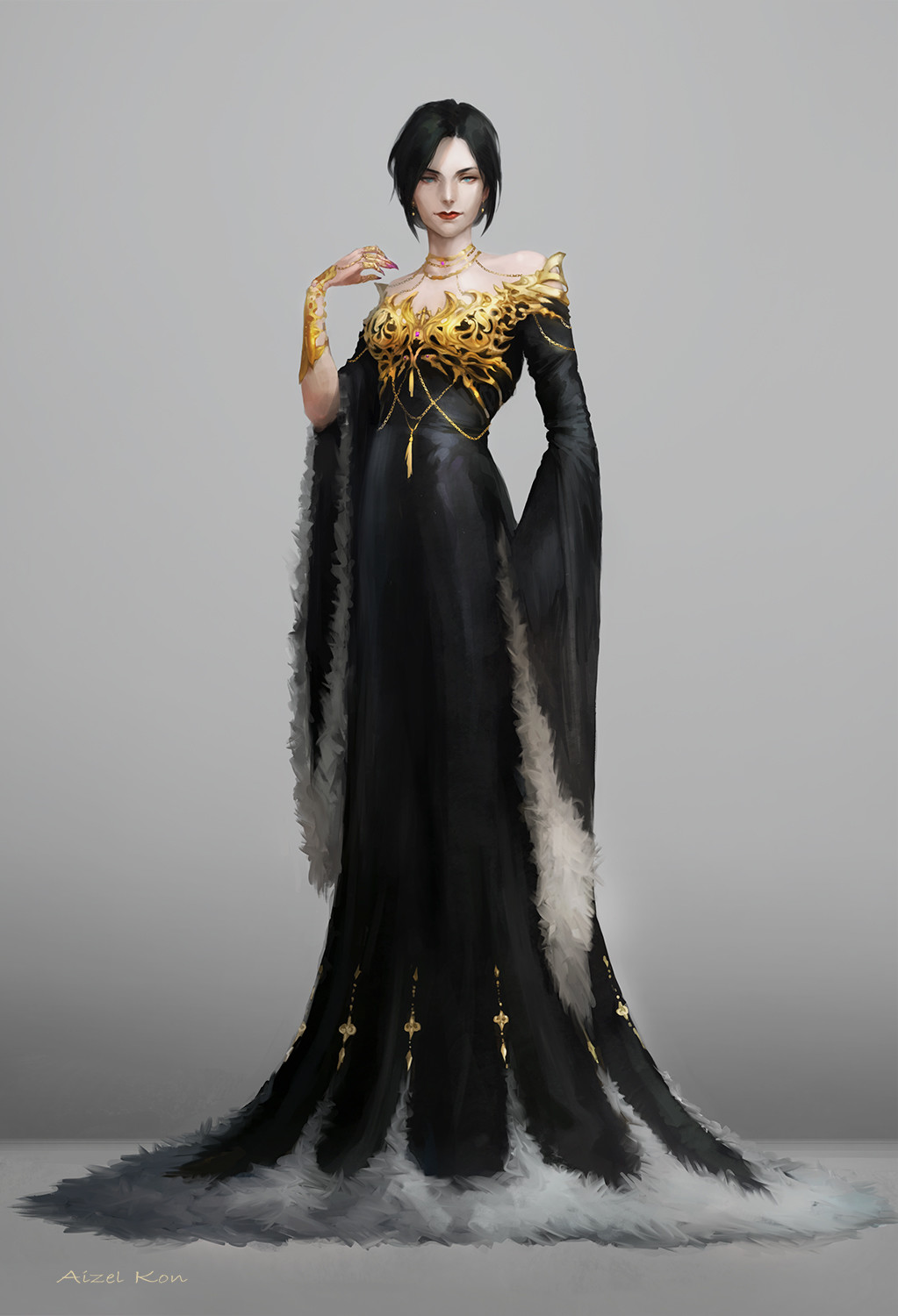
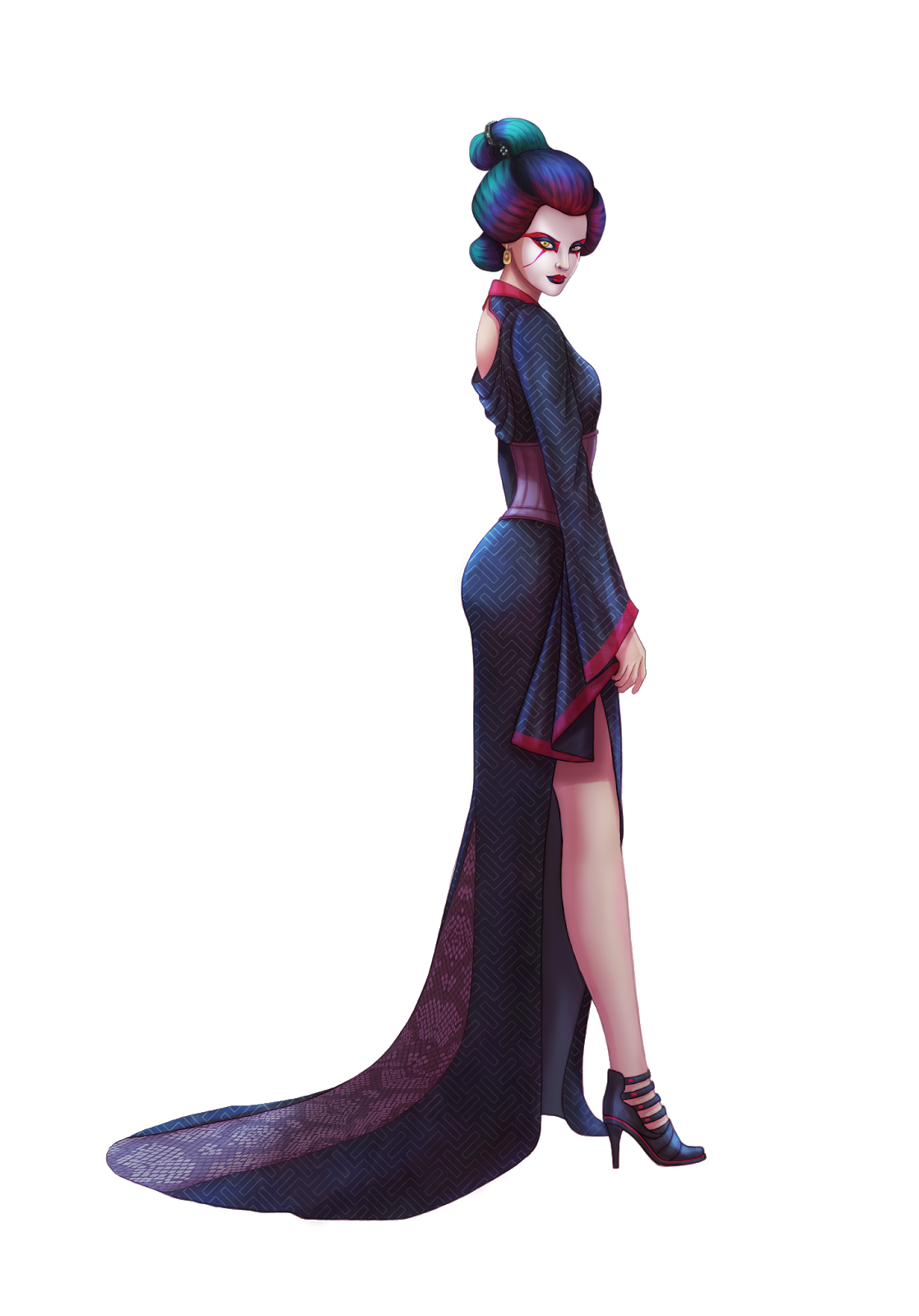
Responsive fabrics can ensure an exceedingly tight fit, fashionable on the streets of Denjuku, but the royalty prefer to keep their garments flowing. Royal ladies like long, impractical trains or skirts that part on one side to reveal their legs (the most recent fashion shows a lot of leg). Shinjurai ladies wear gowns of sheer, silken material, reminiscent of a cross between a kimono and an evening gown; they prefer deep, dark colors that contrast with their pale faces, but the material often has a shimmering sheen to it. Increasingly, in contrast with the rather immodest bottom half or the dress, the top-half has become increasingly tight and modest up front: Shinjurai ladies rarely bare cleavage except, perhaps, via a keyhole, and often have the garment reach all the way to their jawline with a slim, form-fitting “collar” or “choker” on the neck. They may bare the shoulders, though often wear long gloves, and may bear some of their back.
Shinjurai lords somewhat more closely resemble Maradonian nobility with a layer of form-fitting battleweave (or nuweave) between their skin and their clothing. Like the ladies, this garment usually reaches up to the jawline and has the same dark sheen. Over the top of the protective garment, men will wear something reminiscent of a business suit with a jacket and no shirt, leaving the jacket open to reveal the nuweave-covered expanse of their well-honed chests, or they’ll wear something similar to a military uniform, often in white: a broad-shouldered jacket and pleated slacks; the cut of the “Shinjurai military uniform” sets itself apart from the Maradonian officer’s uniform, with cleaner lines and a distinct lack of baroque clutter; observers compare it to the Imperial officer’s uniform, though the Shinjurai will note that the Empire imitated the Shinjurai uniform, not the other way around. Finally, while training or engaging in slow, physical meditative kata, the Shinjurai lord and lady both typically dispense with everything but their protective nuweave garment and a set of leggins so loose that they resemble skirts.
Shinjurai royals typically have silken black hair. Ladies wear their hair in ornate, elaborate styles that typically require several dedicated stylists at least an hour to arrange. Examples might include complex arrangements of their hair pinned jeweled and silver ornaments reminiscent of ancient geisha, or a thick collections of braids streaked through with colored extensions and colorful wires or ribbons. Shinjurai ladies will sometimes keep a single, contrastinglock of their hair a vibrant color, such as bright red, deep purple or a briliant blue.
Shinjurai lords tend to keep their hair short, often cut to mere stubble around the sides of their head with the top longer, often teased out into a tousled arrangement of feathery black locks or curls, the sort of “I get out of bed looking like this” that takes an hour and three stylists to arrange. Men rarely color their hair except for the Renegade Prince, who almost never has the natural, traditional black, favoring brilliant reds, blues or purples, often a mixture of two, or one with some of his natural black. The men typically go clean shaven, except for a reigning king; as the Shinjurai say: “No beard, no king.”
In public appearances, the Shinjurai royal family alwayswear ceremonial make-up that resembles the make-up of ancient plays. They always whiten their faces (some will make a clear boundary between their head and the unmarked skin of their necks and jaws), while others will whiten the face and neck all the way down to the neckline of their clothing. They then usually apply color to their eyes and lips; traditionally this color is black, giving them a monochromatic look, but sometimes fashion permits other colors; this may be some bright red to contrast with the stark black and white, or it can be a vivid plumage of deep colors, matching the rainbow sheen of their dark outfits. Women tend to play up the design of their lips and eyes, while men will typically do little more than mark a thin portion of their lips in a dark color and highlight their eyes so they stand out while performing, but they mayinclude some riotous designs around the face, reminiscent of a highly geometric “warpaint.”
Shinjurai fashion changes relatively rapidly compared to the rest of the Galaxy, and even though the Shinjurai royal family changes fashion more slowly than the rest, they too change. Indeed, given their audience, even a subtle change in the royalty can create ripples across the fashion world, especially if the fashion change comes from the Aloof Princess or the Renegade Prince. Recent trends suggest that the younger Shinjurai royalty are beginning to embrace the immodesty of the street as they show more leg and more shoulder and their high heels begin to rise in height, or the younger lords emphasize their chiseled physique more.
After a long period of monocrome, the Shinjurai royal family has begin to embrace color more. Their clothing, still relatively sheer, often sports subtle geometric patterns on them that emphasize their technological nature. Both lord and ladies have begin to embrace “varicloth” designs that allow them to shift the color or patterns of their dress quickly, and more have “smart tattoos” embedded on their face, so they can will the patterns on their face to change, typically a simple “colored lips and eyes” pattern to an elaborate “sultry” or “beautiful” lips-and-eyes pattern, to a full plumage display of “warpaint” and they shift between these depending on the mood they want to express.
A few have begun to go further and resurrect a long-dead fashion for holographic displays: they’ll add a holographic belt and program it with a few abstract, symbolic patterns which surround them like an aura on command, billowing out with a gesture; they control these patterns with a “control glove” which looks like a skeletal framework of nanopolymers across one hand; even when not wearing the holo-belt, many royals find it fashionable to still wear the control-glove.
Finally, given the state of the Galaxy, after centuries of his absence, the Valiant Prince (or, given the nuanced nature of modern roles, the Valiant Princess) has made his reappearance. Wearing full military regalia has returned to fashion for the first time in centuries for the conquered people. This coincides with an increase in the Denjuku military production, ostensibly to assist with the Alliance war-effort. Some Maradonians find this alarming, and are silenced only by those who point out how badly the Alliance needs the advanced fighters and cruisers of Denjuku.
Royal Arts and Leisure
The Shinjurai royal family expresses itself creatively through more than just fashion. It also does so through fine arts. As Neo-Rationalists, the Shinjurai royal family believe that their pastimes should assist in the honing and training of their mind.
The royal family rarely plays gamesthe way Maradonian nobility do. When they do, they prefer games that require outwitting a worthyopponent. The royal family often play Mitava (Holo-Chess), especially when on camera discussing foreign affairs. They also take part in the pan-galactic mass-player strategy game, Strategem, where they tend to be among the top players.
The royal family knows how to dance after the Maradonian fashion, given how often they tend to be invited to an Alexian Waltz, but they have a dance of their own, theShinjurai Deep Flow. This involves slow, carefully controlled movement of their body that both emphasizes extremely fine control of the body and calming of the mind. The movements resemble martial art training, except far slower and more fluid, and the purpose of the movements aren’t martial. The original intention of the dance is long forgotten, but various moves have an “interpretive” symbolism to them that most Denjuku inhabitants know, but tend to be inscrutable to outsiders (if the GM wishes this form of dance to have mechanical benefits, the character can roll Danceas a complementary roll to Meditation, and characters can attempt to communicate with one another using Dancein place of Gestures, but communication is slower (a minute per roll to get across a concept) and is better for emotional content, such as “I love you but I am forbidden from saying so” rather than “Attack the three on the left, I’ll get the three on the right.”
The Shinjurai royal family often take up traditional Denjuku musical instruments, including the electric samisen, the Shinjurai autoharp (played with the autoharp on the ground, and plucked by the Shinjurai sitting next to it), a particular ancient form of synthesizer, and the traditional electric guitar. Their music tends to be slow and “ambient,” often attempting to achieve a disharmony to the point of sounding like an electronic equivalent to natural phenomenon (such as falling water or leaves flowing on the wind), but they often mingle this with a strong and obvious, if slow and sometimes ominous, beat.
Finally, some Shinjurai take up the art of holoprojection. The appropriateness of this comes and goes over time, but it has come in vogue again. The current fashion trends towards abstract symbolism, usually circular in design, that the Shinjurai can program into their holobelt, but some have begun creating stylized holosculptures of the Rationalist masters.
The Shinjurai Melodrama
“Nobody lies quite like the Shinjurai” – His Grace, Bale Grimshaw, Duke of the Ancestral Spur, Lord of the Shinjurai
Observers often use the words “docudrama” or “melodrama” to describe the behavior of Shinjurai royals, though this suggests that their life has more of a “soap opera” quality to it than it does. The Shinjurai royal family faces the constant attention of a ubiquitous media presence on Denjuku, and the pan-galactic hunger of the Shinjurai people to know more about the lives of the Shinjurai royal family. The Shinjurai royal family use this near constant coverage to weave propagandistic narratives that benefit them. While off-camera, they consult with their small army of media experts on how best to improve their image abroad, how to maintain audience interest, and how to get their preferred narrative across. The result crosses the understated subtlety and fine etiquette of an actual documentary or works like “Downton Abbey” with the pacing and interviews of reality programming.
Some outsiders point out the scripted nature of the supposedly “revealing and intimate” nature of these docudramas, but the populace who consume them understand this intuitively. They remain as interested in the manufactured drama as the real glimpses and flashes of what the Shinjurai royal family are like behind their make-up and beneath their assigned roles. Political experts and pundits also appreciate it, and slice apart major performances like a commentator on a sporting event, speculating on what message the royal family attempts to get across, or what aspects of the performance was scripted, improvised, or a mistaken flash of genuine personality.
This narrative invades every aspect of their lives and their interactions with other powers. Galactic leaders and powerful nobles who come to Denjuku find themselves folded into this narrative, and the wise ones “call ahead” to explain how they wish to be depicted. The royal family may or many not honor these requests, depending on relations between both sides.
For example, suppose Duke Bale Grimshaw requests a formal meeting with King Hoto Shinjurai to discuss a proposed bill on the Senate floor regarding a major purchase order of the lastest Syntech fighter, the Raptor, to counter the rising threat of the Imperial Tempest-class fighter. He adamantly demands this not be turned into a major spectacle and that he not be turned into “a villain,” noting the importance of good relations between the Shinjurai and the rest of the Alliance. Hoto agrees, and proposes a simple dinner with the family, and requests the Bale bring his protege, Bastian Grimshaw, to meet his daughter, the “Aloof Princess” Mina Shinjurai. Bale agrees.
The holovids begin with the the King greeting the Duke in a grand, if politically uninteresting, ceremony. We next see them quietly discussing the specifics of the proposal while playing Mitava. They keep their discussion subdued, and the political commentators talk over them during the broadcast, discussing the King’s holo-chess strategy (he seems to be playing for stalemate) as well as the content of their discussion: the Duke seems concerned about the increasing militarization of Denjuku, and while the King seems interested in discussing the jobs that the order will bring, as well as the importance of involving Denjuku in the war effort, not only because of its technological excellence, but to help the Denjuku people feel more like they’re part of the Alliance.
At the dinner, the Grimshaws find themselves swarmed by floating holo-cameras, though the royal Shinei prevent journalists from bothering the Grimshaw nobles. Nonetheless, all the cameras get a good shot of Mina Shinjurai, in a long gown and tall heels, on the arm of Bastian Grimshaw. When he says something inaudible to her, she seems to break character as the aloof princess, giggles, lowers her face and smiles shyly.
At the dinner, Bale sits to Hoto’s right hand; beside him sits Kayko Shinjurai, the Innovative Princess, who, after a discussion of a recent, memorable match of Strategem between the two of them, peppers him with softball questions about the debated purchase order meant to emphasize the prowess and capabilities of the new Raptor fighter.
Then the cameras swing to a late-comer, Riona Shinjurai, the “renegade princess” wearing a short, tight-fighting black dress, with knee-high boots and long, riotously colored hair. She sways a little on her feet, as though drink, and then grins impishly at the camera. She goes and pushes Kayko aside and takes the seat next to Bale, who scowls sensing a trap. Confirming his suspicions, soon Riona peppers him with questions about an Alliance military scandal that recently dominated Denjuku news, about a major Alliance defeat, and another about abuses of power by the Alliance in the Rogue Stars. She asks the questions in such a way to simply highlight these problems, and doesn’t respond to the Duke’s answers, merely shifts to the next scandal, her grin widening each time. Mina interrupts her, criticizing not the content of her questions, but the rudeness of asking them, as well as highlighting her drunkenness.
They soon begin to argue in increasing crescendo until, Bale, fed up with everything, unintentionally exerts his electrokinesis and the lights momentarily dim (the media exaggerates this to a total black-out with dramatic sparks for a few seconds during the actual broadcast). Hoto then interrupts the two girls and declares “Enough.” He looks to Riona and orders her to depart. He then looks to Mina, who bows her head and apologizes to the Duke in a clear sign of submission, then she excuses herself.
Outside the dining hall, Mina and Riona continue their argument, though Riona turns the discussion away from politics and to the personal by suggesting that Mina has her pro-alliance stance not out of duty or honor, but out of a desire for an intimate relationship with the handsome, but very Maradonian, Bastian Grimshaw. Mina breaks character and slaps Riona, whose smart tattoos suddenly lose their color and return Riona to her normal features. She again breaks the fourth wall and looks directly at the camera in shock. The filming of the scene immediately ends.
Later in the day, an interview with Mina, once more prim and poised as befits her station, broadcasts. She announces the good news that Bale has agreed to the acquisition, in a “win” for Denjuku industries. She also announces that she has agreed to attend a session of the Alliance senate to represent Denjuku’s commitment to the war effort, and sadly announces that Riona has gone into a “temporary retreat” to meditate and refocus on her own behavior. The interviewer pointedly does not ask about the relationship between Bastian Grimshaw and Mina, nor about the incident between her and Riona.
Political commentators later speculate that the King allowed Riona to question Bale both to emphasize that Denjuku couldsell their Raptors to the Empire instead, pressuring Bale to support the purchase order. Her use of recent scandals acknowledged the recent doubt the Denjuku populace have had about their interaction with the Alliance, but by behaving drunkenly and being called out for rudeness by Mina distances the royal family from these statements. They remain divided on what the purpose of the exchange between Riona and Mina afterwords was; their best guess was to underline the two sides of the debate and how the Shinjurai family see all aspects of it, as well as teasing the Alliance about a closer bond between the Shinjurai and house Grimshaw by marrying Mina to Bastian, and making it sound higher-cost than it was. They remain divided as to whether the slap was scripted or a genuine expression of real rage by Mina; if the latter, they also cannot agree whether Mina has real feelings towards Bastian, or if she resents her expected role of dutifully submitting as wife to a Grimshaw.
Intelligence experts within the Alliance do not believe for a moment that Riona is “on retreat,” but that she has been dispatched to the Empire to see what their counter-bid to the Alliance would be.
Playing as Shinjurai Royalty
The following rules represent unique exceptions for playing as Shinjurai Royalty.
Optional Rules: Persona and Expanded Roles
GURPS Social Engineering discusses Cultivating a Personaon page 61; in principle, the Shinjurai dedicate their lives to cultivating powerful, memetic personas. The following rules are entirely optional, as most of the reasons for Shinjurai personas go beyond the scope of the rules and into narrative concerns, but if you want to give their personas additional mechanical teeth and perhaps more deeply explore the concept of personas, use the following rules.
To exploit the persona rules, the character must have spent years cultivating one. Treat this as a Shinjurai Persona perk, which much be specialized by role. This perk represents an “opt in” on the Cultivating a Personarules. To “take on” the persona, the character must roll Acting+5 or Performance+3 or IQ. They may add +1 if they have any levels of Appearance with the “Shinjurai Proprietary” limitation, and +1 if they have a level of Fashion Sense and wear an outfit appropriate to their circumstances. Success grants them a +1 to reaction rolls, influence rolls, and Propagandarolls for the rest of the scene, provided these fall within the confines of their given role, and they do not violate the strictures of their roles.
At the GM’s discretion, Shinjurai Personamay be leveled; in this case, the characteradd their levelof Shinjurai Persona to reaction rolls and influence rolls after a successful persona roll providedthey are influencing a specific subset of people: either characters with the Believer (Neo-Rationalism) quirk or a specific subset of people equivalent to the reaction bonus from a Talent. For anyone else, they get the normal +1 reaction bonus.
The GM may also allow a Nuanced Shinjurai Persona. This is not leveled. It represents a character with an unusual take on a specific role (such as a female version of a male role), or a character with multiple roles, with the Nunaced Persona representing an alternative from their main role. In all cases, the roll for taking on your persona suffers a -2; if you succeed, you gain a +2 to reactions, influence rolls and Propaganda rolls (as people find your nuanced persona more exciting and interesting), or a -2 if the roll fails (as people react poorly to your unorthodox approach).
Some Shinjurai royals so completelyinhabit their role that they develop an odd form of Schizophrenia where they come to apply a certain reality to their role, and a distance from their “real self.” Treat this as either Split Personality(if the role simply bubbles up uncontrollably) or Controllable Disadvantage (Split Personality)they can so completely get into character that they lose who they were. In both cases, the rules for these traits supersedethe above rules for taking on your persona, but while manifestingyour split personality, you get the same benefits of a successful persona roll.
Shinjurai Personas and Communion
Observant readers may note a synchronicity between Shinjurai personas and the Paths of Communion. The Shinjurai royalty are not psionic and thus cannot access Communion, but that does not mean that their actions do not unconsciously shape Communion, or that they’re not shaped by it.
At the GM’s discretion, Persona rules can replaceor supplement the Legendary Reputation of Paths. In both cases, a Persona, while maintained, adds its Reaction bonus to Communion for that specific path only. This represents the persona shaping mass, subconsciousness to the point where Communion itself reacts. The GM might allow third parties to benefit from Shinjurai ceremonies, adding the reaction bonus to a Communion roll by a character that seeks to harness the latent power of those unconscious rituals. If so, Denjuku is an extremely interesting world for Templars and Tyrants, and priests and priestesses of the Divine Masks might also use similar rules and have their own Personatraits.
Expanded Personas
If using the optional persona rules, the following rules expand the personas to include the typical minimum for appearance levels, what Talent they imitate with multiple levels of Persona for the purposes of a Reaction bonus, what disadvantages they tend to simulate while in their persona (or that they would have while in the grips of a Split Personality) and for what Path, if any, they act asthe equivalent to Legendary Reptuation.
The Aloof Princess
Female Persona
Minimum Appearance: Very Beautiful
Simulated Talent: Choose one of Antiquary or Poet
Simulated Disadvantages: Callous [-5]; Intolerance (Irrational Philosophies) [-5]; No Sense of Humor [-10]; Squeamish [-10];
Path: The Bound Princess
The Genius Prince
Male Persona
Minimum Appearance: Attractive
Simulated Talent: Choose one of Intuitive Statesman or Natural Scientist
Simulated Disadvantages: Odious Personal Habit (Pedantic or Smug) [-5]; Truthfulness [-5*]; Workaholic [-5].
The Innovative Princess
Female Persona
Minimum Appearance: Attractive;
Simulated Talent: Mathematical Ability
Simulated Disadvantages: Chummy [-5]; Klutz [-5]; Trickster [-15*]
The Princess Mother
Female Persona
Minimum Appearance: Beautiful;
Simulated Talent: Good Wife
Simulated Disadvantages: Charitable [-15*]; Hidebound [-5]; Sense of Duty (Children) [-10].
The Renegade Prince
Male Persona
Minimum Appearance: Very Handsome
Simulated Talent: Choose one of Born Entertainer, Street-Smart or Tough Guy
Simulated Disadvantages: Compulsive Carousing [-5*]; Gluttony [-5*]; Impulsive [-10]: Laziness [-10]; Lecherousness [-15*];
Path: Choose one of The Beautiful Fool or the Rebellious Beast.
The Valiant Prince
Male Persona
Minimum Appearance: Handsome
Simulated Talent: Born Warleader
Simulated Disadvantages: Callous [-5*]; Delusion (“Carefully applied violence can solve anything”) [-5]; Overconfidence [-5*]
Path: The Righteous Crusader.
Unique Shinjurai Traits
Appearance (Shinjurai Proprietary -25%) [varies]: The “Shinjurai Proprietary” limitation represents a variant of the Off-the-Shelf limitation to appearance. The Shinjurai character is obviously beautiful in a way that other Shinjurai often are. People who have seen a great deal of Shinjurai royalty (Maradonian aristocracy and some Imperial Officials) halve the reaction modifiers unlessthey have a deep emotional connection with the ideaof Shinjurai royalty (typical of characters with Believer (Neo-Rationalism)) who will treat them as celebrities and thus are impacted by the full reaction bonus of the appearance modifiers. Characters with this limitation also automatically count as though they had the Classic Features (Shinjurai)perk.
Controlled Disadvantage (Split Personality) [1]: The character has so integrated into their role that they have the ability to switch personalities into their role. This new personality should have some or all of the disadvantages listed in their role, and may have the talent listed in their role! If using the Optionalpersona rules, switching to this personality automaticallygives them the benefits of a successful persona roll.
Nuanced Shinjurai Persona [1]:Optional. This perk allows the character to use the optionalshinjurai persona rules (see above) with the Nuancedoption. This operates like the normal Shinjurai Persona perk, but represents a unique take. The character may change one or more aspects of their chosen role (the gender, a disadvantage or two, the simulated talent, etc), or represent a second or third persona atop their main persona. Rolls to don this persona are at -2, but a successful roll applies a +2 to reaction modifiers and influence rolls, rather than a +1, while a failure applies a -2 to reaction modifiers and influence rolls. This must be specialized, and cannot be levelled.
Shinjurai Persona [1]: Optional. This perk allows the character to use the optionalshinjurai persona rules (see above). The must specialize by role, and at the GM’s discretion, this trait may be leveled (up to 4 levels). Every level beyond the first adds an additional +1 to their reaction rolls and influence rolls for a specific group, as though they had a specific talent appropriate to the role.
Shinjurai Royal Training[1]:This perk is a variation of Cutting Edge Training (Shinjurai Tech). They may use TL 12 Syntech or Shinjurai Royal technology at no penalty!
Split Personality [-15*]:This represents the disadvantageous form of Controllable Disadvantage (Split Personality) above. The Shinjurai has so internalized their role that it has driven them mad, and they can no longer control switches between their role and their “true” self. When the role-personality is active, the character automatically gains the benefits of their Persona ifyou’re using the optional persona rules. The split personality often has the listed disadvantages and talent for their role.
Taboo Traits (Genetic Defects, Unattractiveness) [0]: No one bornas Shinjurai can have genetic defects or look unattractive. See Biotech p. 65.




 Mailanka's Musing