
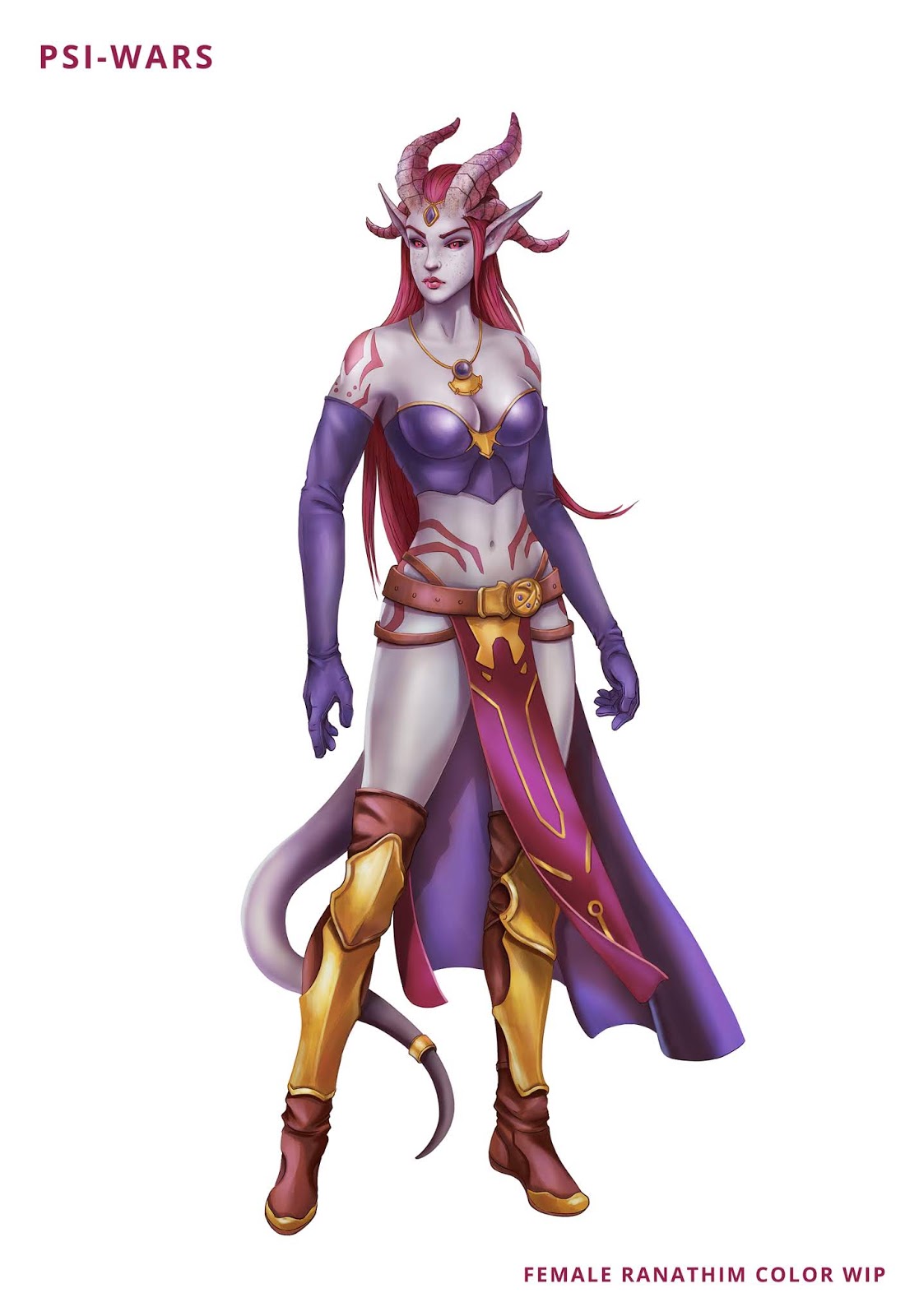
The Mithanna, the Ranathim Peerage

Ranathim Female
Drawn by Kriz Villacis, owned by Daniel Dover

This continues the discussion of the Lithian Aristocracy of the Umbral Rim, this time with an explicit focus on the ancient remnant aristocracy from the ancient, bygone Ranathim Tyranny, and their oath-bound nobles who linger on, thanks to their unique bond with Dark Communion.  This also presents new character options, similar to the Maradonian Nobility, but much cut down on detail and complexity, with a unique set of disadvantages that will ensure their gameplay is never particularly boring.

For additional context, see the Ranathim race here, and the worlds of the Umbral Rim here.

For all Fellow Travelers ($3+ patrons), the Rare Psionic Powers preview has been updated to include a rough draft of Animal Telepathy.

The Mithanna, the Ranathim Peerage

Ozamathim ralek ti”
“Ozamanthim commands it” -Mithanna saying

When Ozamanthim ruled the Tyranny, he bound the most powerful land- and slave-owners of a world to him via a powerful oath. He offered them a chance to join him in his ambitions: they would swear an oath to him, and he would use the power of that oath to ensure their financial and political success. As long as they remained loyal to him, their power was assured. Most agreed and, in so doing, cemented their bloodlines and their worlds to his Tyranny, and also unknowingly ensured their wealth and success across time. This became known as the Mithna Ralekum, the Mithna Edict.

The Edict worked. Millennia after the fall of the Tyranny, these Ranathim bloodlines continue to reap the benefits of their oaths. Despite the political maneuvering of their opponents, members of these families manage to come out on top, over and over again, favored by luck and good fortune. However, as time progresses, they remain bond to the strictures of their oaths, even as the rest of the world moves on, which means they’re often forced to engage in strange behaviors to honor century’s dead laws that retain a real, metaphysical weight for them.

Today, the Mithanna, or the Peerage, the closest thing the Ranathim still have to an aristocracy, remain a powerful and conservative force within the Umbral Rim. Pinned by their oaths to the laws of a long dead tyrant, they use their power and influence to shape law and society to make it easier for they and their kin to remain true to their ancient oaths. Their long interbreeding has forged bloodlines of more-Ranathim-than-Ranathim scions with unique psychic potency and strange new powers. The rest of the Umbral Rim eyes them with suspicion and speaks of them quietly: the ways of the Mithanna are strange and seemingly mercurial, and those who face them in the wrong way can end up defeated by occult powers he doesn’t understand. However, those who have studied the Mithanna for a long time have learned to use the framework of their laws against them, to force them into alliances, or to rip them apart by forcing them to violate their oaths.

The Mithna Edict

To understand the Mithanna, one must understand the Mithna Edict. These oaths bound the Mithanna to Ozamanthim in one of the first well-published examples of “Oath Communion” in the Umbral Rim. The Mithna Edict carries on through the bloodline, one of the earliest known examples of “Generic Communion.” Traditionally, the Mithannaceremonially induct a scion of their bloodline and have him or her repeat the vows of their ancestor, but bastard offspring or lost offshoots of the family have been found having never taken the oaths and yet bear the full consequences of their broken oaths upon them.

Those who follow remain true to their Mithna Edict have access to a superior form of luck that benefits them whenever they seek to advance themselves politically or economically, or whenever they engage in the protection of their domain, or defense of their honor. Overtime, it has bled into other Communion powers, granting them limited miracles woven into the very fabric of their DNA. Those who violate these oaths find themselves cursed by the rage of Dark Communion.

The only means the Mithanna have found to escape their oaths have been to either forsake Dark Communion entirely for True Communion, or to join the Cult of the Mystical Tyrant thus become Tyrants themselves. In both cases, the characters must buy off their Curseand lose their oath magics (including the Mithna Edict).

The Mithna Edict itself consists of several specific oaths. Taken together, they are Code of Honor (Mithna Edict)[-15]. The oaths include the following commands:

  • Obey the commands of Ozamanthim.
  • Never betray or harm the Mystical Tyrant, his servants or his descendants.

  • Honor and protect your assigned domain.

  • Honor your oaths.

  • Submit only to the Tyrant.

The deeper implications of the Mithna Edicts tend to require substantial knowledge and study, and Dark Communion itself ultimately arbitrates what is and what is not a violation of these oaths, and its verdicts often seem arbitrary, though those who have studied Law (Tyrannic)have a pretty good grasp of what is and what isn’t a violation.

Too many widespread violations of the Mithna oaths can be infections. Members of the Mithna in good “legal” standing can still find the curse of violating the Edict weighing upon them not because of what they did, but because of what the rest of their house has down. Too many violations can create a cascade effect, where curses begin to proliferate until the house as a whole is unable to maintain their oaths as a whole and the whole structure implodes dramatically. Over the millennia since the fall of the Ozamanthim Tyranny, many clans have fallen in this way, and only a handful remain today.

Obey the commands of Ozamanthim.”

This law specifically refers to Ozamanthim and causes the greatest headache to the Mithanna. It means that the Mithanna must rigidly follow the unchanging laws of a long dead tyrant. Characters may roll Law (Tyrannic) to know if their actions would violate the law and result in the loss of their power. The Mithanna need only follow these laws to the letter, not to the spirit. In practice, the GM can (and should) enforce strange and arbitrary behaviors on the Mithanna at least once per session (or hit them with a -3 during a scene, if invoking the Ham Clause, representing the difficulty of following an action while also fulfilling some arbitrary occult law.

Never betray or harm the Mystical Tyrant, his servants or his descendants.”

Ozamanthim intended for the Mithanna to obey and protect his lineage. In practice, though, the Cult of the Mystical Tyrant have effectively hijacked the Ozamanthim legacy. The Mithanna cannot directly oppose the actions of a Cultist of the Mystical Tyrant or their direct servants. This means the Mithanna cannot directly oppose Emperor Valorian either, much to their chagrin, but the penumbra of his influence only extends to his Imperial Knights and similarly “in the know” servants that answer directly to the Emperor, rather than his soldiers, warships, diplomats and etc.

The Mithanna only need obey the heirs of the Ozamanthim legacy if their edicts are lawful and legitimate in the eyes of Dark Communion. This requires either the restoration of a descendant of Ozamanthim upon the proper throne (most suspect this will only “take” if the new Tyrant sits on the throne of the now destroyed Stygia, making this impossible, but some quietly hope that the new Tyrant on Sarai will be “good enough”), but the GM might allow followers of the Path of the Mystical Tyrant to command a member of the Mithanna as a Minor Blessing miracle, or create a lasting “legal precedent” with a Miraculous Power miracle.

Honor and protect your assigned domain.”

Each Mithna, or “Clan,” was given a single world to rule, a specific estate as their own, and an aspect of the Tyrannic government to control and watch over. The Mithna may not explicitly betray these things, nor abandon them. A member of a Mithna may leave their world, to be sure, but if their world falls into a state of excessive disrepair, or all members of the Mithna were to depart, they break their oath. Furthermore, if a Mithna is given guardianship over, for example, the farmlands of the Tyranny, they could not actively destroy those farmlands.

In practice, though, this oath tends to benefit the Mithanna. They may directly invoke their Edict powers to guard and protect their domain, or for any action at all (as long as it does not directly violate their oaths) while on their domain world.

Honor your oaths.”

If a member of the Mithanna gives his word, the Edict compels him to honor it. If he violates his word, he violates the Edict, and the Edict retaliates. Thus, people know they can trust the word of the Mithanna. However in practice this only applies to the letter, not the spirit, of a promise. As a result, many Mithanna learn to carefully avoid absolutes, to couch their promises in language that gives them room to maneuver, or time-boxe the promise. They’ve also learned to not make promises for the whole of their Mithna, or that might extend extremely far in time, forcing their descendants to honor an ancient grudge or promise. This does not always succeed, however, and some of the odder Mithanna behavior comes from ancient, ill-conceived promises.

Submit to none but the Tyrant.”

Second only to their prime oath, this oath causes the Mithanna no end of headaches, and often proves the one great weakness their enemies prey upon. The specifics vary, but in principle, the Mithanna may “submit” to Ozamanthim, his heirs (which means the Cult of the Mystical Tyrant), a designated proxy (which generally means the legitimate leadership of the Mithna, for few other designated presentatives of Ozamanthim’s authority remain), but not to anyone else, including Imperial soldiers, slavers, Templars, or various powers that have risen and fallen since.

“Submit” in this context includes declarations of fealty or allegiance, but it also means accepting insult or “dishonor” from others. This means that even a conquered member of the Mithanna cannot surrender without violating their edict. This also means that to insult a member of the Mithanna means instant and terrible reprisal unless one is their direct superior within the Mithna’s organization or a member of the Cult of the Mystical Tyrant.

If so insulted, the Mithanna can wipe the dishonor with the immediate apology of the insulter, or their death. This cultivates a dueling culture among the Mithanna, but this creates its own problem, because willful surrender or allowing someone to slay a beloved kinsman itselfis a form of submission that violates the Mithna edict. This means that an insult, even an unintentional one, can lead to a bloody feud that lasts generations until the origins of the feud have been forgotten and those engaging in the feud know that they kill one another only to satisfy the broken logic of the Mithna Edict.

Those with a deep understanding of how the Mithanna work tend to carefully approach the matter of submission, especially during conquest or after a duel. Clever victors have learned to approach the practically defeated Mithanna with flowery words and proposals of alliance, rather than submission, creating a fiction of the Mithanna as partner, rather than conquered subject. This usually allows the Mithanna to submit in practice, if not in name. This can be handled with an appropriate Savoir-Faire and Diplomacy roll.

The truly defeated or, worse, enslaved, become unable to access the powers of their Mithna Edict. Some Slavers take a great deal of pride in making slaves of the Mithanna, not only to humiliate one of the haughty and powerful, but to watch in amusement as the curse levied on them by Dark Communion plays out. Ironically, it often acts to prevent any form of escape or restoration of glory without heroic, outside intervention, which can mean that once so enslaved, the slave needs little oversight, as Dark Communion will keep him or her enslaved as punishment for their failure.

Mithna Titles and Names.

The Mithna tend to use traditional titles, as opposed to the newer titles of the rest of the Umbral Rim. The standard title for a member of a Mithna in good standing is Thamara(“Master”, sometimes translated as “Baron”) and is worth +1 status, though some prefer the title of Satemo (“Knight”), also worth a +1 to Status. More powerful members of the Mithnause the the title Thamet(“Lord,” sometimes translated as “Count”), and is worth +2 to +3 Status. The ultimate rulers of a Mithnause the title Shef Thamet (“High Lord,” sometimes translated as “Duke.”), always worth a +3 in Status. If the Mithna also rules over a world directly, such as the case for Mithna Adivasta, they take on the title Mierastra(literally “King” though usually translated as “Prince” in this context); this is always worth +4 in status.

Member of a Mithna prefer to be referred to by their title, their given name and then their Mithnaname, such as “Thamet Shan Galiantim.” Outsiders often mistakenly refer to a member of a Mithnawith the title “Mithna,” and most members of a Mithnawill tolerate this.

Mithna Dueling

When members of a Mithna is insulted by another member of a Mithna, they mustattempt to remove this stain of dishonor or violate their edict. Dark Communion accepts the killing of the other as sufficient recompense to immediately remove the stain of dishonor, but this can lead to cycles of reprisals, so the Mithannahave created a ceremonial form of dueling using neurolance batons or glaives. The point of such a duel is to inflict sufficient pain on the opponent to force him to submit, at which point a flowery set of apology or proclamations are exchanged between the opponents to ensure that sufficient honor is retained between both participants that the Edict is not broken.

The duel continues until one side calls out for relief; roll Willpenalized by the pain the character is suffering to resist calling out for relief after every strike of the lash (with a +3 if the character has High Pain Threshold). The defeated party must make an apology; this requires a Savoir-Faireroll (penalized by cultural familiarity if the character is unfamiliar with Lithian culture). On a failure, the character has violated their Mithna Edict and suffer appropriately. If neither character will relent, or the defeated character refuses to apologize, then the duel is to the death, or the refusing character is slain out of hand.

Most Mithanna estates have a “dueling room,” pit set into the ground in a highly ceremonial, ritualistic ground. Most such dueling pits have surprise traps, such as razors or spikes set in the floor or walls, a shifting ground, or neuro-lash armed walls. These help keep the fight interesting for the audience, and ensures that the duelists spill enough blood and suffer enough to satisfy Dark Communion.

Treat this as a variation of Neuroblade Dueling.

Playing as one of the Mithna

All members of a Mithna must choose the Mithna to which they belong, and take the following traits: Mithna (Mithna Name) [1], Classic Look (Pure Ranathim) [1], Mithna Edict [12]. They may additionally choose from additional traits associated with their Mithna

The Mithna(Mithna Name) grants the character access to the Mithna Edict trait, and additional Mithna traits, depending on the bloodline they selected. It also grants access, after character creation, to specific psionic abilities, as noted in the Mithna.Finally, it grants them the equivalent of path regalia symbolwith a single Dark Communion Path and a Broken Communion path, but at the cost of an anti-symbolfor the path of the Mystical Tyrant, preventing them from using its powers effectively.

The Classic Look (Pure Ranathim) perk grants them one increased level of appearance for anyone who specifically likes Ranathim features. It represents the tendency for members of a Mithna to appear “more Ranathim than Ranathim.”

Finally, they gain the Mithna Edict metatrait:

Mithna Edict

12points

Once per hour, the character may elect to reroll any roll twice more and take the best roll, providedthe roll pertains to the character’s wealth, prestige and social power or to the protection of their domain orto preserve their honor orthey’re on their homeworld (as defined by their Mithna’s domain). It might help him win a duel, avoid a scandal by slipping out of a bedroom unseen, with any Wealth rolls, or to impress another lord, but wouldn’t help him heal a fallen comrade or fix his repulsor-bike. It will neverhelp him violate his oath. Once per game session, the character can, instead of rerolling, dictatethe result of his roll as per super-luck; this exhausts all further uses of rerolls for the rest of the session.

This power is the result of an ancient, ancestral oath sworn to Ozamanthim. If the character should ever willfully or accidentally violate their oath, they lose their power.In addition, while he is in violation of his oath, he is Cursed.

Traits: Super Luck (Aspect, improve power, wealth and glory -20%; Dark Communion -10%; Nuisance Effect, once per game session rather than once per day -20%; Oath -15%) [35] + Luck (Aspect, improve power, wealth and glory -20%; Dark Communion -10%; Oath -15%) as alternate ability[2] + Cursed (Mitigator, Oath, -65%) [-25].

Violating and Honoring the Mithna Edict

All Mithna must honor their oath to Ozamanthim, even though he has been dead for centuries, or they suffer the wrath of Dark Communion. This means that failure to correctly navigate through a legal morass of a millennia dead tyrant can result in a character suffering a dread curse. However, the Mithanna aren’t without protection. All members of a Mithna have the core principles and ideas of the Edict drilled into their memory from birth, and thus know at least the basic violations profoundly well.

Furthermore, those born to a Mithna bloodline have an inherited psionic sense of the “shape” of the Edict like a pressure in their mind that informs them of their impending doom. If the character takes an action that would violate his oath, he may roll IQ. On a critical failure, nothing happens; on a failure, he gains an ominous sense of forboding that something he’s going to do will threaten his oath; on a success, he learns what specific action that he is undertaking will violate his edict (though not necessarily the reasons why), and on a critical success, he knows what action he was planning would violate his oath and why, and perhaps a hint as to what he should do instead.Only if he goes ahead and violates his oath anyway does this resultsin the immediate termination of their powers, and requires at leasta minor quest to restore, and suffers theCursedtrait.

Characters who take Law (Tyrannic) can use this roll in place of the IQ roll above, and can roll the skill to understand the deeper context of what law they risk violating and its finer nuance, so they might learn a way around it.

The GM can also allow the Mithanna’s player to roll IQ if a unique opportunity to honor their domain or oaths arises, something where the Mithna Edictwould assist them or that might help them regain their lost edict, should they have violated their oaths.

GMing the Mithna Edict

The Mithna Edict offers an opportunity for the GM to inject some weirdness into his campaign. The Mithna are aristocrats “out of time,” bind to the ancient ghosts of a long dead empire through unbreakable oaths. This helps convey the arbitrary “foreignness” of the Umbral Rim, as even its rulers tend to follow laws and commands that they don’t understand and barely remember. This presents a few pitfalls for GM and player.

First, coming up with a set of arbitrary rules with which to constrain your players requires constant creative energy on the part of the GM. An easier way to handle it might be to use the Ham Clause: once a session, the GM simply declares that the current circumstances binds and limits the actions of the character in such a way that they can still function, but at a -3 to all rolls for the remainder of the scene because they must observe certain niceties. The player can waive the penalty at any time, but doing so violates the Edict and immediately cancels their powers and inflicts the curse upon them.

Alternatively, the GM can create specific arbitrary edicts that will explicitly constrain the actions of the PC. The best such constraints present interesting obstacles or unique options to the PC, rather than arbitrarily kicking them out of the campaign. The best of such constraints simulate Duty, Dread, Compulsive Behaviors, Disciplines of Faith (Ritualism) and small scale Vows. Unless you wish to introduce long-standing constraints, consider limiting them in time and location: a particular constraint only happens currently, or while on this specific, backwater world, and during the rest of the adventure, the PC will face different obstacles. This means the player gets to look forward to unique limitations that change over the course of the adventure, depending on the context in which they are in.

Be careful to avoid arbitrarily punishing the player. Ozamanthim or his heirs may have issued a long forgotten edict that a member of the Mithna could just stumble over by accident without realizing their error and thus the GM could legitimately spring “You broke your oath!” upon the player. This is technicallypossible, but most players will not enjoy it. Realize, instead, that the Mithna have been encountering these problems for centuries and have catalogedall of them rigorously and taught their children how to avoid them. A member of a Mithna should always have a sense of what they can and cannot do, and so if they come to a place, or reach a point in time, where they’re under the constraints of a specific and knownedict, the GM should inform them. If they come under the constraints of an unknown edict, they should always get a chance to roll IQ to avoid violating the edict; they may not know whythe edict’s constraint exists or what its purpose originally was, and this can serve as the impetus for an interesting investigation into the ancient past, but they should never have their powers arbitrarily stripped from them unlessthey were not raised as a member of the Mithna. 

 The long lost scions of these ancient clans often don’t know anything about the Mithna Edict. If a player chooses to play as a Ranathim with a Secret Advantage and the GM selects the Mithna Edict as their secret advantage, they should feel free to pile the cursed traits on, until the player realizes what’s going on (ideally when they encounter another Mithna who explains it all to them), as this represents the central clue to the mystery of their secret advantage.

Examples of Ozamanthim’s Laws

If you’re looking for inspiration for examples of the sort of problems the Mithanna face, consider one of the following:

Sanctuary: Ozamanthim declared a specific and celebrated temple on this world to be a haven from violence. He held a great parley here, and declared that the ban on violence remained “forever after.” Today, the temple is a ruin, or has been co-opted for some other purpose, but within the confines of the original boundaries of the temple, the Mithanna may not engage in violence against any other character. This might be a well-known local fact (Area Knowledge) or an interesting historical curiosity (History), and if there is a strong local Mithnapresence, people might use it as a way to escape their wrath.

The Forbidden Spice: A spice (or drug or alcohol) native to this world was forbidden by Ozamanthim: none may possess it, nor taste of it. In the subsequent millennia, this prohibition fell away, but the Mithanna remain bound by it. To touch it or to taste of it violates their oath. The spice has become relatively wide-spread across the planet, and some have even learned that the Mithna dislike it, and use it as a weapon against them. The Mithna can also restore their Edict by enforcing the law of Ozamanthim and slaying those he finds in possession of the spice, including those that may have used it against him in the first place. The danger this spice poses to Mithna may be well-known locally.

The Festival of Silence: Ozamanthin declared a day of mourning that recurs once every so many years. The ancient cycle has been forgotten, but he commanded all Mithanna to honor the day of the mourning. The Mithanna must perform some act to remember the fallen (place a coin or an offering on an appropriate grave site, or light a candle, etc), and must remain silent and unspeaking for the whole day. The GM can introduce some variations, depending on who the honored person was (or if this is even remembered, though for such a declaration, it must have been someone important, such as the death of a beloved member of the royal family, or a day honoring the fallen of the Monolith Wars). The specific acts forbidden can vary too, such as requiring a fast from sunup to sundown.

The Seal of Ozamanthim: Ozamanthim created a specific set of seals, physical constructions of extraordinarily durable material that are difficult to forge. The bearer had the right to command one of the Mithna in the name of Ozamanthim, though usually only in a specific way. Typically, the messenger bearing the seal could summon the Mithna to the throne of Ozamanthim, rally them for war, or demand that they execute the judgment of Ozamanthim (typically the execution of the condemned). These seals still exist and Dark Communion still enforces these edicts. If a character bearing a genuineseal of Ozamanthim uses the right forms (which requires a Savoir-Faire (High Society)roll, apply a familiarity penalty if the character is unfamiliar with the ancient rituals of the original Tyrannic courts; the Mithna are alwaysfamiliar with this!) they mayrequest a specific favor from the Mithna. Treat this as a one-time Duty. If the roll fails, or the character makes what Dark Communion deems to be an unreasonable request (a request that Ozamanthim never would have made), not only is the Mithna not obligated to fulfill the request, but they may invoke the Mithna Edict when dispatching the imposter. Some con-artists use Forgeryto create a false seal; it is alwaysa violation of the Mithna Edict to accept the commands of the bearer of a forged seal. The Mithna can roll Connoisseur (Relics)or Archaeologyto inspect the seal, and they can, as always, roll IQ to sense the impending violation of the Mithna Edict.

Obey the Forms: The Mithna were often obligated to observe very specific forms when undertaking formal actions, such as attending court or engaging in a duel. A non-Mithna can invoke these forms, such as introducing a social event under the auspices of an ancient courtly ritual, or challenge the Mithna to a formal duel; what matters here is that the Mithna is suddenly bound and constrained by rules and formalities that his opponents aren’t (the Mithna themselves can and often do invoke these forms too, but then all involved are equally bound). This requires a Savoir-Faire (High Society)roll with the normal familiarity penalties; if successful this gives the Mithna a -3 to all rolls for the scene that his opponents can exploit. Depending on the context (and always in the case of a duel), if the Mithna is forced to observe the forms and everyone else isn’t, then he can invoke his Mithna edict to “win,” so while he may be hampered by the formality of his actions, luck and chance begin to play in his favor.

Forbidden Secrets:Ozamanthim declared a certain, specific set of knowledge to be secret, for “National Security” or to protect the “Dignity of the Tyrannic Dynasty.” When the Mithna encounters this knowledge, they may freely learn it and give that knowledge to others bound by the Mithna Edict, they may even act on it, but they may not divulge it to anyone outsideof the Mithna Edict, nor may they act in a way that would reveal it to everyone. This compulsion only prevents the Mithna from actively revealing the secret, it does not punish the Mithna if someone learns the secret on their own. The nature of these secrets are such that most Mithna don’t know they’re guarded until they learn the secret (unless told explicitly so by another Mithna who also knows the secret). Here, the IQ roll is key to being aware that what they’re about to say will violate the edict.

Star-Crossed Lovers: Ozamanthim cared a great deal about maintaining the integrity of his line and to prevent pretenders or politically powerful marital unions from arising. While he never arranged marriages after the fashion of the Akashic Order, he did forbid particular unions, and he tended to do so in sweeping, generational terms. Most of the minor nobles and lineages have forgotten their aristocratic origins but sometimes, a member of a Mithna will fall in love with another Ranathim, only to discover that he is forbidden from a romantic entanglement with them. Dark Communion regards explicit marriage, romantic consummation, or even a kiss as a clear violation, and even frowns upon excessive touching. There are some ways around this law, but they tend to be most unsavory, and create tense, romantic complications that often lead to horrifically tragic love affairs. Many Mithna suggest arranged marriages, or avoiding loveat all costs.

The Right of Dominion:Not every demand of the Edict is a great burden for the Mithna to bear. Ozamanthim gave unto his Mithna certain monopolies, the exclusive right to trade or own a particular substance or parcel of land. Most Mithna still retain that land or those monopolies, but sometimes they encounter forgotten examples of them, such as lost and ancient Tyrannic ships that technically fall under their command, or conquered worlds that had originally been given to them. When a Mithna encounters such a thing, they may roll IQ to detect their unique relationship with it, and may invoke the Mithna Edict in all rolls to reclaim their property or to defeat those who would stand in their way.

The Condemned Man: The punishment for treachery in the Tyranny was not just death, but the death of a bloodline: you and your kin and your descendants all suffered under the condemnation of the Tyrant. Many Ranathim thought this metaphorical, but the Mithna know better. Sometimes, they encounter a lost descendant of a secret branch of one of these condemned bloodlines. They’re not obligatedto destroy them, but they may roll IQ to detect their condemned status, they may invoke the Mithna Edict to kill them, and those who have violated their oaths have their oaths restored if they slay the condemned. Some forward-thinking Mithna like to collect these condemned and keep them in dungeons; if one of their number violates their oaths, they can bring out the condemned and allow the oath breaker to restore their honor by slaying the condemned.

Other Mithna-Related Traits

Characters with the Mithna Edict may use Law (Tyrannic)to have knowledge about the Laws of the Tyranny. Characters may roll against it to learn if an expected course of action would violate the Edict, or what specific adjustments to an action would allow them to undertake a specific action without violating a law, or how they might go about restoring their Edict. Characters may also roll History (Tyrannic) to know the historical context of a specific edict.

Dreams of the Edict [1]: When you sleep, sometimes Dark Communion speaks to you, and shows you visions of the Will of the Edict. These may warn against certain actions, but more often show unique opportunities to honor their domain.  Treat this as Visions (Aspected, Dreams) [1].

Legal Immunity (Mithna) [5]: Some Mithna, such as House Khalli, have a special relationship with the Empire. They have dispensation to ignore the laws of the Valorian Empire (which extends sufficiently far throughout space that you may ignore most laws in the Galaxy, but not within the Alliance or the Cybernetic Union), but you are still subject to the direct commands of Emperor Ren Valorian, and to the laws of the Mithna Edict.

Mithna Contract Lawyer [1]: The Mithna mustkeep their promises, but need only stick to the letter of their promises. The GM should neverpunish a player for a poorly worded promise if he’s taken this perk, but should instead assume that the characteris far more clever at their wording than the player. Furthermore, characters with this trait may replace Fast-Talkwith Law (Tyrannic)for rolls that would trick another character into believing that the Mithna promised something other than what they actually promised.

Serendipity: The player can always use one use of generic Serendipity to manipulate the Edict. They can either expend it to create an exception or to lessen the difficulty of overcoming a specific constraint of the Edict, or to request a beneficial event in regards to the Edict (such as encountering a Condemned Manor something associated with their Right of Dominion). All members of a Mithna may also purchase a unique form of Serendipity:

Serendipity (Mithna Edict -35%) [10]: This variation of Serendipity has the same constraints as the Mithna Edict: it only works so long as the character is true to their oaths, and only works to benefit their wealth, power, ambition or the honoring of their domain. Rather than improve their roll, it can create beneficial circumstances. It can also be used as generic Serendipity (see above) when it comes to fortunate coincidences surrounding the Mithna Edict itself.

Will of the Edict [1]:When rolling IQ when in danger of violating the Mithna edict, treat all success levels as one level higher (Critical failure gives an ominous sense of foreboding, success gives the specifics of what the violation will be) while critical success informs the character of the best route they can take to avoid the specific constraint, or even turn it to their advantage.

Code of Honor (Mithna Edict) [-15]: Members of a Mithnaaren’t requiredto take this code of honor, but many do. Those without should try to live up to the spirit of the Edict, and attempting to find some clever way to undermine or circumvent their limitations violates their Code of Honor.

Enemy (Rival Mithna lineage, 6 or less) [-5]: The character’s family or lineage within larger Mithnahas managed to accumulate blood rivalry with another lineage. This can only be resolved with a long series of highly formal duels, but often regrettably breaks down into outright violence. On a 6 or less, the character either finds himself confronted with a member of this lineage or finds that he risks violating his Mithna Edictif he does not soon seek out a member of this lineage to defeat in a duel or kill. Blood rivals like this often seek to undermine the other politically and economically as well as face on the dueling floor. As a bonus, any time the character has violated their Mithna Edict, the death or defeat of a member of the rival bloodline is sufficient to immediately restore their Mithna Edict.

The Mithna Bloodlines

In addition to the Mithna Edict, members of a Mithna have access to additional Dark Communion miracles powered by the same oath as their Mithna Edict: characters may optionallypurchase these abilities, but lose them if they violate their oaths until such time as they restore their oaths.

Furthermore, all Mithna have a domain assigned to them by the Tyrant. They may use their Mithna Edictpower to improve any aspect of honoring or protecting their domain, but they mustn’t knowingly violate or harm their domain.

Finally, all Mithna have some latent psionics in their bloodline. This allows them to buy a single ability after character creation from the right psionic power, but notthe talent! That said, characters of these bloodlines oftenhave the talent for their particular psionic power.

Mithna Adivasta

Domain: Moros; the gaunt and all necrocraftingtechnology.

Hereditary Estate: Witha ga Hiten

Path Symbolism: The Rebellious Beast(Dark Communion) and Death(Broken Communion)

Additional Oath Magic:

  • Thanatologist (Dark Communion -10%; Mithna Edict -15%) [4/level]

  • Unstoppable (Mithna Edict -10%) [16]

  • Dark Glory (Mithna Edict -10%) [40]

Latent Adivasta Psionic Abilities:Concealing Shadow (Pyramid #3/99 p. 11) [1]; Corspe Sense (Pyramid #3/99 p. 5) 1-4 [26 to 63], Corpse Whisperer (Pyramid #3/99 p. 11) [1]; Necrocontrol 1-3 (Pyramid #3/99 p. 6) [30 to 50], Necrocraft 1-10 [2/level]; Shadow Control 1-3 [11/level]; Shadowplay (Pyramid #3/99 p. 11) [1]

Additional Traits: Controllable Disadvantage (Callous) [1]; Good with Gaunts [1];Obscure True Name [1];Quick Gadgeteer (Necrocraft only, -80%) [10]; Resist Disease +3 or +8 [3 or 5], Technological Secret (Synthetic Flesh) [1]

Additional Skills: Area Knowledge (Moros or The Shroud constellation) both (E) IQ+1 [2]; Connoisseur (Necrocrated Technology) (A) IQ [2]; Expert Skill (Thanatology) (H) IQ-1 [2]; Surgery (H) IQ-1 [2]; Weird Science (VH) IQ-2 [2]

Additional Disadvantages: Callous [-5]; Curious [-5*]; Odious Personal Habit (Morbid Humor) [-5]

Moros has long been a beacon of both hope and fear to the denizens of the Umbral Rim. When Ozamanthim’s forces first came to Moros, they found it already inhabited by the Ranathim Death Cult, and by legions of miserable, sickly slaves. The owners of those slaves happily took the Mithna Oaths on and become Mithna Adivasta.

Today, Mithna Adivasta has the dubious honor of remaining the only truly sovereign Mithna. As nobody else wants to deal with the horrifying plague-world, they happily retain control over it. They balance the competing interests of Domen Lashafra, the Ranathim Death Cult, and Domen Venalina, the cult of Sin-Eaters, while also managing a swelling population of the sick and desperate, and their own growing population of Gaunts.

For their part, the denizens of Moros fear their overlords, who all reside in a sprawling industrial complex located in the polar regions of the world. Known as Witha ga Hiten, literally “the House of Pain,” this complex contains the largest concentration of ancient necrocrafting technology in the Galaxy, rivaling the capabilities of the semi-legendary Tarvagant. In truth, most of that technology has collapsed into disrepair, but members of the house do what they can to maintain the technology, and they have more resources to build or repair any of the ancient necrocrafted technologies of the Ranathim tyranny, which often requires experimentation with fairly fresh cadavers, pliable Gaunts, or even living, screaming slaves. Indeed, their long exposure to the technology has granted them an affinity with the dead, and many have gained access to lesser Necrokinesis abilities.

When one encounters a scion of Mithna Adivasta away from Moros, they generally either represent their clan’s interest to other parties, or they seek to guard or protect (or command) a local Gaunt population, or they seek to salvage technology that will help them repair their lost technologies and restore Witha ga Hiten to its former glory.

The scions of Mithna Adivastatend to be impressively tall, with dark, silken hair and snow-white skin. Their pale irises contrast with the blacks of their eyes, and seem to have a numinous glow about them. Their claws, horns and sometimes even teeth gleam with a glossy blackness.

Mithna Galantim

Domain: Hekatomb; the hunting grounds, parks and beasts of the Tyranny.

Hereditary Estate: Saurunadi Zakon

Path Symbolism: The Devourer (Dark Communion) and the Other (Broken Communion)

Additional Oath Magic:

  • Stalker (Dark Communion -10%; Mithna Edict -15%) [4/level]

  • Terrain Adaption (Dark Communion 10%; Mithna Edict -15%) [4]

  • Hunter’s Eyes (Mithna Edict -15%) [4]

Latent Psionic Abilities:Animal Empathy 1-4 [1 to 8]; Beast Link 1-3 [17/level]; Call of the Wild [1]; Controllable (Frightens Animals) [1]; Good with (Animal) [1]; Pet [1]; Rider Within 1-4 [8 to 26].

Additional Traits:Brave [1]; Fearlessness or Unfazeable [2/level or 15]; Penetrating Voice [1], Replace Striker (Horns; Crushing; Weak -50%, Limited Arc, Straight Ahead -40%) [1] with Striker (Horns; Crushing) [5] for +4 points

Additional Skills: Animal Handling (Ranathim Clade, Hekatomb, or Xeno-Fera) all(A) IQ [2], Area Knowledge (Hekatomb, the Corvus Constellation, or the Morass) (E) IQ+1 [2], Survival (Any) (A) Per [2].

Additional Disadvantages:Bloodlust [-10*], Easy to Read [-10], Loner [-5*]

Mithna Galantimruled Hekatomb before its conquest by Ozamanthim, and they ruled it after. They agreed to preserve the land as a proving ground for the Tyrant and his kin, and a means of punishing traitors. They also spread out throughout the Tyranny, lending their mastery of beasts and primal, untamed land to those who would conquer wild new worlds, and brought their wild monstrosities with them for the wars against the Monolith.

Today, Mithna Galantimremains on Hekatomb, where they have reached an accord with the Slavers to retain their autonomy and their right to hunt those who try to despoil the savage beauty of the world, and in return they provide sport and spectacle for the Slaver gladiatorial rings. Their seat of power and ceremony remains in their crumbling, ancestral castle-complex, Saurunadi Zakon, the Hunting Grounds, which resides in the heart of the darkest jungle on Hekatomb, its aging spires barely visible above the canopy of trees. To reach it requires not just finding one’s way past the jungles, but also defeating the many beasts that the Galantimhave bound to their estate.

The scions of Mithna Galantim range farther afield than most other Mithna. One can expect to find one of their kinsman in the wilds of nearly any world, from the savannas of Sarai to oceans of Samsara to, most excitingly for members of the Mithna, the wilds of the Morass in the Sylvan Spiral. The Mithna has a tradition of affording honor and respect to those who manage to prove themselves in new, untamed worlds, and return to tell the tale.

The scions of Mithna Galantimhave coarse, rugged features: their hair falls in thick manes, their eyes shine a wolfish gold, their teeth seem longer and more feral than other Ranathim, and their horns bulkier and thicker.

Mithna Khalli

Domain: Samsara; the subject races of the Ranathim tyranny (who must be both made to know their place, and who must be kept safe from bigotry or invasion).

Hereditary Estate: Jetuni Zakon

Path Symbolism: The Beautiful Fool (Dark Communion) and Madness (Broken Communion)

Additional Oath Magic:

  • Tough Guy (Dark Communion -10%; Mithna Edict -10%) [4/level]

  • Dark Charisma (Mithna Edict -10%) [11]

  • Sense Passion ( Mithna Edict -10%) [45]

Latent Psionic Abilities:Aspect 1-4 [4/level]; Auric Squint (Pyramid #3/69, p6) [1]; Emotion Control 1-4 [10 to 30]; Instill Terror 1-4 [18 to 27]; Intimidation Factor (PP 63) [1], Mind-Clouding 1-5 [6/level]; Presence(Pyramid #3/69, p7) [1]

Additional Traits: Improve Racial Appearance (Attractive) to Appearance (Beautiful) [8] or Very Beautiful [12]; Cultural Adaptability [10], Extreme Sexual Dimorphism [1]; Language (Galactic Common; Any) [varies]; Language Talent [10]; Legal Immunity (Mithna) [5];

Additional Skills: Area Knowledge (Samsara or the Hydrus Constellation) both (E) IQ+1 [2]; Merchant (A) IQ [2]; Savoir-Faire (Mafia) (E) IQ+1 [2]; Streetwise (A) IQ [2], Swimming (E) DX+1 [2]

Additional Disadvantages:Addiction (any) [Varies]; Greed [-15*]; Xenophilia [-10*]

Rare for a Mithna, Mithna Khalli were native to Styx, rather than to its current domain of Samsara. They agreed to serve as Ozamanthim’s secret police. When Ozamanthim “liberated” the Hydrus constellation from the Eldoth, they migrated their holdings from the Ranathim homeworld to their new estate on the crossroads of the Umbral Rim. There, theywatched over the subjugated population, handled and protected the inquisitors of the Tyranny and personally ferreted out conspiracies against his reign. This seems to have given Mithna Khallisome leniency in regards to their oaths, as they seem able to violate the laws of the Tyrant in the pursuit of some greater conspiracy.

Today, they exploit their stranglehold on the lines of trade in and out of the Umbral Rim. They have a hand in nearly all criminal transactions and smuggling operations on Samsara. This often brings them into conflict with the Templars of the Dark Vigil and the as-of-yet uncorrupted elements of the Empire that technicallyrules the world. The latter often fail to understand why the Empire gives these specific Ranathim special dispensation on their world, but most people suspect a secret alliance between the Emperor and the Khalli, as his closest advisors and agents often command members of the clan during their operations on the world.

They exert their influence and control from Jetuni Zakon, literally “the Floating Castle,” a great, city-sized barge that slowly wends its way around the oceans of Samsara. Jetuni Zakon brims with casinos, cantinas, brothels and slaves; by the Emperor’s dispensation, Jetuni Zakon falls outside of normal imperial law, which means that slavery islegal within the confines of the city-barge, and thus those who want to get a safe taste of what the deeper Umbral Rim looks like often explore the estate of Mithna Khalli, though many an imperial may be shocked to find that Mithna Khalli uses its special dispensation to ensare and keep human slaves on their estate, and that there’s nothing the imperial can do about it.

Despite their ease at integrating with alien populations, the scions of Mithna Khallileave Samsara rarely and cautiously. Their natural and bounteous beauty makes them popular targets for slavers, and if they should fall to slavery, their Edict dooms them to an eternity of dishonor and misery. When they do, however, they often do so to secure resources for their great, floating city-barge (especially slaves from the Slavers), to discuss the “alliance” between Mithna Khalli and the Valorian Empire, or to negotiate with other Mithna.

The scions of Mithna Khallitend to be extremely“gendered,” their females tend to be extremely busty and curvy, and their males tend to be broad-shouldered and well-endowed, both moreso than most Ranathim. This sometimes leads humans to mistake them for slaves or courtesans, which can earn the swift death of the unfortunate human. They tend to have either deeply crimson skin and white, silken hair, or paler skin and crimson, silken hair. Their eyes tend to be vividly colorful, and their claws, fangs and horns less pronounced.
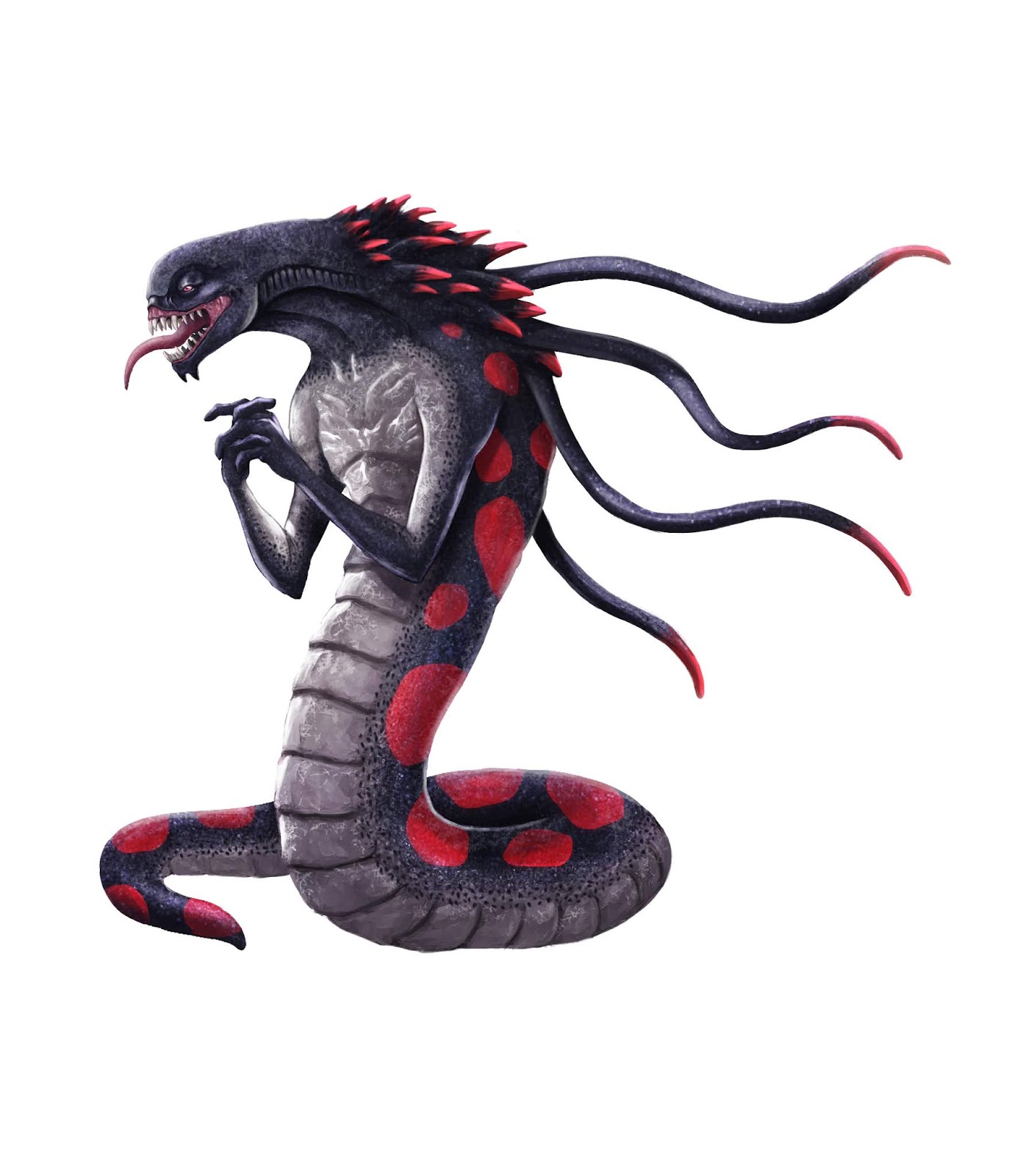
The Lithian Aristocracy

Slaver;
Drawn by Kriz Villacis, owned by Daniel Dover

The winner for the “Template of the Month” turned out to be the Aristocratic background lens, which came as no real surprise.  I had hoped to also get a template done, but that looks to not be in the cards, as working out aristocratic elements took up a lot of time. I did a later snap poll for which aristocracies people wanted to see worked out, and the Shinjurai royalty won, but “Ranathim Aristocrats” did better than I expected.

Everything even touching the Umbral Rim needs special attention to emphasize how foreign and unique it is, while still retaining a measure of cohesiveness.  In many ways, the Umbral Rim is the “dark mirror” of the Glorian Rim, so just as the Maradonian Houses have a great deal of detail, so too do the nobles of the Umbral Rim need some additional detail and cultural context, especially when it comes to their titles, given the shared “Lithian” language between the inhabitants of that part of the galaxy.

This is the first part of a two part series.  Today, we look at the state of “aristocracy” withing the Umbral Rim today, dominated as it is by warlords, potentates, slavers and criminal cartels.  This mostly looks at titles and how they tend to get used.  Tomorrow, we’ll dive into explicit Ranathim aristocrats who have lineages that date back to the Ranathim Tyranny and how they have maintained their power over the intervening centuries since their empire fell.

Lithian Aristocracy

In contrast to the well-defined titles of the Glorian Rim, the Umbral Rim has an anarchic collection of systems, honors and titles. The most common and well-used system are Lithian titles, from the bygone era of the Ranathim Tyranny, when their mystical tyrants entrenched certain offices and honors into the culture of the Umbral Rim. Back then, the Tyrant could give someone a title and the populace respected and honored that title. Today, these titles are mostly empty words.

No “fixed” aristocracy exists within the Umbral Rim. With a few highly notable exceptions, no ancient lineages trail back to the bygone days of the Ranathim Tyranny with their ancestral titles. Instead, minor potentates and warlords rule a single world or a handful of star systems and take on an ancient title to bolster their legitimacy. These titles matter less than the actual power of the man wearing the title. Nonetheless, those who claim and keepespecially prestigious titles tend to impress the populace around them and thus gain additional ascribed(rather than imputedstatus).

The notable exception are the Mithanna, or the Peerage. In the ancestral days of Ozamanthim, he gathered about him a few powerful families, or Mithna (“Peers” or a “House”) and bound them into his service with Dark Communion oaths. These demanded the fealty of the Mithna, but offered in return real power in both a physical and metaphysical sense. Those who violated their oaths found their riches and favors vanish as Dark Communion punished them, but those that kept their oaths flourished. These oaths and their power passed from generation to generation, and the Mithannaremain remarkably powerful and influential to this day. They are the closest the Ranathim have to a true aristocracy, but they retain their position not due to a respect for tradition, but because their oaths have given their ancestors and themselves considerable wealth and power, thus cementing their rulership over the worlds around them.

Lithian Titles

In the Umbral Rim, anyone can claim a title. If they can convince enough people to use the title, then it sticks and the rest of high society begins to refer to them by this title. In a few cases, especially on the recently liberated world of Sarai, a powerful ruler will bestow titles upon especially useful servants and require all their subjects to honor the title. As with all aristocratic titles, these titles are Courtesy Titles [1]with no real weight, but offer a +1 reaction modifier to anyone impressed by titles, and the opportunity to purchase additional Ascribedstatus. In the case of Lithian titles, to claim the title, the character must purchasea minimum ascribed status and may purchase a maximum ascribed status; use the beststatus of all listed titles.

Lithian titles precede the character’s name (when used thus, the first name is usually dropped), or can be used in place of the character’s name; eg “Presenting Thamet Metria”.

Minor Titles

Ganjithim
President, Financier, Merchant Prince

Ascribed Status:+0 to +2

This is a relatively new title, borrowed from a term meaning the heads of prestigious financial institutions, trading institutions. Modern members of the Lithian culture use the to refer to the heads of powerful corporations or Trader Guildfleets, and non-Ranathim often take it upon themselves when they rule a world or region of space primarily through economic means (or want to be seen as ruling through economic, rather than military, means). Slavers often take on this title.

Khaturim
Officer, Warlord

Ascribed Status:+0 to +2

The original tyranny gave this title to high-ranking military officers, and it remains a popular martial title. Powerful rulers might bestow the title onto their highest ranking knights or to their generals, while petty warlords or potentates often take it onto themselves.

Satemo

Knight or Ronin.

Ascribed Status:+0 to +1

A “Satemo” is any fighting man highly skilled in the force sword. This title is often given to elite bodyguards or agents. Ascribed statusdepends on who they serve. If they serve a reputable lord (of the Thametrank) this will be noted in their title.

Shefet or Shefem
Courtier, handmaiden

Ascribed Status:+0 to +1

Originally, this term referred to the ceremonial courtierswho performed a highly specific role in the ceremonial pageantry of the Cult of the Mystical Tyrant. Today, the title is generally bestowed upon especially important bureaucrats, courtiers or servants to a more powerful lord. Slavers often take on this title.

Thamara

Master, Mistress

Ascribed Status:+1

This ancient term once referred to anyone who owned a slave, though its use has changed over time, increasing to owning several slaves, or to owning an especially prestigious slave. Today, the term is more commonly associated with the Cult of the Mystical Tyrant and has thus become a bit of a taboo to use openly. When used, it generally refers exclusively to someone with a greatnumber of slaves, or a specifically unique and prestigious slave, in which case the additional context is given in the title, ie “Thamara of the 7thSlave Legion of Rath,” similar to the Maradonian “Lord” title. Non-Ranathim rarely take this title, though recently more Slavers have been adopting it.

Major Titles

Thamet
Lord, Lady

Ascribed Status:+1to +3

Literally “lord,” this title refers to actualaristocrats. Members of Mithna, or the Ranathim peerage, often take on the title, though rarely others might as well, or might have it bestowed upon them by a powerful ruler, though given the influence of the Mithna, most Lithians tread carefully with this title. It covers all the specific titles that the Glorian rim uses, and thus one cannot rely on the title alone to gauge how much prestige the Thametactually has. Unlike other titles, this is almost never taken on by non-Ranathim.

Fitrem or Fitres
Prince or Princess

Ascribed Status:+3

Literally “Prince” and “Princess,” these refer to heirs or children of a tyrant. It still sees this use on Sarai, but more recently, many have taken on the title if they rule a world or a few worlds, but do not wish to style themselves as kings. In such a chase, their children often gain the Thamettitle, usually with ascribed status 2. The children of a Shef Thamet or Mierastrafrom the Mithnamight also take this title.

Mierastra or Miashan
King or Queen

Ascribed Status:+4

The original tyrant styled himself Mierastra Lithe, but no modern ruler dares take on this name out of respect (and fear) of the Cult of the Mystical Tyrant (though some Lithians will quietly refer to Emperor Valorian as the Mierastra Lithe). Instead, powerful rulers or worlds or a series of worlds refer to themselves as simply “Mierastra.” Technically, Miashanrefers to the consort of the Mierastra, but powerful female rulers sometimes favor it over Mierastra. Sarai has a Mierastraand a Miashan, as does Moros.

Non-Titles

Denizens of the Umbral Rim often refer to certain people with titles that aren’t Courtesy Titles, but rather ranks, roles or a broader term. These terms can be used liketitles in the spoken word, but carry no additional ascribed status (but may have Social Regard).

Chiva: Priest.The rulers of cults and the practitioners of Ranathim healing arts are often referred to as Chiva.

Zathare: Warlock, sorcerer. Powerful practitioners or psychics might be referred to respectfully (or fearfully) as Zathare.

Mithna: Peer, House. The term Mithnais ancient, and refers to a family of those oathbound to Ozamanthim and his descendants. In return for their oaths, they gained a certain measure of power over Dark Communion that ensured their financial and political power. Collectively, they are referred to as the Mithanna. Lithian-speakers sometimes refer to a member of a Mithnawith the title Mithna, even though this technically incorrect (a modern colloqualism). They might also use the term Mithannato refer to a nebulous, secretive, conspiratorial force that ruins their lives, similar to real-world usages of “the Man.”

Patreon Post: House Tan-Shai, the Fifth House

Patrons of the Companion ($5+) and higher tier sometimes get to vote on some critical aspect of the Psi-Wars setting.  Nearly two years ago, they had the chance to vote on the “Fifth house.” The results were… unusual to say the least: a degenerate house elevated by the Mad Emperor, who opposed the Akashic Order, had anti-psionic powers, and followed a Broken Communion cult and sided with the Emperor; they were clearly the anti-Maradonian house!

Well, it’s taken me a lot of time, but House Tan-Shai, lords of the Arkhaian Spiral, are finally here.  Fellow Travellers ($3+ patrons) now have access to a preview of the house.  Enjoy!  As always, thank you to all of my patrons, and if you’re not a patron, you can always become one by hitting that button in the sidebar!

Psi-Wars Atlas III – The Glorian Rim

Before I dive into the post proper, a note on the navigational traits of galactic arms:
 

Default Navigation Modifier: +0

30,0000 parsecs (100,000 lightyears); curved. It takes about 5 months to go from the point where the galactic arm meets the galactic core, to the very end of it with a rating 1 drive. Crossing the galaxy from the tip of one arm to the tip of another arm typically takes 1 year with a rating 1 drive.

The Glorian Rim

Default Navigation Modifier: +0

The Glorain Rim gave birth to the galaxy’s current rulers: humanity. Its worlds nurtured their rise and today, houses the last remnants of the Galactic Federation: the Alliance. Thus, its occupants are primarily human. The Glorian Rim’s ancient traditions dateback to the dawn of human space travel, and the most prestigious of aristocratic houses trace their roots to its worlds. It houses one of the few major powers in the Galaxy that can pose a reasonable threats to the Empire in the form of its alliance of psychic aristocracy and free worlds, which means it faces the constant threat of invasion from the Valorian Empire.

The Glorian Constellations include:

  • The Maelstrom: the swirling hyperspatial storm churned by a pulsar that guards the entrance of the Arm
  • The Ancestral Spur: The homeworlds of humanity
  • The Golden Belt: The most fertile worlds of the Glorian Rim
  • The Rogue Stars: Scattered stars on the edge of the rim; a hive of scum and villany.

A Note on Labyrinthine Worlds

Some worlds in the Glorian and Sylvan Rim are “labyrinthine,” which means their cores died millennia ago and some ancient race riddled the world with endless tunnels and passageways. Persephone is the most famous of labyrinthine worlds; the symbolic caverns of the Akashic Mysteries imitate the labyrinthine passages beneath Persephone, where the first oracles of the Akashic Mysteries first encountered the Devils of Persephone and mastered the art of peering through deep time. However, other such labyrinthine worlds exist, scattered throughout space and, some say, are fundamentally connected to one another somehow. Those who navigate the labyrinths can, according to this legend, travel from one labyrinthine world to another without ever leaving the labyrinth. Navigating a labyrinth is perilous; beyond the danger of becoming lost in its endless passages, traps protect secret chambers and monstrous creatures (like the devils of Persephone) roam their depths.

Other Labyrnthine worlds include:

  • Perspehone (Glorian Rim)
  • Caliban (Glorian Rim)
  • Exile (Glorian Rim)
  • Nehud (Sylvan Spiral)
  • Jotan (Sylvan Spiral)
  • Verdant (Sylvan Spiral)
  • Tho-Tan (Pheonix Super-Cluster)

The Glorian Constellations

The Maelstrom

Default Navigational Modifier: 2

Between the galactic core and the rest of the Glorian Rim lies “the Eye,” a massive and brilliantly bright pulsar whose rapid spin and violent magnetic field sends hyperspatial storms and electro-magnetic shockwaves throughout this region of space. This star’s storms squeezes the channel between the arm and the core, which prevented ancient alien empires from invading humanity’s, but also prevented humanity from conquering the rest of the galaxy until they mastered the Caliban system and thus gained passage to their destiny. Unlucky starships that fail to properly navigate the Malestrom find themselves scattered to strange stars or, worse, stranded in the Eye system itself, where the pulsar’s surging magnetic fields destroy their electrical systems before they can escape. House Kain shares the Maelstrom with House Sabine.

  • Caliban: Default Navigational Modifier: +1. This one star system offers reasonable passage through the Maelstrom. An ancient and mysterious alien citadel, the Hammer of Caliban, orbits the planet Caliban, and its presence seems to stabilize local hyperspatial storms and the influence of the Eye. The master of Caliban, the Archbaron Kain, wields some mastery over the Hammer’s inner workings and can activate its defense systems and a cannon sufficiently powerful to vaporize a dreadnought in a single shot. The world itself is labyrinthine, riddled with passages through its crust and core, and monstrous creatures stalk these passageways. The nobility of Caliban protect the planet’s inhabitants from its inner monsters, and journey into the depths of the planet as their right of passage.

  • Persephone: Default Navigational Modifier: (From within the Glorian Rim) +1; (From beyond the Glorian Rim) -2. This storm-swept, sacred world was among the first colonized by the Maradonian people. They settled its islands and mountains unaware of the devils that lurked in its labyrinthine depths. Their struggle to tame the world led to their psychic mastery of precognition and deep time and the creation of the Akashic Mysteries. Today, the planet serves as the heart of the Akashic Mysteries and the seat of the royal house Sabine.

The Ancestral Spur

Default Navigational Modifier: +0

Humanity originated somewhere on a spur of stars between the Glorian Rim and the Arkhaian Spiral. The oldest human-occupied worlds known to the Galaxy, thus, lie just within the Glorian Rim on a small collection of stars. An aura of history and importance surround these worlds, as every human in the galaxy traces their origin to at least one. Which of the worlds is the true origin of humanity remains a mystery. House Grimshaw and Daijin rule the worlds of the Ancestral Spur.

  • Maradon and Atrium: Default Navigational Modifier: +3. The the homeworld of the Maradon people and their Alexian dynasty. The war that led to its consolidation behind Alexus Rex left the world war-scarred and irradiated. In the long millennia since, most of the Maradonian people have since migrated away from their homeworld and to the stars they conquered. Desertification turned the once lush planet into a barren waste. The Maradoni Aristocracy does what it can to maintain the world, but today, they bury their dead in its necropoli and study its ruins to glean lost secrets. Its terraformed moon, Atrium, houses the Alliance Senate, and is the last remaining domain of House Daijin.

  • Denjuku: Default Navigational Modifier: +3. The home of the Shinjurai people still serves as the seat for the Shinjurai royal family, the ostensible rulers of the Shinjurai people. In fact, the planet was long ago conquered by the Alexian Dynasty and remains today under the thumb of House Grimshaw. The planet itself is a vibrant ecumenopolis, with every square meter of the world industrialized and tamed to the will of its science-minded populace. The result is endless sprawl of corporate skyscrapers, neon-lit shopping distracts, vast, industrial machinery and crime-riddled, gang-ruled slums.

  • Westerly: Default Navigational Modifier: +0. The traditional home of the Westerly people, the Westerly system is positively ancient. The prime colony seems to have been a world that, through over industrialization, created catastrophic global warming that melted its polar ice and sank the world beneath water. The three terraformed moons of Westerly remain heavily populated, and despite millennia of rule by Maradon aristocrats, remain a fractious and independent lot. Most archaeologists consider Westerly the origin point of all humanity.
  • Centaurus: Default Navigational Modifier: -1. This strange world orbits binary stars, and is home to a strange, alien fungus and psychic alien worms. The human colonization of the strange world seems positively ancient and, according to some studies, predates the colonization of even the Westerly system, but cannot possibly be the home of humanity, as the native fauna are genetically incompatible with humanity. This leads fringe archaeologists to speculate that human-kind’s true origin is on some even more remote star, perhaps nearly impossible to reach with hyperspace travel!

The Golden Belt

Default Navigational Modifier: +1

Alternate Name: The Midian Veil

This constellation of stars is newly formed and young yet, filled with verdant worlds lit by yellow stars and lush with greenery and fertile farmland. It serves as the “breadbasket” for the Glorian Rim and its farmers and craftsman rarely leave their beautiful homeworlds; when they do, they carry a reputation as naive bumpkins who have seen little in the galaxy beyond their own backyard.

The cluster lies in a thin nebula, the so named Midian Veil, and at its heart lies Midas, a yellow, super-giant proto-star still in the process of forming. Midas is the brightest star visible in the night sky of any of the worlds of the Golden Stars, and it lights up the whole of the Midian Veil, giving the night skies of its many worlds their famous golden auroras.

Numerous noble houses lay claim to the domains of the Golden Belt, but none more than House Sabine.

  • Arcadius: Default Navigational Modifier: -1. The vegetation of this world favor hues of gold and crimson, giving the world an appearance of eternal autumn. A great moon hangs in its night sky. A peculiar psychic presence lingers on the planet. Many locals report hauntings or strange dreams, and the children of Arcadius have a higher incidence of natural psychic ability ability than any other world in the Glorian Rim.

  • Sequoia: Default Navigational Modifier: +0. While no world can be truly said to be a “forest world,” Sequoia comes close! Enormous trees dominate its landscape creating vast and varied forests, from sun-lit and romantic glades to the deep terrors of the darkest, thorn-hedged thickets. It produces some of the finest survivalists of the Glorian Rim, and the Rangers of Sequoia often serve the alliance as commandos.

The Rogue Stars

Default Navigational Modifier: 1

Running along the edge of the Glorian Rim, near the Arkhaian Spiral or bordering the Galactic Fringe lie the most troublesome stars of the Glorian Rim. Here, the distance between stars grows great and resources become tight. Far from the centers of government in Atrium and the more civilized worlds of the Glorian Rim, asteroid miners, pirates and savage Westerly run amuk. Those worlds that bend knee to the Alliance still have a feral quality to them, for they know that if a band of marauders descend on their world, the Alliance will be unable to mount a reasonable defense until weeks have passed. Worse, those who let corporations or aristocrats onto their world soon find that the lack of Alliance oversight cuts both ways, and their new overlords can easily prove as tyrannical as the Empire that the Alliance claims to stand against, and their distance from the capitals of the Alliance mean that their cries for help often go unheard.

Only minor houses, such as House Harrow, rule the Rogue Stars, and rarely rise above the rank of Baron.

  • Sirocco: Default Navigational Modifier: –1. The badlands and harsh deserts of Sirocco make life for its inhabitants difficult. Those inhabitants break down into two broad groups. The Maradonian pioneers struggle to farm and mine the planet, and struggle under the brutal taxes imposed upon them by aristocratic overlords; those who manage to get ahead fear the raids of the planet’s other inhabitants, the Westerly natives who predate the arrival of the Maradonian interlopers, who have made their peace with the desert and learned to hide themselves out among the wilds. They hate House Harrow and all of the settlers he brought with him and wage a campaign of terror against those who would despoil its wilds.

  • Exile: Default Navigational Modifier: 3. This strange star is a hypervelocity star. Some event, perhaps the creation of the Eye of the Maelstrom, slung it from its original position in the galaxy at a breakneck speed, and in the thousands of years from that cataclysmic event, it has moved tens of thousands of lightyears towards the galactic fringe; in another millennium, it may find itself outside of the Galaxy itself. Ancient ruins similar in architecture and design to the Hammer of Caliban litter its surface, and strange monsters stalk its labyrinthine depths. It has but a tenuous connection to the rest of the Rogue Stars, but it also the beginnings of hyperspatial ties to the Pheonix super-cluster just beyond the rim of the Galaxy, making it an ideal stepping stone to the space beyond the stars. Pirates and smugglers brave enough to settle its surface use it as a base of operations to trade with both the Glorian Rim and the Pheonix super-cluster, but most don’t stay long, and claim that the planet can drive you mad. They point to the reaver tribes that lurk in its labyrinths and raid nearby systems as proof of this.

  • Bellatrix: Default Navigational Modifier: –1. The seat of House Harrow, the most powerful house of the Rogue Stars, and ruled by Count Vladimir Harrow himself. The dense fogs, tall mountain crags and thick, bramble-filled forests of the planet make it a most unwelcoming place, but the Count takes a very lax approach on law enforcement, provided he receives his cut. As such, Bellatrix has proven something of a capital for the Glorian’s rim criminal underbelly. It also serves as one of the few “back door” passage routes to the Arkhaian Spiral via a smuggler route to the star Altair.

House Kain Ancestor Veneration

Kusari Kain

Era: War of the Four Houses

True Destiny: The Faithful Hound

The Akashic Order struggled to integrate House Kain, and would have rather Alexus never elevated them in the first place, but when Kusari Kain slew Shio Daijin, the Akashic Order knew they had a legend they could work with.

The Akashic Order presents Kusari Kain as the exemplary member of House Kain. He subordinates himself to the will of the Order and the other nobility. He sees his place as a knight, rather than a lord. He hunts the enemies of the Akashic Order and the Alliance with ruthless, machinelike efficiency. He knows his place, as the weapon of the Alliance.

Those who have the Destiny (Faithful Hound) can expect to hunt down the enemies of the Alliance, slay them, and to never die while in direct service to the Alliance, no matter how grievously wounded.

Legacy

Kusari Kain worked tirelessly to hunt down the enemies of the old Eternal Empire, and that drive to preserve the power of the nobility with devoted, violent service, remains in his descendants to this day.

Descendents who follow Kusari Kain must take the Obsession (Slay the enemies of the Alliance) [-10].

Milestones

The descendant is spiritually troubled. In his wandering, he meets a wise master, who assists him in overcoming his spiritual trouble. The descendant swears undying loyalty to the wise master.

A great enemy threatens the boon companion or wise master of the descendant while the descendant is away. The descendant must abandon his current quest, allies and friends to rescue his boon companion or wise master. He returns to find much of the Boon Companion or wise master’s property destroyed, but is able to rescue them.

The descendant realizes that to succeed at his quest, he will need a legendary artifact. However, none presents itself, but his wise master directs him to several places where he can collect fragments of an artifact and then he returns with them, and reforges them into a new legendary artifact, which becomes his signature item.

The wise master, having been betrayed by a traitor, sees how that treachery threatens the stability of his domain and the stability of the galaxy. He commands the descendant to hunt down and kill the traitor. The descendant agrees, and arrives at wrongfully acquired stronghold of the traitor to find a small army arrayed against them. He kill them all, and then executes the traitor.

The wise master unrighteously commands the descendant to hunt down and kill a good man. The good man, when confronted, refuses to fight back and instead offers an explanation for his actions and reveals the unrighteousness of the wise master’s request. The descendant chooses to follow his master’s command and slays the good man.

Associated Miracles

Kainian Grit

Minimum Reaction: Neutral

Learned Prerequisite: Blood Purity 1, either Communion 4 or Archetype.

Learned Prayer Cost: 3.

The Descendant pursues his prey with ruthless efficiency. He gains Tough Guy 3 for one hour or until it has assisted him at least once, which ever takes longer. This talent is cumulative with any existing talent, and may exceed +4.

Statistics: Tough Guy 3 (Divine, Path -15%) [13], Rule Exception (This talent may exceed +4) [1]

Divine Hunter

Minimum Reaction: Neutral

Learned Prerequisite: Blood Purity 1, Communion 4 or Archetype.

Learned Prayer Cost: 3 points.

This miracle grants the descendant perfect knowledge of the direction of his target. It only works with targets the character has attuned to (by meditating with something that belonged to them), and the character can only have a single target at a time.

Statistics: Super Memorization 1 (15) (Divine Path -15%, single form of Detect only -80%) [15]; Detect (Single living target only; Cosmic, no die roll required +100%; long range 2 +100%, No Analysis -10%)

Unstoppable (Enhanced)

Minimum Reaction: Good

Learned Prerequisite: Blood Purity 2, Communion 7.

Learned Prayer Cost: 6 points.

For the next 3d seconds, the descendant gains High Pain Threshold, DR 20 (hardened x3), takes no visible damage and is unkillable until he reaches -10xHP, unless he is wounded with an attack that originates from Communion. Furthermore, in addition to his High Pain Threshold, he gains +3 to resist unconsciousness. Finally, when the power wears off, the character must check for death based on his current state, but even if the roll fails, even if he’s automatically dead (-5xHP), the character merely falls unconscious and is not dead unless someone deals a death blow.

Statistics: New variant of Blessed derived from Blessed Be (Pyramid #3-78) [14] with grants the following advantages DR 20 (Hardened 5 +150%, Force Field +20%) [54], High Pain Threshold [15], No Visible Damage [1], Hard to Subdue +3 [6] and Unkillable 1 (Achilles Heel, Divine Attacks, -10%) [45]

Lothar Kain

Era: The Rise of Alexus

Dark Destiny: Bloodthirsty Warlord

The Akashic Order never liked Lothar Kain. They saw Alexus Rex as making a deal with a devil when he allowed him into the ranks of Maradonian Nobility. As such, the Akashic Order goes out of its way to present the memory of Lothar Kain in as sinister a light as it can. It portrays Lothar Kain as a ruthless conqueror and bandit who left destruction and suffering in his wake. They then emphasize to the members of House Kain that if they follow Lothar’s path, they will likely suffer a similar fate.

Unfortunately for the Akashic Order, many members of House Kain fail to see the drawback of this.

Those with the Destiny (Bloodthirsty Warlord) can expect to achieve great success on the field of battle, to crush their enemies, to drive them before the descendant and to hear the lamentations of their women. They can also expect their victories to be bloody and terrifying.

Legacy

Lothar Kain had a complicated relationship with the Maradonian aristocracy. He both despised their weakness, but craved the chance to prove himself better than them. This ideal still pulses deep within the veins of most members of House Kain.

Descendents who follow Lothar Kain must have Obsession (Be recognized as the greatest of nobles) [-10].

Milestones

The descendant faces an impossible battle. He can choose to surrender, make a great sacrifice to buy his allies some time, or he can engage in massive slaughter of innocence to achieve victory. He chooses to engage in slaughter, wins, gains access to a reward, and is honored by the moral authority.

The descendant wins a great military victory. His newly acquired spoils contain a corrupted legendary artifact. The descendant cannot unlock that power alone, however. He must seek a boon companion to sacrifice to the legendary artifact, which will give him mastery over it. He doe so, corrupting or slaying the boon companion and, in so doing, gains great power with no real consequences to himself.

The descendant faces a worthy rival, who represents the moral authority, in battle. The two fight to a standstill. Rather than finish the battle, the rival offers to allow the descendant to join forces with him and to be honored by the moral authority, in exchange for great power and prestige. The descendant agrees.

Many virtuous suitors vie for the attention of a beautiful, virtuous youth. The descendant uses underhanded tactics to tempt and seduce the beautiful, virtuous youth. He succeeds, but she is corrupted by his love. Nonetheless, she proves to be a powerful and capable Boon Companion. As a result, at least one of the suitors becomes a rival.

The moral authority requests that the descendant undertake a quest to recover a legendary artifact on their behalf, and promises riches and prestige when he succeeds. He journeys far from home, acquires the artifact and returns. He finds that the moral authority has betrayed him in the meantime and has taken his home from him. When confronted, the moral authority confesses that they thought he would betray them and agree to return his home in return for the legendary artifact. The descendant may either trade the legendary artifact for the return of his home, or he may wage war upon them, defeat them, and keep the legendary artifact for himself. Either way, the moral authority will portray him as a villain.

Associated Miracles

Dark Warlord

Minimum Reaction: Neutral

Learned Prerequisite: Blood Purity 1, either Dark Communion 4 or Archetype.

Learned Prayer Cost: 3.

The descendant excels at the pursuits of war. He gains Born Warleader 3 for one hour or until it has assisted him at least once, which ever takes longer. This talent is cumulative with any existing talent, and may exceed +4.

Statistics: Born Warleader 3 (Divine, Path -15%) [13], Rule Exception (This talent may exceed +4) [1]

Dark Prowess

Minimum Reaction: Good

Learned Prayer Prerequisite: Blood Purity 2, Dark Communion 8

Learned Prayer Cost: 9 points

As Power of the Abyss (Enhanced) (Pyramid #3-36, page 11) but with the additional Path modifier and without DR 1. This reflects the Lothar Kain’s enormous physical potential.

Statistics: Blessed 6 (Heroic Feats; Divine, Path -25%) [45]

Dark Glory

Minimum Reaction: Good

Learned Prayer Prerequisite: Blood Purity 2, Dark Communion 8

Learned Prayer Cost: 8 points

As Dark Glory (Pyramid #3-36, page 11) but with the additional Path modifier and a -2 to fright checks..

Statistics: Terror 2 (Divine, Path -25%) [38]

Kira Kain

Era: War of the Four Houses

Free Destiny: Romantic Adventurer

Kira served a Grimshaw master during the war of the Four Houses, and when he died, she set out to avenge him. On her long quest, she had wild adventures across the galaxy, uncovering treasures, defeating vile enemies, and she once ruled a planet as a living goddess for a very brief and ill-fated escapade. The whole time, she found herself just a few steps behind the increasingly intriguing and romantic assassin. Eventually, when she caught up with him, he successfully convinced her that it wasn’t her fight, and asked her to join him.

The Akashic Order used to hold Kira up as an example of what happens when a Kain abandons his duty, but this tended to have the opposite effect on members of house Kain, so they’ve just quietly discouraged her veneration, and the leader of house Kain largely agree, as stories of how great life if once you leave the service of the Alliance is counterproductive to Kainian goals.

Those who have Destiny (Romantic Adventurer) can expect to never have a boring life, to gain success at wildly improbable ventures, and to see fate conspire to keep them moving on to their next adventure.

Legacy

Kira had an obsessive goal, but abandoned it. Her legacy is less of a goal, and more of a mind-set.

Those who follow the path of Kira Kain must have Impulsiveness [-10].

Milestones

The descendant serves a master in a time of war. The enemies of the master hire an assassin to slay the master. The descendant tries to protect her master, but fails. She swears an oath of revenge. In so doing, she is able to escape any lingering duties or bonds she might have had.

While far from home, the descendant encounters a magnificent vice. The moral authority had warned her not to partake, but they are far away, so she does. While under the influence of the vice, she encounters a sworn enemy, but because of her vice, she is unable to defeat him and he escapes. She suffers no additional consequences, and gains some great insight thanks to the encounter.

While far from home, the descendant finds a map to a lost treasure, one her rival also seeks. Both pursue the treasure and arrive to acquire it at the same moment. The descendant wins the battle, but must choose between acquiring the treasure or defeating the rival. She chooses acquiring the treasure.

While far from home, the descendant discovers a beautiful youth who is destined to rule a local Moral Authority and is in great peril. The descendant rescues the beautiful youth, who instantly falls in love with her. The beautiful youth requests her assistance in restoring the moral authority, and she agrees, succeeds, and is acclaimed a hero. The beautiful youth offers to let her rule beside the beautiful youth, but seeing that she would become too tied down in the complicated politics of the world, she refuses.

While far from home, The descendant tracks down an enemy she has sworn to defeat after a very long and rewarding journey. She defeats him, but he explains that he was never her enemy, and offers to let her join him. She chooses to let him live, but refuses to join him.

Associated Miracles

Dark Courage

Minimum Reaction: Neutral

Learned Prerequisite: Blood Purity 1, either Dark Communion 4 or Archetype.

Learned Prayer Cost: 3 points.

The descendant fears nothing, except possibly for unspeakable cosmic horrors. She is immune to all fright checks. This miracle lasts for an hour or until it has helped her at least once, whichever takes longer.

Statistics: Unfazeable (Divine Path -15%) [13]

The Tao of Hyperspace

Minimum Reaction: Good

Learned Prerequisite: Blood Purity 2, Dark Communion 7.

Learned Prayer Cost: 6 points.

As Traveler’s Blessing (Divine Favor page 10).

Free Movement

Minimum Reaction: Neutral

Learned Prerequisite: Blood Purity 1, Dark Communion 5

Learned Prayer Cost: 4 points.

After making a successful Meditation roll, the descendant suffers no DX penalties for unstable terrain of any sort. This lasts for the remainder of combat, or an hour, whichever is shorter.

Statistics: Terrain Adaption (Divine Path -15%, Active +300%) [20]

House Elegans Ancestor Veneration

Esau Elegans

Era: Rise of Alexus

True Destiny: Left-Handed Fool

The founder of House Elegans troubled the Akashic Order and they’ve struggled with his inclusion into their Mystery Play. The childhood friend and sometimes rival of Alexus Rex, the Akashic Order wanted to cast Alexus as the hero, and that meant a modification to the legend of Esau. In the Mystery Play, he is usually portrayed as the one who disagrees with Alexus or with Sissi, or who tries some inappropriate tactic, and then proves to be wrong.

House Elegans holds to a slightly different legend. They see their founder as a “contrary warrior,” a man who made points by going against the grain, who challenged the status quo to help prove it, and was willing to try new things and, if they proved to work, to use them.

Those who have the Destiny (Left-Handed Fool) are destined to successfully challenge the status quo, to be the first to spot a flaw in a plan or a tactic, or to defeat their opponents while using unconventional tactics.

Legacy

The true legacy of Esau Elegans is something of a mystery. Very little in the way of records on his goals or ambitions survive to this day, and his descendants argue that it was Esau’s way to have no particular way. He took what came before him, and flowed like water around obstacles. Others note that Esau primarily served as a foil and strawman for Alexus Rex and thus, ultimately, was an empty character for the Mystery play.

Descendents who follow Esau may choose to have no obsession, in which case the Miracles of Esau Elegans automatically fail when they come into conflict with any other miracles, or they may choose to have Obsession (Challenge Orthodoxy) or Trickster.

Milestones

The Descendant faces a rival in battle. The Descendant holds his own, then is clearly defeated but not yet harmed. At the mercy of the rival, the Descendant laughs. The rival, impressed, spares the Descendant and becomes a Boon Companion.

The Descendant and the rival meet two beautiful youths, one who is finer in appearance than the other. The rival wins the affection of the finer beautiful youth, while the Descendant wins the affection of the less fine beautiful youth. The latter proves more virtuous and capable, and becomes a Boon Companion.

The Descendant and his peers face a threat, and have two choices before them. The Descendant sees which choice is superior, and takes up the inferior choice. He is soundly defeated by the threat, but suffers no consequences as a result of his choice. The peers see that his approach was flawed, and choose the right approach.

The peers of the Descendant feel their faith in the moral authority wavering. The Descendant denounces and humiliates the moral authority. One of the Descendant’s peers rises angrily in response and defends the moral authority and the rest of the Descendant’s peers rally around the moral authority. The Descendant suffers no consequences for his challenge.

In a time of crisis, the Descendant uncovers lore or a relic deemed corrupt by the moral authority. The Descendant takes it up, uses it to defeat the crisis, and suffers no ill consequence. The Descendant’s peers question the validity of the moral authority.

Associated Miracles

Dark Charisma

Minimum Reaction: Neutral

Learned Prerequisite: Blood Purity 1, either Dark Communion 4 or Archetype.

Learned Prayer Cost: 2 points.

See Servant of the God of Lies (Pyramid #3-36, page 10)

Interesting Times

Reaction Required: Neutral

Learned Prayer Prerequisite: Blood Purity 1, Dark Communion 6

Learned Prayer Cost: 5 points

Things can always get crazier around the Descendant, and he seems to thrive on the chaos he generates. After making this prayer, something absurd, hilarious or exciting shortly happens. The rule of thumb for this miracle is that it can only make things more interesting or more fun, and that the Descendant may profit from it.

Statistics: Serendipity (Wishing +100%, Divine, Path -25%, Aspect “Only wishes that directly result in greater hilarity, excitement or chaos”) [24]

See Truth

Minimum Reaction: Good

Learned Prayer Prerequisite: Blood Purity 2, Dark Communion 8,

Learned Prayer Cost: 9 points

While under the effects of this miracle, the Descendant cannot be tricked, either by mental illusion, a contest of Acting skill, or his own failing senses. He can fail to notice things, or miss them, or not know/understand what something is (“I don’t know.”), but he won’t believe that something is something that it is not. He automatically wins any such contests. As a general or specific prayer, this miracle lasts for one hour, or until it has protected the Descendant once, whichever is longer.

Statistics: Immune to Deception (Cosmic, includes misperception +50%, Divine: Path -15%) [41]

Jax Elegans

Era: The Fall of Alexus

Dark Destiny: Heretic

Jax Elegans betrayed the Akashic Order and slew the last Alexian Empire, earning him the undying enmity of the Akashic Order. On the other hand, Jax Elegans revealed flaws in the Akashic Order, and defeated a mad tyrant who terrorized the galaxy and slew his own kin. The Akashic Order uses whatever thin justification it can to undermine the memory of Jax Elegans, even using contradictory arguments (“Yes, Lucian Alexus was mad, yes, the Federation that came after was good, but Jax Elegans is still a monster!”).

The Akashic Order fears Jax Elegans because he represents the fate of the Elegans who refuse to play along with their agenda as Esau Elegans did. Jax challenged the orthodoxy, but refused to back down or be a laughing stock, and it literally ended the Eternal Empire. So the Akashic Order denounces the memory of Jax Elegans, but members of House Elegans see him differently, as an unsung hero. They just know enough not to voice their respect when an Akashic priest wanders past.

Characters with the Destiny (Heretic) can expect to uncover a new or lost philosophy or tradition, they can expect to rapidly attain a powerful position within that movement, they can expect to use its secrets to great success, and they can expect to achieve great successes in undermining the Akashic Order.

Legacy

Jax Elegans converted to True Communion because he believed that it held a more complete understanding of the threats that faced the Galaxy. He believed that all of humanity, and that all alien races, were necessary to defeat the Coming Storm, and he believed that True Communion was the best tool to do this. That the Akashic Order would fall to make way for this new order was an unfortunate, but necessary, side-effect.

Descendents who follow Jax Elegans must have either Obsesssion (Restore True Communion) [-10] or Obsession (Otherthrow the Orthodoxy) [-10].

Milestones

The descendant, having been granted power and prestige by the moral authority, encounters a poor and weak man who follows a heresy that undermines the moral authority. They debate the merits of their philosophies, but the poor and weak man proves to have the superior philosophy to the princely descendant. The descendant meditates beneath a great tree on the merits of the poor man’s arguments, and converts.

The descendant brings his new heresy to his peers, and points out the flaws in the moral authority. Most of his peers reject him and the moral authority demands that he recant or lose his power and prestige. The descendant refuses and is exiled. One of his peers, convinced, joins him as a Boon Companion.

The descendant witnesses oppression of the weak in the name of the moral authority. The weak call out to the descendant for liberation from this oppression. The descendant fights against the oppressors and emerges victorious. The weak hail the descendant as a hero, but his peers believe he has committed a grave crime and condemn him.

The corruption of the moral authority grows so great that it begins to devour the peers of the descendant. They either refuse to acknowledge the corruption or fear to challenge it. The peers secretly call upon the descendant to slay the moral authority. He accepts and succeeds, destroying the old order and allowing his peer to create a new order. The peers of the descendant thereafter condemn him as a criminal.

An assassin in the service of the moral authority comes to slay the descendant. The descendant refuses to fight, but speaks instead. The assassin cannot bring himself to kill the descendant, and instead converts and becomes his Boon Companion.

Associated Miracles

Words of Truth

Minimum Reaction: Neutral

Learned Prayer Prerequisite: Blood Purity 1, Communion 5

Learned Prayer Cost: 4 points

See Sermonize, Divine Favor 9

Guide My Hand

Minimum Reaction: Good

Learned Prayer Prerequisite: Blood Purity 2, Communion 8

Learned Prayer Cost: 8 points

As Guide My Hand (Pyramid #3-36, page 12) but with the additional Path modifier. Remember, Weapon Masters have exceptional defaults!

Statistics: Weapon Master (All; Divine, Path -15%) [39]

Moment of Truth

Minimum Reaction: Very Good

Learned Prerequisite: Blood Purity 3, Communion 11.

Learned Prayer Cost: 17 points.

This miracle may be prayed for before making any non-prayer success, damage or reaction roll. The player may dictate the results as fate aligns perfectly behind him. As a learned prayer, this may be used once every hour.

Statistics: Super Luck (Divine Path -15%) [85]

Tia Elegans

Era: War of the Four Houses

Free Destiny: Beloved Mother

House Elegans took no sides during the War of Four Houses. Perceived by the other houses as having colluded with the Knights of Communion and assisting in the fall of the Eternal Empire, they struggled for a time to survive, only to rise meteorically during the era of the Federation. Tia Elegans, the Marchessa during the War of the Four Houses did much to preserve her family and ensure that their legacy carried on.

The Akashic Order doesn’t dislike the legacy of Tia Elegans per se, but they fear her example could encourage other Elegans to focus on house and family over the Golden Path, where their focus should be. The modern Elegans, faced with a new crisis, feel differently, and turn to her lessons as a way to endure.

Those who have Destiny(Beloved Mother) can expect romance, to protect members of her house from threats, to overcome obstacles with virtue and hardwork, to successfully heal and lift others up, and to bring fame and prestige to her entire house.

Legacy

Tia did whatever it took to keep her House alive during a time of crisis. Her single-minded focus likely saved the House during this dark time!

Those who follow the path of Tia Elegans must have Obsession (“House Elegans must rise!”) [-10].

Milestones

The descendant encounters a wicked suitor, who would tempt her away from her path of virtue. She refuses him. Her virtue, patience and hard-work convinces him of the error of his ways and he becomes the righteous suitor, and her boon companion.

An enemy threatens the safety of the descendant’s family and her property while her allies and boon companions are away. She gathers together her family and places them somewhere safe and faces the enemy alone. She cannot save her property, but she saves her family and drives the enemy off.

A member of the descendant’s family has been wounded and is dying or is presumed dead. All of the descendant’s peers give up hope of saving the family member. The descendant sets out to find a cure, or to find the family member. She succeeds and “brings back the dead.”

The descendant undertakes what she believes to be a simple, unrewarding task out of a sense of duty and virtue. In fact, her task turns out to be of the utmost importance! The descendant’s peers recognize both her virtue and her accomplishment and she, and her family, gain prestige and power as a result.

The descendant has a (literal or metaphorical) child. The child will face tragedy and suffering, but as long as the descendant remains faithful to the child, it will survive and eventually gain glory and prestige that eclipses even that of the descendant.

Associated Miracles

Healer

Minimum Reaction: Neutral

Learned Prerequisite: Blood Purity 1, either Communion 4 or Archetype.

Learned Prayer Cost: 3.

The Descendant excels at healing others. She gains Healer 3 for one hour or until it has assisted her at least once, which ever takes longer. This talent is cumulative with any existing talent, and may exceed +4.

Statistics: Healer 3 (Divine, Path -15%) [13], Rule Exception (This talent may exceed +4) [1]

Lay on Hands

Minimum Reaction: Good

Learned Prayer Prerequisite: Blood Purity 2, Communion 8

Learned Prayer Cost: 8 points

See Lay On Hands from Divine Favor page 11.

Aura of Vigor

Reaction Required: Very Good

Learned Prerequisite: Blood Purity 3, Communion 11

Learned Prayer Cost: 17 points.

After making a successful Meditation roll, the descendant and any allies within 2 yards gain +3 to HT. The descendant may apply a -5 to his Meditation roll to expand the effect out to 4 yards away. On a failed meditation roll, the descendant can spend a point of fatigue (or psionic energy reserves) and try again on the next turn. This lasts for the remainder of combat, or an hour, whichever is shorter.

Statistics: Aura of Vigor 3 (see Pyramid #3-19 page 10)

House Grimshaw Ancestor Veneration

House Grimshaw Ancestor Veneration

Tae Grimshaw

Era: The Eternal Empire

Destiny: Aristocratic Inquisitor

Tae Grimshaw first gained the notice of Tanaquil Alexus when she uncovered a conspiracy against the Elegant Empress and suffered at their hands. Tanaquil gave Tae the power she needed to root out the conspiracy and ruthlessly defeat them, which she successfully did. The Akashic Order holds Tae up as finest example of a Grimshaw, who keeps the rest of the Maradonian houses pure and true to their purpose on the Golden Path. They began to emphasize Tae over Janus Daijin after Shio Daijin betrayed the Maradonian Houses by attempting to seize power.

Those who have the Destiny (Aristocratic Inquistitor) are destined to find conspiracies and destroy them, to destroy tools of forbidden power, to drive back the ideological enemies of the Akashic Order, and to increase the purity of the Akashic Order.

Legacy

Tae Grimshaw worked with Tanaquil Alexus to uncover conspiracies against the Alexian Empire, and her Grimshaw descendants carry on this tradition. Modern descendants of Tae Grimshaw feel driven to uncover real or imagined conspiracies against the Alliance, or against the power of the Maradonian Houses.

Descendents who follow Tae Grimshaw must have Obsesssion (Uncover conspiracies against the Alliance) [-10].

Milestones

The Descendant uncovers evidence of a conspiracy against the moral authority. She attempts to reveal the evidence to the moral authority, the conspiracy attacks her, scars her and takes the evidence. However, the moral authority recognizes her efforts and appoints her to a position of power.

The Descendant faces and defeats a powerful member of the conspiracy and retrieves a corrupted legendary artifact. With the blessing of the moral authority, she purifies the legendary artifact and takes it for her own.

The Descendant uncovers evidence that a boon companion is a member of the conspiracy. The boon companion offers to allow her to join, and offers her either great power or his love. She refuses, reveals the boon companion’s treachery to the moral authority, and condemns the boon companion herself.

The Descendant faces and defeats the conspiracy’s master in battle and destroys the conspiracy. For her deeds, she receives honor and high position from the moral authority.

Fragments of the conspiracy remain even after its death. When the descendant is exultant in her victory, an assassin attempt so kill the descendant. The descendant successfully slays the assassin, finally ending the threat of the conspiracy for once and all, but then dies (literally or symbolically) of her wounds.

Associated Miracles

Truth Seeker

Minimum Reaction: Neutral

Learned Prerequisite: Blood Purity 1, either Communion 4 or Archetype.

Learned Prayer Cost: 3.

The Descendant excels at uncovering conspiracies. She gains Truth Seeker 3 for one hour or until it has assisted her at least once, which ever takes longer. This talent is cumulative with any existing talent, and may exceed +4.

Statistics: Truth Seeker 3 (Divine, Path -15%) [13], Rule Exception (This talent may exceed +4) [1]

Clarity

Minimum Reaction: Good

Learned Prerequisite: Blood Purity 2, Communion 7.

Learned Prayer Cost: 6 points.

Communion blesses you with momentarily perfect insight into the world around you, pulling back the fog of ignorance and fear. For the next 3d6 seconds, gain Unfazeable, Enhanced Time Sense and +1d6 IQ (including Will and Perception). This explicitly improves your psionic skills and extra effort rolls.

Statistics: New variant of Blessed derived from Blessed Be (Pyramid #3-78) [26]

Sense Sin

Minimum Reaction: Good

Learned Prayer Prerequisite: Blood Purity 2, Communion 9

Learned Prayer Cost: 10 points

As See Evil from Divine Favor page 12, except it detects that which the Descendant’s moral authority deems inappropriate, and not just what they’ve done, but what they’re capable of doing (That is, you’ll detect not just whether someone has committed murder, but also that they have bloodlust, and so that it’s in their nature to commit murder).

Statistics: Sense Sin (Divine: Path -15%, Cosmic, no die roll required +100%, Vision based, reversed -20%) [50]

Shio Daijin

Era: War of the Four Houses

Destiny: Usurper

Shio Daijin kicked off the War of the Four Houses when he attempted to seize the Alexian throne for himself. As such, the Akashic Order holds Shio Daijin up as an example of what happens to those whose ambition drives them to derail the Golden Path and to usurp their position. The shaming of the name of Shio shamed the name of Daijin and lifted up the name of Grimshaw.

Today, the legacy of Shio Daijin has grown more complex. Some Daijin argue that with the death of the Alexian line, perhaps Shio could have done what was necessary to restore the Golden Path and rebuild the Empire. Alternately, they see what he was doing as attempting to restore order, rather than seizing power.

Characters with the Destiny (Usurper) can expect to gain numerous allies, to gain access to conspiracies, and to receive opportunities to attain a great position of power via unlawful means.

Legacy

According to tradition, Shio Daijin wanted to be Emperor, and this naturally drove him to commit the acts that he did. Naturally, all descendants of Shio Daijin feel the same and push to gain greater and greater power and have endless ambition. A more recent, apologist view sees Shio Daijin as merely attempting to restore order to a chaotic galaxy and nothing more.

Descendents who follow Shio must have either Obsesssion (Rule the Galaxy) [-10] or Obsession (Restore the Eternal Empire) [-10].

Milestones

Over the course of an adventure, the Descendant uncovers a threat to the moral authority. He returns and warns his peers of the threat. His peers, suspicious of his motives, disregard his warning and accuse him of attempting to manipulate him, all except for one, who become a boon companion.

As the Descendant prepares to meet the threat, jealous peers attack (literally or metaphorically) the allies of the Descendant, unintentionally assisting the threat. The Descendant must choose. He either allows the tragedy to unfold, in which case he will lose his boon companion and many innocents will die, but he will regain the respect of his peers, or he makes a pre-emptive strike, in which case he commits an atrocity and is vilified by his peers, but protects his allies and his boon companion.

The Descendant learns that without the help of his peers, he can never avert the threat. Because his peers will not voluntarily work with him, his only recourse is to seize power over them and force them to assist him. If he attempts to do so, he succeeds.

While at his most powerful, the Descendant meets a beautiful youth. The youth offers herself as a bride to the Descendant. If he accepts her, she will give him an heir that will outlast his regime, but she will also betray him, as she seeks marriage only for power.

As the threat reaches its climax, the peers of the Descendant move against him. The Descendant must choose: either he allows them to defeat and kill him, in which case his legacy will continue and the threat will be defeated, or he faces them and defeats them and retains power, in which case the threat fully manifests. It will not harm the Descendant or his allies, but it will destroy the peers of the Descendant and ruin their moral order.

Associated Miracles

Daijin Statesman

Minimum Reaction: Neutral

Learned Prerequisite: Blood Purity 1, Dark Communion 6

Learned Prayer Cost: 5.

The Descendant excels at statecraft. He gains Intuitive Statesman 3 for one hour or until it has assisted himi at least once, which ever takes longer. This talent is cumulative with any existing talent, and may exceed +4.

Statistics: Intuitive Statesman 3 (Divine, Path -25%) [23], Rule Exception (This talent may exceed +4) [1]

Restore Order

Minimum Reaction: Good

Learned Prayer Prerequisite: Blood Purity 2, Dark Communion 7

Learned Prayer Cost: 6 points

Once per session, the Descendant may restore proper order merely by wishing it so. After completion of this prayer, a coincidence happens (that the player himself may choose) that sets the world back on its proper course, and reduces tension.

Statistics: Serendipity (Divine, Path -15%, Wishing +100%, Aspect: Return the world to its proper state -20%) [26]

Aura of Focus

Minimum Reaction: Good

Learned Prerequisite: Blood Purity 2, Communion 9.

Learned Prayer Cost: 11 points.

After making a successful meditation roll, Communion empowers the Descendant with +3 willpower, as well as all allies he wishes to empower who are nearby (generally up to 2 yards away, though the mystic may apply a -5 to his Meditation roll to expand it out to 4 yards away). On a failed meditation roll, the Descendant can spend a point of fatigue (or psionic energy reserves) and try again on the next turn. This lasts for the remainder of combat, or an hour, whichever is shorter.

Statistics: Aura of Focus 3 (see Pyramid #3-19 page 8)

Janus Daijin

Era: Rise of Alexus

Destiny: Strange Sage

The Akashic Order has a strange relationship with Janus Daijin. He predates the strong bond between the Akashic Order and the Alexian Dynasty, and his unusual behavior and unorthodox beliefs challenge the Akashic Order, but at the same time, he had an undeniable influence on the first Alexian Emperor, features strongly in their legends and has the respect of both the Daijin and the Grimshaw, from whom they descend. So the Akashic Order carefully portrays him in terms of an eccentric sage, and advisor to Alexus who tread previously untrodden roads. Fortunately, with the fall of the Daijin, the Akashic Order can afford to push Janus into the background and emphasize other members of the line, such as Tae Grimshaw.

Those who have Destiny(Strange Sage) can count on having interesting lives, will encounter strange technology, lore and relics, and can expect to be called upon desperate rulers in need of their unconventional wisdom.

Legacy

The memory of Janus has faded over time, for he was already old, very old, when Alexus was on his rise, and the House Daijin may well be the oldest of Maradonian houses. Those who follow the Path of Janus find that they’re not particularly driven to do anything at all, except what they wish. Thus, no two such descendants are alike. However, the strange ways of Janus does creep into their lives, creating strange evens, drawing weirdness to them, and even twisting them to make them something other than human.

Instead of gaining an obsession, those who invoke the miracles of Janus instead suffer Corruption. Neutral miracles inflict 1d Corruption, Good reactions inflict 2d Corruption, Very Good reactions inflict 3d Corruption, and Excellent or better inflict 4d Corruption.

Milestones

A great evil threatens the Descendant’s home. None of his peer has the courage to face the threat, and so the Descendant volunteers. He departs his home on a quest that will successfully avert the danger, but he finds that he can never return. If he does return, he finds that his home rejects him.

Upon defeating a great evil, the Descendant uncovers a corrupt artifact or corrupt lore, which empowers the great evil and will allow it to rise again unless contained. The Descendant finds he cannot destroy it, so instead contains it. While so contained, the corrupt artifact both empowers and slowly corrupts the Descendant.

The Descendant meets a beautiful youth (virtuously pure and/or physically desirable) and falls in love. However, the Descendant discovers that to be with the beautiful youth, he must either corrupt the youth or use his corrupt power against the youth. The Descendant chooses to remain alone instead.

Because of his wisdom and power, the moral authority offers him a place of power and asks for his advice. The advice the descendant gives is considered abhorrent by the moral authority. If the moral authority ignores this advice, it will fall.

Death looms for the descendant, and the corrupt artifact offers him the power to escape death and gain a form of immortality. To forestall some future evil, the Descendant accepts and returns at a future date. However, he discovers the price of immortality is unredeemable corruption.

Associated Miracles

Unspeakable Knowledge

Reaction Required: Neutral

Learned Prayer Prerequisite: Blood Purity 1, Broken Communion 6

Learned Prayer Cost: 5 points

Corruption: 3

Upon completion of this prayer, the Descendant opens his mind to the universe. The GM can thereafter give him whatever knowledge he seeks, but the knowledge that the character gains is in such a format that the Descendant cannot express this knowledge to any character who lacks the Broken Communion advantage.

Statistics: Oracle (Inspired +100%, Broken Communion Path -25%, Nuisance, unable to communicate truths found -10%) [25]

Daijin Nova

Minimum Reaction: Neutral

Learned Prerequisite: Blood Purity 1, Broken Communion 4 or Archetype

Learned Prayer Cost: 1

The unbridled power of Janus Daijin flows into the character. The character gains 25 energy points that must be immediately spent on a single use of psionic power. Even when the character buys this as a Learned Prayer, they must still spend 1 impulse buy point to activate it. Alternatively, characters with Communion my purchase it as Psychic Nova instead.

This power inflicts no Corruption!

Statistics: Optional Rule (Points for Energy)[1]

The Lore of Janus

Reaction Required: Very Good

Learned Prayer Prerequisite: Blood Purity 3, Broken Communion 10 or Archetype

Learned Prayer Cost: 4 points

Corruption: 1

Janus had collected a wide array of subtle, small tricks that allowed him to surprise his opponents or to gain access to insights others lacked. As a miracle, or a learned prayer with Broken Communion, this allows Janus to have a single use of any psionic power worth up to 15 points, rolling with a skill equal to his IQ. As a learned prayer (with the Archetype advantage), the Descendant can use this power once per day to gain any psionic power worth 5 points of less, rolling with a skill equal to IQ. What is a “single use” is up to the GM, but should generally constitute no more than an hour of an active power.

Statistics: Wild Talent (Aspect, Psionic only -20%, Divine, path -15%) [13], as alternative ability, and Unusual Background (May use Archetype as basis for Psychic Wildcard Power) [1], as a static trait.

House Sabine Ancestor Veneration

Sissi Sabine

Era: Rise of Alexus

Destiny: the Faithful Princess

The Akashic Order holds Sissi Sabine up as the ultimate example that all Sabine’s should follow as their “True Path.” She sacrificed her needs, love and happiness to see to the furthering of the Akashic Order’s goals. Characters with the Faithful Princess destiny are destined to empower the Akashic Order, to be rescued when in danger, to have people fall in love with her, to have their sacrifices make a meaningful impact on the world.

Legacy

Sissi Sabine’s driving passion, more than even her own well-being, was to support the Akashic Order, but she also mothered the Alexian line. To Sissi, the Alexian line was the Golden Path. She did whatever she could to improve the situation of her children, and considered that first and the needs of the Golden Path second.

Descendents who follow Sissi Sabine must have Obsesssion (Restore Alexian Line) [-10].

Milestones

The Descendent, bound by duty, gains access to a unique conspiracy that would allow her to escape her duty, empower herself, and gain the services of a wicked Boon Companion. She refuses the temptation, unravels the conspiracy, betrays the Boon Companion and faithfully returns to her duty.

The Descendent, bound by duty, will meet the man she is destined to marry, and will not feel about him as he does about her. Nonetheless, she will accept her fate and marry. In so doing, she gains a Boon Companion.

The Descendent faces a grave enemy that threatens to overpower her. She has the insight necessary to escape, but allows herself to be captured instead, knowing that her suffering at his hands will motivate her allies to come together in a great show of force and defeat the threat, which will result in greater power in her chosen faction in the long run.

The Descendant, when faced with heretical diversion from the Golden Path, speaks out against the heretic. This shames a Boon Companion, but also reminds those around her of the need to remain true and converts at least one doubter to the side of the Akashic Order.

The Descendant will have a child with great power and destiny, but tragedy will befall that child, and the Descendant will witness it. Nonetheless, the Descendant is duty-bound to have said child, and to do nothing to avert the destined tragedy.

Associated Miracles

Esper Focus

Minimum Reaction: Neutral

Learned Prayer Prerequisite: Blood Purity 1, either Communion 4 or Archetype

Learned Prayer Cost: 3 points.

According to legend, Sissi Sabine was the most powerful Esper born to the Sabine line. Those who carefully emulate her gain a fraction of her insight. This miracle grants +3 to ESP. These bonuses last for one hour, or long enough to make use of a bonus roll, which ever is longer.

Statistics: ESP Talent 3 (Divine -10%) [14] + Rules Exclusion: May Exceed the +4 Talent Cap [1].

Pure Beauty

Minimum Reaction: Neutral

Learned Prayer Prerequisite: Blood Purity 1, either Communion 4 or Archetype.

Learned Prayer Cost: 3 points

According to legend, Sissi was the most beautiful of all the Maradonian aristocracy. For a moment, her ancestor can share in some of that transcendent beauty.

Statistics: Appearance (Trascendent, Glamour Will-5%, Divine, Path -25%) [14];

Prayer of Hope

Minimum Reaction: Good

Learned Prayer Prerequisite: Blood Purity 2, Communion 7

Learned Prayer Cost: 6 points

After finishing the petition roll in which the character expresses (silently or verbally) her wish for what should happen, she may make a roll against IQ-based Meditation. This roll cannot fail. She applies her margin of success (with a minimum of +1) as a bonus to a roll that someone else makes, provided his actions closely resemble that which she prayed for. This may not apply to combat rolls.

Statistics: Visualization (Divine: Path -15%, Blessing +0%, Reduced Time, 1d6 seconds +80%, Cosmic, No Die Roll Required +100%) [27]

Jaina Sabine

Era: The Eternal Empire

Destiny: the Manipulative Witch

The Akashic Order portrays Jaina Sabine as a wicked woman who manipulated those around her for her personal gain. Jaina sought forbidden and wicked powers so that she could avenge herself against minor insults, and twist the hearts of beautiful men so that they loved her, and then abandoned those suitors for the deeply inappropriate Lothar Kain. They hold her up, and her exile from House Sabine, as an example of what befalls those who betray the Akashic Order in pursuit of forbidden power.

Legacy

Jaina Sabine pursued mystical enlightenment and forbidden power. She tamed the Hammer of Caliban and learned the secrets of the Devils of Persephone despite the wishes of the Akashic Order. Those who follow Jaina Sabine tend to be driven by the same hunger to increase their knowledge and power, no matter the cost to their social standing or the wishes of the Akashic Order.

Descendents who follow Jaina Sabine should have Obsession (Attain Mystical Power) [-10].

Milestones

Many men pursue the Descendant, but one is unsuited for her, due to a lack of virtue and position. The descendant chooses the “wicked” suitor over the “righteous” suitor. Her choice proves correct when the “wicked” suitor proves to be a true, boon companion, nonetheless she suffers the scorn of her peers.

The Descendant stands on the threshold of a haunted place that contains a forbidden power. The peers of the Descendant warn her of the danger of both. The Descendant chooses to enter the haunted place and gains mastery over both it and the forbidden power, but only by allowing it to corrupt her in the eyes of her peers.

The Descendant suffers insult or injury from one of her peers. She chooses to take revenge, and uses a forbidden power to do so. She successfully takes revenge, but her duplicity is revealed by the allies of her enemy; they successfully slander her as an unjust monster, and paint the target of her revenge as an innocent victim. Her peers believe the slander.

A threat faces the family and peers of the Descendant. She offers to assist with her forbidden power, but her peers reject her offer, fearing that they will be tainted by her power. Because of their stubbornness, they suffer defeat, and the Descendant is unable to assist. She loses at least on loved one from her old life.

The peers of the Descendant reveal her crimes. They condemn her, except for the beloved peer, who still sees “good” in her. Her peers seek to exile or kill her. The Descendant has new allies, those associated with her forbidden power or her wicked suitor, who rescue her. In so doing, a beloved peer is wounded, or sees something that convinces him that she is truly guilty. She loses her beloved peer.

Associated Miracles

Dark Beauty

Minimum Reaction: Neutral

Learned Prayer Prerequisite: Blood Purity 1, Dark Communion 4 or Archetype

Learned Prayer Cost: 3 points

Jaina Sabine had the power to twist men’s heart with her great beauty. Her descendants can invoke the same transcendent beauty.

Statistics: Appearance (Trascendent, Glamour Will-5%, Divine, Path -25%) [14];

Curse

Minimum Reaction: Good

Learned Prayer Prerequisite: Blood Purity 2, Dark Communion 7

Learned Prayer Cost: 6 points

Upon completion of this miracle, during which the Descendant visualizes/describes the failure of the target, the Descendant rolls IQ-based Meditation. Success applies a penalty to the target’s actions as long as they more-or-less resemble the moment he described.

Statistics: Visualize (Divine, Path -25%, Curse +100%, Reduced Time 1d6 seconds +80% [26]

Untameable Spirit

Minimum Reaction: Good

Learned Prayer Prerequisite: Blood Purity 2, Dark Communion 7

Learned Prayer Cost: 7 points

Jaina could not be controlled, tamed or manipulated. For details on how this works, see Self-Mastery from Powers: the Weird, page 34. As a general or specific miracle, it lasts for one hour, or until it has protected the Descendant at least once, whichever takes longer.

Statistics: Immunity to External Influences (Divine, path -25%) [34]. applies her margin of success (with a minimum of +1) as a bonus to a roll that someone else makes, provided his actions closely resemble that which she prayed for. This may not apply to combat rolls.

Valria Sabine

Era: War of the Four Houses

Destiny: the Rebel Queen

The Akashic Order struggles with the legacy of Valria Sabine. She refused to be the wilting flower, the puppet for the Order, and she refused to work to restore the Alexian legacy. Instead, she fought for what she believed in, rescued herself, and defied the original order to bring about a principled stand for greater equality for everyone. Nonetheless, as the founder of the Federation, she attracts many admirers, especially in her own house.

The Rebel Queen Destiny means the character is destined to see the injustice the people must endure, to face danger that she can rescue herself from, and to receive the acclaim of the people and a position of power where she can right those injustices (though whether she actually does…)

Legacy

Restore the Federation or End Injustice In the Galaxy

Nothing moved Valria Sabine quite like the suffering of those around her. She willingly sacrificed her own aristocratic privilege to tend to the weak or weary, and respected and admired those of lesser station than herself. She envisioned a Galaxy where all were equal and where the War of the Four Houses had ended.

Descendents who follow Valbria Sabine should have either Obsession (Restore the Federation) [-10] or Obsession (End Injustice in the Galaxy) [-10].

Milestones

The Descendant, when faced with injustice caused by the very social system that empowers her, refuses to turn a blind eye. She rescues the victim of injustice, who becomes a Boon Companion, and faces the scorn of her peers.

When faced with impossible odds, the Descendant gathers up what a rag-tag band of victims and offers them words of encouragement. They together cannot hope to defeat the overwhelming opponent, but she nonetheless instructs them on how to defend themselves and they face down the enemy. They secure enough time to allow reinforcements to arrive, and achieve a major military victory, but at the cost of many lives (not the Descendant’s though).

The Descendant faces a grave foe who threatens her chosen faction, and is captured by them. Rather than allow members of her faction to face the grave enemy, she defies her captors, defeats them, and emerges victorious, carrying some vital advantage she can use to strengthen her faction.

The Descendant sees an opportunity to denounce the very social system that empowers her and she rises up to do so. Her speech shakes the foundations of that social order, and brings allies to her side. She must abdicate a great portion of her power, but in so doing, she creates a new social order on the ashes of the old social order.

The forces of the old order seek to destroy the new order forged by the Descendant, in a last ditch effort. The Descendant has sufficient power to overcome them, but doing so will cost her her life, or that of her boon companion. The new order must be born of blood.

Associated Miracles

Purity

Minimum Reaction: Neutral

Learned Prayer Prerequisite: Blood Purity 1, either Communion 4 or Archetype

Learned Prayer Cost: 3 points

Valria Sabine always stood by her principles, and the descendant can have similarly unshakeable resolve. The descendant may give in to temptation, but only of her own accord: Any attempts to use any influence skill to force her to do something automatically fail.

Statistics: Indomitable (Divine: Path -15%) [13]

Words of Truth

Minimum Reaction: Neutral

Learned Prayer Prerequisite: Blood Purity 1, Communion 5

Learned Prayer Cost: 4 points

See Sermonize, Divine Favor 9

Aura of Courage

Minimum Reaction: Good

Learned Prerequisite: Blood Purity 2, Communion 9

Learned Prayer Cost: 11 points.

After making a successful Meditation roll, Communion imbues the Descendant and all nearby (within 2 yards) of complete immunity to fear. The Descendant may apply a -5 to his Meditation roll to expand the effect out to 4 yards away. On a failed meditation roll, the mystic can spend a point of fatigue (or psionic energy reserves) and try again on the next turn. This lasts for the remainder of combat, or an hour, whichever is shorter.

Statistics: Aura of Courage 7 (see Pyramid #3-19 page 6)

Patreon Post: the Results of the Fifth House Poll (Notes)

In August, I introduced you to four houses, and gave my $5+ Patrons the opportunity to vote on the mysterious fifth house, an outsider to the Alliance.  And vote they did, in one of the busiest and most dynamic votes yet!  I have the poll results up here, including my take on them. If you’re a $5+ patron, check it out!

Support me on Patreon!

Cross-Post: Libris Ludorum Ruminates on Houses

Nemoricus, who is one of my most supportive Patrons (also the author of the Psi-Wars primer: I just post what he gives me; and the author of the Psi-Wars bibliography, which I’ll post soon; and frequent editor of my material) has been following the houses closely and decided to explore them, noodling through them in a series of four posts that I’d like to share with you, and then comment on.

The Posts

The Commentary

I want to say, up front, that I believe in the Death of the Author.  I believe that the most complete and detailed setting book only acts as inspiration, like a cook book, for the reality you create at your table.  Your Psi-Wars (or your D&D or your Shadowrun or whatever) is yours, and thus correct.
So I’m going to say up front that I’m going to disagree with Nemoricus on some points, but this is mainly because I have “additional information” that might change his mind when he sees more material coming out, and because I have a particular vision that just disagrees with some of his points.  That said, I don’t want anyone to take this as “correcting” Nemoricus.  If (when?) he runs his Psi-Wars game, these perspectives will be true.  More than that, they’re useful, to him, to you and even to me.  It shows me how people see my work (I have a hard time gaining perspective on my own material, which is why you always need a professional editor!), and at several points, as you’ll see, Nemoricus raises interesting issues that I haven’t considered, and I find quite convincing.
The first point I want to make, over everything, is how Nemoricus is looking at the houses, which arose from a criticism he had.  How do people see each house?  How would you feel about a house if you were some common guy in the Alliance?  How do other houses see the houses?  How can you use this house in a campaign?  I imply a lot (as you can see from the fact that he pulls a lot of material out of my work), but a point he raised is that it would be helpful if these were explicit, which is what he’s done here!

House Sabine

This house, at least from my perspective, seems the most well-received, though I’m not entirely clear on why.  Some of my readers comment that they just like the idea of a “House Princess Leia,” so that may well be it.  In a sense, I find the Nemoricus’ commentary spot on, but not particularly revealing beyond what I sense most people had already picked up.  The key points:
  • House Sabine is well respected among the people because of their egalitarianism
  • House Sabine is respected among the nobility because they make great wives
  • Nonetheless, people find house Sabine a little creepy, on account of their ESP (their fixation on poison probably doesn’t help either)
  • House Sabine has a bit of a witchy reputation.
While not included here, Nemoricus suggests that House Sabine should have access to Psychic Hunches.  I think I can go along with that; I’d make it Blood Purity 0.
Nemoricus then discusses the paths of Communion.  I mentioned this back in the week before I revealed the Houses, but each House has “three paths of destiny” open to them, each exemplified by an ancestor.  Given that I haven’t revealed my choices, this is the point where he and I will disagree the most, and I’d like to note that the paths of ancestors might not necessarily fit the paths of your current character, which is more what Nemoricus is trying to discuss here.
The Bound Princess: Here, we agree 100%.  When I conceived of House Sabine, I already knew that the Bound Princess would be one of their core archetypes.  They are the princesses bartered and sold across the Eternal Empire, the bidding chips that the Akashic Order used to control House Alexus and to breed its aristocracy.  The archetypal ancestor for this is Sissi Sabine, the founder, who gave herself as a wife to Alexus Rex and mothered the entire House.
The Beautiful Fool: Nemoricus argues for the Beautiful Fool from the perspective of a desire to manipulate others and to get their desires.  Here, I can see Nemoricus reaching for a witchy archetype, and that’s something I’ve struggled with a bit too.  I think their ultimate last two archetypes won’t perfectly fit into the paths, and will borrow from quite a few. I agree with a witchy archetype, the Sabines as manipulators, but I’d also argue for someone who throws off the chains of the Bound Princess.  The Sabines tie strongly into rebellion, in that they lead the charge against the old institutional orders (which makes sense, as they’re keenly sensitive to how those old orders demand sacrifice).  In this sense, House Sabine could be the Beautiful Fool or the Rebellious Beast.  Perhaps a bit of both?
Madness: Nemoricus argues that the weight of their visions could inspire madness.  I find it interesting that he’s chosen the three “traditionally feminine” paths.  It should also be noted that Madness often has privileged access to information that nobody else can understand, and that people tend not to believe the prophet. This is a compelling path for a member of house Sabine to follow and reveals something of their strange and isolated ways.  I think he makes a compelling case for this.

House Grimshaw

This house was one of the first I conceived of and, other than House Elegans, probably went through the most changes as my design progressed.  I personally find them the hardest for people to connect with, but again, I have a hard time seeing how people react to them.  We haven’t seen a mess of characters pop out yet!
I’m glad Nemoricus depicts them as defenders of the old Empire and as big believers as Noblesse Oblige, as that’s what I was going for.  Part of the reason Nemoricus started this was to show how Sabine could be evil and Grimshaw could be good, as at least one commentator saw them the other way around, and Nemoricus wanted to examine both.  What is definitely true is that Grimshaw and Sabine represent two different views of aristocracy, one a champion of the people (who might be deceptive in that support) and the other a champion of the aristocracy (who is honest and forthright in that defense).
As for the Paths of Communion, he’s chosen two of the paths I had chosen: Mystic Tyrant and Righteous Crusader.  House Grimshaw/Daijn tend towards either the path of the inquisitor or the usurper.  This third choice was the Other, which I hadn’t thought of, but I find an interesting choice.  If Sabine are Space Witches, Grimshaw are Space Wizards, locked away in their ivory tower, practicing their spooky, ergokinetic craft.  Making them Other emphasizes this fact, and makes them the subject to whispered conspiratorial theories.
The most striking point of this analysis, though, is his discussion of their psionic powers.  I personally find it troublesome to give the aristocracy flashy psionic powers, and given their limited set, I needed to make sure each house could wrap strategies around their few powers.  As such, I’ve tried to include unified combat and “spy” abilities as the foundation for their powers.
Grimshaw has the flashiest psionic powers I offered, but I the theme I went for was “anti-technology” and I’m delighted that Nemoricus picked up on this.  Their ability to neutralize technology shapes their relationship with it.  They use robotic bodyguards, for one thing, because they know nobody could turn those robots against them (they’d just short them out if someone did), and they use their “empty blades” so that nobody else can sever their connection with their force swords.  His analysis is spot-on here.

House Elegans

I think Elegans is one of my favorite houses, though given their reception, I think I could tighten their themes.  If I had to pick one theme, it would be “Tragedy.”  They’ve lost a lot, which I tried to emphasize with their children’s toys, their “imaginary friends,” and their signet ring (which worked a lot better when there were more Elegans around!).
Nemoricus sees them a little differently than I do, but he pulls that vision from the implications of the setting, so he has a point.  I see them as bundled together, the last remnant working together to bring their house back, but Nemoricus argues for a more scattered house.  His point is that not everyone would make it back, and that they’re strong enough to survive on their own.  I find this a compelling point.  You’re more likely to meet an Elegans out on the rim than you are any other member of an Alliance house. That said, he picked up on “robin hood” like quality, which I totally agree with, and I’m glad he found evident in the writing, as that was my intent.
Nemoricus suggests that they follow the path of the Righteous Crusader, the Rebellious Beast, the Beautiful Fool and Death.  
Now, I had certainly planned on the last two.  Jax Elegans was the Death of Lucian Alexus and the end of the Eternal Empire.  They’re also a dying house haunted by the ghosts of their vanished relatives.  They know Death well.  
I see house Elegans as willing to do and try things that others are not, the “left hand” of the Emperor, and as such that makes the peril of Death a good one for them, but also the Beautiful Fool, in the sense that everyone loves them, but also in the sense that they’re willing to violate the established norms to get what they want, and in so doing, create innovation.
I hadn’t considered the Rebellious Beast, but it suits them, in an entirely different way than House Sabine.  They’re willing to take down the Empire and to do whatever it takes, even dealing a great deal of damage.  I don’t think I would give it to one of their ancestors, but that’s not really Nemoricus’ point. He’s arguing that a modern Elegans would likely follow this path, and I think that’s certainly true!
I feel one point has, perhaps, not been emphasized enough, so I’d like to emphasize it here: Elegans is a warrior house.  Yes, they make great spies and courtiers, but if you walk over their eugenics, you’ll see that they have a lot of combat advantages.  They invented an entire style of combat (that suits their particular eugenics well), and they’ve learned to even gain combat utility out of non-combat powers.  They contrast with House Kain, where the latter is a “warrior house” by being stronger and tougher than everyone else, House Elegans is a “warrior house” by being faster, more precise, and more determined than everyone else.
One point that Nemoricus did raise, which I also feel should be emphasized, is that House Elegans is a political wildcard.  The stance of Sabine and Grimshaw are “known quantities.” Elegans can tip the scale.  Thus, if Sabine and Grimshaw represent two sides of a political conflict, Elegans represents the thing they fight over.  Even if you don’t want to play as a member of House Elegans, they can serve a useful purpose in your campaign by precipitating political strife.

House Kain

A member of House Kain would totally agree with this
Probably the most unique of the Houses (thus far) so it’s interesting to see how Nemoricus sees them, which is primarily independent, anti-tradition, overconfident and romantic.
I find his portrayal of them as anti-tradition a bit troublesome.  I think I understand where he’s going, but I want to suggest a different perspective.  House Kain embraces “traditional” methods more than most houses (except perhaps Grimshaw).  They embrace the old force-sword-and-buckler combat, and they continue to wear the old armor.  They’re more anti-sophistication.  They’re the guys who remain knights when everyone else has moved on to smallswords and poetry.  I would also argue that they embrace the notion of nobility, but a more “landed” version of nobility.  They’re deeply tied to Caliban in a way the other houses have moved away from.  They see themselves as their people’s protector, while many of the rest of the aristocracy have begun to take their position for granted.
This makes the relationship between the rest of the aristocracy and House Kain complicated.  House Kain seems to not care, but they clearly do as they cling to defiantly to their title.  They claim to disdain dueling, while having a unique dueling style all their own.  They are noble where the other houses have become aristocratic.  Which, I think, is what Nemoricus is trying to get at.  That said, this is something I think could be cleaned up and made more straight-forward.
I am very glad that he picked up on their romantic side.  I was worried people would see House Kain as always rough barbarians, when they’re not.  They’re a very masculine house, but where the other houses are more “clean shaven man in a suit” sort of masculinity, Kain is a rough “stubble and pitted steel” sort of masculinity, and he’s quite confident that he can woo the damsel away from the overly sophisticated noble prick who is more into poetry than he is into the arts of war.  I see them as presenting a tough exterior, but saving a gentleness for their women.  On the flip side, a Kain woman is the sort who’s going to say something like “Only a Kain woman can truly breed warrior sons!” and have a lot of spit and fire in them anyway, which might be another reason House Kain has learned to be very nice to women!
One point that Nemoricus makes that I want to repeat, primarily because it’s a good one that I hadn’t considered: House Kain knows the space about Caliban well.  If we see the Hyperspace around Caliban as “mountainous” with the main Caliban thoroughfare, like a “pass,” then House Kain knows all the other “passses.” That means they not only defend the main point of attack the Empire could make, but they can slip out to attack from unexpected angles, and they know what “secret” routes the Empire might eventually uncover and try to go through.  They’re truly competent defenders!

Ammendum: Nemoricus raises the point of “Why is House Kain still a member of the Alliance?”  With such a culture clash, and with such fierce independence, why not abandon the Alliance and go your own way?  I think Nemoricus makes some good points.  Let me supplement it with two additional points.  First, Kain benefits from traffic that it controls going through Caliban.  It has a monopoly and that fuels its wealth.  One of my inspirations for the house was that of a German River Baron, who build castles over rivers and demanded a toll from all traffic.  Imperial domination would certainly undermine that little deal.  The second reason is that the Alliance offers them legitimacy.  Without the prestige of aristocracy, they’re just some warlords and bullies, and they like the romance of being able to seduce Sabine women and cuff a loudmouth Grimshaw on the jaw and get away with it.  They’re proud of their titles, the fact that they’re knights and heroes and that they have ancestors buried on Maradon.  You see this sort of thing during the decline of the Roman Empire, where outsider barbarians craved the legitimacy offered by the Roman empire, even long after the Roman Empire stopped mattering (the “Holy Roman Empire” didn’t dissolve until the early 1800s, 1400 years after the traditional date for the fall of the Western Roman Empire).

The Fifth House?  The Sixth?

I could go on, but let’s stop here for now.  If you enjoyed reading up on the Houses, I highly recommend going over his material, and he has plans for more.  If we’re nice, he might even try his hand at a new house, or do a write-up of the fifth house that will pop out of this weekend’s poll.
What I’ve found striking about this experience is how much of a response the Houses have earned, and arguments as to what more they need.  Nemoricus offers some, some of which I should consider folding into the House write-ups, but I need to borrow some of these ideas for the Empire.  The Houses give a solid foundation on which to build a character, and while one can say that the Empire does this with organizations, I think I would argue that the Houses give a multi-dimensional way of building a character (“An Alliance regular Commando working for House Grimshaw” or “An Elegans Senator” or “A Sabine Spy.”) that the Empire lacks (an Imperial Black Ops Commando; an Imperial Security Officer), but this entire process is a learning process, and I knew up front that I’d need to revisit both the Empire and the Alliance after everything was done, which I will do before Iteration 6 finishes up.
In any case, I wanted to thank everyone for exploring the houses with me.  We’re almost done with the Alliance, so I’ll see you guys next week to wrap it up!