Review: Power-Ups 9: Attributes

Recently SJGames released GURPS Power-Ups 9: Attributes and my Patrons asked me to review it, so here’s my review: Never have I seen a bigger mea culpa from a company, except perhaps White Wolf republishing their old versions of the World of Darkness.  But this should not be a mark of shame on SJGames; instead, the fact that this book exists should make you proud of SJGames. They have heard your endless complaining about attributes, listened, and offered up an entire smorgasbord of options you can use to fix them.

That might seem like an odd review, but upon reading it, that was the unshakeable feeling I had.  It felt like reading someone’s commentary on a collection of threads about the problems with attributes.  “IQ is underpriced once you buy back Per and Will,” “Nobody would ever buy a 15 point talent when an attribute is so much better,” “There are too many skills!” “It doesn’t even make sense that Basic Speed would be attached to HT!” “I liked how HP was handled back in 3e better” and so on.  In the past these sorts of things would have been addressed, typically by GURPS fans, as “Well, it makes sense because X” or “You’re not allowed to buy that back because there’s a hard disad limit” and other such defenses.  This offers no such defenses, though it does sometimes offer the context as to why a decision was made.  Instead, if anyone ever even thought of an objection to an attribute, this book attempts to address it, and other issues beside.  It rips open the entire foundation beneath attributes and exposes them, sometimes more than I would have ever thought necessary.

This gave me mixed feelings about the book.  On the one hand, kudos to Sean Punch. Seriously.  In my experience, the RPG world is full of egotistical authors that bristle at anyone questioning their genius, while Punch says “Oh, YOU DON’T LIKE HOW WE HANDLED ATTRIBUTES? That’s cool, here’s why we did it, and here’s 50 ideas about how you could do it differently, and some tips on how to integrate those changes into the rest of the system.” Amazing.  On the other hand, this claws at the thin tissue of lies that suggests GURPS is a “universal” system. If I start making changes this substantial to my game, is it GURPS anymore? Can you pick up your character from your GURPS game and come play in mine? On the other hand, could you ever?  I know some people tried that, with mixed results, with D&D games, but I don’t think GURPS every really pretended to be universal in the sense of total compatibility between games, just total support for all genres.  In that sense, this makes it a great supplement.

I will say that unlike the other Power-Up books, this isn’t something you’ll reference. It reads more like a discussion, like an extended forum thread or a pyramid article, a guide on how to hack your GURPS game.  Once you’ve gone through it, you should have a pretty good idea of what it’s about, and if you’re putting together a new campaign, you might revisit it once and see if it has any ideas on how to handle an attribute in your game or if you find you’ve run into a trait problem.

I immediately began using it in the context of Psi-Wars, and it removed the last mental block I had to lowering the cost to ST.  It also generated quite some discussion as to whether we should change IQ and DX too, and this sort of underlines one of my core complaints about this book, though it’s not the book’s fault: a lot of what it suggests are so sweeping that if you implement them, you’ll have to throw everything you’ve built so far out the window and start from scratch; worse, the book is persuasive, which left me feeling like I was running a sub-optimal game for running GURPS-as-written, which is probably the biggest… what’s a word for an advantage that’s also a disadvantage? In any case, by unflinchingly ripping open the guts to GURPS, it reveals a lot of problems you probably hadn’t considered, and once it’s been seen, it can’t be unseen.  You’ll be a lot more aware of the warts of GURPS after this book.  It’s a book for the brave and for the game designer, not for the guy who just wants to run some campaign and doesn’t care how good the rules are and he quite likes GURPS.

Thoughts on Attributes, Skills and Talents

One common complaint I hear is that GURPS has too many skills, or that high-cost talents are never worth it. This book addresses neither directly, but indirectly, I think it proves it. The last chapter breaks down how many skills are associated with each Attribute, and it clocks them in at 91 for DX and 144 for IQ!  It makes a timid suggestion of every 5 points of attribute should be associated with 46(!) skills.  If you ever needed proof that a 15-point talent (which caps out at 18 skills) was overpriced, this is it.

When it comes to the notion of GURPS having “too many skills,” I often see people suggesting that they should cull it, or replace it with Wildcard Skills.  They seldom do so, though, and I think I know why.  In both cases, they worry about unbalancing the system; wildcard skills are too expensive to really allow a character to have more than one or two, and if you reduce the number of skills (or reduce the cost of wildcard skills), then you jack up the ratios between skills, talents and attributes.  For this, though, I think Power-Ups 9 proves that there are too many skills associated with each attribute as it is.

Power-Ups Talents lists the suggested value of each talent as:

  • 5 point: up to 6 skills
  • 10 point: 7 to 12 skills
  • 15 point: 13 to 18 skills
And anything with more than 18 skills as too broad for a talent.  However, if we follow the logic, we come to a 20-point “talent” covering “up to” 24 skills.  Of course, as you get to broader and broader talents, you lose a lot of your value.  What are the chances that you’ll want all 24 skills all the time? Unlikely. You become better off focusing on the more narrow skills because you’re more likely to get bang for your buck.  But even so, this gives us a pretty good idea of how many skills should be associated with a 20-point attribute: ~24, not ~90 to 144.  This means that if you want to wildly reduce the number of skills, feel free!
So here’s an abbreviated list of skills for you:

Abbreviated Skill List:

DX
  • Acrobatics (H)
  • Beam Weapon (E) (Includes Gunner (Beams))
  • Bow (A) (Includes Crossbow)
  • Driving (A)
  • Escape (H)
  • Fencing (A)
  • Flail (H)
  • Guns (E) (Includes Gunner)
  • Impact Weapon (A)
  • Innate Attack (E)
  • Pilot (A)
  • Pole Weapon (A)
  • Riding (A)
  • Shield (E)
  • Sling (H)
  • Steal (H) (Includes Filch and Pickpocket, might also contain Sleight of Hand)
  • Stealth (A) (Includes Shadowing and Camouflage)
  • Sword (A)
  • Throwing (A)
  • Tonfa (A)
  • Unarmed Grappling (A)
  • Unarmed Striking(A)
  • Whip (A)

IQ

  • Acting (A)
  • Animal Handling (A)
  • Artillery (A)
  • Computers (H) (Includes Computer Operation, Programming, Hacking, etc)
  • Connoisseur (A)
  • Diplomacy (H)
  • Disguise (A)
  • Electronics (A) (Includes all Electronics skills; you can specialize by type if you like)
  • Expert Skill (H) (Catch all for all the various nitty gritty lore skills, like Anthrolopology or Biology, etc)
  • Fast-Talk (A)
  • Forgery (A) (Includes Counterfeiting)
  • Gambling (A)
  • Games (E)
  • Hidden Lore (A)
  • Hobby Skills (E)
  • Holdout/Smuggling (A)
  • Intelligence Analaysis/Criminology (A) (Basically all skills for integrating and finding clues)
  • Law/Belief Systems (H) (Includes philosophy, theology and law; you roll against this to know what you can and cannot do)
  • Leadership (A)
  • Lockpicking (A)
  • Medicine (H) (Diagnosis, Physician, First-Aid, Surgery, Pharmacy, etc)
  • Merchant (A)
  • Navigation (A)
  • Performance (A)
  • Politics (A)
  • Professional Skill (E) (Dropped to E; also includes Soldier and Crewman)
  • Repair (H) (All the repair skills, including mechanic and electrician, etc)
  • Research (A)
  • Rituals (H) (Including Ritual Magic, Religious Ritual, and any highly precise ritual)
  • Savoir-Faire (E)
  • Strategy/Tactics (H)
  • Streetwise (A)
  • Traps (A)

Per
  • Reading People (H) (Includes Body Language, Lip Reading, Detect Lies and Psychology)
  • Scrounging (E)
  • Search (A)
  • Survival (A) (Includes Urban Survival)
  • Tracking (A)
  • Weather Sense (A)

Will
  • Intimidation (A)
  • Mental Strength (E)
  • Mind Block (A)
HT

  • Body Control (H) (Includes Breath Control, Autohypnosis, Body Sense, anything that has to do with understanding and manipulating your body)
  • Climbing (A)
  • Flight (A)
  • Jumping (E)
  • Lifting (E)
  • Running (E)
  • Sex-Appeal (A)
  • Sports (E)
  • Swimming (E)
I’ve tried to base this list off what I tend to see come up in RPGs, or based on better ways to handle it. Why does GURPS insist that Biology and Computer Programming are separate skills but Epidemiology or Computer Security are just Expert Skills? Wouldn’t all such highly expert-based skills be expert skills?  I’ve also collapsed broad categories into a single thing (“Sword” and “Impact Weapons”) as those are categories GURPS themselves use, so why not use them here? I’ve removed skills that people treat like perks, like Area Knowledge or Fast Draw.  A lot of the skills here typically have specializations; I suggest keeping that as is. If you would allow a talent to apply to all the specializations, then allow the attribute to apply.  I didn’t worry about obviously supernatural skills, like Psionic skills, cinematic “Chi” skills or magic spells. Those are “add-ons” that not every campaign would use.
In this version, DX is pretty spot on for a 20 point talent, Per and Will for a 5 point talent, and HT for a 10 point talent. IQ is still overly broad and probably still clocks in at 20-30, but you can ignore that if you like. I make no statements about how to handle things like whether IQ should contain Will and Per, or whether DX should still contribute to Basic Speed, etc.  I’ve created this as a template for how you might shrink skill lists, that’s all.
On that note, you doubtless look at this and see skills I missed, or find some of the skills overly broad.  I think that’s fine.  The point is that this shows you what a skill list, more in line with the actual costs of skills and talents, would look like.  If you find you need to expand them, then perhaps you understand why SJGames thinks 144 skills for IQ isn’t a terrible idea.  If you find you’d expand some but eliminate or shrink others, that’s also fine.  This is not meant as the master list of all necessary skills. It’s meant as a starting point for your own ideas.
Some suggestions for skills: I think a skill should be something you’re willing to invest multiple points in (fast-draw and area knowledge are bad skills, because hardly anyone dumps 20 points in them to push them up to skill 18 or whatever), and they should be broad enough to tolerate techniques (no “one use” skills, like Breath Control or Meditation). In a more collapsed skill list system, I suggest removing the idea of skills defaulting to other skills as much as possible; skills that default to one another suggest a group of related proficiencies that could be collapsed into a single skill; people who want to differentiate themselves (a doctor who is a better diagnostician than he is a surgeon) can do so with techniques.

Book Review: We Are Legion (We are Bob) and the Bobiverse Trilogy

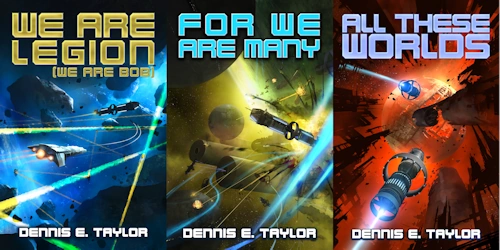
When I finally caved and joined Audible, it was to support Isaac Arthur’s SFIA youtube channel, as he covers topics I dearly love, and he highly recommended the Bobiverse Trilogy, so I thought I would check it out.

I must say, I quite enjoyed it.  It is not a series without flaws, by any means, and I understand this was the author (“From annoyed fan to professional writer” went one of his tag-lines, if I remember correctly) is a fairly new one.  All in all, I would say it’s quite a romp, a sort of popcorn sci-fi, each book fairly small and digestible (the entire trilogy clocks in just a little longer than the single Empire of Silence), and has a nice, hard edge for those who take their laws of physics very seriously.

I definitely recommend this series.

A Summary

We Are Legion follows Robert Johanssen, the eponymous “Bob,” who uses the money from the buyout of his successful tech-startup to sign a contract to be cryogenically frozen after his death. Then, while attending a sci-fi convention, is hit by a car and dies.
He then wakes up in the laboratory of a theocratic United States some two hundred years in the future, not as a human, but as an  uploaded copy of the original.  He has been selected as a candidate for the “Heaven” project, which will involve sending a probe out to another star system, where he is expected to build more copies of himself and rinse and repeat, while seeking good colony targets and returning to help bring humanity to the stars (the copying process gives the book its name).  Unfortunately, there is no small amount of competition, and Bob finds himself under attack from international espionage and then outright declarations of war which has apocalyptic results for the Earth.
Once in space, Bob needs to tackle the lingering reach of enemy human empires, help rehabilitate the Earth, seek out new worlds and new civilizations, help humanity reach the stars, uplift newly discovered sapient species, squabble with his clones, do his best to keep from going insane, and then uncover and wage war upon a horrifying race, the “Others” who see all other races as sources of food.

The Bad

The author is clearly a nerd, or at least knows the nerd target audience very well, and I find the work falls into some geek fallacies pretty quickly.  Bob often finds himself dealing with bullies or bully-like people, and we’re expected to root for him when he outwits of defeats them, but I find this very dissonant when the person being “bullied” is an interstellar battleship capable of orbital strikes.  We can chalk this up to the personality of Bob lingering within the digital copies, but what I find mind-blowing is that people would even try it.  We regularly see villainous personalities making threats or posturing against Bob, or making unreasonable or realistic threats against him, and at one point, he is the subject of bigotry and discrimination, and we are meant to sympathize, and given the response the book receives, quite a few people do.  I just found it absurd. Oh, sure, there’s always some punk who’s going to talk up to a Terminator and pick a fight with it, but I think most people would give it wide berth or, maybe, even worship it.
In general, I find the way a lot of characters behave in We are Legion and its sequels to be a tad unrealistic, namely in the author doesn’t, to me, feel like he has a good grasp of motivations.  People take over governments, or hate the Bobs, or cast him into exile, or demand his time and attention, and while these follow naturally from situations and previous actions, I think they fail to take into account, first, that Bob is often dealing with literally millions of people, and I would expect some diversity of opinion.
Two stark examples stand out to me.  First, Bob eventually offers the uploading technology to humanity, but they, with one sole exception, reject the technology.  Nobody wants to be uploaded, and they point out that all Bob seems to do is chores for humanity and wage wars.  Who would want that?  Folks, that’s what the military looks like, and we get people willing to join that all the time.  If, right now, you went out into the world and offered a million people the chance to become an interstellar battleship, I guarantee you that you’re going to get more than one person reluctantly agreeing.  You might not have a stampede, but there will be people who sign up.  And given the heroism and glamour of what Bob is doing, from exploring the stars to waging war on an alien menace to saving the lives of humanity, I would expect to have seen some hero-worship; people would want to be a part of all of that, but instead, we see Bob treated as an exile, selflessly and thanklessly working for humanity.
The second involves a military leader who becomes the main contact person between Bob and humanity, who regularly makes demands and argues with Bob, and rejects certain proposals that Bob makes, about how Bob wants to use his own resources.  The general’s angry reactions to Bob’s proposals becomes something of a running joke of the series, but I found it perplexing.  It would be like a US Aircraft carrier parked off of an island devastated by a natural disaster with only a small fragment of the original populace clinging to life and offering assistance, and then the captain of said aircraft carrier complaining that the representative of the survivors is mean.  Why does the captain care what the representative has to say?  He’s an adviser at best; every once in a while, Bob will threaten to pull stakes and walk if people don’t cooperate, but that sort of thing would have to seem pretty obvious to most people involved.  I would have expected a lot more toadying from the ambitious, rather than grandstanding: You would rather be seen as the captain’s best friend, rather than his task master.
The other irritation I had was how he tackled the concept of religion.  His theocratic masters were, of course, mustache-twirling villains, while Bob is a perfectly rational atheist.  I find this sort of attitude common among the futurist crowd, and I find it uncharitable.  The rise of the theocracy read like left-wing conspiracy theory, and no effort is made by the author to understand how such a thing could actually happen, and what sort of nuance we might have.
I rush to note that most of these can be explained away as expedients to getting to the better part of the plot, and that there are a few moments when the author seems to be highlighting that a lot of what he is showing has more to do with Bob’s attitudes than what is actually going on (For example, one of the Bobs questions another Bob’s handling of humanity, pointing out that they’re reacting out of fear).  The book, after all, is not about the rise and fall of the United States, or the nature of humanity.  It stood out to me more because I was going through the Dune series around the same time, which tackles these concepts in a far more nuanced way.  But still, they stood out to me, so I thought I would point them out.
My only remaining complaint is that it sort of… just ends.  The author seems to have decided to wrap it up, he tied off all the main plot points, has a final good-bye and he’s just done and moved on to the next trilogy.  It’s a touch perfunctory, and I found it a bit unsatisfying, but I didn’t especially mind it.

The Good

Right out of the gate, the book has an easy and jovial tone that makes it a delight to read.  Normally I just listen to my audiobooks when I have nothing better to do, such as walking between home and work, but with this trilogy, I found myself flipping it on just to see how it finished.
The Bobiverse trilogy absolutely brims with a love of science, technology, futurism and sci-fi.  It’s loaded with references, and a sense of wonder, as Bob’s clones discover new species, new worlds, new life, and discusses them in detail. The first book also includes quotes from sci-fi conventions discussing futurism, which expand a bit on some of the ideas that his series explores, though the latter do don’t do this, which is a bit of a shame.
I would can’t the series “Hard,” as it includes reactionless drives and FTL communication, but beyond those few conceits, it remains rigorously focused on science and explores their implications as well as it can.  It is absolutely a must read if you want to understand how GURPS Space Combat is intended to run, and it had the most fascinating space battle I’ve ever read in the first book, which involved long, slow trajectories, intense calculations and recalculations up until the instant of contact which led to a millisecond-scale exchange of ordinance.  The final battle of the series also touches on the sheer scale of power that a true interstellar war might have.
This may seem terse, compared to my complaints, but this is the bulk of what makes up the books, and its excellent.  It’s why you read them.  They definitely outway the bad, above.

But is it Psi-Wars?

Ha ha, no.  It’s got sapient,  uploaded brains running STL dreadnoughts to fight wars mostly decided by missiles and point defense when it isn’t discovering new life and new civilizations.  If you’re looking for books that I’ll borrow for Psi-Wars, this definitely isn’t one.  It is fantastic inspiration for Heroes of the Galactic Frontier, a Star-Trek-like that I would like very much to get to.  In fact, it very much reads like someone wanted to write Star Trek, but was irritated  by all of the unrealistic elements of Star Trek and so ditched all of them, and wove in a few interesting new concepts, like uploading consciousnesses and a little existential introspection on what cloning your consciousness means.

Book Review: The Empire of Silence

I’m an avid podcast and audible user, since I commute and it gives me a chance to “read” while on the go.  Lately, I’ve been trying to follow works that might give me additional Psi-Wars inspiration and I’ve certainly struck… well, silver with the latest work: Empire of Silence by Christopher Ruocchio

I found the book in a local bookshop, and I’m always on the lookout for an audio book that will tide me over in between works, as I get one “credit” per month, with which I can pick up a free audio book, so I tend to be on the lookout for lengthy works with cheap price tags, and the book interested me.

So what is it?

Hadrian Marlowe, a man revered as a hero and despised as a murderer, chronicles his tale in the galaxy-spanning debut of the Sun Eater series, merging the best of space opera and epic fantasy. 

It was not his war. 

The galaxy remembers him as a hero: the man who burned every last alien Cielcin from the sky. They remember him as a monster: the devil who destroyed a sun, casually annihilating four billion human lives—even the Emperor himself—against Imperial orders. 

But Hadrian was not a hero. He was not a monster. He was not even a soldier.
On the wrong planet, at the right time, for the best reasons, Hadrian Marlowe starts down a path that can only end in fire. He flees his father and a future as a torturer only to be left stranded on a strange, backwater world. 

Forced to fight as a gladiator and navigate the intrigues of a foreign planetary court, Hadrian must fight a war he did not start, for an Empire he does not love, against an enemy he will never understand. –Empire of Silence, Sleeve Summary

 The book, it turns out, is “part 1” of a series, so all that cool stuff about fighting a war and destroying a star, while teased in the opening of the book, don’t actually happen in the book.  Instead, it serves as the introduction to the main character, the aristocratic Hadrian Marlowe, and chronicles his noble origins, his fall from grace, his arrival on a new world, and his slow journey from ignominy back into a sort of freedom; that pursuit of freedom from the “gilded cage” of aristocracy is the core narrative thread of the book.

The book is decidedly space opera, and almost an homage to Dune.  It certainly differs from the book, in tone and in setting, as it explicitly includes aliens (including the Cielcin, against which the mentioned war is raged, but also other aliens, at least two others which feature in the book) and nothing like the spice of Dune or the hints of drug culture rife throughout that book.  Instead, it features aristocratic houses, shield belts, blade combat, and a more medieval culture, with an all-powerful religion featuring inquisitions, forbidden technologies replaced with superior mental training and genetic engineering, and sprinkles in gladiatorial combat for good measure.

Is it Bad?

I’m sorry –Hadrian Marlowe

This audio book clocked in at 24 hours, which is three times the length of an average book, which leads me to believe it’s somewhere around 1000 pages long, which is fine if it’s chronicling a very extensive story, but it is, instead, a first volume to a larger saga, shades of Robert Jordan.  It definitely overstayed its welcome, and I was glad to be finished with it.  I would have have cut at least a third of the book, were I its editor, and this is a first published work of the author, as far as I can tell.

The character himself is someone tedious.  I believe the author was going for something of a subversion of Paul Atreides: instead of a fearless man who holds to his duty, we get an apologetic man who runs from his duties in disgust.  It’s not quite the subversion that we get from Consider Phlebas, which felt like it was mocking the typical space opera hero, but a deeper meditation on what sort of person might become a space opera hero, and attempts to inject realism into such a journey.  The hero is often driven by events beyond his own control, and regularly makes mistakes that cost him… or that come to benefit him.

The book revels in our hero’s disgust a little, showing the horrors of the Empire, including at least one detailed torture scene.  It’s a brutal book in general, putting Hadrian Marlowe through hell in more ways than one and chronicling his misery.  It is, by no means, “grimdark,” though I found myself comparing it to Warhammer 40k, with the Cielcin a sort of “realistic” Ork, and the Inquisition as…well, an unsanitized version of the Inquistion.  It offers a sense of wonder, mainly through the glimpse of alien ruins we eventually get treated to and, of course, the Dune-esque detail to the strange universe.

It uses a very high sort of language and routinely borders on, or even crosses into, pretension.  This is space opera as written by a well-educated member of the British peerage and drips with it.  It even touches on some modern, politically correct themes: the Earth is gone, destroyed by over-industrialization; homosexuality features prominently (though it is not portrayed as especially good or bad, simply there), and he emphasizes the equality of women.  I will say that the author does not hamfistedly drop political anvils, only that these themes are there.  The narrator of my audiobook narrated in the most received of received pronunciation, and it fits the work.

This is not a classic space opera romp where the hero gets the girl (though, at the risk of spoiling things, he is eventually offered the hand of something akin to a space princess, but flees from it) and kills the vile alien .  I’ve seen it compared to Game of Thrones, and that’s an apt comparison.  Both have this drive towards “realism,” this grim cynicism that refuses to accept the mythology of space opera, and while using typical technologies and tropes of that genre, treats them very seriously.  If you don’t mind that, and you don’t mind a long read, then…

Is it Good?

Well, I finished it didn’t I?  Better books have failed to hold my attention.  Empire of Silence has a good grasp of how to build up to a moment of tension and then leave you hanging, to draw you in and entice you.  It takes its time getting to those answers, and I’ve certainly read more exciting works, but it does reward your patience.
Christopher is a master of “Show don’t tell.” To be sure, Hadrian Marlowe has an incessant internal monologue, but he often fails to draw conclusions that the astute reader could pick up on.  Why do particular characters hate one another so much?  What political moves are being made and why? Not all of it is explicit, and Hadrian occasionally meditates on them, but the book very much invites you to read between the lines.
The “Show don’t tell” approach means that the setting is richly described.  For example, the world of Eemesh swelters with a tropical heat and sticky humidity and a literally heavy air (as it has more gravity than Earth does), that oozes from the pages in a stultifying atmosphere that you can positively feel.  He lavishes his often genetically perfected characters with appropriately beautiful descriptions and returns to them again and again, which is a technique I like and try to emulate myself.
By showing us this world, Empire of Silence gave me something I was very much looking for: an exploration of a setting.  I don’t especially care about the travails of poor rich-boy Hadrian Marlowe, and while Christopher Ruocchio clearly does, he’s willing to accept that I’m just there to see the sites and obliges in exquisite detail, from torpid cities barely reaching over the still surface of a tropical sea to the dance of too-polite realpolitik of interstellar aristocracy to the very languages of the setting and the details of its exotic aliens to the most interesting lightsaber expy I’ve seen, the “high matter sword.”  If you want to read (and read and read) about a sumptuously detailed space opera setting, this is where you should go.\
I think I might buy a physical copy of it, so I can go over it in more detail (and so I can go over a glossary, which I’m supposed to be able to download from Audible, but can’t seem to find).

But is it Psi-Wars?

Oh my yes.  While doubtlessly less harsh, the book very much reminded me of the aristocracy of Psi-Wars, with their careful genetic pruning, their dueling culture, the watchful eye of their church (though the Akashic Mysteries are far less prone to torture than the Chantry). I’m  totally going to steal the technology buried within their signet rings.   It’s definitely a worthy read if you want more inspiration for how the Maradonian elite might behave.
They also feature alternate human cultures, from the psuedo-Ottaman Jadians to the super-technological Demarchists to the cybernetic pirates, the Extra-Solarians, who steal men away with their black-masted ships and force slave implants into them, which remind me of the Psi-Wars approach of having alternate “cultures” of humanity. I may borrow the Extra-Solarian idea as well, though I think I would tie them to remnants of the Great Galactic Threat.
I wanted “something like Dune, but different” and I certainly got it.  I wanted loads of new ideas, and I got those too.  I do recommend the book, with the caveats that it’s long and pretentious.