A March Wiki Update

I’ve been busy with family and distracted by my work on cybernetics (I’m very pleased with how it’s coming along). I did get some Wiki material up, especially with help from Jose, who has been trying to help with the tedium of actually formatting, so I got some extra things in. Here’s a quick overview.

Continue reading “A March Wiki Update”

Patreon Poll: Trader Tech 2

Continuing from the poll earlier this week, I have a new set of polls for Trader Tech.  These cover the elements of their military technology that lie outside of the individual.  This includes:

This poll is open to all Patreons of the Companion ($5+) tier.  As usual, please leave a comment as to how you see their doctrine working or what nuance you’d like to add.  I definitely take comments into account.
I know I’ve not yet released the more detailed robot rules, but hopefully you’ll have a sense of what you can do with robots and how they might serve the Traders militarily.  You guys seem very interested in giving the Traders robots, so I hope that particular poll will be useful to you even without worked examples of robots from other cultures.

Redjack Kodiak-Class Light Cruiser

ST/HP:3000

Hand/SR: +0/6

HT: 14

Move:10/150(+11)

LWt.:27,000

Load:3750

SM: +11

Occ.:200ASV

DR:2000*

Range:7jumps (Rating 3)

Cost:$4.5B

Loc.: gG10t4rL

Stall:0

Total Chase Roll:+11

*Nanocomposite Polymer; double DR vs plasma attacks. Higher DR protects against attacks from the front. Additionally, it has a Force Screen that provides 2000ablative, hardened DR.

Notes

Redjack Capital Ship Electronics:

  • Large Ultrascanner Open Mount: 1000-mile search range, 100-mile scan range.
  • Night Vision Sensors: +9 nightvision, ×8 magnification (up to +3 to aimed attacks, if the vehicle aims for three turns).
  • Targeting Computers: +5 to Gunnery projects provided a sensor lock is gained.
  • ECM: -4 ECM rating, 20-mile radius; scramble comms up to 20 miles;
  • Large FTL Communication Array: 30-parsec range.
  • Large Holographic Radio: 10,000 mile range (orbital); “palm sized” holographic console.
  • Security and Safety: Simple Locks;
  • Hyperdrive: Rating 3, with sufficient fuel for 7 jumps.
  • Ruggedized Fusion Reactor: indefinite endurance

Redjack Cruiser Accommodation and Facilities:

  • Full Life-Support: up to 200 people
  • Accommodations: 25 cabins; 150 bunks. 3 months of stored, refrigerated food.
  • Facilities: Two workshops. one ten person command briefing and one ten-person engineering briefing; one 10-person gym; a sickbay large enough for 5. 1 operating theater;
  • Cargo: a secured arsenal capable of sufficient gear to arm 25 men; Additional cargo can carry 100 tons.
Redjack Cruiser Complement:

  • Shuttles: 5 Grappler-Class (or variant) Assualt Boats.

RedjacCruiserArmaments

  • 4 Corvette-scale Light Turrets (Total ROF 12; “Light,” halve penalties to hit corvettes and fighters)
  • 4 side-mounted Plasma Flak Turrets (F/L/R/T);
  • 8 modular “fighter” turrets (“Light,” halve penalties to hit corvettes and fighters)
  • 1 160-ST tractor beam.

The Kodiak has a bridge with sufficient space for 6 control stations: one for the Captain, one of the Commander, two for the pilots/shiphandlers and an additional two to handle electronics, comms and general operations. Each turret has its own control station, and engineering has 4 control stations for monitoring the engines.

The Kodialhas fourfull-rotation“corvette scale” blaster turret with three cannons (total RoF of 12), eight modular “fighter” turrets that can mount all standard Redjack 2-ton cannons, four plasma flak cannons,and a single turret with an ST 160 tractor beam mounted above its hangar bay.

Weapon

Dmg

Acc

Range

Ewt

RoF

Shots

ST

Bulk

Rcl

Notes

Corvette-scale cannon

6d×30(5) burn

9

10mi/30mi

25t

1

NA

M

-10

2

NOV-4 Heavy Plasma Cannon Module

6dx30(2) burn ex

6

4 mi/12 mi

4000

1/3

15/2F

M

-10

3

[1]

MIN-3R Mining Laser Module

5d×15(10) cut inc

12

500/3 mi

4000

1

25/5E

M

-10

1

SP74-TR Heavy Plasma Gatling

6dx15(2) burn ex

6

3mi/
8mi

4000

8

88/
3F

M

-10

3

Isomeric Torpedo Bay

6d×500 cr ex

3

300/
10 mi

2500

1

3

150M

-15

1

Plasma Flak

6dx10 burn

NA

2000/6000

100t

20

NA

M

-10

1

Look and Feel

By no means large compared to Imperial or Alliance ships, the Kodiak is the largest ship in general production from Redjack. Named after an ogre-like beast capable of resurrection from Westerly myth and lore, the Kodiak is the most dangerous vehicle that most corvettes can expect to face. Its powerful impulse drives can keep up with all but the most agile corvettes, and it has sufficient fire-power to blow away nearly any corvette and the flak necessary to drive off fighters. It also has a profoundly powerful hyperdrive, one of the fastest in the galaxy; paired with its astonishing endurance, while small enough to be classed a destroyer, the Kodiak earns the title of “light cruiser” thanks to is extreme long-distance cruise capabilities, as it can go for months on complex shunts and hops across the galaxy to strike behind shipping lanes behind enemy lines and then vanish against just as quickly.

The Kodiak has a distinct and ugly appearance. It appears to be mostly engines at first glance, with a huge rear section blasting out blue radiation. The ship then tapers into a stubby, bottom-heavy cone. It’s “bridge” rests near the top of the vehicle, behind a great, angled pane of armored glass. Two large corvette-scale cannons dominate each side, along a downward angled panel along the lower “midpoint” of the vehicle. Then, just below the “nose” of the cruiser sits a “mouth,” a small, slim hangar bay entrance, with a tractor beam turret that can assist any shuttles that need to launch or land.

The interior of the Kodiak matches the usual Redjack interior fare. It lines its walls with matte, drab, olive brown and olive gray nanopolymer panels. Accommodations mostly consist of simple bunks in unpleasant rooms with the characteristic Redjack life support smell emanating from the vents. Rare for a Redjack craft, the ship has several cabins, more than it actually needs, allowing to carry a VIPs as well as allowing the high ranking crew to have some space to themselves; however, these accommodations pale compared to the luxury suites of an Alliance vessel, offering little more than pre-fab comforts and a stiff bed. The ship also has decent medical facilities and can carry up to a platoon worth of soldiers, though the ship lacks direct assault capability and the soldiers mostly protect the ship from invasion as well as maintain the captain’s discipline. Most of the rest of the ship are access tunnels, work-spaces and long, claustrophobic industrial corridors, full of bare cabling, loose panels and precarious catwalks. The whole of the ship is compartamentalized with multiple redundant systems, so while it looks a mess, it can rapidly close off any sufficiently damaged portion of the ship to protect the rest, contributing to its reliability in combat.

The Kodiak occupies an odd space in military doctrines. It lacks cannons powerful enough to defeat capital-scale ships or to engage in orbital bombardment. It’s also lightly armored compared to most capital ships. Thus, in a stand-up fight against an Imperial dreadnought or even an Alliance cruiser, it has little hope of winning. It does, however, have startling speed and agility for a capital ship, and outguns and out-armors any corvette it’s likely to meet, making it’s real purpose clear: the Kodiak devours corvettes. This makes it an excellent defensive ship, capable of protecting a convoy by itself, or a powerful supplement to a light raiding fleet, able to stand guard against any heavy frigates that might want to fend off the Redjack Raiders or Tiger Sharks. When used by pirate fleets, the Kodiak tends to act as a poor man’s flag-ship: while it lacks the C3I capabilities of larger capital ships, not to mention their firepower, it’s often the best that a pirate can get a hold of, and it has a very tempting price-tag!

Alliance Space Vehicles – Allegiance-Pattern Carrier

ST/HP: 7000

Hand/SR:5/6

HT: 13

Move:1/50(+8)

LWt.: 340,000

Load:150,000

SM: +13

Occ.:7100ASV

DR:2500*

Range:5jumps

Cost:$225B

Loc.: gGs22t

Stall: 0

Total Chase Roll:+3

*The Allegiance-Pattern Carrier has 2500 Carbide Composite DR on all sides (double DR vs plasma attackes). It also has a force screen with 10,000 ablative, hardened DR.

Notes

Alliance Capital Equipment:

  • Capital-Scale Tactical Ultra-Scanner: 4000-mile scan, 400-mile imaging/bioscan; 360°;
  • Targeting Macroframe: +5 to hit target with a scan-lock.
  • Night Vision Sensors: +9 nightvision, ×8 magnification (up to +3 to aimed attacks, if the vehicle aims for three turns).
  • Large Area Jammer: -4 to target with missiles for all allied ships within 25 miles.
  • Distortion Scrambler: May contest Electronics Ops (Comms) rolls with Electronics Ops (EW); 25 mile range.
  • Large Holographic Radio: 10,000 mile range; “conference” sized holographic projector. All communications encrypted.
  • Very Large FTL Communication Array: 300-parsec range.
  • Hyperdrive: Rating 2; 5 jumps.
  • Fusion Reactor: 50-year lifespan.
  • Security: Simple Electronic Locks and security cameras at regular intervals; complex biometric locks for secured facilities meant for the aristocrat alone; Lifepods.

Alliance Carrier Accommodation and Facilities:

  • Full Life-Support: up to 7500 people
  • Accommodations: 1 aristocratic luxury suite, 100 luxury cabins, 600 full cabins, 6500 bunks, 3 months of stored, refrigerated food.
  • Facilities: 100-person diplomatic establishment; 100-person entertainment establishment; 10-person negotiation office (+1 Diplomacy and Law); 10-person Akashic Shrine (+1 ESP and sensory deprivation chambers); 30-person gym; 1000-bed and 5 operating theater hospital;
  • Cargo: a secured arsenal capable of sufficient gear to arm 4000 men; Additional cargo can carry 5000 tons.
Alliance Cruiser Complement:

  • Shuttles: 5 Prestige-Class (or variant) Shuttles.
  • Fighters: Up to 20 squadrons of 25 fighters (Generally at least 10 squadrons of Valiants and 5 squadrons of Raptors)

AllianceCruiserArmaments

  • 6 Capital Turrets (Total RoF 12);
  • 8 Corvette-scale Light Turrets (Total ROF 24);
  • 8 mounted Plasma Flak Turrets (F/L/R/T);
Weapon

Dmg

Acc

Range

Ewt

RoF

Shots

ST

Bulk

Rcl

Capital-scale cannon

6d×75(5) burn

9

60mi/180mi

500t

1

NA

M

-10

2

Corvette-scale cannon

6d×30(5) burn

9

10mi/30mi

25t

1

NA

M

-10

2

Plasma Flak

6dx10 burn

NA

2000/6000

100t

20

NA

M

-10

1

Look and Feel

Like the Regal-Pattern Heavy Cruiser, the Allegiance-Pattern Carrier exudes a beautiful, art-deco elegance with often gleaming white or silver color and swooping, elegant curves. The main body, like most Alliance capital ships, is taller than it is wide, but has a fairly stubby length and is dominated by the bridge that rises from it. Its weaponry have been divided to bristle from either side: 3 capital-scale turrets, 4 corvette-scale turrets, and 4 plasma flak cannons line either side, just below the observation decks and gleaming windows of the superstructure. Two, long launch decks extend from the main body like two, forward swept wing; these launch decks make up the single largest visible structure of the vehicle and dominate one’s impression of the vehicle.

Those who land on one of the two launch decks, which are large enough for even light corvettes to medium (up to SM +8) corvettes to land on, step out into a well-lit and spacious hangar bay. The flight decks themselves have broad openings into space that are “force locked,” allowing one to view the starry sky through the shimmer of the screens. Travel from the hangar bays and flight decks to the rest of the ship is handled with interior shuttles, resembling clean and cozy subways. These shuttles bring one to the habitation section of the ship. The lower part of the habitation section has numberous cabins and bunks, all fairly well-appointed and attractive, though not as nice or roomy as those found in the Regal-Pattern Heavy Cruiser. A great and spacious hospital, as large as any found planetside, dominates this area, and a special “hospital” shuttle equipped with paramedical gear has a straight shot from the flight decks to this hospital, allowing for emergency care of wounded brought in by shuttle. Blow this, one can find the bowels of the ship and the great and bare infrastructure that runs the ship, where numerous servants and technicians scuttle through the machine-cathedral interior to ensure the operation of the great capital ship.

As one travels higher in the ship, into the super-structure, one finds the “Hotel” of the Allegiance: a great collection of luxury cabins, observation decks protected by transparent diamondoid, and large entertainment establishments that vary from Allegiance to Allegiance: gardens, spas, restaurants and casinos. A great diplomatic hall, ready for dinners and dances, can also be found in this section of the ship. The top of the superstructure has the bridge, and three separate luxury suites, the size of two luxury cabins put together with sufficiently nice interiors to garner a +1 reaction. One typically houses the governing noble, while the other two are supplied to guests of honor. The interior decoration of this luxurious part of the ship has romantic lighting provided by recessed glow-lights, contragravity crystal chandeliers, curving banisters and soft carpeting.

High Admiral Lowellin Cole designed the Allegiance to work with the Valiant and Raptor in an effort to create a new model of warfare for the Galactic Federation. His design has a more spartan feel, similar to the Sword-Pattern Battleship, but the aristocracy made adjustments for their own comfort and prestige. Still, his touches can be found in the lower decks, where the considerable number of soldiers and pilots rest in cabins and the great hospital attends to their needs. The “hotel” resembles that found on the Regal, only larger and more impressive. The combined effect of the two designs creates a powerful warship with two primary roles.

In war, the Allegiance carries the fighters of the Alliance to the enemy. The Allegiance might go straight to the enemy, especially if it carries Valkyries, and spill forth its fighters and strike-craft while it hangs back and relies on its powerful force screens to deflect enemy attack. Alternatively, it can fly to a system close to the enemy, and its hyper-drive capable fighters make the leap to attack the enemy, and then jump back to the carrier, preventing the carrier from suffering direct attack. In a full military confrontation, the Carrier struggles against Dreadnoughts and Battleships in toe-to-toe fights; its corvette cannons and its Raptors provide a decent defense against corvettes but these can overwhelm it. Most carriers have an escort of at least a few cruisers and often a battleship or two.

In peace, the Allegiance acts as a mobile hospital, going to worlds in need and using is capacity for soldiers, doctors and technicians to provide much needed aid and care to those on beleaguered worlds. It also doubles as a diplomatic craft, able to provide an excellent location for diplomatic negotiations (especially for the surrender of a world to its new aristocratic masters), or for the aristocracy to remind the leaders of a world who their true masters are, in the most comfortable and entertaining fashion possible. The Allegiance, thus, often “shows the flag” to other worlds or other aristocrats.

Why Capital Ships: Space Artillery and Tactical Command (Part 2 of 2)

Yesterday I dove into the basic theory of capital ships in my GURPS Action chase update. Today, I round it out with a look at truly long range combat, and gaining a tactical advantage on your opponent.

Remote Combat

Lando Calrissian: Yes, I said *closer*! Move as close as you can, and engage those Star Destroyers at point blank range!

Admiral Ackbar: At that close range we won’t last long against those Star Destroyers!

Lando Calrissian: We’ll last longer than we will against that Death Star! And we might just take a few of them with us!

–Return of the Jedi

GURPS Action’s Chase rules do not extend beyond “Extreme,” because we begin to struggle with horizons and ground clutter at some point. However, Dogfighting Action! includes two new ranges: Distant and Beyond Visual, which represent ranges made possibly by the extreme distances of air combat. I want to add two more: Remote and Beyond Remote.

Once we get into space combat, ranges begin to widen to an impossible degree. Orbital bombardment takes place from distances up to 100 miles away! In principle, one should be able to blast another target in space from such a distance. Of course, this is “point-blank” in GURPS Spaceships, and too extreme a distance begins to diminish the “in your face” visuals of Star Wars and Psi-Wars, but nonetheless, I think there is room for powerful artillery ships blasting one another from a phenomenal distance, or at least a seeminglyphenomenal distance.

Every range band in the Action system is roughly five times as far as the previous band. Extreme is up toa mile, while Distant is up to5 miles, and Beyond Visual is “beyond that.” If we follow the progression, Beyond Visual would end at up to 25 miles, and “Remote” would end at up to ~125 miles or -27 to -31.

We need to answer a few questions before we can introduce a new range band, as there are always degrees of distance between ourselves and every object in existence, but most such distances are not tactically relevant. We need to know if Remote is tactically relevant: can a ship at that distance coordinate others, can it attack, can it be attacked, and can people reach it on the time-scales of GURPS Action Chase sequences?

For coordination and attack, the answer is an easy yes. We can easily have communications and sensors devices with ranges at about 100 miles, which is roughly the range of Remote. We can also easily attack out to that distance with pretty much any blaster weapon of any reasonable size. In fact, it’s so easy to attack from 100 miles away that I’ve reducedthe ranges of blasters. I’ve included the details in the new version of my Vehicles conversion. Suffice it to say, only Super-Heavy capital turrets and most super-weapons have this sort of range now, as opposed to even fighter-level cannons.

A greater problem with an attack are the accuracy penalties. For a capital ship firing an aimed blaster cannon at another capital ship from 100 miles away, we’re looking at an average crew skill of 12 + an SM of 13 + 5 from sensor lock and targeting computer and +9 from accuracy – 30 from range penalties, or 9, which is less than a 50% chance of hitting. We’ll need some ways to improve this, as well as some reasonable ways to defend from such a long-range attack.

The trickier question is if it can be attacked or if a ship can reach it on the GURPS Action time-scales. In principle, we can say a ship is unreachable(say, 10,000 miles away) but is freely able to shoot you. This does not create fun gameplay, naturally, as combat occurs on vast, strategic distances and over exceedingly short time-scales, similar to how an ICBM-based nuclear war would go. This is not what we want. So, can we reach a ship that’s about 100 miles away in a minute? Or, more accurately, can we go from between 125 and 26 miles away to between 25 and 5 miles away from a target within a minute at our chosen speeds?

Our target speeds are about 1000 mph for a fighter, 600 miles per hour for corvettes, and between 300 and 100 miles per hour for a capital ship, and an action turn takes one minute. In a single minute, a fighter can cover 15 miles, a corvette can cover 10 miles, and a capital ship can cover between 5 and one-and-a-half miles. Frankly, this already begins to cause problems at dogfighter distances because going from beyond visual (minimum of 5 miles away) to distant (minimum of 1 mile away) is beyond the possibility of slow capital ship. In the best case scenario, a fighter reach a target at 26 miles away in two minutes; 125 miles takes closer to 10 minutes. A corvette can reach a target 26 miles away in up to 3 minutes, while 125 miles away takes nearly 15 minutes. At 300 miles per hour, a capital ship will reach a target 26 miles away in ~5 minutes and 125 miles in nearly half an hour. It is not possible in any account to really interact with a remote target in exactly one minute, though it’s not so far away that it’s really beyond the chase rules: in most cases, you could hand wave things away and suggest that the target is reachable on a 5-minute scale rather than a 1-minute scale, or that you can reach the target, but you’ll suffer several attack attempts.

If we take all of this together, it suggests we should treat remote carefully if we’re going to use it at all. To be useful in combat, we might add an “aiming” action which represents something similar to using the Dead

All of this together suggests we should treat remote carefully, if we’re going to handle it at all. First, remote requiressome sort of time-consuming “precision aiming” action where you carefully line up your shots, the same idea as Precision Aiming from GURPS High-Tech; we can grant a +4 to hit, but also a +2 to dodge, representing the fact that at such distances, even a slight evasive action can offer considerable defensive benefits, and also mimics the Telegraphic attack rules. This gives a capital ship a roll of 13 or less to hit a target, but improves another capital ship’s dodge from an average of a pointless 2 to a possible 4, while corvettes and fighters are effectively impossible at that range. Second, I would require a minimum of 100 mile range on weapons, comms and sensors to effectively operate at that range. Third, I would argue that a Remote vehicle cannotgain advantage on another target (you’re too far away to meaningfully outmaneuver your target at any speed). This helps reduce the lethality of the remote ship: you’re firing with a more limited number of your guns, your target is hard to hit, and your opponent can adjust his force screens so they face your direction. A generic battleship is only going to hit with two or three of this super-heavy cannons, and against a target with 10k force screens, he’ll fail to penetrate DR at all. You really need a super-weapon to operate at such a range, or you need to target a less well-defended vehicle. Fourth, when it comes to movement, we can treat moving from Remote to Beyond Visual as a two-shift move. This is a littlecinematic, as it means that a fighter can move from remote to beyond visual in a single minute with a good roll, while corvettes will typically require two minutes, and capital ships will require a lot of rolling to successfully chase down their target, unless their target is static (which is possible). Finally, I would make this an optional rule: it’s an interesting scenario when dealing with orbital bombardment or when tackling a super weapon, and it’s a good place to park your carrier if you want it help coordinate your battle, but it’s probably more detail than necessary in any other cases.

Formation and Tactics

One important element of GURPS Spaceships is the ability of the commanding officer to exert his tactical acumen to grant his vessel a benefit over his opponent. The Officer template excels at Tactics, and thus we would expect them to be able to bring their excellence to bear against opponents here too.

The first and most obvious way in which an Officer can gain the strategic upperhand against his opponent is with the already existent foresight rules. I’ll talk more about Lucky Breakslater, but suffice it to say, Foresight can translate directly into a Lucky Break, in the same way that Serendipity can.

However, I’d like to make tactics more directly useful, moment by moment. I can simply borrow the tactics rules from GURPS Spaceships, but I want to revisit them and see if we can return to base principles and see whether or not they still fit. After all, the Chase rules don’t use tactics, nor does the Dogfighting rules. Why should we? What sort of benefits would they provide?

In reality, I do think you see tactics in chase scenes! Random mooks who simply point their vehicles at the enemy and drive as fast as they can tend to be less effective than, say, law enforcement officers who coordinate their various vehicles, from helicopters to a fleet of squad cars, to catch their opponent, or back them into a blockade. This feels likea form of tactics that might offer some sort of complimentary bonus to chase rolls.

When it comes to dogfights, we definitely see the use of tactics as well. A good example of this was the “Thatch Weave:” if a less agile fighter had a zero on its tail, it would “weave” with its wingman to bring the zero into the sights of its wingman. Larger capital ships would also maneuver with one another to maximize their firing arcs while minimizing their opponent’s firing arcs.

All of these examples of coordination have something in common: they involve coordination between multiple craft. GURPS Spaceships doesn’t require this, but it assumes teams of characters on one ship, while we’re going to see teams of characters on multiple ships, and thus requiring formations might be an interesting idea.

Formations are a concept also from GURPS Spaceships, but is semi-visible in the GURPS Chase rules in the concept of “chase groups” with leaders. We can call these formations. We can do a few more things with formations: consider that the job of many smaller capital ships are as “escorts,” we can allow a ship in formation to “block” another ship in formation. We can also allow an area jammer to protect everything within that formation. Finally, formations of two or more ships can engage in tactics.

GURPS Spaceships gives tactics the ability to apply a +1 or -1 to dodge, but this is often not useful to the very ships that will want to use tactics the most: Capital Ships, as they often have an abominable dodge. Instead, I suggest the following: in a formation of two more ships, a character within the formation may make a Tactical Coordinationaction against a single target (either a single vessel, or a single formation); if the target is a formation, that target may roll Tactics to resist in a Quick Contest. If successful, the formation may gain one of the following benefits

  • Defensive Tactics: Opponent either has -2 to hit the vessels of the formation, or the vessels of the formation gain +1 Dodge.
  • Defensive Tactics: Opponent either has -1 to dodge the attacks of the vessels of the formation, or the vessels of the formation gain+2 to hit the target vessel or formation.
  • Pursuit Tactics: +2 to chase rolls against the target for this turn

In practice, this allows capital ships to reduce their opponents’ barrages by a hit or two, which might mean the difference between life and death.

Why Capital Ships? New Rules for Dreadnoughts in GURPS Action Chase rules (Part 1 of 2)


My apologies for my absence.  Between illness and family, I’ve been busy, but also, the topic I had selected to tackle turned out to be exceptionally large, so large that I’ve had to break it down into several smaller posts.

The core issue I want to tackle are Capital Ships and how they fit into our new combat paradigm.  I had intended for this to be a single post, but it turned out to be nearly 4500 words, so I’m going to break it down into a two parter.  Today, we start with some theory, and then dive into a greatly expanded set of rules on Passenger Actions.

Why Capital Ships?

Most space-based combat games find that they naturally center around a “sweet spot” of design. For games like Wing Commander, this is the fighter; for settings like Star Trek, this is the capital ship. For settings like Star Wars (and thus Psi-Wars) we need to justify multiplesweet spots to make our visions of our desired form of space combat come to life.

Psi-Wars focuses mostly on the model of “one character, one ship,” and this works best with starfighters, and thus starfighters are probably theprime form for participating in space combat. Thus the other models, the corvette and capital ship, need their justification. I’ll put off justifying the corvette, except to note that it offers an opportunity for multiple characters to lend their skill on a ship that is competitivewith starfighters.

The Dreadnought offers a far greater concern when it comes to justification. They represent enormous resource investments that lack the speed and agility of a fighter, and sport similar firepower, and are vulnerable to starfighters. Why, then, would someone field capital ships at all, instead of fielding fleets and fleets of starfighters? Moreover, how does the capital ship fit into the model of “one character, one ship?” How can our GURPS Action Vehicular Combat model all of this, making the dreadnought useful while still keeping it focused on a single character? To make dreadnoughts function, we need to answer these questions.

The justification of the dreadnought is perhaps the easiest question to answer. The word “capital ship” arose to describe the sort of “dreadnought ironclads” that arose during the heady naval years before WW1 (and thus, in a sense, “Dreadnought” and “Capital Ship” are synonymous, at least if we use the former term to describe a class of ships). I don’t know the logic of justification behind the term “Capital Ship,” but capitalis a term used to describe the great industrial machines in which a nation would invest, suggesting that a capital shipis a great industrial machine of war, a giant mobile fortress from which the rest of your operation can be staged.

This is certainly an apt description for a carrier. A starfighter lacks long-term accommodations and the capacity of long hyperspace journeys, and people and tanks certainly lack the ability to travel through space. The carrier offers room, accommodations and transport capacity for starfighters and soldiers, ferrying them across the galaxy. In a game, they often serve as a “mobile base.” In Tinker Titan Rebel Spy, a playtest I ran to test whether a dreadnought was “too much ship for players to handle,” I found they mostly used their dreadnought this way: they slept in its cabins, flirted in its cantina, planned in its briefing room, and launched their starfighters from its hangars.

We should also consider the capital role of flagship. The great size of a capital ship allows it to carry far more electronics and expert crew members than the average starfighter or corvette. With access to megacomputers, FTL communication and huge sensor arrays, the capital ship has unparalleled ability to see and command a battlefield. They can coordinate fighter squadrons or ground troops, and they can put expert strategists and spies to answering any questions the members of the arrayed force might have.

Finally, the capital role of the battleship remains valid because a blaster shot is much cheaper than an expensive isomeric nuclear torpedo! While a starfighter can defeat a capital ship, so can another capital ship, and it can do so over and over again without needing to refuel or reload, and can do so from a fairly extreme distance. This is less important for swift “first strikes” against other capital ships, but it’s vital to be able to pour on firepower against hardened ground targets, ideally from orbit where you are far away from anti-air defenses.

What the Fighter Ace is to the starfighter, the Officer is to the Dreadnought. Naturally, a fighter ace can directly control his vehicle, while the officer must command his crew to carry out his orders and must coordinate that crew effectively and efficiently. But where a corvette, with a crew numbering typically no more than ten, can afford to allow a handful of heroic characters to shine (one top notch pilot with a couple of highly skilled gunners and a single, desperate scavenger trying to keep the ship flying), a capital ship can have crews in the literally thousands, making it nearly impossible for the singular actions of a character to make a difference. Thus, we must treat out crew as natural organic extensions of heroic characters.

The rest of this post naturally arises from my attempt to adjust the action chase rules to fit these changes. GURPS Action assumes small vehicles with a single driver and a passenger or three: a car chase with perhaps motorcycles and a helicopter or a tank; they do not envision “chase scenes” with battleships and carriers. We need them because they impact battle, but they should do so on a larger, more strategic scale.

Passenger Actions

While a starfighter flies under the direct control of a single player character, perhaps with a single co-pilot or tech-bot assistant, the corvette and the dreadnought fly with the assistance of a crew. The corvette does so with a crew that typically numbers less than ten, making it a good ship for a collection of heroic player characters to directly manage, but capital ships are beyond the scope and scale of a few characters.

For both, we need passenger actions. GURPS Action 2 already has a list of passenger actions on page 33, but this is treated as an aside, appropriate for a game that focuses on car chases. Here, our passenger actions become much more central, so we need to get a grasp of everything a crew member who is not directly involved in shooting turrets or piloting the craft might be doing. For inspiration, we can turn to GURPS Spaceships and look at all the options under “Actions during a turn” starting on page 50. While not everything is suitable, it gives us a sense of what crew members might be doing.

When it comes to a passenger action undertaken by a player character, we simply need to know what skill they’ll roll. For a capital ship, this is harder because we have teams of crewman carrying out those tasks. Thus, we’ll need a concept for this:

Crew Skill: On any capital ship, any and all passenger tasks may be undertaken by the “crew,” a large collection of nameless NPCs sufficiently suited their tasks to undertake it professionally. The skill of a crew is stat to a standard value, similar to BAD. By default, this skill level is 12. Particularly novice crews have a skill of 10, while the finest crews might rise to skill 15.

The Passenger Actions are:

Attack: See GURPS Action 2 page 33. Characters onboard sealed vehicles (most space vehicles) generally cannot make attacks with their own weapons against other vehicles, but they may man turrets and attack with them, using all the normal rules for passenger attacks (including the standard -1 penalty for a passenger making an attack).

Board: Boarding a ship is automatic if the character is aboard a vehicle that has embarked via a launch pad. If the vehicle has attached itself to the hull of the target ship or the character has somehow made it through space on his own to land on the vehicle, assume that a handy airlock is somewhere nearby and the character may enter via an Electronics Operations (Security),Forced Entry orLockpicking roll with a difficulty equal to BAD.

Chart Hyperspace Route: Before making a hyperspace shunt, someone must successfully calcuate a hyperspace route. Calculating a hyperspace route requires 5 minutes (or 5 turns in Action Vehicular Combat), a successful Navigation (Hyperspace)roll and either a computer capable of hyperspatial navigation or a robot with the proper programming. In addition to other navigational penalties, the navigator may accept time spent penalties at -2 per turn reduced (calculating a hyperspace route in one turn/minute imposes a -8 penalty).

Command and Coordinate: A high rank character may attempt to coordinate the efforts of characters making another Passenger Action. He may roll Leadershipas a complementary roll or use the lowerof his Leadershipor the required skill to replacethe crew skill of the crew undertaking the task (for example, the crew is trying to perform emergency repairs; normally this requires the Mechanic skill, and they have a standard crew skill of 12, but a PC has Mechanic-18 and Leadership-15, and so may coordinate the repair crews so that they repair with skill 15 rather than 12).

Emergency Repairs: If a vehicle has a disabled system, the crew can attempt to jury-rig repairs in a single turn. This requires a single person on a starfighter, shuttle or corvette, but requires a substantial crew on a capital ship (assume such crew is available unless circumstances dictate otherwise). Attempting to jury-rig repairs requires a roll against an appropriate specialty of the Mechanicskill at a -10 penalty. Characters with Quick Gadgeteermay halve this penalty! A jury-rigged component is not a permanent fix, and must roll HT the first time it is used in a battle (one such roll is sufficient for the entire battle). Complete repairs, or the repair of destroyed systems, are beyond the capabilities of characters currently locked in a cinematic fight.

Operate Electronics: If a character is at a proper control system, he may supportthe vehicle by operating its electronics. This allows the character to engage in contests with opposing electronics operators: the character may attempt to communicate through a distortion scrambler (Electronics Operations (Comms)) or to detect a target that is actively jamming sensors (Electronics Operations (Sensors)) or to actively a jam both sensors and comms of another vehicle (Electronics Operations (ECM)). For more detail, see electronics and jamming below.

Seize Control:To seize control, the character must be at the controls of the vehicle (see Internal Movement below). See GURPS Action 2 page 33.

Internal Movement

To perform an action, one must be located in the proper location to perform that action (at the controls of a turret to fire it, etc). If the character is not at his location, he needs to spend a number of turns “moving” to reach that location. The number of turns depends on the size of the ship:

  • Starfighters and shuttles: 0 turns (Free movement, assuming movement is possible within the craft)

  • Corvettes: 1 turn

  • Capital ships: 2 turns

For especially large ships, the GM may require three or more turns of movement, but too many turns may slow the game down too much! For additional detail, see GURPS Spaceship page 63 (using 1-minute turns).

These rules assume unimpeded movement, but the GM may create obstacles for characters to bypass. Such obstacles can be handled by a roll against a single skill with a difficulty equal to BAD; success generally means the character can move unimpeded, but failure increases the travel time by a single turn as the character is forced to bypass the obstacle. Examples include locked or damaged doors (Lockpicking, Electronics Operation (Security) or Forced Entry), damaged corridors that require clever movement to bypass (Acrobatics, Climbing,Jumping), or enemy patrols (Stealthor a combat scenario).

If a combat scenario occurs during such movement, the GM may wish to abstract it away with a single roll (Tactics, with bonuses or penalties based on how outnumbered or outgunned one side is), or play it out as a detailed scenario. Technicallysuch a fight can last for up to 60 turns, but consider limiting the fights to know more than ten to twenty turns, so as not to bog down the game with scenarios within scenarios unless the fight is central to the game (such as the climactic duel between Tyrannic Cultist and True Communion templarfor the fate of a world).

The Ops Center

An interesting option presented by GURPS Spaceships is the concept of an ops center. The idea behind it can be found on 18 of GURPS Spaceships, in that you have certain habitats you can dedicate to particular functions, such as an office for administration rolls or a laboratory for gene-testing or what have you. These provide all of the basic toolsnecessary for a job. A 10-room equivalent (an “Ops Center”) applies a +1 to the skill roll and a 100-room equivalent (“a Large Ops Center”) applies +2. This dovetails nicely with the concept of a facilityfrom Pulling Rank and the computer programs that act as superior tools, which I integrated into my base requirements for computers.

What I like about this particular idea is that it emphasizes the importance of a Capital Ship, in that a corvette is unlikely to have an Ops Center, and a ship that is large enough to have a Large Ops Center would be most impressive indeed. Thus I propose we allow them to add specific bonuses to Passenger Actions to emphasize this, whether those are crew skill rolls or NPC rolls:

  • A “War Room” Ops Center improves all Tactics and Strategy rolls
  • A “Star Chart” Ops Center improves all Navigation
  • A “C3I” Ops Center improves all Electronics Operations (Comms, ECM and Sensors) rolls
  • A “Work Center” Ops Center (really a combination of Workshops) improves Mechanic rolls.

Psi Wars: Alternate Capital Ships and Dreadnoughts

Players will probably never command a capital ship, never mind a dreadnought, unless the GM decides that he wants his campaign to center on one and freely hands it over to the players.  Psi Wars focuses more on plucky heroes who defeat dreadnoughts, or they act as set-pieces, the stage for action, or allies in the background.  The dominate the sky and impact the setting, but they’re not a day-to-day concern for most players (or most characters of the setting).  As such, they’re all effectively outside of the price-range of the typical player character.  Still, a variety of capital ships and dreadnoughts certainly serves a role in providing varied opposition, or to assist the GM with world-building.

The Sword-Class Heavy Cruiser

The Sword-Class cruiser isn’t a bad warship. It’s heavy, on the high-end of capital ships. It typically deals ~140(5) damage with its main cannons, which is just enough damage to penetrate its own shields and armor, which means it’ll do a pretty good job of killing most corvettes or capital ships. It’s secondary battery is only at -3 to hit fighters, gains a +7 to hit thanks to high RoF, and deals about as much damage as a Starhawk’s lasers, making it exceptionally well-defended against fighters (though they can still still slip beneath its shields if they get close). The Sword-Class heavy cruiser is a solid escort vessel and a decent capital-killer. It will fail, though, against the Empire-class dreadnought, as it lacks the necessary punch to even penetrate its shields

The Claymore Model

I find the design of the rear, fixed missile mounts to be an odd choice. Perhaps Pulver was modeling the Sword-Class Heavy Cruiser on a specific ship? In any case, it reminds me of the frigates and cruisers of Strike Suit Zero, which focus their fire power on torpedoes as much as they focus on beam weapons. We can rework the Sword to bring its missile front-and-center so its opponents are forced to deal with volleys of torpedoes every turn! We’ll further multiply its fire power by trading out its central major battery for a medium battery: That’s even less likely to defeat an Empire-class dreadnought, but we have torpedoes for that. These cannots fire on corvettes and lighter capital ships. Finally, we replace the rear missile launchers with another set of 10 rapid fire x-ray laser turrets, to prevent fighters from getting the drop on it by getting behind it, and to cover its retreat. This version lacks a stealth hull (as an escort, it expects people to see it coming)

Front Hull System
[1-2]
Hardened Streamlined Diamondoid Armor (total dDR 140) ($1,200m)
[3]
Secondary Battery (10 fixed mounts with 40cm missile launchers) ($150m)
[4]
Defensive ECM ($300m)
[5]
Multipurpose Array Array (Comm/Sensor 13) ($600m)
[6]
Habitat ($30m)

Central Hull System
[1-2]
Hardened Streamlined Diamondoid Armor (total dDR 140) ($1,200m)
[3!]
Medium Battery (three 3GJ x-ray laser turret) ($150m)
[4!]
Secondary Battery (10 very rapid fire 10mj x-ray laser turrets) ($150m)
[5-6!]
Stardrive Engines (FTL-1 each) ($600m)
[core]
Control Room (C10 computer, comm/sensor 11, 15 control stations) ($60m)
Rear Hull System
[1]
Hardened Streamlined Diamondoid Armor (total dDR 70) ($600m)
[2-3!]
Super Reactionless Engines (12.5G acceleration each) ($400m)
[4!!]
Heavy Force Screen (dDR 200 or dDR 400) ($1,500m)
[5!]
Secondary Battery (10 very rapid fire 10mj x-ray laser turrets) ($150m)
[6]
Fusion Reactor (two Power Points) ($300m)
[core]
Super Fusion Reactor (four Power Points) ($1,000m)
The claymore has gravitic compensation ($30m), Artificial Gravity ($30m). 10 Automeds cost $1m
TL Spacecraft
dST
Hnd/SR
HT
Move
Lwt
Load
SM
Occ
dDR
Range
Cost
11^ Claymore
200
+0/5
13
25G
30000
228
11
130ASV
140/140/70*
x2
$8.45B
*Hardened, with an additional 200 DR (400 with two power points)

The Rapier Model

The description of the Sword-Class Heavy Cruiser describes it as “Fast,” only none of the capital ships, when pulled from the examples, are particularly fast in our rules. This partly deliberate. Pulver didn’t want capital ships out running fighters, so most of his TL 11^ cruisers and dreadnoughts have less engines than necessary. This is compounded by our solution of halving reactionless drives twice. The result is that a Sword-class cruiser can only get +1 acceleration per turn on a full burn of all of its engines. Slow indeed! We could certainly double its speed, though, making it a frighteningly quick warship that can keep up with some corvettes!
The Rapier’s design is more power-hungry, as it’ll consume far more energy as it pushes its envelope with reactionless drives. It’s also smaller, both to reflect a more refined model, and to escape the Heavy Capital Ship rules, if those are in place. The ship has far less fire-power, but worries more about how it applies that fire power. With its combination of rapid fire x-ray lasers and its forward-mounted major battery, it makes an excellent corvette/fighter killer, making it a terrifying opponent for most PCs.

Front Hull System
[1-2]
Hardened Streamlined Diamondoid Armor (total dDR 100) ($400m)
[3!]
Major Battery (fixed mount 3 GJ antiparticle beam) ($60m)
[4]
Defensive ECM ($100m)
[5]
Multi Array Array (Comm/Sensor 13) ($200m)
[6]
Habitat ($10m) (3 luxury cabins, 20 cabins, 10-bed automed clinic, two fabricator minifacs, briefing room, gym, lab, 100 tons of cargo)

Central Hull System
[1-2]
Hardened Streamlined Diamondoid Armor (total dDR 100) ($400m)
[3]
Medium Battery (three 10 mj very rapid fire x-ray laser turrets) ($60m)
[4!]
Heavy Force Screen (dDR 150 or dDR 300) ($500m)
[5-6!]
Stardrive Engines (FTL-1 each) ($200m)
[core]
Control Room (C10 computer, comm/sensor 10, 10 control stations) ($20m)
Rear Hull System
[1]
Hardened Streamlined Diamondoid Armor (total dDR 50) ($400m)
[2-5!]
Super Reactionless Engines (12.5G acceleration each) ($240m)
[6, core]
Super Fusion Reactor (four Power Points each) ($1,200m)
The Manticore has gravitic compensation ($10m), Artificial Gravity ($10m), and Stealth hull ($10m) Automeds cost $1m
TL Spacecraft
dST
Hnd/SR
HT
Move
Lwt
Load
SM
Occ
dDR
Range
Cost
11^ Rapier
150
+0/5
13
50G
10000
108.5
10
85ASV
60/30/30*
x2
$3,82B

The Gladius Model

The Claymore is a pretty good model, but we could make a worsemodel. Similar to the Starhawk Regal, we could design an “inferior” Sword-class heavy cruiser, representing an archaic version from previous wars that might remain in service primarily until superior ones can replace them. This model replaces Diamonoid armor with nanocomposite, x-ray lasers with improved UV lasers, and removes sophisticated electronics. It slims down on some of its weapons, because its weaker weapons need greater power to do as much damage as a Claymore or Sword. It also has fewer power points, so needs to more carefully manage its systems: It’ll typically have its shields, and either two engines and one battery active, or one engine and two batteries active.
The result is a capital ship nearly half the cost of its successor. It would also probably lose against a Rapier, which costs less. Obsolete indeed.

Front Hull System
[1-3]
Hardened Streamlined Nanocomposite Armor (total dDR 150) ($900m)
[4]
Secondary Battery (10 fixed mounts with 40cm missile launchers) ($150m)
[5]
Tactical Array Array (Comm/Sensor 13) ($300m)
[6]
Habitat ($30m)

Central Hull System
[1-3]
Hardened Streamlined Nanocomposite Armor (total dDR 150) ($900m)
[4!]
Major Battery (10GJ improved uv laser turret) ($150m)
[5!]
Medium Battery (three 300MJ rapid fire improved uv laser turret) ($150m)
[6!]
Stardrive Engines (FTL-1 each) ($300m)
[core]
Control Room (C10 computer, comm/sensor 11, 15 control stations) ($60m)
Rear Hull System
[1-2]
Hardened Streamlined Nanocomposite Armor (total dDR 100) ($600m)
[3-4!]
Super Reactionless Engines (12.5G acceleration) ($400m)
[5!]
Light Force Screen (dDR 200) ($500m)
[6]
Fusion Reactor (two Power Points) ($300m)
[core]
Fusion Reactor (two Power Points) ($300m)
The Gladius has gravitic compensation ($30m), Artificial Gravity ($30m). 10 Automeds cost $1m
TL Spacecraft
dST
Hnd/SR
HT
Move
Lwt
Load
SM
Occ
dDR
Range
Cost
11^ Gladius
200
+0/5
13
25G
30000
228
11
130ASV
150/150/100*
x2
$5.1B
*Hardened, with an additional 200 DR

The Tarot-Class Light Carrier

The Tarot-Class Light Carrier is a nice enough ship. With 4,000 tons of hangar-space, it can carry 400 typhoon fighters, ~125 starhawks, or 40 Wyverns. It can only launch 800 tons per minutes: 80 typhoons, ~25 Starhawks, or 8 wyverns, though it’s unlikely to have more than 50 pilots aboard. The ship is cheaper than any Sword-class heavy cruiser except the Gladius, which means a fleet of Tarots and Swords can support one another: the Tarot providing fighter cover while the Sword deals with heavier threats.
Note that the Tarot can repair or fabricate $1.5m per hour. This gives you a new Typhoon in about 3 hours, or a new Starhawk in about 7. In fact, SS7 suggests that these might be too quick and recommends reducing that value from per hourto per day. Still, a new Starhawk in a week isn’t too shabby from a non-dedicated vessel.

The Minor Arcana Model

The Tarot is perfect for its job… but it has a lot of unnecessary bells and whistles. What if we want nothing but a forward projection craft, small and light and cheap, that could take our fighters to the enemy, destroy them, and then return to base? With the speeds that Psi-Wars has, the Tarot’s fabrication capacity is a nice-to-have, rather than a necessity, because one can get back from the front lines in a few days, rather than a few years.
The Minor Arcana is smaller, cheaper, with less range, no fabricator, and has less fire-power, but still manages to sport a total hangar capacity of 2100 tons, with a launch capacity of 700 tons… nearly as much per turn as the standard model! It can carry ~200 typhoons, 70 starhawks, or ~20 wyverns. It also reduced cargo where possible, rather than habitats, and thus can still field ~50 pilots. The net result is a solid “on the cheap” carrier, for minor empires or factions with a budget.

Front Hull System
[1]
Nanocomposite Armor (total dDR 50) ($50m)
[2!]
Light Force Screen (dDR 150) ($100m)
[3]
Tactical Array (Comm/Sensor 13) ($100m)
[4-6]
Hangar Bay (300 tons each) ($3m)

Central Hull System
[1]
Nanocomposite Armor (total dDR 50) ($50m)
[2!]
Secondary Battery (Ten 300 MJ x-ray laser turrets) ($60m)
[3-6]
Hangar Bay (300 tons each) ($4m)
[core]
Control Room (C10 computer, comm/sensor 10, 10 control stations) ($20m)
Rear Hull System
[1]
Nanocomposite Armor (total dDR 50) ($50m)
[2]
Habitat ($10m) (25 cabins, 15 bunkroms, 10-bed automed clinic, 2 minifabricators, 40 tons of cargo)
[3-4!]
Super Reactionless Engines (12.5G acceleration each) ($120m)
[5-6!]
Stardrive Engines (FTL-1 each) ($200m)
[core]
Super Fusion Reactor (four Power Points each) ($600m)
The Minor Arcana has gravitic compensation ($10m), Artificial Gravity ($10m), Automeds cost $1m
TL Spacecraft
dST
Hnd/SR
HT
Move
Lwt
Load
SM
Occ
dDR
Range
Cost
11^ Minor Arcana
150
+0/5
13
25G
10000
62
10
120ASV
50*
x2
$1,4B
*Hardened, with an additional 200 DR (400 with two power points)

The Empire-Class Dreadnought
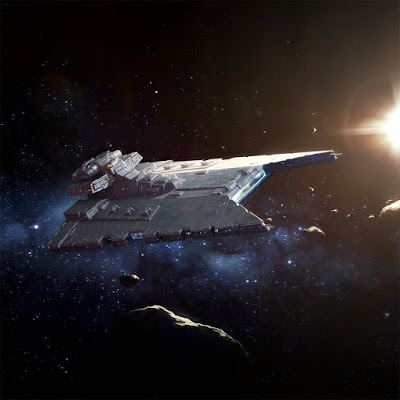
The Empire-Class Dreadnought joins the Typhoon and the Starhawk as iconic for Psi-Wars, and as has been shown in the playtests, they work perfectly fine as written. A standard Dreadnought has sufficient secondary and tertiary cannons to deal with starfighters, and their secondary batteries deal an average of 200(5) damage, which is sufficient to seriously damage or destroy most corvettes. The spinal cannon deals 1400(3) damage, which is sufficient to simply destroy even a Sword-Class Cruiser. The large cannon is inaccurate (-3), and spinal cannons suffer heavily against smaller ships, but with the current rules, it only suffers another -3 against a capital ship, and that it’s fixed gives is a +2, so against a capital vessel (+6), they have a +2 total to hit, which is fairly effective from Close range and certainly from Long. The hangar can support 3,000 typhoon fighters, 1,000 starhawks or 300 wyverns, and it can launch 200 typhoons, 70 starhawks or 20 wyverns per minute. The result is a strategic dominance vessel, a warship capable of defeating fleets of starfighters (with its own starfighters), corvettes, and other capital ships, though sufficient enemy fire-power, skill and determination can certainly defeat one.

The Legacy Model

The prequel trilogy feature the proto-star destroyer, the “Jedi Cruiser,” which is a concept I enjoy. Such a powerful vessel would probably have existed for decades, and its model changed, updated and improved. As with my previous vessels, we can apply the same concept, creating a non-optimal TL 11^ design that draws heavily on TL 10 elements, representing an “early TL 11^ design.”

The Legacy is a size smaller than the Empire-class. It replaces its spinal battery with a fixed mount particle beam, and it reduces its tertiary battery to a secondary battery. It retains a (smaller, though still respectable) hangar with a capacity for 1000 typhoon, ~300 starhawks, or 100 wyverns, and downgrades to fusion reactors and nanocomposite armor. The result is still a ship that can destroy most corvettes and capital ships, carries a respectable fighter cover with it, and it’s effectively immune to most capital ship fire (barring a good torpedo hit), all for a fraction of the cost. The legacy is an excellent ship, to the point where one wonders what threat the creators of the Empire-class dreadnought had in mind when they created it.
Front Hull System
[1-3]
Hardened Nanocomposite Armor (total dDR 450) ($9b)
[4]
Major Battery (Fixed mount with 100 GJ improved particle beam) ($1.5b)
[5]
Tactical Array (Comm/Sensor 16) ($0.6b)
[6]
Hangar Bay (10k tons, 1k launch rate) ($0.03b)
[core]
Control Room (Comm/Sensor 14, C12) ($2b)

Central Hull System
[1-2]
Hardened Nanocomposite Armor (total dDR 300) ($6b)
[3]
Secondary Battery (10 turrets with 10 GJ improved uv lasers) ($1.5b)
[4!]
Light Force Screen (dDR 700) ($5b)
[5-6!]
Stardrive Engines (FTL-1 each) ($6b)
[core!]
Habitats ($0.3b)
Rear Hull System
[1-2]
Hardened Nanocomposite Armor (total dDR 300) ($9b)
[3-4!]
Super Reactionless Engines (12.5G acceleration each) ($4b)
[5-6]
Fusion Reactor (two Power Points each) ($6b)
The Legacy has gravitic compensation ($0.3b), Artificial Gravity ($0.3b)
TL Spacecraft
dST
Hnd/SR
HT
Move
Lwt
Load
SM
Occ
dDR
Range
Cost
11^ Empire Legacy
500
-1/5
13
25G
300k
13k
13
3500ASV
450/300/300*
x2
$51.83B
*Hardened, with an additional 500 DR

The Mythic Model

What’s even scarier and more imposing than an Empire-Class dreadnought? A bigger Empire-Class dreadnought. That’s the idea behind the “Super Star Destroyer,” Darth Vader’s flag-ship. We can do the same with an Empire-Class dreadnought, and create an even bigger dreadnought.
The problem with this approach is that the Empire-Class Dreadnought is arguably too big already. The Legacy-model is already sufficiently powerful to defeat any ship I’ve described over the past week, including the Viking-Class assault carrier, below. The standard model is even more powerful, with a spinal cannon that will vaporize a Sword-class heavy cruiser in a hit. It’s already a super-weapon. Why would you need an even bigger super-weapon? Well, anyone who has an Empire-class dreadnought is probably more worried about prestige than sense in any case, and I’ve made the corresponding design more about intimidation than about battlefield supremacy.
The Mythic has superior shields and sufficient armor to ignore most attacks. It doesn’t need more hangar space, and barely doesn’t need more habitat space (though it has far more workspaces and still needs to carry an army around), thus it has a larger habitat, but it’s control room, tactical array and hangar space are all smaller and in a single slot, making is slower and less stable than the smaller Empire-class vessel. What it has instead is fire-power. Endless fire-power. It replaces the spinal mount with a single beam weapon as powerful as the entire Empire-Class’s spinal mount, and then layers on additional missile launchers (for planetary bombardment), medium batteries (for destruction of capital ships), secondary cannons (to destroy corvettes) and loads of all sorts of tertiary batteries (for point defense and the defeat of fighters). The result is a fleet center-piece, slow, but capable of single-handedly wiping out the enemy fleet… which one would hope it could do, as it costs as much as most fleets.
Note that it lacks sufficient power to run all systems, and that it retains its rear vulnerability to fighters.

Front Hull System
[1-2]
Hardened Diamondoid Armor (total dDR 1000) ($120b)
[3!]
Major Battery (Fixed mount with 1TJ antiparticle beam) ($15b)
[4!]
Medium Battery (three 300 GJ X-ray laser turrets) ($15b)
[5!]
Tertiary Battery (10 very rapid fire 300 MJ x-ray laser turrets, 10 30gj x-ray laser turrets, 10 64cm (medium) missile turrets) ($15b)
[6]
Secondary Battery (ten 80cm Missile Launchers turrets) ($15b)
[core!!]
Heavy Force Screen (dDR 1000 or 2000) ($150b)

Central Hull System
[1]
Hardened Diamondoid Armor (total dDR 500) ($60b)
[2!]
Secondary Battery (10 turrets with 100 GJ x-ray lasers) ($15b)
[3!]
Tertiary Battery ( 10 very rapid fire 300 MJ x-ray laser turrets, 10 30gj x-ray laser turrets, 10 64cm (medium) missile turrets) ($15b)
[4]
Control Room (Comm/Sensor 14, C12), ($2b) Tactical Array (Comm/Sensor 17) ($10b), Hangar Bay (30k tons, 2k launch rate) ($0.1b)
[5-6!]
Stardrive Engines (FTL-1 each) ($60b)
[core!]
Habitats ($3b)
Rear Hull System
[1]
Hardened Diamondoid Armor (total dDR 500) ($60b)
[3-4!]
Super Reactionless Engines (12.5G acceleration each) ($40b)
[5-6]
Super Fusion Reactor (four Power Points each) ($60b)
The Mythic has gravitic compensation ($3b), Artificial Gravity ($3b)
TL Spacecraft
dST
Hnd/SR
HT
Move
Lwt
Load
SM
Occ
dDR
Range
Cost
11^ Empire Mythic
1000
-2/4
13
25G
1m
13k
15
35kASV
450/300/300*
x2
$661.1B
*Hardened, with an additional 1000 DR for 1 power point or 2000 for 2 power points.

Viking-Class Assault Carrier

GURPS Spaceships 4 includes a variety of carriers, including the Tarot listed above, but for the “mega-carrier,” I prefer the Viking, as it’s a touch less ridiculously epic than the Continent. The Viking-Class Assault Carrier can carry up to 200,000 tons, which is a mind-blowing number of fighters (it is, in fact, meant to carry an entire invasion fleet) and approximately 5 divisions of soldiers. A single Viking-Class Assault Carrier, backed by a couple of Empire-Class dreadnoughts, would almost certainly bring nearly any world to its knees (one would hope so, of course, as it’s over a trillion GURPS dollars worth of military hardware, not even accounting for the fighters, bombers, shuttles, soldiers and military hardware). The only problem with the Viking-Class Assault Carrier is that it has a few things in it that don’t quite fit the given model of gameplay: It includes total life support systems (unnecessary for the speed at which ships travel in Psi-Wars), grav guns (not a present technology) and 64mm missiles (which means it can only fire medium missiles and torpedoes).

The Devastator Model

The devastator model is identicalto the Viking Class except for the following changes: Replace the tertiary missile battery with a secondary missile battery, giving it ten 80cm missile launchers (thus, heavy missiles and torpedoes). Replace the ten grav guns in the central Tertiary Battery with ten 300gj x-ray laser turrets, and remove the total life support, doublingthe carry-capacity of the ship (it can carry 100,000 soldiers, rather than 50,000). Price remains the same.