Melee Academy – Wu Wei

Wu Wei

Douglas Cole regularly invites the rest of us bloggers to join him for Melee Academy, where he proposes an interesting scenario or question, and each of us try to answer it in our own way.  Today, he proposed the theme of “Opening Moves.”  What opening move do I like to use in combat?

I wanted to take the opportunity to discuss a concept introduced to me by Weapons of the Gods that I find fascinating to this day, and also to point out how a few optional rules can completely change the dynamic of combat.

The game in question was my martial arts extravaganza, Cherry Blossom Rain, and the character in question is Shimada Daisuke.  His favorite opening move was Wait: He won by doing nothing at all, because Daisuke understood the concept of Wu Wei.

Wu Wei

If you see ten troubles coming down the road, you can be sure that 
nine will run into the ditch before they reach you
-Calvin Coolidge
The characters at the top, as the handy caption informs you, translates as “Wu Wei,” which means “non-action” or “action without action.”  You can read up on the concept here.  In this context, it means to gain victory by doing nothing.  Sometimes, our own actions serve as our own worst enemies.  Watch a kung fu movie (Ip Man’s fight against the Northerner probably exemplifies this best) and you’ll see one character exerting a lot of energy and only managing to exhaust himself while the master waits for him to finish, and then destroys his exhausted opponent with a single blow.  The master learns to bide his time and to express his energy when it serves him best.
Taoism gives us the concept of yin and yang.  I’ll return to this again (and again and again), but yang is action, substance, light, stuff, while yin is passivity, void, darkness, lack of stuff.  A tea cup has both yin and yang and needs both to serve you: It needs a porcelain bowl to hold your tea and a porcelain handle so that you can hold the cup without burning your hand: yang.  But it needs a void in the handle so that your finger can fit through, and it needs a void in the bowl so that the tea can fill it.  It must be empty: yin.  A tea cup is a study in yin and yang, and so is a warrior.  A warrior must win by both doing and not doing, by waiting.

Modified Martial Arts

Cherry Blossom Rain used quite a few rules from GURPS Martial Arts, from Douglas Cole’s Last Gasp, and some common optional rules.
The optional rules pertinent to Wait were:
Cascading Waits (Martial Arts p108): Obviously, if multiple characters are going to end up Waiting on each other, then we need the Cascading Wait rules.
Stop Hit (Martial Arts p108): By waiting until your opponent struck, you could also attack simultaneously.  Both warriors passed the other in a flash, and the winner of the contest defends the attack at -1 while the other defends at -3.
Contest of Wills (Martial Arts p130): This rule forces a contest between Will (or Intimidate or Mental Strength) to see which has the superior “spirit” or “will to fight.”  As an additional optional rule,  if both characters wait for the other and nothing happens, a contest of wills occurs automatically, to emphasize the tension of a mexican-standoff.
Recovery Events (Pyramid #3-44 Alternate GURPS II, page 11): A character who waits regains AP at the end of his turn if nothing triggers his wait.
Wait turns to Evaluate (Optional Rule): I don’t have a specific reference for this, but it’s one I hear often: If you wait and your wait involves watching someone, if nothing triggers your wait, you gain the benefit of an Evaluate maneuver (which is compatible with Recovery Events as Evaluates have the same recovery rate).
The net effect, I think you can see, creates an ideal dueling situation.  You can pause and watch your opponent.  If nothing happens, you can recover and gain additional insight into your opponent, but if your opponent also pauses, you might trigger a Contest of Wills and if your opponent is scarier than you, that might cause you a problems.  It created a scenario full of psychology and tension and tough choices, which I like.

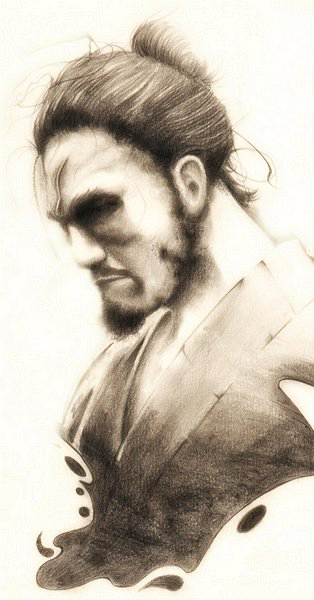
Shimada Daisuke

Shimada Daisuke
Daisuke was the second son of the Shimada clan, the better son and beloved by his father, but forced to become ronin when a spat with his elder brother, the heir of the clan, turned violent.  He bore Legacy, the unbreakable and ancient ancestral blade of the Shimada clan.  He was skilled in Iajutsu (he had Fast-Draw 18 with a +2 “fastest blade in the east” perk-set) and the quick-sheath perk, and he had cultivated his chi to the point where had mastered the power of Timelessness (Enhanced Time Sense, in essence).  He was skilled in Savoir-Faire and Diplomacy, he had extraordinary levels of Mental Strength, thanks to his considerable Will and Inner Balance, and he had “Shimada Eyes,” the ability to roll Intimidation without saying a word.
Daisuke was also a pacifist.  He had Pacificism (Self-Defense Only).  He couldn’t initiate a fight, but he should sure as hell finish one.  This created an interesting dynamic for how he fought, which set him apart from the rest of the more aggressive PCs, and highlighted the power of Wu Wei.

Wait!  A typical Shimada Daisuke encounter

When violence looked imminent, Daisuke would always go first (Timelessness) and he would always say this:
I wait.  If (specific character) attacks, I attack them.

Obviously, he had to do this, because he was a pacifist, but he often made a point of it.  He had reasons for it.  He’d do it in the middle of a fight too.  He’d sheath his blade and just stand there, watching people fight.  Several things happened.
First, Cherry Blossom Rain wasn’t Dungeon Fantasy.  The typical opponents reacted like people.  They often didn’t want to fight, so Daisuke wouldn’t push them.  If some thug blustered and bluffed and waved his blade about in a threatening manner, Daisuke just waited.  He might even talk, tell him to relax, that there was no need to fight and sometimes it worked.  Sometimes the kid who was making threats was just scared, or hungry, or blackmailed.  Sometimes, Daisuke’s waiting won a fight without fighting.
If they intended to fight, but waited as well, that would trigger a Contest of Wills, and then Daisuke would win.  That forced his opponent to either attack or retreat. Attack meant Daisuke would win, and retreat meant he won as well.
If they intended to fight, but moved or feinted or did some aggressive action that wasn’t quite attacking, Daisuke gained an Evaluate bonus and spent no Action Points, while his opponent slowly exhausted himself.
If they attacked, Daisuke would spur into action.  His blade would come out more than quickly enough to beat his opponent to a Stop Hit, which Daisuke would win, which would force his opponent to defend at a penalty (Daisuke could often afford to even apply a deceptive attack to his broadsword skill when making the stop hit, but he had a ridiculously high sword skill).  This made it virtually impossible to defend against, especially if they had failed a contest of wills.  Daisuke would usually sheath his blade again in the same turn and get a free Intimidation roll from his Chiburi, which meant at the end of such a moment, his opponent was dead and everyone else in the room was suddenly less interested in fighting.

Winning Without Fighting

I designed Cherry Blossom Rain to be a lethal game.  It brims with bleeding rolls and power-blows and over-powered Legendary Katanas that did a ridiculous amount of damage.  I intended to make it tragic, a game of wabi-sabi, but Daisuke’s pacifism, respect for life, and willingness to give his opponents a chance to change their mind before fighting him saved lives again and again.   Daisuke’s player understood something fundamental about GURPS: that is it a strategic rather than tactical game, and that he didn’t need to win the fight, only to achieve his objectives, so he walked softly and carried a big stick, and encouraged compromise with his his hand lightly resting on the hilt of his sheathed blade.

Wabi-Sabi

Probably one of the most neglected elements of storycraft is that of theme.  People love to talk about characters, settings and plots, but they often neglect to discuss or decide what a story is really about, or what it’s really driving at.  I’m guilty of this too: Why worry about what a story is about when I’m in love with characters or a particular setting element?  But even so, I’ve found that themes serve as a strong foundation for a game, helping to shape my characters, my plots and my sessions.

If I had to pick a single, driving theme for Cherry Blossom Rain, it would be that of wabi-sabi.  The sentiment is similar to the Western concepts of “Seize the day!” or “Eat, drink and be merry, for tomorrow we die,” but decidedly less uninhibited or optimistic.  Wabi-sabi is noticing a wrinkle on a beautiful, young woman’s face and seeing a hint of the grandmother she is to become.  It’s watching the autumn leaves fall from a tree.  It’s noting the ding on your favorite sword and finding that it has more character now.

Part of wabi-sabi is noting the effect time has on things.  Cherry Blossom Rain has a deep background: The legendary blades aren’t just magical, but they have stories.  The clans and this war was already in motion.  Many games treat the history of a setting as a sort of eternity: The good king has always ruled the righteous kingdom, the evil empire has always threatened the freedom of the world, orcs have always rampaged at the borders.  If there is history, it happened thousands of years go.  In Cherry Blossom Rain, it happened yesterday, and it’s still in motion.  The players find themselves not in an eternally unchanging world, but in a world that was the result of heaps and heaps of small changes over time, and that’s changing still, changing around them and changing with them whether they want it or not.

But the main thing most people take away from wabi-sabi is the concept of fleeting beauty, the knowledge that you might have seen something beautiful, something worth cherishing, and now it is forever gone.  I’ve tried to steep my game with this notion: My game is not an endless parade of samey duels, but distinct moments that the players will never be able to get back.  First, wild adventures through the sinister Kamurocho and a unique opportunity to serve tea to their enemies and get to know them better.  Then, a moment of camaraderie in a hot springs.  Now, they stand on the precipice of war, frantically sharing their last moments with the ones they love, struggling to preserve what they have, knowing that tomorrow it’ll all be gone.  I’ve complained before that my game has slowed to a glacial pace, and it’s not because the players have nothing to do, but because they’re doing so much.  Part of this, I think, comes from their growing awareness of the how fleeting the moment is.  They’re grabbing onto these last few days and holding on tight, because tomorrow their beloved NPCs won’t be there.  They might not be there.  Raoul in particular feels this keenly, as he sees himself as the most likely to die on Sword Mountain. Even the name “Cherry Blossom Rain” speaks to the concept of wabi-sabi, because I’m explicitly trying to evoke the image of cherry blossoms falling from trees, a moment of beauty caught just as it ends.

I really can’t think of a better medium to show the principle of wabi-sabi than in a role-playing game.  A picture freezes the moment forever.  A recording or a video can be played over and over again.  But nobody will ever have a chance to play Cherry Blossom Rain again, not this way, not with these people, not this story.  It’s behind us and done, a stream of fleeting moments, enjoyed and now cherished, but forever gone.  I find this the most poignant element of role-playing: My art is an art that’s lost as soon as its shown.  No matter how wonderful a session, future generations will never have a chance to marvel at it the way they might marvel at one of Leonardo Da Vinci’s paintings.  In that, a session’s beauty is even greater precisely because of its fragility, the very essence of wabi-sabi.

Cherry Blossom Rain: Session 2 and the yips

Do you know what the yips are?  It’s when someone who’s really good at something, usually sports, suddenly loses his touch.  A perfect pitcher suddenly throws homers, a wide receiver suddenly can’t catch, and so on.  When I was in highschool, I had the yips really badly in my summer year: I went from one of the best discus throwers on my team to the guy who literally couldn’t get a throw out of the ring at a single competition.  It was terrible, and to this day, I don’t know what I was doing wrong.

I’ve found myself wondering if I’d have the yips as a GM lately.  Some of my players will look at me like I’m mad, but the truth is, I’m certain my WoD: Witchcraft game wasn’t great, and my WotG game wasn’t what I wanted it to be.  I know the techniques, and I can talk the talk, but I find myself wondering if, perhaps, I’ve lost the ability to walk the walk.  On the one hand, it might be absurdly high expectations: I want all my games to be “great” while greatness is ultimately subjective (Most people will agree when something is bad, or when it’s good, but greatness goes a little beyond that, and it’s often in the eyes of the beholder), and so when I fail to get a jump up-and-down reaction from my more experienced players, I feel like I’m doing something wrong, when I’m probably not.  So perhaps it’s in my head.

Well, if I had the yips, they’re gone now.  I hit every note I needed to in this last session, and more than that, I proved to myself that the techniques I’ve been studying have been paying off.

First, I’ve felt for some time that if you have sufficient advanced material, that prepping and planning the game itself should be relatively easy.  Now, while I had plenty of time to put this game together, I procrastinated (as I usually do when my focus is elsewhere), and ended up spending 30 minutes right writing out some thoughts I’d had the other night before I zipped off to the game.  Despite my almost complete lack of preparation, I still had a really good game.

The players started off in the Kurosawa Castle, guests of Ren and Lord Kurosawa again.  I reintroduced Sano (rudely), and then brought the characters together.  Hitting the high points:

  • After seeing a doctor for his wounds, Kenta (Raoul) went to train with Yudai and then (spectacularly) lost a duel to Yoshiro, the Senshin Swordmaster.  Sakura (Maartje) also practiced with Yoshiro, but was too busy fluttering her eyelashes at him and blushing to actually fight, and lost twice.  
  • Meanwhile, Yukiko (Desiree) slipped and fell while waking down the hallway and smacked her face against a wall while alone with Ren.  It totally happened! (It did!  Desiree had been cursed by the “Mud Girl” as she keeps calling her (she’s noted down in my notes as “the Witch of Jukai”), and so I made her take a “Walking down the hallway” roll, at DX +10, and then used the curse to turn her success into a failure and give her a point of damage).  Naturally, nobody believed her, so Shinji, resident Nice Guy of the Mitsurugi Dragon Guard flew to her defense and was going to challenge Ren before Kenta socked him in the face and told him not to screw up negotiations.  It’s good to be Daimyo, I suppose.
  • Yamato (Hugo) negotiated an alliance with Lord Kurosawa in the face of Tsao Bei (evil Chinese diplomat!), who brought Dark Shota and the Executioner with him.  In addition to agreeing to give Lord Kurosawa some important position in the future shogunate, he also arranged to marry someone to his youngest son (Sano).
  • Desiree decided to have a tea ceremony, so obviously everyone had to come.  She got to play dress up (Fashion Sense gives a +1 reaction modifier if you dress yourself or others well, and I required descriptions.  She was more than happy to oblige), and she even made Kyo look really pretty.  At the Tea Ceremony
    • Someone tried to poison Yoshiro, but Ren protected him.
    • Kenta agreed to marry Kyo to Sano, much to her dismay.
    • Yoshiro reacted… passionately to this revelation, leading Sakura to suspect that he was in love with Kyo, must to her dismay (Sakura’s dismay, not Kyo, we don’t know how Kyo feels about that, she was too busy freaking out about being married off).
    • There was much drama.
  • That night, ninjas attacked!  Fortunately, Kenta, Sakura, and Senshin no Oni (!) showed up to defend him.  Senshin no Oni revealed that Tsao Bei was attempting to grievously wound the swordmaster, knowing that the Senshin would never leave him behind and it would slow down their movement.  He also revealed what he had learned while prowling the city, giving them some clues on where they might find Kimiko.
  • Desiree found the carefully preserved bedroom of Akane, Ren’s older sister who was executed for treason against the emperor.  When he discovered her, he wasn’t angry, as his servants expected, merely very sad, and asked her to play her samisen for her.  She agreed.
Naturally, I’m leaving out some of the details.  A few important things came out of this session.  First, I’ve been trying to explain the importance of beauty and elegance in the setting, but this session served as an excellent demonstration of that, with a sudden focus on Desiree’s tea ceremony skills, her make-up skills, her fashion sense, and Maartje’s calligraphy, and everyone’s savoir-faire (only Kenta screwed up his roll).  Second, I wanted this game to very much be an exploration of Japanese culture, and Hugo’s demonstration of tea ceremonies for the rest of us did a good job at that. Finally, I’ve taken Walter’s sage advice to heart.  You see, I’m terribly fond of having multiple, interwoven stories and that often involves separate scenes for each character.  This can have wonderful results, but as he once said “Dan, your stories are great to watch, but they’re even more fun to interact with.”  I made a point of allowing anyone to jump in on anyone else’s scene, and the result was that you got crossover much faster while nobody lost their moment in the spotlight.  You could see the multiple threads and interact with them, which I think partially explains the success of the session.
What stuck out to me was the interaction I had with the players.  Normally, you don’t see players this invested in characters and storylines until midway through the campaign.  This campaign shows the dividends of my work to make sure that I can have “maximum impact in minimum sessions,” and I thought I had failed (it turns out that there’s a certain “minimum” players need to grasp what the hell is going on), but clearly, I hadn’t.  I can’t stuff “the feel” of a full campaign into a single session, but apparently I can reach that point in two.  Raoul argues that it’s because I have an all-star cast of players, and that’s certainly a contribution.  Raoul himself, for example, has deeply studied my setting and my characters and is highly invested in the game, and Desiree is used to falling into character for one-shot LARPs, but I’d like to think that the work I’ve put into the setting helped.
Once, during the development of 4e, a D&D designer invited his wife to sit in on a D&D playtest and watch.  He asked her opinion, and she said “It looks like 4 hours of work for 30 minutes of fun.”  I’ve been trying for a long time to improve that ratio, so players don’t feel like they have to slog through 4 hours of crap to have a little fun at the end.  After I realized that we’d played for 4 hours and I’d only had 30 minutes of prep, I commented to Bee “I had 4 hours of work that only cost me 30 minutes of work.” 🙂
I think the lessons learned here are clear: Pick your players and match them well to your game.  All the work you do in advance will save you work in the long run, and the fact that I can simply run with little to no prep means I’m not stressed before the session.  Allow PCs to interact with one another, and encourage them to stay in the vicinity of one another so that they can do so.
This is what I wanted from my sessions, and now my players can see where I’m going with it.  And it passed the “player gab” test, since people were apparently chatting about it the next day.  Cherry Blossom Rain has officially taken flight.
Just a shame that Rene and Raymond couldn’t be there to see it… on the other hand, they were sold on the game in session 0. 🙂

Cherry Blossom Rain: Session 1

I’ve noticed that when I “mean to” put something on my blog, it almost never goes up unless I do it while the ideas, the events, are still fresh in my mind, so I’m going to post this right away, lest it fall in the dustbin of history.

So!  As you may remember, I ran my samurai one-shot over the Summer Weekend a month or so ago, thus completing my vision of a GURPS Samurai game wherein I could really explore martial arts.  That was enough… but in the process of creating my game, I created an entire world that really demanded more exploration!  And so, I offered to further the game as a campaign.  Today, I ran the first session of that campaign.

Planning the game turned out easier than I expected.  I fretted that I hadn’t spent a week putting session material together and, indeed, I would have liked to have statted a particular ninja out before hitting the table.  However, I put together a skeleton of a session that relied a great deal on what I had already written (not really a problem, as the whole point of all this fore-planning was the fact that I could use it to make the rest of my game easier to toss together).  The results worked great!  I think this whole “intense work putting together a world so that actually putting the sessions together is a snap” strategem really works well for me.

As to the actual session, I wanted a chance to introduce the new characters, bring everyone up to speed on what was going on, have a big, interesting fight that served as a combat tutorial, and then move on to solving the rest of the story.  I got everything up to solving the rest of the story.  I hate it when a session is 90% combat, but I find that’s just the pulse of my GURPS games: This session, a really interesting fight with lots of combat, the next two sessions aftermath and building the context for the next big fight.  Everyone seemed to enjoy the fight.  I fret that Desiree, who certainly enjoys roleplaying more than beating the crap out of people, might have been a little bored, but she didn’t seem bored, she got to stab someone in the eye with her hairpin, and she said she had fun, so I’ll take her at her word.  And we started late, around 7 pm, so we only had 3-4 hours to play, thus it’s natural that we wouldn’t get much done.

The session began where the last ended: The imperial princess snatched from the home of Taro, the heroic Yakuza, with Yukiko, Daisuke and Hayate there to see the carnage.  They gathered up Taro and moved to leave, when suddenly, ninjas attacked! This gave Hayate a chance to reconnect with his past (an element that had been sorely missing thus far), and showed just how lethal ninjas can be.  Meanwhile, Goro made his move against Taro, bringing his hardest hitters to attack the club and finish off his rival once and for all.  The three players (along with Satomi, the doctor secretly in love with Taro, and Taro, our heroic Yakuza) faced a force of five ninjas, an elite ninja, twenty bandits and the Ox brothers.

Fortunately, the cavalry came (in Maartje’s case, literally).  The other players had their own scenes of arriving at the city or realizing that half their party had vanished, and set off in pursuit, only to arrive at the club just in time to see the carnage unfolding.  Each player had a moment to shine, and quite a few NPCs.  Hayate talked the ninjas down (thus saving the doctor’s life), and through teamwork, Daisuke (by drawing their fire), Hayate (by wounding them with a flash-step-gut-stab), Desiree (by pinning one in the eye) and Taro (by finishing the final one off with a grab-and-smash) managed to put down both of the terrifying Ox Brothers.  And then the players took the time to get to know one another and decide on where they wanted to go next… and we ran out of time.

So, like I said, I didn’t get much done, but the players enjoyed the battle, and I think they needed this sort of “reintroduction.”  All in all, given the enthusiasm shown, I think it went well, but I still look forward to digging into the meat of the role-playing in the next session.

GURPS Martial Arts

(Cross posted from the SJGames forum)

Ages ago, I posted a thread asking questions about how to run a successful and dynamic martial arts game.  I doubt anyone remembers it, but I found many of the suggestions useful.  I’ve finally finished my playtesting and actually run the damn game, and I thought I would share my experience.

1. GURPS actually runs a really great martial arts game.

When I posted my questions, I was concerned about how well GURPS would actually handle the cut and thrust of a martial arts fight.  It’s true that GURPS has lots of options, but in my experience (up to that point), most of them boil down to configuring your attack and defense into optimal values and then using those again and again.  A few maneuvers have lasting consequences, like feints or AoAs, but those tend to last no longer than a single turn, and then everything resets to its original point.

What I actually found is that those one-second consequences tend to last, and once you understand how they work, you end up with a game of chess.  For example, if I attack you with Karate and you successfully parry with Judo, then you might lock me into an arm lock or judo throw me, and thereafter start kicking me in the head.  So, I need to make sure that if I attack you, I do so in a way that you can’t defend properly against, which means that I should feint against you, but knowing that I’ll feint, you might evaluate and, if so, I might be better off evaluating first as well.  And so on.

GURPS also has other tricks, as it turns out. Targeted Attacks and Combos, when used too often, become predictable and your opponent gains a bonus to defense, which means you should use them sparingly, when circumstances warrant it.  It’s a subtle mechanic, but I found it made quite a difference.

2. Use Techniques Sparingly

I honestly find 4e’s treatment of techniques slightly frustrating.  For one thing, I’m not sure why they need to have an Average/Hard split.  If you want to charge 1 point more for a trick, make it -1 more difficult.  What you currently have is that Hard techniques are easier to pull off by default than Average techniques (That is, both a Hard technique at -2 and an Average technique at -3 cost 3 points to max out, but the Hard Technique is paradoxically easier to pull off by default, and less worth your time to study).

Moreover, in 3e, you were required to take every technique in a martial art to “know” that martial art.  Now, this caused problems, but it meant that two different styles that both had Judo and Karate were distinct, because one had X and Y, and the other had A and B.  Moreover, having all those techiques listed on one’s sheet encouraged players to try those moves out.  If you know you’re good at spin kicks, jump kicks, feints and hammer-fists, you’re not going to bother with exotic hand-strikes or head-butts, and you have a distinct fighter that encourages the player to do more than just “Attack/Attack/Attack!”

In 4e, it makes little sense to have more than a couple of techniques, and so you have to pick and focus on what you want your character to be good at.  If you have a Judo of 18 and that’s “enough” for Arm Lock, you don’t take the Arm Lock technique, while another fighter might focus almost exclusively on Arm Lock.  You get distinct fighters within a given style, which means you can get a lot of mileage out of a single style, and that’s great.  It’s just that techniques aren’t where you go to write out how your character fights…

3. Use Signature Moves

… you use Signature Moves instead.  I took Toadkiller Dog’s advice about writing down the more complex moves that a fighter might use and giving them swell names.  Made all the difference in the world.  Take my example above about the Judo 18 guy who doesn’t bother with Arm Lock because his Judo is more than high enough.  He can and should still use Arm Lock, and if you want to remind a player to do that, you simply note down a special armlock “signature move.”

You can even construct very complex moves that take advantage of several unique mechanics to make a killer move.  For example, one samurai had a signature move that involved shifting to a defensive grip for a parry, while side-slipping (this being Chambara, was worth +2), and then spending 1 fatigue for a total of +5 to parry, which he turned directly into a riposte, followed up with a Counter Attack (for a total of -7 to his opponent’s defense) as a thrust (since defensive grips are terrible at swings) to the vitals.  Nobody’s going to think of that move in the middle of a fight, and there are numerous things that you need to calculate (can you take a -5 to your defense with a riposte?  What’s your effective skill between Counter Attack and going after the Vitals?).  By working it out in advance, you only have to glance at a piece of paper to pull of this off.  The extreme potential complexity of GURPS martial arts becomes a feature, not a bug, and people begin fighting in a very complex way.

(And this isn’t entirely unrealistic. The whole point of things like kata is that they teach you to use very complex tactics that you’d never think of in the middle of a harried fight.)

By giving the player’s signature moves and including signature moves with the NPCs, I found that my fights exploded with details and rich tactical depth.  Nobody made straight attacks, because they had customized their fighting styles to support far better tactics, and clever opponents would exploit the weaknesses of a given move with their own tactics, which would lead to rapid exchanges of constantly flowing and evolving tactics.

4. Perks are where it’s at!

As I said before, Techniques aren’t the best way to add lots of character to your fighter, because you can only really take so many and eventually you’re better off simply making him a better, all-around fighter.  That’s where Perks come in.  Perks are almost always worth it (unlike Techniques), and they tend to encourage specialized tactics.  Secret Styles, Trademark Moves and Finishing Moves all encourage and expand upon the Signature Moves above.  Tricks like Iron (Body Part), Teamwork, Resistant to (Chi Power), Schticks, Drunken Fighting, Sexy Feints, and so on, all shift and change the nature of the character in neat little ways or provide him powerful advantages that, if he’s clever, he can really exploit.  A good martial arts game is about turning every character into a “fighter,” and still seeing plenty of diversity.  Perks really provide that.  I’d never try to run GURPS Martial Arts without perks.

5. GURPS, as always, exceeds expectations…

I mentioned already that GURPS ran a great martial arts game.  I didn’t mention how often I thought a rule needed to be changed, when it didn’t.  For example, many people argue that Evaluate is a poor tactical choice, so few people use it.  However, I found that there are so many consequences to attacking a capable foe (Counterattacks, ripostes, judo throws, arm locks, exposing the trick to your secret Combo awesomeness) that people often fell into Evaluate when it became obvious that their opponent was more powerful than expected.

Likewise, I worried that GURPS would overwhelm some of my players (we had one player who generally hates system and fears any game with any level of complexity much beyond free-form), and yet, I found that between the Signature Moves and how GURPS normally handles, the game was surprisingly intuitive, people could do what they wanted, the fights played out swiftly, and even the system-phobe had a great experience.

6. …but change is good.

Even so, I did make some changes.  I used Icelander’s Beat rules (that is, beats apply their penalty to both the user’s attack and defense and at 5+, there’s a chance that it’ll unready the weapon entirely), though I allowed people to defend against Beats with DX-based weapon skill, in addition to ST-based weapon skill (I found that forcing players to always defend with ST-based weapon skill unfairly punished weak fighters, especially since ST-heavy fighters tend to spend lots of points in their skills to compensate for their low DX, and so when they beat, they REALLY beat).  I highly recommend them, as they make Beats useful for everyone, and it means that you’re taking a calculating risk every time you parry or let someone parry your blade, especially if they’re stronger than you are.

I did eventually modify Evaluate some.  I find it odd that one can make a Defensive Attack (inflicting damage) and gain a +1 defense bonus, but Evaluating gives you no defensive bonus, and so I made a little “cautious fighter trinity” of moves: In my version of the rules, Evaluate grants a +1 to your defenses, you can choose to forgo the +1 defense from a Defensive attack to instead gain a +1 evaluate bonus, and you gain an +1 evaluate bonus if you Wait and nothing happens.  I also allowed players who were evaluating to make rolls against certain skills or IQ to understand something about their opponent.  I found this made all three moves more interesting, but didn’t unbalance anything in particular.

Spring Weekend 2011 Part 3: Cherry Blossom Rain

Let me start, as all good articles should start, with a joke.  When Rene finished writing his session last week, he posted to Facebook: Finished with session.  Raoul responded: Will finish tomorrow.  Bee then responded “Dan has been writing his one-shot since February and still isn’t finished.”

Alright, so that’s less funny “ha ha” and more funny-sad.  Still, it highlights how important this session was too me, though putting so much into it almost made me choke at the beginning (the players didn’t sense how awkwardly I lurched into the game, but I could feel it).  We got a late start (Jozef had to take some people home) and we finally bullied him into choosing his NPC (as the Daimyo of his clan, he had the choice between bringing his loud No-Dachi swordmaster and his elite samurai, his Machiavellian warlord and political advisor and his agile cavalry, or in bringing his sister, who wasn’t particularly useful, but really, really, really wanted to come.  He chose, to the approval of the other players, his sister).  Then I described the kidnapping of the Imperial Princess, Kimiko, by some mysterious Yakuza soldier…

I introduced the players.  First, Desiree met her samurai’s father, who demanded to know why his son (Ren) had paid a king’s ransom for her, who she was, and why Ren wanted to marry her, then we shifted her to another scene where the Witch of Jukai offered to curse Ren for her (less because she wanted to protect Yukiko and more because she wanted to harm Ren).  Yukiko interfered and took the curse herself.  Unfortunately, I didn’t have the time to hit her with said curse during the session.

Next, we had a scene where Jaap (Katsuro) had been arrested for bar-room brawling, and after revealing some of how the police worked, our noir detective Asano Makoto freed him in exchange for his services hunting down the Yakuza accused of kidnapping the princess, Taro, because he’s tied into an investigation into who really killed the previous police captain (Detective Asano never accepted the official story that Taro did it: Too many holes).

Then we introduced Rene(Daisuke) and showed the players the muddy, cluttered, stinky side of Kamurocho.  A beautiful Mizushima prince named Kaito gathered rest of the players together in a tea house (including Jozef as Kenta and Raymond as Hayate) where he explained the situation with the Imperial Princess, suggesting that if they rescued her, they could rescind the execution order against the Senshin and their allies (the whole point of the game).  And so, they get ready to set out when Tsao Bei, arrogant Chinese Ambassador and Akiyama toady shows up with the Executioner (a terrifying Shinigami warrior) and Dark Shota (a mystical Kakashi seer with a special connection to ravens) and numerous soldiers.  Violence erupts as Tsao Bei proclaims that the Akiyama will rescue Kimiko.  The battle only lasted about 5-6 seconds, though it took about an hour to play out.  Raymond had a nice duel with Shota (which he lost in a contest of wills, but still bravely sought to fight out), and after being frozen solid while watching a samurai cut down Kyo (only 7 damage, which is a pretty bad wound, but survivable), Jozef managed to actually rip through the Executioner’s armor with his might blade (I spent an action point to turn it from 24 points of injury to 1 because I wanted to have a rematch later in the session, but still hats off.  Man, I always underestimate Kenta), and Rene lost his sword to a beat from the Executioner, who also cut clean through Jaap’s sword, hand-clap parried Tsao Bei’s blade and tossed it to Jaap.  Interrupting the fight, Ren (and Desiree) showed up with his dark and creep secret police and ended the battle, promising Tsao Bei to take the PCs into custody, which he promptly failed to do as soon as the Akiyama allies left.

The party split: Jaap and Raymond took the detective to a gambling den run by a Yakuza named Hachiro, who gambled with Raymond over who would help whom (actually gambled it out, Yakuza style, with two dice and a cup.  Raymond lost every toss 😦 ) and so Hachiro persuaded Raymond to expand the Yakuza’s power, in exchange for a meeting with the Oyabun.  Meanwhile, it came out in other parts of the gambling den that the police captain had been trying to force a woman to be his lover, and that they suspected she might have been the one who really murdered the police chief, and also, that Taro was generally a really good guy.

Meanwhile, the rest of the players took Kyo (and the barely wounded Jozef) to a doctor (Satomi, who happened to be a woman).  Along the way, Rene confronted the fact that Desiree might be the daughter he never knew he had, the child of his one moment of passion with his beloved Aiko.  While at the doctor’s, discussion turned to Taro, and Desiree, thanks to her character’s empathy, picked up on the powerful, romantic and guilty connection between Satomi and Taro, and was able to talk her into taking her to Taro (on the condition that they did it alone, leaving the dangerous Ren behind, whom Satomi worried might kill Taro.  Desiree had forgotten that Ren was both very possessive/protective AND had an entire secret police force at his disposal, and had an appropriately chagrined expression on her face as I described black-clad samurai descending upon the city, tearing it apart to look for Ren’s missing geisha).

They found Taro (by coincidence, also found by Raymond and Jaap), who agreed to bring them to the princess when Daisuke proved that he belong to the Shimada clan by drawing Legacy, the legendary Shimada blade. He explained that the Imperial Princess had never been kidnapped, but was hiding from the Akiyama and hoping to form an alliance with the Senshin, acting as their “hostage.”  He took them to the princess… only to discover that his Yakuza rival had gotten there first and snatched her out from under their nose.  And there, the session ended.

How did it go?  The battle flowed so much better than I expected.  The players used their signature moves and my NPCs fought in a fascinating manner.  The fight was messy and swift, just as it should be, and I think my NPCs (except for Tsao Bei, who came across as a bitch, which is probably appropriate for him) came across as suitably powerful.  Raymond really connected with Shota, and the Executioner terrified people to an appropriate degree (Though I wish I hadn’t needed to fudge that wound away like that.  Must remember: Kenta is goddamn lethal.  Should have learned that lesson when Raoul was playing him).  I managed to show the players enough of the story that it made sense, and the story swept along rapidly, with every action, every step, leading to more story.

Desiree’s response was very positive.  She felt it was a shame that we “didn’t have enough time,” which Raymond agreed with.  Given that the session lasted 5 hours, I took this as a good sign, because it meant that nobody had felt bored.  Indeed, the system never intimidated Desiree, and when she was struggling to decide what to do, her Common Sense and Empathy kicked in, giving her plenty of things to do.  And, in fact, she had quite a few opportunities to show off her “beautiful” skills, performing a tea ceremony for the players at the doctor’s house.  She was very interested in playing in the campaign (provided she had time, which she was doubtful of), and commented on how she could really see that it was a whole setting.  Raymond echoed her sentiments, expressing interest in knowing more about Shota and certainly enjoyed how his character played out.  He also spent half the session speculating on what was really going on, which means the mystery engaged him.

Rene left too quickly to comment (we really ended at the very last minute and it was “get out, get your stuff, leave”), but I think he enjoyed it.

Jaap likely enjoyed it too, but he found it hard to follow the names.  My large NPC casts are difficult to follow at the best of times, but when Japanese names sound like gibberish, as they do to him, you can lose the thread completely.  I had to stop and explain the social situation to the players a few times (Tokens for the win!), and I didn’t mind that, but before the game I worried if Jaap and the setting would really fit one another, and I suspect that my worries were spot on.  Likewise, Jozef seemed lost, less because of the setting, I think, and more because he was treading outside of his comfort zone.  He’s an experienced D&Der, and he wants to try other things, he wants to poke at romance and is certainly interested in politics, but joining my game was like jumping into the deep end of the pool, and I think he was a touch overwhelmed by it, though I bet if I asked him, he’d also say he enjoyed it.

But what about me?  Just the other day, I was complaining about all the planning I did.  In fact, we used almost none of my material.  They didn’t do any of the Yakuza quests, they found none of Kimiko’s jewelry, and they didn’t even really pursue Shinobu and deal with Goro.  But, to my surprise, I didn’t mind in the slightest.  Whatever they did, I felt like I not only had the material to cover it, but I was excited to do so.  I had so many ideas spilling out of me that, as far as I felt, literally every scene, every moment, was interesting.  There was no lull, no boredom, and I was able to bring across the sense of the greater world around them.  That’s exactly what I wanted.  So, yes, all that planning was worth it.  This means, of course, that if I want to keep working this way with games like WotG, I need to settle down and start working on it for a week, an hour or two a day for about 4 days which, incidentally, advice I had given to another GM ages ago.  Turns out to have been good advice.

I’m going to put CBR down for a bit, let it rest, but already, there are people asking about the campaign, so I think I’ll try to kick that off in about a month.  More on that later.  For now, I’m going to bask in my success.

Cherry Blossom Rain

Ages ago, after watching Samurai 7 and the release of GURPS Martial Arts, a part of me yearned to run a samurai game.  I already had Weapons of the Gods, but Japanese martial arts are quite distinct in flavor, approach and philosophy from their Chinese counterparts, as are their stories.  I also wanted to dig deep into the combat complexity that GURPS Martial Arts offered, and such a game would give me an opportunity to do so.  Finally, I have long been searching for a proper swashbuckling system (martial arts stories have a great deal in common with swashbuckling) since 7th Sea hooked me on such tales and then promptly failed me as a system.

The result is pictured above.

Originally, I had intended for Cherry Blossom Rain to last a single session, a one-shot that simply explored the concepts and then moved on.  As usual, GURPS proved a remarkably poor match for one-shots, as it requires a heavy investment in character creation (as opposed to other, quicker systems), but as I playtested Cherry Blossom Rain (which you can read here), I discovered a few things. First, the system is better suited to the sort of game I want to see than I expected.  Second, when I introduced Raoul and Roomie to it, even though I ran the same scenario over and over again, they didn’t tire of it.  Instead, they learned more each time.  A martial arts game, with its finnicky techniques, deep details and highly specific signature moves, tends to encourage a great deal of learning about your character, trying to see how best to approach a situation, and trying to remember which option to use when and why.  Both expressed dissatisfaction with the idea of playing “only once,” and both expressed support for the idea of a campaign.

A small one-shot idea quickly grew into a setting.  The characters came from clans, and those clans had allies and enemies, who also had their own fighting styles, their own histories, their own members.  Martial artists need rivalries and secret loves and hidden conspiracies, and over the months of pondering characters and learning about martial arts, these fell off of me like industrial by-products, seeping into my work until, before I knew it, I had not a one-shot, or even a short campaign: I had a setting.  Given how much detail I was able to create for Cherry Blossom Rain in a few short months, I wonder why I ever dragged my feet on Resplendent Star Empire or Protocols of the Dark Engine.  Perhaps I should work on “One shots” of those as well.

My “first session,” the proposed one shot, looms close.  Spring Weekend begins tomorrow, and I need to have my session ready for their high expectations.  However, to my surprise, the people I expected to join did not, either because they could not, they made a mistake, or they felt it better to let other people try (Raoul, as he’d played in the playtest and knew I had limited slots).  All of these people have expressed interest in joining the campaign, but I’m left with a conundrum, facing 5 fresh faces who already find the game, its world and the system interesting, how can I ever fit more people in for the campaign?

But, in preparing this session, I have learned a greater, more important lesson.  Recently, due to frustrations, I ended Weapons of the Gods (more specifically, put it on hiatus as I focused on other things.  I remain undecided as to whether I intend to return to it or not).  Part of my frustration was the sheer amount of work I had to put into each session to get them up to my own exacting standards.  “If I had put more work into the setting in advance,” I reasoned, “This never would have happened.”  Cherry Blossom Rain should have proved that.  It already has a whole, huge cast of characters.  And, indeed, it lessened the work load slightly… but only slightly.  I’ve been preparing this session for three days now, far longer than one of my Weapons of the Gods sessions.  Now, to be sure, it’s a better session than most of my WotG sessions.  It feels more complete, tighter, and full of details, which is how I like my sessions.  But if all this setting work doesn’t ease my planning, then what, exactly, is the point of it all?  Perhaps I must simply acknowledge that “quest based games” like Weapons of the Gods, 7th Sea, D&D and their like (as opposed to sandbox games that dump you in a single location and keep you there) should be designed one session at a time, with an eye on where I want it to go, like Exalted was designed.  Or, perhaps, my standards and those of my players have simply grown.  Or maybe just my standards, as my players often gave me looks (and to my own ear, I’ve begun to sound like one of those auteurs who’s always complaining that his own works are terrible).

As my blog slowly blooms back to life after a cold, hard winter, I hope to put more details down about what I’m doing.  Perhaps I’ll have a chance to share more about Cherry Blossom Rain with you, more about what it is, rather than just how I feel about it.