A March Wiki Update

I’ve been busy with family and distracted by my work on cybernetics (I’m very pleased with how it’s coming along). I did get some Wiki material up, especially with help from Jose, who has been trying to help with the tedium of actually formatting, so I got some extra things in. Here’s a quick overview.

Continue reading “A March Wiki Update”

Patreon Preview: Trader Guildfleets

Quite some time ago (December 2019, I think), I created a poll for working out the technological infrastructure of the Poll-designed alien race, the Traders.  I’ve been busy with other things, but I managed to get a total of 5 ship designs out for the Traders:

  • General Technological Considerations
  • Their Interceptor
  • Their Blockade Runner/Smuggler Corvette
  • Their Defensive Frigate
  • Their “Battleships”
  • And, of course, their Arks.
This is an incomplete document and I offer it as a preview to my Companions ($5+) patrons.  Don’t worry, Fellow Travelers, when it’s done, it’ll be available to you too, I promise.  It’s just messy as of yet, and I wanted to get some feedback before I make it available to you.

Patreon Poll: Trader Tech 2

Continuing from the poll earlier this week, I have a new set of polls for Trader Tech.  These cover the elements of their military technology that lie outside of the individual.  This includes:

This poll is open to all Patreons of the Companion ($5+) tier.  As usual, please leave a comment as to how you see their doctrine working or what nuance you’d like to add.  I definitely take comments into account.
I know I’ve not yet released the more detailed robot rules, but hopefully you’ll have a sense of what you can do with robots and how they might serve the Traders militarily.  You guys seem very interested in giving the Traders robots, so I hope that particular poll will be useful to you even without worked examples of robots from other cultures.

Redjack Raider-Class Light Assault Carrier

ST/HP:800

Hand/SR: +0/5

HT: 14

Move:12/125(+10)

LWt.:4500

Load:600

SM: +9

Occ.:100ASV

DR:1000/400*

Range:7jumps (Rating 2)

Cost:$700M

Loc.: g6t4rL

Stall:0

Total Chase Roll:+10

*Nanocomposite Polymer; double DR vs plasma attacks. Higher DR protects against attacks from the front. Additionally, it has a Force Screen that provides 750ablative, hardened DR.

Notes

Redjack Corvette Electronics:

  • Ultrascanner Open Mount: 150-mile search range, 15-mile scan range; low probability intercept (detectable at 225 miles); 360° rotation.
  • Night Vision Sensors: +9 nightvision, ×8 magnification (up to +3 to aimed attacks, if the vehicle aims for three turns).
  • Targeting Computers: +5 to Gunnery projects provided a sensor lock is gained.
  • ECM: -4 ECM rating, 20-mile radius; scramble comms up to 20 miles;
  • Large FTL Communication Array: 30-parsec range.
  • Large Holographic Radio: 10,000 mile range (orbital); “palm sized” holographic console.
  • Security and Safety: Simple Locks;
  • Accommodations: 5 cabins; 70 bunks. Two workshops, 1 gym and a sickbay large enough for 10.
  • Hangar Space: The Raider can carry up to 70 tons of vehicles (generally space for 6 SM+3 ground craft, or a single SM +4 craft)
  • Hardpoints: 6 hardpoint/clamps rated for 20 tons each (typically mounted with Wildcats)
  • Hyperdrive: Rating 2, with sufficient fuel for 7 jumps.
  • Ruggedized Hyperium Reactor: 30 days endurance.

The Raider has a bridge with three compurized control stations, one controlled by the Commander, and two by pilots. The engineering section has two additional control rooms.

The Raiderhas one full-rotation“corvette scale” blaster turret with two cannons (total RoF of 2), four modular “fighter” turrets that can mount all standard Redjack 2-ton cannons, and a single, rear-facing turret with an ST 160 tractor beam.

Weapon

Dmg

Acc

Range

Ewt

RoF

Shots

ST

Bulk

Rcl

Notes

Corvette-scale cannon

6d×30(5) burn

9

10mi/30mi

25t

1

NA

M

-10

2

NOV-4 Heavy Plasma Cannon Module

6dx30(2) burn ex

6

4 mi/12 mi

4000

1/3

15/2F

M

-10

3

MIN-3R Mining Laser Module

5d×15(10) cut inc

12

500/3 mi

4000

1

25/5E

M

-10

1

SP74-TR Heavy Plasma Gatling

6dx15(2) burn ex

6

3mi/
8mi

4000

8

88/
3F

M

-10

3

Isomeric Torpedo Bay

6d×500 cr ex

3

300/
10 mi

2500

1

3

150M

-15

1

Look and Feel

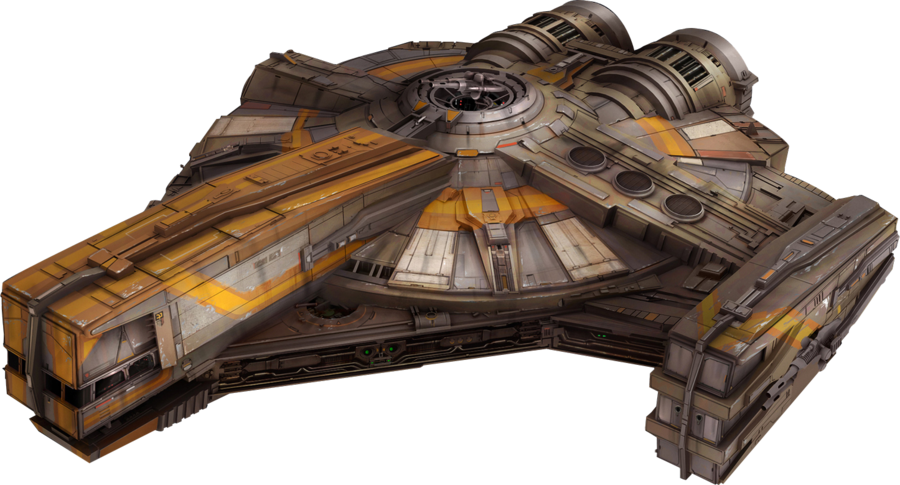
The Raider is central to Redjack military doctrine and often represents the vehicle that makes the most complete use of Redjack materiel. It’s also one of the most distinct and worrisome sights for a remote colony outpost. For its role, though, it’s a remarkably small craft, a little larger than an ARC lancer, and barely small enough to be considered a frigate (some people call it a “Heavy Frigate”), but that makes it the only carrier smaller than a destroyer!

The Raider has a long, “beak” nose perched on the front, a boxy, squat midsection and then powerful, flaring set of engines in the rear. Up to 6 fighters can latch onto clamps located on its underside, perched between the curve of the “beak” and the flare of the impulse drives. A single tractor-beam turret sit between all the clamps on the underside, to assist with the clamping process. Atop the body are four, fighter-scale turrets with signature, two-ton Redjack cannons. In the front, the corvette-scale blaster hides behind the “beak” of the nose. When the vehicle has landed, it extends four legs to rest on, and long hangar bay doors unfurl to allow its onboard vehicles and soldiers to dismount. It cannot land while fighters are clamped on (at least, not if it doesn’t want to damage the fighters).

Raiders have the signature, Redjack interior: spartan with simple, prefab furnishings in matte browns and greys. Most people enter via the hangar bay doors, though various other hatchways can be found on the ship. Inside, they find a rather roomy hangar, typically cluttered with vehicles and soldiers. At six points in the floor, hatches lead to the fighters below, and one to the the tractor beam, while a set of catwalks above the hangar floor lead to ladders which lead to the “fighter” turrets above the Raider. The rear of the hangar bay has a workshop which overlooks the whole of the bay, and houses the technicians that work on the housed craft; it alsoopens to the engine room in the back. The engine room has a small “bridge” of control stations, and then a maze of infrastructure and workspaces that’s five times the size of the hangar bay, leading to the oversized impulse drives, which dominate the engine section. Ahead of the hangar bay, one reaches the habitation section, which consists mostly of bunks and a few galleys, bathrooms, a sickbay, an armory and a single gym. The foremost part of the habitation section has three full cabins, for the command crew. Beyond this one reaches the “nose” of the craft. This houses a small “bridge” with three control sections, one for the Raider’s commander, and two for its pilot and copilot, the electronics for communications and sensors, its main computer, and an access shaft to the large, spacious corvette turret below.

The Raider typically carries up to 6 fighters, usually Wildcats, or 6 Grapplers, of some mixture of the two (three of each is not uncommon). The body itself houses up to 6 redjack ground vehicles on the scale of Wolfhounds of Roughnecks. It also has space for a full platoon of soldiers. It represents the minimum possible interstellar “carrier,” acting as both fighter-carrier, and troop transport.

A Raider typically shunts in orbit of a target world, and flies at its top speed of ~250 miles per hour. This will bring it to its destination in 16 hours, but it usually scrambles and launches its fighters from its clamps: the parasitical fighters can use the Raider’s high speed to assist with their launch, though it’s still tricky to those not familiar with launching from a Raider (treat as a familiarity penalty). The fighters will race ahead of the Raider, attacking any anti-air defenses and softening up targets. If the Raider has grapplers, these will land as well, generally raiding specific sites to disarm defenses or seize vital targets. If these tactics score the victory the Raider seeks, they’ll return to their carrier and leave. Otherwise, the Raider lands; if the defenses of the target site have been sufficiently softened, it will land directly on the site. Otherwise, it lands some distance away and relies on the speed of its internal Wolfhounds and Switchbacks to make up for the distance, while its soldiers come in on foot.

A Raider is, true to its name, good for a raid. It can have a small outpost completely locked down within a day, but it cannot hope to hold a planet or to defeat a fortress. In space war, in addition to their raiding role, they often act as spoilers against small flees: they can make quick hit-and-run attacks at extremely remote targets, and then pick up its fighters and race away again. They can’t launch more than a few wings, but Raiders cost millions, rather than billions, of credits, putting them within the reach of relatively small organizations that favor hit-and-run tactics. They’re especially popular with pirates and slave raiders, who usually convert 15 of the bunks into prison cells.

Redjack Tiger Shark-Class Attack Frigate

ST/HP: 500

Hand/SR: +1/5

HT: 14

Move:6/250(+12)

LWt.:600

Load:140

SM: +8

Occ.:15ASV

DR:1000/400*

Range:200,000, 7jumps (Rating 2)

Cost:$230M

Loc.: g6t4rL

Stall:0

Total Chase Roll:+13

*Nanocomposite Polymer; double DR vs plasma attacks. Higher DR protects against attacks from the front. Additionally, it has a Force Screen that provides 750ablative, hardened DR.

Notes

Redjack Corvette Electronics:

  • Ultrascanner Open Mount: 150-mile search range, 15-mile scan range; low probability intercept (detectable at 225 miles); 360° rotation.
  • Night Vision Sensors: +9 nightvision, ×8 magnification (up to +3 to aimed attacks, if the vehicle aims for three turns).
  • Targeting Computers: +5 to Gunnery projects provided a sensor lock is gained.
  • Distortion Jammer: -4 ECM rating.
  • Tactical ECM: +1 to dodge missiles.
  • Large FTL Communication Array: 30-parsec range.
  • Large Holographic Radio: 10,000 mile range (orbital); “palm sized” holographic console.
  • Security and Safety: Simple Locks;
  • Accommodations: 1 cabin; 15 bunks. One workshop, gym and a sickbay large enough for 1.
  • Hyperdrive: Rating 2, with sufficient fuel for 7 jumps.
  • Ruggedized Hyperium Reactor: 30 days endurance.

The Tiger Shark two computerized control stations for piloting the ship (as well as one for each of its 6 turrets). The engine section contains a robotic control station where a robot can directly plug in.

The Tiger Sharkhas one, forward-mounted large, “corvette scale” blaster turret with two cannons (total RoF of 2), four modular “fighter” turrets that can mount all standard Redjack 2-ton cannons, and a single, rear-facing turret with an ST 160 tractor beam.

Weapon

Dmg

Acc

Range

Ewt

RoF

Shots

ST

Bulk

Rcl

Notes

Corvette-scale cannon

6d×30(5) burn

9

10mi/30mi

25t

1

NA

M

-10

2

NOV-4 Heavy Plasma Cannon Module

6dx30(2) burn ex

6

4 mi/12 mi

4000

1/3

15/2F

M

-10

3

MIN-3R Mining Laser Module

5d×15(10) cut inc

12

500/3 mi

4000

1

25/5E

M

-10

1

SP74-TR Heavy Plasma Gatling

6dx15(2) burn ex

6

3mi/
8mi

4000

8

88/
3F

M

-10

3

Isomeric Torpedo Bay

6d×500 cr ex

3

300/
10 mi

2500

1

3

150M

-15

1

Hardpoint Modules

The Tiger Shark-class Attack Corvette has two rear-mounted “hardpoints.” These come equipped with clamps, air-locks and boarding torches. They can be used for a variety of purposes, especially in conjunction with the rear-mounted tractor beam. They can pull smaller targets to them, latch onto them, and then board them. More commonly, the Tiger Shark can mount two Grappler-class attack boats, which it can support with its attacks, disabling a target and then sending its on-board crew to attack it.

Finally, it can also mount external pods, which can be thought of as external modules, with their own DR; these can be targeted separately from the rest of the craft. Each Tiger Shark can mount two pods or two Grappler-class assault boats.

All pods can be detached either manually (taking 1d minutes) or with a simple push of a button from any control system (1d seconds to fully separate).

Engine Module (Plasma Thrusters)

Cargo Pod

DR 150; HP 75

40,000 lbs; $250k

This simple, cubical pod contain nothing but cargo space for up to 17 tons of cargo and a large hatch that allows easy access to the detached pod.

Fuel Pod

DR 150; HP 75

40,000 lbs; $250k

This rounded, oblong pod can contain up to 5000 gallons of refined hyperium. Each such pod allows another two hyperdrive jumps, or another monthof normal operations. The tanks are not self-sealing and will explode dramatically if damaged, but if they explode while attached to the Tiger Shark, this causes on external damage. Pods filled with refined hyperium explode for 6dx50 cr inc while pods filled with unrefined hyperium will explode for 6dx100 cr inc.

Engine Pods

DR 150, HP 75 (Each)

80,000 lbs; $18M

This set of two long engine pods (and they must always take up both hardpoints, otherwise the ship becomes unbalanced in flight) contain a plasma thruster and sufficient fuel to run the plasma thrusters for 15 hours. While active, the plasma thrusters improve the Handling to +2/5 and improve the move to 10/375 (+13) for a total Chase roll of +15. The fuel in the pods are explosive. If destroyed, they explode for 6dx30 cr inc damage (doubled for unrefined hyperium).

Look and Feel

Redjack designed the Tiger Shark to serve in an explicitly military role. Technically, it serves as a long range “raiding” frigate, which makes it excellent for piracy, which is its primary use throughout the Galaxy.

The Tiger Shark has a familiar and ominous profile. The bulk of the ship is a rounded, blunt “nose” which contains the “eyes” of the control room in a wide, short glass screen; beneath the nose sits its “heavy” corvette cannons in a forward-mounted turret. Behind this nose, the rest of the vehicle tapers to a long “spine” or “tail.” The ion thrusters point out and back from the body. The light “fighter” cannons rest on this spine and can fire unobstructed in all directions. The end of the “tail” or “spine” sits a heavier section of body which mounts the hardpoints and tractor beam turret.

The spartan interior of the Tiger Sharks meets typical Redjack specification. When a Tiger Shark rests on its four landing-gear legs, one can access the interior via a wide cargo hatch in the rear base of the craft, which leads to a cargo bay that can hold up to 30 tons of ill-gotten gains, or via a couple of walkways that lead into the accommodations. The core interior is taken up mostly by a set of bunks for the crew, a nice galley/rec room, a gym, an armory with sufficient weapons and armor for 15 soldiers, and a simple sickbay, which sits adjacent to the cargo room. Higher up in the ship, one reaches the engine room, the workshop, the captain’s cabin and the command section, which consists of two seats facing a board of customizable computer controls, control yokes, and a few cup-holders. All these sections are firmly divided from one another by large bulkheads with sturdy doors, so the destruction of one section doesn’t cascade into the destruction of another section. The interior décor, furnishings and walls have a pre-fab quality to them, constructed of stark olive brown and drab grey polymers and metals, with exposed support struts and arches.

When one reaches the top, they can leave them main body and enter the spine or tail, which mainly consists of suspended metal walkways and great metal doors that can shut off the tail from the rest of the ship. This section is even coarser in construction than the rest of the ship, and leads to workspaces for maintaining the engines and the primary turrets; one must walk the proper gang-plank to reach the turret, and then drop down into its controls. Finally, the rear-most section consists of a single, well-armored room which leads the tractor beam turret and to two spacious airlocks which lead to whatever is attached to the mounted on the external clamps. If engines or cargo spaces are mounted, the crew leaves these airlocks open for easy access to the cargo or the external engine workspace. If the Tiger Shark mounts grapplers, then the airlocks lead to the grapplers. Finally, if the ship has latched onto another ship and has successfully carved a hole in the target ship, then those in the room can board. This room tends to be poorly lit, often with a dim, emergency glow, and the room is sealed from the rest of the tail, preventing anyone on the boarded ship of the rear section from escaping and attacking the rest of the ship.

Tiger Sharks excel at chasing down and attacking other corvettes. Without mounted engines, they can keep up with all but the fasted corvettes equipped with ion thrusters. With additional mounted engines, they can outpace almost any corvette. Most will mount grapplers, which will disembark and attempt to board a corvette that the Tiger Shark has disabled. Their powerful “corvette scale cannon” is enough to damage anything but heavily armored frigates. When facing more powerful ships, Tiger Sharks need to either attack in a fleet or, more commonly, they’ll turn and run.

When Tiger Sharks aren’t preying on shipping lanes, they make acceptable escorts for light capital ships, as they can usually outmaneuver and defeat any anti-capital ship corvette. They also make a decent secondary troop transport, provided you only need 5 to 10 soldiers or a couple of vehicles. They can, also, haul cargo themselves, and tend to be extremely quick when doing so; some people use them as a means to transport high security cargo, though rarely exclusively.

Redjack Wrangler-Class Logistical Corvette

ST/HP: 320

Hand/SR: +0/5

HT: 14

Move:2/150(+11)

LWt.:250

Load:66

SM: +7

Occ.:4ASV

DR:500*

Range:200,000, 7jumps (Rating 2)

Cost:$80M

Loc.: G3t3rL

Stall:0

Total Chase Roll:+11

*Nanocomposite Polymer; double DR vs plasma attacks. Has a Force Screen that provides 250ablative, hardened DR.

Notes

Redjack Corvette Electronics:

  • Ultrascanner Open Mount: 150-mile search range, 15-mile scan range; low probability intercept (detectable at 225 miles); 360° rotation.
  • Night Vision Sensors: +9 nightvision, ×8 magnification (up to +3 to aimed attacks, if the vehicle aims for three turns).
  • Targeting Computers: +5 to Gunnery projects provided a sensor lock is gained.
  • Distortion Jammer: -4 ECM rating.
  • Tactical ECM: +1 to dodge missiles.
  • Large FTL Communication Array: 30-parsec range.
  • Large Holographic Radio: 10,000 mile range (orbital); “palm sized” holographic console.
  • Security and Safety: Simple Locks;
  • Accommodations: 2 cabins; total possible accommodations for 4. One workshop and one prospecting lab (+1 to all Prospecting rolls)
  • Hyperdrive: Rating 2, with sufficient fuel for 7 jumps.
  • Ruggedized Hyperium Reactor: 30 days endurance.

The Wrangler has a single “control” section with computerized controls and seats for a pilot and co-pilot. The engine section contains a robotic control station where a robot can directly plug in.

The Wranglerhas three turrets with full rotation, contained one MIN-3R mining laser, one SP74-TR Plasma Gatling, and one ST 160 tractor beam.

Weapon

Dmg

Acc

Range

Ewt

RoF

Shots

ST

Bulk

Rcl

Notes

MIN-3R Mining Laser Module

5d×15(10) cut inc

12

500/3 mi

4000

1

25/5E

M

-10

1

SP74-TR Heavy Plasma Gatling

6dx15(2) burn ex

6

3mi/
8mi

4000

8

88/
3F

M

-10

3

Logistics Modules

The Wrangler has room for multiple possible configurations of its industrial section. All wranglers are capable of at least dismantling 10 lbs of material into raw materials per hour and fabricating $500 worth of parts per hour, provided it has sufficient raw materials (such as dismantled parts). Note that this fabricator is nota replicator: it might give you the materials you need to build, say, a blaster, but it cannot assemble it for you.

These modules are largeand take at least 4 hours with the right tools to replace, or 8 without the right tools

Salvager Module

40,000 lbs; $3M

Wranglers equipped with Salvager equipmentcan dismantle up to 700 lbs of junk, scrap and damaged (or perfectly fine) starship parts an hour into raw materials. It can also fabricate $1000 worth of parts per hour. Finally, it has sufficient cargo space to store up to 125,000 lbs (62.5 tons)

Foundry Module

40,000 lbs; $600,000

Wranglers equipped with a Foundry can refine raw asteroidal ores into raw materials at a pace of 700 lbs of extracted metal per hour. It can also fabricate $1000 worth of parts per hour. Finally, it has sufficient cargo space to store up to 125,000 lbs (62.5 tons)

40,000 lbs; $600,000

Refinery Module

Wranglers equipped with a Refinerycan refine raw hydrogen, hyperium and ice into refined fuels or atmosphere ready for life support. It can refinehyperium at a pace of 350gallons an hour. It can store up to 17,000 gallons of hyperium (or other liquid).

Look and Feel

The Wrangler is perhaps the least attractive Redjack vehicle in a great collection of unattractive vehicles. The pilot and co-pilot sit in a boxy cabin and watch space through a large window. The rest of the vehicle resembles a longer, larger box, with a single, round turret on the top, mounted with the plasma gatling and two turrets mounted on the bottom, one with a tractor beam, the other with a mining laser.

The interior is hardly less practical. The pilots can leave their squat cabin and either go to one of their two cabins or the shared galley between, or the vast work-area between the cabin and the engine room. Here, they can descend to the mining equipment, or ascend to the anti-fighter turret above via a rickety catwalk. Industrial machinery dominates this central area, though this varies depending on how the Wrangler has been equipped: the foundry glows an ominous red, scrapping gear churns and gnashes machinery into raw material, and great gas tanks dominate the refinery. During mining or salvage operations, this part of the ship empties itself of atmosphere, requiring the crew to move about the ship in vacuum, and the feed salvaged parts or extracted ores directly into the machinery from ‘below” the ship. Finally, in the far back, one enters the cluttered, closed-in spaces of the ion thrusters and hyperdrive, as well as the diagnostic bay of the robot in the back. This section also contains a mini-fabricator and a dismantler, for recycling parts to better maintain the Wrangler.

Wranglers obviously serve as a major industrial component in the edges of the Galaxy. Travelers often see them when traveling through asteroid belts or diving into gas giants, or picking scraps from the debris of a battlefield. They also fill up the hangars of space stations and planets at the edges of space, where their “space trucker” crew, often away and unbathed for months at time, pile into cantinas with the spoils of their mining operation. The common man knows them well as working vehicles.

Pirates and miners also understand their utility as logistical vehicles. A single Wrangler can refine enough fuel to refuel a Wildcat in two hours, and carries enough fuel to refuel a full squadron. They can’t rebuild a capital ship on their own, but they often have enough spare parts or raw material to build spare parts (of can salvage it from other damaged ships) to allow for reasonably field repairs even without bringing the ship into “dry dock.” They also play a role as mine-layers, with enough space to carry hundreds of Boomer-Bots, and it can lay them with precision using its tractor beam and control software. Wranglers often do this to protect a claimed asteroid, but will happily do it to protect other strategic sites. Finally, while slow, a Wrangler is tough and can take a pounding from fighters while taking a few with it. The Wrangler is no combat corvette, but can endure in combat if necessary, making it a useful support vehicle for any light, resilient, independent fleet.

Boomer-Bots

Like Banger-Bots, Boomer-Bots are better described as smart, automated weapon systems than as robots. They resemble large, man-sized oblong spheres with jutting prods, a red camera-eye and a simple interface point. They can warble electronically, and they float patiently while waiting for commands.

Boomer-Bots can survive and move in the cold depths of deep space. Typically, Wrangler-class logistic corvettes will dump them out in the right general area and then issue commands for the Boomer-Bots to go forth and form a network. They can communicate with one another by burst transmission and then settle down for a long, slow wait.

When any ship that isn’t transmitting the right IFF codes comes within 30 miles of Boomer-Bots, they activate. In sentry mode, they signal the details they passively detected back to their master ship via directed, burst transmission, preventing detection by the incoming ship (though they might pick it up anyway on an Electronics Operations (Sensors or Comms) at -6). These sensors readings tend to be passive magnetic and EM emission detections and so say very little. At the command of the master ship, they can “ping” the ship with their Ultrascanners, to get a thorough reading; any ship equipped with an ESM will automatically know that they were pinged and by what, as a Boomer-Bot Ultrascanner signal is pretty distinctive.

If the Boomer-Bot is in kill-mode, it will wait until the detected ship is in Extreme range, and then attempt to ram it in one turn. This requires a roll of 12 or less (17 or less if they have a target lock). The target may attempt to dodge (+1 if they have ESM and the Boomer-Bot locked on). If they fail, the Boomer-Bot will immediately explode and inflict its explosive charge damage. This explosive is usually a HEMP charge; it can be replaced with an Isomeric charge for five times the cost (and deals the same damage as a torpedo).

If a ship attempts to navigate the Boomer-Bot field, treat this as attempting to navigate a debris field; if the ship collides with a Boomer-Bot, it explodes; additionally, every turn, the ship should have to dodge a number of Boomer-Bot attacks depending on the density (by default 1d Boomer-Bot attacks per action turn).

ST: 14DX: 10 IQ: 6 HT: 11

HP: 20Will: 5 Per: 12 Speed:4Dodge: 8Move: 8/300SM: 0; 600lbs

DR: 50

Slam (12): 6d×10 cr

HEMP Self-Destruct Charge (NA):6d×50(10) cr inc + linked 8d×8cr ex [20d]

Traits: Absolute Direction; Accessory (Small Computer, Self-Destruct Charge); Appearance (Ugly; Off the Shelf); AI; Automaton; Bad Grip 1; Cannot Speak (Beep); No Legs (Congragravity); Deafness; Detect (Comms and Ultrascanner, signal detection; Electrical and Magnetic Fields); Doesn’t Breathe; DR 50(Cannot wear Armor); Electrical, Maintenance (one person, monthly), No Peripheral Vision; Night Vision 9; Numb; Obscure -4 (Ultrascannery, Stealthy); One-Eye;Protected Vision; Reduced Consumption 3 [6]; Restricted Diet (Common, Power Cells); Scanning Sense (Ultrascanner; 30miles yards; Targeting, Scanner, Bio-Scan); Sealed; Silent 1; Telecommunication (Comm System, 100 mile range, Burst, Secure, Video); Temperature Tolerance (Cold) 10; Vacuum Support.

Skills: Brawling-12; Electronics Operations (Comms)-8; Electronics Operations (Sensors)-8; Stealth-12; Wrestling-12.

Energy: 2D/Week

Cost: $50,000

Redjack Nomad-Class Light Modular Corvette

ST/HP: 250

Hand/SR: +1/5*

HT: 13

Move:8/300(+13)*

LWt.:95

Load:25

SM: +7

Occ.:5ASV

DR:150/75

Range:500,000, 7jumps (Rating 2)*

Cost:$50M

Loc.: g2t3rL

Stall:0

Total Chase Roll:+14*

*The Nomad’s engine, including its hyperdrive, are modular. The listed values are the most common values.

†The Nomad has an entirely modular hold which can contain passenger accommodations, increasing the number of people accommodated by the craft.

Nanocomposite Polymer; double DR vs plasma attacks. Has a Force Screen that provides 500 ablative, hardened DR. Additionally, the Nomad has modular armor that can further alter its armor profile.

Notes

Unmodified Redjack Corvette Electronics:

  • Ultrascanner Open Mount: 150-mile search range, 15-mile scan range; low probability intercept (detectable at 225 miles); 360° rotation.
  • Night Vision Sensors: +9 nightvision, ×8 magnification (up to +3 to aimed attacks, if the vehicle aims for three turns).
  • Targeting Computers: +5 to Gunnery projects provided a sensor lock is gained.
  • Distortion Jammer: -4 ECM rating.
  • Tactical ECM: +1 to dodge missiles.
  • Large FTL Communication Array: 30-parsec range.
  • Large Holographic Radio: 10,000 mile range (orbital); “palm sized” holographic console.
  • Security and Safety: Simple Locks;
  • Accommodations: 2 cabins; total possible accommodations for 4.
  • Hyperdrive: Rating 2, with sufficient fuel for 7 jumps.
  • Ruggedized Hyperium Reactor: 30 days endurance.

The Nomad has a single “control” section with computerized controls and seats for a pilot and co-pilot. The engine section contains a robotic control station where a robot can directly plug in. A modular “electronics lab” sits adjacent to the control section; it’s exact composition depends on what modules have been installed.

Weapon Modules

The Nomad has two modular weapon turrets with full rotation. These weapons must be paid for separate from the vehicle

The B00-M Heavy Plasma Cannon Module: Sometimes called the “double-aught,” the B00-M Cannon is themost commonly used main weapon module for a Wildcat, and popular with nomads that expect to fight other corvettes. This heavy fighter cannon exchanges rate of fire and reliability for devastating firepower. The B00-M can only fire once every three seconds, and risks overheating after firing more than three shots without waiting 10+ seconds between shots, and needs a full minute to cool down. In Action Vehicular Combat, the B00-M can technically fire once per turn, as an optional rule, the GM can require the pilot to wait one turn between turns to fire it, our to make a Gunnery (Beams)-4 roll to vent heat and cycle the charge faster. It can also aim at a spot nearits target, gaining a +4 to hit, but sacrificing the armor modifier. $650k

The MIN-3R Artillery Laser CannonModule:This weapon is identical to the “mining” laser mounted on the Razer. It is typically used by ships that seek to mine asteroids, but sometimes is used by pirates who wish to carve through the armor of slower, less well-defended corvettes. $700k

The SP74-TRHeavy Plasma Gatling Module:Popular with Nomad crewspilots who expect face fighters (and generally the default choice for Nomads), this gatling plasma cannon lays down a serious barrage of plasma shots more than powerful enough to kill other fighters. It can also aim at a spot nearits target, gaining a +4 to hit, but sacrificing the armor modifier; most users ot the weapon will simply lay down a barrage of fire, like a focused flak cannon, near their target and hope the saturation fire will hit their target. $1,000k

The NUK-3 Disposable Torpedo Bay:Rarely used by Nomads, some pirates, rebels or renegades will load a NUK-3 to help defeat larger capital ships. They usually only use one such weapon and keep their other turret clear for fighting off other fighters and/or corvettes. $100k

Weapon

Dmg

Acc

Range

Ewt

RoF

Shots

ST

Bulk

Rcl

Notes

NOV-4 Heavy Plasma Cannon Module

6dx30(2) burn ex

6

4 mi/12 mi

4000

1/3

15/2F

M

-10

3

[1]

MIN-3R Mining Laser Module

5d×15(10) cut inc

12

500/3 mi

4000

1

25/5E

M

-10

1

SP74-TR Heavy Plasma Gatling

6dx15(2) burn ex

6

3mi/
8mi

4000

8

88/
3F

M

-10

3

Isomeric Torpedo Bay

6d×500 cr ex

3

300/
10 mi

2500

1

3

150M

-15

1

Engine Modules

The Nomad has room for multiple possible configurations of its engines and its hyperdrive. It takes 6 hours to change an engine module, or 12 hours if no tools are available.
p { margin-bottom: 0.1in; line-height: 115%; }

Redjack “Cross-Country” Ion Thruster Engine Module

45,000 lbs; $3.6M (if purchased separately)

This is the standard engine module for a Nomad; it requires no statline change. It trades engine and hyperdrive space for additional fuel for the hyperdrive, allowing it to take more jumps. It also includes additional access space, making the engineer more comfortable, but not enough to improve HT.

This requires no change to the statline.

Redjack “Crosswind” Hyperdrive Engine Module

60,000 lbs; $5M

This module includes the standard ion thrusters of the Cross-Country module, but sacrifices the additional space for a much larger hyperdrive. This improves the hyperdrive rating to 3 and reduces the fuel to 5 shunts.

Redjack “Stormrider” Plasma Thruster Engine Module

60,000 lbs; $5M

This engine module sheds the additional fuel and fills up the engine room with heavier, more powerful plasma thrusters. This greatly expand out the engine profile of the ship and give its engines a violent, red blast when they fire. While active, the plasma thrusters increase the Move of the Nomad to 12/400 (+13) and improve the handling/SR to +2/5 (for a total chase roll of +15). The plasma thrusters consume 24 hours of fuel for every hour active.

Redjack “Horizon” Next-Gen Engine Module

60,000 lbs; $13M

This staggeringly expensive module combines hyperium thrusters with a cutting-edge, state of the art hyperdrive. This results in a shockingly fast ship with an excellent hyperdrive rating. Reduce the hyperspace fuel to 5 shunts, and improve the hyperdrive rating to 3. Furthermore, with the Plasma Thursters active, increase Move to 12/400 (+13) and improve the handling to +2/5 (for a total Chase roll of +15); the plasma thrusters consume 24 hours of fuel for every hour active. Finally, reduce HT by 1 and add the x tag (explosive).

These can be cobbled together using Syntech Next-Gen plasma thrusters and hyperdrives; the results tend to be safer, but one must acquire the parts first! This requires a Mechanic (Starship) roll at -8 (or +0 with Quick Gadgeteer). Such a hypothetical module does not penalize HT or add the x tag.

Electronics Module

Next to the control compartment and beneath the main dish array, the nomad has a modular electronics laboratory which can be slotted for different dish arrays as well as different computers, depending on the intended purpose of the Nomad. By default, this is cabin-sized “server room” with an access point for a robot into the microframe of the Nomad. When a module is installed, it replaces the electronics of the ship, including the main dish, with a new room and new electronics.

Redjack “Doodlebug” Electronics Module

1000 lbs; $200,000

The original design for the Nomad called for a prospector ship. The Nomad was to jump into a new system and check out the local asteroids to see if any had promising ore or material. This module includes an advanced microframe with excellent prospecting software and a geology lab, allowing analysis of samples. Add +1 to Prospecting and Geology.

Redjack “Charter” Electronics Module

1000 lbs; $200,000

Nomads often see use as scouts or explorers on the edges of civilized space. The Charter module includes an advanced microframe within a “starchart” office that provides a constant synthesis on local reports of hyperstorms and the changing location of stars in relations to one another. Add +1 to Navigation (Hyperspace) and Cartography.

Redjack “Blackout” Electronics Module

1000 lbs; $250,000

Designed to allow the nomad to accept a combat-support role, this module upgrades the electronics package of the Nomad to add a 20-mile “Medium” Area Scrambler, granting all allies in its area a -5 ECM rating, and a 20-mile, “Medium” Distortion Scrambler that can disrupt communications in the area. Additionally, the room has contains an advanced microframe with excellent tactical software and a holoprojector with a real-time map of the area. This grants +1 to Tactics (Space) and Electronics Operations (EW).

ARC “Icon” Electronics Module

1250 lbs; $5M

Designed as a joint project between ARC and Redjack, this module is popular with diplomats, merchants and missionaries alike. This electronics package greatly increases the size of the main dish and includes a “Very Large” 300-parsec FTL communication device, as well as a mini-studio with soundproofing, stage-dressing, up-to-date holocameras and a larger holoprojector that allows the occupant to communicate with another at full scale. Add +1 to Propaganda and Electronics Operations (Media).

Blackline Project’s “Anarchy” Electronics Module

1000 lbs; $5M

Urban legends swirl around Nomad’s equipped with top-of-the-line microframes with black-market hacking and decryption programs as well as comm-spoofing technology. If such a module existed, it would add +2 to Computer Hacking-related skills, as well as Electronics Operations (Comms) rolls to avoid being eavesdropped upon or for spoofing other signals, and allows for real-time decryption of signals.

Cargo Modules

The expansive cargo bay (most of the Nomad interior) can be redesigned to match the owners specifications. They may have up to 3 cargo modules.

Basic Nomad Cargo Module

500lbs; $30,000

The standard cargo module for a Nomad, this cargo bay can carry up to 45,000 lbs of cargo. It also contains floor and/or wall-panels (the designs vary per module) that can hide up to 5000 lbs in cargo, serving as basic Smugglingtools. Additionally, these smuggling compartments contain distortion mesh, which apply a -6 to any rolls to detect them or to scan their contents.

Basic Nomad Bunk Module

3000lbs; $100,000

A typical bulk passenger module, this contains bunks and additional life-support for up to 10 people. These accommodations tend to be uncomfortable and earn little in the way of frieght, but some Nomad pilots, especially those that handle refugees make use of them. These also contain standard Smugglingcompartments (see Basic Nomad Cargo Module for more) hidden beneath various bunks or on the wall panels. These smuggling compartments contain distortion mesh, which apply a -6 to any rolls to detect them or to scan their contents.

Basic Nomad Prison Module

3000lbs; $100,000

This module contains ten, tightly packed cells with force ward prison doors and neuronic shackles to keep prisoners in line. This module is popular among bounty hunters or slave traffickers in the Umbral Rim. These also contain standard Smugglingcompartments (see Basic Nomad Cargo Module for more) hidden beneath various bunks or on the wall panels. These smuggling compartments contain distortion mesh, which apply a -6 to any rolls to detect them or to scan their contents.

Standard Nomad Accommodations Module

3000lbs; $150,000

The standard in passenger accommodation, and also popular among nomads with larger crews, this contains two full cabins and life-support for up to 4 additional people. These also contain standard Smugglingcompartments (see Basic Nomad Cargo Module for more) hidden beneath various bunks or on the wall panels. These smuggling compartments contain distortion mesh, which apply a -6 to any rolls to detect them or to scan their contents.

Custom Nomad Luxury Cabin Module

3000lbs; $250,000

This module contains a luxurious cabin fit for one to two people, with sumptuous furnishings and a spacious interior. Additionally, this module contains advanced, well-hidden smuggling compartments which can hide up to 5000 lbs of cargo, allow a Smugglingroll at +1, and provide the normal -6 penalty to detect the compartments with sensors or to scan their interiors. These smuggling compartments contain distortion mesh, which apply a -6 to any rolls to detect them or to scan their contents.

Custom Nomad Temple Module

3000lbs; $250,000

Some Redjack customers are deeply religious. Redjack has several “temple” variations, with the Akashic Mysteries, Shepherdist and Divine Masks as standards, and with generic, open spaces that can easily be customized by the owner to honor their particular religious affiliation. These generally provide sufficient tools for Religious Ritual rolls, and the Akashic model comes with a sensory deprivation chamber. If used as a meeting room, it can house up to 10 people. Additionally, this module contains advanced, well-hidden smuggling compartments which can hide up to 5000 lbs of cargo, allow a Smugglingroll at +1, and provide the normal -6 penalty to detect the compartments with sensors or to scan their interiors. These smuggling compartments contain distortion mesh, which apply a -6 to any rolls to detect them or to scan their contents.

ArmorModules

The Nomad has a fairly simple, if unattractive and unstreamlined exterior that has attachment points and struts capable of accepting additional reinforcement that improves its armor, handling or stealth charactersistics. As an optional rule, called shots for armor chinks automaticallybypass Armor Modules in addition to halving the DR of the Nomad, and disabling the Nomads’s armor destroys the Armor Module. It takes one hour to change out a Nomad’s armor module, or two hours without the appropriate tools.

p { margin-bottom: 0.1in; line-height: 115%; }

Redjack “Mustang” Armor Module

6000 lbs; $10M

One of the trickier armor modules to install, this substantially reshapes the craft with additional hyperdynamic control elements, giving it a sleeker, more aggressive design. It improves Handling to +2/4, unless combined with plasma thruster modules (either the “Stormrider” or “Horizon” module), then it improves Move to 11/500 (+14) and handling to +3/4.

Redjack “Pocket Ace” Armor Module

12,000lbs; $2.5M

Nomad pilots often prefer a certain level of discretion. The “Pocket Ace” module applies of stealthed carbide composite. This increases the DR of the Nomad to 300/150 DR and applies a further -4 ECM penalty. In addition, the armor contains a layer of distortion mesh, which applies a -6 to any attempts to scan the interior of the vehicle and determine what lay inside.

Redjack “Brutus” Armor Module

15,000lbs; $1.5M

Nomad pilots pile on Brutus armor when they expect to come under serious attack and don’t mind hauling the extra weight. Brutus armor notably bulks up the silhouette of the ship, and the extra layers of nanocomposite polymer with added EMA increases DR to 450/200 and triples DR vs shaped charges and plasma attacks.

ARC “Rake” Armor Module

6,000lbs; $4M

Another collaboration between ARC and Redjack, ARC can manufacture a special, diamondoid shell which, in addition to greatly improving its survivability, also gives it stylish lines suitable for a wandering nobleman. This grants +1 reaction modifiers and improves DR to 300/150 (but halve DR vs crushing attacks).

Sample Nomad Loadouts:

The Redjack “Prospector” Loadout: These are so common that some people refer to a “Nomad” as a “Prospector.” These tend to be kitted out for long trips into the lonely belts at the edges of the galaxy, far from civilization for days of scanning asteroids for useful ore. These ships can mine on their own, but often join a larger fleet of Wranglers and Wildcats.

Statline Changes and Notes: $47M, +1 to Prospecting and Geology rolls.

  • SP74-TR Heavy Plasma Gatling Module
  • MIN-3R Artillery Laser Cannon Module
  • Redjack “Cross-Country” Ion Thruster Engine Module

  • Redjack “Doodlebug” Electronics Module
  • 3 Basic Nomad Cargo Modules

  • No Armor Module

The Redjack “Anthem” Loadout: Redjack customers interested in Nomads that aren’t miners are often “tramp traders,” looking to wander a part of the galaxy and make quick trades between systems not usually connected by big liners. These “Anthems” tend to get unfairly tagged as smugglers just because the Nomad is surprisingly good at smuggling!

Statline Changes and Notes: $52M; +4 ASV occupancy; Hyperspace Rating 3 (5 jumps); +1 to Navigation (Hyperspace) and Cartography.

  • 2 SP74-TR Heavy Plasma Gatling Modules
  • Redjack “Crosswind” Hyperdrive Engine Module

  • Redjack “Charter” Electronics Module
  • 2 Basic Nomad Cargo Modules

  • Standard Nomad Accommodations Module

  • No Armor Module

The ARC “Rapscallion” Loadout: Aristocrats with pinched pockets sometimes choose to retrofit a basic Nomad as a personal shuttle. Their considerable endurance makes them very popular for long trips, and its extreme FTL allow the noble to remain in touch while looking fantastic.

Statline Changes and Notes:$56M; +4 ASV occupancy;DR 300/150 (Halved vs Crushing); +1 to Propaganda and Electronics Operations (Media).

  • 2 SP74-TR Heavy Plasma Gatling Modules
  • Redjack “Cross-Country” Ion Thruster Engine Module

  • ARCIcon” Electronics Module
  • 2 Custom Nomad Luxury Cabin Module

  • 1 Custom Nomad Temple Module

  • ARCRake” Armor Module

The Redjack “Solo” Loadout: With all the possible loadouts available for the Nomad, sometimes Nomad pilots sit up and notice interesting vessels, and the “Solo” was one such vessel. The pilot, a smuggler in the Rogue Stars near Sirocco, had turned his Nomad into a racer capable of keeping up with heavy fighters, and with an unparalleled capacity to navigate the stranger stars of the galactic fringe.

Statline Changes and Notes:$68M; +3/4 Hand/SR; Move: 11/500; +4 ASV occupancy;Hyperspace Rating 3 (5 jumps); +1 to Navigation (Hyperspace) and Cartography.

  • 2 SP74-TR Heavy Plasma Gatling Modules
  • Redjack “Horizon” Next-Gen Engine Module

  • Redjack “Charter” Electronics Module
  • 2 Basic Nomad Cargo Module

  • Standard Nomad Accommodations Module

  • Redjack “Mustang” Armor Module

Look and Feel

The Nomad is one of Redjack’s most purchased vehicles, and a common sight across the Galaxy, though not everyone realizes they’re looking at the same ship, given the triumph of Redjack modularity that it represents. The silhouette of the ship is dominated by its array of engines, which spread out in an arc behind the rest of the craft. The center has its “cargo” section, which has a generous cargo ramp that often looks out of place when leading to a set of halls and galleys if mostly accommodations have been installed. Finally, the ship narrows to its control area, which is inevitably a riot of exposed cables and structure unless the pilot is meticulous about the installation of their electronics modules. This area contains the pilot and co-pilot station, and the electronics control room/lab, sometimes called “the server room,” especially if it has an upgraded computer.

The interior of the ship varies a great deal based on the modules installed. Especially sparse Nomads feel excessively roomy, with overly spacious engine rooms, an essentially empty electronics lab, and a cavernous hold. If fully installed, the ship can feel crushingly claustraphobic, with an overwrought engine room that often makes for a tight fit, a busy set of accommodations each with their own mini galley and bathroom set, and a control area overflowing with electronics. As a result, the final layout and look of the ship depends a great deal on the personality of its pilot and crew, and each ship tends to be highly individualized with imaginative paint-jobs and custom modules.

Given their flexibility, Nomads can see a variety of uses. In war, they tend to act as scouts, spies and saboteurs, creeping up on ships with their stealth or racing away when detected. In the meantime, they use their top-of-the-line electronics to scope out the enemy, uncover mine fields and determine where the best attack point for a settlement might be. They can fight, but tend to be outmatched by larger Redjack vehicles, or even Redjack fighters, which are dedicated to war. Outside of war, the Nomad uses its watchfulness and its endurance to explore the edges of the galaxy and avoid an excessive amount of official attenion.


Alliance Space Vehicle – The Lancer-Pattern Heavy Assault Frigate

ST/HP: 700

Hand/SR: +0/5

HT: 12

Move:2/250(+12)

LWt.: 2750

Load: 285

SM: +9

Occ.:90ASV

DR:2500/500*

Range:4jumps

Cost:$2.7B

Loc.: g3rR

Stall: 0

Total Chase Roll:+12

*The Lancer has 2500 Carbide DR on the front and 500 Carbide DR on all other locations. It also has a force screen with 1000 ablative, hardened DR.

Notes

Heavy Alliance Assault Frigate Equipment:

  • Medium Tactical Ultra-Scanner: 30-mile scan, 3-mile imaging/bioscan; 360°;
  • Targeting Computer: +5 to hit target with a scan-lock.
  • Night Vision Sensors: +9 nightvision, ×8 magnification (up to +3 to aimed attacks, if the vehicle aims for three turns).
  • Distortion Jammer: -4 ECM penalty for missiles; +2 to jam missiles.
  • Tactical ESM: +1 to dodge missiles.
  • Large FTL Communication Array: 30-parsec range.
  • Large Holographic Radio: 10,000 mile range (orbital); “palm sized” holographic console.
  • Security and Safety: Complex Locks.
  • Hyperium Reactor: 30 days endurance.

Heavy Alliance Assault Frigate Accommodation and Facilities:

  • Full Life-Support: up to 100 people
  • Accommodations: 1 Luxury Cabin, 4 full cabins, 70 bunks, 1 5-bed sickbay, 1 gym; artificial gravity.
  • Cargo: a single “arsenal” capable of carrying up to 3 tons (enough for 60 soldiers to stow 100 lbs of gear).

The Lancer has a 3-man cockpit with roomy, spacious computerized controls. Generally, this breaks down into the pilot, the co-pilot who can take over the controls and maintains comms and sensors, and a gunner.

The Lancer has a spinal-mounted, capital-scale EM disruptor and two side-mounted, corvette-scale turrets each armed with 3 cannons each (total ROF of 3 each for a grand total of 3). All on-board weapons get their power from onboard energy banks, limiting the amount of shots they have in a battle.

Weapon

Dmg

Acc

Range

Ewt

RoF

Shots

ST

Bulk

Rcl

Disruptor Cannon

6d×75(5) sur

9

60mi/180mi

500t

1

15

M

-10

2

Corvette Cannons

6d×30(5) burn

9

10mi/30mi

25t

1

100

M

-10

2

Look and Feel

The Lancer-Pattern Assault Frigate dates from an ancient era of Alexian Warfare, and their design exudes an antique atmosphere. A gleaming, often baroquely designed ram decorates the prow of the ship, and the head of the ship bulks out behind the prow like a great shield. Behind the prow, the ship extends to the rear, where the engines flare out to give the vehicle its power. Two corvette-scale turrets pivot on the rear half of the vehicle, to either side, and the bridge, well-shielded, nestles atop. A heavy, spinal-mounted EM disruptor cannon runs the entire underside of the vehicle and juts out the bottom of the prow, the Lancer’s “lance.”

A spartan interior greets those who board the vessel. A central, metal walkway runs the length of the ship and clangs underfoot. This reaches all the various bunks along the central shaft of the body, and ladders appear at regular intervals that lead one to the lower-deck, where technicians maintain the EM disruptor and other vital systems. Each bunk room consists of a stacked pair of bunk beds with an extensive locker containing the occupants equipment, generally gear. The rear of the ship has most of the accommodations, including a simple sickbay, a gymnasium and sparring room, and the mess, the command crew’s cabin, and the owning noble’s luxurious cabin. One can climb ladders to reach the “bridge” above, which is as spartan as the rest of the ship. Behind and beneath all of this runs engineering, where technicians scurry to keep the ancestral machinery of the Lancer functioning. In the far front of the vehicle, one enters a great chamber in the hard of the prow, inside the protection of the forward armor. When the ship prepares for boarding, this room seals. Once the ship has rammed the enemy ship, the frontal prow will open as it latches on, and torches will burn through the armor. Once this is finished, the forward “force lock” will drop its screen, and the chamber’s pressure will equalize with the target vessel’s pressure, and the boarders can dismount and attack. Dim lights illuminate the interior with a twilight glow, similar to the conditions of a vehicle in full battle-readiness; this is a conscious choice, to keep the soldiers acclimated to the dark.

The Lancer belongs to an ancient era of warfare, and its like made up the bulk of the fleet of Alexus Rex. They charged at the enemy under the cover of battleship fire and boarded enemy ships. Space Knights led the charge with their heavy armor and force buckler, cutting down nearby opponents with their force sword and clearing a space for the rest of the boarding crew to gain a foothold. Then the rest of the soldiers would flood in and, ideally, take the ship. This allowed Alexus Rex to not only eliminate an enemy ship, but add it to his growing fleet.

Since that Era, the Lancer has seen less and less use. The modern fighter outpaces it and can often destroy a target before the Lancer has even come close to attaching itself to the target ship. They also prove vulnerable to quick strike craft, as their armor can take hits from capital ships, but a fighter can reach their vulnerable rear armor and hit them with a torpedo, assuring their destruction.

Still, it remains a valid tactic to this day: a proper fighter escort can keep it alive, and once it reaches the enemy, a solid boarding party can capture an enemy ship rather handily. A Lancer can carry a full platoon of soldiers and typically carries at least one fully armed and armored space knight. Their presence in the Alliance fleet has forced the Empire to stock its crews with a serious military presence to fend off space knight attacks. They also double as excellent, if bulky, drop-ships, as their heavy armor allows them to shrug off attacks from anything smaller than full orbital artillery, and they can land and disgorge a full platoon of soldiers. Finally, a topic the Alliance finds distasteful to discuss, the Lancer makes an excellent addition to a pirate fleet as their preferred tactics look surprisingly like piracy. No noble would openly acknowledge using them to raid shipping lanes, but quite a few Caliban nobles have grown wealthy during the war and maintain a considerable fleet of Lancers.

Psi Wars: Alternate Corvettes

While individual characters will interact more with starfighters, they’ll most often use Corvettes as a group.  They tend to be within the budget of a complete party, they’ll allow a group of ~5 heroes to go where they wish, and they provide a useful mix of firepower, cargo space and hyperspace reliability.  They’ll also make a good intermediary threat between fighters and capital ships.

Tiger-Class Frigate

The Tiger-Class Frigate fared alright in our playtest, but it isn’t particularly spectacular. A single light torpedo can do a considerable amount of damage, enough to drop it to 20 hp on the front, or to -20 to any other section. This isn’t particularly problematic, as we expect fighters to be able to go head-to-head with a frigate, and neither their blasters nor their missiles can do much against them (though missiles might get lucky on a high roll and inflict a few points of damage). The problem, instead, is the weaponry. A It mounts a very rapid fire UV turret, which is perfect for point defense, but it also mounts several 1 GJ weapons, each of which deal about 70-140 damage (both with armor divisor 5), which is just barely able to damage another Tiger-Class frigate. Only, a Tiger shouldn’t expect to face other Tigers. It should expect to face starfighters and capital ships, unless it’s acting in its capacity for patrol or commerce raiding, in which case its primary focus will be on other corvettes, but substantially less well-armored corvettes.
The Tiger is out of the price-range for most player-characters, and will probably serve as a background piece, an antagonist. Note further that is is heavy corvette, if you wish to apply the Heavy/Light optional rule.

The Manticore Model

Inspired by the corvettes of Strike Suit Zero, the Manticore doubles as an escort or light naval attack vessel. The Manticore remains largely true to the design of the Tiger, only it drops its variou stealth options (to lower costs) and switches out its forward anti-particle weapon for a rapid-fire x-ray laser, and its central mounted x-rays for 40cm (medium) missile turrets. A single hit from the forward-mounted laser will destroy most fighters in a single shot, and its speedy fire means that it has a far better chance of hitting most. It also doubles as a decent point defense weapon. The centrally mounted missile launchers can act as devastating torpedo launchers for dealing with capital ships, or as missile launchers for dealing with fighters (or other corvettes). While it isn’t ideal at handling corvettes, it’ll make a fine escort for larger ships, help fend off torpedoes and fighters, and presents a modest threat to capital ships. The significantly lower cost comes from removing redundant stealth systems (a Manticore escorts huge, non-stealth ships, making its ability to hide useless) and reduced power requirements.

Front Hull System
[1-2]
Hardened Diamondoid Armor (total dDR 60) ($120m)
[3]
Habitat (10 cabins, 6-bed automed sickbay, minifac fabricator) 15 tons cargo ($3m)
[4!]
Major Battery (100MJ rapid fire x-ray laser fixed mount), ($15m)
[5]
Tactical Array (Comm/Sensor 11) ($30m)
[6!!]
Heavy Force Screen (dDR 100 or 200) ($150m)
[core]
Control Room (C9 computer, comm/sensor 9, six control stations) ($6m)

Central Hull System
[1]
Hardened Diamondoid Armor (total dDR 30) ($60m)
[2-3]
Major Battery (40cm missile launcher turrets) ($30m)
[4-5!]
Stardrive Engine (FTL-1 each) ($60m)
[6]
Fusion Reactor (Two power points) ($30m)
[core]
Super Fusion Reactors (four power points each) ($100m)
Rear Hull System
[1]
Hardened Diamondoid Armor (total dDR 30) ($60m)
[2]
Engine Room (Two Workplaces) ($1m)
[3-5!]
Super Reactionless Engines (25G Acceleration each) ($60m)
[6!]
Major Battery (10 MJ improved very rapid fire UV laser turret) ($15m)
The Manticore has gravitic compensation ($3m) and Artificial Gravity ($3m) Automeds cost $600k
TL Spacecraft
dST
Hnd/SR
HT
Move
Lwt
Load
SM
Occ
dDR
Range
Cost
11^ Tiger Manticore
100
+1/5
13
75G
3
17
9
20ASV
60/30/30*
x2
$746,6M

*Hardened, Additional 100 DR from Force Screens (200 if using an extra power-point)

The Stalker Model

The Stalker is a Corvette killer. The Stalker keeps the Tiger’s focus on beam-weapons, but removes one x-ray turret and moves the rear-mounted UV turret to the central hull. This allows it to engage in point defense will rushing its enemy. It replaces the rear position with defensive ECM which, when paired with its dynamic chameleon hul and stealth, creates a vessel that’s harder to detect before it has sprung its ambush. The multi-purpose array allows it to scan for vessel weaknesses, or to detect contraband items. This makes it an excellent patrol ship, but also a fine “pirate” vessel. The forward-mounted anti-particle weapon has been rplaced with a disruptor, to allow it to disable ships before raiding them or boarding them to make arrests. A more military vessel could return to the standard anti-particle model.

Front Hull System
[1-2]
Hardened Diamondoid Armor (total dDR 60) ($120m)
[3]
Habitat (10 cabins, 6-bed automed sickbay, minifac fabricator) 15 tons cargo ($3m)
[4!]
Major Battery (1GJ improved EM disruptor fixed mount), ($15m)
[5]
Multi-purpose Array (Comm/Sensor 11) ($60m)
[6!!]
Heavy Force Screen (dDR 100 or 200) ($150m)
[core]
Control Room (C9 computer, comm/sensor 9, six control stations) ($6m)

Central Hull System
[1]
Hardened Diamondoid Armor (total dDR 30) ($60m)
[2!]
Major Battery (1GJ x-ray laser turrets) ($15m)
[3!]
Major Battery (10 MJ improved very rapid fire UV laser turret) ($15m)
[4-5!]
Stardrive Engine (FTL-1 each) ($60m)
[6, core]
Super Fusion Reactors (four power points each) ($200m)
Rear Hull System
[1]
Hardened Diamondoid Armor (total dDR 30) ($60m)
[2]
Engine Room (Two Workplaces) ($1m)
[3-5!]
Super Reactionless Engines (25G Acceleration each) ($60m)
[6]
Distortion ECM ($60m)

The Stalker has gravitic compensation ($3m), Artificial Gravity ($3m), Dynamic Chameleon ($3.5m) and Stealth ($5m), Automeds cost $600k
TL Spacecraft
dST
Hnd/SR
HT
Move
Lwt
Load
SM
Occ
dDR
Range
Cost
11^ Tiger Stalker
100
+1/5
13
75G
3
17
9
20ASV
60/30/30*
x2
$900,1M

*Hardened, Additional 100 DR from Force Screens (200 if using an extra power-point)

The Renegade-Class Corsair and the Anthem-Class Freighter

Note that the Renegade-Class Corsair is already a variation of another ship: It is virtually identical fo the Anthem-Class Freighter, only with additional firepower, faster engines, and a decent force screen. The result is a ship that’s pathetic, militarily speaking. It cannot deal more than 6d(2) damage, and it has far more energy requirements than it has power. It cannot hope to go toe-to-toe with any model of Tiger, and would lose to a concentrated assault for a skilled fighter pilot, but its primary targets are civilian, not military. The Anthem that it preys upon would certainly move too slowly to escape the Renegade, and would be unable to fend off its superior weapons.

The Maruader model

What happens when you build a Renegade out of military-grade arms and armor? The Renegade Maurader has an identical layout to the standard Renegade, but its weapons are heavier, armor more expensive, and it sports a superior fusion reactor, allowing it to power all of its systems at once. Mauraders might represent the command ship of a pirate fleet, or it might represent the best effort of a last-ditch defense.

Front Hull System
[1-2]
Hardened Nanocomposite Armor (total dDR 40) ($20m)
[3]
Tactical Array (Comm/Sensor 10) ($10m)
[4!]
Medium Battery (Two turrets with 100 MJ x-ray lasers; 5 tons cargo) ($4m)
[5]
Habitat (3 cabins, three-bed automed sickbay) ($1m)
[6]
Habitat (one cabin, three bunkrooms, minifac fabricator, one cell) ($1m)
[core]
Control Room (C9 computer, comm/sensor 8, four control stations) ($2m)

Central Hull System
[1]
Hardened Nanocomposite Armor (total dDR 20) ($10m)
[2-4]
Cargo Hold (50 tons capacity)
[5!]
Light Force Screen (dDR 70) ($5m)
[6!]
Secondary Battery (4 turrets with 30 MJ X-ray lasers, 30 tons of cargo) ($2.4m)
Rear Hull System
[1]
Hardened Nanocomposite Armor (total dDR 20) ($10m)
[2-3!]
Super Reactionless Engines (25 Acceleration each) ($12m)
[4-5!]
Stardrive (FTL-1 each) ($20m)
[6]
Engine Room (one workspace) ($0.3m)
[core]
Super Fusion Reactor (four Power Points) ($30m)
The Renegade has gravitic compensation ($1m) and Artificial Gravity ($1m) Automeds cost $300k
TL Spacecraft
dST
Hnd/SR
HT
Move
Lwt
Load
SM
Occ
dDR
Range
Cost
11^ Renegade Manticore
70
+1/5
13
50G
1000
237.4
8
24ASV
40/20/20*
x2
$130M
*Hardened, Additional 70 DR from Force Screens

The Partisan model

The Renegade may have originally been an Anthem, but it’s jutting guns give it away. The Partisan sports heavier armor than the Anthem (but lighter than the Maurauder) and has the ability to hide its guns when not in use: Treat them as reconfigurable systems with no other mode (“cargo”). They take 20 seconds to reconfigure. All cargo bays, including those associated with the weapon batteries, are shielded (cost is included in the weapon battery), preventing others from scanning the ship. Finally, the ship has a dynamic hull, both to hide it if it’s planet-side, and to allow it to change its markings to appear less conspicious. While its superior armor and concealable weapons might not pass intense scrutiny, it’ll have an easier time passing by less-concerned patrols. The Partisan makes an excellent “spy” ship, in addition to being a tricky pirate ship.

Front Hull System
[1]
Hardened Advanced Laminate Armor (total dDR 15) ($4m)
[2]
Distortion ECM ($20m)
[3]
Multiscanner Array (Comm/Sensor 10) ($20m)
[4!]
Hidden Medium Battery (Two turrets with 100 MJ x-ray lasers; 5 tons cargo) ($6m)
[5]
Habitat (3 cabins, three-bed automed sickbay) ($1m)
[6]
Habitat (one cabin, three bunkrooms, minifac fabricator, one cell) ($1m)
[core]
Control Room (C9 computer, comm/sensor 8, four control stations) ($2m)

Central Hull System
[1]
Hardened Advanced Laminate Armor (total dDR 15) ($4m)
[2-4]
Cargo Hold (25 tons capacity, shielded) ) ($1.2m)
[5!]
Light Force Screen (dDR 70) ($5m)
[6!]
Hidden Secondary Battery (4 turrets with 30 MJ X-ray lasers, 30 tons of cargo) ($3.6m)
Rear Hull System
[1]
Hardened Advanced Laminate Armor (total dDR 15) ($4m)
[2-3!]
Super Reactionless Engines (25 Acceleration each) ($12m)
[4-5!]
Stardrive (FTL-1 each) ($20m)
[6]
Engine Room (one workspace) ($0.3m)
[core]
Super Fusion Reactor (four Power Points) ($30m)

The Partisan has gravitic compensation ($1m), Artificial Gravity ($1m), Dynamic Chameleon Hull ($1.5m), Automeds cost $300k
TL Spacecraft
dST
Hnd/SR
HT
Move
Lwt
Load
SM
Occ
dDR
Range
Cost
11^ Renegade Partisan
70
+1/5
13
50G
1000
112.4
8
24ASV
15*
x2
$137,9M
*Hardened, Additional 70 DR from Force Screens

The Dark-Horse Class Freighter

The Dark-Horse stands shoulder to shoulder with the Starhawk as a recognizable facsimile of similar Star Wars vessels. It also serves as an excellent ship for player characters, as its more powerful than is reasonable for most freighters (putting it head and shoulders above the Anthem, and even the standard Renegade), it relies on superior character skill to run all engines, the force screen and weapons while charging its hyperdrive, and it’s quite affordable as Signature Gear (requiring 20 points). It makes an excellent “home” ship for a player-group.
An errata note: the Dark-Horse in the core book has the 6-slot on the rear filled twice, once with a stardrive and once with an engine room. This seems a genuine error, as it cannot have both range x3 and HT 13.

The Racer Model

As excellent as the Dark-Horse is, some players might expect something even faster, and better suited as a smuggling vessel. The Dark-Horse is already streamlined, but this design makes that clearer by stating it outright. It also shifts the engine room and one hyperdrive forward to the central hull, adds an extra engine, and hides some of its cargo holds. The result is a sleeker, faster and slightly more expensive Dark Horse that relies on a skilled engineer to keep all the systems running, but allows it to compete with some of the slower fighters, provided an excellent pilot is at the helm.

Front Hull System
[1]
Streamlined Light Alloy Armor (total dDR 5) ($4m)
[2]
Habitat (Four cabins, two-bed automed sickbay) ($1m)
[3]
Hangar Bay (30 tons capacity) ($0.1m)
[4]
Cargo Hold (50 ton capacity each)
[5]
Habitat (3 cabins, three-bed automed sickbay) ($1m)
[6]
Control Room (C9 computer, comm/sensor 8, four control stations) ($2m)

Central Hull System
[1]
Streamlined Light Alloy Armor (total dDR 5) ($4m)
[2]
Cargo Hold (25 tons capacity, shielded) ($0.6m)
[3!]
Stardrive (FTL-1) ($10m)
[4!]
Secondary Battery (two turrets with 30 MJ improved UV lasers, 40 tons cargo) ($1.2m)
[5]
Habitat (six cabins) ($1m)
[6]
Engine Room (one workspace) ($0.3m)
[core!]
Light Force Screen (dDR 70) ($5m)
Rear Hull System
[1]
Streamlined Light Alloy Armor (total dDR 5) ($4m)
[2-4!]
Super Reactionless Engines (25 Acceleration each) ($18m)
[5-6!]
Stardrive (FTL-1 each) ($20m)
[core]
Super Fusion Reactor (four Power Points) ($30m)

The Racer has gravitic compensation ($1m), Artificial Gravity ($1m), Automeds cost $200k
TL Spacecraft
dST
Hnd/SR
HT
Move
Lwt
Load
SM
Occ
dDR
Range
Cost
11^ Dark-Horse Racer
70
+1/5
13
75G
1000
132
8
20ASV
5*
x3
$104,4m
*Hardened, Additional 70 DR from Force Screens

The Taj Mahal-Class Yacht

The Taj Mahal, as written, serves as an excellent “nobleman’s” ship, or as a diplomat’s vessel. Despite its claim that “no expense was spared,” it’s quite an affordable ship as written. Most players would turn their nose up at it as written: It lacks firepower and certainly lacks speed (It’s effectively immobile against other starships in combat), it has some nice fundamentals, especially is armor, that could serve as the basis for a more effective PC ship. Also, it’s listed in the book as an SM+9 ship, but it is, in fact, an SM+8 ship.

The Taj Mahal Black

The Taj-Mahal Black closely resembles the Taj-Mahal class, retaining the same external armor and line (with the same number of engines and guns), and those who come inside will notice the same gardens and ballrooms and swimming pools, but some of the cabins have been removed to make way for additional electronics, and the cargo is buried behind layers of deception jamming and shielded hull, allowing for superior smuggling, and much of it has been filled with additional (hidden!) weapon batteries, sensors and a small, last-ditch shield. The result is a ship that, in a pinch, can out-fly most civilian corvettes and sports more fire-power and defense than most fighters and many corvettes. It sacrifices some room for passengers, making it a tight fit, but spies don’t need as much room to drag their contraband around.
The Taj Mahal black is even more expensive than the Taj Mahal, but it’s within the realm of possibilities for well-funded group of spies.

Front Hull System
[1]
Streamlined Diamondoid Armor (total dDR 20) ($10m)
[2]
Open Space (Garden)
[3]
Open Space (Ballroom)
[4]
Habitat (three luxury cabins) ($1m)
[5]
Habitat (Bar, gym, briefing room, three offices) ($1m)
[6]
Multipurpose Array ($10m)
[core]
Control Room (C9 computer, comm/sensor 8, four control stations) ($2m)

Central Hull System
[1]
Streamlined Diamondoid Armor (total dDR 20) ($10m)
[2!]
Medium Battery (one turret with 10mj rapid fire improved UV laser, two hidden turrets with rapid fire 10 mj X-ray lasers) ($8m)
[3-4]
Habitat (six cabins) ($2m)
[5]
Habitat (six bed automed) ($1m)
[6!]
Shielded cargo hold (16 tons) ($0.13m) and SM +7 force screen (dDR 15) ($5m)
Rear Hull System
[1]
Streamlined Diamondoid Armor (total dDR 20) ($10m)
[2-3!]
Stardrive (FTL-1 each) ($20m)
[4-5!]
Super Reactionless Drive (25g acceleration each) ($12m)
[6]
Engine Room (one workspace) ($0.3m)
[core]
Super Fusion Reactor (four Power Points) ($30m)

The Taj Mahal Black has gravitic compensation ($1m), Artificial Gravity ($1m), Dynamic Chameleon hull ($1.5m) Automeds cost $600k
TL Spacecraft
dST
Hnd/SR
HT
Move
Lwt
Load
SM
Occ
dDR
Range
Cost
11^ Taj-Mahal Black
70
+1/5
13
50G
1000
19
8
30ASV
20*
x2
$126,5m

*Additional 15 DR from Force Screens