Patreon Preview: Trader Guildfleets

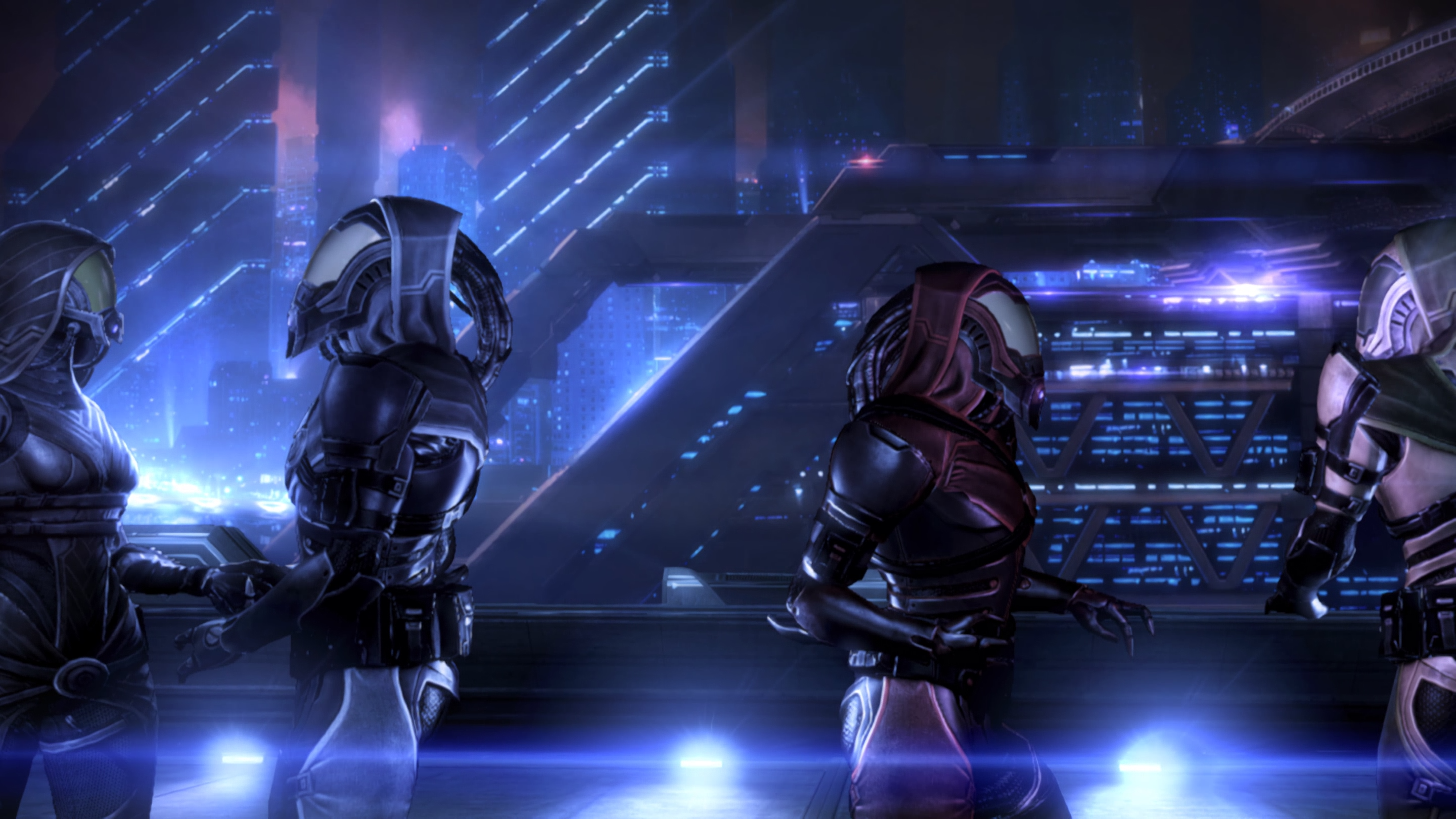
Quite some time ago (December 2019, I think), I created a poll for working out the technological infrastructure of the Poll-designed alien race, the Traders.  I’ve been busy with other things, but I managed to get a total of 5 ship designs out for the Traders:

  • General Technological Considerations
  • Their Interceptor
  • Their Blockade Runner/Smuggler Corvette
  • Their Defensive Frigate
  • Their “Battleships”
  • And, of course, their Arks.
This is an incomplete document and I offer it as a preview to my Companions ($5+) patrons.  Don’t worry, Fellow Travelers, when it’s done, it’ll be available to you too, I promise.  It’s just messy as of yet, and I wanted to get some feedback before I make it available to you.

Patreon Poll: Trader Tech 2

Continuing from the poll earlier this week, I have a new set of polls for Trader Tech.  These cover the elements of their military technology that lie outside of the individual.  This includes:

This poll is open to all Patreons of the Companion ($5+) tier.  As usual, please leave a comment as to how you see their doctrine working or what nuance you’d like to add.  I definitely take comments into account.
I know I’ve not yet released the more detailed robot rules, but hopefully you’ll have a sense of what you can do with robots and how they might serve the Traders militarily.  You guys seem very interested in giving the Traders robots, so I hope that particular poll will be useful to you even without worked examples of robots from other cultures.

Alliance Space Vehicles – Allegiance-Pattern Carrier

ST/HP: 7000

Hand/SR:5/6

HT: 13

Move:1/50(+8)

LWt.: 340,000

Load:150,000

SM: +13

Occ.:7100ASV

DR:2500*

Range:5jumps

Cost:$225B

Loc.: gGs22t

Stall: 0

Total Chase Roll:+3

*The Allegiance-Pattern Carrier has 2500 Carbide Composite DR on all sides (double DR vs plasma attackes). It also has a force screen with 10,000 ablative, hardened DR.

Notes

Alliance Capital Equipment:

  • Capital-Scale Tactical Ultra-Scanner: 4000-mile scan, 400-mile imaging/bioscan; 360°;
  • Targeting Macroframe: +5 to hit target with a scan-lock.
  • Night Vision Sensors: +9 nightvision, ×8 magnification (up to +3 to aimed attacks, if the vehicle aims for three turns).
  • Large Area Jammer: -4 to target with missiles for all allied ships within 25 miles.
  • Distortion Scrambler: May contest Electronics Ops (Comms) rolls with Electronics Ops (EW); 25 mile range.
  • Large Holographic Radio: 10,000 mile range; “conference” sized holographic projector. All communications encrypted.
  • Very Large FTL Communication Array: 300-parsec range.
  • Hyperdrive: Rating 2; 5 jumps.
  • Fusion Reactor: 50-year lifespan.
  • Security: Simple Electronic Locks and security cameras at regular intervals; complex biometric locks for secured facilities meant for the aristocrat alone; Lifepods.

Alliance Carrier Accommodation and Facilities:

  • Full Life-Support: up to 7500 people
  • Accommodations: 1 aristocratic luxury suite, 100 luxury cabins, 600 full cabins, 6500 bunks, 3 months of stored, refrigerated food.
  • Facilities: 100-person diplomatic establishment; 100-person entertainment establishment; 10-person negotiation office (+1 Diplomacy and Law); 10-person Akashic Shrine (+1 ESP and sensory deprivation chambers); 30-person gym; 1000-bed and 5 operating theater hospital;
  • Cargo: a secured arsenal capable of sufficient gear to arm 4000 men; Additional cargo can carry 5000 tons.
Alliance Cruiser Complement:

  • Shuttles: 5 Prestige-Class (or variant) Shuttles.
  • Fighters: Up to 20 squadrons of 25 fighters (Generally at least 10 squadrons of Valiants and 5 squadrons of Raptors)

AllianceCruiserArmaments

  • 6 Capital Turrets (Total RoF 12);
  • 8 Corvette-scale Light Turrets (Total ROF 24);
  • 8 mounted Plasma Flak Turrets (F/L/R/T);
Weapon

Dmg

Acc

Range

Ewt

RoF

Shots

ST

Bulk

Rcl

Capital-scale cannon

6d×75(5) burn

9

60mi/180mi

500t

1

NA

M

-10

2

Corvette-scale cannon

6d×30(5) burn

9

10mi/30mi

25t

1

NA

M

-10

2

Plasma Flak

6dx10 burn

NA

2000/6000

100t

20

NA

M

-10

1

Look and Feel

Like the Regal-Pattern Heavy Cruiser, the Allegiance-Pattern Carrier exudes a beautiful, art-deco elegance with often gleaming white or silver color and swooping, elegant curves. The main body, like most Alliance capital ships, is taller than it is wide, but has a fairly stubby length and is dominated by the bridge that rises from it. Its weaponry have been divided to bristle from either side: 3 capital-scale turrets, 4 corvette-scale turrets, and 4 plasma flak cannons line either side, just below the observation decks and gleaming windows of the superstructure. Two, long launch decks extend from the main body like two, forward swept wing; these launch decks make up the single largest visible structure of the vehicle and dominate one’s impression of the vehicle.

Those who land on one of the two launch decks, which are large enough for even light corvettes to medium (up to SM +8) corvettes to land on, step out into a well-lit and spacious hangar bay. The flight decks themselves have broad openings into space that are “force locked,” allowing one to view the starry sky through the shimmer of the screens. Travel from the hangar bays and flight decks to the rest of the ship is handled with interior shuttles, resembling clean and cozy subways. These shuttles bring one to the habitation section of the ship. The lower part of the habitation section has numberous cabins and bunks, all fairly well-appointed and attractive, though not as nice or roomy as those found in the Regal-Pattern Heavy Cruiser. A great and spacious hospital, as large as any found planetside, dominates this area, and a special “hospital” shuttle equipped with paramedical gear has a straight shot from the flight decks to this hospital, allowing for emergency care of wounded brought in by shuttle. Blow this, one can find the bowels of the ship and the great and bare infrastructure that runs the ship, where numerous servants and technicians scuttle through the machine-cathedral interior to ensure the operation of the great capital ship.

As one travels higher in the ship, into the super-structure, one finds the “Hotel” of the Allegiance: a great collection of luxury cabins, observation decks protected by transparent diamondoid, and large entertainment establishments that vary from Allegiance to Allegiance: gardens, spas, restaurants and casinos. A great diplomatic hall, ready for dinners and dances, can also be found in this section of the ship. The top of the superstructure has the bridge, and three separate luxury suites, the size of two luxury cabins put together with sufficiently nice interiors to garner a +1 reaction. One typically houses the governing noble, while the other two are supplied to guests of honor. The interior decoration of this luxurious part of the ship has romantic lighting provided by recessed glow-lights, contragravity crystal chandeliers, curving banisters and soft carpeting.

High Admiral Lowellin Cole designed the Allegiance to work with the Valiant and Raptor in an effort to create a new model of warfare for the Galactic Federation. His design has a more spartan feel, similar to the Sword-Pattern Battleship, but the aristocracy made adjustments for their own comfort and prestige. Still, his touches can be found in the lower decks, where the considerable number of soldiers and pilots rest in cabins and the great hospital attends to their needs. The “hotel” resembles that found on the Regal, only larger and more impressive. The combined effect of the two designs creates a powerful warship with two primary roles.

In war, the Allegiance carries the fighters of the Alliance to the enemy. The Allegiance might go straight to the enemy, especially if it carries Valkyries, and spill forth its fighters and strike-craft while it hangs back and relies on its powerful force screens to deflect enemy attack. Alternatively, it can fly to a system close to the enemy, and its hyper-drive capable fighters make the leap to attack the enemy, and then jump back to the carrier, preventing the carrier from suffering direct attack. In a full military confrontation, the Carrier struggles against Dreadnoughts and Battleships in toe-to-toe fights; its corvette cannons and its Raptors provide a decent defense against corvettes but these can overwhelm it. Most carriers have an escort of at least a few cruisers and often a battleship or two.

In peace, the Allegiance acts as a mobile hospital, going to worlds in need and using is capacity for soldiers, doctors and technicians to provide much needed aid and care to those on beleaguered worlds. It also doubles as a diplomatic craft, able to provide an excellent location for diplomatic negotiations (especially for the surrender of a world to its new aristocratic masters), or for the aristocracy to remind the leaders of a world who their true masters are, in the most comfortable and entertaining fashion possible. The Allegiance, thus, often “shows the flag” to other worlds or other aristocrats.

Alliance Space Vehicle – Sword-Pattern Battleship

ST/HP: 7000

Hand/SR:4/6

HT: 13

Move:3/90(+9)

LWt.: 360,000

Load:23,000

SM: +13

Occ.:2000 ASV

DR:5000/2500*

Range:5jumps

Cost:$300B

Loc.: gGs21t

Stall: 0

Total Chase Roll:+5

*The Sword-Pattern Battleship has 5000 Carbide Composite DR on the front, and 2500 DR on all other sides (double DR vs plasma attacks and shaped charge missiles). It also has a force screen with 10,000 ablative, hardened DR.

Notes

Alliance Capital Ship Equipment:

  • Capital-Scale Tactical Ultra-Scanner: 4000-mile scan, 400-mile imaging/bioscan; 360°;
  • Targeting Megacomputer: +5 to hit target with a scan-lock.
  • Night Vision Sensors: +9 nightvision, ×8 magnification (up to +3 to aimed attacks, if the vehicle aims for three turns).
  • Large Area Jammer: -4 to target with missiles for all allied ships within 25 miles.
  • Distortion Scrambler: May contest Electronics Ops (Comms) rolls with Electronics Ops (EW); 25 mile range.
  • Large Holographic Radio: 10,000 mile range; “conference” sized holographic projector. All communications encrypted.
  • Very Large FTL Communication Array: 300-parsec range.
  • Hyperdrive: Rating 2; 5 jumps.
  • Fusion Reactor: 50-year lifespan.
  • Security: Simple Electronic Locks and security cameras at regular intervals; complex biometric locks for secured facilities meant for the aristocrat alone; Lifepods.

Alliance Batleship Accommodation and Facilities:

  • Full Life-Support: up to 2000 people
  • Accommodations: 1 aristocratic luxury cabin, 200 cabins, 1800 bunks. 3 months of stored, refrigerated food.
  • Facilities: 10-person strategy ops (+1 Tactics and Strategy); 10-person Akashic Shrine (Sensory Deprivation Chambers; +1 to ESP rolls); 50-person gym; 50-bed sickbay; 1 operating theater;
  • Cargo: a secured arsenal capable of sufficient gear to arm 250 men; Additional cargo can carry 50 tons.
Alliance Capital ship Complement:

  • Shuttles: 5 Prestige-Class (or variant) Shuttles.

AllianceBattleshipArmaments

  • 3 Super-heavy Turrets (Total RoF 9)
  • 10 Capital Turrets (Total RoF 20);
  • 8 mounted Plasma Flak Turrets;
Weapon

Dmg

Acc

Range

Ewt

RoF

Shots

ST

Bulk

Rcl

Super-heavy cannon

6d×120(5) burn

9

170mi/500mi

5000t

1

NA

M

-10

2

Capital-scale cannon

6d×75(5) burn

9

60mi/180mi

500t

1

NA

M

-10

2

Plasma Flak

6dx10 burn

NA

2000/6000

100t

20

NA

M

-10

1

Look and Feel

The Sword-Pattern Battleship comes from an ancient era of Maradonian warfare. They served with the Lancer-Class Assault Frigates, laying down the fire necessary to keep the enemy occupied while the lancers advanced and conquered the enemy ship. When the fleet won the battle, the Sword would turn its cannons on the planet they orbited, ready to rain fire down upon it if it did not surrender.

The Sword retains its traditional appearance. Like the Regal-Pattern heavy cruiser, the Sword is longer and taller than it is wide, though it has a far less pronounced “bridge” superstructure. The Sword bristles with firepower: a line of three, absolutely massive super-heavy turrets run along the top, and five capital-scale turrets line either side, interspersed with plasma flak cannons. Thick armor guard the vehicle, but especially the front which, like the Lancer, has a great and heavily armored prow that can, if necessary, double as a ram.

Compared to the Allegiance and the Regal, the Sword’s interior more closely resembles the older Lancer. Metal walkways clang underfoot as technicians and soldiers march through quiet carbide cathedrals of machinery. Soldiers and technicians sleep in spartan bunks and attend meals in simple mess halls. The dim glow of floating lights in recessed alcoves provide all the illumination of the ship. The bridge begins to more closely resemble modern capital ships, its harsh metal surfaces taking on familiar, art-deco curves and elegance and hanging “chandeliers” become more common, but even here, where guests can expect to stay in simple, compact cabins rather than bunks, no observation decks or entertainment establishments can be found. Instead, guests find war room, strategic ops centers, and a great Akashic shrine, more reminiscent of the Imperial dreadnoughts, which patterned some of their design elements from the fearsome Sword-Pattern battleships.

The Sword served as the centerpiece of Maradonian fleets for centuries. Today, they struggle to compete with the Allegiance carrier. They have considerable firepower, to be sure, but a squadron of raptors with isomeric torpedoes can do more damage than a single Sword and costs less. It can serve a diplomatic function, but here again, the Allegiance does it better, and the Regal does it more cheaply. The Sword, then, tends to linger in the fleets of nostalgic Houses (especially house Grimshaw), but it does serve a purpose in protecting carriers from Imperial Dreadnoughts, as it’s one of the few ships can can go toe-to-toe with one, shrugging off their hits, and having sufficient speed and maneuverability to outflank them and fire a devastating barrage with its concentrated firepower.

Imperial Starships: Imperator-Class Dreadnought

ST/HP:9,0000
Hand/SR:4/6
HT: 12
Move: 1/75(+9)
LWt.:850,000
Load: 100,000
SM: +14
Occ.: 8500ASV
DR: 5000/3000*
Range: NA (5 jumps)
Cost:$680B
Loc.: gGs40t
*the Empire-Class dreadnought has DR 5000 on the front, and 3000 everywhere else except for its turrets and sensors, which have a DR of 100. It has a force screen with 15,000 DR (ablative).

Equipment

Imperial Flagship Electronics:

  • Capital-Scale Tactical Ultra-Scanner: 4000-mile scan, 400-mile imaging/bioscan; 360°;
  • Targeting Megacomputer: +5 to hit target with a scan-lock.
  • Night Vision Sensors: +9 nightvision, ×8 magnification (up to +3 to aimed attacks, if the vehicle aims for three turns).
  • Large Area Jammer: -4 to target with missiles for all allied ships within 200 miles.
  • Distortion Scrambler: May contest Electronics Ops (Comms) rolls with Electronics Ops (EW); 25 mile range.
  • Large Holographic Radio: 10,000 mile range; “conference” sized holographic projector. All communications encrypted.
  • Very Large FTL Communication Array: 300-parsec range.
  • Hyperdrive: Rating 2; 5 jumps.
  • Fusion Reactor: 50-year lifespan.
  • Security: Simple Electronic Locks and security cameras at regular intervals.
Imperial Flagship Personnel and Facilities
  • Command Crew: Commodore (rank 6); Colonel (rank 6); Executive Officer; up to 3 tactical officers (ECM/Sensors), up to 3 comm officers; up to 3 navigators; up to 15 engineering officers; up to 3 pilots.
  • Facilities: Strategy Ops (+2 Strategy); Navigation Ops (+2 Navigation); 200-bed Hospital; 2 operation theaters; Briefing Rooms; Diplomatic Establishment (100-man capacity); Restaurants (100-man capacity); Entertainment Establishments (100-man capacity); Gym/Training facilities (150-man capacity).
  • Food and Accommodations: Total life support for up to 8500 (actual crew complement is closer to 8000) and carries sufficient provisions for the entire crew for a year.
  • Lifepods: 900 (main body; sufficient room for 3600 people); 85 (command bridge; sufficient room for 340).
Imperial Flagship Complement:
  • Starfighters: 20 squadrons of 25 (each) Imperial Fighters in any configuration; generally 12 squadrons of Javelin-Class Interceptors (300), 6 squadrons of Peltast-class Strike Fighters (150), and 2 squadrons of Tempest-class Light Fighters (50). One squadron can be launched per minute.
  • Starfighter Refuel/Rearmament Capacity: The craft has sufficient fuel to fully arm and fuel starfighters for up to 10 sorties (though it should be noted that the amount of fuel necessary to fully fuel the entire complement of starfighters is a rounding error compared to the fuel required to make a single jump).
  • Soldiers: up to 5000 imperial troopers (one “Battlegroup,” led by a Colonel (Rank 6)); more often 1500 to 3000.
  • Materiel: Up to 500 Sentinel-class Utility Gunships; more often 150 to 300 with assorted Hunter-class combat hovercycles and command shuttlecraft.
Imperial Flagship Armaments
  • 4 top-mounted Super-heavy Turrets (F/R/L/T; Total ROF 12);
  • 2 bottom-mounted Super-heavy Turrets (F/R/L/U; Total RoF 6);
  • 10 top-mounted Capital Turrets (F/L/R/T; Total RoF 20);
  • 4bottom -mounted Capital-scale Turrets (F/L/R/U; Total RoF 8);
  • 8 top-mounted Plasma Flak Turrets (F/L/R/T);
  • 4 bottom-mounted Plasma Flak Turrets (F/L/R/U);
  • 4 rear-mounted Plasma Flak Turrets (B/L/R/T)
  • 2 ST 1000 Tractor Beams; Range 2000, Move 10.
Weapon
Dmg
Acc
Range
Ewt
RoF
Shots
ST
Bulk
Rcl
Super-heavy cannon
6d×120(5) burn
9
170mi/500mi
5000t
1
NA
M
-10
2
Capital-scale cannon
6d×75(5) burn
9
60mi/180mi
500t
1
NA
M
-10
2
Plasma Flak
6dx10 burn
NA
2000/6000
100t
20
NA
M
-10
1

Look and Feel

The Imperator-Class battlecarrier is a looming behemoth, a study in firepower in a metallic grey. It’s total volume is comparable to the Empire state building, with similar length and ten stories “tall.” A relatively small (compared to the rest of it’s bulk) bridge appears as a hump with a lighted window in the center rear of the great warship, but these are overshadowed by the building-sized blaster batteries that line its hull (most on the top of the wedge-shaped vehicle, but about a third as many lining the bottom).

One approaches an Empire-Class Dreadnought by shuttle, because they are not equipped to land on a planet. The entry points of two, 50-yard long landing bays sit on the narrow sides of the dreadnought, and lead to a central hangar in the heart of the ship. The enormous hangar rises above newly arrived shuttles with the space of a cathedral; vehicles line its chrome-grey walls, many Typhoon-class fighters, but an even greater number of military vehicles and dropships.

Corridors lead away from the hangar. Technical stations and computer terminals appear regularly along the corridors, and down side-passages one can make out engine structure, pulsing conduits and read-outs: the vast majority of the ship is “access space” for the enormous reactor, force screen projector, the hyperdrive, and the gigantic hyperium tanks. As one climbs higher in the ship, eventually one reaches the habitat section, near the top of the ship. The technical infrastructure of the industrial corridors give way to hallways that lead to bunkrooms and cabins, like walking through an endless hotel. This section houses 7500 soldiers, pilots and technicians, and at the very heart of the living quarters is an “entertainment” quarter with the main mess hall, a ship cantina, gaming rooms, briefing rooms, and a sizeable hospital.

Beyond even this, one arrives at “brass alley,” where lavish quarters house the command crew and visiting dignitaries and less lavish quarters house hundreds of junior officers. Here begins the “Bridge,” the tower from which the commodore and his staff command the dreadnought. A combined briefing room and diplomatic entertainment establishment has a fine view over the ship and whatever world the ship overlooks. The tower also houses a starmap chamber, where Imperial navigators chart the course of the vessel, and the delicate electronics that allow the ship to detect, jam and communicate with others. Finally, at the very top, the bridge proper combines ops center with ship operations: the shiphandler, tactical officer, comm officer and executive officer attend their control stations, while behind them, a great holographic display shows a real-time map of either local space or the region of the planet that the dreadnought currently occupies itself with. The commodore overlooks all of it, typically stationed before the great, armored window that overlooks the whole of the ship.

The Imperator-class Dreadnought is the most iconic vessel of the Imperial fleet. In its original design, it was intended to act as a flagship, supporting older vessels like the Legacy-class dreadnought with its superior fleet complement and larger firepower. In fact, it replaced these older vessels and became the preferred command position of every ambitious imperial officer in the fleet. It’s considerable squadrons of fighters, its large contingent of soldiers and its impressive firepower means that a single Imperator can threaten an entire colony on its own. With its excellent facilities, it can serve as the command ship for an entire fleet. The Empire uses these behemoths in every battle that matters to the Empire, and often deploys them on remote patrols. The only more impressive ships are bespoke command ships made for specific fleet admirals of the Emperor himself.

Typical Names

The Names of Imperator-Class Dreadnoughts tend to be self-congratulatory multi-word phrases that speak to Imperial glory, victory in battle and the history of the Valorian Empire.

Example Names: the Arc of Dominion, the Ascendancy, the Glory of War, Honor’s Price, Leto’s Redemption, the Paramount, the Rite of Conquest, the Supremacy, the Triumphant, the Valorian Laurel, the Victorious

Empire-Class Dreadnought 2.0 – the Vehicle

The Stats

ST/HP: 4000†

Hand/SR:2/6

HT: 12

Move: 4/100 (+10)

LWt.: 410,000

Load: 60,000

SM: +14

Occ.: 5000 ASV

DR: 5000/2500*

Range: NA (5 jumps)

Cost:$111B

Loc.: gGs40t

*the Empire-Class dreadnought has DR 5000 on the front, and 2500 everywhere else except for its turrets and sensors, which have a DR of 100. It has a force screen with 15,000 dr (ablative).

†The Empire-Class dreadnought has Injury Tolerance: Damage Reduction (2)

Equipment

ECM: -2 (Area Jammer, 25 mile radius); Distortion Scrambler (25 mile radius)

Ultrascanner Range: 1,000 miles

Comm Range: 10,000 miles (STL); 300 parsec (FTL)

Hyperdrive rating:3

Complement: 3 squadrons of 25 (each) Typhoon interceptors and 2 squadrons of (25 each) Typhoon Breakers; 1500 soldiers and sufficient military vehicles/dropships.

Command Crew: Commodore (rank 6); Executive Officer; up to 2 tactical officers (ECM/Sensors), up to 2 comm officers; up to 2 navigators; up to 7 engineering officers; up to 2 pilots.

Facilities: Strategy Ops (+1 Strategy); Navigation Ops (+1 Navigation); 200-bed Hospital; 2 operation theaters; Briefing Rooms; Diplomatic Establishment (100-man capacity); Restaurants (100-man capacity); Entertainment Establishments (100-man capacity); Gym/Training facilities (150-man capacity).

Lifepods: 250 (main body; sufficient room for 1000 people); 10 (command bridge; sufficient room for 40).

Tractor Beams: 2, located near the hangar bay entrances (F/L/T/U and F/R/T/U); ST 1000

Weaponry: 4 Capital Class Turrets (F/R/L/T); 2 Capital Class Turrets (F/R/L/U); 10 Standard Turrets (F/L/R/T); 4 Standard Turrets (F/L/R/U); 2 EM Disruptor Turrets (F/L/R/T); 8 Plasma Flak Turrets (F/L/R/T); 4 Plasma Flak Turrets (F/L/R/B); 4 Plasma Flak Turrets (B/L/R/T)

Weapon

Dmg

Acc

Range

Ewt

RoF

Shots

ST

Bulk

Rcl

Capital-Class Blaster

6d×100(5) burn

9

600mi/1800mi

1000t

2

NA

M

-10

2

Standard-Class Blaster

6d×50(5) burn

9

40mi/1200mi

250t

4

NA

M

-10

2

Em-Disruptor

6d×50(5) sur

9

40mi/1200mi

250t

4

NA

M

-10

2

Plasma Flak

6d×10(2) burn ex

6

12mi/36mi

10t

12

NA

M

-10

3

Look and Feel

The Empire-Class dreadnought is a looming behemoth, a study in firepower in a metallic grey. It’s total volume is comparable to the Empire state building, with similar length and ten stories “tall.” A relatively small (compared to the rest of it’s bulk) bridge appears as a hump with a lighted window in the center rear of the great warship, but these are overshadowed by the building-sized blaster batteries that line its hull (most on the top of the wedge-shaped vehicle, but about a third as many lining the bottom).

One approaches an Empire-Class Dreadnought by shuttle, because they are not equipped to land on a planet. The entry points of two, 50-yard long landing bays sit on the narrow sides of the dreadnought, and lead to a central hangar in the heart of the ship. The enormous hangar rises above newly arrived shuttles with the space of a cathedral; vehicles line its chrome-grey walls, many Typhoon-class fighters, but an even greater number of military vehicles and dropships.

Corridors lead away from the hangar. Technical stations and computer terminals appear regularly along the corridors, and down side-passages one can make out engine structure, pulsing conduits and read-outs: the vast majority of the ship is “access space” for the enormous reactor, force screen projector, the hyperdrive, and the gigantic hyperium tanks. As one climbs higher in the ship, eventually one reaches the habitat section, near the top of the ship. The technical infrastructure of the industrial corridors give way to hallways that lead to bunkrooms and cabins, like walking through an endless hotel. This section houses 5000 soldiers, pilots and technicians, and at the very heart of the living quarters is an “entertainment” quarter with the main mess hall, a ship cantina, gaming rooms, briefing rooms, and a sizeable hospital.

Beyond even this, one arrives at “brass alley,” where lavish quarters house the command crew and visiting dignitaries. Here begins the “Bridge,” the tower from which the commodore and his staff command the dreadnought. A combined briefing room and diplomatic entertainment establishment has a fine view over the ship and whatever world the ship overlooks. The tower also houses a starmap chamber, where Imperial navigators chart the course of the vessel, and the delicate electronics that allow the ship to detect, jam and communicate with others. Finally, at the very top, the bridge proper combines ops center with ship operations: the shiphandler, tactical officer, comm officer and executive officer attend their control stations, while behind them, a great holographic display shows a real-time map of either local space or the region of the planet that the dreadnought currently occupies itself with. The commodore overlooks all of it, typically stationed before the great, armored window that overlooks the whole of the ship.

Empire-Class Dreadnought 2.0 – Inspirations

So, for my playtest, I’ve completed a new version of the Starhawk and the Typhoon, two vehicles already available in GURPS Spaceships 4.  For the third “iconic” Psi-Wars vehicle, I have chosen the Empire-Class Dreadnought from GURPS Spaceships 3.  The Empire-Class has served as our primary “imperial” warship, the dread conqueror and the powerhouse to beat.  It has showed up in playtests and in Tinker Titan Rebel Spy, my short-lived Psi-Wars campaign.

The Empire-Class Dreadnought isn’t too bad as far as GURPS Spaceships creations go.  It lacks major issues and, in fact, taught me a lot about spaceship design.  It has perhaps an unrealistically large hangar, and it lacks missiles and armor, which tend to be the mainstays for more realistic ships, but it makes up for it with superb firepower, including an astonishing spinal cannon and very powerful force screen.  This makes it both a terrifying threat, a planet-conquering troop-transport, and a cinematically satisfying opponent to take on, as once you defeat or bypass its screens, even a relatively small fighter can take it out with a well-placed torpedo.

With the recreation of Vehicles in 4e, the goal now is to rebuild it in Vehicles, but also to re-imagine it from the ground up, rather than just “converting” the existing ship.  To do that, I want to dive into what it is, what inspired it, and what role it serves in its fleet.

The core Empire-Class Inspiration: the Star Destroyer

The obvious inspiration for the Empire-Class dreadnought is, of course, the Imperial Star Destroyer, which is probably the most iconic spaceship of Star Wars, maybe falling behind the Death Star and X-Wing, but I bet it’s close.  The great, looming behemoth that stormed onto the screen in a New Hope and then kept going and going fired the imagination then and now.
While I spend a lot of time complaining about Star Wars vehicles here, I need to give it some praise.  First, the wedge-shape design is actually pretty smart when you understand firing arcs.  We like to think of a turret as able to “fire in any direction,” but that’s really not true.  On a tank or a similar vehicle, yes, but as soon as you have two turrets, they start to interfere with one another.  If you picture a “long” tank with two turrets side-by-side, it quick becomes clear that you cannot fire both forward or both backward, but you might be able to fire both “broadside,” and we see that with battleships.  However,  you could stagger the turrets, so that one was slightly higher then the other, in which case, one has a less limited arc than the other, and both can “fire forward,” increasing the number of arcs you can fire in.  The Star Destroyer seems a study in this principle, its wedge design meant to facilitate the “stacking” of turrets so that the maximum number of them can “fire forward” absolutely demolishing anything directly before it.
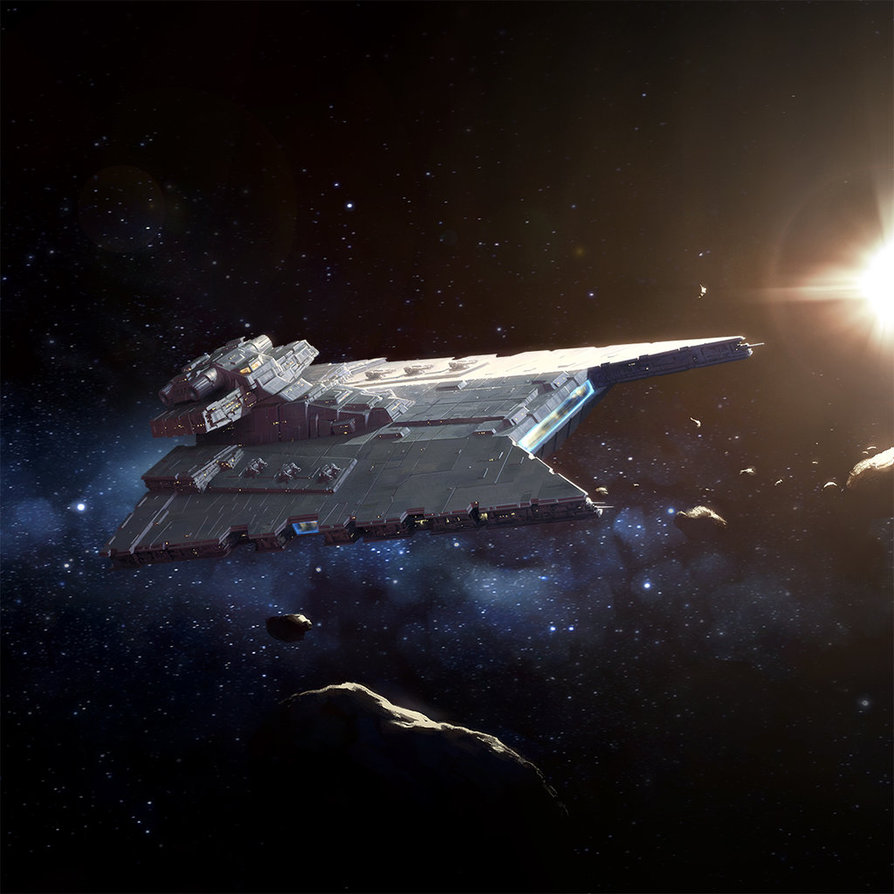
The Nebula-Class Star Destroyer;
What a Star Destroyer with a less prominent bridge might look like

The problems with the Star Destroyer are pretty well documented.  The core problems mostly focus on its space opera origins, and how it pretends to be a naval vessel.  It has this enormous superstructure that seems to serve no purpose: in the real world, we use the castle to elevate sensors higher so we can see over the horizon, but this is unnecessary on a spaceship.  Similarly, all its weapons are on the top” of the ship, and none on the bottom, which makes sense for a naval vessel, but not on a spaceship.  It also has this great, enormous window where the bridge is, making it a prime target: in principle, this should be replaced with sensors and the “bridge” buried in the ship, but for me and the space opera nature of Psi-Wars, that’s a bridge too far.  I want to see my heroic commodore standing astride his bridge looking out upon the battle.

A bigger problem for me is the size of the Star Destroyer.  These monsters start at a mile long and each film introduces yet larger incarnations.  This is not unrealistic: a galactic empire should have the industrial capacity to manufacture millions of mile-long ships without a problem.  We might even expect to see such warships in a realistic setting: Revelation Space features mile-long warships, as one needs that much mass to get a ship  up to near light speed.  No, my objection here is that I don’t really know what all that space is used for.  Star Destroyers have relatively wimpy collections of starfighters at only ~72 (that’s about three squadrons; the modern and much smaller Nimitz-class carrier has up to 90 fighters, and modern fighters are much bigger than TIE fighters, so why does a mile-long Star Destroyer have so few)?  It carries a substantial number of troops ( about 10,000) but not nearly enough transport capacity to get them all down quickly.  It seems to have huge engines, and that’s what I would expect to take up most of the space: generators, engines and hyperdrive, but Star Wars has shown that hyperdrives can be quite small, so unless it’s mostly a giant troop transport, I don’t understand what purpose is served by being a mile long.  People have complained that Psi-Wars ships are “too small” compared to Star Wars, but honestly, that’s because a million ton ship is “big” by any other setting’s standard, from Dreadnought to EVE.
The lack of point defense on a Star Destroyer is, perhaps, excusable in Star Wars, but it really isn’t in Psi-Wars, where the presence of isomeric (aka nuclear) torpedoes will destroy a ship, they need some kind of defense against missile attack!  Fighter cover counts for a lot, but it should be able to defend itself as well.

Real-World Inspirations

The obvious inspiration for the Imperial Star Destroyer and, by extension, the Empire-Class Dreadnought, is the WW2 battleship, but I would argue that this is incorrect.  The battleship was a focused ship: it was all about armor and firepower and nothing else.  The Empire-Class is about firepower, speed and fighter transport.  As lightly armored as it is, it’s more of a battlecruiser than it is a battleship, and its role as carrier makes it a puzzling hybrid, but not an unprecedented one.
After WW2 proved that battleships were dead, the US Navy intended to phase out battleships entirely, but the Marine corps objected.  They had seen how useful a battleship sitting off of a coast could be. A battleship in this context might be seen as floating artillery support, which is vital for any military advance, especially one as fraught as an amphibious assault.  So, the Navy conceived of a hybrid meant to fulfill both the role of battleship and carrier, a “battlecarrier” if you will, and the logic of it remains sound: the front of the vehicle would be all firepower, laying down that artillery support for an amphibious assault, while its rear acted as a landing platform, allowing it to launch close air support for said amphibious assault.  Unfortunately for the marines, the project was canned.
Fortunately for us, such vehicles still exist, and we call them “aircraft cruisers,” such as the Kiev-Class aircraft carrier.  Most such vehicles are probably better described as “helicopter carriers” as they don’t really launch much in the way of F-14 Tomcats or other exciting vehicles that one might make a movie about.
The other real-world vehicle I would cite as an inspiration are the Nimitz- and Ford-Class carriers, not because their mission profile matches that of the Empire-Class dreadnought, but because they are the largest and most impressive naval vessels the planet has ever seen.  They are gargantuan, called “Super-carriers,” they displace twice the tonnage of an Iowa-Class battleship.  The presence of a single super-carrier can redefine local politics, and they act like floating mobile bases.  I see a similar role for an Empire-Class Dreadnought: once it orbits your world, it begins to bend the politics of your world into its orbit from its sheer firepower and presence.

Other Fictional Inspirations

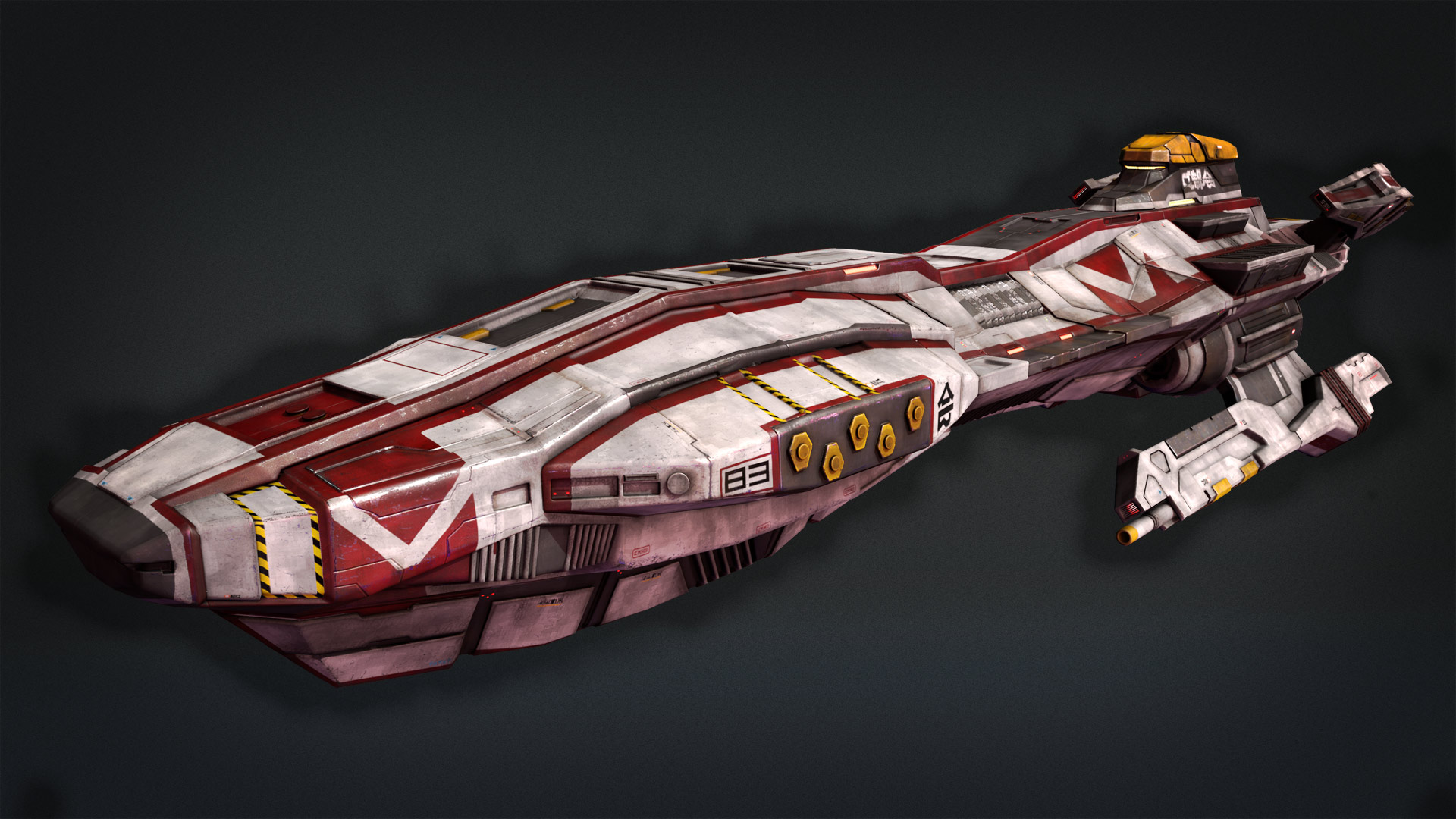
If I had to look elsewhere in the Star Wars universe for better inspiration for the Empire-Class Dreadnought, I would look no farther than the Venator-Class Star Destroyer or “Attack Cruiser” which fits its mission description better. Where the Star Destroyer has some nebulous hangar in its bottom, the Venator has an explicit and obvious launch deck, which fits its role as dual attack/carrier better in that we can see that it’s part carrier.
Beyond Star Wars, I struggle a bit, as the role of the Empire-Class dreadnought is to be, you know, the Capital Ship, so in principle any capital ship will do, but I do draw inspiration from the Cruisers from Strike Suit Zero, not because they’re especially appropriate, but because of how they interact with fighters.  While it’s very difficult for a fighter to single-handedly destroy one, the turrets and various weakpoints remain vulnerable to fighter attack.  While this does not necessarily make “good sense” from a realistic military perspective, it makes a lot of sense from a gaming perspective.
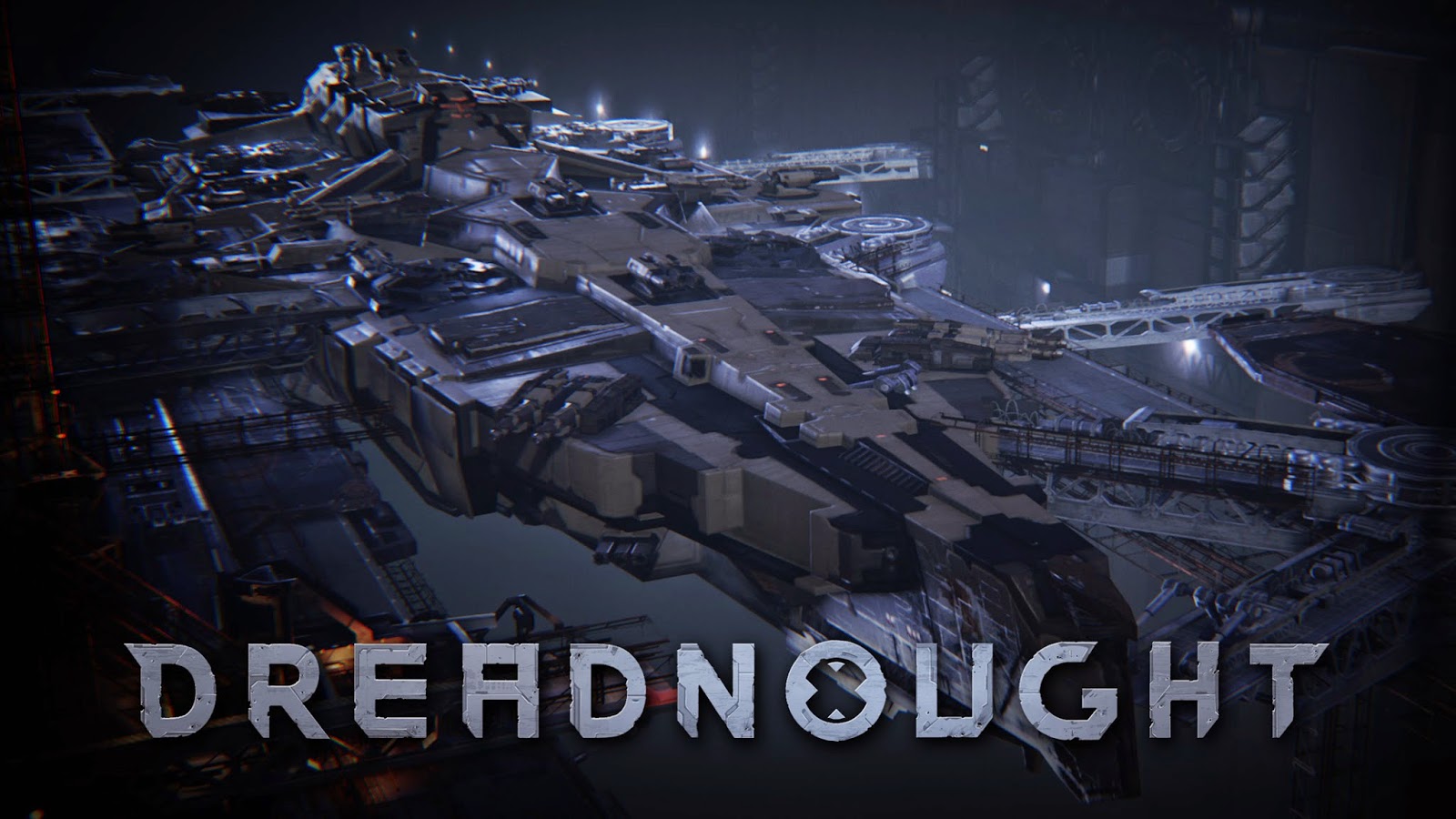
I also find myself looking into the games Dreadnought and EVE for additional inspiration (EVE especially uses real-world stats, which makes conversion a snap).  I’ve been advised to look into Fractured Space, and I may well do that.  These don’t really inform the design of the Empire-class Dreadnought, but they may well inform the design of other vehicles.

Empire-Class Dreadnought Mission Profile

The Empire-Class Dreadnought is the centerpiece of the Imperial Navy.  Its primary purpose is to project imperial power from any point in space to worlds.  As a result, it needs a very fast, very powerful hyperdrive, and sufficient fuel to make multiple sequential jumps if necessary, allowing it to respond quickly to crisis.  Once it arrives at a world, it must be able to quickly establish orbital dominance.  It uses several wings of fighters and bombers as well as its own capital-ship killing firepower to do this.  It can then position itself for orbital bombardment and planetary invasion.  It must carry at least a brigade/legion worth of soldiers and support vehicles, as well as close air support wings, and firepower with sufficient reach to attack a planet from at least low (100 mile) orbit. 
Once entrenched in its orbital supremacy, it must be able to act as a command post for ground and orbital operations.  This requires a large FTL communication array, allowing it to act as a hub for an FTL relay (it will often be beyond the core imperial infrastructure), and extensive scanners and communicators able to coordinate everything in orbit around a world.
It must be capable of acting independently for very long periods of time. This means it needs considerable fuel reserves (both for its jumps and for its fighter complement) and sufficient food onboard for months.  It will use a standard Fusion reactor, given their decade-long fuel supply.
The primary weaknesses of the Empire-Class dreadnought are light armor and relatively slow speed.  “Slow” is only in real space and only in comparison to corvettes: it should be quick enough to out maneuver most other capital ships.  As for armor, it will sacrifice armor for speed (both hyperspatial and in real-space) and supplement its armor with a force screen and point defense capable of turning aside a capital-scale isomeric torpedo assault.

Patreon Post: (Old) Dreadnought Playthrough

I’ve wanted to take some time to look at spaceships again, because I see more points where they need work, and especially as dive into the specifics of Iteration 6, I want to take greater control over my setting (using generic Starhawks and Typhoons is fine if we want to just rapidly prototype a setting, but if I’m going to build it in detail, why not build my ships as well?)

This is likely to go on for awhile, and this week is mostly cleaning up loose ends.  This also means I need to dive into whatever changes I propose to make sure they work, so I hope you like playtests! Most of these will be $1+, because, they’re mainly mechanical asides and technical discussions, but when I start building ships for the final version, those will be $3+.

Today’s post is a companion post to an old post, going back to the dawn of my Patreon, back, I think, to literally my first Patreon exclusive.  It’s the playtest between dreadnoughts that confirmed the rules I documented in Dreadnoughts Revisited. I’ve gone ahead and included the resulting document here, for ease.  I’m posting this because a few of my Patrons heard it existed and were very curious about it. Note that by the time my update is finished, a lot of the rules contained herein will be invalidated, but I find it a fun read, especially the battle between the Reaper and the Rain of Fire (the third one), which is the first time I think I’ve ever shown dreadnoughts at their actual scale of power.

It’s for $1+ Patrons, so if you’re a Patron at all, check it out!  If not, as always, I’d love to have you.

Support me on Patreon!

Psi Wars: Alternate Capital Ships and Dreadnoughts

Players will probably never command a capital ship, never mind a dreadnought, unless the GM decides that he wants his campaign to center on one and freely hands it over to the players.  Psi Wars focuses more on plucky heroes who defeat dreadnoughts, or they act as set-pieces, the stage for action, or allies in the background.  The dominate the sky and impact the setting, but they’re not a day-to-day concern for most players (or most characters of the setting).  As such, they’re all effectively outside of the price-range of the typical player character.  Still, a variety of capital ships and dreadnoughts certainly serves a role in providing varied opposition, or to assist the GM with world-building.

The Sword-Class Heavy Cruiser

The Sword-Class cruiser isn’t a bad warship. It’s heavy, on the high-end of capital ships. It typically deals ~140(5) damage with its main cannons, which is just enough damage to penetrate its own shields and armor, which means it’ll do a pretty good job of killing most corvettes or capital ships. It’s secondary battery is only at -3 to hit fighters, gains a +7 to hit thanks to high RoF, and deals about as much damage as a Starhawk’s lasers, making it exceptionally well-defended against fighters (though they can still still slip beneath its shields if they get close). The Sword-Class heavy cruiser is a solid escort vessel and a decent capital-killer. It will fail, though, against the Empire-class dreadnought, as it lacks the necessary punch to even penetrate its shields

The Claymore Model

I find the design of the rear, fixed missile mounts to be an odd choice. Perhaps Pulver was modeling the Sword-Class Heavy Cruiser on a specific ship? In any case, it reminds me of the frigates and cruisers of Strike Suit Zero, which focus their fire power on torpedoes as much as they focus on beam weapons. We can rework the Sword to bring its missile front-and-center so its opponents are forced to deal with volleys of torpedoes every turn! We’ll further multiply its fire power by trading out its central major battery for a medium battery: That’s even less likely to defeat an Empire-class dreadnought, but we have torpedoes for that. These cannots fire on corvettes and lighter capital ships. Finally, we replace the rear missile launchers with another set of 10 rapid fire x-ray laser turrets, to prevent fighters from getting the drop on it by getting behind it, and to cover its retreat. This version lacks a stealth hull (as an escort, it expects people to see it coming)

Front Hull System
[1-2]
Hardened Streamlined Diamondoid Armor (total dDR 140) ($1,200m)
[3]
Secondary Battery (10 fixed mounts with 40cm missile launchers) ($150m)
[4]
Defensive ECM ($300m)
[5]
Multipurpose Array Array (Comm/Sensor 13) ($600m)
[6]
Habitat ($30m)

Central Hull System
[1-2]
Hardened Streamlined Diamondoid Armor (total dDR 140) ($1,200m)
[3!]
Medium Battery (three 3GJ x-ray laser turret) ($150m)
[4!]
Secondary Battery (10 very rapid fire 10mj x-ray laser turrets) ($150m)
[5-6!]
Stardrive Engines (FTL-1 each) ($600m)
[core]
Control Room (C10 computer, comm/sensor 11, 15 control stations) ($60m)
Rear Hull System
[1]
Hardened Streamlined Diamondoid Armor (total dDR 70) ($600m)
[2-3!]
Super Reactionless Engines (12.5G acceleration each) ($400m)
[4!!]
Heavy Force Screen (dDR 200 or dDR 400) ($1,500m)
[5!]
Secondary Battery (10 very rapid fire 10mj x-ray laser turrets) ($150m)
[6]
Fusion Reactor (two Power Points) ($300m)
[core]
Super Fusion Reactor (four Power Points) ($1,000m)
The claymore has gravitic compensation ($30m), Artificial Gravity ($30m). 10 Automeds cost $1m
TL Spacecraft
dST
Hnd/SR
HT
Move
Lwt
Load
SM
Occ
dDR
Range
Cost
11^ Claymore
200
+0/5
13
25G
30000
228
11
130ASV
140/140/70*
x2
$8.45B
*Hardened, with an additional 200 DR (400 with two power points)

The Rapier Model

The description of the Sword-Class Heavy Cruiser describes it as “Fast,” only none of the capital ships, when pulled from the examples, are particularly fast in our rules. This partly deliberate. Pulver didn’t want capital ships out running fighters, so most of his TL 11^ cruisers and dreadnoughts have less engines than necessary. This is compounded by our solution of halving reactionless drives twice. The result is that a Sword-class cruiser can only get +1 acceleration per turn on a full burn of all of its engines. Slow indeed! We could certainly double its speed, though, making it a frighteningly quick warship that can keep up with some corvettes!
The Rapier’s design is more power-hungry, as it’ll consume far more energy as it pushes its envelope with reactionless drives. It’s also smaller, both to reflect a more refined model, and to escape the Heavy Capital Ship rules, if those are in place. The ship has far less fire-power, but worries more about how it applies that fire power. With its combination of rapid fire x-ray lasers and its forward-mounted major battery, it makes an excellent corvette/fighter killer, making it a terrifying opponent for most PCs.

Front Hull System
[1-2]
Hardened Streamlined Diamondoid Armor (total dDR 100) ($400m)
[3!]
Major Battery (fixed mount 3 GJ antiparticle beam) ($60m)
[4]
Defensive ECM ($100m)
[5]
Multi Array Array (Comm/Sensor 13) ($200m)
[6]
Habitat ($10m) (3 luxury cabins, 20 cabins, 10-bed automed clinic, two fabricator minifacs, briefing room, gym, lab, 100 tons of cargo)

Central Hull System
[1-2]
Hardened Streamlined Diamondoid Armor (total dDR 100) ($400m)
[3]
Medium Battery (three 10 mj very rapid fire x-ray laser turrets) ($60m)
[4!]
Heavy Force Screen (dDR 150 or dDR 300) ($500m)
[5-6!]
Stardrive Engines (FTL-1 each) ($200m)
[core]
Control Room (C10 computer, comm/sensor 10, 10 control stations) ($20m)
Rear Hull System
[1]
Hardened Streamlined Diamondoid Armor (total dDR 50) ($400m)
[2-5!]
Super Reactionless Engines (12.5G acceleration each) ($240m)
[6, core]
Super Fusion Reactor (four Power Points each) ($1,200m)
The Manticore has gravitic compensation ($10m), Artificial Gravity ($10m), and Stealth hull ($10m) Automeds cost $1m
TL Spacecraft
dST
Hnd/SR
HT
Move
Lwt
Load
SM
Occ
dDR
Range
Cost
11^ Rapier
150
+0/5
13
50G
10000
108.5
10
85ASV
60/30/30*
x2
$3,82B

The Gladius Model

The Claymore is a pretty good model, but we could make a worsemodel. Similar to the Starhawk Regal, we could design an “inferior” Sword-class heavy cruiser, representing an archaic version from previous wars that might remain in service primarily until superior ones can replace them. This model replaces Diamonoid armor with nanocomposite, x-ray lasers with improved UV lasers, and removes sophisticated electronics. It slims down on some of its weapons, because its weaker weapons need greater power to do as much damage as a Claymore or Sword. It also has fewer power points, so needs to more carefully manage its systems: It’ll typically have its shields, and either two engines and one battery active, or one engine and two batteries active.
The result is a capital ship nearly half the cost of its successor. It would also probably lose against a Rapier, which costs less. Obsolete indeed.

Front Hull System
[1-3]
Hardened Streamlined Nanocomposite Armor (total dDR 150) ($900m)
[4]
Secondary Battery (10 fixed mounts with 40cm missile launchers) ($150m)
[5]
Tactical Array Array (Comm/Sensor 13) ($300m)
[6]
Habitat ($30m)

Central Hull System
[1-3]
Hardened Streamlined Nanocomposite Armor (total dDR 150) ($900m)
[4!]
Major Battery (10GJ improved uv laser turret) ($150m)
[5!]
Medium Battery (three 300MJ rapid fire improved uv laser turret) ($150m)
[6!]
Stardrive Engines (FTL-1 each) ($300m)
[core]
Control Room (C10 computer, comm/sensor 11, 15 control stations) ($60m)
Rear Hull System
[1-2]
Hardened Streamlined Nanocomposite Armor (total dDR 100) ($600m)
[3-4!]
Super Reactionless Engines (12.5G acceleration) ($400m)
[5!]
Light Force Screen (dDR 200) ($500m)
[6]
Fusion Reactor (two Power Points) ($300m)
[core]
Fusion Reactor (two Power Points) ($300m)
The Gladius has gravitic compensation ($30m), Artificial Gravity ($30m). 10 Automeds cost $1m
TL Spacecraft
dST
Hnd/SR
HT
Move
Lwt
Load
SM
Occ
dDR
Range
Cost
11^ Gladius
200
+0/5
13
25G
30000
228
11
130ASV
150/150/100*
x2
$5.1B
*Hardened, with an additional 200 DR

The Tarot-Class Light Carrier

The Tarot-Class Light Carrier is a nice enough ship. With 4,000 tons of hangar-space, it can carry 400 typhoon fighters, ~125 starhawks, or 40 Wyverns. It can only launch 800 tons per minutes: 80 typhoons, ~25 Starhawks, or 8 wyverns, though it’s unlikely to have more than 50 pilots aboard. The ship is cheaper than any Sword-class heavy cruiser except the Gladius, which means a fleet of Tarots and Swords can support one another: the Tarot providing fighter cover while the Sword deals with heavier threats.
Note that the Tarot can repair or fabricate $1.5m per hour. This gives you a new Typhoon in about 3 hours, or a new Starhawk in about 7. In fact, SS7 suggests that these might be too quick and recommends reducing that value from per hourto per day. Still, a new Starhawk in a week isn’t too shabby from a non-dedicated vessel.

The Minor Arcana Model

The Tarot is perfect for its job… but it has a lot of unnecessary bells and whistles. What if we want nothing but a forward projection craft, small and light and cheap, that could take our fighters to the enemy, destroy them, and then return to base? With the speeds that Psi-Wars has, the Tarot’s fabrication capacity is a nice-to-have, rather than a necessity, because one can get back from the front lines in a few days, rather than a few years.
The Minor Arcana is smaller, cheaper, with less range, no fabricator, and has less fire-power, but still manages to sport a total hangar capacity of 2100 tons, with a launch capacity of 700 tons… nearly as much per turn as the standard model! It can carry ~200 typhoons, 70 starhawks, or ~20 wyverns. It also reduced cargo where possible, rather than habitats, and thus can still field ~50 pilots. The net result is a solid “on the cheap” carrier, for minor empires or factions with a budget.

Front Hull System
[1]
Nanocomposite Armor (total dDR 50) ($50m)
[2!]
Light Force Screen (dDR 150) ($100m)
[3]
Tactical Array (Comm/Sensor 13) ($100m)
[4-6]
Hangar Bay (300 tons each) ($3m)

Central Hull System
[1]
Nanocomposite Armor (total dDR 50) ($50m)
[2!]
Secondary Battery (Ten 300 MJ x-ray laser turrets) ($60m)
[3-6]
Hangar Bay (300 tons each) ($4m)
[core]
Control Room (C10 computer, comm/sensor 10, 10 control stations) ($20m)
Rear Hull System
[1]
Nanocomposite Armor (total dDR 50) ($50m)
[2]
Habitat ($10m) (25 cabins, 15 bunkroms, 10-bed automed clinic, 2 minifabricators, 40 tons of cargo)
[3-4!]
Super Reactionless Engines (12.5G acceleration each) ($120m)
[5-6!]
Stardrive Engines (FTL-1 each) ($200m)
[core]
Super Fusion Reactor (four Power Points each) ($600m)
The Minor Arcana has gravitic compensation ($10m), Artificial Gravity ($10m), Automeds cost $1m
TL Spacecraft
dST
Hnd/SR
HT
Move
Lwt
Load
SM
Occ
dDR
Range
Cost
11^ Minor Arcana
150
+0/5
13
25G
10000
62
10
120ASV
50*
x2
$1,4B
*Hardened, with an additional 200 DR (400 with two power points)

The Empire-Class Dreadnought
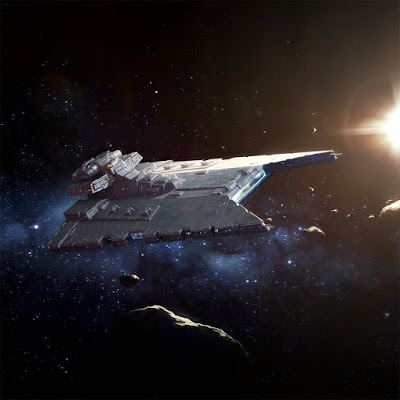
The Empire-Class Dreadnought joins the Typhoon and the Starhawk as iconic for Psi-Wars, and as has been shown in the playtests, they work perfectly fine as written. A standard Dreadnought has sufficient secondary and tertiary cannons to deal with starfighters, and their secondary batteries deal an average of 200(5) damage, which is sufficient to seriously damage or destroy most corvettes. The spinal cannon deals 1400(3) damage, which is sufficient to simply destroy even a Sword-Class Cruiser. The large cannon is inaccurate (-3), and spinal cannons suffer heavily against smaller ships, but with the current rules, it only suffers another -3 against a capital ship, and that it’s fixed gives is a +2, so against a capital vessel (+6), they have a +2 total to hit, which is fairly effective from Close range and certainly from Long. The hangar can support 3,000 typhoon fighters, 1,000 starhawks or 300 wyverns, and it can launch 200 typhoons, 70 starhawks or 20 wyverns per minute. The result is a strategic dominance vessel, a warship capable of defeating fleets of starfighters (with its own starfighters), corvettes, and other capital ships, though sufficient enemy fire-power, skill and determination can certainly defeat one.

The Legacy Model

The prequel trilogy feature the proto-star destroyer, the “Jedi Cruiser,” which is a concept I enjoy. Such a powerful vessel would probably have existed for decades, and its model changed, updated and improved. As with my previous vessels, we can apply the same concept, creating a non-optimal TL 11^ design that draws heavily on TL 10 elements, representing an “early TL 11^ design.”

The Legacy is a size smaller than the Empire-class. It replaces its spinal battery with a fixed mount particle beam, and it reduces its tertiary battery to a secondary battery. It retains a (smaller, though still respectable) hangar with a capacity for 1000 typhoon, ~300 starhawks, or 100 wyverns, and downgrades to fusion reactors and nanocomposite armor. The result is still a ship that can destroy most corvettes and capital ships, carries a respectable fighter cover with it, and it’s effectively immune to most capital ship fire (barring a good torpedo hit), all for a fraction of the cost. The legacy is an excellent ship, to the point where one wonders what threat the creators of the Empire-class dreadnought had in mind when they created it.
Front Hull System
[1-3]
Hardened Nanocomposite Armor (total dDR 450) ($9b)
[4]
Major Battery (Fixed mount with 100 GJ improved particle beam) ($1.5b)
[5]
Tactical Array (Comm/Sensor 16) ($0.6b)
[6]
Hangar Bay (10k tons, 1k launch rate) ($0.03b)
[core]
Control Room (Comm/Sensor 14, C12) ($2b)

Central Hull System
[1-2]
Hardened Nanocomposite Armor (total dDR 300) ($6b)
[3]
Secondary Battery (10 turrets with 10 GJ improved uv lasers) ($1.5b)
[4!]
Light Force Screen (dDR 700) ($5b)
[5-6!]
Stardrive Engines (FTL-1 each) ($6b)
[core!]
Habitats ($0.3b)
Rear Hull System
[1-2]
Hardened Nanocomposite Armor (total dDR 300) ($9b)
[3-4!]
Super Reactionless Engines (12.5G acceleration each) ($4b)
[5-6]
Fusion Reactor (two Power Points each) ($6b)
The Legacy has gravitic compensation ($0.3b), Artificial Gravity ($0.3b)
TL Spacecraft
dST
Hnd/SR
HT
Move
Lwt
Load
SM
Occ
dDR
Range
Cost
11^ Empire Legacy
500
-1/5
13
25G
300k
13k
13
3500ASV
450/300/300*
x2
$51.83B
*Hardened, with an additional 500 DR

The Mythic Model

What’s even scarier and more imposing than an Empire-Class dreadnought? A bigger Empire-Class dreadnought. That’s the idea behind the “Super Star Destroyer,” Darth Vader’s flag-ship. We can do the same with an Empire-Class dreadnought, and create an even bigger dreadnought.
The problem with this approach is that the Empire-Class Dreadnought is arguably too big already. The Legacy-model is already sufficiently powerful to defeat any ship I’ve described over the past week, including the Viking-Class assault carrier, below. The standard model is even more powerful, with a spinal cannon that will vaporize a Sword-class heavy cruiser in a hit. It’s already a super-weapon. Why would you need an even bigger super-weapon? Well, anyone who has an Empire-class dreadnought is probably more worried about prestige than sense in any case, and I’ve made the corresponding design more about intimidation than about battlefield supremacy.
The Mythic has superior shields and sufficient armor to ignore most attacks. It doesn’t need more hangar space, and barely doesn’t need more habitat space (though it has far more workspaces and still needs to carry an army around), thus it has a larger habitat, but it’s control room, tactical array and hangar space are all smaller and in a single slot, making is slower and less stable than the smaller Empire-class vessel. What it has instead is fire-power. Endless fire-power. It replaces the spinal mount with a single beam weapon as powerful as the entire Empire-Class’s spinal mount, and then layers on additional missile launchers (for planetary bombardment), medium batteries (for destruction of capital ships), secondary cannons (to destroy corvettes) and loads of all sorts of tertiary batteries (for point defense and the defeat of fighters). The result is a fleet center-piece, slow, but capable of single-handedly wiping out the enemy fleet… which one would hope it could do, as it costs as much as most fleets.
Note that it lacks sufficient power to run all systems, and that it retains its rear vulnerability to fighters.

Front Hull System
[1-2]
Hardened Diamondoid Armor (total dDR 1000) ($120b)
[3!]
Major Battery (Fixed mount with 1TJ antiparticle beam) ($15b)
[4!]
Medium Battery (three 300 GJ X-ray laser turrets) ($15b)
[5!]
Tertiary Battery (10 very rapid fire 300 MJ x-ray laser turrets, 10 30gj x-ray laser turrets, 10 64cm (medium) missile turrets) ($15b)
[6]
Secondary Battery (ten 80cm Missile Launchers turrets) ($15b)
[core!!]
Heavy Force Screen (dDR 1000 or 2000) ($150b)

Central Hull System
[1]
Hardened Diamondoid Armor (total dDR 500) ($60b)
[2!]
Secondary Battery (10 turrets with 100 GJ x-ray lasers) ($15b)
[3!]
Tertiary Battery ( 10 very rapid fire 300 MJ x-ray laser turrets, 10 30gj x-ray laser turrets, 10 64cm (medium) missile turrets) ($15b)
[4]
Control Room (Comm/Sensor 14, C12), ($2b) Tactical Array (Comm/Sensor 17) ($10b), Hangar Bay (30k tons, 2k launch rate) ($0.1b)
[5-6!]
Stardrive Engines (FTL-1 each) ($60b)
[core!]
Habitats ($3b)
Rear Hull System
[1]
Hardened Diamondoid Armor (total dDR 500) ($60b)
[3-4!]
Super Reactionless Engines (12.5G acceleration each) ($40b)
[5-6]
Super Fusion Reactor (four Power Points each) ($60b)
The Mythic has gravitic compensation ($3b), Artificial Gravity ($3b)
TL Spacecraft
dST
Hnd/SR
HT
Move
Lwt
Load
SM
Occ
dDR
Range
Cost
11^ Empire Mythic
1000
-2/4
13
25G
1m
13k
15
35kASV
450/300/300*
x2
$661.1B
*Hardened, with an additional 1000 DR for 1 power point or 2000 for 2 power points.

Viking-Class Assault Carrier

GURPS Spaceships 4 includes a variety of carriers, including the Tarot listed above, but for the “mega-carrier,” I prefer the Viking, as it’s a touch less ridiculously epic than the Continent. The Viking-Class Assault Carrier can carry up to 200,000 tons, which is a mind-blowing number of fighters (it is, in fact, meant to carry an entire invasion fleet) and approximately 5 divisions of soldiers. A single Viking-Class Assault Carrier, backed by a couple of Empire-Class dreadnoughts, would almost certainly bring nearly any world to its knees (one would hope so, of course, as it’s over a trillion GURPS dollars worth of military hardware, not even accounting for the fighters, bombers, shuttles, soldiers and military hardware). The only problem with the Viking-Class Assault Carrier is that it has a few things in it that don’t quite fit the given model of gameplay: It includes total life support systems (unnecessary for the speed at which ships travel in Psi-Wars), grav guns (not a present technology) and 64mm missiles (which means it can only fire medium missiles and torpedoes).

The Devastator Model

The devastator model is identicalto the Viking Class except for the following changes: Replace the tertiary missile battery with a secondary missile battery, giving it ten 80cm missile launchers (thus, heavy missiles and torpedoes). Replace the ten grav guns in the central Tertiary Battery with ten 300gj x-ray laser turrets, and remove the total life support, doublingthe carry-capacity of the ship (it can carry 100,000 soldiers, rather than 50,000). Price remains the same.