Player Characters are most likely to interact with fighters on a one-to-one manner than any other ship. The standard rules allow any player to simply have a fighter, and they’ll most often spend their space battles fighting other fighters. Thus, in that sense, fighters are perhaps the most important part of the setting.
The Typhoon
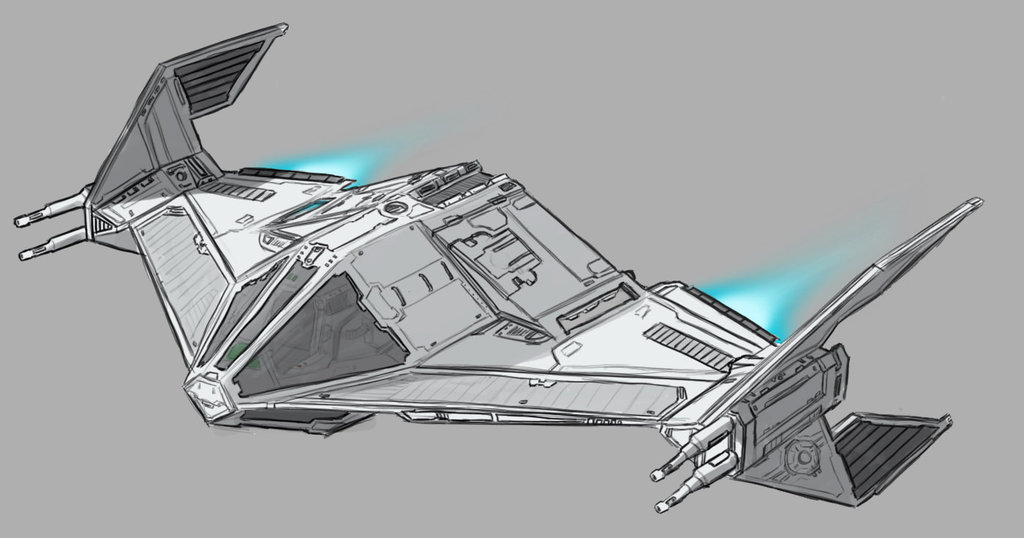
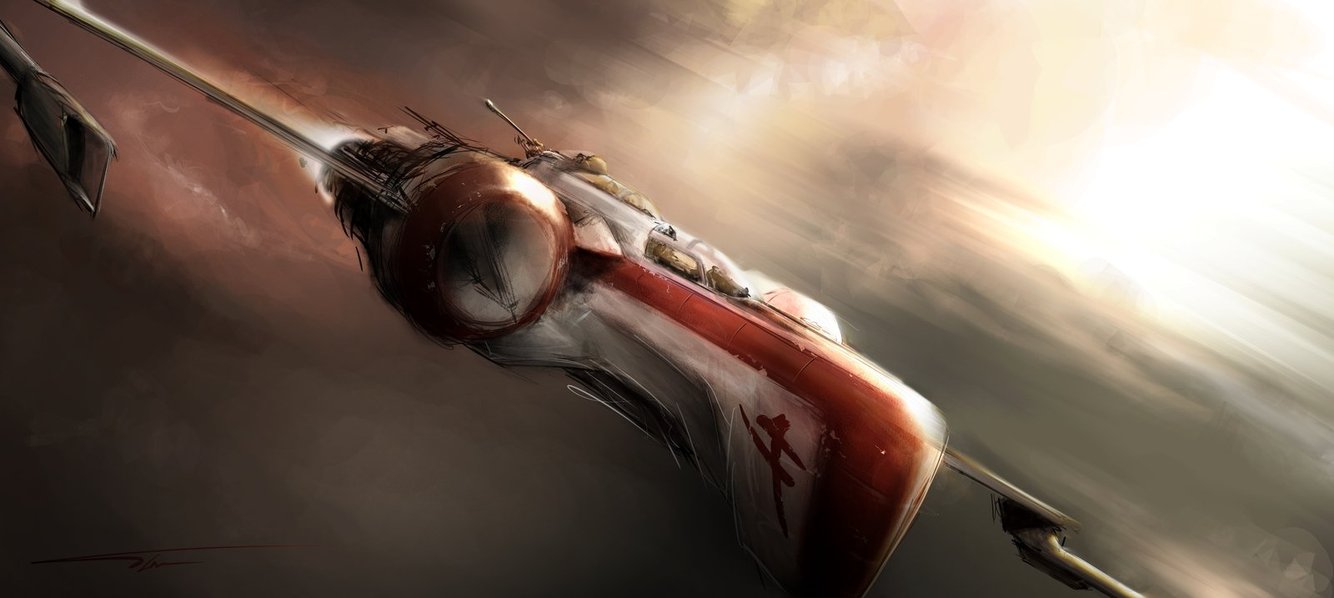
In principle, the concept of the Typhoon is sound: Engines attacked to two forward mounted fixed lasers that are as small and agile as possible. You get a cheap, disposable ship so that you overwhelm your opponent with quantity rather than quality, and because the ship is stripped down to its essentials, it does pretty well. The Typhoon is similar to a WW2 Zero. I highly recommend allowing the Light Fighter optional rule (+1 handling), certainly if they end up in the hands of players.
However, the standard Typhoon, as found on SS4 page 11, has a few technical flaws (perhaps errata?). Its DR is primarily on the front, making it “forward facing” as the description suggests, but its two major batteries are not “fixed,” which cuts its aggressiveness significantly. It also has two super-fusion reactors, which serve no purpose (it only has two systems that use power, its guns, and thus it could get by with a single fusion reactor, much less two super-fusion reactors). We can certainly improve on the design so that it at least makes more sense, without removing the disposable, stripped-down concept behind it.
Typhoon Alpha (Codename: Interceptor)
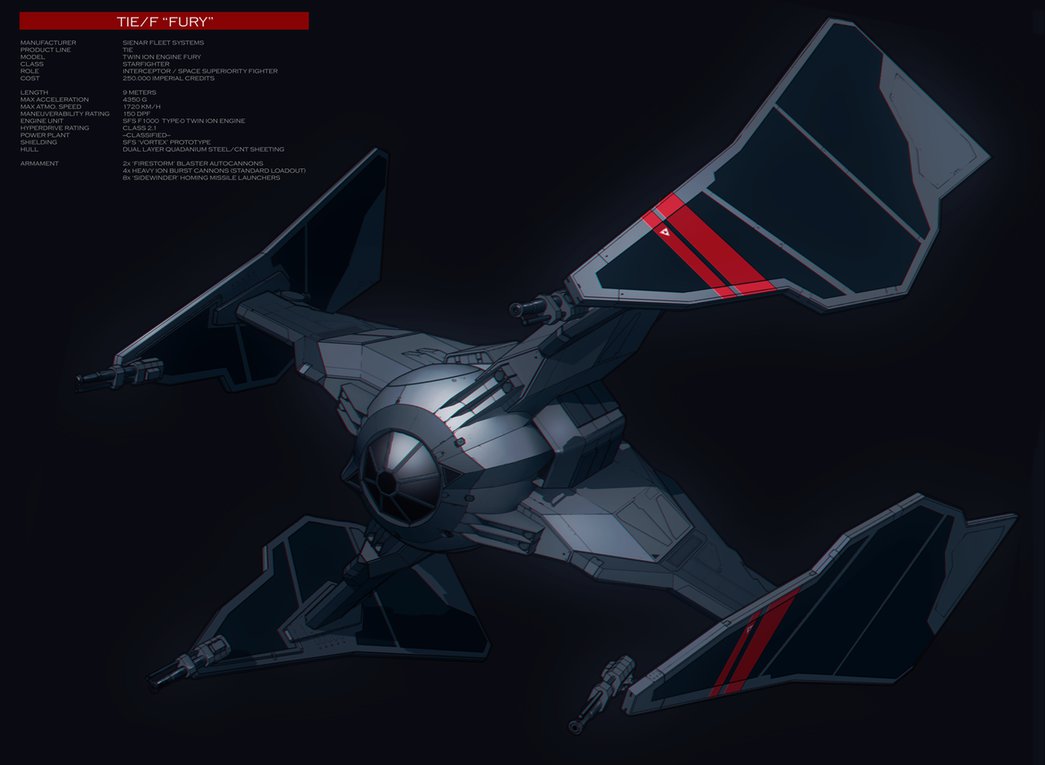
This Typhoon revises the noted problems with the standard Typhoon. The major batteries become fixed, and we replace the two Super Fusion reactors with two fuel cells. This limits their flight-time, but their flight-time was pretty limited before (and does it matter if you run out of power for your lasers?). This also maintains the “reactors on the side wings” design that the Typhoon emulates from the tie-fighter. Finally, Typhoons do not have the listed Emergency Ejection, as their control rooms are [core], which disallows an emergency eject. This trims the cost considerably down to $2.88 million, making it an even more disposable fighter, and better at killing the enemy.
| Front Hull |
System |
|
[1-3]
|
Hardened Nanocomposite Armor (total dDR 15) ($300k) |
|
[4-5!]
|
Major Batteries (Fixed 3 MJ X-ray laser each) ($120k) |
|
[6]
|
Tactical Array (comm/sensor 6) ($100K) |
|
[core]
|
Control Room (C7 Computer, comm/sensor 4, and one control station) ($20k) |
| Central Hull |
System |
|
[1-2]
|
Hardened Nanocomposite Armor (total dDR 10) ($200k) |
|
[3-4]
|
Defensive ECM ($200K) |
|
[5-6]
|
Fuel-Cell (one Power-Point each) ($10k) |
|
[core]
|
Fuel Tank (0.6 tons Hydrogen with 450 mps delta-v) ($3k) |
| Rear Hull |
System |
|
[1-2]
|
Hardened Nanocompsoite Armor (total dDR 10) ($200k) |
|
[3-6]
|
Super Fusion Torch Engine (50G acceleration each) ($1,600k) |
The Typhoon Alpha has gravitic compensation ($10k)
| TL |
Spacecraft |
dST
|
Hnd/SR
|
HT
|
Move
|
Lwt
|
Load
|
SM
|
Occ
|
dDR
|
Range
|
Cost
|
| 11^ |
Typhoon Alpha |
15
|
+2/4
|
12
|
200G/450 mps
|
10
|
0.1
|
+4
|
1SV
|
15/10/10*
|
0
|
$2.76M
|
*Hardened
Typhoon Beta (Codename: Breaker)
The Empire of Star Wars, of course, uses nothing but Tie-Fighters, and it has a variety of interesting Tie-Fighters, including Tie- “Bombers”. We could certainly stand to have a “heavy” Typhoon, one size larger. We’ll keep some core design elements, namely a cheap ship with no shields and an extremely focused design. We’ll also use the “turret” design of the original Typhoon, since a less maneuverable fighter could certainly use a way to shoot at ships behind it. We’ll also keep the two fuel-cell design despite the lack of need for it, to provide some cheap redundancy It’ll be slower, heavier, and more heavily armed, making it decent for a bombing run, provided it has an interceptor escort. We’ll have to design this one from scratch, though.
| Front Hull |
System |
|
[1-3]
|
Hardened Nanocomposite Armor (total dDR 21) ($900k) |
|
[4-5]
|
Major Batteries (20cm fixed Missile Launchers) ($300k) |
|
[6]
|
Tactical Array (comm/sensor 6) ($300K) |
|
[core]
|
Control Room (C7 Computer, comm/sensor 5, and one control station) ($60k) |
| Central Hull |
System |
|
[1-3]
|
Hardened Nanocomposite Armor (total dDR 21) ($900k) |
|
[3!]
|
Major Battery (30 MJ x-ray laser, turret) ($150K) |
|
[5-6]
|
Fuel-Cell (one Power-Point each) ($15k) |
|
[core]
|
Fuel Tank (1.5 tons Hydrogen with 450 mps delta-v) ($10k) |
| Rear Hull |
System |
|
[1-2]
|
Hardened Nanocomposite Armor (total dDR 15) ($600k) |
|
[3]
|
Defensive ECM ($600K) |
|
[4-6]
|
Super Fusion Torch Engine (50G acceleration each) ($3,600k) |
The Typhoon Beta has gravitic compensation ($30k)
| TL |
Spacecraft |
dST
|
Hnd/SR
|
HT
|
Move
|
Lwt
|
Load
|
SM
|
Occ
|
dDR
|
Range
|
Cost
|
| 11^ |
Typhoon Beta |
20
|
+2/4
|
12
|
150G/450 mps
|
30
|
0.1
|
+5
|
1SV
|
21/15/15
|
0
|
$7.48M
|
*Hardened
Typhoon Delta (Codename: Storm)
We need a Typhoon for ace pilots, an elite ship even swifter and deadlier than the standard Typhoon. We replace the Nanocomposite armor with streamlinedDiamondoid armor, giving it a very sleek look and making it even harder to hit (-1 to front or back). We remove one armor system from each location, put 4 lasers on the front section, borrowing from the Starhawk in an effort to address the Typhoon’s lack of firepower, move the Tactical Array back to the Central Hull, keep one of the Super-Fusion reactors, replace the second with a Defensive ECM, and add a fifth(!) Super Fusion Torch to the rear of the ship, making the vessel nothing but guns and speed. It’s a more vulnerable vessel than an Interceptor, but in the hands of a skilled pilot, the armor should never be touched by heavier weapons, and it’s sufficient DR to survive a hit from most improved high RoF UV lasers. Note that 5 engines requires 50 mps of fuel per turn. We’re not counting fuel expenditures, but if we were, the Delta only has 180 seconds (9 turns) of full burn fuel, compared to the Alpha’s 240 seconds (12 turns).
| Front Hull |
System |
|
[1-2]
|
Hardened Streamlined Diamonoid Armor (total dDR 10) ($400k) |
|
[3-6!]
|
Major Batteries (Fixed 3 MJ X-ray laser each) ($240k) |
|
[core]
|
Control Room (C7 Computer, comm/sensor 4, and one control station) ($20k) |
| Central Hull |
System |
|
[1]
|
Hardened Streamlined Diamonoid Armor (total dDR 5) ($200k) |
|
[2]
|
Tactical Array (comm/sensor 6) ($100K) |
|
[3-5]
|
Defensive ECM ($300K) |
|
[6]
|
Super Fusion Reactor (four Power Points) ($300k) |
|
[core]
|
Fuel Tank (0.6 tons Hydrogen with 450 mps delta-v) ($3k) |
| Rear Hull |
System |
|
[1]
|
Hardened Streamlined Diamonoid Armor (total dDR 5) ($200k) |
|
[2-6]
|
Super Fusion Torch Engine (50G acceleration each) ($2,000k) |
The Typhoon Delta has gravitic compensation ($10k)
| TL |
Spacecraft |
dST
|
Hnd/SR
|
HT
|
Move
|
Lwt
|
Load
|
SM
|
Occ
|
dDR
|
Range
|
Cost
|
| 11^ |
Typhoon Delta |
15
|
+2/4
|
12
|
250G/450 mps
|
10
|
0.1
|
+4
|
1SV
|
10/5/5*
|
0
|
$3.86M
|
*Hardened
Typhoon Omega (Codename Assassin)
If an alpha can get away with fuel-cells… why not a more advanced typhoon as well? That a typhoon only needs two power points gives it considerable flexibility. Fuel Cells have virtually no heat signature, making them difficult to detect if you’re using a Stealth hull. So why not add a Dynamic Chameleon hull and have “dark” Typhoons that nobody can detect until they’re right atop you? I also made them streamlined and borrowed form the Delta, so they looked cool, and removed some of their armor to make room for the additional electronics and heavier power-systems. The result is a second elite fighter, one focused on delicate stealth rather than pure piloting skill.
| Front Hull |
System |
|
[1-3]
|
Hardened Streamlined Diamonoid Armor (total dDR 15) ($600k) |
|
[4-5!]
|
Major Batteries (Fixed 3 MJ X-ray laser each) ($120k) |
|
[6]
|
Multipurpose Array (comm/sensor 6) ($200K) |
|
[core]
|
Control Room (C7 Computer, comm/sensor 4, and one control station) ($20k) |
| Central Hull |
System |
|
[1-2]
|
Hardened Streamlined Diamonoid Armor (total dDR 10) ($400k) |
|
[3-4]
|
Distortion ECM ($400K) |
|
[5-6]
|
Fuel-Cell (one Power-Point each) ($10k) |
|
[core]
|
Fuel Tank (0.6 tons Hydrogen with 450 mps delta-v) ($3k) |
| Rear Hull |
System |
|
[1-2]
|
Hardened Streamlined Diamonoid Armor (total dDR 10) ($400k) |
|
[3-6]
|
Super Fusion Torch Engine (50G acceleration each) ($1,600k) |
The Typhoon Alpha has gravitic compensation ($10k), dynamic chameleon ($90k) and a Stealth Hull ($125k)
| TL |
Spacecraft |
dST
|
Hnd/SR
|
HT
|
Move
|
Lwt
|
Load
|
SM
|
Occ
|
dDR
|
Range
|
Cost
|
| 11^ |
Typhoon Omega |
15
|
+2/4
|
12
|
200G/450 mps
|
10
|
0.1
|
+4
|
1SV
|
15/10/10*
|
0
|
$3.98M
|
*Hardened
The Starhawk
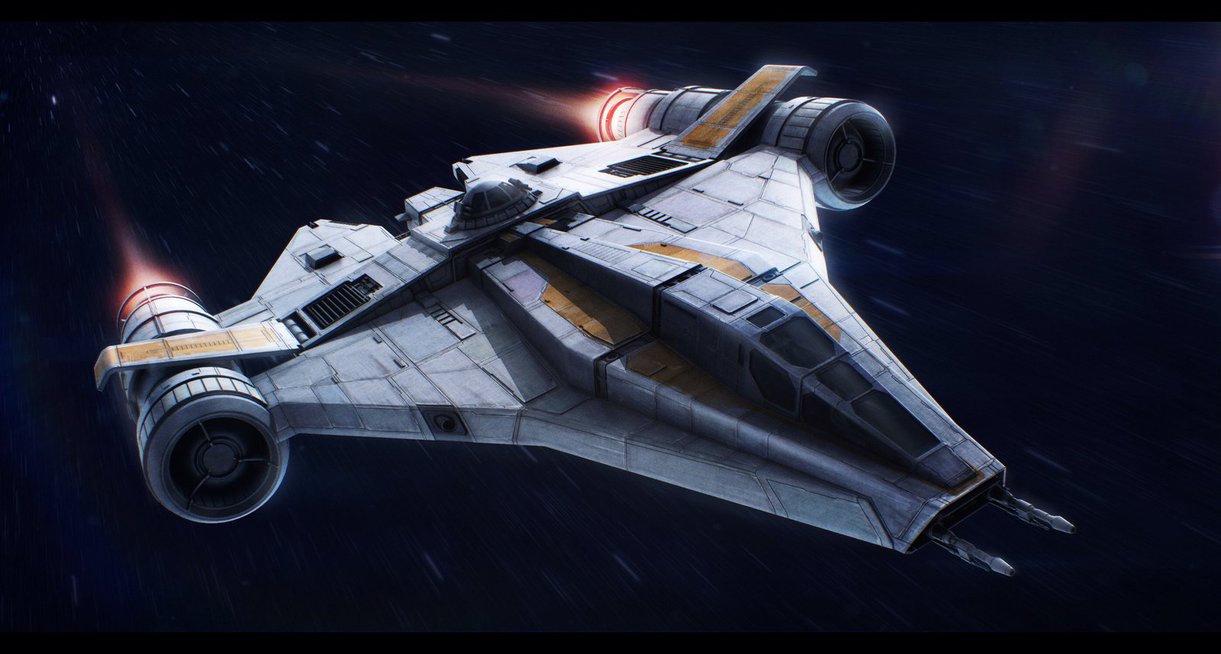
The Starhawk is a pretty good vessel, if overengineered. It has considerable firepower and excellent survivability and speed, making it the “best of all worlds,” but it requires considerable skill to master: the firepower needs a solid gunner behind it to hit with all four shots, and the reactor needs to be coaxed to get it to work, and if a few systems go down, or the pilot makes a bad choice (angling the force screens and then being out maneuvered), then things can go south pretty quickly. If the Typhoon is a zero, the Starhawk is the F4F Wildcat (or, perhaps better, the Curtiss P-40 Warhawk).
The Typhoon really needs some variety, but most players who see a Starhawk will like it, since its responsiveness to skill makes it an excellent PC ship. Still, we can consider some variants to give the setting a little character. Where possible, we should try to emphasize the RoF of 4, the low armor/high shields, and the presence of the engine room and stardrive, which define the Starhawk away from the Typhoon.
The Starhawk Regal
Sometimes, a suboptimal design improves a setting. Psi Wars doesn’t really change much technologically, thus the fighters of the past probably wouldn’t be TL 10… but we would expect them to be different in design, presumably obsolete based on current models. Thus, an inferior Starhawk might model a “previous” Starhawk model
While the Starhawn has 4-laser design (forming the signature “X” pattern), the Regal will have a simpler, “two wing” design with 2 improved UV lasers. Our armor will also be lighter: Advanced Metallic Laminate, but we’ll carry more of it: We’ll replace two lasers, the defensive ECM and one Super Fusion Torch with additional armor. The result will not be much more armor than the current Starhawk, but it’ll be cheaper, slower and lacking as much punch (though its missiles remain as good as before). It requires 3 energy points, while its reactor only provides two, which requires some clever manipulation, making a tech-bot in the engine room a handy addition.
| Front Hull |
System |
|
[1-3]
|
Hardened Streamlined Advanced Laminate Armor (total dDR 9) ($360k) |
|
[4]
|
Major Battery (fixed mount 20cm missile launcher) ($150k) |
|
[5-6!]
|
Major Batteries (Fixed 10 MJ Improved UV laser each) ($300k) |
| Central Hull |
System |
|
[1-2]
|
Hardened Streamlined Advanced Laminate Armor (total dDR 6) ($240k) |
|
[3]
|
Tactical Array (comm/sensor 6) ($300K) |
|
[4]
|
Fuel Tank (1.5 tons hydrogend with 450 mps delta-v) ($10k) |
|
[5]
|
Engine Room (one workspace) ($15k) |
|
[6!]
|
Light Force screen (dDR 20) ($500k) |
|
[core]
|
Control Room (C7 computer, comm/sensor 5, and one control station) ($60k) |
| Rear Hull |
System |
|
[1-2]
|
Hardened Streamlined Advanced Laminate Armor (total dDR 6) ($240k) |
|
[3-5]
|
Super Fusion Torch Engine (50G acceleration each) ($3,600k) |
|
[6!]
|
Stardrive (FTL-1) ($300k) |
|
[core]
|
Fusion Reactor (two Power Points) ($300K) |
The Regal has gravitic compensation ($30k) and wings ($150k).
| TL |
Spacecraft |
dST
|
Hnd/SR
|
HT
|
Move
|
Lwt
|
Load
|
SM
|
Occ
|
dDR
|
Range
|
Cost
|
| 11^ |
Starhawk Regal |
20
|
+2/4
|
13
|
150G/450 mps
|
30
|
0.1
|
+5
|
1SV
|
9/6/6*
|
x1
|
$6.55M
|
*Hardened, Additional 20 DR from Force Screens
The Starhawk Nova
If the Regal represents the Starhawk’s past, the Nova might represent its future. What would make the Starhawk better? More guns! By replacing the 10 MJ lasers with 3 MJ lasers, we can afford to have a six-wing design, putting a total of 24d on an opponent, as opposed to 16d, but the design is slightly weaker against heavier armor (each shot has only 50 penetration vs the standard starhawk’s 70). This gives us the added power needed to improve the shields from light force screens to heavy force screens, making the fighter virtually invincible against smaller fighters, and the space for additional ECM and fuel. The engine room remains, though the tech-bot is less critical in this design. The design is a touch more expensive, but with sufficient wiggle room in the budget, most squadrons can afford at least a couple.
| Front Hull |
System |
|
[1]
|
Hardened Streamlined Nanocomposite Armor (total dDR 5) ($300k) |
|
[2]
|
Major Battery (fixed mount 20cm missile launcher) ($150k) |
|
[3-4!]
|
Medium Batteries (Three fixed 3 MJ X-Ray lasers each) ($300k) |
|
[5-6]
|
Defensive ECM ($600K) |
| Central Hull |
System |
|
[1]
|
Hardened Streamlined Nanocomposite Armor (total dDR 5) ($300k) |
|
[2]
|
Tactical Array (comm/sensor 6) ($300K) |
|
[3]
|
Engine Room (one workspace) ($15k) |
|
[4-5]
|
Fuel Tank (3 tons hydrogen with 900 mps delta-v) ($20k) |
|
[6!!]
|
Heavy Force screen (dDR 20) ($1,500k) |
|
[core]
|
Control Room (C7 computer, comm/sensor 5, and one control station) ($60k) |
| Rear Hull |
System |
|
[1]
|
Hardened Streamlined Nanocomposite Armor (total dDR 5) ($300k) |
|
[2-5]
|
Super Fusion Torch Engine (50G acceleration each) ($4,800k) |
|
[6!]
|
Stardrive (FTL-1) ($300k) |
|
[core]
|
Super Fusion Reactor (four Power Points) ($1,000K) |
The Nova has wings ($150k) and gravitic compensation ($30k)
| TL |
Spacecraft |
dST
|
Hnd/SR
|
HT
|
Move
|
Lwt
|
Load
|
SM
|
Occ
|
dDR
|
Range
|
Cost
|
| 11^ |
Starhawk Nova |
20
|
+2/4
|
12
|
200G/900 mps
|
30
|
0.1
|
+5
|
1SV
|
5*
|
x1
|
$10.13M
|
*Hardened, Additional 20 or 40 DR from Force Screens
The Wyvern
The Wyvern is a solid bomber-style fighter: slower (ignore the 300G/300 mps drive and replace it with 100G/900 mps. We’ll always use hydrogen over water to prevent twinkery thanks to ignoring fuel-requirements), more heavily armored, and having a turret. If the Typhoon is a Zero and the Starhawk a Wildcat, then a Wyvern is a B-2 Flying Fortress. As it proved in the playtest, it’s a fine addition to Psi Wars.
That said, it’s really more “Last Starfighter” than “Y-Wing fighter.” We can certainly adjust it to fit better with some Psi Wars concepts. In particular, the habitat serves no real purpose for our model of starfighters.
The Wyvern X
The Wyvern X rearranges most items to more closely resemble the familiar design of the Starhawk. It replaces the habitat with an engine room, reduces the fuel from two tanks to one, reduces the stardrives from two to one, changes the forward fixed guns to x-rays rather than UVs, and keeps everything else the same. The result is a ship that feels like the Wyvern, but is faster and a closer match to the Starhawk, making it closer to the “Y-wing” concept from Star Wars. Most of the additional expense comes from the engines (which are expensive!)
| Front Hull |
System |
|
[1-2]
|
Hardened Nanocomposite Armor (total dDR 20) ($2,000k) |
|
[3-4!]
|
Major Battery (fixed mount 30 MJ X-Ray lasers) ($1,200k) |
|
[5]
|
Control Room (C8 computer, comm/sensor 6, and two control stations) ($200k) |
|
[6]
|
Medium Battery (three fixed mount 20cm missile launchers) ($600k) |
| Central Hull |
System |
|
[1-2]
|
Hardened Nanocomposite Armor (total dDR 20) ($2,000k) |
|
[3]
|
Tactical Array (Comm/Sensor 8) ($1,000k) |
|
[4!]
|
Major battery (turret with 30 MJ improved UV laser) ($600k) |
|
[5]
|
Engine Room (one workspace) ($30k) |
|
[6]
|
Defensive ECM ($1,000k) |
|
[core!]
|
Light Force Screen (dDR 30) ($1,500k) |
| Rear Hull |
System |
|
[1]
|
Hardened Nanocomposite Armor (total dDR 10) ($1,000k) |
|
[2]
|
Fuel Tank (5 tons of hydrogen with 450 mps delta-V) ($30k) |
|
[3-5]
|
Super Fusion Torch Engine (50G acceleration each) ($12,000k) |
|
[6!]
|
Stardrive (FTL-1) ($1,000k) |
|
[core]
|
Super Fusion Reactor (four Power Points) ($3,000K) |
The X has gravitic compensation ($100k) and an ejection system ($500k)
| TL |
Spacecraft |
dST
|
Hnd/SR
|
HT
|
Move
|
Lwt
|
Load
|
SM
|
Occ
|
dDR
|
Range
|
Cost
|
| 11^ |
Wyvern Zero |
30
|
+2/4
|
13
|
150G/450 mps
|
100
|
0.2
|
+6
|
2SV
|
20/20/10*
|
x1
|
$27.76M
|
*Hardened, Additional 30 DR from Force Screens
The Wyvern Zero
A habitat and stardrives aren’t the worst idea in the world for a fighter. Starfighters are exceptionally affordable, and Star Wars often features characters riding a starfighter to distant systems to check something out. Quite a few signature ships are little larger than starfighters, and the Wyvern, at SM +6, already verges on the size of a corvette. Why not embrace the concept and focus more intently on a “mini-corvette” concept?
I replaced one Super Fusion Drive with a Super Reactionless Drive. While the latter are far cheaper (and thus a savings!) they’re power-hungry and the Wyvern can only handle so much power at a time. The presence of a reactionless means that it can travel slowly if it needs to, and can accelerate more quickly (in combat) with its super fusion torch drives. For long trips, the hydrogen in the fuel tank can be replaced with hyperdrive fuel, quadrupling its range. It can serve as an excellent mini-corvette, but its range is limited mostly by the amount of food you can stuff into a single habitat, and the relatively slow speed of the FTL drive (compared to actual corvettes). In practice, a Wyvern Zero can travel about 16 parsecs before it needs refueling, and does so in 8 hours, or 64 parsecs in 32 hours with a full tank of hyperfuel.
| Front Hull |
System |
|
[1-2]
|
Hardened Nanocomposite Armor (total dDR 20) ($2,000k) |
|
[3-4!]
|
Major Battery (fixed mount 30 MJ improved UV lasers) ($1,200k) |
|
[5]
|
Control Room (C8 computer, comm/sensor 6, and two control stations) ($200k) |
|
[6]
|
Medium Battery (three fixed mount 20cm missile launchers) ($600k) |
| Central Hull |
System |
|
[1]
|
Hardened Nanocomposite Armor (total dDR 10) ($1000k) |
|
[2]
|
Habitat (one cabin) ($100k) |
|
[3]
|
Tactical Array (Comm/Sensor 8) ($1000k) |
|
[4!]
|
Major battery (turret with 30 MJ improved UV laser) ($600k) |
|
[5-6!]
|
Stardrive (FTL-1) ($1,000k) |
|
[core]
|
Super Fusion Reactor (four Power Points) ($3,000K) |
| Rear Hull |
System |
|
[1]
|
Hardened Nanocomposite Armor (total dDR 10) ($1000k) |
|
[2]
|
Fuel Tank (5 tons of hydrogen with 450 mps delta-V) ($30k) |
|
[3-4]
|
Super Fusion Torch Engine (50G acceleration each) ($8,000k) |
|
[5!]
|
Super Reactionless Engine (25G Acceleration each) ($2,400k) |
|
[6]
|
Defensive ECM ($1,000k) |
|
[core!]
|
Light Force Screen (dDR 30) ($1,500k) |
The Zero has gravitic compensation ($100k) and an ejection system ($500k)
| TL |
Spacecraft |
dST
|
Hnd/SR
|
HT
|
Move
|
Lwt
|
Load
|
SM
|
Occ
|
dDR
|
Range
|
Cost
|
| 11^ |
Wyvern Zero |
30
|
+2/4
|
13
|
125G
|
100
|
0.2
|
+6
|
2SV
|
20/10/10*
|
x2
|
$25.23M
|
*Hardened, Additional 30 DR from Force Screens



 Mailanka's Musing