Thoughts on Racial Personality Traits

I’ve been so busy with Eldoth stuff behind the scenes, but a discussion popped up in my Discord that was so interesting I thought about posting one of my patented multi-post diatribes there, but then it occurred to me that I’m not posting to the blog enough, so I thought I would post it here. This is likely one of those “Things Mailanka always says” and I’m sure I’ve discussed it before, but it’s always fun to return to favorite old topics.

Context: Asrathi Impulsiveness

Someone pointed out that the Asrathi lack the appropriate Social Stigma that all aliens in Psi-Wars should have, due to the dominance of a xenophobic empire, which reduces their cost by 5 points to 15 points. While Psi-Wars has no specific set point value for the racial templates of their alien racial templates, but I do aim for 25 or less, as 25 points is the cost of a power-up, and I tend to treat racial templates as a power-up, as that fits the aesthetic of space opera. So, someone proposed removing their Impulsiveness disadvantage, and this triggered a discussion I found interesting.

For additional context, the Asrathi are the “Catfolk” race of Psi-Wars. Their template is largely cribbed from various “Cat-folk” sources, including Dungeon Fantasy, GURPS Basic and GURPS Bio-Tech, and given that this is a moving target, their traits have changed a lot over time, as I settle on what they should look like. However, they have become increasingly unique to Psi-Wars and the particulars of design and philosophy has begun to turn them from something generically “GURPS” to something specific to Psi-Wars, which is part of where this discussion comes from.

This post is mostly me musing on whether Impulsiveness belongs on the template (Spoiler: my conclusion in the end is that it does, but feel free to follow me on the journey)

Continue reading “Thoughts on Racial Personality Traits”

Asteroids: A Meditation on My Process

So, my discord has been hopping lately, and I’ve had some requests for a return to discussion on my process for certain writing elements, a return to “form” with the origins of the blog. The problem with this is that I’ve already explained most of those processes. For example, I could describe how I make templates, but I already did that in Iteration 2, and nothing has really changed. I may have refined some methods and added some sources, but the core method hasn’t changed. Is there, then, no point to discussing these matters?

Well, I wouldn’t go that far. Some things are new, like I’m not sure I’ve explained how I write up one of my martial arts, or how I create new spell lists (and I actually have a post planned for that one). But it occurred to me last night that I could generalize a lot of what I’m doing.

There’s a few reasons I don’t talk a lot about what I’m doing anymore. The first, is that, as noted above, I’ve discussed a lot of it already. The second reason is the time I take to explain what I’m doing could be time taken to just do it, and the latter produces results faster. The final reason is a lot of what I do right now is generalized problem solving, which “isn’t interesting.” Except maybe it is? And that’s the real point about today’s post: to talk about the generalized process of how I go from nothing to something in most cases. This isn’t meant to replace more specific cases; I’d still like to talk about those. This is just meant to explain, to the curious, “How the heck did Mailanka come up with X?” Fair warning: it’s not especially different from most creative processes I’ve seen. I suspect if you talked to most writers or artists you’d hear something similar, so if you’re already familiar with such a process, I don’t think this post will do much for you. But it is a skill, and if you’ve not practiced that skill, it may be useful to get a guide on how someone else does it.

Today, we will use asteroids as an example. Asteroids? Why asteroids? Well, that’s rather the point! We’re discussing how any arbitrary element gets written, so here’s an arbitrary one, and it’s a real one, I’m not just pulling it out of a hat. As you follow along, I think you’ll come to understand why I picked it. If this process works for something as random as asteroids, it’ll work for anything!

Continue reading “Asteroids: A Meditation on My Process”

Review: Power-Ups 9: Attributes

Recently SJGames released GURPS Power-Ups 9: Attributes and my Patrons asked me to review it, so here’s my review: Never have I seen a bigger mea culpa from a company, except perhaps White Wolf republishing their old versions of the World of Darkness.  But this should not be a mark of shame on SJGames; instead, the fact that this book exists should make you proud of SJGames. They have heard your endless complaining about attributes, listened, and offered up an entire smorgasbord of options you can use to fix them.

That might seem like an odd review, but upon reading it, that was the unshakeable feeling I had.  It felt like reading someone’s commentary on a collection of threads about the problems with attributes.  “IQ is underpriced once you buy back Per and Will,” “Nobody would ever buy a 15 point talent when an attribute is so much better,” “There are too many skills!” “It doesn’t even make sense that Basic Speed would be attached to HT!” “I liked how HP was handled back in 3e better” and so on.  In the past these sorts of things would have been addressed, typically by GURPS fans, as “Well, it makes sense because X” or “You’re not allowed to buy that back because there’s a hard disad limit” and other such defenses.  This offers no such defenses, though it does sometimes offer the context as to why a decision was made.  Instead, if anyone ever even thought of an objection to an attribute, this book attempts to address it, and other issues beside.  It rips open the entire foundation beneath attributes and exposes them, sometimes more than I would have ever thought necessary.

This gave me mixed feelings about the book.  On the one hand, kudos to Sean Punch. Seriously.  In my experience, the RPG world is full of egotistical authors that bristle at anyone questioning their genius, while Punch says “Oh, YOU DON’T LIKE HOW WE HANDLED ATTRIBUTES? That’s cool, here’s why we did it, and here’s 50 ideas about how you could do it differently, and some tips on how to integrate those changes into the rest of the system.” Amazing.  On the other hand, this claws at the thin tissue of lies that suggests GURPS is a “universal” system. If I start making changes this substantial to my game, is it GURPS anymore? Can you pick up your character from your GURPS game and come play in mine? On the other hand, could you ever?  I know some people tried that, with mixed results, with D&D games, but I don’t think GURPS every really pretended to be universal in the sense of total compatibility between games, just total support for all genres.  In that sense, this makes it a great supplement.

I will say that unlike the other Power-Up books, this isn’t something you’ll reference. It reads more like a discussion, like an extended forum thread or a pyramid article, a guide on how to hack your GURPS game.  Once you’ve gone through it, you should have a pretty good idea of what it’s about, and if you’re putting together a new campaign, you might revisit it once and see if it has any ideas on how to handle an attribute in your game or if you find you’ve run into a trait problem.

I immediately began using it in the context of Psi-Wars, and it removed the last mental block I had to lowering the cost to ST.  It also generated quite some discussion as to whether we should change IQ and DX too, and this sort of underlines one of my core complaints about this book, though it’s not the book’s fault: a lot of what it suggests are so sweeping that if you implement them, you’ll have to throw everything you’ve built so far out the window and start from scratch; worse, the book is persuasive, which left me feeling like I was running a sub-optimal game for running GURPS-as-written, which is probably the biggest… what’s a word for an advantage that’s also a disadvantage? In any case, by unflinchingly ripping open the guts to GURPS, it reveals a lot of problems you probably hadn’t considered, and once it’s been seen, it can’t be unseen.  You’ll be a lot more aware of the warts of GURPS after this book.  It’s a book for the brave and for the game designer, not for the guy who just wants to run some campaign and doesn’t care how good the rules are and he quite likes GURPS.

Thoughts on Attributes, Skills and Talents

One common complaint I hear is that GURPS has too many skills, or that high-cost talents are never worth it. This book addresses neither directly, but indirectly, I think it proves it. The last chapter breaks down how many skills are associated with each Attribute, and it clocks them in at 91 for DX and 144 for IQ!  It makes a timid suggestion of every 5 points of attribute should be associated with 46(!) skills.  If you ever needed proof that a 15-point talent (which caps out at 18 skills) was overpriced, this is it.

When it comes to the notion of GURPS having “too many skills,” I often see people suggesting that they should cull it, or replace it with Wildcard Skills.  They seldom do so, though, and I think I know why.  In both cases, they worry about unbalancing the system; wildcard skills are too expensive to really allow a character to have more than one or two, and if you reduce the number of skills (or reduce the cost of wildcard skills), then you jack up the ratios between skills, talents and attributes.  For this, though, I think Power-Ups 9 proves that there are too many skills associated with each attribute as it is.

Power-Ups Talents lists the suggested value of each talent as:

  • 5 point: up to 6 skills
  • 10 point: 7 to 12 skills
  • 15 point: 13 to 18 skills
And anything with more than 18 skills as too broad for a talent.  However, if we follow the logic, we come to a 20-point “talent” covering “up to” 24 skills.  Of course, as you get to broader and broader talents, you lose a lot of your value.  What are the chances that you’ll want all 24 skills all the time? Unlikely. You become better off focusing on the more narrow skills because you’re more likely to get bang for your buck.  But even so, this gives us a pretty good idea of how many skills should be associated with a 20-point attribute: ~24, not ~90 to 144.  This means that if you want to wildly reduce the number of skills, feel free!
So here’s an abbreviated list of skills for you:

Abbreviated Skill List:

DX
  • Acrobatics (H)
  • Beam Weapon (E) (Includes Gunner (Beams))
  • Bow (A) (Includes Crossbow)
  • Driving (A)
  • Escape (H)
  • Fencing (A)
  • Flail (H)
  • Guns (E) (Includes Gunner)
  • Impact Weapon (A)
  • Innate Attack (E)
  • Pilot (A)
  • Pole Weapon (A)
  • Riding (A)
  • Shield (E)
  • Sling (H)
  • Steal (H) (Includes Filch and Pickpocket, might also contain Sleight of Hand)
  • Stealth (A) (Includes Shadowing and Camouflage)
  • Sword (A)
  • Throwing (A)
  • Tonfa (A)
  • Unarmed Grappling (A)
  • Unarmed Striking(A)
  • Whip (A)

IQ

  • Acting (A)
  • Animal Handling (A)
  • Artillery (A)
  • Computers (H) (Includes Computer Operation, Programming, Hacking, etc)
  • Connoisseur (A)
  • Diplomacy (H)
  • Disguise (A)
  • Electronics (A) (Includes all Electronics skills; you can specialize by type if you like)
  • Expert Skill (H) (Catch all for all the various nitty gritty lore skills, like Anthrolopology or Biology, etc)
  • Fast-Talk (A)
  • Forgery (A) (Includes Counterfeiting)
  • Gambling (A)
  • Games (E)
  • Hidden Lore (A)
  • Hobby Skills (E)
  • Holdout/Smuggling (A)
  • Intelligence Analaysis/Criminology (A) (Basically all skills for integrating and finding clues)
  • Law/Belief Systems (H) (Includes philosophy, theology and law; you roll against this to know what you can and cannot do)
  • Leadership (A)
  • Lockpicking (A)
  • Medicine (H) (Diagnosis, Physician, First-Aid, Surgery, Pharmacy, etc)
  • Merchant (A)
  • Navigation (A)
  • Performance (A)
  • Politics (A)
  • Professional Skill (E) (Dropped to E; also includes Soldier and Crewman)
  • Repair (H) (All the repair skills, including mechanic and electrician, etc)
  • Research (A)
  • Rituals (H) (Including Ritual Magic, Religious Ritual, and any highly precise ritual)
  • Savoir-Faire (E)
  • Strategy/Tactics (H)
  • Streetwise (A)
  • Traps (A)

Per
  • Reading People (H) (Includes Body Language, Lip Reading, Detect Lies and Psychology)
  • Scrounging (E)
  • Search (A)
  • Survival (A) (Includes Urban Survival)
  • Tracking (A)
  • Weather Sense (A)

Will
  • Intimidation (A)
  • Mental Strength (E)
  • Mind Block (A)
HT

  • Body Control (H) (Includes Breath Control, Autohypnosis, Body Sense, anything that has to do with understanding and manipulating your body)
  • Climbing (A)
  • Flight (A)
  • Jumping (E)
  • Lifting (E)
  • Running (E)
  • Sex-Appeal (A)
  • Sports (E)
  • Swimming (E)
I’ve tried to base this list off what I tend to see come up in RPGs, or based on better ways to handle it. Why does GURPS insist that Biology and Computer Programming are separate skills but Epidemiology or Computer Security are just Expert Skills? Wouldn’t all such highly expert-based skills be expert skills?  I’ve also collapsed broad categories into a single thing (“Sword” and “Impact Weapons”) as those are categories GURPS themselves use, so why not use them here? I’ve removed skills that people treat like perks, like Area Knowledge or Fast Draw.  A lot of the skills here typically have specializations; I suggest keeping that as is. If you would allow a talent to apply to all the specializations, then allow the attribute to apply.  I didn’t worry about obviously supernatural skills, like Psionic skills, cinematic “Chi” skills or magic spells. Those are “add-ons” that not every campaign would use.
In this version, DX is pretty spot on for a 20 point talent, Per and Will for a 5 point talent, and HT for a 10 point talent. IQ is still overly broad and probably still clocks in at 20-30, but you can ignore that if you like. I make no statements about how to handle things like whether IQ should contain Will and Per, or whether DX should still contribute to Basic Speed, etc.  I’ve created this as a template for how you might shrink skill lists, that’s all.
On that note, you doubtless look at this and see skills I missed, or find some of the skills overly broad.  I think that’s fine.  The point is that this shows you what a skill list, more in line with the actual costs of skills and talents, would look like.  If you find you need to expand them, then perhaps you understand why SJGames thinks 144 skills for IQ isn’t a terrible idea.  If you find you’d expand some but eliminate or shrink others, that’s also fine.  This is not meant as the master list of all necessary skills. It’s meant as a starting point for your own ideas.
Some suggestions for skills: I think a skill should be something you’re willing to invest multiple points in (fast-draw and area knowledge are bad skills, because hardly anyone dumps 20 points in them to push them up to skill 18 or whatever), and they should be broad enough to tolerate techniques (no “one use” skills, like Breath Control or Meditation). In a more collapsed skill list system, I suggest removing the idea of skills defaulting to other skills as much as possible; skills that default to one another suggest a group of related proficiencies that could be collapsed into a single skill; people who want to differentiate themselves (a doctor who is a better diagnostician than he is a surgeon) can do so with techniques.

Meditations on Gear in GURPS

Recently I had an interesting conversation over on the Psi-Wars discord.  It started with my statement that I didn’t want to see players “saving up” to buy better force swords, that I didn’t want them buying “better force swords” at all.  This triggered an entire conversation on gear, RPG genre, and the reasons gear is treated the way it is in RPGs.

I’ve found myself pondering the topic a lot lately, especially in light of people requesting revisions to Psi-Wars’ templates, to update them, and my increasing dissatisfaction with how gear is handled in Psi-Wars.  Why do we have gear in games? What purpose does it serve? And what can we replace it with?

What is “Gear?”

Before we go on, we should define some terms.  Gear is fairly obvious in GURPS: it’s stuff you buy with your money!  I’m talking about “loot” in Dungeon Fantasy, or any equipment that you can pick up and discard. It’s anything that enhances your character that he doesn’t pay for with points, really.  It’s an important distinction, for reasons we’ll get back to (or may well become obvious over my meandering musings).
GURPS seems to have inherited its concepts for gear from D&D and the other games of the early era of RPGs.  This includes a starting budget for your character, a big shopping list in the book that you’re expected to pore over for hours to find exactly the right gear, encumbrance to prevent you from carrying too much gear (thus, creating a decision matrix of effectiveness within a given monetary and weight budget), and scaling levels of effectiveness whereby the game assumes you’ll give up your starting gear for better gear “later on.”
These are the concepts I wish to discuss here.

Why Gear? Resource Management

Have you ever been playing an RPG, and wanted to use a particular piece of gear, and your GM says “Is it on your sheet?”  That seems to be gear-as-logistics.  A lot of early RPGs seemed to focus on preparedness: a clever player anticipated his characters’ needs and planned accordingly.  For example, we often hear the common wisdom from D&D veterans to “always carry flasks of flaming oil and a 10-foot pole.”  The idea here is that you’ll almost always need these items and so you’d be a fool not to carry them.  This also means that if you didn’t explicitly write them on your sheet, you couldn’t use them later when you needed them.  This sort of thinking encouraged a very deep look at the available gear and carefully articulating every item your character carried.
Depending on your genre, this may be a feature rather than a bug.  The most obvious example of this is GURPS After the End, where you’ll count every single bullet your character has.  This sort of gameplay creates interesting choices.  For example, if you have 6 bullets and you’re fighting 3 zombies, do you use your bullets on them?  Maybe you’ll need those bullets more later, so maybe it’s better to risk being zombie-bit by attacking the zombies with your machete.  Or, if your group passes by an old ruin, do you want to stop and risk exploring the ruin, hoping for more precious bullets (or whatever else you need)?  
The point of the game is to limit what gear you have, and to very precisely know what you have and what you need, and to keep you from easily having everything you need.  In addition to worrying about tactical decisions or social decisions, the game encourages you to make logistical decisions.  For example, we could go explore that ruin, but if it’s out of your way, that introduces additional travel time, do you have the supplies for that? If you do go and you find a great haul, do you have the room to take it with you, or will it just slow your group down?  What if something bad happens, like someone gets zombie-bit, do you have enough first aid kids or anti-zombie serum to fix it? And, on the other hand, if you don’t have these things, maybe you need to go, just for the chance to get the things you need.  This adds a new layer of thought and approach to the game.  Characters begin to invest in skills like Freight Handling (or higher Lifting ST) to carry more stuff, like other characters invest in survival skills or improvisation techniques so they get more use out of what’s on hand, or traits that prevent the need for any of this in the first place (like higher HT or better Hiking skills).
Early incarnations of D&D definitely had this sort of thing, and often played a bit like a resource management game.  Sure, you could attack those monsters, but how many healing potions do you still have? Even the way the spells work fit into this sort of resource management: you had to think ahead to what sort of spells you needed for the day, and you had only a limited amount, so if you have a single “Nuke’m!” spell, did you use it in this fight, or did you save it, in case another, more dangerous fight came up?  “Hex crawling,” or traveling across the overland map, also involved a lot of the same logistical thinking of a typical After the End game.
Many RPGs import D&D’s ideas without thinking about them, though, and this creates something of a bug in many games, the “nitpicky” GM who complains that if it’s not on your sheet, you can’t use it.  This is fine in certain genres, but can be very out of place in others.  Classic examples include your typical Supers game, Pulp adventure, Urban Fantasy, or works like GURPS Monster Hunters or GURPS Action (which even discusses how to handle this with the “Beans, Bullets and Batteries” sidebar). For example, if your band of intrepid explorers dive into the Congo to stop Doctor Demento from completing his death ray, after their fight with the Dread White Apes of Solomon’s Mines, it might be out of place to check to see if the characters have sufficient supplies for the day, if they noted “tent” on their character sheet, and to ask them to roll HT vs malaria.

Why Gear? Gear as the Alternate Experience Track.

The Resource Management aspect of RPGs have fallen out of fashion in many games, and for good reason (mainly when it’s not appropriate to the genre), and later incarnations of D&D have either removed it entirely or streamlined it (“Worrying about the number of health potions and spell slots: yes.  Worrying about supplies: no.”), though I think the Old School Renaissance is rediscovering what made D&D’s early logistics ideas so interesting in the first place.

Even so, D&D retains gear and loot as a major element of the game. Indeed, loot has become a byword in video games, especially in the looter-shooter or the ARPG.  So even as interest in resource management dwindles (to the point where many RPGs will just restore your HP between fights, and we don’t even worry about finding health packs in modern shooters anymore), they still have gear. Why?
I think we have to understand progression as a concept to understand gear.  Players like the skinner-box reward of “play game, get cool toy.”  The default toy in most RPGs is the character advancement: play the game, get an XP reward, gain level, get new character feature to play with.  However, character progression is slow, permanent and under the direct control of the player.  That is, it will take you several “dungeons” to gain a level, once you do, the feature you gain is a permanent aspect of your character, and you’ve not only picked it out yourself, but you picked it out probably when you designed your character (“Great! Finally level 10 and I can take that one feat to finish my combo!”).
Gear, by contrast, is quick, modular and GM-controlled.  It may take you three dungeons to gain a level, but you’ll get some sort of gear reward at least once per dungeon and often several times per dungeon (especially as you explore).  The gear will often be the result of a randomized loot table, so you don’t now what you get until you pop open a chest or kill a monster and watch him burst like a loot pinata.  Finally, you can swap out one set of gear for another.  Have a magical ice sword that freezes opponents on a crit and find a magical flame sword that deals extra damage per hit? You can swap it out right away and change you character’s “ice” theme for a “fire” theme immediately.  Better yet, you might be able to keep both weapons, and use them as needed, depending on the nature of the fight before you, provided your encumbrance (and whatever other limitations the GM might create, like “No more than 3 magical items”) can handle it. This means well-handled gear creates a second layer of gameplay and choices.  
You’ll also collect currency during your adventures which you can use to buy specific gear you want.  If your character does have an “ice theme,” and you want that nice set of ice armor or an ice spell from the local magic shop, you’ll accumulate money until you have it, selling off whatever loot and gear that you feel doesn’t suit your character or concept. This reward does not necessarily sync with your experience rewards (you might be able to afford your new item before you reach your next level), which means you can get “neat character tricks” more often than the XP track specifically allows.
All of this assumes that characters shouldn’t start with their preferred gear, and that they’ll find better gear as they go on.  This means characters should be willing to discard their father’s lightsaber at the drop of a hat if they find something better.  In many genres, like more mythical fantasy or supers, gear defines a character, like a god’s panoply: King Arthur uses Excalibur; Thor wields his hammer; Captain America has his shield.  This can change, but it does so as a result of a major character growth or some fundamental change, such as Thor losing his hammer and his eye and needing to quest for a suitable replacement. If we introduce gear-as-alternate-experience-track, we invalidate this.  Such a mechanic assumes that our supers can and will regularly stumble across new, superior gear: imagine Captain America finding a magical sword and discarding his shield, and then finding Chitauri armor and ditching his costume for it.
It also puts a great deal of emphasis on gear.  Outside of a few, very rare magical items, most characters in the kung fu genre aren’t defined by their gear, but by their skills.  A great kung fu warrior is not great because he has The Hammer of the Gods, but because he’s mastered Infinite Hammers Technique, and Buddha’s Palm, and so on.  Sometimes, we don’t want an alternate experience track: we want only the one track or, if we want alternate tracks, we want different sorts of tracks (“Martial arts techniques as loot”).  In such a case, weapons and armor tend to be largely irrelevant: sure,  your opponents carry swords or guns, but they’re no better than your own and your real power rests in your skills.

Why Not Gear?

This brings us back to my discussion of why I didn’t see gear as central to Psi-Wars.  Many games and genres don’t make gear especially important, for a variety of reasons.

Gear as Background

In a variety of genres, especially classic horror, soap operas, murder mysteries, or political intrigue games, gear makes no real impact on the game itself.  One’s station and wealth might impact one’s ability to access really good stuff (an especially beautiful dress, or higher end monster-slaying gear), but the game generally won’t turn on these, and what gear your character can access, pretty much anyone else can access, and if you need it, you spend a little bit of downtime to get it.
For example, if the PCs in a horror game realize that the local church is haunted by some monster and they want to fight it, they can then go to a gunstore to pick up guns, and then go into the church to fight the beastie, where they’ll probably find out the gun is irrelevant anyway.  Another example might be a kung fu game, where characters might have swords or staves, but if they lose their sword, they can grab another sword and fight with it perfectly fine, or grab a mop and use it as an improvised staff without a catastrophic loss of damage output.
These games have gear, but the gear is mostly a background element.  GURPS games tend to tackle this by allowing the player to purchase gear out of a budget of 20% of their starting wealth, and then the rest is tied up in “background things.” The character needn’t note that they have a car, or that they have clothes, or that they have cooking utensils in their kitchen, so long as when they need them, the gear that they declare is reasonable for their level of wealth (poverty stricken characters might have a car, but it’s not going to be a Maserati).  This prevents the “nitpicky GM” situation, and it de-emphasizes the importance of gear, so that the players can get to “what really matters” for their particular genre, rather than poring endlessly over gear lists.  Such games almost never feature looting, because nothing the characters can get from the fallen really matters much to their goals.

Gear as Character Signature

Many characters define themselves by their gear.  James Bond wears his suits, Iron Man has his armor, King Arthur has Excalibur.  The characters have gear, and it matters a great deal, but it tends to be an extension of their character and that character’s themes.  We could think of them as powers that the characters happens to hold, rather than powers that the character  has integral to themselves: Iron Man’s powers are his armor, King Arthur’s kingship is symbolized in his sword, etc.

GURPS tends to handle this approach either as gear-as-powers or, more commonly, as signature gear.  The character has gear, and likely put a great deal of time into working out that gear, but he typically only does this fora  handful of pieces that matter very much to him.  If a GURPS player wanted to work out his own character inspired by Iron Man, he might put as much time into designing the armor as he does into designing the rest of his character, but he’s not also going to dive into a gear catalog to work out what sort of car he drives, what sort of guns he carries, and make agonizing decisions over how many rations he should have on his person.

Game genres that feature this approach to gear, typically “mythic” or “heroic” fantasy, or supers, also tend to discourage looting or “upgrading” ones gear.  It does this, first, by requiring a character investment into their gear: you pay points for what you have, and so you’re not going to discard it quickly.  Also, by genre conventions, you’re paying points for something you generally cannot access any other way.  Iron Man can’t go to walmart and buy a better battlesuit, and King Arthur can’t ask a local blacksmith to forge a better sword.  As a general rule, if a GM allows a player to purchase, for example, a magical sword as signature gear, he should not then begin handing out superior magic weapons as loot!  Or, alternatively, if the player knows that there will be magical loot in the game, then he should also understand it’s likely not worth his points to take a basic, unmagical broadsword as signature gear.

Gear as Narrative Device

Most people don’t think of gear in this way, but it often defines a setting or an adventure without being central to the players in the same way that it might be in gear-centric games.  Such gear tends to either be setting defining or a macguffin.  Examples of the former are ultra-tech, while examples of the latter tend to be setting-defining pieces that shapes the narrative based on who holds it.
Ultra-Tech gear, or ubiquitous magical gear, tends to change the way the players can interface with the setting.  A good example of this might be the Resleeving technology of Altered Carbon.  It opens up the opportunity to think of your whole body as “gear,” and it changes how you interact with the setting, but while one might fuss over their sleeve, they’re unlikely to fuss over the technology itself.  Its presence allows for new gaming options and new gameplay mechanics, but it itself is not the focus of player-driven choices.
(Incidentally, poorly handled gear in  game can sometimes create this sort of gameplay as an emergent property.  For example, if a GM allows players to acquire weapons with “save or die” mechanics on them, and then introduces items that armor characters against save-or-die mechanics, and these begin to proliferate out of control, you may get a setting where Save-or-Die mechanics matter more than damage mechanics and characters run around with their magic Save-or-Die swords one-shotting dragons, etc.  Such a “mistake” can fundamentally change how players interact with a setting and, if handled well, might create a memorable change).
As a narrative device, a macguffin is better explored elsewhere and commonly known, thus I only note it to highlight its presence as, technically, gear.  It may be worth realizing that if the GM accidentally introduces a ridiculous OP item (such as a ring of wishing), one way you can handle it is to acknowledge what you’ve introduced and begin treating it as a macguffin and the center of the story. (ie, suddenly everyone is gunning for your ring of wishing).

Mixing and Matching

The point of this meandering post is not to say “Thou shall” and “Thou shall not.” Instead, I seek to highlight some of the various approaches to gear based on genre.  Rather than adding gear to a game because that’s how GURPS works, you might consider what sort of gameplay you intend with the gear, and apply it accordingly.

Naturally, these often mix and match.  Classic D&D paired gear-as-logistics with gear-as-alternate-progression-track, while later D&D incarnations kept the gear-as-alternate-progression-track and shifted the rest to more gear-as-background.  Sometimes, gear-as-background morphs into gear-as-logistics depending on the needs of the group (if your horror campaign leaves the city and goes into the jungle, the GM may care about survival logistics!).  Characters might have signature gear as well as  gear-as-progression-track if the signature gear is unusually powerful or the player has a reason to remain attached to the item (“This sword may not be the best, but it is my father’s sword); such gear might be narratively important (“It may seem a simple sword, but only it can slay the Lich King.”).

Games often make certain forms of gear very important while pushing the rest to the background.  What sort of gear players need to ponder carefully can say a great deal about genre.  A typical fantasy game might turn on what armor and weapons you choose, but not care a great deal about the exact nature of your “spell casting supplies,” other than to note that you have them. By contrast, GURPS Monster Hunters or GURPS Cabal (or any game with extensive Magical Modifiers) might care more about what magical symbols and regents you carry on your purpose, but be fine with you having “a generic gun.”

Psi-Wars and Gear

Currently, Psi-Wars uses the standard GURPS model, which tends to treat gear as logistics and alternate-progression-track, while allowing for a smattering of other elements.  However, one of the reasons for this post is to begin a series wherein I revisit how I handle gear.
Space Opera as a genre doesn’t care what your character carries around.  Luke Skywalker pulls whatever he needs out of his utility belt, and the story never grinds to a halt because Han Solo didn’t bring some medical equipment or toolkit with him. Instead, characters tend to have what they need when they need it, unless there’s some narrative reason for that to be disallowed.  If the space princess needs to change out of her battleweave armor and into a fine gown, the GM won’t tap on her sheet and note that she didn’t have one noted on her sheet and then insist that the group spend the next hour working out how to get her a dress.  No, she has it, and she can likely even dictate its details and claim a Fashion Sense bonus.  It helps that most characters tend to have ships with cargo bays that they can easily justify as having “whatever” in there.
When characters do care about gear, that gear tends to be deeply symbolic.  Luke carry’s his father’s lightsaber, and Han carries his signature blaster. People do change out weapons and gear when it suits them (such as stealing stormtrooper armor), but this tends to be momentary and superficial, or the weapons don’t really matter (a rebel blaster and a stormtrooper blaster are both just as good).  Characters tend to either have deeply symbolic and narratively resonant signature gear, or they have some background gear.  
This is the core reason I don’t see players “trading up” when it comes to gear.  While Psi-Wars definitely has “zero-to-hero” elements in it, these tend to parallel those of the wuxia/kung fu genre, where the character needs to learn how to fight or how to master their powers, rather than ditch their old force sword for a better, newer force sword.  Characters either have gear because they need it, in which case it tends to be typical gear not unusual for the setting (“I have some sort of blaster”) or a deeply personal and symbolic set of gear. This tends to parallel gear-as-symbol or gear-as-background element.
Characters need fairly regular access to spaceships (that is, anyone who wants one should be able to do it without making it the central thing about their character) and the ability to declare that they possess some sort of signature gear.  Beyond that, most everything else should fade into the background: if characters need something, it should either be so commonly available that it wouldn’t make sense for them not to have it (“Do I have a datapad?” “Of course, duh”), their organization should provide it (“Standard issue imperial blaster”) or they should be able to scrounge for it (“Found those power-converters you were looking for”) rather than fussing over precisely how much money they have, though wealthy characters should have a highly noticable advantage over those without wealth: the difference between spoiled space princess and starving moisture farmer should be obvious in gameplay.

The Frame vs the Game

Sometimes when I’m looking at my statistics, I notice that I’m getting a number of views from a particular source, such as a blog.  These are usually GURPS blogs (special shoutouts to Dungeon Fantastic, GURB and Let’s GURPS for sending traffic my way) and I noticed one I hadn’t seen before called the Disoriented Ranger. It seems my post on the Riddle of Systems triggered some thoughts from him.  It’s not really a rebuttal, so much that the post inspired him.

The thing that inspired him is a comment I often make about “the game” of D&D being about “killing monsters and taking their stuff,” vs other elements that other games do better. He wonders if D&D needs those elements and slides into a discussion on metanarratives and how RPGs are a sort of “controlled language,” which is an interesting discussion.

But it did get me to thinking about how many people reject the label of D&D being “about killing monsters and taking their stuff.”  He doesn’t seem to, not explicitly, but I do think about it.  And while I was thinking about it, I came across an idea that I wanted to offer you to sort of show something I think is critical to understanding the bounds of RPGs, what they do, and why people often get into arguments about whether a game is “broken.” It’s a conversation about what the game of an RPG is, and what isn’t “the game” of an RPG. It’s an arbitrary distinction as you’ll see, but it’s useful for having a particular sort of conversation about RPGs.

What is a game?

This is where things already begin to go horribly wrong, especially since a “game” is hard to define.  What I want to do is set an arbitrary definition, one that I think a large segment will agree with and the rest, I ask you to humor me, because while you might not agree with the model, the model is useful for what we’re discussing.  It creates an interesting distinction.

For our purposes a game is a series of interesting choices and options, a sort of constructed theoretical space through with a player can mentally explore by making a series of interesting choices.  The game of an rpg is that mental space which the rules put most of their focus on.

Rouges do it from behind.
Necromancers do it with the dead.
Barbarians do it better when they’re angry.
Clereics pray so they can do it.
Rangers do it with two hands.
Fighters do it hard and sometimes with chains.
Druids do it with animals.
Bards do it with music.
Wizards read books to do it.
Sorcerors do it spontaneously.
Illusionists pretend to do it.
Enchanters convince you to do it.
Psions do it with their minds.
Monks do it with out wearing a thing.
Mindflayers do it with tentacles.
Shadowdancers do it in the dark. -Ned the Undead, OotS Forum

When I say “D&D is about killing monsters and taking their stuff,” I mean that the game of D&D is mostly focused on killing monsters and taking their stuff.  The bulk of the page count, the majority of interesting options, focus on choices you make in how you want to go about killing monsters and taking their stuff, and in how you want to overcome the obstacles that the GM places between you and killing monsters and taking their stuff.

Most of D&D’s rules concern themselves with combat, dungeon exploration, trap evasion, etc.  Most of your character creation options, magic spell choices and loot mechanics (for example, the fact that there’s loot and that you get it by killing monsters and raiding dungeons) centers on how you choose to interact with the game.  The rogue chooses to use stealth, perception and physical agility to bypass most traps and monsters and, during combat, to outmaneuver opponents and attack them from a vulnerable state, for example. A barbarian will choose to attack straight forward with rage and strength and a giant weapon.  These are alternative approaches, alternative strategies, to the same problem of “How do I kill monsters and take their stuff?”

Okay, What’s a Frame

A frame, in this context, refers to a framing device, a narrative concept where you wrap the actual story you want to tell in a different story.  An example might be that we’re reading a horror story, but the events of the horror story are told through the personal experiences of the journalist who tracked down the horror story in the first place.  It is, if you will, the story around the story.

You can think of RPGs as having narrative “framing devices” around their central core gameplay. A common D&D example of this might be:

You’re in a tavern.  There’s a mysterious stranger in a shadowy corner.  He offers to sell you a map to {the dungeon}. You buy the map and you go to {the dungeon}. {Gaming things happen}. You return and sell loot.

But frames don’t have to be boring.  They can be terribly interesting in and of themselves. For example, the frame might be:

During this darkest hour of a kingdom, as the vile forces of the evil Orc warlord Gutterash gathers on the plains beyond, the magical princess Feylana falls ill with some malefic sorcery, cast by Gutterash’s ally and traitor to the kingdom, the former vizier Alistair von Evilstein.  However, the good wizard of the kingdom may know of a cure, but it requires the blood of the dragon found in the dreaded {dungeon}. Others have tried and failed to plumb its depths, here are the maps they drew. And so, the heroes begin their long and perilous journey to {the dungeon}. {Gaming things happen}. The heroes return, haggard but triumphant, bearing not only the necessary dragon’s blood, but also an enchanted blade and a tome that outlines the keys to Alistair von Evilstein’s power, and where those keys lay {in other dungeons of course}, which offers the kingdom hope of stymying his wicked rise.

They can be as detailed and nuanced as you want them to. They might even include their own “gameplay elements,” in that the GM might ask you to roll for something during them, or he may offer you choices that affect the rest of the campaign or change the tenor or themes of the eventual “actual gameplay.” And this is where, in my experience, the conversation tends to break down: for some people, the “actual gameplay” of a particular RPG is the draw, but for others, the frame they put around the “actual gameplay” is the real draw.

A Metaphor: JRPGs

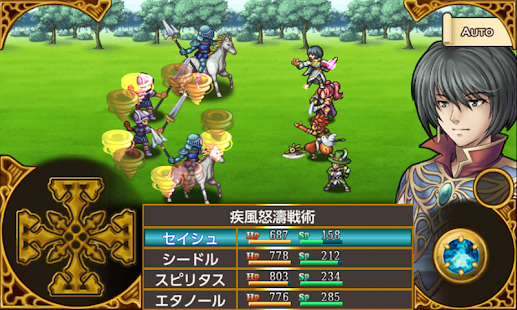
Consider, for a moment, the time-honored gameplay of your typical JRPG.  The “game” is pretty obvious in these: you have characters lined up on one side, and bad guys on the other and you both take turns whacking one another or using items or trying to run. If you lose it’s usually game over, and if you win, you get loot and experience. What characters you choose, how you build them, and what monsters you face, all determine your preferred tactics.

A JRPG fight

This is “the game,” but most JRPGs aren’t just an endless stream of such encounters.  Such a game is possibe! But they tend to be rare.  Instead, they wrap them in a frame: you walk around, you explore, you talk to people, or alternatively it can be beautiful, hand-drawn pictures with dialogue beneath them (like a visual novel) or it can be vivid cut-scenes. The purpose of all of these are to provide narrative context for all of the combat-based gameplay (for example, introducing you to the personality and agenda of the boss you’re about to fight, or the peril of the princess you’re trying to rescue).

A visual novel

These frames can have their own gameplay elements, such as choices you make, or the opportunity to explore which can be rewarded with more combat-oriented gear, or the chance to “romance” on of your companions and get an, um, rewarding cut scene.  These “frame gameplay elements” can become outright mini-games: if they themselves can hold the players’ attention and they also have “builds” and “rewards” that allow the player to explore that specific “game space,” then they begin to rival the “central game” in value to the player.  Taken together, these can make for a pretty complex and rich experience:

So, we might begin with our visual novel frame, have some action, have some additional visual novel exposition, break it up with some minigames and dating sims, go back to exposition, then more combat, then more cut scenes, etc.

How people interact with these will vary, and you run the risk of cluttering your game or drawing attention away from what was meant to be the core of your game.  What if your JRGP combat is boring, but the visual novel compelling, so people grind through the combat so they can see more of the visual novel?  What if they really like the dating sim or the strategy layer, or the card game, and want to focus on playing that all the time?  This isn’t necessarily a problem for a computer game: people can play it how they like.  It does suggest maybe that your core mechanics aren’t very good, or that you’ve built a disjointed, broken-up sort of game that different people experience very differently, with everything but the bit they like getting in the way of their fun.

There’s sort of this conceit that because the core gameplay is the most important, and the core gameplay of JRPGs are traditionally combat-oriented, that combat is necessary or “more prestigious” than the rest, which can only be “frame.”  However, I would argue that if your combat sucks but some other element rocks, maybe you should make a different game.  Visual novels, dating sims, card games, strategy games, breeding games, etc, are all perfectly fine games.  If your “frame” is the most interesting part of your experience, maybe it shouldn’t be “the frame” at all.  Maybe it should the game.

The Frame is the Game? 

Addressing the disconnect

Tabletop games are a bit less forgiving of this sort of thing than single-player games because they’re fundamentally cooperative.  A pretty good example of a game with a divided focus might be Shadowrun, which is primarily about “killing corporate goons and taking their stuff,” but has these magical and hacking “mini-games” that, for some players, are more interesting than the core draw of the game.  In a computer game, they would just play characters that focus on those mini-games, but at the tabletop, their gameplay actively intrudes on other people’s gameplay because it takes time away from people.  One of the core elements that I understood came out of the indie Gameforge scene was the notion that you should know what your core gameplay is about and focus on it, and I highly recommend that.

For many RPG groups, the frame is the game.  This is especially true of overtly broken games.  A hopefully uncontroversial example of a broken game would be the classic Palladium Rifts game, which “has a great setting but terrible mechanics” as people love to say.  This dichotomy is largely born out of the fun people have in the frame.  Like many games from the 90s, it offers some sops towards “frame gameplay,” like non-combat skills, but the bulk of the game and its rules all turn around fighting monster or soldiers or soldier monsters or aliens or whatever.  This part is broken, with classic examples of weird, arbitrary and highly exploitable rules that tend to break suspension of disbelief, wildly unbalanced classes that make creating cohesive challenges difficult, and tedious gameplay that turns into slug matches where two fighters just use the same attacks over and over again until the other person runs out of MDC. 

Why would people like the game? Because of the context of their game.  They loved the imagery of oppressive Chi-Town with dogboys sniffing out psychics and stealing gifted children from wailing mothers while hackers, mystics, mutants and rogue scholars lurk in the underground, waging a resistance against the forces of intolerance and oppression, while exploring a dangerous, wild world of resurgent magic, high weirdness, apocalyptic ruin and uncharacteristically violent, shapeshifted baby dragons.  I played in many games where the core gameplay was dispensed with entirely and, if you will, the game turned entirely into a visual novel.  For these sorts of people, claims that Rifts (or whatever game) isn’t broken, because they had a good experience with the game.  They’re not deluded, they’re not crazy, they’re not fanboys, they’re just interfacing with the game differently, in a way that cuts out the parts they don’t like.

I’m not going to tell you that it’s wrong to play a game this way.  The point of many posts I’ve made in this vein is not that this sort of gameplay is wrong, but to highlight that this difference exists, that the frame is not the game, and that when people like me complain about the game, we’re complaining about the game, not the frame. I’m also trying to encourage you to see the difference and if you’re the sort that prefers the frame to the game, to realize what you’re doing, and once you do, I want you to ask yourself this question:

What is the core gameplay actually doing for me?

Is it okay to run D&D were no combat takes place?  Sure! No gaming police are going to take your books from you, but I have to ask you this: why are you using a game where 90% of the rules are about combat?  Wouldn’t your game be better supported by more closely aligning it to the actual gameplay that you find cropping up at your table?  (The examples below aren’t meant as necessarily to be replacements for D&D in this context, just a few RPGs I know that fit the description.  I’m sure there are better, more precise examples out there).

 By all means, keep D&D at your table if it provides you with value.  For many gamers, while the core mechanics might no longer be interesting, the book’s artwork and setting conceits provide inspiration, and the mechanics provide a sort of shared language that they can all understand (“My character is really strong!” “How strong?” “A 16.” “Oh, so really strong, but not like the strongest ever?” “Yeah.”).  Running D&D this way is a bit like “running Harry Potter” where everyone has access to those books and has sort of system they’ve agreed to, and they’re “playing” the game.  It’s fine and don’t let anyone tell you otherwise.

But there people who sort of lock themselves into a familiar space.  They want to do something fundamentally different than what the RPG they have on hand really does, but it’s all they know, so they sort of ignore the game and run what they’re going to run while “fighting the system.”  Don’t do that, man.  If you’re trying to do something specific, trust me, there’s a game out there for you.

"Who Gives a S**t?" A Meditation on Setting Design

Tons of people are doing settings, but that is kinda hard for me to wrap my head around. I love GURPS content, I love spells, powers, advantages, builds, encounters, adventures, but for me, a setting is kind of a deeply personal thing.
-Benjamin Gauronskas, Let’s GURPS

Yes, that is the second time I’ve used that quote, but I think it’s an important one.  It highlights a truth: Settings often aren’t useful to people precisely because they are so personal.  A GM discussing his favorite, homebrew setting is often about as engrossing for the audience as a player discussing his favorite character.  In part, this is because settings need to be experienced.  What makes Star Wars fun is that you’re there, watching the ships explode and the lightsabers clash.  What doesn’t work is watching a couple of nerds sit around discussing the importance of the Bendu Priests in the founding of the Jedi Order.

The problem here is that we need to be able to connect with a setting, and we’ll only do that if it’s useful to us.  I’ve avoided going deeply into setting with Psi Wars because, for the most part, it won’t be useful to you.  I get it: Most of you who are reading this are doing so to see how I build a campaign, or to rip off some rule idea I have, or because you’re bored and want to read GURPS stuff. The majority of my audience will never run a Psi-Wars game.  That doesn’t mean nobody will, but if I want to my blog posts to be as universally useful as possible, I need to make my posts useful to a broad audience: the casual reader, the inspiration-seeker, the crunch-head, and the psi-wars fan, and thus my posts have so far been generic and very meta.

The same principle must apply, itself, to setting design.  To make our setting interesting, we have to connect with our audience, and to connect with our audience, we must understand their needs, why they might be interested in a setting.  We also need to understand what a setting is. So, before I get into building any setting material, let’s stop to consider the point of a setting, and who our audience is.

Setting: What is it Good For?

Context.  It’s good for Context.
Everyone who’s studied literature knows that all literature have four bits: Character, Plot, Theme and Setting.  Setting is usually an after thought: it’s the stage in which everything else takes place.  It’s “not as important as” characters, who perform the action, plot, the action that happens.  However, I would argue that this misses the point of what setting really does, which is to provide context.  A story about two lovers whose parents disapprove of their love has a very different context in Renaissance Verona than in the Antebellum American South.  
Setting puts us in a specific time and place, and that carries with it all the context that we might associate with that.  If you’re a woman in some fanciful fairy-tale medieval world, you could be a princess, or you might “rebel against conventions” and be a knight, but you could not be a scientist (though perhaps an alchemist!).  The setting determines what you can be, and what that means.  For example, the idea that a female knight “defies conventions” is a setting-assumption, a context provided by the setting. Perhaps all knights are men, and perhaps your female knight gets a lot of guff.  Perhaps some knights feel threatened, other knights are concerned about your well-being, and one particularly handsome knight is besotted with you, but is now thoroughly confused about how to go about dealing with you.  It could just as easily be the other way around, where female knights are common, or that male knights are revolutionary or unheard of.  The setting determines this.  Your character is a knight, but the setting provides context as to what being a female knight means to the world.  Likewise, the setting shapes the plot with context.  Perhaps being a female knight causes trouble for your relationships (“Why can’t you just be a princess, like your sister?”), or perhaps your father’s death creates an inheritance crisis, with some dastardly duke trying to claim it, as he argues that your father has no “male heirs” and you vociferously disagree as an heir to your father’s knightly title.  Again, all of this, from social convention to inheritance law to the idea of titles themselves are setting assumptions.  They provide us with the context we need to make the story work.
Role-playing games thrive on context.  They evolved out of games, first and foremost, so they already had mechanics and gameplay in place before they even became “roleplaying” games.  Most people like to argue that the major innovation was that players now “played the role” of a single piece… but we were already “playing a role” in wargames, usually that of commander of a force for a specific scenario.  For example, if you play as Ryu in Street Fighter, you’re already “playing his role” but you’re not role-playing.
What “role-playing” actually covers is a topic for another time, but one of the things that mattered in the switch from wargame and boardgame to role-playing game was a deeper emphasis on context.  You’re not just “playing a knight,” you’re worried about what being a knight means, in this world, in this setting.  And to really explore that, we need to know what being a knight means in this world, which means we need to define our setting.
Psi-Wars has Space Knights that use the force sword and psionic powers.  How does one become a space knight?  How do various factions feel about them?  Why doesn’t anyone else use force swords and psionic powers?  Space Knights seem well studied in philosophy… but which philosophy?  What underlying assumptions does it have?
Psi-Wars actually already has a lot of this context (We have a galactic core, which is civilized and powerful, and a rim which is barbaric and poor; we have Communion, with all its underlying assumptions; we have an Empire and an Alliance and criminals and law enforcement and alien warriors and giant robot armies).  The point of going deeper is to provide even more context.  That context provides inspiration to GMs trying to create plots of players trying to create characters.  Context provides inspiration for actions to undertake, or challenges that might afflict the PCs.  It helps to explain why the factions fight, and to outline the troubles we’ll have in bringing peace to the galaxy.  It even explains why we might want to bring peace to the galaxy.
As we move forward, we need to remember that, more than anything else, we need to provide useful context to our players (or to GMs who might want to use our material).
But what’s useful context?

Those Who Give a S**t: Your target Audience

What is useful depends on who  you ask.
The easiest way to know what people want is to simply ask them.  Hey, reader, what do you want out of a setting?  Well, there are more than a hundred of you, typically, more than 500 sometimes.  If you all responded, that would give me quite a lot to sift through.
An easier way, one used by most companies, is to do some research and then to come up with an archtypal imagining of their target audience, and then design the game towards those specific people.  With that in mind, let me offer you four players and how they might approach your setting.

Brent, the Jock

This is Brent.  Brent is only in your game because he’s your bud, and he likes hanging out with you guys, but he’d honestly be as happy bowling, or watching sports, or playing video games.  He’s mostly here to be social (A “cheetoist” as the kids call them).  He has no interest in doing any “homework.” He doesn’t really want to make a character or read through the rules.  He mostly just wants to sit down and play, and more than that will make him moan about how RPGs are so much work.  Brent demands to know why he should bother with setting at all.
I’ve made Brent a jock, but he could as easily be someone who works a lot and just doesn’t have time to read, or a girlfriend gamer who’s just there because her boyfriend is, or really anyone who feels that an enormous investment in a non-existent fantasy world is a waste of time.  He represents anyone who has zero interest in reading massive tomes.  He just wants to play.  One might be tempted to say that he’s fairly rare in GURPS circles, but I find the opposite is true.  He might make a character (ideally from templates, or even better if he can talk you into doing it for him), but thereafter he just says what he does and rolls 3d6.  For him, GURPS is actually pretty simple, and he likes it that way.  He doesn’t necessarily mind a detailed setting so long as he’ll experience it rather than need to put a lot of work into learning it.
Brent is important, probably the most important of the four.  If we keep Brent in mind, we’ll remember that all setting material has an investment cost.  One of the reasons Star Wars is such a success is that it has very little investment cost.  There’s an evil empire, and you know it’s evil because it looks evil, and it fights the plucky, heroic rebellion, which you know is plucky and heroic because it looks plucky and heroic.  You don’t need to read a million comics or watch a bunch of TV shows and read up on wikipedia to follow the movies.  For him, if Psi-Wars suddenly becomes this huge study of complicated politics, he’ll tune out.  If Brent was one of my readers, he mostly spends his time on the Primer, looking at characters, getting the gist from others, and waiting for an actual game to emerge.
Brent demands that our settings be minimalistic, and easy to get into.  He demands justification for each detail we add to our setting.

Willow, the Nerd

This is Willow.  Willow is a huge nerd, and she games because she loves games.  She’s a huge Star Wars fan, belongs to the fan-fiction community, is a wiki-contributor, and has a collection of Star Wars figurines at home (“Rey is the best Jedi!” though she’s also partial to Aayla Secura, but she won’t admit it).  She’s also deeply invested in GURPS and has perhaps run a few games of her own, as well as owning all the supplements (and complains about a lack of THS fiction line), and she hates games where “things don’t make sense.” She’s studied history, theology, linguistics, economics, etc, and is quick to point out inaccuracies she finds in any setting she plays in.  But she’ll also read everything you write.  If you write well, she’ll get terribly excited and want to add to it.  If you write poorly, if she has no sense of the setting, she’ll lose interest or grow disenchanted.  Ultimately, she wants to go to your setting (She is a “simulationist”, as the kids say these days).
I think we all know a Willow.  In a sense, role-players are Willow: We’re creating our own worlds and our stories and exploring them.  Willow is very strongly represented in the GURPS community, as GURPS excels at the sort of lavishly detailed settings Willow really enjoys.  She’s also naturally drawn to more detailed settings (so naturally she’s more a fan of the Expanded Universe) because it allows her to invest deeply.
Sometimes people want to invest deeply.  Perhaps they’re bored, or perhaps their life sucks and they want to escape for a little while.  Good setting material is often entertaining for its own sake.  But for it to work, it has to be internally consistent.  It needs to hang together well.  She stands in opposition to Brent, because to Willow, setting is its own justification.  If Psi-Wars becomes too simple, she’ll tune out.  If she’s one of my readers, she got terribly excited when I wrote Communion stuff, and has been somewhat lukewarm for the rest of the time (unless she likes meta stuff, then she’s happy).
I think we pay too much attention to Willow when we design settings, because she gives us the most feedback, thus Willow-centric settings tend to be overrepresented.  If you move too far towards Willow, your richly complex setting becomes very difficult for new people to enter.  Nonetheless, she does exist, and she matters.  We need to make her happy too.
Willow demands that our settings be entertaining and internally consistent.  She wants something worthy of exploration.

Desirée, the Romantic

This is Desirée.  She’s been roleplaying for years (her favorite game is Vampire: the Masquerade, but she’s been moving towards 7th Sea and Fate lately).  She loves to LARP (especially “Nordic” LARP).  She likes romantic stories, and when she discusses your games, she always discusses the people in them like they were real.  Her characters all have extensive backstories, usually with multiple relationships buried in there.  She’s disappointed if there’s not some exploration of relationship somewhere in the game (Romance, yes, but also familial or friendship, or duty to another; ideally, some fantastic intersection of all of the above).  She has little time for mechanics, but claims she just plays for the story. (She is a “dramatist” or “narrativist”, as the kids say these days).
Desirée doesn’t have to be girlish.  She’s any player who role-plays to see how the story unfolds, rather than to “game the game.”  They want to participate in that story and find out what happens next.
Desirée cares deeply about the setting, but only to a point.  Economics bore her to tears.  She has no time for discussions of military technology.  She doesn’t want to hear about yet another martial arts school.  What matters to her is what the setting does for her character’s story.  She’ll want to know about Psi-Wars aristocracy (“Do they have houses?  How do those houses feel about each other?”), or social conventions (“Do they dance?  What does a boy give a girl if he really likes her?  Do they drink wine?  What could my character do that would utterly scandalize her father?”)  Slavery might interest her, as it’s dreadfully tragic, or criminal organizations, either as a source of rebellion or someone to rail against.  She wants to know what the setting means for her personal narrative, what social and contextual options it gives her personally.  The big picture isn’t as important as what she can do with her little piece of the setting.
Desirée demands that our settings be focused on creating interest narrative choices for the players and providing a social context for their characters.

Bjorn, the Warrior

This is Bjorn.  He’s also been roleplaying for years (Cut his teeth on D&D.  Loved the Rifts setting but hated the system.  Thinks the Street Fighter RPG was underrated.  Would really like to get his hands on Legends of the Wulin, and owns all three editions of Exalted).  He’s already got his character all written up, and his character is badass.  He’s found a loophole to exploit to make his character invincible, but he’ll be deeply disappointed if you don’t find a way to get around it.  When you mentioned Psi-Wars, he instantly asked about lightsabers, Jedi powers, and wanted to know more about the Rightous Crusader, Rebellious Beast and Death (“Hmm, or maybe the Other would be better.  What kind of templates can I change into if I take that?”).  If he’s reading Psi-Wars, his favorite bits were the weapons and armor posts, and all the martial arts.  He tunes out whenever Desirée discusses philosophy or her latest romantic tragedy, but sits upright whenever there’s a fight.  He’ll explain that he’s not here for the story, but for the mechanics (He’s a “gamist” as the kids like to say these days)
People love to hate Bjorn, but the truth is a lot of us got our start playing as Bjorn.  He’s one reason GURPS DF is a big hit (and Brent loves playing DF with him).  Cool powers and interesting gameplay draw us in, and they’re as much a part of a role-playing game as Desirée’s deep interest in roleplaying.
Bjorn also cares about your setting, but only to a point.  He has no interest in social dynamics or politics or legal matters.  He wants to hear about military technology, cool martial arts styles;  He decides what philosophy to adhere to not based on his personal beliefs but what powers they give him access to, and what strategies they encourage.  He plays the game to win, and he’s looking at the setting like a game board to navigate.  For him, the setting matters mainly in what mechanical context it offers.  For him, it’s about navigating the various philosophies and factions to get at the best mechanical bits (and for many such players, this isn’t just a hassle, but part of the fun of the game, as pursuing the coolest powers often has the most interesting narrative demands)
Bjorn demands that our setting be focused on creating interesting mechanical choices for players and providing a context for their struggles.

Pleasing Everyone All Of The Time

Upon reading the above archetypes, one might be tempted to put oneself in one category or the other, but I suggest against doing this.  You are not a Willow or a Bjorn.  Rather, at different times and in different ways, you are all of them.  All people have a tendency to initially resist investing in something new, but if we’re going to invest, we want to invest in something high quality and intriguing.  Role-players, by and large, both want to play a role, but also want to play a game.  We want to know what a setting means for our personal, narrative choices and for our tactical choices.  The above archetypes do not represent people but impulses with all of us, extreme ends of particular spectra that we’re all speckled across.
Fortunately, these requirements aren’t mutually incompatible.  It’s possible to make a setting that requires a low investment to jump into, but rewards deep investment (Star Wars is just such a setting), and setting elements can both contain interesting narrative choices while also guiding mechanical strategies.  We don’t need to pick and choose which players to please.  Rather, we should try to keep their demands in mind with each step of our setting design:
  • Brent demands that our setting have a low investment and wants a justification for each setting element (Elegance)
  • Willow demands an internally consistent and entertaining setting, and she wants the setting to reward deep exploration (Depth).
  • Desirée demands context for her interesting narrative choices (Drama).
  • Bjorn demands context for his interesting mechanical choices (Action-Packed).
By answering these four demands, we ensure that our setting is not more bloated than it needs to be, but that it still has plenty that people can (optionally) explore, and that these setting elements both drive narrative development and player tactics.  The result should be a very solid setting, if we can stick with the ideal.  Of course, nothing ever reaches its ideal, but ideals are like stars: You don’t need to reach them, you just need to use them to guide you to your final destination.

The Illusion of Mechanics

According to some, this is good art

According to some, this is not good art

I’ve seen a couple of posts that touch on a topic very near and dear to me when it comes to game design, not because I agree or disagree, but more that they enter into that arena and invite discussion on the topic.  The first is Creighton Broadhurst’s Why Character Optimization Is Pointless (Unless You Enjoy It) and Christopher R. Rice’s Building Player Characters To Concept.  The theme they touch on is the illusion of mechanics.  At their core, they say “Mechanics don’t matter” Or, at least, these mechanics don’t matter, but maybe those do.  And they also point out that this is a matter of taste.  As you’ll see soon, I don’t disagree with their premise.  This is not a rebuttal of their posts, but a comment on some larger implications, and what their perspectives on game design can do to inform your own perspective, even if you disagree with them.

A Meditation on Gameplay

I’ll get into this a lot, over and over again, because it’s one of my favorite topics.  Raph Koster’s A Theory of Fun essentially boils it down to this, if I may paraphrase my reading of the book: Gameplay is a series of interesting choices that have emergent properties, so that each choice leads to a new set of interesting choices.  “Fun” is the exploration of said emergent properties and learning how to master them.  Raph Koster believes that humans fundamentally enjoy learning, and that fun boils down to the charge we get out of it.  Games and play has always been a learning experience, whether it’s cats learning to hunt by playing with one another, or children learning about good teamwork and the importance of hard work on the field of sports.
Consider the typical D&D combat scenario.  You’re playing a fighter.  Three orcs have managed to pin down your mage 3 squares away, your rogue is temporarily unconscious, your cleric is trying to revive him, and the Orc Shaman stands 5 squares away, chanting a spell that boosts all the orcs a great deal.  What should you do?  Should you move to attack the Orc Shaman, hoping to distract or defeat him, or perhaps even draw the rest of the orcs to you?  Do you move to attack the three orcs pinning your mage?  Do you retreat to your cleric and thief to stand watch over them?  And how do you position yourself precisely?  What abilities do you use?  Is it worth it right not to burn a daily that tags all the orcs in the area and forces them to draw their attention to you? What’s the mage got up his sleeve?  You have a series of interesting choices, from who to attack, with what ability/weapon, and where you position yourself, and each choice has consequences that will lead to new choices, some good or bad, and we’re trying to make our choice by trying to model what will happen next.  Our mastery of the game comes from how well we can model what will happen next.  A bad game has no meaningful choices (“Well, all fighters have an ‘I win’ button, so I just push that and the fight is over. There’s really no meaningful choice here”) or no meaningful emergence, while a good game has both of those things (and that’s your real definition of “game balance,” but that’s a topic for another time).
This model definitely applies to more than just interactive game play, though.  I feel that narrative follows a similar vein, though usually less interactive.  Most authors will discuss tension and exploring themes.  I argue that they’re discussing similar concepts to choices and emergence.  The author poses questions to us that we can think about ourselves.  The characters may make their own choices that we have no control over, but we do have control of how we personally would answer those questions.  Then, the author answers the question by having the character make a choice, and then exploring the resulting events.
For example, we could have a princess faced with a choice between a prince she does not love, and a heroic peasant hero that she does.  With this choice, we pose the question of whether it is better to choose a relationship that is practical and/or fulfills obligations, or for one that fulfills passion and ideal.  We could have the princess choose for the heroic peasant hero, and then unspool a story where the kingdom thereafter falls apart because of the anger caused by her choice, with the spurned kingdom’s father either waging war on the princess’s kingdom, or refusing to come to their aid when a great evil attacks: the consequences of failing to fulfill obligation.  But, we can contrast this with how faithful the passionate hero is, and how his passion and ambition drives him to great heights, meaning that he can act to help the princess when necessary: the consequence of choosing passion means that you are doing what you love, which makes difficult tasks much easier!
Roleplaying games definitely explore both of these forms of gameplay.  When people argue fluff vs crunch, to me it sounds like they are arguing about whether they prefer the former gameplay or the latter.  I personally feel that an RPG enjoys its greatest success as a medium when it successfully tackles both and explores the tension created by both (say, the princess is a D&D sorceress for whom passion also acts as something that powers her spells, the peasant hero is a rogue who violates social norms/obligations routinely, and the prince of another kingdom is a paladin who is driven by obligation.)  Together, they can tackle problems from both a narrative and mechanical perspective, with the consequences of their choices in the story driving the GM’s choice of combat scenario, while the results of their combat scenarios drives the story.

The Point of Mechanics

Both Mr. Rice and Mr. Broadhurst have noticed that narrative can drive gameplay as much as mechanics, and are choosing for narrative over mechanics, though they’re doing it in different ways.  For Mr. Broadhurst, he argues that the choices you make in character creation won’t actually “let you win” and don’t matter for the larger scheme of the story.  The GM will simply increase or decrease the challenge as necessary.  Mr. Rice, for his part, has placed a character concept, a narrative conceit, above points, a mechanic conceit, in importance.
Allow me to play devil’s advocate and pick apart their points (though allow me to note that neither is wrong, a key point that I will return to shortly),  In both cases, they note that something is not strictly necessary.  However, I would argue that nothing in a game is necessary.  That’s the nature of gameplay.  We use rules not because we must, but because we can. Rules are fun.  The constraints and consequences of rules and choices should work to create the emergence and choices I discuss above.  The question is not whether or not a rule is necessary, but whether or not we want to play that way.

The Point of Character Optimization

Mr. Broadhurst notes the “arms race” of character optimization.  Say that Alice, Bob and Charles are playing a game with Mr. Broadhurst.  Alice, cunning as she is, works out a wizard who is far more powerful than Bob’s Rogue or Charles’s fighter.  That means that Mr. Broadhurst needs to increase the challenge, which means that Bob and Charles need to optimize as well, so you get into a pointless arms race.  Ultimately, Alice ends up “no better” than Bob or Charles, and she does not “win” the scenario.
But I would point out that if gameplay is all about mastering the emergent properties of our choices, then what Alice is doing and encouraging itself looks like gameplay.  She has learned how the game works and has correctly modeled it.  She has displayed her mastery of the character creation rules, and thus has a superior character.  By seeing what she has done, the rest understand something new about the game and adapt.  Some may complain (“Mages are overpowered” says Bob, who starts to cross-class as a Rogue/Mage), while others might grasp important concepts (“This is really about controlling the battlefield, and my fighter can do that in a way that’s different from Alice, that’s kind of neat!” says Charles).  The GM might point out flaws in their model (“Wait, you mean these monsters are immune to magic?  Hmmm…”) and the learning process can go on as the game evolves from the choices the players made.
Character optimization is gameplay.  The arms race is a feature of gameplay.  Of course, Mr. Broadhurst doesn’t contend this point.  He specifically notes that if you like it, that’s fine.  He merely feels that it’s less interesting to him and his players than other forms of gameplay.

The Point of Points

Christopher Rice makes a similar point: You don’t need character points.  What you need is a concept, and the concept should be king.
But why do we have points?  Do people who use points not also have concepts?  Of course they do! I’m playing in one of Chris’s games (Aeon-D), and my concept loosely boils down to “Brick” and I have about 250-300 points to make this.  Can you make a brick on that point total?  Of course you can.  I had originally wanted a variety of other traits, like some medical skills, but it quickly proved impractical and it wasn’t that important, so given a choice between these traits and others, I chose the other, brickier traits. Whereupon I was told to stop worrying about it and to make the character “to my concept.” I don’t know what the final point value will be, but I can tell you it will be far north of 250 points.
Point-based systems like GURPS give us interesting choices between a variety of advantages, skills and ways of modeling our character on a particular budget.  It also offers us disadvantages that we can accept if we’d like to make a choice of being even weaker than average in an area in exchange for being stronger than average on an area.  Because these traits interact in interesting ways, the very act of character creation becomes an exploration of a series of interesting choices and their emergent properties; GURPS character creation is gameplay.
By removing the conceit of point totals, Chris is removing that gameplay.  Why would he do that? Like Mr. Broadhurst, Christopher enjoys other gameplay more.  I cannot speak for him, of course, but I could guess as to why someone might feel that way.  They might feel that the point totals don’t actually create interesting gameplay (“Supers are better balanced by focusing on limits other than points”), or that they’d rather focus on gameplay that isn’t tied to PC power level (“I want to see what happens when you have Thor on the same team as Hawkeye!  Can we make that interesting or must it necessarily devolve into Angel Summoner and BMX Bandit?  How can we make it interesting?”)

A Matter of Opinion

At the beginning of this post, I include a picture of a minimalist Star Wars posters by Andy Helms and contrast it with the Sistine Chapel, noting that some people prefer the former to the latter.  This is not intended as a tongue-in-cheek condemnation of philistines who prefer the former to the latter, but an important observation: Art is subjective.  But what Andy and Michelangelo both did are conscious choices. Michelangelo is showing off all the supreme artistic skill he has acquired, while Andy Helms is making a point about how much beauty you can create with a minimum amount of lines or design.  They both demonstrate important artistic principles, but in different ways.
Who is right? That’s a matter of opinion.  In fact, given how subjective it is, I think it would be inappropriate to say that one is right and the other is wrong.  In fact, I would argue that you have a lot to learn from both.  What matters most is they knew what they wanted and went after it.
Game design is not science, but art.  When you create a game, you are creating gameplay, which means you need to pick out your preferred series of interesting choices and emergent properties.  Someone who favors a more narrative sort of gameplay is not better or more mature than someone who picks out a more mechanical sort of gameplay, but it’s important to make conscious choices of how you want your game to work.  Your game cannot be everything to everyone, and attempting to do so will ruin your game.  By focusing on the elements that you want, you can bring your players attention to that which matters.  In a way, what the two articles are doing is more like what Andy Helms is doing: Removing elements from gameplay to get a more focused game. That’s good!  But that doesn’t mean that games that don’t adhere to their suggestions are necessarily bad, anymore than Michelangelo is a “bad artist.”
(As a player, we should be willing to accept this, and to try new things, which I believe is Chris’ point  when he says his approach required “maturity.” I believe he’s not arguing that someone who prefers people stick to agreed point totals is somehow less mature than someone who comes up with concepts but can’t be bothered to stick to an agreed point total.  If I enforced strict point budgets in a game and Chris were to play in it, I doubt he would say “Point totals?  How immature!” And, in fact, if someone were to say that, he’s probably call them immature, because I believe his point is not “Point totals are stupid and immature” but “An unwillingness to try new things is immature”, and if that is his point, we are in total agreement).
Thus, the whole point of this post is not that Mr. Broadhurst or Mr. Rice are wrong, but that they are right to make conscious choices that benefit their game, and that I encourage you to be conscious of the choices you make.  They both re-examine sacred cows and correctly note that they are not necessary, but that does not mean that they are not fun.  They have just chosen to focus on other, equally unnecessary things that are also fun,  When you design your gameplay, I encourage you to do the same: think about what you’re trying to do, understand that rules are there to help you create gameplay, and make them the tools you use to create that gameplay, rather than constraints that must be followed to please the Gaming Gods.

Psionics and the Psi-Wars Framework

I’ve largely already addressed psionics in an Action framework in each individual post.  We can largely see where they fit into the above.  For example:
  • Violence (Psychokinesis and Ergokinesis)
  • Stealth (Telepathy and Psychokinesis)
  • Superior information and/or planning (ESP)
  • Social manipulation (Telepathy)
  • Mobility (Psychokinesis)
  • Technological Superiority (Ergokinesis)
Mobility suffers a bit, but that’s because I want ships front and center to gameplay.

Beyond that, I’m largely not concerned about how well Psionic Powers will work because I believe that PK did his homework. PK is one of the shining examples of an author who understands frameworks, as can be attested by his work on the Monster Hunter and After the End series, thus I fully expect that not only will they work well with the Action framework based on the adjustments I’ve made, but they’ll work well with one another.

That said, if a psionic, rather than classic, approach is going to work, it needs to provide reasonable power for a reasonable cost when compared to the skills and technology available to the average character: it needs to be a viable strategy.  For the most part, the psionics I’ve chosen offer the ability to do something that technology cannot, with a few exceptions (lightning blasts aren’t really any better than blaster bolts).
My largest concern has been the considerable point-cost associated with Psionics.  A character can become pretty good at, say, information gathering with ~20 points worth of the right skills and the right technology.  An ESPer needs to spend considerably more than that to make his gift work, but his gift can offer much more than those 20 points.  To further off-set costs, I have introduced God-Like Extra-Effort.

God-Like Extra-Effort and Psi-Wars

So what are the implications of God-Like Extra-Effort?  My intent was to lower the required buy-in cost of psionics while still rewarding deep investment.  That is, players should have a reason to spend 200 points in psionic powers, but feel they got their points worth.  
The standard extra-effort rules, power-begets-power, tends to punish having low power-levels.  Going from TK-Grab 1 to TK-Grab 2 (+1 level) requires a staggering will roll of -10!  Psionic Campaigns introduces a rule where each +1 level is only -4, so in that case +1 TK Grab is only -4, but going from TK-Grab 20 to 21 is also -4, while in the standard system, “power begets power,” Going from TK-Grab 20 to 22 is Will -1.  I chose to go with power-begets-power because it rewards deep investment and creates a sort of exponential increase in power typical of the genre.
However, to off-set the extreme costs of high-level upgrades, I chose to use Godlike Extra Effort.  The same character who wants to increase his TK-Grab from 1 to 2 (or from 20 to 40) could make a Will-5 roll and spend 4 fatigue, or Will -4 and spend 6 fatigue, or will-2 and spend 10 fatigue.  Or, if he can make a Will-10 roll and spend 20 fatigue, then he’s gone from TK-Grab 1 to TK-Grab 10 (or from 20 to 200!).
This suits the sudden and intense power-increases often seen in the genre of Star Wars, but does it fit the framework of Action and Psi-Wars?

God-Like Extra Effort and Closed Powers

Most psionic powers fit into one of two models.  A closed power has a cap on its level.  An example of a closed power is Telerecieve, which caps out at level 6 (for unlimited range).  We tend to avoid any craziness with closed powers because they have maximum limits.  Mostly, in this case, God-Like Extra Effort just saves us some points, which is what we want.
Telerecieve has a buy-in cost of 21 points.  That lets you read someone’s thoughts if you touch their skin with yours (so a kiss, or holding hands).  Raising it to level 3 will allow you to read someone’s mind if they’re close-by, which is typical of Star Wars.  This costs either 42 points (double our original cost) or requires 2 fatigue and an extra-effort roll at Will-10.  Alternatively, if we assume a character has Will 18 and can reasonably apply a -5, then increasing to level 3 costs him 4 fatigue.  Increasing to level 6 costs 10 fatigue, if we follow the same route.

If we already have Telerecieve 5 (buy-in cost of 60 points), increasing it to level 6 costs us 1 fatigue and a Will-2 extra effort roll.

The net result is that a character with a low buy-in cost operates something like a magician: With some fatigue, he can do nearly anything, but with no fatigue, he can do something, but it requires highly specific tricks to make it work.  High-power characters can reach even higher power level with casual ease, making the higher point cost a little more worth it, but because there’s a cap on how high you can go, you won’t see ridiculous results.  I think you’ll also find that players won’t bother to buy their power levels too high.  After all, Telerecieve already does most of what they want, and it’ll do everything they could possibly want with a roll of Will-5 and 2 fatigue, so why buy level 4 or 5?  That helps keep the point costs low, and that works alright.

One exception should be noted for abilities with soft-caps, like Suggestion.  What happens when someone tries to push for Suggestion 5, despite it being banned?  A banned power is banned.  If someone wants to reach it, they need to get GM permission, usually via an unusual background (or a perk).

God-Like Extra Effort and Open Powers

Open Powers are powers with an undefined level cap.  In Psi-Wars, these are:
  • Psionic Shield (Page 24) (Increased Penalty)
  • Psychic Armor (page 25) (DR)
  • Dampen (page 33) (Radius)
  • EK Shield (page 33) (DR)
  • Lightning (page 12) (Damage)
  • Radar Sense (page 34) (Range)
  • Surge (page 34) (Damage)
  • Combat Sense (page 37) (Bonus)
  • Awareness (page 39) (Range)
  • Clairaudience (page 40) (Range)
  • Clairvoyance (page 40) (Range)
  • Cure (Page 46) (Reduced fatigue cost)
  • Life Extension (Page 48) (Increased effect)
  • Steal Life (Page 52) (Increased HP/FP drain)
  • TK-Crush (Page 54) (Damage)
  • TK-Grab (Page 54) (ST)
  • TK-Push (Unique) (Knockback)
  • Super-Jump (Page 57) (Increased distance)
  • Aspect (Page 61) (Increased Charisma)
  • Instill Fear (Page 64) (Increased Range)
  • Mind Clouding (Page 66) (Increased Penalty)
  • Mind Shield (Page 66) (Increased penalty)
These powers tend to benefit from having more than one level.  A character with TK-Grab of 1 is nearly useless.  Psionic Shield 1 or EK Shield 1 or Aspect 1 are also similarly unimpressive.  Most of them have a sweet-spot where players will tend to congregate.  For example, one wants enough TK-Grab to at least pick up most items, such as guns or data readers, and then beyond that, perhaps ST 10, and so on.
God-Like Extra-Effort can allow characters to reach reasonable levels just as it allowed characters to do decent things with closed powers.  The problem arises when players go nuts, especially when you add in the potentially unlimited power that a character can gain from Communion.
For example, Psychic Nova grants a character 24 fatigue for a single use of a psychic power.  Assuming he has 10 fatigue of his own that he’s willing to spend, that gives him a total of 34 fatigue, which is up to x17 on a single extra-effort roll.  If we make our usual -5 roll, that’s about 9 times the usual power level.
What could 9 times do?
  • A character with Psionic Shield 5 goes to Psionic Shield 45, making him utterly impossible to read for the next minute
  • Psychic Armor 5 goes from a DR of 5 to a DR of 45, making him effectively immune to most psionic attacks
  • A character with Dampen 5 goes from a 5 yard radius to a 45 yard radius, or an area of around 57,000 square feet, or a major building or a city block.
  • EK Shield 5 goes from DR 5 to 45, which is almost proper armor against blaster fire.
  • Lightning 3 goes from 3 dice (36 points) to 27.  That deals ~95, which actually isn’t enough to penetrate a heavy hardsuit!
  • Surge 3 goes from 3 dice to 27, which will short-out a machine of up to ~300 HP regardless of its DR
  • Combat Sense 2 (already very expensive) jumps to 18, making a character virtually untouchable for one roll.
  • Awareness 5 increases to 45 for a spectacular 2000 AU
  • Clairaudience (page 40) 5 increases 45 for a spectacular 2000 AU
  • Clairvoyance (page 40) 5 increases 45 for a spectacular 2000 AU
  • Cure (Page 46) Level 4 increases to level 36, for -36 fatigue cost (which cost us 24 fatigue?)
  • Life Extension (Page 48) Soft-Capped at level 1
  • Steal Life (Page 52) Level 5 improves to level 45, from stealing 5 HP to stealing 45 HP.
  • TK-Crush (Page 54) Level 5 improves to level 45, from inflicting 5 damage to 45 damage.
  • TK-Grab (Page 54) Level 5 improves to level 45, from a basic lift of 5 to 405
  • TK-Push (Unique) Level 20 improves to level 180 from three yards of knockback to on a small person to 25 yards of knockback.
  • Super-Jump (Page 57) from level 2 to level 18, or an average long-jump of 312 miles.
  • Aspect (Page 61) from level 5 to level 45, or +45 to reaction modifiers.
  • Instill Fear (Page 64) from level 5 to level 45, for a spectacular 2000 AU
  • Mind Clouding (Page 66) Improvement beyond level 10 is largely moot.
  • Mind Shield (Page 66) A character with Psionic Shield 5 goes to Psionic Shield 45, making him utterly impossible to read for the next minute
It’s possible for characters to ramp things up even more than this, but difficult. The above assume the character has spend between 25 and 50 points on the specific advantage in question, and then maxes out his possible Extra-Effort roll.  Many of these are actually pretty okay: Improved DR, improved ST and improved Damage are actually largely what you’d expect.  That a character can utterly exert himself and call upon communion to empower himself enough to surge an entire spaceship is something I’m entirely comfortable with.  I’m similarly comfortable with the extreme levels of Dampen.  Using TK Crush to instantly gib someone seems a little less fair… but it involves a contest of Skill vs Will, so some psychic noob can’t just squish a dark psionic lord, because the dark psionic lord has Will 20 and the noob has skill 12.  
Quite a few are pretty impractical.  For example, extreme levels of combat sense are very powerful, but as they apply to a single roll, blowing 30+ points of energy reserves on it seems a waste.  Likewise, Mind Clouding doesn’t really get any better past level 10 (Total invisibility).  Powers based on range become ridiculous and their use is questionable.  If you want to use clairvoyance on someone on Pluto and you’re willing to spend 30+ energy reserves on it, sure, okay.
Some seem to create nonsensical results, mostly those that deal with fatigue in the first place, and this creates questionable results even with normal extra-effort.  These are Cure and Steal Life.  I’d simply say that extra-effort is impossible with Cure, as Cure is exclusively about reducing fatigue costs.  Spending fatigue to save fatigue is nonsense.  Steal Life is a little less certain.  Boosting it so that you can steal 45 HP from someone is on par with inflicting 45 damage.  That’s completely fair.  Stealing that much life is, also, perfectly acceptable. It gets weird, though, if you spend 30 energy to regain 45 fatigue.  I think I’d say that you can’t regain any fatigue if you’ve used extra-effort.
Finally, some of the powers just don’t make sense at extreme levels, and this applies to even buying them at extreme levels.  You could purchase Aspect 15 for 60 points, and +15 to reaction modifiers is as game-breaking as if you got it from extra-effort. Super-Jump also gets silly if you dump 100 points into it, so that you can jump 32x your normal distances. The question becomes: How many levels do you find acceptable?  Pick that value, and soft-cap it at that (people might buy more with perks).  
For Aspect, I’m inclined to go with 8 levels, as talent caps at 4 levels, most people don’t allow a Charisma higher than +4, and +8 represents the reaction bonus gained from transcendent appearance.  This reflects a sort of transcendent charisma.  Super-Jump is another judgment call.  Supers certain have characters who can leap from one side of the continent to another.  Do we want space-knights to do that?  I think at that point, we’re better off flying.  Wookiepedia notes a distance of “up to 8x” which seems a perfectly fine number for our purposes.  That gives us a typical high jump of around 4 yards, which seems plenty of distance (The Flying Leap skill only triples distances, so 8x seems more than far enough: A flying jumper’s flying jump).  Thus, I suggest we cap Super-Jump at level 3.

Niche and Psionic Power-Level

Having established that Psionics aren’t necessarily game-breaking in their own venue, and they’ll interact well with the Action framework of Psi-Wars, how well will they interact with non-psionic characters?  Will they steal their limelight and become the new standard?  Why have a spy when you have a telepath?  Why have a scavenger while you have an electrokinetic.
I’ve largely already explored these in each individual power-discussion, and for the most part, these powers have a synergy with skills and technology, rather than replacing them outright.  That said, the telepath niche could replace the spy.  If we add in the power possible with God-Like Extra-Effort, is it possible that a psion could be better at that niche than their competition, point for point?
Yes, I think so. In fact, I hope so.
Psionics has a -10% modifier which should make their powers cheaper than “wild” abilities.  A psion should have a cheaper danger sense than a non-psion, for example.  The compensation for this is the presence of psionic countermeasures, such as technological countermeasures, skills/disciplines that can defeat psionic powers, and the presence of anti-psi characters.
This last is vital, as it should create a dynamic: A 250-point psionic widget-master should be superior to a 250-point mundane widget-master, but a 250-point anti-psi should defeat the psionic widget-master, but be defeated in turn by the mundane widget-master.
However, I don’t expect that psions are so powerful that anti-psi is the only way to defeat them.  Psionic powers tend to expensive.  The absurd God-Like Extra-Effort I noted above required ~50 points of advantage plus a once-a-day effort, and additional points invested in things like Communion and additional Energy Reserves, etc.
The larger fear, one legitimately worth some playtesting, is not that psions will be too powerful, but that they’ll be too weak, especially at “low” point levels.  How many points does it take to gain the sort of synergy between energy reserves, psionic power levels, Communion levels, and appropriate skills/techniques to really start to shine?  300 points strikes me as low, and I suspect 400-500 would be closer to the mark.  Much more than that, though, and the balance might start to tip heavily towards the Psion, as power-begets-power tends to benefit those with hundreds of points worth of psionic powers.

The solution might well be to start at 300 points, and then be generous with points.  At high point levels, psions will tend to invest in their powers, but mundane heroes will invest more heavily in wealth, connections and deep skills.

A Comment on Star Wars and Psionic Powers

Good. Good…The Force is strong with you. A powerful Sith, you will become. Henceforth, you shall be known as Darth…Vader. 

-Chancellor Palpatine, Revenge of the Sith

One element I notice when I tinker around in the expanded universe, especially in games, is that characters often talk about how extraordinarily powerful a character is in the Force, and that power is usually expressed in psychokinetic force. A character might thrust out his hands and knock back a dozen people, and bystanders will be awed by their power in the force.  Alternatively, the reason why a character is seen as “powerful in the force” is not really described.  Perhaps people just sense his power, nebulously.  Both of these likely come about because showing that someone is telepathically powerful, or precognitively powerful, is difficult to show in a cinematic manner.

An RPG is different.  If a character has 300 points dumped into ESP powers, he’s definitely “very strong,” but not in a way that’s visually easy to describe.  The character isn’t flinging people around or shooting lightning out of his fingers. Instead, he’s seeing through walls, seeing the future, and detecting psionic activity at a huge distance.  Because an RPG puts numbers on everything, players can better grasp more abstract forms of power.

Inevitably, this difference means that many characters won’t follow cinematic elements, especially since Psi-Wars isn’t Star Wars.  A player who wants to play a cinematically powerful Star Wars character might invest deeply into psychokinesis.  But someone who wants to be effective in combat might invest in something else.  ESP, for example, allows one to fight in situations where one cannot see, to precognitively defend themselves, to improve their defenses even further, and to sense danger.  That makes for a highly effective combatant!  In fact, Telepathy and ESP are generally superior to Psychokinesis for most situations Psi-Wars characters will find themselves in.

The result is that Psi-Wars will feel different than Star Wars.  Don’t expect a great deal of psychokinetic combat action!  I would expect gameplay that more closely resembles Push or Dune, where characters use ESP to try to outread one another, where characters use their mind control abilities to enact intricate plots, and even psychokinesis is used in a more subtle fashion. I say this not to outline a design intent but to warn you, dear reader, about an emergence that’s coming out of the choices I’ve made.  I know a lot of people smile and nod when I say that Psi-Wars isn’t Star Wars, but it isn’t.  It’s inspired by Star Wars, but the end result will definitely be different, and this is one particular example.

Evaluating the new Power Framework

Cool ideas bro, but does it work?

Many RPGs that I enjoyed in my youth, I came to notice over time, are plagued by what I liked to call the “Cool Idea! Syndrome.”  The writer needed to fill out a book full of cool powers, and they needed to inspire their audience, so they wrote neat ideas into their books.  What they didn’t do was write a working system into their game.  It was enough that they had neat ideas, and they seemed to have stopped there.  The result were that some cool powers completely changed the game, or even wrecked it, while others seemed to do nothing at all.  We’d have arguments at the table, and the games would shortly end up shelved while we turned to more robust games (like GURPS!).

A good system is cohesive and builds interesting gameplay.  Players respond to incentives and they’ll see that there’s an inherent goal in your gameplay (Psi-Wars, imitating GURPS Action, has the goal of “Accomplish the mission”), and a variety of ways to get there (Stealth, direct combat, good social interaction), as well as a variety of possible stumbling blocks/challenges that could stop you from getting there if you can’t beat them (while, ideally, keeping even failing gameplay interesting).  It does this by providing a clear ruleset that creates interesting interactions.  Raph Koster argues (if I may attempt to paraphrase an entire book) that “fun” in a game essentially boils down to experiencing unexpected emergence coming out of this clear-and-simple ruleset, and the feedback loop of learning to master that ruleset and its emergent behavior.

A good system should provide you with those things.  I could write an entire series on building gameplay (and someday I will), but you can already get a pretty good idea of what it looks like by reading Dungeon Fantastic or David Sirlin‘s game design articles or Raph Koster’s Theory of Fun, etc.  Dungeon Fantastic touches on what I’m sort of talking about in this post on “plugging holes”.

“Plugging Holes” examines some of the underlying implications of the framework created by the DF rules and how to deal with them regarding a particular goal (survival, in this case).  For example, a character needs to survive being attacked by a goblin with a spear, but he also needs to deal with death curses from a lich.  These require substantially different things, so different that players are often better off specializing in their particular niche and protecting one another.

But those niches aren’t inherent to GURPS.  Kromm put them there, deliberately, with his design of Dungeon Fantasy, which Peter is exploring in his Dungeon Fantastic articles.  One reason people love “Kewl Powerz” is not just because it lets them be awesome, but because those cool powers create a framework for gameplay (Said differently, cool powers let players be awesome in a specific context.  You need both the cool powers and the cool context for it to work)When we create our own powerset, we’re creating a similar framework full of dangers and strategies and interactions that the players can interact with and explore.  Ideally, we create one that promotes gameplay that fits our genre and design goals.

The question I pose to you is this: Does this design succeed at doing that?  Does it promote a world full of mystical claptrap that borders on fantasy, while also allowing high-octane gunfights and spy-vs-spy action?  For added tension, realize that Star Wars itself often fails at this particular dichotomy (gunslingers and spies are practically a joke in the prequels, almost completely overshadowed by mysticism and the fantasy elements).

Do we have a working framework, or do we have a pile of cool ideas?

Assessing Communion

Normally, this would be the point at which I’d build some templates, create some characters, and write some overwrought playtest that checks all the ins and outs, because the best way to know something is to see it in action, to walk a mile in its shoes, but I don’t think that’s going to work just yet.  First of all, powers substantially change Action, adding an entire layer to the system.  Adding Communion over Psi, while fitting for a Star Wars knock-off, means we have two layers of powers to work with.  Second, powers themselves are very flexible.  While Star Wars treats “I have powers” as the Jedi schtick, because we chose to use Psionic Powers we don’t have that luxury.  A Telepath has a completely different strategy than an Electrokinetic.  We need to come to grips with not only how powers impacts our setting, but what sort of empowered characters that we want!
So I want to start simpler.  I just want to run through some mental experiments, more akin to what I did when I rewrote the spaceship combat system (twice).  I playtested, yes, but I also tinkered behind the scenes on the implication of what I had done.  That’s what I want to do here too.
We’ll do it in steps.  First, we’ll discuss the intent of the design.  Then we’ll look at whether the system fulfills that intent, but comparing the baseline with what our design does.  Then we’ll look at some strategies that might arise out of it and speculate on some character design points.

The Goals of Psi-Wars

Let’s return, just as a reminder, to our core activities of Psi-Wars.  Back in Iteration 1, I wrote:

Star Wars tells, roughly, three sorts of stories:

  • (Starship troopers) Military stories featuring soldiers fighting dramatic and often tragic planet-side battles.
  • (Ace pilots) Military stories featuring ace pilots in small space-fighters taking on much larger opponents in wildly kinetic fights.
  • (Agents of Terra) Espionage stories where a handful of agents need to either uncover a plot or enact a plot of their own to sabotage an enemy installation, rescue one of their own, or bring stolen plans back to base.

This was inspired by GURPS Space, and we’ve since moved on to GURPS Action, but let’s see if we can get to the heart of it.

 An Action scenario has, as its goal, a the successful outcome of a predefined mission.  Action scenarios always have a mission, even if it isn’t the mission we thought it was (For example, players might be hired to protect a guy who turns out to be treacherous, child-murdering scum, at which point “the mission” changes into “Assassinate this guy and get away clean.”).  The goal matters, so unlike in a video-game-inspired DF game, we tend to approach the situation holistically.  Where a DF-inspired game might be primarily tactical (with gameplay focused on “How we kill these monsters here in this room”), Action is typically more strategic (“We’ll only kill these goons in this room if it gets us closer to our goal. If bypassing them would get us closer to our goal, we can do that too).

Star-Wars, and Psi-Wars, works the same way.  Characters have a goal: Rescue the princess, destroy the Death Star, defeat the Empire.  How they achieve that goal is up to them.  They might rescue the princess by going in guns blazing, or they might do it by posing as stormtroopers with a prisoner.  They might defeat the Empire by blowing up their Death Star, or they might do it by seducing their top enforcer away to the Light Side of the Force.

The strategies and niches of Action tend to fall into the niches of action and spy movies.  The idea is largely to understand your goal, get to it, and then get out with a minimum amount of trouble.  The classic strategies are:

  • Violence (the Shooter, the Big Guy, the Fast Guy; or for Psi-Wars, the Commando or the Bounty Hunter)
  • Stealth (The Assassin or the Infiltrator; and the Spy and the Assassin in Psi-Wars)
  • Superior information and/or planning (The Investigator; and for Psi-Wars, the Officer and the Spy)
  • Social manipulation (The Faceman; and the Diplomat and Con-Artist for Psi-Wars)
  • Mobility (The Wheelman, the Traceur; and the Fighter Ace and Smuggler in Psi-Wars)
  • Technological Superiority (the Hacker and the Wirerat; and the Scavenger in Psi-Wars)

The challenges fit into the same large niches, in direct opposition to the heroic niches: the enemy can also deploy violence, can deploy detection systems, can hide its intent behind layers of deception, put itself in remote, hard to reach places, and use top-of-the-line equipment.  Action usually promotes symmetry except in one regard: It realistically has swathes of “normal” opposition, and a single layer of “heroic” opposition.  That is, there may be normal locks, or common thugs, or the computers aren’t particularly noteworthy.  This both allows a particular character to shine and it makes reasonable sense.  But to keep things challenging, it usually adds some serious opposition, usually in the form of named NPCs, who stand in opposition to the heroes: Their beautiful-but-deadly sniper, their arrogant-and-condescending sysad, the cigarette-smoking hitman/cleaner who hides the sinister organization’s actions behind a smokey web of lies.

The ideal action scenario creates a sort of strategic maze for the players to explore.  Perhaps we put our macguffin on an island fortress owned by a Middle Eastern tyrant with a personal army, out-dated equipment and a beautiful daughter who just wants off that terrible rock and loves to party.  How do the players tackle this?  Ideally not through set-pieces designed by the GM, but by trying to apply their preferred strategies in such a way as to get around it.  An infiltrator, a wirerat and a faceman would tackle it in a completely different manner than a shooter, an assassin and a demo-man.

The actual look and shape of our Macguffin, the reasons behind what we do and why, the locations, the people involved, don’t actually matter, not for the purposes of the framework.  They absolutely matter when rubber meets the road, and we’ll definitely discuss them in more detail later, but here and now, they’re not that important.  So we can replace “island fortress” with “Asteroid base” and “Middle Eastern Tyrant” with “Alien Warlord” and outdated computers with “primitive, clunky machinery and outdated robots.” The daughter can remain the same, but where she goes, what she looks like and what she thinks of as a good time will change.

As you can already see, Psi-Wars has all of this well in hand, which shows in the Playtests.  If you go back over the playtests, especially the Iteration 3 playtest, this is exactly how the game played out, though on a more tactical level (because our playtests have, thus far, been done in a bottle).  But we need Psionics and Communion to fit into the same framework.

The Riddle of Systems

I played in a Lord of the Rings Roleplaying Game once, and it was awful.  To this day I know not the name of a single NPC.  Every fight scene was an endless, and often malicious, deluge of relatively useless monsters, and the final “climactic” scene was so tedious that one of the players literally shouted “Get on with it!” at one point and everyone else at the table, but the GM, agreed with him.  When I asked him about it later, he agreed it was a terrible game. “The system was just shit.” He explained.

“Yeah, that was the problem” I thought to myself, but smiled and nodded.

Another story, if you’ll permit me: I’ve seen Fate Core discussions make the rounds, from complaints from GURPS fans that Fate Core doesn’t do enough, to complaints from  minimalists that it does too much, that you need nothing but Aspects and Fate Points, that the game is driven by the Fate Economy.  I’m currently in a Fate Core game, and what struck me about that discussion is how little the GM uses fate points and aspects.  In fact, I’m the only one who does things like create scene aspects, spend my fate points, etc, and when people try to do the same, they look at me, rather than the GM for a discussion about how to actually deal with the mechanics.  When it comes to that specific GM, he runs the game the way he runs every game: He puts the book on the table, so we know what game it is we’re playing, and then he tells his story and we respond and sometimes, once or twice a session, we’ll roll some dice to add some uncertainty, and then go back to telling the story.

Sometimes, the game will go well.  “It’s a good system,” he’ll say.  Sometimes, the game will go poorly.  “It’s a bad system,” he’ll say.

I often see arguments over system.  Rifts, for example, “has a great setting but a terrible system.”  The Old World of Darkness is some people’s favorite system of all time, and they bristle if I point out that it’s very broken.  D&D 4e is “too much like an MMO” and so on.  The general thrust that I hear in these discussions is if so and so could finally find the perfect system, then his games would finally work.  Everyone is on the look for the next supplement that will finally make their game work.  And if you show them something different, something new, they’ll recoil.  “That doesn’t work for me,” they’ll say.

Conan the Barbarian has an interesting concept called the Riddle of Steel. Let me pose to you the Riddle of Systems, and then answer it for you: Flesh is stronger than system.  What problem with your games isn’t the system.  The problem with your game is you.

What are systems good for, anyway?

That’s not to say that I don’t think systems are useless or pointless (My most popular post on this blog is The Three Thigns an RPG System Do For You), it’s just that I think people ascribe too much power to them and, at the same time, that I think they fail to utilize them in the right way.
An RPG system does not make a game. It does not entertain your friends.  It will not tell a story for you.  You have to do all those things yourself.  But an RPG system offers you the tools to make that easier.
If I can use a metaphor: A car will not build itself.  A person builds a car.  But it’s far easier to build a car with mechanical tools than it is with a heavy rock and a sharp stick.  It’s easier to turn a bolt with a proper wrench, because it lets you apply your force with greater precision.  It’s easier to lift a car with a car jack than with a gang of guys.  It’s easier to take a pre-assembled tire and just use it to replace a flat tire than it is to find a way to repair that tire on the go.
A good system acts like a good toolset.  It provides the inspiration necessary to crystalize your ideas around a campaign concept, or for your players to crystalize their ideas around a character concept.  It offers pre-built enemies and pre-built NPCs and pre-built settings that you can assemble together for the beginnings of a campaign. It offers you a basic gameplay structure, so that even if you don’t know what you’re doing, the game might turn on some very interesting choices. It leverages your existing skills to create greater impact.  
But in the end you have to do the work.  Your ruleset might have inspired you, but you need to put that inspiration to paper.  It might have offered you a pre-built NPC, but you have to bring her to life in front of your players, and you have to find where she belongs in the campaign.  The game might create an interesting tactical framework, but you have to build the actual encounter.  The ruleset can help you, but it does it by magnifying your effort, not by doing the work for you.
In this sense, a system can be broken.  If it fails to magnify your effort, if you find that you’re fighting the system more than you’re using it, it might be broken.  Are the choices offered by the tactical framework interesting, or are they ultimately false and there’s a few really good strategies that overwhelm everything else?  Does the game involve a lot of busywork that ultimately results in nothing interesting?  Do you put a ton of work into the game and get nothing really useful in return, or end up feeling like you’re rewriting everything?  Then  you might have a broken system.  Stop using it.

The Hunt for the Perfect System

Learn the form, but seek the formless. Hear the soundless. Learn it all, then forget it all. Learn The Way, then find your own way. – The Silent Monk, Forbidden Kingdom

Alright, so I’ve just established that systems are good and important, that you need to have a good one, and why, and that broken systems are bad and you should avoid them, none of which should surprise you.  This is why you’re looking for “the Perfect System” anyway, right?  Even if you accept what I’ve said, then some system must magnify what you’re doing to the point where you can twitch one way or another, and splendid story will spill forth and your players will frolick through your endless encounters of rapture and joy.  Surely there must be something out there like that?
There isn’t.  There never will be.  No matter how great your tools get, they’re only as good as you are.  You need to strengthen the man more than you need to worry about “the Perfect System.” And that means getting more out of your system.

The Sin of the Cargo Cult

The first way you do that is to understand how the system works.  Those who fail to do this commit The Sin of the Cargo Cult.  They refuse to learn the form while seeking the formless: They just go through the rituals required of them by the rules, without understanding why.
If I may return to the car analogy, there are some people who open a manual, and use it to fix their car.  They go through the motions of changing their tire or changing their oil, and they do this when the manual says they should, and it’s fine.  The car works, more or less.  But you couldn’t call them a mechanic.  A mechanic understands how cars work.  He knows how that wheel was bolted onto the axle, and why they chose to do it that way.  He knows what the oil is for, why this oil works for this car, and what other kinds of oil is out there.  He knows how an engine works.  He understands the rules, which means he can throw the rules away.  If the car breaks down an a weird and unexpected way, he’ll be able to fix it while the manual-clinging guy cannot.  If he needs oil, but his preferred oil is unavailable, he’ll know how best to make a temporary fix, or what oil he can substitute effectively.
As a GM (or a player!), you can do the same.  If you try to understand the game design principles behind the design choices your system uses, you can go from being a guy who uses the manual to a game mechanic.  Rather than run a game, you can engineer your game.  When you run into weird situations, your mastery of the underlying principles means you always know what to do.
Do you know why D&D uses dragons and elves? Why not hufflepuffs and assholes? Among other reasons, it’s because certain things have mythic resonance.  Dragons represent a great and terrifyingly inhuman enemy, a sort of obstacle that man has been “fighting” since the dawn of time.  And non-humans become short-hand for other cultures, and the “tall, thin vs short, stout” are themes that come up again and again, which mythic archetypes that humans tend to want to see in their stories (There was an article on this, but alas, I cannot find it).  Why does D&D focus on combat and not on, say, cooking contests?  Why does it use HP and the d20 and fixate on local fights?  Why do they use spell slots rather than magic points?  D&D is creating a series of interesting choices that focus around resource management, local tactical combat and the trade-offs inherent between killing monsters and taking their stuff.
If we fail to understand these things and we try to shoot off in our own direction, we will inevitably create a heartbreaker.  We know that D&D needs elves, but we don’t know why, so we have elf-like beings called Ganders.  We know that D&D needs magic, but we want to replace them with magic points because we’ve seen some other games do that and we like those other games, even though we don’t really understand the context of those choices.  We know that D&D has combat, but we find some of the combat unrealistic (“damage should be much more dangerous!”), and the end result, unexpectedly, is that mages become super-heroes, nobody likes Ganders, and fighters are useless and extremely fiddly.
If we do understand these, we can play with the concepts while building our own gameplay.  If we understand the mythical implications of dragons and elves, we can borrow from other mythology, including old-world mythology (“D&D with a Japanese spin!”) or a modern mythology (“D&D with a Saturday Morning Cartoons spin!”).  If we understand the principles of gameplay, game balance and encounter design, we can begin to replace existing elements (“Magic becomes psionic powers”), expand elements (“Here’s how fighters can study martial arts”), or add entirely new elements (“What if we made a game called D&D High, where characters had to balance their dungeon excursions with getting their homework done on time, and their social relationships?  Will our hero, the dwarven quarterback finish the dungeon and get the ring that he needs to ask the Homecoming Elf Queen to Prom in time for homeroom, or will the dreaded Hall Monitor catch him and send him to Detention?) in a way that makes sense.
This was the sin of the Lord of the Rings GM.  He did what the book said, but he’s not a very good GM.  Thus it failed, and he blamed the tools.  If he better understood what makes a game work, and why the rules were set up the way they were, he’d have had a better game.

The Sin of the Comfort Zone

Where the magic happens
The second way you do this is gaining a new perspective on gaming. Those who fail to do this commit the Sin of the Comfort Zone.  This is my great frustration with those who won’t try new things or, when they do, note that this new thing is new and not like the old thing at all, and thus crap.
We’ve used a mechanic as a metaphor.  You need the right tools to build a car.  Can you build a car with carpenter tools?  With a computer?  With office management skills?  No, of course not.  You can’t turn a screw with a Kanban manual, and a keyboard won’t support the car’s weight if you try to use it to jack the car up.
And yet… A skilled computer scientist will clear his throat and say “Automation.” A computer itself can be a tool for designing your car.  A computer can program a robot, and the robot can build your car.  And if a robot can build one car, it can build a million.  The office manager would quickly point out the same, that process builds cars, and specific people or tools are irrelevant.  You can switch out one tool for another, one person for another, as long as you have the proper tool-procurement procedures and training procedures and car-building procedures, you can use management techniques to build cars.  Even the carpenter will smile and point out that you can, in fact, build a car out of wood.  In any case, though, what’s your ultimate goal?  To get somewhere?  You can get somewhere in a boat, and you can build a boat with carpentry skills too.
Mechanics might bristle and say “That’s not what I meant.” But what we have here is a paradigm-shift.  Different tools facilitate different ways of looking at the problem.  If the mechanic pauses for a second, he might realize that computers and management procedures can allow him to expand his skillset to serve millions, and that understanding of carpentry might expand what he can do with cars, or even push his skillset so he can conquer entirely new domains.  He goes beyond “fixing cars” and into “building infrastructure for transportation.”  Even if he doesn’t, even if he just wants to build his hobby car at home, understanding how managers, programmers and carpenters approach their problems can broaden how he views his issues.
Different RPG sets do the same.  We’ve discussed D&D, and if you want to go into a dungeon, kill monsters and take their stuff, D&D is pretty good at that and Nobilis isn’t.  But if you want to talk about the meaning behind killing monsters and taking their stuff, if you want to examine why people might want to do it, why the presence of dungeons and killing monsters and taking their stuff is important, then suddenly Nobilis is great for killing monsters and taking their stuff.  Fate isn’t very good at killing monsters and taking their stuff either, unless by that you mean worrying about the narrative structure around that, looking at the drama of a hero being pushing to the brink of defeat, and then using recent events, his environment and his own hopes and fears to come back from that defeat and create a dramatic, and dramatically appropriate, victory.  Then it’s great! Even if we don’t want to play those games, but D&D, understanding how these different games see the gaming world can impact how we envision our own game.  We can borrow some concepts from Gumshoe to improve our puzzles and mysteries, some of Nobilis’ paradigm to add flavor to our gods and cosmos, and use Fate to grasp the rise and fall, the pulse, of narrative flow in our game.
If we fixate our search on finding “better tools for what we already do”, then we can miss the possibility of new ways of doing things. If the way you’ve been working doesn’t work, then changing how you work might be the ticket to getting a better game.  A new system might give you a new game, or it might give you a new way of doing an old game.  That freshness of perspective, either way, is going to put some pep into your game’s step.
This is the sin of my Fate GM.  He cut his teeth on World of Darkness and tries to run all games as World of Darkness. He likes the idea of trying new games, but once he does, he judges the game by the old paradigm.  Does it give him the World of Darkness mechanical feel that he wants?  If not, then it’s “not a good system.” But he’s dissatisfied with that old World of Darkness feel.  If he ran the games as they were intended, despite his discomfort, he might start to find something new, something that’s closer to what he’s looking for.

Lo, the Perfect System

So here it is, the perfect system uncovered!  It’s all about improving yourself as a GM and a player.  The riddle of systems is that it’s the hand that interacts with the system that matters most.  It is the intent and the knowledge that we carry with us that matters.  We use systems, and those systems need to be good, of course!  But we need to understand the system, and we need to have a story worth telling, and a game worth playing before the system can begin to work.
The art of running a game is the art of self-improvement, and believe me, you can definitely improve how you run a game (I don’t care if you’re a tween who stole his brother’s copy of D&D or you’re Kenneth Freaking Hite, you can improve your game).  And you’ll do it thus:
1. Read up on game design theory: You need to understand how RPGs work.  Read the GM section of your preferred game, and read the design notes behind it.  Go deeper, though.  If you want to know more about game design, read David Sirlin’s blog on game design, or read Raph Koster’s “A Theory of Fun.” If you want to know more about the narrative-part of RPGs, look up books like Hamlet’s Hitpoints, or any number of websites or books on how to write a book, or how to critique a movie. Follow a literature course!  Then read up on people who put both of these together: general RPG design concepts (like on this very blog!) or in the aforementioned GM sections, because the best games usually have designers well-versed in RPG design principles.
2. Try a different game: A really different game.  Don’t go from D&D to Pathfinder, or from GURPS to Heroes.  Go try something new. And then really try it.  Run it exactly as intended.  Don’t complain!  Stop whining about how the game is totally different from what you usually do.  Of course it is, that’s why you tried it!  Try to figure out what it’s doing, why it does it, talk to people about it, about what they get out of it.  Tell people what your problems are with it.  Make it work.  Get a success.  Get at least one person to go “Wow, this system is awesome!” Then you’ll start to understand it.
3. Synthesize: You’ve learned new concepts and tried new games.  Apply them to your given style.  Look at how the new game compares and contrasts with your favorite old system.  Look at the design principle you’ve uncovered.  See if you can figure out how it’s already been applied to your system.  See if you can ferret out some of the reasoning behind things.  Try to blend these new concepts together into something unique and whole.
4. Apply: Run a freaking game.  We like to theory-craft on these blogs (I certainly do), but nothing matters until rubber touches the road.  Then suddenly half of your new-fangled theories will be exposed as the tissues of lies that they are.  You’ll learn what works and what doesn’t, and you’ll get bumps and bruises, but what will be left will be stronger, tougher and better.
Remember the riddle of systems: The perfect system isn’t found out there.  It’s built, piece by piece, through education, exploration and experience.