Thoughts on Racial Personality Traits

I’ve been so busy with Eldoth stuff behind the scenes, but a discussion popped up in my Discord that was so interesting I thought about posting one of my patented multi-post diatribes there, but then it occurred to me that I’m not posting to the blog enough, so I thought I would post it here. This is likely one of those “Things Mailanka always says” and I’m sure I’ve discussed it before, but it’s always fun to return to favorite old topics.

Context: Asrathi Impulsiveness

Someone pointed out that the Asrathi lack the appropriate Social Stigma that all aliens in Psi-Wars should have, due to the dominance of a xenophobic empire, which reduces their cost by 5 points to 15 points. While Psi-Wars has no specific set point value for the racial templates of their alien racial templates, but I do aim for 25 or less, as 25 points is the cost of a power-up, and I tend to treat racial templates as a power-up, as that fits the aesthetic of space opera. So, someone proposed removing their Impulsiveness disadvantage, and this triggered a discussion I found interesting.

For additional context, the Asrathi are the “Catfolk” race of Psi-Wars. Their template is largely cribbed from various “Cat-folk” sources, including Dungeon Fantasy, GURPS Basic and GURPS Bio-Tech, and given that this is a moving target, their traits have changed a lot over time, as I settle on what they should look like. However, they have become increasingly unique to Psi-Wars and the particulars of design and philosophy has begun to turn them from something generically “GURPS” to something specific to Psi-Wars, which is part of where this discussion comes from.

This post is mostly me musing on whether Impulsiveness belongs on the template (Spoiler: my conclusion in the end is that it does, but feel free to follow me on the journey)

Continue reading “Thoughts on Racial Personality Traits”

Asteroids: A Meditation on My Process

So, my discord has been hopping lately, and I’ve had some requests for a return to discussion on my process for certain writing elements, a return to “form” with the origins of the blog. The problem with this is that I’ve already explained most of those processes. For example, I could describe how I make templates, but I already did that in Iteration 2, and nothing has really changed. I may have refined some methods and added some sources, but the core method hasn’t changed. Is there, then, no point to discussing these matters?

Well, I wouldn’t go that far. Some things are new, like I’m not sure I’ve explained how I write up one of my martial arts, or how I create new spell lists (and I actually have a post planned for that one). But it occurred to me last night that I could generalize a lot of what I’m doing.

There’s a few reasons I don’t talk a lot about what I’m doing anymore. The first, is that, as noted above, I’ve discussed a lot of it already. The second reason is the time I take to explain what I’m doing could be time taken to just do it, and the latter produces results faster. The final reason is a lot of what I do right now is generalized problem solving, which “isn’t interesting.” Except maybe it is? And that’s the real point about today’s post: to talk about the generalized process of how I go from nothing to something in most cases. This isn’t meant to replace more specific cases; I’d still like to talk about those. This is just meant to explain, to the curious, “How the heck did Mailanka come up with X?” Fair warning: it’s not especially different from most creative processes I’ve seen. I suspect if you talked to most writers or artists you’d hear something similar, so if you’re already familiar with such a process, I don’t think this post will do much for you. But it is a skill, and if you’ve not practiced that skill, it may be useful to get a guide on how someone else does it.

Today, we will use asteroids as an example. Asteroids? Why asteroids? Well, that’s rather the point! We’re discussing how any arbitrary element gets written, so here’s an arbitrary one, and it’s a real one, I’m not just pulling it out of a hat. As you follow along, I think you’ll come to understand why I picked it. If this process works for something as random as asteroids, it’ll work for anything!

Continue reading “Asteroids: A Meditation on My Process”

How to run an RPG IV: Railroads vs Sandboxes

So, we know that we need to run games, so we want to get to it.  We have a rough idea of what we want, and we have at least a foundation for putting together a group and getting them to show up.  You might even have a session scheduled already.  Okay.  So, where do we start?

Well, now we start diving into the deep wells of what people classically think of when running a game, and I wanted to start off by talking about the two most commons structures for a game. If you’ve moved around in RPG circles for awhile, you’ve doubtlessly heard of them and might even have opinions on which is better: “railroads” vs “sandboxes.” I’m going to tell you what I think in brief, and then we’ll dive into what I mean.

In short:

  • Sandboxes are better than rails
  • But it’s not really a choice between one or the other; you’ll really need to understand both and to realize that it’s more of a sliding continuum.
  • As a beginner, you should focus on learning and mastering rails; sandboxes will begin to come naturally to you as you become more experienced.

What the heck are railroads and sandboxes

If you’re unfamiliar with the concepts here, let me briefly outline them.  
A railroad or a game that’s on rails is very linear.  A good example would be a typical “linear” computer game.  You show up, you get objectives, you go down narrow hallways that never branch, you achieve your objective and you advance to the next stage. Your progress is so linear that you never deviate, as though you are a train on rails (hence the name).  If we use our basic story concept from post II, that of monster hunters rescuing a doomed child from a cult, then our story might go something like this:
First, the heroes go to their homebase and receive an assignment.  Then they accept the assignment and go to the particular world where they need to do their mission.  Then they journey on a direct route to the fortress, and fight some monsters along the way, then they fight their way through the fortress and rescue the child.  Then they decide to protect the child, which brings us to the next act.
A key realization to take away here is that the players don’t have a choice.  In the strictest sense of a railroad, they are going to do these things, and they cannot advance the plot if they don’t.  The last one is particularly noteworthy, as many players might say “Wait, why would I protect this child? Why wouldn’t I just turn him over and get a payday?” the answer is, of course, to advance the plot, but a lot of players tend to buck against this sort of thing and resist it.
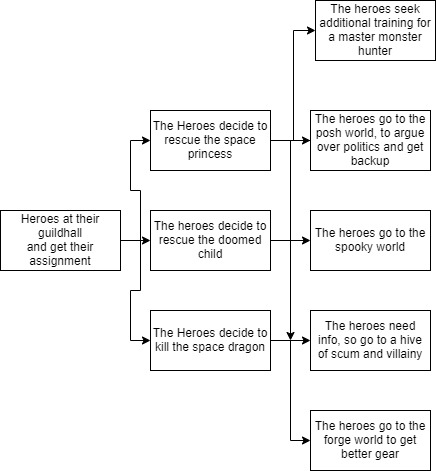
A sandbox, by contrast is very open.  A good example of a typical “sandbox” game would be most open-world games, or games like Minecraft with no real objectives.  You show up and ask what you can do, and the GM shrugs and says “I dunno, what do you want to do?”  You’re tossed into a vast ocean, able to go wherever you want, and given no real objectives or direction.  Your progress is entirely up to you, and there’s no sense of urgency or directive.  If we use our basic story concept form post II, then we focus on the monster hunters as a group or a faction, and the world in which they inhabit.  They can choose from any number of possible jobs, go anywhere they like, and do whatever they want.  Our story might look something like this:
First our heroes go to their homebase, and then look over a board of possible jobs, and pick one and then decide what to do, and they can really do anything, or any combination of things.
A key realization here is that when you’re building a sandbox, you’re not creating a plot, you’re creating a setting, and the plot naturally emerges from how the players interact with the world. The two major problems you run into with this approach is a sense or aimlessness or purposelessness from the players (they don’t know what to do or where to go and any direction seems as good as another). The other is that you have to plan for all of this.  In our above example, if we dedicate a week to working out the “rescue the doomed child” plot, and nobody chooses to go there or take up that mission, we’ve wasted all of that time.  A key to mastering sandboxes is understanding what to plan for, and how to make sure you waste as little time on needless elements as possible.

So, why are sandboxes better?

At the end of the day, an RPG turns on choice.  You are more likely to have players who bristle at you presenting false choices or removing choices than they are at having a sense of aimlessness.  Taken to its ultimate extreme, rails aren’t even games, they’re just plays where everyone says their line and performs their pre-determined action.  
Rails are brittle.  What happens if your players don’t want to rescue the child? What if they just turn him over to the cultists and wash their hands of it? Then your entire story has been derailed and you’re lost, while if you’ve built a sandbox, if the players decide they don’t want to rescue the child, well, you still have the Space Dragon and the Space Princess and that extra-special training on a secret world, etc.  Sandboxes are more resilient in the long term and broadly more pleasing to players.
In the long run, thinking of your game as a setting in which narrative naturally emerges becomes a more resilient way of prepping a game, because in the long term, you can return over and over again to your sandbox and “construct” stories from it fairly easily.

Oh, so I should just sandbox then. Why are we even talking about rails?

Because nobody runs a pure railroad game or a pure sandbox game.
A better way to think of sandboxes vs rails is to think about setting-driven games vs plot-driven games.  When you’re prepping a sandbox, you’re really prepping a setting.  You’re creating a context for your players and inserting them into it.  When you’re prepping a railroad, you’re really writing down plot.  Games honestly need both. You need to have a setting with which the players can meaningfully interact, and you need a plot that drives the action forward.  There are lots of ways to do this, from creating a “rail” that consists if a sequence of small, tightly bounded sandboxes, or a “branching” set of rails, where players need to follow a long a particular story, but they reach certain “choice points” where the GM has a good understanding of both branches (like “if the players don’t choose to rescue the child, this happens instead…”), or a broadly defined setting with lots of interesting hooks and features from which the GM and players can collectively improvise a coherent plot that follows predictable lines. 
I personally find this last the most desirable sort of game, but to create it, we first need to understand a lot of things, especially about how plots work, which means we need to understand rails.

So why, as a beginner, should I focus on rails?

Because you need to learn to walk before you can learn to run.  In the end, railroad games work a lot like how a book works, and people tend to think more in those lines.  If you go back and look at my initial inspiration in post II, it fits more neatly and more intuitively into a railroad-sort of game (“the monster hunters accept a mission; the monster hunters go to the planet; the monster hunters fight the cultists; the monster hunters rescue the child”) than it does into a sandbox game. It’s easier to get you started, and getting started is the most important part of all of this.
Rails also teach you the structure of a story.  You can think more easily in terms of act structures, in terms of “escalation of tension,” and in cause-and-effect.  If I may make a musical analogy: learning to run a game “on rails” is like learning to read sheet music and learning to play a musical instrument.  Once you’ve learned to do that, then it’s easier to learn to improvise music in things like “jazz,” as people start to teach you scales and you start to “play” with the music you learned on sheets.  By the same token, eventually, you’ll need to learn to improvise a story, but it’s easier to do that if you know how a story works, and it’s easier to learn how a story works if you follow easy-to-understand linear stories.
As you get better at rails, you’ll learn how to bound your players reasonably.  For example, consider the choice of rescuing the child.  In a lot of ways, it doesn’t make sense: the monster hunters were hired to retrieve the child, so they should.  Why wouldn’t they?  If you just inform them that they’ve made such a decision, they’ll likely rebel, so it’s better to think of plausible reasons for them to make the choice you want them to make, or for you to shift the context enough that the choice is no longer particularly relevant, then the story will naturally flow along the lines you intended. 
For example, 
  • if the child heals or helps the party, they are less likely to turn him over to people who will hurt him
  • If the cultists betray the party, the party is less likely to want to complete their given mission
  • If the cultists already believe the party has betrayed them and act as though it is so, the choice if largely mooted.
  • If the players understand that this is the story, or that they are heroic characters, and that this fits genre conventions, they’re likely go to along with it
“Good” railroad GMs learn to hide the rails, to make the players think it’s all their own idea, or accept that they have only specific choices. This makes the bounds places on the players harder to see, and the whole story feel organic.  This is a vital step to learn, even for sandbox games, because you cannot provide an infinite sandbox. You must, inevitably, bound your player’s choices, and learning rails helps teach you how to bound them in an efficient and effective way.
Well-bounded plots are also just easier to plan for.  Trying to “plan the world” is a recipe for failure for a starting GM.
Once you’ve learned how to write a proper plot and how to guide the players down that plotted path, then the next step after that is to learn how to loosen up those rails, to give them real choices and to highlight major choices so they don’t assume they’re perpetually going down rails.  Then, eventually, you’ll learn to discard all of that, you’ll have “learned the form so you can master the formless” and you’ll learn to think in terms of setting and natural, emergent plot using the plot beats you mastered on rails, as well as how to focus your planning on what really matters, as well as to predict the typical choices of your players, then you’ll be ready for the “better” sort of game in the form of a sandbox.

Musings on Mooks and GURPS Combat Encounters

As I work my way through the session planning for Tall Tales of the Orochi Belt, I find myself pondering combat encounters, and how GURPS tends to handle them.  How exactly should I stat up my minions in GURPS? And how can I transmit that to you in a way that helps you put together interesting sessions?

I’ve been diving through a few books to see how best to handle encounters in GURPS, in particular the Campaign Framework books, which put the most effort to actually translating the GURPS rules into something you can use in a game, and thus actually have bad guys.  Of course, all four handle opponents in very different ways, but I also find all four surprisingly lacking.  If I could criticize GURPS for one thing, it would be its tendency to demand detail in areas that really don’t matter, and to provide precious little detail in areas that do.

What do I mean by Mooks

…(M)ooks are defeated if injured at all – even a 1-HP gut punch will do. — GURPS Action 2: Exploits

To clarify what I mean by a mook, I mean the inconsequential opponents that the PCs face, the speed bumps on their road to victory.  On the one hand, these characters don’t need stats: they’re speed bumps, things that soak up the character’s precious time while the bad guy gets away, and give a chance to the main characters to look good.

See, we know the heroes are awesome, and we want to see them being awesome, and the way you do that is providing them with opponents to showcase their great skill, typically by winning a fight with the odds stacked against them and so lots of games provide rules for one-hit opponents that immediately go down. Not providing these rules tends to turn every fight into a tedious grind, where you know your opponent has no hope of defeating you but you need to burn many minutes per opponent, grinding them down to zero HP, to defeat them.  Thus, most games that I know that have this sort of wild disparity between hero and opponent include some way of speeding up the fight so we don’t focus overly long on something that doesn’t matter.  But if they don’t matter why bother with them at all? 

You can answer this question a lot of ways, but I happen to think there are wrong ways to answer that question, and most of them boil down to “Because it’s expected.”  If a fight doesn’t matter, then it doesn’t matter if the fight is slow or long, in all cases, it’s tedious.  If your fight consists of rolling to hit, and then always succeeding and always taking your opponent out, while never really being in danger, then you’re just punching mannequins until the GM declares that you’ve met your mannequin-punching qouta and you can get to something that matters. This leaves us with a conundrum: mooks shouldn’t matter, but if they don’t matter, then we shouldn’t have them in the game and yet people expect them, but if we only keep them “because it’s expected,” then we create tedious, pointless fights.  So they answer has to be: mooks matter.

So, if mooks matter but are ultimately, individually, inconsequential,. then how do we make them matter? Well, I think with a moment’s reflection, we can come up with some obvious reasons.  First, mooks in sufficient number do pose a real risk. Go watch the fight in Moria in the Lord of the Rings (or really, any fight against Orcs) and you’ll notice that while an individual orc is no threat, the orcs as a whole pose a real danger to the heroes.  If you further look at most movies, the mooks might not pose a threat to the heroes, but they definitely pose a risk to “normals.”  This is typical of the super-hero genre, such as the Battle of New York in the Avengers: few of the Avengers were actually in real peril, but the everyday people definitely were, and many scenarios in the film are constructed around that premise: alien monsters threaten people, and the hero needs to defeat them.  Finally, mooks tend to soak up resources, such as your fatigue (there’s a great fight in Daredevil season 1 that showcases this), your bullets and your healing potions.  They also take up time, which might be crucial in a certain scenarios (such as the bad guy getting away while throwing wave after wave of minions at you).  A well-fought battle can allow you to save your resources for the final fight against the big bad, while burning those resources might let you get through them more quickly, in a time-sensitive match.

Mooks also tend to change up the preferred tactics of a lot of characters.  A lot of players focus on defeating toughened targets.  A DF character might focus on tons of ST, armor divisors, high levels of Feint and the ability to target vulnerable locations so they can defeat a single, very tough target well, but if you instead put him up against a dozen goblins, most of those advantages go out the window compared to someone with extra attacks, dual weapons, AOE spells, or Whirlwind attacks.  If mooks matter, and mooks fundamentally fight differently than big bosses, then players are forced to adapt to shifting sets of circumstances, based on who they fight.

How GURPS handles Mooks

Okay, clear, you get what a mook is, why he matters, how he matters, and what they can lend to a game.  So what am I going on about? Well, as I look through GURPS material to explore mooks, I’ve noticed a tendency to treat them like characters and I have… mixed feelings about this.  Most advantages and disadvantages are built from a player-character perspective.  For example, the primary disadvantage of Callous is that it gives you a reaction penalty (-5 points for a -1 reaction penalty).  This doesn’t matter as much for NPCs, which is why you often hear people say “Don’t worry about point totals for NPCs,” because an opponent with Callous and Odious Personal Habits, Bully and Hidebound is worth less than a character that has none of those, but that fact just isn’t relevant.  On the other hand, some disadvantages, like Berserk, Bloodlust, Code of Honor and Cowardice do matter, a lot, and could completely reshape the fight.  If we step back and look at a group as a group and accept that Mooks serve more purposes than just fighting, such as the patrolling guards while you’re sneaking through a fortress, or the rabble of an opposing faction that your Bard/Diplomat is going to talk to, then these disadvantages might matter more.  But I often find that when I’m presented with a Stat Block filled with advantages and disadvantages, I need to stop, parse, and write notes down, and I rather wish GURPS did a lot of that for me.  Tell me how these guys are supposed to fight.  Tell me how to use your mooks in my campaign.

I think D&D tends to do a pretty good job of this, especially my favorite iteration, which was 4e (yes, I know, I am a heretic), which pushed so far into heresy as to practically script your fights with each opponent.  Monsters had pre-defined attacks, and a sudden change to how they fought once they became sufficiently wounded, which meant that fights tended to escalate once things got worse, and a lot of the game turned on getting a sense as to how the enemy fought and then trying to use your own tricks to your advantage.  It didn’t take a ton of parsing to work out: it was spelled out for you in black and white.

I’d like to stop and take a look at how various GURPS Campaign Frameworks handle mooks, to get a sense of what they do, and what I’d rather see. I’d also like to hear your thoughts, on how you handle these sorts of characters, if you do at all.

GURPS Action

Mooks don’t need complete character sheets — GURPS Action 2: Exploits

You’re darn right they don’t.  In one sense, I think GURPS Action handles Mooks the smartest of the four, because it says “Look, one hit will take them out; their stats/skills for anything that matters is either 10 or BAD+10, and give them a couple of guns or something.”  Easy.  So if you’re fighting some BAD 0 cops, then they shoot at you with basic 3d pistols and roll a 10 or less to hit you (before modifiers).  If you’re fighting some BAD 5 commandos, then they have Skill 15 when they shoot at you, might have some ballistic vests (DR 10 or 12, I think, at least against bullets) and are shooting some high ROF 6d assault rifles at you.  Relatively simple.

Where I think Action falls down is providing some variety. There’s no real, obvious difference between how these two guys fight. Action suggests that maybe some tough mooks would have High Pain Threshold (though how does that even work, if one hit takes them out?), or you might have some “pencil neck” mooks who present even less of a threat.  Action largely consists of entirely human opponents, so this is somewhat forgivable, but I would expect facing a mess of fanatical, suicidal terrorists to be an entirely different affair than fighting Russian special ops or some corrupt cops, and not just because the BAD changes.  Spec Ops would have tight tactics and combined arms; the corrupt cops would make stupid mistakes and be willing to negotiate (likely easily intimidated) while the terrorists might totally refuse to negotiate and when they start to lose, begin to take absurdly dangerous risks that could turn the fight suddenly at the cost of their lives (though they would also tend to make a lot of tactical mistakes).  Thus, it seems reasonable to expect each scenario to be more diverse than just “Their skill levels differ” but there are no clear guidelines as to how.

GURPS After the End

…a game where four PCs can charge a 100-person raider camp head-on and expect not just to survive, but to prevail. –GURPS After the End 2

The more I’ve read After the End in researching Psi-Wars, the more I’ve come to appreciate it.  It’s definitely not as influential as Action, but it’s increasingly making an impact on my rules and my templates.  When it comes to mooks, though, it’s a bit of an awkward fit because After the End doesn’t assume mooks the way Action does.  If you’re playing a heroic realism game with a default, 150-point scavenger, then a single Raider with a board with a nail in it is not just a speed bump, but potentially a serious problem, worthy of a detailed fight!  That said, we can definitely see that some opponents have inferior capabilities, and After the End has some suggestions as to how to turn up the high octane action: when you’re 250 point Hardy, Experienced Scavenger faces a Raider in a Cinematic game with the Cannon Fodder rules turned on, then that raider turns into a mook.  So, I have to give After the End a little credit even if I don’t find their approach totally useful, because I’m looking at this through the lens of “Is this useful for my Psi-Wars game?” rather than is it useful for my After the End game.

Unfortunately, the PDF preview has no one I would consider a mook that I can discuss (though it does have some monsters), so I’m just going to discuss the Raider on page 17 of After the End 2, and if you have the book, you can follow along, but if you don’t, you’ll have to take my word for it.  Here, we have quite some detail: for example, they have IQ 9 but Per 11; they have skills at differing values (though typically harder skills at a penalty: for example, they have Axe/Mace (an Average skill) at 12, but Kusari (a Hard skill) at 11).  And they have specific traits: Callous and Improvised Weapons.  So, unlike with GURPS Action, where you can just improvise off the top of your head, you need to have memorized this NPC stat block, or have it in front of you.  That’s not necessarily a bad thing though. It also doesn’t tell you much about how they fight. Not here at least.

See, if you page back to page 15, the “Raider” stat block is the culmination of a section on gangs titled “Gangs.” It discusses how many there tend to be, what their bases look like and what sorts of variation they might have.  This last is key: we have five “attitudes,” and two Lenses, either motorized gangs (think Mad Max) or “Masters of the Land.” They also have some brief discussion of slavers or “hostile townies.”  So, in a sense, this actually does what we want to: one entry provides us some considerable variety.  A Mad Max style gang might be Motorized and Debauched while some other gang might be Masters of the Land and Cultish. The first gains disadvantages (like Bad Temper (6)) and skills like Driving at DX+1 (11 in this case), while the latter is amenable to a good Diplomacy check but react badly if people refuse to join up and typically tend to be stealthy in some way and integrated well into the local terrain. Nice.

The problem I have with these, from the perspective of building combat encounters, is that most of the material here is for constructing interesting broader interactions.  These lenses and suggestions act as starting points for a total scenario.  For example, Mad-Max style slavers might have hit a local town and dragged away some slaves to their camp, so we need to know things like what their encampment might be like, or that they have Bad Temper in case we want to piss them off into making a mistake. A Cultish group might rescue the heroes if they’re in trouble, bring them back to their forest fortress and become increasingly unhinged and dangerous once it becomes clear that the PCs are not “one with the purpose.”  These are interesting, but not what I’m looking for.

GURPS Dungeon Fantasy

Some monsters are fodder, and just get squished. These aren’t necessarily trivial; numbers and effective offense can let them chip away at the party before being exterminated — GURPS Dungeon Fantasy 2

Dungeon Fantasy explicitly talks about Fodder, which is what it calls “mooks,” they even have the “take 1 HP and you die” rule (“And Stay down,” page 27). In fact, the book largely talks about all the things I discuss above: that fodder should be meaningful opponents, but mostly by chipping away at the PCs or distracting them for the more dangerous monsters.  This isn’t all that surprising, because DF is very much built around combat encounters the way other campaign frameworks isn’t.  It might be okay in GURPS Action if all of the gun-toting mooks are terribly generic, but it’s an unforgivable sin in a Dungeon Fantasy game if all the monsters have identical stats (a trait it shares with Monster Hunters, though Monster Hunters is more about solving the mystery of the monster than it is in numerous highly nuanced combat encounters).

If we look through the monsters, even the fodder, we still see a lot of variety.  I couldn’t find any good Fodder monsters in any PDF previews, so I’ll discuss the Flesh Eating Ape as an example, even though it’s probably more of a henchman. Notice that it has skill-14 in basically anything that matters, making it consistent and easy to remember.  In both the Notes and the general description, we see repeated reference to their grappling ability, including a discussion of Neck Snap.  This sort of detailed discussion of how the monster will fight helps set it apart, though we still need to parse some things (like the fact that it’s a Brachiator and is Ham Fisted; how will these impact combat?). 

As GURPS Dungeon Fantasy matured, it goes into even more detail.  Check out the Demon of Old; again, not a mook, but note the sidebar extensively talking about how it would fight, and what sort of tactics you would need to defeat it.  Pretty good stuff!  There’s still a lot of parse in the stat-block, though, such as their Lifebane, their Dread, the fact that they don’t breath and are immune to metabolic hazards, etc.  You do have to read it carefully, but not as carefully as you might with the older versions of these monsters.

I also want to turn your attention to the Monster Prefixes from DF Monsters 1, a similar approach to what I did in a DF Monsters thread once ages ago: we assign some sort of prefix to a monster and change its approach.  We might have an Energy Draining Flesh Eating Ape that begins to inflict Fatigue Damage once it has you, or a Distorted Demon of Old with 8 arms and 3 mouths and is not vulnerable to strikes to the vitals nor does it Dread holy things, but is instead susceptible to magic.  While not exactly built for mooks, it does begin to address the sort of thing I’d like to see: one or two specific twists to low-level opponents that fundamentally changes the fight. 

These tend to be much too “broad” for my tastes, but they’re meant to fit a fantasy game where you want to paint in broad strokes, rather than a more nuanced action game. I feel like if you could blend the combat-oriented nature of prefixes with the more down-to-earth lenses of After the End and the simplicity of GURPS Action mooks, I think you’d have a winner.

What is your Experience?

If you’re in a medium that allows comments (my Discord server, for example; you can comment right here, but I tend to be slow to see them; google is terrible about notifying me), I’d love to hear your experience with mooks in GURPS, especially games with gunplay. Do you find the Action approach too generic, or do you find the more detailed approaches of other games, like After the End, too detailed? Are there tricks you use to spice up combat?  How do you feel about stat-blocks vs quickly improvised opponents?

How to Run a Game III: Organizing the Session

Now that you know you need to run a game to learn to run games, and that you have a vague idea of what to do, we need to organize the session. Now, you’re doubtless thinking: “But Mailanka, I don’t know what I’m actually going to run? All these other things talk about realistic NPCs depiction, or fair combat encounters, or character growth speeds, or fair rewards! Why aren’t we talking about that?”  Well, first, I said this would be a long series.  But second, this is sort of like that meme where you’ve got students asking how to do their taxes or buy a home while teachers insist on reciting banal historical facts or mathematical equations: you need to understand the fundamentals of how to get your game running before you worry about what you’re going to actually run.  If all you get from my series is how to put together an event and successfully do so, you’re already leaps and bounds ahead of people who have mastered the monomyth, the three act structure and realistic dialogue but are unable to get people to show up to their house. It is better to be able to put together an event that brings people together to have a nice time chatting than it is to write the perfect story that nobody ever experiences.

I want you to mentally set aside RPGs for a moment, and focus on a tea party, not because I’m super into tea and crumpets, but because whatever works for organizing a tea party (or a dance or a night out bowling) will work for an RPG; the only real difference is the subject matter of the event, the reason for the event, but not all the organizing around it.  The reason I want you to think about this like a tea party is because I want you to be able to abstract any planning experience you have for other things and realize that it applies to planning an RPG as well.

Let’s keep it simple and focus on the basics, like:

  • People
  • Space
  • Time
  • Mood
  • Your purpose

People

You can’t have your Tea Party without people. So, who do you invite?  Obviously, the only people who want to come to a Tea Party are people who like tea, but they also generally need to like one another.  They might not know one another yet, of course, but they need to like one another once they meet up, otherwise, your tea party is doomed.  You also need to decide how many.  Too few and you feel like you’re drinking tea alone or that you have nobody to talk to.  Too many, and you feel like you’re in a crowd, and you end up drinking tea alone with nobody to talk to (and even if you could, they couldn’t hear you over the buzz of the crowd).
An RPG isn’t really any different, except for one key element (setting aside that it’s not about tea).  The purpose of a tea party is ultimately about having conversation (the tea is incidental), while the purpose of an RPG is, you know, the RPG, and in particular, RPGs tend to rely on engagement with the GM (in a sense, it’s better to compare it to split-screen couch gaming: everyone needs to fit in a relatively small space, and they need access to the thing that provides the game).  This tends to sharply limit the number of people you can reasonably invite, at least to a table top RPG: it should be enough people to create interesting gameplay (you can get by with one or two players, but I find less than three tends to feel empty) and you shouldn’t have more than the GM can handle; this latter number varies a lot, depending on the sort of game you’re running, how much attention each player requires from the GM, and how well the GM can handle the group.  More than about 6 players, and I find people start to have a hard time fitting around the table, reaching the minis or the dice, getting the GM’s attention, or talking over one another.  4-5 seems to be the sweet spot for most games, and in computer programming, we call this “the pizza rule,” that a team should be no larger than could be fed by a pizza (or two pizzas, depending on how hungry everyone is), which also puts you at about 4-6 people, which is also a good number for more collaborative events.
So, we can have 3-6 players in most cases.  Where do we find them?  Well, you can ask around your friends and family (they tend to be pretty amenable to it, if you’re not overly annoying about it), or you can do what most people do when seeking interesting people: go to where those people tend to aggregate and ask around.  If you have a Friendly Local Gaming Store, that’s pretty ideal, because then you can regularly interact with fellow gamers.  RPGer associations and clubs also tend to also facilitate finding good players.  If neither are available to you, seek an online community.  If you have to turn to the internet, you may have to surrender the idea of a “classic” tabletop experience, but the internet is loaded with tools to help you, and online gaming is the only socially acceptable way to game in your PJs without taking a shower, so it has some perks!
Finding players isn’t enough, you need to find good players that won’t rip one another apart.  That’s pretty key in all events too, especially tea parties: these people need to get along.  Most gamers are geeks, and geeks tend to feel being ostracized is basically one of the worst things ever, and thus the seek to create “safe spaces” where people feel “accepted,” but be careful with this approach.  The truth is, some people have a very high social “cost” to deal with.  They’re demanding, or they’re frustrating, or they’re time or energy sinks that will suck all the oxygen out of your game.  If you’ve gamed before, you’ve doubtlessly experienced an otherwise great game that was ruined by “That Guy.”  Your job as a player is to not be “that guy,” but your job as a GM is to not invite “that guy,” and honestly, not every game even needs “that guy” in it.  It is totally possible to have a game where everyone gets along great and contributes.  Sure, you’ll always have varying levels of social skills and people will be up and down in their moods and levels of contribution, but you don’t need to tolerate straight-up assholes, you really don’t.
My experience with these difficult people is that most of it comes down to maturity and “soft skills,” how well they get along with other people.  You can usually filter these out pretty quickly with some competency tests.  Just sit down and talk to these people, or watch them game with others (most FLGSes also feature other sorts of games, like mini-wargaming that you can watch).  Things to watch out for:
  • Tends to turn the conversation towards themselves, their interests and their accomplishments
  • They have a tendency to blame others or outside forces for misfortune in their life
  • Sore-losers
  • Bragging
  • Substance abuse
  • Tends to talk over people
  • Perpetually late
  • Tends to argue and refuses to compromise (they “have to be right”)
  • Shifty/deceptive, such as stealing from other players or cheating
  • Inability to remember basic rules or take a very long time making a decision
  • A lot of pleading that they’re special cases or need special assistance all the time
  • They make you feel weird or uncomfortable
  • A lot of people warn you away from that person
These aren’t necessarily deal breakers, but if you see a few of them lining up together, you might want to avoid them.  On the other side, there are some traits that you should seek out from a good player:
  • They tend to listen and/or ask questions to get to the heart of what someone else is trying to say
  • Actively participate in the social group
  • They take time out to explain things to people
  • They lose gracefully
  • They worry about details that impact others (such as making sure the change is exactly right, or they really worry about being on time, etc)
  • They notice when other people seem to feel excluded and invite them in
  • They bring snacks or spare books or other things that help people out
  • You like being around them
  • Other people say they’re cool/nice/a good player
It’s possible to have these traits and still be a jerk, but they tend to be good signs.  Most people are a mixed bag, of course, and so you’ll always have to make a judgement call.  These tend, largely, to reflections of one’s empathy and conscientiousness which are the traits you’re looking for here (as well as a little decisiveness, because the last thing you want are players sitting around shrugging, unable to figure out what it is they want).  If you find that you, personally, tend to skew towards the former more than the latter (though my experience with such people is that they rarely know that they do; a sure sign, though, is if you often find yourself disinvited from things…), fret not: you can learn soft skills.  It’s not easy, but it can be done. 
Having “good” players is not enough, they need to like one another.  This is often a freebie among friends, but if you’re collecting a new group, consider seeing if you can get them together before hand, like invite them all out for some food or something and see how they interact.  Things might emerge that you didn’t expect (for example, two perfectly nice people might be opposed on political ideology and end up arguing strenuously on this topic all the freaking time, and they might even have interesting arguments, but it might distract from the game). Seeing how people interact can inform a lot about your game and whether it will work.  I have personally had games fail because I tossed together random people “who were interested” from the internet together and then watched it go down in flames as they spent all their time arguing with one another and then fighting me when I didn’t take one side or the other.
The hard truth is, your group is not going to be perfect.  People are going to rub up against one another.  The worse your group is, the more you’ll have to step in and intervene, and the more that will “cost” you.  It can be done, but it takes experience.  Realize that sometimes your games will fail not because of anything you did, but because your players just didn’t get along or couldn’t show up or what have you.  That’s one of the reasons this step is so crucial. But even when you have bad players, it’s possible to succeed, especially if you can find ways to minimize their anti-social tendencies (if you find your players tend to forget their character sheets, keep spares, for example), and leverage your good players to cover for the bad players (sit the guy who’s memorized the entire book next to the fellow who can’t even remember what die to throw; sit the two political arguers away from one another so they’re less likely to start arguing, etc).  When you find a truly great player, someone who helps lead others and helps guide/mentor others, make sure you stay on his good side and keep him happy, as he can help carry a lot of the weight for you.

Space

Okay, so you have your players.  Where will you play?  If you want a “classic” tabletop experience, you’ll need a table and the space to play.  If you own your own house, that makes life easier, or you can play at the FLGS, etc.  If you’re online, all you need is your computer and a digital space to occupy.
This isn’t an especially hard step to do, but you’ll need to do it nonetheless.  Some questions to ask:
  • Are you sure your space is available? Did you check?
  • If your space is shared, is there some sort of reservation system? Did you remember to reserve your space?
  • Is there enough room in your space for all of your players and whatever props you want to use and whatever snacks you want to supply?
  • If you’re using a digital space, have you tested to verify that everyone can connect? Can you talk to one another online? It doesn’t hurt to test it out, and to make sure whatever server you have can handle the load.

Time

When are you going to play?  If you’re some high school kid or are unemployed or retired, you have nothing but time, but as you get older, you often have to deal with family and jobs and relationships and other commitments that makes finding time hard.
I highly recommend cultivating your scheduling skills.  Google Calendar and other, similar tools allow for sharing of schedules and working out when people are available and when they are not.  Try to timebox your session (I find 3-6 hours is pretty good, though I tend towards shorter sessions rather than longer ones, but if you find you’re gaming very rarely, a single longer session might be better).  If you are running a long session, think about food.  Realize that if you have very long periods between sessions, people may well forget what happened, so having a re-cap before each session helps a lot, or making your sessions self-contained episodes helps a lot too.  
Real life happens, and even if everything is perfectly scheduled, someone’s kid is going to get sick, or someone’s dad is going to die, or someone is going to decide this is too much for them, or they’re going to have a hangover or whatever.  Don’t build you campaign around a single person.  You should be able to handle losing as many people as possible.  Sometimes it’s unavoidable, but the less you need any particular character or player, the more resilient your game will be. I’ve had games that shrunk down to 2-3 reliable players because they were the only ones who showed up, and when that’s the case, I recommend biting the bullet and running for them: it rewards them for showing up, it’s a good object lesson in resilience, and, hey, you’re running a game!
When you’re finished with your session, be sure to revisit the scheduling of the next session right away!  You’ll want to remind your players of their commitment and get a sense of who will be joining in the next one.  BEFORE a session, send out reminders.  People often forget, and it’s better to learn that someone has forgotten and scheduled something else a few days before the session than it is on the day of the session.

Mood

So, you’ve got your players, your space and your session scheduled.  You need to keep everyone happy.  This brings us back to our tea party example: the tea party isn’t really about the tea, it’s about the conversation. In a lot of ways, tea parties are actually a lot like an RPG, in that you could host an RPG at a tea party.
In both cases, you want to create an inviting environment.  Try to cut out any unwanted sounds.  Create a sense of isolation from the rest of the world, a so called “safe” or “creative” space where people can relax and pretend to be orcs and elves or whatever without fearing being laughed at for being a dork.  Provide creature comforts like cozy chair and especially food.  People tend to be more relaxed and sociable when well fed!  Food can also serve to promote a particular vibe: doritos, pizza and mountain dew creates a strong “gamer vibe,” while ethnic food from your particular setting creates a greater sense of immersion in the setting.  I often find players (the good ones anyway) bring their own snacks, which helps create a sense of camaraderie.  Drinks are especially important, as people will be talking a lot and this will dry their mouths out.  Consider pop, tea, hot chocolate or just a big jug of water, especially on a hot summer’s day.
Music and props can also set the mood, such as decorations or minis.  Try to avoid distracting your players: you’ll need to talk over Kenny Login’s “Into the Danger Zone,” no matter how fun it is, but soft, setting-appropriate ambient noise goes a long way towards helping your players get into the mood.  
Try to minimize distractions.  “No Mobile Phones at the game” is a very good rule, since mobile phone apps are designed to be as distracting and addictive as humanely possible. Chit-chat and “kibitzing” is trickier: friends getting together to chat, especially before the session, is valuable bonding time, and so is worth encouraging. Cross-talk in a session is less valuable and can be distracting, but sometimes brings moments of much needed levity to otherwise intense moment. You also really can’t stop the Star Wars or Monty Python quotes; they’re going to happen.  One skill you’ll need to perfect is how to grab your players’ attention when you need it.  It’s not so much that you can prevent all distractions; they’ll happen, but you need to create an environment where they’re organically minimized to an acceptable level, and then when the group gets out of hand, you can bring them back in line in a relatively easy way.

Purpose

The point of all of this is, of course, to game.  Or, at least, that’s the justification.  What you’ll have created, if you do all of the above is, indeed, a nice little tea party. You have people that like one another in a nice cozy space snacking on their favorite snacks, chatting with one another.  It’s great, and if that’s all you accomplished, I’m sure they’d enjoy the experience.
But the purpose is to play a game.  We’ve only set the stage for playing that game, and now, we need to learn how to run the game.

How to Run Games II: Seek Inspiration

On the assumption that you guys liked last week’s article, here’s a continuation of the series.  We talked last week about seeking experience, about learning to run games by running them, but now we’re stuck.  If the best way to learn games is to run them, then we have to run them. You’ve got the book in your hands and the group has agreed to your time slot. Now what? What do you even run?

I find that once you’ve realized that you have to run even a bad game and you’ve cleared the hurdle of your own fear of failure, the next problem is knowing what to actually do.  You might accept that your first game will suck, but it doesn’t help you because you don’t even know what to do for your first game.  So how do we get past that?

We need to cultivate inspiration.  People will tell you that inspiration strikes “like a bolt from the blue,” that it just happens and there’s nothing you can do to make it happen. That might be true, but there are things you can do to facilitate it happening, and to take greater advantage of it when it does happen.  There are also things you can do to force your gears to turn when inspiration won’t strike.

Seeking Inspiration

The best way to find inspiration is to invite inspiration.  We tend to find inspiration in music, art and interesting stories, so the best thing you can do is cultivate those things and surround yourself with them.  
Art is a great source of inspiration.  I used to save lovely works from deviant art to my computer, but Pinterest is probably your best tool for this job.  I recommend creating a board with images that inspire you, especially for a specific setting or concept.  For example, I have a Psi-Wars board, sub-divided by aliens and robots and spaceships and planetscapes, etc. Not only does this give you one place you can go and look at when you need inspiration, but it’s a great way to help you formalize your thoughts on a particular visual element, especially since pinterest has this handy way of suggesting more art for a particular topic, or linking to images other people who saved this particular image also tend to save.
I personally find a lot of inspiration in music, and I imagine you do too.  Try to construct playlists of particular works that inspire you when thinking of a particular setting or campaign.  I tend to favor more ambient, low-key music, so it doesn’t distract me as I work, but it allows me to immerse myself in the “auditory world” of a particular setting, which often brings my thoughts back to the work I seek inspiration on.  I also find film or video game soundtracks work great.  They tend to be especially cinematic and engrossing, but aren’t meant to dominate your attention the way more lyrical music is meant to.
Finally, you will output what you consume.  If you want to get ideas on a particular topic, go consume media associated with that. Do you want to design a Star Wars campaign? Go play some Star Wars video games, or go watch Star Wars, or read some Star Wars comics or read some Star Wars books.  Branch out into space-opera-like books and video games and TV shows. Watch something completely unrelated but that’s good and speaks to you.
If you surround yourself with neat things that make you think, it becomes much easier for something to leap out at you and suggest itself for your campaign or your NPC or whatever.

Catching Inspiration

Inspiration might strike at any moment, but if you’re unprepared to “catch” that inspiration, it might flit away.  A lot of people recommend “Dream journals,” but let me recommend “journals” in general.  Consider carrying around a notebook with you. Perhaps you’ll see a pretty girl or a nice sunset, or a haunting bit of urban decay, or someone will mention something that fires your imagination: whip out your notebook and write it down.  Alternatively, if you have a smart phone, take a photo of it, or make a quick, auditory note.  You’ll often see writers doing this, and that’s why.
Consider also cultivating some friends that don’t mind when you jabber on about something. If you’ve seen a good movie or read a good book or seen something interesting that’s fired you up, talk about it.  Our minds strongly relate verbalizing with thinking, and so when we talk about something, we tend to subconsciously analyze it.  If you ask someone what they thought, say, of a movie, the first response I often get is that they’re not sure, they have to stop and think about it, and after they’ve thought about it, they can articulate it, and once they start to articulate it, then they start to get very fired up about it.  Some people do all of this automatically and come out of a film pissed off or deliriously happy, but often, it’s only after people stop and think about a film that they really reach these heady heights, and talking about that facilitates it.  Thinking about something is a good way of writing it down into your memory.

Forcing Inspiration

So, deadline time, you’ve done all of that, it’s helped, but now you need to have something now, and your campaign isn’t materializing out of the void, fully formed.  What do you do?

Use Creativity Tools

You’re not the first person to have this problem, not by a longshot, so people have been compiling things to help you for literally ages.  RPGs come with pre-written adventures and loads of explicit story hooks.  Websites like Behind the Name will help you come up with names for your characters, as will Random Name Generators. Story cards (like those from Once Upon a Time, but there are loads of others), collections of “archetypal plots” or “archetypal characters” and sites like TV Tropes can all serve in providing ideas and connections that you can use to lay down the basic foundations for what you’re trying to do.

Brainstorm

I’ve heard this called various things, like “mind mapping” or “rubber ducking” etc, but the idea is always the same: just start writing ideas down. Nothing is too stupid or too wrong to write.  The point is to trigger that verbalizing part of your brain and to initiate a conversation with yourself so you start to articulate what you already know.  Your mind is like a network, and you just need to illuminate the connections that you already know are there. Just write the obvious thing and then the next obvious thing and so on, until you’ve got everything churning and you have a much better idea of what to do.  You’ll usually get to a point where small little phrases aren’t enough and you start writing an outline or start trying to explain your thoughts more fully, and this point you know your creativity is fully charged and you can get to work.
You can do this with people too.  Other people often have different ideas, different perspectives and different things that are obvious to them.  If you do this as an exchange, it can often get very heated, because both sides get very inspired. If you’re working as a team, you’ll need to bring the two visions together, but if not, you’re under no obligation to take on the ideas your sparring partner has.  His purpose, for you, is to help fire you up, so if you realize you want to run A and he likes B better, that’s fine, he can run B, but you’re running A.  This, by the way, is one reason that if you’re going to spar with someone like this, you shouldn’t do it with one of your players; they may well be left thinking “Yeah, but B would have been better.”  You want to introduce A to them whole-cloth.

Steal like an Artist

You’ll often see me reference this, but it’s true.  Most people don’t conjure a song wholecloth, or have a novel spring fully formed from their brow.  They borrow from existing works, and start tweaking it, or use it as a basic framework for their broader idea.  
Say you’ve done the above, and you’ve been struck by this image of urban decay, and you have this jazz soundtrack and you have this neat idea for an urban fantasy wainscott idea about jazz and monsters; you can even see what one of the major characters looks like.  Okay, now what? Is there a story fairly close to your idea? Like the Get Down or Stranger Things or, heck, Supernatural or Constantine or the works of Tim Powers? Borrow one of those and use it as your template.  Where you don’t know a detail, fill it in with a detail from one of those works.
The point here isn’t necessarily to completely imitate a story, though that’s fine if it’s the best you can come up with; that’s at least a starting point. If you can, see if you can borrow and blend from multiple sources to create something that feels wholly original with you.  Or, see if you can build everything on your own, but what you can’t do, fall back on your borrowed inspiration to fill in the gaps.
“Stealing like an artist” is also a reason to cultivate a broad library of resources. If you’ve watched a lot of movies, played a lot of games, read a lot of books, and gone through a lot of adventures, and you can remember them, then you have an entire library of material from which to casually steal from.  This goes back to the experience post, and my suggestion of “read more stuff.”

A Worked Psi-Wars Example

Back in last week’s post, I relayed a story about how I was able to conjure up a story in 15 minutes for a girl who couldn’t think of a story at all. I chalked it up to experience, but this is a more concrete example of how I’m able to come up with inspiration so quickly: I’ve learned to cultivate inspiration, and steal from existing ideas when I’ve run out of ideas.
So, let’s say I need a campaign idea for Psi-wars toot sweet. What can I do?  Well, I can look at the setting itself, and I can look at things I’ve seen recently that I like.  One thing I just finished watching was Netflix’s Witcher
Psi-Wars isn’t fantasy, but… it’s space opera, so I could borrow these ideas.  We could have some sort of “Bounty Hunter” that hunts “monsters.”  That would fit in Psi-Wars pretty nicely.  If we want it to have a nice fantasy feel, we could set it in the Umbral Rim. It tends to have mixture of fantasy-esque civilization, the strange races and a reasonable excuse for space monsters: remnants of the biological warmachines from the Monolith War.  Most of those would probably be in the Shroud, especially on worlds like Moros, which is filled with sick people, a cult of Sin Eaters, and ruled by House Adivasta.  We could say there was some sort of group of genetically engineered monster hunters (the secret of their genetic engineering is, of course, unique to them, and they’re dying).  They’d probably be a group of Ranathim “Bounty Hunters;” as for a name, I could steal “witcher,” but that would sound something like “Chiva” which is too close to “Priest” in how I’ve used it, so how about literally monster hunter with the Sariel Matra. Not too bad. Not quite as catchy, but it will work.

(Other ideas could work here too. The Arkhaian Spiral has Eldothic monstrosities in it, remnants of the Scourge and, of course, the Cybernetic Union, all of which could require specialists to hunt down, and these specialists might use unique “Wyrmwerks” technology.  Most of these threats arose relatively recently, though, so they wouldn’t have the same “ancient” feel.  The Sylvan Spiral is also famous for its space monsters and genetic engineering, both of which fit the idea of a Witcher well.  It tends to be more sparsely settled, though, and people tend to be more interested in visiting it than staying, so such characters might be more like guides than monster hunters, but if they were a native tradition by a group of aliens that lived in the Morass, they might act more like classic Witchers.  Finally, the you might have Imperial monster hunters, some sort of corps dedicated to fighting the strange monstrosities that crop up throughout space. The Imperial Knights already verge on this.  Such a unit would feel more like Black Ops than the Witcher, but that doesn’t mean that Psi-Wars Black Ops is a bad campaign idea).

Okay, so we’ve got this group of Ranathim monster hunters who tend to modify themselves, probably using secrets similar to the monstrous lost arts that created the very monsters they hunt.  As a center of power on their dying world, their nobility probably doesn’t like them, and perhaps the Ranathim Death Cult, who tends to oppose all things created by those forbidden arts, tend to take a dim view on them as well, so the rest of the people in the Umbral Rim aren’t super into them either.  
Alright, that’s neat, but the purpose of this was an adventure? Well, we can borrow from the Witcher itself, but there are other sources of inspiration.  What about the Mandalorian? 
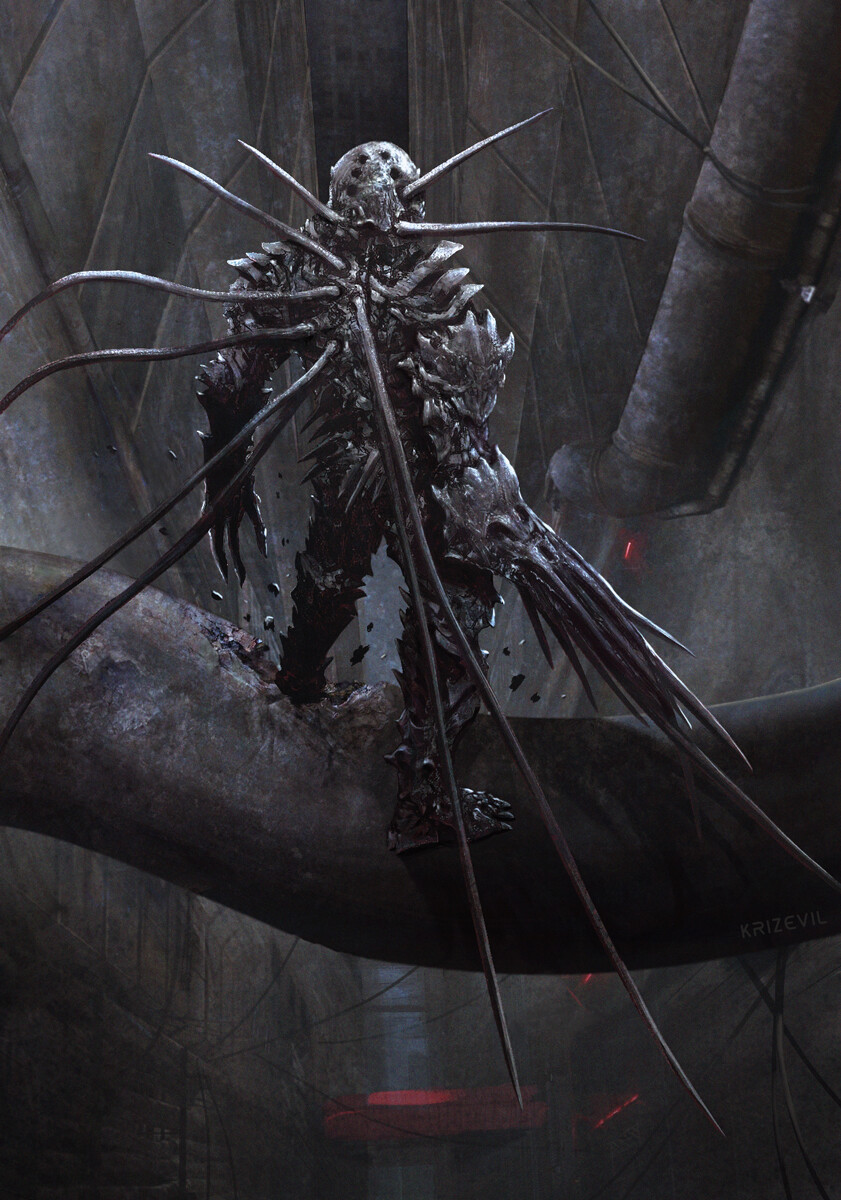
Giving these guys unique armor might be really cool; I already had ideas for a sort of bio-mecha armor, they might wear that stuff.  Make them very imposing and impressive.  Come to think of it, there’s a lot of similarities between the Mandalorians (“This is the way”) and the Witchers as organizations: on the edges of the world, badass, doing what needs to be done for money, keeping secrets that make them badass.  We could treat the Sariel Matra as sort of bio-tech, necromantic mandalorians.
Oh, but weren’t we looking for a story?  Well, both the Witcher and the Mandalorian turn on a theme of the responsibilities of fatherhood.  So we could do some thing with kids.  The Witcher’s stories follow a sort of formula, one we find in GURPS Monster Hunters: first, something bad happens.  Then, the hero gets involved.  Then the hero needs to solve the mystery of what the monster actually is.  Then the hero needs to resolve the monster, often by killing it, but not necessarily.  There may well be violence the whole way through.  But the “twist” in the Mandalorian is that the target is a child.  The Witcher also has a similar twist in its third episode.
We could do something similar.  We need some sort of monster, some grave peril and threat.  Perhaps  we have, I dunno, a cult on this planet that allies itself with some dark God of Death. They’re terrorizing the world, and something of theirs has gotten out and is harming children.  We might draw on some of the imagery of Stranger Things or IT, this cult and the monsters tend to focus on children, there’s something of a bedtime story quality to it.  Someone hires the Sariel Matra to rescue a child and bring it to them.  The child is held deep in this complex.  On the way, they find themselves fighting other scum and bounty hunters to be the first to get to the child, who turns out to be Keleni and being fiercely protected by the last remnants of their clan.  The child’s last protector is gasping their last breath when the main characters get there, and they beg the PCs to rescue their child.  The heroes then learn that the people who hired them in the first place is, of course, the cult itself, and the child is meant to be a vessel for their dark god or whatever, so the players can turn the child over and enable the possession, or they can take on the whole cult.
This story has some problems. The Witcher and the Mandalorian work with a single character, while we’re looking a group of players.  The Witcher and the Mandalorian are TV shows, so the writer can force the protagonist to make the most interesting decision, while a GM doesn’t have that luxury.  What interesting choices could the GM lay before the players, and how can the GM prevent his players from derailing the plot? There’s also more details to work out, like what do Sauriel Matra genetic engineering and armor look like? Who’s the dark god of the cult? That’s not really the point of this post: the point is to have an idea.  You could run the above for a group and it would work, more or less, you’d have to fill in some gaps, name some characters, stat some enemies, the point is to get an idea, to get a starting point, where we’re filling in blanks rather than trying to figure out what to run in the first place.  Hopefully, this showed you what such a process might look like.

How to Run a Game Part I: Experience

@Mailanka mentioned being famous for over-prep and yet always getting a feeling of stage-fright before a session in the Tall Tales channel. I’m similarly afflicted, and I think there’s a dearth of good practical advice for session planning -Mwnrnc

I sometimes talk about GM advice, but I don’t go into it that much, because it’s such a deep, vast topic that once I start, I will probably never stop, but if there’s a lot of demand for it, and I’m working on a session anyway, I might as well spend some time talking about it.

I’ll have to check that out…I’ve been reading Justin Alexander’s blog for a while and I think his advice is generally good. But a lot of his examples sound like an attractive, charming, socially gifted person telling you that the best way to find a partner is to “just be yourself” -Mwnrnc

There’s a lot of things I could talk about (a broad and deep topic) but I think the most crucial one is experience.   It’s also what lies beneath Mwnrnc’s objection above.  A lot of good GM skills can’t really be picked up from reading a blog, only experienced.  If you’ve molded yourself into a good GM, and then you’re “just  yourself,” everything will flow fine.  But then the question is “How do you mold yourself into a good GM?” and the answer to that question is one people don’t particularly like: “practice.”

A lot of GM skills can’t be taught, only learned.  Things like getting a feel for what someone wants but can’t express well, or when someone isn’t particularly engaged and how to get them back into the game, or how to build trust with your players so that they’re willing to try out things with you that they wouldn’t normally try, or just learning to be witty, so that when someone says something funny, you can instantly reply with something funnier, but that still fits in the game and keeps people engaged.  If you watch a lot of the best GMs, they have this sort of charisma, this magnetic appeal.  They just make games happen, and you likely have a hard time explaining, and if you ask them how they did it, they likely couldn’t tell you.  I personally had this experience when someone asked for help creating a session, and based on her input, I had a session spooled out in less than 15 minutes and she sort of gaped at me and asked how I can do that. I had no good answer at the time, but I do now: I simply had more experience than her.

Are good GM’s just more talented than other people? Maybe.  I do believe there’s a darwinian force at play among GMs: bad GMs can’t find players and so get winnowed out or discouraged, while good GMs have success that snowballs, so eventually, the top GMs tend to share a lot of similar traits.  But I tend to be skeptical of the notion of “talent” which I think understates the amount of work it takes to become a great anything.  Great artists or composers aren’t born being good at these things.  They work really hard at them.  The same goes for being a GM.

Experience is also the best thing to focus on because, in a sense, it’s the easiest advice I can give you: the way to become a great GM is to run a lot of games. If I tell you nothing else, and you follow it, you’ll eventually become a great GM.  Everything else is secondary, little refinements to that core advice.  I can expand on that advice, and that will be the rest of the post, but the one thing to remember is that hard truth: run more games.

Always Be Gaming

Okay, so you’re with me. You need to run more games.  Uh, but how?  This rather creates a chicken-and-egg problem, doesn’t it? Because to run a game you need to know how to run a game, but to know how to run a game, you need to run a game.  Well, the short answer is you just do it.  I kick  you off the edge of the pool and shout “Swim! SWIM!” and you flail around helplessly and eventually figure some things out. But while you flail, you’re going to splash a lot, and that will piss people off, and that’s a problem, because to run a game, you need to play with people, and your splashing is going to drive them away.  Problem!
So the first thing you should focus on is cultivating a group of victims friends who are willing to endure your really terrible games, because they will be terrible and you must accept that.  You have an advantage here, though. Why are we talking about this at all? Because people want to know about how to run games.  A lot of people. Which means there are a lot of people around you who understand how hard it is to run a game and who, themselves, want to learn to run and are also looking for victims friends.  Maybe you guys can work something out?
The advice I can give you is to seek out a community or a group of like-minded people and run games for each other.  The most successful GM-learning groups I’ve seen are round-robin games, where someone runs a session one week, and then someone else runs a session the next week.  Everyone in the game is a total noob at GMing, and so people tend to have more patience (and constructive criticism) for one another.  How much of a jerk will you be to a guy for running a terrible session when it’s your turn next week?  Chances are, most of you are part of a community like this, whether you know it or not.  You’ve probably found this post through a link on a Discord group, a forum or a facebook group which means, boom, you’re part of a community, and there are other people from that community looking at this, so work something out.  If you can’t get it to work in person, swallow your fears of your own technical incompetence and try it out online.  There are lots of virtual tabletop options and VoIP protocols have made long distance conference calls essentially free.  Thus, there’s nothing stopping you from doing this except your fear of failure.  Speaking of which:

Embrace the Suck

The only way to learn something is to try it, and the first time you try it, you’re going to be terrible at it.  Accept that.  Embrace it.  There’s a brittle sort of mentality that most of us have where we’d rather see ourselves as attractive, successful geniuses than face up to the fact that we might be homely, stupid losers, but that sort of mentality leads to fat 60 year olds dressing like they’re hot 20-year-olds, or people with know experience saying “How hard can it be?”  Only by understanding and accepting where we’ve done poorly can we begin to fashion skills to fix those problems.
Once you’ve run your game, invite criticism. I would say “constructive criticism,” but the truth is, even assholes give good advice, you just have to dig through the sarcasm to find it.  Get a thick skin and learn to suffer the slings and arrows of your player’s disdain.  Learn to laugh at your own failures.
All that said, try to favor players who give more useful feedback over those who don’t.  If you can only find assholes, then play with assholes, fine, but if you have a choice, the guy who says “I didn’t find your NPCs believable” is much more useful than the guy who says “Your game sucked, dude.”  You already knew the latter, but the former is giving you a clue as to why.
By the same token, learn to constructively criticize.  You need this for two reasons.  First, if you’re going to be part of a group of people running and criticizing, you need to elevate your worth to remain useful to the group.  When someone else runs a game and (inevitably) you didn’t like it, you need to figure out why, and articulate it.  You also need to learn it so you can criticize your own games.  Your core focus in all of this is defeating the Dunning-Kruger effect: you’re trying to accept that you don’t know what you don’t know, and you’re trying to figure it out, that means you need to guess at why your game didn’t work, so you can try something different the next time and improve.  The possible things that went wrong are too long for me to list here, but what matters is that you forge a habit of introspection after your games, and try to think about what went wrong.
This is not to say that all criticism is useful or valid, of course.  As you get better, you’ll find a lot of advice tends to be repetitive or aimed at less experienced people than yourself. You’ll also learn that a lot of people tend to react emotionally, or have no real sense of what actually makes a game work.  A good example of that is a common suggestion of “Give the players what they want,” which can be true, but needs to be more nuanced than that, as seen by its opposite “Monty Haul GMs are bad.” You need to create a tension between the player getting what they want and what they have to do to get it and you need to know when there’s too much tension and when there isn’t enough, and you need to know what they want. All of this requires experience, part of the reason you’re running games, but it’s not the feedback the average player will give you, because it’s not something they understand well themselves.
Some people will tell you that you should just “be yourself,” that you should “love your games the way they are,” but that goes back to that “you’re talented or you’re not” fallacy.  You can always improve.  Always.  If you’re the sort of person who thinks they’ve got it all figured out and they couldn’t possibly get better, chances are you’re in the grip of the Dunning-Kruger effect, and you have no real self-awareness of just how bad you are.  If you seek self-improvement as a GM, it’s more useful to think of yourself as a bad GM who could use feedback than to think of yourself as a great GM who never needs anyone’s advice and all criticism is a personal attack.

Wax on, Wax Off

A common meme that I remember from my heady days on RPG.net was the notion that “gaming doesn’t make you smarter.” This was meant to undermine the arrogance of a lot of gamers who thought they were better than other people because they had memorized how many HP a balrog had, but it’s something I object to because, the truth is, everything makes you “smarter” and all knowledge is interconnected.  For example, if you memorize the whole Monster Manual, well, then you’ve learned to memorize things in general.  Are there other things you might usefully memorize? That’s a handy skill!  By the same token, being good at other things will make you a better GM.
So, in addition to practicing running games, there are some other skills you can practice that will eventually have applications in gaming.  I’m going to discuss three, broad categories, but that doesn’t mean that there aren’t more.

Learn to Host a Party

This is a position that a lot of gamers find controversial, but this is a hill I’m willing to die on.  The single most critical skill you can have as a GM is the ability to host a nice party.  If people get together with you and have a nice experience with you, and no gaming happens, or the game is bad, but people had a nice time, then you had a successful game. Period.  People will want to come back.  If your games are always terrible, they might favor doing something else (“Why not just a dinner party?”) so if you actually want to run games, you need to develop good gaming skills, but it’s still paramount that you learn to host.
Programmers often talk about “soft skills,” which they use to mean the ability to interact well with other programmers and with business.  It’s the sort of thing that’s not a “core technical competency,” but makes the difference between a good programmer and a bad programmer. Hosting skills are like that: it’s not really about how good you are with the game, but it can often make or break the gaming experience anyway, because it doesn’t matter how good you are with the game if everyone hates gaming with you.
At the end of the day, a game is about friends getting together to have a nice time.  It’s like bowling, or tea parties, or movie marathons.  In fact, a lot of people using gaming as an excuse to keep in touch with friends.  The sorts of skills that make for a nice tea party or mini-golf event will make for a good GM, skills like:
  • Scheduling
  • Staying in contact
  • Reminding people of the event
  • Realizing that people will forget/lose key elements, so you keep spares around
  • Understanding the chemistry between people
  • Putting people at ease with one another so they can relax and have a good time
  • Facilitating trust
  • Keeping people fed and happy
If you can’t run a game, consider hosting parties or events.  The experience you gain doing that will directly translate into your ability to host a good game.

Learn to Tell A Story

The second most important skill to learn as a GM is how to tell a good story.  A lot of GMs argue about crunch vs fluff, about good mechanics vs a well-told story, and I’m of the opinion that both matter, but if we’re talking priorities and you can only learn one, learn to tell a good story.  A well-told and engaging story can cover the flaws of a badly run game.
Watch some films and read some books.  These will help you build your “literary vocabulary.”  If you want an amazing scene in a game, you need to learn to articulate that, and learning how other people articulate it will help you learn to do the same.  You’re going to see films anyway, but they provide a rich cornucopia of flowing visual images that you can steal for your games. But books tend to be better, because they learn to invoke more than just the visual and auditory senses, and they’re closer to the medium you’ll be using anyway: they tend to be better at talking about scents and feels than films are, and often take more time to discuss ideas that films tend to brush over quickly (because they don’t work well in a primarily visual medium).
Learn to criticize those works too.  I know a lot of people who just watch a film and go “Mmm, explosions good.” I’m not going to say that mindlessly enjoying a popcorn flick is bad, I’m saying that doing so doesn’t make you a better GM.  Think about the structure of the film or the book. Think about what scenes or moments that you liked and why.  Think about what led to those moments.  Thing about the structure of it. Discuss it with friends.  Watch critical youtube videos on film making and writing in general. Noodle around TV Tropes.  As you get a sense for what works for you and what doesn’t work, and how an author or a film maker created a particular structure, scene or emotional impact, you’ll get a sense as to how to do it too.
You should also practice speaking.  This is not one I see a lot of people discuss, but actual storytelling is a real and legit tradition, up there with rhetoric.  It’s something of a dying art, but you can still find people who do it, and you can learn from them.  There’s a way to project your voice, or to carefully enunciate, or to shift your tone and tempo for particular moments (horror tends to benefit from slow, staccato patterns, little punctuations of speech in the midst of silence, while drama and action tends to benefit from quick, lagasso patterns, rapid flowing speech like the rapid, constantly flowing action, etc). If you practice giving speeches, commanding a room, or learning to actually tell stories, it’ll help your ability to do the storytelling part of the game.

Learn how games work

I suggest that storytelling is more important than game mechanics, but that doesn’t mean the latter isn’t important.  If you want to be truly great, you need to master all the skills, and carefully weaving math, simulation and interesting choices through your game is how you elevate it from a nice story to a truly engaging game.
How games work is at least as complex a topic as how stories work, and understanding the tension between the two and how to resolve them is also an art, but as you learn that by running games, you can also learn how games work in general by playing more of them.  I highly recommend board games, or board-game like computer games, or collecting strange and obscure RPGs (we’re in a golden age of that, by the way, so plenty out there).  Don’t use AAA open-world action games for this sort of thing (they’re fine, but they tend to be cinematic experiences that tell you more about stories than about how to construct interesting gameplay, as a lot of their techniques aren’t easily replicated at the tabletop).  What you’re looking to master is what games do well with their mechanics, what they do badly, how they tell their stories with their mechanics and, most critically, how emergence works.
Emergence is the large scale behavior that results from the interactions of small scale rules.  Games like Chess or Go have relatively simple rules, but you get these deep discussions not of those rules, but how they interact.  A lot of modern games really turn on some pretty heavy emergence; Magic the Gathering seems especially prone to this, as the rules tend to be fairly straightforward.  Understanding emergence is one of the great struggles of all game designers, as well as predicting it; in one sense, you can’t actually predict it, as a lot of the fun of a game is exploring emergence, and if the creator could easily grasp what emerges from gameplay, chances are you can too and that negates a lot of the fun of that exploration (it makes the game “predictable”), but you can get a sense of what tend to be good ideas (“game balance” is about preventing all of the emergence from being too lop-sided, while a lot of complaints about “nerfing” are when people discover an interesting an unintended emergence that might, nonetheless, make for interesting gameplay). The only real way, though, to tackle these concepts are to try to play games that embrace them and understand what makes them work and what doesn’t.
Consider cultivating mathematical skills, as well as programming and science.  Numbers are the language of game mechanics, in many ways, and what you’re trying to do is find some way to simulate the world, to use numbers to tell a story about the world, which is what science and programming also do.  I’m not saying you need a calculus degree, but if you become more adept at playing with numbers, doing math in your head and learning how to express real world values in terms of numbers and vice versa, it will tend to help your games more broadly.  Computer programming is similar, though more about using rules-based logic to describe the world or solve a problem, and it also teaches a lot about how difficult it is to predict the interactions of complex systems and how to test for them.  I think there’s a reason you see more and more good game designers with programmer backgrounds, as there’s a lot of crossover between the two disciplines.
As with all of the above, it always helps to also practice teaching these or explaining them if you can, but it goes double here, because one thing you’ll be doing as a GM a lot if explaining numbers to people and how they interact with the “real world” of your game.  Learning how to hold someone’s hand through basic arithmetic and algebra is pretty important skill as a GM!

Abstractions and Critical Thinking

In the end, what you’re looking to do is see how the skills you cultivate in life can apply to more than just what you cultivated them for, and to self-analyze to find ways you can improve, as well as to understand the things you’re working with more deeply, to see how you can better yourself there too. 
In the end, I suppose I’m saying “If you try to be a better person, a side-effect of this is that you’ll be a better GM too,” and I know that’s the sort of overly expansive advice that borders on being corny, but it’s true.  We often like to talk about the give and take of advantage and disadvantage but notice the caveat that a lot of people seem to have it all while others seem to have nothing, and that’s because a hard truth about life is that advantage breeds advantage, skill breeds skill.  Someone who is good at school tends to learn a lot of skills that make them better at life in general (how to knuckle down and meet a deadline, how to schedule, how to socialize, how to deal with BS bureaucracy to get what they want, and incidentally how to learn) while those that do poorly tend to do poorly at lots of things.
This brings us back to Mwnrnc’s objection to GM advice that feels like “Just be yourself, provided you’re already awesome;” that’s sort of why it is that way.  A lot of good GMs tend to be generally pretty competent people who have learned core skills like self-analysis, how to take criticism, and how to abstract their skills and apply them more broadly, and they’ve mostly done this through experience and “intuition” rather than explicit application of advice and thus cannot easily express it.  The above is why.  In some ways, being a good GM is like being a good chicken sexer, you just have to know, and it’s hard to express what you need to know.
The plus side, though, is that nearly everything you’re doing already, if you figure out a way to apply it to your gaming experience, is making you a better GM.  This is often why they say your life experiences find expression in your art.  So take heart, and realize that whatever it is you’re doing, there’s some opportunity, however small, to turn it into a lesson on being a better GM.

If I revisit the topic, I’ll discuss some other things that can help you as a GM.  There is, in fact, lots of possible advice, which is why there are tons of blogs on the topic and why the back of RPGs are cluttered with advice (advice that often looks the same).  As with any art, there is experience and practice, but there’s also theory, and we can discuss theory.

Meditations on Gear in GURPS

Recently I had an interesting conversation over on the Psi-Wars discord.  It started with my statement that I didn’t want to see players “saving up” to buy better force swords, that I didn’t want them buying “better force swords” at all.  This triggered an entire conversation on gear, RPG genre, and the reasons gear is treated the way it is in RPGs.

I’ve found myself pondering the topic a lot lately, especially in light of people requesting revisions to Psi-Wars’ templates, to update them, and my increasing dissatisfaction with how gear is handled in Psi-Wars.  Why do we have gear in games? What purpose does it serve? And what can we replace it with?

What is “Gear?”

Before we go on, we should define some terms.  Gear is fairly obvious in GURPS: it’s stuff you buy with your money!  I’m talking about “loot” in Dungeon Fantasy, or any equipment that you can pick up and discard. It’s anything that enhances your character that he doesn’t pay for with points, really.  It’s an important distinction, for reasons we’ll get back to (or may well become obvious over my meandering musings).
GURPS seems to have inherited its concepts for gear from D&D and the other games of the early era of RPGs.  This includes a starting budget for your character, a big shopping list in the book that you’re expected to pore over for hours to find exactly the right gear, encumbrance to prevent you from carrying too much gear (thus, creating a decision matrix of effectiveness within a given monetary and weight budget), and scaling levels of effectiveness whereby the game assumes you’ll give up your starting gear for better gear “later on.”
These are the concepts I wish to discuss here.

Why Gear? Resource Management

Have you ever been playing an RPG, and wanted to use a particular piece of gear, and your GM says “Is it on your sheet?”  That seems to be gear-as-logistics.  A lot of early RPGs seemed to focus on preparedness: a clever player anticipated his characters’ needs and planned accordingly.  For example, we often hear the common wisdom from D&D veterans to “always carry flasks of flaming oil and a 10-foot pole.”  The idea here is that you’ll almost always need these items and so you’d be a fool not to carry them.  This also means that if you didn’t explicitly write them on your sheet, you couldn’t use them later when you needed them.  This sort of thinking encouraged a very deep look at the available gear and carefully articulating every item your character carried.
Depending on your genre, this may be a feature rather than a bug.  The most obvious example of this is GURPS After the End, where you’ll count every single bullet your character has.  This sort of gameplay creates interesting choices.  For example, if you have 6 bullets and you’re fighting 3 zombies, do you use your bullets on them?  Maybe you’ll need those bullets more later, so maybe it’s better to risk being zombie-bit by attacking the zombies with your machete.  Or, if your group passes by an old ruin, do you want to stop and risk exploring the ruin, hoping for more precious bullets (or whatever else you need)?  
The point of the game is to limit what gear you have, and to very precisely know what you have and what you need, and to keep you from easily having everything you need.  In addition to worrying about tactical decisions or social decisions, the game encourages you to make logistical decisions.  For example, we could go explore that ruin, but if it’s out of your way, that introduces additional travel time, do you have the supplies for that? If you do go and you find a great haul, do you have the room to take it with you, or will it just slow your group down?  What if something bad happens, like someone gets zombie-bit, do you have enough first aid kids or anti-zombie serum to fix it? And, on the other hand, if you don’t have these things, maybe you need to go, just for the chance to get the things you need.  This adds a new layer of thought and approach to the game.  Characters begin to invest in skills like Freight Handling (or higher Lifting ST) to carry more stuff, like other characters invest in survival skills or improvisation techniques so they get more use out of what’s on hand, or traits that prevent the need for any of this in the first place (like higher HT or better Hiking skills).
Early incarnations of D&D definitely had this sort of thing, and often played a bit like a resource management game.  Sure, you could attack those monsters, but how many healing potions do you still have? Even the way the spells work fit into this sort of resource management: you had to think ahead to what sort of spells you needed for the day, and you had only a limited amount, so if you have a single “Nuke’m!” spell, did you use it in this fight, or did you save it, in case another, more dangerous fight came up?  “Hex crawling,” or traveling across the overland map, also involved a lot of the same logistical thinking of a typical After the End game.
Many RPGs import D&D’s ideas without thinking about them, though, and this creates something of a bug in many games, the “nitpicky” GM who complains that if it’s not on your sheet, you can’t use it.  This is fine in certain genres, but can be very out of place in others.  Classic examples include your typical Supers game, Pulp adventure, Urban Fantasy, or works like GURPS Monster Hunters or GURPS Action (which even discusses how to handle this with the “Beans, Bullets and Batteries” sidebar). For example, if your band of intrepid explorers dive into the Congo to stop Doctor Demento from completing his death ray, after their fight with the Dread White Apes of Solomon’s Mines, it might be out of place to check to see if the characters have sufficient supplies for the day, if they noted “tent” on their character sheet, and to ask them to roll HT vs malaria.

Why Gear? Gear as the Alternate Experience Track.

The Resource Management aspect of RPGs have fallen out of fashion in many games, and for good reason (mainly when it’s not appropriate to the genre), and later incarnations of D&D have either removed it entirely or streamlined it (“Worrying about the number of health potions and spell slots: yes.  Worrying about supplies: no.”), though I think the Old School Renaissance is rediscovering what made D&D’s early logistics ideas so interesting in the first place.

Even so, D&D retains gear and loot as a major element of the game. Indeed, loot has become a byword in video games, especially in the looter-shooter or the ARPG.  So even as interest in resource management dwindles (to the point where many RPGs will just restore your HP between fights, and we don’t even worry about finding health packs in modern shooters anymore), they still have gear. Why?
I think we have to understand progression as a concept to understand gear.  Players like the skinner-box reward of “play game, get cool toy.”  The default toy in most RPGs is the character advancement: play the game, get an XP reward, gain level, get new character feature to play with.  However, character progression is slow, permanent and under the direct control of the player.  That is, it will take you several “dungeons” to gain a level, once you do, the feature you gain is a permanent aspect of your character, and you’ve not only picked it out yourself, but you picked it out probably when you designed your character (“Great! Finally level 10 and I can take that one feat to finish my combo!”).
Gear, by contrast, is quick, modular and GM-controlled.  It may take you three dungeons to gain a level, but you’ll get some sort of gear reward at least once per dungeon and often several times per dungeon (especially as you explore).  The gear will often be the result of a randomized loot table, so you don’t now what you get until you pop open a chest or kill a monster and watch him burst like a loot pinata.  Finally, you can swap out one set of gear for another.  Have a magical ice sword that freezes opponents on a crit and find a magical flame sword that deals extra damage per hit? You can swap it out right away and change you character’s “ice” theme for a “fire” theme immediately.  Better yet, you might be able to keep both weapons, and use them as needed, depending on the nature of the fight before you, provided your encumbrance (and whatever other limitations the GM might create, like “No more than 3 magical items”) can handle it. This means well-handled gear creates a second layer of gameplay and choices.  
You’ll also collect currency during your adventures which you can use to buy specific gear you want.  If your character does have an “ice theme,” and you want that nice set of ice armor or an ice spell from the local magic shop, you’ll accumulate money until you have it, selling off whatever loot and gear that you feel doesn’t suit your character or concept. This reward does not necessarily sync with your experience rewards (you might be able to afford your new item before you reach your next level), which means you can get “neat character tricks” more often than the XP track specifically allows.
All of this assumes that characters shouldn’t start with their preferred gear, and that they’ll find better gear as they go on.  This means characters should be willing to discard their father’s lightsaber at the drop of a hat if they find something better.  In many genres, like more mythical fantasy or supers, gear defines a character, like a god’s panoply: King Arthur uses Excalibur; Thor wields his hammer; Captain America has his shield.  This can change, but it does so as a result of a major character growth or some fundamental change, such as Thor losing his hammer and his eye and needing to quest for a suitable replacement. If we introduce gear-as-alternate-experience-track, we invalidate this.  Such a mechanic assumes that our supers can and will regularly stumble across new, superior gear: imagine Captain America finding a magical sword and discarding his shield, and then finding Chitauri armor and ditching his costume for it.
It also puts a great deal of emphasis on gear.  Outside of a few, very rare magical items, most characters in the kung fu genre aren’t defined by their gear, but by their skills.  A great kung fu warrior is not great because he has The Hammer of the Gods, but because he’s mastered Infinite Hammers Technique, and Buddha’s Palm, and so on.  Sometimes, we don’t want an alternate experience track: we want only the one track or, if we want alternate tracks, we want different sorts of tracks (“Martial arts techniques as loot”).  In such a case, weapons and armor tend to be largely irrelevant: sure,  your opponents carry swords or guns, but they’re no better than your own and your real power rests in your skills.

Why Not Gear?

This brings us back to my discussion of why I didn’t see gear as central to Psi-Wars.  Many games and genres don’t make gear especially important, for a variety of reasons.

Gear as Background

In a variety of genres, especially classic horror, soap operas, murder mysteries, or political intrigue games, gear makes no real impact on the game itself.  One’s station and wealth might impact one’s ability to access really good stuff (an especially beautiful dress, or higher end monster-slaying gear), but the game generally won’t turn on these, and what gear your character can access, pretty much anyone else can access, and if you need it, you spend a little bit of downtime to get it.
For example, if the PCs in a horror game realize that the local church is haunted by some monster and they want to fight it, they can then go to a gunstore to pick up guns, and then go into the church to fight the beastie, where they’ll probably find out the gun is irrelevant anyway.  Another example might be a kung fu game, where characters might have swords or staves, but if they lose their sword, they can grab another sword and fight with it perfectly fine, or grab a mop and use it as an improvised staff without a catastrophic loss of damage output.
These games have gear, but the gear is mostly a background element.  GURPS games tend to tackle this by allowing the player to purchase gear out of a budget of 20% of their starting wealth, and then the rest is tied up in “background things.” The character needn’t note that they have a car, or that they have clothes, or that they have cooking utensils in their kitchen, so long as when they need them, the gear that they declare is reasonable for their level of wealth (poverty stricken characters might have a car, but it’s not going to be a Maserati).  This prevents the “nitpicky GM” situation, and it de-emphasizes the importance of gear, so that the players can get to “what really matters” for their particular genre, rather than poring endlessly over gear lists.  Such games almost never feature looting, because nothing the characters can get from the fallen really matters much to their goals.

Gear as Character Signature

Many characters define themselves by their gear.  James Bond wears his suits, Iron Man has his armor, King Arthur has Excalibur.  The characters have gear, and it matters a great deal, but it tends to be an extension of their character and that character’s themes.  We could think of them as powers that the characters happens to hold, rather than powers that the character  has integral to themselves: Iron Man’s powers are his armor, King Arthur’s kingship is symbolized in his sword, etc.

GURPS tends to handle this approach either as gear-as-powers or, more commonly, as signature gear.  The character has gear, and likely put a great deal of time into working out that gear, but he typically only does this fora  handful of pieces that matter very much to him.  If a GURPS player wanted to work out his own character inspired by Iron Man, he might put as much time into designing the armor as he does into designing the rest of his character, but he’s not also going to dive into a gear catalog to work out what sort of car he drives, what sort of guns he carries, and make agonizing decisions over how many rations he should have on his person.

Game genres that feature this approach to gear, typically “mythic” or “heroic” fantasy, or supers, also tend to discourage looting or “upgrading” ones gear.  It does this, first, by requiring a character investment into their gear: you pay points for what you have, and so you’re not going to discard it quickly.  Also, by genre conventions, you’re paying points for something you generally cannot access any other way.  Iron Man can’t go to walmart and buy a better battlesuit, and King Arthur can’t ask a local blacksmith to forge a better sword.  As a general rule, if a GM allows a player to purchase, for example, a magical sword as signature gear, he should not then begin handing out superior magic weapons as loot!  Or, alternatively, if the player knows that there will be magical loot in the game, then he should also understand it’s likely not worth his points to take a basic, unmagical broadsword as signature gear.

Gear as Narrative Device

Most people don’t think of gear in this way, but it often defines a setting or an adventure without being central to the players in the same way that it might be in gear-centric games.  Such gear tends to either be setting defining or a macguffin.  Examples of the former are ultra-tech, while examples of the latter tend to be setting-defining pieces that shapes the narrative based on who holds it.
Ultra-Tech gear, or ubiquitous magical gear, tends to change the way the players can interface with the setting.  A good example of this might be the Resleeving technology of Altered Carbon.  It opens up the opportunity to think of your whole body as “gear,” and it changes how you interact with the setting, but while one might fuss over their sleeve, they’re unlikely to fuss over the technology itself.  Its presence allows for new gaming options and new gameplay mechanics, but it itself is not the focus of player-driven choices.
(Incidentally, poorly handled gear in  game can sometimes create this sort of gameplay as an emergent property.  For example, if a GM allows players to acquire weapons with “save or die” mechanics on them, and then introduces items that armor characters against save-or-die mechanics, and these begin to proliferate out of control, you may get a setting where Save-or-Die mechanics matter more than damage mechanics and characters run around with their magic Save-or-Die swords one-shotting dragons, etc.  Such a “mistake” can fundamentally change how players interact with a setting and, if handled well, might create a memorable change).
As a narrative device, a macguffin is better explored elsewhere and commonly known, thus I only note it to highlight its presence as, technically, gear.  It may be worth realizing that if the GM accidentally introduces a ridiculous OP item (such as a ring of wishing), one way you can handle it is to acknowledge what you’ve introduced and begin treating it as a macguffin and the center of the story. (ie, suddenly everyone is gunning for your ring of wishing).

Mixing and Matching

The point of this meandering post is not to say “Thou shall” and “Thou shall not.” Instead, I seek to highlight some of the various approaches to gear based on genre.  Rather than adding gear to a game because that’s how GURPS works, you might consider what sort of gameplay you intend with the gear, and apply it accordingly.

Naturally, these often mix and match.  Classic D&D paired gear-as-logistics with gear-as-alternate-progression-track, while later D&D incarnations kept the gear-as-alternate-progression-track and shifted the rest to more gear-as-background.  Sometimes, gear-as-background morphs into gear-as-logistics depending on the needs of the group (if your horror campaign leaves the city and goes into the jungle, the GM may care about survival logistics!).  Characters might have signature gear as well as  gear-as-progression-track if the signature gear is unusually powerful or the player has a reason to remain attached to the item (“This sword may not be the best, but it is my father’s sword); such gear might be narratively important (“It may seem a simple sword, but only it can slay the Lich King.”).

Games often make certain forms of gear very important while pushing the rest to the background.  What sort of gear players need to ponder carefully can say a great deal about genre.  A typical fantasy game might turn on what armor and weapons you choose, but not care a great deal about the exact nature of your “spell casting supplies,” other than to note that you have them. By contrast, GURPS Monster Hunters or GURPS Cabal (or any game with extensive Magical Modifiers) might care more about what magical symbols and regents you carry on your purpose, but be fine with you having “a generic gun.”

Psi-Wars and Gear

Currently, Psi-Wars uses the standard GURPS model, which tends to treat gear as logistics and alternate-progression-track, while allowing for a smattering of other elements.  However, one of the reasons for this post is to begin a series wherein I revisit how I handle gear.
Space Opera as a genre doesn’t care what your character carries around.  Luke Skywalker pulls whatever he needs out of his utility belt, and the story never grinds to a halt because Han Solo didn’t bring some medical equipment or toolkit with him. Instead, characters tend to have what they need when they need it, unless there’s some narrative reason for that to be disallowed.  If the space princess needs to change out of her battleweave armor and into a fine gown, the GM won’t tap on her sheet and note that she didn’t have one noted on her sheet and then insist that the group spend the next hour working out how to get her a dress.  No, she has it, and she can likely even dictate its details and claim a Fashion Sense bonus.  It helps that most characters tend to have ships with cargo bays that they can easily justify as having “whatever” in there.
When characters do care about gear, that gear tends to be deeply symbolic.  Luke carry’s his father’s lightsaber, and Han carries his signature blaster. People do change out weapons and gear when it suits them (such as stealing stormtrooper armor), but this tends to be momentary and superficial, or the weapons don’t really matter (a rebel blaster and a stormtrooper blaster are both just as good).  Characters tend to either have deeply symbolic and narratively resonant signature gear, or they have some background gear.  
This is the core reason I don’t see players “trading up” when it comes to gear.  While Psi-Wars definitely has “zero-to-hero” elements in it, these tend to parallel those of the wuxia/kung fu genre, where the character needs to learn how to fight or how to master their powers, rather than ditch their old force sword for a better, newer force sword.  Characters either have gear because they need it, in which case it tends to be typical gear not unusual for the setting (“I have some sort of blaster”) or a deeply personal and symbolic set of gear. This tends to parallel gear-as-symbol or gear-as-background element.
Characters need fairly regular access to spaceships (that is, anyone who wants one should be able to do it without making it the central thing about their character) and the ability to declare that they possess some sort of signature gear.  Beyond that, most everything else should fade into the background: if characters need something, it should either be so commonly available that it wouldn’t make sense for them not to have it (“Do I have a datapad?” “Of course, duh”), their organization should provide it (“Standard issue imperial blaster”) or they should be able to scrounge for it (“Found those power-converters you were looking for”) rather than fussing over precisely how much money they have, though wealthy characters should have a highly noticable advantage over those without wealth: the difference between spoiled space princess and starving moisture farmer should be obvious in gameplay.

Putting the War back into Psi-Wars: Saying Yes to Mass Combat

So last time I argued that Mass Combat was a terrible idea for Psi-Wars.  I haven’t changed my mind and I still think it’s a terrible idea.  Ergo, it’s a waste of time to even look at Mass Combat, right?  I would argue that it isn’t.  We need to challenge our assumptions, push our boundaries, and look more deeply at things. While I know many people are “loathe to do work they do not need to do,” the difference between quality work and shoddy work is a willingness, first, to go the extra mile and, second, to make good use of “wasted” work.

Hemingway called this his Iceberg theory, that the surface of a story, what you read, is only part of it.  The rest of the story should be buried beneath.  By removing things the author understands well, he can make his story stronger.  A role-playing setting can work the same way: very rarely have I seen economics discussions erupt in earnest among my players, such as wondering what happens to the loot they sell to the local merchant, but if you understand the economics of your world and your setting is carefully built around it, or at least inspired by it, it can hang together in a pleasing way, and when players ask “Hey, why is X?” then you have a ready answer.

This, by the way, is how you solve the Willow/Brent dichotomy when building  your setting.  Brent doesn’t care about anything that’s not directly pertinent to him, but Willow wants to know more and more and more and to see that it all works.  If a setting element isn’t directly pertinent, then it should be optional, buried beneath layers of gameplay as a foundation element, but if Willow wants to know about it, she should have the opportunity to dive deeper, to get more out of your material when she wants to.

How does this apply to Mass Combat?  Even if we don’t want to use Mass Combat in Psi-Wars, understanding what it looks like could tell us a great deal about Psi-Wars as a setting.  Mass Combat discusses not just strategy, but logistics, administration and supply lines.  Understanding how and why factions in a setting goes to war tells you a lot about the underpinnings of the setting.  Furthermore, Psi-Wars is derived from the Action genre, and in Action, even if Mass Combat doesn’t directly show up, the state of militaries in the world and global conflict definitely provides context to the action that takes place.  Finally, just because I think Mass Combat is a terrible idea doesn’t mean you, dear reader, agree.  Perhaps you have a crazy good idea.  If I explore Mass Combat, even for one post, I can serve all of these needs.

Mass Combat in Psi-Wars

Mass Combat has its own, pre-existing units, it’s own pre-existing tags and its own pre-existing quality levels.  I should be able to simply plug and play with relative ease.
Troop Quality has a one-to-one mapping with the mook quality I defined back in Iteration 4. Poor Quality troops are BAD 0, or Skill 9-10.  Basic Quality troops are BAD 2, or Skill 12.  Most Imperial troops are Basic Quality. Good Quality troops are BAD 5, or skill 15.  Kill Squad Elites are Good Quality, and Fanatic to boot.  Finally, Elite Quality troops are BAD 8, or skill 18.
Equipment Quality is harder to pin down.  Obviously, the sort of gear you see Alien Warriors, basic Security Agents, Partisans and Criminals running around with is probably Poor Gear. The next obvious step up from that, Basic Gear, would be the reliable and common sort of gear of paramilitary security agents and most Alliance soldiers.  The advanced-but-troubled gear of the empire is probably Good. The extra-expensive, bells-and-whistles gear of the Kill Squad Elite or other Heavies might be Fine, and the “no expense spared” of someone with an advanced plasma battle rifle, a force glaive and a top-notch heavy combat hardsuit is probably Extra Fine. Perhaps we could see the Elite Ceremonial Guard as Elite Quality with Elite Gear.  No wonder their so terrifying!
Carbine Troopers are obviously just Riflemen with Good Gear and Basic Quality (and Night and Sealed).  Kill Squad Elite are simply better equipped and trained Riflemen, with Fanatic.  Flamer Troopers don’t really fit into anything… but they could be Combat Engineers.  Heavy Troopers are clearly Heavy Support Weapons. Recon troopers don’t fit in well.  Troops like Commandos might by Anti-C3I Riflemen, but Recon Troopers are mostly just spotters for artillery, and thus part of some hypothetical (SP) Artillery unit.
What else do we  have?  The Empire-Class Dreadnought and the Typhoon-Class Starfighter!  We don’t have their explicit Mass Combat values, but we can derive them from Pyramid #3-30: Spaceships.
What additional troop options could we have?  The obvious elements from Star Wars are the Super-Tank (the AT-AT, especially as treated by Empire at War, was definitely a Super-Tank), a Light Tank (the AT-ST) and Sky Troopers or Motorized Recon Troops (covering recon troops on speeder bikes).  From GURPS, the Light Tank also stands out, as does the Flying Tank (aka the Grav Tank), and the Drop Ship (which is probably the Banshee-Class drop ship, in our case).  Simply from our own design, especially our WW2 leanings, the Main Battle Tank, the Infantry Fighting Vehicle (or the Flying IFV), the Close Air Support aircraft, and, of course, Self-Propelled Artillery.
Not all of these things are necessarily useful, but they are, together, interesting to look at for ideas.

Troop
Tags
TS
WT
Raise
Maintain
Carbine Troopers
F, Rec, Night, Sealed
2000
1
120k
25k
Kill Squad
F, Rec, Fanatic, Night, Sealed
3200
1
175k
30k
Flame Trooper
Eng, F, Night, Sealed
2000
1
120k
25k
HSW
F, Night, Sealed
(2500)
0.5
120k
25k
Empire Class Dreadnought
C3I, Space, T6000
1100K
lots
265b
10b
Typhoon
C3I, Space
6400
2
3500k
140k
Light Tank
Arm, Cv, F, Rec, Nt, Sld, Hov
2000
4
475k
25k
Flying Tank
Air, Arm, Cv, F
5000
8
5700k
225k
MBT
Arm, Cv, F, Night, Sld
12000
8
1500k
60k
Super Tank
Arm, Art, Cv, C3I, F
60000
16
12,000k
400k
Artillery
Art
(12000)
8
1000k
40k
Motorized Recon
F, Rec
500
1
50k
5k
Sky Troopers
F, Rec
500
1
570k
114k
IFV
Arm, Cv, F, T1
5000
8
750k
30k
Flying IFV
Air, Arm, Cv, F, T1
2500
16
4000k
150k
Drop Ship
Air, T5
(6000)
16
40,000k
3,000k
CAS Aircraft
Ait
(15000)
8
76,000k
3000k

A note for those of you keeping score at home: the Empire-Class Dreadnought has a b by its Raise and Maintain.  That stands for billions.  It’s not a cheap vessel.  It it also has a troop strength in the millions. Furthermore, I’ve guessed at T values and WT values, but the Pyramid article I cited above suggest just using the weight directly.  About 5 tons will give you one “T”, so the Empire Class Dreadnought has a “T” of 6000, and a Typhoon a WT of 2, which matches what we expect out of an Empire-Class Dreadnought: up to 3000 typhoons (in case you need that many). In actual practice, we have more specific values than that.  For example, you can’t just stuff 60,000 soldiers into the hangar bay.  You need to feed them, house them, keep them happy, and that means a cabins.

So we have pieces of an army, some of which are useful, others are not.  Some of the values look completely off  (Why are CAS aircraft so powerful, and light tanks so weak?).  But one thing that stands out to me is that a Drop Ship is the one thing that will get most of materiel down from orbit and into combat with the enemy… and it can’t carry a lot of this equipment: No MBTs, no artillery, certainly no super-tanks!  Suddenly Ultra-Tech’s fascination with a light-tank makes more sense.  Motorized Recon and Sky Troopers are identical when it comes to troop strength and how they’re applied to battle.  Their primary difference is in cost and form of mobility.  Are we better off with IFVs or Flying IFVs?  Personally, I think some numbers need to be rebalanced, especially some of the costs, and this sort of rebalancing is one of the reasons I really don’t want to do Mass Combat in Psi-Wars.  I don’t want to spend another couple of weeks working out a detailed constellation of Mass Combat troop-options for what amounts to a minor subsidiary of the main focus of gameplay,
But, again, even if I decide not to pursue Mass Combat, looking into it can tell us a lot about our setting.  Look at the fact that a drop ship can’t carry anything heavier than a light tank.  Look at how much equipment an Empire-Class Dreadnought can transport.  Look at how important a CAS aircraft, and artillery, are.  If you were to design a military force from Mass Combat, what would it look like?  What would its primary focus be?  What is your military doctrine?  If we understand that, we can understand a great deal about how the military context of Psi-Wars.

I offer you three views inspired by the Mass Combat System.  You can decide for yourself what you’d like to see.

Three Imperial Military Doctrines

The Compact Empire

The First Order, what a compact empire might look like

Let’s focus on the Empire-Class Dreadnought.  To my eye, it looks like a completely self-sufficient ship.  It has the fire-power to take out any other ship in the Psi-Wars catalog, and a yawning hangar bay sufficient to deploy a small army. As an expression of Imperial might, the Empire-Class Dreadnought need only drop out of hyperspace by a planet to engage in gunboat diplomacy.  By showing the colors and reminding the recalcitrant natives of the fact that the empire can bomb them back to the stone age without leaving orbit, should generally be enough to discourage rebellion.  If rebellion begins, the dreadnought can deploy soldiers to put it down.

But how many?  The Empire-Class Dreadnought has room for a crew of 4600.  Around 1800 are bridge crew, technicians and so on.  That leaves more than 3000 for soldiers (or pilots!).  In practice, I expect the number will be much smaller, as this needs to include support and logistic personnel.  Let’s consider the case of 1000 soldiers, or 100 rifleman mass combat units, which is a regiment (if we push to the full 3000, we could claim a brigade).  But a regiment isn’t just a thousand soldiers milling about.  They have artillery support, CAS support, recon squads, tanks, etc.  Plus they need transportation down to the planet.  What does all of that look like in practice.  What sort of equipment is an Empire-Class dreadnought carrying?
If we imagine a platoon like so:
  • 3-5 infantry units of 10 soldiers
  • 1-2 heavy support weapons
  • 1-3 vehicles in support

Then when we scale it up to a full 1000 soldiers, we get something like this:

  • 100 infantry squads: 50 tons of cargo (TS 20,000)
  • 50 HSW: 125 tons of cargo (TS 25,000)
  • 10 grav-bike recon squads: 50 tons of cargo (TS 3500)
  • 10 light tanks: 200 tons of cargo (TS 20,000)
  • 10 CAS: 1500 tons of cargo (TS 150,000)
  • 10 Flying IFV (likely filled with kill squads): 1500 tons of cargo-hauling (TS 25,000)
We need 100 banshees to deploy all of this in a single go. That costs us 10,000 tons. That leaves us with about 16,000 tons of space, which gives us 200 typhoon interceptors (TS 1.25 million) and 100 typhoon breakers.  An dreadnought might scale back on the air power to add additional land power, but this is a good order of magnitude.

So an Empire-Class Dreadnought, all on its own, can deploy an entire air-force worth of fighter-craft, a full regiment of soldiers, a couple of tank platoons complete with aerial support and rapid, aerial deployment of soldiers.  This, in short, is a small army, one more than capable of taking a city.

And taking cities is probably what this army does.  A single regiment, no matter how well equipped, would fair poorly against an entire planet.  I expect this force could easily destabalize something on par with most non-super-power nations on Earth (setting aside even technological differences), but it would be very hard pressed to fight the US or even China or Russia.  But a dreadnought doesn’t need to fight an entire planet.  It has the fighter/bombers to maintain total orbital dominance, and then blast the planet into submission.  Its military force becomes a surgical scalpel.  The real life-line of a world is its starport, which ties it into intragalactic commerce.  Without that, the world will starve and dwindle.  But blasting the starport strips the dreadnought’s commander from any potentially valuable resources the planet might have.  So, instead, it might without total bombardment unless the locals resist with too much ferocity, and send its regiment to pacify just the starport, or just topple a single linchpin official.  The dreadnought applies the deft touch of the conquistador rather than the total dominion of the mongol horde.

This strategy reminds me of how Warhammer 40k Space Marines fight: They too deploy bikes, light tanks, and soldiers in drop pods.  They value mobility and compact forces, and send their land forces as surgical attacks to do what their orbital bombardment couldn’t.  It also reminds me of a pirate force: Drop some armored bikes and some light tanks, neither of which are great but are better than what the locals have, speed around, take everyone’s stuff, get back to the drop ships, and take off!

I find this an interesting premise, and it more than anything makes me want to try Mass Combat.  Imagine a campaign centered on a single, rogue Dreadnought, run by the players, which roams the galaxy raiding planets for resources, staying one step ahead of the enemy while trying to secure enough intergalactic space credits to keep their army alive until they can… do the thing they really want to do, whatever it is.

But I’m not convinced it’s very imperial.  It doesn’t match the grand, awe-inspiring power of the Empire that I previously discussed.  We need a different model.

The Towering Empire

The Battle of Hoth, a good example of a
towering empire in action

I stated in the previous discussion of imperial military doctrine that they prefer shock and awe.  I chose this direction for two reasons.  First, it fits with the Empire as depicted in Star Wars: It’s massive AT-ATs, its looming Star Destroyers, and its jaw-dropping Death Star. Second, it makes a sort of political and martial sense.  Displaying the massive power of the empire will encourage other nations to submit more quickly to Imperial power, and it also prevents disgruntled nations from rebelling for fear of calling down that might upon themselves, and, most importantly, it puts money in the pockets of friendly industrialists and impresses the courtiers and centers of power back home (one of the reasons you see so much glowing coverage of American military action is that it plays well back home.  Watching Star Destroyers ripping the crap out of “criminals and rebel scum” might play well back in the Empire’s core worlds).

This suggests things like the Super-Tank.  Empire at War treated the AT-AT as a super-tank, and just a handful slaughtered the rebel resistance on Hoth. We could build a supremely large tank, an Ogre, that towers over the horizon, raining death down on your opponents.  If we want to deploy it from orbit, we’d need a huge drop ship, and probably sufficient time to unload the thing.  Given its size, how slowly it would deploy, and its enormous cost, why would you even build such a thing?  For that matter, why would you even bother with land warfare at all, especially when the compact option works so well? Well, as was stated before, such a small strike force couldn’t defeat a whole world, but a couple of Ogres might.  But anything an Ogre can do, a dreadnought can do better: Your spaceship will be bigger, better armored, carry more firepower, and be much farther away.  If you want to rain destruction, why not do it from a dreadnought?

What if you couldn’t? In the Empire Strikes Back, Star Wars introduced the planetary shield.  The idea is a huge generator that does nothing but generate a shield that makes it difficult to attack or even land in the vicinity.  The Empire had to land outside the shield radius and march in, which is why it did it with tanks and once the shields were down, flew in shuttles that landed on the base.  Why not just fly under the shield with your shuttle?  Anti-Aircraft batteries.  A low-flying aircraft is almost always more vulnerable (especially if its designed to carry stuff rather than to fight) because of its necessarily lighter air-frame.  A tank, that can rest on the ground, can afford to be heavier and thus more well armored.

The shield protects the AA guns from orbital bombardment.  The AA protects the base from aerial assault that comes under the planetary shield. Therefore, the answer is to have a heavy land-force that lands someplace relatively safe outside of the planetary shield, walks in, and demolishes the defenses well enough that a full orbital attack can commence.  Just as it worked on Hoth.

How do these shields and AA guns work?  That’s a good question, and yet another reason I’m leery of going deeply into mass combat.  Outside of mass combat, planetary shields prevent orbital bombardment and direct landings by shuttle (you can’t fly through them).  AA guns are probably just very large blaster turrets aimed skyward with very rapid, light fire, the sort of thing you’d put on a capital ship to shoot down fighters.

The AT-AT had legs so that it looked like a monster.  The idea was to give the impression of dragons that our heroes could slay.  One thing that has always stood out to me, as I watched the clone wars, was how robotic AT-ATs and AT-STs looked.  Ogres are also traditionally associated with AI (so you don’t need to waste any room on crew).  Together, I think I’d rather see a super-tank as something associated with our robot armies: these huge and terrifyingly monstrous tanks crawling around on legs and carrying the sinister, calculating intellect of the robotic general.  The Empire could do this too, but let’s look at another option.

The Modern Empire

The Clone Wars might show us how
a modern empire might fight

The other aspect of the imperial military doctrine is rapid, forward movement.  Blitzkrieg, in other words.  This isn’t a mistake: the Empire is heavily inspired by WW2 Germany.  Why not draw further inspiration from that, but also modern war: a highly mobile, highly modern force that’s well coordinated and constantly on the move.

The Empire of Star Wars has earned a measure of respect from its fans that I rarely see given to the villains of other fandoms, and when you watch them in action, I find it easy to see why.  The Empire is effective.  It has a polished, professional and modern force.  You can make sense of how they act, and they often win.  They destroyed Alderaan, captured the Princess, almost defeated the Rebels at Yavin, defeated them at Hoth, captured Han and defeated Luke at Bespin, and sprung an effective trap on the rebels at Endor (their only mistake was to overlook the natives, and honestly, who would expect that sticks and stones could zip through stormtrooper armor?)
Our Empire could be similar.  This would imply artillery, machine guns, main battle tanks and close air support, two of which our previous doctrine already had.  This army would look more like the Towering Empire in that it would settle outside of a planetary shield and raid in, using heavier transports to get its artillery and MBTs down, but once they were there, they’d have total domination over anything less than a Super Tank.  If everything was automated, with IFVs transporting our soldiers, then we have a highly rapid force with considerable fire-power, and we gain our shock-and-awe and our blitzkrieg.
This empire looks more like the modern US or WW2 Germany than it does the Empire of Star Wars, but I think I can live with that.

The Disposable Empire

(E), over on discord, made an interesting point that I want to include here so that if I forget later, I can come back to it and, of course, to inspire you, dear reader.
“Why build heavy lifters?  Why not just parachute everything in, and then leave it?”
The logic goes like this: The empire has access to an entire galaxy’s worth of industrial power, and it can afford to focus it onto a single hostile world.  It can afford to throw away its tanks by just hurling them onto a planet and then forgetting about them.  If they lose, then they’re just rust on a planet, and if they win, eh, it’s the same thing.  Either way, you go and build more tanks.
This explains quite a few features of the empire, like the look-alike, industrial quality of storm troopers, and the extremely cheap and disposable TIE fighter.  A disposable empire would focus on sheer numbers of cheap, low-quality combat vehicles it could afford to overwhelm the enemy with and then just… leave them on on conquered worlds as garrison forces or just abandon them.  The only things you really care about are your delivery systems, like your dreadnoughts, which become the heart of your imperial power (along with your industrial might).
This might seem heartless, but they’re just machines.  People can be easily ferried up and down, so after the battle is won, you can go and pick up the survivors, bring them back to the dreadnought and move on.  Of course, this means in the first, harried moments of invasion, it’s win or die, because if you lose, there’s no handy dropship you can retreat to.  The empire can mitigate this somewhat by blowing the hell out of everything with orbital bombardments, but an invasion is probably occurring under circumstances where orbital bombardment either isn’t possible or is undesirable.  Thus, storm troopers really really need to win, which might explain their ferocious fanaticism and their rather low quality.

"Who Gives a S**t?" A Meditation on Setting Design

Tons of people are doing settings, but that is kinda hard for me to wrap my head around. I love GURPS content, I love spells, powers, advantages, builds, encounters, adventures, but for me, a setting is kind of a deeply personal thing.
-Benjamin Gauronskas, Let’s GURPS

Yes, that is the second time I’ve used that quote, but I think it’s an important one.  It highlights a truth: Settings often aren’t useful to people precisely because they are so personal.  A GM discussing his favorite, homebrew setting is often about as engrossing for the audience as a player discussing his favorite character.  In part, this is because settings need to be experienced.  What makes Star Wars fun is that you’re there, watching the ships explode and the lightsabers clash.  What doesn’t work is watching a couple of nerds sit around discussing the importance of the Bendu Priests in the founding of the Jedi Order.

The problem here is that we need to be able to connect with a setting, and we’ll only do that if it’s useful to us.  I’ve avoided going deeply into setting with Psi Wars because, for the most part, it won’t be useful to you.  I get it: Most of you who are reading this are doing so to see how I build a campaign, or to rip off some rule idea I have, or because you’re bored and want to read GURPS stuff. The majority of my audience will never run a Psi-Wars game.  That doesn’t mean nobody will, but if I want to my blog posts to be as universally useful as possible, I need to make my posts useful to a broad audience: the casual reader, the inspiration-seeker, the crunch-head, and the psi-wars fan, and thus my posts have so far been generic and very meta.

The same principle must apply, itself, to setting design.  To make our setting interesting, we have to connect with our audience, and to connect with our audience, we must understand their needs, why they might be interested in a setting.  We also need to understand what a setting is. So, before I get into building any setting material, let’s stop to consider the point of a setting, and who our audience is.

Setting: What is it Good For?

Context.  It’s good for Context.
Everyone who’s studied literature knows that all literature have four bits: Character, Plot, Theme and Setting.  Setting is usually an after thought: it’s the stage in which everything else takes place.  It’s “not as important as” characters, who perform the action, plot, the action that happens.  However, I would argue that this misses the point of what setting really does, which is to provide context.  A story about two lovers whose parents disapprove of their love has a very different context in Renaissance Verona than in the Antebellum American South.  
Setting puts us in a specific time and place, and that carries with it all the context that we might associate with that.  If you’re a woman in some fanciful fairy-tale medieval world, you could be a princess, or you might “rebel against conventions” and be a knight, but you could not be a scientist (though perhaps an alchemist!).  The setting determines what you can be, and what that means.  For example, the idea that a female knight “defies conventions” is a setting-assumption, a context provided by the setting. Perhaps all knights are men, and perhaps your female knight gets a lot of guff.  Perhaps some knights feel threatened, other knights are concerned about your well-being, and one particularly handsome knight is besotted with you, but is now thoroughly confused about how to go about dealing with you.  It could just as easily be the other way around, where female knights are common, or that male knights are revolutionary or unheard of.  The setting determines this.  Your character is a knight, but the setting provides context as to what being a female knight means to the world.  Likewise, the setting shapes the plot with context.  Perhaps being a female knight causes trouble for your relationships (“Why can’t you just be a princess, like your sister?”), or perhaps your father’s death creates an inheritance crisis, with some dastardly duke trying to claim it, as he argues that your father has no “male heirs” and you vociferously disagree as an heir to your father’s knightly title.  Again, all of this, from social convention to inheritance law to the idea of titles themselves are setting assumptions.  They provide us with the context we need to make the story work.
Role-playing games thrive on context.  They evolved out of games, first and foremost, so they already had mechanics and gameplay in place before they even became “roleplaying” games.  Most people like to argue that the major innovation was that players now “played the role” of a single piece… but we were already “playing a role” in wargames, usually that of commander of a force for a specific scenario.  For example, if you play as Ryu in Street Fighter, you’re already “playing his role” but you’re not role-playing.
What “role-playing” actually covers is a topic for another time, but one of the things that mattered in the switch from wargame and boardgame to role-playing game was a deeper emphasis on context.  You’re not just “playing a knight,” you’re worried about what being a knight means, in this world, in this setting.  And to really explore that, we need to know what being a knight means in this world, which means we need to define our setting.
Psi-Wars has Space Knights that use the force sword and psionic powers.  How does one become a space knight?  How do various factions feel about them?  Why doesn’t anyone else use force swords and psionic powers?  Space Knights seem well studied in philosophy… but which philosophy?  What underlying assumptions does it have?
Psi-Wars actually already has a lot of this context (We have a galactic core, which is civilized and powerful, and a rim which is barbaric and poor; we have Communion, with all its underlying assumptions; we have an Empire and an Alliance and criminals and law enforcement and alien warriors and giant robot armies).  The point of going deeper is to provide even more context.  That context provides inspiration to GMs trying to create plots of players trying to create characters.  Context provides inspiration for actions to undertake, or challenges that might afflict the PCs.  It helps to explain why the factions fight, and to outline the troubles we’ll have in bringing peace to the galaxy.  It even explains why we might want to bring peace to the galaxy.
As we move forward, we need to remember that, more than anything else, we need to provide useful context to our players (or to GMs who might want to use our material).
But what’s useful context?

Those Who Give a S**t: Your target Audience

What is useful depends on who  you ask.
The easiest way to know what people want is to simply ask them.  Hey, reader, what do you want out of a setting?  Well, there are more than a hundred of you, typically, more than 500 sometimes.  If you all responded, that would give me quite a lot to sift through.
An easier way, one used by most companies, is to do some research and then to come up with an archtypal imagining of their target audience, and then design the game towards those specific people.  With that in mind, let me offer you four players and how they might approach your setting.

Brent, the Jock

This is Brent.  Brent is only in your game because he’s your bud, and he likes hanging out with you guys, but he’d honestly be as happy bowling, or watching sports, or playing video games.  He’s mostly here to be social (A “cheetoist” as the kids call them).  He has no interest in doing any “homework.” He doesn’t really want to make a character or read through the rules.  He mostly just wants to sit down and play, and more than that will make him moan about how RPGs are so much work.  Brent demands to know why he should bother with setting at all.
I’ve made Brent a jock, but he could as easily be someone who works a lot and just doesn’t have time to read, or a girlfriend gamer who’s just there because her boyfriend is, or really anyone who feels that an enormous investment in a non-existent fantasy world is a waste of time.  He represents anyone who has zero interest in reading massive tomes.  He just wants to play.  One might be tempted to say that he’s fairly rare in GURPS circles, but I find the opposite is true.  He might make a character (ideally from templates, or even better if he can talk you into doing it for him), but thereafter he just says what he does and rolls 3d6.  For him, GURPS is actually pretty simple, and he likes it that way.  He doesn’t necessarily mind a detailed setting so long as he’ll experience it rather than need to put a lot of work into learning it.
Brent is important, probably the most important of the four.  If we keep Brent in mind, we’ll remember that all setting material has an investment cost.  One of the reasons Star Wars is such a success is that it has very little investment cost.  There’s an evil empire, and you know it’s evil because it looks evil, and it fights the plucky, heroic rebellion, which you know is plucky and heroic because it looks plucky and heroic.  You don’t need to read a million comics or watch a bunch of TV shows and read up on wikipedia to follow the movies.  For him, if Psi-Wars suddenly becomes this huge study of complicated politics, he’ll tune out.  If Brent was one of my readers, he mostly spends his time on the Primer, looking at characters, getting the gist from others, and waiting for an actual game to emerge.
Brent demands that our settings be minimalistic, and easy to get into.  He demands justification for each detail we add to our setting.

Willow, the Nerd

This is Willow.  Willow is a huge nerd, and she games because she loves games.  She’s a huge Star Wars fan, belongs to the fan-fiction community, is a wiki-contributor, and has a collection of Star Wars figurines at home (“Rey is the best Jedi!” though she’s also partial to Aayla Secura, but she won’t admit it).  She’s also deeply invested in GURPS and has perhaps run a few games of her own, as well as owning all the supplements (and complains about a lack of THS fiction line), and she hates games where “things don’t make sense.” She’s studied history, theology, linguistics, economics, etc, and is quick to point out inaccuracies she finds in any setting she plays in.  But she’ll also read everything you write.  If you write well, she’ll get terribly excited and want to add to it.  If you write poorly, if she has no sense of the setting, she’ll lose interest or grow disenchanted.  Ultimately, she wants to go to your setting (She is a “simulationist”, as the kids say these days).
I think we all know a Willow.  In a sense, role-players are Willow: We’re creating our own worlds and our stories and exploring them.  Willow is very strongly represented in the GURPS community, as GURPS excels at the sort of lavishly detailed settings Willow really enjoys.  She’s also naturally drawn to more detailed settings (so naturally she’s more a fan of the Expanded Universe) because it allows her to invest deeply.
Sometimes people want to invest deeply.  Perhaps they’re bored, or perhaps their life sucks and they want to escape for a little while.  Good setting material is often entertaining for its own sake.  But for it to work, it has to be internally consistent.  It needs to hang together well.  She stands in opposition to Brent, because to Willow, setting is its own justification.  If Psi-Wars becomes too simple, she’ll tune out.  If she’s one of my readers, she got terribly excited when I wrote Communion stuff, and has been somewhat lukewarm for the rest of the time (unless she likes meta stuff, then she’s happy).
I think we pay too much attention to Willow when we design settings, because she gives us the most feedback, thus Willow-centric settings tend to be overrepresented.  If you move too far towards Willow, your richly complex setting becomes very difficult for new people to enter.  Nonetheless, she does exist, and she matters.  We need to make her happy too.
Willow demands that our settings be entertaining and internally consistent.  She wants something worthy of exploration.

Desirée, the Romantic

This is Desirée.  She’s been roleplaying for years (her favorite game is Vampire: the Masquerade, but she’s been moving towards 7th Sea and Fate lately).  She loves to LARP (especially “Nordic” LARP).  She likes romantic stories, and when she discusses your games, she always discusses the people in them like they were real.  Her characters all have extensive backstories, usually with multiple relationships buried in there.  She’s disappointed if there’s not some exploration of relationship somewhere in the game (Romance, yes, but also familial or friendship, or duty to another; ideally, some fantastic intersection of all of the above).  She has little time for mechanics, but claims she just plays for the story. (She is a “dramatist” or “narrativist”, as the kids say these days).
Desirée doesn’t have to be girlish.  She’s any player who role-plays to see how the story unfolds, rather than to “game the game.”  They want to participate in that story and find out what happens next.
Desirée cares deeply about the setting, but only to a point.  Economics bore her to tears.  She has no time for discussions of military technology.  She doesn’t want to hear about yet another martial arts school.  What matters to her is what the setting does for her character’s story.  She’ll want to know about Psi-Wars aristocracy (“Do they have houses?  How do those houses feel about each other?”), or social conventions (“Do they dance?  What does a boy give a girl if he really likes her?  Do they drink wine?  What could my character do that would utterly scandalize her father?”)  Slavery might interest her, as it’s dreadfully tragic, or criminal organizations, either as a source of rebellion or someone to rail against.  She wants to know what the setting means for her personal narrative, what social and contextual options it gives her personally.  The big picture isn’t as important as what she can do with her little piece of the setting.
Desirée demands that our settings be focused on creating interest narrative choices for the players and providing a social context for their characters.

Bjorn, the Warrior

This is Bjorn.  He’s also been roleplaying for years (Cut his teeth on D&D.  Loved the Rifts setting but hated the system.  Thinks the Street Fighter RPG was underrated.  Would really like to get his hands on Legends of the Wulin, and owns all three editions of Exalted).  He’s already got his character all written up, and his character is badass.  He’s found a loophole to exploit to make his character invincible, but he’ll be deeply disappointed if you don’t find a way to get around it.  When you mentioned Psi-Wars, he instantly asked about lightsabers, Jedi powers, and wanted to know more about the Rightous Crusader, Rebellious Beast and Death (“Hmm, or maybe the Other would be better.  What kind of templates can I change into if I take that?”).  If he’s reading Psi-Wars, his favorite bits were the weapons and armor posts, and all the martial arts.  He tunes out whenever Desirée discusses philosophy or her latest romantic tragedy, but sits upright whenever there’s a fight.  He’ll explain that he’s not here for the story, but for the mechanics (He’s a “gamist” as the kids like to say these days)
People love to hate Bjorn, but the truth is a lot of us got our start playing as Bjorn.  He’s one reason GURPS DF is a big hit (and Brent loves playing DF with him).  Cool powers and interesting gameplay draw us in, and they’re as much a part of a role-playing game as Desirée’s deep interest in roleplaying.
Bjorn also cares about your setting, but only to a point.  He has no interest in social dynamics or politics or legal matters.  He wants to hear about military technology, cool martial arts styles;  He decides what philosophy to adhere to not based on his personal beliefs but what powers they give him access to, and what strategies they encourage.  He plays the game to win, and he’s looking at the setting like a game board to navigate.  For him, the setting matters mainly in what mechanical context it offers.  For him, it’s about navigating the various philosophies and factions to get at the best mechanical bits (and for many such players, this isn’t just a hassle, but part of the fun of the game, as pursuing the coolest powers often has the most interesting narrative demands)
Bjorn demands that our setting be focused on creating interesting mechanical choices for players and providing a context for their struggles.

Pleasing Everyone All Of The Time

Upon reading the above archetypes, one might be tempted to put oneself in one category or the other, but I suggest against doing this.  You are not a Willow or a Bjorn.  Rather, at different times and in different ways, you are all of them.  All people have a tendency to initially resist investing in something new, but if we’re going to invest, we want to invest in something high quality and intriguing.  Role-players, by and large, both want to play a role, but also want to play a game.  We want to know what a setting means for our personal, narrative choices and for our tactical choices.  The above archetypes do not represent people but impulses with all of us, extreme ends of particular spectra that we’re all speckled across.
Fortunately, these requirements aren’t mutually incompatible.  It’s possible to make a setting that requires a low investment to jump into, but rewards deep investment (Star Wars is just such a setting), and setting elements can both contain interesting narrative choices while also guiding mechanical strategies.  We don’t need to pick and choose which players to please.  Rather, we should try to keep their demands in mind with each step of our setting design:
  • Brent demands that our setting have a low investment and wants a justification for each setting element (Elegance)
  • Willow demands an internally consistent and entertaining setting, and she wants the setting to reward deep exploration (Depth).
  • Desirée demands context for her interesting narrative choices (Drama).
  • Bjorn demands context for his interesting mechanical choices (Action-Packed).
By answering these four demands, we ensure that our setting is not more bloated than it needs to be, but that it still has plenty that people can (optionally) explore, and that these setting elements both drive narrative development and player tactics.  The result should be a very solid setting, if we can stick with the ideal.  Of course, nothing ever reaches its ideal, but ideals are like stars: You don’t need to reach them, you just need to use them to guide you to your final destination.