Action Vehicular Combat Playtest 1 – Starhawk vs Typhoon

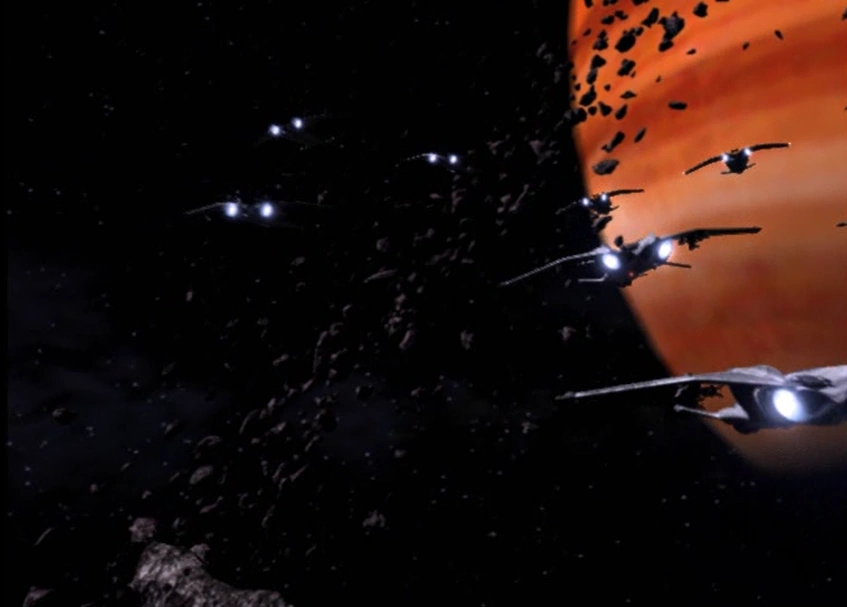
Now that we have an update to our Action Vehicular Combat, integrated the Chase rules, the Dogfighting rules and a few additional expansions, we need to test it out, with our newly revised Typhoons and Starhawks! Naturally, we need pilots, so we’ll choose our old friend Tobin Starlaw, to whom we’ll give this fancy new Ace Fighter advantage, and we’ll choose Starlet as his wingman. Starhawks are superior to Typhoons (they certainly cost more), and Tobin and Starlet are superior pilots, so they should be able to easily handle an array of mook fighters. Thus, for this battle, we’ll have the pair face off against a wing of 5 typhoons in an asteroid field (Rough, Normal terrain which starts at Distant range).

For simplicity, Tobin has Pilot 18, Gunnery/Artillery 16, Daredevil and Ace Fighter. Starlet has Skill 15 in everything pertinent. Tobin has an ally Tech-Bot with skill-18 in anything pertinent (mainly Electronics Operations, Hyperspace navigation and doing quick repairs). Starlet has some lame, run of the mill robot with no personality and skill 12. The Starhawk stats are here. What matters most is that the Starhawk has the following traits:

  • 140 HP, HT 11

  • An absolute maximum speed (for escape) of 650 (+14)

  • +4 Dodge (in high agility)

  • A best possible Chase Roll (high agility, afterburner) of +17

  • +4 accuracy on its missiles (4 missiles), with 6dx10 damage

  • -4 ECM (and a decoy launcher)

  • ROF 12 cannon (+2 to hit), with 6dx5(5) damage

  • DR 15 and force screen DR 200 which can be angled.

Our imperial pilots have skill 12. For a reference to a typhoon, see here. What matters most is that the Typhoon has the following traits:

  • 90 HP, HT 9f

  • An absolute maximum speed (for escape) of 750 (+15)

  • A best possible Chase Roll (afterburner) of +15

  • +5 dodge

  • -4 ECM (and a decoy launcher)

  • ROF 6 between two cannons (+1 to hit), with 6dx5(5) damage

  • DR 15

The Dogfight

Turn 0: Encounter

So, Tobin and Starlet patrol an asteroid belt, seeking to ensure its safety as a route to attack the dread imperial warship, Sunbreaker. As the great boulders float serenely past, Starlet breaks from her introspective musing to notice the red flash on her screen: five incoming bogeys. She taps her comms on and notifies Tobin, who responds that he sees them. The five Typhoons seem as aware of their presence as the heroes are of theirs.

The Encounter begins at Distant Range. The sensors won’t pick up targets farther than that, thanks to all of the interference from the Asteroids.

Note: It might be interesting to look at what an ambush might look like. How can you keep someone from detecting you, visually or with sensors, and then ambush them. What would such an ambush look like?

Turn 1: Distant (-19); 5 Typhoons vs Tobin and Starlet

Tobin signals to Starlet to break off. He’s faster and more agile and knows he can take out the Typhoons faster than she can, but not if he’s shackled to her less-capable piloting skill. He hopes to break some of the enemy fighters off. She acknowledges, her hands tighter on her controls, as she now knows she must face this threat on her own.

The Typhoons see the split and their engines rev with screaming plasma as they activate their afterburners and split, three after Tobin and two after Starlet.

This is an example of “Breaking up the chase into smaller parts.” Alternatively, all five could go after one, in which case we get a three part chase.

Terrain and Thrills: The GM declares the asteroid belt as sufficiently dense that it counts as Rough Terrain.

Step 1: Quarry chooses chase maneuver

In this case, we have no clear “quarry” and “pursuer”, so we go with whomever has the highest Basic Speed, which is surely Tobin. Thus, the Typhoons need to pick first. They choose “Move and Attack” of course, and pursue their respective stahawks. They activate their afterburners.

Step 2: Pursuer chooses chase maneuver

Tobin and Starlet are separate and can choose their own maneuvers. However, both Tobin and Starlet chooses Move and Attack. Their wings whine and then thunk as they shift into forward position and their afterburners unleash their plasma roar as they bear down on their targets (pursuit). They also adjust their force screens forward.

Step 3: Pursuer resolves any rolls for their maneuver

Tobin and Starlet both need to roll their operating rolls: 22 and 19 respectively, to avoid hitting an asteroid. They pass easily with a 3 (what a place to waste a critical success) and 13.

Tobin fires a missile at a Typhoon. His artillery skill is 16, the missile has +4 acc, is firing for airburst (+4), the Typhoon has +4 SM, -4 ECM, and a -8 speed penalty (Range does not matter). This means he’ll hit on a 16 or less and does so with a 10.

The Typhoon must defend. It has a dodge of 11, with +2 from its decoy which it fires. The missile applies a -3 to dodge, thus, the ship dodges on a 10 or less. It rolls an 8 and the missile sails past.

Starlet fires a missile at a Typhoon. His artillery skill is 16, the missile has +4 acc, is firing for airburst (+4), the Typhoon has +4 SM, -4 ECM, and a -8 speed penalty (Range does not matter). This means she’ll hit on a 15 or less and barely does so with a 15.

The Typhoon must defend. It has a dodge of 11, with +2 from its decoy which it fires. The missile applies a -3 to dodge, thus, the ship dodges on a 10 or less. It rolls a 9 and expertly evades the attack.

Step 4: Quarry resolves roll for their maneuver

All 5 typhoons must evade the asteroids; with a skill of 12 and a handling of +5, they need a 17 or less, and all do so (the worst roll is a 13). They swarm around the asteroids, having rolled out of the way of the first salvo of missiles, and then open fire in a hail of blaster bolts.

Each Typhoon is at Distant (-19) with an ROF of 6 (+1) against SM +5 starhawks. They have a radar lock (+3) and targeting computers (+2). With their skill of 12, this gives them a 4 or less. Not ideal, but this is extremely distant. At this point, all fighters are just specs to one another. Unsurprisingly, the bolts go wide, peppering the asteroids and lancing the space near our Starhawks, but never quite hitting.

Step 5: Resolve the Chase quick contest.

Each group must resolve their own. Tobin has a skill of 18 with a total bonus from his craft of +17 -2 from Move and Attack, giving him a 33. Starlet has skill 15 and +17 from her craft, -2 for move and attack, for a total of 30. The Typhoons all have skill 12 and +20 from their craft -2 for move and attack, for a 30.

Tobin rolls a 13, beating his skill by 20, while his 3 pursuing typhoons roll a 12, beating theirs by 18. Neither gains advantage of comes closer to the other. As both are pursuing, the agree to close range one step and are now at Extreme. The swift Typhoons more than compensate for Tobin’s amazing piloting, and though he edges towards advantage, they manage to fend him off for now.

Starlet rolls an 8, beating her skill by 22. Her two pursuing typhoons roll a 17, which is a failure. It’s not clear what happens here, if Starlet gets a 10+ margin, or if her opponent gets a success by 13and thus she “only” succeeds by 9. She chooses to become Advantaged and to close a step. As both pursued, they agree to shift another range band closer.

Starlet’s not doing so bad! With a quick blast of afterburners, she manages to outwit the two typhoon pilots who notice too late what she’s doing as she suddenly looms less than 200 yards behind them!

Turn 2: Tobin (3 missiles) vs 3 Typhoons: Extreme (-15); Starlet (3 missiles; advantaged) vs 2 Typhoons: Long (-11)

Terrain and Thrills: The GM rolls and comes up with a giant asteroid. He applies this to Starlet: her typhoons and she need to dive into Tight terrain, or Evade the giant rock.

Step 1: Quarry chooses chase maneuver

Starlet’s typhoons race to escape Starlet’s fighter and find themselves accelerating towards a looming planetoid full of craggy canyons and spikey craters. They dive towards it, accepting the danger. They attempt a Move (Escape) with their Back facing Starlet.

Those facing Tobin choose a Move and Attack (Pursuit) with the F facing Tobin.

Step 2: Pursuer chooses chase maneuver

Tobin notices Starlet’s starhawk chasing her prey dangerously close to a moonlet, and so figures he needs to end this. He chooses a Move and Attack, which he thinks should be sufficient to take out all three enemies.

Starlet chooses Move and Attack as well.

Step 3: Pursuer resolves any rolls for their maneuver

Starlet needs to make a roll at -2 to avoid the sides of the canyon she finds herself racing down and breakneck speeds. The GM insists on making it even more perilous, increasing it to -4. She has an effective skill of 19, reduced to 15. She passes handily with a 6.

Advantaged, her opponents face whatever direction she wishes. She chooses B, which they had assumed. She opens fire: their +15 speed is worse than her -11 range penalty, so she has a -15 from speed, +4 from size, +5 from radar and targeting computer, and +2 from ROF. She is focused on a single target. With her skill of 15, she has an 11 to hit. She rolls a 15 and her shots go wide, ripping chunks out of the canyon wall that her near supersonic fighter just misses as she dodges under them, but the typhoons remain untouched.

Tobin needs to make a basic Piloting roll to avoid asteroids and does so easily with a 9. He races around a smaller rock and then brings his cannons to bear. He divides his DR among all three: 8, 4, 4. He’s at Extreme (-15) range, with +5 from radar and targeting computers, +4 from their SM and, thanks to his Ace Fighter advantage, +9 from accuracy. His RoF allows him to add +1, +0 and +0. With his skill 16, he has a 20 or less against the 8-shot one, and a 19 or less against the rest. He could go for deceptive attack, but he expects his ROF to be enough to take them out. He rolls 10 (6 hits), 14 (3 hits) and 6 (Critical hit, with 4 hits).

The critically hit Typhoon cannot dodge. As a mook ship, it should promptly explode, but we check anyway: Tobin rolls a 17, causing a cascading failure, which inflicts double damage and he rolls twice more for 9 (no effect) and 15 (disabled weapons). Thus, the first hit blasts through the cannon, ignites the fighter’s power cells which explode dramatically. The first shot deals a total of 240 damage vs an effective DR of 3. This is a major wound, which forces the ship to check to see if its disabled (at -1), which it fails, and it forces a survival check, which it just passes. Then the other three shots hit it. Thus, the cannon explodes, the ship begins to drift out of control for a split second before the rest of the shots lance home and it catastrophically detonates.

The second Typhoon needs to dodge by 6 or more. It has a base dodge of 11 with no additional bonuses. It rolls a 10 and thus dodges 2 of the four shots. The remining 4 hit for a total of 440 damage after DR. The second typhoon disintegrates under the hail of fire. The third rolls a 10, also dodging two of the three hits; the remaining hit deals 120 damage, which is enough to disable the craft: however, it rolls an 8 on the HT check and is still able to continue, though realistically its plasma fuel will probably ignite and in the interest of handling mooks like mooks, we say the starfighter is dead. The pilot ejects, and Tobin streaks past him while the imperial pilot shakes his fist amidst the growing debris fields of his companions.

Step 4: Quarry resolves roll for their maneuver

3 typhoons are dead. Two remain. They attempt to flee from Starlet and, perhaps, get the upper-hand on her. They need to evade the canyon walls, rolling a piloting skill at -4. This gives them a 13: They pass with a 13 and 12. Close one, with one of then just scraping its oversized wing on a canyon wall..

Step 5: Resolve the Chase quick contest.

Each group must resolve their own. Tobin has no opponents, and thus no chase roll.

Starlet has a 30and rolls a 14, beating her skill by 16. Her two fleeingtyphoons have a 32 and roll a 7, succeeding by 25.

Starlet’s wings narrow and she dives through a particularly close canyon and then erupts onto a craggy plain on the planetoid. Too late, she notices the circling Typhoons, which suddenly arise on her tail. They have advantage!

Turn 3: Tobin (3 missiles) vs 2 Typhoons (Distant vs Tobin, Advantaged and Long vs Starlet) vs Starlet (3 missiles).

Terrain and Thrills: The GM declares that the giant asteroid remains valid for Starlet and the two remaining typhoons.

Step 1: Quarry chooses chase maneuver

Starlet knows she needs to escape, but she’s pissed. She goes for a Force. She does not angle her force screens.

Step 2: Pursuer chooses chase maneuver

The Typhoons continue to pursue Starlet with a Move and Attack.

Tobin blasts through his Typhoons’ debris and then spots the red images of the Typhoons bearing in on Starlet, too close for comfort! He shifts his wings into their backswept position, and then punches his after burners, screaming at 600 (+14) to get to her. This gives him a total chase bonus of +17 (as usual) but only a handling of +3. To get “around” the asteroid, he declares his manuever to be a Stunt. The GM demands a -6 stunt. Tobin chooses a -8 stunt, and makes it a High-G maneuver.

Step 3: Pursuer resolves any rolls for their maneuver

The typhoons need to not crash into the asteroid. They roll a 9 and 8 and are fine.

They open fire on Starlet; She is Long Range (-11) but her speed of 300 (+13) is worse, so they’re at -13 to hit her; her SM is +5, their targeting computer and radar give them an additional +5 and their ROF gives them +1. With skill 12, they have a 10 or less to hit her. The first rolls a 13, his blaster fire going wide and spattering against the rocks and spires that Starlet races between, but the second rolls an 8, which hits her with not one but two shots.

Starlet must dodge. She has a skill of 15 and a handling of +4, which gives her an 11 or less to dodge (15/2 = 7, +4 = 11); at move 300 she cannot make a High G defense. She rolls a 15. Both shots hit. The first inflicts 115 (5) damage, which is reduced by her ablative DR of 200 and her static DR of 15 to 72 damage, and the second shot rolls 100 damage, which is reduced by her remaining 140 DR and her static DR of 15 to 69 damage, which means her vehicle has taken 141 out of 140 damage. This is a major wound; the GM rolls on the critical hit table to see if she has any additional issues and rolls a 14, which is a disabled engine. A blast lances through her fusion generator and her engines wink out. She finds herself tumbling out of control, lights blinking and her robot screaming in her comm while she shouts back at it to fix it. She rolls a 10 to see if her ship is still functional, and it, otherwise, is.

As Tobin’s starhawk reaches its absolute peak speed, he kills his engines, brings his wings flush against his body and lets the Starhawk spin as it hurtles up and away and begins to turn and fall towards the planetoid. The entire of the Starhawk shakes and Tobin grits his teeth as his vision begins to grey out. He must roll HT to endure the intense maneuver and succeeds with a 10. Then throttles forward, brings his wings back and rockets back into control, perfectly on course. With a -8 to his skill from his stunt and +3 from handling, he needs to roll a 13 or less, and succeeds with an 8. He has a +5 in his next chase roll against the two Typhoons.

Then Tobin opens fire, because he’s an Ace Fighter, which lets him fire during a Stunt. He fires a missile at one of the Typhoons: He ignores range, applies +4 for air burst, +4 for acc, -4 for ECM, +4 for SM, -8 for speed and his own skill of 16 for 16 or better. He hits with a 7.

The typhoon must dodge. Its Tactical ESM warns him of the incoming missile from the unexpected target before it’s too late. He banks sharply to the side in an attempt to dodge and throws flares at the last moment: the Typhoon has a dodge of 11 with +2 for flares, +1 for tactical ESM and -3 from the missile’s speed, and fails with a 14. The missile inflicts 180 damage, -15 for DR, for 165. This is not actually enough to kill the Typhoon, but as it’s a mook vehicle, we’ll declare it destroyed. It’s dodge fails to clear the explosion radius and the blast slams it into the planetoid, where its disintegrates in a spray or parts across the surface.

Step 4: Quarry resolves roll for their maneuver

Starlet’s robot attempts to restart the power and engines with an Electrician of 12, moving its tools and grippers deep into the bowels of the craft while beeping back diagnostics to Starlet. It rolls a 9 and her engines flare back to life.

Starlet tucks her wings closer to her body and then uses her larger body to slam into the Typhoon, hoping to knock it to its doom. She must make an operator roll (skill 15 + 4) and succeeds with a 10. The Typhoon deftly evades, rolling an 8 against its dodge of 11.

Step 5: Resolve the Chase quick contest.

Tobin pursues the remaining Typhoon. He has skill 18, his vehicle grants him +17, and he has a +5 from his high-G stunt. He rolls a 7 vs a 40 and succeeds by 33. The opposing Typhoon rolls a 9 against its 30 (-2 from Move and Attack) and succeeds by 21. Tobin closes to Extreme and gains Advantage.

Starlet has a 30and rolls a 10, beating her skill by 20. The last Typhoon has a 30 and rolls a 12, succeeding by 28. Starlet escapes its close confines: it still remains at Long, but neither has advantage on the other, though with her spinning out of control, that might not remain true.

Turn 4: Tobin (2 missiles, Advantage) vs 1 Typhoon (Extreme vs Tobin, Long vs Starlet) vs Starlet (3 missiles, Out of Control, -1 HP).

Terrain and Thrills: Why not more problems? He rolls a 9 for a new Chase Circumstance: nothing happens. Space is boring!

Step 1: Quarry chooses chase maneuver

The typhoon is pursued by Tobin and must make its maneuver. It tries to make its escape with a move, now that it’s outnumbered, or at least buy some time until Starlet crashes.

Starlet must make an Emergency Action even though her engines have been restarted. She keeps her wings forward and her screen in standard configuration.

Step 2: Pursuer chooses chase maneuver

Tobin Moves and Attacks. He sets his wings forward once more.

Step 3: Pursuer resolves any rolls for their maneuver

Tobin is “on the asteroid” now and must roll Piloting -4. Even with a 14, this is child’s play for an elite pilot like Tobin. Then he locks on the Typhoon and opens his gatling blaster on full auto to eliminate it.

Tobin is at Extreme (-15) range, against an SM +4 craft, with a full targeting system (+5) and a high ROF (+2). He may also use his accuracy (+9). He needs a 21 to hit and hits with 6 out of 12 shots. The Typhoon needs to dodge with its 11 and fails, rolling a 13. The total comes to something around 620 damage and the fighter disintegrates under the withering hail of fire.

Step 4: Quarry resolves roll for their maneuver

The last Typhoon is dead, but Starlet must still endure. She must roll against HT to keep operational. She rolls an 12 and the vehicle is “out.” She triggers the ejection system as the Starhawk descends towards the planetoid and then crumples against its surface.

Notes

In Tinker Titan Rebel Spy when I ran a space fight, I felt embarrassed and sort of brushed through it. I felt like it was too abstract, too long, and too uninteresting. This has none of those problems. I think if I’d had this system in place then, I would have been far less shy, as this, to me, feels very dramatic and exciting. The numbers are a bit fiddly to work out, but this is no worse than space combat.

The Typhoons performed pretty well. They remained something of a threat to the Starhawks, though Tobin ripped through them like nobody’s business. His Ace Fighter made an enormous difference, maybe too much of a difference, but I’ll chalk that up to the fact that his opponents were mook pilots. Starlet, being a more reasonable character (more on par with what a typical player character might be, if they invest a littleinto their piloting skills), had a tougher time. A lot of her results came down to luck. With a slightly better set of results, she might have turned it around.

The Typhoons are very simple and very effective. Their blasters proved enough to take out a starhawk, and their extreme speed made even mook pilots a challenge, especially given their high dodge values.

The Starhawks also did what they were supposed to do. Their force screen let them survive serious hits, as did their superior HT. Their heavier armament also made a difference. They were clearly better than the Typhoons, but one would expect them to be. I worry that the afterburners, variable wings and adjustable screens might be too “fiddly” but at least here it worked out oka.

I think I would argue that blasters are better than missiles, but it depends on range and ECM. The -3 to dodge works out well, though I’d like to play with that a bit. Different missile times might have different values. A missile certainly does the job, as we could see, but blasters reallyaren’t bad, at least not for fighting other fighters. If you can get close, I’d use it as a primary weapon, which means we have that “Mig Alley” feel that I wanted: Missiles are good, but don’t dominate.

The robots didn’t do much. They maybe could have tried to jam sensors (perhaps this would have saved Starlet’s fighter). They could have jammed missiles, but the typhoons had no missiles, and no robots to jam the starhawk missiles, so it was moot. Could they have jammed the targeting sensors? Slamming attackers with a -3 might have been a big deal. I should work out those details in Passenger Actions, and contemplate what happens if a fighter pilot tries to do the same.

Next, we need to look at Dreadnoughts and what they can do, and what it’s like to face one in a fighter, as well as (laser) hot dreadnought-on-dreadnought action!

Action Vehicular Combat

These rules are based on the GURPS Action Chase rules starting on Page 31 of GURPS Action 2: Exploits; this has been substantially updated to account for dogfighting and other, heavier forms of vehicular combat.  While this was designed for Psi-Wars, most of it should work for any vehicle-heavy Action game.

New Traits

Ace Fighter

25 Points

The character is an elite vehicular combatant: he gains all the benefits of a gunslinger when using vehicle-mounted weaponry (such as missiles, fixed-mount blasters, or turrets). He also gains +1 to vehicular dodge to the first attack he suffers that turn after making a successful stunt.

Range Band Table

Psi-Wars uses an expanded Range Band table, both for ranged combat and for chase scenes. Use the lowrange penalty for all ranged attacks.

Range Band

Starting Range

Range Penalty

Notes

Close

0-5

-0 to -2

Melee Range; Apply bulk penalty to ranged attacks at this range

Short

6-20

-3 to -6

Pistol range;

Medium

21-100

-7 to -10

Long

101-500

-11 to -14

Rifle Range

Extreme

500-2000

-15 to -18

Sniper Range

Distant

2001-10,000 (5 mi)

-19 to -22

Missile range

Beyond Visual

10,000-50,000 (5-25 mi)

-23 or more

Requires active sensors to engage

Remote

50,000+ (25+)

-27 or more

This is beyond meaningful range in any chase scene!

Rounds

Use the rules found on page 31 of Action 2.

Round Sequence

You may use the sequence noted on Page 32 of GURPS Action 2 (especially if the chase is literallya chase). Alternatively, the character with the higher Basic Speed or the character with Advantage is declares second and resolves first (like the “Pursuer”)while the other character declares first and resolves second (like the“Quarry”). This works best for dynamic “dogfight” style combat, or running gunfights.

Characters driving vehicles that have configurable options (afterburners, variable geometry wings, angular force screens etc), the configuration of the vehicle must be set when the player declares his character’s maneuver.

Chase Maneuvers

In addition to the notes on page 32 of GURPS Action 2, the following rules apply:

Advantage: A character who wins a “chase roll” gains advantageover his opponent. This represents superior positioning! Advantaged characters gain a few benefits over their opponents, noted here and in the Chase Roll resolution roll. Once advantage has been gained on a target, it cannot be lost until the character loses a chase contest or he switches targets for his chase maneuvers.

Collision Range: Any vehicle whose speed bonus is greater than the absolute value of their range penalty is at collision range. This is “close” for humans, but may be much greater for faster vehicles. “Collision Range” is important for certain Conditions.

Facing: Vehicles have 6 faces: Front (F), Right (R), Left (L), Back (B), Top (T) and Under (U). A vehicle that “pursues” its target has its Front (F) facing its opponent, while a vehicle that “evades” its target has its Back (B) facing its opponent. When a chase or fight begins, or when two vehicles which had not previous engaged one another do so, they are “Neutral” to one another, and the GM can determine what their initial facing towards one another is. Any fixed mounts on the vehicle must have the proper facing to fire. Characters who are Advantaged may make an attack at any facing of its target (Within reason: generally two ground vehicles cannot attack the “Top” or “Bottom” of the other, for example). Note that in a chase or a dogfight, facing is, in fact, highly dynamic. This represents the facing that most commonly faces your opponent.

Match Speed: Characters who are already Advantaged against their target and gain Advantage again may “match speed.” The benefits of “matched speed” are noted in the attack rules!

Pursuit or Evasion: Instead of worrying about “Pursuer” or “Quarry,” when a character chooses a maneuver, he must declare if he pursues or evades. A pursuer may not increase range between himself and his target, while an evader may not reduce range between himself and his target. Two characters may attempt to Pursue or Evade one another! A vehicle with a stall speed may notpursue a target that is Advantagedagainst it.

Static: Static maneuvers cannot be undertaken by vehicles with Stall Speeds unless that Vehicle has first Stopped. Static vehicles automatically lose Advantage and cannot gain it.

Specific Maneuver Updates:

Attack: Vehicles with a stall speed may not Attack. Facing: F

Disembark/Embark: May also represent boarding a vehicle or entering/departing a carrier in a fighter, or escaping a vehicle via ejection system or lifepods. Minimum necessary range is Collisionrange. Facing: Any(Operator choice).

Emergency Action: Facing: Any (Opponent’s choice).

Force: Requires Collision range, rather than Close range. Facing: Any (Operator’s choice).

Hide: Facing: Any (Operator’s Choice)

Mobility Escape: Facing: B.

Mobility Pursuit: Facing: F.

Move: You must note if you are pursuingyour opponent (in which case you have F facing) or escaping your opponent (in which case you have a B facing). Note that two vehicles can attempt to pursue one another if both seek Advantage. Vehicles with a stall speed may not Pursue a vehicle which has Advantage against them (but they may Escape).

Move and Attack: Facing: F; if you have sufficient mobility to gain a mobility move, at the GM’s discretion, you may freely attack normally disallowed facings (such as the Top (T) of a ground vehicle with an aerial vehicle, or the Underside (U) of a boat with a submarine).

Reverse: Ignore this; this is better handled by the facing system and the fact that vehicles can switch between pursuer and pursued at will (and, in some cases, both are pursuers)

Ram: Requires collision range, not close range. Facing: F.

Stop: Facing: Any (Operator’s Choice). This can also be treated as a static maneuver wherein nothing happens, as opposed to surrendering a chase (especially in a space battle!).

Stunt: Facing: Any (Operator’s Choice). Vehicles with a stall speed may not Stunt against vehicles which have Advantage against them (but they may Stunt Escape). Stunts may also be High G. A High G stunt adds +1 to the chase roll, in addition to the bonuses gained from the Stunt itself, but requires an HT roll with the same prerequisites, bonuses and consequences as outlined in High-G dodge in Defenses (see below).

Stunt Escape: Any (Operator’s Choice); Stunt Escapes may be High-G, just as with Stunts above.

Chase Rolls

See GURPS Action 2 page 34, with the following update:

Chase Rolls meet in a Quick Contest. The outcome sets the range band at the start of the next round:

Victory by 0-4: No change. If your opponent had Advantageagainst you, they lose it.

Victory by 5-9: You may either gain Advantageagainst your foe or shift range by one range band. Characters who already had Advantageagainst their foe may Match Speed. If the character chooses to shift range, those who made a Pursuing Move or Move and Attack mustreduce range while those who made an Escaping Move or Move and Attack must increase range.

Victory by 10+: You may Match Speed or shift range by one range band and gain Advantage (unless you already had Advantage, in which case, you Match Speed) or you may shift range by two bands. Shifting bands follow the rules for Victory by 5-9.

Voluntary Shifts: If both craft pursue one another and both involved agree, an additional range band shift can be freely granted. If both craft attempt to escape one another and both involved agree, either an additional range-shift can be granted orboth can simply escape.

Escape

Escape occurs under the following conditions: the chased target successfully hides and elects to escape; the pursuer stops and declares their intent to resign the chase; the chased target exceeds the maximum range for attack given the current terrain; the chased target successfully shunts into hyperspace.

At the GM’s discretion, if the chase enters perfectly open terrain where further maneuvers are no longer relevant and only maximum speed matters, the GM can declare that the vehicle with the highest speed automatically wins the chase. For the chased target, this results in an escape. For the pursuer, this means that combat occurs at whatever range the chaser desires.

Static Maneuvers

See Page 34 and 35 of GURPS Action 2. Note that a static maneuver grants your opponents one free range band shift, and not victory on a chase roll! The static vehicle may still participate in the chase and may even gain Advantage, but their opponent will still gain their range-band shift!

A vehicle that has Matched Speed automatically loses its Matched Speed bonus if it engages in a static maneuver and its opponent does not.

Attacks

See GURPS Action 2 page 35 with the following clarifications:

Advantaged: If you pursuedyour opponent and you are Advantagedyou may choose to attack any facing the GM allows.

Deceptive Attacks: Characters engaged in a chase maymake deceptive attacks!

Facing: Any weapons you wish to attack with musthave the option to attack in the facing you currently have. When attacking, you will attack the facing that your opponent declared. If you are Advantaged against your opponent, you may choosewhich facing to attack. If you have the ability to make a mobility pursuit or escape, the GM may allow you to attack normally forbidden facings. If you have the option to choose which opponent’s face you attack, this choice applies only to your attack (a different opponent might attack a different face).

Matched Speed: If you have Matched Speed, you gain the benefits of Advantaged; Additionally, instead of using the Range (and Speed)modifier below, use the higher of the absolute value of the range penalty or your Stall Speed as your Range/Speed penalty. Finally, you may add accuracy to your attack even if making a Move and Attack (or any other attack that does not normally grant accuracy).

Movement: Gunslingers never suffer movement penalties for firing with hand-held weapons. Vehicle mounted weaponry never suffer a penalty for move and attack. Passengers aboard a vehicle suffer a -1 for hand-held weapons only; vehicle mounted weapons (such as stabilized turrets) suffer no penalty.

Range (and Speed): Always use the highest of the absolute value of your range penalty, your own speed penalty, or your opponent’s speed penalty as your range penalty. In most cases, range will be the most important concern, but as very quick vehicles get closer to one another, their speed matters more and more. If your own speed bonus exceeds the absolute value of your range penalty, then you’re said to be “in collision range.”

Sensor Lock: Gain +3 to all attack rolls if you have a sensor lock.

Targeting Computer: Gain +2 to all attack rolls if you have a targeting computer.

Gunslingers and Ace Pilots: Most characters an only attack during the maneuvers stated on page 35 of GURPS Action 2. However, some characters have additional flexibility when attacking from a vehicle. Gunslingers may attack during the following maneuvers with hand-held weaponsand Ace Pilots may attack during the following maneuvers with vehicle-mounted weapons:

  • No Attack Allowed: Disembark/Embark (Ace Pilots Only), Emergency Action, Hide
  • Attack without Accuracy: Mobility Escape, Mobility Pursuit, Move, Stunt, Stunt Escape
  • Attack with Accuracy: Disembark/Embark (Gunslinger only!), Force, Move and Attack, Ram
  • Attack with Accuracy +1: Attack

Missile Attacks

When making a missile attack, ignore the above rules for deceptive attacks, range, sensor locks and targeting computers, and ace pilots never add their accuracy to the attack. Instead, when rolling to hit, add accuracy, size modifier, your opponent’s ECM penalty and half of your opponent’s speed modifier as a penalty (rounded up). Explosive weapons without armor divisors may attempt an “air burst” for a +4, and treat a miss by 1 on an explosive weapon as a “near miss”: a hit but with 1/3 damage and no armor divisor.

Missiles have a static dodge penalty of -3.

You may make a missile attack in any circumstances in which you can make a normal attack. With an Attack, add +1 to accuracy.

Defenses

See GURPS Action 2 page 35. In addition, characters with Ace Pilot gain +1 to their first vehicular dodge if they chose a Stunt maneuver (Whether or not it succeeds, the erratic motion is enough to throw off your opponent’s attack).

Advantaged: If you attempted to escape and you gained Advantage, add +1 to all Defense rolls this turn.

High-G Dodge: If the vehicle has an acceleration of 40 or more, or has a move of 400+, it can make a High-G Dodge. This adds +1 to the dodge, but the pilot must make an HT roll. This HT roll gets +2 if the vehicle has a G chair or if the pilot wears a G-suit. On a failure, the pilot loses fatigue equal to the mari

Missile Defense

If the attack is a missile, apply a dodge penalty of -3. If the vehicle is equipped with a Tactical ESM, add +1 to dodge missiles. If the vehicle has a decoy launcher, they may use it toadd a further +2 to dodge. Alternatively, the defender may attempt to jam the missile. Treat this as a parry using (Electronics Operation (EW)/2), with a bonus equal to half the vehicle’s ECM rating, and +2 if the vehicleis equipped with a decoy launcher and uses it.

Decoy launchers have only so many charges. If the GM declares that the decoy launcher is “running low,” roll 1d6: the result is how many times you may benefit from the decoy launcher rules.

If the missile is explosive (without armor divisor) and the vehicle defends with a margin of 0, treat the attack as a “near miss”: a hit that inflicts 1/3 damage. If the attack was already a near miss, then it misses entirely.

Force Screens

If the vehicle is equipped with a Force Screen, the DR provided by the Force Screen is ablative. Every point of damage it absorbs reduces the total DR of the force screen by 1. The Force Screen automatically recharges to full power between manuevers! Adjustableforce screens may choose to double the DR of a single facing, at the expense of halving the DR of all remaining faces; the facing configuration of an adjustable force screen must be determined when your maneuver is chosen.

Damage

GURPS Spaceships offers fairly detailed rules for damage which this new system does not. To compensate, the following table can be used whenever someone achieves a critical hit, or when a major wound against a vehicle is achieved.

3d

Damage

3

Critical System Damage: Inflict triple damage. If the vehicle is Flammable or Explosive, roll HT (-3 for Explosive). If the roll fails, the vehicle explodes next turn.

4

Cascading failure: Inflict double damage. Roll twice more.

5

Gaping Armor Hole: apply only half DR to this attack; further attacks may attack this point for -5, and if they hit, they may ignore DR.

6

Damaged Controls: -2 Handling until repaired and the ship has a “Close Call” Wipeout and must make an Emergency Action next turn.

7

Wounded passenger: choose one of the pertinent (player character or named NPCs) to take damage as though caught in an explosion (including a dodge roll, if that’s possible). If numerous nameless passengers exist, 10% of them die or are injured.

8

Wipeout: The vehicle has a “Close Call” wipeout and must make an emergency Action next turn.

9-11

Normal Damage only, no additional effects

12

Explosion: if the vehicle is Flammable or Explosive, roll HT (-3 for explosive). On a failure, an internal explosion occurs and damage is tripled.

13

Wounded Passenger: choose one of the pertinent (player character or named NPCs) to take damage as though caught in an explosion (including a dodge roll, if that’s possible). If numerous nameless passengers exist, 10% of them die or are injured.

14

Disabled Engine: power and engines fail. They can be restored with a passenger action and a roll of Piloting(Starship) -4, Spacer, or Electrician, provided the vehicle has Access space. This also causes a “Close Call” Wipeout.

15

Damaged Weapons: Half of all weapons (rounded up) are disabled until repaired

16

Force Screen Disabled: the ship loses Force Screen DR and will not regain it until repaired

17

Cascading failure: Inflict double damage. Roll twice more.

18

Critical System Damage: Inflict triple damage. If the vehicle is Flammable or Explosive, roll HT (-3 for Explosive). If the roll fails, the vehicle explodes next turn.

Thrill of the Chase

Pyramid #3/112 “Action” has Kelly Pedersen’s excellent “Thrill of the Chase” article, which adds all sorts of interesting complications we can use in chase scenes. I highly recommend it, and will borrow a simplified version for space.

Note that “space” in Psi-Wars is a very cinematic form of space. Asteroids aren’t remote mountains isolated by thousands of miles, but patches of densely packed boulders smashing into one another, and these patches might be scattered throughout an area near a planet, defying all astrophysics. Nebulas have ionic lightning churning in its stormy depths. Psi-Wars isn’t trying to offer realistic space combat (hence the use of aerial performance rules for its starfighters) but a funform of space combat.

Space Terrain

Open Space is always Open Terrain. The maximum practicalrange for all fights within open space is Beyond Visual (once one reaches “Remote” territory, the combat/chase becomes more strategic, a long march with distant artillery bombardment rather than the cinematic, nail-biting combat of closer ranges).

Nebulas are Open Terrain but reduce the maximum range to Distant. Sensors require active use (no automatic detection) and suffer a -4. All missiles suffer a -4 to accuracy.

Debris Fields such as asteroid fields, ice patches or junk fields, are Normal Terrain. Maximum range is Extreme, and while fighters can operate normally, anything larger than a fighter treats it as rough terrain. Especially dense debris fields count as Roughfor everyone!

The tunnels or canyons of an asteroid or an especially large battle station count as Tight Terrain. Fighters can fit, but treat it as rough terrain, and larger ships cannot fit at all. Maximum range is Longmaking these sorts of battles very close “knife fights”

Space Chase Events

Space is vast and empty and thus painfully boring, but not in Psi-Wars! While perhaps less dynamic and jam-packed than a planetary environment, a GM can use the rules from Thrill of the Chase to spice up a dog fight too!

Obstacle

The most common space obstacle is a single instance of an asteroid, comet or giant piece of space debris. Space is wide open enough that one can fly around it, or it might float out of your way, given time. Thus it can be circumvented with a single Stop maneuver, if you’re okay with “taking the long way around” which grants your opponent a free range shift, if they want it. You can also Stunt to get around it, or through it.

Plowing through such an obstacle (or blowing it apart with a Move and Attack) is more difficult. Treat the object as having 2d×100 HP; these are fairly small asteroids, but the smallest are easily as large and heavy as a fighter, and may even rival a dreadnought in size and mass!

Dead Ends

Space is too open to truly stop anyone, but if one arrives at an even larger asteroid, those bordering on planetoids, with tunnels large enough to hide a small spaceship. Ships that move towards a giant asteroid or icey body like this treat it as a narrowing of terrain from Open or Normal to Tight.

Bystanders

Most battles take place near planets with active traffic. Threatened bystanders might be a passing freighter or a passenger liner that suddenly shunts into real-space from hyperspace, unaware that it dose so in the midst of combat. They might suddenly arrive in the path of a ship and require extra consideration to avoid, or they might be hit by a stray attack and need some immediate assistance. Useful or Involved bystanders might be the authorities or potential allies that can be called upon to join the fray (local asteroid miners irritated at the Imperial presence, but not willing to openly fight). These might literally join the battle, or pass on messages or sensory information to help assist in finding or slowing the enemy party. An especially helpful example of a Useful Bystander might be a hyperspatial beacon, which can transmit navigational information, allowing for faster hyperspatial calculations for a quicker escape.

Opportunities

These represent battle-changing moments that grant options for Hide, Mobility Escapes, Mobility Pursuits, Stunts or Stung Escapes. Space offers few of your typical examples, such as a new vehicle or a change in the road, but it offers new and unique “cosmic” opporunities. Not every part of space will have the same opportunities, as the churning singularity of the death star of Styx offers different challenges than the traffic-heavy space around Denjuku.

  • Solar Flare or Ionic lightning Strike: A sudden flare of electrical activity jams sensors and communicators. This offers an ideal opportunity to hide, if the vehicle has the ability to “hide in open space” or is in terrain (such as a nebula or debris field) that allows for hiding. Also, during such an event, fighting with missiles or maintaining radar locks become difficult, which might change the dynamic of the fight.
  • Gravitational Wake: A large body moving at high speeds, such as a comet or descending meteor or the spinning of a black hole surrounded by debris, might allow vehicles to “pass in their wake.” This disrupts and distorts the hyperdynamic medium and may allow for very quick travel along predictable paths. This might allow for a stunt through the gravitational wake, or a mobility move as one “rides” the wake. These events tend to be short-lived.
  • Shunt Event: A large vehicle, such as an enemy naval vessel or an especially large passenger freighter or liner, can suddenly appear out of Hyperspace. Ultrascanners will warn of an impeding Shunt Event, but clever dogfighters can try to use it to their advantage, either putting the impending shunt even between themselves and their pursuers, forcing their opponents to go around while they traveled straight through, or trying to herd their target towards the shunt event so that it will momentarily block their passage. This can allow stunts or (for very clever ships) hide maneuvers.
  • Explosion: In a larger battle, if a large ship is suddenly destroyed, this sends out shockwaves and creates an instant debris field. The moment of destruction has a lot of power in it, and those too close to it might, themselves, be destroyed, and the sudden arrival of a debris field can be used by a daring pilot to force his pursuers into very tight and dangerous terrain.

Chase Circumstances

“Thrill of the Chase” offers an interesting Chase Circumstances table. A modified, space-appropriate version appears below.

3d

Event

3-4

Roll twice on this table

5

Giant asteroid/ice body/hulk reduces terrain to Tight

6

Opportunity appropriate to environment

7

Debris Field (or Debris Field ends)

8

Threatened Bystander

9-11

Nothing Special

12

Asteroid/Comet/Junk Obstacle

13

Useful of Involved Bystander

14

Debris Field (or Debris Field ends)

15

Opportunity appropriate to environment

16

Giant asteroid/ice body/hulk reduces terrain to Tight

17-18

Roll twice more on this table

Action Vehicular Combat – Musings

One of the reasons I wanted to step away from GURPS Spaceships is that it seems less compatible with the GURPS Action rules than I would like, and I didn’t want one rule-set for outspace and one ruleset for the ground. In principle, a repulsor-car chase and a dogfight should be essentiallythe same.

I’ve dug through the chase rules, and the Dogfighting rules from Pyramid and, of course, I’m already familiar with the Spaceship combat rules. My intent here was to get a feel for how things worked, and what I’d want to change if I wanted to use the rules for Psi-Wars. My core discovery is that the Chase rules are for chases, and what I really want is a vehicular combat system. The chase rules comment several times on what happens when you “Catch up” to your target: combat happens. Fortunately, the chase rules support combat, allowing the game to flow in and out of combat and chases:

Chases and combat aren’t exclusive! The chase rules support combat during a chase, and the GM is free to end a chase if both sides decide to stop running and start shooting. Similarly, if somebody bolts from a fight, the GM can switch over to the chase rules -GURPS Action 2 page 31

So if we want a more comprehensive example of what a Psi-Wars Dogfight or Tank battle looks like, what we ultimately need to do is work out how vehicular combat should work in GURPS Action, as the GURPS Action doesn’treally consider this, focusing more on cars and motorcycles than tanks and fighter jets.

Incidentally, a quick aside: one thing I’ve struggled with in GURPS Action is how to handle movement. If you’re at rifle range and you want to move to melee range, how do you do it? The answer has been staring me in the face the whole time: you trigger back into the chase rules. Duh. This actually means moving into melee is actually pretty easy.

Core Assumptions of GURPS Action

When it comes to chase scenes, the game assumesthat turns take up to a minute (it is intentionally vague), and that we have various range-bands. “Dogfighting Action!” assumes a minimum distance, typically Extreme. GURPS Action doesn’t really discuss “facing,” but Dogfighting action states that the “winner” faces the target and the “loser” does not. Another fair assumption is that if one is fleeing, their back is showing to the pursuer, whose front faces the target. The chase rules allow attacks, but the assumption is that while one might be firing the whole time, only a few shots “count” and those shots are the single attack made during the “Turn.” You’re also only allowed to attack during an Attack or a Move and Attack (or, as passengers, during Rams, Forces and Disembark/Embark).

Understanding Ranged Attacks

GURPS Action 2 requires those in a vehicle to attack at a -2 penalty or the bulk or their weapon whichever is worse (a “move and attack”) and disallows aim. GURPS Spaceships explicitly allows aiming (and assumes at least 3 seconds worth of aiming) and grants fixed mount weapons a +2 to hit, while turret weapons have a +0.

We’re mostly concerned with turrets and fixed mounts, as most vehicles will use one or both of these. According to B467, “Turrets” have no special rules, but Fixed Mounts must have facing, and the operator rolls against the lower of his Gunner or Control skill to hit. The other difference between the two is noted on page B548 under “Attacking from a Moving Vehicle.” For aerial vehicles, this is –1 for hand-held weapons and +0 for all other weapons; for water vehicles, a stabilized turret is at -0 while a fixed mount is a -1, and for an off-road ground vehicle, a stabilized turret is -1 and a fixed mount is -2.

This clearly disagrees with GURPS Spaceship’s +2 for fixed mounts, limiting the skill roll of the fixed mount gunner and generally applying a -1 above what a turret firer suffers. Where is the bonus for GURPS Spaceships coming from? Well, their description of Fixed Mounts on page 26 of Spaceships gives us a clue:

However, superior focusing or stabilization systems give fixed mounts better range and fire control (a +2 to hit).

The first thing to notice is that it notes that superior focusing or stabilization systemsgive the fixed mount its superior accuracy, notthe fixed mount itself. This might be a reference to how GURPS Vehicles works. For a 1-ton fixed mount, you need 40 cubic feet (and the mass associated with the structure necessary to support those 40 cubic feet). For 1-ton gun in a full-rotation turret, you need 48 cubic feet. GURPS Spaceships might hand-wave away both as “about 50 cubic feet,” and grand additional accuracy-bla-bla to take up the remaining 8-10 cubic feet. Note, also, the “however” in the quote above. This suggests that the rule balances outthe fact that a fixed mount can fire in only one direction, because why equip fixed mounts at all if turrets are just as good? In Vehicles, this is because of that lost volume and mass, but Spaceships doesn’t have that granularity, and so it needs to offset the downsides to a fixed mount, and this is how it does that.

So it seems that “Dogfighting Action!” is correct: fixed mount weapons don’t get a bonus. If anything, they should get a penalty! I like the idea of the piloting skill acting as a limiting value, but I worry that would over-rate the already exceptionally useful Piloting skill! It’s hard to differentiate one pilot from another if the game requires all characters to have the same skill! It’s also an extra layer of complexity. Thus it seems clear that Dogfighting Action’s handling of turrets vs fixed mounts is correct (and likewise, its handling of hardpoints: Let’s just ignore the -1 acc unless we’re mounting guns!)

But what about the -2 move and attack penalty? According to B470

Do notapply [the move and attack] penalty to mounted weapon attacks, ramming attempts, or vehicular melee attacks.

This is why I argue that GURPS Action assumes that all attacks during a chase are with hand-held guns, because the rules cover hand-held guns! This means that Mr. Pulver is correct again in “Dogfighting Action!”, your vehicle does notsuffer a move and attack penalty.

Passengers dosuffer a -2 or -4 penalty if the vehicle dodges (not the vehicle operator!). This is not in the GURPS Action chase rules, which instead gives the passengers a flat -1. This may be because of the way the game handles time. If a brigand in a truck opens fire at a cop-car and the cop-car dodges, the cop’s partner doesn’t fire thenbecause she’s being jostled too much, but once the car has settled down, she may take some shots at the brigand. All of this is covered by the “-1 for passengers.”

What about aimed attacks? GURPS Spaceships always allows them, “Dogfighting Action” seems to ignore them, and GURPS Chase rules onlyallow it when you stop moving. Is there any way to aim? Well, according to Basic: yes, but you’re limited by SR unless you’re using a stabilized weapon. So why doesn’t the Chase rules allow it? Well, under Attacks on page 35:

“Only Attack, Disembark/Embark, Force, Move and Attack, and Ram allow attacks. During other maneuvers, either your target isn’t in sight or your movement is too wild to allow a shot.”

This also explains why we don’t have Mobility Attacks (they represent shortcuts that your opponent cannot take, and that puts your target out of sight) or Stunt Attacks (Your movement is too wild), which answers one question I had, but at the same time, it reveals something I didn’t know:

“Heroes with Gunslinger can shoot during any maneuver but Hide!”

Woah! That’s amazing! So a Gunslinger can shoot at basically any time. He also gets accuracy where others wouldn’t. I personally think this should only apply to gunfire from handheld weapons. For mounted weapons, we need some sort of different advance, like “Ace Pilot” or something.

Ranges, Speed and Collision

One thing I found odd and interesting about “Dogfighting Action!” is that the system limited the fighters to Extreme range. Why is this? Well, as best as I could tell, it has to do with how range and speed modifiers are calculated. If we check “Target’s Speed and Range” on B551, it argues that we should sum the speed and range of the target and use that sum to find the modifier. Thus, a a car that travels at 25 yards per second (-6) and is 10,000 yards away (-22), the penalty is -22 (10,025 yards) not -28. Similarly, if you’re shooting at a super-sonic jet fighter going 500 yards per second (-14) that’s ten yards away (-4), the total penalty is -14 (510), not -18. These values might shift one way or another by a point, depending on how you round it, but it won’t make much of a difference until you bring those two values close together: a 500 yard per second craft at 500 yards away has a total of “1000 yards” and thus while each individual trait is -14, the final value is -16. This additional -2 is the worstsuch a penalty will be, and this is about where Pulver recommends you limit the range of the vehicle: given that these vehicles move faster than 500 yards per second at top speed, being closer to one another than 500 yards means they can slam into one another in less than a second: our speed begins to matter more than our range!

Taken together, this suggests that your ranged attack penalty should always be the worse of your range penalty or your target’s speed bonus as a penalty.

GURPS Spaceship does introduce a “Collision Range” which is an interesting concept. “Dogfighting Action!” mumbles something about forcing another target by tapping wings or something similar, but how close do you need to be? We can bring the concepts together: when your speed bonus is larger than the absolute value of your range penalty, you are in “collision range” because speed matters more than your range (and you can also cover that distance in less than a second). At this range, you may perform any action that requires you to be “Close,” including forcing, ramming and is the result of a reverse.

Facing

Many vehicles care about facing. A tank has more armor in the front than in the back; vehicles with angled force screens determine which direction those screens face, and vehicles with fixed mounts can only fire in a single direction.

GURPS Action makes no distinction about the direction the vehicles chase. This is likely because for vehicles like cars, motorcycles and other typical “chase scene” vehicles, this doesn’t matter. Your action hero might be escaping by driving backwards, so his front faces his pursuers because it’s cool. Sure, that can happen in the Action rules as written, and don’t matter as far as the chase rules are concerned.

They dostart to matter for vehicularcombat. A character can reach out of a window and fire his gun in any direction, but a car with machine guns attached to the top cannot. A lot of the maneuvering of a dog fight is an attempt to get behind the opponents, so that his weapons cannot fire on you, while yours can fire on him.

So, the question is: how do we determine facing, especially in dynamic situations, like trying to get above another fighter, or to attack the side of a vehicle that is trying to keep you behind it or in front of it. GURPS Spaceships has a few suggestions, as does the “between the lines” of “Dogfighting Action!”

  • If you succeed at a “Chase” roll and reduce range, your front is pointed at the other vehicles.

  • If you succeeded at a “Chase” roll and increase range, your back is pointed at the other vehicles.

That much is obvious. What’s also implied here is that if your intentis to increase range or reduce range, then you have the same facing. That is, if you try to escape, your back is facing the other vehicle whether or not you succeed. GURPS Spaceships treats facing as an aspect of a maneuver choice (The evasive and escape maneuver have your back facing the target).

This creates an interesting situation that contrasts GURPS Spaceships with “Dogfighting Action!”. In the former, both combatants choose their facing. It’s possible for both fighters to face one another for the entire battle; this is less a case of two fighters just staring each other down, but more that they “swoop” past one another at high speeds, and both turn as one to make another “jousting pass.” In “Dogfighting Action” the one who succeeds at the maneuvering roll dictates the facing of both himself and his target: he can shoot but his rival cannot. It should be noted that GURPS Spaceships 4 offers a compromise between these two positions with “Airplane-Style Dogfights” where if your opponent gained Advantage on you, you cannot choose to “close” and thus cannot “face” your target.

This suggests a Spaceships’ like model. You can either attempt to “Close” with your opponent, in which case your “front” faces your target; or you can attempt to “Escape” your opponent, in which case your “Back” faces your target. If you can outmaneuver your opponent, you might gain some“Advantage” which might do a few things, but one of those things might be to let you choose your opponent’s facing. If you have a Stall speed, you cannot “Close” on a target that had advantage on you in the previous turn.

All-Out Move or All-Out Move and Attack

One thing that came up as I worked through the Chase rules is that the Chase Roll Result gives equal weight to speed and handling, but the vehicle rules give extra weight to Handling (which assists in dodging). This makes Handling superior to Speed for chases. Is this okay?

If you have a vehicle with a Speed bonus of +1 (3 yards per second or 6 miles per hour) and a Handling of +5 (say, a extraordinarily agile hoverboard) in a chase with a vehicle that has a speed of +11 (150 yards per second, or 300 miles per hour) and a Handling of -5 (say, a rocket-sled with no steering or meaningful brakes), they would be dead even in chase rolls, which might strike you as absolutely stupid, but that really depends on your circumstances. The rocket-sled can only go straight. If your race is on a flat and open field, then obviously the rocket sled wins, but if we’re in a cluttered city-scape, which is what GURPS Action assumes, then the Rocket Sled’s crazy speed only counts for so much if it needs to turn and can only do so by stopping, having the guy get out, turn it in the new direction, and hop back in and accelerate away, while the hoverboard can only putter along but can turn on a dime, jump, dodge, juke, etc.

How can I fix this? What am I even trying to fix? There seem to be situations, like on a straightaway, where raw speed matters more than your agility or your ability to maneuver. Taking an “All-Out Move” might make your speed matter more in some way. But how do you prevent people from using it in circumstances where it isn’t a straightaway. For example, what prevents someone from going “flat out” in a crazy situation full of obstacles, like on-coming traffic? The answer there, I’m afraid, is “nothing,” and in such situations, your handling matters a great deal, because superior handling and skill allows you to maximize your speed in situations where others wouldn’t be able to maximize speed, and maximizing your speed in dangerous situations where a failed roll could make you “wipe out” is the definition of a stunt.

So what are we left with? We’re left with the fact that in certain situations, speed matters more than handling. An example might be on a long, straight highway, or in the air if a fighter wants to escape. In such situations, where those involved are far enough away from one another that maneuvering doesn’t make a difference, the vehicle with the faster speed dictates what occurs. And that’s a simple enough rule to simply state: If you’re faster than the other guy, there are no obstacles and maneuvers won’t help you, then you just escape. If he’s faster than you, then you just don’t.

Dogfighting 2: Jet vs Tank

One thing I’ll need to handle if I get into fighters vs cap-ships, I need to see how high-speed craft work against slower, sea-bound craft, but I don’t havesea-bound craft that I can compare the standard TL 8 fighter to. However, I do have tanks. High-Tech has a TL 8 main battle tank, but I’m pretty sure I know how that fight will end, which is with a dead tank on turn one, because the fighter will get a missile lock, fire, and kill. The only real disadvantage is that the fighter isn’t carrying any missile that easily punches through armor, but the top of a tank is only DR 100, and the missile deals 200 damage; it wouldn’t necessarily be a one shot kill, but the tank sure wouldn’t be happy. Thus, I’d like to propose using the TL 9 “Light Battle Tank” from GURPS Ultra-Tech. It’s more advanced than the fighter, but at least it can fight back and make things interesting.

Surely,” I hear you say, “GURPS Action doesn’t handle things like a fighter jet ‘chasing’ a tank.” Oh, but it does! It calls this mobility pursuit. The fighter is able to operate on three dimensions and can treat the tank as static. Of course, it must pursue in ways that the tank cannot compensate for. Just chasing the tank over flat ground is not mobility pursuit, but if the tank must go over rough, rocky ground that the fighter can just soar over, then it becomes a mobility pursuit. Similarly, if things go bad for our fighter, it can use a mobility escape, simply climbing beyond the range of the tank.

It should be noted that the tank and a Psi-Wars capital ship aren’t precisely the same, because a fighter can’t use superior mobility against a capital ship, as both operate in three spatial dimensions, but we have some additional ways we can simulate it in Psi-Wars, if it comes to that.

The Craft

The fighter will be Maverick, once more: pilot-18, all other pertinent skills at 16. He’ll fly an advanced Viper (an “F-18”-ish craft).

Our tank will be a dangerous, experimental tank in the hands of some hyper-advanced criminal cartel. The Light Battle Tank (UT 226) comes with a tank cannon (which won’t be useful), a coaxial chaingun (which also won’t be useful), a “strike laser” which will be useful, and a rack of 10 missiles, which will also be useful. Among other things, it sports a tactical ESM (+1 to dodge if locked on). It has no radar or, despite its description, radar stealth. I am, however, going to borrow the Radar Stealth from the hover tank on the same page. At TL 9, this gives a -4 to radar, so we’re going to treat it, altogether, as ECM -4, for simplicity (we can argue it has thermal cloaking to prevent IR locks, etc).

The strike laser is on UT 116 and is, surprisingly, a TL 10 item on a TL 9 tank. Interesting. Let’s replace it with the Point Defense laser at TL 9, which weighs the same, just has halved damage. It has an accuracy of 18, and halved damage at farther than 9,000 yards (so, beyond visual). I’m not sure how it’ll handle “point defense.” I see no special rules anywhere, so for here, I propose we treat it like a parry. I might not use that rule for Psi-Wars, but we’ll use it here.

The Missiles are TMLs from UT 146. They have an accuracy of 3, and we’ll make them homing, but just treat them like the homing missiles from Dogfighting: they’re as vulnerable to ECM as any missile. Their minimum range is 3000 yards so, like the missiles from Dogfighting, they cannot hit closer than Distant, but can reach out to Beyond Visual. It’ll use proximity detonation HE rounds, so benefit from the +4 to hit, and will deal 6dx5 damage, which is less than the fighter’s missiles, but it’s also a smaller warhead (100mm vs ~160mm); the closeness in damage is no accident, as I used the TL 9 HE warhead as the base for my new missile. I could probably have worked out a more “realistic” version.
(The realistic version would use HMX from GURPS High-Tech, which has an REF of 1.7. If my calculations are correct, such a weapon would give 6dx7 cr ex, rather than the 6dx10 that I used; I could transition to this, but the LBT has a side/top DR of 200, which means it would be virtually impossible for our fighter to damage it).
The LBT can move at a top speed of 50 miles per hour, giving it a +6 to chase rolls.
The Tank is driven by the Claw, a nefarious agent up to no good; he has Gunnery and Artillery 18, and Drive (and all other pertinent skills) 16.

The Fight

Turn 1: Distant

Step 1: Quarry Chooses Maneuver

Step 2: Pursuer Chooses Maneuver

This is an interesting question, as our fighter really occupies a different scale than the tank does; this matters most for radar, as it’s much easier to pick up a jet, silhouetted by the sky, than it is to pick up a tank driving in a radar-noisy landscape. Nonetheless, we’re going to start with Maverick chasing the Claw, as the reverse is absurd, and Maverick wants to stop the Claw before he can get to some civilians and deal some real damage.
We’ll start at Distant, mainly because I don’t believe you could pick out a tank in cluttered terrain without visual confirmation, not well enough to target anyway, and I don’t have decent “sensor” rules yet, so we’ll go with this.
The Claw has some interesting options. He could Hide, which gives him a +0 due to the range involved, so he has a pretty good chance of pulling it off. This sort of makes sense: slip behind some trees and a jet-fighter cruising at mach 1 at high altitudes is going to have a pretty good chance of passing you by completely. Then you could pull out and “chase” the jet-fighter. However, since that sort of thing won’t be happening in space, and that’s really the sort of thing I want to understand, we’re not going to do that. Another good option is Attack. By stopping and taking time to aim a shot at the jet, our tank could do some real damage. I’m not going to do that either. Instead, the Claw chooses move, based on the rational that he doesn’t yet realize he’s under attack (he lacks radar, though perhaps his hyper-spectral sensors could pick up the jet, but is he even looking?) and he wants to reach his nefarious goal as soon as possible.
Maverick, of course, needs to remove this guy as quick as possible and chooses Move and Attack, firing off a missile. He’s not making a mobility pursuit, as he’s not actually cutting the Claw off in some unusual way.


Note: You can’t make mobility pursuits and attacks. Why not? Come to think of it, there’s a lot of maneuvers that look more like options. Couldn’t you do a Mobility Stunt Move and Attack, like your helicopter cuts off someone’s motorcycle while flying upside down and peppering the area with bullets? Or is that to much awesome for a single maneuver?

Step 3: Resolve Pursuer Rolls

Maverick gets to make his attack. He’s firing a missile, so he takes his:
  • Artillery 16
  • Accuracy 5
  • Target ECM -4
  • Target Speed (halved) -3
  • Target SM +5
So we need a 19 or less to hit. That ECM makes a difference, but not enough for its slow speed. Maverick rolls a 15, and hits.
The Claw gets notified the moment Maverick locks on (Tactical ESM), and begins to swear. He can dodge (he has a base dodge of 8, with a -2 from the tank’s handling, a +1 from combat reflexes, and a +1 from his tactical ESM, giving us a 8), or we can try point defense. If we treat that as a “parry” with gunnery, then we have a 9 + 3 + 1 +1 or 14, but I’m not sure this is the right approach: are all missiles equally easy to engage in point defense against? We have no rules I can find anywhere on point defense, so I don’t know what’s fair here. So, instead, let’s try a lame dodge. We need an 8 and we roll… a 9. So we’re hit. It’s a top hit (I can’t find where the rules say that its armor is located, but I’m going to assume the turret and front are DR 500, and tops and sides are 200). Maverick hits with 250 explosive damage, which means the tank takes 50 damage, out of it’s 150. That’s not enough to “stun” the vehicle, though it’ll temporarily have a -4 to its control rolls. It’s shaking and bouncing mercilessly, and the Claw’s ears are ringing, but he’s fine.


Note: the weaponry our fighter is carrying is just not strong enough to punch through armor. An air-to-surface missile might have something more like 6dx8(10) cr ex, which averages 160 damage and would punch through 1600 DR; the tank has DR 200, and is laminate with EMA, and thus has effectively 600 DR, which means it would take 100 damage from such a missile, on average, which is worse than what the air-to-air missile can do, but still isn’t a one-shot kill. Most of this is a technological disparity, though. An air-to-surface missile can generally kill a tank, and “fighter vs tank” is usually a terrible match-up for a tank.

Step 4: Resolve Quarry Rolls

No Rolls necessary


Step 5: Resolve Chase Contest

Maverick has a -2 from his move and attack, +14 from his speed, and +3 from his handling atop his skill 18, for a total of 33; he rolls an 11 and succeeds by 22. The Claw has +0 from his move, -4 from shock, -2 from handling, and +6 from speed with a drive of 16, for a total 16; he rolls a 3 and succeeds by 13, which is technically not enough, but it’s a critical success! C’mon!
Just based on results, Maverick could approach by a band, but let’s make the case that with a critical success, the Claw is able to somehow out maneuver him and stay just on the edges of Maverick’s approach. On average, though, we would expect Maverick to close a band at least once a turn, often two bands per turn.

Turn 2: Extreme; The Claw has 100/150 HP; Maverick has 5/6 missiles.

Step 1: Quarry Chooses Maneuver

The Claw is definitely the quarry, and running is futile, so we’re going to stop and Attack.


Step 2: Pursuer Chooses Maneuver

We rattled the tank last time. Another missile might get lucky again. Move and Attack.

Step 3: Resolve Pursuer Rolls

Maverick makes to make his attack. Our stats are largely the same as last time, but here they are again:
  • Artillery 16
  • Accuracy 5
  • Target ECM -4
  • Target Speed (halved) -0 (he’s static)
  • Target SM +5
So we need a 22 or less to hit, which means we’ll almost certainly hit. We roll a 10 and hit.
I don’t think I can make the case that our tank can dodge; this would be another good time to make a point defense attack; I sat down and hunted up some rules on this, and the only thing I could find was in Modular Mecha which gives point-defenses a skill of 13 or less. This is TL 10, so perhaps a TL 9 point Defense would be skill 12? If we do that, and roll an 11, then our point defense defeats the missile.

Note: Is this fair? I’m not sure. We really have no logic behind point defense, and it’s not something I’d include in Psi-Wars, but it would be nice to have some official rules behind it. The idea seems to be a wait and attack with an AI controlling the point defense, but would it aim? Do we care about range? Do we care about missile SM? How is this supposed to work? It’s not something I feel the need to dive too deep into, but I know it’s something a lot of people would like to see on a tactical (not space) scale of combat.

Incidentally, the damage it took last turn, does it still affect it this turn? I would say no, but then, I’m not really clear as to how shock should impact vehicles in chase scenes at all!

Step 4: Resolve Quarry Rolls

So, the Claw gets to make his attack. He can fire his Strike Laser (but if that was used as point defense, it is still an option?) or his missile. Given the ambiguity of the point defense, a missile would make more sense, but let’s see what the Strike Laser would look like.
For the Strike Laser:
  • Gunnery 18
  • ROF +0
  • Accuracy 18
  • Range -15 (Range + Speed = -17, if we wanted to be picky)
  • Target SM +5
We would need a 26 or less to hit, which is as close to a sure thing as we’re going to get. Lasers have absurd accuracy values; if we us the Psi-Wars reduced blaster accuracy, we drop down to 17, which is a much more interesting value.
For the missile:
  • Artillery 18
  • Accuracy 6
  • Target ECM -3
  • Target Speed (halved) -7
  • Target SM +5
This brings us to a 19 or less.
Either way, we roll 10 and hit. That leaves Maverick to dodge; he has a skill of 18, so a base dodge of 9, with a handling of +3, and can make a high G dodge for +1, so he has a 13 or less. He rolls an 11 and easily dodges.

Note: In my space combat rules, I made missiles harder to dodge, the idea being that they could turn with you. It’s an interesting idea, but given that they’re so accurate already, I’m a little loathe to do that. It might be interesting to explore in the future.

What’s also interesting is how agile and able to dodge our fighter is. We really need some means of trimming that dodge down, so it doesn’t turn into an interminable exchange until someone gets a critical hit.

Step 5: Resolve Chase Contest

The Claw took a static maneuver, but still rolls. As far as I can tell, he still rolls Drive and adds Handling, but doesn’t add speed. That’s weird, didn’t he stop? Well, as best as I can tell, these involve up to a full minute of manuevering, so what likely happened is that our tank drove, stopped, aim, and then drove some more, all during this one turn. The handling handles how quickly it can stop and go, so if this was a ferrari he was driving, he’d still have a decent chance of keeping ahead… well, to some extent as we’ll see. In any case, this gives him a total of 14 to roll against; he rolls an 11 and succeeds by 3.
Maverick has a -2 from his move and attack, +14 from his speed, and +3 from his handling atop his skill 18, for a total of 33; he rolls an 13 and succeeds by 20.
This means Maverick wins by 17, again, which is enough for a +2 shift, and because his opponent is static, he gets another shift! In principle, Maverick can move from Extreme to short and pass within 6 yards of the tank. There’s no reason to do this, of course, and Dogfighting suggests we get no closer than Extreme; given our elevation, this seems to be best.


Note: This makes “Attack” an ideal maneuver for our tank. We can’t escape anyway (though we could Hide, at least as a tank). This would be the sort of behavior I would expect from Psi-Wars capital ships: shot at incoming craft, and shoot at other vehicles, but not to try to “escape” fighters. In principle, it should not be practical.

It is interesting though: what happens if you’ve got your enemy down cold, and have that much mobility on them, but you’ve reached a point where there’s nothing more you can do with that mobility? Perhaps there’s such a thing as “too much mobility,” and that’s fair and this reflects that, but I wonder. Perhaps we should have some kind of strafing maneuver?

Postscript

I think I’m going to stop here, not because I’ve run into problems: we could play this fight out to the bitter end, but either Maverick runs out of missiles (either because the point defense takes them all down, or because he can’t get through the armor), or the tank gets a lucky shot on Maverick and takes him out. It’s actually fairly close at this point: each missile only has about a 50% chance of doing any damage, and a lot of it will be negligible (it got lucky on that first shot), mainly because it has the wrong armaments. With the right armaments, it’s one shot and one kill. We don’t have good rules for point defense; if we use the point defense rules from Modular Mecha, though, then the tank is pretty safe from missiles and I would hand the fight to the tank (It’s TL 9, so…).

I also note that the fight involves extremely accurate attacks, but we’re also featuring extremely competent characters, so that might be part of it. If the characters had skill 12, would this still be true?

What also jumps out at me is that at this point, the tank is actually stopped and fighting, and the rules for “Stop” in Action is that the Chase is over and you’re having “tactical combat.” This, of course, is geared towards people in cars shooting pistols at one another. The Chase rules are for chases, and what we want are vehicular combat rules. The combat rules of the rest of Action covers this for people; we need this for vehicles, which shouldn’t be too hard to put together. What the chase rules offer is an abstract form of movement which even the Combat rules of Action use for personalmovement.

But what I find interesting is that this holds up remarkably well. It does some odd things, but for the most part, it works more or less as I expect, and that’s because, as noted above, we’re using standard, not simplified, vehicular combat rules, we just have an abstract movement system layered atop it.

Fixing Scrapperlock

Every once in a while, the GURPS blogger community forms a wave of ideas.  Someone will post something, and then other people, inspired by the idea, will pile on and put in their own two cents.  This time, it was Douglas Cole on running away, which had followups from Peter on Dungeon Fantastic and Michael Eversburg over at Chainlink and Concrete.  The general context of the discussion was the fact that players will take on things too big for them and then fail to run away.  All of them offer insights into how best to run away and speculate a bit on why it’s so hard, but I want to talk first about the psychology of why players don’t run away.

Scrapperlock

I used to play a great game, now tragically defunct, called City of Heroes. One of the classes you could play was the Scrapper, a melee character with high damage output, but only middling defense, representing characters like Wolverine (Claws/Regeneration) or Batman (Martial Arts/Super-Reflexes).  The nature of the defenses were such that if you could hold out just a little bit longer, you could usually use some super-defense or heal to keep yourself going just a little longer, and your damage output was such that you could probably defeat your enemies.
This resulted in something the community liked to call “Scrapper lock.” Scrappers would join a party, jump into the fight, and then refuse to run away when things went south.  And for good reason!  With a little luck, a scrapper could turn the fight around.  So we (my first character was a Claws/Super-Reflexes character, so I am most familiar with scrapperlock) learned not to run, not because we couldn’t, or we were poorly equipped (My own scrapper was very quick and agile and could certainly leave a fight if he wanted), but because that next attack might just be enough to turn this whole thing around.  We didn’t run because we didn’t think we had to.

Scrapperlock and D&D

Douglas Cole was specifically referring to a D&D game in his post, and Peter mostly discusses Dungeon Fantasy, which means they’re both talking about the same sort of game.  In a typical D&D or D&D-inspired game, the monsters are usually geared towards the party.  One does not expect to stumble across an entire warband of orcs when you are level 1, but instead, to come across rats and goblins.  We learn, in D&D (and most MMOs), that we’ll always be able to defeat our opposition.  That’s why it has concepts like Challenge Ratings and levels.  The unspoken contract of D&D is that you should be able to defeat every encounter you come across, and failure to do so is a personal failing, an inability to grasp the tactical complexities sufficiently to defeat the tactical puzzle of that particular monster set.  Another unspoken rule of D&D and its ilk is that your characters are cool, and if you lose, then that’s not cool, and so the GM has screwed up somehow.
So of course you don’t run.  To run is to admit failure.  In principle, you should be able to win.

The Absence of Scrapperlock in GURPS Action

Chainlink and Concrete seems to miss this point entirely.  If you read his advice, for example, he discusses never taking on a fight that you’re not sure you can handle.  He’d be the sort of player who would scout every room in a dungeon, see the piles of orcs in two of the three rooms, and then sneak through the third room and avoid all conflicts.
Unsurprisingly, if you read more of Chainlink and Concrete, you’ll notice he’s more the sort of GM/Player who plays something akin to GURPS Action, and I rarely see Action characters who aren’t willing to run away.  An Action player tends not to look at a scenario as a linear sequence of rooms and encounters, but as a non-linear, holistic arena.  You have an objective (say, to assassinate a warlord), and if you can do that without fighting anyone, well, power to you.  You might bust in through the gates, fight the warlord’s entire horde, or you could slip around back, stab him in the face, and sneak back out, or you could even call him up, tell him he’s won a million dollars and tell him where he can go to pick it up, and then ambush him and stab him in the face.  Whatever you want.
This explains Michael’s completely different perspective, because he plays in a completely different style.  If you want to encourage your players to run away, you should consider running your game more the way Michael would.

GURPS as a Strategic Game

This is a topic I’ll come back to again and again, and will likely serve as the basis for a post at some point, and what I am going to say is an oversimplification to highlight a point rather than to “correctly” categorize games or to circumscribe play, but it amounts to this: If D&D is a tactical game (with a focus on a series of individual fights), then GURPS is at its strongest when it is a strategic game (with a focus on the big picture).  
GURPS doesn’t treat information gathering or stealth skills as minor add-ons while the ability to kick butt is central, but rather, it treats all of these elements as of equal value.  A character who has no combat ability (but loads of, say, politics, savoir-faire, lip-reading and pick-pocket skill) in D&D is a level 0 character.  A character with no combat skill (or very minimal combat skill) but loads of politics, savoir-faire, lip-reading and pick-pocket skill is as valuable in GURPS as a character with loads of combat ability.  To make both of these characters work equally well, then you must acknowledge that a non-combat approach is as valid as a combat approach, and the non-combat character needs to be aware that he will suck in a fight that the combat character can handle easily.  They start to become tools that work best when the group tackles the scenario as a whole, rather than a sequence of tactical encounters.  The interesting fight for the combat character is too dangerous for the non-combat character, and the encounter that’s interesting for the non-combat character is tedious and opaque to the combat character.  But a dynamic scenario where combat and political intrigue begin to merge, with the political character able to arrange access for the combat character to the target of assassination, while the combat character protects and guards the non-combat character, works well for both characters.
GURPS doesn’t have to work this way.  Dungeon Fantasy and Monster Hunters are both designed to allow most characters a more-or-less equal facility with combat, and even GURPS Action encourages all characters to be at least somewhat competent in battle.  But even Dungeon Fantasy can work as described above.  The Wizard can focus more on his lore skills or non-combat spells if he wishes.  The thief is not necessarily an assassin and the scout is not necessarily a sniper.  It’s completely possible to approach Dungeon Fantasy with the logic of GURPS Action, and when I run it, that’s exactly how I do it.

The Features of a Strategic Game

Asymmetrical Combat
In a typical strategic game, there’s no “balance” in an “encounter.” There are opponents arranged in a reasonable fashion.  There may well be an entire army at your gates, while their supply lines are protected by an old man with a spear and his two goats.  Players should see that the enemy often has overwhelming power, and that such power should not be encountered if the players can avoid it.  Instead, the players should adjust their strategy to best achieve their objective.  Speaking of which…
Clear Objectives
A Strategic game should have clear and specific objectives.  That is, you should be trying to save the city, or rescue the princess, or stop the lich from conquering the world.  These objectives are unique to the scenario, rather than general “Kill as many monsters as you can.” However the players achieve these objectives should be fair game.  If the players just sit the lich down and talk him through his personal problems and he chooses to give up his path of conquest and turn his necromancy instead to bolstering the kingdom with a supply of cheap labor then, well, congratulations!  You have won the game!  This matters because it will create the non-linear play that you’re looking for.
Strategic rather than Tactical rewards
D&D grants experience based on victory in tactical encounters: If you skip a room full of 10 orcs, you’ve lost 10 orcs worth of experience.  In a GURPS Action game, you’re going to get your bonus cash when the warlord is dead, and nobody cares how many people you did or did not kill along the way.  Strategic rewards focus your players on achieving their final objective.  If they probe defenses that turn out to be stronger than they expected, then they’ll retreat, check their intel, and try somewhere else, and they won’t be bothered that they couldn’t defeat that encounter, because that specific objective wasn’t the objective.
An Open World
A typical dungeon is a constrained structure, often designed to funnel the players along a predefined gameplay experience.  They don’t have to be this way, and they didn’t used to be that way.  The typical Action scenario is an open field that allows the players to come at it from multiple perspectives.  This definitely encourages non-linear play.
Active NPCs
A typical dungeon encounter waits for the players to come to it.  An action scenario often pounces the players, and usually does so with overwhelming power.  If players approach the next dungeon room because they are supposed to, and they cannot defeat the encounter, something has gone wrong.  If they exist in a world of asymmetrical combat, where terrifying, unbeatable opposition exists that can only be defeated via underhanded means, then players will learn that they want to have an encounter only on the best of terms.  If the enemy ambushes them in their sleep, then the players will learn to run, to fight that encounter only on their own terms.

A Difference in Philosophy

I want to note, first of all, that there’s nothing wrong with the D&D model.  D&D and its various incarnations are the most popular RPGs on the planet, and their computer-game descendants follow exactly these lessons, with level-balanced encounters and piles of loot and so on.  The Action model has its adherents and probably is best exemplified with MOBAs, stealth games, FPSes and skirmish games.  Thus, I’m not saying that you shouldn’t play D&D or run your DF game in that particular model.  I’m saying that if you do, you shouldn’t be surprised when your players get scrapper lock.  A bad encounter is a ruined night!  If you do want a more flowing, strategic game, though, consider my suggestions above.  Dungeon Fantasy can certainly handle that sort of gameplay!  
If you do, though, you need to also be aware that this philosophical shift will take some time.  I’ve run this way for my entire gaming career, and I’ve frequently been baffled by D&D players who joined my group and couldn’t figure out what to do.  Their problem was that they were looking for tactical encounters to be placed before them.  To them, being told “You must go to the dungeon and slay the lich king” is just pre-amble, not a trigger to go looking for maps, or lore on how best to kill the lich king, or for alternate entrances to the dungeon, or to try to figure out how the lich funds his armies so that they can infiltrate his organization, etc.  By the same token, I would often baffle them when I seemed “overly interested” in lore, and would try to “short-circuit” their dungeons by finding out “technicalities” that would get me to the end of the dungeon while bypassing all of the defenses.
These represents two very different gaming philosophies, and shifting a player group and culture from one to the other takes a lot of work.  It requires re-examining assumptions and learning an entirely new playbook.  I’d recommend doing it one small step at a time.  The first step to teaching your players to run away isn’t actually about encouraging them to run away, it’s about getting them to look at your dungeon in a new light.  Reward the character who looks into lore and the thief who keeps looking for secret doors with a chance to bypass a lot of your dungeon. Have the orcs up and ambush people and the lich take an active presence in the world (but don’t attack the players directly in the first few instances).  Make the player’s allies more important, and reward information gathering networks (if they don’t build them, introduce them to NPCs who do, NPCs who might have their own agendas).  Slowly expand the world around the players and put it into full motion.  Once the players become used to the idea of asymmetrical combat and thinking in a strategic manner, retreat will absolutely become an option (and once retreat becomes an option, you might start to see beautiful things, like the False Retreat, etc)

Psi Wars: Spaceships!

Seldon Crisis: Battle by AdamBurn
You seem to want a system for whooshing space opera battles between fighters and capital ships.  GURPS Spaceships is not that system.
I’ve held off on dealing with Spaceships for as long as I could, not because I dislike the book, but because I knew how much work it would be, and boy was I right. This was a doozy.  Ulzgoroth, above, is not wrong. GURPS tends to trend towards the realistic and Star Wars is, to put it lightly, not realistic.  That said, GURPS Spaceships actually does address whooshy spaceships at great length, especially in  Spaceships 4: Fighers, Carriers and Mecha, but we’re going to have to parse all of that, understand all of it, and then pull out all the pieces and put them back together to get the game we want.  Unsurprisingly, I can’t find much material on this sort of thing.  Most people I find who actually use GURPS Spaceships use the tactical system out of Spaceships 3, because it works pretty well out of the box.  We’ll take a look at that too, but by the time we’re done, we’ll have a combat system that’s as unique to Psi-Wars as the Chase System is to Action.
I’ll be posting Spaceships stuff all week. And all of next week too.  Like I said, a doozy.  Today, I’ll take a look at what’s wrong with the actual Star Wars paradigm and why it’s so hard to model in Spaceships, and we’ll take a glance at alternate GURPS models that might work better.

The Problem with Star Wars

The problem with Star Wars is that it isn’t actually set in space.  Like many space operas, it’s actually set on an ocean that happens to look a lot like space, but isn’t, because space isn’t an ocean.  Atomic Rockets, there, covers a lot of the misconceptions that Star Wars subscribes to but let me see if I can break it down for you here.
The typical Star Wars combat scenario looks something like this:
Star Destroyer and Tie-Fighters

You have a large, slow-moving capital ship that can launch squadrons of swift, agile and light fighters to defend it and to bring the fight to the enemy.  The two work in tandem to defeat the enemy, and the enemy needs to bring both elements with him to defeat his enemy.  This combination of tactics and weaponry, pulling an enemy in two directions (he must be fast to deal with fighters, but heavy to deal with the capital ship) is called combined arms.

The combined arms model Star Wars uses is that of carrier and airplane, especially from World War 2.  That looks something like this:
Carrier Landing

Again, large, slow, heavy capital ships (often flanked by destroyers and cruisers) launch squadrons of swift, light fighters to take the fight to the enemy, and to protect the capital ships.  The two support one another and, again, we get combined arms.  We can have the cool, whooshing dog-fights of the air and the stately elegance and astonishing power of naval combat.

But I want you to notice something that is true of the second picture and that is not true of the first picture.  In the second picture, the ship is in the water and the jet is in the air.  Air and water have two different sets of rules.  Air is light and easy to move through quickly, but requires a great deal of energy to remain in.  Thus, a World War 2 propeller fighter (as found in GURPS High-Tech) has a move of 200, while it has a range of about 500 miles (give or take 300).  Water, on the other hand, is harder to move through than air, but is far easier to rest on. Doing that costs you almost nothing.  As a result, a typical WW2 carrier has a move of only about 20 (literally a tenth of the speed of a fighter) while it has a maximum range around 10,000 miles, 50 times that of the fighter.

A lot more firepower

Furthermore, the airplane and the jet have different attack vectors.  Fighters come at you from above.  It turns out that a deck is terribly difficult to armor, meaning a relatively small fighter can carry more than enough fire power to sink your ship. To defeat them, you need missiles and anti-aircraft fire.  Ships, on the other hand, are better at attacking you on a horizontal plane.  They’ll fire shots at you that’ll hit you about around your middle.  That’s much easier to defend against, but since ships are heavier, they also carry a lot more firepower than a fighter does.  You create combined arms because each is exploiting its own unique medium to maximum benefit, and you need a way to fight in two different arenas equally well.

Space doesn’t work like that.  Space isn’t “two mediums” it’s just one, one that’s very easy to remain in (you can just drift, like a ship) and one that’s very easy to move through (you can zoom through it much faster than a fighter). There is literally no reason why a star destroyer couldn’t be as fast as a tie-fighter.  You put enough engines on the back of that thing, and it will literally move faster than a bullet.  In fact, just to be in orbit around a planet, it already must be faster than a bullet.  There’s also no wind resistance, nothing stopping it from spinning pirouettes and turning on a dime, except its own considerable inertia.  Imagine watching a star destroyer literally keep up with a tie-fighter and then wonder why the star destroyer even has tie-fighters.  In the Empire Strikes Back, a star destroyer keeps pace with the Millenium Falcon, “the fastest ship in the galaxy,” which previously had no trouble racing around with tie-fighters… so how fast is a star destroyer anyway? If star destroyers are so fast and agile and pack so much firepower, why would you bother with a starfighter like the tie-fighter?

Ultra-Tech civilizations toss around some serious firepower too.  In A New Hope, Luke Skywalker fires “proton torpedoes” at the Death Star and blows up something the size of a small moon.  The destructive power that tore apart the Death Star presumably came from a “chain reaction” within the Death Star itself, but how much firepower was in that proton torpedo?  Couldn’t  you put some anti-matter in there, or something of equivalent power?  It turns out that you can put some serious hurt on someone with just a small amount of anti-matter: A starhawk (the “not a X-wing” of GURPS Spaceships 4) carries 20cm missiles which can carry 100-kt warheads.  That’s nearly five times the destructive power as what we dropped on Japan in WW2, and it’s as powerful as actual ICBM nuclear missiles.  If a starhawk fires one of those at something the size of a battleship, the battleship would be gone.  So, if fighters like starhawks have stardrives and enough firepower to take out entire dreadnoughts, why would you bother with a capital ship like the star destroyer?

You might shake your head at me and say “You’re overthinking it.  Just enjoy the movies!”  and I do enjoy the movies, but we’re not in a movie now.  We’re in a role-playing game.  If a starhawk can take out an Empire-class dreadnought with ease, all the players will leave their dreadnoughts at home and just bring their fighters.  The setting and its rules need to be consistent and sensible enough that the players can work with it.

GURPS Spaceships operates with realistic space assumptions, which tears apart the thin tissue of lies that makes up our desired starfighter scenario.  However, it also gives us the tools to put it back together… but before we do that, perhaps we should actually look at a real dogfight model.

Dogfighting Action!

David Pulver (writer of GURPS Spaceships, BTW), wrote an article titled “Dogfight Action!” in Pyramid #3-53.  In it, he takes the Action 2: Exploits Chase rules and turns them into aerial dogfight rules, which sounds perfect for Psi-Wars! This uses modern fighters, which are too advanced for our purposes, but let’s take a look at those rules briefly.
In Exploits, the pursuer and the pursued both make rolls (in our case, Pilot rolls) to see who is “winning.”  There are a number of bands between the two.  If the pursuer wins, he closes on the pursued, while the pursued opens up ground between himself and his opponent.  This roll is based on your piloting skill, your handling and the speed of your craft.
In Dogfight Action!, this roll instead determines whether you have someone “in your sights.”  If I win, then I can either choose to approach and have you in my sights and fire, or I can choose to move farther away, in which case neither of us can fire at the other.
In Exploits, you can fire as a Move-and-Attack action to fire at your opponent, either by leaning out of the car window and shooting your pistol, or by firing the weapons on your vehicle.  The same applies in Dogfighting Action!, though no penalty applies for movement (fighter craft are built for this, apparently). It also has some interesting rules regarding missiles: Every fighter jet has an ECM rating, depending on how advanced it is.  This penalizes attempts to detect you early, and attempts to hit you with a missile.  I like this. It reminds me of chaff or emp pulses from games like Strike Suit Zero.
Both Exploits and Dogfighting Action! have cool tricks you can do.  Exploits discusses Stunts explicitly, which are cool tricks you can do that will get you killed if you screw up, but will also help you win the chase if you pull it off.  Dogfighting Action doesn’t explicitly refer to these, but definitely allows them.  It also discusses how to make the “Reverse” work, which in Exploits turns the pursuer into the pursued, or brings the pursuer very close to the pursued.  Dogfighting Action uses this to bring fighters much closer to each other.
I tried to put together a playtest to show you, but it rapidly fell apart because I, foolishly, tried to have two jets fighting one, a scenario that comes up all the time in space combat.  Action designed its rules to handle two-party chases, something explicitly referred to in a sidebar.  Dogfight Action tries to turn this into a combat system and it just doesn’t work as well as I think Pulver would like it to.  It also has some other strange flaws like, once again, missiles are all powerful and essentially guaranteed to hit (thanks to having an RoF of 1×194 for an RoF bonus of +7, on top of ignoring range and halving speed penalties and its considerable accuracy…), and all of the fighters were exactly the same, except for minor, niggling differences (one has an assault cannon, the other a gatling), which may well be true and also interesting (if we accept that, can we accept a sci-fi universe with only a handful of unique models of starfighter?)
I found some ideas in here interesting, but I couldn’t make it work as an actual dogfight system.  Ah well, stripmine it for ideas of value, and then we’re go back to the Spaceships system.
Seems like we’ll have to try to wrench it into something that’ll actually allow wooshing spaceship combat.

Psi-Wars — Adjusting the Templates

Now that we’ve adjusted the rules accepted that GURPS Action can serve as the engine for our Psi-Wars campaign, we can also revisit the templates from GURPS Space, which are pretty basic and constrained, and we can replace them with something more befitting of our particular vision of  cinematic space-opera universe.

Before we begin, though, I want to make a very important note: We don’t actually need to do this. If Action 2 is mostly compatible with how we see Psi-Wars, then Action 1 is as well.  There’s no reason that we can’t just use Shooters and Wheelmen and Faces, with a modicum of adjustment.  In fact, any templates I create here will probably look mostly like those already.  So, if you’re interested in running this now, just do it!

But say we want something a little more specific. Perhaps we want to make the Core/Rim split more pronounced by writing it right into the templates, or we feel like some of the templates don’t really fit the Action templates: A bounty hunter isn’t really an Investigator, nor is he an Assassin, nor is he a Big Man, but he’s a little of all three. Certainly Space Knights are almost nothing like anything in Action, except possibly the Weapon Master.  Likewise, some of the Action templates really don’t fit well at all in a Star-Wars inspired universe, like the Wire Rat or the Hacker.

I’m going to go ahead and make new templates, in part because of the problems noted above, but also so that you, dear reader, if  you are unfamiliar with how templates are made, can have a chance to see how I go about making them.

I prefer to open up my copy of GURPS Template Toolkits 1: Characters and use the process noted in there.  First, we would need to define our core activity (which, if you remember, we did in Iteration 1).  Then we’d need to work out niches, with suitable traits, that address those core activities (“Spying, Combat, Space”), then mix and match those niches and traits to create interesting templates (“An assassin is about the stealth and deception portions of spying mixed with a stealthy, ambush-focused combat”).  We do this to make sure we don’t miss anything.  The book goes into exquisite detail about how to do all of that, but the building of this pre-framework framework takes a lot of work.  Do we want to make that much of an investment? Do we need to?

Well, we’ve already noted that we can use GURPS Action, right? Action already has a list of “appropriate traits” and it’s already divided all of its niches up and put them in a handy “build your own character” book called GURPS Action 4: Specialists. This excellent book will let you make nearly any character you want… including, say, a Bounty Hunter or a Fighter Jock or a Diplomat (for aggressive negotiations).

Of course, we want to build a template rather than a character, but Specialists can give us guide-posts on what skills might be useful.  As an example, I’m going to create the Bounty Hunter template right here in this blog post.

What is a Bounty Hunter?

The first step in creating a template is defining the template.  What is a bounty hunter? Well, it says right in GURPS Space (Page 227):

Bounty hunters catch fugitives and bring them back in for a hefty reward.

Thus, in dangerous, anarchic rim, beyond the reach of the law, a bounty hunter hunts criminals others aren’t willing to pursue, nabs them, and brings them back to the authorities.  This implies quite a few traits.  First, they have some level of respect for the law but, at the same time, do not belong to “the system.” They are neither police nor noble, and is often little better than a criminal or thug himself. They go where those “in the system” dare not tread.  A bounty hunter walks in a violent world and engages in violence, but restrains himself at the last moment, bringing in his prey alive (“No disintegrations”).  A bounty hunter needs to be able to receive an assignment, figure out where his prey went, travel those long, interstellar distances while tracking him, get close to the target, subdue the target, and then bring them back for their reward.

Let’s look at the GURPS Space again and see what it considered important for the bounty hunter, mechanically.

For advantages, it requires Legal Enforcement Powers, which in this case represents very limited powers, and the “local jurisdiction” of “fugitives only.” Legal Enforcement Powers are on the Action “Suitable Advantages List” so that’s acceptable.

For skills, it emphasizes Criminology, I presume for understanding how the criminal mind works. This is certainly an acceptable skill (and puts lie to my idea of de-emphasizing it), Law (“Region”, though I’ll replace that with “Galactic”), presumably so the Bounty Hunter knows what he can and cannot do. This is also an acceptable skill. Finally, we have Streetwise, which represents understanding the street well enough to ask questions and find your query.

In general, the template has a strong focus on combat competence (Gunslinger, Fearlessness, High Pain Threshold, Beam Weapons, Brawling, etc), a decent focus on intelligence gathering (Improved Perception, Intuition, Photographic memory, Research, Shadowing), and a minor emphasis on “fitting in socially” (Cultural Adaptability, Social Chameleon, Acting, Fast-Talk), and resoluteness (Fearlessness, Single Minded, Unfazeable, Indomitable).

Choosing Bounty Hunter Skill Sets

Specialists work by taking a standard “Basic Action Template” and upgrading it with skill sets appropriate to the character.  We’re going to do the same, but we’re mostly noting how useful these skills are to the overall template.  Just as a character might have a particular talent or skill come up in three different skill sets, thus becoming highly adept at a particular thing, we’re going to note the total “cost” of all of our traits, to get an idea of how much emphasis our choices place on certain traits or skills.
However, I should emphasize that for our purposes, this is a guideline.  We just want to see which traits might be useful to a bounty hunter.  Obviously a given character won’t take them all.  We just need to present the options to them.  As we look at each template, we’ll decide which traits we see as “primary,”  vital to the concept, and which we see as optional, which represent minor background choices or particular paths a specific character might choose.
So, what skill sets suit a bounty hunter?
Hostile Extraction leaps out at me right away, as this is what a bounty hunter does. They go in and bring a character out.  
  • This skill set offers Craftiness, but that looks iffy to me.  Some bounty hunters will be subtle, but many will just blow open your door, shoot you full of sleep darts, and then cart you off to the Capital world for trial.  So we mark it as optional.
  • Brawling is too specific. We’ll just note “Unarmed Striking” and note it as primary. 
  • Fast-Draw is also very useful: More than just getting the drop on someone, it’ll let you shift back and forth from armed to unarmed, which is useful for a character who needs to grapple.  This is primary as well. 
  • The skill set also offers Guns, but we’ll trade that in for Beam Weapons and put it on primary (especially given that blasters can  have a stun setting). 
  • Holdout is less immediately important: Some bounty hunters will sneak close to their target, but others will be more straight forward, thus it’s optional.  
  • Intimidation will not just let you push people around to get to your target, but help you survive in the mean streets and keep your captive in line once you have him. Primary.
  • Psi-Wars doesn’t use rope, generally, so Knot-Tying is dubious. Optional at best.
  • Liquid Projectors are much cooler in a UT setting than in a modern, Action setting, but Psi-Wars doesn’t use vortex projectors.  The role of “mace” is replaced by Neurogloves and Nuerolash batons, so we’ll add Shortsword to optional.
  • Shadowing is very central to what a bounty hunter does. Primary.
  • Stealth is also self-evidently primary.
  • Judo or Wrestling is key too, though we’ll note them as “Unarmed Grappling”
You get the idea.  We need to go through each skill set, looking over the traits to see which are appropriate and which are not, a bit like building a GURPS character.  I won’t go over the specifics of each skill set, except to explain why I chose each.
A bounty hunter is pretty tough and determined.  The Resistance skill-set looked tempting, but it’s probably a bit much. Goon offers similar toughness of mind, and adds toughness of body too, so I took that instead. We need to find our prey, so that implies, in the very least, Detective. Once we’ve found them, we need to keep track of them with Surveillance or Electronic Surveillance (for homing beacons).  Once we’ve tracked our prey, we need to actually get to them.  That’s going to be a mixture of Tactical Driving for car-chases (or quick escapes), Bushwhacker for bounty hunters who are adept at hunting in non-urban environments, and Urban Assault for those who hunt in urban environments. Once you’ve got to your target, you need to take him down.  Close Quarters Battle lets you deal with him personally, while Booby Traps lets you deal with him more elegantly.
Specialists also has Power-Ups, for turning our bounty hunter into more than just a pile of skills. Gunslinger seems appropriate, given the cinematic excellence of bounty hunters both in GURPS Space and on the silver screen.  Survivor again represents their tenacity, and Just that Good is an excellent choice for anyone who is top-notch in general.
Going over the resulting skill list, I notice a few open spots. GURPS Space has an emphasis on social acumen.  Why? Well, it might be that the bounty hunter regularly interacts with other cultures, but I think it’s more likely that he needs to get close to the target. Violence is one option, but subtlety works as well (You can think of bounty-hunting as government-endorsed kidnapping).  So we can add Femme Fatale for one method of getting close, and Impersonation for another.  I considered Social Engineering, but a bounty hunter rarely manipulates his targets beyond closing in.  Finally, foot chases are almost a certainty, requiring some Parkour.

The Trait List

Primary Attributes: ST +1 [10]
Optional Attributes: HT +1 [10]
Primary Secondary Traits: Will +1 [5], Per +3 [15]
Optional Seconadary Traits: HP [2/level], Basic Speed [5/level], Basic Move +2 [5/level]
Primary Advantages: Combat Reflexes [15], Danger Sense [15], Daredevil [15], Fearlessness [2/level] or Unfazeable [15], Intuition [15], Law Enforcement [5]
Optional Advantages: Absolute Timing [2], Acute Senses [2/level], Ambidexterity, Appearance [Varies], Cat Fall [10], Craftiness 3 [15], Enhanced Dodge [15/level], Enhanced Dodge 2 (Dive for Cover) 2 [10], Enhanced Parry [5], Fit or Very Fit [5 or 15], Gunslinger [25], Hard to Kill [2/level], Hard to Subdue [2/level], High Pain Threshold [10], Night Vision 1-9 [1/level], Peripheral Vision [15], Rapid Healing or Very Rapid Healing [5 or 15], Rapier Wit [5], Recovery [10], Resistant to Poison +3 or +8 [3 or 5], Signature Gear [Varies], Wild Talent 1 [20], Upgrade Luck to Extraordinary Luck [30] for 15 points.
Primary Perks: Cheaper Gear (Vehicles), Equipment Bond (Vehicle), High Heeled Heroine, Honest Face, Penetrating Voice, Weapon Bond
Optional Perks: Robust Hearing, Robust Vision, Compact Frame, Off-Hand Weapon Training
Primary Skills:
Intimidation (Will/A) [12], Beam Weapons (Pistol) (DX/E) [3], Beam Weapons (Rifle) (DX/E) [4], Beam Weapons (Projector) (DX/E) [4], Criminology (IQ/A) [4], Fast-Draw (DX/E) (Ammo, Knife, Long-Arm, Pistol) [5], Forced Entry (DX/E) [2], Grappling [10], Intelligence Analysis (IQ/H) [4], Mechanic (Contragravity or Starship) (IQ/A) [4], Navigation (Hyperspace) (IQ/A) [4], Observation (Per/A) [8], Pilot (Contragravity or Starship) (DX/A) [10], Shadowing (IQ/A) [14], Stealth (DX/A) [4], Streetwise (IQ/A) [5], Tactics (IQ/H) [8], Throwing (DX/A) [3], Traps (IQ/A) [8], Unarmed Skill [10]
Optional Skills: Acting (IQ/A) [8], Acrobatics (DX/H) [4], Body Language (Per/A) [2], Camouflage (IQ/E) [4], Carousing (HT/E) [2], Climbing (DX/A) [4], Detect Lies (Per/H) [2], Disguise (IQ/A) [4], Electronics Operation (Sensors or Surveillance) (IQ/A) [8], Electronics Repair (Sensors or Surveillance) (IQ/A) [2], Escape (DX/H) [2], Explosives (Demolition) (IQ/A) [4], Fast-Talk (IQ/A) [8], Freight Handling (IQ/A) [2], Holdout (IQ/A) [2], Interrogation (IQ/A) [2], Jumping (DX/E) [1], Knife (DX/E) [1], Knot-Tying (DX/E) [2], Lip Reading (Per/A) [2], Naturalist (IQ/H) [4], Photography (IQ/A) [4], Research (IQ/A) [2], Running (HT/A) [4], Savoir-Faire (High Society, Mafia, Military, Dojo) (IQ/E) [1], Scrounging (Per/E) [1], Search (Per/A) [2], Sex Appeal (HT/A) [2], Shortsword (DX/A) [1], Smuggling (IQ/A) [6], Tracking (Per/A) [4], Traps (IQ/A) [4], Urban Survival (Per/A) [4]

Building the Template

We have far more than we need, but that’s rather the point.  There are a variety of “right ways” to build a bounty hunter, from a former cop who went rogue and now hunts for profit, or a big bruiser who utterly destroys his opponent, to a clever girl who seems harmless until she springs her trap, to a old and dusty cowboy who hunts you down in the barren wastelands of a distant desert.  What we need to do, though, is narrow the list above into a usable template that allow players to express the uniqueness of their character while also hitting all of the vital points, both for the game in general, and for their bounty hunter to feel bounty-hunter-y.

Now, the details of how best to do this are more art than science.  The Templates Toolkit and Specialists both offer plenty of advice.  The rest is just tinkering around and seeing what comes out.  In general, I find it best to start with the BAT, then hit the high notes.  First, determine the most important and necessary advantages and take them (for our Bounty Hunter, that’s Law Enforcement, Combat Reflexes and Luck).  Then determine the most important skills, and take them at appropriate skill levels (18 for true mastery/specialization, 16 for excellence, 14 for reliable competence, 12 for basic competence, and 10 for something you might use sometimes). If you have several viable approaches (for example, you could take Brawl or Karate), make a list of options. Then optimize your skills and traits to get the most out of your points (if you have 10 IQ skills that you’ve spend 20 points in each, you could take a talent or improved IQ to save points in skills), and then take any remaining points and put them into Advantages or optional “secondary” skills.

In regards to optimization, I’m a big fan of talents. A talent or two can really say a lot about the focus of a character.  The skill sets I found regularly referenced Craftiness, and also referenced Circuit Sense.  If we look at page 31 of Specialists, we see more talents that might useful: Outdoorsman and Smooth Operator leap off the page at me.  Or we can dig through Power Ups 3: Talents and find some nice talents. It’s not strictly necessary, but I enjoy it, so I will. While many talents can fit, I prefer those that draw attention (both in their name and in what they do) to the purpose of the character.  Keeping this in the mind, I chose Impersonator, Stalker and Tough Guy.
Finally, we should pay attention to point cost… but how many points?  Well, a standard GURPS Action Template is 250 points, including a 20 point “background lens.”  I like the idea of that background lens, so I’m going to shoot for 230 + 20 point background lens.  I suspect this will still not be enough (because this is a setting that features expert martial artists who also have super powers), but it’ll do for this iteration.
Here is my resulting template:

Bounty Hunter Draft 1: 250

Attributes: ST 11 [10], DX 13 [60]; IQ 13 [60]; HT 12 [20] (150)
Secondary Characteristics: Damage 1d-1/1d+1; BL 24 lbs; HP 11 [0]; Will 13 [0]; Per 14 [5]; FP 12 [0]; Basic Speed 6.00 [-5]; Basic Move 6 [0]. (0)
Advantages: Combat Reflexes [15], Legal Enforcement Powers (Bounty Hunter License) [5], Luck [15]. (35) A total of 35 points from the following: +1 to +3 ST [10/level], +1 DX [20], +1 IQ [20], +1 to +2 HT [10/level], +1 to +3 HP [2/level], Perception +1 [5], +1 Basic Speed [20], +1 to +3 Basic Move [5/level], Acute Senses (Any) [2/level], Ambidexterity [5], Appearance (Attractive or Beautiful) [4 or 12], Cat Fall [10], Craftiness [5/level], Danger Sense [15], Daredevil [15], Enhanced Dodge 1 [15], either Fearlessness [2/level] orUnfazeable [15], Fit or Very Fit [5 or 15], Gizmos 1-3 [5 to 15], Gunslinger [25], Hard to Kill [2/level], Hard to Subdue [2/level], High Pain Threshold [10], Impersonator [5/level], Intuition [15], Night Vision 1-9 [1/level], Peripheral Vision [15], Rapid Healing or Very Rapid Healing [5 or 15], Rapier Wit [5], Recovery [10], Resistant to Poison +3 or +8 [3 or 5], Serendipity 1-2 [15/level], Signature Gear [Varies], Stalker [5/level], Tough Guy [5/level], Wild Talent 1 [20], or Upgrade Luck [15] to Extraordinary Luck [30] for 15 points or choose from some of the perks below:
Perks: Alcohol Tolerance, Equipment Bond (Vehicle), High Heeled Heroine, Honest Face, Off-Hand Weapon Training, Penetrating Voice, Weapon Bond
Disadvantages: A total of 50 points from the following:
Primary Skills: Criminology (A) IQ+1 [4]-14, Law (Galactic) (H) IQ-1 [2]-12 and Streetwise (A) IQ+1 [4]-14; Select two from Research or Shadowing both (A) IQ+1 [4]-14, Intelligence Analysis (H) IQ [4]-13, or Observation, Search or Tracking all (A) Per+1 [4]-15.
Secondary Skills: Stealth (A) DX+1 [4]-14; Pilot (Contragravity or Starship) (A) DX+1 [4]-14, Beam Weapons (Pistol) DX+2 [4]-15; Two of Fast-Draw (Ammo, Pistol, Long-Arm, Sword) all (E) DX+2* [2]-16, Beam Weapons (Rifle or Projector) both (E) DX+1 [2]-14 or Shortsword or Throwing both (A) DX [2]-13; Choose one of Brawling (E) DX+2 [4]-14 or Karate (H) DX [4]-13; Choose one of Wrestling (A) DX+2 [8]-15 or Judo (H) DX+1 [8]-14;  Choose two of Savoir-Faire (High Society, Mafia or Military) all (E) IQ+1 [2]-14, Acting, Fast-Talk both (A) IQ [2]-13, Carousing (E) HT+1 [2]-13, Sex Appeal (A) HT [2]-12, Intimidation (A) Will [2]-13; Choose four of Forced Entry (E) DX+1 [2]-14, Climbing (A) DX [2], Acrobatics (H) DX-1 [2]-12, Camouflage or First Aid, both (E) IQ+1 [2]-14, Disguise, Electronics (Sensors or Surveillance), Explosives (Demolition), Holdout, Mechanic (Contragravity or Starship), Navigation (Hyperspace), Smuggling or Traps all (A) IQ [2]-13, Tactics (H) IQ-1 [2]-12, Swimming (E) HT+1 [2]-13, Hiking or Running both (A) HT [2]-12 or Scrounging, Survival (Any) or Urban Survival, all (A) Per [2]-14;
Background Skills:Computer Operation (E) IQ [1]-13; Vacc Suit (A) DX-1 [1]-12; Choose 20 points from a background lens;

Sanity Check

What do we need to be able to do this a character? First, the everyman stuff: Every Psi-Wars character should be able to work a computer, wear a vacuum suit, fly a ship or a vehicle, hike, sneak, shoot a blaster pistol, fight unarmed, talk his way out of a situation (influence skill), and take care of his wounds. Can we do all of that? Check.

Next, what were our goals? Using our updated version Action 2 and our goals, can we:

  • Get a job?  Well… uh, no.  We don’t have any kind of Current Affairs, though I suppose we could use our general fact-finding skills.  Better would be a Law-Enforcement contact.  We might also consider a Reputation: Typical Star Wars bounty hunters seem to be straight-up mercenaries. They get work by having a reputation for being effective and dangerous.
  • Find our target? Yeah. Criminology is a must, for understanding the criminal mind. We also have two additional skills required for researching things (See “Gathering Intel”).
  • Get to our target? Yeah. We have Pilot as a must, and we have options like navigation, survival, climbing and swimming for making it the long way.
  • Getting close to our target? Yeah, stealth is required, but we have several “impersonation” skills for sliding in close, and quite a few advantages in that direction as well (that’s why hotness is an option for bounty hunters), and why we have options like holdout.
  • Taking our target down? Yeah. We have hand-to-hand skills as a must as well as pistols, plus numerous other combat skills, and several trap options.
  • Turning our target in? Yeah. Law and Law Enforcement are required.

How do we compare to our original template? The original had Cultural Adaptability, Indomitable, Photographic Memory, Single-Minded and Social Chameleon, which we’re missing. I don’t see the need for Photographic Memory, but the rest have their uses: Cultural Adaptability and Social Chameleon help to get close to your target, Indomitable prevents them from talking you down, and Single Minded just fits the mindset. However, none of these are listed in the accepted advantages exceptCultural Adaptability. Let’s go ahead and add that and, while we’re at it, add Cultural Familiarity and Language. Our Bounty Hunter is well-traveled! For skills, we literally hit every note that the original template had, sans bullets. Well done!

Now let’s compare it to a typical action template. We don’t want to be too broad, or give the player too many choices (density will be too high). We currently have 39 options (not counting perks) in our Advantages list, while the typical Action character has less than 20 and even the Specialist BAT has only 35 or so. Can we trim? Well, I can remove Cat Fall, Peripheral Vision, Rapier Wit and Recovery, leaving ~35. The problem seems to be that the Bounty Hunter is a little bit of everything: It’s highly believable that the Bounty Hunter excels at finding people, killing people, seducing people, surviving just about anything, and flying away in their ship at high speeds.  We could probably ditch the Impersonation/Cultural Adaptability elements (that seems more the schtick of the spy), but given that they were in the original Bounty Hunter template in Space, I’m not quite ready to discard them yet. The character concept may well be too broad, but I’m willing to give it a shot for now. We can fix it later.

Disadvantages

This works the same as the skillsets, only we comb through the disadvantage options looking for the proper characterization/troubles that might afflict our bounty hunter, and then separate them into primary and optional. The primary will be selected first, and the optional will come later, like in the Action templates. The first set is priced so that the player can afford at least one copy of the worst disadvantage, or around half of his points, and the rest of his -50 comes from the optional.


The only required disadvantages should be absolutely requisite (like Duty for a soldier). For primary disadvantages, try to favor disadvantages that the GM can either form core of the character concept, or that act as a hook for pulling the character into action. Avoid any disadvantage that would stop the character from fulfilling his role (If you must have a disadvantage that might prevent a character from fulfilling his role, or that would pull him from the action, make it a secondary, so it comes up less often).

My chosen disadvantage packages were:

  • Antisocial: Bounty hunters get a higher share if they hunt alone.  Thus, many of the best might have more than just a chip on their shoulder.
  • Checkered Past: I presume that if a bounty hunter could be a cop, he would be.  Something drives him out into the rim, and one thing that does that might be some shady past.
  • Cocky: A willingness to leave the safety of the core for the danger of the rim requires a certain level of overconfidence.
  • Hard-Boiled: Life on the rim exposes bounty hunters to the darker sides of human nature.
  • Honorable: Bounty hunters might not brim with righteousness, but they do acknowledge the power and importance of the law.  In fact, they are the longest arm of the law.
  • Obsessed: A bounty hunter needs more drive than most people to get out of his comfy bed, and go into the darkest dives and deepest hidey holes, risking life and limb, to bring a man back.
  • Scarred: Too many run-ins with the dark-side of the world can leave bounty hunters in a bad way.  They might carry physical or metaphorical scars from their times delving into the dark-side.
  • Vice-Prone: Bounty Hunters do not hunt just for pleasure or a sense of honor. They hunt, explicitly, for the money.  Thus, one expects they have extra needs that need to be fulfilled.
Using the same method before, I derived the following primary and optional list:
Primary Disadvantages: Code of Honor (Pirate’s or Professional’s) [-5], Greed [-15*], Impulsive [-10], Obsession (Bring a specific target to justice) [-5*], Overconfidence [-5*], Sense of Duty (Team) [-5], Workaholic [-5]
Optional Disadvantages: Alcoholism [-15], Appearance (Unattractive to Ugly) [-4 to -8], Bully [-10*], Callous [-5], Flashbacks [-5 to -10], Jealousy [-10], Laziness [-10], Lecherousness [-15], Loner [-5*], No Sense of Humor [-10], Odious Personal Habit [-5 to -15], Pacifism (Cannot Harm Innocents) [-10], Post-Combat Shakes [-5*], Secret (Past Crimes) [-5 to -20], Selfish [-5*], Social Stigma (Criminal Record) [-5], Stubbornness [-5*], Trademark [-5 to -15].

This list looks good enough: -15 in the primary disadvantages, and the remaining -35 in the rest.  A quick sanity check: Are we missing anything from the Space template? Only the Vow, but I don’t much like that Vow in any case.  How’s the density?  At 25, we’re on the high end (most of my templates run dense), but there are Action templates with more.

Now, combining the disadvantages with the changes I had previously wanted to make gives us this:

Bounty Hunter Draft 2: 250 points

Attributes: ST 11[10], DX 13[60]; IQ 13[60]; HT 11[10]
Secondary Characteristics: Damage 1d-1/1d+1; BL 24lbs; HP 11[0]; Will 13[0]; Per 14[5]; FP 12[0]; Basic Speed 6.00 []; Basic Move 6[0]. 
Advantages: Combat Reflexes [15], Legal Enforcement Powers (Bounty Hunter License) [5], Luck [15]. (35) A total of 40 points from the following: +1 to +3 ST [10/level], +1 DX [20], +1 IQ [20], +1 to +2 HT [10/level], +1 to +3 HP [2/level], Perception +1 [5], +1 Basic Speed [20], +1 to +3 Basic Move [5/level], Acute Senses (Any) [2/level], Ambidexterity [5], Appearance (Attractive or Beautiful) [4 or 12], Contact Group (Space Patrol or Security Agency; Skill-12, 15, or 18; 9 or less; Somewhat Reliable) [5, 10, or 15], Craftiness [5/level], Cultural Adaptability [10], Cultural Familiarity [1/level], Danger Sense [15], Daredevil [15], Enhanced Dodge 1 [15], either Fearlessness [2/level] orUnfazeable [15], Fit or Very Fit [5 or 15], Gizmos 1-3 [5 to 15], Gunslinger [25], Hard to Kill [2/level], Hard to Subdue [2/level], High Pain Threshold [10], Impersonator [5/level], Intuition [15], Language [2-6], Night Vision 1-9 [1/level], Rapid Healing or Very Rapid Healing [5 or 15], Reputation (Badass or Gets the Job Done, low-lifes only -50%) +1 to +4 [3, 5, 8 or 10], Resistant to Poison +3 or +8 [3 or 5], Serendipity 1-2 [15/level], Signature Gear [Varies], Stalker [5/level], Tough Guy [5/level], Wild Talent 1 [20], or Upgrade Luck [15] to Extraordinary Luck [30] for 15 points or choose from some of the perks below:
Perks: Alcohol Tolerance, Blaster Perks, Equipment Bond (Vehicle), High Heeled Heroine, Honest Face, Off-Hand Weapon Training, Penetrating Voice, Weapon Bond
Disadvantages: A total of –15points from Code of Honor (Pirate’s or Professional’s) [-5], Greed [-15*], Impulsive [-10], Intolerance (Criminals) [-5], Obsession (Bringa specific target to justice) [-5*], Overconfidence [-5*], Sense of Duty (Team) [-5],Workaholic [-5]; Choose -35 points from the previous, or from the following: Appearance (Unattractive to Ugly) [-4 to -8], Bad Temper [-10*], Bully [-10*], Callous [-5], Flashbacks [-5 to -10], Jealousy [-10], Loner [-5*], No Sense of Humor [-10], Odious Personal Habit [-5 to -15], Pacifism (Cannot Harm Innocents) [-10], Post-Combat Shakes [-5*], Secret (Past Crimes) [-5 to -20], Social Stigma (Criminal Record) [-5], Stubbornness [-5*], Trademark [-5 to -15]
Primary Skills: Criminology (A) IQ+1 [4]-14,Law (Galactic) (H)IQ-1 [2]-12and Streetwise (A) IQ+1 [4]-14; Select two from Research or Shadowing both (A) IQ+1 [4]-14, Intelligence Analysis (H) IQ [4]-13, or Observation, Search or Tracking all (A) Per+1 [4]-15.
Secondary Skills: Stealth (A) DX+1[4]-14; Pilot (Contragravity or Starship) (A) DX+1 [4]-14, Beam Weapons (Pistol) DX+2[4]-15; Two of Fast-Draw (Ammo, Pistol, Long-Arm, Sword) all (E) DX+2* [2]-16, Beam Weapons (Rifle or Projector) both (E) DX+1 [2]-14 or Shortsword or Throwing both (A) DX [2]-13; Choose one of Brawling (E) DX+2 [4]-15 or Karate (H) DX [4]-13; Choose one of Wrestling (A) DX+2 [8]-15 or Judo (H) DX+1 [8]-14; Choose two of Savoir-Faire (High Society, Mafia or Military) all (E) IQ+1 [2]-14, Acting, Fast-Talk both (A) IQ [2]-13, Carousing (E) HT+1 [2]-12, Sex Appeal (A) HT [2]-11, Intimidation (A) Will [2]-13; Choose four of Forced Entry or Jumping both (E) DX+1 [2]-14, Climbing (A) DX [2], Acrobatics (H) DX-1 [2]-12, Camouflage or First Aid, both (E) IQ+1 [2]-14, Disguise, Electronics (Sensors or Surveillance), Explosives (Demolition), Holdout, Mechanic (Contragravity or Starship), Navigation (Hyperspace), Smuggling or Traps all (A) IQ [2]-13, Tactics (H) IQ-1 [2]-12, Swimming (E) HT+1 [2]-13, Hiking or Running both (A) HT [2]-11 or Scrounging, Survival (Any) or Urban Survival, all (A) Per [2]-14;
Background Skills:Computer Operation (E) IQ [1]-13; Vacc Suit (A) DX-1 [1]-12; Choose 20 points from a background lens.

*: Modified by self-control value
1: +1 from Combat Reflexes

Impersonator can be found on page 11 of Power-Ups 3: Talents (and only there, evidently), Stalker can be found on page 15 of Power-Ups 3: Talents or GURPS Martial Arts Fairbairn Close Combat System and GURPS SEALs in Vietnam, and Tough Guy can be found on page 16 of Power-Ups 3: Talents and in GURPS Mysteries.

And there you have it, a usable template that hits all the high points of being a bounty hunter and feels at least a little like a Space Opera character.

(EDIT: Added Intolerance (Criminals) [-5] as a primary disadvantage at Kalzazz’s suggestion)

Bounty Hunters by Art of Ty

Psi Wars: The Second Iteration — Adjusting the Rules

GURPS Action!

Previously, we grabbed a few core elements from Space and Ultra-Tech and used them to rapidly prototype our campaign, and according to our playtest, it worked!  We have a pretty functional game. You can sit down and run Psi-Wars as written.

But I prefer something with a little more detail. Many aspects of the characters feel off. The space knight isn’t very Jedi-like, and our heroes aren’t as heroic as I would like.  Morever, I find that the ideal design for a campaign is a campaign framework.  Works like Dungeon Fantasy, Action and Monster Hunters really drill down on the rules that matter to them, build their templates and their rule-sets around that.

For the next phase, I’d like to do the same for Psi-Wars.  I want to focus on our core activity, pull out the various niches appropriate for that core activity, and then figure out how best to express that in both rules and character.  I’d want templates, focused mechanics, and unique rules.

Now, the proper way to do this would be to dig through piles of books that use the rules that we want: Martial Arts, Gun Fu and Technical Shooting for the combat rules, Mass Combat for the mass combat rules, Spaceships for the space fighter rules, Campaigns for things like dangerous planetary environments or picking locks or detecting danger.  But that would take far too long for the purposes of Psi-Wars, which is supposed to be a study in quick campaign building.  So we need something we could steal from.

What other GURPS work focuses on cinematic action involving combat, infiltration and exfiltration, espionage, military-scale combat and commando missions?  Oh, I know: GURPS Action.  There are two books GM veterans always end up recommending to people: the first is GURPS Powers, and the second is GURPS Action 2: Exploits.  In my experience, a significant portion of the gaming populace just wants to run games that resemble the action movies that they enjoy in the theater, and Star Wars is no exception.  While I don’t believe that Action is ideal for running every type of game (Dungeon Fantasy and Monster Hunters are distinctly different, and a hypothetical, Star Trek-inspired Captain-and-Crew game would also feel different), but it’ll certainly work for our Psi-Wars.

So, all we need to do is comb through GURP Action 2: Exploits and see where our campaign needs to differ.  I’ve done so below (It’s after the jump.  There’s a “Read more!” in case you miss it, as this is a long intro post), but I’ve also included a “tl;dr” for those of you who just want the results and want to get on with the game.  I would recommend reading my notes, however, if you like this approach and want to apply it to other genres. “Like Action, but with X” describes many RPG genres, including cyberpunk, post-apocalyptic works in the milieu of Mad Max, the Assassin Creed series, and hypothetical fantasy works that focus more on cinematic action than on dungeon crawling.  The differences I highlight below tend to be those based on setting assumptions and technologies, which are the same things that will differ in your version too.

The core results are this: Almost everything works exactly as described in Action.  The main technological differences are noted below:

  • Infrared Cameras (UT 60-61) replace normal cameras.
  • Ultrascanners (UT 66), usually set to automatically search for either life signs or power signatures. It may have a profile system and sound an alarm when it detects someone not on that “white list.”  These replace most of your security systems.
  • Ultrascan Portals (UT 104) replace most search procedures.
  • RF Bug Detector (UT 106) are used for bug-hunting.
  • Cuff Tape (UT 107) replaces zip-ties.
  • Electronic Cuffs (UT 107) replace cuffs.
  • Neuronic Restraints (Agony option) (UT 108) also replace cuffs and augment torture.
  • Power Dampers (UT 108) also replace cuffs for our psionic characters.
  • Verifier Software (UT 106) replace polygraphs.
  • Privacy Field (UT 106) defeat eavesdropping attempts.
  • Add Neural Disruption Field (Agony option) (UT 103), Rainbow Laser Fences (UT 101) in the “Open” configuration, and Nerve Poison and Sleep Poison (both UT 161) to the trap options.
  • Plasma charges (UT 88) replace most explosives, and are improvised using power cells and the Electrician skill
  • Mechanical locks do not exist.
  • Crediline(UT 205) replaces truth serum.
  • A generic “Tracer” device replaces all of the various bug and tracker options.
  • A EM grapnel with a balloon piton replaces most climbing technology (“Look, ma, a tow cable!”)
  • Insertion happens on foot, by ship, by shuttle, by vehicle, by scuba/submarine, or by orbital insertion with drop capsule or stealth capsule (UT 232)
  • Beam Weapons replace Guns
  • Hacking rules replace most intercepts (and are mostly done by robots, so we don’t have to fuss with it)
A few skills gain greater importance:
  • Ignore Forensics references. Psi-Wars isn’t that subtle.
  • Favor Intelligence Analysis over Criminology
  • Favor Research over Computer Operations (which has its own role)
  • Technological challenges are more often the domain of robots than humans.
  • Engineering (Starships) is to starships what Architecture is to buildings.
  • The primary “Getting around” skills are Piloting (Contragravity or Starship), Hiking, Running, Swimming, Scuba, Parachuting and Navigation (Hyperspace)
Beyond this, almost all rules remain the same.

Note: If you want to follow this iteration, it might be useful to invest in the GURPS Action series.  I’ll come back to it quite often throughout Psi-Wars.  It’s also one of the best campaign frameworks out there.

The Notes:

Action 2 Conversion Notes

Chapter 1: Challenges Not Headaches

Leave this alone. It’s the life-blood of your Action game.

Chapter 2: The Basics

Almost no changes here, just some clarifications.

Getting the Ball Rolling

This stays the same, except it should be noted that psychic characters often have precognition. A vision might also motivate them to act (as Luke’s vision of Han’s pain motivated him to go to Cloud City, while Anakin’s vision of his wife’s death motivated him to turn to the dark side).

The Job

Remains the same. While it may seem odd to have the players putting up “Adventurers seeking work” posters, this is the sort of thing that landed Han the cushy transport job from Mos Eisely to Alderaan with Luke and Obi-Wan.
It also won’t come up all that often (Adventure usually finds the heroes in Psi-Wars).

Assembling Kit

Remains the same, though most often the requisite gear will be handed to the players (“Quick! We need to escort these medical supplies through an imperial blockade! Here’s your Starhawk-class deep-space fighter!”)

Targets and Locations

Works the same, except we should de-emphasize the use of Computer Operations here. In Psi-Wars, computers just do what they do, and often you won’t “do an internet search,” you’ll just ask a droid if he knows something. Searching a database is Research. Computer Operation is trying to deal with odd computer situations (such as salvaging corrupted data).

Travel

Works the same. Note that Pilot (Starship) and Pilot (Contragravity) will come up the most, and Navigation (Hyperspace) will be your primary form of Navigation.

Bullets, Beans and Batteries

Go ahead and use this as written for bullets. Super-science power cells last substantially longer, and your players wouldn’t be surprised to come across an ancient device layered with dust and cobwebs that still had power! Assume that power cells last for a week, if it’s worth tracking at all.

Squad SOP

Mostly unchanged, except for a few technological notes.

Communications

“Like attracts like” isn’t relevant: Everyone uses TL 11 radio, and it does what you’d expect it to do. A wrist-comm can talk to a starship, to a droid, or to the central mainframe. “Drop a dime” is also not relevant. Most urban areas will have public consoles you can access. You might need to make a Computer Operation roll hereto gain access to the right person and get in touch with them. Everything else, especially “the Cell Phone Problem” remain relevant.

Formations

Unchanged.

Light

It should be noted that Ultra-Tech has its own values for these, found on UT 74. TL 11 lights are vastly more powerful than TL 8 lights. Alternatively, if you used the standard TL 8 rules, nobody would think twice about it. The movies all use standard, off-the-shelf TL 8 technology, after all.

Subtlety

Unchanged

Staying Alert

Unchanged

Go-To Skills

These remain valid, though Criminology is unlikely to come up that often. Use Intelligence Analysis as the standard “Get a clue” skill instead. Furthermore, note that Computer Operations is the standard skill for knowing/understanding computers, Engineer (Starship) is the standard skill for understanding and messing with Starships, and Engineer (Robotics) is the same for understanding Droids.

Chapter 3: Tricks of the Trade

Here, we note Kromm’s four As. These remain valid: The typical Star Wars adventures begins with assessing strange cirumstances (“What is this strange droid and where did it come from?”), analyzing the resulting data (“I need to get it back to the rebellion/resistance/republic!”), acting (“I’ll pay you to take me to the rebellion/resistance/republic!”) and avoiding (“These are not the droids you are looking for.”)

Gathering Intelligence

Action does not deal with ESP powers, but we do. Note that it’s possible to gather intelligence psychically: Visions, hunches and “bad feelings” can guide the players to the facts that they need, though they won’t usually solve the mystery themselves (that would be taking the fun out of it)

Physical Searches

Use Intelligence Analysis more often than you use Criminology (the latter is mostly about crimes, though it can give you a clue about what happened at a particular scene). Ignore all references to forensics. If you musthave forensics, have a forensics droid do it, or something. Psi-wars characters don’t have time to wait around to find out that a perp’s blood-type doesn’t match that found on the scene.

Audio Surveillance

Most Psi-Wars characters just listen. One can also listen with ESP. Audio surveillance devices don’t seem to come up often in Star Wars, so we might not expect them to come up often in psi-wars either. That said, audio surveillance devices do exist in Ultra-Tech. You can use a version of the laser mike and the surveillance worm, both on UT 105, if you wish. They all use Electronics Operations (Surveillance). Opponents who wish to defeat audio surveillance might use a Privacy Field (UT 106). In a building or a starship, this will probably be wired into the main power grid, allowing a cunning engineer to find a way to shut it down without the occupants of a room knowing, but privacy fields can be portable as well (though they’re heavy enough and bulky enough to be somewhat obvious when they are in use).

Visual Surveillance

Most Psi-Wars characters just watch. One can also watch with ESP. Binoculars often have IR or Hyperspectral capability.  I’d go with IR for simplicity (most UT helmets have IR by default). Photography is noted on UT 51, and all Psi-Wars photography will be 3D (which costs the same as a normal camera), and TL 11 cameras have doubled magnification (ie a 3D flatcam costs $50 and has 8x magnification), and their results can be shown in holographic displays. Feel free to ignore them, though. I’ve never seen a Star Wars moment with someone taking a photo of someone else.

Bugs, Beacons and Wires

The problem with this section is that it has too much detail for Psi-Wars. Psi-Wars characters are rarely wire-rats, nerding out about the difference between a comm-tap and a homing beacon. Instead, Psi-Wars characters have tiny little gadgets that they attach to people, and those gadgets just do it. Whatever they need to know, the gadget figures it out. It’s about the size of a cinematic “bug.” Treat it as a combined nanobug, emissions bug and homing beacon (All UT 105). It can read the data entries of whatever device its plugged into, it can send you audio/visual data, and it can transmit its location.

Psi-Wars Tracer: This device combines the functions of the homing beacon, nanobug and emissions bug. It is SM -11. It can transmit its data (by radio) up to a mile away, and it can transmit its code signal (not data, just a basic transmission for determining where it is) up to 200 miles away.

Of course, we also expect to track ships. That requires FTL communication!

Hyperspace Tracer:This device acts as a homing beacon, but sends its signal out over hyperspace. The device is 5 lbs, costs $50,000, and requires external power. Generally, these devices are fixed to the ship secretly using Electronic Operations (Surveillance)or Electronic Repair (Surveillance). Engineer (Starship)or Electricianmight notice the drain on the power, and Electronics Operation (Comms) might pick up the disguised signal.

Intercepts

Ignore this section. This is covered by hacking, below.

Dumpster Diving

“Is there a garbage chute? A trash compactor?” “Yes there is.”

Files and Records

Once again, favor Research over Computer Operations unless the character is delving into corrupted data or doing something else fancy. Also, Psi-Wars characters rarely engage in “forensic accounting.” If the Emperor claims that the Death Star cost a trillion credits, we believe him.

High-Tech Challenges

Use these rules as written, with a few considerations. First, Psi-Wars is too distributed for an “internet.” There may well be planetary networks, but despite FTL communications, someone on Jakku cannot hack someone on Coruscant. Instead, you need to jack into (“slice”) a computer terminal more local to what you want to hack. Such ports are littered throughout a ship, and droids almost always have such a line. In fact, let droids do your hacking for you.
Intercepts, that is monitoring communications, security feeds or data entry, is done by hacking into the computer system, and seeing what transpires on it. Everything is wired through the computer network, thus a droid with access to a computer terminal can give you access to all of that information, provided it is a sufficiently good hacker.

Social Engineering

Once again, we should note that the presence of psionics, especially Telepathy, will certainly impact this aspect of the game.

Manipulation

Unchanged.

Interviews

Unchanged.

Making Them Talk

Psi-Wars doesn’t use polygraphs, they use Verifier Software (UT 106), usually supplied to interrogation droids. Instead of truth-serums, use Crediline and Memory-Beta (UT 205) to persuade the interrogated person to trust his interrogator, and to improve his memory of events.
Torture is greatly assisted by the agony version of neural disruption technology, such as neural restraints. Assume that they automatically give a +6 to interrogation rolls, and also allows the cap of +6 to be raised to +8, leaving up to an additional +2 to be gained from cruel character action.
Brainwashing is far easier in the Psi-Wars universe, but is almost entirely the domain of psionics. Certain hypothetical drugs might supply +1 or +2 to Brainwashing rolls, but that’s all the benefit technology can provide.

Fitting In

High and Tight, Scumbags and the Big Deskare the only elements from this section that really matter in Psi-Wars.

Planning

Unchanged, except to note thatEngineering (Starships)is to starships what Architectureis to buildings.

Getting In

This section is the most substantially changed of all sections on Action 2: Exploits, thanks to the vastly different technology available to the Psi-Wars universe.

Surveillance and Patrols

I originally thought I would go with Hyperspectral cameras, and this technically applies a +3 to their roll to detect a stealthy character, but since we’re using BAD anyway, penalties/bonuses are already covered by that, so an IR camera is simpler for us to work with.

Insertion

Most of the time, Psi-Wars characters will travel by foot or by vehicle. They’ll rarely use the other options, and but they might make an orbital insertion using Drop or Stealth capsules (UT 232), after which use the Parachutingrules as normal.

Climbing

The biggest change here is the “tow cable” from Star Wars. Treat it as a combination of an EM Piton Launcher (Pyramid 3-12 p7) and a Balloon Piton (Pyramid 3-12 p6) and a rope-traverser (Pyramid 3-12 p7). This allows launching of lines up to 400 yards away, and supporting 5000 lbs, and allows one to ascend 2 yards per second.
Other rules are unchanged.

Parkour

Unchanged.

Fences

Fences are less likely to show up in Psi-Wars, but it’s not inconceivable. The types remain the same, except improve razor wire to cutting wire (UT 102), dealing 1d-1 cutting damage. Fences might also be built with a Neural Disruption field (Agony option) built into them, for a non-lethal method of dissuading intruders.
Laser fences are also a possibility. Use Rainbow Laser Fences (UT 101) in the “Open” configuration. This will often be a security feature even within buildings. Why would people use this instead of force screens or wards? Drama. Or perhaps a need to let air pass or to clearly, visibly see what lies on the other side without the distortion caused by a ward, or they know that the thing they want to keep out is capable of plenty of damage, but is not particularly well armored (like dangerous animals).
Force screens (191) and force wards (193) are more common, especially on starships, to prevent entrance into a particular area. The primary way of bypassing these is either sheer damage or sabotage.

Locks

Mechanical locks do not exist in Psi-Wars. The varying quality of Electronic Locks and Biometric Locks are covered by BAD modifiers.

Doors

The rules remain the same. Multiply the DR for grills, bars, attachments, etc, by 5. Leave doors the same, but allow for armored doors (UT 101).

Security Systems

The rules remain the same, but the systems differ. Lasers as a detection method almost never exists. Surveillance scanners with IRcameras or ultrascanners are the most common. Ultrascanners are usually either set to detect radiation (thus, droids or people carrying active technology) or bio-signs (thus, humans with active metabolisms).

Traps

Add the Neural Disruption Field (Agony option) (UT 103). For contact poisons, use their listed rules, or use the Nerve Poison or Sleep Poison from Ultra-Tech (both UT 161). Explosives are typically EMP (UT 157), Plasma (UT 158) or Biochemical Aerosol (UT 153) with Sleep Gas or Nerve Gas, all in the 64 mm range.

Grabbing the Goods

Unchanged. Note that characters will often use electronic cuffs (UT 107), Neuronic Restraints (Agony option) (UT 108) and Power Dampers (UT 108) to bind their prisoners.

Destruction

Arson

Almost never used. Ships don’t burn that well, it seems.

Blowing Stuff Up

Psi-Wars uses plasma charges as explosives (UT 88). A small, half-pound charge deals 6dx4 cr ex sur damage, while a large, 5-pound “satchel” charge deals 8dx10 cr ex sur. It can be triggered with a timer or a specific coded comm signal. The detonator is built in.
Plasma charges can be improvised from power cells. Use an Electricianroll to sabotage the cells enough to turn them into plasma charges. A c-cell can be turned into a small charge, while a d-cell can be turned into a satchel charge.
The rest of the rules are unchanged.

Sabotage

Unchanged.

Setting Traps

Unchanged

Deception

Cleaning

Rarely called for.

Cover-Up

Rarely called for.

Fake ID

Most citizens of the Psi-Wars universe have biometric data listed in the database and can be identified biometrically. Still, the rim or new citizens might have “ident chips.” Both of these use the listed rules here.

Falsifying Records

Ignore the section on paper. There is no paper in Psi-Wars, because it’s the future! Note that creating the faked media is only one step in the process. The next step requires presenting it, or replacing existing media with it. The latter might require a hacking roll.

Fooling a Polygraph

There are no polygraphs in Psi-Wars. Fooling Verifier Software is a matter of excellent Acting.

Impersonation.

Unchanged.

Psy-Ops

Unchanged… though this is more typically the domain of the psychic.

Getting Away

Unchanged.

Providing Security

Like “Getting In,” most of the changes here represent technological shifts.

Watches

Unchanged

Bodyguard Duty

Unchanged

Bomb Disposal

Unchanged

Checkpoint Security

Ultrascan Portals (UT 104) grant a +5 to Search rolls.

Electronic Security

Finding a bug uses the listed rules if using a RF Bug Detector (UT 106). A multispectral bug sweeper automatically detects all the bugs in a ten-yard radius with a skill of 16 (UT 106).

Security Tools

Psi-Wars uses different security tools, as noted above (listed below for your reference)

  • IR Cameras (UT 60-61)
  • Ultrascanners (UT 66), usually set to automatically search for either life signs or power signatures. It may have a profile system and sound an alarm when it detects someone not on that “white list.”
  • Ultrascan Portals (UT 104)
  • RF Bug Detector (UT 106)
  • Multispectral Bug Sweeper (UT 106)
  • Electronic Cuffs (UT 107)
  • Neuronic Restraints (Agony option) (UT 108)
  • Power Dampers (UT 108)
  • Verifier Software (UT 106)
  • Privacy Field (UT 106)

Chapter 4: Ultra-Violence

This chapter is almost entirely unchanged. Everything works very, very well for our Psi-Wars campaign. That said, a few comments:

Chases

This works fine as written. It’s worth noting that grav vehicles tend to move very quickly:

  • The Grav Bike has speed bonus +9 and handling +4
  • The Grav Jeep has speed bonus +10 and handling +3
  • The Grav Tank has speed bonus +8 and handling +1

One of my favorite scenes in Return of the Jedi was the forest-based grav bike chase. In the Chases system, racing at top speed through dangerous terrain like a forest (which is something only really possible with hover vehicles like these) counts as Stunt Escapes and Stunts, both using the Pilot skill. Note that while the grav jeep is faster than the grav bike, their total chase rolls come to the same value, and the grav bike has superior mobility. In a stunt situation, it’ll have an advantage over the grav jeep, as it’s less likely to fail its roll. For their part, grav tanks really scream along and will absolutely run down a human on foot, but most vehicles will handily out run them.
We don’t yet have space fighter rules, but there’s a pyramid article (Dogfight Action!) that uses these as the basis for dogfights. We can look at it again when we start stapling the spaceships rules onto all of this.

Combat

This works exactly as described, except (obviously) we use Beam Weapons instead of Guns, including all Extra Effort options (Heroic Charge will really help our Space Knights), and all Cinematic Combat options.
Unarmed Etiquette might seem like a strange one, given the presence of Force Swords in combat. After all, shouldn’t a guy who takes on a space knight with his bare firsts be doomed? But Star Wars regularly features characters who are willing to throw a punch or a kick at a Jedi, including Darth Maul, who you would think would know better. Why? Because such an attack obviously isn’t being parried by the light saber. You need to either keep a hand free to parry it, or you need to dodge. The real reason it’s foolish to attack a Jedi (or a space knight) with your bare hands is that youhave nothing to parry themwith, except your bare hands. Good luck!

Chapter 5: When Things Go Wrong

Medic!

Use this exactly as written, except to note that you’re using TL 11 first aid (which heals more than TL 8 first aid does). While Star Wars (and thus Psi-Wars) certainly has more advanced medical technology, from an Action perspective, this is mostly window dressing. Badly wounded characters still end up spending days (of downtime) in the hospital.

Repairs

Use this exactly as written.

It’s Better To Be Lucky

The Action rules regularly use Impulse Buys as an option, which certainly fits the tone of Star Wars and thus Psi-Wars. This sort of thing should be something psychics excel at, and that’s something we’ll need to look at later on, when we get to stapling more detailed psionic rules onto our psi-wars.

Captured!

Can’t wait for a short stormtrooper to rescue you? Rescue yourself!

Escaping Restraints

Use these rules as written. Psi-Wars can replace flex-ties with cuff-tape (UT 107) and cuffs with electronic restraints (UT 107), neuronic restraints (UT 108) and power dampers (UT 108). But as far as these specific rules are concerned, this is a special effect. Use the special effects each technology has (the cuff tapes apply damage on a failed escape attempt, and the cuffs can be unlocked with a comm signal, etc) but ignore the listed ST values, etc. The fact that electronic cuffs might be hard to escape is a factor of your BAD modifiers more than anything else.

Escaping Prison

Use the rules as listed, except to note that the sort of security systems mentioned in chapter 3 will be present here (Force Wards, Laser Fences, etc).

Chapter 6: Directing the Action

This is mostly just GM advice, which will work fine (though we need to blend this advice with that of GURPS Space), but there’s a few points worth commenting on.

Campaign Types

The campaigns you want are:

  • Caper can work, provided you focus on it as a spy mission
  • Commandos works as written
  • Spy vs Spy tends to lack the James Bond glamour, but it can certainly work.
  • Task Force is probably the classic psi-wars scenario.
  • Vigilante Justice is often where Psi-Wars heroes get their start
  • War against Terror works, but your foe is often much more capable than “mere” terrorists.

Ten Rules To Use Sparingly

Given that many Psi-Wars fights aremartial-arts duels between heroes and henchmen, consider allowing tactical combat more often.
Fright checks are generally the domain of psions, who can inflict them with telepathy.
Tech level is TL 11, but Star Wars certainly has no trouble mixing older technology with newer, and sometimes cutting edge technology. Familiarity is a sufficient penalty for heroes, so ignore the Tech Level rules except, perhaps, for deliberately primitive aliens, but even then, they can use blasters after a single training montage.
I have noted Control Ratings for the Empire and the Federation. Treat this as a guideline for those cultures, not as a hard-and-fast rule for what characters have access to (they’re all a bunch of rebel scum and smugglers anyway).
Go ahead and use the Crippling Injury rules: force swords are meant to lop off limbs, and losing a limb is just an excuse for getting a cool bionic replacement.
Psionic powers, obviously, exist in Psi-Wars. It’s right in the name!

Assistance Rolls In Action

Works as written. It should be noted that if we’re going to go in-depth on Pulling Rank and organizations, there are some GURPS books for that!

Duty in Action

Works as written,.

Enemies

This work as written, though I would like to define them more carefully. The Dog should obviously be replaced with a Space Dog! And we have our own, considerably more expanded Robots.

After Action

Works as written, though we’ll use Law (Galactic) instead of Law (Police).

Making Everybody Useful

If you want to use the standard Action templates, go ahead and use these.  I’ll be making new ones, so our guidelines must differ. Still, it’s worth having one of these sections when we’re finished.