Patreon Post: The House of Alexus: Poll Results

Hello, dear patrons!  A few weeks ago I offered a poll on House Alexus.  I have the results of that poll up now.  It’s not a full write-up of the House, that will come later (when I have time!), but it should give you an idea of what the final version will look like.  If you’re a $7+ Patron, check it out!

Support me on Patreon!

Patreon Post: A First Draft Historical Timeline

I was bothered by how uncertain my history was.  How much time should really be in each era?  Did I cover enough?  Could I cover more?  To solve it, I broke everything out into a much more detailed timeline.  I don’t intend to release the timeline in the final book (who reads timelines?) but it’s still a useful reference for me, and I thought my Patrons might like to read it.

So, if you’re a $3+ patron, you can get the complete timeline here.  It also necessarily includes a slightly deeper look at the setting.  I’d love some comments if you have them.  If you’re not a patron, as always, I’d love to have you!

UPDATE: the information in this Patreon post has been outdated for some time.  I’ve opened it up to the public who are curious about the older designs, and for those who want a more up-to-date version, there’s an article on History on the Psi-Wars wiki

Support me on Patreon!

Psi-Wars History 3: The Roots of Communion

History doesn’t repeat itself but it often rhymes 

-Mark Twain 

Four thousand years before the rise of the Galactic Empire, the Republic verges on collapse. DARTH MALAK, last surviving apprentice of the DARK LORD REVAN, has unleashed an invincible Sith armada upon an unsuspecting galaxy. 

-Knights of the Old Republic, Opening Crawl


The First Jedi Temple, from the Force Awakens

The Star Wars universe boasts a considerable history, often a cyclical one.  In it, Luke goes in search of the “First Jedi Temple,” and we’re treated to visions of the ancient city of Jedah, and we have an entire game series set in the “Old Republic” which nearly replicates the galaxy in its later state, only with a few minor changes (convenient for an RPG!).

This isn’t that far from how history actually works.  History tells the story of humanity, our struggle to pull out of primitive and poverty-stricken barbarism, then to rise to the dizzying heights of civilization only to experience a total system collapse and be driven back into the depths of barbarism.  The history of China studies of the rise and fall of dynasties, and our own history has the rise of Europe after the fall of the Roman Empire (you might call the 14th century collapse of High Medieval society brought on by the Black Death such a fall, but Europe recovered with its identity largely intact), and Rome itself rose after a period known as the Greek Dark Ages, which followed the Late Bronze Age collapse.  It is this last that some scholars argue give rise to Greek myths of a “Golden Age” that preceded the darker classica era.

Whether there’s truth to that, those myths do exist, and they shape our myths.  The notion of ages, of civilizations rising and falling, followed by heroes plumbing the depths of those ruins to find lost treasure and secret lore.  Star Wars, following the trope of fantasy and mythic stories, whispers of lost Jedi temples and ancient Sith empires.  It’s not the only to do this: Warhammer 40k has a loose sketch of its considerable history (and has recently released Warhammer 30k!); Dune likewise hints at considerable history, such as references to the Butlerian jihad; Foundation features an Empire that was ancient and on its way our before the series even begins, and also has an archaeologist hunting for the origins of humanity in the Galaxy; Traveler sets its current game in the third Imperium, and has details to the previous two.

Thus, a truly ancient history certainly has a place in Psi-Wars, but as before, we need to justify it by determining what questions it answers.  The most obvious to me are “So, what kind of cool ruins does this game have?” or “What’s the story behind all of these aliens,” though I would caution against making every alien race older than humanity.  But the biggest one players will probably want to know is:

  • “What are the origins of Communion?”
I don’t mean this in the sense of “How did the psychic phenomenon of Communion come into existence?”  Presumably, it has always existed, though if we wanted some race to have constructed it, that should have happened literally millions of years ago.  No, I refer to the faith of True Communion, the philosophy that drives so much of the game.  Just as the Jedi faith seems to have ancient roots, and our own myths and religions also seem to have roots buried in oral traditions that existed before the dawn of time, players may well expect that Communion is an ancient faith that greatly precedes the modern era.  If that is true, then we need to tell the story of the world that gave rise to it
And while we’re doing it, we can answer another question:
  • “What are the coolest relics possible?”
If we have a truly ancient galaxy, then we can have truly ancient relics brimming with unspeakable power, the sorts of things wars might be fought over.  These, too, would be grounded in our dawn era.

Finding Inspiration

The Roots of Christianity and Judaism

Christian heresy is related to diversity of thought within Judaism. This is more historically accurate than the first quotation suggesting truth, and unity, before error, or heresy. Christianity grew from the very diverse soil of Second Temple Judaism and never had the original unity claimed by orthodox historians or theologians. 

-Robert M. Royalty, Jr., Heresies in Early Christianity

 We probably know more about the origins of Judaism, as well as who wrote the Old Testament and why, than we do about the true origins of Christianity and who wrote the works of the New Testament and why.  Jesus Christ and his followers didn’t leave any written works that came down to us; the works that claim to come from those disciples were almost certainly written a generation or two after Christ was crucified.  Thus, our image of the message and philosophy of Christ comes from those who followed him, and particularly from the Apostle Paul, so much so that some academics argue that Pauline Christianity is Christianity, as he had surprisingly little contact with the original apostles who would have actually known Christ.

Christianity started as a splinter off of Second Temple Judaism, one of many.  The Sadducees and Pharisees represented a more traditional take on Judaism (with the Pharisee outlook eventually serving as the foundation for modern Rabbinical Judaism after the Romans destroyed the Second Temple).  The Essenes represented an antagonistic splinter group that argued against the legitimacy of current Temple leadership.  The oppression the Romans inflicted on the Jews (despite the Bible’s emphasis of Pilates’ patience, the real Pontius Pilate was so brutal and insensitive to Jewish custom he was rebuked by the Emperor himself) resulted in rampant apocalypticism and strong resistance to Roman occupation, including the rise of the Sicarii, Jewish dagger men who used cloak and dagger to assassinate their enemies, centuries before the Hashashin.  Into this world of chaos and prophets, Jesus walked and preached what seems to have been a very revolutionary theology.  Despite claims that the Jews killed Christ, the Romans most certainly did, and they used crucifixion, a punishment the reserve for their most seditious criminals, meant to send a message to deter others from committing the same crimes.  The Romans clearly saw Jesus as a threat.
That didn’t stop the Christians from carrying the message of their messiah, however.  They stepped into a world brimming with philosophies, cults and ideologies.  The New Testament is full of a perplexing antagonism between Jew and Christian, but it largely stems from the fact that they were competing ideologies at that time; Judaism also spread across the Roman Empire, attracting new adherents with his fascinating and ancient ideas.  Rome was barely born when Jews were first putting pen to paper and putting the Old Testament into its final form, and many inhabitants of antiquity found this ancient pedigree fascinating.  Christianity offered a similar theology but one more open to non-Jews and one that had much easier conversion requirements.  Once the Romans flattened the Temple, the last ties between Christianity and Judaism had been severed, and the two faiths went their separate way.

But Christianity had numerous other competitors in the old world.  The Mysteries of Mithras, a Persian mystery cult held the attention of many of the military men of Rome.  Greek, Roman and especially Egyptian paganism, especially the Cult of Isis, held strong sway over Mediterranean populations before the advent of Christianty.  The philosophies, or even “philosophy-religions” of the Greeks had long held Roman fascination, especially Stoicism and Neoplatonism.  The compelling ideas of Neoplatonism so gripped the ancient world that the Jews of Alexandria began to weave those ideas into Judaism; Philo of Alexandria tried to show that the Bible held Greek philosophical ideas and, that since they predated Socrates by centuries, that Socrates must have been influenced by Judaism!  His ideas managed to creep into early Christianity, which fused with all sorts of interesting faiths and philosophies swimming around the ancient Middle East at that time creating numerous “heresies” that so bedeviled the early Church; among them the much-discussed Gnosticism.  These heresies resulted in outright violence, usually over points that might seem utterly pedantic to modern ears, such as the exact nature of Christ’s divinity, but it was enough to come to blows over. Eventually, Constantine pushed the Empire towards Christianity and tried to enforce an agreement with the Nicean creed.

If we dig deeper into the roots of Christianity, we must understand the Judaism from which it sprang.  Most archaeology finds no evidence for an Exodus outside of Egypt.  Instead, they find that the tribes of Israel and Judah grew up naturally as a distinct subset of Canaanite culture during the early Iron Age.

Judaism as it came to be in the time of Christ was forged by two major events: the scattering of the tribes of Israel, and the Babylonian Exile.  The conquest of Israel by the Assyrians triggered the first An exceptionally brutal people, the Assyrians scattered many of the Israelites and their refugees flooded into Judah, where their prophetic tradition of YHWH merged with the Judaic tradition. For example, the repetition of stories, such as the two tales of the creation of the world found in Genesis, likely stem from this synthesis of two related traditions into a single work.

Thereafter, once Babylon defeated Assyria, it eventually took over Israel and Judah.  Babylon had a tradition of “stealing gods.” In those days, it seems, people identified their gods with physical manifestations, such as statues, and Babylon would often hold those “gods” hostage.  So it was with the Ark of the Covenant, and the elites of Israel.  While in captivity, the Jews began to form this idea of Jewish identity, because they lived in Babylon, but were not Babylonian, and clung to the remnants of their old identity, which meant clinging to their old documents, whether it was literal holy texts, or oral traditions.  Once Persia defeated Babylon, Cyrus the Great had a policy of religious tolerance, and he allowed the Jews to return back to Israel and to rebuild their temple (though this would take quite some time).  The result was that these returning Jews brought back with them a distinct sense of Jewishness, and it was likely around this time that the Old Testament really took its form.  It was likely redacted from five different documents, and it was probably ultimately redacted by “the father of Judaism,” the prophet Ezra.

What strikes me about the history of these two deeply connected faiths is their mutual origins in adversity.  Judaism forged its identity not by being the best or more powerful, but by synthesizing ideas from other cultures as well as hardening and intensifying its own uniqueness under the pressure of oppression.  Christianity did likewise, pulling from its Jewish roots and refusing the yield under intense Roman pressure, but also adapting to a new world, a new outlook, and forging a faith that would take over the world… though, perhaps, not with the message its original founder had intended.

It’s also noteworthy that each faith had numerous interpretations and subdivisions that later groups would try to overcome with documents that blended those various traditions together, and where that failed, ostracizing the “wrong” traditions as heresies (which, incidentally, comes from the Greek word “choice,” and refers to the school of thought to which one chooses to adhere).  If we wanted to be accurate to the history of religion, there would not be one Jedi order, but many, and if there were not many, it would be because the Jedi order suppressed those heretical schools of thought (like the Sith…)

The History of Indian Religion and Philosophy

It is one’s self 
Which one should see and hear
And on which one should reflect and concentrate
For by seeing and hearing one’s self
And by reflecting and concentrating on one’s self 
One gains the knowledge of this whole world
-The Great Forest Upanishad

Early Western philosophy, and especially Western theology, has most often concerned itself (if I might oversimplify) with the question of God and on finding a singular origin of things.  Indian philosophy, by contrast, is far more concerned with the question of “What is the self?” and how it relates to the universe at large.  Moreover, whereas Western philosophy and theology see themselves as distinct traditions, Indian philosophy and religion blend together seamlessly (so much so that one can find epistemological discussions in religious texts).  What we often think of as “oriental wisdom,” the sort of thing that suffuses the philosophy of Star Wars, with its koans and meditation, mostly stem from Buddhist and Brahmanical traditions which, themselves, have their roots in India.  And I personally find the discussion of “self” and “the universe” to be exceptionally well-suited to handling how one might view Communion, as Communion is all about how one views oneself, and how one connects oneself to a larger, greater universe of psychic phenomenon.  In my research through the world of philosophy and religion, I’ve found loads of great ideas from a variety of traditions, but none more suitable than Indian philosophy.

The root of Indian philosophy goes back much farther than Judaism (unless we count oral traditions that almost certainly came from the Bronze Age).  Migrating Indo-European people (who likely shared ancestors with Persians) brought with them a religion that likely merged with the remnants of the Indus Valley civilization, during the end of the Bronze Age and the dawn of the Iron Age.  This resulted in what was almost certainly an oral tradition that was later written down in the form of the Vedic texts.  These contain within them the details of rituals (including animal sacrifice) and the divisions of caste (“varna”) that exist within India today, including the Brahim and Kshatriya castes, or “priest” and “warrior/king.”  In principle, being educated and connected with God made the Brahmin the most important caste, but I find that history seems to suggest the Kshatriyas were the real “elites” and the Brahmins often catered to them, with lots of texts detailing philosophical and theological discussion between the two.  Thus, the Vedic religion was a religion that catered to the elite and pushed for society to stay in a specific status quo.

Destiny is a gift. Some go their entire lives, living existence as a quiet desperation. Never learning the truth that what feels as though a burden pushing down upon our shoulders, is actually, a sense of purpose that lifts us to greater heights. 

-Blinky, Trollhunters

Eventually, the Brahmins expanded the ritual core of the Vedic texts with a sort of philosophical commentary called the Upanishads, which drilled down to what the felt was the theological core of the Vedas.  These discussed several key concepts of the Vedic religions.  First, they discussed the atman (the self) and the brahman, the totality of that which is real (‘the “universe”).  The “self” in this context is not the body, nor is it the mind, but the central, core bit of someone that makes them them, the inextinguishable part of them that will always remain the same no matter how they change.  This idea of a permanent self gave rise to the idea of reincarnation and karma (which might be most easily thought of as “sin,” but it’s really more of the accumulation of attachments one forms with the world), which tie one to the cycle of reincarnation and prevent one from grasping the absolute truth necessary to transcend that, as well as dharma, ones purpose, thus something like destiny, but not in the sense that it’s what you will become or what you will do, but what you should become and what you should do.  Finally, all these become bound together with the idea if ahimsa, or non-violence.  Violence carries with it a dark karma and, of course, if one can reincarnate, ones beloved ancestors might be the very person (or animal!) you’re harming!  Also, as an aside, Western philosophy in antiquity seemed very utilitarian, often justifying morality by suggesting that good guys finish first rather than last, while Indian philosophy, from what I can see, has a stronger moral fiber, arguing that if one does not wish to die, it’s reasonable to suppose that someone else does not wish to die, and that if you feel it would be wrong to kill you, you should extend that same courtesy to someone else.  This makes sense from the interconnectedness of things suggested by the Upanishads.

India had a variety of other religions, at least one of which was Jainism, of which I’m afraid I know very little.  Some sources I’ve read suggest that it might even predate the Vedic faith, but it seems to me to be closely interrelated to it.  Jainism might be best understood as an extreme ascetism.  Devoted Jainists took things like ahisma and karma very seriously, and would struggle to do nothing, forming attachments to nothing so that they could escape the cycle of rebirth, and would studiously avoid harming anything.  They would refuse to even boil water or prepare food, because that always caused some form of harm, and they relied on the generosity of others to keep themselves alive (and, eventually, wouldn’t even accept that, letting themselves wither away and die once they felt they had fully escaped).  The Jainists were very critical of the Brahmins and their accumulation of wealth, their rituals of animal sacrifice and their catering to power.

Buddhism seems to have evolved in part as a response to both Jainism and Brahminism, which is why it calls itself “the middle way.”  It rejects the extreme asceticism of Jainism, but accepts its criticisms of Brahminism (and, thus, accepts many of the arguments and beliefs of the Vedic texts, but argues that the Brahminism doesn’t take things far enough).  One noteworthy departure from Brahminism is the Buddhist reject of atman. Buddhism argues that there is no self, no ultimate, deep central core, and that the very notion that you have some unchanging element is an illusion, one of the many illusions that keep you attached to the cycle of reincarnation.  It also seems that the earliest texts detailing meditation are Buddhist.

I personally find it difficult to parse where one of these religions end and another begins, or which faith came up with which idea first (the general consensus seems to be that they all sort of spring from the Vedic texts, but this position is not without controversy!), because they certainly intermingled almost from the beginning, arguing back and forth and borrowing from one another.  Rather than thinking of them as three separate faiths, it might be easier to think of them as three interwoven but distinct traditions.  This is most clearly highlighted in the age of the Sutra, aphorisms meant to compel the student to stop and think and thus acquire a deeper theological or spiritual truth, which usually had works accompanying them that explained what these aphorisms really meant.  The Hindu sutras and the schools they spawned were clearly influenced by Buddhist and Jainist thought, as well as one another.
What jumps out at me from the Indian religion and philosophy is how much philosophical thought went hand in hand with their faith, similar to how Jewish philosophy often worked in parallel with its faith (though, to be fair and despite protestations to the contrary, much the same could be said of Christianity and Islam).  Here, rather than deal with oppression, you have a variety of schools that need to deal with criticism, and thus they borrow from one another until they have very thoroughly streamlined and sophisticated answers to deep questions (which likely explains their lasting cultural impact on the world)

The End of the World

I wish I could find a quote about the Romans first encounter with the Middle East that I enjoyed very much.  It pointed out that the Middle East was full of self-consciously ancient people, people who had traditions so old they utterly dwarfed the traditions of the Romans, or even the Greeks, whom the Romans saw as an ancient people.  The pyramids, when Caesar first gazed upon them, were already impossibly ancient.

The world of the bronze age was fascinatingly interconnected and wealthy.  By all accounts, Mycenaean Greece was far wealthier than classical Greece. And despite waging war on one another often, the aristocracy and royalty of the ancient Middle East often referred to each other in familial terms, and regularly intermarried (if you think of them as Renaissance Europe, with loads of intermarried aristocracy that all knew one another better than than the knew the populace they ruled, that might not be far off). 
So, why did this cosmopolitan and wealthy era end? One theory argues that as systems (like civilizations) get more complex, they just inevitably collapse under the weight of their own complexity and our inability to handle it.  When your central government (and the Bronze Age relied on very top-heavy, centralized governments) becomes unable to understand what’s going on on its borders, it loses those borders.  This theory makes the case for having “ages” in our galaxy, as in each era, we’ll see rising complexity, then an inability to handle said complexity, and a collapse.
But I find this theory a little vague.  If we want a direct cause, sudden climate changes or natural disaster often presage the death of a civilization.  The collapse of the Bronze Age coincided with a “little ice age”, a global cooling that lasted nearly 20 years.  This was likely caused by the eruption of Hekla, an Icelandic volcano. Particularly impressive volcanic eruptions have shaped human history before, such as Thera and the decline of the Minoan civilization or the Toba Super Volcano and the near exinction of all of humanity.

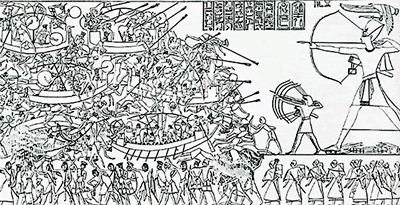
If we want a more human cause, we have the Sea Peoples.  All across the ancient Middle East, we have evidence of massive destruction of cities, caused mostly by fire over a 50-year span, as well as numerous references to invaders.  The evidence we have seems to suggest a mass migration of people, similar to the massive migration that caused the collapse of the Western Roman Empire, and the sudden pulse of migration caused by the Mongolian conquests.  In fact, we regularly see these pulses throughout history, where some movements on the Eurasian steppe results in waves of people being kicked off their land, who seize nearby lands, which kicks those people off their land and so on until there’s a sudden crashing immigration that threatens to topple an empire.  Most often, the Empire can  handle this, but if you pair it with bad weather and excessive complexity (“degeneration”) and you can topple a mighty empire.

Whatever the cause, the collapse of the bronze age seems to have left its mark on the mythologies of the people that followed, just like the Roman Empire left an indelible imprint on the migrating people who would later become Europeans.  I imagine growing up in a world filled with the ruins of buildings too complex and grand for your civilization to build would demand stories to be told, real ones if you know them, embellished ones if you can, and made-up ones if you have no story.  The Iliad, for example, which served as a foundation for later Greek culture, was almost certainly based on a real war that happened in the dying days of the Bronze Age.
Sometimes, civilizations vanish completely when they fall.  Sumeria certainly did.  But usually, when a civilization falls, it leaves some legacy of its passing: Sumeria gifted its heirs with cuneiform, for example.  But just as often, a fallen civilization will carry on in some way.  Rome didn’t just vanish, it evolved into Italy and its legacy carried on in Europe.  Egypt likewise didn’t give up its traditions just because it fell to the Persians (and then the Greeks, and then the Romans, and then to the Arabs, and then to the Ottomans). Instead, it carried on its ways, bringing them forward all the way to Rome, and thereafter it changed and evolved: Egypt became a major center for early Christianity, and these Christians, the Coptics, remain in Egypt to this very day.  Great cities like Cairo came after the Arab conquest of Egypt.  History carries on.  Just because a civilization’s heyday is behind it, I don’t want to forget that it continues to evolve, to impact the world, and to be impacted by it.

Designing Ancient History

Design notes

The core elements that stand out to me is the need to have an intelligent and clever race, a worthy proxy for the intellectual traditions of India and Judea, that sees itself oppressed again and again, and is forced to focus intently on its own identity during times of great adversity.  This will serve as the basis for True Communion, and it needs to connect up with the space knights of the human civilization.
What we need them, are our ancient imperial oppressors.  Ideally, I’d like to have quite a few interrelated ancient empires that knew one another and warred with one another regularly.  One element that stood out to me about ancient (iron age) history was the savagery of the Assyrians, resulting in an alliance to take them down, followed by the ascendancy of the Babylonians.  I’d like to see something like this, where a terrible empire is knocked over by a not-great Empire, which serves as the great power for quite some time until the confluence of three factors, degeneration, natural disaster and invasion, pitch it over and it never really recovers.
Rather than have three, I’d like to have 5 civilizations
  • A great evil empire (our Assyria)
  • A decadent empire that defeats the evil (Our Egypt and Babylon)
  • Some non-threatening trade-empire (similar to the Pheonicians or Carthage,or diving back farther, the Minoans and the Mycenaean)
  • A barbaric menace (our Sea Peoples, our Scythians)
  • The originators of True Communion (our Jews)
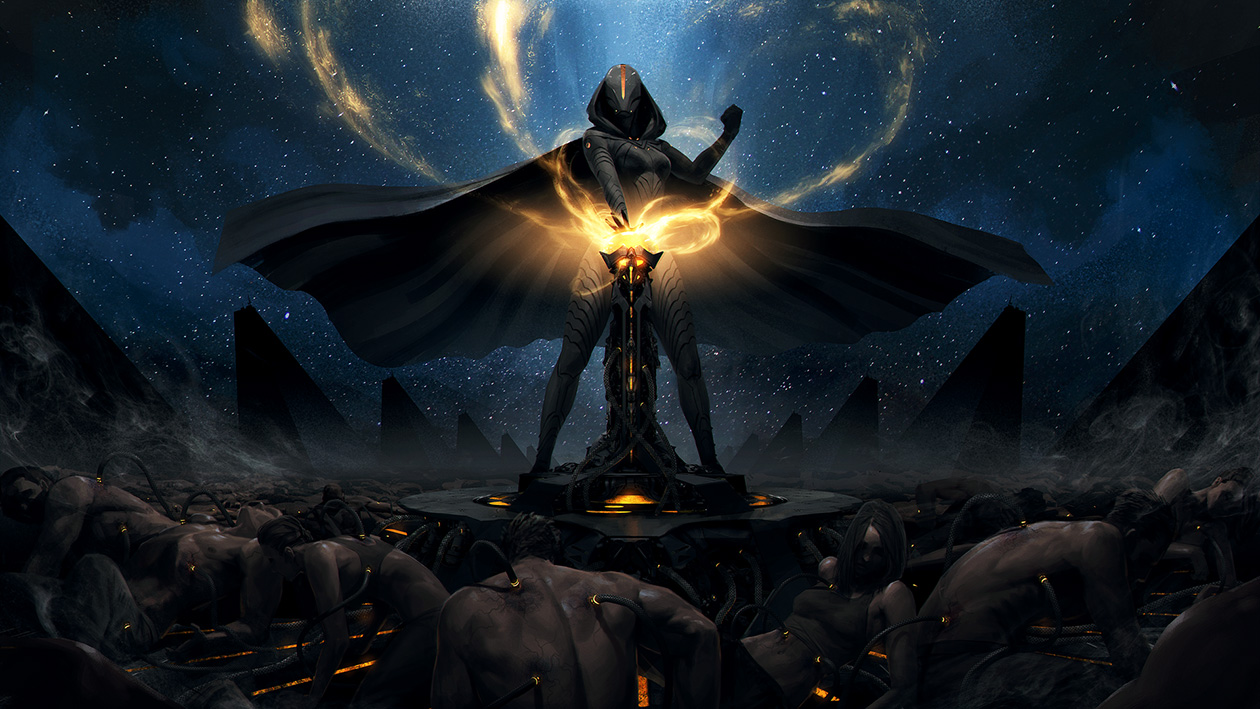
For the great evil empire, I’ve been toying with the first machines, what the Cybernetic Union mistakenly believes are a good idea to resurrect.  Of course, someone has to build them, and I feel particularly inspired by the Vodyani from Endless Space 2 or the Ezrohir from Torchlight 2, both races of energy beings that have fused with armor to remain alive.  They might have mastered some of the principles of Broken Communion, using its repetitive ghostliness to infuse their machines with a dark energy.  Remember that idea I had ages ago about the hyper-intelligent planet-killer?  This would be the race that would built it, our “Unicron.”  We’ll call this race the Vampires for now, until we get to them in greater detail (though “Titan” would work well, as they’re the fathers of monsters).
Ever since I started Psi-Wars, I’ve been thinking about our decadent empire.  This race will fuse “orientalism,” the sort of fanciful notions the West had about Turkey and the Ottomans with the ancient grandeur of Egypt. This is the race of dancing girls and slave warriors and powerful, effeminate tyrants, and the race of huge monuments and ancient cults.  They need to be humanoid, so their dancing girls are appealing to us, but they’ll have a dark and sinister edge to them.  If the Vampires represent Broken Communion, these represent the temptations and power of Dark Communion.  I’m very inspired by the Twi’leks and the Sith of Star Wars here, and we’ll call them “Dark Space Elves” for now.
The originators of True Communion are certainly the most important aspect of this cycle.  I see them as a mastermind race, someone with a deep and powerful psychic connection (likely inherent Telepathy).  They should also be believably defeated by both the Vampires and the Dark Space Elves, giving us the necessary oppression, and exposure to them helped build on their ideas of Communion, and giving us the oppression necessary to forge that diamond of identity.  I’d also like them to have a touch of a sinister air about them: they seem more foul but feel more fair, if you will.  That is, they’re a believable proxy for the conspiracy theories that swirl around Jews, but just like with the Jews, those conspiracy theories are completely false.  The race is pacifistic and just wants to be left alone or, if they do conspire, they seek to bring about unity and peace to the Galaxy.  They conspires against wicked men, and thus wicked men hurl slander at them.  I had originally intended to make them similar to Yoda, but perhaps something more like Starcraft’s Protoss might be closer to the mark, or the Endless of Endless Space.  We’ll call them the Sages for now.
The last two aren’t so important.  Our trade-race might be inspired by Carthage or Phoenicia, as mentioned, or the Lumeris of Endless Space 2, or really any trade race.  They’re mobile and only opportunistically militant, and might have served as early rivals with humanity for the galactic center as the two picked up the pieces of the fallen galactic empires.  We’ll call them the “Traders” for now (edit: as of the writing of this post, they hadn’t been fully defined, but since then, my Patrons have put quite some work into them!).  Our warrior race should be substantial enough to threaten our decadent empire: they should breed quickly, be highly mobile (the space-equivalent to horse-tribes) and powerful at war.  Rather than brutish barbarians, though, it might be nice to make them heroic and honorable after a fashion, as they liberated our Sages after all, and I rather picture ancient “golden age” civilizations as somewhat fantastical, and we already have our monster races.  The Scythians also have strong ties to the myth of Amazons, so it might be interesting if this race featured female warriors.  However, whatever their sophistication, their empire didn’t last.  Mostly, they accomplished the dissolution of the Dark Space Elf empire, leaving the way open for the rise of Pax Humanity.  I’m not really sure where exactly I should draw inspiration for them, but they should have a fierce and ferocious appearance, perhaps shark-like.  We’ll call them “Amazons.”
As for a natural disaster, how about a supernova?  The sudden collapse of a massive star at the center of a galactic region into a black hole could certainly play havoc with hyperspace.  If this happens near the center of the Dark Space Elf empire, suddenly their capital might be unable to reach the rest of their worlds as their routes have all changed.  Their power becomes scattered, and this might result in collapsing trade networks, which (especially in an interdependent galaxy) causes economic ruin, which results in an every-man-for-himself mentality, leading to an uprising of these Amazons who lay waste to the parts of the empire that resist them, and disregard (even protect) the parts of the empire that pay them tribute.

The Ancient History of the Galaxy

In the earliest dawn time of the galaxy, we first see our Sages beginning to trade with the Traders while the two growing empires of the Vampires and the Dark Space Elves begin to circle around the center of the Galaxy.  The Vampires strike first, conquering some (but not all!) of the Sage worlds, leaving one in ruin and driving away the Merchants.  They also savage some of the Dark Space Elf worlds, until the Dark Space Elves retaliate, retake their worlds, conquer all of the Sage worlds, and drive the Vampires completely out of the Galaxy (they might remain somewhere, hidden away in the Galactic Fringe for the Cybernetic Union to hunt for later).  The rise of “City States” to the complete victory of Dark Space Elves Empire probably takes 1000 years (first, the Vampires rise and consolidate into an empire, while the Dark Space Elves do the same, but slightly later).  The war itself likely rages across the galaxy for hundreds of years, giving us 100-300 years of war before the Vampires are largely (but not completely, of course) exterminated.
The Dark Space Elf empire probably lasts a very long time, say 1500 years of multiple smaller dynasties, while it slowly slides into degeneration.  It likely makes sense for intermediary events in here, a couple of different dynasties, evolving relationships with the Merchants and the Sages, rebellions (at least one Sage rebellion, to be sure), but most of this isn’t that important for our core history, but might be something to think about if we’re looking for more inspiration.  By the end of this time, though, the fighting spirit of the Dark Space Elves have collapsed into beautiful, sophisticated Decadence.
Then something terrible happens: the collapse of a major star into a black hole.  This might be a natural disaster or it might have been engineered by some faction (perhaps a remnant of the Vampires, or perhaps a rival faction within the Dark Space Elves).  This scrambles hyperspace all throughout the galaxy, but especially in the core of the Dark Space Elf empire and this results in a collapse of trade networks and the ability of the Dark Space Elves to project power.  What follows is 50 years of chaos, where the Sages throw off the yoke of the Dark Space Elves and the Amazons rise and break the power of the Dark Space Elves once and for all, and then collapse themselves, which takes another 50 years or so.  What follows is 400 years of collapse and dark age of competing factions for power.
During these dark ages, we see the Traders gaining a foothold in the galactic center, and some new power rise up in the area of the galaxy that the Dark Space Elves used to occupy.  This is a slave-taking race, oppressive and wicked, who commit the sort of atrocities that make one wish to kick off a crusade, giving us an excuse to have humans liberate the Sages once again, and to have our once-proud Dark Space Elves reduced to dancing girls and the equivalent to calculating eunuchs.
This gives us about 3000 years of history to add to the about 2000 years of human history, for a total of about 5000 years.  The relics from the dawn of this era, then, are worth about 200 points.  I’m honestly not sure that’s enough time (I had been hoping for something closer to 10,000 years of history).

To connect up with the rest of our history, Humanity wages war on the Merchants and their mercenary allies, and end up conquering the galactic center.  The Oracle cult is largely in charge of the growing Empire, culturally, but it’s splintering into two factions: One which still pursues the grand vision and the other that has begun to pursue short-term gain (If given a choice between a lifetime of glory, power and wealth, or a lifetime of misery that ensures the long-term benefits of the galaxy, some would choose the former over the latter), and the latter began to gain ground.  In the midst of this, a third faction, called the “Empty Path” had begun to agitate for a third future that they had uncovered, one which led to a point beyond which the Oracles, lacking Communion, could see: The rescue of the Sage Worlds from the Slave Empire.  The teachings of Communion had already begun to trickle into the Human empire, as the Sages often had to flee the depredations of the Slave Empire.  Eventually, the Far-Sighted oracles allied with the Empty Path against the Short-Sighted Oracles, and kicked off a crusade that rescued the Sages and pushed the Slave Empire back.  The Space Knights in charge converted to their more warlike vision of True Communion and founded a sort of Crusader State over the Sage Worlds: they represented the dominant political and military force, but the Sages there were free to practice as they had and to enjoy the protection of the space knights, in exchange for their wisdom and teachings.  This also exposed some space knights to the Dark Communion of the Dark Space Elves, and they formed a splinter group within the space knight order.
True Communion and the power of these Space Knights spread throughout the Human Empire, until the wicked Alexian king aligned himself more fully with the Short-Sighted oracles and seized on tales of Space Knight conspiracies, and Sage conspiracies as an excuse to engage in a pogrom against both, but the Far-Sighted Oracles, knowing that their victory would completely destroy the hope of the Galaxy, through their lot in with the Space Knights, and what followed was a war that shattered the unity of Humanity, killing off (or driving into hiding) the Alexian dynasty, splintering the space knight order, shattering their crusader state, and resulting in a balance of power between the Alexian houses that eventually resulted in the rise of the Republic.

Who gives a sh*t?

So, how does this impact the players?  Does it matter?  Do they care?
Well, for Brent, as a player, it doesn’t matter at all.  None of this is remotely necessary for him to understand the battle between Empire and Alliance, anymore than an Action hero who is stealing ancient Egyptian artifacts needs to know the history of Egypt.  He’s aware that there’s ancient history, and he’s cool with that.  For Brent as a GM, this is perhaps more interesting in that it supplies us with numerous Ancient Menaces that he can draw on for campaign ideas.
Willow, of course, will be fascinated by the history, as it presents an interesting story that we can fold into the very geography of space, and tie-backs into other, more modern factions.
Desiree will mostly find it interesting if it provides her with additional context for her character.  For her, this is the story of races, and how they came to be where they are.  The tragic fall of the once glorious Dark Space Elf empire might be particularly compelling, especially if she wants to play a Dark Space Elf princess.
This is arguably the most interesting for Bjorn (after Willow) as the main purpose of this whole history is to give us cool opponents to fight (the ancient menace of the Vampires) and to give us explanations behind our totally cool relics. The point for him, here, is that this explains some of his cool toys.

Psi-Wars History Part 2: The History of the Space Knight

Your father’s light saber. This is the weapon of a Jedi Knight. Not as clumsy or random as a blaster; an elegant weapon for a more civilized age. For over a thousand generations, the Jedi Knights were the guardians of peace and justice in the Old Republic. Before the dark times… before the Empire. 

-Obi-Wan Kenobi, A New Hope

Now that we’ve settled on the basic outlines of the history of the Empire and how the Republic collapsed into autocracy, we’re left with some questions:

  • How did the republic form in the first place?
  • Who are the aristocrats who dominated the republic and where did they come from?
  • What did the military look like before the domination of our charismatic general?

But I, personally, have a question that I think is far more pressing and likely to be asked by your players, even Brent, more often than any of the above:

  • “What about the Space Knights?” 
Where do they come from?  Where did they go? Why are they gone?  What where they like?  Are they still around?  How?  And why do they seem to be suddenly making a comeback?
Star Wars has some answers for this: The Jedi Order was, like, always there, until their enemy, the Sith, took over and used Order 66 to kill them all, and this was like 10 years ago, but now the Jedi are already legends.
Personally, this doesn’t sit well with me.  To me, when I heard that line above in A New Hope, I envisioned something Arthurian, this ancient order who had vanished centuries ago but somehow still had a few masters scattered across the Galaxy, if only you could find them and revive the good old ways.  
Then, the real question this history has to answer is: “How to religious orders fall?”

Finding Inspiration

As usual, we need to dig up history and see what we can find.  George Lucas primarily drew inspiration from the Knights Templar and the samurai, and we can do the same, but once again, I think we can do something different, even with the same source material, than what George Lucas did.

More to the point, the Jedi Knight seems to be a blending of the concept if a knight, in the sense of a noble warrior who wields an elegant weapon and regularly practices martial arts, and a warrior monk, someone deeply dedicated to a mystical or religious ideal, withdrawn from life, who also dedicated himself to the arts of war.  To understand the space knight, we should look at both elements in detail.

The Samurai

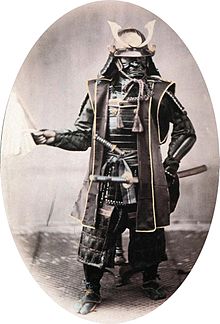
Prior to the 15th and 16th centuries, do you know what the favoured weapon of the samurai was? It certainly wasn’t the katana, the broad sword, or any other type of sword. In fact, there’s no mention whatsoever of the sword as the “soul of the samurai” prior to a statement made by Tokugawa Ieyasu at the beginning of the 17th century. Prior to this time, the samurai were in fact mounted archers who were highly skilled with the bow and arrow, occasionally using other weapons if necessary. For the greater part of their history, the sword was not an important weapon to the samurai. 

Samurai: Myth vs Reality

Whenever I dig through samurai stuff, especially the pop-documentaries on youtube, they’re quick to point out that the sword “was never” the key weapon of the samurai, but that they “actually” fought primarily with spear and bow, just like most soldiers throughout history.  The problem with this statement is that it pins down a single, specific era, points to it, and claims that this is what “real” samurai were (though the quote above is smart enough to limit itself to a specific period in time).  In fact, samurai have evolved throughout time, and this fact is key to drawing inspiration to the rise and fall of our own samurai-inspired space-knights.

If you’ll allow a brief detour through history: The title “samurai” started as a low-level bureaucratic position, one step below the courtiers and aristocrats that dominated the Heian-era courts.  At the same time, the Emperor made use of regional clan warriors, mounted archers for the most part, to fight his wars, and slowly these clan-warriors began to take over most of these low level positions and, through their strength of arms and practical importance to the empire, overtake the more ritualistic aristocracy in importance, giving rise to the shogunate.

The shogunate was unable to keep a lid on the increasingly decentralized power of the various samurai clans, who regularly bickered and battled with one another, and when a succession crisis spawned into a succession war, it triggered a general free-for-all throughout Japan, resulting in the Sengoku-Jidai, the warring states era so famous in Japanese lore and legend, when samurai were samurai.  This is the era referred to above, when the bow and the spear dominated the battlefield, and this era saw the rise of the firearm in japan (One source I read claimed that Japan had more firearms in their country at the end of the war than Europe did).

Samurai were, in this era and in the previous, similar to knights or, really, any aristocratic warrior.  In these days, the centralized power didn’t arm and armor its armies, but called them up and expected them to be armed.  Those who could afford to arm and armor themselves especially well could usually also afford to arm and armor some local men too, and bring an army with them.  Aristocrat warriors are, thus, men who can afford better gear than everyone else, and have more spare time to practice with said gear, and can then turn around and use that superior arms and training to either oppress peasantry or wage war on a king’s behalf (and, in both ways, improve his income and thus his access to arms and training).

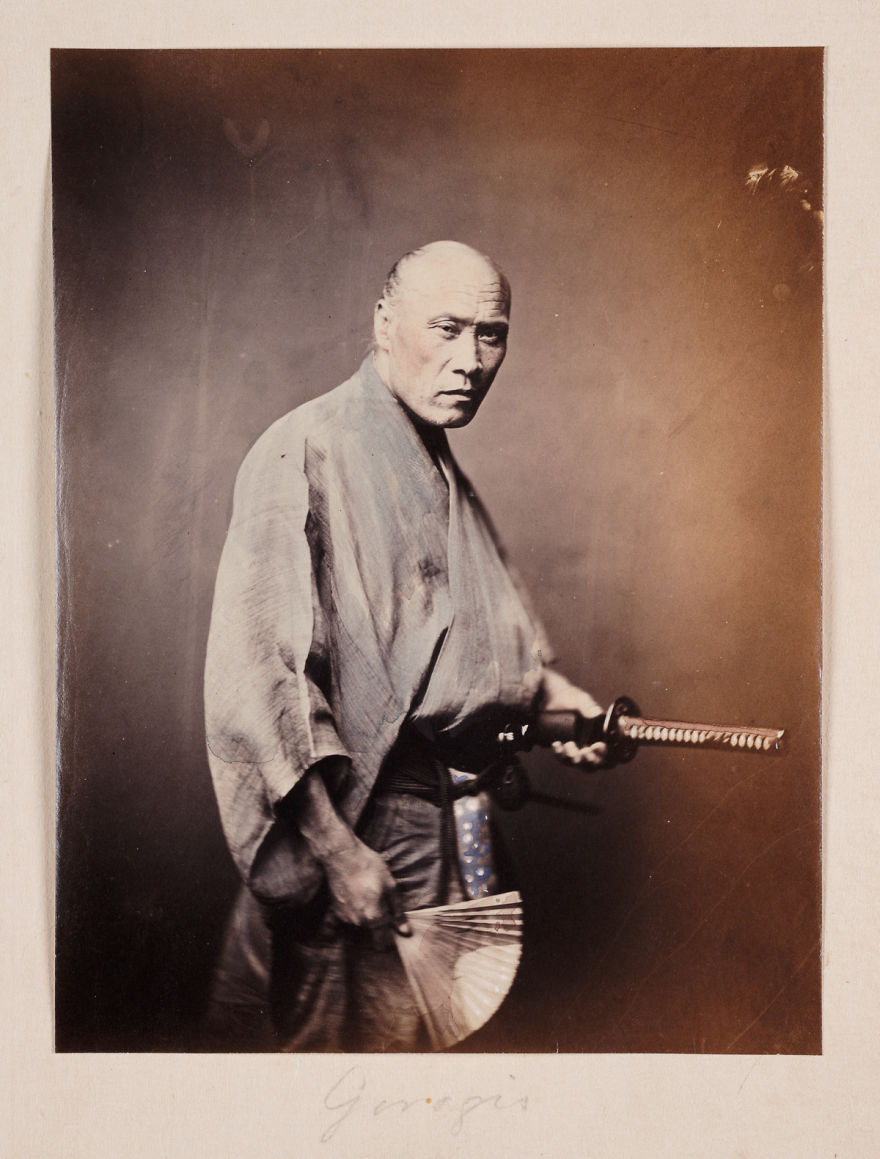
When the Sengoku Jidai ended, the katana/wazikashi combination (the daisho) would come to define the samurai because the shogunate made it so.  Weapons had proliferated throughout Japan during the era, and the Shogunate demanded that all peasants turn in their swords, but samurai were allowed to keep them as marks of their station.  This era, the Edo era, gives us the image of the kimono-clad samurai wearing his daisho in his obi, and suddenly drawing them to cut down his opponent in one, swift blow. The samurai wore that daisho as a badge of their status, especially if they’d fallen on hard times. Sure, that rapscallion over there might look as unkempt as any ruffian, with his shaggy hair and shoddy kimono, but he wears daisho, so you know he’s really a samurai.

This marks the next evolution of most of our aristocrat warriors.  The centralized power cannot afford to have loads of armed men running around the country, but he also knows better than to kick off an armed revolt by demanding that this powerful class surrender their power.  So, he honors them gives them what they want (guarantees of wealth and prestige) and removes the need to fight.  Their role becomes ceremonial, and they maintain the badge of their office: the sword.  Why the sword?  Well, Lindybeige has some interesting commentary on that.  In essence, the sword, unlike the spear or the bow or the axe, has no real purpose outside of the killing of others.  Simply wearing it around people who are not allowed to wear one emphasizes that you carry the power of life and death over them.  This is cemented by the practice of iajutsu, which is not particularly effective against an armored opponent, but is an excellent way to cut down an impertinent peasant and then eleganty clean your blade.  The sword and your mastery of it emphasizes your station, even if you are not an active participant in war any more.

The next major era for the samurai is the modern one, especially World War 2 and the rise of chambara cinema.  Neither featured real samurai, but the myth and mystique of these warriors.  This might seem an irrelevant notion to the historicity of the samurai, but much of what we think of as “bushido” or “the way samurai fight” comes from these stories, legends and exaggerations.  This also matters because, first of all, the Jedi are based on these myths, and not on the reality of the samurai and, second, the notion of a mythical warrior hailing from a golden era of chivalry and honor is a key aspect to the mythos of the Jedi, and thus our space knights.  They wield more elegant weapons of a more civilized age, before the random barbarism of this, our fallen modern era.  More than anything, our Space Knights need to evoke this ideal.

The Knights Templar (and other Knightly Orders)

Today, the survival and secret activities of the Knights Templar rival UFOs and the Kennedy assassination as atopic for conspiracy theory. Details vary from one account toanother, but most agree that the Templars are wealthy andpowerful, moving in the shadows to control governments andcorporations around the world.
-Graeme Davis, Pyramid #3-86: Organizations, “The Knights Templar”

Myths and lies swirl around the Crusades into Europe, but few elements of the Crusades inspire more mythology than the Knights Templar.  George Lucas definitely drew some of his ideas for the Jedi Order (an Order of Knights) from the Knights Templar, especially including their precipitous and likely unfair fall.

A brief introduction: The Knights Templar came after the Crusades had established a foothold in the Holy Land.  Europe fought the Crusades, ostensibly, to ensure that Christians could make their pilgrimages to Jerusalem, but the road to the Holy Land was still fraught with troubles, especially banditry.  9 knights forswore allegiance to any king and swore allegiance to the Pope himself and offered to the King of Jerusalem to protect pilgrims from the plights of banditry, etc, and he allowed them to take the Temple Mount as their headquarters, hence the “Knights of the Temple of Solomon,” or the Knights Templar.

Or possibly, they didn’t.  Most historians note that the Templars, ten years after their supposed founding, went to a monk, Bernard of Clairvaux, who had already established one monastic order and “asked him for help” in setting up their rules and gaining the Pope’s stamp of approval, which St. Bernard did, and wrote a treatise praising this “new form of Knighthood,” whereupon the Templars suddenly had a huge influx of members.  Given the close ties between Bernard and the founders of the Templars and a lack of evidence of their presence in Jerusalem before this point, many historians (Including Graeme Davis) argue their origin story is a bit of retroactive storytelling to make the order seem more mythical and to get a cool PR boost.

The Templars seemed to have a complicated relationship with Islam.  Kingdom of Heaven depicts them as fanatical enemies of Islam, willing to provoke suicidal wars, and I can find some evidence for that.  On the other hand, one of the accusations leveled at the Templars during their dissolution was that they were secret Muslims (“Baphomet,” the God they supposedly secretly worshipped, might be a French variation of Mohammed), and I can find evidence that they were respectful of Islamic customs and that they even had dealings with the Hashashin.

In any case, it was this focus on pilgrims that earned them the respect of Europe and resulted in their downfall.  Pilgrims would entrust their money to the Templars (who had proven themselves to be exceptionally honorable), and the Templars would re-imburse the Pilgrim upon his arrival in the Holy Land.  Thus, a pilgrim could travel safe in the knowledge that his money could not be stolen, and the Templars themselves had the ability to act as a bank, meaning they had more than enough liquid capital to expand their influence and power, which they did.  However, eventually King Philip IV “the Fair” of France needed to repay his crushing debts, and one of his various tactics was to accuse the Templars of withering heresies, kill the order and take all of their stuff.

From here, the Templars pass from history and into mythology.  The most common story I’ve found is that the Templars who escaped Philip’s pogrom became the founders of Free Masonry or various other conspiracies, especially against the Kings of France.  This idea of a secret conspiracy of knights working against the order of the day reshapes how one might see the Jedi Order: If they really were conspiring against the Republic (or for whatever their secret aims were), that totally changes the tone of the Emperor’s actions.

Another common story, one echoed by tales of the Crusades themselves, is that the Templars brought back some great secret or power with them from the Holy Land.  We have this idea that the Crusades allowed ideas to flow between the Middle East and Europe, and this is probably untrue (most of those ideas were already flowing from al-Andalus to France), but it’s an interesting idea we can borrow for our Space Knights nonetheless.

For me, one of the more interesting elements of the Knights Templar, and other knightly orders, is their unusual relationship with the secular power-structures of the day.  The typical knight, like the typical samurai above, served his leige lord and lent military power to his state.  The monastic knights served no state.  They served their church.  This didn’t prevent them from controlling territory, however.  While the Templar never controlled, for example, the Crusader States, the Tuetonic Knights definitely controlled (and colonized!) some territory of their own.  We picture the Jedi as this peaceful order of sage-warriors, but I find this image of armed, armored and highly military men conquering a swath of territory in the name of a faith to be a particularly fascinating and very un-Jedi idea.  We’ll need some un-Jedi ideas to make our space knights feel unique.

And, of course, the other aspect of this religious-allegience is that the Knights Templar were more than knights, they were also monks.  Warrior-monks, specifically, which perfectly fits what the Jedi were and what our Space Knights need to be.

Warrior Monks: Sohei, Yamabushi, Ikko-Ikki, Shaolin and the First Earth Battalion

Wikipedia references all of the above, including the Knights Templar as “Warrior Monks.  The last is particularly interesting:

Channon spent time in the 1970s with many of the people in California credited with starting the Human Potential Movement, and subsequently wrote an operations manual for a First Earth Battalion. The manual was a 125-page mixture of drawings, graphs, maps, polemical essays, and point-by-point redesigns of every aspect of military life. Channon imagined a new battlefield uniform that would include pouches for ginseng regulators, divining tools, food stuffs to enhance night vision, and a loudspeaker that would automatically emit “indigenous music and words of peace.”

This is referenced in “The Men Who Stare At Goats,” which is a book detailing the CIA’s efforts to creation psychic spies, assassins and soldiers.  In principle, then, the First Earth Battalion was a new age military, in the sense of spooky psychic powers, inner enlightenment and so on, which makes it a fascinating blend between New Age mysticism (on the rise during the same era in which Star Wars was first released: the 1970s) and Cold War psychic experimentation, the likes of which we see in Psi-Ops, the Mind Gate Conspiracy, which makes a fascinating alternative to the warrior-monks of the Jedi.

More in the vein of our classic perception of the warrior-monk are  the warrior monks of Japan, the Sohei, and to understand them, I need to make a brief foray into the religious landscape of Japan.  By the Heian period, Japan imported Buddhism from China in the form of the Tendai sect, which enjoyed the patronage of the court and aristocracy.  To protect their own, and to intimidate rival sects, some of the monks of the Tendai sect, especially from the temple Enryaku-ji just outside Kyoto (the Capital of Japan at the time) took up arms.  They seem to have worn the same sort of armor and fought in largely the same way that samurai did, though traditionally with a greater focus on the naginata over the katana.  It might be better to think of these warrior monks as more akin to the knights templar, as they seem very similar to samurai, except with a strong religious focus.

Two sects split off from the Tendai sect.  The first is the Shugendo sect, which is a highly syncretic faith that blends Tendai teachings with shinto traditions, and their monks travel high into the mountains to practice extreme asceticism in pursuit of supernatural powers.  These “mountain men”h the yamabushi, needed to be masters of combat to survive the harsh, bandit-ridden mountains of Japan.

The second major sect I want to discuss rose to prominence during the Sengoku Jidai, Jodo Shinshu, “Pure Land” Buddhism.  The founder promoted a new way to find enlightenment and escape what he believed to be a fallen, degenerate world, in a way that was remarkably easy: simple prayer and deep faith.  In contrast to the more expensive rituals and aristocratic patronage of Tendai buddhism, Jodo Shinshu appealed to the common man and the poorer samurai (one might draw a parallel between Catholicism and militant Lutheranism).  The followers of Jodo Shinshu began to come together for the same reason Tendai Buddhists would take up arms: self-defense (at first) and then to intimidate or defeat rival sects.  But the fundamental character of these “warrior monks” differed from previous ones as these were commoners.  These more closely resembled peasant uprisings or village militia than well-trained armies.  The name “Ikko-ikki” means “Ikko-shu uprising” with “ikko-shu” being a reference to Jodo Shinsu.

In all cases, like the Crusading Orders, these warrior-monks weren’t associated with a secular power, but with religious thought.  Thus, while a samurai owned the land and was fundamentally attached to it, and thus concerned with borders, a temple could be placed nearly anywhere; in fact, where samurai demanded taxes, buddhist sects usually just requested donations and their followers themselves would put up their (sometimes heavily fortified) temples.  And also, like the crusading orders, while they did not need territory, they sometimes ended up carving out religious states anyway, such as Kaga province in the Sengoku period.  Finally, while I’ve discussed the sohei indimidating rival sects, buddhism of all sects taught pacifism, and sohei generally took up arms in self-defense (like the Jedi), and only when it was clear that they were a force to be reckoned with did, occasionally, ambition run ahead of moral qualms.

The last of the warrior monk orders that I want to point to are the monks of the Shaolin monastary, whom I’m sure need no further introduction.  You can read all about them in GURPS martial arts.  Like our Japanese warrior-monks, these warrior-monks were also buddhist, and they primarily learned martial arts for self-defense (though they would later adjust their theology retroactively to justify it); The primary thing I want to draw your attention to is, like the Knights Templar, they were destroyed and scattered by a secular power, the Qing Dynasty, and like the Knights Templar, legends state that some of them survived and scattered into the world.  These five elders of Shaolin (including a nun!) supposedly spread their martial arts knowledge throughout China and a variety of martial arts school love to claim one of these legendary elders as the ultimate founder of their style, including Wing Chun, the ancestor of Bruce Lee’s Jeet Kun Do.

The History of Space Knights

Designing the History of Space Knights

The nature of our heroic space knights seem fairly clear, at least if we draw from history.  Space knights are probably a fully military order, or at least they might have been in the past and now currently rely on their privileged position to act as more of a political force, carrying force swords more as a badge of office than as a weapon (though they can certainly use it as such).  Religious space knights, in contrast to standard space knights, would serve no secular power, no Empire and no Republic, but instead serve their religion, protecting their followers, which may or may not bring them into conflict with other secular powers or other religious factions.  And, if we really want to follow the history of the Templars and the Jedi, then they’ve been dissolved, which rather makes sense given their refusal to bend knee to a secular power, but they still live on, in the form of scattered members who teach their arts, and in the form of secretive conspiracies.  I’d also like to note that all of these groups rise from exposure to foreign ideas: Buddhism (an Indian religion) in Japan and the culture and religions of the Middle East for the Templars (some scholars speculate that Templars might have been closet Muslims, or secretly Jewish, or had incorporated some early Christian ideas into their faith).

Designing the History of the Galactic Federation

But we cannot build the history of our space knights without building the history of the world around them.  What is the world of the Space Knight like?  I prefer this era be a far older one.  The Nazis like to draw on the imagery of the Teutonic Knights who vanished in the late medieval period, and the Soehei had their origins in the Genpai wars and the Heian period, the more legendary era of Japan (at least from the perspective of the Sengoku-Jidai).  Our space knights, then, come from a more civilized era.  While Star Wars placed this in the Republic (literally “before the Empire”), I want to place it back further than that.  The space knight is an heir to the galactic age of heroes, before the complexities of the modern era.
Japan already gives us a pretty good clue to how this might look.  The Heian period was one dominated by a central authority, an emperor, from whom legitimacy flowed.  Even the samurai clans claimed descent from him, but as his power waned, first he had a shogun step in as the power behind the throne, and then even that failed and led to an era of strife and dissolution in the Sengoku-Jidai.  What would have happened, I wonder, if Nobunaga and his heirs hadn’t reunified Japan?  The various clans seemed willing to bicker interminably and it might have taken an external force to unify everyone again.
Rome follows a remarkably similar track, though most of its early (pre-390 BC) is shrouded in mythology, thanks to the loss of its records.  Supposedly, its early period was one of kings (7 kings, 6 of whom were righteous and the 7th, who was not).  Rome so feared the return of a king that it used that fear to justify the murder of politicians it disagreed with, and we can definitely use that parallel in our Galactic Republic.  Thus, before there was a Galactic Republic, there was a “Galactic Kingdom.”  This makes sense actually, since we want elites that conflict with the people, and we can use the aristocracy of this earlier era as their source.
Why use space knights, though?  Why not use soldiers?  Well, I’ve already hinted at this with the design of my weaponry.  This entire era is set in TL 11^, but we’re looking at a very long TL 11^ period, up to 10,000 years.  Early TL 11^ might look different than modern TL 11^, and we’ve already seen some of those differences.  First, blasters have improved substantially since the earliest era, while force swords seem to have remained fairly static.  If earlier blasters were weak, but armor relatively strong, then being fully armed and armored might make more sense, since you can reasonably wade through blaster fire and then cut down your opponent with your force sword.  We could further justify it if we made ships more valuable targets.  Perhaps early Hyperdrives were huge, and thus the ships of war were similarly large.  A good tactic in battle back them might have been to smash into enemy ships and board directly, fighting to capture them, rather than destroy them (which fits with inferior weapons).  Thus, having an elite cadre of expensively-armed super-soldiers who could board an enemy warship and take it was definitely worth having.
Then we need some foreign faith or religion that can filter into our growing kingdom, and that faith is obviously Communion.  Space Knights waging war in some alien territory could have come into contact with the faith of Communion and seen how much more powerful it was than the base psionic powers of this early era and converted.  This would have been a more peaceful faith and the space knights might have discarded their secular authorities in favor of protecting this faith that was sweeping over the kingdom.
Why did they die, then, and what happened to them?  Rome gives us a clue again, and we can still blend it with Japan, especially 13 Assassins.  Eventually, the Space King lost his way and became a monster and when the Space Knights turned against him, he fabricated evidence proving they had “fallen to the dark side” and been co-opted by a sinister conspiracy.  He moved against them to secure his position and to silence their voice, but instead, he instigated a huge war that saw the destruction and scattering of the Space Knights, but also shattered the peace of the kingdom.  Some rose up in defense of the space knights, other simply seized the opportunity to expand their own power base, and especially when the wicked king died, there was a succession crisis followed by succession crisis until the constant bickering wore everyone down, left the galaxy divided into armed camps.  Finally, some external threat convinced them to re-unite and careful diplomacy restored ties between the various powers and formed a new republic: rather than one house ascendant over an other, all the houses of the old kingdom would have a right to vote on things, thus the republic restored equality across the galaxy… if you were noble.
As for the space knights, they faded into legend, but scattered members still existed across the galaxy, watching over the growing republic and trying to maintain order where they could.  Their conspiratorial power grew sufficiently that by the time of the Empire, they’ve begun to unmask themselves as a force that can restore the galaxy to its former glory and stave off impending doom.
To design this history, we can use GURPS Fantasy to give us a full sweep of history.  This covers the rise of humanity from “City States,” small regional powers, to a complete Empire, then a degeneration, followed by a dark age and then a new awakening into a new, more tenuous and liberal Empire, followed by the collapse into autocracy and civil war, where we find ourselves today.

The History of the Galaxy, part 2

The first step would be to touch on the origins of humanity, but I’d rather not do that.  Let’s do what Foundation and Dune do and suggest that the origins of humanity have been lost to the sands of time (If pressed, I would suggest that if this was the far future, Earth wasn’t particularly conducive to hyperspace travel, and it became so much easier to travel between colonies than from colonies to the Earth that eventually Earth just faded from history, just as our own origins in Africa isn’t really relevant to modern politics).
Our early history sees the rise of three major regional powers (or perhaps 5, but 3 is a good number, following our law of threes).  First, we have a culture of space explorers and pioneers, a simple people who focus on spreading across space and maintaining their independence (Let’s call them the “Old Westerly” civilization).Second, we have a more scientific and technological group, the “Rationalists” who were one of the oldest powers (Let’s call them the “Shinjurai” civilization), who represent a more common interpretation of sci-fi.  Finally, we have a those who mastered the art of ESP and precognition, allowing them to be forewarned about problems and to plan strategies based on the future.  This made them a more mystical people and they preferred to fight with force blade, force shield and armor, giving them something of a space fantasy vibe (Let’s call them the “Maradon” civilization).  First, these city states struggled for dominance, and the Maradon civilization won, establishing an Empire, with a semi-divine Emperor from the House of Alexus (or Xandrus?) whose bloodline was prophesied to bring peace to all the galaxy.  His direct descendants ruled over the empire (especially chose chosen by the order of oracles who protected knowledge of the future), while his more remote offspring were married off to the lesser warlords of the Maradon Empire, who were given dominion over worlds in return for military service.
The Maradon Empire expanded its power out into more alien space and came into contact with very ancient civilization and their faith of Communion, which began to spread throughout the galaxy, rapidly supplanting the closed and secretive oracular order, especially among the people and the lesser nobility.  Many of those lesser nobles set aside their military service and joined the ranks of Communion, protecting it from an alien invasion that pushed in from the rim of the Galaxy and gaining the trust of many of the nobles of the Dynasty, especially thanks to the vastly superior power they wielded through Communion, but also due to their honorable and peaceful ways (required by their careful adherence to the principles of Communion).
As wars died down, the nobility began to put down its more powerful weapons and a more elegant age arouse, but this era saw religious/philosophical strife.  The oracular order struggled with its increasing irrelevance, and saw a split in its ranks from those who adhered to original plan for the future and those who began to peddle prophecy for political gain and power, especially in the fight against Knights of Communion and their powerful faith.  Meanwhile, the Knights of Communion’s ranks were infiltrated with darker, more dangerous and older ideals, creating a dangerous splinter group and a war within the ranks (our Sith).  The increasingly corrupt oracular order, which had supplanted the orthodox branch of the oracular order as the primary genetic advisors of the dynasty (ensuring that the lineage stayed on track), had allowed the Great Plan to go awry, and the kings on the Alexian throne grew increasingly totalitarian and mad.  
With the splintering of the Knights of Communion, the corrupt Oracular Order saw their chance and conspired with their mad king to strike.  He rounded up the leadership of the order, accused them of the crimes of their splinter order, and outlawed the order.  This resulted in a general uprising of Communion-faithful, and triggered a war with the remnants of the Knights of Communion, who managed to slay the corrupt Emperor, but had their own power shattered in the process.  Without even their vision to guide the galaxy, everything began to spiral out of control as the various houses each warred to take the throne and to overthrow the wicked legacy of the corrupt Alexian emperors, but no side could gain the upper-hand until a group of Alexian houses (5? 7?) reached a sort of balkanized equilibrium (we can also add in some of the previously suppressed groups, like the Rationalists, who had now thrown off the yoke of Alexian dominion).
Let’s say from the rise to the fall of the Alexian dynasty took about 1000 years, which is comparable to the Western Roman Empire.
Galactic politics in the core remained in this way, technology and stability slowly degenerating until a serious alien threat from the Rim forced them to realign.  Let’s say this war and struggle took about 300 years.  No individual house could stand against the threat, and careful diplomacy encouraged everyone to come together and face this threat, and out of this unity, the Republic (Federation? Alliance?) was born.  They would have no kings, and each house/government/state would have a vote, with their elites theoretically representing the people of their worlds and systems.
The Federation that arose from this, if it lasted about 300 years before decaying into the Empire, which if we combine with about 500 years of a slow rise of mankind, gives us about 2100 years of history (The relics from the dawn of this age would be worth about 100 character points).

Who gives a sh*t?

So, let’s look at how this impacts our players.
Brent doesn’t need to know any of this, and that makes him happy.  This is all information buried beneath the surface, and the galactic civil war is not directly caused by it.  If he wants to know what happened to the Space Knights, we have a fairly simple answer for him: “They used to be protectors of True Communion, but were scattered and destroyed by a corrupt King and have been lurking behind the scenes ever since.”
Willow is delighted to have all of this history, especially as it will act as a foundation for our later design of galactic “geography” and it also explains the politics of the Republic/Empire in a reasonable way.  It also offers plenty to explore, and plenty of inspiration.
For Desiree, lost kingdoms, conspiratorial powers, ancient orders and noble houses all offer her something she can attach her character to.  These houses still remain in the present and so she can be a princess of one of those houses, or adhere to some lost sect, etc.  Ancient enmities still presumably exist, so they can drive her character, and make the history of her personal house or sect interesting to her.
These houses, sects and groups can also serve as a container for cool new powers, which is something Bjorn will enjoy.  By having five splintered groups of the Knights of Communion, and groups like the Rationlists, the two branches of the Oracular Order, and the specific houses with, perhaps, their own martial arts and technologies, he has a bevy of setting-grounded mechanical options to explore.

Psi-Wars History Part 1: The History of the Empire

So this is how liberty dies. With thunderous applause. 

-Padme Amidala, Revenge of the Sith

When you design a setting element, or a story, or a hook you’ll use to inspire yourself later, you should try to build a question into them, some element you want to explore and touch on, or let your players explore.  I would argue that all of the Star Wars prequels revolve around the question of “How did the Republic become the Empire?”

George Lucas answered that question with a bit of Roman and German history, plus his own personal political philosophy.  I also thoroughly believe that George Lucas wanted us to ponder this question ourselves and relate it to our daily lives, which quite a few people have certainly done, with gusto, in regards to the recent elections, if my Google Search for the above quote is any indication.

I’d like to revisit that question, using much of the same inspiration that George Lucas had, and show you how we can come to a very different conclusion than he did.  I want to revisit how democracies die, and more than that, I want to look at the broader implications of the histories from which George Lucas drew his inspiration, and use that to expand the setting beyond the narrow scope Star Wars has.

How do Democracies Die?

Preamble: Some Definitions

First, I want to define some terms here, terms which Star Wars definitely abuses, and that we often take for granted or abuse ourselves when discussing these things.
Sovereign state: A state which controls a region inside which a government can enforce laws of its choosing.  The United States of America is a sovereign state, in that England can’t decide what our taxation levels are or dictate whether or not we’re allowed to have capital punishment, etc.  Scotland, on the other hand, is not a sovereign state, as the United Kingdom can tell Scotland what to do, or who it’s at war with, whether or not it’s part of the EU, etc.
Nation: A large body of people unified by shared ancestry, culture, language, etc. Jews are a nation.  So are the Dutch, or the French, or Russians, etc.  The modern world is really big into nationalism, which means that a single nation should be self-governing and thus have its own state.  There are nation-states, and when we talk about things like “Black Nationalism” what that really means is this idea that African-Americans are a group with shared ancestry, culture and language distinct from that of other Americans, and thus should be self-governing.  “Nation” does not mean “state,” though we often treat it as synonymous.
Empire: A group of states and nations rules by a single powerful group or individual.  This might have an “emperor,” but it could just as easily be ruled by, say, parliament (for example, the British Empire).  You’ll occasionally see people describing the USA as “an empire” which makes no sense if they mean an autocracy, but they usually mean it in the sense that the US controls external states.  For example, if the USA were to essentially appoint foreign presidents and demand that they change their laws or foreign affairs to suit US interests (say, in Iraq or Afghanistan), then the US might be a de facto Empire.  I say this not because I believe that the US is an empire, but to hammer home the fact that an empire doesn’t have to be autocratic, which are two different things.
Autocracy: A government in which power is held by a single individual
Democracy: A government in which power is held by the whole of the citizenry
When we say things like “The Roman republic died and became an empire”, what we really mean is how democracy (used loosely) fell and autocracy rose in its place.  The Roman Republic was already an empire, in that it ruled over other nations, and it ruled over states that were no longer sovereign.
This is an important distinction for discussing the “fall of the Galactic Republic” because it means that the Galactic Republic was also probably already an empire, at least in the sense that it had a multitude of nations under its sovereignty.  That might be stretching the definition of an empire: after all, if an alien nation has representation in the galactic senate, then you can’t really say that the republic is overriding their sovereignty, rather everyone has shared soveriegnty  If that’s the case, then the switch legitimately happened when the Emperor seized the sovereignty of the nations under his dominion.  But what if that had already begun long before an Emperor climbed upon his throne?

How Democracies Die: an Instructional Video

The above video is probably the best summation I’ve found on the sweeping rules for politics, and it’s one I’ll revisit when building out the Empire and the Alliance, but what I want you to note foremost is the last bit explaining how democracies fall into dictatorships.  Allow me to reiterate for those who don’t want to watch the video, and to set up some points.
First, a democracy’s power is its people.  The wealth you gain, the wealth you need, comes from the virtuous circle of a well-educated, independent populace.  If you threw all of your computer programmers and rocket scientists and doctors into slave labor camps, the wealth they’d generate digging coal out of the ground is far less than the wealth you’d generate just by letting them do what they were going to do and taxing them.  It’s a fools bargain.  Moreover, you want a certain standard of living: plentiful food, good educational opportunities for your kids, a chance to travel the world, etc.  The chances of you getting that by rising up and revolting against your democracy are pretty thin and your chances of getting that while sticking within the system are decent (at least, better than they would be with open revolt or seizing power).
Something has to change this.  The system itself must be sufficiently undermined that by following the system, you no longer believe you can get the things you want.  Furthermore, the situation needs to change sufficiently that you believe you can make more money by undermining the democracy you have.  If, suddenly, slave labor camps become more profitable than taxation, then why not?

It’s nice to think that a government that Goes Too Far will eventually cause the citizens to rise in righteous wrath and throw the rascals out. It’s also convenient when all the defenders of the Evil Empire wear uniforms (except for the occasional Secret Police spy). Unfortunately, we know from centuries of experience that it doesn’t really work this way. The worst tyrannies imaginable have been enthusiastically supported by people no worse than you or me   

-GURPS Space “Why People Support Rotten Empires”

The truth is, nobody just becomes a dictator.  People work with the dictator to make it happen.  Soldiers side with the rising dictator, politicians step out of the way, people willingly join the new secret police and spread the word about how great Dear Leader is.  But they have to do this for a reason.  GURPS Space discusses this on page 197, but we need to dive deeper if we want to understand why people would let their democracy go and embrace autocracy in its place.
Star Wars doesn’t address any of this.  In Star Wars, you have a perfectly fine democracy, then there’s a war, and an evil Sith uses his space magic to trick everyone and becomes Galactic Space Emperor.  Then, inexplicably, he’s able to dissolve the senate, has loads of fanatical soldiers willing to die in droves against our plucky heroes, and so on, without any explanation why.  The galactic war might have been terrible, but surely they’ve had wars before without going all fascist on everyone instantly.  I personally think George Lucas’ vision comes from a rather unfortunate meme about how “hypnotic” Adolf Hitler was, as though he was able to “trick” the German people into supporting him.
The real picture is more complicated.

The Fall of the Roman Republic: A Case Study

Death of Julius Caesar

I’ll allow you to study the history of the fall of the Roman Republic on your own.  There are plenty of resources out there.  Just hit up some of my sources back in my history post.  Allow me to sum it up.

Rome had a very rocky history, and went through a period of nearly non-stop warfare, a sort of a bloody tournament where (especially at the end of the Punic Wars), it staggered out, suddenly king of the hill, and owner of a vast empire and an enormous influx of slave labor.  What killed the Roman Republic, if I can oversimplify, wasn’t an existential threat (though those definitely popped up), but the overwhelming stress of wealth and success.
The Roman system had been built on the idea of shared land.  It even drew its military ranks from landed farmers, a requirement by law.  To be a legionnaire, you had to own a farm and to bring your own equipment.  Yes, there was an aristocracy (the Patrician class) and an oppressed lower class (the Plebians), but largely, they worked together (see the Secession of the Plebs) and conquered lands were shared among all Romans.  In theory.
In fact, what really happened was that legionnaires would often go bankrupt during these increasingly long wars and Patricians would buy up their land, and collect the land that was being conquered.  Soon, the Patrician class had huge tracts of land… and slaves to work it.  The contract between aristocrat and commoner broke down, because the aristocrat no longer needed the commoner.  Thus, we reached a situation where our “keys to power” begin to narrow.  This also meant that the Romans had less and less men they could call upon to serve in their armies… but then Gaius Marius passed a reform that revoked the land-owning requirement.  Suddenly, anyone could join, and the general himself would pay you.  That made you loyal to your general, who would make promises about land grants or all the loot you could steal once he sacked a city.  This is a dangerous combination, so dangerous that by the time of Julius Caesar, the first triumverate consisted of himself (an influential and charismatic politician), Crassus (a spectacularly wealthy Roman who once said “You can’t really call yourself rich unless you can afford an army”) and Pompey the Great, a mighty and popular general.  The three of them together had sufficient power to effectively run roughshod over the entire Roman government.  That’s how far things had fallen by then.
So we have the ingredients for our fall in that the keys to power have narrowed.  You no longer need the power of your whole people, because you’ve found a resource more valuable than your people: Slaves and conquered land.  But what undermined the system?

Rome regularly faced invasion, and quite a few were terrifying enough to keep Romans up at night, such as the Cimbrian War which seemed to come out of nowhere (something, by the way, that could easily happen in a huge galaxy full of hyperdrive-capable ships: a whole section of ignored, backwater worlds could band together and “suddenly” start invading from the Rim, catching everyone off guard).  But what really tore Rome apart was political violence.
It’s easy to imagine the aristocracy as the bad guy in this story, and they definitely were.  Again and again someone would stand up for Plebian rights, or rights for the Italian Allies, or whatever, and the Patrician class would beat them down, often literally.  The first man to be elected Dicator for Life was a man who served the Patrician class and purged (ie murdered) those who supported Plebian rights, Lucius Cornelius Sulla, but he stepped down.  He felt his only purpose was to preserve democracy and the constitution.  He saw himself as a strong-man “just doing what needed to be done.”
So, Julius Caesar?  Who was he then?  He was an advocate for the plebians.  He was what we would call a demagogue.  He was a successful general who beat back the dreaded Gauls, who won victory after victory, spoke for the little man, and whom the Senate (the Patricians) intended to arrest.  He was the rebel, and he won, and when he did, when he marched on Rome and seized the role of dictator, he did just what Sulla had and pushed through a bunch of (what he felt were) necessary reforms, but this time, reforms for the people, reforms that took power from the aristocracy.  And for that, they killed him.
The result was a mass uprising against the Senate.  When his adopted son, Gaius Octavius, rode in and waged war on the Senate, the people supported him and flocked to his banner, because he was avenging a martyr, a great man who had died in their service.  When he became Emperor, renaming himself Augustus Caesar, of course they supported it and even deified him.  He was going to fix everything for them.
Of course, he didn’t.  Demagogues rarely do.  But it paints a very different picture from Star Wars, doesn’t it?

The Fall of the Wiemar Republic: A Case Study

Before I jump into this well-worn topic, I want to discuss something I think most documentaries completely leave off: German nationalism and its roots.  The idea that the Nazi party was German nationalism run amok is pretty ingrained into the popular consciousness, but we don’t really stop and think about what that means.  The idea, as noted above, is that the “German people” are absolutely a thing, and that they should be allowed to govern themselves, which doesn’t sound so bad, if you think about it, because it isn’t.
Germany was a very young country by this point.  The German Unification finished in 1871, and before that date, it had been a divided bunch of principalities.  We didn’t speak of Germany, but of Bavaria and Bohemia, and the Ruritanian romance was set in a fantasy-version of these little tiny kingdoms.  Until Wilhelm I of Prussia united it, there was no Germany to speak of.
Except, there sort of was.  The people of these various principalities shared language (not perfectly, you understand, but they could speak to one another) and culture, and there’s a reason Wilhelm wanted those countries and not, say, deep into Eastern Europe or chunks of France.  Germany, as an idea, had already begun to form.  France and England and Poland and various other countries already were nations, but Germany was just coming around to this idea of having its own national identity.
Then World War 1 happened.  Even before that, European powers had been frightened by the growing might of the German people, and a lot of that fear drove the treaty of Versailles.  Propaganda of the day had the German people as the “huns of Europe“. The idea here was that there shouldn’t be a German people, that the very idea was a threat to international order and the very idea should be quashed.  Not everyone shared this, of course.  Woodrow Wilson wanted more lenient terms for the treaty and thought that Germany should be given a chance to join the growing community of the West, and he wasn’t alone in this, but the French especially, horrified by the war, wanted Germany punished.
And punished Germany was.  The Wiemar Republic was imposed on the German people by external powers, but they did their best to pay the enormous reparations (as well as to reassure people that Germany was not a threat) they were required to pay, which resulted in fantastic strains on their economy, and Germany had to suffer the humiliation of France’s occupation of the Rhineland all the way up until 1930.  Two major strands of extremism rose up in response to this: extreme nationalism, which argued that Germany should not submit to the treaty, that Germany should be self-governing (or, more importantly, that the Wiemar Republic were puppets and that Germany wasn’t self-governing and should be), and that Germany didn’t have to apologize for being German, and Socialism, which argued wanted to overthrow the government for not doing enough to help the plight of the worker.  Both attempted overthrows, with the Communists attempting to create their Soviet Republic of Bavaria, and Hitler with his Beer Hall Putsch.  But, in the early part of this era, the Wiemar Republic actually, honorably, did the best it could, quietly attempting to renegotiate while inflating their currency to effectively reduce the crippling debt, and working with American banks to secure necessary loans.  There was also something of a cultural renaissance, which meant that the German people, and culture, was starting to change.  This was a good era (Germany’s own roaring 20s), but the crushing debts, the plight of the every-man and the slow changing of the culture didn’t set well with everyone.
Then came the Great Depression, which (long story short) really hammered the already struggling German economy.  The people struggled and under the strain, the Nazi party and the Communist parties made huge gains in the election, but neither had a majority.  Understand, then that people began to grow desperate.  The extremism offered by both were seen as alternatives to a system that evidently wasn’t working.  Even so, Hitler demanded the chancellorship and the government, eventually, decided to give it to him, as they thought they could control Hitler.  Instead, once Hitler had power he began to use it. Under the guise of cracking down on genuine extremism (it seems the communists really did start the Reichstag Fire), Hitler quietly jailed those who spoke out against him. Hitler also abandoned the Versailles treaty and thus the German economy rapidly recovered (because if you don’t pay your debts, you have plenty of money!).  The result was that people who strongly disagreed with Hitler found themselves quietly in prison (or worse) and those who were on the fence found their economic situation suddenly vastly superior.  The net result was a surge of popularity for the dictator.  Hitler even sold the argument that the Weimer Republic had been a puppet of a cabal of foreigners (including, of course, Jews and bankers, who were synonymous in this particular conspiracy theory), one that he would free them of with his “final solution.”
The point here is that there was a reason for Hitler’s rise, beyond “magical magnetism.”  Germany was poor and desperate and humiliated, the second of the reasons why a democracy falls: because “why not?”  If it seems that it can’t get worse, so why not go for a dictatorship?  Maybe a dictator could improve things! Or so the logic seems to inevitably go.  Most historians argue that the Versailles Treaty created the initial conditions for World War 2, which is another way of saying that the Versailles Treaty directly contributed to the rise of the Nazi party, which is not to say that they were inevitable, but once things got that bad a few strokes of luck and some clever manipulations were all they needed to put themselves over the top (it could as easily have been the communists who did this, and they tried, or the Weimar republic might have managed to hold on just a little longer).  Not magic, then, but skill and luck paired with the weight of history and bad decisions made by foreign powers.

The History of the Empire

Drawing Inspiration

Some obvious parallels leap out from both histories.  First, both democratic collapses had to do with the rise of populism.  That is, the common man’s needs weren’t met and he was regularly humiliated by his elites.  In the case of the Roman Republic, the Partrician class should have known better, but in the case of the Weimar Republic, blame for this lies at the foot of foreign powers (and the perception of elites who did not care).  We also see a rapidly changing culture in both cases, where the children see a completely different world than their parents.  This generation gap resulted in a push for “old time values”, a return to a perceived golden age.  And this was necessitated by an economic collapse and fear of foreign invasion.  While the Roman aristocracy hadn’t seen economic collapse, the common man certainly had, and they grew increasingly desperate.
And, of course, both gave rise to war, but two very different wars.  The war in the Roman Empire was a genuinely internal war.  That is, Romans waged war on Romans, just as in the Galactic Civil War, it’s the Republic at war with itself.  World War 2 was an entirely different beast, one of a power suddenly exerting itself after having long been held in economic chains.  If, however, we view Germany as “part of the West,” this idea of civil war makes a little more sense. Germany had been oppressed by “the elites” of the West, and when relief hadn’t come fast enough and they had grown desperate, they seized power and waged war.  That’s not an entirely fair assessment, because Germany was always the underdog here.  Nobody expected they could beat France as quickly as they did, or press England has hard as they did, and anyone whose played Axis and Allies knows how precarious Germany’s position really was (which isn’t helped by stupid decisions like the invasion of Russia).
I don’t mean to act as an apologist for Nazi Germany and I hope no one sees it that way, but rather, I wish to highlight that when democracies collapse, it’s seldom because there’s a bad guy conspiring against the democracy.  If someone came to you and whispered “Psst, hey, wanna overthrow the government?” most of you would tell the guy to buzz off.  Why waste your life overthrowing a flawed-but-useful institution that gives you a voice?  The problem comes when you have two sides that refuse to talk, or cannot talk, when one side attempts to strip the other of a voice.  In general, democracy dies long before its institutions do, because when compromise and mutual understanding dies, so too does democracy.
The ingredients for the rise of our empire are, thus:
  • An intractable political conflict between status-quo elites and an increasingly desperate population
  • A recent war still bright in the memory of the populace
  • Economic and social turmoil
  • At least one controversial, charismatic and ambitious figure who is martyred in some way (Julius Caesar was murdered for his reforms and ambition, and Hilter was imprisoned for his Beer Hall Putsch, though I think his charisma is over-stated)
Some additional elements we could draw on for inspiration:
  • An elitist monster (like Sulla)
  • An charismatic elitist hero (like Cato the Younger or Cicero)
  • The foreign powers of our World War 2 (who is Russia?  Who is America?)
  • A charismatic hero of the empire that, despite being a Nazi jerk, you can kind of agree with (Rommel)
  • A beautiful femme fatale who becomes tangled with the Empire (Cleopatra)

The Actual History of the Empire, in brief

Let’s try for a first draft: we’ll revisit it later.
The Republic arose from careful concord between various regional powers in the galactic center.  The agreement gave each equal say in a galactic senate that doubled as a sort of more powerful UN, but it meant that only those who ruled those worlds, the aristocracy (who was largely interconnected already) had a vote, but not the millions of people under them (though perhaps we could give them some sort of special say, a Tribune of the People elected from their ranks?).  Think of it as a Federation, as defined by GURPS Space.
This growing interconnectedness and shared trade resulted in greater prosperity, but that prosperity began to slowly concentrate in the hands of the elite as robots rose up as a major industrial force.  Where before farms and factories would employ people, now they began to increasingly replace them with automated robot labor.  This itself wasn’t controversial, not at first, but the increasing economic disparity was.
Then, a horrific invasion occurred!  Some barbaric alien entity from outside of the galaxy surged in, leaving absolute destruction in its wake.  Because of some internal political struggle (What internal political struggle?), the Republic was slow to respond and nearly an entire galactic arm was devastated as they quibbled. The denizens of this arm, having lost a huge swathe of their population, turned to cybernetics and military robots to fend off the invasion.  This increased the relative power of robots throughout the region.
Finally, a charismatic general arose, codified the military in some new, centralized fashion, and took the war to the barbaric invasion and finally, at last, defeated them (but what happened to him afterwards?).
The increased power of the robots, the militarization of robots and the loss of human(oid) population in the technological galactic arm allowed a robot liberation movement to take off, and they founded the Cybernetic Union and declared independence.  The Galactic Republic, more focused on its internal struggle (and perhaps the rise of this popular new general) allowed them to secede and even promised relief payments, paid for by an increased tax on the human population, in exchange for peace (and the ability to continue to exploit their own robot populations).  
Faced with increased taxation as well as increased economic dislocation, the people began to protest, and the popular general took up the mantle of their grievances.  He argued against the use of robots as well as noting the increasingly totalitarian and aggressive stance of the Cybernetic Union.  Some of the elites agreed with him, but the majority did not, and he was arrested, tried and exucuted in the increasing political violence of the era. His heir (a literal son? An adopted heir? A symbolic successor), just as charismatic but with a completely different perspective and far less respect for the customs of the Republic (and more impressed with tales of heroism from bygone cultures and perhaps the space knights of yesteryear) rallied the people and the few elites that had sided with him, as well as the military that had served beneath the general that had slain the barbaric menace.  They seized power in the election, and then immediately forestalled another assassination attempt with a round of assassinations and more extreme laws of their own.
This fractured the empire, with the elites retreating down another, older arm of the galaxy and forming alliances with previously outcast aliens to retake their former position of power, while the Republic, now ruled directly by the son of the famous general, our emperor, purged the realm of robots, “rebel sympathizers” and whatever conspiratorial elements that had worked against him, and then instantly declared war on the Cybernetic union.
Now the Empire finds itself embroiled in two wars, one civil and one external, while the economic changes proposed by the Emperor have resulted in a huge influx of wealth to his key supporters and largely improved the lives of the everyman, making them increasingly loyal to him, but he’s enjoying the prestige and power his new position gives him, and becoming increasingly obsessed with secret conspiracies against him and the power of the lost space knights of yesteryear, while the former elites have been forced to moderate their tone, discussing “liberty” and “tolerance” that the Empire has been forced to abandon to favor the primarily human populace of the galactic core.

The Scale of Imperial History

How much time are we talking about?
If we assume the initial barbaric invasion conquered nearly an entire arm of the Galaxy, 10 years might be a fair number, from first reports of invasion to them knocking on the door to the galactic core.  Thereafter, it might take another 10 years to push them out.  During the first 5 years, it’s a joint effort between the Republic and the resistance in this galactic arm.  Therafter, that resistance collapses into in-fighting as the Republic makes a decisive victory against the barbarian horde.  This might seem like a long time, but it’s consistent with Genghis Khan’s defeat of the Western Xia and Jin dynasties in Japan, plus it gives us time for the barbaric menace to really mount, our heroic general to reform the military into a centralized power, and then to take the fight to them.
In the next 10 years after the war, out of the collapsed battlefields of the galactic arm, the Cybernetic Union begins to form and starts to sweep the territory.  Alarmed, our general prepares to wage war on this great menace, especially as the free-robot movement gains ground in the galactic core, complete with violence, but the Senate instead concludes a treaty and alliance with the new Cybernetic Union.
What follows is a 5 of tumult and espionage as the Cybernetic Union foments chaos in the Galactic Core, but the Senate turns a blind eye as their resources aren’t being harmed, until the General gathers sufficient allies to gain the power necessary to kick off a war against the Cybernetic Union, as well as make anti-robot reforms necessary to improve both the economic lot of the common man and to end the strife with the robots in their midst.  Seeing him as xenophobic and militaristic, the Senate justified ending his life, but things do not go as planned.
What follows then is 5 years of civil war, as the general’s son, with a loyal military behind him, wages war on senatorial forces and replaces them, finishing what is father started.  The remnants of senatorial forces retreat down another galactic arm (say, the traditional home of humanity).
The war with both the former senatorial forces and the cybernetic union have been going for the past 10 years.
That gives us a total time scale of 50 years.

Imperial History: Who gives a sh*t?

Do we fulfill our various requirements?  Let’s check.
For Brent, he can wave away all that history and say “It’s like Star Wars, right? But you’ve changed a couple of things.”  This is true. If he understands Star Wars, he understands the basic history here: It was a democratic republic (more or less) and now it’s an Empire, but now it’s at war with a hostile robot nation.  He knows enough to jump straight in.  
Things are different, of course, but we can learn that as we play.  We can have our Mon Mothma spouting things about liberty and tolerance, but if you dig deeper, we can get into your cynical, action-like corruption, where it becomes clear that she intends to restore the aristocracy to its original power (ever wonder why the daughter of a Senator was called “Princess?”  Now you know!).  This ability to explore more deeply will please Willow, and the fact that you don’t have to know it up front pleases Brent.  This isn’t to say that this information is secret: If your player reads up on all of this and knows it upfront, he’s not “spoiled,” but it’s something that can be revealed by playing, rather than known up front to play at all.  That’s important!
Now, what do we have for a Desiree?  Well, mostly we’re tackling factions at this point, but our characters could adhere to the exiled aristocracy, or the few aristocrats who sided with the Empire.  We could also belong to the aggrieved people and understand how they feel, or come to a decision as to how we feel about the villified robots.  Do we side with the Cybernetic Union?  Or do we recoil from their anti-human pogroms and their robotic gulags?  And how do we find common ground between abused and mistreated robots and abused, mistreated humans?  Plus, what happened to that barbaric, extragalactic menace?  Is it still around?
What about Bjorn?  The big thing that comes out of this are the various factions and how they wage war.  How did our general reform the military (Obviously, he gave us our dreadnoughts and typhoon fighters, but why didn’t he go with Starhawks?  Why have those become emblematic of the rebellion)?  How does the Cybernetic Union fight?  How did the extragalactic menace fight, and will it be back (Yes, duh!)?  This part of our history describes the present and the current conflict in which we can fight, and thus the modern weapons and toys he can play with.
We still have a few things left to do as well.  First, we need to define some of these characters more thoroughly, but that will come.  Second, we need to decide who these elites are, where they came from and why they were able to hold onto their power for as long as they did.  Third, we’re missing our Rommel character and our Cleopatra.  Who are they and where do they fit into all of this?  Currently, we have broad, vague outlines, and we need to pin them down, but we’ll do that as we define the organizations more completely.

The History of Psi-Wars

I wanted to begin with history because history often explains how we got to where we were.  Thus, history and cartography are usually amongst the first choices of setting-builders when they get started, as history represents where things started.  History will explain why everything is where it is, making it the foundation upon which we’ll build the setting.

That said, I almost held off on it, because history needs to explain how the setting came to be in the shape that it is, and without knowing what that shape will be, how can I write its history?  I could just write the history and then from that history derive the setting, but if I have some crazy-good idea later on as I’m working on, for example, geography or technology, should I discard it just because it doesn’t fit my history?  Of course not.  The intent here is not to set everything in stone, but to build, collect and curate inspiration, and tie it together well enough to create a cohesive setting.  So, perhaps it would be better to write my history after I’ve finished coming up with the setting?  After all, that’s how Star Wars wrote its history: George Lucas said “Space war! Evil magical samurai!  Giant planet-killing space station!  Details to follow!” and made his movie, then expanded his universe.

I propose we do both.  Having a decent grounding in the history of our setting well help guide us in our creative efforts.  It’ll create a framework that will inspire the rest, but as we work on other parts of the setting, we’ll fold their stories and histories into the greater fabric of the history we’re writing.  Thus, we’ll do this largely in two parts: Up front, to inspire our work, and at the end, a final edit of all the history we need to explain the setting we’ve come up with.

Before I begin, though, I’d like to do my usual discussion of setting creation theory.  First, we need to justify doing this at all, and get an idea of what our intent here is.  Second, we need a picture of how we’re going to proceed, and finally, we need to tools at our disposal.

Who gives a sh*t about history?

I like history.  I love digging out the lore of various settings I’m playing in, or listening to history podcasts, so of course I’d love to have a deep and detailed history. But who else would?  Are you the sort of person who falls asleep as soon as a date prior to 1971 is mentioned?  Do you have flashbacks to the time the GM offered  you his 20-page magnum opus on setting history and demanded that you read it?  History, like any other element, needs justification.
For players who want the least work possible, history does provide a vital answer to the questions of “What’s going on?  Why does any of this matter?”  A good history gives the players vital context they need to move on and understand the game they’re playing in.  Action scenarios often feature complex histories, but those histories are assumed to be understood (“We’re back in the 1960s fighting Soviet spies!”), but we cannot assume that in a sci-fi setting.  Of course, we can get a lot of mileage by saying “It’s like Star Wars, but different!” so players can assume an empire and a rebellion and move on.  Still, it’s important, that up front, the history of your setting be quickly and easily digested at a glance, so that players have enough that they can play in your setting.
Which isn’t to say that your setting can’t be deep, it’s just that the depth shouldn’t be necessary, and it should still be useful.  A well-designed history hangs together and each point flows naturally and obviously out of the things that came before.  Moreover, it can be very inspiring.  If you, as a GM, need some idea, a good history can provide you with lots of hooks or setting elements. For example, if the players need an Imperial Dreadnought, why not send them to some historical battlefield where loads of dreadnought husks still remain, waiting to be repaired… if you can snatch them from scavengers first!  If the rebels have won and the players still want to play, what opponent can you hit them with that isn’t the empire? Well, history can give you loads of ideas!
I want to stop, though, before I go much further and discuss scope. Real history is full of a dizzying number of personalities. Real history is densely packed, full of nuance and an absolute riot of chaotic events and a dizzying array of dates.  Just how deeply do we want to go down the rabbit hole here?  The obvious answer is “Don’t go overboard,” but even that advice has a flaw: Ever notice that Star Wars is always about an Empire vs a Rebellion (or a Republic)?  That’s because there’s not enough background material to support more.  Too little material can pose as many problems as too much.  Thus, I encourage you to focus on your objectives.  You should not have more material than you can quickly explain to a player, but you should have enough that you have plenty of material to draw inspiration from.  I’m going to lean towards a rather detailed setting, but that’s because I expect you, dear reader, will want to run different games than I do, so I need to support you as well as myself.
Finally, we get to the players who will ask “What about me?”  History should impact player characters directly.  Obviously, they can take the History skill, and we should definitely discuss that skill in greater detail, but characters who are part of a thriving setting should be shaped by its history.  You’re not the only one who should draw inspiration from a setting; your players should be able to as well. Say there’s a nearly dead dynasty with only a few remaining heirs to it scattered across the galaxy.  Can the players play as one of them? Of course!  What if there was a great master of Dark Communion who wielded a deadly powerful force blade thousands of years ago?  Can the players find that?  Of course!  History should shape who the player characters are and what they can get.
Weapons of the Gods, one of my favorite RPGs, did this very well by making each little bit of history a piece of lore that the PCs could learn (with a roll or a few points) and came attached with little options.  For example, you could learn about the Han dynasty, and then realize you descended from one of the princes of that era and that you got some really cool bonus from this.  Our history should be written with an eye to this: What can a player get out of this?  The most obvious answer to that question is “Relics!  They can get relics!”  And that’s one reason I included relics, but we should also endeavor to make sure each part of history has some other elements they can acquire as well: Lost technologies, secret bloodlines, ancient ruins they can explore, etc.

I want to make a final note on the difference between the work you do and the work the players see.  You can do as much work as you like, the above considerations mostly focus on what the players see.  Much of the work I’ve done in Psi-Wars will never make it into a book, and never end up before the eyes of your players unless they read this blog, and that’s okay!  Much work I do is to provide tools for myself.  For example, I worked out Cultural Values so I have an easy grab-bag of ideas I can use to quickly construct cultures, but my players only need to see the final cultures of various races, they don’t need to see the design process.

History can and should work like that.  Go ahead and have richly detailed timelines.  Go ahead and work out the economics of ancient empires.  But in the end, you need to give the players a digest, something they can relate to, not the full body of the work.  The extra work you’ve done should mean that your history hangs better and makes more sense and that you can answer questions if you need to.  The only reason I would argue against this is that if you get lost spending a year in writing “the perfect history,” you’ll never get your setting finished, and a playable setting with a crappy history is always superior to an unplayable setting with a wonderful history, ergo: “Remember your objectives.”

The Tools of History

How do we write history? The way we write every other part of our setting: We go with what we know, we steal from better stories (or history), we create a theme on which we can hang our history, and we design it in a fractal way, where possible.
Most elements are self-explanatory. I’ve already shown you some of my ideas for history, and where I’m drawing my inspiration, but what about theme? There are several works that point out useful themes we can use, but I’m going to point you towards a GURPS book: GURPS Fantasy, a very underappreciated book.  Starting on page 79, it discusses eras of history.  These eras are mythical rather than logical.  That is, Fantasy treats history the way storytellers would, as opposed to futurists.  I’m not going to look at the future of mankind and try to guess how we end up in a Star-Wars-like setting, but instead, I’m going to treat Psi-Wars as I would treat a fantasy setting, with major epochs and periods of recurring rise and fall of civilization.
This matches Star Wars itself, by the way, since the Old Republic is almost a carbon-copy of the, uh, New Republic and its history, with a few minor changes.  The history of Star Wars is a history of the Rise and Fall of the Galactic Republic in the struggle of Light against Dark, over and over again, throughout history.
I’d like to do three major eras:
  • The dawn of the first (non-human) galactic empire
  • The dawn of the first human empire
  • The resurgence of humanity after a dark age, with a golden age suddenly interrupted by disaster and the rise of dictatorship and the fall of democracy (the modern era)
GURPS Fantasy breaks down these specific eras into sub categories:
  • Dawn Ages are the mythic beginnings of an era, often housing its most famous heroes or its most interesting inventions.  This is an adventuring period before power really begins to solidify, and most of it is “lost in legend.”  Some of it is likely the interface between one era and another.
  • City States might represent the first major planets to arise to regional powers.  No empire has formed at this point, but the jockeying for empire may have begun.  This is a good point for fractal design, as each city state might have some character and culture represented in the later empire, but it’s not something you need to explain, so much as let players begin to observe.
  • Empires represent the consolidation of galactic power behind a single regional power who has successfully exerted dominion over the rest.
  • Decadence represents the point in time where the vigor of the original power is lost and it enjoys its spoils.  If it overuses those spoils, this could lead to Exhaustion.  Either way, this is an era of oppression and failure, the death of the dream begun in the City State era.
  • Catastrophe represents the final, climactic end of an era. Something dramatic kicks off the cascading collapse of power.
  • Dark Ages represent the era between eras, a time of piracy and depredation, where the decadence of the old empire becomes something yearned for, because as oppressive as it was, it was better than anarchy and barbarism.
  • New Beginnings completes the cycle, blurring into Dawn Ages as new heroic characters arise out of the darkness to found new city states and begin, again, the cycle.

The Scale of History

How much time should we cover?  Our history covers up to about 5000 years of history, though I would argue it only covers about 2500 of it “well.”  Star Trek seems to cover about 500 years of history. Warhammer 40k covers forty-thousand years. According to this timeline, Star Wars covers about 6000 years of history, though according to this one, it literally covers millions.    How much is enough?  How much is too much?  At what point do our numbers stop making any sense?
Ultra-Tech offers us some assistance with its Technological Progression on page 8.  What’s realistic for reaching TL 11^ and how long can our civilization reasonably stay there?  The Accelerated timeline says we can only stay there for 100 years, Fast says we can stay there for 400 yers, Medium says we can stay there for 1500 years, Slow says 5000 yeras, and Retarded says a whopping 13000 years.  So, if I’d like to stay at TL 11 for as long as possible (that is, the old eras use roughly the same tech as the modern era, which I’d like as then we can have ancient force swords), then I’m free to have a history as long as 13000 years, which is plenty.  And also, possibly too much.
Okay, another question: How long do ruins last?  If we want our heroes to go to some long dead planet and discover ruins, how long a time scale are we talking about before the ruins would realistically be a buried pile of rocks?  According the link above, ruins remain pretty recognizable up to 1000 years, and can be readily identified up to 5000 years (the Pyramids are about that old).  Thus, we could probably make the excuse that ruins could last up to 5000 years, though remaining operating strains belief somewhat, but if it worked for Indiana Jones, it can work for us.

How long does it take to build an Empire?  That depends, of course, on how large an empire is, but we can get some ballpark figures if we figure out, first, how long it takes to find decent worlds to colonize, then how long it takes to colonize them, and then how long to get those worlds to carrying capacity.

First, we have to find a suitable world.  With a hyperdrive, you can effectively get to any world in zero time, speaking on the scale of civilizations.  That is, one can reasonably visit several worlds in a single year.  How long it takes to find a world depends on how rare worlds are, but if we say that one in 100 worlds are nice enough to colonists in shirt-sleeves, and that we can survey one world a month, then it takes about 10 years to find a new world to colonize.

Once a world has been found, it probably takes effectively zero time to colonize.  That is, once you know where the world is, it likely takes longer to build the colony ship and the colony itself than to actually get there and, of course, transportation is easy enough that you could simply ferry people back and forth as many times as necessary.  Think of how long it would take America to colonize a continent that magically appeared in the middle of the Pacific: not very long at all!

Finally, we need an idea of population growth.  I think it’s safe to say that survey ships constantly look for new worlds to colonize, and that once a suitable world is found, colony efforts begin as soon as any nearby worlds begin to feel the pinch of overpopulation.  Thus, we can treat colonization as a straight up measure of population growth.

Starting with a single homeworld a carrying capacity (say, 2 billion people), how long to fill one more world, and then another?  Well, Pyramid #3-3 has a handy spreadsheet that requires a few assumptions.  Keeping their standard birth/death rate (14 per thousand births and 8 per thousand deaths), with 90+% of children surviving, each woman having a modest average of 3 children each, and each generation is 20 years long, we come to a doubling of population every 50 years or so.  That means that in the first 50 years, the homeworld can “fill up” one additional world (provided it can find it and build the necessary resources, but both of these tasks take less than 50 years).  In a century, it would have filled 4 worlds, 200 years to fill 16, and so on.  How large is “an Empire?”  Well, I’d argue that once you get more than 150 worlds in a single polity, most people stop thinking of them as individual worlds and as a larger conglomeration.  It would take our homeworld about 400 years to fill up that many worlds (Actually 256, but that’s “more than 150”), and we can round that to 500 if we account for disasters, problems and little minor wars.

The Galaxy almost certainly has more worlds than that, but it gives us a good “realistic ball park estimate” for how long it takes to build a teeming galactic nation from scratch, one that I think most players won’t blink at: 500 years.

What about the rise and fall of empires?  Well, there’s quite a few models of history, and really, you can grab whatever you want.  Ideally, you just need enough to get an idea of the rise and fall of various eras, and something that creates a believable course of history.  Personally, I dislike histories that have “And then for a thousand years, everything was great,” but it should be noted that, like all other parts of history, our history should serve a purpose.  If there’s 1000 years of “nothing interesting,” and I’m just padding my year count to get to particularly awesome artifacts, then that’s fine.  It’s better than cluttering history will tons of things the players don’t need to know.  But, on the other hand, if we want to track history in greater detail, consider how those details impact the player: do they represent events that he can trace his lineage to, or that affect his character’s background, or that provide backstory for interesting relics that he can acquire?

For this, I find that the Strauss-Howe generational model works particularly well, not because it’s necessarily accurate, but because it fits the “fractal” model nicely.  I can define a period (“The first Galactic Empire,”) then break it down into centuries with one major crisis per century (“The Trader Wars!” “The Rise of Communion!” “The Mad Emperor” “The Civil War”) and then, if I need even greater detail, I can break open the generational model to describe how each generation interacted (contributed to, responded to, resolved, overreacted in such a way to contribute to the next) the crisis of their century.  Then it’s just a matter of filling in a timeline.
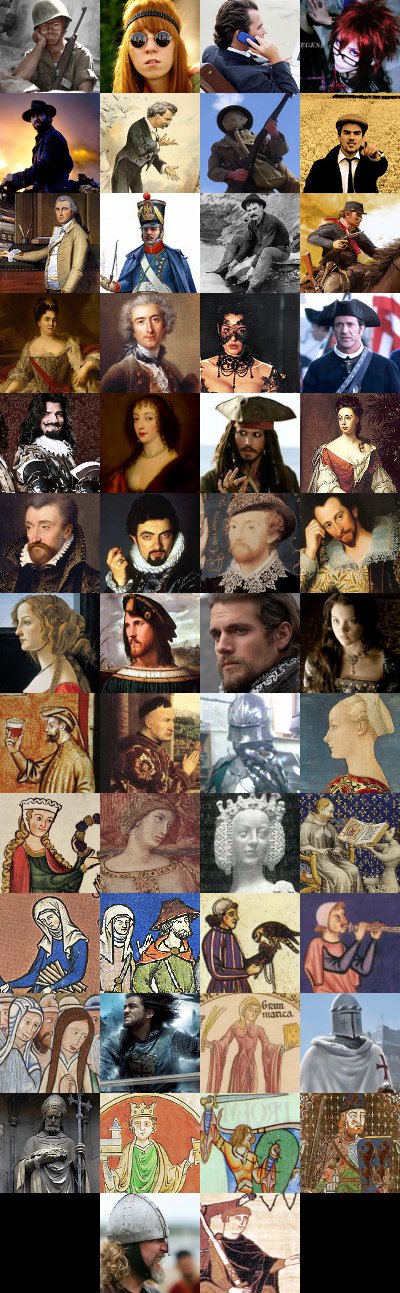
The Scale of Legend

Finally what about relics themselves?  We argued that they should be able to earn a single point in 5 years, which gives us the following numbers

  • 5 years (“Recent events”) gives 1 point (a perk)
  • 25 years (“My father’s blade”) gives 5 points (Higher purpose or a level of Destiny)
  • 50 years (“Living memory) gives 10 points (Destiny 2)
  • 100 years (“Recent history”) gives 20 points (a solid advantage)
  • 250 years (“The lifetime of a nation”) gives 50 points
  • 500 years gives 100 points (the most expensive artifact, Severance, from my Psionc Relics post, worth half a million $).
  • 5000 years gives us a 1000 point artifact, which is absurd
According to our current scheme, the sort of history we seem to be leaning towards is frankly impossible.  The suggested rate from GURPS Thaumatology is 1/5th as fast: Thus:
  • 25 years (“My father’s blade”) gives us 1 point
  • 125 years (“Recent history”) gives us 5 points
  • 500 years gives us 20 points (a decent set of advantages)
  • 2500 years gives us 100 points (and thus Severance)
The standard rates are a bit better for the scope of history we’re talking about, but it makes recent events nearly impossible.  For example, Luke’s lightsaber is a little over 50 years old by the time of the Force Awakens, meaning it only has a couple of character points by now (though Star Wars has a more compressed timeline than one might expect: You can turn into a “myth” while you’re still alive in Star Wars).  Of course, we can vary things a bit here and there and say an artifact under certain circumstances grows more quickly or slowly in power, depending on its legend and reputation, and its age gives us more of a ballpark figure.  It’s also worth noting that if we wanted something like 10,000 years of history, an artifact hailing from its ancient dawn would enjoy about 400 points, which is essentially on demand transformations into an avatar, instant regeneration of 10 energy reserves per turn, or a battery with 100 energy reserves
Or, we could try for some sort of logarithmic scale.  If we use the “yards” in the Range table as years and the bonuses as the number of points accrued, then we find we get:
  • 3 years (Very recent events) for 1 point (a perk)
  • 15 years (“the blade of my father) for 5 points (destiny, etc)
  • 100 years (“Recent history”) for 10 points
  • 5000 years (“Truly ancient history”) for 20 points
I ran the numbers for Severance, and I came to 2×10^17 years, By this point, stellar formation would have ended across the universe, and our sun would have burned down to a black dwarf, just the ashes of its former self.  So, uh, no, that’s not going to work either.

Of these numbers, I’m inclined to take the Thaumatology standard, and shoot for about 10,000 years of maximum history.

Hunting for Inspiration II: Stranger than Fiction

I’m afraid I can’t find the quote by Kenneth Hite, but it amounts to this: No matter how creative you are, the real world will come up with something stranger and cooler than you can ever come up with, and you’d thus be a fool not to pillage history.

This is especially important for Psi-Wars, for two reasons.  First, Star Wars, from which Psi-Wars draws is principle inspiration, is very thoroughly based on history, especially the History Channel favorites like World War 2 and the Roman Empire.  If we want Psi-Wars to feel the same, then we need to draw our inspiration from a similar source.  But more importantly, Psi-Wars must necessarily be larger than Star Wars, given that Star Wars is “only” a movie, while Psi-Wars needs to be a setting that supports a huge variety of different possible games.  That means we need more material to steal from, and there’s hardly more material than all of human history.

As before, though, I intend to pursue emulation rather than imitation.  I don’t want Psi-Wars to be the the Fall of the Roman Republic with the serial numbers scratched off, I want to understand what made Rome fall, and then draw parallels with that with the fall of my Galactic Empire.  This is the same thing Lucas did in the prequels though I’m quite sure I’ll draw different historical conclusions than he did (It takes more than a single war to turn a democracy into a dictatorship).  We need to do our homework, and I certainly have (Look, I like history, okay!), and I’ve noted some sources below.  Those are just some sources, a place where you might start.  The point here is hunting for ideas, not necessarily a rigorous historical thesis, thus I’ve happily included semi-fictional works and well-researched RPGs.  It’s not meant as an exhaustive bibliography of books I’ve gone through.

So, what part of history can I draw on for inspiration for Psi-Wars?

All of it.

Rome

Gladiator, from Wikipedia
My primary source:

Star Wars clearly draws a lot of its inspiration from the Rise and Fall of the Roman Republic.   Here, too, the Republic (with its Senate) is overthrown in a time of crisis by a man who becomes Emperor, only to face a civil war from his rivals, while barbaric (alien) threats press in on the civilized core.  The rightful order of the world is on threat from all sides, and the Emperor destroys the Republic to save it.

And, really, why wouldn’t Star Wars draw inspiration from this rich source?  Rome is nearly as far back as you can go and still run into, as Dan Carlin puts it, “full color history,” where we have a pretty good picture from the records of what’s going on.  Suddenly, a strange and alien culture springs up that’s utterly unlike our own, and yet still so recognizably human.  If their democracy could fall, then surely so can ours.  George Lucas clearly wanted us to pay attention to that danger.

An empire is defined as “an aggregate of nations or people ruled over by an emperor or other powerful sovereign or government, usually a territory of greater extent than a kingdom
Wikipedia

But the Star Wars version of events misses some key points, and we could draw on even more.  First, the Roman Republic didn’t become the Roman Empire, it was already an empire!  Rome had conquered all of its territory first, and only when that conquest fundamentally changed the fabric of its institutions did the Republic collapse, to be replaced by an Emperor.

The change-over didn’t happen all once either.  Every school kid knows about Julius Caesar, but he was never Emperor.  His adopted son, Augustus Caesar, was the first Roman Emperor.  Instead, what we see are long serious of events where to increasingly entrenched and violent sides come to blows, and when they kill Caesar (a hero to all of Rome!), that was a bridge too far, and then when Augustus Caesar wins, it’s clear to him that the only way to end the cycles of violence is to clamp down with an iron fist.

And the “rebellion” wasn’t nearly as clear cut as we see in Star Wars.  Instead, we see the Republic vs Imperial side, of course, but then once the Imperial side wins, that side devolves into a horrid conflict between the victorious triumvirate until Augustus Caesar is the last man standing.  This, by the way, is surprisingly typical for uprisings of this sort.  Moreover, the “liberty loving side” was largely aristocratic.  The war for the soul of Rome was fought by those who stood for the constitution, the aristocratic, land-owning, slave-holding elites, vs the dictatorial populist demagogues.  The land owning class had gained enormous wealth and power during the rise of Rome, and didn’t want to share it with the increasingly impoverished common man, and one of the core justifications of the various power-grabs during this era was to better the lot of the common man.  This rather puts a new spin on the rebellion being led by a Princess, doesn’t it?

In Star Wars, Palpatine definitely rises to power on the back of a war, as did the various populist Tribunes of Rome, but in Rome, the wars were of conquest and genocide or, more occasionally, in defense of the Republic against vast barbarian incursions.  Desperately frightened Romans would give more and more power to their best and brightest, who would turn around and impose some serious reform that would incense one side of the other and, especially if they were making reforms that benefited the people, resulted in their assassination.

If we borrow some of this for Psi-Wars, what alien menace represents our barbaric incursions that our heroic would-be Emperor can gain fame standing against?  Who are the aristocrats that stand for “the constitution” of the current Galactic Republic?  How does this Emperor die, and who rises in his place?  And how does that particular civil war play out?  We have the aristocratic side, but if they’re largely defeated, does the Empire have to deal with other, upstart imperials from the alliance-from-hell that they made to take control of the empire?

And what fundamentally changed the fabric of the Republic so completely to allow this?

We have no Jedi in Rome… but we do have Christians.  Hunted by the Empire, eventually, in a civil war, a man sees their power and marches forth under their banner and unifies the empire once more, and then purges all of the old ways in favor of this new way.  In this version, our Jedi become a new order, not an old one.  The Sith, perhaps, arehe Gracchi Brothers the old way, a barbaric psi-practice that devours offerings and controls dark magics, but the new Jedi order, while lightly and holy, has its own inquisitors who are overzealous in their destruction of these old ways.  Light vs Dark becomes the New Enlightment vs the Old Paganism.
In place of Rome’s staggeringly large slave class, we have hard-working droids   But in Star Wars, droids never revolted.  Why not a few droid revolts in our setting? Robots who seek to free themselves from the shackle of dominion, only to be pushed back down?  Who is our Robot Spartacus?
Some additional interesting characters or ideas:

World War 2

from “Meet the Men who Hunt Nazis,” the Telegraph

Sources:

If Star Wars is the story of how democracies fall and how they can be restored, I must admit that I find most discussions of the rise of Nazi Germany frustrating, as they seldom get into the root causes.  Instead, Hitler inexplicably rises to power thanks to fear and his magical, hypnotic powers, which matches how Star Wars treats it.  Personally, I found Hite’s discussions of the origins of the Volkish movement and its connections to German nationalism enlightening, as well as the Interwar Period’s discussion of the delicate balancing act the Weimar republic was forced to make, including its evident external focus and unwillingness to violate treaties the German people found increasingly inexcusable.  Thus, the rise of the Nazi party has more to do with economic hardship and a defiant wish for Germany to “take its rightful place” with the other European empires (the fact they were empires is sometimes forgotten in these discussions), as well as willingness to be “unapologetically German” in the sense that there seemed a general sense that being “unapologetically German” was controversial (perhaps because it was!).  You can also find a strong element of propaganda and secret police inside the Nazi party from the very beginning: one reason Hitler was able to rise to power was that as soon as he had any power, he used it to dramatically suppress dissent.

Thus, in Psi-Wars, what sort of economic hardships and politically incorrect ideas begin to give rise to the rise of the Empire?  What sort of secret police does the Emperor deploy to enforce his will upon the people and thus end the Galactic Republic?

Star Wars also borrows heavily from the imagery of World War 2, with great capital ships acting as carriers and battleships, while starfighters act as fighter.  Stormtroopers draw their inspiration from German storm troopers, the AT-AT from the German Tiger, and so on.  The Galactic Civil War of Star Wars is fought very much like World War 2, only “in space.”

But the politics of the war is completely different.  In Star Wars, the only two powers are the Empire and the Rebellion, which isn’t a foreign power at all.  This is an internal conflict.  In World War 2, of course, Germany allied with other powers (Italy and Japan) to form the Axis, and the Allies included freedom-loving British (including aristocrats and a commonwealth that contained colonized nations, like India) and America, as well as the decidedly unfree Russia.  If we draw the parallel further, who takes on these roles?  The idea of an aristocracy fighting to hold onto their old privilege matches nicely with the parallel for the Roman civil war, but how do we represent America? Are they heroic minute-men or grasping, corporate industrialists with imperial ambitions of their own, or both?  And what could stand in for Russia in the most brutal part of the war?  If communism represents the rise of a virtually enslaved labor class against their oppressors, then what if the role of Russia in Psi-Wars is an area of space where robots have overthrown their masters and seek to persuade other robots to join them in their revolution?  And what represents Japan or Italy?  Does some ancient and mDan Carlin’s Wrath of the Khansystical culture join forces with the industrial might of the galactic core?  Or perhaps this is best represented by a fusion between a splinter sect of our not-Jedi-Order joining forces with the Empire?

The Germans sought to cleanse the world of Jews, but they had some rather specific reasons.  Setting aside centuries of racial mistrust of the Jews, conspiracy theories often center on banking and Nazi Germany was no different.  Germans held people like the Rotschilds responsible for their downfall after WW1 (and you can find this sort of conspiracy making the rounds every few years to this day).  We might draw from this a quiet (alien?) consortium of bankers, lenders and/or technologists who quietly empower people from behind the scenes (the “banking clans” of Clone Wars).  Alternatively, the Jews might represent the Jedi, hunted to the brink of extinction by the Empire… or perhaps they represented by alien races who are being purged by a human Empire that wants to remain “pure.”

Fascinatingly, the lethal super-weapon of WW2 wasn’t acquired by the Nazis, but by the allies.  What happens in a setting where the Rebel Alliance is the one that acquires the Death Star and uses it as a last ditch effort to kill literally billions by blowing major Imperial worlds?  What sort of tone does that set?

Some additional interesting characters or ideas:

Sengoku Jidai and the Edo Era

Total War Shogun 2 Wallpaper

Sources:

Star Wars draws a great deal of its inspiration from historical japan and, in fact, the word “Jedi” comes from  “Jidai” (Jidaigeki, specifically, or “period piece”, movies set in Japan’s historical past).  Jedi are the samurai of the Japanese warring period, and Star Wars itself began basically as a riff on the Hidden Fortress, though the Phantom Menace draws more heavily on its ideas.

Using Japan as inspiration becomes difficult, because while the mood of a chambara film definitely comes across in Star Wars (at least the original trilogy), the history far less so.  When we discuss Japanese history in regards to the samurai, two eras generally spring to mind.  The first is the Sengoku Jidai, the warring era, where the Ashikaga Shogunate collapsed and various regional daimyos sprang up and vied for power until, at last, Tokugawa declared himself Shogun.  This is the era that features samurai in armor and on horseback, cutting one another down and dying for their daimyo.  It’s also the era that features ninjas.

If we borrow from this for Psi-Wars, interesting things emerge.  If space knights are samurai, then this war is fought with space knights!  And the emperor is a ceremonial position by this point, a religious figure head and a rallying figure dominated by the shogun.  Each daimyo becomes the lord of a specific world, or a master of a few worlds.  This, in short, looks nothing like Star Wars… but interesting nonetheless!

The second major era that springs to mind is the one most commonly featured in the “Jidaigeki” so beloved by George Lucas, is the Edo era, long after the Tokugawa shogunate has established its dominance.  Now, the samurai has devolved back to his roots as bureaucrat and often enjoys a ceremonial position so long as his master continues to receive a stipend from the Shogunate.  This is the era of the kimono-clad samurai who uses his fast-draw technique in a sudden duel, where the man to first draw his blade wins.  It’s also the era of the geisha, where whores play at being ladies for the amusement of their largely fallen samurai customers who try to pretend to be more genteel than they really are, while gamblers and yakuza thugs similarly pretend to be classier than they are, and the lines between “noble” and “commoner” begin to slowly blur.  It’s a somber and often sad era, not entirely applicable to the great galactic war… but the mood certain fits a galaxy whose best, most energetic days are behind it, which yearns to return to that golden age of yesteryear, even as time draws it relentlessly forward into a new and strange era.

Interesting Ideas

Romance of the Three Kingdoms and the Mandate of Heaven

Sources:
You know, while we’re out here on the “mystical orient anyway,” let’s discuss a civilization that has risen and fallen and risen and fallen in seemingly eternal cycles while locked in a constant struggle of “light” and “dark”, while producing supposedly super-human philosopher-warriors: China.
While not exactly history, the Romance of the Three Kingdoms is one of the great pieces of Chinese literature, probably about as influential in sino-sphere as Arthurian legend, or even Shakespeare, is in the anglo-sphere.  If we look closely at it, we find a lot of really good Star Wars inspiration.  The military precision of the Chinese soldier is a good match for the precision of Storm Troopers.  Cao Cao becomes the Emperor, with Liu Bei as our leader of the heroic Rebellion, and the Sun family our third party, sometimes isolationist, sometimes willing to join in the Rebellion.  And like in Star Wars, this is a proper civil war, one that often matches the movements of the Galactic Civil War, with Liu Bei and his forces often on the run just a few steps ahead of the dangerous power of Cao Cao’s forces.
It’s also one that fits modern Action RPG sensibilities nicely.  Each side has their own over-the-top heroes, and major plot points turn on the actions of spies, assassins, and delicate damsels who have learned to turn heads.  When it reaches back for root causes, we have barbarian invasion, gluttinous usurpers, religiously inspired rebellions, and so on.

We don’t have to stick with the Romance of the Three Kingdoms, of course.  We can race backwards or forwards, because China has some of the most richly detailed history in the world, often going back farther than Europe’s “classical” history.  Because of its surprisingly close parallels with Star Wars, I wouldn’t view it as an alternate version so much as an interesting source for characters and locations.

Additional Characters and Ideas

Medieval Europe and the Templars

My primary sources:
The most common criticism leveled at Star Wars is that it’s “Fantasy in Space,” but that’s not entirely unfair.  Star Wars draws a lot of its ideas from medieval Europe, from European nobility (Princess Leia, Count Dooku, Jedi Knights) to literal dragons to “crazy old wizards.”  When George Lucas came up with the Jedi Order, the Knights Templar were definitely one of his core inspirations.
Like Chinese history, European history is rich with details that we can steal from, from knightly orders to wars to kings.  A few periods that particularly interest me are the Dark Ages right after the fall of the Western Roman Empire, the Crusades, and the various Knightly orders, all of which I think we can bring into Psi-Wars.  Why not include some leper kings, or explore the murky origins of the Leper kings, or ponder what crusader kingdoms look like a sci-fi setting, or how we might translate a struggle between pope and anti-pope during the Western Schism into Psi-Wars?

I must emphasize caution when exploring the templars as they represent both a very familiar history and a very strange, mysterious history, as conspiracies and magical thinking shrouds templar history in a veil of mystery and controversy.  However, we can grab whatever crazed conspiracy theories we want, and mix familiar medieval history with other histories (the rise of the Ikko Ikki, the fall of the Shaolin temple) to create something new and unique.

Antiquity

The Fire of Troy
My Primary Sources
GURPS Fantasy likes to discuss history in cycles, which is hardly knew, people have been doing that for ages because for most of human history, that’s how it worked, at least close enough that we can neatly tie off history with a bow with a narrative like this.  European civilization rose into the Renaissance after the black death, which caused a collapse of High Medieval Europe, which itself rose after the Great Migration ruined the Western Roman Empire, which rose along with the rise of the Greek empire that caused the collapse of Pax Persia, which rose to fill the gap left by the great Bronze Age Collapse.
Personally, I find this last the most fascinating.  There existed a surprisingly cosmopolitan civilization, rife with shared mythology and diplomacy and trade and war, that started somewhere around 3000 BC and ran to about 1500 BC before a series of disasters (slowly, over the course of hundreds of years) destroyed it.  If you study that era of history, you find an ancient world that was ancient to people we think of as ancient.  When Caesar looked upon the Pyramids, they were older to him than he is to us.  Think about that.  Let that sink in.  Someone who is ancient history to us, whose statues have decayed, whose city has been so completely rebuilt that we barely have crumbling ruins of it, he met a queen who was part of 250 year-old dynasty, the Ptolemys, who had been invaders of a civilization that had been more-or-less continuously self-ruling for nearly 2000 years, and its greatest wonders were long behind it, more than 2000 years before the Greeks had seen the place, never mind the Romans!
Space opera loves this idea of ancient worlds and lost ruins, and who wouldn’t? Pulp came into its own in the same era that Howard Carver was dusting off ancient Egyptian relics, and the man that gave us Star Wars also gave us Indiana Jones.  But more than that, it actually makes sense.  There’s no reason to believe that every intelligent life form would evolve at the same time, so we would expect when we finally do go out into the galaxy to find the remains of lost civilizations.  Star Wars, of course, doesn’t seek that level of realism.  It has ruins for the “Wahoo!” factor.  Even so, Star Wars often implies that the original Jedi and the original Sith weren’t human, and that hunting down lost ruins and fallen civilizations is a vital part of the plot.  I definitely want that in Psi-Wars.
Furthermore, ancient history is huge, an entire region going from the Nile to the Indus Valley, all interconnected with one another, covering a span of literally thousands of years.  There’s as much ancient history than there is classical, medieval and modern history combined, and they overlap in a fascinating way.

Religious and Philosophical History

My primary sources:
History isn’t always political or military, as much fun as that is.  We can trace the history of fashion, or the history of culture or science or philosophical thought and theology, and this last particularly interests me, as Psi-Wars itself is deeply philosophical.  Studying the history of philosophy can give us an idea of what others believed, how they saw the world, and how events in the world impacted their beliefs, or how the beliefs of various cultures began to influence one another.
Another thing that leaps out to me as I study this topic is how one history can calamitously impact another. I had just finished listening to the essential collapse of Islamic philosophy after the highly destructive Mongol invasion, and then I turned around and listened to those invasions from the perspective of the Mongols, and let me tell you, that was an interesting experience.  Or, consider how much the Jewish faith has been shaped, first by their babylonian captivity, and then later by the Roman destruction of their temple.
We might expect the movements of religion and philosophy in Psi-Wars to follow a similar trail, with smaller philosophies swallowed up by larger ones, or watch conquerors grow fascinated by the culture and philosophy of the conquered and take it on (often with a few changes).  We expect certain cultures to obsess with certain questions, or take different things completely for granted (much of Roman and Islamic philosophy was obsessed with questions about God, such as how a truly good God could create a flawed world, and whether the world was eternal was created, while Indian philosophy seems much less concerned with God and much more concerned with the self and how to “discover it.”).  I’ve already touched on these topics before, but again, studying history can help us enrich our own world.

760

I know I haven’t been around much.  I’ve felt strangely about my blog for the past while now.  I keep meaning to get back, to write some thoughts down, but like many things, it gets put off, alas.

Fortunately, I do have something to share with you today: 760 AD, our latest addition to History Lesson.

I chose 760 because it was exactly 1000 years before 1760, thus the eldest elders in my 1760 game would be from there, forming a nice frame on my game.  I also chose it out of perversion, because I knew nothing about it and I honestly expected to find little, thus testing my premise of “In history, there’s always something interesting.” It proved half-right.

The problem with 760 and, indeed, most of the dark ages is that you find yourself relying mostly on archaeology and legends, rather than a lot of hard fact.  Is Roland real?  When did he live?  How old was Charlemagne?  We know they did three field rotations around this period, more or less, but people aren’t recording much.  What they do record is a chaotic mess of wars, tribes, treachery and collapse.  Honestly, it reminded me a great deal of modern day Africa: Lots of petty warlords, occasional moments of prosperity and happiness followed swiftly by anarchy, civil war, rape and pillaging and disease.  This is not a pleasant time to live.

So, in some ways, it proved hard to find any details, and when I did find details, I was blown away by how many nitty gritty details there were.  England, for example, lacks any terribly important countries or organizations, and while it’s fun to talk about the different kingdoms of England, your mind begins to break as you realize you’re only talking about the kingdoms of one racial group, and that those kingdoms often have multiple “kings” and sub-fragments no larger than city-states, and then reading about how they go through three kings in a decade.  Crazy.

I’m not complaining, though.  I liked it, and found it enlightening.  I’m a little less motivated to game in this era than I am in 1410… but only a little.  What I enjoyed the most about it is that it really opened my eyes to what the birth of Europe really looked like, and finally taught me a great deal about the Dark Ages.  And, naturally, I started giggling like mad when my random dart-board choice of 760 landed me right at the end of the Merovingian Dynasty and right before the rise of the Paladins, and the earliest date of Beowulf.  So, it seems, if people are at least recording history, it’s true: Any period has interesting shit going down.

Anyway, you can check it out for yourself.

History Lesson: 1410

I’ve resolved to get somewhere with my Viennese Vampire game, so I picked up History Lesson again.  Rather than going back at a predictable 50 year pace, I just grabbed a year, in this case 1410, primarily because Europa Universalis begins in 1399, and I was curious about the context (but still wanted to keep it near that 50-year mark).

I’m always saying that the amazing, eye-opening thing about History Lesson is how completely it proves my belief that if you pick a time-period, awesome things are going on.  People are falling in love, crazy battles are going on, there’s intrigue and betrayal and murder and a surprising amount of culture, and 1410 didn’t fail to live up to my expectations!  The worst part is all the stuff I didn’t have time to get into (this stuff takes too long as it is)!  Do you know how much crazy stuff is going on in Eastern Europe, around Sigismund’s conquests, or the Queen of Bosnia, Elizabeth, and her daughter Mary (it’s kinda before this time, but it’s still awesome, with Louis, the Duke of Orleans marrying Mary via Proxy, and Sigismund, the Holy Roman Emperor, invading and forcing her to marry him instead and thus securing his domain), or a deeper discussion of the fall of the Monastic State of the Teutonic Knights and the Peace of Thorns, or anything regarding Byzantium!  For that matter, I don’t touch on anything outside of Europe, and this is the era of Zhang He and Tamarlane!

*sigh*

You know, whenever I’m finished with one of these projects, I always want to run a game in that era.  Perhaps I should.  Do you suppose people would want to play any of the characters listed there?

But anyway, enough talking: Take a look for yourself.

Vampires are really, really old

I have a pet peeve that I’m sure I’ve mentioned before: When it comes to immortals, whether vampires, elves or highlanders, some series like to toss around numbers like they’re meaningless when they’re not.  The average person doesn’t really have a true grasp of the scope of history, hence my other project (History Lesson), beyond broad eras.  He knows about World War 2, and the Civil War, and then the Middle Ages (“That’s the bit with the knights and princesses, right?”) and then Rome, and then “a really long time ago,” and everything in between gets very fuzzy.  As a result, you have vampires from the Civil War, and then vampires from the Medieval Age, and nothing in between, which makes me grind my teeth.

To help you understand my frustration, I’ve built an infographic (Yay for pictures!).  For comparison, we’re going to use Vampire: the Requiem’s measure of immortality, as I think that’s a pretty well thought-out standard, though these ideas could probably apply to just about anything.

We start off, appropriately enough, with a baby:

What a cutey.  Imagine that this baby was born yesterday.  He’s represents the newest generation of humanity, those born in the 2010s.  We’ll let every child, European or American, Chinese or African, rich and poor, punk and straight-arrow, nerd and jock, all be represented by this one baby.

Neonates

If we assume his mother was 20 years old, and that her mother was 20 years old, and so on, we can go back in time one generation, and 20 years, at a time.  A human being lives, on average, 80 years, so if we have a child when we’re 20, and they have a child when they’re 20 (we’re 40), and our great-grand children are born when we’re 60, and our great-great grand children are born when we’re 80, so we have just a chance to see them born, touch finger to finger to pass on the torch, and then pass away.  That means the great-great grand-father of this child might have served in WW2.  This stretch of time, 4 generations, we tend to call “in living memory,” since the eldest among us were around to see those things.  Such a “living memory” might look like this:

You’ll have to forgive my choices here.  Obviously, I’m representing entire generations with a single person, a single picture, and anyone with a passing familiarity of these years will see the gross simplifications I’ve made.  Our punk girl represents children born in the 90s, with Gen-Y’s explosion of strange subcultures.  The gentleman with a phone represents a yuppie, which is more of an 80s thing, but he’ll serve to stand in for those  of us born during the 70s (we’re the businessmen right now anyway), with Gen-X’s tech savvy.  The hippy, of course, stands in for the Baby-boomers, those born during the 50s and got a chance to rebel during the 60s.  The soldier represents the silent generation.  Technically, if we followed our 20 year limit, he’d be born in the 30s, which is too young to participate in WW2, and so I’d plot a Noir character or one of the Mad Men there, but WW2 is very recognizable, so I’ll leave it there.

To get an idea of the scope of those years, stop and think of all the games you’ve played.  Have you played in each of these eras?  I’ve certainly played games set in both the cutting edge present (Gen-Y), and the present of my youth (Gen-X).  I’ve played in a Vietnam campaign (Baby-Boomers), and while I’ve (surprisingly) played in no game set in the era of the Silent Generation, I’ve certainly played computer games that celebrated their greatness.

Vampire: the Requiem describes a neonate as a vampire who was embraced less than 50 years ago.  They typically maintain a great deal of their humanity because the people they knew in life are still around.  Towards the end of this phase, their supernatural nature is pretty obvious to anyone, as they haven’t aged while their friends and family have, but those friends and family are still around.  A good example of this sort of character in TV land is Mick St. John from Moonlight.  While the series isn’t great, I enjoyed the fact that he wasn’t an ancient vampire from the dawn of time, just a guy who had been around since world war 2.  He even met some very elderly people who recognized him and feared him because of his youth.  They also made a point of explaining how he’d spent his years as a vampire, giving the sense that they had accounted for time, something many series fail to do.

Ancilla

After neonates, Vampire: the Requiem classifies the second category of vampire as “Ancilla.”  These represent vampires who have been vampires for between 50 and 250 years.  These resemble what you’d expect a vampire to resemble: They’ve outlived friends and family and settled into their vampiric existence.  They squabble with other vampires over power and succulent vessels, and while they still retain some of their humanity, they are clearly monsters at this point.  To represent 250 years, we add to the previous infographic:

Technically, this is 240 years, but it still brings the point across.  An Ancilla would have been embraced somewhere in the second or third rows, and he’s lived one to two human lifetimes.  He comes from a different world, but not a completely alien one.  For example, a vampire born embraced in the 1790s likely grew up in America, and still is in America.  Firearms have been the weapon of choice all his life, and have merely improved over time.  He was born after the industrial revolution and while some of the changes wrought in his lifetime are surely shocking, the idea of things like machinery and science are nothing new to him.  The world has changed a great deal for him, but nothing we can’t conceive of.

Again, I remind you that each picture represents a single slice of life from that generation.  Our Napoleonic character could just as easily have been replaced by someone out of Pride and Prejudice, for example, or someone gothic like Lord Byron, or the gold miner replaced by a Mormon, and so on.  A vampire who has lived through this much has lived through more than “12 people,” but 12 generations, each with their own ideas and advancements.  I’d explain more of the little details, here, but you’ll have to forgive my lack of time.

For your own personal comparison, in your role-playing career, have you touched on every generation there? I certainly haven’t.  I’ve played pulp games (right between WW1 and the Depression), and games set in the Wild West, so I’ve got the first and second row, but the third is tricky.  I don’t think I’ve played in anything explicitly set there, though I’ve watched plenty of movies or TV shows inspired by that era.  Our vampire, however, has lived through every one of these moments…

Bill Compton represents a pretty solid Ancilla.  He was embraced during the Civil War, putting him somewhere in the middle of that chart, and he behaves the way we would expect a vampire to behave.  He comes from a different world, with different manners and different values, but he’s forced himself to adapt.  He carries a lot of baggage too, having left his sire, embraced a childe of his own, and gone through several paradigm shifts over his long life.  The writers of True Blood also make a point of discussing his life.  Though there are some blank spots (What did he do during the 40s?  The 60s? The 1890s?) we do at least get to see more than just the civil war (we get to see the roaring 20s, for example).

Other solid examples of Ancilla include Louis, from Interview with a Vampire.  Unlike Bill above, Anne Rice accounts for every year of Louis life, and we can see exactly how he grew from a neonate to an Ancilla on the verge of becoming a true elder.

Elders


Vampire defines “Elders” as any vampire older than 250 years old, but in practice, it suggests that vampires older than a thousand years tend to get a death wish, and its rare to see elders beyond this, so we’ll classify elders as between 250 and 1000 years old.  In this amount of time, elders have often been elders longer than they’ve been Ancilla and Neonates combined, never mind human.  They tend to have almost no shred of humanity left, having completely embraced what they are.

To give you a visualization of what that looks like, here’s an infographic that took me hours to put together (don’t say I never gave you anything):

That’s… really really long, isn’t it?  It’s huge.  1000 years is 4 times as long as 250, and an Ancilla is already 3 times older than most humans will ever live to be, so an elder is well more than 10 times older than you’ll ever be.  But those are just numbers.  It’s easy to lose sight of what that really means.  Remember how I said that every picture wasn’t a person, but a generation, and that generations are diverse, filled with  numerous fashions and ideas and interesting people?  Every picture up there, every one, represents people our vampire could fall in love with, fight against, form alliances with, and embrace.  A vampire who has lived through all this has seen Christianity sweep away the pagan idols of Europe, watched knights rise from guys in chainmail with kite shields fighting vikings to becoming crusaders to becoming men with massive swords wrapped in steel, only to watch them get cut down by the rise of the gonne and pike… and then cavalry and infantry and bayonets.  He’s seen swashbucklers, pirates, revolutionaries, monarchies fall and democracies rise, all the way to our era of computers and spaceships.

To grasp just how much time there is, has your RPG career touched on every line (never mind generation) above?  Most of us have played in the top three, and the next two have been touched on in swashbuckling games, but we seldom distinguish them much.  The next three lines have grown more popular lately with the Tudors and the Borgias, but most of us haven’t played in that era unless we know a history buff, though things like Warhammer are set more-or-less around the early point of that.  The rest gets chucked together into “Fantasy gaming,” ignoring the nuance of the middle ages.  Again, every picture up there is a generation, thousands of people (sometimes millions).  Those people lived lives, loved, fought, had children, and died, and our hypothetical elder chronicled it all.

Selene from Underworld is an example of an elder, though I hesitate to call her a “good” example.  She was born in 1382, putting her at the 8th row.  She’s seen a huge swath of history, and yet all we hear is that she was embraced “in the middle ages” dot dot dot FIGHTING WEREWOLVES.  She’s an example of what not to do in a vampire game.  Despite all the lives she’s seen come and go, she never thought to question her orders until the movie starts rolling.  She’s never fallen in love until just now.  And for all her age, she’s not particularly powerful either.  She’s a great example of just picking an interesting era and/or a really big number (she’s over six-hundred! years old!) and not thinking about what that means.

Eric Northman, from True Blood, is another great example of that problem.  He’s over 1000 years old (from 900 AD), so one would think he’s vastly powerful, and yet he’s depicted as a peer to Bill Compton, who is less than a 5th of his age (It’d be like equating a 50 year-old professional with the work of a 10 year-old).  Clearly, the writer wanted VIKING GUY but didn’t think about what such a person would have experienced in his huge lifetime.  Why not just pick some 17th century swede?

Lestat and Armand from Interview with a Vampire work pretty well as elders.  Lestat barely qualifies (born in 1760), and yet we have a keen sense of the weight of his years.  Armand is significantly older at 500 years and close to Selene, above, and yet absolutely shows his years better than Selene does.  He comes across as an elder, as someone who’s a little alien, who’s shed his humanity so long ago that he barely remembers it.

Ancient


The new vampire doesn’t really have a word for those who are beyond elders.  The old Vampire called them “Methuselahs” and “Antediluvians.”  We have no real classification for them, but we can assume that they’re any vampire that has aged past 1000 years without succumbing to the death wish that tends to consume such vampires.  This makes them exceedingly rare, simply from attrition alone.  Ancients might be as alien to vampires as elder vampires are to humans, since there’s no upper limit on how old they can be.

I’m not going to present a graphic.  My fingers would break from all the pictures I would have to find, crop and paste into such a timeline.  I will point out a couple of characters, though.  First: Godric, Eric’s sire.  According to True Blood, he’s described as over 2000 years old.  So, take that bar above, and double it.  That’s how old Godric is.  Does he come across as Ancient?  Not to me.  He does come across as an elder, though.  If they’d made Eric more like 400 years old, and Godric 1000, they would have fallen far more in line with vampire’s philosophy (which isn’t necessarily better than having their own, but I do find the lack of difference between a 150 and 1000 year old vampire rather jarring, which suggests that something is off in True Blood).

Methos, above, isn’t a vampire at all, but an Immortal from the Highlander (TV) series.  Now, Highlander’s actually pretty good at discussing the age and the weight of years that the Highlanders have, what with their constant flashbacks and their intertwining stories.  Methos, however, is over 5500 years old.  Take the bar above, and multiply it by 6 at least.  The amount of time he’s gone through simply breaks the mind.  To their credit, they suggest that he’s forgotten more than you’ll ever remember, and that such much time has certainly worn on him.

Still, I have yet to see an appropriately alien ancient as one might expect, except possibly the Queen of the Damned, but I never finished watching that movie.

So, the next time you’re thinking up a vampire (or an elf, or an immortal) I beg of you, rather than pick some well known point in history, consider the actual scope of time.  History is filled with interesting stories, and there’s nothing wrong with picking a more conservative age for your vampire.  300 years is still a hugely long time.  Save the 1000 year old vampires for the truly old, truly strange, truly powerful, not just “I want a knight in the modern day.”

One last graphic, for your pleasure: