All I Want for Christmas: Kronos Faction 2: The Indigo Brotherhood (and the Crimson League)

So, yesterday I dropped the least interesting of my faction ideas for Kronos. Today, I drop my favorite: the Indigo Brotherhood.

The Indigo Brotherhood is old. It takes to Undercity Noir 1, where a member of the faction helped out one of the Ranathim PCs escape from her Bloodsider pursuers. I didn’t have a strong idea of what they were like that point, other than that I knew:

  • They were psychic
  • They were a rebel faction
  • They were inspired by the Indigo Academy for the Gifted

This Indigo Academy was, of course, a reference to a secretive catspaw cult of the Cult of Revalis White, which dates back to Iteration 6.

What exactly they were like, I had several different conflicting ideas, not all of which made it in.

The earliest inspiration was an idea for Telepathic Blaster Combat that combined the teamwork of the Final Form with the tactical precision of Combat Geometrics. I liked the idea of this being a highly coordinated group of scrappy rebels using their telepathy to outmaneuver the Empire. The problem I had with this idea is that, first of all, the Indigo Brotherhood teaches more than just Telepathy, as it teaches everything, and second, there’s another rebel faction that I think would do far better at this sort of thing (The Warmaidens).

The second inspiration came from my work with cybernetics. I wanted an Ergokinetic Cyber-Mysticism that allowed the psychic to interface with their cybernetics and make them more powerful, a cybernetic equivalent to the Keleni breathing forms. The problem, again, was the Brotherhood teaches more than just Ergokinesis. I could have two different styles, but what about the other psychic disciplines? And how big is this organization going to be?! So this was spun off into its own organization.

The third idea came from Mob Psycho 100, probably one of the best psychic anime I’ve ever seen (and I’ve seen quite a few!). The character above used a toy sword as a focus for their psychic power, and it was a great example of these sort of quirky psychic powers that felt like something unique and a hook on which I could base a style, except it had the problem of “how do I even define something like that?” I can just tell you to apply a Gadget limitation to a psychic power and call it a focus, but that doesn’t let you rapidly make a character, and doesn’t tell that much a story about the organization. I still liked the idea.

The final inspiration was the powers-system of To Be Hero X, an excellent Chinese/Japanese super-hero “anime.” While I’m not convinced the power system makes as much sense as the writers think it does, the “trust/fear” system of the setting interfaces neatly with Communion, especially some speculations as to how it could work. An extremely canny individual with a deep understanding of Communion could manipulate events to make certain psychics align with a Communion Path, and then super-charge their connection with it by broadcasting their feats to a sufficiently large population, say, the population of Kronos. They’d need to arrange for dramatic narratives, rivalries and arrange for situations where a hero was needed, but the result, if handled well, could fasttrack a psychic onto some unconscious form of Communion.

If we combined these last two concepts into the idea of a school for psychics, and a secret rebellion, and I think we’ve got something GMs can really use.

“So they’re the X-men?”

No! They’re not the… look…. I’m… okay fine.

So, I wasn’t setting out to make the X-men. I do a lot of deep dives into psychic sci-fi, and one thing I’ve noticed is that it hit its peak around the same time as the X-men were being made, and if you stop and go back and look at the X-men, the parallels are obvious. There is lots of secret conspiracy experiments on rare, advanced people who have unique abilities to manipulate the world around them, and much of the story turns on telepathy and other psychic abilities, and the technologies that augment them. And when you take those psychic powers to their natural extreme, they start looking a lot like super-powers (in fact, there is a nWoD 2.0 game, Deviant, which focuses on, among other things, psychics, and you bet you can make super-heroes with that).

There’s really no way to create an underground school for illegal psychics that doesn’t vibe like the X-men. Rifts had similar vibes because it tried a similar thing. Of course, I didn’t need to then split the group into two factions, but there were other reasons for that. But on the other hand, their focus on experiments, psychic drugs, conspiracy theories, the edge of indoctrination, all pulls the vibe back towards the paranoid paranormal sci-fi of the 60s and the 70s that I was aiming for.

With my innocence established, I would like to pitch that having super-heroes in Psi-Wars might not be such a bad thing. Psi-Wars is, like most space opera settings, is designed to be a trope stew, where a samurai and a cowboy team-up to fight a dragon and rescue a princess. Why not add super-heroes into the mix?

Kronos is also the perfect place to put them. It’s highly urbanized, the ideal haunt for “super-heroes,” and if you take the psion template and its inherent weirdness, mix it with the concepts of a psychic focus, the inherent self-deception of the Indigo Brotherhood, the media manipulation, and the drugs and experimentation in a night city saturated in crime and neon, I think, I hope, we have something Psi-Wars players can mess with. It’s also an organization that brings psychics to the fore as more than just discount sorcerers, which is how I’ve seen people use them.

They’re also a nice contrast to yesterday’s post: from the intolerance of Silver Faction to the idealism of the Indigo Brotherhood.

The Indigo Brotherhood

The Indigo Brotherhood is broken into two pieces: the Organization and the Esoteric Style

With the Organization, I tried to replicate the ideas from the Slaver cartels by including some sample NPCs; between those, some implications of the various powers and the tasks the needed by the organization, and the agendas/storyhooks, I hope this gives people enough to easily drop into the organization and get started.

The Indigo Academy was a struggle, because it could potentially teach anything, but I wanted to capture the thrust of what sort of training they generally do, and give some “worked examples” if powers they might teach.

This is the second, officially detailed rebel organization of the setting (though Mech Mob could use some revisiting)
All I want for Christmas: Kronos Factions 1: Silver Faction

I asked my backers to give me a month to write what I would like, and they kindly obliged by giving me the space I need to do what has weighed on my mind for awhile. In fact, since I’ve been working on the Trader Band, I’ve thought about Kronos a lot, and rather enjoyed fleshing out this part of the Psi-Wars galaxy (and this approach to fleshing it out, so I might do it more often for other parts of the galaxy). I have noticed some holes in the faction structure of Kronos, not that every niche needs to be filled, but there were a few I really wanted to touch on, three to be precise. I haven’t finished the third yet, and I might shift it to be a broader faction, and it might not be finished by the new year but the other two are done, and today, I present the least interesting of the three. Tomorrow, I’ll present the most interesting (to me) of the three.

A Gap In Tolerance

This first faction arose from a discussion with Autumn Rain about the Shinjurai of Kronos. I was discussing how the Shinjurai of Kronos are more tolerant than the Imperials, and thus better at administrating the highly heterogeneous environment. To me, Kronos reminds me a lot of Hong Kong: a highly successful port full of crime, innovation and a melting pot of multiple different groups rubbing shoulders while an older administration tries to keep the piece and a newer administration comes in and imposes its will. Naturally, the older administration had a better handle on keeping a lid on the tensions, and the newer administration stokes tension. I think if you look at the history of Kronos and the role the Shinjurai played in it, that makes sense.

Except Autumn Rain pointed out that when Ren Valorian conquered the world, the lore states there was a riot in which many members of alien minorities were killed and their businesses ruined. Ah. Hm. Good point!

I can go back and change that, of course, but I don’t think I should. I think it’s possible for both to be true. You can have a highly tolerant society that has adapted to living with multiple cultures and the tension that comes with it, but also have large parts of that society that does not tolerate others. In fact, if you look at some of the major factions of Kronos (the Bloodsiders, the Asrathi mafia) ethnic tension is written in. It’s a challenge, and not everyone handles it as well as others. Shouldn’t that apply to the Shinjurai too?

I had a long post diving into the sociology of how a larger group can be both highly tolerant yet have large factions that are not at the same time, but I don’t think I’ll waste time with that. Suffice it to say that I think it’s plausible for both to be true.

The problem, though, is we don’t really talk about this faction of Shinjurai and/or Kronos natives that aren’t as high minded when it comes to inter-ethnic harmony. Who were the people who rose up against the aliens of Kronos? What do they do now? How do they feel about the Empire? I would expect the Empire would at least tacitly encourage this sort of thing, because of Ranathim, Asrathi and Shinjurai are fighting one another, they are not fighting the Empire. It would also give me one more criminal faction, and the seedy underbelly of Kronos can’t have too many criminal organizations.

Silver Faction

And so, I came up with Silver Faction. The initial inspiration was the Freikorps of (post WW1) Germany and their equivalent Silver Shirts of the US: a group of people who align with the dictatorial government, but where that government acts with the legitimacy of the state, these “Brown shirts” act as a vigilante arm. They serve an important role in dictatorship: an authoritarian government exerts top down control, but struggles to convince people that a person’s neighbors all agree with the dictator, which is a vital part of control. Having uninformed people who exuberantly and violently act out the wishes of the government implies that the government aligns with the will of the people, and also intimidates dissenters into silence, fearing that their neighbors agree with the violence of these pro-government gangs.

If you dig around in such groups, you can find they infiltrate prisons where the act as informers for the government, and fertile recruitment grounds for the military and security forces of the regime. The Empire already forcibly recruits prisoners into their services, why not also have a mercenary company that recruits the most fanatically loyal and “misguided” members of the prison populace and pitches them into the most dangerous battles as a sort of cannon fodder? That seems historically plausible.

The downside of such a group is that even if they’re ostensibly doing what the government wants, they’re an uncontrolled group of criminal, vigilante extremists. Sure, it’s arguably useful to the dictator to have “self-policing communities” this way, but a group that violently destroys businesses, even the businesses of the disenfranchised, harms the economy. Sometimes, the government needs to handle political dissent carefully, lest they trigger a mass uprising, and having a frustrated vigilante group step in and force the issue by murdering the guy in his home may trigger the very problems the regime hoped to avoid. GURPS Mass Combat accurately notes that Fanaticism is a double edged sword, producing amazing results, but locking in the administration of those units into the most straightforward courses of action.

Worse, it is also inevitable that the faction produces “losers.” When the Nazi party rose to power, the Freikorp became the SS and SA, that is, they were recruited and folded into the government, but the vigilante actions didn’t stop! If someone is fanatically devoted to your ideals, and they are effective, talented, fit and useful, you recruit them. The only reason someone would serve in Silver Faction rather then the military or the Imperial ministry is that they’re unsuitable. So you get a weird dichotomy of these being the most devoted followers of the Emperor, but also some of the worst.

I worry the faction will feel like a bad copy of the Empire. They would naturally fetishize imperial equipment and tactics, but also necessarily perform them worse. Fighting them would be like fighting the Empire, only far easier, and with them doing even worse things. If the Empire defeats you, they’ll arrest you and interrogate you and toss you in a prison. If Silver Faction defeats you, they’ll kill your family and burn your house down. Is there anything Silver Faction offers that the Empire already doesn’t?

Well, I think so, at least enough to justify a relatively quick faction page. It says something useful about the setting, in that not all the people ruled by the Empire disagree with it; some strenuously agree with it, and I think this is a truth about dictatorship that not enough fiction tackles: yes, it is the nature of dictatorship to deceive its populace into thinking more people agree with it than really do, but that doesn’t mean nobody agrees with it! Also, having an inferior copy can be useful for certain games, especially low power. Psi-Wars has “degrees of threat” based on its BAD, and BAD 0 to 2 is good for starting characters or sidekick campaigns. Finally, having “the Empire, only slightly different” is useful, in the same way that having multiple different Maradonian Houses is useful. After all, PCs in the core will often fight “the Empire” and having slightly different flavors of it keeps the game from growing stale. In this case, it’s much more integrated into the criminal world, and a Asrathi Mafioso can kill Silver Faction members with relatively impunity in a way that they can’t kill Imperial Security.

But I wanted at least one twist, and I dove into religion to find it. I figure Silver Faction has either accidentally configured itself into an Imperial Cult, or has been manipulated into it by members of the Imperial inner circle who understand how Communion works, even if these guys don’t. This gives us some interesting Communion Oaths and hints at how we might tie them into bigger campaigns, as spies and Imperial Knights find ways to manipulate these chumps into rampaging with their strange power at a specific enemy as a distraction for their real agenda.

“Can I Play A Racist Asshole?”

I felt awkward writing the character considerations. These guys are clearly bad news. Even if you want to depict Ren Valorian as an ultimately good man who is using ruthlessly practical means to save the Galaxy from itself, I find it hard to justify these guys. They undermine whatever good he’s doing with their fanaticism. And, of course, if you want to depict the Empire as bad, there’s nothing redeemable about these guys. So I wanted to talk about why I went into detail on the character considerations.

First, I have no idea what you guys are doing. Just because I see a faction as irredeemable doesn’t mean they are. As a rule, I don’t tell you what you are or are not allowed to play, unless templates become too unwieldy (hence “no PC dragons” which is more about “I don’t know how to support that” than “I find that morally repugnant.”) People see things I don’t, and may notice some elements, an approach, that I’m missing. People often come up with interesting ideas I don’t think of. Perhaps you may want to play a former member of one of these factions who still bears some of the Oaths, and is struggling to expand his or her worldview now that they’re out of the cult-like environment. Finally, a lot of people slice my ideas up and extract the marrow and use it for other things. Perhaps they’ll see the oaths and concepts and translate it to something else more PC friendly.

Second, I regularly make deep character details for groups and factions that I see as unplayable. Slavers get a ton of details, even though I doubt anyone actually wants to play them (naturally, some people do, because of course, but in that case, see point one). Even if a faction is intended as an NPC faction, GMs often build NPCs as PCs first, and so those “PC options” are really NPC options, explaining how an elite Silver Faction fighter might work.

This is the real reason I wanted this section, not to assuage guilt at writing an abhorrent faction (I, after all, write a lot of abhorrent factions. We need bad guys!), it’s to point out the design behind their oaths and to make some suggestions. While they have a point cost, I designed them to make for interesting encounters: it gives you henchmen that will refuse to die, minions whose minds rebel when you try to read them, fighters who tend to cause your non-imperial weapons to malfunction, or a thug who pauses and sniffs the air and then instantly recognizes your alien presence. I primarily gave them these powers to make them interesting, unusual encounters.

I want to finish with a suggestion: even if you want to run an Empire-focused game, where the Empire is more “morally grey” than absolutely bad, I suggest keeping these guys as bad guys. After all, “morally grey” suggests shades of good vs evil. Yes, there are imperial soldiers heroically sacrificing themselves to save people from the genocidal wrath of the Cybernetic Union, or fleet admirals who are seizing hellish slave worlds in the Umbral Rim and liberating the aliens there while doing everything they can to preserve the Lithian past. But on the other end of the spectrum, you have selfish, entitled, small-minded people who resent the success of everyone who doesn’t look like them, who see you and your insignia and your years of service, and then grin and jab a thumb at their overweight belly and say “We’re the same.” No matter how worthy your cause is, there’s always someone who takes it way too far, and these are those guys for the Empire

More Kronos Musings: Geography

Now that we know something of its history, what does it look like today? I generally don’t like “island worlds” though on some level it’s unavoidable. Most games can’t handle one fully detailed world (Earth) and even your most far ranging fantasy games rarely escape a single continent. Still, we can add a few more details than just “one city.” Nonetheless, let’s start with one city.

The Shield Spire, Grand Nexus and the Pit

The Spires of Kronos are gargantuan structures built by the Eldoth themselves. They have a mile square base, and extend up into the atmosphere to about 20 miles in height, and extend down into the crust to an unknown depth (at least 20 miles down). They’re extraordinarily resilient, but not indestructible. They contain the machinery of the Deep Engine within them; they are some of the largest such Deep Engine sites known, and Kronos has the most such Deep Engine Sites known in the Galaxy. These spires remain largely inaccessible today, though some groups have managed to unlock a portion of a few different spires.

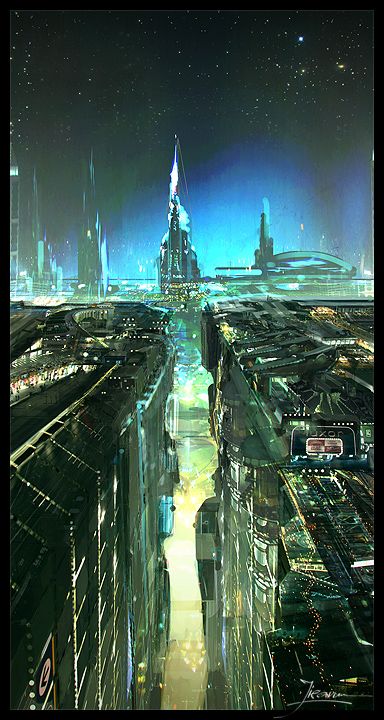
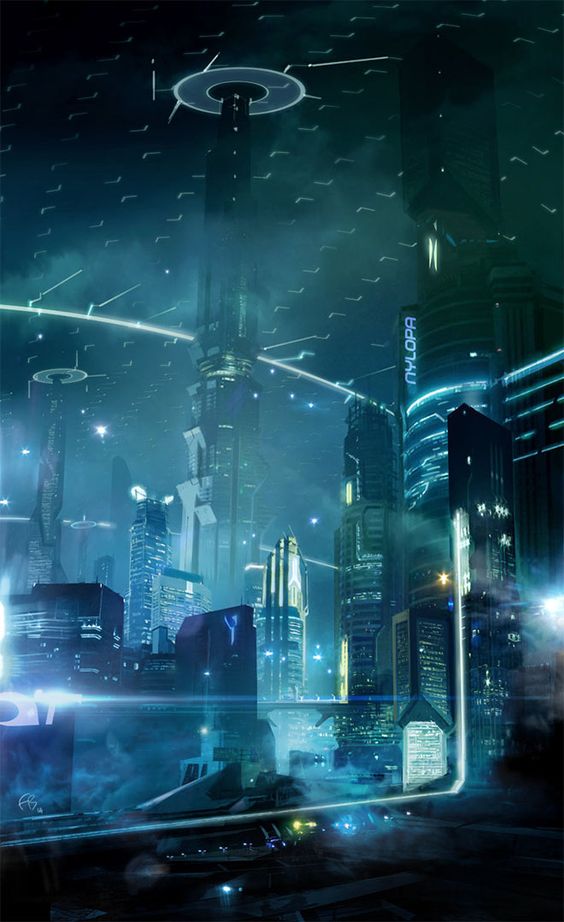
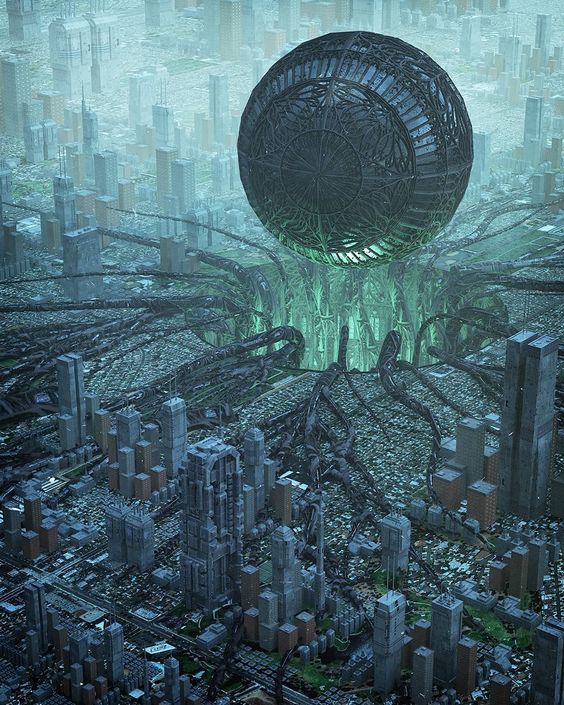
The Shield Spire is the most well-known of the spires. It is so named because of the “shields” that surround it. The Shield Spire is located at the 30th parallel above the equator, at the prime meridian. The Eldoth designed the area to be a primary base of operations, and it remains the central “capital” of the world.  The area immediately around the spire, out to a distance of 5 miles in radius, was originally a clear area.  Over the millennia, a city sprang up around the spire of high rises, temples and grand palaces, including the cathedral-sized factory complex of House Mistral and the current imperial headquarters, the imperial security ministry building and the governor’s palace.  This area is known as Grand Nexus, and is the capital of Kronos, housing about 3 million people. It’s dark, neon-lit night skyline dominated by the vast structure of the spire is perhaps the most iconic image of Kronos.
Arrayed around the spire are five vast, hexagonal “shields,” from which the spire gets its name. Each of these shields measures 10 miles to a side, and is constructed of a mixture of alien metals and ultra-advanced concrete 100 feet thick. The shields are elevated above the planet’s surface at a height of 20 stories (10 stories of which is just the structure of the shield itself).  Contrary to popular depictions, these are not domes meant to keep out the elements; they are bunkers meant to resist orbital assault, with most of their defensive structure aimed upwards, at the sky.  In fact, several of the shields have had sections of their walls demolished to allow easier access to the bunker within with no ill effect. Past the much thinner walls or doors on the sides of the shields, one enters the bunker itself, which his an inverted pyramid that extends into thThe Shield Spire is the most well-known of the spires. It is so named because of the “shields” that surround it. The Shield Spire is located at the 30th parallel above the equator, at the prime meridian. The Eldoth designed the area to be a primary base of operations, and it remains the central “capital” of the world.  The area immediately around the spire, out to a distance of 5 miles in radius, was originally a clear area.  Over the millennia, a city sprang up around the spire of high rises, temples and grand palaces, including the cathedral-sized factory complex of House Mistral and the current imperial headquarters, the imperial security ministry building and the governor’s palace.  This area is known as Grand Nexus, and is the capital of Kronos, housing about 3 million people. It’s dark, neon-lit night skyline dominated by the vast structure of the spire is perhaps the most iconic image of Kronos.

The interior of the shield consists of “blocks” that are twenty stories tall and about 80 yards long and wide. The blocks is unique, and may be set aside as office space, living space or machinery.  Each “block” can be treated as its own building with its own internal structure: the top-most structures tend to have interior gardens, flowing fountains and decent lighting, while those lower down consist of bare concrete corridors with interspersed metal doorways and dorm-sized rooms. In some places, the “block” may be absent, creating a vast open area or a yawning void in which people might construct monuments, or gardens, or they may fall into disrepair and become great, gulfs of darkness.  Between these “blocks” are large, 20-yard wide corridors that form a grid; these corridors extend the entire length and width of the shield, and extend all the way from one 20-story “floor” to the next 20-story “floor.”  Those who enter the Shield from “street level” can look up all the way up to the barrier of the shield above. Lights usually hang on the underside of the floor above, as to the interior transport trams.

One travels about the interior of a shield, or from one shield to another, either on foot, walking down the great corridors, or they take a train.  The trains are attached to the roof of the floor “below” the current floor, and generally reached via a staircase to a catwalk that leads to the “subfloor” train. To get from one floor to another, one takes either a staircase, or an elevator. A few high-speed elevators reach the whole structure, but these are reserved for emergency use by the authorities, with per vertice of the hexagon, located halfway between the vertice and the center of the hexagon, with one more emergency elevator at the center of the hexagon.  Other elevators handle a maximum of 10 floors and one must travel from one elevator to another to make their way the full distance from the top to the bottom.
Not every shield is fully occupied.  The primary occupied shields are the so-called “northern shield,” which sits north-east of the avenue that stretches from the Pit to Grand Nexus, and the “southern shield” which lies on the southern side of the same avenue.  The Southern Pit, sometimes called “the South Side” is home to many secondary industries and a vast working population of cheap laborers.  It has the largest alien population of the region, and seethes with crime. The north shield, or “the North Side” has a more (though not exclusively) human population and tends towards middle class, or lower-classes working in the service sector and aspiring towards Imperial Citizenship.  It has a fairly strict law enforcement presence, with numerous checkpoints to maintain the peace.   These two shields have the largest populations, each with around a billion people. There’s also the “Far Shield” which is on the other side of Grand Nexus from the two “main shields” which mostly consists of industry that serviced House Mistral and the pit on the far side, which is still actively mining.  Today, much of the shield has been decommissioned or has been taken over as an exclusively imperial part of the city, and houses no more than a million people.  Given its spaciousness and the grandness of much of its design, those who live in the shield are the envy of the other shields.

Between each shield is a great avenue a mile wide.  Originally, these were kept clear: a straight avenue of concrete and alien metal that led directly between the shields to the Spire. Today, they have become cluttered with “sprawl,” as people have built houses or shops up against the walls of the shields, between which roads and traffic wends their way.  The main avenue between the Pit and Grand Nexus is frequently used as a commercial district and home to the so-called Night Market, where local merchants and street food vendors will open stalls at night, when the night shields the planet from the dangerous solar flares of the Star of Kronos.

At the far end of each of the five avenues, away from Grand Nexus, lies a great shaft.  Each is ten miles across, and goes all the way down to the planet’s core.  Most of these pits have collapsed in on themselves, or begun to fill up with water, but two remain active.  The most active one, simply called the Pit, is ringed with a great, eye-shaped spire that rises up above the rest of the city to the second largest structure in the area.  This is the Starport of Kronos.  It houses numerous ship repair and maintenance facilities, and given the enormous size of the pit, it can house even imperial dreadnoughts.  The depths are still used for mining the planetary core, and the ores found in the core are brought directly up and placed on waiting cargo ship sin the Pit.  Between the deepest depths and the starport, one can find impromptu housing structures built into abandoned mines. These low-level living quarters and communities extend for a depth of about one hundred miles, and those nearest the pit have reasonably good air quality, despite the fumes from the mining below, given their open access to the atmosphere above.  As cargo vessels travel up and down the shaft to access ores, they often see children swinging their legs on the balconies of their shoddy homes, watching the traffic go up and down and enjoying what light spills down the shaft.  The population in the mine shafts are a fluid group, interacting with the miners below and the starfarers above; those who are fleeing from other worlds often find themselves hiding in the depths of the Pit.  This is a very anarchic part of Kronos, as the denizens of the pit belong to no “official” community, and the tunnels are too convoluted for the Empire to readily assert their dominion.  Thus far, as long as groups don’t interfere with the operation of the space port above or the mining below, they’re left to their own devices.  The Empire estimates that upwards of 100 million people live in the Pit.

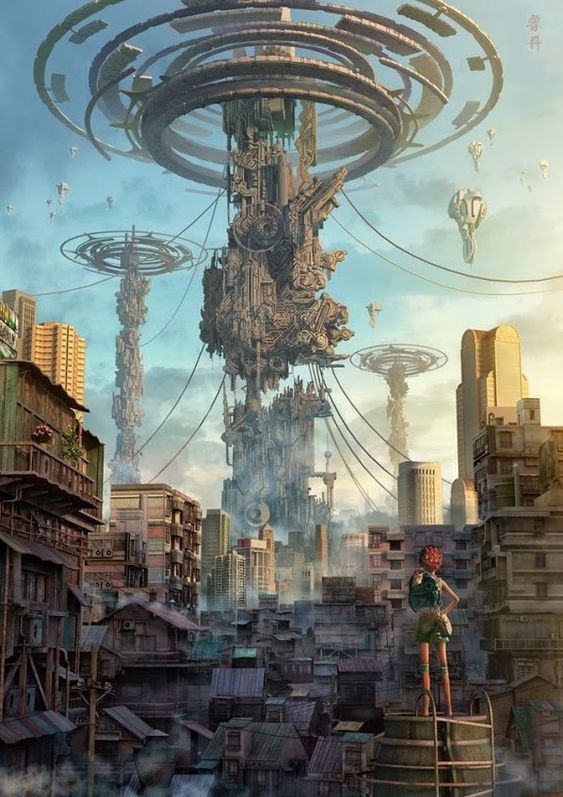
Beyond the shafts and the shields lies the sprawl.  This consists of homesteads, apartments buildings, communities and townships that have grown up on the continent around the Shield Spire.  These tend to be less densely packed: people may have a house with direct access to a road, or even a lawn or a garden. Travel in the sprawl is generally by repulsorcar, and communities cluster around urban centers with tall buildings: essentially, the sprawl consists of endless smaller cities that have all grown together, but see themselves as distinct from the Spire itself, which they call “the City.”  The Sprawl collectively has about 100 million people in it.

The total sum of Grand Nexus, the Shields, the Pit and the Sprawl comes to about 3 billion people, the majority of which live in the shields or the Pit.

The Other Spires

The Shield Spire is but one of twelve spires, spaced equally across the globe of Kronos.  Each governs a unique and distinct region of the world.
The Dead Spire: The northernmost spire, it was damaged heavily during an orbital bombardment and created a region of intense twisted psionic energy.  The ruins of past civilizations remain there, haunted by psionic ghosts and malevolent presences.  The only living being there are either scavengers, darting in to salvage some part of a broken civilization, and an outpost of imperial scientists, who are studying the strange pyschic phenomenon around the broken spire and its ruins.
The Jungle Spire: On a distant, southern continent, the Eldoth may have attempted to create a region of sustainable agriculture: the ruins of hydropnic plants and greenhouses can be found beneath the overgrown foliage of the region.  The spire, still humming at the center of the verdant continent, evidently does something to the fertility of the region, and things that grow their grow to towering and dangerous proprotions. The Ranathim Tyranny noted the fertility of the region and transplanted some of their favorite plants to the region, especially some of the more dangerous plants of Hekatomb.  The continent has become an emerald nightmare, but farmers to eke out what they can from the lush soil at the edges of the region.
The Sea Spire: Despite the reputation of Kronos as an entirely urban world, it has geographic features like seas and oceans.  The most prominent sea has a great spire jutting out of its center, around which what must have once been floating citysteads remain, great metal drums miles in diamter that slowly float around the ocean like great artifical island-ships.  The ocean itself has darkened with pollution, but the spire keeps the algae and plant life of the ocean alive, even if no biological fish swim its depths.  That doesn’t mean nothing swims its depths, though: dark shadows sometimes move in its greatest depths and send sensor systems on the fritz; the current theory by imperial researchers is that oceanic warmachines of bygone eras still move in those depths.
The Storm Spire: Another of the shattered spires, this one lies to the south-west of the shield spire.  Like the Dead Spire, it too was shattered in an ancient war, and the energies released in its shattering roiled up the atmosphere around it: a continent-sized hurricane raged around the spire after it died, and that hurricane rages still today, with the spire at its eye.  Worse, the region is haunted with twisted psionic energy, and giant shadows shuffle about within the tempest, barely visible from the outside. The rain that falls in the stormhas black particles in the raindrops that sicken and twist those exposed to it. The eternal storm wrecks the weather of the rest of the planet and makes weather control nearly impossible.  Worse, the storm sometimes migrates slightly spreading its black rain to other parts of the world.  Grand Nexus in particular needs to remain alert, and issues warnings whenever “the Black Rain” gets too close.