One of the reasons people worry about blogging is that they’re worried about making mistakes, but as Game in the Brain blogger +Justin Aquino likes to say, “Better to open your mouth and be thought a fool and corrected so that you are no longer a fool, than to keep your mouth shut and remain a fool” (or something to that effect). I said something a few weeks ago, and I was very illustriously corrected. Curious about the new data, I did some hunting, learned about even more tools available to me, and then re-evaluated how and why I wanted to do session design the way I did.
Today, we’re going to talk about Nights Black Agents, Blowback, Lady Blackbird, and Nobilis itself, and the tools all of them give for session design, and why I want to use the tools that I do, and how, exactly, I’m going to use them.
Nobilis Session Design Principle: Projects
Nobilis loves trees. The universe itself is a great tree, with each world being a fruit resting in its boughs. Were Jenna Moran a computer scientist (oh she is? Look at that), I would suspect she was making a pun/metaphor with a tree structure, where each world is a final node in a great tree-style memory structure, because she creates the same structure for your character in Nobilis.
Raoul finds that system of character creation odd, but I happen to love it. When you’re done, you’ll have a rich understanding of your character and a mess of questions. You’ll do the same with your Imperator, creating not just your imperator, but what he wants and your relationship with him. Finally, you’ll create a series of “projects,” associated with various characters, about the story that you’re trying to create.
In fact, were I to just relax and let Nobilis be Nobilis, I would simply stop discussing session design at all and bore you with stories about the rest of my characters as I ramp up my campaign notes and get started, because Nobilis is player-driven. I’d let the players write projects and simply run the game based on what they chose.
Yo, Dawg, I heard you liked Projects
So why not just use projects for my players? Jimmy, for example, has the Project of how he becomes an angel. So why not just run a story where he becomes an angel? I’ll give you two reasons.
First, I set up the campaign as a mystery campaign. That’s its premise. Therefore, for this arc, there needs to be a mystery structure, which means the story is fundamentally about how the players solve the mystery of Abigail Ng’s murder, which is largely worked out. That might be a misunderstanding of the intent of Nobilis on my part, but it’s how I set it up and it’s what I’m going to go with for now.
But the reason I set up that structure and why I want to set up further structure is not to limit player action, but to support it. “The story of how I became an angel” isn’t enough to create a full story. Who is the antagonist in this story? What stop’s Jimmy’s character from becoming an angel? What sorts of twists and turns will happen? What can I inject to make it dramatic and exciting? I don’t know, and there’s the rub when it comes to session design. Suddenly, I need to have something to kick off that story, to add to it, and that’s where I end up putting all the work into the game, and where my interest in maintaining the game begins to break down. I want to do the work now, while I’m inspired, not in a crunch time right before game-day.
By having other structures in place, I can grab from them to add spice and flavor to Jimmy’s story. Maybe Meon’s hatred of Cameron Delacroix makes him opposition for Jimmy’s rise, or perhaps Cameron has decided to switch sides, and another excrucian (that I’ve already worked out) opposes him. By having structure in place, when a player asks for something unusual, I have an entire spice-rack full of ideas that I can grab from.
But why not use projects as the basis for this structure? After all, I certainly use the same character creation process for my Powers that the players do (I find it turns a few half-baked ideas into more fully formed concepts pretty quickly). Well, the project with projects is that they’re player-facing. They discuss what the players want to do and the questions that they face. I don’t care about these sorts of things for NPCs broadly speaking. The game should not be about what they want or what questions they face except in that it might give me inspiration for gameplay for the players.
That’s where the ideas from other games come in to help. I can use a project-like structure in the design of my session-building structures, but projects as written will only serve as an inspiration for the final structure.
Nights Black Agents, Blowback and the Push Diagram
Kenneth Hite pointed out that I had conflated his Conspyramid with his Vampyramid. Upon closer examination, I see why I did that, because they’re actually mean to be conflated to a degree. The conspyramid forms the structure of the conspiracy, and the vampyramid forms how that conspiracy will react, and with what agents. So, if you poke at the bottom later, you get bottom-layer reactions. As you poke higher up the structure, delve deeper into the truths of the organization, you get more and more dangerous pushback from the organization. This fit’s Kenneth Hite’s assessment that, in a spy thriller, the reward for information is danger, and the reward for facing danger is information. The more you know about the conspiracy, the more dangerous the conspiracy is.
Kenneth Hite borrowed the concept from
Elizabeth Samet’s Blowback, which is a pay-what-you-want game about burned spies. As it’s pay-what-you-want, I encourage you to check it out, especially if you’d like to support a fellow creator.
The problem with the Push Diagram for my purposes is that it’s reactive. The premise assumes that the PCs are fighting against the Conspiracy or the Agency, and that the Agency is responding. The premise for Nobilis is much more free-wheeling and complex than that. What Meon wants isn’t the same as what Belphegor wants, and while there are definitely forces moving behind the scene, the intent here isn’t that the players are slowly unraveling Lord Entropy’s conspiracy, or uncovering the vast organizational warmachines of Cameron Delacroix. Instead, they’re meandering path through this mystery will bring them up against various groups with various agendas.
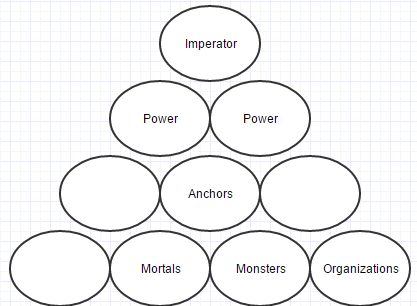
Still, the core concepts fit with the project structure fairly well. An Imperator has his powers, powers have their anchors, and anchors have their organizations, monsters, mortal agents and so on.
That chart isn’t perfect, of course. Powers do not share anchors, and organizations/mortal agents/etc can be attached directly to powers or imperators, but it does give an idea of the scale of conflict and how it’ll go. We have an additional problem in that the players are powers themselves. They don’t start at the bottom. Rather, they have their own organization and anchors working against one another’s organizations and anchors. Thus, in fact, players automatically start at level 3, which means most of these charts won’t have much meaningful depth.
But that’s okay. I intend to have lots of little charts. We have several other Imperators. If each player needed to “work his way up that chart,” for each Imperator, we’d be here forever. Instead, this chart serves more as a guide of what to do. For example, Lord Entropy has Meon as a power, and Meon has some desecrated nun-cum-cult-prophetess/lifecoach/scammer (say) as an anchor, and he has his Ogres and Nimblejacks and the Cammora. If I want Lord Entropy to be involved, I have no less than 5 things I can draw upon to represent his influence.
This brings us the the Push Pyramid. Hite has it associated with specific aspects of his conspiracy, but we can’t afford to do that, in that because players aren’t actually working their way up the pyramid. That is, it’s not that players uncover Nimblejacks and so the cult-prophetess initiates a “recruitment” of one of the PC’s anchors into her cult. Instead, the moment Jack Livingston, Power of Adventure, starts ripping up Nimblejacks, Meon himself will come over, knock on his door and ask what is up, because they’re peers. So, again, we have a shallow chart: We only care about the interests and motivations of the Powers and Imperator.
But isn’t that enough? Each character who walks out of the character creation system has two questions. We can replace that with two goals, the two project bubbles that a particular power wants. The Imperator can have his as well, and these become Imperial Miracles. When Lord Entropy states that something is true, then it becomes so, and everyone who acts to make it happen gains a bonus. These become statements of truth about the world, and as actions occur to create “destiny points” in these project bubbles, they become more or less true. The Imperators become facets of the setting, with their desires shaping the world, and the story often becomes about how the PCs interact with these miracles and the (relatively) more mundane goals of the powers and how they serve their imperator.
If I have all of these things in place, then a given session can be shaped by the desires of a particular set of Imperators, how they interact and what tools they have at their disposal, in the form of Estate, anchors and mortal assets, that they can deploy to see that their will is done.
Lady Blackbird and Setting Design
Lady Blackbird does something different. It doesn’t have organizations or charts or diagrams at all. It just has a series of challenges: How difficult is it to defeat a sky-squid? How difficult is it to sword-fight a bunch of marines? How hard is it to sneak into Nightport? And so on.
By sprinkling names, ideas and random challenges, Lady Blackbird creates a series of little inspirations and invokes thought about what they mean. If Skysquids are very difficult to defeat, this means, first of all, that there are skysquids and, second of all, that they are scary.
I’ve long pondered how to handle discussing things like Vancouver itself, and again, Nobilis provides the rules: Each setting has its own rules, special semi-estate-like rules that Nobles can invoke for minor bonuses. I’ve already had these rules for Vancouver and a few other areas (like Toyland) for awhile. But these tend to be high level. What’s it like to actually be in Toyland? What sorts of problems might I face in Vancouver?
Lady Blackbird provides the solution to this. I can treat each setting as three pieces: the Nobilis setting rules, a series of challenge discussions, and perhaps a minor bestiary/NPC catalog. Then, when players are in a given setting, if I’m at a loss, I can use the NPCs, rules and challenges to inspire me.
Putting it Together
So, once I’ve finished my rules, I should have:
- My overarching mystery
- The PC projects
- The Imperator Project/Organization Structures
- Setting rules, challenges and NPC catalogs.
A given session, then, has four inputs that I can draw on. If Jimmy wants to become an angel, and that interacts interesting with a facet of the mystery, I draw both of those in, hunt over my notes for an interesting antagonist (“Hmmm, Cameron Delacroix…”) and look at why he might want to oppose that based on his motivations/projects and what assets he might deploy against the PCs to achieve those aims, and then we pick out some interesting side-challenges and color based on the setting that the PCs are in.



 Mailanka's Musing