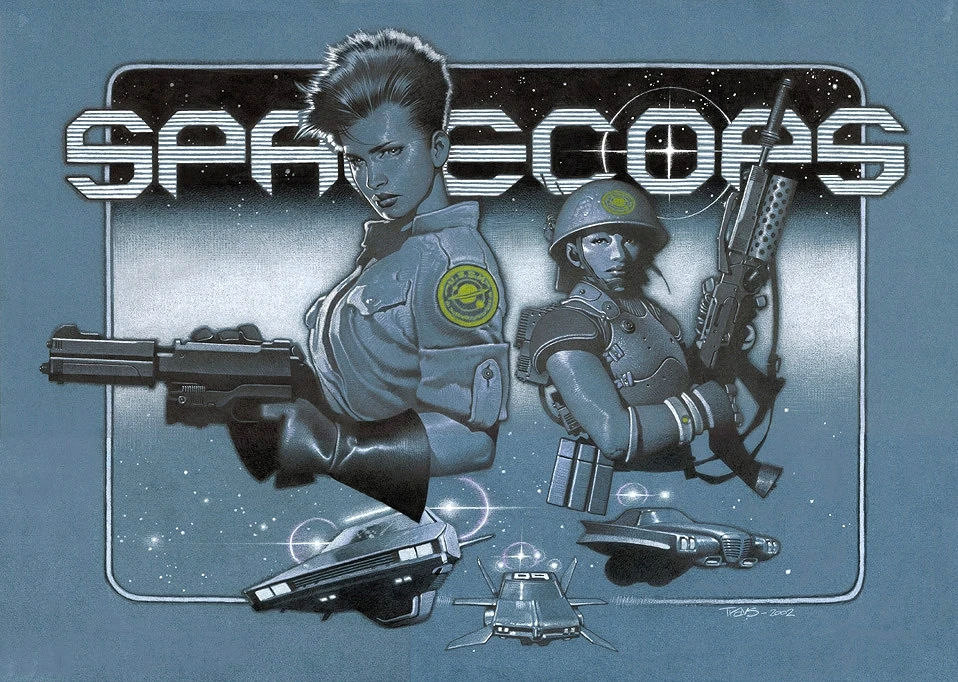
Crime in Psi-Wars

I’ve been quietly working at criminal elements in Psi-Wars, including the release of the Security Agent Template and the Outcast background.  But what sorts of crimes are we actually committing that the cops need to stop us? While not a strictly necessary thing (crime isn’t so different in Psi-Wars from the ordinary world), thinking about it helped me sort out my thoughts.

This is not meant to be an exhaustive exploration, just a meandering musing on the sorts of crime we might see in the Psi-Wars universe, especially those organized criminals might focus on.  I’m not exactly a law enforcement expert, but if we approach this with a little thought and a focus on the cinematic, I think we’ll make some headway.

Most crimes in Psi-Wars will be familiar to anyone familiar with the 20th century, as that’s the core inspiration for pulp works which, in turn, inspire Psi-Wars. Nonetheless, the “space” part of “space opera” implies some sci-fi considerations, and thus some sci-fi crimes!

I will also note that crime, especially in action films like the Fast and the Furious and various heist films tend to be depicted in a glamorous light.  That glamour quickly fades when you look very close at criminality.  Psi-Wars is, while decidedly salacious, family friendly, so I’ve tried to elide certain realities and not discuss some of the more squeamish aspects of crime, but the implications of certain criminal elements are inescapable.

The Least Crimes

A lot of crimes, like “Jay-Walking” may not seem to matter much and certainly aren’t a major focus for any criminal organization, but they are worth mentioning.  In particular, minor crimes matter more in the Empire, as it is a totalitarian society.  The Imperial legal code is sufficiently complex that most people violate at least a minor law a day.  These might include minor traffic violations, failing to keep something up to code, accidentally touching a security agent, failing to have highly specific credentials on your person, violating some obscure curfew, etc. In most cases, the GM is justified in allowing security agents to harass and issue fines to any character essentially at will, the a Minister of Justice will frown on this being done to an Imperial Citizen.  

If the GM wants mechanics to cover this, a character can roll Law (Imperial Criminal) +4 when confronted by an Imperial Security Agent to prove that they meticulously avoided violation of any minor law, with a +1 if the character has Honesty or Citizen (Imperial). Characters may also take a perk, Fastidiously Law-Abiding, which means they always obey the law precisely.  The GM might require at least one point in Law (Imperial Criminal) and some level of Honesty; characters with this perk may ignore this rule, and can never be harassed by security agents (and if they are, they can always answer each charge perfectly).  This is effectively an “opt-out” of harassment by security agents, though it does not protect one from intentional crime violations (might it does protect against additional minor infractions; for example, a character might commit murder, but it’ll never be with an unlicensed blaster carried across planetary lines, as it will be technically licensed somewhere and it will have been brought in legitimately).  All of this is, of course, highly optional.

One special case of “minor crimes” worth covering are those of free speech. The Empire, of course, does not acknowledge free speech, and so certain forms of protest or activism will be considered sedition, treason or insurrection.  In particular, the Empire will not tolerate anti-imperial sentiments, peace protests, pro-robot-rights movements, pro-aristocracy sentiments, or pro-alien rights.  

The Alliance is much freer with its speech, but it will might prosecute pro-Imperial activism as treason.  Most Aristocratic worlds have lese-majeste laws in place that make it illegal to insult an aristocrat.  However, this is usually either isolated to just the ruling noble and their extended family and tends to result in fines rather than imprisonment or it is legally considered “fighting words” that allows the insulted party to react with violence; this is typical of Caliban, for example, where there is no explicit punishment for insulting members of House Kain, but doing so allows members of House Kain to take action against you to protect their honor: that is, the penalty for insulting a member of House Kain is that you take your life into your own hands. If you can fend off reprisal, then perhaps your fighting words had merit!

Vice: Prostitution, Gambling and Drugs

The criminal world has an alluring glamour, and much of that comes from the world of vice: the implication that the criminal world is filled with beautiful women, quick money and tattooed alpha males.  Of course, the reality is that vice is a business. The criminal world provides a service that legitimate businesses cannot.

Most of these walk a blurry line of acceptability. The people involved willingly undertake these actions: they willingly take drugs, risk their money, or engage in monetary, sexual transactions. Why, then, should they be illegal? The authorities tend to justify their illegality either on moral grounds (these are “wicked” acts) or to undercut the sorts of organizations that profit from vice, and who use those profits to do far worse.

Both the Alliance and the Empire seek to control vice. In practice, the officials in charge of enforcing vice laws tend to create gray areas in the law, either intentionally or via corruption, where vice is allowed to continue but only under circumstances the state or corrupt officials allow.  In the Empire, when vice is punished, those who offer the vice (the casino, the prostitute or the drug-dealer) tends to suffer heavier punishment, often prison time, than the client, who often suffers mostly a fine.  The Alliance is a touch more lenient in both cases, and often the only punishment for either is a minor fine and making the arrest a matter of public record, which is often more than enough punishment for aristocrats to avoid engaging in the crime!

The precise enforcement varies from world to world in the Alliance (prostitution and gambling are outright legal on Denjuku and in the Orochi Belt, though often confined to certain locations and may require a license), but Maradonian worlds often have laws regarding eugenic transactions.  While what goes on between two peasants is a private matter, the liasons of aristocrats bearing eugenic DNA is not; it is generally illegal to trade money for the right to breed with a particularly well-bred noble and bear a bastard child outside of the confines of a noble house.  These “blood laws” contend that the genetics of its members belong to the House, and those who “trade” those genetics are violating the law.  Such violations are generally dealt with in the house, though, with security forces mostly just investigating and uncovering conspiracies to engage in such transactions, and then turning over the evidence and the perpetrators to the House.

The legality of drugs varies, but generally, any incapacitating or highly addictive drug is illegal or controlled, and one cannot access them without a doctor’s prescription, if at all. Combat enhancement drugs or psychic enhancement drugs tend to be treated as weapons, and generally have even stricter laws which affect not just their dealers, but those that take them. The Empire takes both of these sorts of drugs more strictly than the Alliance.  The Alliance tends to frown strongly on combat enhancements, but psychic enhancement drugs tend to be less strictly controlled, and the aristocracy may well have full access to them.

Trafficking: Slavery and Human Smuggling

One of the stated reasons to oppose vice is that the organizations that engage in vice often engage in even worse crimes.  Trafficking is one such crime.  The most common example, cited primarily by the Empire, is the kidnapping of attractive youths and transporting them into the Umbral Rim as pleasure slaves by nefarious slavers.  Organizations that perform this sort of action often do it behind the guise of vice: they’ll persuade someone to enter into the “grey” trade of vice, and then once they’re in, slip them over to a slaver who will smuggle them into the Umbral Rim.  Of course, the reality is that not all, or even most, trafficked victims end up in the Umbral Rim: dens of vice all across the Empire and the Alliance might potentially have unwilling participants in them, especially on the Rim, far from the watchful eyes of security agents.

Not all forms of trafficking is so traumatizing to the trafficked, though.  The Alliance and the Empire both have superior economies to other parts of the galaxy, and often, aliens will seek to immigrate to these more prosperous regions of the Galaxy.  Aliens, aristocrats and pro-Alliance dissidents often seek to escape the totalitarian confines of the Empire for the freedoms of the Alliance and need to slip past Imperial blockades.  Often, Aliens from the Umbral Rim or the Sylvan Spiral who seek to get to the Alliance must run a gauntlet of not just slipping into the Alliance undetected, but slipping through the Empire as well! To these hopeful immigrants, human traffickers aren’t sources of dread, but of hope.  Of course, many smugglers promise access to the freedom of the Alliance, but they might be a cover for some other form of trafficking.

Theft

The most obvious crime, the one I think most people think of is theft. Do criminals in Psi-Wars steal? Of course they do!  But what do they steal?

What about currency? Well, in the Empire and the Alliance, most of your currency is digital.  Thus, the theft of currency would involve some sort of hacking.  However, some currencies (especially in the Umbral Rim) do involve a physical currency, and thieves can steal a “cred chip” or credentials used to access currency, or used to access certain doors.  Of course, in the Alliance, this is more difficult as these tend to use biometrics.  Thus, pickpockets can steal your credits in the Empire, but have more difficulty doing so in the Alliance.

What other valuables might people steal? Consumer electronics, of course, though most computers in psi-wars tend to be either large or built into structures or ships, but entertainment consoles and datapads will go for a decent price.  One can also steal cars or spaceships, which is covered in the Action Conversion document.  Finally, works of art and, especially, antiquities can be stolen. Interesting, antiquities are likely to be a major source of criminal attention, not just because they’re valuable, but because they often have psychic potential or might unlock the secrets of the ancient past.

Naturally, one must break in to get access to items to steal.  That’s already covered by the Action Conversion document, however.  Broadly speaking, characters need to be able to bypass electronic locks, sneak past cameras and other security systems, and get safes open.

Cybernetic theft would make for lucrative theft, and would likely replace organ theft as a crime, as it’s no longer necessary to steal a kidney when you can replace your kidney with superior cybernetic organs.  This sort of thing is fairly well-covered in cyberpunk works, and I expect it would be a relatively common, if ghoulish practice, on highly urbanized worlds like Denjuku or Kronos.  These would likely involve very literal “chop shops” where cyborgs are dismembered.  This is likely a major crime, though: while one can steal cybernetics without killing people, it’s much easier to commit murder and then strip the body for parts.

Piracy is a form of theft, of course: it’s a large-scale theft of all the cargo on a ship.  This can parallel with trafficking if the pirates in question also take slaves.  Generally, piracy lacks the finesse of more classic theft: it’s more “smash-and-grab” than slipping in unseen, but having a few hackers or safe crackers can help get the loot out quickly and cleanly and avoid unnecessary damage to the stolen goods.

Violence: Murder, Assault and Coercion

All organized crime involves violence.  The gentlest criminal organization must be able to at least have a credible threat of violence to prevent its rivals from removing it, and to enforce compliance from its victims.  The most common forms of criminal violence, then, are those that are meant to improve Intimidation; characters who use force to gain any bonus to their Intimidation roll are certainly committing a crime!  If coercion doesn’t work, more bloody violence can ensure, to ensure the compliance of the target, to torture for information, or to kill. Most criminal killings will be crimes of passion or (underworld) politics.  All effective criminal organizations will have some sort of enforcer whose job it is to eliminate a specified target.

This creates an additional market possibility for organized crime: not only can it remove its own rivals, it can also remove yours, for a fee.  Assassins often fulfill this role, but the most common hitman don’t rise to the lofty heights of the Assassin template: they’re often just a hired man with a blaster and nothing to lose!  But Bounty Hunters often double in this role: while they’re ostensibly there to maintain justice, most Bounty Hunters will take any job, dead or alive, and more than one crime-boss has exploited this, turning Bounty Hunters into their personal mercenaries.  Indeed, with some bounty hunter lodges, the line between law enforcement and criminal organization gets very blurry indeed!

Extortion, Racketeering and Blackmail

Of course, any criminal group that can threaten violence can offer to not commit violence, for a fee.   While “Rackteering” covers any sort of routine, repeatable crime, it often refers to protection rackets. In this case, a criminal organization threatens to commit violence (or simply does so) unless the target business offers to pay up (a “lunch money” scam writ large). In Psi-Wars, where entire space stations the size of cities might be far from help, a pirate fleet itself might engage in large scale extortion of this sort; they can also apply extortion to entire trade routes, forcing merchants to pay for “pirate insurance” to avoid their cargo being stolen.

Not all extortion is necessarily violent.  Criminals often help their clients engage in sinister activity, whether it be a hitman who accepted a contract to kill, or a courtesan who took a highly placed politician into her bed (a “honeypot”).  The danger of the crime hanging over the head of the client can, itself, become a lucrative source of revenue if the criminal can persuade the target to give up money and that the blackmail will legitimately go away.  Kidnapping, while a very different sort of crime, follows a similar sort of trajectory: in both cases, an implicit threat hangs over the target (to their business, to their reputation, or to their loved ones) and in exchange for a payment, the criminal swears to honor an oath not to bring that harm about.  This often requires careful negotiation and, ironically, trust building. Diplomacy is recommended!

Of course, criminal organizations that get good at extortion and blackmail soon learn that taking too much kills their flows of income, and allowing others to harm their clients also harms their income.  Protection rackets and piracy insurance can slowly but surely morph into proper security services as the criminal organization needs to ensure their targets business remains viable.  Arguably, quite a few legitimate governments of the Umbral Rim got their start via illegitimate means!

Financial Crimes: Loan Sharking, Laundering, Fencing and Smuggling

At some point, the criminal organization has a great deal of money and stolen goods.  What to do with it all?

For stolen goods, the criminals will need ways to offload the merchandise.  Fences are often “grey market contacts” that know clients that aren’t squeamish about accepting products of questionable origin. Connections and reputation are key here: a known criminal will find it difficult to transact with legitimate businesses, but intermediaries who cultivate just enough of a legitimate reputation might.  In fact, there’s often a thick swathe of intermediaries, from the shady fixer who sells to the less shady grey market, who shells to the somewhat shady customers, to can sell to the completely legitimate friends and coworkers, thus fully “cleaning” the good.

If you can’t fence stolen goods, consider bringing them to another world.  Smugglers will often take stolen goods (or just forbidden goods, such as weapons, drugs or antiquities) and excels at bypassing customs to get these to their customers.  These customers tend to be fences, who help integrate the illicit goods into the rest of the market, but the off-world nature of the products often makes that easier: little chance of a business recognizing that you’re selling their stolen goods right back to them.

Just like goods can be “laundered” so too must money.  Bank robbers can’t immediately spend their stolen wealth, and few people want to accept the payment of a known drug dealer or pimp, so “dirty” money needs to become “clean” money that can be invested in legitimate enterprises (as most organized criminals have their fingers in legitimate businesses too!). This often involves a similar process of trickling the money through a variety of accounts, currencies and gray markets until stolen Lithian Blood-Gold turns, eventually, into Imperial Credits, with Imperial Security none-the-wiser about their origin!

Having all this money means that the criminals can then use it to invest.  The easiest investment is grey banking.  Many people are unable to access proper financial services, either because they have a criminal record, or they simply lack the proper facilities to access them, or they have been otherwise blacklisted (as is the case for many alien races in the Empire). Enter the gray bank, often bankrolled by organized crime, these tend to be flush with money, and willing to loan it out to whomever asks for it… for exorbitant interest rates, of course.  Often, if the debtor can pay back the staggering interest, that’s enough for the gray bank, but in some cases, the debt becomes leverage over the target, who is then blackmailed or pushed into some other crime, such as prostitution, or looking the other way during a smuggling operation.

Corruption: Bribery, Fraud, Embezzlement and other White Collar Crimes

Once the Organized Criminals have their tendrils in legitimate businesses, and they have people who owe them money, they can begin to push their way deeper into legitimate business, using it as a mask for their illicit practices. Their leverage, and the bribes they can afford to pay, begins to make officials look the other way.  While they have legitimate businesses in their pockets, they can afford to do some shady accounting and siphon funds away, directing them back to their own practices or their own money laundering rackets until the money simply vanishes as far as official institutions are concerned. Finally, if they understand the world of business and law well enough, they can begin to use the machinery of bureaucracy against them, creating front companies, false insurance claims and so on to slowly milk the system of its wealth until it collapses, or they’re caught, in which case they revert to other practices to cover everything up.  This is on the large scale what the Con-man is on the small scale, and indeed, Con-men often have a role in cartels and syndicates that pull of this sort of thing regularly.

This sort of thing isn’t generally tackled much in Psi-Wars, but Accounting should uncover embezzlement or track down money laundering, while Administration will often uncover fraud.

Forgery

Just as masters of violence and extortion begin to find themselves providing real value to their community, so too do masters of white collar crime.  Eventually, they begin to create items of value, though the value might be artificial: replicas of art, antiquities or even currencies.  This is generally handled with the Forgery skill, unless it’s money, in which case it’s Counterfeiting. Note that in Psi-Wars, many currencies are digital, and will also require Computer Hacking to properly insert into the system.  Fake IDs are also generally digital: the criminal will need to engage in Forgery to create believable credentials, and then Computer Hacking to insert those credentials into the system.

Many skilled forgers become legitimately great artists.  After all, to pass off a work as the work of a great artist, one must be a great artist.  This can often create frustration among the criminal world, for they may have true masters of their craft who can only “publish” under the name of other artists, and can never strike out on their own, as their own work will become too derivative.

Psychic Powers

The Empire expects all psychic powers to be registered with Imperial Security.  Possessing psychic powers without registration is, itself, a crime, and any use of an unregistered psychic power only compounds the crime.  The Empire has an entire division of security dedicated to combating psychic powers!  Characters who are registered as psychic have License (Psychic) [1] but this only applies to the Empire itself; such registration is generally not necessarily anywhere else.

Both the Empire and the Alliance have laws about the illegal use of psychic powers.  Generally, these mimic normal laws: using a psychic power to try to kill someone is attempted murder, reading their thoughts without permission is similar to hacking or other forms of privacy invasion, mind control is a form of coercion, etc.  Investigating these crimes can be very difficult, but the use of espers or anti-psis to detect their use after the fact is a form of proof, as is expert testimony from characters with Expert Skill (Psionics).  The Empire places harsher restrictions on these, treating the use of a psychic power as worse than the underlying crime (hacking with ergokinesis is worse than just hacking in the eyes of the Empire), but the Alliance does not.  The Alliance also has gentler laws when it comes to aristocratic excesses with psychic powers, which means they can often get away with a lot more than a non-aristocratic psychic.  The rest of the galaxy typically handles psychic laws this way too.

Communion generally isn’t covered by legal frameworks.  Neither the Empire nor the Alliance formally recognize that Communion even exists. Moreover, it’s very difficult to prove that an event was the result of someone using Communion or a completely random coincident: while the Divine nature of Communion leaves a signature that psychics can detect, it feels different and many psychics won’t know what they’re feeling, there’s nothing tying it to the person that the cause: they ask Communion to do something, and then something happens.  Broken Communion is a little easier to detect, thanks to its warping presence, but lacking the proper knowledge, it’s difficult to tie the effect to someone specific.

Lithian legal frameworks from the Umbral Rim do differ on this point.  They recognize the impact of Communion, and they have their own experts in the form of their priests and sorcerers who can determine if someone is using Communion in a particular way or not.  Even with this expert advice, it’s difficult to tie someone to a specific communion-related crime, and such trials often look more like “witch trials” than a more thorough legal proceeding.  The Lithian sphere also makes the use of Broken Communion strictly illegal, and treat it as something demonic, though how thoroughly this is enforced varies from world to world.

Robots and Slavery

Robots are property in the eyes of most of the galaxy.  For the most part, robots are happy with this arrangement, but some robots, and some people involved with them, are not.  Robots require a new legal framework.

Unlicensed ownership of robots is generally illegal in the Empire.  Having a robot requires a License (Robot) [1], though the empire will overlook particularly weak or low-intelligence robots: a robo-dog is fine, a robo-servant is questionable without a license, and a combat robot is right out. Note that the license puts a cost on owning a robot, but doesn’t make it impossible: wealthy and powerful corporations still employ quite a few robots!  Advocating for robot right is also illegal in the Empire; it is treated as sedition.  Trying to help a robot escape ownership is also illegal: the Empire considers it a combination of theft and sedition: you’re stealing someone’s property and also advocating for robotic rights at the same time! Unattended robots, or robots deemed too dangerous by the empire, may be either impounded or summarily destroyed.

The Alliance is much more tolerant of robots.  Anyone can own a robot, though some localities might treat combat robots the same way they treat weapons and require a license or may forbid ownership entirely.  A combat robot is allowed to exist though; it is not destroyed, but it might be impounded or requested to leave the planet. Robots even have some limited rights on some worlds: Denjuku in particular allows for the concept of free robots, but a self-owning robot must have a License  and has numerous legal restrictions placed on it.  The Alliance does allow for robot rights advocacy, but it’s unpopular: aggressive activists find they don’t often get invited to parties, and the authorities might find some other reason to arrest them, such as trespassing or disturbing the peace, etc.

Harm to robots, such as hacking them, or destroying one, etc, tends to fall under the same sorts of laws as the destruction of property or hacking.  They are legally viewed as property, not as people.  This creates something of a legal conundrum regarding the laws of self-ownership on Denjuku and other worlds that allow for self-ownership, but generally this is treated as the damage of the robot’s property, which means the robot gets compensation, but less than a person would.

Note that robots aren’t the only forms of “sapient property” in the galaxy.  The Clones of Xen tend to treated as valuable property, though they can attain self-ownership as well.  The Cybernetic Union has “cyber-slaves,” humans who have had slave implants installed on them by a robot: the Union tends to treat its cyberslaves (and organics in general) the way Denjuku treats its robots: as slaves that can achieve second-class citizenship via limited self-ownership.  The Umbral Rim, of course, also has slaves, which tend to have the worst lot in that one can do pretty much whatever they want to a slave, and damage to a slave counts as damage to property.  Legally, helping a slave escape is generally seen as a crime tantamount to theft, provided the state has the power to do anything: the combination of a weak state and some power of certain anti-slavery actors, like Domen Sefelina, the Saruthim, and the behind-the-scenes action of the shadowy Dark Vigil chapter of the Templars tends to mean that significant social pressures exist to prevent slave owners from being too rough with their slaves or pursuing escaped slaves too aggressively.

Alliance Constabulary: Personnel

Just as criminal players dealing with the Empire will need mooks to fight, so too will criminal players facing down the criminal justice of the Alliance.  But, again, we find that the Alliance has wildly varying law enforcement.  This results in a highly customizable set of mooks that require a little bit of work from you, dear reader, to put them into action.  Once again, we have three different broad sorts of law enforcement, and we also have three different sets of equipment (the most common being Rook & Law and Stellar Dynamics).  You’ll have to put the pieces together, just like you have to with insurgents, but I do have a “standard example” available for each entry.

Let me know what you think of the approach, and enjoy!

Alliance Constabulary: Personnel

Law Enforcement Types

Constabularies have their own set of laws and concerns that they focus on, which means each world has its own sort of police resources available. The various personnel below break down along law enforcement types, which act as suggestions, ways in which you might customize your force. Additionally, consider the following optional traits below.

Common Law

Common Law constabularies worry more about how the people see them. They tend to pursue justice for the sake of justice, and as a result, they quickly earn the trust of the people. As they see themselves as servants of the people, they tend to go for a lethal option last.

Optional traits:

Fastest Gun in the West [1]. Common Law constables tend to want to draw their weapon only at the last minute, to keep from escalating the situation. If the Common Law constable has this perk, also give them Fast-Draw at DX.

Good with Locals [1]: The Common Law constable understands his people. When dealing with the people of his world, he gains Sensitive: an IQ-3 roll to sense intent, and +1 to Detect Lies and Psychology.

Reputation (Good Cop) +1 [5]: Years of service have convinced the local populace to trust the constabulary. This grants a +1 to reaction rolls, but also a +1 to any rolls to talk someone into backing down or surrendering peacefully.

Diplomatic Law

Diplomatic constables worry first and foremost how their superiors, or the rest of the Alliance, will see their law enforcement. As a result, they tend to be deeply concerned with appearances and with non-lethal law enforcement, as the last thing they want to do is kill an off-world suspect!

Optional traits:

Looks Good in Uniform [1]: The constabulary cares a great deal about how their uniforms look, and how their constables look in those uniforms. Treat all constables in uniform as at least Attractive.

Handcuffing +2 [2]: The constabulary wants to subdue their opponents as quickly as possible. The constable gains the following tactic:

Instant Cuff (BAD): If the constable has grappled the target or parried a barehanded attack, they may roll Instant Cuff vs the better of the target’s DX or best grappling skill. Success means one limb has been cuffed. This counts as an attack; you may defend normally. See MA page 73 for additional details.

Law Enforcement Powers (Alliance) [10]: Replace the Law Enforcement Powers (Constable) with (Alliance), which grants the constabulary interstellar jurisdiction, allowing them to bypass the usual hassles that face most constables.

Procedural Law

Procedural constables focus first and foremost on maintaining the law. They know it inside and out, and follow it well. They also have careful procedures about how to go about arresting suspects, how they fight, and how they fill out paperwork. Thus, while the procedural constabulary might seem like a heartless machine, it is at least an efficient one.

Optional traits:

Battle Drills [1]: the constabulary has practiced teamwork until they have it down to a science. Constabularies with this optional trait can never accidentally hit one another with fire, they ignore penalties for firing through hexes occupied by other similarly trained constables, and they gain +2 to notice something another would notice.

Standard Operating Procedure (Paperwork Perfection) [1]: The constabulary always does its paperwork, and it uses airtight wording. Whenever some bureaucratic element of the arrest is described in ambiguous terms, the GM always errs on the side of the procedural constabulary.

Fit [5].

Constabulary Equipment

The Alliance has access to a far broader spectrum of equipment than the Empire does. They tend to draw most of their equipment from one of three sources:

Rook & Law: A centuries old industrial cooperative preferred by rural inhabitants for their reliability.

Startrodder: A corporation known for its military weaponry; it has a long tradition of arming the Federation and was one of the first corporations to side with the Alliance against the Empire.

Stellar Dynamics: A newer arms manufacturer with a focus on civilian markets, and with a sleek design aesthetic

The typical urban constabulary uses Stellar Dynamics weaponry; rural or poor urban constabularies might favor Rook & Law, while highly militarized constabularies might prefer Startrodder. In that case, replace the following weapons with:

Pistol: PB-9 Blaster Pistol may be replaced with:

Rook & Law Walker 049 Blaster Pistol: Dmg 5d(5) burn, Acc 4, Range 250/750, RoF 1, Bulk -2, Rcl 2. May not fire hotshots.

Startrodder PC 440 Blaster Pistol: Dmg 4d+2(5) burn, Acc 4+1, Range 400/1200, RoF 3, Bulk -2, Rcl 2. Malf 16. May not fire hotshots.

Scattershot Blaster: B-87 “Suppressor may be replaced with:

Rook & Law Outlander 683 Blaster Shotgun: Dmg 3d(2) burn, Acc 6, Range 400/1200, RoF 1×12, Bulk -4, Rcl -1 or Dmg 7d (3) burn, Acc 8, RoF 1, Rcl 2. May not fire hotshots;

Startrodder PC 870 Trench Blaster” Scattershot Blaster: Dmg 3d+2(2) burn, Acc 6, Range 350/1000, RoF 2×12, Bulk -4, Rcl -1. or Dmg 8d (3) burn, Acc 8, RoF 2, Rcl 2 Malf 16. May not fire hotshots;

Rifle: RSB-1 Blaster Rifle may be replaced with:

Rook & Law Huntsman 844 Blaster Rifle: Dmg 6d+1(5) burn, Acc 8, Range 750/2100, ROF 1, Bulk -5, Rcl 2. May not fire hotshots.

Startrodder SC 515 Blaster Rifle: Dmg 6d(5), burn, Acc 8+2, Range 1000/3000, RoF 3, Bulk -6, Rcl 2, Verify Malf.

Constable

A standard constable is the face of law enforcement in the city. They typically travel in grav-cars or grave-bikes, or even stroll about on foot. They perform most average arrests, issue most citations and respond first to crises. They represent the most common foe that criminals face in the Alliance.

ST 11

HP 11

Speed 5.25

DX 10

Will 10

Move: 5

IQ 10

Per 10


HT 11

FP 11

SM +0

Dodge 8

Parry 8

DR: 45/15


PB-9 Blaster Pistol (12): 3d+1 (5) burn (Acc 4, Range 370/1100 RoF 3, Rcl 2, Bulk -2)

Skills: Area Knowledge (Neighborhood)-12, Criminology-12, Law (Police)-10, Pilot (Contragravity)-12, Savoir-Faire (Police)-12, Search-12, Streetwise-10.

Traits: Legal Enforcement Powers (Constable) [5].

Notes: Human; Armor covers torso only; lower DR applies to crushing attacks. Carries communication device with 100-yard range, light source with 25 yard range, and a pair of electronic cuffs. No Encumbrance.

Constable Tactics

Cover Suspect (17): After aiming, announce that you have your target in his sights and demand that he give up. Make a Wait (Will fire if targets makes an Attack). If wait triggers, make a double-handed (Braced; +1 accuracy), sighted all-out attack (Determined) for your opponents’ torso. You may defend before your wait triggers, but not after.

Fire from Cover (11): When in cover, move from cover and make a pop-up (-2) all-out determined (+1) sighted shot using a double-handed grip. If you hit roll a random hit location if you hit. Return to cover. You may not defend.

Fire on the Move (11): While holding the pistol in two hands (reduce bulk by 1), make a Move and Attack. Move up to your full movement and attack, using full RoF 3. Successful hits strike a random hit location and deal deal 3d(5) burn. You may dodge, but you may not retreat or drop.

Takedown (16): Make an All-Out Attack (Slam). Move full movement +1 (6) and roll 16 or less to hit. Inflict 1d+1 cr damage and your opponent must roll DX or go prone. You may not defend. (On subsequent turns, most Constables will grapple (12) and then attempt to pin (quick contest of 13 vs ST).

Negotiator

Typical Law Enforcement Type: Diplomatic Law

Negotiators never carry weapons, because their role is entirely diplomatic, and if they carried weapons, it might threaten those they negotiate with. They talk suspects down, they negotiate with terrorists, they represent law enforcement on distant worlds as they argue for the extradition of criminals. Negotiators are no fools, of course: they tend to be backed up by generic constables or the superior hand-to-hand capability of Peace Officers.

ST 11

HP 11

Speed 6

DX 12

Will 10

Move: 6

IQ 10

Per 10


HT 11

FP 11

SM +0

Dodge 10

Parry 11

DR: 45/15


Trained Strike (12): 1d+1 cr (C, Parry 9)

Trained Kick (12): 1d+2 cr (C, 1, Parry 7,

Skills: Body-Language-15, Diplomacy-15, Criminology-15, Law (Police)-15, Pilot (Contragravity)-12, Psychology-15, Savoir-Faire (High Society)-15, Savoir-Faire (Police)-15, Search-12.

Traits: Legal Enforcement Powers (Constable) [5].

Notes: Human; Armor covers torso only; lower DR applies to crushing attacks. Carries communication device with 100-yard range, light source with 25 yard range, and a pair of electronic cuffs. No Encumbrance.

Negotiator Tactics

Control Suspect (16): After parrying a barehanded attack or after grappling, make an Arm Lock attempt (15). If successful, your opponent’s arm is trapped. You defend attempts to break free with a skill of 15, and you may roll a quick contest of Arm Lock (15) vs the higher or your opponent’s ST or HT, inflicting damage equal to the margin of success.

Draw Fire (15): Hurl some insults or make some pointed comments to a single target, and roll Psychology in a quick contest with the target’s will. Success makes the Inspector the focus of the NPC’s fire.

Talk Down (10): Discourage the suspect with pointed comments about his future if he continues hostilities! Roll Psychology (-5 after combat has begun) against the target’s Will (provided he is neither Unfazeable nor Indomitable). Success means the target becomes defensive (All-Out Defense), while success by 5 or more causes the target to flee or surrender peacefully.

Peace Officer

Typical Law Enforcement Type: Diplomatic law

In some circumstances, the constabulary cannot carry or use weapons. Instead, for whatever reason, they must use non-lethal means to arrest their targets. Constabularies typically deploy Peace Officers as discrete guards for VIPs, as a form of subtle riot control, or to arrest politically difficult targets.

ST 11

HP 11

Speed 6

DX 12

Will 10

Move: 6

IQ 10

Per 10


HT 11

FP 11

SM +0

Dodge 10

Parry 11

DR: 45/15


Neurostun Baton (15): 1d+1 cr linked HT-10(5) Neurolash effect (Seizure).

Trained Strike (15): 1d+1 cr (C, Parry 9)

Trained Kick (15): 1d+2 cr (C, 1, Parry 7,

Skills: Area Knowledge (Neighborhood)-12, Body-Language-12, Criminology-12, Fast-Draw (Shortsword)-12, Law (Police)-12, Pilot (Contragravity)-12, Savoir-Faire (High Society)-12, Savoir-Faire (Police)-12, Search-12.

Traits: Legal Enforcement Powers (Constable), Combat Reflexes.

Notes: Human; Armor covers torso only; lower DR applies to crushing attacks. Carries communication device with 100-yard range, light source with 25 yard range, and a pair of electronic cuffs. No Encumbrance.

Peace Officer Tactics

Control Suspect (16): After parrying a barehanded attack or after grappling, make an Arm Lock attempt (15). If successful, your opponent’s arm is trapped. You defend attempts to break free with a skill of 15, and you may roll a quick contest of Arm Lock (15) vs the higher or your opponent’s ST or HT, inflicting damage equal to the margin of success.

Precise Takedown (15): Make a Move-and-Attack (Slam). Move full movement (6) and roll 15 or less to hit. Inflict 1d+1 cr damage and your opponent must roll DX or go prone. You may defend, but you may not retreat. (On subsequent turns, most Constables will grapple (12) and then attempt to pin (quick contest of 13 vs ST).

Neurostun Discipline (15): Make a shortsword attack to the torso with your baton. Your opponent defends normally. If you hit, inflict 1d+1 cr damage and HT-10(5) seizure neurolash affliction. You may defend normally.

Inspector

Typical Law Enforcement Type: Procedural Law

Inspectors represent elite law enforcement with high levels of forensics skills and a focus on “fighting smart.” They might represent a local constabulary detective, or a senatorial inspector. Either way, they tend to ask a lot of questions and tend not to pick fights, and often have 2-5 constables with them, just in case someone decides to get violent.

ST 10

HP 10

Speed 5.25

DX 10

Will 12/14

Move: 5

IQ 12

Per 12


HT 10

FP 10

SM +0

Dodge 8

Parry 8

DR: 40/13


PB-9 Blaster Pistol (12): 3d+1 (5) burn (Acc 4, Range 370/1100 RoF 3, Rcl 2, Bulk -2)

Skills: Criminology-15, Diplomacy-12, Fast-Draw-12, Observation-15, Pilot (Contragravity)-12, Psychology-15, Savoir-Faire (Police)-15, Search-15

Traits: Legal Enforcement Powers (Constable)

Notes: Human; Armor covers torso only; lower DR applies to crushing attacks. Carries communication device with 100-yard range, light source with 25 yard range, and a pair of electronic cuffs. No Encumbrance.

Inspector Tactics

Cover Suspect (17): After aiming, announce that you have your target in his sights and demand that he give up. Make a Wait (Will fire if targets makes an Attack). If wait triggers, make a double-handed (Braced; +1 accuracy), sighted all-out attack (Determined) for your opponents’ torso. You may defend before your wait triggers, but not after.

Fire from Cover (11): When in cover, move from cover and make a pop-up (-2) all-out determined (+1) sighted shot using a double-handed grip. If you hit roll a random hit location if you hit. Return to cover. You may not defend.

Fire on the Move (11): While holding the pistol in two hands (reduce bulk by 1), make a Move and Attack. Move up to your full movement and attack, using full RoF 3. Successful hits strike a random hit location and deal deal 3d(5) burn. You may dodge, but you may not retreat or drop.

Spotting (15): Spend the turn watching target opponent and make an Observation roll, then shout out advice to an ally constable. This acts as a Complimentary roll (Success grants +1 to the ally’s attack roll, critical success adds +2, and so on, if the target can hear him and adjusts his shot based on the result).

Draw Fire (15): Hurl some insults or make some pointed comments to a single target, and roll Psychology in a quick contest with the target’s will. Success makes the Inspector the focus of the NPC’s fire.

Sharpshooter

Typical Law Enforcement Type: Procedural Law

Elite constables become sharpshooters. They tend to back up their fellow constables either at a distance, with their rifle, or up close, with their superior gunmanship. They sometimes act as a sort of “elite strike force,” the first in and the last out. In that case, they might wield the Stellar Dynamics RB-5 blaster carbine, but the Alliance tends to shy away from paramilitary weapons.

ST 11

HP 11

Speed 6

DX 12

Will 10/12

Move: 6

IQ 10

Per 10


HT 11

FP 11

SM +0

Dodge 10

Parry 11

DR: 40/13


PB-9 Blaster Pistol (15): 3d+1 (5) burn (Acc 4, Range 370/1100 RoF 3, Rcl 2, Bulk -2)

RSB1 Blaster Rifle (15): Dmg 6d(5) burn, Acc 8+3, Range 1100/3300, RoF 3, Bulk -5, Rcl 2

Skills: Area Knowledge (Local)-12, Criminology-12, Forced Entry-15, Gesture-15, Savoir-Faire (Police)-12, Stealth-15

Traits: Combat Reflexes, Legal Enforcement Powers (Constable).

Notes: Human; Armor covers torso only; lower DR applies to crushing attacks. Carries communication device with 100-yard range, light source with 25 yard range, and a pair of electronic cuffs. No Encumbrance.

Sharpshooter Tactics

Cover Suspect (Rifle) (26): After three successive aiming actions, make a wait action (will fire if target attacks anyone), which if triggered results in a braced, sighted All-Out Attack (Aimed). Successful hit strikes the torso and deals 6d+1(5) burn. You may not defend.

Fire from Cover (14): When in cover, move from cover and make a pop-up (-2) all-out determined (+1) sighted shot using a single-handed grip. If you hit roll a random hit location if you hit. Return to cover. You may not defend.

Fire on the Move (13): While holding the pistol in one hand, make a Move and Attack. Move up to your full movement and attack, using full RoF 1. Successful hits strike a random hit location and deal deal 5d(5) burn. You may dodge, but you may not retreat or drop.

Takedown (16): Make an All-Out Attack (Slam). Move full movement +1 (6) and roll 16 or less to hit. Inflict 1d+1 cr damage and your opponent must roll DX or go prone. You may not defend. (On subsequent turns, most Constables will grapple (12) and then attempt to pin (quick contest of 13 vs ST).

Gunslinger

Typical Law Enforcement Type: Common Law

When the situation gets dicey and could go either way, a good Gunslinger can help the situation. They can draw their weapons “at the last second,” which means the constabulary doesn’t have to escalate the situation with drawn weapons, but at the same time, if the suspect does get aggressive, the gunslinger can draw and fire immediately, if necessary.

ST 11

HP 11

Speed 6.25

DX 12

Will 10/12

Move: 6

IQ 10

Per 10


HT 11

FP 11

SM +0

Dodge 10

Parry 11

DR: 40/13


PB-9 Blaster Pistol (15): 3d+1 (5) burn (Acc 4, Range 370/1100 RoF 3, Rcl 2, Bulk -2)

Skills: Area Knowledge (Local)-12, Criminology-12, Fast-Draw (Pistol)-15, Gesture-15, Pilot (Contragravity)-12, Savoir-Faire (Police)-12, Stealth-12

Traits: Combat Reflexes, Legal Enforcement Powers (Constable).

Notes: Human; Armor covers torso only; lower DR applies to crushing attacks. Carries communication device with 100-yard range, light source with 25 yard range, and a pair of electronic cuffs. No Encumbrance.

Gunslinger Tactics

Cover Suspect (20): After aiming, announce that you have your target in his sights and demand that he give up. Make a Wait (Will fire if targets makes an Attack). If wait triggers, make a double-handed (Braced; +1 accuracy), sighted all-out attack (Determined) for your opponents’ torso. You may defend before your wait triggers, but not after.

Instant Shot (16/15): Wait (“If my opponent moves to attack, I’ll draw my weapon and attack first”). If your wait triggers, roll Fast Draw (+1 for Hip-shot) (16). If you succeed, you may immediately attack (15). A successful hit strikes the torso. You may defend normally.

Fire from Cover (14): When in cover, move from cover and make a pop-up (-2) all-out determined (+1) sighted shot using a single-handed grip. If you hit roll a random hit location if you hit. Return to cover. You may not defend.

Fire on the Move (13): While holding the pistol in one hand, make a Move and Attack. Move up to your full movement and attack, using full RoF 1. Successful hits strike a random hit location and deal deal 5d(5) burn. You may dodge, but you may not retreat or drop.

Strong Arm

Typical Law Enforcement Type: Common Law

Constables need to take their targets alive, and Strong arms excel at that. Big, strong and tough, strong Arms tend to act as superior prison guards, elite backup for typical constables, or as someone you bring when you want to make sure a particularly slippery target won’t get away.

ST 15

HP 15

Speed 5.5

DX 10

Will 10/12

Move: 6

IQ 10

Per 10


HT 12

FP 11

SM +0

Dodge 8

Parry 10

DR: 40/13


B-87 “Suppressor (12): 5d(3) burn (Acc 8, Range 75/230, RoF 3, Rcl 2, bulk -4) or 2d+1(2), ROF 3×12, Rcl 1).

Neurolash Baton (15): 1d+1 cr linked HT-10(5) Neurolash effect (Seizure).

Skills: Area Knowledge (Neighborhood)-12, Criminology-12, Intimidation-15, Law (Police)-10, Pilot (Contragravity)-12, Savoir-Faire (Police)-12, Search-12, Streetwise-10.

Traits: Fearlessness +2, Legal Enforcement Powers (Constable).

Notes: Human; Armor covers torso only; lower DR applies to crushing attacks. Carries communication device with 100-yard range, light source with 25 yard range, and a pair of electronic cuffs. No Encumbrance.

Strong Arm Tactics

Cover Suspect (21): After aiming, announce that you have your target in his sights and demand that he give up. Make a Wait (Will fire if targets makes an Attack). If wait triggers, make a double-handed (Braced; +1 accuracy), sighted all-out attack (Determined) for your opponents’ torso with ROF 1×12 (+2). You may defend before your wait triggers, but not after.

Fire on the Move (13): Move full movement and hipfire scattershot blaster, using full RoF 3×12 (+5). Successful hits strike a random hit location and deal deal 2d+1(2) burn. You may dodge, but you may not retreat or drop.

Takedown (16): Make an All-Out Attack (Slam). Move full movement +1 (6) and roll 16 or less to hit. Your opponent defends at -2! Inflict 1d+2 cr damage and your opponent must roll DX or go prone. You may not defend. (On subsequent turns, most Constables will grapple (15) and then attempt to pin (quick contest of 17 vs ST).

Neurolash Discipline (15): Make a shortsword attack to the torso with your baton. Your opponent defends normally. If you hit, inflict 2d+1 cr damage and HT-10(5) seizure neurolash affliction. You may defend normally.

Talk Down (14): Discourage the suspect with pointed comments about his future if he continues hostilities! Roll Intimidation (-5 after combat has begun) with a bonus equal to your weapon’s bulk against the target’s Will (provided he is neither Unfazeable nor Indomitable). Success means the target becomes defensive (All-Out Defense), while success by 5 or more causes the target to flee or surrender peacefully.

Alliance Constabulary: Materiel

Our space cops need guns.  While the Empire has a single supplier, the Alliance has many varied suppliers and needs, which means that what sorts of arms and armor our constables might have vary depending on their intent and on where they get their weapons from.

A huge variety of guns resulted from my working on this post, not all of which are listed below, but I want to thank GURB once again for providing much needed variety for my weapons.

This design process went through quite a few steps, so you’ll see me revisit again tomorrow when I look at Personnel, but that’s because Materiel articles are design journals, while personnel documents actually make it into the final work.

Alliance Constabulary: Materiel

The Alliance Constabularies, naturally, vary from world to world, but they tend to remain consistent in that their mission statement focuses first and foremost on the gathering of evidence to convince others of the legality of their case. Enforcing the law itself comes second to this, and so they lack the military-style hardware that defines Imperial Security. Instead, the constables of the Alliance arm themselves for self defense or for light combat against civilian criminals. If they face an entrenched, militarized threat, they call in the local militia or they call upon the aristocracy, who have the means of dealing with such foes.

As usual, we expect each sort of world to have their own arms and armor, but we can still create a few examples from which GMs can draw inspiration. In general, the weapons of the alliance constabulary must be either weapons they always carry for their own defense, such as pistols, weapons that give them a distinct edge over similarly armed criminals, such as shotguns or rifles vs pistols, and finally, some non-lethal way of taking down their opponent.

Beyond the approaches that constables might take, as noted in the Alliance Constabulary organization, we can further divide our constabulary into two broad categories: rural and urban. Rural constables resemble the lawmen of the wild west, while urban constables resemble modern police, both for immediate player understanding; this implies two sets of weapons “for flavor,” that largely perform the same role, but function slightly differently. This results in two “suppliers,” Rook & Law, which represents an older, more powerful and relatively reliable weapons with a “Cowboy” vibe: few shots and slow rates of fire, but favor one-shot kills. Stellar Dynamics, on the other hand, represents much more modern equipment, the blaster equivalent of what one might expect to find in a modern SWAT team, appropriate for “urban” law enforcement.

For equipment, we’ll need:

A variety of pistols for every need

A variety of shotguns, for dealing with things like doors or groups of criminals

Sniper rifles

Battleweave vests.

For Vehicles, we likely need the same sort of vehicles that the Empire had, but with less military hardware attached. This makes me want to revisit imperial security’s vehicles, but we’ll do that at a later time, and thus skip it here. But, as notes:

A prison transport van

A patrol grav-car

A patrol grav-bike

Armor

Constabular Tactical Vest

We can simply use the same tactical vest that militia use, just without inserts. That gives us 40 DR of battleweave on the chest. The resulting vest is 4.5 lbs and costs $2000. It comes with no accessories. If we give constables a responsive uniform (“one size fits all!”), this is status 0 clothing, so 2 lbs and $500. Complete constable kit, then, weighs about 7 lbs and costs about $2500.

Weapons

Neurolash Weapons, revisited

So far, I’ve left Neurolash weapons as agony only, but that seems to fit the Empire better than the gentler Alliance (plus, imagine the scandal if your cops tasered a noble heir with agony batons). Thus, I propose one new type of Neurolash weapon, with some additional rules:

Neurolash weapons are HT-10 (5) (increase the HT penalty by all neurolash weapons by 5). Failure inflicts an irritation, while failure by 5 or more inflicts the noted incapacitating condition for a number of minutes equal to (the margin of failure-5).

Agony: HT-10(5). If the target fails, they lose 1 fatigue and suffer Severe Pain (-4) for the next (HT-20) seconds. If the target fails by 5 or more, or if the loss of fatigue from the above effect would case them to go beneath 0 fatigue, they suffer Agony for a number of minutes equal to their margin of failure-5. On a critical failure, the target suffers a heart attack condition.

Seizure: HT-10(5). If the target fails, they take 2 points of fatigue damage (and -2 from shock); If the target fails by 5 or more, or if the loss of two fatigue from the above effect would cause them to go beneath 0 fatigue, they suffer Seizure for a number of minutes equal to their margin of failure-5.

Characters may target the face, vitals (in this case, nerve clusters on the torso) or the groin for an additional -5 to this roll (That is, apply the stun modifiers to the neurolash field rules). Attacks to limbs cause searing pain in the limbs: If the character suffers Severe pain in a limb as a result of an attack, he must roll Will (at a penalty equal to the pain he’s feeling) not to drop what he was holding in that limb, or to sink to kneeling if his leg was struck. Characters suffering Agony automatically fall to the ground and drop what they’re holding.

Pistols

Most constables will carry a standard issue blaster pistol, something not particularly special or remarkable, similar to the ubiquitous Glock 22. For that, I choose GURB’s Stellar Dynamics PB-9. Some police officers would prefer something a little heavier and a little more traditional. For that, I have the Rook & Law “Walker” 049 heavy blaster pistol.

Stellar Dynamics PB-9 Blaster Pistol: Dmg 3d+1(5) burn, Acc 4, Range 370/1100, Wt 2.2/C, RoF 3, Shots 135(3), ST 7, Bulk -2, Rcl 2, Cost $3400.

Rook & Law Walker 049 Blaster Pistol: Dmg 5d(5) burn, Acc 4, Range 250/750, Wt 3.7/C, RoF 1, Shots 50(3), ST 6, Bulk -2, Rcl 2, Cost $3200. May not fire hotshots.

Scattershot Blasters

A Scattershot blaster offers superior firepower in a cheap, light package that’s comparable to that of a pistol. In the real world, police use shotguns because they have multiple modes of fire that prove useful, and for a modest boost to firepower. The constabulary will use them for the same (though they only have two forms of fire, of course).

A typical urban policeman might use a “standard” police shotgun. Once again, we go to Stellar Dynamics:

Stellar Dynamics SB-87Suppressor” Scattershot Blaster: Dmg 5d(3) burn, Acc 8, Range 75/230, Wt 6.3/C, RoF 3, Shots 86(3), ST 7, Bulk -4, Rcl 2, Cost $10,700.

or 2d+1(2) burn, Acc 6, RoF 3×12, Rcl 1.

For more traditional, rural lawmen, we have Rook & Law again:

Rook & Law “Outlander” 683 Scattershot Blaster: Dmg 7d (3) burn, Acc 8, Range 400/1200, Wt 8/C, RoF 1, Shots 21(3), ST 6, Bulk -4, Rcl 2, Cost $7500. May not fire hotshots;

or Dmg 3d(2) burn, Acc 6, Range 400/1200, RoF 1×12, Rcl -1.

Rifles

The point of a police sniper rifle is to cover a suspect, or provide superior fire support for another constable on the ground. This is, effectively, as powerful a weapon the Alliance is comfortable with arming their constabulary with. Their weapons need to be highly accurate, to hit precisely what they mean to, and nothing else. Once again, we have two options:

Stellar Dynamics RSB1 Blaster Rifle: Dmg 6d(5) burn, Acc 8+3, Range 1100/3300, Wt 11/C, RoF 3, Shots 25(3), ST 7, Bulk -5, Rcl 2, Cost $21,000.

Rook & Law Huntsman 844 Blaster Rifle: Dmg 6d+1(5) burn, Acc 8, Range 750/2100, Wt 8.5/C, ROF 1, Shots 25(3), ST 7, Bulk -5, Rcl 2, Cost $8,000. May not fire hotshots.

Alliance Constabulary

The Alliance expects each planet to govern itself, which means it expects each planet to have its own laws and to enforce them.  That seems simple enough, until one crashes headlong into the fact that alliance members regularly intermingle and each has their own law.  What happens when a nobleman and members of an independent corporation run afoul of the law on their planet?  How do the locals handle that arrest?  How do they handle people who have fled justice on their world and have tried to find sanctuary on some other world?

Where the Empire allows its law enforcement to be judge, jury and executioner, the Alliance most definitely does not. It demands rule of law, not just out of sheer righteousness, but also out of the necessity of so many different legal systems rubbing elbows with one another.  If you’re going to accuse a nobleman of breaking the law, you must present evidence to the House that governs him if you want to see justice done!

The result of this is a wild variety of law enforcement systems and approaches to the law meant to deal with the veritable chaos of the Alliance legal system.  I offer a few ideas below.

The Alliance Constabulary

The Alliance does not have an explicit interstellar law enforcement agency. If the Senate suspects non-compliance or treachery from one of their own, they’ll send an inspector whose job it is to investigate, and that alone. He can report his findings back to the Senate, and he has the authority to arrest people on the behalf of the Senate, but he lacks the authority to deploy serious firepower on his own.

Instead, the Alliance typically relies on local law enforcement to protect the peace on its worlds, typically called a Constabulary. More than that, it allows each world to decide how law enforcement is handled on their own world. Each world is independently sovereign, after all, and thus may have its own laws (which typically vary from CR 2 to CR 4), and their own form of enforcement. However, the Alliance does demand certain considerations. The Alliance demands rule of law, that each sovereign member be allowed to be sovereign, and that one can only be judged by one’s peers. This means that houses worry about the law enforcement of houses, that planetary governments worry about the law enforcement of their citizens, etc. One can arrest someone belonging to another Alliance member, but doing so involves navigating treacherous waters and demands very tight evidence. Thus, most law enforcement in the Alliance has high requirements for proof of guilt, and focuses intently on collecting evidence to prove guilt.

Each Alliance member has their own form of law enforcement, but in practice, when discussing law enforcement in the Alliance, we discuss the law enforcement found on planetary governments, as organizations typically deal with them with internal audits and then punitive dismissals, while Houses have an entirely different form of justice and honor. When we discuss arrest, trials, prison and so on, our focus is on how planets within the Alliance handle these things.

Each world has its own form of justice and its primary concerns, and each planet’s code of justice is pulled between various poles, such as the need for actual justice or the control of the populace, as well as to fulfill their requirements to the Alliance, or their handling of criminal violators from other Alliance members in their local jurisdiction. Broadly, these can be broken down into a few categories:

Common Law: Common Law enforcement concerns itself less with law and more with justice. Their judiciary tends to use Trial by Judge, where the judge has considerable leeway to decide what needs to be done for himself and tends to be guided more by precedent and popular opinion than by strict reading of the legal code. Meanwhile, their constabularies tend to be deeply tied to the local populace; they tend to react to problems to neighborhoods and individuals and usually look first for impromptu solutions to crises and disputes before bringing the full force of the law. These tend to be the most common law enforcement systems on low CR worlds, Republics, or worlds far from the Senate with low populations and low law-enforcement budgets.

Procedural Law: Procedural laws focus on an extremely strict reading of the law as written. If a law turns out to be unjust, then it must still be enacted, but the populace should take this as a sign that they need to revisit the law! The law tends to be written to be carefully kept in accordance with the Alliance Concord. The judiciary tends to use Adversarial trials, but might use Trial By Judge. They take the need for evidence, the proper reading of rights and paperwork very seriously, which means that if they need to justify their actions before the senate, they can easily do so. These tend to be common law enforcement systems on high CR worlds, Corporate worlds, or worlds with enormous populations where you need a strict system to keep all of your constabulary in line.

Diplomatic Law: While the Alliance demands that all of its members must adhere equally to the rule of law, in practice, the law is more equal for some than for others. Diplomatic law enforcement tends to concern itself more with the practicalities of law enforcement, which means it must acknowledge the desires of the powerful elites in their midst more than they must acknowledge the demands of some abstract justice or true equality under the law. Their judiciaries tend to use Adversarial trials, but the trial itself is a technicality that rarely happens (and if it does, they’re usually sensational). Instead, the decision tends to be made by negotiation behind closed doors as both sides come to an agreement about matters of guilt and punishment. The Constabulary itself focuses on non-lethal means of defusing a crisis, and tends to be more concerned with the politics of an arrest than the procedure or the justice of it. As a result, while some law enforcement actions might be very questionable, they rarely get questioned by the Alliance, because such law enforcement inevitably subordinates itself to the will of the Alliance itself, rather than to the will of the people. These tend to be most common in Feudal or Monarchical worlds, where the will of the ruling class matters more than anything else, or on worlds that by their very nature, must integrate very carefully with Alliance will, such as trade worlds.

Constabulary Agendas

The Constabulary seek, first and foremost, to enforce the rule of law. They must walk within the lines laid out for them by the Senate and their alliance membership. This isn’t a particularly onerous burden, but it creates a culture that seeks high standards of proof, and demands honor from law enforcement. One corrupt cop might not cause a great issue, but a culture of corruption threatens to call a Senatorial inspector to see what’s going on with the local law enforcement, and if he can bring evidence of widespread corruption, this might result in sanctions or, worse, expulsion from the Alliance.

At the same time, Constabularies answer to local authorities, enforce local laws, and deal with local culture. As such, each planet has its own distinct flavor of law enforcement, with its own considerations. Fundamentally, law enforcement agencies in the Alliance seek to enforce local law and ensure local stability.

This can create conflicts with other Alliance members, especially in complex situations that involve numerous members in a single location, or when a criminal flees his world and takes shelter in another. As each member answers to their own laws, when a member violates the laws of another, careful diplomacy typically follows. The most common recourse is either to signal the problem to another member or expel the offender from the world before he causes too much of a problem. In cases where an offender has gone off world, the planetary government must attempt to persuade the allied member to extradite the criminal, or send in an agent (typically a marshal) to extract the offender. In all cases, high level constables must carefully engage in polite diplomacy and have a mountain of evidence to show to others, should they find themselves dragged before the Senate to explain why they’re going beyond their jurisdiction.

Because of the complexities of dealing with multiple members, the Right of Defense, and the strict requirements of evidence, the Alliance frowns on policemen who shoot first and ask questions later. The role of law enforcement in the Alliance is to investigate, report and arrest. While they certainly arm themselves and can fight when their lives or the lives of others are on the line, when it comes to real, large scale violence (such as invading a gangster den, or dealing with a hostage crisis), the Senate expects law enforcement to involve their local militia or, better, the aristocracy and their knights and regulars!

A serial killer stalks a downtrodden neighborhood in a bustling starport. The constabulary has uncovered evidence pointing to a recently arrived nobleman who has predatory predilictions and has evidently chosen to exercise them on the local poor. The noble’s House and his rivals both have a strong presence in the starport. Thus, the constabulary must investigate quietly, and they must gather enough evidence to bring it up to the noble’s house, or convince the government to expel the noble. Moreover, the constabulary must carefully ensure that this noble did the deed, and not that his enemies have planted evidence simply to discredit him. Finally, once he has this proof, he must present it before the noble’s house and persuade them to allow him to extradite him.

The local planet has their own way of doing things, which includes turning a blind eye to the actions of a powerful band of criminals and pirates who often engage in awful things, such as slavery. The local government tolerates this because the alternative would be a full blown war against the pirate nest, a war they honestly fear they would lose. However, after the kidnapping of a lady of a minor house, the Senate has caught wind of the piracy and has assigned an Inspector to investigate claims that they’ve corrupted the local government. The constabulary need to decide how they want to handle cooperation with the inspector: revealing their complicity may result in the sanctioning of their world, but it might also mean they can draw enough attention to the pirates to bring down the Houses and their military might to bear against the problem.

An interstellar corporation has a mining operation on the planet, and they work their laborers to the bone. They move within the law, especially their own law, and they have powerful allies in the Senate that prevent scrutiny. However, after safety disaster after safety disaster, or the disappearance of labor reformers on a planet, some of the locals have had enough, and have begun to attack corporate representatives. Local law enforcement must move to put down these riots and restore control, while local authorities, equally incensed corporate abuse, wants the corporation investigated.  The constabulary needs to carefully balance all interests and ensure justice is done (and sufficiently well documented that it can justify its actions to the Senate).

A notorious criminal has escaped prison, stolen a freighter and fled off-world. The local constabulary must uncover the whereabouts of the criminal, and then find a way to retrieve him. They might attempt negotiation, to see if they can persuade the allied member to extradite the criminal, but failing that, they’ll need to handpick a marshal who is diplomatic enough to extract the criminal without causing an interstellar incident!

The Alliance Constabulary as Opposition

Local Alliance law enforcement tends to have decent security protocols, though they often rely on informal, rather than deeply technical, means of keeping their own safe. Thus, they tend to be BAD -2.

Common Law constabularies tend to have very modest offices, and might even have small, local offices that double as modest armories and small jails, enough for temporary holding of a few suspects for questioning, at least. They rarely have surveillance or complex locks. As such, they tend to rely on less formal means of security: a local sheriff might keep particularly sensitive documents at their home, or in some isolated location known only to them. Likewise, they’ll often disseminate information in informal discussions among themselves, which means one can rarely tap remote channels or hack into their systems for their files (which might be scattered on disorganized data pads, if they exist at all!). Typically, the best approach to uncovering vital information is to infiltrate the group, have a good understanding of the members, or find some way to eaves drop. While security is easy to break into (typically BAD -0), there’s often few rewards for those who succeed.

Diplomatic Law: Diplomatic constabularies pride themselves on discretion. They make embarrassing files quietly disappear, and they often negotiate the sensitive details of a case between one another. The only time files or documents get created is when they are strictly necessary, and when they do, the constabulary creates those documents to tell the story they (or their superiors) want them to tell. As a result, even if one gains illicit access to a diplomatic constabulary, they often cannot trust what they find. Accessing a diplomatic constabulary is often harder than it first seems. A focus on secrecy often means the diplomatic constabulary offices serve as a front, with real action taking place elsewhere (a local, discrete restaurant or in a secret facility), and some diplomatic constabulary offices even have “secret” passages, or simply hard-to-navigate corridors. Security, thus, tends to be light (BAD -0, usually), but navigating the labyrinthine traditions of the constabulary tends to be far more difficult!

Diplomatic constabularies, with their carefully massaged truths, tend to be uniquely well-suited to dealing with psions. Consider giving them a BAD -0 for apparent security, BAD -2 to -5 for their “secret” security and PSI-BAD of -2.

Procedural Law: Procedural constabularies record everything. Every warrant, arrest, budgetary concern, interrogation and prisoner transfer has proper paperwork filed on a system maintained somewhere on the constabulary premise. They also have extensive surveillance of their own offices: they monitor every visitor, every interrogation and, if possible, every arrest. All of this is evidence, both to keep local constables honest, and to convince the rest of the Alliance that their procedures are just! They lock all doors and have careful procedures about who may or may not access their armories, prisons, garages, etc. The excellent security protocols mean that a Procedural constabulary is at least BAD -2 when it comes to security, and often BAD -5 if well-financed. The downfall of a procedural constabulary is that one may “hack” the procedures using forged credentials or forged holocam footage, as superiors are more likely to rely on their security procedures rather than their instincts or personal knowledge. This also creates an enormous “weak point” vulnerability, as someone who has broken into a local constabulary has access to a wealth of files, credentials, weapons and secrets!

Serving in a Constabulary

Law Enforcement Ranks
Rank
Militia
6
Commissioner
5
Deputy Commissioner
4
Marshal, Sheriff, Chief Constable
3
Deputy, Chief Inspector
2
Sergeant, Inspector
1
Senior Constable, Senior Watchman
0
Constable, Watchman

The Constabulary serve only local planetary governments, so never exceed rank 6. A commissioner and his deputies govern an entire planet’s constabulary. Beneath them, the names vary, but typically, a Marshal is an agent that is familiar with off-world travel, and can be sent to provisionally to represent the planetary government in off-world investigations. Sheriffs and Chief Constables tend to remain local, and run municipal investigations. Some worlds have only Sheriffs and Chief Constables with no overarching structure beyond the laws passed by the government and the oversight provided by Senatorial inspectors! “Deputies” directly answer to their superiors and represent them in the field. Their titles always associate with their superior’s title (“Deputy Chief Constable” or “Deputy Sheriff” or “Deputy Marshal”) but most people simply call them “Deputy” for ease. An inspector (distinct from a Senatorial Inspector) is a detective, who might answer to a Chief Inspector, if enough exist on a force. Finally, all the actual policing on the ground is done by constables, who answer to senior constables, who answer to sergeants.

All Allied Law Enforcement characters have Legal Enforcement Powers (Constable) [5], which grants them local jurisdiction, the right to carry arms, to make arrests and to search with a warrant. Marshals may have Legal Enforcement Powers (Marshal) [10] which allows interstellar jurisdiction, but only in regards to crimes committed on their own worlds. They have the full backing of the government of their world, should the matter come before the Senate.

Favors of the Alliance Military

Entry Clearance (Pulling Rank p 13): A member of a Constabulary can petition for access to a local prison, or to precinct houses, or to armouries, etc.

Warrant (Pulling Rank p 14): The Alliance holds the rule of law to be sacred. Thus, any arrest or search must come with a warrant!

Consultation and Specialists (Pulling Rank p 15): Alliance Constabularies have experts in Area Knowledge (Local), Current Affairs (Local), Criminology, Forensics and Streetwise and, in some cases, even in Tracking!

Files and Record Searches (Pulling Rank p 15): All Constabularies must keep case files that they can present to the authorities to justify a warrant or to help with a conviction. As a result, most Constabularies have extensive records of crimes committed on their world, mountains of evidence one can sift through, and detailed files on every convict on hand.

Gear (Pulling Rank 16): Many (but not all!) constabularies arm their constables with standard gear. Constables can petition for an upgrade, superior vehicles, and so on.

Facilities (Pulling Rank 18): Not every constabulary can afford to have top-of-the-line forensics facilities, but each world tries to have at least one and, if they cannot, try to have access to an off-world one that will help prove a crime beyond a shadow of a doubt.

Muscle (Pulling Rank 19): All constabularies can at least put together some well-armed constables armed with neurolash batons if you need some help dealing with trouble.

The Cavalry (Pulling Rank 19): If necessary, a Constabulary can send out a posse of well-armed constables to help put down trouble, but no Constabulary in the Alliance has paramilitary constables. They’ll need to contact the local militia if military-scale hardware or air-support is necessary. Fortunately, many Constabularies keep contact with local militias for just this scenario!

Character Considerations

Requirements: Characters serving in a Constabulary must have a minimum of Wealth (Struggling) [-5], Law Enforcement Rank 0 [0], Legal Enforcement Powers (Constable) [5], and Duty (12 or less or 15 or less, Extremely Hazardous) [-15 to -20]. Marshals (Law Enforcement Rank 4) have Legal Enforcement Powers (Marshal) [10].

A local constabulary as a patron is worth 20 points, and -20 points as an enemy.