Mapping Psi-Wars 2: Galactic Map Making

So, previously, I had a post on making a map in general, but the problem with Psi-Wars, and space-based sci-fi in general, is that astrophysical realities make map-making in space especially challenging. I wanted to spend a post talking about these difficulties and how I plan to fudge things to make it work for Psi-Wars.

I also want to comment that I’m not entirely happy with this post.  Galaxies are pretty complicated, and this post was already running long, but I hope I captured the sort of core issues that one faces when going from the surface of a planet to the black sea of the stars.

The Astrophysical Problems with a Galactic Map


Quick, I want you to think of Star Wars, and I want you to picture a map from it. Can you answer some of the following questions:

  • Where is Tatooine in relation to Alderaan, Dagobah, Hoth and Yavin IV?
  • Which is closer to Coruscant: Tatooine or Naboo?
  • What are the worlds around Alderaan like? What similarities do they share?

Can you answer any of them? I have a map above, but note that I’ve seen other maps that conflict with it, such as the galactic maps found in Empire at War, so you can use that map if you like, but try to remember. And contrast this with, say, your knowledge of the map of Middle Earth (in which direction, from the Shire, does Mordor or Lothlorien lay?). Personally, I find it very hard, to the point of irrelevance. I’ll offer one example: Naboo is closer to Coruscant than Tatooine, so why would the Jedi, in The Phantom Menace, choose to go to Tatooine to get parts rather than some other world on the way back to Coruscant? The answer, I think, is because “astrography” isn’t a major concern of the Star Wars writers, and it won’t much impact your Star Wars campaign either. If your characters want to go somewhere, they do, and you can place star systems in vague areas (“Tattooine is far from the galactic center, and in Hutt Space.”) and that’s fine.

This doesn’t mean crafting a star chart is pointless, just that if you’re going to do it, you need to give some real thought to why you’re making the map and what it offers you. A map, if I may sum up my previous post, exists to explain geographical realities, such as distances and relationships between the themes and elements of your campaign. The problem with a galactic map is that it’s not geographical; a geographical map is literally set in stone, as it measures the earth, while astrophysical maps measure the stars, and the stars work very differently. You can use this difference to your benefit, especially in that if addressed face on, it forces you to answer questions that might prove interesting and offers options that really set your game apart from typical fantasy fare, but dogive some additional consideration to any stellar map you’re going to map.

Most of my discussion focuses on galacticscale maps, as that’s what Psi-Wars uses, but I’ll try to briefly touch on some general topics as well.

1. Three Dimensional Thinking
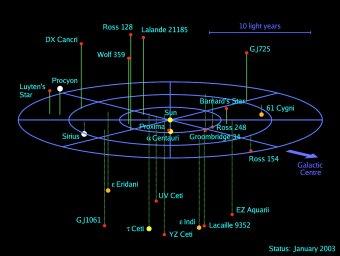
This actually doesn’t matter too much for galactic maps: a galaxy is hundreds of thousands of light years across while less than a thousand light years thick (at least with the “thin disk” part of the galaxy). By comparison, if a dinner plate is about 10 inches (25 centimeters) across, if it had the same dimensions as a galaxy, it would be about a millimeter thick. That’s not “paper thin” but it’s close enough that most people would think of it in two dimensional terms. I’d like to note that this is a case where most sci-fi actually skews the wrong way: they tend to overemphasize the three-dimensionality of galaxies because they know that space is three dimensional.

This sort of topic comes up more in smaller-scale sci-fi settings. Given that stars are actually scattered across a three dimensional space, it makes sense to depict them like that. Personally, I rarely see players fuss over that, because working with a flat piece of paper is easier than working with a three dimensional model. I find the extra dimension doesn’t really add anything: it’s not like “Up” is harder than “Down” or anything, and you can effectively reorient that three dimensional space in whatever way is convenient for you, so little is gained by emphasizing it. Nonetheless, it can earn you brownie points with purists. There are a few ways to tackle this, but the easiest is make a notation by each star how many (interstellar units you care about) the star is off the plane depicted by your map, treating the map like a grid with an X, Y and Z axis.

2. The Galactic Sea

The etymology of “Galactic” comes from the same places as “lactos,” or “milk,” in that “Galaxy” is ultimately just the Latin translation of the Milky Way. This notion of the Galaxy as liquid is a fitting one, as is calling space “a sea,” not because it’s an exact fit, but because it highlights some important truths about the nature of a Galaxy and its stars: they are better thought of as a fluid than a solid.

Islands serve as a useful metaphor for stars because both involve enormous distances of inhospitable, flat desolation punctuated by a scattering of tiny, life supporting points, but islands and stars have at least one critical difference that I wish to highlight: islands do not move, but stars do. Stars orbitthe galactic center, and they do so at different speeds. This means that the constellations of our sky have changed and will continue to change, that what was once our nearest star will not be in the future, and that everything, given enough time, will dramatically change.

Now, a brief point about this: in 36,000 years, Ross 248 will come within 3 light years of the Solar system and thus be our closest star, and this will last about 8,000 years. Meanwhile, in 50,000 years, Niagra falls will have eroded away. So, we can overstate the fluidity of the galaxy. It shifts and changes, but so do mountains. Even if we look into the far distant future of 10,000 years from now, we’re unlikely to see much of a difference: the sorts of animations astronomers make of constellations changing tend to be on scales of 100,000+ years. The real point about this objection is that no star has a concerete “connection” to one another.

Allow me to draw a contrast between galactic “geography” and planetary geography. Imagine a continent with a great ocean on its western coast and a mountain range down its center, and this great continent stretches from the arctic to the equator. The moisture of the western ocean and the mountains at the center mean that the western half of the continent is likely moist and filled with rivers as the clouds that build up over the sea rain out over the western side of the mountains and flows back down into the ocean. This likely means that the eastern half of the continent is dry and arid, a desert. Meanwhile, the north is likely cold and the south is likely hot. One can walk from the cold north to the hot south and notice the temperature slowly increasing during his long, long trek. The continent’s parts relate to one another and are a smooth, continual set of cause-and-effect.

Not so with star systems. Imagine Tatooine, a hot and arid world. Do you imagine all the planets in the Tatooine system are hot? No, of course not. A world closer to its star(s) might be bitterly hot, while those more distant will be cooler and cooler. Presumably the system has asteroid belts and gas giants and kuiper belts. Just because Tatooine is hot has no bearing on the warmth, dryness or coldness of other worlds, other than that if Tatooine is in the habitable zone, other worlds probably aren’t. In Endless Space, the game claims that red stars are more likely to have “hot” worlds while blue stars are more likely to have “cold” stars, a useful conceit when deciding which stars to try to colonize, but as one poster pointed out, has no real bearing on the climate of worlds: one can easily have a hot world around a (technically hot) blue star and a cold world around a (technically cold) red star, or vice versa, because their orbital distancematters more than the temperature of the star.

Worse, no star is really going to impact another star. You’re never going to have a “belt” of “Iron stars” all with hot, volcanic worlds and asteroid belts, making it a place well known for industry. There’s no mechanism by which to create that sort of distinct, thematic image. Instead, all of your stars will be scattered and random, creating a homogenous mixture when taken as a whole. Even the arms of a galaxy might be an emergent property the orbits of a galaxy, creating a sort of wave by the sheer chance of bunching up at particular points (though the nature of galactic arms is still a matter of debate).

Without structure, we cannot point to a region of space, like a galactic arm and assign it a theme, because there’s no inherent connection between the stars there, other than the fact that, at this moment, they happen to be close to one another.

3. The Galaxy is Huge

Space is big. Really big. You just won’t believe how vastly, hugely, mind-bogglingly big it is. I mean, you may think it’s a long way down the road to the chemist, but that’s just peanuts to space. –Douglas Adams, Hitchhiker’s Guide to the Galaxy

The primary problem with a galactic map is that it’s too big. Think about how many Star Wars planets you can name. Using wikipedia, I get about160 with a very rough count. Astronomers can’t really pin down the number, but they estimate between 100 and 400 billionstars. Assuming one Star Wars world or moon worth discussing per star, rather than multiple planets and moons per star, the Star Wars galaxy details 0.0000000064% of the galaxy. More realistic games, like Traveler, have these enormous maps with empires so vast that even with FTL it might take a human lifetime to cross them, and they stillrepresent just a drop in the bucket of the whole of the galaxy.

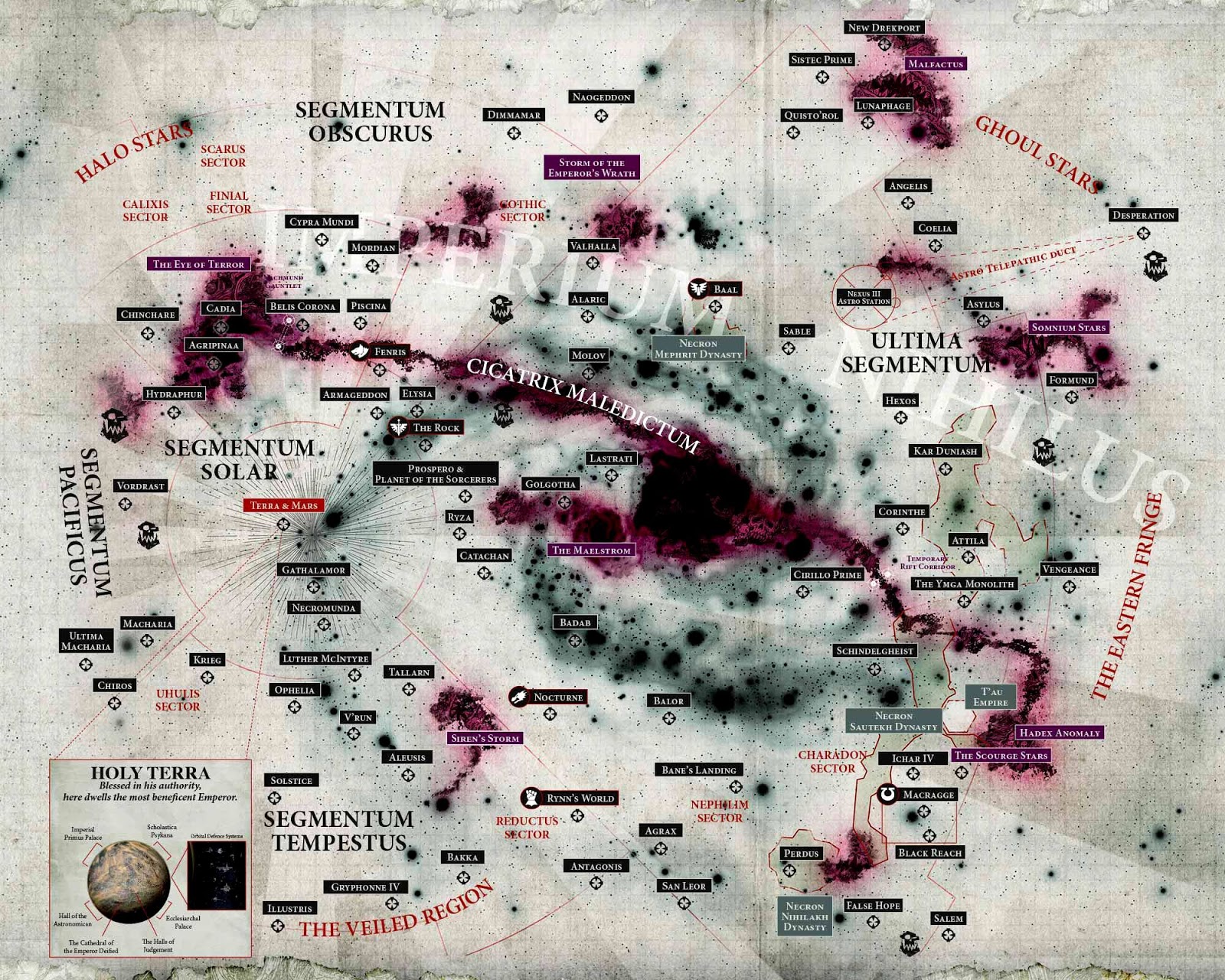
The only game to remotely get the scale of the galaxy right, and I still think they’re underselling it, is Warhammer 40k. It actually gets things like population numbers something close to right, because if you have a substantial fraction of those stars colonizes (say 1% of 100 billion stars, or 1 billion stars), and you have an average of 1 billion people gives you a quintillion people. It’s close to saying every person currently on planet earth got their own world of a billion people to rule. This is why only a fraction of the Imperium is capable of psychic power, and yet the imperium has no problem just shoveling psychics into (10,000 a day or so, if I remember correctly) the Astronomican to keep it powered, because that’s “only” about 10 million per year, and if only 1% of the population has the capacity to power the Astronomican, you still have literally trillions of people to choose from.

Warhammer 40k doesn’t bother to discuss structures, it just lays out a map of the galaxy and talks about general trends: “Here are the Gaunt Stars,” and “This little spot is the vast Tau Empire,” and so on. There are so many space marine chapters, which are the best of the best of the best, that you every player could make up their own and it probably wouldn’t detail every chapter in existence. You have plenty of room to drop your own whole set of worlds, and with vast and ancient history, and to have Chaos swallow them up like nothing without even making a marginal impact on the rest of the galaxy, a fact many a video game and Games Workshop themselves gleefully exploit.
Lying about Galactic Maps

So Star Wars is wrong, not just a little wrong, but really really wrong. Yet, nobody notices. Why? Because people aren’t astrophyscists and Star Wars doesn’t really concern itself with astrophysics.

Space Opera is famous for shrinking space down or just handwaving travel. A recent episode of Voltron had a planet so packed with explosives that, if detonated, would “destroy everything within a distance of 10 solar systems.” That either means within something like 1,000 AU, which is nothing (that might take out an oort cloud, but no other star systems), or it means that ten nearby systems would be destroyed, which means the explosive has the capacity to reach light years, which is a feat on par with a super-nova (and even those don’t destroy nearby systems, unless very very close, but it might sterilize them). But we don’t mind, for the same reason we don’t mind Han Solo stepping out of a door and watching the Republic capital-world, and other worlds being blown up by Starkiller Base (never mind the fact that it shot a multiple FTL beams). It’s similar to how many children’s cartoons will show comets, ringed planets, stars, asteroids and such all within hopping distance of one another. It just doesn’t matter, as long as you can maintain a thin veneer of reality.

Star Wars is really more concerned with changing planets the way one changes settings. They could as easily have stargates, except that would preclude the cool space battles. It doesn’t really matter if Naboo or Tatooine are closer to Coruscant, what matters is that we first want our story on Naboo, then on Tatooine, then on Coruscant. In this sense, a map doesn’t matter at all.

When it comes to spatial objects like black holes, pulsars, nebulae, asteroids or ringed worlds, most space opera simply sprinkle these into the background to justify weird things or to remind the viewer that he’s on an alien world. Perhaps a great ringed planet dominated the background of the ancient planet on which our characters adventure (a feature that has never been in Star Wars, for some reason!), or dead, volcanic world might be under the dour gaze of a “black sun,” a black hole surrounded by a nimbus of glowing gas giving it an otherworldly light.

This is why Star Wars doesn’t really have a map and, where it does, you don’t remember it: because it doesn’t matter. There are worlds, and you may well remember their names, but your characters will flit from world to world in a flash of onrushing, blue-shifted starlight. It’s an excuse, a conceit, and thus in principle, we don’t need a map.

That said, given that people don’t necessarily care that much about space opera galactic maps, we can lie, and we can make them however we want. Why? For the same reasons we make any map: inspiration, geopolitical realities, and beautiful obsfuscation.

Structure the Unstructured

If the Galaxy has a bright center, Tatooine is the point farthest from it.” – Luke Skywalker, A New Hope

Despite the fact that we claimed a galaxy has no structure, it does have some structures we can exploit. Galaxies tend to be most densely populated (with stars) at their core, which tends to have a “bulge” that rises above and below the galactic plane. It also tends to be more densely populated in its arms than outside of them though, of course, there are stars everywhere.

Star Wars centralizes political power in the galactic core. There are some problems with this realistically speaking (the galactic core might be too energetic to support life in the long-term), but that hardly matters for our purposes. As one moves farther from that “bright center,” one begins to exceed the grasp of power and enters regions of increasing lawlessness where alien powers begin to dominate (that is, we’re reaching the exotic edges of the map).

Star Wars also describes regions, the most famous being the “unknown region.” Most of these are based on how the galaxy was explored and colonized: these are cultural regions rather than geographical ones (sort of like how we associate Egypt more with its ancient civilization than its desert terrain), though we have some “political” ones, like “Hutt Space,” a popular one especially in video games.

We can also use structures that do exist in galaxies, even if they don’t work quite the way we’ll use them. These include armsand clusters. An arm might be a united region of space, as it would legitimately be more densely packed with stars than the regions between arms, and we might use clusters to describe closely associated regions of stars. A cluster might plausibly share some astrophysical characteristics (they tend to be stars formed together, and thus might share similar metallicity and thus occurrence of asteroids or cold bodies) or similar age (and thus might all be protostars with nebulae or truly ancient stars with vanished civilizations), and would likely share cultural characteristics as a single civilization might have colonized all the stars of a particular cluster.

We can also create fictional structures using hyperspace. Star Wars uses hyperspace lanes, and I’ll borrow the concept of “Constellations” from the Endless Space series: certain stars are more easily reached via FTL by particular “routes” that are unique to the geography of whatever medium that makes FTL possible (in this case, hyperspace). Thus while nothing “connects” two stars in real space, in hyperspace they might have a very quick and easy connection and thus regularly interact, while other stars even closer to one another might have no such hyperspatial connection and thus have no similar causal connection as people will rarely travel between them.

Ignoring 99.9999999% of the Galaxy

But how can we justify going from ~200 billion stars to ~200 stars? We have 9 orders of magnitude less stars in Star Wars than in the actual galaxy. The obvious answer is that moststars aren’t worth talking about. The presumption in Star Wars is that there are far more stars than mentioned, hence why new films have no problem just dropping a new star system, like Takodana or Geonosis, or expanded universe works will happily conjure up homeworlds, like Ryloth, out of thin air. They couldbe there and given the sheer number of stars, nobody talks about all of them all the time.

We can easily say that few stars are easily reached via hyperspace. If only a fraction of stars in the galaxy are habitable, and only a fraction of that can be easily reached via hyperspace, than we might easily only have “thousands” of worlds worth discussing, rather than billions. Given our rapid speed of movement, the players will barely notice that their ships just travelled a thousand light years and byspassed a million stars to go from one interesting world to another interesting world given that the million worlds they bypassed aren’t interesting.

This does mean that, presumably, there are untold, epic amounts of real-estate just out there for grabs, for pirates, smugglers, and would-be colonists to just grab. It may well mean that most of the civilizations of the galaxy are “dark” and unheard of, never seen and never involved, unless something shifts the shape of hyperspace and a previously isolated world suddenly finds itself exposed to the vast might of an intragalactic civilization it had never even known existed and rapidly finds itself overwhelmed. To me, though, this is a feature, rather than a bug.

Having Fun with Astrophysics

I mentioned above that galaxies do have quite a few structures we can exploit. We have to lie a bit about how much they matter, but the average space opera player is generally going to be okay with interesting-but-inaccurate astrophysics, and if they’re not, if they want to talk about what’s “really” going to go on, well, as long interrupt your session, I think that’s fine, but I like talking about astronomy! I’m not trying to be accurate, and I’ll happily fess up to that. Instead, I want to find a way to invoke some of the fascination people have with space to create a sort of mythology around a location, to explain what makes it unique and what makes it stand out.

Stars vary a great deal in type, and we can exploit this to say a great deal about how unusual a star system is. Tatooine has two stars. Stars come in every color, from blue to red to yellow (though it should be noted that, realistically, all of them will look white). A bloated, red super-giant says “the end of the world” to many players. I’ve never seen a game set in a proto-system, but such a primordial world would certainly offer a spectactular view, with regular meteor showers, a nebulous night-sky and a blurred out star shining brightly and setting its planetary nebula a light. Similarly, a dying star that’s slowly sloughing off its exterior would create a magnificent view, though how a world would survive that remains an open question (Star Wars worlds have survived worse!). On the more intensely energetic side, we have neutron stars, pulsars, magnetars and, of course, black holes. These tend to be too powerful and too disastrous to have livable worlds around them, but they may shape entire local clusters, dominating their themes. Similarly, truly giant stars may well serve a similar roll to pulsars and black holes (typically, a super-giant star is just a black hole or neutron star waiting to happen), serving as the heavy center of a local cluster.

A star system can have interesting planets too. I find that space opera doesn’t concern itself overly much with any planets but the single one in a system the players care about, but they can offer some variety. It might be possible to have habitable worlds orbiting gas giants. A world with a mighty Jovian slowly rising over its horizon, or a majestic ringed giant in the distance can add a lot of character to a world. We might also set a station in orbit above a gas giant, mining it for whatever we wish. On the even heavier side, we might have a brown dwarf, a failed star that’s heavy enough to be exceedingly warm and perhaps even create some very minimal fusion, but not to fully ignite like a star. Asteroid belts aren’t planets, but are famous as locations for grizzled miners and interstellar hillfolk. Asteroids legitimately have considerable mineral wealth in them. We can also play with icy worlds or ice rings around worlds; the Old Republic has at least one space battle scene set amidst these great space-faring, crystalline ice-bergs!

A nebula is more impressive in space photography than in real life, but that doesn’t mean we can’t exploit the more cinematic version of them. In reality, a nebula only looks like a fog because over a scale of light yearsits mass begins to obscure some of our line of sight: it hasn’t got a fraction of the density of the air atop mount Everest, never mind the density of a fog bank. That doesn’t have to stop us from making improbably thick and stormy nebulae. And a nebula can legitimately cover many, many light years, which means if we give it cinematic properties, it can create a “dark sector” all of which poses navigational hazards and may hide pirates!

Telling a Story with Astrophysics

We don’t have meaningful interstellar structures in a geographicalsense when it comes to galactic maps, but that doesn’t mean we can’t fudge things. Better, while there’s no logical reason for the worlds of a swathe of space to share a particular trait, there’s no reason they couldn’t either. In a sense, we’re free to tell whatever story we want, within the limits of suspension of disbelief, about any part of the map.

For example, earlier I said that there’s no real reason to have an “iron belt” of worlds all rich in metals and hot, like a forge, but there’s also no reason we couldn’t. Perhaps we have a cluster of very high metallicity stars that formed recently. At the heart of this cluster there resides an enormous red super-giant, which looms over every world in the cluster like this great, baleful red eye. The cluster might have a star system rich in asteroids, and another star system with a metal-rich, volcanic planet, and a third star system with this huge, coal-black “Hot jupiter” that hovers close enough to its parent star to be impressive, but not so close that we can’t mine it (perhaps it’s rich in star-fuel). Immediately, we have a theme of “iron stars,” several star systems rich in mineral wealth and likely poor in everything else.. We might imagine the denizens of these worlds to be gritty miners and soot-covered thieves and vast industrial complexes ruled by sallow-cheeked corporate lords.

We might contrast such a region of space with a glimmering, rainbow-sheened nebula lit from within by several stars being born. We might have a garden planet in one system and a crystal-ice planet with silvery rings in another. Clearly, this is region of space where princesses and knights come from, with brilliant castles and sacred spaces. We can see a difference between these worlds and the “iron” worlds.
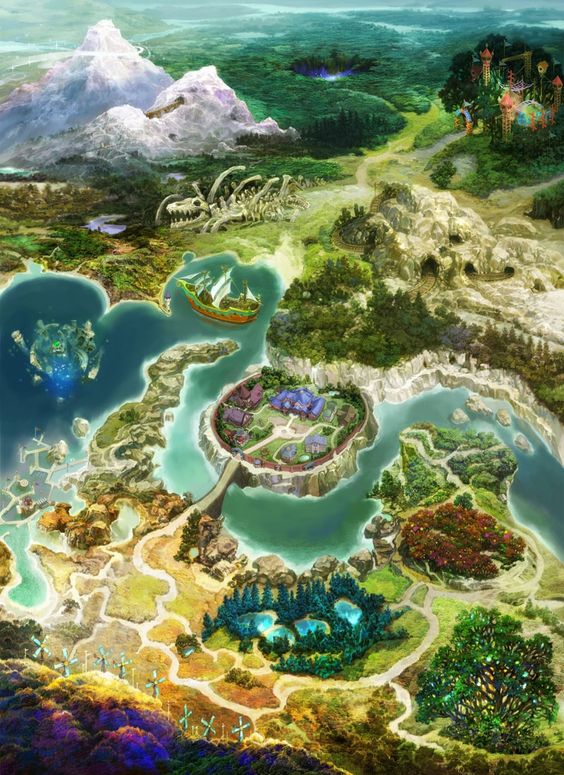
Are these regions of space “realistic?” Maybe not, but they might inspire you, and they’re easily differentiated and easily understood. For a space opera setting, that may well be enough!

Mapping Psi-Wars 1: Map-Making in Theory and Practice

Making a Map

Ever since Tolkien unveiled his Middle Earth with the luxurious map of his world therein, fantasy worlds have followed suit, and I personally find it difficult to find fantasy novels that don’tinclude a map. This has spilled into the fantasy RPG genre, such that Dungeon Master who begins his campaign preparations by first sketching a map has become a cliché in RPG circles. One can do a quick search of the internet to find a glut of such maps and software that can make them look fantastic.

Sci-fi settings seem to have less of a close relationship with maps. Star Wars, Star Trek and Warhammer 40k all have such maps, but they don’t seem to feature nearly as prominently in the work. While sci-fi mappers certainly enjoy mapping our worlds and sectors, they seem to do so with less gusto, especially when it comes to galacticscale maps. I think this is, in part, because such maps are less visceral for readers. You intuitively understand concepts like “Mountain” and “Ocean” but “blue star” and “red star” don’t say nearly as much to you.

I’ve held off on creating a map for Psi-Wars for a variety of reasons, but my Patrons have requested it as a January topic (if you want to vote on the February topic, feel free to join us and help us build the Psi-Wars setting!), so here we are. The actual creation of a good lookingmap is proving quite difficult and time-consuming, so we might not see an “actual” map so much as a sketch and descriptions, but I also wanted to stop and take the time to discuss what I think the purpose of a map is, mistakes people often make, and what I’m trying to achieve with my map.

Why Make a Map?

1. Fractal Inspiration

the_only_fantasy_world_map____by_eotbeholder-d42b141-1

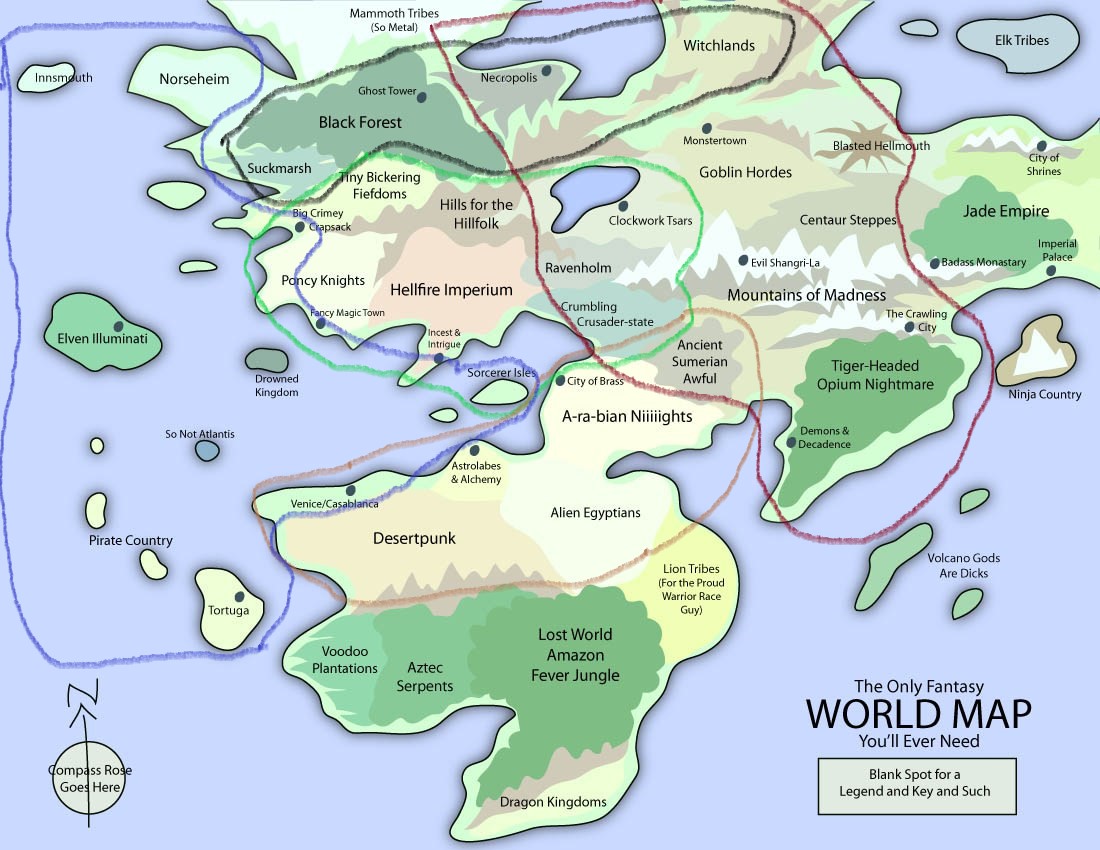
Behold the greatest fantasy map ever made! Though, please note that I’ve besmirched its greatness with some lines marking out some regions.

To me, this exemplifies the most important reason for a map: to inspire the reader and immediately give him story ideas as well as to tell him something about the world (and setting, themes and genres) in which he is going to play. Personally, I cannot help but see each genre popping up whenever I look at each location and I can imagine a dozen adventure ideas for this setting and, with study, a dozen more. This means the map is serving its role: you should look at it, and be inspired to run a game.

I think the core reason so many game masters start a campaign by making a map because it organizes their thoughts. It brings into focus the various campaign themes and elements they’re going to be using, and makes it visual.

I think we can layer this inspiration, hence “fractal inspiration.” When you look at a bit of a map and get an idea of what to do, you need to be able to look deeper and get the specifics of your adventure, and look more broadlyand get the context of your adventure. I marked out the regions to give you a better sense of at least three scales of detail: region, land and city. In a sense, you can see how the map was created in broad lines. For example, we have a “desert” region, a “European” region, a “monster” region, a “jungle” region, etc. These follow broad themes, though here they’re mostly a mixture of genre-based themes crossed with terrain-based themes, but we see other examples, such as “elemental”-inspired maps, or historically-inspired maps, etc. Then we move deeper and get a closer look, both at our themes and areas. From regions we move to lands or countries, and we go from broad themes to specific subsets of that theme: for example, we break our desert down into mad-max-inspired “Desertpunk,” ancient Egyptian elements, and Arabian Nights themes (among others; “Crumbling Crusader-states” should probably be at least partially desert-based: themes can cross!), all genres we associate with the “desert” terrain. We can dive even deeper, creating more specific context, and on this map, that’s generally cities. These help clarify our larger genre (“Hellfire Imperium” could mean many things, but the fact that we have an “Incest and Intrigue” city definitely means it’s human, and likely Roman, given its title of “Imperium”), as well as give us a much more specific element to work with, even if we’re not directly involved with that city.

When creating our map, thus, we can “start big” and name the obvious things about our campaign (our regions), and then take each of those and name the obvious things about those themes, and then we can start to populate these more detailed areas with more specific elements, such as cities, towns, shrines, etc. In a sense, we begin with a “mind-map” and turn that mind-map into a literal, physical map of the world.

It should be noted that this does not needa literal map. You should consider using this “mind-map” method to create your setting whether or notyou intend to make an actualmap.

2. Beautiful Obfuscation

A good writer learns to “steal like an artist” and hide the more obvious elements of his designs, the same way an artist erases the sketch marks he used to create his work. The problem with the “inspiration” map above is that it’s obvious, and this can give the audience (including the player and GM) a sense of disconnection and disbelief. He’s obviously not looking at a real place, but a tool for his RPG campaign.


Obfuscation can help suspension of disbelief and lend a hint of character to the world. It can also beautify it, both in a metaphorical sense (a beautiful name is more appealing than a naked trope) and in a literal sense (adding beautiful topographical artwork turns a barely-translated mind-map into an artifact worth showing your players). For example, we might rename “Poncy Knights” into “Avalon” or “The Kingdom of Chevalier.” This certainly implies“Poncy Knights,” enough that you get a sense of what it’s about, but it also lends character and “sounds” more like what we’d expect on a map. We could also replace the basic splotch of color with some images of fairy-tale castles, winding roads and some churches.

Obfuscation also adds an element of mystery. If we change the name of Ancient Sumerian Awful into “The Nameless Cities,” that invokes foreboding and mystery. Why are they nameless? Are they, perhaps, named, but none dare speak their name? If we go there, what will we see? And what sort of adventures can we have? By obfuscating our intent, we give our players something to discover.

A couple of warnings about beautiful obfuscation. As with fractal inspiration, you don’t actually need to craft a map to get it. I’ve already mentioned changing the name of the “Poncy Knights” to “The Kingdom of Chevalier,” but I didn’t need to feel the need to make an actual map to do this. You can simply apply place namesas you see fit, and they often create the same effect. Similarly, working out some greater details of the sorts of descriptors you might apply to travels through the countryside (perhaps it is often “sun-lit” and “clear-skied” and full of “quaint” things, like a quaint church and a quaint village, and obviously, there are many “snapping banners” and we like to talk about how “shining” everything is) without actually drawing a picture. In practice, you’ll need this more at the tabletop than you will the map. In a sense, at this stage, you’re translating from ideas to hard, concrete, useful concepts.

The second warning I want to offer is that beautiful obfuscation is usually where map-making goes horribly wrong. First, driven by the need to create insider terms, the map-maker will cover his map with useless jargon. While “Poncy Knights” doesn’t sound as nice as the Kingdom of Chevalier, if we start naming our kingdoms “Twee, Gor and Rumbleness” they tell the player nothing, especiallyif our fixation with accurate map-making means that the lands become indistinct and similar (just collections of mountains, roads and greenery with nothing to differentiate them). The inspiration you worked so hard to get in the first step is lost here. This can have an advantage in acting as a reward for those who do get into your world, but consider how high you want to raise the barrier for entry  There are reasons to do this, of course, and I’m not saying every such map is wrong, I only caution you on going so far in that direction that you lose sight of the purpose of your map!

Finally, I see map-maker after map-maker get hung up on beauty and spend months with Campaign Cartographer trying to make the perfect map when he really should be spending his time working on the actual campaign. Maps are useful, but their value should be measured against everything else. And ignore those sites that tell you everything you’re doing wrong with your map: never let the perfect be the enemy of the good. If your map works for your group, that’s enough!

3. Geographical Realism

In the real world, we use maps to help us navigate the world, and to understand the geopolitical situations we face. This is also true of setting maps. Some games really feature travel, and so are deeply concerned with what route players will choose to get from here to there, with different routes bringing different crises and rewards with them. Many “old school” RPGs concern themselves a great deal with maps, and using them to direct travel, from mapping the dungeon in which one travels to the overland journeys one makes. If your game focuses on this, then a map may well be a must!

The geopolitics of a world often prove more important than navigation, as many genres of games handwave away travel times, but the context in which an area is often shapes stories. If we look at our original “inspiration” map, for example, we see that the Crumbling Crusader States are bordered by the Hellfire Imperium, Ravenholm, the Mountains of Madness, Ancient Sumerian Awful and “Arabian Nights.” Their most likely source of support, the Poncy Knights, are not adjacent. This tells us a great deal already, that they’re the last line of defense between a likely ungrateful Hellfire Imperium and many of the monsters of the world, with the Arabian Nights land as rivals and sometimes unlikely allies. If we set our game there, in addition to a landscape of crumbling fortresses being devoured by the desert and lonely knights and pilgrims wandering desolate roads, we can expect to see sudden Saracen incursions and paladins fighting off Lovecraftian monstrosities. We might have attempts to forge alliances with those Arabs of the south and their expy Saladin wisely setting aside his hatred of the crusaders and teaming up with them to press back the threat of the Alien Egyptians. If that doesn’t work, our tired crusaders may need to seek help from the decadent Hellfire Imperium, or the blood-corrupted counts and grey, stormy wizards of Ravenholme.

This geopolitical reality can shape the larger context of your setting, implying which flavors go well together (by their close positioning) and which tend to be highly foreign to one another (based on how remote they are to one another). Notice, for example, that the more familiar and human elements of the game lie at the center of the inspiration map, and the weirder and more extreme elements lie at the edges of the map!). Maps illustrate proximityand energy expenditure necessaryto cross the border from one sort of story to another.

While I argue that inspiration is the core purpose of a map, geography represents the first moment you actually need a map.. Yes, there are ways to discuss proximity and route without making a map, but a map makes grasping these concepts so easy and obvious that it’s frankly foolish to try to forego it. If you don’tmake a map and your player characters travel or have a lot of questions about geopolitical context, you’ll end up sketching out a map for your players anyway.

4. Room to Grow

planeworld_map___elemental_courts_by_levodoom_dbulvh2-pre

Maps tend to be large, sprawling affairs. They often have beautiful implications within them and can inspire you, but they should not, in my opinion, dictate every last detail. You can pick any place in the real world and get lost in dizzying detail, which is not what you want your players to do. Nor do you want to spend literally years just to create a single map for one setting. Instead, you want to lay the foundations for inspiration, and put some pointers that might inspire you further when the time arises.

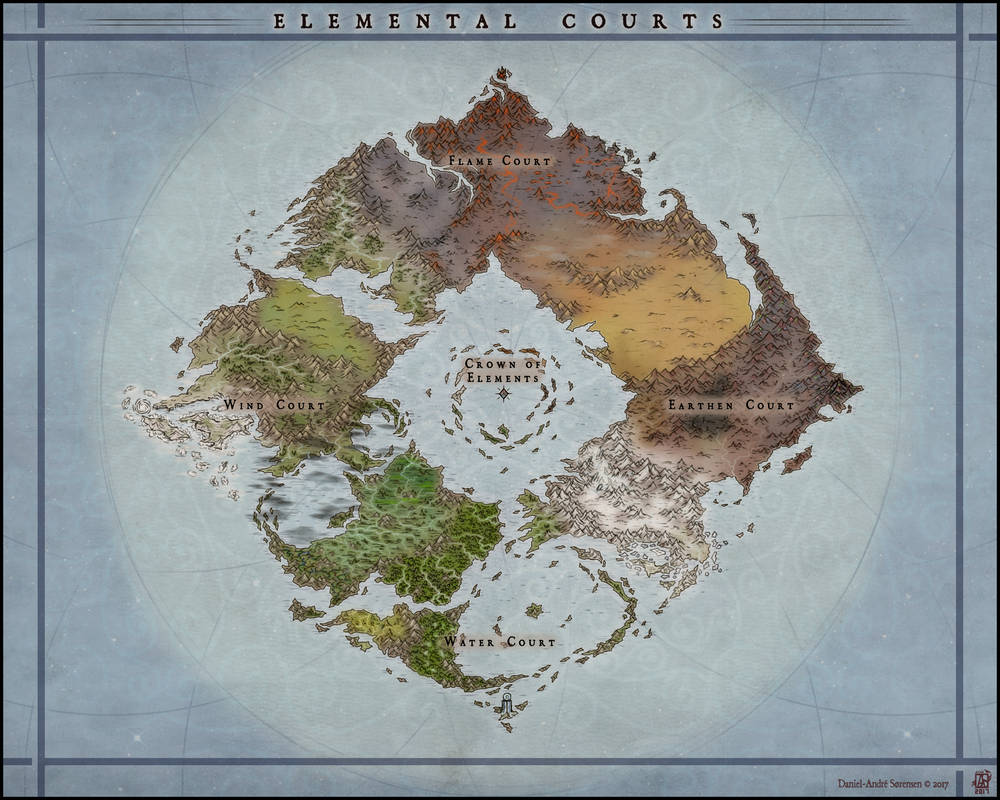
Consider the above map: it only names 5 locations, but you can infer other things from the map, such as the arctic region between the Earth and Water court, or the jungles between the Wind and Water court. What are those places like? What sort of cities might they have? I think the implicationsare clear; we don’t actually know for sure, but we’re invited to fill the blanks in, and to contemplate how the elements might interact. Similarly, the original inspiration map names a lot of names, but actuallytells you nothing. What might a city in “Desertpunk” look like? Perhaps a roving caravan-city full of colorful tents and even more colorful people who wander from oasis to oasis. What sort of cities might be in the Crumbling Crusader State? Almost certainly some sort of “holy city,” perhaps one that has been held by either the Arabian Nights land or Ancient Sumerian Awful for a long time, but now the Poncy Knights cling to it out of religious fervor. Should we need to add more, it’s especially easy to do so.

This is extra critical to do when creating a setting for other people, such as Psi-Wars, because as a setting designer, you don’t actually know what sort of campaigns people will try to run with your setting. You should use your map to point them in interesting directions, and then stepping out of the way when they decide that none of those pointers exactly provide what they’re looking for, and instead, give them some interesting blank spots on the map to put exactly what they have in mind.

The Perfect Map

Exalted, 1st Edition
I’ve seen quite a few maps in my day, but I spent a great deal of time poring over the Exalted 1st Edition map when I received my copy, and to this day, I find it one of the finest maps ever made, as it tackles every element I discussed above, and you’ll soon see how I’ve borrowed a lot of concepts for the Psi-Wars galactic map. Thus, I offer it as illustration of each concept.

First, inspiration and themes. Exalted has “five terrestrial elements,” Earth, Air, Water, Fire and Wood. Each of these elements dictate a part of the world, the “five poles” of the world. At the center of the world lies that great and mighty mountain, and this is where the world is “most stable.” The farther one gets from that center, the more extreme and governed by some other element it gets until, beyond the edges of the map, it becomes total, unformed chaos: the Wyld. This means that each direction is governed by its element: the islands of the West, the frozen North, the blistering South, and the forest-covered East. This gives us a sense of where we want to set our stories. Viking? North, of course, and a bit to the West. Abandoned jungles full of lizard men? East, please, and a bit to the south. Stories set in the deep desert with wandering nomads? The far south, of course! What about a stable kingdom? Then pick a direction, based on its elemental association, but bring it close to the center.

Second, beautiful obfuscation. Of course, the map is littered with evocative names and symbolism. It’s a bit hard to read from here, but at the cusp of two rivers lies “Nexus,” one of the most important cities of the setting, in the heart of the “Scavenger Lands” of the east. We also have cities like “Thorns” in the east, the evocative “the Lap” with an image of a great statue in the south, as well as Gem (I wonder what comes from there), or the “Coral Archipelago| in the west, “Diamond Hearth,” “Crystal” and “Icehome” in the north. These fit the regions nicely enough and give ideas as to what one might do in each, without coming out and telling you exactly what to do.

This particular map lacks distances, and I’m not sure whether or not later maps fixed that; It does give us a sense of geopolitical connection, though. The great continent in the center is the “Blessed Isle” and serves as the home for a world-spanning empire. Thus, the closer you come to the stable center, the more likely you are to find yourself beneath its boot. The edges bring you into realms more and more wild and less survivable. In between, in places like the Scavenger Lands or the Coral Archipelago we being to see elements of freedom from both tyranny and chaos, and where smaller powers might reside.

Finally, this version of Exalted leaves plenty of room to grow. It sprinkles a few cities around, and the book itself outlines some broad regions and drops a few example nations in each, but it leaves tons of room to create your own. Later iterations of Exalted seemed determined to put a stamp on every square inch of the setting and I, personally, felt it lost a lot of its sense of adventure as it did so. It turned from something that you, personally, could put your own preferred campaign into, and became something defined solely by the authors of the books. This is why I point to the 1st edition copy of the map, rather than the latter, more cluttered maps.