Musings on Mooks and GURPS Combat Encounters

As I work my way through the session planning for Tall Tales of the Orochi Belt, I find myself pondering combat encounters, and how GURPS tends to handle them.  How exactly should I stat up my minions in GURPS? And how can I transmit that to you in a way that helps you put together interesting sessions?

I’ve been diving through a few books to see how best to handle encounters in GURPS, in particular the Campaign Framework books, which put the most effort to actually translating the GURPS rules into something you can use in a game, and thus actually have bad guys.  Of course, all four handle opponents in very different ways, but I also find all four surprisingly lacking.  If I could criticize GURPS for one thing, it would be its tendency to demand detail in areas that really don’t matter, and to provide precious little detail in areas that do.

What do I mean by Mooks

…(M)ooks are defeated if injured at all – even a 1-HP gut punch will do. — GURPS Action 2: Exploits

To clarify what I mean by a mook, I mean the inconsequential opponents that the PCs face, the speed bumps on their road to victory.  On the one hand, these characters don’t need stats: they’re speed bumps, things that soak up the character’s precious time while the bad guy gets away, and give a chance to the main characters to look good.

See, we know the heroes are awesome, and we want to see them being awesome, and the way you do that is providing them with opponents to showcase their great skill, typically by winning a fight with the odds stacked against them and so lots of games provide rules for one-hit opponents that immediately go down. Not providing these rules tends to turn every fight into a tedious grind, where you know your opponent has no hope of defeating you but you need to burn many minutes per opponent, grinding them down to zero HP, to defeat them.  Thus, most games that I know that have this sort of wild disparity between hero and opponent include some way of speeding up the fight so we don’t focus overly long on something that doesn’t matter.  But if they don’t matter why bother with them at all? 

You can answer this question a lot of ways, but I happen to think there are wrong ways to answer that question, and most of them boil down to “Because it’s expected.”  If a fight doesn’t matter, then it doesn’t matter if the fight is slow or long, in all cases, it’s tedious.  If your fight consists of rolling to hit, and then always succeeding and always taking your opponent out, while never really being in danger, then you’re just punching mannequins until the GM declares that you’ve met your mannequin-punching qouta and you can get to something that matters. This leaves us with a conundrum: mooks shouldn’t matter, but if they don’t matter, then we shouldn’t have them in the game and yet people expect them, but if we only keep them “because it’s expected,” then we create tedious, pointless fights.  So they answer has to be: mooks matter.

So, if mooks matter but are ultimately, individually, inconsequential,. then how do we make them matter? Well, I think with a moment’s reflection, we can come up with some obvious reasons.  First, mooks in sufficient number do pose a real risk. Go watch the fight in Moria in the Lord of the Rings (or really, any fight against Orcs) and you’ll notice that while an individual orc is no threat, the orcs as a whole pose a real danger to the heroes.  If you further look at most movies, the mooks might not pose a threat to the heroes, but they definitely pose a risk to “normals.”  This is typical of the super-hero genre, such as the Battle of New York in the Avengers: few of the Avengers were actually in real peril, but the everyday people definitely were, and many scenarios in the film are constructed around that premise: alien monsters threaten people, and the hero needs to defeat them.  Finally, mooks tend to soak up resources, such as your fatigue (there’s a great fight in Daredevil season 1 that showcases this), your bullets and your healing potions.  They also take up time, which might be crucial in a certain scenarios (such as the bad guy getting away while throwing wave after wave of minions at you).  A well-fought battle can allow you to save your resources for the final fight against the big bad, while burning those resources might let you get through them more quickly, in a time-sensitive match.

Mooks also tend to change up the preferred tactics of a lot of characters.  A lot of players focus on defeating toughened targets.  A DF character might focus on tons of ST, armor divisors, high levels of Feint and the ability to target vulnerable locations so they can defeat a single, very tough target well, but if you instead put him up against a dozen goblins, most of those advantages go out the window compared to someone with extra attacks, dual weapons, AOE spells, or Whirlwind attacks.  If mooks matter, and mooks fundamentally fight differently than big bosses, then players are forced to adapt to shifting sets of circumstances, based on who they fight.

How GURPS handles Mooks

Okay, clear, you get what a mook is, why he matters, how he matters, and what they can lend to a game.  So what am I going on about? Well, as I look through GURPS material to explore mooks, I’ve noticed a tendency to treat them like characters and I have… mixed feelings about this.  Most advantages and disadvantages are built from a player-character perspective.  For example, the primary disadvantage of Callous is that it gives you a reaction penalty (-5 points for a -1 reaction penalty).  This doesn’t matter as much for NPCs, which is why you often hear people say “Don’t worry about point totals for NPCs,” because an opponent with Callous and Odious Personal Habits, Bully and Hidebound is worth less than a character that has none of those, but that fact just isn’t relevant.  On the other hand, some disadvantages, like Berserk, Bloodlust, Code of Honor and Cowardice do matter, a lot, and could completely reshape the fight.  If we step back and look at a group as a group and accept that Mooks serve more purposes than just fighting, such as the patrolling guards while you’re sneaking through a fortress, or the rabble of an opposing faction that your Bard/Diplomat is going to talk to, then these disadvantages might matter more.  But I often find that when I’m presented with a Stat Block filled with advantages and disadvantages, I need to stop, parse, and write notes down, and I rather wish GURPS did a lot of that for me.  Tell me how these guys are supposed to fight.  Tell me how to use your mooks in my campaign.

I think D&D tends to do a pretty good job of this, especially my favorite iteration, which was 4e (yes, I know, I am a heretic), which pushed so far into heresy as to practically script your fights with each opponent.  Monsters had pre-defined attacks, and a sudden change to how they fought once they became sufficiently wounded, which meant that fights tended to escalate once things got worse, and a lot of the game turned on getting a sense as to how the enemy fought and then trying to use your own tricks to your advantage.  It didn’t take a ton of parsing to work out: it was spelled out for you in black and white.

I’d like to stop and take a look at how various GURPS Campaign Frameworks handle mooks, to get a sense of what they do, and what I’d rather see. I’d also like to hear your thoughts, on how you handle these sorts of characters, if you do at all.

GURPS Action

Mooks don’t need complete character sheets — GURPS Action 2: Exploits

You’re darn right they don’t.  In one sense, I think GURPS Action handles Mooks the smartest of the four, because it says “Look, one hit will take them out; their stats/skills for anything that matters is either 10 or BAD+10, and give them a couple of guns or something.”  Easy.  So if you’re fighting some BAD 0 cops, then they shoot at you with basic 3d pistols and roll a 10 or less to hit you (before modifiers).  If you’re fighting some BAD 5 commandos, then they have Skill 15 when they shoot at you, might have some ballistic vests (DR 10 or 12, I think, at least against bullets) and are shooting some high ROF 6d assault rifles at you.  Relatively simple.

Where I think Action falls down is providing some variety. There’s no real, obvious difference between how these two guys fight. Action suggests that maybe some tough mooks would have High Pain Threshold (though how does that even work, if one hit takes them out?), or you might have some “pencil neck” mooks who present even less of a threat.  Action largely consists of entirely human opponents, so this is somewhat forgivable, but I would expect facing a mess of fanatical, suicidal terrorists to be an entirely different affair than fighting Russian special ops or some corrupt cops, and not just because the BAD changes.  Spec Ops would have tight tactics and combined arms; the corrupt cops would make stupid mistakes and be willing to negotiate (likely easily intimidated) while the terrorists might totally refuse to negotiate and when they start to lose, begin to take absurdly dangerous risks that could turn the fight suddenly at the cost of their lives (though they would also tend to make a lot of tactical mistakes).  Thus, it seems reasonable to expect each scenario to be more diverse than just “Their skill levels differ” but there are no clear guidelines as to how.

GURPS After the End

…a game where four PCs can charge a 100-person raider camp head-on and expect not just to survive, but to prevail. –GURPS After the End 2

The more I’ve read After the End in researching Psi-Wars, the more I’ve come to appreciate it.  It’s definitely not as influential as Action, but it’s increasingly making an impact on my rules and my templates.  When it comes to mooks, though, it’s a bit of an awkward fit because After the End doesn’t assume mooks the way Action does.  If you’re playing a heroic realism game with a default, 150-point scavenger, then a single Raider with a board with a nail in it is not just a speed bump, but potentially a serious problem, worthy of a detailed fight!  That said, we can definitely see that some opponents have inferior capabilities, and After the End has some suggestions as to how to turn up the high octane action: when you’re 250 point Hardy, Experienced Scavenger faces a Raider in a Cinematic game with the Cannon Fodder rules turned on, then that raider turns into a mook.  So, I have to give After the End a little credit even if I don’t find their approach totally useful, because I’m looking at this through the lens of “Is this useful for my Psi-Wars game?” rather than is it useful for my After the End game.

Unfortunately, the PDF preview has no one I would consider a mook that I can discuss (though it does have some monsters), so I’m just going to discuss the Raider on page 17 of After the End 2, and if you have the book, you can follow along, but if you don’t, you’ll have to take my word for it.  Here, we have quite some detail: for example, they have IQ 9 but Per 11; they have skills at differing values (though typically harder skills at a penalty: for example, they have Axe/Mace (an Average skill) at 12, but Kusari (a Hard skill) at 11).  And they have specific traits: Callous and Improvised Weapons.  So, unlike with GURPS Action, where you can just improvise off the top of your head, you need to have memorized this NPC stat block, or have it in front of you.  That’s not necessarily a bad thing though. It also doesn’t tell you much about how they fight. Not here at least.

See, if you page back to page 15, the “Raider” stat block is the culmination of a section on gangs titled “Gangs.” It discusses how many there tend to be, what their bases look like and what sorts of variation they might have.  This last is key: we have five “attitudes,” and two Lenses, either motorized gangs (think Mad Max) or “Masters of the Land.” They also have some brief discussion of slavers or “hostile townies.”  So, in a sense, this actually does what we want to: one entry provides us some considerable variety.  A Mad Max style gang might be Motorized and Debauched while some other gang might be Masters of the Land and Cultish. The first gains disadvantages (like Bad Temper (6)) and skills like Driving at DX+1 (11 in this case), while the latter is amenable to a good Diplomacy check but react badly if people refuse to join up and typically tend to be stealthy in some way and integrated well into the local terrain. Nice.

The problem I have with these, from the perspective of building combat encounters, is that most of the material here is for constructing interesting broader interactions.  These lenses and suggestions act as starting points for a total scenario.  For example, Mad-Max style slavers might have hit a local town and dragged away some slaves to their camp, so we need to know things like what their encampment might be like, or that they have Bad Temper in case we want to piss them off into making a mistake. A Cultish group might rescue the heroes if they’re in trouble, bring them back to their forest fortress and become increasingly unhinged and dangerous once it becomes clear that the PCs are not “one with the purpose.”  These are interesting, but not what I’m looking for.

GURPS Dungeon Fantasy

Some monsters are fodder, and just get squished. These aren’t necessarily trivial; numbers and effective offense can let them chip away at the party before being exterminated — GURPS Dungeon Fantasy 2

Dungeon Fantasy explicitly talks about Fodder, which is what it calls “mooks,” they even have the “take 1 HP and you die” rule (“And Stay down,” page 27). In fact, the book largely talks about all the things I discuss above: that fodder should be meaningful opponents, but mostly by chipping away at the PCs or distracting them for the more dangerous monsters.  This isn’t all that surprising, because DF is very much built around combat encounters the way other campaign frameworks isn’t.  It might be okay in GURPS Action if all of the gun-toting mooks are terribly generic, but it’s an unforgivable sin in a Dungeon Fantasy game if all the monsters have identical stats (a trait it shares with Monster Hunters, though Monster Hunters is more about solving the mystery of the monster than it is in numerous highly nuanced combat encounters).

If we look through the monsters, even the fodder, we still see a lot of variety.  I couldn’t find any good Fodder monsters in any PDF previews, so I’ll discuss the Flesh Eating Ape as an example, even though it’s probably more of a henchman. Notice that it has skill-14 in basically anything that matters, making it consistent and easy to remember.  In both the Notes and the general description, we see repeated reference to their grappling ability, including a discussion of Neck Snap.  This sort of detailed discussion of how the monster will fight helps set it apart, though we still need to parse some things (like the fact that it’s a Brachiator and is Ham Fisted; how will these impact combat?). 

As GURPS Dungeon Fantasy matured, it goes into even more detail.  Check out the Demon of Old; again, not a mook, but note the sidebar extensively talking about how it would fight, and what sort of tactics you would need to defeat it.  Pretty good stuff!  There’s still a lot of parse in the stat-block, though, such as their Lifebane, their Dread, the fact that they don’t breath and are immune to metabolic hazards, etc.  You do have to read it carefully, but not as carefully as you might with the older versions of these monsters.

I also want to turn your attention to the Monster Prefixes from DF Monsters 1, a similar approach to what I did in a DF Monsters thread once ages ago: we assign some sort of prefix to a monster and change its approach.  We might have an Energy Draining Flesh Eating Ape that begins to inflict Fatigue Damage once it has you, or a Distorted Demon of Old with 8 arms and 3 mouths and is not vulnerable to strikes to the vitals nor does it Dread holy things, but is instead susceptible to magic.  While not exactly built for mooks, it does begin to address the sort of thing I’d like to see: one or two specific twists to low-level opponents that fundamentally changes the fight. 

These tend to be much too “broad” for my tastes, but they’re meant to fit a fantasy game where you want to paint in broad strokes, rather than a more nuanced action game. I feel like if you could blend the combat-oriented nature of prefixes with the more down-to-earth lenses of After the End and the simplicity of GURPS Action mooks, I think you’d have a winner.

What is your Experience?

If you’re in a medium that allows comments (my Discord server, for example; you can comment right here, but I tend to be slow to see them; google is terrible about notifying me), I’d love to hear your experience with mooks in GURPS, especially games with gunplay. Do you find the Action approach too generic, or do you find the more detailed approaches of other games, like After the End, too detailed? Are there tricks you use to spice up combat?  How do you feel about stat-blocks vs quickly improvised opponents?

Imperial Security: Materiel

What sorts of soldiers, vehicles and equipment do Imperial Security generally sport?  Well, we already have a rough idea of what sorts of roles their troopers fulfill, because I wrote up security agents back in Iteration 4, and we touched on it already:

  • Generic Security Troopers: generalists with blaster pistols and neurolash batons who represent the typical security trooper one might meet and who act as basic backup for the rest.
  • Assault Security Troopers: elite specialists with a focus on direct attack in close environments (urban or ship-borne raids).
  • Riot Control Troopers: Troopers armed with shields, neurolash batons and a bad attitude, meant to put down riots.
  • Security Snipers: While the Empire of Star Wars generally isn’t associated with high accuracy, the concept of a sniper fits perfectly with the oppressive atmosphere we’d like our empire to foster.
  • Security Officer: An officious lieutenant who either supervises security troopers, or assists a named Security Agent.
As before, and despite claims to the contrary, the role of Security Troopers isn’t it kill people, it’s to enforce peace and order.  They prefer to take suspects in alive for questioning, and to intimidate the populace, rather than kill them.  Plus, many security troopers genuinely believe in protecting civilians and killing bad guys, and see the rebel conspiracies they undo as dangerous anarchists and little better than more base criminals.  Sometimes, they’re even right!

Security Materiel

Armor

When it comes to armor, two concerns pull Imperial Security in different directions.  First, it wants the prestige and power that comes from military power.  The Empire fetishizes the miltiary, and in Imperial Security, police militarization has run amok. On the other hand, it doesn’t face military-scale threats.  It doesn’t have to deal with rifle fire or heavy attack vehicles.  It deals primarily with punks who wield pistols, clubs and knives.
Against clubs, knives and fists, battleweave is more than sufficient.  DR 20 will stop clubs, knives and pistols, and will definitely slow down a vibro knife enough that a character will watch away with a few stitches rather than a long stay at the hospital.  Against light pistols, a tactical battle weave vest should be sufficient, but our troopers want to look like the military, and that means looking like someone with a hardsuit, and that means clamshell armor.
Recently, pyramid released an ultra-tech armor design system!  Since we’re finally digging into detail work anyway, let’s take a look.  Battle weave is just energy cloth with 2/3 the DR, which means max DR is 80, DR/inch is 160, and a WM of 0.021, making it heavier than Monocrys, and also more expensive!  I’ve dismissed monocrys and nanoweave thus far because they’re only effective against bullets and edged weapons, which isn’t useful in a setting full of beam weapons and armor that protects against beam weapons won’t stop blasters!

Real life SWAT agents just wear uniforms and tactical vest. We could do the same, but why not armor the sleeves and gloves while giving our agents a light clamshell that will stop blaster fire to the chest?

If we want to stop a vibroblade, we need an average of 35. A monocrys coverall with DR 35 would weigh 11 lbs and cost $825, while battle weave would weigh 13 and cost a staggering $6,500!  For a clamshell, we already have one (UT 176), but if we wanted to reinvent the wheel (Why not?  Then I feel I can release the values in my PDF), we could.  Of course, it turns out the original clamshell is probably a solid armor with some flexible armor inside.  On the other hand, while this is technically possible (at least, specifically, for the chest), if you look at storm trooper armor, that’s closer to what our armor design system calls plate.  We could redesign a complete armor system that uses plate for the torso with a thin layer monocrys armor beneath.

We need about DR 50 to stop the average blaster shot from a pistol.  Assuming we had full coverage already from DR 30/10 monocrys, then we only need DR 40.  If it’s to “the torso” (including the abdomen and thus groin) and is plate, it would weigh:

  • Advanced Nano-Laminate: 9 lbs and $1700
  • Advanced Nano-Composite: 18 lbs and $850
  • Diamondoid: 13 lbs and $1250
  • Diamondoid Laminate: 7 lbs and $2500
Diamandoid laminate is probably what we’d make our military hardsuits out of, so it fits the best, and look at that weight!  The cost is huge, but Imperial Security has the money.  The diamandoid probably also give is a nice gloss.
So, our complete set is a monocrys coverall with DR 30 (Torso, arms and legs, and we’ll add neck) vs pi and cut (and let’s just add imp for simplicity) and 10 vs cr and burn, with DR 40 plates over the torso and abdomen.  The total cost is $5500 and it weighs 14 lbs.  The chest is plate (thus vulnerable to both chinks and gaps) and the rest is optimized fabric, thus vunerable to chinks.  Technically, that means you can bypass the DR 40 with an attack to the gaps, and “only” face DR 30/10, but that might be more specific than players want.
For the extremities, we’ll add optimized monocrys gloves with DR 15/5, with neg weight and costing $50, and some monocrys-lined diamonoid laminate boots, which come to a total weight of 1 lb and costs $300.
For the head, we could go with a full helm, like our military troopers use, but security troopers need to be able to talk to people. They still benefit from having IR/Night vision and from not breathing in toxins (especially if they want to gas a bunch of rioting citizens), and real swat teams wear combat helmets.  A DR 30 diamond laminate helmet weighs 1.5 lbs and costs $250, If we add an IR visor (glasses) and an air mask with filter, hearing protection and tiny radio, then we increase the weight by one lb and the cost by $700 for a total of $1000.
The net result is a warrior with DR 70/30 on the torso and feet, 30/10 on the limbs and neck, 15/5 on the hands, 30 on the skull with no DR on the face (but with a filter mask, hearing protection, IR visor and tiny radio with a range of 5 miles), for a total weight of 17.5 lbs and a cost of $6,850.  That’s a very good deal!
You could make the case that not all characters should wear this, that some would “just” wear monocrys or battleweave, but I’d argue that security troopers are security troopers, and this also makes it simpler.

Weaponry

Savvy readers  might have noticed that thus far, I’ve avoided the stun setting on blasters.  I think I mentioned it in Iteration 1 and then dropped it.  That’s because while the stun setting shows up in A New Hope, most of the rest of Star Wars seems to forget it, even when it might be really handy for taking prisoners alive.  They’ll threaten to shoot to kill, or they’ll shoot a fleeing suspect and accidentally kill them, when a stun setting would have taken care of the job nicely. Furthermore, the rest of the larger genre, as it focuses on translating modern action into sci-fi, just treats blasters as guns with subsonic laser-bullets. which kill rather than stun.  I say this because a stun setting would be really handy for space cops.
If we look at real-world police pistols, the weapon of choice for imperial security would probably be something like an H&K .40, or an SIG Sauer P226, both of which have a reputation for excellent design and power.  What we want is something with a little more punch than a standard blaster pistol, but not quite a magnum blaster pistol.
For our paramilitary troopers, we need a blaster SMG.  We have one from Iteration 4, but Overtech is slightly different and fits better (and is less complicated), so we’ll make a few minor modifications and bring that through.
Our snipers will need a sniper rifle, naturally. There’s no reason not to use the same design we had before in Iteration 4, again, with some minor modifications.
Finally, the classic cop car carries a shotgun, and it’s something I tried to touch on before, but I didn’t really have the tools.  Well, now I do.  The purpose of a shotgun in a police car is that it offers him superior firepower, superior accuracy, and is better able to breach things like doors.  My main problem with plasma weapons as written are that they’re explosive, which is terrible for fighting in streets full of civilians.  So, we’ll use the diffuse option!
Before I go further, I want to note that I’ve already discussed how imperial weapons tend to “feel:” They’re overengineering, overpriced, but lighter and tend to be superior to other available weapons.  One of my favorite blogs, GURB, boils down the concept into an idea I’d like to use, the “brand”  of a company, which means we can have a standard “way” of handling guns.
For the Empire, I’d like to have a sort of conglomeration of companies that have been drawn into a single massive company that answers to the Ministry of Finance.  Using random corporation name generators, I’ve come up with the Overtech Conglomerate.  Using GURB’s suggestions, Overtech weapons are: 10% lighter, 10% more expensive (just cuz!), -1 on maintenance (they’re like Apple and prefer to be proprietary) but +1 on HT.  That gives us a core “concept” that we can wrap around our weapons.
The Overtech BP-45 Enforcer
This glossy, attractive weapon deals 3d+2(5) burn sur with an rof of 3, weight of 1.8 and 120 shots with a C cell, and comes in at a staggering $4500!  It comes with a laser sight which adds +1 to hit within 1/2D, but grants the target +1 to dodge.
The Overtech BPX-5 Avenger
An impressive weapon reminiscent of the Enforcer, the Avenger is heavier and sports a second grip for steadying the weapon.  It deals 4d+2(5) burn sur with an rof of 12, a weight of 3 lbs and 60 shots with a C cell.  It comes in at a heft $15,000.   It comes with a laser sight which adds +1 to hit within 1/2D, but grants the target +1 to dodge.
The Overtech BR-1 Executioner
This long sniper-rifle sees use both in the security world and in the military world.  It deals 7d(5) burn sur with an rof of 3, a weight of 12 lbs and 15 shots with a C cell.  It comes in at a heft $28,000.   It comes with a laser sight which adds +1 to hit within 1/2D, but grants the target +1 to dodge, and a compact targeting scope which adds +3 to accuracy and offers IR vision.
The Overtech PR-500 Breaker
A carbine-sized weapon with a pump action this weapon deals 3dx5 burn damage with an rof of 2, a weight of 5 lbs, and 10 individual power cartridges, and costs $12,000.

Additional Weapons

Our security agents need a few additional weapons at their disposal.  First, we need neurolash batons, which have already been worked out and are fine as written.  Second, we need “tear gas” and flashbangs.  We already have stun grenades worked out, so all that remains are “riot control” grenades.  Tinkering with some ultra-tech numbers, we come up with an 8-yard radius with an HT-5 roll to resist feeling Nauseated, and fail by 5 or more means you’re Retching for 1 minute per margin of failure.

Vehicles

Our security force needs to tackle three problems with its vehicles.  The first is simply getting to their criminals. Patrols generally falls outside of the purview of Security, but it might be nice to know what sorts of vehicles it would use if it was patrolling, partially as an example of materiel and assistance it could lend to others, and for how it might look if it was patrolling a world (such as, for example, the Imperial capital, or any world where Security holds direct sway).
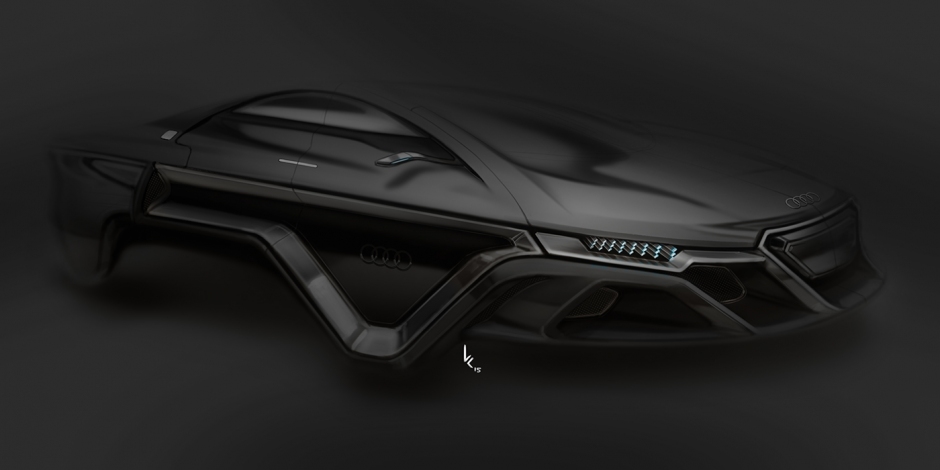
Second, Imperial Security needs to keep its eyes and ears on the populace.  The old idea of a police helicopter might suit us, but given that our cars can already fly, we need to something more useful, and the real purpose of a police helicopter is surveillance: it spotlights targets, it scans the air, it transmits information realtime.  That makes it a high performance, aerial command platform.
Finally, what if the populace riots?  Then we need to deploy our riot troopers, and what better way to do that than a riot suppression tank?  It doesn’t need to be a full combat vehicle, but it can pack riot-suppression gas launchers and pain beams to debilitate and disperse crowds.

Grav Car: the Prowler

Normally, I’d use the Grav jeep as a basis for our vehicles, but it’s all wrong, so I wrote up my own rules for creating grav-cars, which is available to my Patrons!  The executive summary for the rest of you is that grav cars should be hover cars, to facilitate cool chases, and that where possible, we should treat cars as cars, only reskinned and ramped up to represent their sci-fi origin.

So, we have a design system.  What is it that I want to design?  Well, a police car allows police to patrol neighborhoods or highways, to swiftly get to a crime scene, or to chase down fleeing suspects, and to bring suspects back.  Security agents, though, aren’t cops.  They’re enforcers, investigators and troubleshooters.  Still, something that can take our agents to the crime scene, allow them to bring perpetrators back and chase fleeing suspects, and look good while doing it, wouldn’t hurt!

We need:

  • Armored Vehicle and Blasterproof windows: Our agents want to be well secured when investigating crime-scenes.  They’ll also want to jump behind their doors when in a firefight.  We’d expect them to be close to prove against full rifles, so they need to have a DR of about 80.  That turns out to be a bit expensive, and let’s be honest, 60 will do the job for the most part.
  • A faster engine: If they’re going to chase down a fleeing suspect, or they simply want to get somewhere in the nick of time, then they’ll want a top-performing engine.
  • Weapons? The problem with weapons is that the Ministry of Defense is very territorial about combat capabilities.  The Ministry of Justice’s movement towards paramilitary capability is dangerous.  Even so, being able to pop out some non-lethal countermeasures might be nice, and give it a “spy-car” feel!
This is the result:
Vehicle ST/HP Hand/SR Ht Move Lwt Load SM Occ DR Range Cost Loc
Prowler 60 4/3 12 20/200 2 1 +3 1+3S 60 10k $130k G(X)
The Prowler carries 3 weapon mounts, all “hidden.”  The “X” hit location only applies if the weapon mounts have been exposed.  It has two forward-mounted 100 lb mounts, ostensibly for non-lethal weapons (or EMP cannons), but one might use it for actual weapons, and one 10 lb rear-mount, generally armed with a grenade deployer, usually for smoke or riot-gas grenades.  This leaves about 400 lbs of “real” cargo space.  Finally, with all doors and windows shut, the Prowler is sealed, having NBC filters. It uses 2 F-Cells to gain its range.

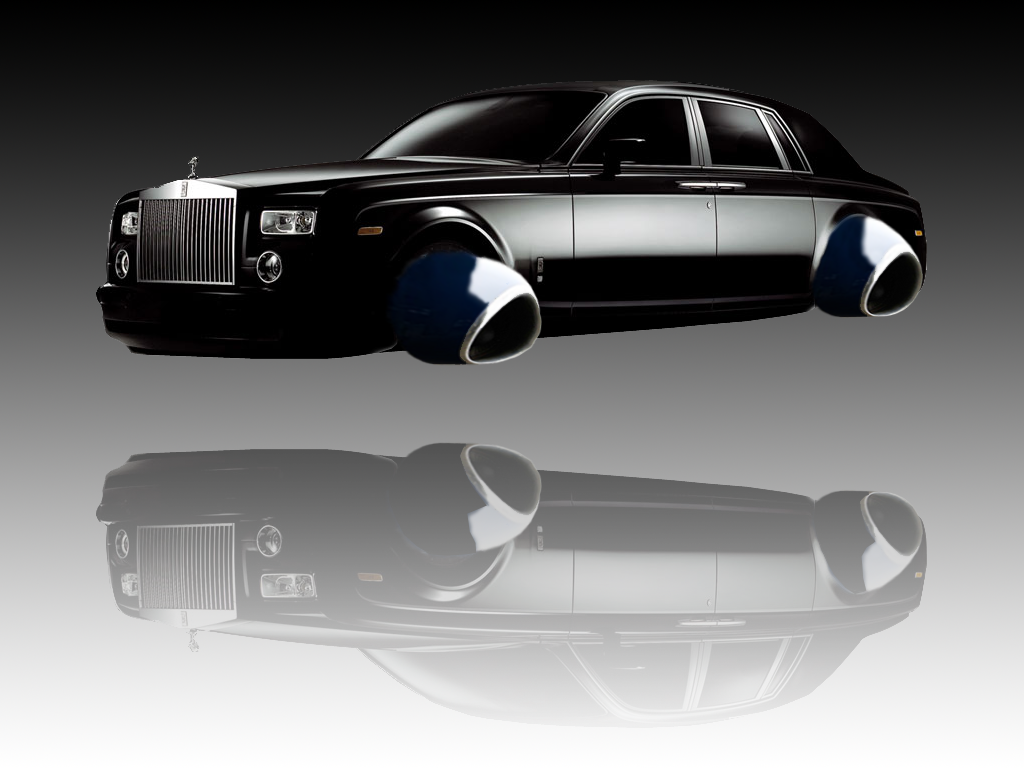
Grav Car: the Warden

Imperial Security does more than just arrest criminals of the Empire.  They also escort and protect the Ministers of the Empire.  Prowlers and Hunters will serve well to protect agents of Imperial Security, but what about the actual ministers themselves?  They’ll want beautiful vehicles appropriate to their vaunted status, but also well-defended vehicles.

  • Armored Vehicle and Blasterproof windows:We want to keep our VIPs safe, so we need solid protection.  This time, we definitely want a DR of 80.
  • A faster engine: The primary importance of a fast engine is a quick get-away.  This is probably less important than the armor.  If a vehicle is under attack, the driver should radio in. regarding his circumstances and back-up should rush to the scene.
  • Beautiful! VIPs will demand exellence!  The result must be a vehicle that brims with spaciousness and luxury, worth at least a +1 reaction modifier, both inside and out!

The result is a hover-sedan, better armored the prowler, and quick (at least for a Sedan).  It has the same range on teh same number of cells (It’s running the same “Mark 2” engine), but it’s more massive armor and clunkier streamlining slows both its acceleration and its top speed.  It lacks any weapons that a Prowler might have.

Vehicle ST/HP Hand/SR Ht Move Lwt Load SM Occ DR Range Cost Loc
Warden 65 3/3 12 30/180 2.2 1 +3 1+4S 80 10k $160k G

Grav Bike: the Hunter

Not every security agent needs a full Prowler.  Often a simple patrol vehicle like the Hunter will do.  The Hunter is a grav bike with superior (astonishing!) speed and an armored shell, equivalent to a Prowler, though the benefits of an armored bike are questionable, as it does nothing to protect the rider.  It also contains a weapon mount for up to 70 lbs of weapon, though this is usually left empty, due to legal hassles.

Vehicle ST/HP Hand/SR Ht Move Lwt Load SM Occ DR Range Cost Loc
Hunter 25 +4/2 12 30/300 0.35 0.2 0 1+1 60 12k $12,500 E

Sky Recon: The Sentinel

Slowly, surveillance drones replace police helicopters, but both serve the same essential need: To provide high-powered eyes in the sky.  In essence, this amounts to high-powered sensor equipment that can sweep the area, highlighting targets for security agents.

This, unlike the previous vehicles, would absolutely be a contragravity vehicle, and its aerial nature would allow it to move at very high speeds.  We could treat it as a low IQ robot (a drone), but for this instance, I want a full “totally not a helicopter”

The key features of this vehicle aren’t found in Vehicles, but in Ultra-Tech.

  • Eye in the Sky: The Sentinel needs to be able to locate enemies and spot them for the rest of the Imperial Security forces in the area. That means a searchlight (UT 74), an IR sensor array (256x magnification; UT 61), and a Medium Ultrascanner (UT 66).  We need a comm system and a computer, but the comm system weight and price are a rounding error in this vehicle!
  • Armor: The Sentinel should be at least as tough as the Prowler or perhaps even the Warden.
  • Speed: The Sentinel needs to be fast, but it’s fine if it’s about as fast as a Prowler: It’s main objective is being high up.
  • Transportation: If we’re going to have a air transport, we might as well put some extra people in it.  In addition to the pilot and the scanner, let’s add space for a squad of up to 5 security troopers.
The final version has all the noted elements above, plus an additional weapon mount hidden in its nose, that can carry up to 100 lbs of beam cannon.

Vehicle ST/HP Hand/SR Ht Move Lwt Load SM Occ DR Range Cost Loc
Sentinel 75 +2/4 12 20/200 3 1 +4 2+5S 80 10k $400k G(X)

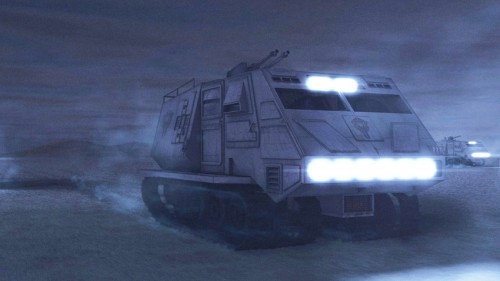
The Security Tank: the Vanguard

Imperial Security, by law, may not deploy full military gear.  However, it certainly can argue for the need for heavy vehicles.  First, it needs to transport dangerous prisoners who may well have well-armed compatriots who’ll try to free them; second, they’ll need to transport their own squads of soldiers into heavily contested areas under marshal law (such as into the midst of a major gang war); finally, they need the ability to put down riots.
Enter the Vanguard.  This heavy vehicle doubles as an armored transport and a light attack tank.  Like the previous vehicles, it uses repulsor lifts to move around (I like to picture crackles of energy coming from its contact nodes, arcing against the ground).  It needs to fulfill a few roles:
  • Armor: It needs to be able to stop small missiles from destroying it.  DR 200 is sufficient to stop a heavy blaster, DR 300 (laminate!) will stop a 25mm HEMP round, and DR 500 is necessary to stop a 40mm round. Heavier is possible, but then we push into genuine “tank” territory, and the Imperial Navy begins to scowl at us.
  • Armaments: We need two kinds of weapons. First, we need some sort of riot-gas deployment system, thus some mounted grenade launchers.  Second, we need some sort of anti-riot weapon, like a neural beam, or just a stunner mounted on a turret.
  • Transport Capacity: If we want to send a full squad, we need up to 10 people in the back of the vehicle.
Vehicle ST/HP Hand/SR Ht Move Lwt Load SM Occ DR Range Cost Loc
Sentinel 100 +1/5 12 5/125 8 3 +4 2+10S 500/300 5k $1,000,000 t
The sentinel has an independent turret that can carry up to 125 lbs of gun, and 2 25mm launchers that can fire up to 32 rounds per second (and has a total of 32 rounds).  It’s fully armored, including protected visors and sensors allowing the driving crew to see,  It’s crewed by two people, a gunner/commander and a driver.  It has room in the back for 10 passengers, with attachment points in case they’re prisoners who need to be bound, or for response teams, so they have some sort of place to hang their gear.

Alien Warriors

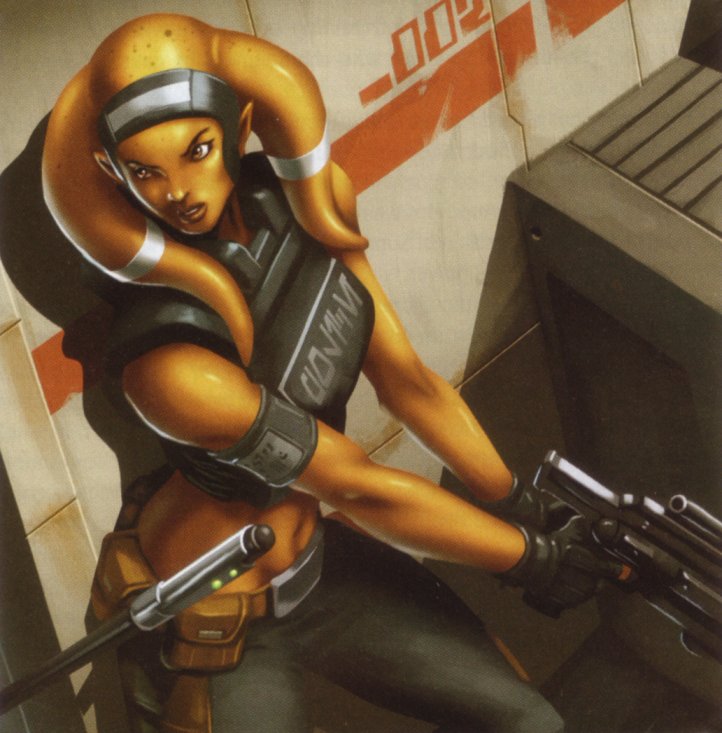
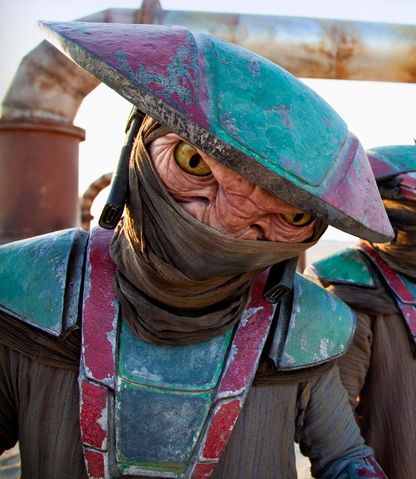
Setting Psi-Wars in space gives us the opportunity to explore more than just Action elements; we can also explore the typical tropes of sci-fi, and that means aliens! But what sort of aliens? Well, Star Wars doesn’t really support the in-depth exploration of alien races that, say, Star Trek does (for example, the Twi’lek race wasn’t even named until West End Games released their RPG). Star Wars follows the space opera conventions of taking a generic pulp story (say, a wild west story) and changing the window dressing to fit the genre. So, instead of Cowboys and Indians, we have a story featuring Colonists and Alien Warriors.

The term “savage” or “barbarian” or even the euphemistic “native” are, in reality, racist and dehumanizing terms. Our ancestors comforted themselves with the fiction that the people over the hill weren’t really people, but a sort of monster. “Indians” were wild, whooping monsters; “Huns” were the devil’s footsoldiers, Gog and Magog; those Scythians don’t even speak Greek, so they don’t count as real people, etc. At the same time, as cultures began to blend, the “we” began to admire the “them” and we get stories of the noble savage. This sort of story features strongly in most pulp serials; think of Tonto and the Lone Ranger, or Robinson Crusoe and Friday or, for a more modern example, Mani from Brotherhood of the Wolf. To continue to treat humans like this is highly questionable, but the resilience of these tropes, as well as how they cross cultures (The “savages” considered “civilized” people just as savage, though usually debauched and weak) speaks to their power as tropes.

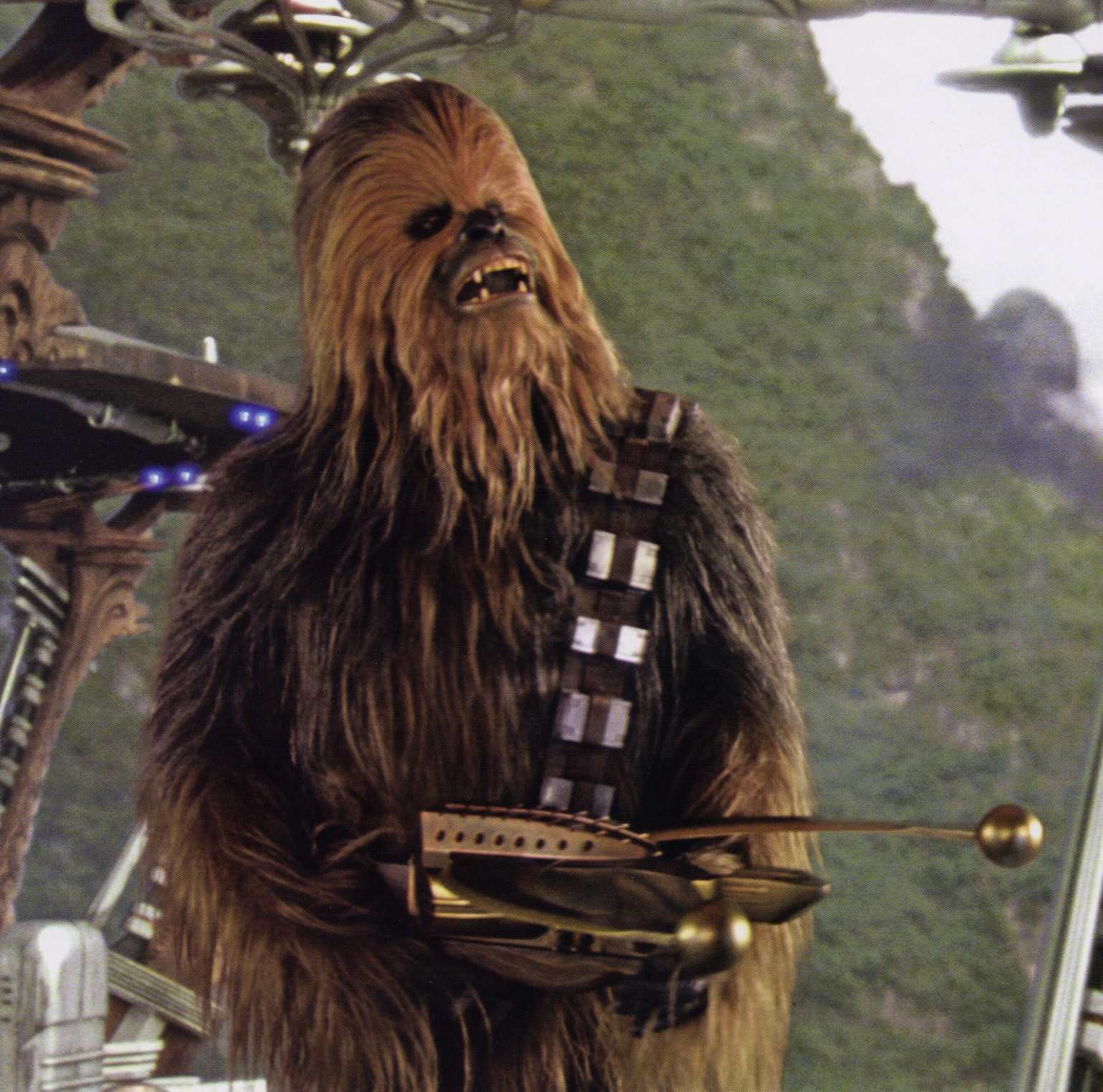
So, Star Wars definitely invokes the idea of the alien savage and neatly sidesteps the dehumanizing nature of the tropes by pointing out that aliens are inhuman. Chewbacca, with his reliance on strength and his “primitive” crossbow becomes Han Solo’s Friday. The ferocity, cleverness and durability of cultures like the Bedouin and the Apache inspired the Tusken Raiders (and the Fremen, from whom the Tusken Raiders are also clearly inspired). Even the Ewoks, somewhat weirdly, were inspired by the Viet Cong: George Lucas envisioned Star Wars as ultimately a protest of the Vietnam War, and he defended the imagery of the primitive Ewoks defeating the technological empire as inspired by the Viet Cong defeating the technologically superior Americans.

So what I’d like to do here is also to invoke the fear and respect people have for more primalcultures, at least as they tend to be portrayed in stories. I’m not looking to specifically invoke cultures so much as stories cultures tell about their boogie-men: the dangerous mountain men, the ferocious jungle warriors, spooky witches and wild berserkers. But I also want to invoke the respect these cultures earned from their “civilized” enemies after sustained contact and combat. I also want to point out that while their technology might be different, even inferior, they do not lack for sophistication. They might be wild and dangerous, but ultimately, you can sympathize with them, perhaps even join them, as might be the case of a Frontier Marshal or a Commando, joining forces with alien warriors to defeat the technological juggernaut of the empire.

Realistically, these “alien warriors” should have racial templates. They should be scaled lizard people, or beautiful and exotic blue-skinned space-elves, or adorably large-eyed fish-people with crazy spears. But in this pass, I want to keep things generic. And, of course, these sorts of stories were originally told about humans, so a generic human template should work.

The Concept of Alien Warriors

We could do nearly anything with our aliens and, realistically, we should approach each one independently. The jungle aliens of Scylla IV should fight in a completely different way than the mountain aliens of the Forge. So creating a “generic” set of Alien Warriors is an academic exercise at best, but I’m okay with that. By exploring the sorts of tactics aliens might have, I can get an idea of what sorts of tactics all aliens might use.

Even so, I need to pick a single point of inspiration to create a working force out of. For my core inspiration, I choose the Apache, not because I feel they are more “savage” than any other people, but their particular tactics and approach to guerilla warfare with inferior weapons against a superior foe neatly fits into how I’d like to see my Alien Warriors fight. They fought and resisted a modern Western force (the Americans and the Mexican) right up until 1924! They certainly used “primitive” weapons like bows and arrows, but they mastered relatively modern weapons, like metal-headed tomahawks (contrast with the sabers the American cavalry men would use), metal knives and rifles. They also fought by using the land and their mastery of it. They knew where to hide and how, how to stay mobile no matter what, and how to survive, even thrive, in climates where the US soldiers couldn’t easily get to them. They were a classic “shatterzone” people, and if they continued to fight to this day, they’d probably fight a lot like the Taliban: losing themselves in mountains and defeating their enemy with precision sniper fire and anti-air missiles.

Our “alien warriors” should also be masters of their planet, able to fight exceedingly effectively even with less sophisticated weaponry, against technologically superior opponents, like the Empire. They do so with primal ferocity, stealth and closeness to the land, strategic cleverness and supernatural power. This last definitely departs from the real world, as (as far as we know) the Apache were never able to call down the wrath of the Divine on anyone, but in Psi-Wars, “hokey religions and old superstitions” are a very real force.

Our basic combatant should be the warrior. The warrior arms himself with a simple, old-school rifle and a basic melee weapon, making himself fairly effective at either melee or range. He should know how to vanish into his preferred terrain (mountain or desert, in this case), and how to outlast his opponents in such an environment. He’s the weakest link in an already stressed chain, which means he needs to be very competent and flexible.

Our specialists need to master stealth, ferocity, speed and the supernatural. For stealth, we’ll have Scouts, which resemble warriors but with even greater mastery of ranged weapons and the ability to simply vanish. For ferocity, we’ll draw from another primal tradition and include the Berserker, someone ferociously strong, armed with a melee weapon, and able to unleash pretty terrible devastation on their opponents; For speed, we’ll get into cavalry. We’ve already touched on it with the Mounted Security Agent, but the same basic principles apply here: the alien warrior needs a deep connection with his mount, a mount that is native to his environment, and uses it to out maneuver his opponents. Finally, we need some kind of shaman, some psionic character with the ability to draw down Communion. While such a character wouldn’t typically be a mook, I think he’s worth discussing in this context, as I can envision even mook-level Shamans whipping their allies into a frenzy, or protecting them from supernatural attack.

Tactical Theory

Warriors should fight a lot like guerrillas. When attacked, they should fade and flow. Their more vulnerable people should be able to pick up and leave (suggesting a nomadic lifestyle), and the warriors should be able to take up defensive positions, ideally as snipers, while scouts and berserkers vanish to await the close approach of the enemy and then spring on them in dread ambush, ideally with with cavalry at the ready to rush in and finish off the enemy. When on the offensive, warriors will act more like raiders. Their cavalry will sweep in and get what they need and go. If they need more, they’ll creep close, ready themselves for ambush, and then unleash themselves when the cavalry descends on the enemy.

In all cases, their tactics resemble those of a high-precision military, but with sniper fire taking the place of suppression fire. Warriors and Scouts will take out key targets and terrify everyone, which forces people to take cover, which allows the berserkers and cavalry to sweep in close and finish everyone else. This creates tension between taking cover and exposing yourself to open fire on the enemy, but it relies on stealth and area knowledge to work.

The Shaman’s role is to provide supernatural benefits that fill in the gaps. His visions, or weather manipulation, or blessings of luck or whatever, benefit the warriors as long as he’s alive an unopposed, adding a supernatural dimension to the conflict.

Skill Level Theory

Warriors represent the meeting of two extremes. Obviously, their technology must be lacking compared to more up-to-date groups, otherwise we’d treat them as something else (criminals, perhaps, or pirates). But an inferior group with inferior technology isn’t an interesting encounter, but a slaughter. That can be okay, but I want to embrace the noble savage idea here, and really dig into what made the Apache and the Bedouin and their like so terrifying: they were effective. This ties into the Fremen and Dune’s idea that some worlds make men hard. Our warriors are those hard men, people who have faced the terrifying trials of a dangerous world, and come out strong and lethal.

Thus, I propose Skill 15 as the baseline. Warriors and Riders are “high risk professionals” just by virtue of being survivors of their dangerous world! The true elites, like the Berserkers and the Scouts represent some of the best experience one can get from the universe, and enjoy Skill 18. This will make them a very unique challenge for the players, who will almost certainly out-tech them, but will find themselves struggling against their ninja-like skill levels. It also makes them an interesting experiment in the validity of “skill 18 mooks.”

Shamans represent a unique case. In principle, they should be fairly skilled at what they do, but what they do is also fairly unique. Furthermore, their mastery of the “occult” should pale before those who have studied sophisticated versions of this. That is, the Shaman is better than the Empire when it comes to Communion, because the average Imperial trooper is not supported by Psions, but they’re not as competent as a unit of crack Psi-Knights. I’ll give them Communion 9 and skill 12.
All Alien Warriors will feature Sure Footed (representing their skill in specific terrains) and Penetrating Cry (their memorable and distinctive warcry), Night Vision 2 and Higher Purpose (Defend my Homeworld). They also have Confusion (Technological) which represents their general inability to use technology they don’t already know.

Technological Detail

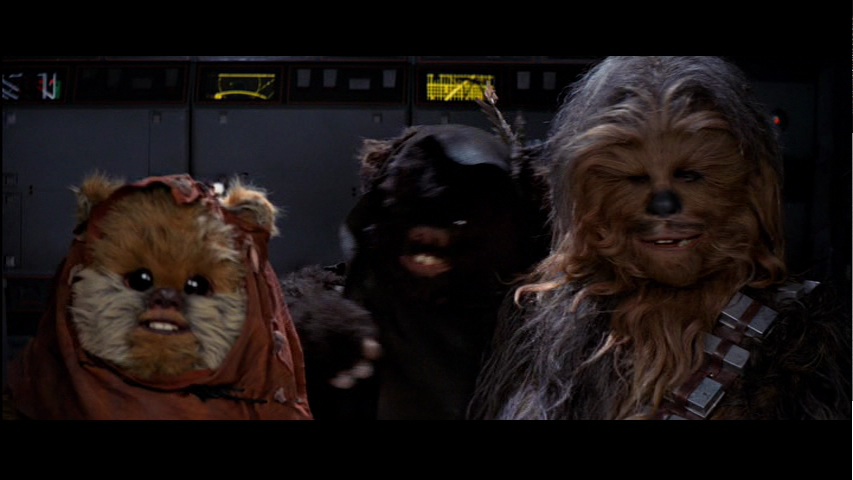
Yub yub!

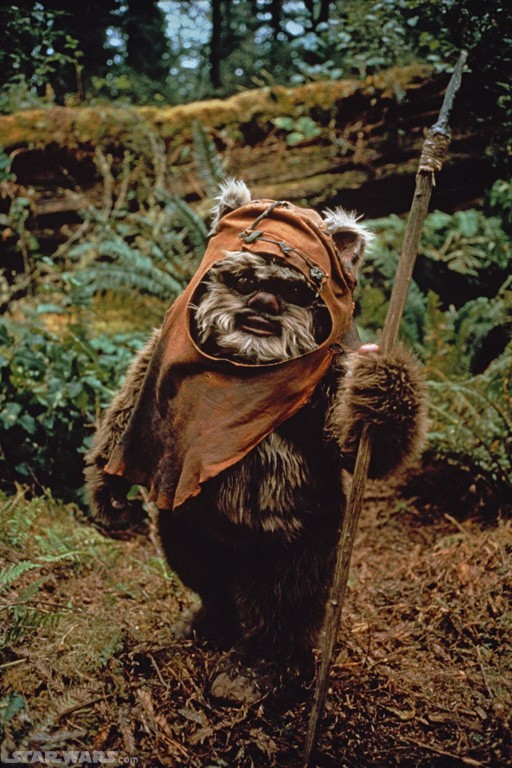
The primary defining feature of warriors is their lackof technology. Like criminals and pirates, Warriors lack the money to really fully outfit their armies. Furthermore, they lack the technological know-how, so we expect them to have primitive weapons. However, I don’t want to go full-Ewok and give them stone axes and spears because I happen to think the imagery of arrow-wielding teddy-bears defeating the armored might of the Empire is a silly image. But I happen to think that Tusken Raiders with less sophisticated blaster rifles and a penchant for disappearing in the mountains are a real risk.

Note that Alien Warriors typically lack the supporting technologies other forces enjoy. This doesn’t have to be so, but this particular version lacks communicators (they use Gesture instead) or IR visors (they use their natural Night Vision instead).

Melee Weapons

Before we go much further, we should touch on hand-to-hand, as that’s going to be one of the signatures of the warrior. Traditionally, warriors wielded spears, because spears are fantastic weapons. However, you can’t really have “vibro-spears” as effective weapons. The sword is a fine weapon, but does not say “savage” as well as other weapons. It says “civilized and elegant,” especially when you consider the lack of utility a sword has outside of warfare (and, let’s be honest, even in warfare). The force sword in particular is the epitome of elegance and sophistication, with the opposite note that we want to strike with our warriors.

That leaves us with the knife, the shortsword and the glaive, all of which can be vibro-weapons. The knife is a no-brainer, especially for stealthy incursions. The glaive is probably too large a weapon, one that requires formations. That’s not to say that we can’t have alien halberdiers, but that’s not what I want here. So, I suggest replacing the shortsword and the glaive with a vibro-axe. That’s smaller than a glaive, larger than a knife, maximizes cutting damage which makes the most out of being a vibro-weapon (and in sufficiently strong hands, can cut through the weaker parts of a heavy hardsuit!), and fits the vibe of the tomahawk or the viking war ax.

Blasters

As I said before, I don’t want to do our wariors without them. The intellectual exercise of a space-bow is an interesting one, but even Chewbacca fires blaster bolts out of his crossbow, so we’re going to follow suit.

Back when I designed the Rebel soldiers, I included “old rifles,” and I think those would be perfect here. We don’t need to do any additional work other than to include those as our preferred weapons.

Armor and Shields

Neither Apache nor Bedouin wore much in the way of armor. It slowed them down too much, was too heavy in the hot, desert sun, and offered little protection against bullets. Furthermore, armor requires a serious investment in infrastructure to make. Native Americans did sometimes carry shields, but those were meant to stop arrows or melee weapons, not bullets. For this version, I suggest no armor at all. If we need something, I’d go with something like a less sophisticated version of Battleweave… bioplas would fit nicely, especially a practical bioplas smartsuit, as bioplas is “organic” enough to be grown rather than built, and a smartsuit would be eminently practical for a people focused on survival. In fact, the Fremen wore Desert Survival Suits, which would suit us nicely (arguably, so do the Tusken Raiders). But such a suit will do very little to practically stop blaster fire, so it’s a wash.

The Supernatural

Mastery of Communion is, itself, a form of technology. Our shamans should be psionic to make it work, and they probably are, but that’s more detail than I want. A simpler way would be to simply have the Shaman roll for Communion and gain access to a miracle. We can specify any, if it comes to that, but I’ll have a few suggestions.

I expect most Warriors will carry talismans and trinkets, but I think that will fall beneath the scope of rules. However, you might consider granting the Alien Warriors, as a group, a Destiny of 1 to 3, representing the power their talismans give them to survive. Note that this might make them exceedingly effective (as though they weren’t that already).

Alien Warriors

All the following minions have been created in such a way that they’ll fit on two sides of an A6, so you should be able to print 4 per page. I have greatly reduced their complexity even further, so that most characters are virtually identical. Note that the listed tactics aren’t the only moves possible, just a helper for some of the more complex actions these characters might undertake.


Alien Warrior

The fundamental of the alien barbarian army, the Alien Warrior can work equally well in melee as at a range. They’ll generally start the battle hidden away, and then either begin to snipe at their opponents, or erupt with terrifying ululations and attack with their vibro axe.
ST 12 HP 12 Speed 6
DX 11 Will 10/12 Move: 6
IQ 10 Per 12
HT 11 FP 11 SM +0
Dodge 10
Parry 11
DR: 0

Old Blaster Rifle (15):
5d+2(5) burn sur (Acc 10, Range 500/1500 RoF 3, Bulk -4)
Vibro-Axe (15): 2d+5(5) cut (Reach 1 Parry 0U, +1 damage if 2-handed)
Skills: Area Knowledge (Homeworld)-15, Gestures-15, Observation-12, Stealth-15, Survival-15, Tracking-15
Traits: Combat Reflexes, Confused (Technological) (12), Fit, Higher Purpose (Defend Homeland), Night Vision 2, Penetrating Voice, Sure Footed (Sand and Uneven)
Notes: Human(oid?); No Encumbrance
Alien Warrior Tactics

Vanish (10):At the beginning of a fight, a psycho will attempt to vanish and get the drop on his opponent. Roll Vanish (ignore modifiers for stealth at the beginning of a fight). Success means he may attack one opponent “from behind.” He may not do this at any other point in the fight.

Fire From Cover (14):Momentarily come up out of cover (Pop-up fire, -2 or -0) and, while shoulder firing, make a sighted All-Out (Determined, +1) attack at the torso of your opponent using full RoF 3, and then return to full cover. You may not defend.
Art of the Axe(13): Move up to 2 yards and make a Committed (+2) Deceptive (-4) Attack with your Vibro-Axe at the target’s torso. Opponent defends at -2. You may not parry or retreat, and you defend at -2.

Warcry (8):If your opponent is unaware of you, make an intimidation attempt with a howling warcry. You may make this attempt again for free after successfully killing a target.

Alien Rider

The Alien Rider is the cavalry arm of the alien barbarian army. The nature of their beasts will vary, and so I haven’t included any details on how they’ll attack, but note that the cavalry assault allows the beast to attack as well. The traditional way is for a slam, which will typically knock someone over who isn’t already dead from a vibro-axe to the head. Typically, the alien riders remain in reserve and attack only when the enemy has walked into a trap, such as a dead-end gulch. When on the offensive, they’ll be the spearhead of the alien force.

ST 12 HP 12 Speed 6
DX 11 Will 10/12 Move: 6
IQ 10 Per 12
HT 11 FP 11 SM +0
Dodge 10
Parry 11
DR: 0

Vibro-Axe (15): 2d+5(5) cut (Reach 1 Parry 0U, +1 damage if 2-handed)
Skills: Area Knowledge (Homeworld)-15, Gestures-15, Intimidation-12, Observation-12, Riding-15, Survival-15, Tracking-15
Traits: Combat Reflexes, Confused (Technological) (12), Fit, Higher Purpose (Defend Homeland), Night Vision 2, Penetrating Voice, Sure Footed (Sand and Uneven)
Notes: Human(oid?); No Encumbrance

Alien Rider Tactics

Cavalry Assault (13):Move at least 7 yards on horseback towards your opponent and make a Committed (+2) Cavalry (-2) attack (-1). Your opponent defends a -1 if not mounted. Deal 2d+6(5) cut. You may not parry, but you may dodge at -2 and your mount may dodge as normal, and may attack. You are at +1 defense against melee attacks from targets on foot.
Cavalry Evasion (-):Ride away from your target making an All-Out Defense (Dodge). Dodge all attacks at 11. Your mount may also defend.

Warcry (8):If your opponent is unaware of you, make an intimidation attempt with a howling warcry. You may make this attempt again for free after successfully killing a target.

Alien Scout

Scouts enjoying their lack of Confusion (Technological)
The Alien Scout is close to the Rebel Guerilla in tactics and effectiveness. They’ll vanish before the battle begins, often covering the battlefield in traps, and then they’ll make their move ideally from behind enemy lines. They’ll either eliminate targets with their vibro-knife or, more likely, sniping at their enemy. Note the scout lacks Confusion (Technological). They can steal enemy arms and equipment and make use of them.
ST 11 HP 11 Speed 6
DX 12 Will 12/14 Move: 6
IQ 12 Per 14
HT 12 FP 12 SM +0
Dodge 10
Parry 13
DR: 0

Old Blaster Rifle (18):
5d+2(5) burn sur (Acc 10, Range 500/1500 RoF 3, Bulk -4)
Vibro-Knife (18): 1d(5) imp or 2d (5) cut (Reach C)
Skills: Area Knowledge (Homeworld)-18, Gestures-15, Observation-15, Stealth-18, Survival-18, Tracking-18, Traps-18
Traits: Combat Reflexes, Fit, Higher Purpose (Defend Homeland), Night Vision 2, Sure Footed (Sand and Uneven)
Notes: Human(oid?); No Encumbrance
Alien Scout Tactics

Vanish (13):At the beginning of a fight, a scout will attempt to vanish and get the drop on his opponent. Roll Vanish (ignore modifiers for stealth at the beginning of a fight). Success means he may attack one opponent “from behind.” He may not do this at any other point in the fight.
Snipe (29):After a single aiming action, make an All-Out Attack (Determined). Successful hit strikes torso. You may not defend.
Remove Sentry (16/11): If the target is unaware of your presence, make a telegraphic grapple for the head (22). You may defend normally. If your target is grappled, make an all-out (Strong) “slicing” attack (thrust cutting) attack with the blade on the target’s neck (13). Opponent dodges at -1 or parries at -2. If you hit, deal 2d+2(5) cut to the neck and double all damage that penetrates DR. You may not defend.
Trap (18): Deployed scouts may have already prepared a variety of traps. Ideas:

Snare: Roll Per-based Traps vs 12. Failure means up to ST 22 target is dangled by one leg.
Covered Pit: Roll Per-based Traps vs 12. Failure means fall 2 yards into pit.
Deadfall: Roll Per-based Traps to detect. Deals 20d cr to 3 yard radius on an 11 or less.

Alien Berserker

The Berserker is a tricky mook to handle. Given their high pain threshold and their berserk nature, consider treating even mooks as henchmen, and henchmen as bosses. What makes them difficult and dangerous is how hard they are to kill. Typically, Berserkers will join warriors in hiding, and then unleash themselves with a terrifying cry. Fear is one of their prime weapons, as when they’ve killed an enemy, they can trigger a free intimidation roll as they walk, blood-soaked, at their enemy,
ST 15 HP 15 Speed 6
DX 12 Will 12/16 Move: 8
IQ 10 Per 10
HT 12 FP 12 SM +0
Dodge 10
Parry 13
DR: 2

Vibro-Axe (18):3d+4(5) cut (Reach 1 Parry 0U, +1 damage if 2-handed)
Skills: Area Knowledge (Homeworld)-18, Gestures-15, Intimidation-15, Stealth-15, Survival-18, Tracking-18
Traits: Berserk (12), Combat Reflexes, Confused (Technological) (12), Very Fit, Fearlessness +2, High Pain Threshold, Higher Purpose (Defend Homeland), Night Vision 2, Penetrating Voice, Sure Footed (Sand and Uneven)
Notes: Human(oid?); DR represents tough skin. No Encumbrance
Alien Berserker Tactics

Vanish (10):At the beginning of a fight, a warrior will attempt to vanish and get the drop on his opponent. Roll Vanish (ignore modifiers for stealth at the beginning of a fight). Success means he may attack one opponent “from behind.” He may not do this at any other point in the fight.
Warcry (11):If your opponent is unaware of you, make an intimidation attempt with a howling warcry. You may make this attempt again for free after successfully killing a target.
Frenzy (14): Make an All-Out (Double) deceptive (-4) attack against one or two targets. Your opponent(s) defend at -2. You may not defend.

Alien Shaman

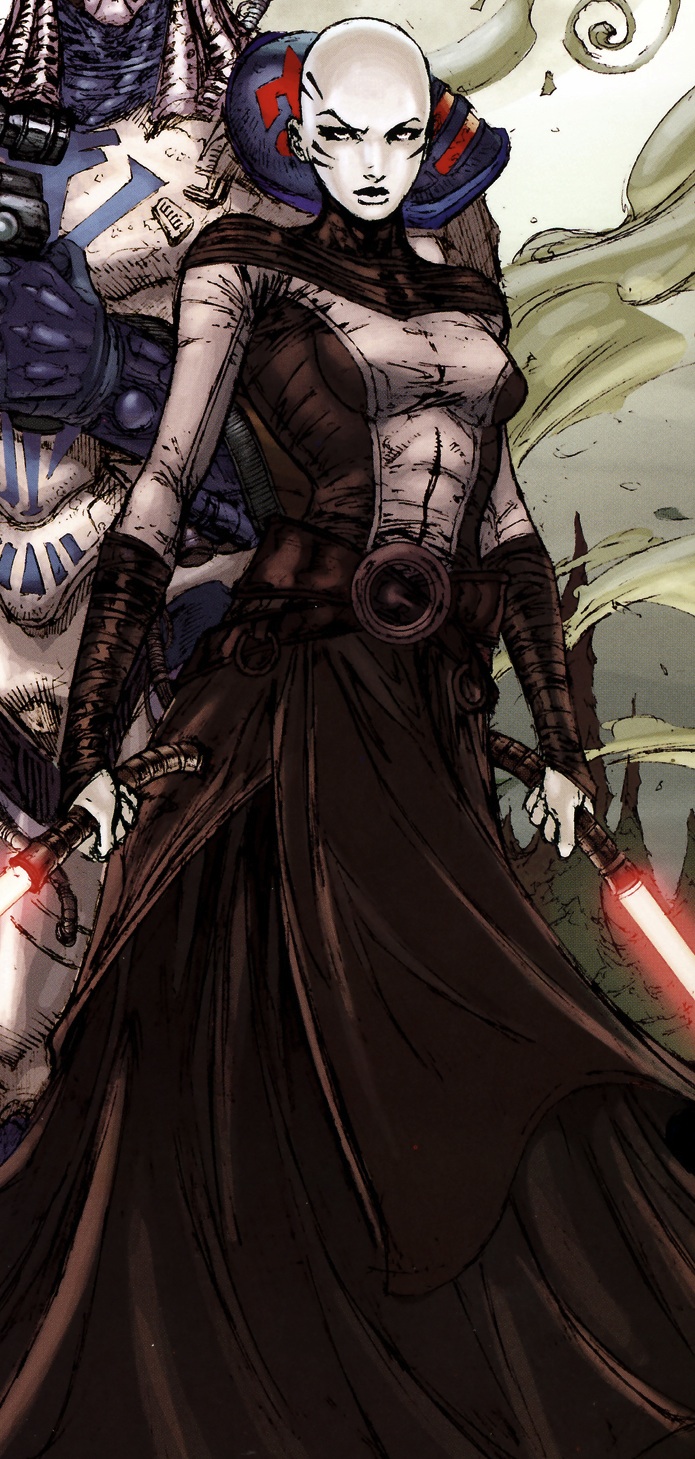
Witch of Dathomir

The Alien Shaman represents the supernatural power of the alien barbarian army: they could as easily be “witches” or “priests” or “oracles.” They act in a sort of leadership-support position, not excelling at combat (though armed), but assisting their allies in defeating the enemy. Typically, they’ll stand somewhere near the back, pray regularly until they can pull down a miracle, or until someone finally puts the shaman down. Despite their relative weakness, removing a shaman should probably be a high priority for a force that wishes to defeat an alien barbarian army.

ST 10 HP 10 Speed 5
DX 10 Will 12/14 Move: 5
IQ 12 Per 12
HT 10 FP 10 SM +0
Dodge 8
Parry 9
DR: 0

Vibro-Knife (12): 1d(5) imp or 2d (5) cut (Reach C)
Skills: Area Knowledge (Homeworld)-15, Gestures-15, Intimidation-12, Stealth-12, Survival-15,
Traits: Communion (9), Confused (Technological) (12), Fearlessness +2, Higher Purpose (Defend Homeland), Night Vision 2, Penetrating Voice, Sure Footed (Sand and Uneven)
Notes: Human(oid?); No Encumbrance
Alien Shaman Tactics

Rally (12): Every (mook) member of the shaman’s squad (up to 10 men) gain +1 to fright checks and may ignore disadvantages harmful to combat for the duration of combat, so long as the Shaman lives.
Strategic Vision (13):If the shaman is granted a vision before the battle, he may roll a contest of Tactics+4 against his opponent. If the Shaan wins a contest of tactics with his opponents, he may grant one free reroll to his squad.
Miracles of Communion (9): After praying for 1d6 seconds, the Shaman may attempt a miracle (apply a cumulative -1 for each additional miracle granted). Suggestions include:

  1. Blessing: Any single character gains two rerolls as though he had luck.
  2. Flesh Wounds: Ignore the first injury inflicted on a single Alien Warrior.
  3. Cursed: A single target suffers Unluckiness until the end of the battle or until the shaman is dead.
  4. Dread Presence: The Shaman forces a Fright Check against any who opposes him.
  5. Dark Storm: The Shaman conjures up weather that allows him to apply +1 or -1 to any rolls in the battle so long as he lives.
  6. Eclipse: The entire battlefield is darkened to -5 vision penalties.

Minions: Pirates

Pirates

The mooks I’ve created so far have obvious relations to the real world. Troopers, criminals and cops all actually exist, and I’ve largely just replaced real world firearms with blasters and real-world armor with ultra-tech armor. If I have one frustration with Star Wars (and thus Psi-Wars), it is this tendency to keep things “like the real world.” If we’re going to play in a sci-fi setting, I’d like to explore sci-fi concepts. Pirates are my first chance to do that, as they don’t really represent anything that actually exists in the real world. Certainly, we have our own, actual pirates, but the pirates of Psi-Wars must necessarily operate in a unique environment: space.

The Concept of Space Pirates

Like criminals, pirates are less focused on defeating their opponents than in acquiring material gain. This could consist of a ship’s cargo, the ship’s personnel (slaves) or the ship itself. Whatever their focus, this necessitates boarding the ship. Pirates can’t afford to simply blow a ship up, though they might demand the surrender of an enemy ship, but even then, one might expect some resistance from the crew on the ship itself. The tactics necessary for the space battle itself isn’t relevant to this article, so much as the tactics of the boarding crew itself.

Pirates might focus on more than just boarding enemy ships. Pirates could double as low-rent mercenaries or the soldiers of an alien warlord. In a sense, they represent “paramilitary” criminals, and survivalist soldiers.

The basic pirate is the raider. Traditionally, pirates were simply sailors who, when close enough, would just mount an attack. I’d expect space pirates to work the same way: the non-essential crew of a pirate vessel would simply arm up with appropriate weapons and join in the boarding parties. Fighting on a spaceship would be close and personal, and we wouldn’t want to excessively damage the ship or your merchandise, so I’m going with vibro-blades and blaster pistols. Pirates might also wear vaccuum suits of some kind, in case things go catastrophically wrong (or, if the pirates are considered expendable by their captain, they might not).

The next is the marauder. A pirate works because most civilians will be poorly armed. A few men with blasters and vibro-blades are dangerous enough if you’re unarmed. If you’re facing well-armed and professional crewman, say some defensive mercenaries. For that, we need even heavier arms and armor, and more destructive intent. For this, I’d go with a combat hardsuit (or perhaps even space armor), and either a plasma shotgun or a plasma gun. It’s explosive, which could rip apart your loot, but a marauder is someone you send in against the hardest of point of opposition. They represent a cross between heavy troopers and assault troopers as depicted by a crazed space-mercenary. In case you need a marauder to act like a typical boarder, we can give them a vibrosword.

Then we’ll need specialists. Broadly speaking, in addition to typical loot (cargo, the starship itself), pirates might want to get at parts or steal robots, or they might want to enslave the crew itself. For the first, we’ll use engineers, characters armed with explosives, emp weapons and engineering skill. These can double as asteroid miners or repair crew. For the latter, we’ll use slavers, characters armed with either neurolash baton or a neurolash whip, for additional flair.

Tactical Theory

Like criminal gangs and security forces, tactics will vary a great deal from criminal gang to gang. Generally, once the ship has been boarded, all pirates will make a bee-line for the command deck, fighting their way through any opposition. Boarders will make up the bulk of the pirates, subduing any minor opposition, such as crewmen or aggressive passengers, either with threats or violence. Rogue Miners will either replace all boarders, in certain crews, or bolster their numbers as low-rent marauders or assist in cutting through secured doors. Marauders, if they’re present, will hammer any serious points of opposition, spearheading the rest of the boarders.

Saboteurs and Slavers exist to add some interesting spice to pirate encounters. Saboteurs will quickly remove any technological advantage a party might have, while slavers will quickly intimidate and defeat any hirelings the party might have, and threaten the crew directly.

Skill Level Theory

Boarders and Engineers are essentially combat amateurs. Like criminal goons, they’re primary threat is that they have weapons and are willing to use them; they’re skill 10. Slavers are necessarily more professional, though low-risk professionals. They’re skill 12. Finally, Marauders might be skill 12, as we wouldn’t expect pirates to have serious military-grade training, but Marauders represent the most dangerous things a pirate can throw at you, and they regularly face high level risks. Thus, I’d make them skill 15.

Technological Detail

In many ways, we’d expect pirates to resemble criminals, albeit with heavier weaponry and vacuum suits.

The Vibro-Blade

Setting aside the obvious space-cutlass imagery, the intent behind equipping pirates with vibro-blades is that they’re cheaper than blaster and less likely to create collateral damage, while more than good enough to cut through most forms of armor, including most battleweave vests and the less well-armored parts of light combat hardsuits. We don’t need to choose any specific or unique form of vibro-blade.

Blasters and Plasma Weapons

The old blaster pistol, designed for criminal goons, works pretty well here too. The pistol, of course, is a superior weapon to a vibro-blade but there’s a chance that it will miss and inflict collateral damage on something, which isn’t to say that they shouldn’t use it, but it becomes a secondary weapon, something to use when you’re sure it’s safe, or when you’re hard pressed.
A plasma weapon might seem to be an even worse weapon for the purposes of collateral damage than a blaster pistol, but it’s a remarkably cheap weapon for the amount of firepower it offers. A variety of plasma weapons could serve well as back-up weapons, and their explosive nature makes them great for blowing doors open.

Specialist Gear

Miners will obviously use demolition charges and plasma torches to do their work. The fusion torch from Ultra-Tech seems good enough (I note that it’s only reach C, but that seems errata, so I’ll include reach 1). To deal with robots and electronics, they’ll deploy EMP grenades. For slavers, the existing neurolash options are perfectly fine.

Armor

We could simply give our pirates vacc suits, but they’ll fail the first time they go into combat. So, instead, we’ll give them a battleweave armored battlesuit. We don’t have actual rules for that, but we can extrapolate out to 30 points of DR, which gives us roughly the same armor as a heavy battleweave vest.

A heavy combat hardsuit makes perfect sense for our mauraders and engineers, but we wouldn’t expect them to be as advanced or capable as those of Imperial Troopers. However, Imperial Troopers have heavy hardsuit armor with the advanced option, making it twice as expensive and 2/3 the weight. If we reverse engineer that, we can get “less advanced” armor that costs $5,000 and weighs 45 lbs for the same protection.

In all cases the armor and vacuum suits comes equipped with a communication device, but the helments do notfeature HUD or Infra-Red: they’re simple space helmets. Most pirates also carry lighting devices and electronic cuffs (to take prisoners with).

Pirates

All the following minions have been created in such a way that they’ll fit on two sides of an A6, so you should be able to print 4 per page. I have greatly reduced their complexity even further, so that most characters are virtually identical. Note that the listed tactics aren’t the only moves possible, just a helper for some of the more complex actions these characters might undertake.

Pirate Raider

The Pirate Raider is your basic combatant. They’ll tend to favor threatening with the vibro-blade over firing with their pistols unless that becomes strictly necessary. As usual, the tactics listed below are only optional.
ST 11 HP 11 Speed 5
DX 10 Will 10/12 Move: 5 (4)
IQ 10 Per 10
HT 10 FP 10 SM +0
Dodge 8 (7)
Parry 8
DR: 30

Old Blaster Pistol (10):
3d(5) burn sur (Acc 5, Range 150/450 RoF 3, Bulk -2)
Hotshot Plasma Pistol (10): 10d (2) burn ex (RoF 3, Range 400/1200, Rcl 2 Bulk -2, Malf 14)
Vibro-Blade (10): 2d+3(5) cut (Reach 1 Parry 0)
Skills: Spacer-10, Vacc Suit-10
Traits: Fearlessness +2, Off-Hand Weapon Training (Pistol).
Notes: Human; Helmet provides vacuum seal, filtered air, hearing protection (+5 to resist hearing damage) and -4 to sighted attacks. They also feature 100-mile communication devices. Carry 25 yard light source and neurolash cuffs. Lightly Encumbered.
Raider Tactics

Combat Assault (8): While holding the pistol in one hand, make a Move and Attack. Move up to your full movement and roll Close-Quarter Battle-2 (or -0), using full RoF 3. Successful hits strike a random hit location and deal deal 3d(5) burn. You may dodge, but you may not retreat or drop.
Burn Cover (15):Make a sighted All-Out Attack (Determined) (+1) for the top of someone’s cover (+4 for targeting a point). Success means the character is not directly hit, but is caught in the explosive radius. Apply damage without an armor divisor.
Vibro-Slaughter (14): Move up to 2 yards. Make an All-Out Attack (Determined) with Vibro-Sword against opponent’s torso. Opponent defends normally. You may not defend.

Pirate Engineer

The Pirate Engineer understands how ships work and will provide that knowledge to his allies. He exists to force doors open, to slap mines on opponents or doors, or to toss EMP grenades at robots. Most of these aren’t listed in the tactics below because tossing a grenade requires no special rules that aren’t already listed below.
ST 12 HP 12 Speed 5
DX 10 Will 11 Move: 5 (2)
IQ 11 Per 11
HT 10 FP 10 SM +0
Dodge 8 (4)
Parry 8
DR: 100/60

Fusion Torch (10):
8d+2(5) burn(Reach C, 1, Parry no)
EMP Grenade (10): HT-8(5) (8 yard radius,
range 35 yards, +4 if you aim for the ground, 1 turn to ready, 2 seconds to blow)
HEMP Limpet Mine (10): 6dx8(10) cr inc + 8d cr ex [3d] (Reach C; Requires 3 ready actions to prep; After placed, required a ready action to send a command to blow mine)
Skills: Engineer (Spaceship)-10, Explosives (Demolition)-12, Forced Entry-12, Spacer-12, Vacc Suit-12
Traits: None.
Notes: Human; Helmet provides vacuum seal, filtered air, hearing protection (+5 to resist hearing damage) and -4 to sighted attacks. They also feature 100-mile communication devices. Carry 25 yard light source and neurolash cuffs. Heavily Encumbered.
Engineer Tactics

Fusion-Slaughter (14):Move up to 1 yard. Make an All-Out Attack (Determined) with Fusion Torch against opponent’s torso. Opponent defends normally. You may not defend.

Pirate Slaver

The Pirate Slaver, like the Raider, will focus on melee over ranged as melee is safer, especially when your preferred cargo, people, are so fragile. Remember, Mooks can just use standard attacks; the tactics below represent exceptional moves, options if you want to make them more dangerous. The Neurolash Entanglement is especially effective and frightening! Slavers will also make use of their Intimidation skill (add +1 for Callous!)
ST 11 HP 11 Speed 5.25
DX 10 Will 10/12 Move: 5 (4)
IQ 10 Per 10
HT 11 FP 11 SM +0
Dodge 8 (7)
Parry 8
DR: 30

Old Blaster Pistol (12):
3d(5) burn sur (Acc 5, Range 150/450 RoF 3, Bulk -2)
Neurolash Baton (12): 1d-1 cr + HT-5 (5) (Reach 1, Parry 0)
Neurolash Whip (12): 1d-2 cr + HT-5 (5) (Reach 1-3, Parry -2U)
Skills: Intimidation-12, Spacer-12, Vacc Suit-12
Traits: Callous, Bully (12), Fearlessness +2, Off-Hand Weapon Training (Pistol).
Notes: Human; Helmet provides vacuum seal, filtered air, hearing protection (+5 to resist hearing damage) and -4 to sighted attacks. They also feature 100-mile communication devices. Carry 25 yard light source and neurolash cuffs. Lightly Encumbered.
Slaver Tactics

Combat Assault (10): While holding the pistol in one hand, make a Move and Attack. Move up to your full movement and roll Close-Quarter Battle-2 (or -0), using full RoF 3. Successful hits strike a random hit location and deal deal 3d(5) burn. You may dodge, but you may not retreat or drop.

Neurolash Brutality (13):Move up to 2 yards and make an All-Out (Determined, +4) attack for your opponent’s vitals (-3). Your opponent defends normally. If you hit, inflict 1d-3 cr damage and HT-10(5) neurolash affliction. Any damage that inflicts shock requires a roll for stunning. You may not defend.

Neurolash Entanglement (14):Move up to 2 yards and make a Committed (+2) Entangle (-4) attack at the torso. If you hit, inflict HT-5(5) neurolash affliction. You may use a Ready on subsequent turns to maintain the grapple with a quick contest of 11 vs their ST. You may not parry with your whip and you may not retreat, but you may dodge at -2.

Pirate Marauder

These are the strike force of your pirates, the elite of the elite. They’ll unleash a devastating amount of firepower and threaten everything, but that’s precisely what makes them so terrifying. Consider having them offer threats before making good on them with a devastating blast of firepower.
ST 15 HP 15 Speed 5.5
DX 10 Will 10/12 Move: 5 (3)
IQ 10 Per 10
HT 12 FP 12 SM +0
Dodge 9 (7)
Parry 11
DR: 100/60

Plasma Shotgun (15): 10d(2) burn sur (Acc 8, Range 350/1000, RoF 3, bulk -3)
Vibro-Blade (15): 3d+3(5) cut (Reach 1 Parry 0)
Skills: Intimidation-12, Spacer-12, Vacc Suit-15
Traits: Bloodlust (12), Combat Reflexes
Notes: Human; Helmet provides vacuum seal, filtered air, hearing protection (+5 to resist hearing damage) and -4 to sighted attacks. They also feature 100-mile communication devices. Carry 25 yard light source and neurolash cuffs. Medium Encumbrance.
Marauder Tactics

Plasma Avalanche (12): When firing a semi-automatic explosive weapon with an enormous store of ammunition, accuracy isn’t so important! While firing a plasma shotgun from the shoulder, make a Fast-Firing (-4) hipshot for a total RoF of 6 (+1). Your recoil is 3! You may spread your fire, and roll for scatter if you miss; Gain +2 to fast-draw and cascading waits. You may not defend.
Burn Cover (19):Make a Hip-fired shotfor the top of someone’s cover (+4 for targeting a point). Success means the character is not directly hit, but is caught in the explosive radius. Apply damage without an armor divisor. Gain +2 to fast-draw and Cascating waits.You may defend normally.

Vibro-Slaughter (15):Move up to 2 yards. Make an All-Out Attack (Strong) with Vibro-Sword against opponent’s torso. Deal 3d+6(5) cut damage. Opponent defends normally. You may not defend.

Minions: Security Agents

Security Agents

If we’re going to have criminal thugs, and we’re going to feature characters like Smugglers and Con-Artists, we should feature law enforcement as well. After all, what is it that the smuggler is slipping past, and who are the criminals on the run from other than the police?

 Star Wars is surprisingly mum on the topic. Wookiepedia has a terse couple of articles that say little more than what a law enforcement officer does and offers few examples. In the films themselves, we occasionally see storm troopers acting in a capacity similar to law enforcement, usually responding to crises and questioning random passerbys about droids. Even the Bounty Hunters of Star Wars are closer to paid hitmen than they really resemble people who collect fugitives from law enforcement.
So, in Psi-Wars, we’ll be charting our own course, borrowing from generic sci-fi works that seem to fit, and doing what space opera generally does, which is take the modern world and truss it up with sci-fi gadgetry.

The Concept of Security Agents

A Security Agent keeps the peace. They are well-trained, disciplined agents who act to settle disputes, watch their community for danger, and move against that danger when it is found. Combat is not their primary purpose, they all have combat training, and some security agents have paramilitary training, verging on full soldiers themselves.

The non-combat aspects of being a security agent fall outside the scope of this document. The intent here is to create the combat threat that those who oppose security agents might face. A con-artist is more worried about some investigator uncovering his crime than he is about the lethality of the security agent down the street, but in this document, we’re onlyworried about the latter.

Constable Zuvio

Most security agents serve a local jurisdiction. They patrol neighborhoods, loiter threateningly outside of banks and space ports, flag down speeders that fly too fast through pedestrian areas, and enjoy the sci-fi equivalent of donuts. Local agents have considerable variety to them. Just as real-life police offers might wield pistol and shotgun from a car, or revolver and truncheon from a horse, we’d expect local agents to adapt to their local environment. I’d like to see if I can hit three variations: the “traditional” beat-cop, the mounted (on speeder or horse) agent, and the lightly armed or “ceremonial” agent, similar to the British bobby or the feudal Japanese police forces.

Paramilitary security agents represent what we most often seen in films: police in full armor and bristling in weapons, marching down on protestors or kicking in doors to blow away terrorists. These are they whom the other security agents call when things turn south. These represent the more present threat to the average hero, and thus are substantially more skilled.

Finally, we could envision ceremonial security agents, the so-called “royal guard” who stand watch over VIPs. Their role would be as much about impressing others, projecting the power of their client, as it would be about protecting their client.

Tactical Theory

As mentioned before, the average security agent represents the face of the security force: locals who regularly walk around an interact with the populace. They’re the “first responder” to various issues, and the danger they face varies all the way from getting cats out of trees up to fighting off armed and dangerous criminal gangs.  We expect them to be competently trained, approximately on par with basic soldiers.  Where security agents tend to differ a lot is in their terrain and culture.

In an urban environment, the standard security agent is the first to respond to a problem, usually your most numerous opponent, and often your only opponent.  An elite security agent might head up a squad of agents.  If the situation escalates, urban security agents will usually have at least one elite agent on hand, at least one squad of paramilitary agents, and support from a few security snipers.  If the escalation is a riot, then they’ll go with Riot Control instead of paramilitary agents, but they may still have snipers, just in case.

In a rural environment, mounted security agents make up the bulk of your force and are often your only force.  They might enjoy the support of security snipers, which will look substantially different, but you can use the security sniper stats.  Most rural environments lack the resources for elite security agents, though in particularly rough country they might have elite security agents simply through experience, but you’ll have to modify the template somewhat.

In ceremonial circumstances, ceremonial agents will dominate the scene, with ceremonial guards standing watch over VIPs or deploying to face down particularly tough opponents (they act as the ceremonial equivalent to paramilitary forces in such a case). Ceremonial agents do not deploy Elite Security Agents because they are Elite Security Agents. If the especially long arm of the law is necessary is necessary, they might deploy snipers, who are polite enough to remain out of sight and expose themselves only by opening fire when absolutely necessary.

In all cases, the objective is the peaceful take-down of the suspect.  Security Agents armed with lethal weapons will “cover the suspect” by pointing their weapon at their target, demanding he surrender, and Waiting to see if he acts, firing if he acts aggressively.  The sniper will work in a similar way, aiming for his maximum bonus, and then waiting on a signal from a higher-up before firing.  Ceremonial guards, ceremonial agents and riot control agents use non-lethal weapons, and can afford to take down their suspect first and ask questions later (often literally).

Skill Level Theory

Local Agents should be skill 12. They’re better than unskilled opponents, but they’re not high risk professionals or the cream of the crop. They have what training they need to put down basic criminals. Personally, I think local agents should be handily defeated by soldiers, but that arguably comes down to equipment rather than training.

Paramilitary agents, snipers and ceremonial agents are skill 15. They’re elites with extensive training, the cream of the security crop, and they regularly face high risk situations and need to excel at them.
Ceremonial Guards need to utterly protect their VIP and look good doing it. We could put their skill level nearly anywhere, from a “we’re mostly here for show” 12 to an elite 15, to a masterful 18. I’m going to choose 18 to reflect the real danger posed by going after someone as dangerous as a king or a high priest.

Technological Detail

The technology of most security agents would resemble a toned-down, pistol-oriented version of military armaments: professional, modern, expensive. They would also vary considerably from locale to locale, but I don’t have time to necessarily go into that sort of detail here.

The Blaster Pistol

We already have a slew of interesting blasters, and I don’t think I need to design any new ones. The “old, reliable” blaster represents the old reliable service revolver that many police would have, which might be sufficient for a typical local agent. The standard blaster pistol is likewise enough for the rest of our agents.

Other Blasters

Modern police officers often carry “riot shotguns,” weapons meant to be defensive. The closest equivalent to that would be a plasma weapon, but a burning explosive weapon isn’t very “defensive.” Rather, it’s highly destructive. On the other hand, it will work well for removing cover or blowing open doors, and a shotgun isn’t the safest weapon to use around civilians either.

For our assault agents, the imperial assault blaster would seem to do the job nicely. It’s more expensive than a basic carbine, but it’s small, compact and has a high rate of fire. We can borrow from the Imperial arsenal once again for the police sniper.

Other Weapons

When making a raid, agents will need to drop stun grenades on their opponents. We can use those from our standard Iteration 3 equipment.

Riot troopers will, of course, use the standard neurolash baton.

Finally, our ceremonial bodyguards need some sort of impressive melee weapon. We could use a vibro-glaive, which is impressive enough, but strikes me as “too primitive.” A force glaive is also an option, certainly lethal enough, but it might be overkill, especially if we want to keep people restrained and alive. A neurolash staff fits the bill better for control

Armor

For the average agent, I suggest a battle weave tactical vest without inserts. DR of 30 is enough to really slow a pistol attack down, turning a critical wound into a minor one. For assault agents, we can add the inserts, helmets and a visor, similar to imperial agents. Finally, riot agents use riot shields. Simple enough! Ceremonial Guard would wear a full hardsuit, one elegantly designed, of course.

Support Technology

There’s no reason for security agents to lack communication devices, so all come equipped with one. Paramilitary agents and riot control agents also have face-plated visors, granting then superior vision and accuracy. All security agents, furthermore, come with a light source and electronic cuffs, for taking down suspects.

Security Agents

All the following minions have been created in such a way that they’ll fit on two sides of an A6, so you should be able to print 4 per page. I have greatly reduced their complexity even further, so that most characters are virtually identical. Note that the listed tactics aren’t the only moves possible, just a helper for some of the more complex actions these characters might undertake.

Security Agent

This represents a standard security agent, the typical beat cop armed with pistol and operating in a vehicle. The plasma shotgun is an optional “defensive” weapon, or for breaching doors.
ST 11 HP 11 Speed 5.25
DX 10 Will 10 Move: 5
IQ 10 Per 10
HT 11 FP 11 SM +0
Dodge 8
Parry 8
DR: 30

Blaster Pistol (12):
3d(5) burn sur (Acc 5, Range 300/900 RoF 3, Bulk -2)
Plasma Shotgun (12): 10d(2) burn sur (Acc 8, Range 350/1000, RoF 3, bulk -3)
Skills: Area Knowledge (Neighborhood)-12, Criminology-12, Law (Police)-10, Pilot (Contragravity)-12, Savoir-Faire (Police)-12.
Traits: None
Notes: Human; Armor covers torso only. Carries communication device with 100-yard range, light source with 25 yard range, and a pair of electronic cuffs.
Security Agent Tactics

Cover Suspect (19): After aiming, announce that you have your target in his sights and demand that he give up. Make a Wait (Will fire if targets makes an Attack). If wait triggers, make a double-handed (Braced; +1 accuracy), sighted all-out attack (Determined) for your opponents’ torso. You may defend before your wait triggers, but not after.
Fire from Cover (11):When in cover, move from cover and make a pop-up (-2) all-out determined (+1) sighted shot using a double-handed grip. If you hit roll a random hit location if you hit. Return to cover. You may not defend.
Fire on the Move (10):While holding the pistol in two hands (reduce bulk by 1), make a Move and Attack. Move up to your full movement and attack, using full RoF 3. Successful hits strike a random hit location and deal deal 3d(5) burn. You may dodge, but you may not retreat or drop.

Mounted Security Agent

Mounted security agents primarily represent mounted officers, typically your more “wild west” deputies who serve under a frontier marshal and ride local, alien mounts, hence the older blaster pistol and the reliance on a plasma shotgun. A variation of this could also represent “speeder cops.”
ST 11 HP 11 Speed 5.25
DX 10 Will 10 Move: 5
IQ 10 Per 10
HT 11 FP 11 SM +0
Dodge 8
Parry 8
DR: 30

Old Blaster Pistol (12):
3d(5) burn sur (Acc 5, Range 150/450 RoF 3, Bulk -2)
Plasma Shotgun (12): 10d(2) burn sur (Acc 8, Range 350/1000, RoF 3, bulk -3)
Skills: Area Knowledge (Planetary Region)-12, Criminology-12, Law (Police)-10, Pilot (Contragravity)-12 orRide (Alien Mount)-12, Savoir-Faire (Police)-12, Tracking-12.
Traits: None
Notes: Human; Armor covers torso only. Carries communication device with 100-yard range, light source with 25 yard range, and a pair of electronic cuffs.
Mounted Security Agent

Cover Suspect (19): After aiming, announce that you have your target in his sights and demand that he give up. Make a Wait (Will fire if targets makes an Attack). If wait triggers, make a double-handed (Braced; +1 accuracy), sighted all-out attack (Determined) for your opponents’ torso. You may defend before your wait triggers, but not after.
Fire from Cover (11):When in cover, move from cover and make a pop-up (-2) all-out determined (+1) sighted shot using a double-handed grip. If you hit roll a random hit location if you hit. Return to cover. You may not defend.

Cavalry Charge (9): While your mount moves, make a shoulder-fired sighted all-out Determined (+1) cavalry attack (-4). Roll for a random hit location if you hit. You may not defend (but your mount may!). Setup: You’re on a horse (or the alien equivalent).

Ceremonial Security Agent

The Ceremonial Security Agent might be a lesser palace guard or an agent for a more peaceful civilization. He focuses on subduing his opponent non-lethally, using his martial arts and his neurolash baton. This explains his high-level excellence, as facing down a criminal with your bare hands is much more dangerous than facing him down armed with a blaster.
ST 11 HP 11 Speed 6
DX 12 Will 10 Move: 6
IQ 10 Per 10
HT 11 FP 11 SM +0
Dodge 9
Parry 10
DR: 20

Neurolash Baton (15): 1d+1 cr + linked HT-5 (5) (Reach 1, Parry 0)
Fist (15): 1d cr (Reach C)
Skills: Area Knowledge (Neightborhood)-15, Criminology-15, Law (Police)-12, Savoir-Faire-15.
Traits: None
Notes: Human; Armor covers torso only and can be hidden beneath clothes. Carries communication device with 100-yard range, light source with 25 yard range, and a pair of electronic cuffs. Often dressed in an impressive manner (+1 reaction).
Ceremonial Security Agent Tactics

Contain Threat (13): While in close-combat with an opponent, make a disarming(-2) attempt with Judo. If you succeed, roll a quick contest of 11 vs your opponent’s Retain Weapon skill (+2 if using a two-handed weapon). Success disarms your opponent. Setup: You’re in close combat with an armed opponent.

Take-Down (15): Step into close combat with your opponent and initiate a Judo Sweep using a stiff arm to the upper torso (requiring an empty hand). If you hit, roll 15 vs your opponent’s DX, Acrobatics or best Grappling skill. Success forces opponent prone. You may defend normally. Setup: Both you and your opponent are standing and you’re within one yard.

Deploy Baton (12): Make a defensive attack with your baton at your opponent’s vitals (-3). Your opponent defends normally. If you hit, inflict 1d-3 cr damage and HT-10(5) neurolash affliction. Any damage that inflicts shock requires a roll for stunning. You may defend at +1.

Elite Security Agent

These represent your chief investigators, detectives or the equivalent to “federal” agents. Use them if you want to give your security forces a bit of a boost.
ST 11 HP 11 Speed 6
DX 12 Will 12/14 Move: 6
IQ 12 Per 10
HT 11 FP 11 SM +0
Dodge 10
Parry 11
DR: 30

Blaster Pistol (15):
3d(5) burn sur (Acc 5, Range 300/900 RoF 3, Bulk -2)
Skills: Criminology-15, Fast-Draw-12, Pilot (Contragravity)-15, Savoir-Faire (Police)-15.
Traits: Combat Reflexes
Notes: Human; Armor covers torso only. Carries communication device with 100-yard range, light source with 25 yard range, and a pair of electronic cuffs.
Security Agent Tactics

Cover Suspect (22): After aiming, announce that you have your target in his sights and demand that he give up. Make a Wait (Will fire if targets makes an Attack). If wait triggers, make a double-handed (Braced; +1 accuracy), sighted all-out attack (Determined) for your opponents’ torso. You may defend before your wait triggers, but not after.
Fire from Cover (14):When in cover, move from cover and make a pop-up (-2) all-out determined (+1) sighted shot using a double-handed grip. If you hit roll a random hit location if you hit. Return to cover. You may not defend.
Fire on the Move (13):While holding the pistol in two hands (reduce bulk by 1), make a Move and Attack. Move up to your full movement and attack, using full RoF 3. Successful hits strike a random hit location and deal deal 3d(5) burn. You may dodge, but you may not retreat or drop.

Paramilitary Security Agents

These are the agents the other agents call in when things get dangerous. They excel at breaching tactics and quick take-down of dangerous suspects.
ST 11 HP 11 Speed 6
DX 12 Will 10/12 Move: 6 (5)
IQ 10 Per 10
HT 11 FP 11 SM +0
Ddg 10 (9)
Parry 11
DR: 100/36

Assault Blaster (15):
4d+2(5) burn sur (Acc 3, Range 300/900 RoF 8, Bulk -3, Malf 16)
Stun Grenade (15): HT-8 or stunned (8 yard radius)
Skills: Criminology-12, Fast-Draw-12, Forced Entry-15, Gesture-15, Pilot (Contragravity)-12, Savoir-Faire (Police)-12, Stealth-12
Traits: Combat Reflexes
Notes: Human; DR 100 on the torso, 30 on the skull, 20 on the face. Helmet provides filtered air, IR vision (+2 to vision checks), a HUD and hearing protection (+5 to resist hearing damage) and -4 to sighted attacks. They also feature 100-mile communication devices. Carries set of electronic cuffs. Lightly encumbered.
Paramilitary Security Agent Tactics

Cover Suspect (17): After aiming, announce that you have your target in his sights and demand that he give up. Make a Wait (Will fire if targets makes an Attack). If wait triggers, make a double-handed (Braced; +1 accuracy), sighted (-4 masked) all-out attack (Determined) for your opponents’ torso at ROF 3. You may defend before your wait triggers, but not after.
Fire on the Move (15):While holding the assault blasterin two hands (reduce bulk by 1), make a Move and Attack. Move up to your full movement and attack, using full RoF 8. Successful hits strike a random hit location and deal deal 4d+2(5) burn. You may dodge, but you may not retreat or drop.


Sniper Security Agents

These usually work with Paramilitary agents, but they might also serve with Mounted agents or hidden from sight with ceremonial agents. In all cases, they represent the ultimate “long arm of the law,” able to take out a suspect at hundreds of yards away.
ST 11 HP 11 Speed 6
DX 12 Will 10/12 Move: 6
IQ 10 Per 10
HT 11 FP 11 SM +0
Dodge 10
Parry 11
DR: 30

Blaster Rifle (15): 7(5) burn sur
(Acc 10+3, RoF 3, Range 800/2400, Bulk -5, Malf 16)
Blaster Pistol (15): 3d(5) burn sur
(Acc 5, Range 300/900, RoF 3, Bulk -2)
Skills: Criminology-12, Fast-Draw-15, Forced Entry-15, Gesture-15, Pilot (Contragravity)-12, Savoir-Faire (Police)-12, Stealth-15
Traits: Combat Reflexes
Notes: Human; DR 30 on the torso. Carries communication device with 100-yard range, light source with 25 yard range, and a pair of electronic cuffs.
Sniper Security Agent Tactics

Cover Suspect (24):After three successive aiming actions, make a wait action (will fire if target attacks anyone), which if triggered results in a braced, sighted All-Out Attack (Aimed). Successful hit strikes the skull and deals 7d(5) burn sur. You may not defend.

Riot Control Agent

When crowds get out of control, security agents call in Riot Control. Consider them the more brutal, heavily armored equivalent of the ceremonial security agent, in that they both focus on non-lethal subdual of the populace.
ST 12 HP 12 Speed 5.25
DX 10 Will 10/12 Move: 5 (4)
IQ 10 Per 10
HT 11 FP 11 SM +0
Dodge 8 (9)
Parry 8
DR: 100/36

Neurolash Baton (12): HT-5 (5) (Reach 1, Parry 0)
Blaster Pistol (12): 3d(5) burn sur
(Acc 5, Range 300/900, RoF 3, Bulk -2)
Riot Shield (12): DB +3, DR 60/HP 60
Skills: Criminology-12, Fast-Draw-12, Pilot (Contragravity)-12, Savoir-Faire (Police)-12
Traits: Fearlessness +2, Teamwork (Riot), Shield Wall Training
Notes: Human; DR 100 on the torso, 30 on the skull, 20 on the face. Helmet provides filtered air, IR vision (+2 to vision checks), a HUD and hearing protection (+5 to resist hearing damage) and -4 to sighted attacks. They also feature 100-mile communication devices. Lightly encumbered.
Riot Control Agent Tactics

Crowd Containment (12):If within one yard of your opponent, step close and make a defensive shove with your shield. Opponent defends normally. Roll 1d dkb damage. If you have an ally behind you, and you both have teamwork, add 1/5 of his ST to yours. If you knock your opponent back at least one yard (that is, roll at least his ST-2 damage), he needs to roll DX or be knocked down. You may defend at +1. Setup: You’re within one yard of an opponent and your shield faces him.
Deploy Baton (9):Make a defensive shortsword attack with your baton at your opponent’s vitals (-3). Your opponent defends normally. If you hit, inflict 1d-3 cr damage and HT-10(5) neurolash affliction. Any damage that inflicts shock requires a roll for stunning. You may defend at +1.
Discipline with Prejudice (11): If your opponent is down make a Telegraphic (+4) Committed (+1 damage) baton swing to the face (-5) of downed opponent. Your opponent defends at -1 due to being down. If you hit, inflict 1d+3 cr damage and an HT-10(5) neurolash affliction. You may not parry with your baton, but you may dodge or block at -2 and you may not retreat. Setup: Your opponent is down.


Elite Ceremonial Guard

This represents the ultimate in personal protection, able to subdue almost anyone who gets too close to the VIP they guard. This particular version focuses on the Neurolash Staff and uses a rather advanced martial art (which makes them somewhat complex to turn), but they could be adapted to use the Force Glaive.
ST 12 HP 12 Speed 6
DX 12 Will 12/14 Move: 6 (5)
IQ 12 Per 12
HT 12 FP 12 SM +0
Ddg 9 (10)
Parry 12
DR: 100/60

Neurolash Staff (18): 1d+4 cr + linked HT-5 (5) (Reach 1,2, Parry +2)
Force Glaive (18): 9d(5) (Reach 2,3, Parry 0)
Skills: Criminology-15, Law (Police)-15, Savoir-Faire-18.
Traits: Combat Reflexes
Notes: Human; DR 100 for torso and skull, 60 for other hit locations. Armor and staff provides +1 to reaction. Helmet provides filtered air, IR vision (+2 to vision checks), a HUD and hearing protection (+5 to resist hearing damage) and -4 to sighted attacks. They also feature 100-mile communication devices. Lightly encumbered.
Elite Ceremonial Guard Tactics

Lightning Strikes Twice (11): Make a Defensive Rapid Strike (-6) using the neural-lash end of lance (Neurolash field defense: -1). Your attack is not vulnerable to a destructive parry. If you hit, strike the torso. You may defend at +1.
Walk Among Clouds (16): After making a riposte defense (-3), make a Riposte Swinging Neurolash Defended Push (-2) and spend 1 fatigue. Your opponent defends at -3. If you hit, inflict 1d+4 double knockback damage. You may defend normally.

Embrace Agony (14): Make an All-Out (+4) Deceptive (-4) field-defended (-1) thrust for the vitals (-3). Your opponent defends at -2. If you hit, inflict 1d-1 cr and HT-10(5) aff. Any crushing damage that inflicts shock requires a stun check. You may not defend.

Minions: Criminals

The game Star Wars: Empire at War has three factions: Empire, Rebellion and Criminal. This seems logical, if watching the films. Criminals serve neither faction, only themselves, and can pose a threat to either, and criminals are a deeply central part of Star Wars, present in all three original films, from the “hive of scum and villainy” of Mos Eisley, to Lando Calrissian, to Jabba the Hutt. However, it might be a mistake to see them as on par withthe Empire or the Rebellion. After all, the full might of Jabba the Hutt is a laughable fraction of that of a single Imperial dreadnought and its accompanying legions, or a full armada of Rebellion forces. Setting aside sheer numbers that either faction can bring, they also bring superior training and equipment. What is a Gamorran with a vibro-axe against a fully armed and armored storm trooper?

This mistakes the role of criminals in the setting. They are not a military faction, but a presence on the streets, in back alleys and in gloomy cantinas. They represent the corruption of the world and the slow failing of institutions in the Galaxy. They are your slavers, your drug dealers and your muscle. They live in a different world than military might, one where heavy weapons will rarely come to the fore for a variety of reasons, but weapons still matter. I discussed them at length when analyzing the tactics of Psi-Wars. Given how differently criminals will fight than military forces, I think it might be useful to examine what sort of mooks we might face were we to anger the wrong crime-boss, or meet the wrong sort of person in a dark alley.

The Concept of Criminal Thugs

Criminals are, ultimately, bullies. They are the strong who prey upon the weak who no longer have the protection of a powerful state (whether that state is just, like the Republic, or corrupt, like the Empire, it still offers nominal protection). Where “criminal” ends and “state” begins can sometimes be murky. After all, the Empire also bullies the weak, but in principle, the difference is military grade hardware and training. If a crime-boss is able to field tanks, starships and well-disciplined soldiers, he graduates to “Warlord” and goes beyond the scope of this document.

Thus, in principle, criminal thugs are civilians with a bad attitude. They have sufficient training, strength and access to arms (and the will to use them) that they can intimidate the unarmed and easily frightened (they can, if you will, take candy from a baby), but they are not so powerful that they can afford to go into open rebellion and defiance of a major state player. Thus, we can define our thugs in a few ways: they might be physically strong, or they might have access to non-military grade weapons, they might have a modicum of combat experience, and they are skilled at intimidating others. Criminals also tend to be extremely local. Piratesmight wander about the galaxy, but that’s a discussion for another time. The sort of criminals we mean are extremely local. They run a neighborhood, or even a planet, but they don’t control a major segment of a galaxy (and if they do, they do so through a network of influence that allows a variety of planetary gangs to pool their influence and power, rather than through flying great battleships around with which they persuade people to join up with them).

When it comes to physical strength, we expect to see the bruiser: big, muscly aliens that crack their knuckles and growl at others at the behest of their boss. This typifies the criminal thug: A guy with a great deal of ST is a threat to an unarmed civilian, but he’s a joke to a man in a full hardsuit with a blaster carbine. Still, one cannot generally bring such equipment into a cantina or to a meeting with a smuggler-lord, which gives the bruiser a natural edge. The bruiser might use weapon, but if he’s just a defender of a cantina, he’s better off just using straight-up strength and wrestling skills to physically grab someone and throw them out. Big goons can certainly wield guns, but their prime advantage goes away, as an ST 15 brute is no better with a blaster pistol than an ST 7 housewife. Thus, the point of a bruiser is physical control and intimidation. He can break your limbs rather than kill you, and he can physically throw you out.

For weapons, most criminals will train with easy weapons that are relatively cheap and are easy to acquire. This means vibro-knives (which run about $400) and pistols (which run from $600 for a holdout blaster to $5600 for a heavy blaster pistol). Grenades are fairly cheap, but their legality class makes acquiring them pretty difficult, though expendable jammers are LC 3 and EMP grenades are LC 2, which might be doable. Cheap rifles and carbines might also be a possible, but they have dangerously low LC ratings (risking that the gangster will get caught) and they’re not very concealable. This latter matters the most, as a gangster needs to adapt to shifting circumstances, able to draw a weapon at an instant’s notice, or bring an unnoticed weapon with him to a meet, or into a dark alley. This concealability issue prevents them from using vibroglaives. Force swords are fairly concealable, but they’re difficult to use well, and very expensive. Finally, the neurolash baton might not seem a symbol of the criminal element, but it has a high legality class, only costs around $500, and excels at inflicting pain, three things a criminal would love. Finally, we might expect improvised weapons: wrenches or big hunks of metal as clubs, chains, fist-loads, etc.

Three sorts of goons might use these weapons. First, we have the basic criminal thug, the punk, the kid who just started running with the gang, and so on. They’ll be exceptionally poor fighters, but have access to some basic weaponry and street fighting techniques. These represent the bulk of a gang’s forces.

Then we’ll have the psycho. As noted before, a willingness to inflict heinous violence on someone is a hallmark of the criminal. A “psycho” might represent a serial killer, though that sort of character is best reflected by a legitimate boss character, or they might just be the sort of unhinged ganger who’s much more violent than his comrades. A criminal gang might work by generally keeping their psychos “in line” until they’re needed, then unleash them.

Finally, we have the enforcer. This is the professional foot-soldier of the criminal gang, who might also act as a lieutenant to someone higher up. They’re masters of intimidation who negotiate with other gangs, and keep their gang in line. When that doesn’t work, they might resort to being hit men in their own right.

We could consider more elite hitmen. This interesting article discusses the four typical categories of hitmen. The typical goon represents the novice hit man, while the enforcer represents the journeyman hitman, the dilettante doesn’t really belong in a gang at all, and we miss the master. However, I would argue that an elite assassin is, in fact, a named character and a boss in their own right. They fall outside the premise of criminal mooks, even if they are part of the criminal world.

Tactical Theory

Most gangs will lack anything approaching real tactics.  They’ll simply mob up and come after you.  The driving force here is not to kill you, but to intimidate you.  The point is to exert force and then, via that force, get what they want: Dominance, product, money, whatever.  Thus, for a criminal, violence is a means to an ends.  This is true of all combat forces, but it’s more true of criminals on a tactical scale than it is of military forces, which work on a more strategic scale (“I took your favorite planet, so you should sign a peace treaty with me” vs “I’m holding a gun to your head, so give me your wallet”).

The bulk of the average gang is the goon, not out of choice, but out of necessity.  Gangs lack the resources for military-scale training or equipment by definition, as a criminal outfit with military grade equipment would be better represented as a group of pirates, guerillas or rogue imperial troops.  This means criminals go to war “with the army that they have.”  This means they don’t particularly have a special tactic: send your guys in, hope they get the job done.

Criminal gangs with different character might completely replace goons with a different sort of criminal.  Crazed bikers might consist entirely out of psychos, while the sci-fi equivalent to the Yakuza might consist entirely out of enforcers. If a criminal gang mixes and matches a group, it’ll tend to send its goons and bruisers forward, as both benefit from being close to the enemy.  The bruiser can take hits and the goons are expendable.  Enforcers will tend to hang back, relying on their superior marksmanship to defeat the enemy from a greater distance, and psychos will engage in trickery and try to get around behind their opponents.

Skill Level Theory

As the Alliance soldiers showed us, sometimes it’s not realistic to have all opposition be extremely skilled. It’s also not necessary. Sometimes lesser skilled opponents present their own challenges. The typical criminal footsoldier will be little better trained than the average civilian, because they are largely average civilians with meaner spirit (thus, do not have pacifism) and access to weapons. That means most criminals should have skill 10.

The more lethal criminals should certainly be skill 12, as they represent a cut above the rest, someone who has seen some battle and understands the street. They represent the difference between an unruly gang of drug dealers protecting their neighborhood, and an interstellar consortium of rackteers and hitmen-for-hire.

Skill 15 is too high for most gangsters. That typically reflects elite characters who have extensive training and combat experience, and such characters in the criminal world have either moved on to being full mercenaries or have made a sufficient name for themselves that they begin to become named characters. Still, we might envision some characters like this, especially the psycho characters, as we tend to associate scary levels of effectiveness to the mad.

Technological Detail

The technological focus for criminals will be on cheapness, concealability and ability to draw quickly, thus they’ll likely focus on pistols. However, the criminal world is flush with variety, so we should try to match with a variety of weapons, from cheap and unreliable to simple and semi-professional.

The Blaster Pistol

This article touches on the most popular firearms of criminals. The most striking thing to note is that, of course, the pistol is by far the most dominant weapon. This is to be expected, of course, because a pistol is easy to carry into a bar or a bank, the average civilian isn’t armed with anything better, and they’re cheap. What’s striking is that most of them are older weapons, or they’re dramaticweapons. We could probably break criminal pistols down into one of three rough categories. First, we have the cheapest, simplest weapon they can get their hands on, because any gun is better than no gun. This might be the .38 special. Next, we have a dramatic weapon, one that as soon as you flash, people are impressed. This is the gun of the mob boss, the gun of the biggest gangster, and it is more “bling” then effectiveness, more bark than bite. This might be a chromed Desert Eagle. Finally, we have the traditionally effective pistol. It’s an older weapon, and it might not be the flashiest weapon, but it works where it counts. This is the weapon of the professional, veteran gangster, like a mafia hitman, and it might be reflected by the .45 ACP.

The blaster equivalent of the .38 Special would be a Cheap (RPK’s version) Holdout Blaster. That is, -2 accuracy, Malf 16 and HT 9. It’s going to fail you, it won’t hit, and it does almost no damage, but by god, it only costs $250, making it cheaper than a vibro knife, which is funny because it does less damage than a vibro knife too!

For our Deagle, what we need is a heavy blaster pistol that’s even more heavier and blastier. It should strike fear in the hearts of other gangsters, while professionals should be relatively dismissive of it. We could make a heavy blaster pistol that deals even more damage and weighs even more, has +1 reaction (stylish) but saves some cost by being Cheap (in the RPK way), meaning it’s loaded with damage and still costs a lot, but lacks what really matters to weapon.

For our ol’ reliable, a basic blaster pistol is probably sufficient. The best way to depict that it’s older technology is to give it the Cheap (Ultra-Tech version) tag, increasing its weight, and reliable, increasing its cost.

Naturally, criminals can use standard pistols too! But this gives us an interesting spread of weapons to play with.

Heavier Blasters

Partisan weaponry certainly applies to most gangsters. If one can get ahold of a hunting blaster or a cheap assault blaster, they’ll do wonders for taking out your enemy. But if we want a more classic feel, that means we need the equivalent to a Tommy gun and a sawed-off shotgun.

For the Tommy Gun, we’ve already made several “submachine blasters,” but this one should be larger. We’ll use the heavier weight of a “cheap” weapon, and the reduced accuracy we’ve been consistently using for the “submachine blaster,” but we’ll make it a two-handed weapon, thus one fired with Beam Weapons (Rifle). The result is something weaker than a carbine but something harder hitting than any submachine blaster but the imperial assault blaster.

For the “Sawed off shotgun,” we can’t saw off a blaster and expect it to still work, but the premise here is a modification that allows a weapon to be smaller but much more dangerous. That sounds like a hotshot round. Furthermore, we tend to expect our shotgun to have a spread. The reason criminals liked a sawed off shotgun is that it acted as a sort of a room-sweeper. You didn’t need to be particularly accurate to make it work. A high-power but short blaster wouldn’t be particularly accurate, especially on a “snap shot” like a shotgun might be. So, we’re better off with a plasma weapon, either a hand flamer (which is a great idea! Criminals could totally use hand-flamers to terrorize their opponents!), or we need a classic plasma weapon. The latter is explosive thus probably the best. Alas, we don’t have an official plasma weapon design system, but we do have an unofficial one. But moreover, we don’t need one: We can just use the standard plasma pistol, hotshot it, and make it cheaper in both senses of the word, giving us the worst idea in the world: A weapon that deals 10d explosive damage with a price tag not much worse than a holdout blaster and not much heavier than a standard blaster pistol, but has a bad habit of blowing up in your hand.

Blade, Club and Improvised Weapon

Our criminals lack much in the way of money and make do with whatever melee weapons they can find. Criminals will ideally choose easyweapons, or very cheap ones. Improvised weapons, like clubs, make a lot of sense. “Normal” knives make more sense than vibro-knives, as they’d be cheaper and more readily available, but they’ll fair poorly against armor (but so will clubs). A neurolash baton is a seriously intimidating weapon, and the sort of item I expect most leg-breakers would absolutely want (as well as neurolash cuffs!), but more expensive than basic improvised weapons and specialized, thus likely to end up in the hands of a professional enforcer rather than a basic goon.
Real world criminals tend to use explosives, but this veers into military-grade stuff, which is (in principle) fine, but a goon with a rocket launcher is more likely to be a one-off sort of opponent, or better represented with a different sort of goon. However, real life criminals can get ahold of molotov cocktails or “nitro” fairly easily, and they can be useful for breaking an entering. The most obvious way to handle this would be improvised plasma charges, the ones we have back in the gear section of our ruleset.

Armor

Armor tends to be obvious, cost a lot and weigh you down, and most armor in the reach of the average criminal isn’t going to much to stop concentrated firepower. I imagine most criminals will forego armor. Enforcers might wear it, but that case they might wear a basic battleweave vest, which offers them a DR of 20 to their torso and vitals, which is enough to blunt your lighter pistols and turn a lethal shot into merely a major wound.

Support Technology

Communication devices are common enough that all criminals should have them, though usually in an informal manner (holographic communicators, or wrist-comms) rather than dedicated, military communication devices. Furthermore, the purpose of criminals are to cow opponents into submission, thus they often wear flashy, attractive garments. This is especially true of the Enforcer and the Bruiser.

Criminals

All the following minions have been created in such a way that they’ll fit on two sides of an A6, so you should be able to print 4 per page. I have greatly reduced their complexity even further, so that most characters are virtually identical. Note that the listed tactics aren’t the only moves possible, just a helper for some of the more complex actions these characters might undertake.

Criminal Goon

Your basic minions for criminal combat. They are selfishin that they’re trying to impress others, and are easily “called out” to do foolish things with insults. They lack real experience, and will often make foolish attacks, such as “Gangsta Shootin’”. They will also often Do Nothing.
ST 10 HP 10 Speed 5
DX 10 Will 10 Move: 5
IQ 10 Per 10
HT 10 FP 10 SM +0
Dodge 8
Parry 8
DR: 0

Cheap Holdout Pistol (10):
2d+1(5) burn sur (Acc 1, Range 60/180 RoF 3, Bulk -1, Malf 16)
Improvised Club (9): 1d+3 cr (Reach 1, Parry 0U)
Knife (10): 1d-2(2) imp or 1d-2(2) cut (Reach C or C,1 for a cut, Parry -1)
Skills: Area Knowledge (Neighborhood)-10, Intimidation-10, Pilot(Contragravity)-10, Streetwise-10
Traits: Bully (12), Selfish (12)
Notes: Human; Carries communication device with 100-mile range. 
Goon Tactics

Gangsta Shootin’ (10): Make a all-out determined (+1) sighted shot using a stance that you think looks impressive, but actually makes your goon less useful (-1 to hit). Your attack suffers a -1 Malf (Cheap Holdout Pistols are Malf 15). Roll a random hit location if you hit. You may not defend.
Beat-Down (13): Move up to half your move (2 yards) and make a Telegraphic (+4 to hit) All-Out (Strong) attack. Your opponent defends at +2 and you deal 1d+5 cr (with a club) or 1d(2) cut with a knife. If attacking as a group, grant the group the equivalent of high ROF based on the number of attackers, just like with a mob. You may not defend.
Swagger (14): Make a flourish after defeating an opponent, taking your whole turn. Roll Intimidation+4 to frighten off or cow your opposition.

Criminal Bruiser

The criminal bruiser acts primarily as a bouncer for a club, or as serious muscle to support some goons. He’s most threatening when faced with unarmored opponents. He’s easily fooled, which is especially important if he ends up standing guard.
ST 15 HP 15 Speed 5
DX 10 Will 8/10 Move: 6
IQ 8 Per 8
HT 12 FP 12 SM +1
Dodge 8
Parry 8
DR: 2 cr

Improvised Club (9): 2d+4 cr (Reach 1, Parry 0U)
Fist (12): 1d (Reach C, 1)
Skills: Area Knowledge (Neighborhood)-10, Hobby Skill (Feats of Strength)-10, Intimidation-10, Lifting-12, Streetwise-10
Traits: High Pain Threshold, Gullible-12
Notes: Human; DR is tough skin and vs crushing only, representing their durable bones and muscles. Bruisers are often aliens. Carries communication device with 100-mile range.
Bruiser Tactics

Beat-Down (13): Move up to half your move (3 yards) and make a Telegraphic (+4 to hit) All-Out (Strong) attack. Your opponent defends at +2 and you deal 2d+6 cr (with a club) or 1d+2 cr with your fist. You may not defend.
Body Check (14): Move 6 yards and make an All Out Slam (Strong). Your opponent defends normally. Deal 1d+2 cr. If you deal more damage than your opponent, they must roll DX to remain on their feet. If you double their damage, they automatically fall. You may not defend.
Subdue (14): Make an All-Out Attack (Determined) Grapple. Opponent defends normally. If they fail to defend, they are grappled: They may not move away, and are at -4 DX (-1 dodge, -2 parry). You may not defend.
Swagger (14): Make a flourish after defeating an opponent, taking your whole turn. Roll Intimidation+4 to frighten off or cow your opposition.

Criminal Psycho

The psycho is part serial killer and part crazed punk. His disadvantages reflect the worst stereotypes of criminal behavior, making him unpredictable and dangerous. Lucky reflects the spooky edge such characters often seem. If the psycho is a mook, rather than a henchmen, ignore Lucky.

ST 10 HP 10 Speed 6
DX 12 Will 10/14 Move: 6
IQ 10 Per 10
HT 12 FP 12 SM +0
Dodge 10
Parry 10
DR: 0
Hotshot Plasma Pistol (12): 10d (2) burn ex (RoF 3, Range 400/1200, Rcl 2 Bulk -2)
Partisan Blaster (12):
3d(5) burn sur (Acc 3, Range 300/900, RoF 12, Bulk -2)
Vibro knife (12): 1d (5) imp or 2d (5) cut (Reach C or C,1 for a cut, Parry -1)
Skills: Area Knowledge (Neighborhood)-12, Intimidation-12, Pilot (Contragravity)-12, Stealth-12, Streetwise-12
Traits: Bully (12), Combat Reflexes, Fearlessness +2, Lucky, Odious Personal Habit (Various), On the Edge (12)
Notes: Human; Usually goads the rest of his group on towards some crazed action. Carries communication device with 100-mile range.
Psycho Tactics

Vanish (7): At the beginning of a fight, a psycho will attempt to vanish and get the drop on his opponent. Roll Vanish (ignore modifiers for stealth at the beginning of a fight). Success means he may attack one opponent “from behind.” He may not do this at any other point in the fight.

Grab-and-Stab (12):Make a Move up to half your move (3 yards) and make a Telegraphic (+4 to hit) All-Out (Double) attack. First, grapple your opponent (Your opponent defends normally). Success means your opponent is at -4 to DX, -2 to parry and -1 to dodge. Then, make an impaling attack with your vibro-knife, dealing 1d+2 (5) impaling damage. You may not defend.

Wild Fire (9): While firing from the hip, move up to 3 yards and make an unsighted All-Out Attack (Suppression fire) using RoF 12. Anyone under the suppression zone can be hit (to a maximum of 12 targets) and must make a Will or Will-based Soldier roll (Add Fearlessness as a bonus, +2 from Combat Reflexes, and characters with Unfazeable automatically succeed) to expose themselves to the suppressive fire zone. Successful hits strike a random hit location. You may not defend. Gain +2 to Fast-Draw or to act first during a cascading wait.

Swagger(16): Make a flourish after defeating an opponent, taking your whole turn. Roll Intimidation+4 to frighten off or cow your opposition.

Criminal Enforcer

The most professional of the bunch, they represent excellence in the field of criminals. They tend to act as a stable center around which the other gangsters can focus, though they are not, themselves, leaders.

ST 11 HP 11 Speed 6
DX 12 Will 11/13 Move: 6
IQ 11 Per 11
HT 12 FP 12 SM +0
Dodge 10
Parry 10
DR: 20

Impressive Blaster Pistol (12): 4d+2 (5) burn sur (RoF 3, Range 300/900, Bulk -3, +1 reaction)
Old Assault Blaster (11):
4d(5) burn sur (Acc 3, Range 250/750, RoF 8, Bulk -3)
Neurolash Baton (12): HT-5 (5) (Reach 1, parry 0)
Skills: Area Knowledge (Neighborhood)-12, Fast-Draw (Pistol)-12, Interrogation-12, Intimidation-12, Pilot (Contragravity)-12, Savoir-Faire (Mafia)-12, Streetwise-12
Traits: Bully (12), Combat Reflexes
Notes: Human; Often well dressed. DR applies to torso only (it’s a vest worn under their clothes) Carries communication device with 100-mile range.
Enforcer Tactics

Professional Shooter (11): While in cover, move from cover and make a sighted, All-Out (Determined) attack with the Impressive Blaster Pistol. Opponent defends normally. If successful, hit the torso. Return to cover (Pop-up attack). You may not defend.

Wall of Fire (14): Make a sighted, All-Out (Determined) attack with the Old Assault Blaster at full ROF 8. Opponent defends normally. If successful, hit a random hit location. You may not defend.

Swagger(17): Make a flourish after defeating an opponent, taking your whole turn. Roll Intimidation+4 to frighten off or cow your opposition.

Minions: Alliance Troopers

If the Empire and the Storm Trooper are the golden standard of soldiers from Star Wars, the brave troopers of the Rebellion are the silver standard. Of course, a typical Star Wars game doesn’t feature combat against the Rebellion, but there’s no reason for that to be true of Psi-Wars. Moreover, heroes of the Alliance may well be accompanied by Alliance Troopers. Thus, they’ll need as much detail as Imperial Troopers.

The Concept of Alliance Troopers

The soldiers of the Rebellion are defined by being in a state of rebellion. They’re the brave resistance to the great and powerful empire and stand as a contrast to it. The empire is the Leviathan, the great, tyrannical state, and the Rebellion fights against it: they’re the Minute Men, La Resistance, the Viet Kong, and the Taliban. George Lucas often described the Rebellion in these terms. If the Empire is Goliath, the Rebellion is David.

In a sense, both forces are foils to one another. Where the Empire’s soldiers are faceless, the Rebellion’s soldiers show their faces. Where the Empire is well-funded with sleek and advanced technology, the Rebellion is poorly equipped and makes use of old technology. Where the Empire has legions of soldiers at its disposal, the Rebellion has only a few desperate heroes to defeat the great military-industrial behemoth that marches on them.

While describing the Rebellion as “the Taliban” might seem harsh to modern ears, it fits tactically. Like the Rebellion, modern terrorists fight a technologically and numerically superior foe. They must make use of spoiler tactics, explosives, old and reliable weapons like jeeps and AK-47s, and cheap missile launchers to defeat their opponents. They must also make use of the land, network with the local natives, and scatter when their foe launches a serious attack.

The Rebellion differs from the terrorists on two key points, though. First, terrorists lack professionalism. They generally draw their ranks from disenfranchised and disposable youths. The Rebellion, though, shows signs of full military training and also have access to military hardware. If we look at the Rebellion as a splintering of the Empire, then that seems appropriate, and closer to the Revolutionary war, where a portion of the military broke with the Empire and joined forces with the Rebellion. Second, terrorists are villainous. They sow discord for the sake of discord and often have no real plan, other than nebulous idealism, for what will come if they achieve victory. The Rebellion, thanks to its superior professionalism and leadership, is heroic, and has a real plan in place, a restoration to the Golden Age that came before. To evoke this, the Rebellion should represent something from our past, from our own golden age of war.

Thus, I propose that the Rebellion be professional soldierswith a focus on spoiler tactics, explosives and agile hit-and-run tactics. Thematically, they should evoke Americans of WW2 or possibly the revolutionary war crossed with the French resistance movement.

Tactical Theory

Like the Imperial trooper, the backbone of the Alliance military is the rifleman. However, they need to be both visibly and mechanically distinct from Imperial Troopers. We have two meaningful ways to differentiate the Alliance rifleman from the Imperial Carbine trooper: the rifle, and their armor.
For the former, we want to replace the advanced, compact and over-priced imperial carbines with traditional, heavier and cheaper rifles. If the imperial carbine is M-4 carbine, the Rifle is the M1 Garand, which suits the speed of fire, and emphasizes a focus on fewer, but more accurate shots. We’re missing our AK-47, though. If we follow the “gun cult” of the AK-47, we expect a highly reliable and exceptionally cheap weapon. A ruggedized, cheap carbine might fit the bill.

For armor, we’ll discard the combat hardsuit for a helmet and battleweave vest with inserts, and thus we have something that resembles a typical WW2 soldier, but something that’s also justified by the logistical situation the empire finds themselves in: the armor protects the soldier enoughbut does so for about 1/5 the cost of a standard hardsuit. The net result is a rifleman who is nearly as good as an imperial soldier, but not nearly as expensive.

Recon troopers definitely suit the rebellion. A commando who can infiltrate past enemy lines, radio back troop movements and then snipe at enemy officers and so chaos and discord certainly fits the shoe-string warrior concept. We can expand that further by giving them demolitions, explosives and traps. The recon trooper becomes the ultimate guerrilla warrior, where a single squad can tie up an entire company of imperial soldiers with clever tactics.

The soldiers of the Alliance must go toe-to-toe with the mechanized fist of the Empire. If they cannot defeat tanks and gunships (or their equivalent), their rebellion is doomed. The cheapest way to do this is with missile launchers, but a standard IML is a mere $2000 and weighs a paltry 4 lbs. Given that a blaster can easily run $20,000, which not give every soldier a missile launcher? But if we give every soldier a missile launcher, what role does a heavy soldier play? He can serve a traditional role of machine-gunner and grenadier. Rather than use a gatling blaster though, we could use a weapon similar to a SAW with an underbarrel grenade launcher. They provide suppressive fire and remove hard targets with a plasma-lance grenade.

The Alliance doesn’t have room for assault troopers. Relentless, well-armored killers descending like a storm on the enemy tends to be more evocative of a tyrannical force than a heroic force (outside of something like knights… which is an idea worth exploring, but doesn’t fit the vision of the Alliance). If I were to choose a weapon, the easiest would be a vibro-blade bayonet, and like missile launcher, that’s something every soldier can have, turning every rifleman into an “everyman” soldier, able to shift from a supporting role to an assault role as necessary.

This leaves a slot open, and for that, I suggest the Partisan, a civilian who has taken up arms in favor of the Rebellion. They lack decent armor or decent weapons (using cast-offs of the Rebellion or black market surplus Imperial arms), but they represent the extreme low cost of the Rebellion, and represent its ability to inspire others. They also make a good stand in for any civilian uprising.
For our elites, the Rebellion doesn’t need kill-squads, but leaders, veteran sergeants who inspire their rifleman, or lethal commandos who lead their teams of guerillas to victory.

So, our final “combined arms” of the Rebel Alliance looks something like this: Omni-competent rifleman, equipped with grenades, missile launchers, blaster rifles and bayonets serve whatever role is necessary, supported by a heavy gunner and an inspiring sergeant. When they make their attack, they’ll find that rebel guerillas, lead by a commando, have laid traps and pinned the enemy in the ideal situation for an ambush, and then assist the fight by sniping at the enemy. If either force needs more support, they can turn to the every day person to gain it in the form of a Partisan.

Skill Level Theory

The soldiers of the Rebel Alliance should be as competent as the soldiers of the Imperial, meaning the average soldier should be skill 12. To emphasize their heroic nature, I suggest a basic Higher Purpose as a standard, “Against Impossible Odds”: In such situations where the mooks find themselves overwhelmed by the enemy (usually 3:1 odds), they gain +1.

Our elites, of course, have skill 15, but given their “leadership” role, they’re more likely to be full Henchmen.

Finally, Partisans are defined by their lack of skill, making them skill 10.

Technological Detail

The design considerations for the Rebellion are cheaper, more reliable, and traditional. We want to evoke a more heroic feeling, and make sci-fi callouts to wars of old.

The Blaster Rifle

The easiest way to make a cheaper rifle would be to create a new rifle from scratch and apply the “cheaper gear” modifier to make it larger and heavier. If we use the standard weapons as our target weight, then the net result is a weaker rifle.

If we want something like the Garand, we need a Cheap, Reliable, and a low-tech feel, perhaps low RoF. A cheap weapon is 1.5x as heavy and half the cost, while a reliable weapon is +25% cost (if we use the High Tech numbers, and why not?). If we want to make a weapon that weighs about 9 lbs (the weight of a standard blaster rifle), we get a weapon that deals 5d+2 damage (the GURPS UT blaster rifle should actually deal 6d+1 damage), weights 9.2 lbs and costs $9300.

If we want to do the same thing with a carbine, we get 4d+2 damage, a weight of 6.1 lbs and a cost of $6000.

Bayonets are found on HT 197. Treat them as a socket bayonet, but with the option of a cutting edge (treat them as a large knife for the purposes of swing damage): A bayonet deals thr+4(5) and sw+1d-1(5). It inferior to the actual damage of the weapon, but in very close combat, it doesn’t suffer from bulk penalties.

Sniper Rifles

As the role of a Rebel recon trooper is definitely that of sniper, the sniper X-ray is the perfect weapon. It’s also $40,000, which is mind-blowingly expensive for an army on a budget (You could fully equip 3-4 rifleman for the same cost).

A basic Alliance rifle with a proper scope (for +3 to aimed shots) should be sufficient for the purposes of the average guerilla, though I’d trade out the bayonet for a combat knife, to allow for silent kills. For a commando, can we do better?

If we use the beam weapon design system, a cheap 8d single-shot blaster rifle weighs just shy of 23 lbs and costs $15,000, which is a pretty reasonable pricetag for a rifle that hits with as much punch as a force sword. It’ll do nicely for our commandos.

Partisan Weaponry

If we’re going to have partisans, we need partisan combat gear, which means readily available weaponry. The most obvious weapon is a hunting rifle. A single shot, cheap blaster rifle should do the trick. A 6d blaster rifle, single shot, with a cheap option will cost $6,400.

The other classic “partisan resistance” weapon would be the sten gun. A small, cheap, unreliable submachine blaster. That would be a heavy pistol scale blaster with a rifle configuration, RoF 9 and Malf 16 gives us 4d-1 damage, a loaded weight of 4 lbs, for a cost of $3200.

Heavy Weaponry

Explosives are the weapon of choice for our plucky rebel heroes. They’ll defeat the tanks and gunships of the empire with RPGs and Bazookas. An IML is on UT 146, weights 4 lbs, and costs $2000, making it quite affordable. An IR missile (Skill 15) costs $400, a plasma lance warhead (6dx12(10)) costs a forgiving $150 while a TL 11 HEMP warhead (6dx8(10), plus explosive damage) costs a paltry $20. I would give this to everytrooper, but assume about half of all troopers carry one.
If we want a non-gatling “SAW” weapon, we can use the actual SAW as an example. It weighs about 22 lbs, though I’d prefer our final version to be lighter despite its cheap make, thanks to the fact that blasters arelighter than machine guns. If we make a cheap, RoF 12 weapon that deals 6d damage, it’ll weigh 19.2 lbs (unloaded), and a surprisingly light 50 shots, meaning the weapon can only fire for a full 4 seconds before it needs to be reloaded. It costs $25,600, which is steep, but not bad for what you’re getting. The UBGL is the same basic design as the Imperial design (a UBGL is a UBGL)

Bombs and Traps

For basic demolitions, we already have a few plasma charges worked out back in Iteration 2. They’ll serve our purposes well enough. The point of our commandoes and guerillas distributing satchel charges is to disrupt the enemy or destroy their installations. We don’t much more attention to this other than to note their skill with demolitions.

What’s left, then, is how to build traps. GURPS Dungeon Fantasy 16: Wilderness Adventures has a few nice ones we can use, as does GURPS Seals in Vietnam. The obvious ideal trick is the mine, whether a claymore (or a varient), or the limpet mine. A smart grenade can be set to go off when a detonator is triggered, but no option exists for proximity detection. Still, we can do as the SEALs did and use grenades and trip wires to do much the same. For something akin to a claymore or a landmine, a 4 lb mine can be set to be triggered if there’s pressure on it, and is the equivalent to a 100 mm warhead.

Armor

A typical vest is 50% more DR than the standard flexible armor, so a Battleweave Vest would have a DR of 30 for $900 and 9 lbs. TL 11 inserts are +69 DR, but I say we increase it to DR 70 just to get a nice, round 100. This is another $600 and 9 lbs.

We should combine the vest with a decent pair of boots and a helmet. TL 11 Assault boots (UT 173) will work fine for another $150 and 3 lbs. A light infantry helmt (UT 176) is $250 and 3 lbs. Troopers will need a separate radio system, and commandos will need their own IR visor. The total cost is a cheap $1900 and 24 lbs, which means most troops will have light encumbrance.

Support Technology

All Alliance troopers come equipped with communication systems equivalent to wrist-comms, for a 100-mile communication range.  The Alliance lacks faceplates, which means they don’t suffer the accuracy penalties from firing with a mask, but they also don’t have IR vision.  I could give them IR visors, but I think I’ll limit this to IR goggles for commandos.  They do carry light sources, as a result.

Hmmmm…

After looking at the completed version of the equipment I’ve offered the Alliance, it makes sensein the same way that things like the Starhawk Regal make sense. They represent an older era, the beginnings of the TL 11 era, while the “advanced” weaponry of the Empire represent the first steps into the end of the TL 11 era. But it doesn’t necessarily make sense for all troopers to be equipped so poorly. The Taliban (and thus guerillas) might be poorly armed with old AK-47s, but the actual soldiers should have something slightly better. The standard blaster carbine or rifle might represent a middle-of-the-road development that is neither too cheap nor too expensive for a typical Alliance soldier.

Alliance Troopers

All the following troopers have been created in such a way that they’ll fit on two sides of an A6, so you should be able to print 4 per page. I have greatly reduced their complexity even further, so that most characters are virtually identical. Note that the listed tactics aren’t the only moves possible, just a helper for some of the more complex actions these characters might undertake.

Partisan

The Partisan represents a standard civilian warrior. They are, of course, absolutely terrible, unable to effectively kill an opponent, poorly armed and poorly armored. They don’t represent a serious threat so much as a story consideration, or potential fodder for a more skilled commander to turn into a serious threat.
ST 10 HP 10 Speed 5.00
DX 10 Will 10 Move: 5
IQ 10 Per 10
HT 10 FP 10 SM +0
Dodge 8
Parry 8
DR: 0

Hunting Rifle (10): 6d(5) burn sur (Acc 10, Range 600/1800, RoF 1, Bulk -4)
Rifle Butt (6): 1d+1 cr (Reach 1)
Partisan Assault Blaster (10): 4d-1(5) burn sur (Acc 3, Range 250/750, RoF 8, bulk 3)
Skills: Observation-10, Professional Skill-10, Stealth-10, Urban Survival-12.
Traits: Pacifism (Reluctant Killer)
Notes: Human; Untrained and largely unready for combat. Apply a -4 to shoot any recognizable humans (or other galactic sapients generally considered non-monstrous) with visible faces, or -2 if no face is visible. If they killed someone with a visible face, roll against Will or break down. Consider randomly deciding which attack them make (50% chance of attacking (either disorganized fire or Panicked Strike) or defending ( Panicked Retreat)
Partisan Tactics

Disorganized Fire (6):Whether firing a partisan blaster, or a group of partisans firing hunting rifles, collect all of their shots into a single Suppression Fire roll (6+total rof). This counts as an all-out attack, so no partisan in the group may defend.
Panicked Strike (10):Make an All-Out Attack (Determined) with your Rifle Butt at the nearest target to pose a risk to you. Because this is close combat and a “non-lethal” attack, it does not suffer from Pacifism. You may not defend.
Panicked Retreat: Make an All-Out Defense (Increased Dodge) and move at least one yard away from your nearest foe.

Alliance Rifleman

The essential alliance soldier is a flexible element in the rebellion’s military. They can act as basic fodder, or as heavies laying down missile fire, or as assault troops charging the enemy.

ST 11 HP 11 Speed 5.25
DX 10 Will 10/12 Move: 5 (4)
IQ 10 Per 10
HT 11 (12) FP 11 SM +0
Dodge 8 (7)
Parry 9
DR: 100/30

Blaster Rifle (12): 6d(5) burn sur (Acc 10, Range 700/2100, RoF 3, Bulk -4)
Vibro-Bayonet (12): 1d+3(5) imp
(Reach 1)
Grenade (12): 6dx5 cr exp inc
(Range 35 yards, +4 if you aim for the ground, 1 turn to ready, 2 seconds to blow)
IML (12): 6dx8(10) cr inc + 8d cr ex [3d cut] (Acc 3, Range 750/30k, RoF 1, Shots 1, Bulk 4)
Skills: Pilot (Contragravity)-12, Savoir-Faire (Military)-12, Soldier-12, Vacc Suit-12
Traits: Fearless +2, Fit, Higher Purpose (Against Impossible Odds)
Notes: Human; Armor grants DR 100 to torso, and Helmet provides DR 30 to skull. Add +1 to all rolls when facing at least 3-to-1 odds. 100-mile communication range and 25 yard light source. Lightly encumbered.
Alliance Rifleman Tactics

Fire from Cover (11):Come out of cover and make a sighted, all-out (determined) pop-up attack against the enemy. Return to cover. You may not defend.
Focus Fire (24):While you have a weapon braced either on the ground or on cover, aim. If you have already aimed, make a sighted, all-out determined attack on your opponent’s torso. You may not defend, but because you are prone or behind cover, apply a -2 to any attempts to hit you.
Bayonet Charge (12): Make a Move (up to 4 yards) and Attack (Slam) with your bayonet. Deal 1d+3(5) imp damage. You may defend normally, but you may not retreat or parry with your weapon.

Alliance Heavy Support

The Alliance Heavy brings a genuine light support weapon to the fray, and both missiles and grenades as ordinance. His role is to be within the infantry squad, offering supporting suppression fire.
ST 12 HP 12 Speed 5.25
DX 10 Will 10/12 Move: 5 (4)
IQ 10 Per 10
HT 11 (12) FP 11 SM +0
Dodge 8 (7)
Parry 9
DR: 100/30

Support Blaster (12): 6d(5) burn sur (Acc 10, Range 600/1800, RoF 12, Bulk -6)
Underbarrel EMGL (12): 8d cr ex or6dx3(10) cr in + linked 2d cr ex [1d-2 cut]. (Acc 4, Range 360/2200 yards, RoF 1)
IML (12): 6dx8(10) cr inc + 8d cr ex [3d cut] (Acc 3, Range 750/30k, RoF 1, Shots 1, Bulk 4)
Skills: Armoury-12, Pilot (Contragravity)-12, Savoir-Faire (Military)-12, Soldier-12, Vacc Suit-12
Traits: Fearless +2, Fit, Higher Purpose (Against Impossible Odds)
Notes: Human; Armor grants DR 100 to torso, and Helmet provides DR 30 to skull. Add +1 to all rolls when facing at least 3-to-1 odds. 100-mile communication range and 25 yard light source. Lightly encumbered.
Alliance Heavy Tactics

Suppression Fire (9):While firing from the hip, move up to 3 yards and make an unsighted All-Out Attack (Suppression fire) using RoF 12. Anyone under the suppression zone can be hit (to a maximum of 8 targets) and must make a Will or Will-based Soldier roll (Add Fearlessness as a bonus, +2 from Combat Reflexes, and characters with Unfazeable automatically succeed) to expose themselves to the suppressive fire zone. Successful hits strike a random hit location. You may not defend. Gain +2 to Fast-Draw or to act first during a cascading wait. You may not defend.
Spread Fire (13):While you have a weapon braced either on the ground or on cover, make a sighted, all-out (Determined) attack, dividing your 12 ROF in up to 3 ROF 4 attacks against up to three targets. You may not defend, but because you are prone or behind cover, apply a -2 to any attempts to hit you.

Alliance Veteran Sergeant

The Veteran Sergeant leads his unit of riflemen, using both his superior combat skill to support them, as well as his leadership and tactics to make them a more effective fighting force. He can also remove the worst disadvantages of a partisan fighting force.

ST 11 HP 11 Speed 6.00
DX 12 Will 11/13 Move: 6 (5)
IQ 11 Per 11
HT 12 (13) FP 11 SM +0
Dodge 10 (9)
Parry 11
DR: 100/30

Blaster Rifle (15): 6d(5) burn sur (Acc 10, Range 700/2100, RoF 3, Bulk -4)
Vibro-Bayonet (15): 1d+3(5) imp
(Reach 1)
Grenade (15): 6dx5 cr exp inc
(Range 35 yards, +4 if you aim for the ground, 1 turn to ready, 2 seconds to blow)
IML (15): 6dx8(10) cr inc + 8d cr ex [3d cut] (Acc 3, Range 750/30k, RoF 1, Shots 1, Bulk 4)
Skills: Leadership-15, Pilot (Contragravity)-12, Savoir-Faire (Military)-15, Soldier-15, Tactics-12, Vacc Suit-12
Traits: Charisma +1, Combat Reflexes, Fit, Higher Purpose (Against Impossible Odds)
Notes: Human; Armor grants DR 100 to torso, and Helmet provides DR 30 to skull. Add +1 to all rolls when facing at least 3-to-1 odds. 100-mile communication range and 25 yard light source. Lightly encumbered.
Alliance Veteran Sergeant Tactics

Fire from Cover (14):Come out of cover and make a sighted, all-out (determined) pop-up attack against the enemy. Return to cover. You may not defend.
Focus Fire (27):While you have a weapon braced either on the ground or on cover, aim. If you have already aimed, make a sighted, all-out determined attack on your opponent’s torso. You may not defend, but because you are prone or behind cover, apply a -2 to any attempts to hit you.
Bayonet Charge (15):Make a Move (up to 4 yards) and Attack (Slam) with your bayonet. Deal 1d+3(5) imp damage. You may defend normally, but you may not retreat or parry with your weapon.
Rally (15): Every (mook) member of the veteran sergeant’s squad (up to 10 men) gain +1 to fright checks and may ignore disadvantages harmful to combat for the duration of combat, so long as the veteran lives.
Strategem (12): If the sergeant wins a contest of tactics with his opponents, he may grant one free reroll to his squad.


Alliance Guerrilla

Guerillas can represent well-trained locals, or less elite recon troopers. While demolition stats aren’t noted below, they certainly have the skill necessary to blow something up. If they can succeed with their vanish rolls, they tend to want to either remove the enemy with their vibro-knives, or they’ll begin sniping the enemy. Their skills with traps represent a suggestion of how to treat them rather than a genuine tactic: they’ll pepper the battlefield with a mess of traps in advance, making them the Psi-Wars equivalent of “Tucker’s Kobolds.”
ST 11 HP 11 Speed 5.25
DX 10 Will 11/13 Move: 5
IQ 11 Per 11
HT 11 (12) FP 11 SM +0
Dodge 8
Parry 9
DR: 0

Blaster Rifle (12): 6d(5) burn sur (Acc 10, Range 700/2100, RoF 3, Bulk -4)
Old Blaster Carbine (12): 4d+2(5) burn sur (Acc 10, Range 350/1000, RoF 3, Bulk -4, Reliable)
Vibro-Knife (12): 1d(5) imp or 2d (5) cut (Reach C)
Grenade (15): 6dx5 cr exp inc (Range 35 yards, +4 if you aim for the ground, 1 turn to ready, 2 seconds to blow)
Skills: Camouflage-12, Explosives (Demolition)-12, Observation-12, Pilot (Contragravity)-12, Savoir-Faire (Military)-12, Soldier-12, Stealth-12, Traps-12, Vacc Suit-12
Traits:Fearless +2, Fit, Higher Purpose (Against Impossible Odds), Night Vision 2
Notes:Human; Has 100-mile communication device. Add +1 to all rolls when facing at least 3-to-1 odds. Unencumbered.
Alliance Guerilla Tactics

Vanish (7): At the beginning of a fight, a guerrilla will attempt to vanish and get the drop on his opponent. Roll Vanish (ignore modifiers for stealth at the beginning of a fight). Success means he may attack one opponent “from behind.” He may not do this at any other point in the fight.
Remove Sentry (16/11): If the target is unaware of your presence, make a telegraphic grapple for the head (16). You may defend normally. If your target is grappled, make an all-out (Determined) “slicing” attack (thrust cutting) attack with the blade on the target’s neck (11). Opponent dodges at -1 or parries at -2. If you hit, deal 2d(5) cut to the neck and double all damage that penetrates DR. You may not defend.
Snipe (23):(With Blaster Rifle) After a single aiming action, make an All-Out Attack (Determined). Successful hit strikes torso. You may not defend.
Fire from Cover (11):Come out of cover and make a sighted, all-out (determined) pop-up attack against the enemy. Return to cover. You may not defend.
Trap (12): Deployed guerrillas may have already prepared a variety of traps. Ideas:

Sensor Wire: Roll Per-based Traps to detect. Signals to Guerilla when tripped.
Trip-Wire Grenade: Roll Per-based Traps to detect. Triggers grenade
Jamming System: Not genuinely a trap, but use the “Trap” skill anyway. Jams communication in a 2-yard radius,


Alliance Commando

Alliance commandos are to partisans and guerillas what the Veteran Sergeant is to Alliance Rifleman: A way of turning a minor unit into a superior unit. Like the Guerilla, he excels at stealth, night combat, and laying traps. He can also offer leadership and excellent tactics. Elite squads of commandos can act as military assassins and saboteurs, or they can join with guerillas or other allies to act as a sort of advisor.
ST 11 HP 11 Speed 6
DX 12 Will 11/13 Move: 6
IQ 12 Per 11
HT 12 (13) FP 11 SM +0
Dodge 10
Parry 11
DR: 0

Blaster Rifle (15): 6d(5) burn sur (Acc 10, Range 700/2100, RoF 3, Bulk -4)
Old Blaster Carbine (15): 4d+2(5) burn sur (Acc 10, Range 350/1000, RoF 3, Bulk -4, Reliable)
Vibro-Knife (15): 1d(5) imp or 2d (5) cut (Reach C)
Grenade (15): 6dx5 cr exp inc (Range 35 yards, +4 if you aim for the ground, 1 turn to ready, 2 seconds to blow)
Skills: Camouflage-15, Explosives (Demolition)-15, Leadership-12, Observation-15, Pilot (Contragravity)-12, Savoir-Faire (Military)-12, Soldier-12, Stealth-15, Tactics-15, Traps-15, Vacc Suit-12
Traits:Combat Reflexes, Fit, Higher Purpose (Against Impossible Odds), Night Vision 2
Notes:Human; Has 100-mile communication device, and IR Goggle (+2 to vision rolls). Add +1 to all rolls when facing at least 3-to-1 odds. Unencumbered.
Alliance Commando Tactics

Vanish (10): At the beginning of a fight, a psycho will attempt to vanish and get the drop on his opponent. Roll Vanish (ignore modifiers for stealth at the beginning of a fight). Success means he may attack one opponent “from behind.” He may not do this at any other point in the fight.
Snipe (26):(With Blaster Rifle) After a single aiming action, make an All-Out Attack (Determined). Successful hit strikes the skull. You may not defend.
Fire from Cover (14):Come out of cover and make a sighted, all-out (determined) pop-up attack against the enemy. Return to cover. You may not defend.
Remove Sentry (19/14): If the target is unaware of your presence, make a telegraphic grapple for the head (19). You may defend normally. If your target is grappled, make an all-out (Determined) “slicing” attack (thrust cutting) attack with the blade on the target’s neck (14). Opponent dodges at -1 or parries at -2. If you hit, deal 2d(5) cut to the neck and double all damage that penetrates DR. You may not defend.
Trap (12): Deployed commandos may use the same traps as guerrillas, but with skill 15.
Rally (12): Every (mook) member of the commando’s squad (up to 10 men) gain +1 to fright checks and may ignore disadvantages harmful to combat for the duration of combat, so long as the commando lives.

Strategem (15): If the commando wins a contest of tactics with his opponents, he may grant one free reroll to his squad

Minions: Imperial Troopers

We already discussed Imperial Troopers in some detail when we talked about building mooks, but let’s go from theory into concrete detail. I want to start with Imperial troopers because they represent the most obvious element from Star Wars that we’d want to port into Psi-Wars. We already know what Storm Troopers look like and how they fight: They’re terrifying, they’re highly inaccurate, and they’re impressively armed. In Psi-Wars, Imperial Troopers will have the same vibe, but I want to dig a little deeper into the reasoning behind the decisions and the impact they’ll make on how combat plays out for our heroes.

The Concept of Imperial Troopers

When we discuss empire, especially in the context of something like Star Wars, we really mean dictatorship, the rule of a single august emperor, directly, over all of his territory (one can make the case that the big shift in Rome with the victory of Augustus Caesar was not from republic to empire,but from republic to dictatorship, since the Roman Republic had been an empire for many years, in the same way that the British Empire was also a parliamentary democracy). Typically in these sorts of dictatorships, the military is personallyloyal to the dictator, and their loyalty and might keep him, directly, in power. This fact also forces him to conquer, since his conquests result in increased wealth and prestige for his military forces, which gives him more power, but also more military officers to please, which means he needs to conquer again.

The military in these cases needs to be deeply loyal and very impressive. They need to march in the square, to intimidate the populace, as much as they need to march on the enemy. Thus, as said before, they need to be about shock and awe. The empire also has vast resources that it constantly pours into its military (at the expense of its civilian populace), meaning the empire has all the coolest toys. Their deep loyalty, though, either needs some form of personal empowerment or a deep sense of belonging to the group and a willingness to sacrifice oneself for the “greater good” represented by the dictator. The former would result in heroes who could overthrow the emperor, though, so the latter is far superior. Imperial troopers need to be brainwashed and devoted to the imperial cause or, at least, made to fear those loyal to the cause enough that they’re willing to fight.

We also know what stormtroopers feel like in a film: Faceless mooks who look really frightening but prove to be rather ineffective. They might have the coolest toys, but they often prove overpriced and fragile, glass cannons easily destroyed by a focused and skilled opponent. They pour firepower into the enemy, but they’ll seldom actually hit. They are Goliath, vulnerable to a focused and skilled David.

Tactical Theory

Star Wars focuses on tactics inspired by WW1 and WW2, which are reasonable enough given the semi-automatic nature of blasters. The ideal tactic in such an environment is to “dig in” and wait for your opponent to come to you, using trench warfare, and the Trooper templates built thus far assume this sort of approach. To defeat it, the Empire will need to use their superior equipment and shock-and-awe tactics to defeat them.

We know that superior equipment means superior armor (we want our soldiers covered head-to-toe). We’ve already seen that even light battle suits make a trooper rather hard to kill. Heavy combat suits can endure quite a few hits, and if we argue that “superior armor” means “flawed TL 12 combat hardsuits,” or “up-armored TL 11” then we have even harder soldiers who can afford to wade directly into rifle-fire. The cost of such armor are combat masks, which make sighted shots (thus, aimed shots) difficult, but if we focus on hip shooting fast-fire or suppression fire, this isn’t such a problem. This suggests a heavy focus on assault troopers, which fits the original conception of storm troopers. They “storm the enemy”, overwhelming the enemy lines.

The idea of a recon trooper as a sniper doesn’t fit the machine-like nature of the military force. Snipers are elite soldiers, highly trained, rather than disposable minions that one can feed into the military machine. However, if we focus on the idea of expensive gear, then artillery makes sense. After all, we have space tanks and Empire-Class dreadnoughts backing up the military. Therefore, recon troopers as forward observersmake the most sense.

Artillery plus suppression fire drives the enemy into hiding deeper into their trenches. Once pinned down, the empire is free to advance on the enemy. Their shock and awe has worked, now they must commence with execution of their opponents. Grenades tossed into trenches will flush out the enemy, but flame throwers represent an even more terrifying threat, which fits the modus operandi of the empire perfectly. The only problem with flame throwers is that they’re weak, TL 9 weapons. We’d have to upgrade them. Other weapons could work well too: Melee weapons (vibro bayonets, nuerolash batons), but they don’t fit the “terror” of the empire as well as a flame thrower.

The only time we see heavy troopers in Star Wars is when we see storm troopers mounting a tripod machine-blaster and then laying waste to all around him. This seems suitable to the tactics we’ve described: we have a heavy Imperial team, carting around far more fire power than any other heavy, and then laying waste to the enemy once their impromptu machine-gun-nest has been put in place. This approach neglects the sort of heavy firepower necessary to take out an individual hard target, but Imperial troops tend to lack that: they’re more like American troops in modern warfare, where they never seriously expect to meet hard opposition, and when they do, well, that’s what tanks are for!
Thus, our combat roles are

  • Rifleman who focus on rapid fire and quick advancement
  • Elite, heavily armored assault troops equipped with grenades and superior rifles
  • Assault troops with superior flame throwers
  • Heavy troopers with tripod gatling blasters for extreme suppressive fire.
  • Recon troops with a focus on Forward Observer skills
  • A heavy vehicular presence.

Skill Level Theory

Highly trained professional soldiers should probablybe Skill 15, but this poses a problem. First of all, it suggests that Imperial Troopers are alwaysa dread threat, often more competent than all but the most combat-focused PCs. Moreover, if the Empire treats its troops as disposable, then it’s losing thousands of highly trained super-soldiers every battle. With the endless resources of the empire, equipment is easily replaced, but training is slow. Well trained soldiers take time. Worse, huge numbers of highly skilled, innovative and independent soldiers could easily turn on the Emperor and try to gain power in their own right. It makes more sense to have a few highly skilled units who are exceptionally loyal to the Emperor bolstering hordes of less well-trained, expendable recruits.

This means we have two levels of soldiers: the typical Skill-12 soldier, and the elite Skill-15 soldier who may or may not be a mook.

Technological Detail

If the hallmark of the Empire is bettertechnology (higher quality, higher tech level) and greater cost and with a risk of a certain fragility (making them, upfront, more terrifying, but in the long run more easily defeated), then we need to tinker with trouble-prone, advanced technology, and create the beginnings of a technological combat suite for the Empire.

The Blaster Carbine

The Blaster is the golden standard of the Psi-Wars military. How can we alter it to fit the technological paradigm of Psi-Wars? Simply taking a TL 1 blaster carbine, even a flawed one, isn’t an option, because there are no TL 12 blaster carbines. However, we can use the suggestions from the Cult of the Gun in GURPS Gun Fu page 39. The Imperial blaster carbine is probably reminiscent of “German Engineering,” over-priced, over-engineered, but with an exceptional reputation. The simplest way of depicting it would probably be slightly higher damage (+10%), higher rate of fire (a light automatic weapon with sufficient rate of fire to engage in the suppression fire so vital to the empire’s strategy), a higher malfunction rate (representing fragility), a lower HT (likewise), and higher price. For simplicity, we’ll say that if a mook rolls a critical failure, he’s out, too busy trying to fix his gun to worry about anymore.

Instead of fudging numbers, we can directly create one using the Blaster and Laser design system in Pyramid #3-37, and modify them based on the quality modifiers: we can have “cheap” or “advanced” blasters (from standard ultra-tech gadget design), and we can have fine (accurate) or fine (reliable) weapons. We don’t have the reverse options… but RPK has some suggestions on his site: “Cheap” guns are -1 to acc, HT and Malf for -60%. For greater granularity, let’s say that each is -20% to cost. The point here isn’t to allow players to modify their guns, mind you, but to give us additional detail that Ultra-Tech doesn’t grant us.

An increase in damage from 5d to 5d+2 increases the cost to about $12,400 and the weight to 7.2 lbs, or 5.1 lbs if we use the “advanced” option. If we also increase the rate of fire from 3 to 4-10, that doublesthe cost of the weapon. On the other hand, this removesthe need for the Fast-Firing technique. We could instead argue the weapon effectively has a free +2 to fast-firing (the equivalent to a perk) via “rapid charge-cycling technology” or some such nonsense. We’ll give this a +10% cost. If we reduce the Malf to 16 and the HT to 9 (it’s delicate from over-engineering) and lower the accuracy by 2, we have a total saving of -80%. So, we get a total CF of 0.3, and thus a final cost of (fudging upwards slightly) $16,200, which looks excellent for an “overpriced, over-engineered carbine.

If we want a superior weapon for assault troopers, we can build a “heavy carbine.” We’ll use the same basic stats above: 5d+2 damage, Malf 16 (-20%), HT 9 (-20%) and -2 Accuracy (-40%), advanced, but instead of fast-firing bonus, we’ll just go straight for a rapid fire weapon. Increasing to a full ROF 10 is effectively double the cost. If we reduce it to RoF 8, I think I can justify a -20% to the increased cost. Thus, between it being “advanced” and its various drawbacks, the total CF is 0, which means it costs about $25, 000. If we add an underbarrel EMGL which weighs +2 lbs and costs us another $1000.

More Blasters!

If we want to continue this theme, we might expect the equivalent to a blaster submachine gun. We’ll create a gun from scratch, a “pistol” with 4d+2 damage, RoF 8 (-20%), HT -1 (-20%) Malf 16 (-20%), -2 Acc (-20%) and “Advanced”, and we’ll charge $13,500 for it. I doubt that our military troops might use it, but the same factory/corporation that makes the other blasters might make these, and imperial police forces might use them.

For our Heavy, the Semi-Portable Blaster is the closest to what we’re looking for, but it’s both too heavy, and it doesn’t have the ROF we’re looking for. If we envision a two-man team, one carrying the E power cell and the tripod (~45 lbs), and the other carrying the heavy weapon, then we come to a weight of about 50 lbs. Assuming a blaster of 6.6 lbs (including a clip of 2 c cells) and a light hardsuit of 18 lbs, the typical heavy is carting around at least 68 lbs, putting him at Medium encumbrance. It might make more sense to give the assistant (the one with the tripod and e-cell) the blaster, and the guy carrying the heavy weapon a pistol, just in case. A heavy blaster takes 5 seconds to reload, and a tripod takes 3 seconds to put into place and attach to the blaster. Thus, it takes ~8 seconds to ready a machine gun nest “from nothing.”

Heavy Gatling Blaster is about 50 lbs, deals 9d+2 damage, and has an RoF of 16. As a gatling blaster, it has no malf. It’s not an overengineered weapon, specifically, but it’s a strategy unique to the Empire, which is good enough for me.

The Flamer

If we’re going to use a flamer, it needs to have a purpose. The standard flamer isn’t that great: An assault flamer deals 5d burning damage that isn’ttight beam. That means it’ll deal an average of 17 burning damage, which is enough to instantly ignite flame resistantmaterials, which includes everything short of green wood and flesh. If it can be lit on flame, assume it is. That’s pretty decent. Unfortunately, armor stops it far more effectively than it stops a blaster. However, High-Tech p 178 has its own rules on flame throwers: Unsealed armor defends at 1/5 value (which is consistent with blaster damage!) and damage dealt by a flamer counts as large area damage, you can “sweep” the attack with All Out Attack (Jet), (for simplicity, just divide the dice of damage up), and finally, the plasma “sticks” to the target and deals 1d damage per second for the next 2dx5 seconds (allow the target to get it off with a DX roll, at the normal penalty for “being on fire”, -2 and don’t bother with tracking how long it lasts). This last isn’t entirely realistic (We’re blasting our opponents with streams of plasma rather than burning fuel), but anything to boost the effectiveness of a flamer.

Artillery

If the primary focus of an imperial recon trooper is as Forward Observer, then we need appropriate artillery. We have no rules for orbital bombardment (other than a direct attack, though I expect the spinal battery of an Empire-Class Dreadnought is probably not a precision weapon that can shoot an apple off someone’s head without blowing away his city block). So, we’ll stick with actualartillery. Pyramid #3-31 has an article on heavy guns, including artillery. We don’t need the precise stats of artillery weapons so much as we need the damage they deal. If we assume that all artillery rounds are plasma rounds, then a 100 mm round (a “medium howitzer”) deals 6dx10 burn ex sur. The rules listed in the book for a 160mm plasma round are nonsensical (they deal less damage than the 100mm round), so we’ll just make it 6dx20 burn ex sur. Given how Cinematic Explosions work, the only pertinent facts are how far away someone can stand and be in danger of being reduced to 0 damage. For a 100mm round, that’s a 5 yard radius, while for a 160mm round, that’s a 10 yard radius.

But how long, after calling in artillery, will it take for the artillery shell to reach the point of attack? According to High-Tech, it takes 2d+5 seconds to finish calling in a precise airstrike. Furthermore, the round travels at 500 yards per second on a flat trajectory, or 250 on an arced trajectory. Noting that advanced artillery (to say nothing of orbital bombardment!) will travel faster (2-4 times as fast!), and noting 3000 yards as a good standard estimate, we can guess that the shot will arrive between 1.5 seconds and 6 seconds after the call has been made, or almost exactly 1d seconds! Once barrage has arrived, it can be any number of rounds of 100-160mm. The exact amounts are up to the GM and depend on the situation. A low-danger situation might have a single, low RoF 100mm medium artillery, while a highly dangerous situation could result in the deployment of a battery of railguns each firing 3 160mm rounds. A good rule of thumb might be 1 round per BAD, with 160mm rounds counting as two rounds.

Armor

The Combat Hardsuits, as written, are already as small and expensive as they can reasonably get without going to TL 12. A basic combat hardsuit is already DR 100, which means that more than half of all blaster carbine shots will already fail to penetrate a heavy combat hardsuit, and a blaster carbine shot will regularly penetrate a lighter combat hardsuit, just not enough to reduce the target to 0 hp (the fact that we remove a mook after he’s taken any damage at all is a cinematic artifact, one not everyone will use, and not relevant to the intentions of the empire in armoring their disposable troops). Thus, arguably, the hardsuit that we’re already using are “good enough.” Moreover, they have the masks we want for our “dehumanizing” effect. What is left?

We argued that we want each group to be distinct, that Imperial technology should be “over-engineered”, over-priced, cutting edge and prone to failure. The problem here is how do we define this “over-engineering” element without making things exceedingly complex for mook design? Thus, I’m not going to bother: While High-Tech fixates on highly specific make and model of firearms, it seldom bothers to go into great detail with armor and I suspect this is not from a lack of interest or research, but a lack of tools to meaningfully model differences in kevlar vests.

Support Technology

All imperial troopers come with communicators and IR visors in their helmets. This gives them a 100-mile communication range and the ability to see in darkness, plus +2 to vision rolls to pick out someone based on their heat signature. They do not carry light sources (their IR vision is good enough). Given their visors, let’s go ahead and include a HUD, including mapping software. That’s a little more advanced than we strictly need and makes them pretty accurate… but I’m alright with that.

Imperial Troopers

All the following troopers have been created in such a way that they’ll fit on two sides of an A6, so you should be able to print 4 per page. I have greatly reduced their complexity even further, so that most characters are virtually identical. Note that the listed tactics aren’t the only moves possible, just a helper for some of the more complex actions these characters might undertake.

Imperial Carbine Trooper

This is our basic “storm trooper.” He has decent armor and the Imperial Carbine, giving him superior rapid-fire. The primary tactic of the Carbine trooper is to stand around spraying fire everywhere. The fact that he primarily uses Suppression Fire explains why he’s so easily hit: He cannot defend. On the other hand, his superior armor will keep him upright in most instances.

ST 11 HP 11 Speed 5.00
DX 10 Will 10/12 Move: 5 (4)
IQ 10 Per 10
HT 11/12 FP 11 SM +0
Dodge 8 (7)
Parry 9
DR: 60/30

Imperial Blaster Carbine (12): 5d(5) burn sur

(Acc 10, Range 500/1500, RoF 3, Bulk -4)
Rifle Butt (12): 1d+1 cr (Reach 1)
Plasma Grenade (12): 6dx4 burn sur ex
(Range 35 yards, +4 if you aim for the ground, 1 turn to ready, 2 seconds to blow)
Skills: Pilot (Contragravity)-12, Savoir-Faire (Military)-12, Soldier-12, Vacc Suit-12
Traits: Fearlessness +2, Fit
Notes: Human; Armor grants DR 60 to skull and torso, and DR 30 to all other locations, and is sealed; Helmet provides filtered air, IR vision (+2 to vision checks), a HUD and hearing protection (+5 to resist hearing damage) and -4 to sighted attacks. They also feature 100-mile communication devices. At light encumbrance (-1).

Imperial Trooper Tactics
Suppression Fire (8):While firing from the hip, move up to 2 yards and make an unsighted All-Out Attack (Suppression fire) using Fast-Firing for RoF 5. Your recoil is 2. Anyone under the suppression zone can be hit (to a maximum of 5 targets) and must make a Will or Will-based Soldier roll (Add Fearlessness as a bonus, +2 from Combat Reflexes, and characters with Unfazeable automatically succeed) to expose themselves to the suppressive fire zone. Successful hits strike a random hit location and deal 5d+2(5) burn You may not defend. Gain +2 to Fast-Draw or to act first during a cascading wait.
Combat Assault (10):While firing from the shoulder, make a Move and Attack. Move up to 5 yards and attack, using full RoF 3. Successful hits strike a random hit location and deals 5d+2(5) burn. You may dodge, but you may not retreat or drop.


Imperial Flame Trooper

The Imperial Flame Trooper is the imperial assault trooper. He lacks the superior armor and he’s slower, thanks to the heavy power pack of his weapon, but if we use the above flame rules, it’s a fairly devastating weapon.

ST 11 HP 11 Speed 5.00
DX 10 Will 10/13 Move: 5 (4)
IQ 10 Per 10
HT 11 (12) FP 11 SM +0
Dodge 8 (7)
Parry 9
DR: 60/30

Heavy Flamer (12): 8d burn

(Jet, Range 130/390, Bulk -5)
Plasma Grenade (12): 6dx4 burn sur ex
(Range 35 yards, +4 if you aim for the ground, 1 turn to ready, 2 seconds to blow)
Skills: Intimidation-12,Pilot (Contragravity)-12, Savoir-Faire (Military)-12, Soldier-12, Vacc Suit-12
Traits: Fearlessness +3, Fit
Notes: Human; Armor grants DR 60 to skull and torso, and DR 30 to all other locations, and is sealed; Helmet provides filtered air, IR vision (+2 to vision checks), a HUD and hearing protection (+5 to resist hearing damage) and -4 to sighted attacks. They also feature 100-mile communication devices. At light encumbrance (-1).

Imperial Flame Trooper Tactics

Sweeping Flame (9): While firing from the hip, move up to 2 yards and make an unsighted All-Out Attack (Jet). Attack up to 2 targets out to 130 yards. Deal 4d damage to anyone hit, plus 1d burning per second until they clean the plasma fuel from them, and another 1d burning per second if they catch on fire. You may not defend. Gain +2 to Fast-Draw or to act first during a cascading wait.

Burning Assault (10):While firing from the shoulder, make a Move and Attack. Move up to 5 yards and attack a single target. Deal 4d damage to anyone hit, plus 1d burning per second until they clean the plasma fuel from them, and another 1d burning per second if they catch on fire. You may not defend. You may dodge, but you may not retreat or drop.

Imperial Heavy Trooper

Aka the Gatling Gunners, the Imperial Heavy Trooper consists of a team of soldiers, one carrying a heavy gatling blaster, the other a carbine, a tripod and an E-Cell. Together, they rapidly set-up an entrenched gatling nest, with the heavy gunner focusing fire down range while his teammate supports him.

ST 12 HP 11 Speed 5.00
DX 10 Will 10/12 Move: 5 (3)
IQ 10 Per 10
HT 11 (12) FP 11 SM +0
Dodge 8 (6)
Parry 9
DR: 60/30

Heavy Gatling Blaster (12):9d+2 (5) burn sur (RoF 16, Range 1500/400, ST 20, Bulk -10)

Imperial Blaster Carbine (12):
5d(5) burn sur (Acc 10, Range 500/1500, RoF 3, Bulk -4)
Skills: Pilot (Contragravity)-12, Savoir-Faire (Military)-12, Soldier-12, Vacc Suit-12
Traits: Fearlessness +2, Fit
Notes: Human; Armor grants DR 60 to skull and torso, and DR 30 to all other locations, and is sealed; Helmet provides filtered air, IR vision (+2 to vision checks), a HUD and hearing protection (+5 to resist hearing damage) and -4 to sighted attacks. They also feature 100-mile communication devices.At Medium (-2) Encumbrance. A team of two, one carrying the tripod and power cell, the other heavy Gatling.

Imperial Heavy Trooper Tactics

Set-Up: It takes 3 seconds to set up the tripod and 5 seconds to load the cell into the Gatling blaster.
Suppression Fire (11):While firing from a tripod, make an All-Out Attack (Suppression fire) for RoF 16. Anyone under the suppression zone can be hit (to a maximum of 16 targets) and must make a Will or Will-based Soldier roll (Add Fearlessness as a bonus, +2 from Combat Reflexes, and characters with Unfazeable automatically succeed) to expose themselves to the suppressive fire zone. Successful hits strike a random hit location and deal 9d+2(5) burn. You may not defend.
Focused Fire (17):Make a sighted All-Out Attack against a single target, or a group of foes (Dividing shots among them) at full RoF 16. Successful hits strike a random hit location and deal 9d+2(5) burn. You may not defend.

Imperial Recon Trooper

The Recon Trooper wears camouflaged armor or a cloak/net over his armor, and wields a longer blaster rifle. His primary purpose is to act as a forward observer for artillery (characters with knowledge of Imperial Tactics, especially if they have Expert Skill (Miltiary Science), will recognize a recon trooper on sight and know what he’s up to). They can also snipe, but they’re less precise about it than other snipers. They’ll typically work in teams of two, one spotting while the other snipes.

ST 11 HP 11 Speed 5.25
DX 10 Will 11/13 Move: 5 (4)
IQ 11 Per 12
HT 11 (12) FP 11 SM +0
Dodge 8 (7)
Parry 9
DR: 60/30
Blaster Rifle (12): 7(5) burn sur
(Acc 10+3, RoF 3, Range 800/2400, Bulk -5, Malf 16)
Blaster Pistol (12): 3d(5) burn sur
(Acc 5, Range 300/900, RoF 3, Bulk -2)
Skills: Camouflage-12,Forward Observer-12, Observation-12, Pilot (Contragravity)-12, Savoir-Faire (Military)-12, Soldier-12, Stealth-12, Vacc Suit-12
Traits: Fearlessness +2, Fit
Notes: Human; Armor grants DR 60 to skull and torso, and DR 30 to all other locations, and is sealed; Helmet provides filtered air, IR vision (+2 to vision checks), a HUD and hearing protection (+5 to resist hearing damage) and -4 to sighted attacks. They also feature 100-mile communication devices. At light encumbrance (-1). HUD has mapping software, and Recon trooper carries a basic Forward Observer range finding device.
Imperial Recon Trooper Tactics

Vanish (7): At the beginning of a fight, a psycho will attempt to vanish and get the drop on his opponent. Roll Vanish (ignore modifiers for stealth at the beginning of a fight). Success means he may attack one opponent “from behind.” He may not do this at any other point in the fight.
Forward Observer (12): After 2d+5 seconds, of observation and calculation, make a roll. On a success, call in BAD 100mm plasma rounds or (BAD/2) 160mm plamsa rounds, which arrive 1d6 seconds later.
Situational Awareness (14):Make a Concentrate maneuver and make an Observationroll. You can attempt to spot hidden opponents, or sudden changes in the battlefield.
Spotting (12):Make a Concentrate maneuver and make an Observation roll as a complementary roll to an ally’s aimed attack.
Snipe (23): After a single aiming action, make an All-Out Attack (Aimed) with Masked penalty. Successful hit strikes a random hit location and deals 7d(5) burn sur. You may not defend.
Immediate Action (12): If the imperial trooper critically fails, make an Immediate Action attempt on his next turn. If successful, his gun returns to normal, otherwise it is inoperable.

Imperial Kill Squad Elite

Kill Squads are the Empire’s elite. They’re fanatically loyal and lethal. They wear heavier armor and carry heavier carbines with superior rate of fire and dangerous grenades. They perform effectively the same tactics and role as carbine troopers, but better. They can act on their own (they’re as stealthy as recon troops), but they’re most often used to bolster support for carbine troopers and flame troopers, acting as a front line, laying down heavier fire and soaking up most hits.

ST 12 HP 12 Speed 6.00
DX 12 Will 11/13 Move: 6 (5)
IQ 11 Per 11
HT 12 (13) FP 12 SM +0
Dodge 10 (9)
Parry 11
DR: 100/60


Heavy Blaster Carbine (15): 5d+2(5) burn sur (Acc 10, Range 500/1500, RoF 8, Bulk -4, Malf 16)
Carbine Butt (15): 1d+2 cr (Reach 1)
Underbarrel EMGL (15): 8d cr ex or6dx3(10) cr in + linked 2d cr ex [1d-2 cut]. (Acc 4, Range 360/2200 yards, RoF 1)
Skills: Observation-12, Intimidation-15, Pilot (Contragravity)-12, Savoir-Faire (Military)-15, Soldier-15, Stealth-12, Vacc Suit-15
Traits: Bloodlust (12), Combat Reflexes, Fanatical (Empire), Fit
Notes: Human; Armor grants DR 100 to skull and torso, and DR 60 to all other locations, and is sealed; Helmet provides filtered air, IR vision (+2 to vision checks), HUD, and hearing protection (+5 to resist hearing damage).They also feature 100-mile communication devices. Lightly Encumbered (-1)
Imperial Kill Squad Tactics

Suppression Fire (7):While firing from the hip, move up to 3 yards and make an unsighted All-Out Attack (Suppression fire) using RoF 8. Anyone under the suppression zone can be hit (to a maximum of 8 targets) and must make a Will or Will-based Soldier roll (Add Fearlessness as a bonus, +2 from Combat Reflexes, and characters with Unfazeable automatically succeed) to expose themselves to the suppressive fire zone. Successful hits strike a random hit location and deal 5d+2(5) burn You may not defend. Gain +2 to Fast-Draw or to act first during a cascading wait. You may not defend.
Combat Assault (13): While firing from the shoulder, make a Move and Attack. Move up to 6 yards and attack, using full RoF 8. Successful hits strike a random hit location and deals 5d+2(5) burn. You may dodge, but you may not retreat or drop.
Immediate Action (15):If the Imperial trooper critically fails, make an Immediate Action attempt on his next turn. If successful, his gun returns to normal, otherwise it is inoperable.