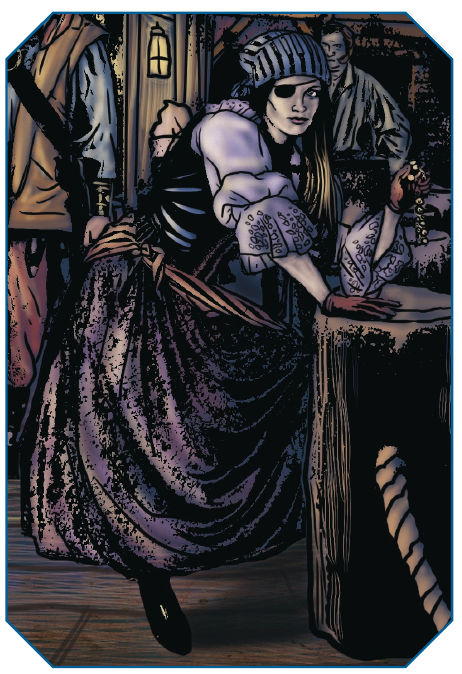
GURPS PDF Challenge 2021: GURPS Action Adventure 1: Templar's Gold

 So, here we are, the PDF challenge completed!

This has one chapter;

  • The Adventure: which is the adventure.
I was really looking forward to this adventure, and delighted to see it unlocked. The actual thing didn’t quite live up to my expectations (I liked Green Madonna better), but it’s not bad. The adventure is somewhat barebones, you’ll need a good knowledge of Action to make it work, and the adventure suffers from an incomplete understanding of Action’s core mechanics, but there’s nothing really deal breaking here, and it makes up for it in rich historical context and detail that, I think, really sells the adventure. Recommend

The Adventure

The Adventure consists of 5 sections.

The Setup

The setup risks being superfluous in a book with a very tight word count. It launches into a discussion of the sort of character that sounds so implausible that they must be real (I’ve got a long list of “implausible-sounding but real” characters from history), so I went to double check, but I couldn’t find anything. So, I presume he’s our Indiana Jones stand-in.  He’s the old friend of the adventurers, and his death kicks off the adventure.
I applaud evocative descriptions, and I think it’s good not to let your flavorful and implausible character dominate the actual adventure, and I don’t think people are going to mind reading it.  But they also can’t do anything with it, and it’s half a page to a page or largely redundant information. This wouldn’t be a problem except we have a very tight word count. So every time I note something as underwritten, there’s a part of my mind that goes back to this section and says “But did we have to know that Sam Butler was a skilled jazz and blues player? Why was it so important for us to know that he served in the French Foreign Legion as an American? Was that really worth not squeezing out another couple of words here?”  
So I don’t object specifically to how awesome Sam Butler is; this is, after all, an Indiana Jones adventure.  Taken on its own, he’s a decent way to set up the story, but unlike with the Green Madonna where every character introduced in the intro is either directly plot relevant or in the plot as an NPC the PCs can encounter, Sam Butler stops being relevant as soon as he dies, and so this feels like wasted word-count.  I think you could replace the first page or so “There’s this old family friend who dies” and sprinkle whatever  additional context the players need at the relevant parts. I like that I have a sense of who Sam Butler is, and I like “the dead NPC” concept quite a lot (I use it in my own games).  But we’ve got such a tight wordcount that I’m left wondering whether this was necessary at all.
I suppose I’m complaining less about the section than the fact that tight, strict word counts have a suffocating effect on this sort of adventure filigree.

The Characters and Zone Rouge

The next two sections discuss how to adapt GURPS Action to this pulpy adventure, including a reference to Pyramid #3/8, discussions of how various lenses would work and how Sam Butler might have known them (which, for example, finally draws a thread between why it’s relevant that Sam played the blues, but it’s enough to discuss it here, I think). It also discusses Pulling Rank and how Pyramid #3/8 discusses how it’s different.  A lot of this is just quick references to an existing work, but I feel it’s fair to point this out.  This is a cliffhanger adventure, so you need cliffhanger material, and that exists, and you need to reference it.
Zone Rouge is also good, and it made me check the author.  Yup, this is classic S. A. Fisher.  From what I’ve seen of his material, he runs his adventures less in a strict, narrative way so that you can see every scene shot by shot like a cinematographer, but more as an exercise in improvisation.  Zone Rouge discusses what France is like during WW1 and offers a variety of random encounters or issues the players might face.
Taken together, this is largely what sold the adventure to me. In contrast with the Setup, this is a a single page that punches above its word count when it comes to how much impact it’ll have on the adventure.  It creates a historical backdrop that is, in and of itself, interesting to explore and layers the adventure itself over the top of. This is a stunningly good use of setting, something a lot of adventure writers (myself definitely included) forget. It’ll be up to you to figure out how to use it, but it’s a great way to add meat, which allows you to remove a lot of detail from the rest of the adventure, because you’ve provided a core meat to the adventure that the GM can use to fill out any “blank” spots.  Well done.
A friend of mine would run GURPS and one of the players, unfamiliar with GURPS, would describe his adventures as “Action Documentaries,” because they were a lot of fun, but also the player learned a lot of things from the game.  This section reminded me of that strong point of GURPS: how its well-written supplements merge with tight mechanics to create a fairly unique experience in the RPG world, and this adventure, in a lot of ways, exemplifies that.

Events

The adventure references Pyramid #3/17, for understanding what Paris looks like at the time.  And then it essentially does the “Adventure as outline” approach to adventure-writing. We have a series of one to three paragraph quick references to what happens.  The events themselves paint a wild adventure that follows the correct pulse of adventure: the price of knowledge is danger, the reward for knowledge is more danger.  So you get a constant flow of “find a thing, get attacked, attack leads you to finding another thing, you have to fight again” and so on. It works.
There are a couple of problems I have with this section.  First, I don’t think Fisher understands what “BAD” is.  I see bits like:

A Per-based Soldier roll, at BAD -3, helps avoid the hazards in the Zone Rouge

(Though, to avoid a quibble, this is actually from  Zone Rouge, not Events, but it’s illustrative, you’ll see a lot of references like this through the section).

But BAD is not “a modifier” it’s the modifier. Here’s what Action 2: Exploits says on the matter

 Looking up and assessing these penalties can be time-consuming… When the team is poised to blow the vault door or raid the villain’s mansion, it’s boring and frustrating for things to grind to a halt while the GM consults rules and tallies modifiers… As an alternative to detailed modifiers, the GM can set a single difficulty – the Basic Abstract Difficulty (BAD) – that covers all aspects of a particular phase of the adventure.

The whole point of BAD is that I don’t want to stop what I’m doing and go back and check the adventure to see what the modifier for a Per roll is, or what what the difficulty for breaking into an airplane is. I usually just declare an adventure to be BAD X, and then it applies to everything.  If and when it changes, note that. Like the initial battle over the journal seems to be BAD -2, and then the actual encounter with the Templar’s Gold seems to be BAD -5.  Just say that.

In my mind’s eye, I see an interplay between Fisher and the Editor.  Fisher writes “A Per-based Soldier roll, at -3, helps avoid the hazards in the Zone Rouge.”  And the editor says “It’s Action; use BAD.” So Fisher amends it: “A Per-based Soldier roll, at BAD -3, helps avoid the hazards in the Zone Rouge.”  

There are also lots of bits where knowing the BAD would be useful:

Butler has hidden de Molay’s journal in a drawer under the pilot’s seat. This is locked. Lockpicking will be handy!

But at what penalty? It doesn’t say.  In fact, the whole section for Paris-Le Bourget Aerodrome (as one example) references skills with no penalties.  So what’s the penalty? Well, I would infer a -2, from the fact that when we get penalties, he uses the words “BAD -2” (though I see -3 in quite a few other places, so perhaps it’s BAD -3?) They’re not in reference to these, this BAD is not listed in anyway that would imply it’s meant to cover all penalties.  Obviously, it wasn’t hard for me to infer one, but the adventure should really specify it. Hardly a deal breaker, but it’s something Fisher could improve upon.

The other problem has to do with the nature of the outline structure of the adventure.  Everything in it amounts to quick suggestions that sound good but, in my experience, risk tedium in practice. An example:

If more than half of the goons are put out of action or driven off, their leader will flee to a nearby biplane and try to escape (he and his backseater both have Piloting-13 and Gunner-13). If the PCs notice, they may follow in the two-seat Black Eagle for another chase scene. A couple more two-seaters are ready for flight near the hangar, so additional team members can join in the chase, though they’ll be restricted to using handheld weapons or simply following the mook to his destination. For vehicle stats, use the TL6 biplane on p. B465.

Setting aside the fact that this sort of thing makes me wish I had more biplane stats (we actually have quite a few in HT), I’ve run aerial chases and they can be pretty boring.  You roll pilot, they roll pilot, you roll better and eventually, you roll five better and you catch up.  Of course, you can shoot at them, but then what you really need is Dogfighting Action (pyramid #3/53) and you can make the chase scene much more dramatic with The Thrill of the Chase (pyramid #3/112), but we don’t even get a reference to them here.  There’s this consistent habit throughout the adventure to suggest that there is action here, but not to specify what takes that action to the next level.  Have a chase here, fight some mooks here, have another chase, fight more mooks. We get the stats on the mooks, and we get references to the stats for the vehicles, but no suggestions as to what makes those particular moments more exciting than “We shoot” or “we fly.”  And this is where I start to grit my teeth, remembering Sam Butler’s elaborate description and thinking “But perhaps that word count would be better used here.”

There is one exception to this: the battle climaxes with a confrontation of a tank, and we get a detailed description of the stats of the tank, and we get a discussion of some explosives and some likely ways to defeat the tank if the players have trouble.

This section is the core of the adventure and it has the requisite action moments, and it is more than just action: there is at least one interesting NPC, and when you combine it with the more intricately designed events from Zone Rouge, and you’ve got quite a serviceable and fun adventure.  But to really make use of it, you need to apply your own knowledge of GURPS Action.  If you’ve read through as much as I have, it’s pretty easy to say “I know what you mean” and “I can fill the gaps here.” If you’re new to Action, though, you might get a little lost, or find some of the fights seem overly easy or uninteresting.

Aftermath

So the players get the gold, get rich, and then die.  Unless they figure out the curse! Which they will. And then it’s revealed: if Butler had given away half of his treasure to charity, he would have lived.
I found this very unsatisfying and thematically dissonant. “Give half of it to charity” feels like an obvious way to get around a “curse” on a Christian treasure. Like, of course.  But, worse, it retroactively paints Butler in a bad light.  We set him up as this really swell guy, but evidently he died because he didn’t give enough of it away to charity? Of course, the adventure doesn’t call that out, and if you’re pressed, I’m sure you can think of all sorts of reasons for it: he’s nice, but he just didn’t get around to it, or he had more pressing concerns at the moment, or he gave some to charity, it just wasn’t technically enough to stop the curse, and anyway if he didn’t die we wouldn’t have the adventure. etc.  But the theme of this curse is that it will only kill you if you are selfish.  That’s the theme.  A selfless, “good man” wouldn’t die from the curse. But we set up the whole of Sam Butler as this selfless good guy who was enamored of chivalry and puts his life at risk to defend other countries, but the curse killed him anyway? It’s an unfortunate and, I think, unintentional implication.
I would have gone with a different curse, one that wouldn’t create this thematic dissonance. I’m not sure what, but something more obscure, like “Put at least one of the gold coins in the votive box as an offering to god, but it has to be in this specific cathedral that was important to the templars, but fell into ruin centuries ago.” That has the high weirdness we might expect from a magic and be the sort of thing Butler never could have known or done by accident, and it wouldn’t have this unfortunate side effect of implying “Hey, maybe Butler was a bit of a jerk.”

Conclusion

After reading this, I came to two conclusions.  First, we need more word count for these.  I suppose I get it.  I mean, I have Lair of the Fat Man, but I’ve never run it. Nobody buys big, 30-page adventures so we get these abbreviated adventures bundled in a challenge, but after this and Green Madonna, I’m willing to entertain the notion of buying and running a 30-page adventure. This is why we have frameworks like Action and Dungeon Fantasy, and Dungeon Fantasy Adventures sell, so why not Action adventures?
My second conclusion is that Fisher is a better HT writer than an Action writer, and that I’m okay with that.  Neither this nor Mercenaries were stellar at advancing the mechanics of Action and this could have used a better understanding of Action mechanics or references.  What we get, instead, is lots of references to real-world things, and I’m fine with that. What makes Fisher’s stuff great is the real-world grounding.  Sure, yes, I’d like to know if I should be using BAD -2 or BAD -3 for Templar’s Gold, but I can figure that out myself pretty easily.  What I would never think of would be what Zone Rouge would look like, or who the Apaches were and how they would be relevant to this adventure.
Is it a good adventure? It’s alright. It’s a little bare-bones, and you’ll have to fill out the meat yourself, but he’s written up a pretty good recipe for doing that and given you the ingredients.  It’s less of a “out of the box” adventure that Green Madonna was, but (while I found the curse unsatisfying), it doesn’t just stop mind adventure. It builds to an appropriate climax and then rounds it off.

GURPS PDF Challenge 2021: DF 23: Twists

 This is the last PDF unlocked by moolah.  The other one needed to be unlocked with total backers.

This has one chapter, Strands in the Braid, but the one chapter is pretty cleanly broken into three parts to the point that I thought it had three chapters.

  • Lords and Ladies: Titles and Status in DF
  • Demons and Darkness: Horror DF
  • Sufficiently Advanced: So I heard you wanted guns?
It’s a good book. It tackles the things it needs to tackle in a very DF way, and you’ll walk away with more knowledge of how GURPS works, and how to expand your DF game. I think you’re better off having it than not having it.  That said, I get the sense a lot of people had higher hopes for this than it could match.  It will not give you courtly games out of the box, or DF Monster Hunters, or DF: Galtar.  It will point you in the right direction to make those yourself! But you’ll still have to make them yourself, you’ll just have a little more guidance in doing so.  I think that’s going to disappoint some DF fans.  I found it okay, but I have very high proficiency levels with GURPS that a lot of people in the DF community don’t (as DF is often a gateway into GURPS). I still think its worth getting, as I said, but modify your expectations.

Lords and Ladies

Broadly speaking, this points you towards Guilds, which is the right thing to do (though it should be noted a lot of this material is similar to what’s already in Guilds), and suggests Status-As-Rank and a means of Pulling Rank, but in social contexts. This is what I did in Psi-wars, and I think it works well enough.  It also lets players buy status, which is yet another thing to soak up money, and I think it fits the premise well-enough: if you amass a great fortune via dungeon crawling, at some point we expect to see your character in finery in some king’s court.  It also adds Followers in what looks to my eye like a shout out to classic D&D, though it should be noted that these allies don’t come free.  It’s more of a guideline as to what you might have, though I find some of the numbers tossed around… interesting. Like, okay, at Status 7, and it emphasizes that NPCs (especially kings) might have, more, caps out at 30 retainers and 2000 goons.  Alright, but how do I dungeon delve at that point? Do I send my vast armies in ahead of me and then wait for them to clean up?
I don’t think that’s the intention of this work, but this creates some interesting derived values. How large is an army in DF? Well, a PC “King” caps out at around the aforementioned 2000 and 30 retainers.  The goons are worth no more than a “guard,” a bargain henchman worth 62 points. How much is a retainer worth? Well, up to your point value.  How much are you worth? Well, according to Twists, at least 400 points.  So, 30 “9 or less” allies will run you about 150 points if each bought individually without buying them as an Ally Group, and about 50 points if they’re bought as a group.  And then the Goons are less than 25% of your value, so one each, but they have a multiplier of x20, so they cost you about 20 points. Then the book suggests at most “Very Wealthy” which is another 30 points, and then, of course, Status 7 [35]. So between 135 and 235 points of your 400 points is “It’s good to be King,” which means that much of your character isn’t  delver, it’s just these traits
At Status 4 [20], which requires at least 250 points, it still recommends Very Wealthy [30], you can have up to 10 retainers [30 and 50 points] and 200 goons [14], which means a minimum of close to 100 points is necessary to play a “maxed out” Status 4 character, leaving you a mere 150 points to define the rest of your character with, which suggests to me that you could have a “True Noble” character template if you wanted. I seem to remember an aristocrat template in a pyramid article, or perhaps in Swashbucklers; I’d have to see how it lines up.
But we come back to the interesting derived values for DF.  See, as much as I bellyache about it, a lot of people refuse to listen to sense, and insist on running DF-as-Fantasy.  And as much as I complain about it, this is hardly the worst way to  do it, and I think Twists shows why.  We know what a generic soldier looks like: the Guard Template.  We have other henchmen that give us a sense of what other retainers might look like, and now we have a sense of scale: if you’re fighting an Status 2 “Cavalier” (according to Guilds), then he’s around 150 points, and has around 50 guards at his disposal and about 5 minions of roughly his caliber.  Seems like an interesting, broad-range encounter, no? Of course, the book firmly  asserts that “NPCs can have bigger armies” but we’ve got gradation levels now, we’ve got a sense of scale.  People are going to use it that way.  Between this, Strongholds and “Social Adventures” GMs will realize they have the means to abandon the dungeon and go conquering the countryside or liberating damsels from, er, actual dungeons and defeating wicked barons, or becoming tangled up in politics.  But that raises a different problem, in that Social Adventures is a few throwaway paragraphs suggesting that you read Social Engineering and Mass Combat.
All in all, this is an interesting section, though I think you should really pair it with Henchmen, Guilds and, um, the rest of GURPS if you want to get the most out of it. I’ll talk a bit more about that at the end. However, one thing I’m going to ding it on: there’s no list of titles. Okay, this is discussing rank and status, and you can grab the rank titles from Guilds and use those as your titles, I guess. But the Courtly titles are.. assuming you’re in a court, and they’re sort of weird (Cavalier? Emir? No Earl, Marquis or Duke?). If there’s anything players will want to know, it’s what is the Status of a Duke? They’ll want to buy a level of status and know what name should be associated with it, you know, the title.  Give us a list of titles, and if that’s too Eurocentric for you, give us several lists of titles.  

Demons and Darkness

Hey B-Dog! I heard you like horror!
The most fascinating part about this chapter is how little advice it actually gives. I’ve often felt that DF already had all the makings of a horror scenario, and this chapter is a long laundry list of references, as though to say “See? You had horror the whole time!” It lists particular monsters (that were already part of DF), some suggested modifiers (that were already part of DF), points to explicitly DF magic styles, and suggests sticking to the already published DF rules.
It does suggest using Horror’s rules on corruption, Monster Hunter on Fright Checks, and to trim down the easy resurrections, then it offers some basic advice on how to spook up your dungeons.
This chapter is fine, though in a sense it’s pretty unnecessary as objectively all these things existed and all it really does is show you that fact and point you towards a few things.  I don’t actually disagree with this approach; one of my big complaints with the DF line is that it seems to assume (I suspect based on how people actually react to the DF line) that you need everything spoon fed to you directly, and it’s refreshing to see a supplement sigh with exasperation and point out that it already spoon fed this to you here, here and here.  Sometimes, though, we need that.
That said, this is mostly about turning your dungeon into Darker Dungeons (some references to Sanity would have been nice, though I’m pretty sure they already exist in a Pyramid somewhere) or Diablo.  To me, though, making the dragon into a DEMON DRAGON BLARGAGARG isn’t really the definition of horror. I would expect more investigation, invincible monsters that need you to know their specific weakness to defeat, and so on.  I would expect the horror to follow you back home, so after you kill the DEMON DRAGON BLARAGARG a curse might follow you home and begin to haunt you and kill your loved ones until you figure out what’s going on. But at that point it ceases to be DF and starts to become Fantasy Monster Hunters, and I’ll talk about that in a bit too.

Sufficiently Advanced

I’m not really sure what to make of this chapter.  It’s definitely not how to run an Ultra-Tech dungeon crawl, though it seems to offer some advice that you could let you better convert some of the DF monsters into something that feels more appropriate to sci-fi, which is useful to me, and it alludes to using these rules for a fantasy knock-off of After the End, which would be fun. It seems to mutter about allowing guns in DF in a sidebar.  I think it amounts to “Buy HT for [5] and then pay double for your musket” which is probably the best element of the chapter. 
The rest seems to be about “So you want to run an adventure where fantasy characters stumble across a spaceship that they think is full of gods or demons or whatever, and they get laser “wands.” How do you handle that?” and in that case, I either feel like the advice should either be “Woah, don’t do that” or “Here’s a full 10+ pages on how to run an ultra-tech dungeon crawl a la Elderborn or something.” This sort of goes halvesies and essentially just says things like “PCs can look at Ultra-Tech but not use it.  You can reskin things to look more like Ultra-Tech if you want.”

Conclusion

I don’t really know how I feel about the Twist books.  I think I like this one better than the Action twist book, because Action is meant to be a pretty broad genre and should legitimately think about a lot of the topics it just brushes past, while I can see DF being sufficiently narrow that you can afford to give pretty narrow advice, and I think this does a decent job of that.
But I also think that these twists come from somewhere, and that somewhere are incessant questions on how to do X in DF.  Now, my answer has always been “You don’t want to run DF anymore, you want to use DF as a basis to run a broader genre.” My big complaint about DF is not that people insist on using it for things other than dungeon crawling. DF exists to narrow GURPS down to just dungeon crawling, and all the rest of GURPS exists if you want to broaden things back out.  Like if you want to have Mass Combat, for example, you don’t need DF: Mass Combat, you just use Mass Combat. But a certain segment of the DF audience seems to get scared if asked to go outside their walled garden and insists on having the DF label slapped on things (this is my core objection to Ring Fort too: not that Ring Fort is bad, but that it needed the DF label slapped on it lest people lift their noses at it)
I think Twists does an admirable job at answering these questions in a DF way: if you run these rules in a DF game, they won’t take you out of dungeons, for the most part.  But they’ll start to point you in directions that DF doesn’t handle well out of the box: Lords and Ladies starts to point towards Fantasy Action, Demons and Darkness starts to point to DF Monster Hunters, and Sufficiently Advanced starts to point you towards DF After the End.  This is not a problem, and this is fine: if you begin to realize that base DF isn’t enough for your Lords and Ladies, follow the advice of Lords and Ladies and integrate Social Engineering and Mass Combat.  Start to look in Action for some additional advice and realize that your game is fundamentally changing and that’s okay.
But on the other hand, I think a lot of people are going to look at this book and be disappointed.  It isn’t enough for them to run these things out of the box.  They may see the references to other books as a cop-out.  My gut says they’re wrong, but maybe they’re not.  Maybe this needed triple the word count and a deeper dive on how to integrate these broader sort of fantasy games into the DF framework.  I’d personally rather not see that happen, but I’ve also noticed in my own work that many GURPS supplements tend to underestimate the amount of work necessary to get a particular game off the ground, and that the readers are often as well-versed in GURPS and improvising as the author is, which is often not the case. Time and time again, I’ve rolled my eyes at the DF community for demanding a particular thing, and then when they get it, I read it and realize that their complaints had more validity than I realized and find the book indispensible. So maybe this book isn’t enough for you or your game. Maybe we do need more.
So my gut says “This is plenty of material for you to work with” but my gut is often wrong on these things.  I’d also say that you’re better off with it than without it, but it might disappoint you, because it still leaves a lot of homework for you to do.  I say dive into the rest of the GURPS line and you’ll find the answers you seek, but I’m not sure how many people this is aimed at will find that it a satisfying book.

GURPS PDF Challenge 2021: DF 22: Gates

In the home stretch now! Only two left to go after this.

This has an actual chapter structure!
  • Gates and the Campaign: How to use Gates in a DF Campaign
  • Gate Rules: The metaphysics and game mechanics of Gates
  • Sample Destinations: Some places the gates could lead.
All in all this book was better than I expected. I went into it with some trepidation, as I’ve not had an especially good experience with GURPS and portal realms. This largely seems a working of Portal Realms material into DF and it covers what it needs to.  I walked away concluding that I probably wouldn’t use Gates in a DF game, but more thoughtful about thinking about gates in Psi-Wars.  It’s a very niche product, and I doubt most DF games would use it, but if you’re interested in portals, it’s actually a very good companion to Portal Realms, and I’m glad I have it.

Into the Gates

So, our first chapter explains what a Gate is and what sorts they are.  
As an side, I found Time Portals especially thought-provoking.  Dell’Orto points out that time travel is essentially useless in the dungeon fantasy genre and I spent a lot of time thinking about that, because it’s one of those surprisingly insightful points about genre that you don’t think about.  The fantasy genre is often “stuck in time.” You might imagine if you went back in time, instead of being in a monster-beset kingdom with a good king and an imperiled princess, you’d end up in a monster-beset kingdom with a different good king and a different imperiled princess.
You could fix this, of course.  You could argue that TL changes. You could create moments in history that the characters could explore, but you’d have to explain those moments in history, and you’d have to make them feel distinct.  There’s value to that, of course, but at some point you’re not playing Dungeon Fantasy anymore, but you are instead broadening out to a more generic fantasy, with DF as the foundation from which you’re springing, which is hardly something I object to. You should want to branch out!  But he’s absolutely right not to do it here.  In fact, the oft-forgotten GURPS Fantasy has a whole chapter on how to do this, if you’re interested.
Then we get into the sort of structures we tend to find in these things, such as the “City of Gates” vs “The portable gate” and things to look out for in both.  It also goes into why you’d go into one.  I’ll come back to that point though.
Then in Gate Rules, we discuss the physics of gates, how to tackle PC exploitation of gates, and how magic might impact them.
Finally, we get a collection of realms you could visit.
There’s a quick aside here to “Jester Gates” which are joke-realms that act like “Bonus stages.” You don’t know what you’re going to get, and gameplay will fundamentally differ.

So Where Are We Now?

I have fairly mixed feelings about this book.  First, as a Dungeon Fantasy book, I don’t think I’d ever use it, and if I used portals, I wouldn’t need this book, with one exception and I’ll come back to that.
Okay, so, I tend to see the DF genre as about overcoming dungeons.  The characters in dungeon fantasy are dungeon-delving machines.  They may have personality and they may have ties to the world, but the bulk of their design is “how do I kill monsters and take their stuff?” How you got your quest, who is involved, and the context around the dungeon crawl is fluff; it can be interesting fluff, but it’s not the meat of what the game is about.  So I don’t really care that much about how I get to the dungeon.  If I go to one dungeon via a long trek, and then another via a portal, okay, sure. But I don’t need a book for that.
What makes portals interesting is that they allow for genre bending elements. Like you might have one world that is a world of talking animals and cartoonish monsters, and another world that is Dark Souls with the runes scratched off.  As these are so obviously thematically different, you might connect them with a portal.  But exploring the tension between the two isn’t something I’d expect in a Dungeon Fantasy game.
The exception to this is the little shout-out to Jester Gates, which I think I would use. I would design a specific dungeon that fit the themes of my setting and world, and then I might sprinkle “Bonus challenges” that the PCs could optionally take on.  The fact that they’re (literally) gated behind a portal means that the weird and unusual nature or the highly specific rules make sense.  This represents a really good use of a portal.
I could also see something like trying to play on the tension of unusual physics.  For example, if you have a gates between an ice world and a fire world all within one room, and you have a fight ranging between the two, or you need to engage in puzzle solving across multiple worlds using gates, I think that would make good use of the theme/genre/rule bending, but the book doesn’t cover this that much, and I think you’d be better off covering a specific example in an adventure rather than talking about generalized portal puzzles.
So I’m left with using this as a more generic fantasy tool, and the book even hints at it. For example, it frets about people using the gates to be merchants and creates weird limitations that makes this especially difficult to do.  But can you imagine a campaign where you were playing interdimensional fantasy merchants, trying to navigate through various portal realms and ancient Gate Cities created by a lost civilization while trying to deal with the pecularities of various gates? That… sounds cool.  It’s not DF, but it’s the sort of thing this book would let you do. But then why is this stuff in here? Shouldn’t it be in a more generic book? Don’t we have a generic book for this in Portal Realms? So why does this exist?
Well, I sat down and reread Portal Realms alongside this, and it gets into a lot of stuff that Gates doesn’t, and Gates gets into a lot of things that Portal Realms doesn’t.  In fact, the more I read the two side by side, the more I realized that if I ran a Portal Game, I’d want to use Gates as a companion to Portal Realms.  Then it clicked: Gates is to Portal Realms what Wilderness Adventures is to… well, you know, going on Wilderness Adventures: this is a generically useful book that focuses intently on making it useful for DF.
Based on that would I recommend it? Well, it’s still pretty niche, but it’s also only like $3. It’s competently written, it’s got some interesting ideas, and I suspect I’d reference it if I was exploring its niche.  Which I may well do in Psi-Wars as portal travel and strange physics that lets you travel from world to world is absolutely a thing there.  So, yes, a tentative recommend.

GURPS PDF Challenge 2021: GURPS Encounters: the Mysterious Airfield

We’re nearing the end! Only three more to go!

This book has two chapters:

  • The Venus Field Air Force Base: which details the base, its history, and ends with a map
  • Base Personnel: Which briefly sketches a few personalities, little more than a name and a little snippet on personality.

I love this book! It’s not the sort of book I would have expected to love. It’s not the sort of thing that makes me cry “I need to use this right away!” but it will almost certainly see some use eventually and it’s made me rethink how I write particular things.  I still quibble that the PDF challenge is sucking a lot of oxygen out of the idea of a revived, kickstarted pyramid, so I think it’s debatable if this would have been better as a pyramid article or a Challenge PDF, but the authors really made the most of the extra breathing room given to them by being a Challenge PDF.  I think it wouldn’t have been as nice as a pyramid article.  In either case, this is the sort of thing I want to see in  Pyramid or Challenge PDFs: something I didn’t know I wanted. If I know I want a thing, I want to just buy it. If I’m going to buy a bundle, I want to find rare treasures in it, and the Mysterious Airfield is a rare treasure.

Recommend.

Into the Boneyard

So the premise of the Mysterious Airfield is that it’s one of those old airplane boneyards where people ditch old planes. I don’t know how accurate or well-researched everything was, but it was accurate enough in the beginning that I wondered if this was a real location.  Then we got into psychic children and strange, alien portals and I went “Ah, no, fictional.” (Or is it…?) the first portion of this chapter is about the location itself, and it goes into some pretty surprising amounts of detail, such as how much damage it would take to destroy a building and how much damage a fuel tank will cause if it explodes, and so on.  The chapter ends with a map that I would have expected right after this section, but alright.

The second section of the first chapter, though, is what took this book from “Sure, okay” and sent it over the moon.  It goes into the history of the Venus Field.

  • The Post-WW2 Boneyard
  • The Cold War Experimental Lab
  • The Rogue Agency
  • The Super-Villain Lair
  • and then Relics of the Past

Okay, first up, I am a huge sucker for a sense of the passage of time.  I want to hear about the various personalities in a dynasty.  I want to get a sense of how things are flowing. I want a setting to feel like it’s alive and in constant motion.  This does all of that. It flows in a way that makes perfect (if quite cinematic) sense.

But it does something else too.  See, each of these moments in time get a bunch of hooks for each.  This means you get a lot of use out of this location: you could pick a time period and run an adventure then, or you can run an historical campaign throughout the whole thing.  And because you have this stack of history behind it, you can explore that history.  Even if we set it in the modern era, or in the Supervillain Lab era, or what have you, the players can explore the past of each era, and these layers build atop one another like the dust of history: to understand why there was a supervillain lair, you have to understand the dark machinations of the rogue agency, and to understand how a rogue agency got here, you need to understand the psychic experiments of the cold war.  It’s a really great idea, and an amazing use of three pages that takes a ho-hum concept and really ramps it up to 11.

The (Psychic) Kids are Alright

Finally, we have a one-page description of various people that might be in the Venus Field.  It’s not entirely clear when they would be there, but I think it’s mostly the Boneyard/Cold War Lab Eras that we’re talking about.  They’re not much: just a name and a paragraph outlining a brief, simplistic stereotype.  But honestly, that’s enough. I don’t need detailed stats for every character.  For example, that there’s a Patrick Pollard who’s an old mechanic that will tell stories already says volumes.  The Monster Hunters can meet a Patrick Pollard in a nursing home who can tell them about the experiments, or give them insights into the origins of the dread psychic villain who goes by the name of Angel, but that he knew as Angela Simons.  Or they could meet him during their infiltration of the bone yard.  Or they can bump into him while playing as psychic kids trying to escape the lab.

This sort of thing is very valuable, because coming up with a few names and a few basic sketches of personalities (especially in minor background characters) is often one of the most difficult parts of session design, and so every little bit of help goes a long way, and also helps ground a GM more thoroughly in the setting.

Conclusion

So, like I said, I love this book.  One of the things people often need is inspiration from an unexpected angle, something that will give their story some zing and make the players sit up and notice. The Green Madonna had a burning dwarf, and this has an airplane graveyard, which are things that absolutely exist, but not something you’d necessarily think of as a location for an adventure.
It’s also very tightly done in its 10 pages, and I wasn’t left feeling like it was particularly underserved or that it was an overwritten Pyramid article, and as I mentioned above, it’s the sort of thing you wouldn’t buy as a standalone, making it a perfect thing to toss into a bundle.  It’s a good book, and well worth the price.

GURPS PDF Challenge 2021: How to GM GURPS: High Powered Origins

 Next we have the next in the series of How to GM GURPS, and it’s the second time Christopher Rice has tried his hand at it.

This has one chapter:

  • Great Power which offers said advice.
I think I’ve managed to pick up a reputation for being a harsh critic.  I don’t actually like giving negative reviews.  See, other than a few dedicated fans, I don’t think most people bother to read extensive reviews of an RPG book, not unless it’s put right in front of your face.  But authors read them, because they want that feedback, and nobody likes to have a negative review. I’ve noticed even a crack about an otherwise good book will frustrate an author.  I feel that, man. An author puts their heart and soul into a work, often spending months on it, and then some guy reads it in a day and says “Ugh, garbage.” I don’t want to give the impression that I feel that way, or that I’m dismissing someone’s hard labor.  So if I’m going to complain about a book, know that I’m not doing it callously.
With that in mind, I say: This is not a good book.  In fact, I spent most of the time after reading the book coming up with counter advice and poking holes in the advice, and then being flummoxed that it was written the way it was and analyzing how this happened.  Of course, that sounds dramatic, like this is a trainwreck of a book.  I promise you, if you have this book in your collection, it will not give you cancer.  I have read worse advice than this. But it’s not worth your $3. Give it a miss.

The Good, the Bad and the Very Christopher

So I can break this up into pieces to get a sense of how I feel about the book.  It’s not all bad, so there is some “Good.” It’s also a very distinctive book that I feel has more of the author’s fingerprints on it than I’m used to seeing, but that might be because I’m quite familiar with Christopher. So let’s use these as our categories

The Good and the Christopher

Let me start by noting that I found the book rather peculiar. Perhaps it’s my familiarity with Christopher, but I found myself thinking that this was less a book on how to GM high powered adventures, and more what “How To GM GURPS” would have looked like if Christopher had written it in the first place. 

Some examples:

  • Encouragement to simplify systems
  • Emphasis of Wildcard Skills
  • Advice to use Pop Culture comparisons
  • The Use of Buckets
  • A deep emphasis of narrative while maintaining a considerable understanding of the mechanics.

This not necessarily a problem, though I’d rather a stronger focus on solving problems with high-powered origins than on how to generally run GURPS games the Chris way, even if the latter isn’t necessarily a bad thing to have.  If you take this as “How to GM GURPS the way Chris does” then it tends to read better, and there’s some very good lines in here that newbs need to read.  Let me quote some of it at you.

Despite its reputation, it’s also not a “reality simulator.” Rather, GURPS is a toolbox to create exactly the game the GM wants within a consistent framework (which is sometimes confused with being a perfect simulator).

 Pop Culture Comparison: Be open to players phrasing questions like “I wanna be X from Y.” This sort of fiction-based concept is extremely helpful when starting character or campaign design because it lets the GM build a good foundation.

Having access to large numbers of points has its hazards. Aside from risking characters who are too focused or too general, players may suffer from “decision fatigue” because they have too many choices!

Good stuff!  These are the sorts of things a new GURPS GM should watch out for and think about and approaches they can use.  And a lot of these are problems that are pretty focused on GURPS as opposed to, say, D&D. So I think it belongs in a How to GM GURPS.  I’m not saying these are the only three good lines. I’m saying that Chris is being open and honest about his experience, and it helps in a lot of places.

Props, by the way, for the Cardboard World quote.

The Bad

Alright, let’s get into it.  This book is badly organized, offers bad advice and is frustratingly good-advice adjacent, so much so that I think with a decent editor kicking Chris literally once, most of the problems in this book would have been solved.

First, know that I’m approaching this book from the perspective of high powered games.  I have fewer objections to some of the advice as laid out for “a generic GURPS game.” Some of it will cause some problems, but it’s mostly alright and won’t lead you too far astray.  But I run a lot of GURPS.  I run a lot of high-powered GURPS, and I’ve also run a lot of low-powered GURPS (for awhile, all of my games were 50 points or less). A lot of this advice sounds like someone who regularly papers GURPS pitfalls over and runs the game in a more narrative way and has little advice for how to tackle those pitfalls other than “Don’t fall in pitfalls.” And I know for a fact that Chris does have the chops to tackle these problems because I use material he’s written to tackle these problems, which is one of the reasons I find the book so frustrating.  So why isn’t that advice in here!?

Let’s break down what I mean.

Decomplicating the Rules

So the premise in this section is that GURPS is already complicated, and the more points you have, the more complicated it gets, so you should use less optional rules and less crazy things and just keep focused on what will make your game work.  That’s fine advice at its base: “Keep focused,” but it’s not stated that way, it’s also based on a faulty premise, and it will guide new players in a bad direction.

First, as I’ve said before, I’ve run a lot of low-powered GURPS games, and one of the reasons I do that is that GURPS feels made for low powered games.  Most games I’ve played are additive: you start with a base, and as you advance, you gain more power and complexity, and this means a low-powered character is boring (you can’t effectively play a kid in WoD without a special ruleset, for example).  But with GURPS this isn’t true.  In GURPS, you can go negative.  A zero-point character can be as wildly detailed as a 100 point character or even more so, because you can take disadvantages. In fact, in a low-powered point games, you often need to fret about how many problems the PCs are taking on, because each disadvantage adds another layer of complexity. 

Low powered games often care a lot more about things that high powered games don’t. If you’re a 50 point character who meets two goons in an alley, you want to know as much as you possibly can about both of them so you can defeat them, while to a high powered character, the nuance of their specific skills doesn’t matter much, you’ll blow through both in less than a turn.  And high powered games can afford to just sweep lots of abilities into a single, expensive super-traits rather than fiddling with techniques and perks and limitations to save points.  

So in a lot of ways, high powered games are naturally less complicated than low-powered games. This isn’t a deal breaker, but we’re already on the wrong foot. A high-point fantasy game doesn’t need each sorcery spell to be lovingly hand-crafted to 5 points or less, or need to worry about exactly how many perks you can take, or going into enormous detail on your techniques. A better way to state this is to focus on what complexity matters for your game, rather than just taking on all the complexity you can.  This bad premise isn’t a deal-breaker, but it’s the foundation for the next misstep, which in my opinion is a deal breaker.

The other problem is that a lot of complexity in GURPS was added specifically to handle high-powered games.  Imagine you’re a new GM who wants to run a high-powered shonen anime campaign. You hear GURPS is great, but daunting, so you grab this book to help, and you read this line:

For a good starting point on essential mechanics for running a GURPS game, see GURPS Lite; from there, add in rules from the Basic Set and other supplements to address situations most likely to come up in the campaign.

What are you gonna do? You’re going to tell your players to toss together 500 point anime martial artists, and then run the combat out of GURPS Lite. You know what will happen? Nobody will be able to hit one another. Because Deceptive Attack exists precisely to deal with skill 20+ characters fighting one another, and it isn’t in GURPS Lite. I just had someone commenting to me on how vitally important Deceptive Attack is and how it’s not emphasized. This is the place to emphasize it, because the purpose of an advice book is to point out how to overcome problems. “Help, my character can’t hit anyone because everyone’s defense is so high” is exactly the sort of thing this book should be helping, but ctrl+f “deceptive” turns up no hits.

What you really want to do here is talk about having a focus and keeping on that focus and removing complexity that doesn’t help that focus.  I think he’s trying to do that by suggesting “start with minimal stuff and add to the campaign what is helpful” and in principle that’s good advice, but this is the place to bring up some core things that really help high level play. Without doing that, you’re encouraging people to throw the baby out with the bathwater, and only after they realize they have no baby, to go hunting around to find it again after. It’s broadly useful advice, but mis-applied in such a specific book.

High-Powered Combat

If there’s one problem I see over and over again in any “build-your-own-character” systems, it’s how difficult it becomes to write balanced combat scenarios for it.  I’ve seen this in Exalted, and I’ve seen it in Aberrant, and I’ve seen it in GURPS.  The problem is people will take so much DR or so much damage or so much offense or defense, in comparison to everyone else, that any scenario that would challenge one character is a bloodbath or a cake walk for another character.

The way to solve this is with Benchmarks.  Characters should be within a particular range when it comes to offense and defense.  In Psi-Wars, I accomplish this with the ubiquity of battleweave (there’s no reason for anyone to have less than DR 20 against blasters), and outside of military ordinance (which is typically handled with cinematic rules like the Cinematic Explosions rule), everything is calibrated around between 3d(5) and 8d(5); it’s rare to find someone outside of this range (and if they are, it’s usually because they have less of an armor divisor).  With these benchmarks, you can roughly eyeball scenarios so most people feel useful and like they can participate and don’t just get curbstomped by the wrong guy.  I’m not saying that everyone needs to be equally effective at combat, I’m pointing to the risks have having a combat at all with one HP 1, DR 0 Pixie and an HP 100, DR 100 combat god in the same party.  You need to be in the same ballpark, speaking the same mechanical language.  This is the sort of thing that can happen in a High Powered Game. So the advice to give is: “try to have this minimal level of offense and defense, and try to have these minimal skills and don’t go beyond this particular range.” With that in place, you can design your scenarios in a way that won’t absolutely destroy or bore someone in the party.

And then where it gets frustrating is he almost offers this advice: he talks about working out how much offense and defense each character has (what specifically are we looking for here?).  He talks about having the GM look over each character to make sure they don’t have any major holes (what holes are we looking for?), he talks about being overly focused or overly generalized a lot (“Jenny One-Skill.” I like that!), but what specifically are we worried about here and how do we solve it? 

It’s BENCHMARKS! 

You check the totals of every character to make sure they fall within the benchmarks. The problem with the Jack-of-All-Trades is that he has nothing that sets him apart and he might not meet some of the minimum benchmarks because he’s spread too thin; the problem with Jenny One-Skill is she blows the benchmarks in one particular way and sucks at the rest.  If we had benchmarks, we’d know what specifically we were looking for! And Chris knows this stuff: he wrote It’s a Threat so if anyone knew how to balance combat, it would be him. So why is it not here?

Incidentally, I pick on combat here, because combat is where this problem rears its head the most, but it’s really about whatever the central conceit of the game is.  In a highly social game set in a court (which is another sort of high powered game, just in a different way), lacking certain core social traits at the levels interesting for the game, or having so many that you blow the premise of the game out of the water, can cause as much of a problem as being wildly unbalanced in combat. You need to know the tolerance levels of your gameplay and keep your players within those tolerance levels so they can enjoy the gamespace you created.

This is also a good place to talk about ways to help people who fall outside of the benchmarks. Rules like Flesh Wounds, TV Action Violence and Cinematic Explosions are survival tricks to make sure that the people who are not invested in combat (or whatever your particular field is) can still participate without the GM needing to wildly intervene all the time to keep them from being destroyed by the game, or bored. He does mention the utility of Impulse Buys, but a little more depth on survivability and gamespace participation would help a lot. It’s sort of part of what “benchmarks” is: how do you ensure everyone has at least minimum participation in the core elements of what your game is about?

Building to a Concept

In Building to a Concept, Chris suggests removing point totals as a fundamental limitation.  Now, I’m not going to tell you running a game with varying point totals is wrong.  I am going to say that it makes your life harder, and if you’re a noob, which this book is supposed to be aimed at, it’s not the sort of thing I’d recommend doing. It’s something to do when you have a better idea of what will and will not work. Like, for example, knowing how to benchmark characters well.  He suggest a “tolerance” of 50% up or down for a campaign, but that “supers or fantasy” can go much higher than this, and goes with 200% in an example.

First, I’m mystified that he’s picking on “supers and fantasy.” If there was a genre that could tolerate whacky point totals, it would be sci-fi. THS outright suggests this! Like, a cyborg with an arm cannon that deals 8d(5) is vastly more expensive (GURPS RAW) than a commando with a heavy blaster rifle, but they’re both about as dangerous in combat. So I’m not sure why he picks on fantasy, which lacks the tools that Ultra-Tech has to rebalance these differences.  My guess is he’s either thinking of GURPS Magic or the fact that it’s in genre to have a useless princess and a FREAKING DRAGON in the same party.

But this is where bad advice starts to compound on bad advice. So go back to said noob who is running his shonen anime GURPS game. That’s like Supers right? So it’s fair to have someone with 500 points, and someone with 250 and someone with 1000 points in the same party, right? The 250 point character works out to something like a Face who is heavy on social traits and has minimal combat traits, and a 1000-point combat god with advanced martial arts. So we have the equivalent to Lois Lane (250 points), Superman (1000 points) and Nightwing (500 points).  Now write a combat scenario that’s fun for all three and doesn’t turn Lois into paste or bore Superman to tears.  “I use kryptonite!” is fun the first time, but it gets pretty tiresome after that.  But worse, since we’re not using advanced rules, the 1000 point martial artist can’t get hit.  If he’s got Karate-30, he has a parry of 19.  The only way he’ll get his is if he critically fails his roll, and this is made worse by the fact that you benchmarked most of the combat characters around the 500-point mark.

If you forced everyone on the same point total, knew about things like Deceptive attacks and other tricks to allow people to actually tackle their high level opponents, and you kept everyone on more-or-less the same playing field, then a lot of these problems naturally go away.  If you follow the advice here, you make the game harder for yourself.  This sort of advice makes life harder for the noob this book is aimed at.

I also want to take a moment to note that if you force everyone to have the same point total, you’ll find that most of the concepts line up after the players force themselves to fit into the mold.  Instead of having Useless Princess and THE DRAGON, you end up with with Moderately Useful Princess and the Troubled Dragon, and they line up better.  He correctly points out that setting your point values too low can create over-specialized characters in an attempt to reach what the player thinks of as appropriate for their concept, but modifying the concept (he already suggests we say no to bad concepts) and giving people an understanding of what sort of ballparks define “powerful” (Benchmarks, again) we can mitigate that.

It feels like he’s aiming at something like “Let people make whatever concept they want, don’t worry about the rules, just roll and shout and have a good time!” That’s not a bad way to play a game (I run No Thank You Evil for my kids that way), but that’s how you run GURPS Ultra-Lite, not GURPS.  This is not “How to GM GURPS Ultra-Lite” or “How to GM No Thank You Evil,” it’s How to GM GURPS, and the point of these books should not be to wave away these problems, but to show you how to tackle them.  Where else are you going to get advice on how to properly build high powered characters than this book?

Approaches to Character Design

I actually really like this section.  They point out all sorts of different ways to approach how to play a high powered game, such as the difference between characters who mostly have their power based on political and hierarchical power vs characters who are focused on raw, physical power, or characters who focus on narrative concept vs mechanical concept. It’s very good stuff, and worth a read… but why  is this here and not in “genres for high-powered games?”  A quibble, mostly.

Skills vs Wildcard Skills

Man, stop selling Wildcard skills.  They were a nice attempt to limit some complexity of GURPS, but it didn’t work. The sort of point investments you have to make to get them to a decent level mean at some point you’re better off with Talent or Attribute.  Yeah, you get less written on your sheet, but the mechanical value is so dubious they had to add free impulse buy points to try to balance it out. If you want to reduce the complexity of the skills of the game, trim the number of skills in the game.  Giving a noob permission to ignore skills he doesn’t like or bundle skills he thinks naturally belongs together is very much the sort of thing a noob needs to hear.

Character Growth

This isn’t a bad section, and it’s tackling a real issue, I just think it could be written better. The big problem here is the fact that at some point, everything gets really expensive.  Like, your 1000-point character doesn’t really care about a 1-5 point total reward; wake him up when he has 25, 50 or 100 points to burn. He makes suggestions like “encourage large improvements instead of smaller” and “limit when players can spend their experience” and points out the advantages this offers.  You could just say something like “Consider giving out experience in a larger chunk at the end of an adventure rather than smaller peices after every session.” It’s what I think he’s trying to say, and again, one clean edit later and he would be saying something like this more clearly.

High-Powered Pitfalls

I found this section weird.  

He lists Point Debt, but it’s not meant as a pitfall, but a suggestion that you should give people free points if they forgot something rather than punish them for not knowing the system, and then let them pay you back.  Fair enough, but it’s not a pitfall it’s how to solve a problem.

He says “Don’t build All-Powerful Characters” and points out how boring they can be.  But if I’m new t GURPS, my assumption is going to be that the point values and the system already prevent that.  This will instead read as “Please don’t break our fragile system.” Are you really afraid that people will turn their 1000-point character into Q unless you say “Please don’t do that?” And this section doesn’t actually tell you how to “not build an all-powerful character.”  What he means is there needs to be ways to challenge you in the gamespace, or you won’t have much fun in the game, but then discuss that and how to have holes in a character that act as interesting challenges.

There’s a section on Misplaced Realistic Powerful Characters, and I’ve read it several times and I’m still not sure what it’s talking about. I think it means something like making nitty, gritty characters that have mastered high levels of Knot-Tying in a swashbuckling game because they sail ships and knots are important for sailing, but they miss that nobody cares about knot-tying and house keeping in a swashbuckling game.  But if so, I’m pretty sure he already addressed it, and he even points you back to that section, so what is this? Just a section that emphasizes the previous point?

In Super-Normal vs Super-Powered, he seems to realize that having a 250-point character in the same party as a 1000-point character is maybe not the best idea, especially if Useless Princess isn’t minmaxed all to hell, and if she was played by a min-maxer, why wasn’t she also a 1000-point character? And so he suggests getting around the pitfall of his own making by making either parallel gameplay (“Fight these useless mooks while the Great Dragon fights the Death God”) or gives them lots of GM plot-armor (“I know you’re 250 points, but I’m going to secretly give you another 250-points worth of Destiny, Serendipity and Super Luck that you didn’t know you had in the form of me fudging your rolls for you all the time”).  How about not advising people make these wildly varying point totals in the first place?

And finally in Unusual (Background) for Whom he… gives really good advice that I with some other authors would take.  Just because something is rare doesn’t mean it should be expensive. If you’re paying points, there should be a reason you pay points and Chris nails what those reasons tend to be: you’d surprise people, you’d impress people, or the GM thinks the power would be too powerful and is taxing you to bring your capabilities in line with your point values.  It’s a good section and worth a read.

In Conclusion

I want to like this book.  GURPS needs a book like this.  Chris is the man to write this book. In this book, he often gives good advice, and comes very close to giving very good advice, but taken as a whole, what I see is a book that will cause a newbie GM more trouble and frustration than if he didn’t have this book. And I think with a single edit run, you could fix all these problems!  Re-order a couple of things, call out a few specific problems (how to deal with extremely high skill, how to trim down skill lists, how to keep players within certain character capability benchmarks, how to use Templates or buckets to help with all of the above), remove more troublesome advice like wildly varying point totals (that’s GURPS 201, not GURPS 101) and I think I’d instead be telling you to get this book and hand it to your buddy. It’s very close to a good book. It teaches you just enough GURPS to make you dangerous, if you will.  But in its current state, I can’t recommend it.
I hate writing bad reviews.  Sorry, Chris.

GURPS PDF Challenge 2021: Space Atlas: Grissom


Next in our challenge round-up, I have Grissom, the latest (first?) addition to our Space Atlas (for 4e, at least).

It has one chapter:

  • Why So Stubborn? Which details Grissom. It includes a map.
I like it.  I would welcome more books like this. In fact, I suspect it’s probably the most underrated development of the PDF challenge.  That said, it’s not setting my world on fire.  I’m not having mad dreams about trying to write up an entire set of campaign framework around it.  On the other hand, I would absolutely use it. Is it a recommend? Yes.

Exploring Grissom

The book gives us the requisite GURPS Space boiler plate that I have personally never used in a game, and one of those hex maps.  It also does more than most atlas entries I’ve read to give us a sense of what the rest of the star system looks like, and actually makes the rest meaningful. It’s not a single world orbiting a single star with “Oh technically I don’t know a gas giant or something out there.” Not that there’s anything wrong with those sorts of systems (most Psi-Wars systems work like that), I just wanted to give it kudos for going the extra mile here.

Then we get into the culture and the environment, and the environmental details are rather sparse, but the cultural ones are pretty good. You get a real sense of who they are as a people, and how they would differ from the rest of the galaxy. I do want to knock it on a couple of points here.  So one premise of Grissom is that the rest of humanity lost contact with them for awhile.  It’s a system that’s coming out of isolation.  How long of an isolation? It doesn’t say, because it depends on the campaign, but this is presumably the reason why they are culturally distinct from the rest of the setting in some way.  But there’s no discussion of language or cultural familiarity.  Perhaps this is because the author didn’t know what the language elements of your setting would be and so didn’t want to mess with it, but Ctrl+F “language” reveals nothing.  Do they all speak the same language? Does something prevent any linguistic drift over all of this time? What’s going on? My guess is the author didn’t think of it.  A lot of us don’t think in terms of language barriers, but presumably there would be one after a long period of no contact, and it’s not like UT characters don’t have the tools to overcome that. It wouldn’t need to be much: one quick mention of this fact would be nice.  But this is more of a quibble than a problem.

Then it turns out there’s a BIG SECRET on Grissom.  Guess what the secret is! I’ll wait.  IT’S AN ALIEN ARTIFACT! There’s nothing wrong with this, of course, but I would caution writers to not overuse them. The first new star system we get has an alien artifact in it, which means that fertile field is already tapped. What are the chances that the next one, and the next one, will want to have an alien artifact too? So this is less of a criticism of it, and more of a cautionary note not to over use this if this series continues.  That said, the artifact is rather novel: it’s not a dead spaceship or a super-weapon: it’s turning a gas giant into a star. This was the plot of Space Odyssey 2010 (and given the emphasis on the rest of the star system on Grissom, this feels a bit like Space Odyssey 2010: the setting), sure, so it’s not the most wildly original concept, but most of the time we get alien artifacts, they’re a macguffin you can hold in your hand, not planet-scale megastructure that you didn’t notice until you scratch the surface.  So as far as alien artifacts go, it’s a decent one.

And then we get some campaign seeds, so we can drop it in a campaign, and we get distinct ideas for off-worlders and natives.

I double checked (I own every Space Atlas book) and the average space Atlas entry is 2 pages, with one page essentially being a map and the GURPS Space Boilerplate. So this is way more info than we traditionally got on planets.  And it’s more than enough information to run this sort of setting.  I rather think a space atlas entry is a great use of a 10-page supplement, and I might use it as an outline for some of my own material.

Could I use it in Psi-Wars? Sure, I guess. The real problem it runs into isn’t that it doesn’t fit, it’s more than it’s a bit shrugworthy as far as Psi-Wars is concerned: the culture described is essentially a bog-standard Westerly culture, and the excitement levels of some artifacts slowly igniting a new star is, for Psi-Wars, small potatoes.  It’s not to say that I can’t use it, but this is really aimed more at “Star Trek” than “Star Wars.”  That’s not a problem, it’s just a matter of genre. But I must say that the fact that it could slip into Psi-Wars relatively unnoticed does speak to how good a job the writer did at keeping it generic.

So I think it’s worth your time and I don’t regret having it. There are some issues with how sedate the material is, so some readers might snooze on it, but if you’re willing to accept that not every setting needs scantily-clad space princesses and rogue alien mafiosos and giant space dragons to be exciting, then this setting could be great for you.  I expect I’ll get some use out of the book.  I also hope this becomes a thing, where we get at least one new Space Atlas entry, of about this heft, a year. Or more.  I think that’s the best part of the book: if you can do this once, you can do it more often than that. It’s also why I offer that cautionary note: because I’d like to see more of these.

GURPS PDF Challenge 2021: 2-Page Dungeons

This very tightly designed work has, unsurprisingly, 5 dungeons:

  • From a Sinking Ship: Get the magic medallion from a terrified rat before the ship sinks into the sea, or the skeletons get it.
  • The Blasphemed Shrine: Fight some demons, I guess.
  • A Cold Day In: Fight a dragon in a fragile ice cavern
  • All Along the Watchtower: Kill the orcs and seize the tower before they can raise alarm
  • The Floor is Lava: THE FLOOR IS LAVA!

Each dungeon comes with a detailed map.

I think this is actually a neat concept, and if you run DF, my guess is you’ll almost certainly get some use out of them.  The actual execution of several of these dungeons is off, though, and I’ll get into ways they could be improved. Is this a buy? Well, for the price, sure!

From a Sinking Ship

This is a very promising concept.  The idea is that you’re trying to get at a medallion that is tangled around a rat, on a ship that’s slowly sinking, while skeletons are also trying to get it. The ship was a cargo ship, and you can also loot the ship for cargo.

This is a great concept, as it pulls the PCs in several directions and intrinsically creates interesting choices.  You need to fight the skeletons and loot the ship and get the medallion and get off in time.  You can’t do all of the above, so you have to prioritize, which means players are doing lots of things, and a disorganized group is doomed, while an organized group can walk away with a haul!

Or they could except the “loot” is hard to find and doesn’t amount to much ($45 for 30 lbs). I think the one thing I would have done is make the loot more valuable (gimme some chests of gold and jewels), otherwise the PCs will just ignore it, get the rat as soon as possible and skedaddle, and the time limit becomes less interesting.


The Blasphemed Shrine

The players go into a temple, fight some demons, then go into another section with nothing in it except three cruddy fountains (“Are there monsters in the fountains?” “No! Maybe.” “I stab the fountains.” “You kill the monsters”) then they go to the third section where they fight the same demons, plus a boss monster that has to be killed in a specific way, and then maybe loot some sarcophagi that maybe they should leave alone.

This one is boring.  There’s no real gimmick other than “Boss is hard to kill!” which is to to be expected.  It’s got a Diablo aesthetic, which is nice, I guess.


A Cold Day In

The players fight their way through a linear, cold-themed dungeon where fire magic and explosions risk bringing the a collapse of icicles. It’s a nice concept, though it requires a little homework on the GM’s part. I probably would have added rules for “repairing” damage with ice magic, but it’s a pretty tight word count.

All Along the Watchtower

This is a nice concept, in that the players need to avoid giving alarm, so they have to sneak through and make sure all the orcs die without alerting anyone else, and if they do, they’ll have to find some way to stop that alarm from getting out!  This makes for a very unusual, more action-like dungeon crawl.  It’s a nice change, and probably my favorite of the 2-page dungeons.

Why must they avoid giving alarm? Is it because they’ll be swarmed? No. It’s because they’ll warn the next post.  Of whatever the players are doing. Why does this matter? Well, I think that’s the biggest weakness of this particular adventure.  See, the point of a 2-page dungeon is that you can just grab it and toss it into a game. Bored on a Saturday night? Hit up the local FLGS with some characters and a 2-page dungeon and just play this tightly bound, one-off adventure.

But not All Along the Watchtower.  For it to work, there must be a broader context. They talk about this broader context in a blurb, but it has to be there.  That’s not a deal breaker, but it does weaken it as a drag-and-drop adventure.


The Floor is Lava

THE FLOOR IS LAVA! The adventurers fight their way through a fire-themed dungeon to get a magic crystal, but they have to be careful, because THE FLOOR. IS. LAVA!

Mostly, they face fire-themed enemies, and they’re surrounded by lava, and will have to make little hops to get from one outcropping to another, and stray damage might trigger a rock mite spawn.  For a game where THE FLOOR BEING LAVA is so central, it doesn’t seem to matter much. The players won’t need to do much to avoid the lava, and most of the monsters either can’t fall (they fly) or aren’t particularly vulnerable to flame.

Anyone who has played Floor is Lava, or seen the gameshow on Netflix, knows that the whole point of the game is deft acrobatics.  I’d like this one a lot more if it were less linear, allowing the rogue or martial artist to flex their dungeon parkour skills and scramble across a shorter, but more dangerous route.  The dungeon is designed from the perspective of slow-moving scrubs making their way carefully across safe rocky outcroppings, but give us some more dangerous, more skill-based outcroppings too. That would give the players more choice, and thus more tension in the scenario (especially if they screw up and a flying enemy start to harass them).

Conclusion

I think this is a fun concept.  It’s like twitter poetry: how much dungeon can you fit into two pages? I encourage you to try yourself! It’s also a good meditation on dungeon gimmicks and essential dungeon design.

Is it useful? Well, in principle, these are very “one shot” and there’s a lot of them, so you can just grab one and run it, which a lot of people will do.  Are they good dungeons? I can’t really speak to their design or balance as I don’t play enough DF to tell, and I’ve noted some of the problems with several of them, so if I had to guess I’d say “They’re alright.” I think in most cases, players will shrug at the memory of the adventure. “It was fine,” they’ll say.  But the GM will appreciate being able to run a “fine” game at a moment’s notice. They’re not the memorable ones: there are no Tomb of Evils in here, but they’re more cohesive than some randomly generated  dungeon, and fine for a quick, impromptu session or for stalling for time while the GM works on a more interesting or impressive dungeon.  And there are some neat ideas in here that a GM can steal.

It could have been better, and, hot take, I wouldn’t mind seeing more of these.  Recommend.

GURPS PDF Challenge 2021: Renaissance Venice: Spies of Venice

 So Spies of Venice is the latest  in what looks intended to be an ongoing series given that we have a new series tag associated with it. It has 5, count them 5, chapters in this 10-page book:

  • The Secret History: The Origins of Renaissance spycraft
  • Agencies and Agents: Details on Venice’s spies were organized
  • Techniques and Missions: What they spied on, and how.
  • The Post: How Venice facilitated communication throughout renaissance Europe
  • Characters and Campaigns: So you wanna play a spy, huh?

I’m not going to do a big breakdown of the book, because I feel about this book the way I feel about most  Matt Riggsby books: it’s good, it’s niche, I’d like to use it but probably won’t, and when I do use it, I’ll find it useful, but also wish there was more material to cover the specific thing I wanted.

I always get a nagging sense that I could work out most of this on Wikipedia, but Matt collates it all just enough, and integrated GURPS just enough, that you feel it’s worth buying, especially at the very cheap price tag. The real benefit to me of a Riggsby work is more that he, like Kenneth Hite, points out an element of history that’s especially worthy of further investigation into as a gamer, gives lots of pointers for expanding it, and integrates just enough that you could probably run it out of the box (even though you won’t).

Despite being quite interesting, it’s rather dry: more la Carre than Fleming, though there’s a whole paragraph for if you want James Bond in the Renaissance!  Of course, there’s nothing wrong with pointing out that spycraft in the Renaissance mostly consisted of being in someone else’s court, listening to what people said, and sending messages back to your king while worrying that people might read your mail. But the whole of “This is what you do with it” is less than a page.  This is a report for a history teacher with a one-page “oh and you can run this in an RPG too” tacked on at the end to justify it as a gaming supplement.  I would really appreciate more thought put into how to integrate these sorts of things into a campaign, both serious and cinematic, but where would you cut page-count for it? Once again, I feel like 10 pages is too small unless just the historical information is enough… which is a bit of an open question, because I bet you if you doubled page count, Matt would fill it with more history, because there’s always more history.

A friend commented on Renaissance Venice “being doled out piecemeal.” I checked, there is no other Renaissance Venice books I can find or even more Pyramid Articles, so it seems to be this + Hotspots: Renaissance Venice.  Are we going to get more? Do we want more? If we want more, would it be better as a single volume? Would you buy a big book on just Renaissance Venice? I’ll be honest, I’m not sure I would.  But I feel like between Green Madonna and this, there’s surely some hunger for an historically-authentic-if-improbable cinematic swashbuckling GURPS campaign framework, and such a series would make a great springboard for books like this, because you could point to that specific work and specific templates, the way Osiris Worlds was able to point to Steampunk.  There’s a lot of works that sort of thing would make more useful, and it would expand the GURPS framework line in a good direction that fits what a lot of people seem to want to use GURPS to do (ie, historically-authentic-but-somewhat-improbable cinematic historical gaming).

Is it a good book? Sure. It’s a Matt Riggsby book.  I don’t feel like I wasted my money.  Is it probably going to rot on my shelf? Hmm… I’m not sure. I don’t think I’ll run Venice anytime soon, and I suspect I won’t dive in to reference it anytime soon, but just reading through it made me think about things that will influence what I write moving forward.  Should you buy it? Well, if you like historical stuff, then sure, it’s good. I wouldn’t call it a must have, or beg you to petition SJGames for more, as I would with Greed Madonna, but I don’t think you’re wasting your money either. It’s solid.

GURPS PDF Challenge 2021: Infinite Earths – Osiris Worlds

 Next on our list, we have Infinite Earths: Osiris Worlds, a collection of Egyptian-inspired Alternate Earths.

This has two chapters:

  • Ancient Egypt in the Infinite Worlds: which discusses general concerns, such as interesting dates, cultural familiarity and languages
  • Three Key Worldlines: This is what you’re here for.  The worlds are:
    • Osiris-6: Aliens built the pyramids!
    • Osiris-3: Akhenaten and his ghoul armies ravage the world.
    • Osiris-7: If you put a woman in charge, you get a  world of clockwork swashbuckling.
I wasn’t really interested in this going into it, and after reading it, I’m modestly impressed at the quality.  At least, it wasn’t as bad as I thought it would be. Is it good? I don’t know.  I think it angles more towards “It’s fine.” It does the job it sets out to do and I see no major holes.  The book does amount more to “writing prompts” than “detailed worlds” but at least they point you in the right direction. Would I recommend buying it? No. But to be fair, I wouldn’t recommend most Alternate Earth books.  I’m also not particular into that genre; I get the sense a lot of that comes down to reading the timeline and then arguing about the plausibility of a particular extrapolation and if that’s what you see, only really Osiris-7 is interesting.  The other two are more “interesting adventure ideas” more than detailed worlds.  You can live without this book, but at the price, you’re probably not wasting your money either.

Egypt, Expanded across Space and Time

The first chapter does a pretty good job of hitting the minimal highlights of what you need to know for Alternate Earth games set in Egypt.  It hits some good diversion points, it talks about the dating issue, and tackles language and culture. If you have GURPS Egypt, or you’ve explored Egypt on your own, you probably know most of it, but it’s still nice to have. It also has a list of more classic Osiris worlds which is worth a glance over, and fits well into an IW campaign.

That sounds pretty terse, but this is probably the section I found the most interesting.

World after World

Osiris 6 is our first world.  Here, Khufu is using some weird, physics bending power to build the pyramids and various monuments.  Where does this power come from? Well, there’s a whole sidebar full of suggestions.  And that’s it, that’s the world.  The idea is to send in your IW agents, figure out what’s really going on, and then go “Oh no, it’s from X, and X is bad because of Y” and then you defeat the bad guys.  Or you steal the tech and bring it back.  But this world is more about solving the mystery of the Great Movers than, say, exploring their impact on history.

Osiris-3 is “What if Akhenaten terrorized the world with an army of ghouls?” It has an evocative piece of art, some suggestions about what to do with the idea, and a sidebar that references GURPS Horror for some suggested stats on the monsters. The idea is to send IW agents here, go “Oh crap, ghouls!” fight them, and then worry about Cabal or the Reich finding this world.  Of the three worlds, I’ll be honest, I like this one the best.  But it also doesn’t feel especially inspired. Like, sure, zombies makes everything better, right? So why not zombies in ancient Egypt? There’s not really more meat to it than that.

Osiris-7 suggests an alternate timeline where Cleopatra and Antony successfully fended off the forces of Augustus and Alexandria and its great library became even more important to Rome.  Thanks to this, the scientific revolution came early, and we get a clockpunk world.  It has a pretty substantial sidebar on the technology, though it mostly amounts to how to integrate Steampunk into Egypt (which, as an aside, is likely good advice for Broken Clockwork World, Phil’s last PDF challenge work).  This one strikes me as the timeline most like an alternate timeline and the least like a generic adventure idea. Like the Current Affairs section is actually pertinent, and this is the one I could most see expanded out into something.

The Dust of Time

And that’s it, basically. Perhaps you can see why I’m not wildly excited about it.  It’s not a bad book.  If I had a question, like “Oh, but how do I even run Akhenaten and his ghoul armies?” there’s enough support there for me to work the rest out.  It’s not like some other books I’ve read where it amounts to “Hey, here’s a neat idea” and then offers no support to run it at all.  But on the other hand, the support is pretty sparse and to my eye, the book reads more like a list of campaign ideas more than it does campaign settings.  But most Alternate Earths read that way to me, even the best Alternate Earths, unless they’re going to get a huge, full-book treatment, and even then, I don’t use them.  I’d run Cabal or Madness Dossier, but I wouldn’t run anything in the old 3e Alternate Earths books, or anything out of the current IW, so I don’t feel I’m especially qualified to talk about it.

As I said above, I wouldn’t recommend this book, but I wouldn’t recommend any Alternate Earths books.  I don’t see any gaping holes or anything to get stomping mad about, so if you like this sort of thing, it could be worth your money.

GURPS PDF Challenge 2021: the Green Madonna


So, I don’t buy adventures, generally speaking. I just make my own. I’ve been making my own for ages, and thus I underestimate the value of an adventure for acting as a good worked example, or for even grabbing me by my belt and shouting “I am awesome, run me!”

That’s what The Green Madonna did. It’s amazing. I could wax poetic in so many ways about this book. If you like Swashbuckling at all, you should get it.  The only downside is that, surprise surprise, it’s too short.  I read through it, enrapt, and then it suddenly just cuts off and I was left flipping back and forth through the book to figure out where the next part was.  Presumably, you’re supposed to do it yourself? But if I were Pulver, I’d just make the Green Madonna part 2, but I suspect that won’t happen, because this one won’t receive any attention, because nobody buys adventures.

I Heard You Like Swashbuckling?

The first reason to get this book is because swashbuckling is awesome.  I used to play lots of 7th Sea, and I still play it today, but the problem with 7th Sea is that it’s a crap system set in a funhouse-mirror of Europe that makes you want to dig out your research of the era, but you can’t, because it may or may not fit into the funhouse mirror version, so you end up just researching more of Theah, which is useless geek knowledge, rather than real history, which is useful nerd knowledge.

I always thought GURPS would make for a more satisfying swashbuckling experience.  The combat system plays well with swashbuckling action-by-action duels.  There’s often a criticism that GURPS is too realistic for Swashbuckling, but that stems from a misconception that swashbucklers swung on chandeliers and slid on banisters just because it was cool, but most of my experience with swashbuckling adventure was that they were closer to the modern Action genre: high-flying action grounded in a gritty foundation.  If someone was swinging on a chandelier, it wasn’t just for kicks, but because he needed to get across a gap and the chandelier was the only means he could see. And also, 7th Sea doesn’t actually encourage this either, and GURPS actually does, if you dig around enough in GURPS Martial Arts, which you should be doing anyway because you need fencing to make your adventure work.

But GURPS also grounds itself in history in a way that 7th Sea doesn’t, and in a way that swashbuckling adventures really need to.  Mind you, it’s a somewhat silly history, full of improbably conspiracy theories and implausible shoutouts to real life people made larger than life.  This features an interpretation of Isaac Newton that crosses action cinema with GURPS Cabal and keeps just enough realism to make you wonder just how plausible it is.

This book makes excellent use of existing works to show you where the skeleton of a swashbuckling framework exists, which is another reason it’s a great book: if you run this, the problems you’ll need to solve to make the adventure work can largely be solved by works that exist, which this book mostly references, and once you’ve figured out how to make decent swashbuckling characters and how to handle them in a game, you can run any swashbuckling game you want.

Or Maybe a Little Raymond Chandler?

The structure of this story, and the characters within it, are amazing.  Whomever wrote it clearly has a solid grasp of how to make adventures work, and likely has studied the classics. 

It starts with a burning dwarf pirate bursting into a tavern room shouting for help and then is followed up by gang of ruffians bursting in to finish the job on the dwarf and kill everyone. FIGHT ENSUES!  You’ve immediately got the Raymond Chandler solution of “Burst into the room with two guys with guns.” There are two reasons for this: the first is because everyone likes action, but the other is to trigger the “ball of yarn” mystery: these two guys have clues which will lead you to the next clue, which will lead you to the next clue.  This adventure is very much structured like a ball-of-yarn mystery.

It also features a great cast, such as the aforementioned Isaac Newton, but also Lady Champagne, the  beautiful, tragic, one-eyed femme-fatale who will bedevil the party.  Or she would, if the adventure continued. She, of course, needs to be rescued from sinister, torturous Spaniards. But will the players regret rescuing the dangerous damsel? They’ll probably have mixed feelings on it.

There’s also a lot of backstory that goes into the adventure. While not explicitly mentioned, this context will allow the GM to improvise more information drops and clues as necessary, as the players will start only with the knowledge of someone killing a poor, burning dwarf and the nebulous promise of treasure somewhere at the end of this adventure, and everything else they’ll have to pick up along the way.  All told, the adventure is written in a very dense way that will naturally pull the players from encounter to encounter following a Hitean pulse of thriller adventure: the reward for facing danger is information; the price of learning information is more danger. So the players will face a challenge, then learn something new, then suddenly face another challenge, which will lead them to some new information, and so on.  It’s an excellent structure for an RPG.  And it has the information density beneath it to allow the GM to dribble along those interesting clues.

The Good, the Bad and the One-Eyed Damsel

I suspect that David Pulver is as much a fan of Jack of All Trades as I am.  If you’ve never heard of it, you should watch it for the intro alone, but also because Bruce Campbell is awesome and its a great piece of 90s camp. But it’s exactly the sort of story that would feature a burning dwarf, a beautiful one-eyed lady, and lots and lots of sword play.  It has a similar energy and it winks at you with some of its weirder elements.  It’s fun. But it layers this with the additional research and depth that we’d expect from a great GURPS work.  This is amazing and I want to run it right now.

Some nitpicks.  The first set of guys who start a fight in the bar justify their actions by claiming the person who hired them said “No Witnesses.” When the players interrogate him later, the book suggests that he thought the lady who hired them was just a jilted lover; they didn’t actually know why she hired them. Like… wow. You were going to kill an entire room of innocent people over a lover’s spat? I’m actually okay with that, but guy, put Bloodlust in their character write-up! I suppose that was the intent of giving them Bad Temper.  Second, at some point, a spanish officer refers to Lady Champagne as senorita. First, that should actually be señorita but I’m not going to knock ‘im for that.  But I’m pretty sure a señorita is unmarried, and Lady Champagne is referenced as a widow or a married woman several times, which would make her a señora. There’s a modern trend to refer to all older women as señora and younger women as señorita but this is not set in modern times, and also, I’m pretty sure Lady Champagne isn’t a teenager.  Maybe she’s just super-cute? But again, this is a minor nitpick.

What is a real detriment to the book is how it just cuts off.  I remember thinking “This is too good to be true, there’s no way they can fit all of this goodness into a single 10-page supplement” and indeed they couldn’t.  The adventure is:

  1. Encounter the burning dwarf and fight the pirate brigade
  2. Go to the Sloop Zion, encounter Isaac Newton, fight the inquisition
  3. Go to the plantation of Lady Champagne, rescue her from Spanish officers
  4. Find the map in the Green Madonna that points you towards the lost treasure on a far off island that’s the remnant of Atlantis, and Lady Champagne offers to join you
  5. Roll credits

Like… what? I flipped and saw the advert on the back. Like, one more page! Give me the map! Give me something! Don’t leave me like that! I suppose the idea here is that the players now have the Green Madonna, which is the treasure and it’s a clue to “the next adventure!” but it’s so obviously tied together that if this happened in a theater, the audience would riot! I rioted! Point 1 is Act I; points 2-4 are Act II, where we set up the big payoff.  Going off to find the treasure is clearly Act III.  So why is it missing?

Because they ran out of room, obviously.

What are we supposed to do with these 10-page supplements if they don’t give us what we need to run things? It’s frustrating.  I’m not going to disrecommend this over it, because holy crap, what is there is awesome and uses those 10 pages as gloriously as it could.  I wouldn’t actually trim down on anything to make the room for a third act.  Given a choice between those two options, I choose for what we have here.  But why do we have to have these artificially limited page counts? They’re not saving on paper and ink.  If Pulver knows what happens in the third act, let him write it!  How is this a good model.

If it were up to me, I’d go ahead and create a full campaign framework for swashbuckling (though you can certainly stretch and bend Action to cover a lot of it) and include the finished version of this as the main adventure.  What we have no is a piecemeal where we can gather up individual little bits and stitch them into a campaign which is… well, that’s just how people who don’t run frameworks run GURPS, so that’s fine. I just wouldn’t have expected a piecemeal adventure where I have to write the third act on my own. I can! I was just surprised to see that it expected me too.

I would definitely pay for a part 2.  Are you listening Pulver? Punch? Evil Stevie? Give me a $10 version of this adventure, I’ll plunk down for it, I promise.

EDIT: Or $20.  Or, like, kickstart it and offer a deluxe, signed version for $50.  I’ll pay.  Give me part 2. I’m serious.