GURPS PDF Challenge 2021: DF Encounters: the Ring Fort

 Carrying on with the PDF 2021 special in order of how they unlocked, we come to DF Encounters 4: the Ring Fort, which I almost missed for some reason.

DF Ring Fort is a very simple book with one chapter:

  • Hlifborg Ring Fort: which details the ring fort.
That’s it.

I have mixed feelings about the Ring Fort.  When I saw it, I had no idea what it was doing in the DF line.  After reading it, I’m still not sure what it’s doing there. Does this mean I don’t like it? No, not at all.  Quite the opposite, in fact.  It feels like a strange book that doesn’t remotely fit in the line as the line currently stands, and I think it undermines a lot of the conceits of DF. If I used this in DF, I would end up reorienting DF around how this book is designed.  I think I’d have a better experience for it! But what you end up with is a realization that GURPS Low-Tech with Magic is an awesome way to run GURPS, and that DF isn’t the only way to run GURPS.  In a DF book.  But would anyone have bought or used this if it wasn’t a DF book?  Well, it’s in a freaking package deal with a book on the spies of Venice, so yes, I think people would have acquired it, more than a thousand people, in fact.  So why is this DF?

I have some theories, but the core takeaway is that this book is worth your time even for a DF campaign. But you should definitely, definitely consider getting this one even if you don’t like DF. It’s up there with Wilderness Adventures for broad usefulness.  It’s a definite recommend.

So What is the Ring Fort?

In principle, this book represents an “encounter” DF PCs might have. It might be a village they come across, or where their enemy is holding up. With that out of the way, we get a little historical context, then a very detailed map, a detailed discussion of the setting, including locations within in, the defenses (to the foot), and even the economics of its upkeep.  We stories behind why certain areas are named what they are named, and a full description of the military complement that are there, what you can buy, what you can do to earn money, the names of major figures and suggested stats for their lieutenants, and so on.  By the time you’re done, you’ll know every inch of this fort.

In 10 pages.

You’ll often hear me bellyache about how these supplements are too short or don’t cover nearly enough ground.  Not the Ring Fort.  Douglas Cole used his word count meticulously.  You will not walk away from this book feeling frustrated that it lacks material, and you also won’t walk away feeling like you wasted your money either. It goes into more than sufficient depth for its topic, and it wastes no space. This is up there with Read the Sky as an exemplar of how to do a 10-page PDF right.  Should it have been a pyramid article instead? That’s a topic we’ll come back to often, I suspect, but in this case, I think a pyramid article wouldn’t have been long enough.  This is the right length.

So Why Do You Like It?

I often run into a problem of not knowing what the scale of things should look like. If I have some bandits that raid the locals, how many are in the band? 5? 50? 500? 5000? 5 million? Like what’s too many, what’s too few? How large did armies get? How many knights is an impressive total? If you had a classic medieval castle with a classic medieval town of village nearby, how many people would reasonably in it? What sort of services would you find?

This covers all of that magnificently. I walked away from this with a more solid understanding of what defenses like this would look like, even what their economy would look like.  The best setting books are worked examples that you could extrapolate to something else.  The greatest praise you can heap on a GURPS book is “I could use this in my campaign” and that goes double if you’re not using it for its stated, intended purpose.  And I’m saying I can and probably will use this.

So Why Isn’t It DF?

I have a peeve about things getting the DF tag that don’t really need it, because it tells me the culture is shifting in such a way that suggests people don’t want Generic RPGS anymore, and that makes me sad.  

So I’m reading this book, and given its extraordinary depth, detail and realism, I assume that this is historically accurate, and then I stumble across the mention of two of the “riddars” (which reads as “ridder” or “knight” to me, because I’m fluent in Dutch) and both of them are female.

“Huh.  Were there female knights back then? I understood there wasn’t, but I’ve seen some articles come past that contend otherwise. Maybe my understanding was wrong?  Hmmm, I wonder if Cole knows something I don’t.”

Then I read up on Riddar Asdis Hafdottir:

An astute ship-handler and inspiring leader, Asdis exudes an optimistic energy and commands with an easy humor laced with a saucy undertone. Young for the role (barely out of her teens), she has an obvious charisma and an equally quick blade. She displays a fierce temper and cutting wit..

A saucy, sarcastic, charismatic teenage ship captain? Okay, so we’re going with fantasy not historical accuracy, right? It’s fantasy, we can do whatever we want without being historically accurate; orcs aren’t historically accurate!  She even reminds me of Astrid from How to Train Your Dragon. I’m not complaining about Asdis; she’s a great character! I have no objections to tossing her in my DF campaign.  But there’s no historical precedent for… but, wait, on the other hand, the real world is stranger than fiction, because fiction has to make sense.  “The past was full of male chauvanism” is a story we like to tell ourselves, but the reality is always more complicated than that.  Could he be basing this on a real character? I’ve read of even less plausible historical figures, especially from the swashbuckling era. So I don’t know anymore!

The whole book gave me this vibe: how much is the result of deep, historical research and meticulous study, and how much is “Wheeee, we throw fireballs and monsters!” I don’t know.  It kinda freaks me out.  I suspect this might be the reason he called it DF as it gave him a little more flexibility to add more cinematic characters of Asdis, but at the same time, I don’t know.  Like it could be 100% historical (even the magic could be based on what was considered normal in that era) and I wouldn’t know.  

That’s not really a reason to say it isn’t DF, though.  So why would I argue it isn’t DF?

Let’s establish what DF is: DF is going into dungeons, killing monsters, and taking their stuff.  Is the Ring Fort a dungeon? No.  Does it have monsters? No.  Could you take their stuff? No, but it is a place where you can go to pick up a quest, or sell some stuff? Sure.  But do you need to know the name of the saucy, teenage female ship captain to do that? No.  Do you need do know there are 250 soldiers in the garrison, the thickness and size of the walls and gates to do that? No.  Do you need to know the economics of the fort to know why they’re buying your stuff? Or selling you stuff? No.

Do you know what sort of game you’d need to know this stuff? Where you were playing as part of the fort.  I’d want to serve under Asdis.  I’d want to go raiding for the fort.  I’d want to see the political struggles between the people there. I’d want to defend the fort from raiders.  Or I’d want to play a necromancer who was conjuring up an army of the dead to try to breach its defenses and seize it, defeating its heroes.  The fort is cool and I’d want it to become central, and the ways in which it screams to become central aren’t things that synergize with the DF gameplay. Instead, DF-style gameplay detracts from how I’d want to use this fort.

Having read it, it’s a straight-up Low Tech product masquerading as a DF product because it’s embarrassed by being a Low-Tech work, or because Cole works with DF and Dragon Heresy is a D&D product, and he’s made a mission of trying to inject historical accuracy into D&D-like products, or so would be my guess. He likes to blur the fantasy with the historical and is probably giggling at trolling me this hard with Asdid and will never tell.  But, damn, you don’t need DF to make this work at all.

I’m not saying you can’t or shouldn’t use this in a DF game, not at all.  It’s a village, you can sell stuff there, they can give you quests.  The fact that you don’t need to know that there are 250 soldiers on premise doesn’t mean that knowing it makes the book useless.  Like, realistically, any DF village you’re going to find is going to be a 2-pager at most “Here’s what it looks like here’s some names you can toss around, here’s what you can buy. Hey, they like buskers at the ring fort.” Cool.  We’ve got that.  We just went on another 8 pages with even more information that makes this even broader.  And is there anything forbidden about expanding a DF campaign? Guilds is a thing: we can serve the Fort, or we can play as evil characters, slap on some mass combat and go to war with the fort if we want.  Sounds cool!  Some people even complain DF is too constrained, and this work will really appeal to them.

It’s just that, as mentioned above, it makes me sad when perfectly good LT books get reskinned as DF books “because DF sells.” Like, everything I said above applies to the Incense Trail or GURPS Crusades too.  You can use them in a DF campaign as well, if you want, with a little rejiggering. I would have made this a generic Encounters book or a Hotspot Book.

Conclusion

You should buy this book.  If you’re into DF, you should get it because it gives you more of a sense of what towns look like and how they function.  If you’re into DF and feel constrained, you should definitely get it, because it will inspire you as to how you could broaden your game.  Even if you’re not into nordic culture, it provides much needed context. If you’re not into DF, but you are into generic LT products (such as the LT companions), don’t let the association with the DF line dissuade you from getting it.  I think the only reason to not get this book is if you have no interested in things remotely in the LT or fantasy era, and even then, I could find uses for the context this gives and how it thinks in other games.

This was one of those “happy surprise” books. I enjoyed it quite a bit.
GURPS PDF Challenge 2021: Action 8 Twists

 I’ve not been feeling well, and I’m not actually all that excited about the GURPS 2021 challenge, if I’m honest.  I said it before and I’ll say it again: this is a better model for Pyramid articles than for GURPS supplements, and you’ll doubtless hear that over and over again: I would be happier for half as many books with twice the length.

The art is nice, though.

So we can break out GURPS Action 8: Twists into three sections

  • Part of Something Bigger: Higher wealth, status, and social adventures in Action. This is the reason I wanted the supplement.
  • Things Just Got Weird: Genre-bending Action. This one is bad, a false promise.
  • No-Tech Thriller: Removing all that sweet tech from GURPS Action. Surprisingly good!
It’s a decent work, but each of these sections needed to be three times their size. Worth your money.

Part of Something Bigger

If I’m honest, this one section is the reason I backed the kickstarter in the first place, so I was quite excited to see it.  What popped out didn’t live up to my expectations, but it’s better than what we had before.  It discusses higher levels of Rank (Psi-Wars would max out at 5, if I followed this logic).  It also gets into improved paygrades and wealth, which I may study and use to update the wealth rules of Psi-Wars, though I would have appreciated a discussion of poverty, which wasn’t there. Then it briefly discusses Status, but it doesn’t really say all that much about it. Presumably, you just use it for reaction modifiers like normal.  Finally, it calls out some books you can use for more social organizations, which is a handy little reference guide that doesn’t forget that pyramid exists (which is important, as Pyramid often has the most bang for your buck, but the scattered nature of it makes it hard to find what you’re looking for).

Is this stuff useful? Yup.  I could have used a lot more of it, actually.  What specifically are the benefits of status? How do you balance reduced wealth against the free budgets that you get from your organization? Rather than call out Social Engineering, could we do a walk through of it the way Action 2: Exploits walks through GURPS Basic and breaks down how to handle all the bits we need with greater ease? That would take you a page, maybe two.  But we don’t get it.

This section isn’t bad. It’s good! But it’s two pages long, and we clearly could have done with a lot more discussion here.

Things Just Got Weird

This section is a disappointment, and I’ll highlight exactly why:

[This work] assumes a standard Action campaign that turns weird temporarily

In essence, this section is a list of references to things, like if you want Ancient Secrets, hey, use GURPS Horror, GURPS Magic, GURPS Thaumatology or maybe even GURPS Martial Arts! If you didn’t know those books existed, that might be useful, but I suspect if you’re reading this section it’s because you have GURPS Horror, and you want to have some advice on how to integrate it. 

Then it largely goes through a familiar story structure: the heroes do their normal thing (“the ordinary world”) and then weirdness happens (“the call to adventure”), then they need someone to help them understand what’s going on (“meeting the mentor”) so they can operate in this strange new understanding of reality (“crossing the threshold”) and then face the monster on its own terms.  The terms I use aren’t in the book, just how I’ve seen it referenced in other works.  That’s not to say that it’s bad, just that I was already familiar with the structure. Perhaps you weren’t.

Then it does briefly tackle how you more-or-less run a Monster Hunter scenario but with Action rules, like how BAD interacts with your research.  It suggests things like not insta-killing PCs who are almost certainly not prepared for this.  And when we’re back to this crap:

The heroes have defeated the weird enemy and saved the world, or at least themselves. Does the campaign stay weird?

No.

…In effect, “it was all just a dream,” or like the Halloween episode of a TV show. Afterward, it’s back to regular action. The weirdness is never mentioned again – well, not until the GM tosses in another twist! If the players really want to continue down that road, transition to “The X-Terminators” (in Pyramid #3/5) or Monster Hunters.

Allow me to cleanse my palette with a small digression. I promise I’m going somewhere with this. Okay, so my wife was watching an old Aussie show called “Round the Twist” where the big bad banker is going to buy up the nice old ladies house and do something dreadful with it, and his excuse is that she can’t pay her mortgage, and she can’t pay it because she’s being kept in the hospital because she keeps claiming she saw a dragon. In the end, our heroes find the dragon, bring back an egg, which hatches in front of the mean ol’ nurse and the banker, and the dragon bites the nurse who freaks out. Everyone laughs, the day is saved, because dragons are real. Roll credits.

I bring this up because I kept expecting that the twist to be that the banker had set up some sort of fake dragon.  I realized I had been set up to think this by years of watching Scooby Doo.  And the great thing about Scooby Doo was, because you knew the monster couldn’t be real, it set up a mystery: how did they actually do it?  This works because in Scooby Doo, it’s never actually a monster.  I would draw as a contrast a series like Fringe or the X-Files, where you always know that it’s actually monsters, and the trick is figuring out how the monsters work and convincing people of their existence and the danger they pose to the world.  Revealing their nature changes the nature of the world.

This brings me back to my fundamental critique of this approach: if the players, in an Action game, learn that someone is using ghosts to kill their opponent, their first assumption is going to be that it’s Scooby Doo and they’re actually using advanced gadgetry or clever manipulation to fake ghosts to scare their opponents.  When they realize it’s actual ghosts, the entire dynamics of the world change.  Those government projects where people stare at goats? Not a joke anymore, but a real threat.  Death cults become a real threat, and antiquarians valuable contacts. You’ve opened an entirely new world to them. Then you say “Naw, it was only a dream.” You do a genre bait-and-switch, and then you shout “Psych!” and revert the bait-and-switch? Why?

Look, I get it.  Call of Duty: Zombies was a fun game, but I don’t need advice for that. Your players just go “Let’s fight zombies for a session.” I had a session of Cherry Blossom Rain like that.  But I didn’t need two and a half pages to explain how to do that: I just ran a combat with zombies.  This is a deliberate bait-and-switch-then-back of Action-to-Monster-Hunters-to-Action.  Why?

Well, I think the real reason is people want to run Nights Black Agents.  But the advice for that is just to shrug and say “Then use the X-terminators article or Monster Hunters.” Okay, but Monster Hunters operates on some pretty different assumptions, such as the ubiquity of Wildcard Skills.  There’s a whole book, Sidekicks, on converting Action characters into Monster Hunters, which tells me there’s real hunger for this.  Instead of wasting white space telling me not to do this, why not give me a deeper discussion of how to integrate Action-style rules (BAD, big budgets, chase scenes, etc) into stories with supernatural opponents?  The answer probably boils down to “We didn’t have enough space!”  Then why are you writing it at all? Because there’s that hunger for it, obviously.  But if you’re going to acknowledge a real desire for this sort of story, why not fully acknowledge it, instead of trying to shoo people away with terrible advice.

No-Tech Thriller

I initially thought this was a joke, since Kromm is always joking about a “No-Tech Book” and I suppose the name itself is, but this actually tackles a very real scenario that happens a lot in Action: what happens when characters get stranded without their gear? If they escape from a prison camp, or they crash in the jungle, or their lost in Pripyat, how do they scavenge and build gear to defeat the bad guy?  It touches on such a short term complication, explaining how to handle character’s advantages (like how do you keep it No-Tech when someone has Gizmo without invalidating Gizmo?).  It expands on the existing mechanics from Action 2 and shows how to use them in a scenario with no Tech. It dives more deeply into “Wilderness adventures” and survival.

This was a wonderful surprise.  It made me want to run such a scenario. Of course, like with the Weirdness chapter, it recommends this be temporary, and it might be odd for me to praise this one and condemn the previous one, but the previous one involves a cosmological shift, where you shake the metaphysical foundations of the players and break the social contract, and then pretend it never happened.  This challenges the players to think outside of the box and use their characters in new ways, which I think is the foundation of a good action game: first, they fight, then they socialize, then they try to survive the jungle, etc. Action characters can do anything and you have to hammer home to your players that overspecialization is a bad idea in Action, while also allowing the various specializations within Action to each shine in their own way.  It’s a wonderful section!

So it’s all sunshine and rainbows here? Well, again, I’m left wanting more.  I’d love a Wilderness Adventures for Action.  You can sort of piece one together, of course, and there are pieces to one here, especially if you use Dungeon Fantasy’s Wilderness Adventures.  From me, this is a nitpick: I have more than enough material to run this sort of story, even if it’s a little scattered (Mercenaries has some, Dictionary of Danger has some, this has some, Wilderness Adventures etc), and I don’t need it to have the words “GURPS Action” on it, but I think for the mundane GURPS user who’s just getting started, a collation might be nice. But lacking a particular “Nice to Have” is no reason to condemn the work.

Conclusion

Action 8: Twists is, all together, a decent work that suffers from the fact that it really could be three entire supplements all jammed into one book.  I think if you had made each of these their own 10-page supplement, I would offer a glowing review of each.  I especially think the advice I complain about from the second would be less of an issue when it’s a single column of a ten-page supplement than if it’s a 2.5 page supplement.  So, while I suspect that a lot of these reviews are going to come down to “This should have been a full supplement” but these were all actually decent topics for 10-page supplements, it’s just mind boggling that Sean Punch looked at these topics and said “Yeah, we should jam them all together into one already too-short supplement.” If you’re going to do that, make these three different articles in a pyramid, or give them three full 10-page supplements.  Don’t give me a mini-pyramid in a book that’s ostensibly a “real supplement” or whatever these are supposed to be.

Is it worth your money? Yeah, sure. But it’s not a slam dunk, and I think it’ll leave you frustrated and wanting more. But I’ll definitely use this material, and it might be the most useful of the books to come out of the 2021 PDF Challenge.

GURPS PDF Challenge: GURPS Dungeon Fantasy 21: Megadungeons

 So, here we are.  We’ve made it through the total line up and reached “the cream of the crop,” the ultimate release of the PDF Challenge.  Was it worth it?

In short: yes, it’s worth your money.  I should clarify up front that at the end of the day, this is a “GM Advice” book more than a resource, though it does include some tables in it. Maybe I’m not the best person to judge a dungeon fantasy book, and I’m not generally a fan of “GM Advice” books, but I legitimately found this useful and it’s made me reconsider some of my hesitations towards the genre.  I think if the rest of the DF line began to follow the logic laid out by Dell’Orto, it would only profit from it. That said, I think after you’ve read it and digested the information within, I doubt you’ll read it again (perhaps to use a few of the tables).

Behold the Full Scope of It!

The book really breaks down into two parts: the Megadungeon and the Campaign.  The Megadungeon breaks down what a Megadungeon is and how to set up one, and the Campaign discusses what changes to make in your campaign to accommodate one. To my eye, they sort of blurred together into one long set of advice.
Megadungeon discusses what defines a megadungeon, where they should exist (and what different choices mean), some themes and elements of megadungeons, the concept of “challenge levels” and how to randomly generate elements within them (with a focus on monsters and their stuff).
The Campaign discusses how to integrate them into your campaign, what changes you might need to make to magic to make them work, and alternate Experience award schedule and the most valuable sort of words written in an RPG supplement under “But it’s not ready yet!”
And that’s it, that’s the book.

The Wisdom of the Ancients

A few comments before I move forward.  First, I’m firmly of the belief that Dell’Orto is the top blogger for GURPS.  It wouldn’t surprise me if he eclipsed Kromm for views.  I think he’s becoming the most influential voice in the DF community, and Megadungeons shows a lot of why that is.
The second thing I’d like to discuss is my own relationship with Dungeon Fantasy. I grew up with a very religious mother and we were afflicted with the 80s moral panic about D&D as much as anyone else was, so when it came to my formative RPG years, I wasn’t allowed to play D&D (I’m sure the fact that the one time she played she died in the first scene had nothing to do with her antipathy towards the game). But my father introduced me to Traveller (the original version, with the little black books and the ability to die in character creation) and I also expanded into Marvel (the FASERIP version) and then eventually I was old enough and beyond her reach that I could run what I pleased, but by then I had already escaped the D&D “walled garden.” Where for many gamers the six stats of D&D and class systems were obvious and intuitive and everything more free-form that was weird, indie scariness, these other systems were my bread and butter, so I was pretty good at them. But it also meant that D&D was a fairly foreign thing to me, a frustrating array of arbitrary decisions made decades ago and suffocating class structures. 3e began to free things up a bit, but like I said, by then I was gaming in other worlds.
When I finally got to D&D, it was mostly with 4e GMs, and what I found was extremely sanitized, an almost MMO-like experience where every room was an intriguing, bespoke encounter, every fight balanced for the party. I didn’t mind 4e; to my outsider eye, it was the edition ever created, but the culture around “Fighting Fantasy” wasn’t for me. I found myself thinking: “This isn’t how I would run a dungeon.”
For me, I’d want there to be a sort of logic to the dungeon.  I would expect to find empty rooms dripping with flavor, or just there for camping.  I would expect to find areas with no monsters and just traps.  I would expect to be rewarded for understanding the layout of the dungeon: instead of being expected to play through a series of escalating encounters, I would fully expect that clever play would allow me to bypass them all and defeat the boss monster at the end and get the big payout, without sacrificing a ton of XP or otherwise being punished for doing so. That’s the sort of game I would want to play.
Now, perhaps some old grognards are nodding along and saying “That’s what D&D is” (or was, at least).  I suppose it depends on the GM who runs it.  But Megadungeons is very much written in that line.  I went from thinking that I wasn’t the sort of person to run DF to thinking that, hey, maybe I was, and maybe the sort of ideas I would bring to the table weren’t remotely out of line.  When Dell’Orto discusses stocking a megadungeon, he outright discusses empty rooms or room only with traps (these must exist side-by-side, by the way.  This is not a comment he makes, just my own observation: if every room is trapped, then the players will always guess that a room without monsters is trapped. If most rooms aren’t trapped and may or may not have monsters then when you do find a trap, it’s a surprise!). If you follow his numbers, about a half of all rooms will have neither monsters nor traps.  And his final experience reward schedule has to do with the treasure you collect, not the monsters you defeat.
But I think the most critical aspect of this work, as noted above, is his observation of “It’s not ready yet!” This is the core observation of the Psi-Wars design process as well.  GMs get really attached to the idea of a complete, finished game, and they often like big projects.  They’ll do things like come up with a single race and want to give it extensive history and super-detailed rules.  All you really need, to get started, is a template.  Likewise, if you want to run a Megadungeon game, you generate it on the fly. His rules for creating a megadungeon will let you more-or-less randomly generate it, but what these rules are really for are for creating enough of a megadungeon to keep your players happy for a couple of sessions, and if they go off the beaten path, the book will support you randomly creating more stuff.
This book pleases me on a philosophical level, but it managed to deflate some anxieties I’ve had about the game, which isn’t what I expected.  What I had hoped for was some advice I could use for Psi-Wars Labyrinth, and there really isn’t that much in here for that, but it wasn’t really meant for that.  This isn’t a big on vast, underground complexes, it’s a book on how to run DF with a vast “dungeon”, whatever shape that take, a “challenge world” and what it might look like.
I would absolutely run a DF game like this. I’ve seen some people pitching settings on my discord that run games like this. It’s a useful book, and at 10 pages, it doesn’t overstay its welcome. I wouldn’t put it as a “Cream of the crop” book. I think Mercenaries and Tricked out Rides were better books, but this is up there. It’s easily one of the best books from the Challenge, especially for DF.

GURPS PDF Challenge Reviews: Horror: Beyond the Pale

We’re almost done.  This is the penultimate release from the PDF challenge, and it’s unique in that it’s an adventure that isn’t for a framework, but for “vanilla” horror itself.

The executive summary is this: This doesn’t work as an adventure.  It’s alright as a “Creatures of the Night” entry, though I’m not the biggest fan of the monsters, but as an adventure, the book puts too much attention on the introduction and the resolution, gives you details you don’t need, and shrugs at getting the players from point A to point B.

I would skip this one.

A Glimpse From Beyond the Pale

This is the point where I’d normally launch into the construction of the book, but before we do, while you’re fresh and curious, I want you to close your eyes for a moment and picture yourself as a player. In that context? Great. Okay, given that, assume you receive the following information from the GM:
  • There have been several grisly murders.
  • They caught a guy covered in blood who was muttering something about “They made me watch,” but the detective who contacted you doesn’t think he did it.
  • When you investigate the bodies, you are given a wealth of detail, such as the following: “Decent health. Cause of death was internal puncturing of all major organs, including brain. (Punctures caused by irregularly sized spikes of bone, grown in  from his own skeleton. There are medical conditions where  this could happen, but not this quickly. While Jules broke his  left humerus four months ago, X-rays show no sign of this.”

There are additional details (such as who these people were, but for the most part entirely normal people), but from this, I want you to pause and think.  The GM has given this information to you. Can you solve the mystery?

Did you guess: manifestations of an entirely white dimension called the Drawn that can only be harmed by magic and kill people for the lulz? If so, well done, you win the game!

We’ll come back to this point.

The Structure of Madness

There’s only one chapter, which is the adventure itself. We get the “Backdrop” which is the introduction fo the adventure, “the Truth” which details the monsters themselves, three and a half pages of crime-scene notes, more details on the monsters (about a page), and then another page on the final fight and an epilogue.
The core idea, as I can glean (some of it is a little vague) is that there’s an artist who insists on painting in monochromatics (all shades of red, all shades of blue, etc) and when he did art in all shades of white, he accidentally tapped into “the Pale,” this dimension of pure whiteness and these Drawn came out.  They’re perpetually bored, so they murdered nearby families for their own amusement, using their ability to reshape bodies, and the guy accused they let live because he was psychologically indisposed to providing them the emotional nourishment they sought, so after failing to incite a reaction from him with their gory parades, they ignored him.
If the players don’t act, the monsters will come back out and start murdering more people and/or cops “until their time runs out,” though I’m not clear from my reading how long that is.  They can evidently shapeshift to try to fool people and will do so to facilitate their rampage.  They can only be meaningfully hurt by magic.

The Tediousness of White

So how do I feel about this adventure? Well, I think you can break down the book into two broad parts: the monsters and the adventure itself.
The Drawn read like something out of Creatures of the Night, and they’re not too bad as an encounter. Check out this bit of text:

In their native form – at least as  humans perceive them – the Drawn  appear as wispy, thin humanoids  formed of white light, with hideously swollen hands and heads.  When hunting, however, they  assume the guise of their intended  prey’s lost loved ones. Their stolen  identities are grotesquely imperfect, with light-bulb heads and  distorted voices, but usually close  enough to fool their targets. — Page 8

Setting aside for a moment the dissonance between “grotesque imperfections” that sound pretty blatant, and the fact that they can somehow fool people into believing that they’re the target’s closest and most well-known companions (it’s probably your horror-movie approach of “You can clearly see something is wrong with this person, but nobody else seems to mind for some reason”), the first bit is wonderful and has a weird, dreamlike quality to it which I think is great for this sort of monsters.

I also can’t help but wonder if Cultist Simulator had some hand in inspiring this.  It too features painting in its game, and has deeply occult white pigmentation, and would use names like “the Drawn,” and would have the sort of weird, spooky references to these creatures scattered across mythology and antiquity as this one does.  If so, then you, sir, have excellent taste.  If not, well, great minds think a like, I suppose.

All that said, I’m not especially a big fan of these monsters. Their weakness to magic is awfully binary: you either have it or you don’t. A variety of vulnerabilities make for a more interesting encounter, and most traditional monsters have vulnerabilities to something an ordinary person can gain access to for a reason.  If you can kill a vampire with fire and garlic,then you go get fire and garlic.  If you need magic and you don’t have any, you’re out of luck.  There should be some sort of superstition, some legend, that non-magical players can learn of and exploit to at least protect themselves from the warping touch of the Drawn, and perhaps even drive them back to their endlessly achromatic realm.

Second, I’ve never particularly liked the chaotic evil monsters “who do it for the lulz.” Horror, to me, is not about the sudden explosion of gore, especially in a table-top RPG where your ability to get across the shock factor of people-as-intenstinal-pinatas is somewhat limited, but about the slowly dawning horror of dread, which is why I think Cthulhu and his ilk are generally more popular with horror gaming than slasher killers. Even “gory” things like zombies tend to be more about “how do you survive zombies” rather than lurid descriptions of zombies eating people’s faces.

Thus, a big part of a good horror RPG scenario is coming to understand the true horror of the monster, and why they do what they do. “Because it’s fun” is up there with “a Wizard did it” for a non-reason.  A vampire does it because they need blood to survive.  Cthulhu does it because he’s so vast and beyond you that he doesn’t even realize he does what you would consider evil, anymore than you worry about the morality of swatting a fly, or destroying millions of bacterium with a single injection of anti-biotics.  The Cenobytes do it to liberate you from the confines of maudline existence and elevate you into a world of sensual intensity (via unending agony;  you’re welcome!). The creature in Annihilation did it because… that was in its nature, it was just by its nature this sort of reality prism. It didn’t mean to harm and perhaps, even, was curious about us and was unaware that it was destroying us with its very touch, or its exploration.  

The Drawn do it because they’re bored and then they cackle and run about, splashing in blood puddles.  That sort of monster doesn’t really interest me.  There’s a bit of art in here that really captures how I feel about them “Oh no. Blood.  So much blood.  How scary. Can I go now?”

Broken Bodies, Broken Adventure

This adventure spends an inordinate amount of time feigning that it’s a police procedural.  It has an enormous amount of detail on the lives of each of the people killed, exactly how they killed them, and these cruel little implications in each one. But other than underlining how gleefully sadistic the Drawn are, I don’t really see what purpose this serves. Once the adventure was done, I felt like the author had been frolicking in blood-puddles a bit, exulting in a glee for gore that I just didn’t share.  I’m not sure that was their intent, but that was the after taste it left me with.  If this serves no purpose, if the players cannot draw reasonable conclusions from it, then what’s the point of all that detail? It’s wasted word-count.
This grasps the shape of a good horror “police procedural” mystery, but I think it fails in its execution.  A good horror mystery presents something that could plausibly have been done by a human suspect, only there are small inconsistencies that the police might overlook, but the PC investigator, savvy to the genre, does not.  A good example of this in the story might be the lack of blood.  A bad example of it is “the characters died from having their bones grow into their brains.” If the murder is obviously supernatural and the police ignore it, they look like morons.  If the murder is subtly supernatural, then the players begin to question their own sanity, and the approach of the police is more sensible. When they finally prove the high weirdness of events, the player gets a moment of triumph.
The second big problem here is that the Drawn are an entirely novel creation.  The players cannot be expected to know what they are. Thus, if you had people who were beaten to death, but seemed particularly anemic, then Crane as the suspect is plausible, but maybe there’s a vampire involved and the PCs should arm up with garlic and fire and go hunting at night.  However, given the clues,  you cannot possibly expect the players to know what they’re up against.  The only way for the players to know what they’re up against, and the adventure explains this, is for them to roll Occultism, succeed, and then receive an info-dump.  Presumably the whole info-dump all at once, with the GM explaining all the things.  
Which brings me to the second problem with this adventure: the structure.
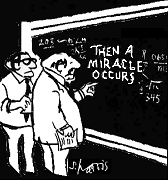
You have the beginning, which looks like an overly detailed police procedural full of gory details.  The players look for clues, find a wealth of useless information, spin their wheels guessing what the GM “has in its pocketses” (“Is it a vampire?” “No.” “Is it a warlock?” “No.” “Is it a demon?” “No.”) until a miracle happens and someone makes their Occultism roll and then the GM explains all the things and if they have magic, they can fight it, otherwise, people die. The end.
When I read this adventure, I can’t help picture the GM sitting behind his screen with this smug expression on his face, glorying in the detailed gore of each, individual description, and going over the deliciously creepy interrogation with the weird suspect, and then watching his smile get bigger and bigger as the increasingly exasperated players guess again and again, always getting it wrong, and then triumphantly revealing his weird, maniacal creation.  I don’t think this would be an especially fun experience.
If you’re going to do an adventure like this, it needs to either be a familiar monster with the twist built into sussing out the reality of the creature from the clues left behind, or a slow set of revelations about the nature of this novel creature to the players, where the entirety of the adventure is built around getting to know this new monster, it’s motivations and its world.
One last aside: what’s with the weird point totals? A typical Horror character clocks in around 75 points.  A typical Monster Hunter Sidekick clocks in around 200.  This is 150-200. If it’s aimed at default Horror, shouldn’t it be 75 points? And if it’s aimed and MH Sidekicks, wouldn’t you attach this to the Monster Hunter series? It just feels like an odd choice.  It could be that the idea is you start with 75 point horror characters, and then some 15 games later, you encounter the Drawn, but that seems an odd choice.  Adventures, in my experience, are aimed at beginning parties, not veteran parties, because beginners often need help getting going, while a long-running campaign usually has some momentum.

Meditations on an Empty Canvas

So, I’m not really a fan of this as an adventure.  There’s not much in it that I would salvage for something else.  I don’t really need the overly detailed description of the personal lives of these random people, I don’t really need the overly detailed descriptions of their tortured bodies.  If I wanted to run something like that, I would use a different monster, and thus need different sorts of deaths, and so that part is useless to me.  It’s passable as a “Creatures of the Night” entry, because you could use the Drawn elsewhere, but I’m not particularly fond of them either, as they’re uninteresting when it comes to motivations, inaccessible when it comes to exploring their strange origins, and too narrow in their vulnerabilities.  But I’ve read worse Creature of the Night entries than that!
But given that you can pick up a half dozen Creatures of the Night for ~$6, is it worth it to pay $3 for one entry? I don’t think so.
Give this one a miss.

GURPS PDF Challenge: Boardoom and Curia: Tomorrow Rides

 We’re entering the final stretch.  Only three left to go!  And today, we have the maddest of the bunch: Tomorrow Rides!

The executive summary is this: you can skip this. I like it, but that’s more a matter of personal taste.  It’s not a bad book, by any stretch, and it’s quite a creative work that will interface well with Action 6, but there’s nothing in here that you need, and it won’t do much for any game but offer a bit of flavor and background on a couple of things.

The Breakdown

The book breaks down into two chapters: “History,” which introduces us to the origins of Tomorrow Rides, and “In the Campaign,” which is the nuts and bolts of how it will work.
“History” introduces us to Jody Macht, the now-blind founder of Tomorrow Rides. It explains that Tomorrow Rides came out of a desire for Jody Macht to vicariously enjoy the squeal of tires and the thrill of the chase now denied her by her accident.  It explains the cleverly named “Mach Two” facilities, and briefly touches on other sorts of campaigns this might fit into.
“In the Campaign” explains how one can get access to the sweet rides available from Tomorrow Rides, gives us a stat breakdown of the organization, the codes they use for their rides, some suggestions on how you can randomly generate a tricked out vehicle, and speculates on what their ultimate motives might be.
And that’s it.  Tomorrow Rides is an organization that can get you access to really cool cars.  Everything is just a greater detailing of that concept.

Sorting through the Wreckage

Before I go on, I must explain my fondness for Steven Marsh. See, Steve is a madman. I was a subscriber to the digital Pyramid #2 (and had a couple issues floating around of the original, physical Pyramid), and I believe I might have even been there when Steve took over.  But he’s been there for a long time, I’d daresay 20 years, and I believe that the Pyramid #2 had weekly issues, and he had to write a column for all of them.  It’s became something of a running gag for him to pick a topic for a column in Pyramid #3 only to realize that he’d already covered that.  He scraped the bottom of the barrel long ago and, devoted man he was, he got out a shovel and started digging.  He’s descended into untold depths and every once in a while, returns with some unfathomable treasure, like this book.
Steven Marsh comes up with the most wild, off-the-wall stuff I’ve read.  Not in the sense of mind-bending concepts, that’s more Kenneth Hite’s bailiwick.  No, Steven Marsh is the sort of guy who says “Hey, you ever think about this?” and focuses on something relatively mundane and manages to squeeze something out of it that you hadn’t considered.  Only a mind like his could have thought “Hey, we need some organization whose sole purpose in life is to give you wild rides.”
But his flailings into the unplumbed depths in search of topics nobody has covered results in hit-or-miss results.  This is a miss, I’m afraid.  It’s not a bad concept, but what are you going to do with it?
The niche for this is to explain where your cool cars come from. But, uh, I wasn’t casting about for that.  Do I need to know where the cool cars of the Fast and Furious Crew come from? Does James Bond need a unique organization just for him? No.  If you’re playing Action, which this is most well suited towards, and you want a spy-car, you just put in a request and your GM gives you one or he doesn’t.  Where it comes from is a foot note at best. It’s a bit like detailing the temple that gives out healing spells in DF.  That’s nice, but most people don’t really care.
Unless the organization matters.  For example, if that Healing Temple has a particular agenda, or a dark secret, or some way to interface with it on a daily basis, or some way in which its healers are unique, then it starts to matter.  Tomorrow Rides doesn’t really have any of that.  The cool vehicles it offers are generically cool.  It has stats, but they don’t really matter: Tomorrow Rides isn’t going to be going to war.  Nobody is trying to undermine them.  Whether or not they can react to a sudden threat from another organization isn’t really relevant.  And they don’t really have any agenda other than “Make sure you do something cool with this vehicle,” which you were going to do anyway.
As I read the book, I found myself thinking “This feels like the Saturday Morning Cartoon I never knew I wanted to play.” But then I realized I still couldn’t play it. There’s no ranks, no org chart, no internal agendas. Other than the people who drive for them (who are more like associates than people who work FOR Tomorrow Rides) who do they employ? Presumably auditors, consultants, mechanics, likely some drivers of their own. What do they want? There’s a section that discusses Tomorrow Rides as a mad conspiracy, but what I mean is more of a day-to-day basis, the adventure hooks that Tomorrow Rides faces.  “If I work for Tomorrow Rides and I get a call from them, it’s to…” what? Drive a car? That’s a given.  What else? Rescue the daughter of a great car scientist from the clutches of the bloodthirsty Racer V? Make sure that Tesla Motors doesn’t steal that government contract out from underneath us? Go to the Bermuda Triangle and raise up the lost wreckage of a WW2 sub carrying experimental Nazi atomic engines that we want to load into a race car? There’s nothing.
Look, the point of an organization book should be how to play with that organization. That’s why we have stats: to know what its limits are, and how best to manage it.  Does the Loyalty of its employees matter? Does how well they’re paid matter? This book is like a City Stats book for a City that you’ll never go to: it’s a nice read, but you can’t do much with it.
I don’t think it’s a bad book. I don’t regret owning it or reading it. It inspired me and made me think of things I wouldn’t have on my own.  That’s why I like the mad-lad Steven Marsh. Now that he’s been liberated from the shackles of Pyramid, I hope he brings more of his crazy to GURPS, because we could use it.  Reading about Jody and the possible conspiracies and ruminating on the possibility of Tomorrow Rides having a time machine is fun, but you don’t need this book.  It won’t rev up your Action game, it won’t add a new faction to your Supers game, it won’t give your Monster Hunters game an unusual edge that they couldn’t already access, and it won’t give you new technology for your sci-fi game.  All it will do is give you a couple of names and details you can toss around about where your heroes got their car, and perhaps a bit of a twinge at the missed opportunity for running a game centered on Tomorrow Rides itself.  If you like that, then by all means, get this book. But for most of you, I think you can safely skip it.

GURPS PDF Challenge Review: Action 7: Mercenaries

Mercenaries unlocked ninth in the GURPS PDF Challenge.  This continues the Action series by offering a “campaign lens” to further customize your Action campaign.

My executive summary is: this is good! It wasn’t what I expected, but I really enjoyed it nonetheless.  It’s chock-full of ideas, and if you’re at a loss as to what to do with GURPS Action, this makes a great entry-way into a campaign. I would very much welcome a variety of books like this for action, even at this word count.  Like GURPS Action 6: this is a very economical book that squeezes everything it can out of its word count, and at $3, you’ll feel like you underpaid for it.

 Have you ever wanted to run the Expendables in GURPS? This is the book for you.

The Briefing

The book breaks down into three sections:
  • Mercenary Campaigns, a discussion of how to run Action with mercenaries
  • Firefights, some rules for speeding up play (including the BATTLE system)
  • Let’s Go Home, which talks about long-term Mercenary campaigns.

Mercenary Campaigns

I would argue that Chapter 1 is the real meat-and-potatoes of the book, even though it’s not what people are going to talk about. It breaks down how to set up a Mercenary campaign in TL 6, 7 and 8, adds some lenses for generic Action, discusses how best to use Specialists to create individual mercenaries, reprints some cinematic rules from GURPS Gun Fu and discusses a concept called “Combat Zone BAD” which abstracts all the difficulty of an entire theater for the purposes of abstracting difficulty (including things like not getting sick or for your survival rolls when bivouacking, etc) and Merc Units as Patrons.

I think this is probably the most important chapter, because it illustrates how to shift the generics of GURPS Action into the specifics of a mercenary campaign.  Action is a bit of an odd-man-out in the Framework series (though I think you can make the case that After the End follows a similar mode): DF and Monster Hunter both make a lot of fairly specific decisions, and while you have plenty of wiggle room and you can reverse engineer some decisions, it shuts out a lot of material.  Action doesn’t, really.  Rather, it mostly just digests some of the rules in a particular direction, but still leaves the game wide open. The upside of this is that GURPS Action is broadly useful to everyone (hence why it serves as a basis for Psi-Wars), but as a downside, it still leaves a lot of work for you.  Mercenaries digests these rules further, and I think that helps a lot.  I’d love to see a cops version and a heist version.

Firefights

Chapter 2 is the sexy chapter, though, the one everyone will talk about. It tackles “BATTLEs”, “Opportunities,” “Challenges” and “Casualties.” In principle, these look like one cohesive piece, but I think in practice, you can see BATTLEs and casualties as one thing, and Opportunities and Challenges as its own thing.

BATTLE is just an abstracted version of the Mass Combat system that has been “dumbed down” for Action. In this version, we ignore numerical superiority, the benefits of combined arms, broad strategic choices, and just have the leader roll Tactics with a difficulty of BAD, with individual combat scenes acting as complementary rolls and the previous results rolling over (so you’ll want to win as much as possible as early on as possible, and if you’re losing, maybe see if you can work out some smaller battles that better favor you to build some momentum).  This is the sort of thing that sounds dumb and obvious, but I think it’s brilliant.  It takes work to make something this concise, small, obvious and useful.  The more BAD it is, the more obvious that they’re going to have solid discipline and tactics; the less BAD it is, the more obvious that they’ll lack discipline and have crappy weapons, etc. Numbers don’t matter because there’s always “Enough” for the scene that you want. I also approve of Tactics over Strategy, as this is a much more immediate sort of fight: the kind that you can see on a movie screen, rather than men moving giant units around on a map.

I have a few complaints, though.  There’s not much discussion of complementary rolls. It feels more like “Each player gets a moment if the GM gives it to them, and they’ll probably pull it off, so it’s +1 per player.” You can do more than that, like have things like “Can you defuse this bomb in time,” or “can you take that machine-gun next in 2d6 turns or less?” but there’s not really a lot of support for that here.  That’s a word-count issue, though, and could be indefinite in length: you can always say more about that and offer more ideas.  My other complaint is meant to be handled by the Casualties section. Your units are likely to be small: 5-20 people, would be my guess.  So -10% in casualties is often going to mean one specific guy. Who? Well, the casualties section essentially says “It could be anyone.”  What is a “casualty?” “Interpret it liberally.” Look, there’s nothing here that you couldn’t work out on your own, so perhaps it’s not worth the word-count to delve into, but it’ll be a question that comes up, and the book doesn’t answer it that well.

As to the question of “What sort of cool encounters can we have in the midst of these battles,” that seems to be handled by Challenges and Opportunities, but they seem to do more than that.  They’re a broad set of ideas for spicing up your campaign.  You can use them in a BATTLE, I think, but you’re better off picking a few Challenges before a battle to work out some complications you can hit your players with, which could be handled as Complementary Combat scenes, above.  The opportunities don’t work as well as bits to toss the players way in a firefight, but more as interesting things that could happen over the course of the adventure.  For example, one of them is that you might find a Billionaire’s Kidnapped Granddaughter. Cool!  Probably not something that happens in the midst of shooting at people, but it could, and it’s also not something that’s likely to affect the outcome, but it would certainly change the course of the adventure.  Challenges can be used this way too: a minefield might represent an interesting challenge by itself, or as something you can toss into a firefight as a surprise when one of your mook allies gets blown up, or someone steps on a mine and you need to disarm it while bullets are whizzing past.

Let’s Go Home

This is a one-page summary on handling long-term campaigns, including randomized conflict zones (“Brutistan is a Tropical Dicatorship/Monarchy”), whether or not you improved in rank or lost rank or the ability to make ARs for an adventure, etc.

Manly Reminiscences

What you end up with this book is not just how to run a Mercenary campaign in Action, but a campaign generator.  Our mercs might to go Brutistan and participate in the putting down a revolt against the Monarchy that’s really being fronted by a military dictatorship.  We could allow the players to find the kidnapped daughter of the king, held by the bad rebels, only to be betrayed by the military forces who want to secure her for some dastardly reason and end up fighting both sides while dodging landmines, and trying to either negotiate a new deal or get extracted. Great fun, and I just go this from reading the book.
It’s usefulness extends beyond TL 6-8 Mercenary campaigns.  It’s utility in THS or some Cyberpunk TL 9 world should be fairly obvious, though it would take a bit of work.  I’d definitely use the BATTLE system in Psi-Wars, as quickly handling a big battle between two different sides is pretty much exactly what I want out of Psi-Wars.  Just shrugging and saying “One side will win or lose” diminishes the role of the officer, but worrying about the TSes of Valiants and Javelins and Space Knights shifts the focus from where it should be.  BATTLE is a perfect compromise and deserves all the praise it’s getting.
So, yes, this book gets a big thumbs up from me.  It wasn’t what I wanted, it was what I needed.  
 
As an aside, I find it amusing that Action 6 muttered ominously about introducing military-grade weapons to Action, and then Action 7 says “YAY! Military grade weapons!” I still don’t get why Action 6 was so down on military stuff.  That’s why Flesh Wounds are a thing!
Also, we’re back to some great artwork.

GURPS PDF Challenge Review: Monster Hunters Encounter 1

8th in our series comes a Monster Hunters book, the second most supported series of campaign frameworks.  This is, in essence, an adventure book, but it actually manages to contain not one, but two adventures for the same page count.  How is it able to do this?

My TL;DR summary is: This is fine.  It feels rather by-the-numbers, and I’d end up fleshing them out a lot, but unlike some other works I’ve panned, the skeleton provided by Rice is actually quite useful.  Of the two, the second is definitely better than the first. The more I work with them and dive in, the more I like them, but neither of them are going to “wow” anyone.  They’re work-horse with some decent design.  For $3, you could do worse than this set of adventures, and it’s a decent illustration as to how Monster Hunters should work, but I would have preferred the first one to be more innovative.  All that said, this is worth your $3.

Digging In

The book has only two chapters, which are the two “encounters.”
  • The Midnight Bordello
  • The Moon Clan
Both encounters follow the same structure: they lay out the basic premise, then they lay out “the hunt.”  They detail how the Hunters might uncover that a monster needs to be hunted, they handle what an investigation will reveal and what the difficulty will be.  Then it dives into how you’ll go from investigation into full on hunt, and what the final confrontation and its aftermath will likely look like.

The Midnight Bordello

Or, as I like to call it, “That Time Dean Winchester Couldn’t Keep It In His Pants.”  The core of this is that there’s a whore-house full of sexy, sultry vampires and you need to stop them, and the head mistress, Beatrix.
The biggest weakness of this adventure is how obvious it is. Once a monster hunt leads players to a dark bordello, the first thing they’re going to assume is vampires: they’re all hot, they like necking, they operate at night, they’ve got to be vampires.  And then you spring the big surprise on them: it’s actually… yeah, no, it’s vampires.
This is compounded by how difficult it is.  For example, the What is -8, which means a Sage will only get it on a 9 or less, and a dedicated Vampire-hunting Sleuth on a 6 or less.  Once the players have looked at their first dead hooker who seems a little wane and pale, they’re going to immediately guess “Vampire” and playing footsie by saying “but is it?” feels obnoxious.  On the other hand, this might be intentional.  Monster Hunters gives a +4 to deduce the truth of a situation if the players first guess it, so the “What” might, in practice, be a -4 rather than a -8, precisely because the players will guess it, which actually brings it in line with the other Encounter’s difficulty.  Similarly, the “Where” seems a gimme, given some of the suggested discovery conditions (such as the PCs just encountering the bordello).  The Who is probably the most interesting investigation, as we learn later in the adventure that Beatrix, if caught, will try to pass herself off as just one of the victims of the true head vampire, or even just one of the girls. Thus, if the players end up at the Bordello, assume Vampires, and then just start carving into everyone with garlic-tipped bullets, they might just miss their real target, as Beatrix slips right through their fingers.
The final confrontation is nicely written, with options for both day and night, and sets up the series of conditions, including a great “panic button” moment in the form of a bunch of feral vampires she can unleash when it comes to it, which is important: all the best “final fights” should have at least one twist available.  
This has a second one, in the form of a suggestion that between her social skills and “glamour” she might manage to “talk her way out.”  I’m personally a bit skeptical of this. Once you start rolling behind a table and informing players what they think of her, or that they like her, or whatever, they tend to get very suspicious.  I think the core idea is fine, as I noted above with the “Who” investigation and its importance, but this needs to be handled with a subtlety that’s not really elucidated in the text. But “How to run a good social encounter” is not really the premise of this book, so it gets a pass. Just be warned that you should be good at handling social encounters before running this particular adventure.
The aftermath notes what she does if she escapes, and discusses the vampire who created her, which is a nice twist, because it means this is an encounter that could easily spawn into a campaign, and reminds me of a single node on Night’s Black Agents Push Diagram.
I find the difficulty of it a little off-putting, as “Night of the Sex-Vampires” is going to be an adventure I’ll have a hard time selling as the Deeply Serious Affair the difficulty levels involved, as well as some of the subtlety suggests. Given its aftermath, it feels like it should be more introductory.  I’d run it in a way that felt “for the laughs” at first, and slowly got worse and worse as they players realized the stakes, especially if they lost track of Beatrix. It’s also a nice way to introduce some good recurring NPCs; while the text discusses nothing of the sort, this begs for the addition of a troubled teen, a corrupt cop and/or a hooker with a heart of gold who’s in a little over her head, and all of these are easy enough to add.

The Moon Clan

The Moon Clan is a bunch of lycanthropes who follow some witch-wolf who believes the moon is some sort of “trapped spirit” and seeks to release it with bloody, monthly rituals that often demand sacrifices, which can mean people going missing.
The investigation is easier than the Midnight Bordello, with difficulties of -4 to -6 rather than -8. There’s also a lot more things to learn (including an interesting When and Why), which means it’s a fairly easy encounter to add some urgency too if one of the PC’s favorite recurring NPCs was captured by the Moon Clan. It’s also complex.  While “people disappearing in the woods” doesn’t require a genius to figure out “werewolves,” the story is more complicated than that, with layers involving magic and cult practices, which means careful players will be more rewarded with deeper investigations in this encounter than the previous one.
Once the Moon Clan has been uncovered, Father Moon’s magic seems the toughest part of the adventure.  Perhaps I’ve missed something, but Monster Hunter’s werewolves never struck me as especially terrifying, but the encounter makes up for it with numbers and home-ground advantage.  The text points out the difficulty of attacking 30+ werewolves and cultists with a typical Monster Hunter party, and suggests a more careful game of cat and mouse, though I’m not sure what in the investigation would guide them to this.  Instead, it might be best to run the final encounter as a slowly escalating set of encounters: as you start to make headway in your investigation, you’ll encounter some werewolves and cultists.  As you dive into the woods to face them, you’ll meet patrols and someone will suggest secrecy, and if the players screw up and attack head on, we can figure out some way to leave them an escape route (to prevent a TPK) and then harry them with the werewolves as Father Moon intones that “they know too much.”
The aftermath highlights the fact that the clan is a clan.  They have children, family, and essentially make up a small town.  What do you do with all of that once you’ve gutted them of their weird moon cult? This doesn’t draw the players down a rabbit hole the way the Midnight Bordello does, but it nonetheless poses interesting questions for Monster Hunters.
More than the Midnight Bordello, this adventure has an interesting cast of characters, such as the Traitor Son, and Father Moon and Mother Moon. It also practically begs for a a weirdo, fanatical serial-killer type “Dragon” as a major worthy, and some cunning folk who live nearby and warn the players away from Outer Haven, and also perhaps try to hide their own connections with the Cult.  There’s a lot you can do with this one.
Also, an aside: I really appreciate that there’s a cult in a book that’s neither a crypto-christian cult, nor a satanic cult, nor a cthulhu cult.  I don’t necessarily mind these, it’s just nice to have a bit of variety.

A Moment of Reflection

I have mixed feelings about these encounters. On the one hand, they’re very by the number.  Chris essentially went through Monster Hunters 2 like a checklist, filled it in, and gave us two adventures out of it.  Neither is wildly creative or the sort of encounter that will have players sitting up and talking about how unique, innovative and unexpected it was (though with a bit of polish, the Moon Clan begins to push in that direction).  So, the worst we can say about them is that they’re fine.  And for $3, that’s good enough.
On the other hand, “going through a checklist” is a useful exercise for student GMs to explore. Once you see how these are constructed, cross-reference them with Monster Hunters 2, it becomes more obvious how you could create your own adventures.
Furthermore, the encounters don’t hold your hand, and that’s a good thing. These are not a carefully scripted adventure. Instead, it’s an outline for a situation that is going on, plus advice and detailed rules on how to handle specific elements of the hunt.  The rest, though, is up to you.  Which means these are pretty easy to plant into any ongoing campaign.  Yes, if you want a few more NPCs and ties to your players, you’ll have to provide those, but you always have to provide those.  Rice gets that, and doesn’t try to do it for you. He gives you… encounters! It’s up to you to decide how to work those into your larger campaign.
I also appreciate that Rice didn’t bother to pad his wordcount.  Chris can be ruthlessly conservative with his time and wordcount, and it really works in his favor here.  These are fairly barebones and, realizing that, we get quantity.  And I’m not entirely sure, other than an even deeper description of the NPCs and their combat capabilities, and a deeper discussion of the investigation and the sort of clues the PCs might find, what we’d fill out that wordcount with.  
I think there’s room in the world for a true Monster Hunters adventure, but for my money, if I’m honest, I think I prefer this Encounters format. I rarely run scripted adventures for a reason, but one of these encounters is actually pretty easy to work into my style of GMing.  So I have to admit, for me, I like them.  Thus, I see no reason to hesitate in recommending them to you.  They’re a decent and cheap addition to a Monster Hunter collection.
Also, the art is hit of miss, and feels more like “GURPS standard” than the brilliance of some of the other books, but that’s not really a problem.

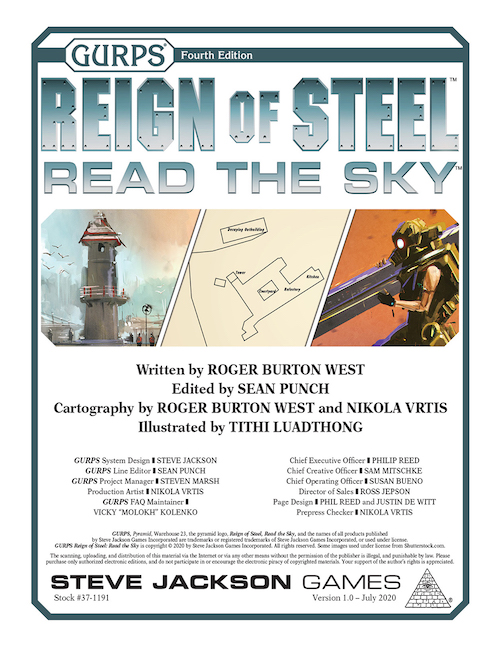
GURPS PDF Challenge Review: Reign of Steel: Read the Sky

Next in our series, we come to Reign of Steel: Read the Sky, an adventure for Reign of Steel, a GURPS setting about a post-apocalyptic world conquered by murderous, super-intelligent AI.

The executive summary: this is good.  Very good.  I will definitely use it.  I also think it’s the best work to utilize the space given to it out of any of the GURPS PDF Challenge books I’ve read so far.  It’s not great. It won’t blow your mind, and it has some issues, but it definitely has a place in your library as a work-a-day adventure for introducing people to Reign of Steel. It also provides some useful ideas for other games (especially GURPS Action).

The Breakdown

There’s nothing to breakdown there’s only one chapter: Read the Sky.  But that chapter is broken down into:

  • An unnamed first section that lays out what the real circumstances are
  • Setup (how to build your characters)
  • Events: the adventure
  • Aftermath: a teeny blurb on the consequences of the adventure
  • Characters: the bad guys the party will face
  • Locations: maps and some details on the areas in the adventure.

 The premise is this: A group of pirates led by one Samuel Axe fought with a Zone Zaire raiding party over the control of a small town called Tenby, and the pirates won. They’ve shut down communications to prevent rescue, and our heroes, unaware of these events, have been sent to investigate.

The adventure breaks down into three broad parts.  First, the trip to Tenby, which is interrupted by a “random encounter” bandit attack.  Then Tenby itself, which presents a mystery of what happened (The townsfolk will claim all is fine, and those aren’t blaster marks, just an unusual choice in paint jobs, everything is fine, thanks for asking.  Try the mushroom stew, it’s to die for.) and a possible combat encounter, and then the adventure culminates in a final confrontation with the pirates and, possibly, a single robot.

Musings

I’m not really one for using pre-made adventures, but there are a few that I’ve liked and made a great deal of use of.  This reminds me of one of those: “Fennerman’s Furs.”  It was one of three introductory adventures in the 2nd edition of the “Faserip” incarnation of the Marvel RPG. It was very simple, and followed a pretty straightforward sequence: an alarm trips in Fennerman’s Furs, a fur store, you have to investigate to find out that there are thugs ripping the place off, and once you subdue them, a supervillain shows up in a truck and jumps the heroes for a final confrontation.  It was simple, straightforward, impossible to screw up, and taught me a lot about the basics of minimalist adventure design, which was invaluable for a highschool GM like myself at the time.

This reminds me a lot of that in that it’s simple, straightforward and follows a very basic three arc structure.  It leads the players by the nose a bit, but it leaves room for flexibility.  It also provides quite some variety, all with a purpose.

The initial bandit fight highlights the danger of the world, provides some narrative spacing between “you have a mission” and “you arrive at the town” and acts as a warm-up for what’s to come, which makes this a great choice for an introductory adventure, as it lets players get a feel for how combat will go.

The town offers a change of pace: the fix (getting Tenby back on the grid) is very easy, but things seem off. This is a point where the adventure can go wrong in a variety of ways: the players might miss all the clues, fix the thing and go home, missing the rest of the adventure.  They might screw up, eat the poisoned stew and get sick and die to the villagers.  They might bypass all of that, and then kill all the villagers and never realize there’s another encounter beyond that.  However, the adventure offers more than enough clues and “hit your players over the head with a clue bat” options to get them to realize more is going on and to point them in the right direction.  A crucial one is the fisherman’s wife who betrays the plan with a hastily passed note warning the PCs. This serves multiple purposes: it warns the PC of the poison, and likely ears the PC’s gratitude (preventing unwarranted retribution) and gives a clue to the fact that the villagers are effectively hostages.  The adventure also insists on the PCs having a medic, which prevents the worst consequences of the poisoned stew.  Thus, this part of the adventure has multiple, meandering ways to get to the final resolution, and shores up potential faults with a few masterful touches and suggestions that might be so subtle that you’ll miss their cleverness on your first read-through.

The final battle is a straightforward fight, but with the added heroism and complication of kids being held hostage, and a psycho robot that the bad guys can unleash on the PCs.  This section also implies that the actions of everyone involved could bring the wrong sort of robot attention eventually, and it builds Samuel Axe as a boatsman/wheelman, rather than a fighter, which means escape is quite a viable option, either leading to a chase, or to a recurring opponent.

The author even finds the room in all of this to drop some additional details, like robot activity in the area, details on poisonous mushrooms, and loads of maps, a few names and implied traits of the NPCs involved, and while it’s light on stats, it does point to templates that the GM can use to flesh them out on his own.

I think my only real complaint about this adventure is that it’s barely Reign of Steel. Yes, there’s a robot in it.  One. Exactly one.  And yeah, it’s post-apocalyptic.  But the adventure reads more like an episode of the A-team than Terminator: Genesys.  The adventure even has details for suping it up as a straight-up Action story, which is how I’d treat it! On the other hand, you can’t really shed most of the Reign of Steel stuff either. The whole impetus of the adventure (getting Tenby back on the grid) and the robot, which is the adventure’s capstone, require it to be Reign of Steel. I mean, with some work and thought, maybe you could peel out the Reign of Steel elements, or put more in, but it sort of occupies this weird grey zone of “Just enough of Reign of Steel to not be a generic Action adventure, but not enough to act as a good introduction to the world.”

Still, I would totally run this.  I’d recommend it to you if you’re at all interested in Reign of Steel or GURPS Action, or you just want to read a well-written adventure.  I think this is a great example of an introductory adventure for GURPS, and you could learn a lot by exploring the template it offers.

GURPS PDF Challenge Review: The Broken Clockwork World

Let’s do the TL;DR first.  Hey, do you like Isekai anime? Or Stranger Things? Have you considered a story where characters go from our world into another, or things from another world spill into ours? Have you considered making the other world a broken, clockwork, steampunk work with some sumerian elements?

That’s it. That’s the book. You literally have all the support the game offers you (aside from a couple of steampunk robot-monsters, and a very deep discussion of portals) in the above paragraph.

I’m exaggerating a little, but that was definitely my first impression and it barely got better on a deeper reading. It’s not good. It’s frustrating because I want it to be good, but it let me down completely.  This book fails as a setting book.  It’s passable as a “campaign elevator pitch,” which you shouldn’t be paying $3 for.  I would give this one a miss.

Breakdown

The book is broken into 4 chapters
  • Two Worlds in Collision, two pages which introduces you to the broken clockwork world
  • Interactions, which is two pages on how you get there from here
  • The Broken Realms, which touches briefly on the technology of the setting, and mostly goes into 4 specific critters
  • Campaigns, which discusses how you might use the material.

What’s Wrong with the Clockwork World?

Let me briefly summarize the Clockwork World: it’s a steampunk setting, with physical justifications and technobabble to justify why it is a steampunk world and why it will stay a steampunk world, and then it notes that it is Sumerian, has a small blurb about the theology of the setting and notes the active intervention of gods at some point.  And then some unspecified cataclysm happens, and now everything sucks.  The Gods are gone, and you can sometimes fall through cracks in the world and end up in our world, or vice versa.
Okay, so what do I do with it?

The Campaigns section briefly touches on this.  The core idea is that you either have things fall out of the BCW and players interact with it (“Stranger Things,”) or players fall into the BCW and have adventures (“Isekai anime”).  It discuses approaches from 0 to 200 points.
 
But the book immediately starts to fall apart when it explains its world. It basically doesn’t.  It offers some hints at more lurid descriptions and throwaway lines about how varied everything is, but for the most part, we’re left to do the heavy lifting ourselves.  
 
Say we want to introduce a pretty princess as a narrative hook for our story? What does she look like? The book seems to suggest that they’re somehow culturally locked into a Sumerian  approach to things, but surely their steampunk technology has innovated their approach to things. How have they merged? Book doesn’t say. The book mentions that the setting has advanced thims things like newspapers and revolutions and robot horses, but that it’s still bronze age priests and kings. How does that work? Book doesn’t say. It’s either an anachronism stew, or we’re left to do the heavy lifting of making it work for ourselves.
The book feels like it sells itself on being such an outlandish pitch, but “outlandish pitches” are interesting because they’re supposed to explore something outlandish.  Other than a few descriptions of clockwork skies and gasmasked riders in desolate wastelands, the book does very little to integrate the stranger elements of the setting: what do characters look like? How has their culture fused with their technology? What sort of factions are there in the setting? You can see hints of it (the Iron Lion seems to be a clockwork temple guardian), and it’s not that Phil can’t do it (he has an entire sidebar in one of his Steampunk books on what people look like). So why is it missing here? Why isn’t he laying out his vision for us?
Maybe the reason is wordcount. That was the stance of the Chaotic GM, but I say it’s worse than that. I think the problem is priorities. About a third of the book is dedicated to “interactions.” It discusses what first contact would be like, the portals between worlds (including, and I’m not kidding, the dimensions: “between 8′ and 30′ in diameter”), that the exact number of active gates is unknown, that some portals permit 2-way traffic and some don’t, the fact that you can’t lop your arms off with the portals, and how long they last (there are transient gates, intermittent gates and periodic gates). Then it talks about totally-not-magical-spells that will let you crossover, and “psychic interdimensional communication” that will let you send messages in dreams. Then it talks about the government’s opinion (they’re super suspicious and trying to keep it a secret, natch) and the fact that there are rogue, don’t-follow-no-rules renegades that slip in and out of the two worlds: you know, the PCs.


“The GM should have Gates behave however suits the plot.” — The Broken Clockwork World, p 5

Two pages might not sound like much, but it’s a third of the book (discounting the ad, the cover and the table of contents), and none of it matters to me. That one quote above is all you need to say, and it’s basically inferred: “these two worlds are connected, people can get back and forth, see Portal Realms for ideas!”  Then use that wordcount to elaborate even a little on the factions, some example city-states (just a blurb!), some minor commentary on fashion, or at least a list of inspirations so I can see what you’re trying to do here (Is this Nier Automata? Dishonored? Stargate but Sumerian?).  Toss me a couple of names and agendas.  Give me something to work with here. The point is, this book had the space for these details, at least some of them, in brief, but chose to spend that wordcount on unecessarily details descriptions of portals and their use.
The book fairs a little better if shift focus from the BCW and onto our world.  Then the lack of detail doesn’t really matter because we can infer most things from our own world.  You get a list of monsters that can come across, the means by which they would come across, and how people would react to them. If you would actually like to adventure in a broken, clockwork world, this book is nearly useless.  If you want some weird, clockwork things to impinge on our world, you could do worse than this book. But that rather defeats the purpose of the book, doesn’t it? The Madness Dossier wasn’t sold as a book about going to a world where the world was ruled by mad, Sumerian gods, but as a book about a conspiracy to prevent some reality quake from destroying our timeline, and so the details of History B aren’t really important.  This is a book about the Broken Clockwork World, but you can’t actually use it to run games in the Broken Clockwork World.  That’s a big mark against it.
 
In a sense, this book, and its choice on emphasis, would have been fine if it had been Generic Steampunk World.  We know what that looks like, we have tons of books on it, tons of works to draw on. The deep discussion of Interactions would be warranted, because that would be the one thing you’d need to explain: There’s a steampunk world connected to ours, here’s how to get there.  Instead, we’re sold this outlandish premise, and then told to do all the heavy lifting ourselves.  
 

This is a peeve of mine, because you invariably get people who love the idea, and work themselves into a lather trying to make it happen and/or defending it, when there’s no substance behind it to merit that devotion.  See, for example, Rifts. By putting out a title with an outlandish premise, the author immediately gains your attention (“it’s not just a steampunk world, but a Broken, Sumerian Steampunk world! Do you love steampunk? Do you love the Madness Dossier? Do you love post-apocalyptic settings? Then come on down, only $3 a ticket!”) but then immediately backs out (because realizing an outlandish setting takes a lot of work!) and blames the word count and/or your own lack of creativity when called on the problems in their design.  This book is the RPG equivalent to clickbait. 


Enough

I’ve written and rewritten this review.  I could go and complain even more.  Why does the book insist that “mystical templates” are inappropriate when this was clearly a setting with active gods and supernatural powers are clearly present.  Why does it discuss the fact that (unnamed, undescribed) factions that seek to repair the damage caused by the breaking when you don’t even tell us what the breaking was? Why is this a post-apocalyptic setting with zero references to After the End? Why is there a discussion of (mystical!) priest powers with no reference to Divine Powers? Why is there a whole section on “rituals of transition” when the Gate spell is right over there? But I have to stop somewhere.

I don’t like writing negative reviews.  People put time and energy into these books, and at $3 a pop, it feels mean-spirited to pan a book.  But this is bad. It left me frustrated and one of the reasons I’ve had to re-edit it is to bring my rants into some level of coherence.  If  you want to know more of my complaints, just ask me, I’m sure I’ll give you an earful.

I think the biggest problem with this book is the effect I’m seeing it have on others. I see people praise the book, and I get it: it’s a great premise. But the insistence on fixating on useless details and ignoring all the things that would actually make the setting useful while shrugging and saying “Work it out yourselves” is pretty iconic of the failure of many GURPS setting books. I have no doubt the people enamored of the premise will bristle at my condemnation of this book, but know this: I am among your number. I love the premise. It’s a great premise.  But demand more of a setting book than a premise and exhaustive detail on its magical portals. If this gets revisited with the treatment it deserves, I’ll happily revise my opinion, but for now, my opinion is this: don’t waste your money on this book. Go buy an overpriced drink with some friends instead.

GURPS PDF Challenge Reviews: How to GM: Ritual Path Magic

 Even before we start, this book comes at two disadvantages.  First, its title starts with the letter “H” rather than “G” which messes with my alphabetical ordering of my folder. Second, I don’t use RPM for a variety of reasons. Thus, for me, this was definitely in the camp of “I got it in a bundle” rather than something I would buy if it showed up on Warehouse 23. This will doubtlessly color my review and make it hard for me to objectively judge the quality of this book, but I’ll do my best!

The book breaks down into

  • Tips, Tricks and More, which covers what you’d actually expect the book to be about
  • Ritual Path Magic Ultra-Lite, which was quite a surprise, but not an unwelcome one
  • Examples, a list of pre-rendered spells.
Overall, from my biased, uninformed perspective, it looks like a pretty good book.  I  mean, I’ve looked into RPM, and I had questions and concerns, and this book addressed those.  It didn’t make me rethink my position on RPM, but that wasn’t its purpose.  So I’d call this work a success: If you actually do want to use RPM, but you find you struggle with it, this may well be a book for you, if you don’t mind paying $3 for some GM advice (which, we must admit, is a pretty small asking fee.)

Musings

This covers a whole variety of things.  Let me hit some of the highlights.
So right off the bat, Chris addresses whether or not to treat something as “Lesser or Greater.”  It’s a good analysis! RPM leaves it in the hands of the GM, which is fine, but some guidance is welcome.  This doesn’t try to take it back out of GM hands, just illustrates some of the thought processes you might want to engage in while pondering what to rule on.  In all honesty, I walked away from that section thinking there should be three levels: lesser for “Yeah, sure, that’s basically nothing so it’s fine,” Greater, for “That’s some serious magic,” and then some higher level for serious, world-shaking magic.  This is not a knock on the book: a good discussion should make you think, make you engage and ponder how best to go about tackling thing sort of thing.
There’s a section on “Damage over time” that highlights one of my issues with this sort of magic system.  He lays out a very good thought process for how you can create such spells, but unless I misread it, it amounts to “If you want to do 1d per second over 10 seconds, you’re doing 10d, and the fact that it’s over time is a special effect.” I would argue that dealing 10d over the course of 10 seconds is generally less effective than just dealing 10d. This is not to knock his advice: the fact that he tells you to skip duration is a good thing! It’s just one of those things that emphasizes how superficial most elements of a free-form magic system really are.
There’s a section in Pitfalls on “limiting Grimoires” by adding “Spell Familiarities.” I find this an interesting section, as it seems to run against what a “free-form” magic system like RPM should be: players should say “I want to do X, what do I roll against?” and the GM should just tell them. However, a friend of mine suggested that the real strength of RPM is that it acts as a spell-design system, and this part of the book seems to agree. The real intent of this section is to limit the number of spells the GM needs to think about, and thus to design.  There’s a side-effect of this suggestion, which is that characters will have a limited number of spells they generally rely on.  This is key to maintaining a niche, in my opinion.  What’s the difference between a Dream Mage and a Mind Mage? Between a Fire Mage and a Forces Mage? Why, what spells they’re familiar with.  
If you were hoping for RPM as a hand-wavey “If you want to do X, just do roll Y,” that’s where RPM Ultra-Lite steps in.  I rather saw it this way since it was introduced in Monster Hunters, but I think it’s grown quite a lot since then, and this trims it back to something simple and streamlined.
So what about my objections to RPM? For example, I don’t like the Energy Raising “roll until you don’t roll no more” mechanics. Does this address that? Nope! But that’s not its purpose. It’s purpose isn’t to fix RPM for people, like me, who don’t like it. Chris actually has a Pyramid Article that does that. The purpose of this book is to help people who do like it, including people like me who might try something a little out-of-the-box but still need some guidance, figure out how all of this works.  I think it succeeds at that.
Also, goddamn that art.  These little PDFs have really raised the bar.

Conclusion

I wouldn’t have bought this supplement, and I’m not hip deep into this system the way I am in, say, Psionic Powers, Sorcery, Ultra-Tech or Divine Favor, so I can’t really speak to the things the RPM community regularly argue over, but from this looks good from where I’m sitting. If I did change my mind and decide to use RPM, I’d surely open this book up.  It doesn’t feel too long, or too short, or like it’s addressing things that don’t need to be addressed. It reads like an experienced GM guiding you through the RPM process and helping you avoid issues.  It doesn’t “fix” RPM, but that was never its purpose and I’m pretty sure the sort of people who buy this book wouldn’t think of it as broken; this is to their tastes, and I wouldn’t hesitate to recommend it to anyone who did want to use RPM.