The GURPS PDF Challenge Review: DF Adventures 3: Deep Night and the Star

The fourth PDF to unlock in the GURPS PDF Challenge was Dungeon Fantasy Adventure 3: Deep Night and the Star.
Now, this one leaves me at a disadvantage.  Yes, I’ve played Dungeon Fantasy, though no more than a few sessions at a time.  While I own most of the books, and I wouldn’t hesitate to run it, I’m not the sort of man that runs many adventures out of a book.  I also tend to lean more heavily towards “Tell a heroic narrative” side of the fantasy spectrum than the “kill monsters and take their stuff” side of the spectrum, which means that people like Dell’Orto will probably do a better job of telling you if the adventure is well balanced and such.  Thus, with that caveat, let’s explore!
The book is broken up into two chapters (though in practice it feels like three)
  • Prologue
  • Atoep
In Atoep, they have a final section on “new monsters” which I would have treated as its own (one page) section.
The prologue explains the premise: the stars are misaligned and demons and eldritch things pour out of the darkness.  These come from some eldritch space-think, and the wise old sage has created a portal that allows the heroes to reach it.  They must go there, and kill it by delving into three different living dungeons. That will end the eldritch incursion.
I like the premise of the adventure well enough, but I feel like the execution falls flat and risks being repetitive.  I think it’s a good idea, but it feels more like the seed of an adventure than a proper adventure.  Would I recommend it? I’m less confident in it than the others, but for $3, it’s hard to say no.  I just wouldn’t expect too much out of it.

Thoughts on the Premise
So, this continues a trend I’ve noticed in GURPS Dungeon Fantasy of “psychic swords vs eldritch evil” that I think gives DF a rather unique flavor that I don’t get from other fighting fantasy works.  This feels less like a typical D&D adventure, and more like a weird eldritch horror game with pulp-fantasy heroes fighting back against it.

This is reinforced by several interesting choices.  The “Dungeon” is a living, “blind idiot god” that moves between the stars.  The “surface” of the dungeon is just an accumulation of space debris, and the dungeons delve into the upper structures of its living body, to destroy and burn out parts of it.  There was an expedition that went before you, and you can see their remains half dissolved in walls, and the echoes of their personalities, slowly being digested by Atoep, whispering nonsensical madness in certain chambers.
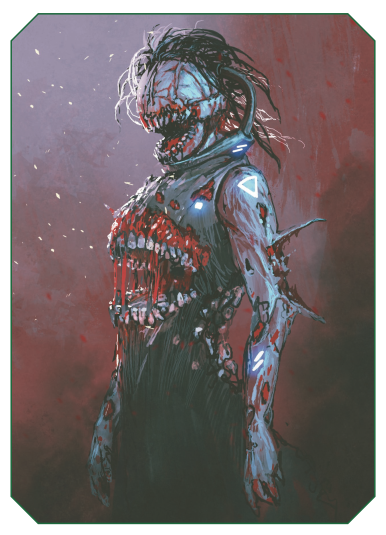
And then the art.  I mean, wow.  Look at that!  This whole series has great artwork.
The problem I have with this is the above is pretty much it.  Who’s the big bad guy orchestrating all of this? Nobody, it’s just a think that happened.  Can you talk to Atoep? Nope.  There are cultists. What do they believe? I dunno, doesn’t say.  Can you cast spells with the power of Atoep? Nope.  Are their eldritch secrets to be found sketched onto the walls of Ateop’s heaving innards? Nope. You just go to this weird world, go into psuedo-dungeons, kill some monsters, burn out the final area of each, rinse and repeat twice more, job done.  There is a reference to a cool skyship/spaceship that the players can adventure on, and you can get it, but it’s pretty scant on details.  Like many other things in the book, it saves wordcount by pointing us in another direction, likely towards the Fantasy Vehicles book I don’t yet have.
Like Riggsby’s other PDF Challenge book, I don’t mind the ideas here at all, I would just have rathered paid double or triple the price for more.  It feels less like an idea than a seed of an idea. And that’s fine, but for my purposes, I couldn’t use this “out of the box.” I’d have to greatly expand it, and that limits its utility to me.

Thoughts on the Adventure

I can’t really tell you if you the adventure is “good” in the sense of well-balanced and with interesting elements or not, but I can give my less-experienced impression. 
First, all three dungeons have exactly the same layout.  If you have mapped one, you have mapped them all.  This may be justified by the fact that organs can repeat across an organism: you’re basically going into Atoep’s eyes, and the inside of one eye is basically the same as another eye, so fine.  But the result is that if the players have seen it once, they have seen it three times.  That, IMO, risks making it feel tedious.
The monsters tend to be the same few monsters over and over again too.  We see a lot of Demons from Between the Stars, No Brainers, Neuroids, and Double-Devourers (a new monster).  Later on, we’ll see some Flying Squid Monsters and a single Mind Warper.  While the encounters vary from dungeon to dungeon, they don’t vary that much.  One dungeon has some molds in it, another has more cultists, but beyond that, they tend to be pretty similar.  This might also increase the sense of tedium.
The adventure is set up to create a nice sense of escalation, though.  The new monsters, the Cleansing Crabs and the Double Devourers, are conceived of as the “immune response” of Atoep (and there are others, like rising water levels or “fever,” etc).  If you cause collateral damage (with all your fireballing and machine-gunning arrows at people), it’s possible you’ll trigger an immune response, aka a nasty addition to the current encounter.  This chance increases the more damage you’ve done to Atoep, so the third dungeon, whichever it is, will be _much_ harder than the first, and this is the real point of difference, which might be enough to solve the tedium of the above two: by keeping everything the same except for the introduction of worse and worse conditions for your encounters, you can escalate the game without confusing your players.
But I’d worry a lot that the players would feel like they’re doing the same thing over and over again and fighting the same monsters over and over again.  I think I would have integrated clearer “themes” to each dungeon.  Sure, they’d all be variations on the “eldritch” theme, but they’d make each location more distinct.  I’d also have had different layouts for each dungeon: hit up the “eye,” the “intestine” and “the voice box” or something. 
I’d have also given the players more personalities to interact with.  Sure, DF players just want to kill monsters and take their stuff, but my experience is that they at least want to pretend that they’re doing more than just killing monsters and taking their stuff, and some Mind Warper taunting them with its plans to take over their world and then a race between them and the Mind Warper and its Cultists to get to the Skyship before Atoep died would have been a lot of fun.
I think this brings us to the core problem with this work, and a theme I think we’ll run into often with these: the premise of a lot of these supplements are more ambitious than the page limit really allows. If you doubled the size of this text, the additional detail would go a long way from making this a bare-bones, workable adventure into something really memorable.

Conclusion

It’s… it’s fine. I think I’d call it the “first disappointment of the series,” which feels like a harsh thing to say, but let me clarify what I mean.  When I read what it’s about, I got very excited.  By the time I was done, I was much less excited. That doesn’t mean it’s bad.  I think I might even try to run this adventure, as the premise is very compelling. I just wouldn’t run it “as is.”  I don’t know how you, dear reader, feel about that, but I think $3 for a sketch of a very good idea with some good, basic work put into it isn’t a bad buy.  So I would tentatively recommend it.

GURPS PDF Challenge Reviews: GURPS Template Toolkit 3: Spaceship Crew

Following the unlock order of the PDF challenge, we come now to Template Toolkit 3: Starship Crew, which turns out to be exactly what it says on the tin.

The book is split into two parts (nout counting the introduction).
  • Job Openings (a list of templates)
  • Assembling Crew (suggestions for using the templates)
Briefly summarized, this is exactly what you’d think it would be, providing us with several templates for building a spaceship crew. It’s also very good, which means that we’re batting 3 for 3 with the releases and reviews.
Also, as an side: this is some of the best art I’ve seen in a PDF.  SJGames invested more than I would have guessed into these PDFs (though you’ll see some art re-used as you go through all of the PDFs).
With that, there might not be much more to say about it, but if you know anything about my process, you likely know I find this a very interesting book.  But I think it’s more interesting than you likely realize, because of what it signals about the intentions of GURPS.  Why is it a Template Toolkit, and what can you do with it?

Breakdown

So, we have our two chapters.  The first covers “Everyman Advantages,” which is familiar to anyone who has used a GURPS Campaign Framework: it’s an abbreviated list of “all acceptable advantages and disadvantages and skills”.  However, it’s intent is more to give you a basis on “what traits are always acceptable.”
Then it moves on to the templates.  Each Template is 150 points, and has two lenses: Legendary, for a heroic version of the template for +50 points and Multi-Role, which is intended for other templates; it’s sort of our “cross-class” template, so if your Helmsman is also a Commander, you take the Helmsman Template, and the Commander Multi-Role lens. This also costs 50 points.
The Templates are:
  • Commander (“The Captain”)
  • Helmsman (“the Pilot”)
  • Operations Officer (the guy with all the Electronics Operations skills who tells you what’s on scope and that another ship is hailing you)
  • Tactical Officer (the guy who shoots the ship’s weapons)
  • Engineer (“The Scotty”)
  • Medical Officer (“the Bones”)
  • Science Officer (more the guy who answers questions about weird phenomenon and gets samples from planets than the guy reading your radar)
  • Security Officer (for shooting people)
  • Loadmaster (Someone’s gotta load cargo on…)
  • Steward (The guy who talks to passengers and makes them happy)
Chapter 2, “Assembling Crew,” discusses different power levels, and it includes an “Omni-Competent” lens, also worth 50 points. It also discusses different genres in very broad terms (I think the book would benefit from sitting down and discussing the different genres in more detail, while it actually just implies a great deal across the whole book). It also discusses where you can find some of the more obscure perks and talents.
Taken together, the book covers everything from Firefly to Star Trek, giving you templates for handling any typical “Captain and Crew story,” whether that captain and crew are part of the gloriously heroic navy, sinister pirates, or cunning tramp freighters dodging the law.  It also covers everything from 150-point “heroic, but not that heroic” characters to cinematic, 300-point legends that saved the Federation from a great alien menace.

The Minimal Viable Template Book

In a sense. TT3 replaces GURPS Space in same the way GURPS DF 1 replaces Fantasy.  GURPS Spaceships has templates in it, but they follow the mold of early 4e templates, not the “modern” template approach of Late 4e GURPS (GURPS 4.5?).  Thus, most people tend to forget that Space has templates (and in any case, they cover more than just the starship crew; for example, they include thieves and space knights), but I suspect Space will continue to see more use than Fantasy does, because most people have a pretty static view of how they see Fantasy and they don’t need a book to tell them that, while the GMs of sci-fi games all have wildly disparate ideas on settings they could be running, and space offers not just support for that, but rules for generating biologically plausible aliens and astronomically plausible planets.
Those familiar with my approach to setting and framework design doubtless know what I’m going to say next: if you combine this with a few other books,  you have everything you need for 90% of “captain and crew” space adventures.  Everything else is just details.  The real strength his book brings over the templates in Space is tight integration with the rules of GURPS Spaceships.  Spaceships outlines a “base” set of rules for how to handle spaceships, different roles characters would take on, and these templates largely fill those roles.  In a very real sense, there is a “game” already present in GURPS Spaceships, which these Templates plug into. If Templates Toolkits 3 is “GURPS Space Adventures 1: Captain and Crew” then GURPS Spaceships and its various supplements are “GURPS Space Adventures 2: How to run the game and have fun.”  The Engineer integrates with the SS repair rules, the Helmsmen with the piloting rules, and so on.  If you whip up some planets from Space, some aliens from Space, pick a TL and grab some gear from Ultra-Tech, Bob’s your uncle, you have a space campaign, and you’re basically three iterations into what I did with Psi-Wars.
Thus, if you want to run a sci-fi campaign for GURPS, this is a must have for your campaign, and at $3, it’s pretty affordable.

Wait, a Template Toolkit?

I found the choice of Template Toolkit to be an odd one at first, but after reading it, I understand it.  But I also think it likely says something about the future of sci-fi support in GURPS.
A Template Toolkit exists to help you create your own templates.  This is not a book for creating your sci-fi templates, it is sci-fi templates. So what gives? Well, they only look like sci-fi templates, they actually are toolkits.  A proper campaign framework makes assumptions about a setting that this book does not. What is your TL? Is FTL available? What sort of campaign are you running? Are their aliens? Cybernetics? Psychic powers? This book tries to offer support and suggestions for all options.
But then, if it’s trying to cover all possible aspects of captain-and-crew game, why isn’t it a full PDF treatment? Why is it a ten page, $3 PDF? This is where we get into “the future of sci-fi in GURPS.” A lot of people have asked for the space opera equivalent to DF, not in the sense of Space Opera, but a full campaign framework for science fiction.  But such threads making the request immediately fell to arguing over what sci-fi.  See, Blade Runner, Aliens, Terminator, the Expanse, Star Trek and Star Wars all fall within the very broad domain that people mean when they say “sci-fi.” Though purists will forever argue about what actually merits the lofty title of “sci-fi” (“Star Wars is more space fantasy” they’ll say), the point is that what people popularly think of as sci-fi covers everything from the rigorously researched Atomic Rockets to the “Space Fantasy” of Star Wars.  This is not true of fantasy. Oh, sure, sometimes the setting is dark and moody, sometimes it’s sunny and bright, sometimes it has elves and orcs and sometimes it has lizard people and deep ones.  But they almost always mean guys with swords killing monsters and taking their stuff, and if you want more, you can build upon that foundation. There are other forms of fantasy (urban fantasy, the whimsical fantasy of Xanth or Gulliver’s Travels) but thanks to the ubiquity of D&D, most people don’t use the term “fantasy” to include those sub-genres.
The net result is there’s no easy, obvious “one size fits most” campaign framework that you can put under the umbrella of “Sci-fi,” and these tend to get shorter treatments:
  • if you want Cyberpunk, there’s a Pyramid article for you, and you otherwise use GURPS Action at a higher TL.
  • If you want planetary romance, you dig out “The Dungeons of Mars” article and upgrade your DF to include the elements found therein.
  • If you want to play a bug hunt, you dig out Monster Hunters, take MH 5: Xenology and, depending on your power-level, Sidekicks and and Ultra Tech and build-your-own X-com or Aliens.
  • If you want Captain-and-Crew, you grab this, Spaceships, Space and Ultra-Tech and get to work.

I don’t think we’re going to see more support than that.  We might see some specific settings (Reign of Steel, Transhuman Space), but I wouldn’t hold my breath for “GURPS Not-Star Trek.”

Heroes of the Galactic Frontier

Those deep into their Mailanka lore have likely stumbled across Heroes of the Galactic Frontier.  I was working on that before I started this blog and Psi-Wars.  The idea behind Psi-Wars was to introduce you to the idea of this with a “simpler” version in the form of not-Star Wars and, well, here we are, still working on Psi-Wars (though in my defense, Psi-Wars as it was initially conceived of, as an example of campaign framework design, was done in the first year; everything else has been people asking for more setting material and refinements to the framework).
HotGF was meant as a “not-Star Trek” and “not-FTL.” It was meant to take the core gameplay of Spaceships and turn it into a workable game.  With TTK3 out, that’s less necessary, but still an interesting project to work on.  Assuming I’m right and we don’t see a different implementation of GURPS Captain-and-Crew pop out, I might, but it’ll be quite a distance off.
But even without my work on it, I hope you can see how you can use this to build your own campaign fairly easily. At this point, you have pretty much all the tools necessary. Yes, they’re scattered across a variety of supplements (and I think that’s one of the things people appreciate about watching me do it, is I might think of an article that they didn’t), but it should be pretty doable at his point, thanks to TTK 3.

The GURPS PDF Challenge Reviews: The Incense Trail

Continuing my reviews of all the GURPS PDF Challenge, we move on to Hot Spots: the Incense Trail.  By Matt Rigsby, one of my readers commented “It’s Matt Riggsby, of course it’s going to be good,” and the executive summary here is that they’re right: this is exactly the sort of thing we’d expect from Mr. Riggsby.

The book breaks down into:
  • Geography and Land Use
  • History
  • Economy and Culture
  • Gazeteer
  • Campaigning 
Ultimately, this is about the pre-Muslim Arabian Peninsula, primarily from roughly 500 BC to 500 AD, which makes it an interesting time period because it isn’t covered by most GURPS books (the closest he can get are GURPS Egypt and GURPS Rome, both of which are merely adjacent to the region in question).

My Impressions

This book reminds me of a Kenneth Hite book, not that it’s filled with high weirdness, but that the information density is very high without giving the impression that it is.  Every paragraph or so there’s a reference that, while totally fine on its own, makes me want to jump over to Wikipedia to learn more.  This sort of writing ultimately makes me want more, a lot more.  I think, after reading this, I would happily fork over $20 for a full supplement treatment, though I get that will never happen: have you heard of the Incense Trail? Do you know why you’d want to read up on it? No? Then the supplement won’t sell.  That makes this a perfect treatment for a $3 supplement to be bundled in with a bunch of others.  I think most people will treat it as a book they also got while getting Megadungeons and Tricked Out Rides, but I think you should stop and really read it. There’s good stuff in here!
I happen to be very interested… well, in the Middle East in general, but I’ve always been interested in the shadowy times of the pre-Islamic and early-Islamic Middle East. This book actually taught me a lot, giving me pointers to the religions and kingdoms that dotted the area south of the Fertile Crescent. Everyone knows about the Hebrews, Canaan, Assyria, the Sumerians, Babylon, etc; but how much do you know about the Nabatians and the Kingdom of Saba?  
One of the things I came across during my research into early Islamic history was a debate over whether or not what we call Mecca today was actually the real “original” Mecca or a creation of a later Islamic ruler; one of the key arguments the Mecca-Skeptics make is that some city in the middle of the desert right next to the Red Sea wouldn’t be the center of a trade route (“They would just transport goods by ship”).  Yet, if you read through the Incense Trail, you’ll see that isn’t true: it’s not only plausible, but we know there were cities and communities that were central to the Incense Trail (really interesting cities too, like Iram of the Pillars).  It put Mohammed in a better context for me, as well as some of the other things I learned in my research (I may have to go back and reread “In the Shadow of the Sword” again with this context).  So this book taught me something.
Okay, so some of you are thinking “Well, then, this is dry and musty history.” I happen to think history is a great source of inspiration, which is why I study it so much (I will also note that some of the most well-received RPG authors, like Kenneth Hite, or fantasy authors, like Tolkien or G. R. R. Martin, are historians, or are drawing heavily from history).  But even if you don’t want a historical game, this is a region of the world that later inspired 1001 Arabian Nights, back when it was still polytheistic and “full of sorcerers,” and was bordered by places like Rome, Egypt, Babylon, etc. It’s the world of bazaars, spices, the sacred scent of incense, Petra, the djinn, ancient gods and fallen kingdoms in a world of sandswept desolation. Even if you’re running a strictly fantasy game set in the another world, there’s still some insights here for your campaign.
The one downside to the book is that it’s very light on gaming information.  You have essentially a single page that touches on the sorts of skills and perks such a character might have and a very light sketch of what sort of campaigns to run.  I have mixed feelings about it.  First, I would have loved a much deeper treatment, but that means more words, more page-count, and we’re back to the conundrum above which is you can’t afford that on $3, and would people pay for more before reading the book? Second, some people argue that the strength of GURPS supplements lies not in how useful they are to GURPS people, but how universally useful they are.  This is a supplement that takes all the disparate parts of history (economic history, cultural history, religious history, military history) and begins to bundle them together so that you’re getting a complete picture of what that part of the world looked like. Sure,  you could do a lot of this research on your own with Wikipedia and Google, but it’s going to take weeks, and you’re not going to find everything you need (I know, because I’ve looked!), and this integrates it all together in a way that the layman is going to struggle to do.  I think that’s it’s great strength, not as a GURPS supplement, but as universal RPG supplement that would help any campaign.
So, yeah, I would definitely recommend this. For only $3, you’re going to get quite a treat.  It’s more of a snack than a full meal, and it’ll leave you wanting more, but there are far worse things to say about an RPG book than “I would happily have payed ten times that price for ten times the wordcount.” And if you got this as part of the PDF challenge, don’t let it settle on your hard drive and get covered with data-dust.  Read it! You’ll enjoy it more than you think.

The GURPS PDF Challenge Reviews: Tricked Out Rides

So, in the beginning of July, Warehouse 23 ran a Kickstarter, the “2020 PDF Challenge” which included 12 PDFs.  I’m going to try to review all twelve (in the order they were released).  If you missed the challenge and want to pick them up, I think you still can, and I believe the price is around $3 apiece.

The first to drop was Action 6: Tricked-Out Rides.  TL;DR: This is totally worth getting for anyone who follows the Action Line.  It’s not GURPS Vehicles by any stretch, but it’s more than enough for most action games. It has a few holes (it really should have jump jets for cars), but by and large, it’ll let you build almost any car (not motorcycle, tank or fighter jet) that you’d like to see in an Action game.

Tricked Out Rides is a 10-page PDF by Sean Punch, whose work is always impeccable. It has two sections: the Introduction and the Body Shop. It’s short, but dense, and it packs a lot. Think of it as like a very long and very detailed pyramid article.
The book gives you a series of “standard” vanilla vehicles, from a sub-compact car all the way to an HMMV, and then has rules for upgrading them with a variety of options including:
  • Improvements to the core statline
  • Integrated Upgrades
  • Electronics
  • And cool gadgets
This is not a replacement for GURPS Vehicles: it will not give you realistic stats.  But it doesn’t want to. In GURPS Action 1, they gave you the option to take a standard vehicle and “downgrade it,” for the hero who wanted a beat up, rusty old Chevy. This does the reverse, and gives you the options to improve things.  A lot of options are patently unrealistic if you stop and think about them.  For example: any upgrades to armor or the mass of the vehicle would reasonably slow it down, but they don’t; similarly, upgrades to speed would likely come along with measures to reduce the weight of the car, but nothing stops you from doing both at the same time, having both a heavier, tougher, faster and more agile car.  The book even discuses this in a sidebar on Modifications and Weight, and I happen to agree with this approach.

“I’m going to need you to get all the way off my back about this, sir.”  

–Ryan George, Pitch Meeting

Look, this is GURPS Action, the realm of things like “Knight Rider” and “Air Wolf.” The writers of Knight Rider didn’t stop and think “But where do you fit the advanced mainframe on which the AI is installed into a Pontiac Trans Am?” It just does, okay? The point of these vehicles is to be cool, not to break them down into their core components, blue-print them, work out their aerodynamics in a wind tunnel, run some complex calculations through excel that involves the dreaded cube root, and then come up with the actual top speed to three significant figures.  It’s for people who just want a super cool vehicle now. When you pair this with the standard Action rules for weaker vehicles, you do get something of a substitute for GURPS vehicles.
So can you build KITT with this? Alas, no.  I looked. You can install a computer, but it caps out at Complexity 3.  There are (rather shockingly) no rules for jump jets that I could find, which I’m definitely going to give it a bad mark for, as for awhile, “cars that jump” was all the rage in the 80s, so not having that is a huge oversight; it’s also not something I can easily work out myself how that should operate, so it would be appreciated! But you can make what amounts to a race car with turbo boost (NOS) and you can armor the vehicle, and you could probably use the same basic rules for gadget installation to install some UT gadgets, if you really wanted a robotic car.
So most of these vehicles that you’ll make with Tricked-Out Rides will either be a facsimilie of a real-world vehicle if you want some sort of system to build out an actual vehicle, but you don’t want to use GURPS Vehicles or GURPS Spaceships, or you’ll use it to build a more subtle-than-KITT James-Bond gadget car, or a suped-up Fast-and-Furious car.  Other than oversights for icons like KITT, this is a pretty thoroughly good book and I’d call it a must-have for any Action game unless cars really don’t matter to your game. I will also note that it doesn’t support non-cars.  There’s no motorcycles, tanks or fighter jets in here (though I don’t think it would be a problem to assign these rules to motorcycles).  There is a sidebar on the dangers of high-octane military weaponry and how it can wreck a campaign, but given that Action 2 discusses nuclear weapons, I feel like a sidebar warning against the dangers of a Heavy Machine Gun is a little narrow-minded.
Another downside to the book is that it uses the standard rules for Signature Gear, which makes these vehicles ridiculously expensive.  The example spy-car clocked in at 39 points.  I’m not sure if you bought it as signature gear, you’d get 39 points worth of advantage from that car, as in a lot of cases you wouldn’t be able to leverage it.  Contrast this with a tricked out gun that’s going to rarely run you more than 1 to 5 points… Of course, you can just pay for the vehicle, or requisition it from your organization, but I think the hefty character point price on these vehicles will make players hesitate to get them. Mind you, you need some sort of limitation there, to explain what Billy Bob gets for taking his discounted, beat up truck intead of a sweet ride like Damien Swift’s street racing spy-car.  I’m just concerned that the signature gear rules would overly punish Damien Swift given the utility of his spy car.  But that’s not something that Tricked out Rides can really address.
I’ll definitely be looking through this for how to apply it to Psi-Wars.  I thought about going with something like this, but the problem I ran into is that we expect fighters and capital ships to vary too much from one another.  We don’t expect there to be “a generic capital ship” and “a generic fighter” and then trick them out, we expect wildly different designs and bespoke experiences.  Even so, I can imagine people might want to tinker with their vehicles and get “the most out of them that they can.”  But given that I’ve stepped away from dollar costs for signature gear for ships, I’m not sure what that would practically look like.  If you allow it “for free” then people will take all the upgrades you allow.  If you put a character point limit on it, that needs to be applied by some consistent measure.  While I disagree with the implications of the Signature Gear system that Action 6 uses, it does mean you know exactly what 1 character point can buy you!
Overall, it’s a great book.  It belongs in the collection of any Action gamer.  No, it doesn’t cover every possible vehicle you’d want in an Action game and indeed has a few glaring holes, but what it does offer is dense and useful, and even where it has holes, those holes tend to be pretty obvious as to how you could fill them (add some ultra-tech, apply this same idea to motorcycles, maybe even the fighter jets from Dogfighting Action, etc). It’s better for people who want to run games inspired by James Bond, the Fast and the Furious or Dukes of Hazard than it is for people who want to run Knight Rider, Air Wolf or Top Gun, but I think that’s a perfectly acceptable scope (with the inability to properly stat up KITT as a noted exception).