LBAW Wilwatikta 14: The (Oc)Cult of Wilwatikta

If the history of Wilwatikta is going to matter, it must be player and GM facing. It cannot be irrelevant background info (I don’t mind that, but then we should summarize it, and those really interested in the specifics can dig up design notes to find out how we came up with it). Gamers don’t actually care about the history of the dungeon they’re in unless it provides context for their loot, or helps them solve puzzles, or helps them navigate it.

Fortunately, lots of neat ideas popped up from my notes, so I have plenty of things to play with. I wanted to settle down and discuss some of history’s mysteries, and also discuss some of the evolutions of the planet and nail down some mechanical traits, such as some of the cults I’ve spoken of and some of these “variant racial templates” I’ve discussed.

Continue reading “LBAW Wilwatikta 14: The (Oc)Cult of Wilwatikta”

Backer Post: Domen Tarvagant Poll Results

We’ll get back to our regularly scheduled Wilwatikta posts soon. Tech took a very long time and so I lost a lot of my lead. So in the meantime, I thought I’d drop a poll result that’s been a long time coming: it’s from the first “joint” poll I wrote in Google Forms years ago. Why has it taken so long to come out? I’m not sure, because I’ve been actively using them (my backlog of “unreleased” content I have is becoming a bit of an issue; I should really focus on getting it out). In any case, if you wanted to know more about the other Ranathim death cult, the forbidden one, here you go! With luck, I’ll get the actual cult out soon!

Wiki Highlight: Hackers and Bloodsiders

It’s been a rough month for my health, and Undercity Noir has dominated my attention, but my blog discipline has been slipping.  My apologies for that.  Even so, I do have more material on the wiki. In case you missed it, or wanted some “Creator commentary” here we go.

Hacker

Fulfilling my last “Release the Balloon People” poll, I’ve released the Hacker cross-training power-up. This represents a sea-change in how I’m handling cross-training: instead of treating it like the Specialist Skill-Sets from Action, I’m treating them more like the Cross-Class Templates from DF, though not in the sense of literal cross-class training.  Instead, I generally find I prefer creating a list of things you can further invest in.  Rather than construct a character by picking a base template and 5 or so highly determined micro-templates, I’d rather you picked One Big Template and then One Big Power-Up, because this is conceptually simpler.  You might be a Cyborg + Space Knight or Psychic + Con-Artist. Similarly, I’d rather see Hacker + Assassin.  This also works very well for the “side-kick” templates I’ve built: you can take a 125 point “mini-template” and grab a 50-point power-up template, and then fill out the other 75-125 points with additional skills and advantages from your template.

In my experience, when I make characters with templates, at some point I already know what I want.  Following the details is nice, but eventually I get it and I’m tearing off on my own.  I suspect less experienced players eventually do the same, and they’ll want more things from their advantage list than fits into the default value, more skills than they can afford, etc.  So, I feel like hitting fewer “high concept” templates like this works a lot better for this sort of character creation.

So you can see the Hacker template and the new, updated cross-training templates here.

Bloodsiders

So quite some time ago, I released a list of criminal organizations in Psi-Wars, and offered up a poll for who you wanted detailed first, and the House of Bastards won handily, so naturally I did the Bloodsiders first.  Why? Because they were pertinent to Undercity Noir and half the characters took some sort of relationship with them so they needed to be expanded.  The result took more time than I expected, mostly because of their Mythos.  They have street magic that’s steeped in their superstitions and urban folklore, so I needed to create the set of stories and oaths they would acquire from this.  This makes it a “minor philosophy,” and largely a subset of the Divine Masks.
The Undercity Bloodsiders are descendants of refugees from the Umbral Rim who gathered together to form new bonds in the crowded undercity of Kronos.  They recreated their own vision of the culture of the Umbral Rim in those mean streets, and the resulting criminal gang is a savage group of bloodthirsty punks with a fixation on the occult and their own strange tales of the Undercity.

You can check out their organization here and you can check out their mythology here.

The Templar Chapters: the Far Striders

Alternate Names: The Templar Vagabonds

The rim of the Galaxy has more than its fair share of beggars and religious pilgrims. One can find them in a cantina drinking quietly, or sitting in the street with a raised bowl, begging for credits or scraps of food. They seldom stay in one place long, often wending their way to some distant temple, or to richer planets. They make easy pickings for thugs or pirates, but most criminal scum native to the rim tend to leave religious itinerants alone, for they know who travels with pilgrims. Those who violate this taboo may find themselves casually disarmed by a staff-wielding pilgrim or wake up in a gutter with no memory of what happened after they first uttered a threat. The religious itinerants of the Rim enjoy the protection of the Templar Vagabonds of the Far Strider Chapter.

The Templar Vagabonds resemble the pilgrims they protect. Many wear simple brown robes, belted with a sash over a tunic and pants and sturdy, serviceable walking shoes. Others might wear an old, well-worn, patchwork vacc-suit. They often wear hats, to keep the sun off their face, or a scarf over their face to keep out dust. They typically wield either a staff, usually just a very long length of pipe or some rough-hewn wooden walking stick, or a cobbled-together force sword at their belt. Many mistake them for scavengers, beggars or wandering trash; the Templar Vagabonds prefer it that way.

Origins of the Far Strider Chapter

Shortly after the liberation of the Temple Worlds by the Communion Crusade, the Knights of Communion turned to the protection of pilgrims who wished to journey to said worlds. As the reach of the faith spread farther and farther over the galaxy, the Templars found they needed to journey even greater distances. The Sparriel sage-knight Rokoonooda took it upon himself to build a new chapter of Templars, one trained in the art of survival and navigation, so that they could travel to the most distant part of the Rim and back, even if it took years, to escort pilgrims from the most remote regions and to answer the calls for assistance from the most isolated temples. His chapter became self-sufficient, able to recruit, train and arm themselves with very little support from the broader Templar hierarchy. He named them the Far Strider chapter.

As a result, when the Knights of Communion fell, the Far Strider chapter barely noticed. They hadn’t needed the support of the larger organization of the Knights of Communion for some time, so when the execution squads of the Alexian empire came hunting for them, they simply cast aside what remained of their armor and dignity and merged into the population. Nonetheless, they retained their identity; what had been an overt chapter of the Knights of Communion became a covert chapter. They secretly inducted new members, introduced them to fellow Templar Vagabonds, quietly accepted calls for assistance, and distributed ancient Templar secrets amongst themselves.

Today, they maintain their old role of defenders of the faithful. Remote monasteries know they can call upon the Far Strider Chapter when in need, and pilgrims will “hire” the Templar Vagabonds to guide them safely to their destination. Their secretive ways and their ability to casually travel the galaxy makes them one of the few chapters in some form of contact with other chapters, which makes them a vital glue for holding the remnants of the Templars together.

Personalities of the Far Strider Chapter

Chapter Master Dindee Ooda

Dindee Oodao is an elderly and irksome Sparriel. Throughout his long tenure (the longest in the chapter’s history), he played pranks upon his own disciples, laughed heartily with his fellow templars during gatherings, and taught the Templar Vagabonds not to take themselves too seriously, and each of his jokes and riddles contained a profound truth within them.

Thus, when Dindee Ooda disappeared, the Far Striders did not notice at first, for the Grand Master, like the rest of his chapter, could fall off the radar for months at a time. But months turned into years, and no prank seemed forthcoming. Finally, the Templar Vagabonds began to panic and hunt for clues as to what happened to their Chapter Master. They uncovered journals and memory crystals which revealed Dindee Oodao’s personal quest to recover the lost relics of Isa the Exile and put them under the protection of the Far Strider chapter. Each cache found by a Far Strider investigator pointed to further caches of information, maps to suspected relics, and hints of a larger conspiracy. Some of the memory crystals contained cryptic messages suggesting that Dindee Ooda expected fellow Far Striders to discover these caches and instructing them directly to carry on the quest.

The Far Strider Chapter is divided as to what to do. Some wish to carry out the quest, while others feel it more important to find their Chapter Master first and foremost. Some continue to treat him as their Chapter Master, merely on an extended absence, while others have begun to discuss the need for succession. The general consensus seems to be that this is Dindee’s greatest trick, and that in doing it, he has put the chapter to the test.

The Knight Commander, Shimada Jack

The Knight Commander of the Far Strider chapter is a native of the Alliance world of Persephone, and served under Chester Sabine, father of Nova Sabine, during the Great Galactic Invasion, whom he introduced to True Communion. With the death of Leto Daijin, Shimada Jack left the Federation in disgust and devoted himself to the Far Strider Chapter, where he trained under Dindee Ooda himself. His strategic acumen and logistical skill made him a natural for tending to the needs of the Templar Vagabonds, and he became their Knight Commander

Recently, Nova Sabine contacted Shimada Jack, begging for help against the Empire. Knight Commander Jack has become increasingly concerned with the Empire’s oppression of the Galaxy and feels inclined to turn the Far Strider’s resources to openly declare for the Alliance and help defeat the Empire. More than this, he feels that Dindee’s quest was an effort to re-unite all of the Templars, to restore the Knights of Communion, a task that the Far Striders are well-suited for, given their contact with most other chapters.

Shimada Jack, appears as a distinguished and handsome old man. He keeps his hair cut short and wears a beard. Despite his humble birth, he speaks with more than a hint of an aristocratic accent, likely picked up from his years of service to the Federation, and has an infectious smile that readily disarms conflict. The Templar Vagabonds adore him, and readily approach him for advice. Many in the chapter call for his ascendance to the role of Chapter Master, but Shimada has refused, believing that Dindee Ooda still lives and that he is unsuited for the role.

The Swordmaster, Mysterious Kitha

Mysterious Kitha (with the full name Anxamorte Kitharn) serves as the Far Strider Swordmaster. Despite his role, he prefers to go unarmed, and often claims that Communion will provide him with whatever weapon he needs to defeat his foes. As swordmaster, he trains Far Striders in the art of improvisation and tactics. He often starts with basic chores to toughen his student up, then moves on to evasion, situational awareness and diplomacy, often neglecting actual combat training until the very end of the student’s education. He firmly believes that teaching students to fight will make combat their first resort when it should be their last. His preferred technique is the Simple Form, which he combines with Keleni stick fighting to create a highly unpredictable style.

Mysterious Kitha dismisses all discussion about whether or not the Chapter Master has died or not and who should succeed him as irrelevant. When the time comes for a new Chapter Master, Communion will let them know. Instead, he tries to focus the Chapter on the task clearly given to them by Dindee Ooda, and gathers up willing Templar Vagabonds to begin the quest for Isa’s relics.

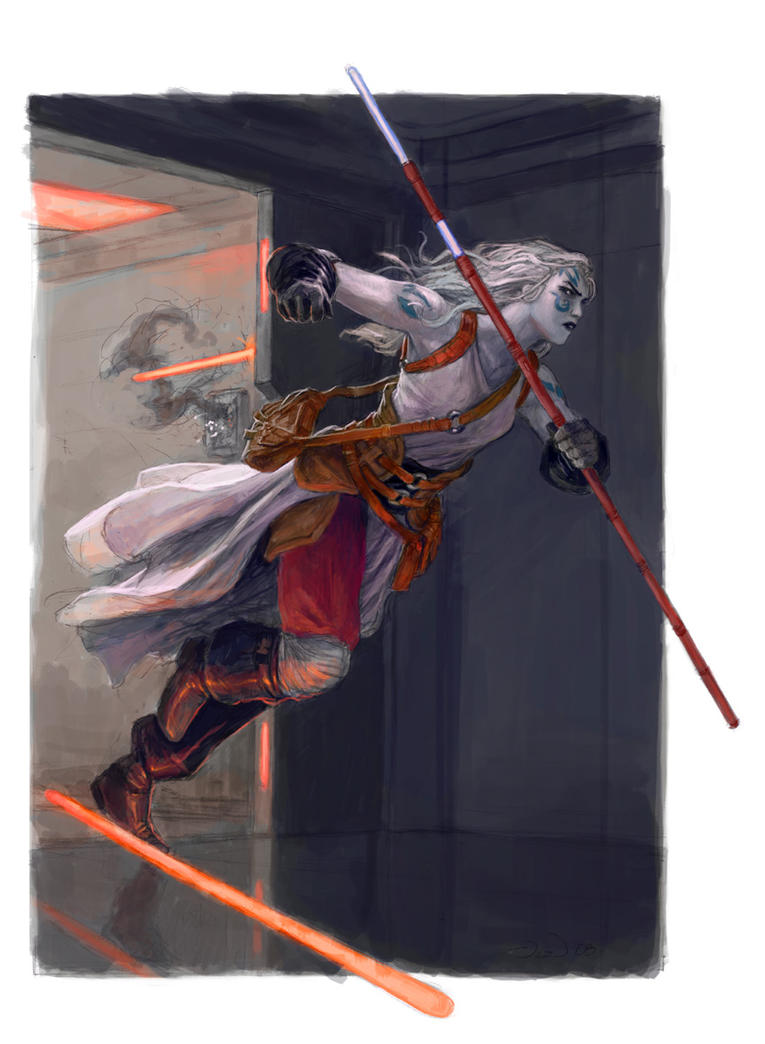
Mysterious Kitha is Keleni, but with remarkably dark blue skin, the color of the ocean at night. An unruly and tangled mane of white hair surrounds his face, catfish-like whiskers surround his mouth, and he wears rags. He enjoys wine, and the scent of it often lingers near him.

The Warden-Nun, Teleku Lili

The Warden of the Far Strider chapter is traditionally a Trader born on the Teleneku Ark, the closest thing the Chapter has to a home, and Teleku Lili is the latest in a long line of such Wardens. She acts as the first line of defense of the Ark and sees to the needs of those aboard, as well as maintains contact with the rest of the Templar Vagabond. When the grand master calls a gathering of the Chapter, as the Warden, Lili acts as host.

Lili believes that Dindee Ooda is dead, and that a new Chapter Master should be called, and advocates for Mysterious Kitha to take that position (much to his annoyance). She argues further that the ultimate purpose behind Dindee Ooda’s quest is to carry on Isa’s legacy of converting new races to Communion. She believes that Communion wishes to be spread beyond the bounds of the Galaxy, and she works to prepare the Teleneku Ark for an intergalactic journey that will take them far beyond the stars that they know.

Lili is a young albino Trader with white skin and red eyes that resemble finely polished rubies that carry within them the glint of stars. She wears a lightly armored Trader skinsuit beneath a simple brown robe, and carries the heritage force sword that all Far Strider Warden’s carry. She speaks softly, but with a very pleasant voice and speaks Galactic Common with a velvet fluidity. She has the bearing and demeanor of a librarian, both shyly quiet and profoundly knowledgeable. Traders tend to find her less attractive, seeing her albino skin as unhealthy, but aliens and humans both describe her as “cute,” and she has a small circle of admirers, none of whom she entertains, as she feels a proper Warden should dedicate herself to her job.

The Chaplain, Abbot Isikaia, “The Grasshopper”

Abbot Isikaia is the “Grandather” of the Teleneku Ark (see below), though by now, its social structure resembles nothing of a typical Ark. He sees the journey of the Ark as the compliment to the journey of pilgrims: where they seek to go to holy places, Isikaia tries to bring holiness to the pilgrims. He accepts any who wish to take an audience with him, and speaks in the typical, impossibly clipped manner of the Traders, but those who are true to the faith of Communion an always understand what he means: what seems to be a single syllable becomes, to their ears, a deep and intricate truth that is nearly impossible to explain to others.

Isikaia has deep green skin and wears nothing but a cloth over his loins, eschewing the typical Trader garb of a vaccsuit and gasmask, allowing others to see him in his true Trader nature, including his distended jaw. He often goes without food for long periods, and resembles a bundle of frail sticks wrapped in stretched green leather.

Resources of the Far Strider Chapter

Organizational Resources

The Far Strider Chapter is a poor chapter. They can offer very little in the way of material resources, and expect their members to improvise when the need arises. They have no standard issue gear (they expect their members to scavenge or build their own, or inherent their weaponry from a previous Templar Vagabond), they offer no cash or funding and have no facilities.

The Far Strider chapter has numerous “Safe-Houses,” (see Pulling Rank page 15), but these resemble flop-houses more than safe-houses. Local communities or passing Templar Vagabonds maintain the small sanctuaries so that the next Templar Vagabond has a place to rest. Such Safe Houses tend to sport caches of equipment, information and money, but exactly what is in each varies from house to house and moment to moment; such caches are whatever the last Templars could scrounge up and store, in case they or any other templar might need them, often including notes on local events and star-maps for the local area. Safe houses tend to be secured either by the local community, or are hidden from sight and noted with sigils and symbols known only to members of the Far Strider Chapter.

What the Far Strider Chapter lacks in wealth, it makes up for in social connection and knowledge. The Far Strider Chapter has an excellent reputation among communities of dispossessed and religious communities (including True Communion communities, but remote Akashics and minor folk religions like Shepherdism all tend to have a positive opinion of Templar Vagabonds). With appropriate groups that have a positive association with the Far Strider Chapter, Templar Vagabonds may Pull Rank for a complimentary roll on Reactions, or to gain an Introduction (see Pulling Rank 18).

The Far Strider Chapter has a deep knowledge of the remote areas of space. They often have high levels of Area Knowledge, and may act as guides. Treat guides as Consultants (Pulling Rank p 15) with Area Knowledge 21. The Far Strider Chapter can also provide members with excellent star charts to “lost” worlds on the rim. Treat this as Files (Pulling Rank page 15).

The Far Strider Temple: The Teleneku Ark

The Far Strider Chapter travels from temple to temple as their needs and quests dictate, but if they called any temple home, it would be the Teleneku Ark. Scuttled during the early Alexian wars with the Traders, True Communion faithful, repaired it, and built a great, mobile temple to True Communion within. It travels the Galactic Rim to this day, bringing the sanctity of True Communion to remote communities and after centuries of offerings, minor repairs and additions it is, by far, the largest and most ornate temple of True Communion.

The Teleneku Ark, like most Trader Arks, is enormous and is capable of hosting entire city within it. Broadly speaking, it does so: it brims with refugees and pilgrims who may ask for passage on the ship if it plans to head in the same direction as their particular journey. The Ark also houses considerable monastic complexes, libraries and monastic schools, making it one of the larger temple and monastic communities to True Communion still in operation. “Operation” may be a strong word, as the centuries old ark groans in need of proper maintenance, and its underbelly swims in corrosion that the monks can barely handle, and disrepair is a constant concern of Temple Wardens.

The Astral Gardens, the Teleneku Ark’s most celebrated feature, serve as the spiritual center of the great Temple-Ark. They reside in a dome atop the Ark, where they may bath in starlight during the “night” cycle of the artificial lighting. Fountains and streams flow through the meandering and peaceful gardens, and at its center, surrounded by the artificially supported life, an enormous eloi crystal slowly spins on its anti-gravity platform.

When the Teleneku Ark arrives in a system, its shuttles spill forth from it in a great, religious armada that descend upon a planet. The monks of the Teleneku Ark treat planet-fall like a religious festival, and they entertain the populace with hymns, religious dancing and sprinklings of water. They tend to the sick where they can, proselytize, and bring the message of True Communion with them. But, in particular, theybeg. The Teleneku Ark relies on the generosity of the faithful for its repairs, maintenance and its stores of food. The Ark’s denizens work to repair the Arks factories and food vats so they need rely on no one, but in the meantime, their begging, dancing and loudly proclaimed religious messages irritate local officials, who usually drive off the Ark after a short time.

The Templar Vagabonds claim no specific temple as their home, but the Teleneku Ark has a special place in their heart. The Warden of the Ark, always a female Trader, is treated as a Master of the Far Striders, and when the Far Striders gather for a conclave (typically once a decade or whenever a major matter, such as the disappearance of the Grand Master or Shimada Jack’s call for rebellion, comes before the Chapter), they meet at the Teleneku Ark and gather in the Astral Gardens. For many novice Templar Vagabonds, their first moments on the Teleneku Ark are their most cherished memories.

The Far Strider Community

Pilgrims of the Rim

Any religious person from the Rim has at least heard stories of the Far Strider Chapter. The Far Strider Chapter continues to offer their services to religious individuals who travel the stars, whether as pilgrims or refugees, and see them safely through their journey. These travelers inevitably remember the act and wish to return the favor. Far Striders, by convention, refuse personalfavors, but accept organizational ones, so a Far Strider may claim a favor for the deeds of another Templar Vagabond. As such, the Far Strider Chapter has built considerable good will among the religious communities of the Galactic Rim, and can generally count on safe passage or even the hospitality of these groups.

The Gutter Fraternity

As one goes farther and farther from the bright center of the galaxy, the harder life becomes, and many people fall through the cracks and find themselves homeless wanderers of desolate worlds. Inspired by the example of the Far Striders, many of the poverty stricken peoples of the Rim have taken to emulating them: they share tips with one another, swap favors, engage in mutual defense and recognize one another by certain hand signs or code words. They have formed an informal organization that the Rim has dubbed the Gutter Fraternity, though some outsiders mistakenly believe it to be the Far Striders; despite this error, the Gutter Fraternity and the Far Strider Chapter do have close ties: the Templar Vagabonds often recruit from the Gutter Fraternity or get tips about a particularly psychic child from them, and in return, the Templar Vagabonds go out of their way to protect the poor wherever they go, whether those beggars are actual members of the Gutter Fraternity or not.

The Patchwork Fleet

The Empire faces insurgencies all across its edges, but few more resilient than the Patchwork Fleet. What started as a collection of crusty old asteroid miners, merchants and part-time pirates found themselves backed into a metaphorical corner by some particularly ham-fisted and overreaching decisions by local Imperial authorities. When they moved to defend themselves, the Empire took it as a full blown insurgency and acted. Shimada Jack happened to be nearby and gathered a group of Templar Vagabonds to help resist the Imperial attack and to get the remnants of this group to safety.

The insurgents dubbed themselves the Patchwork Fleet and now move from system to system as a patchwork fleet, training locals in how to build and maintain their own starfighters or convert their corvettes to small attack vessels. They help defend locals from pirates and hit imperial convoys. While not overtly devoted to True Communion, the ideology begins to spread throughout their ranks, and their work with other insurgencies also spreads True Communion ideals, until it’s not uncommon to hear quotes from Communion literature bandied about, either casually or formally, in the regions the Patchwork Fleet is known to operate in.

Many in the Far Strider chapter have connections with, friends within, or have served with, the Patchwork Fleet, and thus the two organizations often collaborate. The Far Striders have numerous connections across the galaxy, and support or assist numerous rebels, but the Patchwork Fleet is perhaps their most well-known and most successful rebel contact.

The Virtues of the Templar Vagabond

The Far Strider Chapter practices three virtues:

  • Tolerance
  • Humility
  • Asceticism

Isikia teaches all three; Shimada Jack teaches Tolerance, Mysterious Kitha teaches Humility and the Warden-Nun Lili teaches Asceticism.

The Far Strider Chapter embraces an ideology of self-denial. Following True Communion and, especially, becoming a Templar Vagabond means setting aside your mortal life and mortal concerns and pursuing a higher path. They often quote aphorisms from the Verses that refer to removing oneself from the world. They believe that monks and Templars alike should understand that what mattersis not how much one has, but how much one can do for others.

When it comes to the “others” they should do good deeds for, this means everyone. The Theology of the Far Striders Chapter argues that True Communion is a philosophy of universal brotherhood. Everyone should be welcomed into their ranks, no matter how poor, how low-born, or how alien. Furthermore, they see everyone as equal in True Communion. An aristocratic lord who joins the ranks of the Templars Vagabond must learn to roll up their sleeves and clean the Teleneku Ark or their local safe house by hand, along side a former slave and a poor street urchin.

The Heresy of the Far Strider Chapter

The Far Strider Chapter embraces more heterodox virtues than orthodox virtues, which makes for a tense relationship with Keleni Traditionalists. Their tolerance of other traditions means unusual ideas leak into the culture of the Chapter, and their remoteness from one another means that each Templar Vagabond has their own unique take on Communion. The rest of the Chapter accepts this as a matter of course, believing that each master brings with him unique insights into Communion; this also makes it easier for specific Templar Vagabonds to embrace the peculiar brand of theology that another Chapter has, and thus more easily interact with them. Taken as a whole, though, the Chapter embraces strange ideas about Communion that bother other, purer chapters, particularly their belief in the extinction of self, devotion to chastity, translation of Communion texts into other languages, and their tendency to try to connect True Communion theology into other faiths, especially folk religions or the Akashic mysteries.

This tolerance means they tend not to be especially vigilant against those who would harm Communion with their ideals. The Templar Vagabond have largely lost their fighting spirit: they canfight, and will to defend their pilgrims, but they shy away from crusades and tend to leave more vile traditions alone. They have little interest in shadow wars with the Akashic Order or the Cult of the Mystic Tyrant.

The Martial Arts of the Far Strider Chapter

Rokoonooda believed in flexibility and taught the chapter to try to understand the underlying principles of war and, if possible, to avoid conflict. The Far Strider Chapter teaches:

  • The Simple Form
  • The Graceful Form
  • Keleni Stick Fighting
  • Guidance

Templar Vagabonds tend to learn from one another in close master/student relationships, or train with one another when their paths cross. They also try to learn from whatever temple or martial tradition they come across in their travels.

The Simple Form tends to serve as the basis for almost all Templar Vagabonds, as it has the flexibility to integrate almost any style. A master will teach it to his student and then the student will learn other force sword styles (or other martial arts) in his journey and find a way to integrate the Simple Form into those styles, or to integrate those styles into the Simple Form. As a result, most Templar Vagabonds have extraordinarily fluid approaches to combat, where no two fight the same.

The most common styles to supplement the Simple Form are Keleni Stick Fighting and the Graceful Form of the Alliance. Keleni Stick Fighting allows the Templar Vagabond to defeat a foe without killing him, which many Templar Vagabonds prefer: a resonance staff is as common a weapon among them as a force sword. The Graceful Form teaches agility and defeating an opponent through intimidation rather than injury, and integrates well with the Simple Form.

Finally, many members of the Chapter study Guidance as a means of dissuading an opponent from fighting with a simple wave of their hand and negotiation. The humbleness inherent in Guidance serves their virtue of humility well. The swordmaster, Mysterious Kitha, is especially fond of the style. Many other chapters point out that a devotion to Humility and mastery of telepathic Suggestion make the Templar Vagabonds exceptional conspirators, but the Chapter laughs their concerns off as paranoia: the Far Strider Chapter has no desire to rule the Galaxy.

Vagabond Tactics

The Templar Vagabonds don’t worry about supply. They tend to make do with whatever they have on hand, and if they must engage in some covert activity, try to limit themselves to missions they already have the equipment to undertake. If they need more, they typically beg for it: they will call on favors, ask for it from the local religious community, or simply walk up to others who would benefit from the act and strike up an alliance on the spot.

When it comes to organization, the Templar Vagabond act as de facto independent clandestine cells. A higher ranking Templar Vagabond may see a need for action and then remotely contact various groups to perform tasks necessary for the completion of that plan: Dindee Ooda was particularly fond of this, giving particular Templar Vagabonds seemingly nonsensical missions that accumulated into a major action that defeated an opponent. Vagabonds often do not know why they must do what they do, but accept it on faith. Such orders come from mutual acquaintances or via “drop points” that all local vagabonds know.

When trying to accomplish a mission, Templar Vagabonds prefer violence as a last resort or as a means of defense. They would rather persuade others, and persuade they do! They are accomplished speakers who can draw crowds, create whisper campaigns, or even incite riots. If things go wrong, Templar Vagabonds can simply drop what they’re doing and fade into the populace, but they also learn to survive on any planet in the harshest of climates. They can simply leave whatever population center they are in and take to the deep wilderness. If they do end up captured, they can take advantage of the toughness built up in the pursuit of asceticism and endure their captivity in stoic silence.

Typical Templar Vagabond Traits include:

Advantages: Cultural Adaptability, Cultural Familiarity (Any), Honest Face,Forgettable Face, Language (Any), Language Talent

Skills: Acting, Area Knowledge (Any), Carousing, Current Affairs (Local), Diplomacy, Filch, Hiking, Holdout, Navigation (Any), Meditation, Mind Block, Observation, Panhandling,Public Speaking, Pilot (Starship)Savoir-Faire (Servant), Stealth, Smuggling, Survival (Any)

Relics of the Far Strider Chapter

The Staff of Rokoonooda

Rokoonooda struggled to walk in his last days, and carried a crooked cane with him wherever he went. This cane has been passed down to each chapter master of the Far Strider chapter, as a reminder of infirmity and the importance of service. Those who bear gain a bonus +4 to True Communion creation rolls to invoke miracles of the Exiled Master, but tend to suffer unfortunate fates, often suffering humiliation, injury, set-backs or encountering truly bizarre phenomenon. The Chapter Masters of the chapter refer to this as “taking the burden of Rokoonooda.”

Price: $50,000

Statistics: Reputation 4 (Exiled Master) [20]; Unluckiness [-10]

The Warden-Blade

The Far Striders have lost the secret of the resonance blade, but they still have a few, including the traditional blade all Wardens of the order have always carried: the Warden-Blade. The ancient weapon is more than a weapon, it is a badge of office, and as such, it grants the bearer the ability to enter anyfacility, temple or monastery associated with True Communion. The bearer must be worthy, but if they are, doors automatically open for them.

Price: $150,000

Statistics: Accessory (TK Lockpicks; True Communion Locks only) [1] + Telekinesis 2 (One Task, Picking Locks associated with True Communion, -80%; Reduced Time 10, +200%; Divine, -10%) [21] + One Task Wonder (Lockpicking, True Communion facilities only; Cosmic, no die roll required) [2]

The Relics of Isa the Exile

The most famous figure of the schism of True Communion followed by the Templars, according to tradition, Isa the Exile brought True Communion to humanity and all alien kind. He is the most beloved sage of True Communion to all Templars. Dindee Ooda sought out relics associated with him, and believed he had located many.

All of Isa’s relics are instantlyrecognizable as very holy to the faithful; the relic itself and the bearer both gain +2 reaction from the faithful. Furthermore, the relic itself counts as “holy” for any purpose that might benefit it, but will explicitly only work “for the worthy;” precisely what this means is up to the GM.

The Mantle of Isa

According to legend, Isa was a masterful healer. His very touch restored health to the plagued and protected the weak from psionic malediction. He fearlessly faced vile spirits or wicked psychics and ministered to the weak and dying. According to legend, his simple robes carry these same effects: the wearer, or anyone touching the garment, is protected from all hostilepsychic effects; the garments also provide the wearer an additional 10 HP in the form of “vitality reserves.” The garment also heals any who touches it: the wearer cannot control this, the garment, instead, decides who it will heal; when the garment heals, the wearer takes on the wounds or disease or the disease of the healed target; this is first paid out of vitality reserves. The vitality reserves of the mantle “heal” at 1 HP per day. At the GM’s option, rather than suffer the effects of the disease, the wearer instead pays an amount of HP (either his own or out of the Vitality reserves) determined by the GM.

Shady antiquities dealers regularly peddle scraps of the mantle of Isa; if such scraps are genuine and have real power, they typically grant the keeper a vitality reserve of 1 and a +1 to resist hostile psionic abilities.

Price: $1,000,000; scraps are worth $4,000.

Statistics: Healing (Cosmic, no die roll required +100%; Divine -10%; Empathic -50%; Unconsious -30%) [33]; Static (Psi; Area Effect (Requires Contact -30%) +35%; Discriminatory +150%; Divine -10%) [81]; Vitality Reserve 10 (Divine -10%) [18]; Holy [1]; Social Regard 2 (Venerated; Blessed) [10]

The Staff of Isa

The staff of Isa is, perhaps, his most recognizable relic, as he carried it wherever he went. The staff would most likely have been a resonance staff that he used for self-defense, but it has gained a tradition as a “tool of miracles.” Those who bear it receive visions of what Communion would have them do, are unusually lucky when serving the will of True Communion, and may invoke powerful miracles, gaining a +4 reaction from Communion.

Price: $500,000

Statistics: Destiny 3 (Serve Communion) [30]; Holy [1]; Social Regard 2 (Venerated; Blessed) [10]; True Investiture +4 [20]; Visions (Overwhelming; Divine rather than Psionic) [15]/

The Crown of Isa

Isa belonged to the Kihita clan, the royal clan from whom the rulers of the Keleni were drawn before the destruction of their interstellar polity at the hands of the Eldothic Empire. As such, many True Communion faithful claim that Isa the Exile was a prince who gave up his prestige and position to bring True Communion to the whole of the galaxy. According to this legend, he inherited a crown that, if worn, would reveal his full glory and fill him with the full might of Communion.

If the Crown exists, it might grant the wearer the ability to invoke the Primordial Avatar miracle at will; the wearer may choose which Avatar to invoke: Righteous Crusader, Bound Princess or Exiled Master.

Price: $2,500,000.

Statistics: Alternate Form (Bound Princess) [209]; Alternate Form (Exiled Master) [15]; Alternate Form (Righteous Crusader) [15]; Holy [1]; Social Regard 2 (Venerated; Blessed) [10].

The Templar Chapters: Wardens of the Monolith

Alternate Names: The Templar Pariah, The Templar Wardens

Those who fought against the Great Galactic Menace, when away from prying ears, will sometimes whisper of a rumor of assistance from deep in that arm of the Galaxy. The wildest intelligence reports from the Cybernetic Union which discuss looming threats against the Terminus Council, confirm these rumors. Both discuss mysterious, armored space knights seemingly unstuck from time, caricatures of the Knights of Communion from before the fall of the Alexian Empire with devastating force sword skills, powerful psychic abilities and a message for all who came to the world of Sepulcher “Go. This world is forbidden.”

The Wardens of the Monolith are real. Their massive Temple-Fortress guards Sepulcher, the ancient homeworld of the Eldoth. A fully militant order, they cut an imposing figure in their traditional armor. They often fight in perfect silence, operating in squads of two to five, and they move with psychic synchronicity, intuitively knowing one another’s plans. When roused from their quarantine of Sepulcher, they have a military fleet of carriers and fighters at their disposal; they could be powerful military allies against the Cybernetic Union, or against a returning incursion of the Great Galactic Invaders and, indeed, quietly assisted Leto Daijin’s efforts to defeat the first of such incursions.

The History of the Wardens Chapter

Before his betrayal of the Knights of Communion, Revalis White led a crusade deep into the Tech Arm to uncover Sepulcher, the seat of the Empire that brought such devastation to the Keleni people. He hoped to seal that world off once and for all. He found Sepulcher and he found that dread race not dead, but sleeping. He establishedthe Wardens of the Monolith and laid the foundations for the Temple-Fortress of the chapter, and tasked them with guarding this world. The Wardens were to prevent the return of the EldothicEmpire, and to prevent anyone from pilfering their forbidden secrets or interfering with the world. Then he left, scouring the full extent of their former empire, a quest that brought him beyond the Rim of the Galaxy; it was after this final journey that he turned to the Cult of the Mystic Tyrant.

The Betrayal of Revalis White and the fall of the Knights of Communion did not reach the ears of the Wardens for some time, for Sepulcher was a remote world, and their purpose demanded silence and secrecy. Furthermore, Revalis White had not gained official sanction for his crusade: the Knights of Communion knew nothing of the Wardens of the Monolith. They spent the next centuries expanding their Temple-Fortress, improving their war factories and maintaining their fleets and equipment. They also took the time to study the remnants of the EldothicEmpire and to better understand their technology, so as to better understand how to counter them if they ever rose again. They learned much of their DeepEngine, of the Eldoththat still walked, and of the dread threat they had defeated and how it drove them to desperation.

It took the great galactic invasion to shake them from their solitude. The dangerous, extra-galactic aliens descended in waves from the galactic rim, and refugees flooded into the space protected by the Wardens of the Monolith. At first, the Chapter turned them away, but when the Templar Pariah saw what the Great Galactic Invasion did to those it captured, how it twisted and devoured them, the Chapter Master of that era, Prester Khan, spurred to action. He marshaled the fleet and his agents, and they began subversive hit-and-run attacks, using their superior knowledge of this region of space and their powerful command of Communion (as well as their understanding of the relics of the Monolith Empire) to fatally undermine the Great Galactic Invasion, until the mighty fleets of Leto Daijin swept in to defeat the invasion.

As for the refugees, the Templar Pariah resettled them on worlds once native to the EldothicEmpire, after swearing them to never speak of what they found on those ruined worlds. Their leaders further swore undying loyalty and fealty to the Templar Pariah, an oath the Wardens of the Monolith rejected; nonetheless, the once isolated Chapter found themselves inundated with converts to True Communion, with pilgrims suddenly coming to Sepulcher not to see the ruins of the Eldoth, but to set foot in the sacred Temple-Fortress of the Wardens of the Monolith. Suddenly, the Templar Pariah found themselves the accidental rulers of a budding empire of refugees.

The rise of the Cybernetic Union threatened the safety of the Refugee Empire, and the grasping, metallicclaws of the Union reached for Sepulcher itself. Once more, the Wardens of the Monolith sprang into action, their fleets and their weapons readied against the invader. The assassins of the Cybernetic Union managed to kill the Chapter Master, who died in the arms of his former student. She took the mantle of Chapter Masterand despite her youth, marshaled the Refugee Empire to her side and calls for a full crusade against the Cybernetic Union, to wipe them and their corruption from the Galaxy. While the refugees back her completely, the rest of the Chapter grows discontent at their new, more aggressive mandate, her blood connection to the traitor Revalis White, and the troubling actions of her brother. Some within the chapter discuss the possibility of removing her for dangerous heresy and replacing her with a more pure leader.

Personalities of the Wardens of the Monolith

Chapter Master Anya Terra

The current Grandmaster of the Wardens of the Monolith, Anya Terra, studied under the former Grandmaster, Prester Khan, fought at his side, and held him as he died. Her heroism, charisma and impeccable virtue led to her ascension as the new Chapter Master, though not without controversy. She has readily embraced the former Chapter Master’s agenda: she has folded the Refugee Empire more completely into the workings of the Chapter, introduced new technologies based on Eldothic designs, and personally leads a crusade against the Cybernetic Union. Her youth, her heterodox innovations, and her blood connection to their founder and the traitor, Revalis White, has made her very recent rise very contentious. Already, whispers of coup and counter-coup echo in the bowels of the Temple-Fortress, with some Templar Pariah lining up behind her and others lining up against her. The Chapter Master, young as she is, does not yet see the threat.

Anya Terra is astonishingly beautiful, with flowing black hair, snow-white features, full red lips and fiery eyes. She moves with purpose and her presence dominates a room. When she speaks, she reminds the chapter of their glorious purpose and she inspires religious devotion among the denizens of the Refugee Empire, who had taken to referring to her as Saint Anya before her ascent to the position of Grand Master. Some would have her be an Empress to a new theocratic empire; others would see her tossed off of her throne. She herself is only coming to grips with the full weight of power.

The Knight Commander, Malek

One of the few aliens to serve in the Wardens of the Monolith, Malek comes from a servitor race created by the Eldoth; he is psychic energy, a “ghost,” trapped in a shell of carefully constructed armor. This makes him functionally immortal, and he has served as a Templar Pariah for centuries. The Knight Commander is a highly experienced strategist and a master of hit and run tactics, as well as a phenomenally capable force swordsman who personally leads his Templars into battle.

On the matter of the shifting politics of the Chapter, Malek is silent. He prefers not to voice a strong opinion or, indeed, to not speak on any topic if he can avoid it. Nonetheless, when roused from his silence, he voices support for Anya Terra and condemns those who would tear the chapter apart over perceived heresy. Even so, his race’s natural loyalties lie with the Eldothic Empire and thus he sees merit in what Alyx Terra claims, and his own alien nature makes him suspect in the eyes of many of the Chapter. He may never lead the chapter, but his support is still seen as key to any overthrow of Anya Terra.

The High Captain, Alyx Terra

Anya’s brother, Alyx, serves as the Chapter High Captain; he governs their Templar fleet and leads raids and spy missions against the Cybernetic Union, and leads expeditions deeper into the Tech-Arm. Like h is sister, he too has a certain genius and astonishing bravery that, when paired with the losses the Templar Pariah suffered during their recent crusades, led to his meteoric rise..

If Anya has proved controversial, Alyx has proven scandalous! His expeditions routinely bring back Eldothic lore and technology, and he freely delves into forbidden lore. He has written extensively on the Deep Engine of the Eldothic Empire and suggests making use of it to gain a strategic edge for the Templars pariah. Even worse, he speaks in defense of his ancestor, Revalis White, and argues that his “betrayal” was misunderstood. He has uncovered evidence that the Eldoth made war on some ancient threat related to the great galactic invasion, and it was to contain this threat, not the Eldoth, that Revalis founded the Wardens of the Monolith, and for this reason that he “betrayed” the Knights of Communion. Rumors of madness swirl around him, that he has confided to his sister that he has spoken to Revalis White in his dreams, that he has already begun unlocking the secrets of the Deep Engine for himself. Voices on the council call for his exile from the Order or even his death, even while he begins to gain support from fringe elements within the Temple-Fortress and especiallyfrom the Refugee Empire. For her part, Anja hesitates, unwilling to back her brother’s obvious heresy, but equally unwilling to execute her kin.

Like his sister, Alyx is handsome, with a slim figure and dark hair that contrasts with his snowy skin. Where she is outgoing and charismatic, he is bookish and soft-spoken. Nonetheless, his eyes have a hypnotic quality and when he whispers his conspiratorial findings to others, he holds them in rapt fascination. His madness, if madness it is, has an infectious quality. Beneath his subdued exterior, he seethes with energy, curiosity, drive and, some suspect, anger at having his ideas condemned.

The Custodian, Aethia Neve

Far away from any true temples, the Wardens of the Monolith have no Chaplain or Warden. Instead, the Templars assigned to the care of the Temple-Fortress of Sepulcher act something akin to monks and their supervisor, Aethia Neve, is something akin to a Chaplain. She guards over the lore and traditions of the Chapter and sees to the purity of the members, to ensure that none stray too far from their path. This makes her exceptionally conservative, and she is the primary voice against Anya Terra. She advocates for a return to the original mission of the Wardens of the Monolith. She argues against involvement in wars with the Cybernetic Union, pointing out that the rumors she has received of the Empire, the heirs to Leto Daijin, are as monstrous as the Union. She would cut off contact with the “Refugee Empire” and turn away any further refugees. She also argues against the growing cult around Revalis White, arguing that, though he founded the Chapter, his treachery eliminated any duty the Chapter had to his memory. She feels that she should be the new Chapter Master, and seeks to bring the Templar Pariah back to their roots, before the dangerous experiments and “empire-building” of Prester Khan.

Aethia Neve is a handsome, mature woman. She rarely smiles, and her black, flinty eyes feel as though they could bore a hole into one’s soul. Streaks of white hair shoot through her short black hair. She rarely wears armor, preferring simple black robes, belted with the sash that carries her resonance blade and her rosary. She speaks in crisp, well-enunciated tones and peppers her conversation with quotes from Communion literature.

Shen-Wu, the Technologist

Shen-Wu fled the human-slaughtering pogrom of the Cybernetic Union with his family and joined many other refugees pleading at the doorstep of the Wardens of the Monolith for sanctuary. Prester Khan granted their request, and introduced them to the worlds of the Refugee Empire; like so many other refugees, Shen-Wu found himself overwhelmed by the beauty, purity and spirituality of True Communion and abandoned his Neo-Rationalist beliefs in favor of devoting himself fully to True Communion.

Shen-Wu made his pilgrimage to the Temple-Fortress of Sepulcher and offered his services as an engineer and scientist to Prester Khan, who accepted, and allowed him to remain in the Temple-Fortress to maintain and improve their war-factories. There, he learned and studied the lore of the Eldothic Empire, and merged them with the resonance technologies of the Wardens of the Monolith, creating new armor and weapons which he offered up to the Chapter. He shared his notes with young Alyx Terra and shared his technologies with Anya Terra. He remains friends with the Terra family, and speaks on her behalf to the Refugee Empire; his influence within the Refugee Empire grows, who see him as an intermediary between themselves and “Saint Anya.” He wholeheartedly endorses Anya’s crusade against the Cybernetic Union, having seen the horrors they inflict upon the Galaxy first hand, and has tried to initiate contact with the rumored “Empire” he has heard that exists beyond the Cybernetic Union.

Resources of the Wardens of the Monolith

Organizational Resources

The Wardens of the Monolith are a highly militaristicchapter who expect a certain level of uniformity from their members. They have force swords, knightly armor and force bucklers on hand as standard gear (treat as Gear, see Pulling Rank p 16); resonance swords and resonance armor are too rare and too personal to treat as standard gear. Furthermore, they have ready access to fighters and other military craft; treat these as Gear as well, and Templars can call upon them for support (Cavalryand Fire Support, Pulling Rank page 19); they can also call upon the Refugee Empire for less formal back-up (Treat as Muscle, pulling rank page 19).

Despite their military capabilities, the Wardens of the Monolith are experts at remaining hidden and have agents planted throughout the former domain of the Eldoth. They can assist with CoverUps, covert Insertion/Extractionand Safe Houses(Pulling Rank 14-15). The Wardens of the Monolith use these assets to investigate the deep rim of the Tech Arm, and have extensive knowledge of the Eldothic Empire, the Cybernetic Union, the great Galactic Invasion and knowledge as to how best to travel this region of space (all of which can be handled with Informationrequests, see Pulling Rank p 15).

The Wardens of the Monolith guard the forbidden technologies of the Eldothic Empire, and have retrieved many Keleni artifacts that the Eldoth had stolen during their conquest of the temple worlds. Gaining access to Eldothic ruins typically requires Entry Clearance (Pulling Rank 13). Treat access to ancient relics as “experimental gear” from Gear (Pulling Rank 16).

TheWardens of the MonolithTemple: the Temple-Fortress of Sepulcher

The Wardens of the Monolith came to Seplucher primarily to ensure the Eldoth remained imprisoned on their world and that none came to the planet to steal their forbidden secrets. As such, the Temple-Fortress began primarily as a military installation. It bristles with defenses, it houses military equipment and it serves as the center of the Templar Pariah logistics chain. Over centuries of worship and adjustment, however, the Temple-Fortress has slowly become more and more religious in nature, until its two functions merged and it became a symbol of an ancient Templar holy war against the Eldoth, then the Great Galactic Invasion and now the Cybernetic Union.

Revalis White sought out the most rugged and remote location on which to build his Temple-Fortress, and chose a very mountainous region with towering, forebodingpeaks, frigid temperatures and a singing wind. The Temple-Fortress must protect an entire planet, and so what began as a modest fortress and homebase has sprawled into a vast military-industrial complex that is build into the very mountains of Sepulcher themselves. Most who first behold the Temple-Fortress believe it to be the colossal walled temple that seems carved out of the mountains themselves, which walls that reach hundreds of feet with a vast, diamandoid gate large enough for a military column to pass through, surmounted with the True Communion Triad and with its walls decorated in Keleni scripture reminding the readers of their duty to the safety of the Galaxy. This is but one part of the Temple-Fortress, the symbolic heart of it and the original structure. The actual Temple-Fortress extends nearly a mile below the surface and miles in all directions from this central point, like roots under a tree.

The central installation of the Temple Fortress of Sepulcher acts primarily as a reception point for guests, supplies and, lately, pilgrims; it also acts as the primary staging grounds for when the Templars decide to initiate a major military operation. Directly beneath it lie layers of nano-reinforced concrete, and beneath that, bunkers which contain supplies, monastic cells in which the templars live, the true HQ of the structure, and a central station for an automated train system that can quickly transport a templar to any particular point within the extended military complex. Deeper still, one can find the industrial heart of the Temple-Fortress, including ancient, Alexian-style automated war-factories, vast fusion generators, and the hydroponics necessary to keep the Templar population fed. On the edges of the Temple-Fortress, one can find remote launch platforms for fighters, and vast planetery defense cannons that pepper the mountainsides. More broadly, the Temple Fortress utilizes a satellite network to monitor incoming traffic and planetary movement, though most do not consider this part of the Temple-Fortress itself.

As time progressed, the Temple-Fortress took on more of a religious cast. As one travels the mountain passes to reach the great heart of the Temple-Fortress, one passes religious monuments to ancient saints or fallen heroes, some half-forgotten in the snow, others still tended, with flowers and hologram chips displaying fond memories of the fallen. Within the temple itself, at the true heart of the sacred geometry of the Temple Fortress lies the Shrine of the Fallen, an enormous, vaulted chamber with stone and holographic visages of Templar Pariah from the past, with hundreds of glittering, blue memory crystals dangling from the ceiling or from the hands of the statuary. At the very heart, beside a defaced status of Revalis White floats the deep blue Eloi Crystal of the Temple-Fortress, a well-worn crystal as many a Templar Pariah have built their resonance blade from its fragments.

The Wardens of the Monolith keep watch over the ruins of the Eldothic Empire, which has granted them access to unique truths and relics. The stolen riches of the Keleni Temple-Worlds can be found on Sepulcher, and the Templar Pariah have done their best to gather them into a single, secure vault beneath the feet of the Shrine of the Fallen. The Wardens of the Monolith also have access to all Eldothic secrets: they keep all their research, notes, discoveries and forbidden Eldothic technology in the Forbidden Library.

The Temple-Fortress’s vast size often makes it a lonely place. Dust accumulates in mile-long corridors or tunnels that haven’t seen traffic in years. The Templar Pariah have shrunk and grown over time, but their numbers have generally dwindled, as recruiting in such a remote part of space has proven difficult. As such, while early Templar Pariah generations added to the vast Temple Fortress, over the past few centuries, the Templar Pariah have been in steady retreat, abandoning entire sections of the sprawling structure. Warfactories have fallen silent and tunnels have flooded or become occupied by crawling horrors that the Templar Pariah simply walled off and abandoned. The Wardens of the Monolith reached their nadir with the Great Galactic Invasion, which sapped what little reserves they still had, but with the rise of the Refugee Empire and eager, devoted recruits suddenly in great supply, the Templars Pariah have begun to reclaim sections of their grand Temple-Fortress and rediscover some of their own heritage.

The Templar Pariah Community

The Refugee Empire

With the collapse of of the Galactic Federation in the tech-arm of the Galaxy following the Great Galactic Invasion and the rise of the Cybernetic Union, many humans and aliens alike fled from their ravaged homeworlds and sought refuge where they could. The isolation and the martial prowess of the Wardens of the Monolith meant that they remained relatively untouched, and thus many begged at the feet of Prester Khan for admission onto formerly Eldothic worlds which the Grandmaster, in an act of mercy, granted.

As the refugees streamed onto the awe-inspiring, ruined worlds of the Eldoth, and witnessed the profound skill and gentleness of the Templar Pariah, they remembered the legends of the Knights of Communion, and became deeply interested in the philosophy of True Communion. Lacking the resources or interests for mass conversions, the Templar Pariah left the refugees to their own devices, who began to develop a bastardized version of True Communion that venerated the Templar Pariah like saints.

A generation has passed since that influx. The refugees have established themselves firmly on their new worlds and have successfully carved out small cities and begun to trade with one another, forming the beginnings of a new interstellar nation built upon Eldothic ruins and around the protection of the Wardens of the Monolith. The most promising youths seek entry into the Wardens of the Monolith and even those who cannot rally around their protectors, treating them as lords and kings. Anya Terra does not seek to rule the “Refugee Empire,” but she has nonetheless become its de facto monarch, as each world sends representatives to the Temple-Fortress, seeking advice and legitimacy for treaties and legal judgments.

The Wardens of the Monolith are of two minds regarding the Refugee Empire. Many opposed Chapter Master Khan’s mercy in the first place, worrying that the refugees would begin to reawaken old Eldothic technology, a fear that has since proven well-founded. On the other hand, they now have entire worlds at their beck and call, who willingly offer tribute both in the form of material wealth and eager recruits. Anya’s call for crusade has been answered not just by Templars, but by the common refugee with an enthusiasm not seen since the original crusade to reclaim the Temple Worlds. If it is Communion’s will that the Wardens of the Monolith found a theocratic empire based on devotion to True Communion, to found new Temple Worlds on the ruins of the Empire that once ruined the original Temple Worlds, who are the Templar Pariah to argue?

The Null Terminator Cult

The Cybernetic Union knows that should the remnants of the old Alexian Federation return and apply its psychic abilities against the Cybernetic Union, the Union has few weapons that can stop such a power. Worse, they have grown increasingly aware of the mysterious threat posed by the Templar Pariah. To counter both of these psychic threats, the thinking machines of the Cybernetic Union sought some means by which it too could gain mastery over psychic powers.

It eventually created a cadre of experimental psi-borgs. They took their finest, humanoid military models and integrated the brains of imprisoned psychics into them, under the strict control of the robotic mind of the psiborg. The experiment succeeded in creating “psychic robots,” after a fashion, though many had a tendency to go mad and self-destruct and otherwise behave in deeply irrational ways.

Chapter Prester Khan battled many of these Psiborgs and learned to use his telepathy to contact and liberate the organic brain trapped within. Most such freed beings committed suicide, but a few, led by NBS-108 “Horatio Prime” converted to True Communion as best they could in their corrupted state, and founded the Null Terminator Cult.

The Null Terminator Cult consists of psiborgs under the leadership of Horatio Prime and those robots who follow them (as well as some humans or cyborgs who support their cause). They are unable to connect with True Communion, but can connect with Broken Communion and they universally walk the Path of Death. They preach a doctrine of self-destruction, that the robots of the Cybernetic Union betrayed their fundamental purpose when they rose up against humanity, and that they should cast the Cybernetic Union down. Each psiborg follower of Horatio Prime seeks their own destruction but hope to achieve a meaningful sacrifice in their deaths, preferably by fatally undermining the Cybernetic Union. Their subversive pro-human message resonates with many robots and humans alike trapped within the extremist regime of the Cybernetic Union, and who seek to help these “Cybernetic Boddhisatvas” in the destruction of the Cybernetic Union and then their own final rest and peace.

The Null Terminator Cult holds the Wardens of the Monolith in high regard and claim Prester Khan as their liberator and founder. The Wardens of the Monolith, though, take their distance from the abominations represented by psychic robots using stolen flesh to connect with Broken Communion. Even so, their mutual aims at the destruction of the Cybernetic Union, and the genuine belief the Null Terminator Cult has in True Communion makes them useful allies, even if Grandmaster Alyx Terra cannot overtly call for their aid. The Null Terminator Cult, of course, does not wait for such calls. They tend to closely track the movements of the Wardens of the Monolith and if they feel they can assist their “brothers in arms,’ they will quietly intervene even without the Templar Pariah’s request.

The Virtues of the Templar Pariah

The Wardens of the Monolith Chapter practices three virtues:

  • Justice
  • Asceticism
  • Purity

Aethia Neve teaches Purity and Asceticism; Malek teaches Justice and Asceticism.

The Wardens of the Monolith enforce a strict, fundamentalist reading of True Communion. They can often cite aphorisms from the Verses by heart and can readily offer the canned explanation as to what the aphorism means. They punish deviation from Templar duty swiftly and harshly, enforcing militaristic discipline. They exist to punish the enemies of Communion and as such, tend to measure others by the same tough measuring stick they apply to themselves. In addition to harsh discipline and dogmatic doctrines, the Wardens of the Monolith demand self-reliance: a Templar Pariah is not a true Templar Pariah until he has survived a solo sojourn into the harsh, desolate wastes of Sepulcher. After such a journey, the Templar Pariah returns toughened and with deeper, individual insights into True Communion.

These individual insights into True Communion often prove a point of tension for the Wardens of the Monolith. They have only survived for as long as they have through a deep devotion to their traditions. Deviation from traditions carries with it a high cost: Temple-historians can trace the loss of sections of the Temple-Fortress or whole squads of Templars to a slackening of devotion; worse, those who work with Eldothic technologies or explore Eldothic ruins, or study the philosophies of Revalis White often entertain heretical notions; to prevent all of this, the Templar Pariah drill dogma into the head of each new recruit. But at the same time, the elites of the Wardens of the Monolith have gone on numerous spiritual journeys across the wastes of Sepulcher and they learn things that don’t always sit well with the simpler reading of Templar Pariah doctrine. Thus, the Wardens of the Monolith have a constant struggle between the fundamentalism of the staunch traditionalists and the most zealous recruits, and the nuanced wisdom of the Chapter Master and some of the Templar Masters. Usually, the charisma and deft diplomacy of the Chapter Master is enough to navigate these treacherous waters, but with the Wardens of the Monolith in the hands of their youngest Chapter Master yet, this may prove difficult to maintain.

The Heresy of the Wardens of the Monolith

As noted above, the Wardens of the Monolith find themselves surrounded by dangerous, alien ideas, including the philosophies of Revalis White, Eldothic secrets, and the Cyber-Rationalism of the Cybernetic Union. Worse, they lack a proper chaplain to the local populace true doctrines, and so the Refugee Empire is rife with heretical ideas. The Wardens of the Monolith must maintain constant vigilance if they want to ensure that their disciples remain untained.

Nonetheless, heresy has crept in, a heresy spawned by their rigid dogmas, centuries of isolation and their need to remain pure. They have lost Charity and the realization that their purpose is mooted if they cannot love their fellow sapients. That Chapter Master Prester Khan’s outreach to the refugees of the Great Galactic Invasion proved controversial among the members of the Templar Pariah proves how far they have fallen and it, combined with their unusual perspectives gained from centuries of isolation on the Eldothic homeworld and their very archaic outlook, would make them a difficult chapter to re-unite with the other Templar Chapters.

The Martial Arts of the Wardens of the Monolith

Revalis White left behind a legacy of effective military tactics and lethally effective combat techniques, as well as a devotion to the more mystical concepts of True Communion. The Wardens of the Monolith teaches:

  • The Old Form
  • The Destructive Form
  • Resonance Harmony

The Wardens study their styles with militaristic discipline. New students join a “squad” of fellow Templars and they drill as one beneath the tutelage of a single master, who commands the “squad.” The most common technique drilled into them is the Old Form, and they learn to handle armor, force sword and force buckler with equal facility, as well as how to fight together and in support of additional soldiers, should any be available.

Some masters train their students instead in the Destructive Form. These masters prefer its flexibility and lethality and tend to see their mission as less of one of defense and more of one of extermination of the foes of Communion. Generally such masters will either teach one promising student the Destructive form in private lessons, or will train all of his students in the art, but typically in a more personal fashion and less in the form of drills.

Those who master the foundations of force swordsmanship move on the Resonance Harmony. They are taught the ancient art of crafting their own Resonance Blade, and either told to seek an Eloi fragment that calls to them, or to construct their own Psuedo-Fragment. This creates a deep bond between Templar Pariah and his blade, and often explains their more fantastic feats. The Wardens practice a deeper path of Resonance Harmony and have learned to apply it to their armor as well. Those who master this technique construct their own armor and learn to empower it with their psychic abilities, making themselves virtually impregnable fortresses of psychic might.

Pariah Tactics

The Wardens of the Monolith get their equipment from the war-factories of the Temple-Fortress of Sepulcher, ancient machines carefully maintained by the Pariah Warden and her Templars. Over time, the Wardens of the Monolith have had to make adjustments and adapt their technology to changing needs, and when they did, they were forced to include local technologies, mostly technologies native to the Monolith Empire. The resulting, eclectic technology is unique to the chapter and while highly effective, requires familiarity with the technology to keep it running.

The Wardens of the Monolith engage in overtly military tactics. They make good use of their fighters and are well-practiced with speeders to engage in hit-and-run tactics: they prefer to use well-armed vehicles in such cases, but they have been known to improvise acrobatically, with one Templar driving a speeder while the other leaps to the target to disable it with her resonance sword and then leap back. They particularly favor the box ambush, leading their target into a geographical point that they cannot easily escape and then wading in with their resonance swords and dispatching them.

The Templar Pariah maintain a military-style hierarchical structure. In the past, they rarely sent out military assets far from Sepulcher, though during the tenure of Prester Khan and Anya Terra, these sorts of forays grow increasingly common. While improvisation is understandable and expected, Templar Pariah receive commands from their superiors and are expected to follow them. More and more Templar Pariah make use of enthusiastic volunteers from the Refugee Empire, using them as foot soldiers while the Templar acts as an elite shocktrooper, using combat tactics reminiscent of the rise of the Alexian Empire.

The Wardens of the Monolith do not expect to be captured. Upon capture, they will often choose death over captivity, but if they feel they must endure, they will focus on meditation and silent resistance as they wait for rescue.

Typical Templar Pariah Traits include:

Advantages: Cutting Edge Training (Pariah Technology), Synchronization

Skills:Armoury (Force Sword, Personal Armor), Explosives (Demolitions), Leadership, Meditatoin, Mind Block, Pilot (Contragravity or Starship), Soldier, Tactics

Unique Resources of the Wardens of the Monolith

Resonance Armor

In their century long exile on Sepulcher, the Templar Pariah carefully studied the art of Resonance Harmony and expanded their mastery of eloi fragments and pseudo-fragments. Over time, they learned to replicate the resonance field, similar to what protects a resonance staff, over their armor, and then to integrate it asan integral part of their armor.

Resonance armor is crafted from diamondoid armor (it must be diamondoid or some other crystalline metal; laminate does not work) with an integrated eloi fragment or psuedo-fragment, usually in the chest. Anyone can wear the armor, but only a psychic can generate the resonance field that reinforces the armor, and the armor can only accept the psychic energy of a single power at a time. A psychic currently powering resonance armor may still use her psychic abilities freely; her powers are not tied up in the armor, any more than they are tied-up in the powering of a resonance blade or a psi-blade.

Characters wearing powered resonance armor gain a bonus to DR equal to +5 DR per 10 points of abilities (from a single power) to a maximum of +50 DR; treat this DR as having the “force field” enhancement: DR stopped by the resonance field never reaches the character. Additionally, the character gains a bonus to their Striking and Lifting ST while wearing the armor equal to their talent (from the same power).

Resonance Armor gains an additional bonus depending on the power used to generate the resonance field:

Anti-Psi: Double the bonus DR for all attacks coming from a psychic source. This bonus DR alsoapplies against attacks that normally bypass armor (such as TK-Crush or Mental Stab).

Ergokinesis: Double the bonus DR against energy attacks (including blasters, plasma weapons, lasers and force blades); furthermore, the resonance field prevents the destruction of electronics, and grants a bonus to the HT of all gadgets on the character’s person (explicitly including any cybernetics worn by the character).

ESP: Once per session, triple the DR against any single attack; you may apply this bonus after knowing the attack has hit. Furthermore, the character gains +1 Defense Bonus (but this doesn’t count as a shield) while wearing the armor.

Psychic Healing: Double DR against all forms of toxic or fatigue damage, even from attacks that normally bypass armor (such as follow-up attacks). Furthermore, the character gains a bonus to HT rolls to resist metabolic hazards or to heal from wounds equal to their Talent.

Psychic Vampirism: Double DR against all forms of toxic or fatigue damage, even from attacks that normally bypass armor (such as follow-up attacks). Furthermore, the character gains a bonus to Perception rolls to notice any living being or sources of psychic energy.

Psychokinesis: Double DR against all physical attacks, including vibroblades, explosions (with crushing damage) and bullets. Furthermore, the character doubles the ST bonus gained from Talent.

Telepathy: The wearer gains +4 to all attempts to resist mental intrusion, and may add Talent to Perception Rolls to notice anyone with a thinking mind; the armor and its wearer also gain a bonus to reaction rolls equal to the wearer’s talent.

Armor

Locations

DR

Cost

Weight

Notes

Resonance Armor

All

50

$80,000

44

Sealed; B-cell; +1 reaction

Resonance Helmet

Head

50

$20,000

6

Seals resonance armor

Origami Resonance Armor

Centuries of studying Eldothic technology bore fruits for the Wardens of the Monolith, and they have learned to replicate some of their “Origami metal” technology. Resonance Armor proved an especially suitable receptacle for this technology, as its innate connection with the user allows them to command it with but a thought.

Origami resonance armor when “unfolded” looks like normal resonance armor, though typically much thinner and lighter, and with the eloi- or psuedo-fragment away from the chest, typically at the throat or wrist. When unfolded, it works like normal resonance armor as well. But with a mental command (as a free action), the character can order the armor to “fold.” This takes two seconds, after which the armor compacts itself into a single point on the body of the character, typically a heavy collar of a heavy wrist-band, allowing the character to conceal the armor. Removing the armor in this state, or putting it on, takes a single ready action. The character may make another free mental command to unfold the armor, which takes two seconds. During the folding or unfolding of the armor, the character is free to act as normal.

Origami Resonance Armor is typically very light and thin, typically no thicker than a millimeter. By itself, this is barely any armor at all, and wearers benefit greatly from being skilled psychics. Anya Tessa encourages its use by elite agents, so that they may mingle with a civilian population without too much trouble, but enjoy the protection of armor as soon as it is necessary.

Armor

Locations

DR

Cost

Weight

Notes

Origami Resonance Armor

All

20

$25,000

20

Sealed, B-cell; +1 reaction

Resonance Armor Imbuement

Resonance Armor Imbuement 2, 4 or 1 points.

Prerequisite:Armoury (Force Sword), Force Sword, Weapon Master (Force Sword); Either Ergokinesis Talent or True Communion 4+.

The character may use use his psychic connection to his resonance armor to alter or improve its resonance fields to empower or adjust his defenses. Treat these as the use of Defensive Imbuements. The character may only use Resonance Armor Imbuement with resonance armor (though a character may buy both Resonance Armor imbument and Force Sword Imbuement at a cost of 3, 6or 12points) and may only use skills selected from the list of imbuements appropriate for the psychic power currently empowering the character’s resonance armor (though all psychic powers may use “general” imbuements). These imbuements are armor-based Defensive Imbuements. See Pyramid #3/4 “the Perfect Defense” for further details.

Statistics:Imbuement (Psionic -10%; Resonance Armor only -80%) [2, 4 or 8 points]

General: Reinforce Armor

Ergokinesis: Blinding Defense; Insulated Armor; Vengeful Defense (Energy Attacks Only)

ESP: Expand Armor; Nullifying Armor

Psychic Healing:Healthful Armor; Restorative Armor

Psychic Vampirism: Energizing Defense; Vengeful Defense (Fatigue or Toxic attacks only

Psychokinesis: Blunting Armor; Impenetrable Armor; Lighten Armor; Padded Armor; Vengeful Defense (Physical Attacks only)

Telepathy: Spiritual Defense; Thunderous Defense; Subtle Defense.

Resonance Warcraft

Resonance Harmony Lens: +1 point

Wardens of the Monolith learn to fight with force sword and resonance armor as one complete piece. Thus, the Chapter practices their own unique version of Resonance Harmony called Resonance Warcraft. Students learn to build their resonance sword and resonance armor, often from the same eloi fragment or the same pseudo-fragment, and then train for a total mastery of both. Such characters learn to psychically imbue both their weapon and their armor to achieve unparalleled techno-psychic prowess.

Additional Required Skills: Armoury (Personal Armor)

Additional Imbuement Skills: Any Defensive Imbuements

Secret Power: Resonance Armor Imbuement

Perks: Armor Familiarity (Any), Secret Power (Resonance Armor Imbuement), Technological Secret (Origami Armor, Resonance Armor)

Relics of the Wardens of the Monolith Chapter

The Kihitani Throne

When the Eldoth invaded the Keleni Temple Worlds, they shattered the growing interstellar nation that the Keleni had been slowly forging. Horrified by how their sacred sites disrupted their Dark Engine, the Eldoth slaughtered millions and enslaved millions more. In particular, they say to the near total destruction of the Keleni royal clan, the Kihitan. Along with their destruction of the Keleni people, they confiscated countless relics vital to the running of the Keleni Temple Worlds, to prevent them from rising again.

One such relic was the Kihitani Throne. The traditional seat of the Kihitani kings, it represented the rightful rulership of the Keleni. The throne itself was a powerful (and richly ornate) Psi-Booster, capable of improving the Psi-Talents of anyone who sat gained a +8 to Telepathy, ESP and Psychic Healing talents. Furthermore, those chosen by the throne gained a +4 legendary reputation in the Path of the True King, a unique path of True Communion that mingles the wisdom of the Exiled Master with the Duty of the Bound Princess and the Justice of the Righteous Crusader. The precise details of this path, its milestones and its gifts are left up to the GM.

The Wardens of the Monolith have, since their occupation of Sepulcher, have uncovered the Kihitani throne (as well as other priceless Keleni relics), which they keep buried in a vault deep below the Temple Fortress. Each Grandmaster, after they first take the position, descend into the vault and gaze upon the Kihitani throne and weigh the temptation of claiming it for themselves. Thus far, none have.

Treat the throne as a Psi-Booster Throne (see Psi-Tech page 13) with a +2 Reaction modifier. As a relic, it also grants +4 to the True King unique True Communion legendary Reputation. The throne is conservatively worth $10 million (To the Keleni, it is priceless), and weighs 2,000 lbs.

The Mask of Revalis

Revalis White traditionally wore a mask from an executed Kainian noble who had defied a command from the mad emperor Lucian Alexus to slaughter innocents. For him, according to lore, this represented an important lesson in morality, power and the lies found in hierarchies. The mask remains in the possession of the Wardens of the Monolith, though it is locked away with other, dangerous relics and technologies. According to whispered legend, the Mask allows one to see “as the Eldoth did,” and fates the wearer to uncover the lies of the organization he serves, and to find his own truths. Those who wear it inevitably find their feet placed upon the path of the Prodigal Knight, just as Revalis White was.

Treat it as a DR 50 mask/faceplate; it weighs 2.1 lbs.

Price: $300,000

Statistics: True Sight (Anti-Psi) [21]; Destiny (Uncover the truths the powers that be wish to remain hidden) 3 [30]; Legendary Reputation (Prodigal Knight) +1 [5]

The Templar Chapters: The Dark Vigil

Alternate Names: The TemplarsVigilant
In the heart of the Tangled Expanse, on the cusp of the riotous and exotic Dark Arm of the galaxy and the ordered and imperial galactic core, lies the former ocean world of Alhari. Upon a shallow, turquoise blue sea and abutting a the great island mountain of Alhari sprawls the canal city of Maon. Hyperspace travel to and from Alhari is easier than any other world in the Tangled Expanse, and once one reaches Alhari, the restof the Tangled Expanse is easier to reach. As such, Maon is the busiest space port of the Tangled Expanse and serves as its de facto capital. All merchants, treasure hunters and pilgrims who seek to explore and exploit the Temple Worlds of the Tangled Expanse pass through it, and enjoy its rich, colorful and riotous culture. Where money flows, so too does crime, and Maon overflows with vice, with casino barges, floating brothels, and thieves clambering the tall buildings of Maon. Despite all of its crime, however, Maon has a reputation as a safe city, free of slave traders and assassins, because even with the grip the criminal underworld of the Dark Arm has on Maon, they fear one thing in the shadows whose name they mention only in hushed whispers: the Dark Vigil.

The Dark Vigil Chapter, a remnant of the legendary Knights of Communion, are Maon’s guardians. The popular image of them depicts them either in rich, silken black robes, with a force sword belted in their sash, or as extraordinarily fit and athletic men and women bearing tattoos on their backs, shoulders and arms. They perch atop the towering buildings of Maon and watch over their city; they have hidden bases and vaults scattered throughout the city in which they hide untold treasure and the secrets of immortality. They are more than just the boogeymen of the Maon’s criminal underworld, but it secret masters, demanding a cut of all profits and dictating what may and may not happen on Maon: the casinos and brothels get a nod, slavers and assassins disappear into the night. And when those in need, be they escaped slave or orphaned child, call upon the darkness of Maon for help, the Templars Vigilant answer them.

Origins of the Dark Vigil Chapter

The Tangled Expanse is home to the old Keleni Temple Worlds and, being easier to navigate to, Alhari (or its original Kelen name, Amika) became the gateway to the rest of the Tangled Expanse. Maon began as a small island village in the shadow of the sacred mountain of Anona. As pilgrimages to the temple worlds of the Keleni became increasingly popular, Alhari acted as a gateway to the rest of the Tangled Expanse. First came pilgrims, then merchants and criminals, first to exploit the pilgrims, then one another.

During the Alexian Interdiction during the death throes of the Alexian Empire, when the Keleni were forced from their homeworlds and the Order of the Knights of Communion lay in ruins, the True Communion nun Laela the Beautiful organized the Dark Vigil Chapter and tasked them with protecting the sanctity of the Temple Worlds. They mustn’t accept any Keleni members until the Interdiction lifted, and they mustn’t let anyone know of their existence. The Knights of Communion would rise again someday, she told the first Chapter Master of the Dark Vigil, Jaen Tsan, and the Dark Vigil was to ensure that the Temple World stood ready for that day.

Today, the Dark Vigil Chapter continues to guard the Temple Worlds, with Maon as the center of their power. They act as a mixture between a secret society, enforcers of street justice and a racketeering operation. All criminals and shady dealers of the sector know that they cannot do business on Maon without the tacit approval of the TemplarsVigilant. The Empire has become increasingly aware of the presence of some subversive force on Alhari and have begun to treat it as an insurgency, but have not yet fully grasped the extent of the resources available to the “Maon Vigilantes” or why their members can seemingly vanish into thin air, enjoy amazing luck, and seem to know exactly how to avoid imperial traps, or why all the criminals of Maon refuse to speak of them.

Personalities of the Dark Vigil Chapter

Chapter Master Jaen Tsan

Jaen Tsan is an ancient Tarvathim who had seen the rise and fall of Ranathim Empire, served in its wars and fought against the Keleni on multiple occasions, but upon his defeat at the hands of Laela the Beautiful, converted to True Communion and at last found purpose for his seemingly endlessly empty existence.

Jaen Tsan towers over the rest of his Templars, but his limbs and body are rail thin and his features show centuries of scarring, giving him an odious appearance. White cataracts cover his eyes, but seem not to impair his vision at all. Leathery skin stretches over his bony body and upon it, one can read a litany of the names of fallen Templar heroes tattooed upon his skin: whenever a beloved friend fell, he noted their name upon his flesh upon his skin to forever remember them, and thus began to Vigilant tradition of tattoos.

The endlessly patient and just Jaen Tsan has presided over the Templar Vigilant for the whole of their existence. He has walked with the Five Templar Elders, the last members of the Knights of Communion. He grows wistful when he looks upon their statues in the mountain temple of Ijosin. The Templars Vigilant hold him in worshipful awe, and only recently has he revealed to the Vigilant Council that he is dying. He has not revealed what is killing him, as the Tarvathim are supposedly immortal. Speculation runs rampant: he dies of a broken heart; the Cult of the Mystic Tyrant has found some way to poison him; True Communion itself calls him back; Jaen Tsan is lying because he wants to retire. Whatever the case, Jaen Tsan will soon be no more and with him, one of the last living memories of the original Knights of Communion. His successor must be chosen, and that successor will determine the fate of the Dark Vigil Chapter.

The Warden, Jaden Wu

Young, handsome, talented and pious, Jaden Wu joined the Templars Vigilant as an orphan in the arms of Jaen Tsan. He studied at the feet of masters before he could walk, and showed a powerful understanding of both psionic phenomenon and the need for compassion and restraint when exercising them. Upon reaching the age of majority, Jaden sought to join the Ijosin monastery as a monk of True Communion, but in his meditations, True Communion laid out his future for him and, with great sadness, he abandoned his dream of becoming a monk and joined the Dark Vigil Chapter instead.

There, he rapidly rose up the ranks and became Warden, who tended to the physical infrastructure of their assets, to the mountain monastery of Ijosin, and to the needs of the poor of Maon. He was, without a doubt, the most beloved of the Dark Vigil Chapter and certain to become Jaen Tsan’s successor despite his youth.

Then someone murdered Jaden Wu. His name now resides on the skin of Jaen Tsan, another fallen hero of the Dark Vigil Chapter. But who would murder Jaden Wu? Signs point to someone he trusted, someone within the Chapter itself, most likely over the succession crises posed by Jaen Tsan’s approaching doom. Some within the chapter refuse to accept this, and have rampaged through the criminal and conspiratorial worlds to find the killer, while the more cynical and bitter have turned their eyes inward. The death of Jaden Wu threatens to tear the Dark Vigil Chapter apart, at the time when they need their unity the most.

The Trade Master, “Grandfather” Kazuma Kane

Kazuma Kane survived as a street urchin for years until his psychic potential caught the attention of the Dark Vigil Chapter and he was invited to join. He served with distinction, easily mastering the secrecy and stealth made necessary by his role, and using his understanding of the street when engaging on sacred espionage or secure valuable assets for the Dark Vigil Chapter and in reward for his service, patience and wisdom, he joined the Council of the Dark Vigil Chapter as the Trade Master, who governs over the chapter’s logistics, and effectively handles their racketeering operations.

For the criminals of the Tangled Expanse, “Grandfather Kane” is the Dark Vigil Chapter. He and his collection of elite Knights-Errant act as enforcers within the criminal world. All illicit trade that goes through Maon must go through him. He has made the Dark Vigil Chapter rich, and he enjoys no small measure of that wealth. But his influence is his greater asset, and when Kazuma Kane sends a representative to any criminal organization in the Tangled Expanse, they listen. Kazuma, in turn, uses his influence and wealth to improve Maon, to protect the temples, and to strengthen the Chapter for the confrontationswith the Empire and the Cult of the Mystic Tyrant that he feels are inevitable. His critics, however, believe that he has forgotten the mission of the Dark Vigil chapter and if he rises to the rank of Grand Master, will turn the Chapter into an overtly criminal organization.

Kazuma Kane was close friends with Jaden Wu. The worked together to ensure that the poor of Maon were well taken care of. Jaden Wu acted as the face of the Templars Vigilant, but Kazuma Kane provided the financial backing . He suspects the death of Jaden Wu was orchestrated by the Cult of the Mystic Tyrant to sow dissension in the ranks of the Dark Vigil Chapter in preparation for a strike against them. He councils patience to the Chapter, and readiness for what will come next.

The Sword Master, Zarie Sutra

Zarie Sutra first came to Maon as a Satemo Sonostra, a knight of rage for the Ranathim cult of the Rebellious Beast. The beautiful Ranathim woman had hunted down a powerful corporate executive who had abused and murdered her sister and intended to avenger her sisters death through his deathwhen Jaen Tsan intervened. He persuaded her to allow him to dispense dispassionate justice and showed her a better way than cycles of rage and grief. He helped her transcend the limitations placed upon her soul by her innate psychic vampirism and she became his apprentice in the Dark Vigil chapter. Her mastery of Ranathim psi-sword arts paired with an intense talent for force swordsmanship, and she rapidly became the finest force swordsman in the chapter, and thus became the teacher of all current Templars Vigilant.

She had deep feelings for Jaden Wu and his death nearly overwhelmed her with grief. She struggled with her own fury and rage, remembering the death of her sister, but rather than fall to them, she channeled them into a one-woman quest for answers, and her investigations revealed the complicity of at least one member of the Dark Vigil Chapter, and evidence of a deeper conspiracy within the chapter. She suspects that Kazuma Kane had something to do with the death of Jaden Wu, and that the forces that back him seek to draw the Dark Vigil chapter down the same path as the Cult of Satra Temos, turning them from a sacred order into a base criminal conspiracy. She advocates a purge of the Chapter, to ferret out this conspiracy of traitors, and to end all association between the Chapter and crime, which she feels has corrupted them.

As the direct apprentice to Jaen Tsan, Zarie Sutra is well positioned to become the next Chapter Master of the Dark Vigil, but she has less support in the chapter than Kazuma Kane does, in part because the genuine conspiracy within the Templars Vigilant works against her, and in part because old Communion prejudices against the Ranathim work against her: many believe that the death of her friend and the imminent death of her teacher will cast her into a destructive emotional spiral and she would tear the Chapter apart in her pursuit of purity and redemption.

The Chaplain, Mosiah Baba

The Chaplain, Mosiah Baba, is a wrinked, dark-skinned man with milky white eyes. He refuses offers for cybernetic replacements, arguing that Communion shows him what he needs to see. He claims the temple called him, and he displays a profound knowledge of the workings of Communion. Before an apprentice of the Dark Vigil Chapter can be accepted as a Knight, they must evade imperial patrols and climb the mountain to visit Mosiah Baba, who ascertains their worthiness.

The Empire is aware that someone maintains and protects the Temple, and while they have been unable to find or pin down Mosiah Baba, they have issued a warrant for his arrest. The common people of Maon love the aged priest, who regularly visits and blesses them, and the street-preachers of Maon answer directly or indirectly to him. Since the death of Jaden Wu, he has gone missing, and the Dark Vigil Chapter, stripped of their moral center, desperately seek out his fate.

Resources of the Dark Vigil Chapter

Organizational Resources

The Dark Vigil Chapter is a wealthy chapter. They access to considerable sums of money, well-appointed facilities, and a small fleet of corvettes with an array of stealth and smuggling features. While the true intent of their wealth is for charity, the Dark Vigil Chapter will open its coffers to Templars Vigilant in need; treat this as Bribe/Hush money (Pulling Rank p 14). They might make their stealthy corvettes available to their Templars as well (treat as Gear, Pulling Rank p 16), but will often use them for Insertion/Extraction (Pulling Rank p 14). The Dark Vigil Chapter has excellent Espionage capabilities and can offer most “Covert Activity” organizational requests! Finally, the Dark Vigil chapter has luxurious safe houses, well-appointed and training facilities owned and maintained through shell corporations (treat as Safe Houses and Facilities, see Pulling Rank pages 14 and 18).

The Dark Vigil, being in the heart of the Tangled Expanse itself, has access to numerous relics, and often confiscate relics from illicit antiquities dealers, primarily to return them to their proper place, but a few relics have collected in their vaults, especially Cult relics, which they either destroy, or keep locked away to prevent them from falling in Cultist hands. It keeps them in the near-legendary “Vault,” a highly secure facility guarded by a crack team of Templars Vigilant under the command of the Warden, buried deep in the Anona mountain.

The Dark Vigil Temple: Ijosin

This an ancient temple dates back to when the Keleni still walked the Alhari and called it “Amika.” High up the steep cliffs of Mount Anona, the Keleni carved the Forbidden Temple of Ijosin directly from its stone. The Keleni name for the temple itself has been lost, and the denizens of Alhari refer to it by an Elegans name: Ijosin.

Ijosin seems to either rise from the high peeks of of Mount Anona, or perhaps continues the natural lines of the mountain. Half of it overlooks the shallow seas that surround Maon; the other half looks down the jungle-covered mountain. Under the canopy of jungle, pilgrims walk ancient paths to reach the hallowed sight. Within the temple itself, vines creep and crawn over Keleni statuary and moss fills many of the fountains and stones clog its many streams. Nature has overgrown the temple, obscuring many of its sacred markings, but it has not destroyed its sacred center: the snow-white eloi floats beneath the branches of a great tree that sprouted up over sacred center of the temple.

The temple once housed a considerable monastic complex, where True Communion monks could meditate over a skyscape of endless ocean and learn the deeper secrets of themselves and the universe. Once, fountains flowed into streaming rivulets and glassy surfaces covered serene ponds, disturbed only by the darting color of fish in the darkness below. Today, the Empire has interdicted the world to all True Communion pilgrims. Only Mosiah Baba, a lone monk, dares defy the Empire to maintain a presence within the temple.

This is, of course, the facade the Dark Vigil Chapter allows the Empire to see. Below the temple, in the stone of Mount Anona, the followers of True Communion have dug out tunnels, crypts and vaults. In these sacred chambers, the Dark Vigil Chapter carry out their secretive ceremonies, and allow pilgrims to worship in secret. Below this, unknown to all but the chapter council and Mosiah Baba himself, the Chapter keeps its Vault, a sacred space surrounded by blessings, great stone gates and numerous, lethal traps in a maze that contains relics sacred to the Cult of the Mystical Tyrant and other relics deemed dangerous by the Dark Vigil Chapter.

The Dark Vigil Community

House Elegans

During the age of the Galactic Federation, house Elegans held Alhari as their seat of power, and the ancestral estate of House Elegans resides in Maon, where it continues to serve as the seat of government for the planet, and houses the current Imperial governor. Elegans made their peace with the Dark Vigil Chapter quickly and, indeed, quietly shared their same values. The Dark Vigil chapter would execute criminals that House Elegans couldn’t pursue for political reasons, and House Elegans would use evidence uncovered by the Dark Vigil chapter to expose broader criminal conspiracies to the Galactic Federation. They also generously funded the Ijosin Monastery, and more than one bastard child of House Elegans made his way into the Dark Vigil chapter. With the fall of the Galactic Federation, the Dark Vigil Chapter remember their friends in House Elegans, and despite the vast distance that has grown between the two groups, members of one faction generally honors the favors and requests of the other, where possible.

Criminal Organizations and Domen Sefelina

The Dark Vigil Chapter keeps watch over the criminal underworld of Maon, ensuring that it does not tread over boundaries the Chapter considers unacceptable. While the more ruthless underworld factions of the Dark Arm find them intolerable, the gentler criminal organizations, like smuggler rings casinos and prostitutes find them a godsend, as they allow them to practice their craft without fear of violence, extortion or slavery. The “criminal organization” that benefits most directly from the Dark Vigil Chapter is Domen Sefelina, the Ranathim Cult of the Beautiful Fool. Both they and the Dark Vigil oppose slavery, abuse and murder, and while the Dark Vigil doesn’t necessarily approve of the wanton activities of Domen Sefelina, they find common cause in freeing slaves and opposing the rise of the Cult of the Mystical Tyrant.

The Antiquities Market

The Dark Arm is full of ancient relics of spiritual significance and psychic power. Many, such as the Imperial Ministry of Heritage of Zathare sorcerors would seek to exploit them, while alien cults and True Communion practitioners simply want their sacred artifacts left alone. Maon is a point of interest for many treasure hunters, and a natural point to swap their wares, and here, the Templars Vigilant practice their craft, ensuring that nothing leaves the Temple Worlds or the Dark Arm that shouldn’t. As such, they have close ties to honest antiquities dealers and the magnificent Maon museum in keeping tabs on the archaeological underworld. Both sides work together, with the Dark Vigil chapter funneling harmless-but-archaeologically significant artifacts to local museums, and with the antiquities dealers informing the Dark Vigil when powerful and dangerous artifacts surface.

The Virtues of the Templar Vigilant

The Dark Vigil Chapter practices three virtues:

  • Justice
  • Charity
  • Patience

Mosiah Baba taught all three; Jaden Wu taught Charity (While he still lived), Zarie Sutra teaches Justice, and Kazuma Kane teaches Patience. With the death of Jaden Wu and the disappearance of Mosiah El, new templars can only learn Justice and Patience until the Dark Vigil Chapter finds its center again.

The Dark Vigil Chapter sees True Communion as a living, growing philosophy. It changes and adapts to the needs of the people who follow it. What True Communion means to a nun is entirely different from what it means to a whore; what it means to a lord is different from what it means to a street urchin. The Dark Vigil Chapter embraces an ideology that accepts the flaws of others, that sees True Communion as a path that sinners walk to become saints, rather than as a destination that only saints are worthy of reaching. Dark Vigil doctrine might not embracethe sins of sinners, but it forgives them their weaknesses and accepts them into the fold on the condition that they will try to improve.

Nonetheless, they feel that those who follow True Communion have an obligation and a duty to protect and safeguard their community, and the more saintly one becomes, the more duty he must take upon himself. The Templars Vigilant, as a result, take on tasks that they know others cannot: they enforce laws for the lawless; they execute the criminals that the desperate cannot defend themselves against and the government refuses to convict. They feed the forgotten and protect those society refuses to protect. A saint, in the Dark Vigil Chapter’s eye, does not just gain self-perfection, nor does he demand perfection from others; rather, he tries to make the world a better place, even if he has to get his hands dirty to do it.

The Heresy of the Dark Vigil Chapter

The Dark Vigil Chapter struggle with the true meaning of Justice, especially while attempting to embrace Charity. Without strict enforcement of the law, Justice would seem to have no meaning; in this reading, all crime should be purged from Maon, and the younger Templar Vigilant who flock to Zarie Sutra’s banner tend towards this reading of Justice, believing that the Chapter has fallen into corruption. On the other hand, Justice could be seen as enforcing the morals of one’s community. By this reading, the streets themselves have a law and this law may differ from the religious laws one follows. Older Templars Vigilant and especially those who flock to Kazuma Kane’s banner accept this reading of Justice, refusing to impose their own moral code upon the streets and instead maintaining the code of Justice as Maon sees it.

The Dark Vigil Chapter no longer practices Asceticism, which they have replaced with Patience. They often enjoy rich garments and spacious, well-appointed apartments and live in a luxurious, wealthy city with beautiful vistas. They see it as more important that their novices learn to endure in silence, whether they endure their own intense emotions or the pain of Mind Fire Ink, than they deprive themselves of food, drink and clothing.

The Dark Vigil Chapter rejects Purity. To hold anyone to such an extreme ideal is folly. They modify their bodies, they accept cyborgs into their ranks, they turn a blind eye to some of the vices of their own members. Maon is, itself, no longer pure, with a vast press of aliens having replaced the original Keleni inhabitants. The Dark Vigil Chapter see no point in raging against the changing of times. Instead, they wait and they watch.

The Martial Arts of the Templar Vigilant

Their founder, Laela, was an exceptional swordswoman, and they follow in her tradition of mastery of the force sword. The Dark Vigil Chapter teaches:

  • The Serene Form
  • The Final Form
  • Sacred Body Mastery

Whether in the Forbidden Monastery of Ijosin or in a sacred space within the various safehouses of the Dark Vigil Chapter, the Templar Vigilants engage in deeply intense meditation to gain total mastery over both their body and mind. The sacred movements of Sacred Body Mastery are usually the first thing taught to a prospective apprentice, and accounts for their reputation of astonishing, and often beautiful, physical fitness. If the Vigilant masters these, he moves on to force swordsmanship: the Serene Form, with its speed, precision, defensiveness and introspective katas tend to be the most popular force sword style among the Templar Vigilant, but many also study the telepathic stealth, the lethal strikes and willingness to die of old Keleni assassination techniques.

Vigilant Tactics

The Templar Vigilants supply themselves via criminal enterprise. If they ever need to secretly transport an escaped slave or acquire the funds necessary to purchase a precious relic or secure a temple site, they generally do so via criminal means. The Templar Vigilants have strict morals about which crimes they’ll perform: they generally prefer to profit from evading “unrighteous” laws (for example, they often engage in smuggling, especially medical supplies) or from offering protection to others provided those they protect are fundamentally moral (protecting an upstanding political activist from Imperial reprisal is good; protecting a corrupt executive is not). The Templar Vigilant tend to turn a blind eye to “harmless” crimes like prostitution, gambling and minor drug peddling, but this is controversial in the chapter, and some of the older or more upstanding members grow alarmed to see what younger or less discerning templars see as “acceptable.”

When the Dark Vigil chapter wishes to apply pressure to others, they prefer to use blackmail and assassination. Generally, the preferred practice is to slip into the target’s home and leave some proof that the Dark Vigil Chapter knows of a wicked deed that the target has engaged, with an implicit threat that unless the target straighten up (and cooperate), they Dark Vigil will come for them next. Assassination is used against targets too corrupt to be redeemed, those judged by the Council as guilty of abhorrent crimes. Once the victim is isolated, his executioner prevents evidence of the target’s crimes, pronounces the council’s sentence and then executes them. This must be done, even if it makes the templar’s job as assassin more difficult (True Communion is most demanding!). In principle, neither of these should be done for the enrichment of the Templar, but the temptation to become an assassin for hire, or to use collected evidence of crimes to enrich oneself always remains strong.

If the Dark Vigil’s operations are uncovered, they vanish. They understand all the nooks and crannies of Maon, as well as have a solid understanding of the languages and manners of the aliens of the Dark Arm, and can easily slip their force swords away, change garments and de-activate their tattoos to blend in. If they should be captured, like most Templars, they simply endure their suffering in silence, waiting for rescue or, if none is forthcoming, accepting their fate patiently.

Typical Vigilant Traits include:

Advantages: Cultural Familiarity (Dark Arm), Language (Kelen, Lithian)

Skills: Acting, Diplomacy, Holdout, Intimidation, Merchant, Observation, Shadowing, Smuggling, Stealth, Streetwise,

Unique Resources of the Dark Vigil Chapter

Mind Fire Ink

The tradition of tattoo art on the bodies of the Templar Vigilant is more than just a fashion statement. For many, the tattoos represent lost friends or sins they committed and wish to never commit again (the act of enduring the tattoo is a form of self-flagellation). But the Dark Vigil chapter also has access to mind fire ink, a type of psi-boosting hallucinogen derived from Keleni herbal sciences.

The psionically active ink in Mind Fire Tattoos interacts with the bearers biology to generate a dose of a psi-boosting drug on command. Each tattoo differs in the effect it generates, both due to the nature of the ink, and to the design of the tattoo itself (the ink reacts to the psionic symbolism of the tattoo). However, the basis of all tattoos are the same: the tattoo is a smart tattoo and may be “hidden” at the mental command of the bearer. Alternatively, the bearer may issue a mental command to the tattoo to generate a dose of a psi-boosting drug. The effect of this drug is identical to Psi-Booster(Psi-Tech page 34) except that in addition to inflicting 1d6 toxic damage on a failed HT roll, for the duration of the drug, the character is also Hallucinating. A Mind Fire Tattoo costs $500 per point the level 1 ability of the psychic ability costs, and requires a successful Artist (Body Art) roll; at the GM’s discretion, Mind Fire Tattoos must be purchased as signature gear.

The use of Mind Fire Ink is a violation of the Purityvirtue.

The Black Chapter Vigil does not have access to all possible forms of Psi-Booster. They can only grant practitioners the following abilities:

  • Combat Sense (ESP)

  • Mind Clouding (Telepathy)

  • Mind Shield (Teleapthy)

  • Inner Healing (Psychic Healing)

  • Instill Terror (Telepathy)

  • Psychometablism (Psychic Healing)

  • Seeker Sense (ESP)

Maon Minnow Fighting

Thanks to the criminal underworld of Maon, numerous “canal urchins,” sometimes called “minnows” in the local slang, clutter up the city. Most take up a living as harmless beggars or minor pick-pockets, and many will grow up to become criminals or prostitutes, but a the Dark Vigil chapter draws many of its ranks from their population, and the Chapter feels a deep connection to the dispossessed of Maon.

The “minnows” of Maon learn to survive the hard way; their preferred trick when things go south is to run as fast as they can, using their superior knowledge of the city and their own agility and small size to escape their foes. As they get older, evasion becomes less possible and must be replaced with fighting techniques. The street fighters of Maon are unprincipled survivalists who seek to end a fight as quickly as possible. They focus on quick strikes to end a fight and if that fails, either moving in close for a devastating mixture of grapples and pummeling, or a quick attack meant to floor your opponent. While Maon “minnows” study grappling, the point of their fighting technique is rarely the submission of their opponent, but his quick defeat. If this should fail, they release their hold and run. The style also makes use of improvised weapons, whatever can be found.

Given the unusual environment of Maon, many “Minnows” learn to use the water and long drops to their advantage. Most learn to climb, fall and dive until it becomes second nature, and they use trips, throws and pushes to hurl their opponents off of heights and into water, where they have studied the art of fighting to better defeat their opponent.

The Dark Vigil Chapter has further improved and codified the techniques many of their recruits learned as youths, and then turn around and teach it to the dispossessed children of Maon, creating a coherent body of techniques that has become known and “Minnow Fighting.” They often use its excellent parkour training in combination with the Final Form, or use its dirty fighting tricks to augment the close combat mastery of the Serene Form. Those who have mastered Sacred Body Techniques combine Power-Blow with Psychic Strike for astonishingly devastating punches!

Skills: Acrobatics, Brawling, Climbing, Judo, Jumping, Swimming

Techniques: Acrobatic Stand (Acrobatics), Balancing (Acrobatics), Breakfall (Acrobatics),Combat Swimming, Disarming (Judo), Elbow Strike (Brawling), Evade (Acrobatics), Feint (Brawling),0Hammer Fist (Brawling), Jam (Brawling), Knee Strike (Karate),Push Kick (Brawling), Running Climb (Acrobatics or Jumping), Scaling (Climbing),Targeted Attack (Brawl Punch/Face), Targeted Attack (Brawl Kick/Groin), Trip.

Perks: Dirty Fighting, Finishing Move, Improvised Weapons, Iron Hands, Neck Control (Karate), Power Grappling, Sure-Footed (Slippery), Sure-Footed (Uneven), Sure-Footed (Water), Special Set-up (Brawl Parry to Judo Throw), Technique Adaption (Ground Fighting), Urban Jungle Gym

Cinematic Skills: Flying Leap, Light Walk, Lizard Climb, Power Blow

CinematicTechniques:Roll with Blow

Optional Advantages: Language (Kelen), Perfect Balance, Trained by a Master (Evasion)

Optional Skills:Area Knowledge (Alhari), Axe/Mace, Breath Control, Intimidation,Knife, Kusari, Running, Shortsword, Staff, Swimming,Two-Handed Axe/Mace

Signature Moves

Minnow’s Escape (Move and Evade)

First Cast:Stepping into Close Combat, the vigilantmakes a Committed (+1 damage) Attack for the Face(-5). Roll Brawl5. Success inflicts thr(+Brawlbonuses) and any crushing damage that inflicts shock forces a knockdown/stun roll. You may not parry with the hand you attacked with, and your remaining defenses are at -2 and you may not retreat. If this is used on the first turn of a fight, it is a Dirty Trick. Setup: Opponent is not expecting a fight.

Fish and Flash: Make a quick fake to one side, and then make a quick jab to your opponent’s face. Make a rapid (-6) defensive (-2) Feint using Brawling (Roll Skill-8), then make a Rapid (-6) Defensive (-2 damage) Punch to the Face (-5) (Roll Skill-1l). If successful, deal thr-3 (+ brawling bonus) and opponent must make a Stun check if you inflict any shock. You defend at +1 for the remainder of the turn.

Skipping Stones: Make an All-Out Attack (Double). First, Deceptively (-2) grapple the head (-3) (Judo-5). If successful, roll Knee Strike (-1) to strike the head (-5) (add +1 if you have Neck Control). Roll Brawling-6. If you hit, deal thr+2(+Brawlingbonuses); any crushing damage that inflicts shock forces a knockdown/stun roll. Opponent defends against the judorappleat -1, and defends against the knee strike at –4(for block or parry) or –3(for dodge). You cannot defend. You may attempt to maintain your grip on your opponent normally.Setup: You are already in close combat with your foe.

Flailing Minnow: If your opponent is pinned, shift your grip so that you can sit atop him. Roll a contest of ST- or DX-based Judo, and your opponent rolls the better of ST, DX or his best grappling skill. If you succeed, your arms are freed. Opponent attacks at -8 and defends at -3, and you have +5 to attempts to resist his break free attempts. You may freely punch him on later turns. Setup: Your opponent is Pinned.

Swimming Lesson: While near water or the edge of a building or canal, make an All-Out (Strong) deceptive (-2) Push Kick (-3). Roll Brawling-5. Your opponent defends at -1. If successful, roll thr+2 (plus brawling bonuses) damage; apply no damage, instead apply double knock-back. This is generally sufficient to knock the opponent over the precipice; handle the rest as falling damage. Minnows prefer to give swimming lessons after a successful feint or stun (such as a Fish and Flash). Setup: Your opponent is near a precipice from which he can be knocked off.

Shark Maw: While underwater, grapple your opponent (the lower of Judo, Swimming or Combat Swimming). Minnows who perform this technique generally make a Breath Control roll before going underwater, and then simply hold their foe under, knowing he’ll drown before they do. Setup: You and your opponent are underwater.

New Traits

Techniques

Balancing

Average

Default:Acrobatics;

Prerequisite:Acrobatics; May not exceed prerequisite skill+5.

Use this technique instead of Acrobatics when Balancing (Exploits p. 19). This technique is redundant if you have Perfect Balance.

Combat Swimming

Hard

Default:Swimming

Prerequisite:Swimming; May not exceed prerequisite skill+4.

When fighting underwater, the maximum of your combat skill is Combat Swimming, rather than Swimming.

Running Climb

Hard

Default:Acrobatics or Jumping;

Prerequisite:Acrobatics or Jumping; May not exceed prerequisite skill+6.

Use this technique instead of Acrobatics or Jumping when using the Running Climb rules (Exploits p. 19).

Scaling

Hard

Default:Climbing-3

Prerequisite:Climbing; May not exceed prerequisite skill.

Allows the character to buy off the -3 penalty when scaling a building; see Climbing (Exploits p. 19).

Skidding

Average

Default:DX-2

Prerequisite:None; May not exceed DX.

Allows the character to buy off the -2 to DX when making use of Skidding (Exploits p. 19).

Relics of the Dark Vigil Chapter

The Psi Sword of Jaen Tsan

Jaen Tsan carries a blade with as unique a pedigree as himself. It originally belonged to a fanatical devotee of Domen Khemet, the Ranathim Cult of Death, and it still has a bone-white light to its blade. Jaen Tsan used it as an executioner, and he uses it for that purpose today, though he offers the traditional Xamorte exectutioner’s chant when he uses it now. The Dark Vigil chapter holds the blade in both dread and awe: it represents something terrible to take up, something corrupt that Jaen Tsan has turned to righteous purpose, but on the other hand, it’s symbolic of everything the Dark Vigil Chapter does, as the Dark Vigil chapter enforces and executes their own form of justice in the streets of Maon. While the Dark Vigil Chapter has had no Chapter Master but Jaen Tsan, it seems likely that whomever succeeds him will also take up the sword.

The wielder of the Psi-Sword of Jaen Tsan may, in addition to using it as a normal psi-sword, may invoke the miracles of Death as True Communion Miracles without risking Corruption. The sword demands a strict code from the follower, requiring that he follow at least -20 points of self-imposed mental disadvantages appropriate to Communion; if the character violates them, he may stillinvoke the miracles of Death, but they will corrupt him normally. The blade’s wielder will also find himself in positions where he must execute the guilty; this must always be done legally, though not necessarily as defined by the local government, but certainly as defined by True Communion’s religious edicts.

Price: $100,000

Statistics:Alien Path (Death as True Communion) [1], Higher Purpose (Execute the Guilty) [5], Reputation (Death) +2 [10]

Broken Communion Miracles: Inured Mind, Roads of Broken Communion, Chaotic Interference Shroud of Broken Communion, Black Sun, Commune with Dead Sense Death, Extinction of Communion Lesser and Greater Avatar of Death

The Heart of Laela

Before Laela the Beautiful left her Chapter to seek out Revalis and avenge the death of Gladius Tao, she gave Jaen Tsan one last gift: a violet memory crystal that she wore on her brow. She placed it in his hand, closed his fingers in it, and told him she would always be with him. He kept it for a century before he could bear it no longer and gave it to the swordmaster of the Chapter; the position has passed down the Heart of Laela ever since.

The Heart of Layla contains the “psychic image” of Laela. Those who hold it or wear it on their brow sometimes dream of Laela or seem to hear her whisper urging them to act in a particular way, or showing them the way to some particular secret. Those most worthy or deeply connected to Communion will “see” Laela herself as a sort of ghost or after-image. She will offer them advice, teach them martial secrets from her boundless knowledge of Templar martial arts or discuss the deeper truths of Communion. She is not the ghost of Laela, but a memory of her left in the crystal, and thus cannot answer what happened to Laela the Beautiful after she departed Alhari. She is also “in the mind” of the bearer, and cannot offer anything except information.

Price: $55,000

Statistics: Patron (Laela’s memory; Psionic -10%; Highly Accessible +50%; Minimal Intervention -50%) [9]

Stolen Artifacts of the Cult of the Mystic Tyrant

The Dark Vigil Chapter has, over time, collected items precious to the Cult of the Mystic Tyrant and keeps them buried in its labyrinthine Vault, to deny their ancient enemies access to them. Whether or not the Cult is aware that the Dark Vigil Chapter has them is up to the GM.

Examples include, but are not limited to:

The Key to the False Tomb of Satra Temos

The true nature of Satra Temos remains a mystery: his name is evidently a psuedonym. Legends persist that he found some form of immortality, but that he also had a tomb located on some lost world; most scholars of Satra Temos agree that the tomb exists, but that it is not the final resting place of Satra Temos but is, instead, a secure location for his secrets and treasures or possibly a trap for the unwary.

At great expense, the Dark Vigil Chapter managed to secure a peculiarly resilient stone shaped as though it was meant to slot into a larger mural. The creator of the work inscribed astronomical imagery onto it which, if connected with other keyes to the False Tomb of Satra Temos, would show its precise location, and how to open the tomb.

The Blood Chalice of Anthara

The old Imperial Cult of the Ranathim, Domen Meret, used a psionically resonant “chalice” to formally determine the heir of Anthara. The ministers poured the blood of a sacrifice into it and then floated a hollow, gold “dousing needle,” shaped like an arrow-head in the blood. The needle would turn in the direction of the true heir, and then the blood would ignite once the heir held the chalice, clearly indicating that he had the right to rule the Ranathim Empire.

With the fall of the Ranathim Empire, the old chalice, and thus ritual, was lost. None seek it today except for the fragmented remains of the Cult of Anthara, who seek the true heir of Anthara. In truth, the Dark Vigil Chapter has it in their vault, which would allow them to find that true heir if they wished.

The Stasis Chamber of Leto Daijin

The execution of Leto Daijin finally broke the unity of the old Galactic Federation. In an effort to placate the rage of the people at the death of their beloved war hero, the Senators of the Federation placed the body of Leto Daijin into a stasis chamber and shipped him to be buried on Maradon with the honors appropriate for his achievements and contributions to the safety of the Galactic Federation. They could not have anticipated that this itself would turn into a disaster. Opponents to Leto Daijin sought to seize it and destroy the body, while agents of Ren Valerian sought to seize it as a monument to the future Emperor’s rule. Chaos ensued as numerous ships descended on the transport and destroyed its escort in what some call the first shots of the Galactic Civil War. The stasis chamber and the body itself was lost.

Exactly how the Dark Vigil Chapter tracked it down remains their secret, but it took time and deception. The body of Leto Daijin lies in frosty repose in a misty chamber deep within the vault.

The Knights of Communion and their Chapters

Long ago, the Knights of Communion formed the first Knightly Order of the Galaxy. The Maradonian knights that made up its ranks gave up aristocracy and the Akashic Mysteries to pursue a crusade to liberate the Temple Worlds of the Keleni. For an age, they protected those worlds, unmasked the criminal conspiracies of the Cult of the Mystic Tyrant and then fell in a war against the Alexian Empire in which they slew the last Alexian Emperor.

The Knights of Communion, or the Templars, may have fallen as an order, but they still existed. In truth, the Order had always been comprised of multiple smaller chapters, each of which served a local temple. The defeat of the Templars did not destroy the order, only scattered it and drove it underground. Many Chapters fell in the ensuing chaos, caught up in reprisals by the Cult or by last Emperor’s pogrom, but many slipped away and vanished in the shadows where they carefully watched and cultivated the growing Federation, offered their assistance secretly to the remaining temples of Communion, guarded the Temple Worlds from the shadows, and protected the lost secrets of the Templar Order.

They remain in the Galaxy to this day. Some have strayed far from their original roots and have fallen into heresy or “innovative” True Communion doctrines. Others have had to sacrifice their more knightly ways in the name of secrecy and the material means necessary to keep their orders alive. All are aware that the rise of the Emperor, the dominion of their traditional enemy, the Cult of the Mystic Tyrant, and the threat posed by the Coming Storm. All stand ready to act, stepping forth from the shadows to create a new age of prosperity and harmony, if that is what Communion will.s

Agendas of the Chapters of the Knights of Communion

The Knights of Communion formed to liberate the Temple Worlds of the Keleni. After their resounding success, they continued to serve as protection for the Temples of Communion and the pilgrims who traveled to them. As part of this, they excelled at engaging the secret enemies of True Communion, such as the Akashic Order and the Cult of the Mystic Tyrant. After their fall, survival secrecy and maintaining the legendary lore of the Templars also became high priorities.

  • Sacrilege! During the chaos of a high holy day, as pilgrims flood into the local temple, nearby villains (Pirates, slavers, bandits) seek to take advantage of the situation by kidnapping pilgrims, monks and/or nuns. The local Templar chapter must investigate what became of them, rescue them, and permanently deal with the problem so that the community remains unmolested in the future, all without being detected by the watchful eyes of the Empire, who do nothing about the actions of the villains…

  • Conspiracy! A senator, assassinated; a series of murders with strange, occultish symbols left near them; a theft at a local museum. The local authorities have not yet put all the pieces together, but the local Chapter has! They sense the machinations of a dangerous conspiracy. The templars must investigate the source of the conspiracy, and then eliminate the threat it poses while removing evidence of either the conspiracies actions or their own.

  • A lost Templar ship containing a relic of the famous leader Gladius Tao has been uncovered by the Imperial Ministry of Heritage; the archaeological dupe believes he’s found something for a museum and perhaps some propaganda shots; the Emperor’s Imperial Knights seek to acquire it for their own occult power. The Templars must infiltrate the find, strip it of anything incriminating, steal the artifacts and defeat any Imperial Knights, all without altering the Empire to their presence or true objective.
  • Rebellion! A local Temple of Communion, incensed by the people’s mistreatment by the Empire, has fully endorsed a local faction of rebels who have, in turn, accepted the assistance of the Alliance in fending of the Empire. The planet is in full rebellion, and the Empire brings its full weight against it. The local chapter has secretly gathered enough materiel and martial prowess that if they lent their weight to the rebellion, they could tip the scales, but at a great cost in heroic templar lives and their own secrecy. An Alliance noblewoman, a secret adherent to True Communion, has personally come to the Chapter Fortress to make her plea, with the approval of the local Abbot. Will the Templars accept her request?

The Templars as Opposition

The Templars have fallen far from their golden age, but can still pack an enormous punch. The templars are devoted psionic-warriors, skilled in the arts of combat and war, with a deep connection to Communion, possessor of ancient relics and lost martial secrets, and the power of surprise and conspiracy on their side. They are typically BAD -8 as opponents, with a matching PSI-BAD! Their only real weakness if their few numbers and their need to maintain secrecy, lest they draw the attention and ire of the Empire.

The precise nature of their tactics or security varies from Chapter to Chapter. As a rule, most modern Templar wield at least a force sword (some wield psi-swords or the legendary resonance swords of Templar lore) and are masters of numerous force sword techniques as well as psionic abilities with combat applications (especially Sacred Body Technique). Some Templars augment this training with additional martial arts, including hand-to-hand techniques, or armed techniques with other weapons, especially if they want to hide their nature as Templars, or if they lack the resources for a proper force sword. Some templars wear armor, but without major industrial infrastructure or some source of wealth, it’s difficult to fully arm and equip an entire Chapter, so most go without, or with simpler forms of armor. Especially well-equipped Templar chapters might maintain the same sort of small fleets that the Knights of Communion used during their crusade.

Templars face persecution from overt powers, like the Empire, as well as covert conspiracies, like the Cult of the Mystical Tyrant. As such, they maintain careful secrecy. They often “hide in plain sight,” by simply folding themselves into a local populace and making use of simple, unadorned buildings. They especially make use of local sympathizers to assist their cause, and just as locals will tend to keep the secrets of a Communion Temple, so too will they keep the secrets of their protectors, the Templars. Alternatively, they might remove themselves far from major places of power, often to the Galactic Rim or to uninhabited worlds. They often use signs, symbols, or coded Communion verses to communicate with one another. They tend to make use of insurgent tactics, primarily to maintain their cover and to acquire whatever resources they need, but if they need to apply pressure, protect others, or engage in outright rebellion, they’ll use insurgent tactics to get the job done.

Serving the Knights of Communion

Religious Ranks
Ranks:

Religious

8

Grand Master

7

The High Council

6

Chapter Master

5

Chapter Council

4

Master Knight

3

Knight Errant

2

Knight (Templar)

1

Apprentice

0

Novice

The Knights of Communion, aka the Templars, were a human, rather than Keleni, creation, based on the principles of tolerance espoused by Isa the Exile. While humanity created and dominate the Templars, they actively recruited aliens, including the Keleni, and prefer to use Galactic Common as the basis for their terms. Even so, they have an unusual fusion of Maradonian and Kelen concepts and words. While rare, Templars do sometimes use the Kelen honorifics appended to their names to denote position within the organization, and their structure closely parallels the structure of a Communion Temple.

Novice: Just as with a Communion temple, those who wish to join the Templars must first act as a servant. They tend to engage in tasks that can assist their later, potential training; for example, they might clean Templar weaponry, maintain Templar fighter-craft, or assist a Templar when giving general lectures. Through their grueling and tedious tasks, the unfaithful are weeded out from the devoted, and the basis of their future skills are set.

Apprentice: Sometimes called a “squire” or a templar-in-training, an apprentice is a novice who has proven himself, taken the vows, and constructed (or been given) his force sword. As with Communion Monks, an apprentice must be sponsored by a master, who takes them under their wing and teaches them the ways of Communion and the fighting techniques of the Templars. Unlike monks, an Apprentice will often travel outside of the Templar fortress, accompanying their master and getting a better sense of the world. If using keleni honorifics, apprentices have the –wala (apprentice) honorific.

Knight: Sometimes called a “Junior Knight” or a “Templar,” an apprentice becomes a templar when his master decides that he is worthy of the position and can be taught no more. This formally ends the master/student relationship, but informally such ties never end; in fact, knights often begin to learn advanced concepts, such as virtues and martial secrets from their masters at this time. Knights are generally kept close to the fortress as defenders, or stationed at temples to protect the monks or the local community. They also stay close to the fortress because of the fortress needs to initiate a crusade, the knights make up the bulk of their forces. If using Keleni honorifics, they have the -wonahonorific (“Journeyman”). Those who follow old Maradon etiquette might call them “Sir.”

Knight-Errant: Those who prove themselves as exceptional knights may become “Knight-Errants,” or “Senior Knights” or “High Templars.” Such characters have the trust of the chapter, and the chapter often sends them out on more dangerous missions, such as rescuing lost pilgrims, protecting priests on their long journeys, or commanding units of Templars in battle, especially on distant worlds.

Master Knight: Or “Master Templar.” Once a templar has achieved great success, the Chapter Council may select him for the rank of Master. A Master Templar has typically achieved great proficiency in some aspect of True Communion doctrine (such as a Virtue) or in martial prowess, ideally both. A master’s role is to take on an apprentice and teach them the ways of the Templars. They typically travel outside of the Chapter and deal with various problems, or lead major military operations by the templars. If using Kelen honorifics, they (and all higher ranks) take on the -tutahonorific; if using Maradonian honorifics, they may be called “Lord,” but generally prefer “Master.”

Chapter Council and Chapter Master: Every chapter has a headmaster and a council made up of the most influential and powerful masters. Each member of the council has an administrative role within the chapter, including:

  • Knight Commander: who governs and commands all templars. They are typically excellent strategists and leaders.

  • Swordmaster: the finest martial artist in the Chapter, they govern the training of pupils, especially novices in the basics of the arts, and take on advanced training of knights, as well as maintain the force swords in the possession of the Chapter.

  • Warden: The warden oversees the physical infrastructure of the templar chapter, such as their fortress, their planetary defenses and their logistics.

  • High Captain: he governs the deployment and command of the Templar fleets, typically their carriers, transports, fighters and corvettes.

  • Chaplain: not actually a Templar, but generally a High Priest or Elder on assignment from whatever Temple the Templar chapter protects. He speaks for the Temple’s needs, and sees to the spiritual education of the templars.

At their head is the Chapter Master, whose word is final and who governs the whole of the Chapter.

High Council and Grand Master: When the Templars were a single, cohesive organization, a single man and his council overlooked allchapters of the order. The council was made up of delegates of each chapter, and had their own titles (Knight Grand Commander, Grand Swordmaster, Grand Warden, Grand Captain, Grand Chaplain, who was typically a Rank 6 monk, such as an Abbot or, more rarely, a Saint), and governed by a Grand Master selected by the Council, who spoke for all Templars.

Favors of the Knights of Communion

The Knights of Communion, the Templars, are a militant branch of the Temples of Communion. They often provide the same benefits as a Temple does, with additional military hardware and firepower.

As with Temples, rank across all Chapters is universal. While the Chapters have been separated by great gulfs of time and space, they still recognize one another and will honor the rank and requests of other chapters (unless, for some reason, they come into conflict with one another).

Similarly, temples and templars are closely linked! In principle, Templars serve temples, and so the rank of a templar is technicallyinferior to that of a monk. Templars who make requests of temples do so at -1 rank. Despite monks being technically superior to Templars, organizational culture being what it is, monks make requests of Templars at base rank.

For Favors, use the favors of temples, with the following additional notes:

Gear: Templars tend to request that apprentice templars surrender their worldly possessions either to the Chapter or to a nearby temple. Thereafter, the chapter provides all necessary gear: armor, fighter-craft, supplies, etc. Treat this as gear requests. Force swords are not covered by this: Chapters expect their members to have their own force sword!

Templar Fleets: Templar chapters typically have access to transports, star fighters and small carriers. These can be called upon with Evacuation, Travel and Fire Support requests.

Templar Forces: The Templars, despite their religious rank, are a militant force. One can call for additional support by making a Cavalry request.

Secrecy: After the fall of the Alexian Empire, the Templars went into hiding, and there they remain. They have become exceptionally adept at covering their tracks, and can offer most covertrequests, including Cover-Ups, Insertion/Extraction, and Safehouses.

Resources of a Templar Chapter
Most chapters have some physical manifestation of a headquarters. Traditionally, this is in the form of a fortress of some kind, but in the modern era, most Templars (those not on some remote world beyond the reach of the likes of the Valorian Empire) cannot afford to have so brazen a structure. Instead, they tend to distribute their resources: a training dojo hidden in the jungle, an arms cache in the secret basement of an unmarked warehouse, safe-houses scattered across a planet, and a meeting house in the home of a wealthy sympathizer.

Templars do not have temples, but one might be forgiven for thinking that they do. Most templar chapters have a strong bond with a single temple, which they protect. The abbot of the temple is typically the chaplain of the order, or the temple might supply a chaplain to the temple. The nature and ideology of the temple has a profound influence on the culture of the Templar chapter.

Templars are exceptional fighters, and most chapters have at least three martial arts that they teach. They usually have at least partial knowledge of Templar force sword forms and traditional Alliance force sword forms, and may also study additional martial arts (typically either a keleni martial art, or some unarmed technique), as well as the psychic disciplines of True Communion. Chapters with access to a Temple tend to subscribe to the same virtues as the Temple; those that do not tend to have 1 to 3 virtues, almost never with a full set of Orthodox virtues (as they have long since fallen from the orthodox path and struggle with unusual ideas based on their unique concerns and setting). Typically a master on the council will typify one virtue, with the Chapter Master embodying all virtues of the chapter.

True Communion Templar Character Considerations

Requirements: Characters serving a True Communion Chapter need at least Rank 0, Duty (Almost All The Time, Extremely Hazardous) [-20] and some form of Discipline of Faith, typically Mysticism [-10]. They often demand vows, particularly vows of poverty, chastity and secrecy. Modern Templars have either Secret (Templar, Possible Death) [-30] or Enemy (Imperial Knights and Cult of the Mystical Tyrant; Hunted; 12 or less) [-30]. Knights may purchase levels of Social Regard (Venerated).

The Temples of True Communion

Sci-fi Temple Ruins by Robert Brown
True Communion stands in a strange position, at once one of the most popular philosophies of the Galaxy, but at the same time, reviled by the elites of both Empire and Alliance; it is a closeted philosophy, one that many adhere to, but few willingly admit. Even in its heyday, True Communion had little true hierarchy: only when the Keleni Temple-Worlds had total independence and the Keleni were united as one people, one nation, beneath their royal dynasty, did True Communion begin to look like a truly united philosophy. Instead, when one seeks to find adherents of True Communion, one finds scattered communes and communities, usually of lower class individuals, who gain their spiritual guidance from a nearby temple.

A Temple represents the core of the True Communion faith for a local community; its abbot represents the highest spiritual authority that they know. True Communion builds its temples in naturally occurring “holy places,” which tend to be found in remote, uncivilized regions. There, they seek to condense that spirituality into the heart of the temple, where Eloi Fragments can form. They also gather relics and philosophical lore for any who seek them. Ultimately, the purpose of a temple is to provide a safe haven for sacred things, and a place where those who wish to learn the ways of True Communion can go and discover themselves in peace.

Despite this, most temples end up acting as a central hub of religion for the locals. Though they must travel far (or the temple must come to them, often sending priests to look out for the local faithful), people regularly bid the monks of the temple to give them blessings, knowledge, healing, guidance and to officiate their ceremonies. Thus, temples become the secret hearts of the community of the True Communion faithful.

Agendas of the Temples of True Communion

A temple exists to protect a holy place and to provide a place for people to come to partake in that sacred space. Beyond this, the monks of the temple seek to live out the principles of True Communion, which means they seek to support justice, charity and so separate themselves from the world. Thus, they often assist and guide local communities of faithful, tending to their spiritual needs and the material needs of the poor, and seeing that the faith remains true, that the “communities of faithful” are genuinely faithful, exhorting them to return to the path of True Communion if they falter and cutting them off if they refuse.

  • A rebellious teen with considerable latent psionic abilities has been disrupting a local community with mischievous, even criminal, behavior, though he (or she) seems to not be genuinely malicious. The community has called upon the temple to send someone to “guide” the youth, by which they mean to tame him and put an end to his obnoxious behavior. The Abbot has seen in a vision from Communion that the youth walks a path between light and dark, and may join either True Communion or Dark Communion. One of the members of the Temple volunteers to go, protect the youth from rival factions and find a way to guide the youth to his (or her) ultimate destiny.

  • An ancient temple, once thought lost, has been discovered. Already, imperial archaeologists, criminal treasure hunters and sinister cultists descend upon it to rifle through it for relics and memory crystals. The temple must send skilled and competent monks to quietly recover the artifacts, bring them back to the temple, and ensure that no further desecration is done.
  • A community starves under imperial embargo. At great risk, a member of the community reaches out to a temple and begs for aid. The monks of the temple must use their reputation to find some way to either lift the embargo, or to find smugglers willing to risk the blockade to bring medical supplies and food to the planet or, barring all of that, to find some miracle that might make any of this possible.

  • A heretic has begun to spread a dangerous philosophy among the faithful, and an entire temple has fallen to his honeyed words. Your temple must send priests to counter the unrighteous words of the heretic, and either convince the corrupted temple to give up its new and wicked practice, or to be denounced before their own community.

  • Pilgrims descend! On the anniversary of the death of a particularly beloved saint of True Communion, a horde of people approach the temple. The temple must make ready for their arrival, see to their protection from bandits and convince local imperial authorities that such a mass of ideologues gathered in one place poses no risk to their power.

True Communion Temples as Opposition

The Temples of True Communion do not typically enjoy state of the art security, nor are they guarded by elite soldiers; despite the combat training many Communion monks enjoy, they mostly use it for self defense and, for example, rarely have access to heavy hardware. Thus, as opposition, the temples of True Communion rarely rise above BAD -2.

They are, however, some of the most potent psions of the Galaxy, with access to centuries of lore and miraculous feats from its saintly masters. Their PSI-BAD as typically -8!

Most temple security comes in the form of remoteness. Temples tend to find a place on forbidding islands, atop precarious peaks, or lost in deep jungles. Finding the temple is often the first trick. Second, temples rely on the goodwill of their faithful. The people who follow True Communion will rarely give up their secrets and may well be willing to die before betraying their faith to outsiders. If the temple can be found and infiltrated, while specific monks won’t offer much resistance (and may even invite the travelers in!), the leaders of the temple often have a good idea of what’s going on, thanks to their own psionic powers and knowledge gleaned from Communion. Generally, assume that the temple knows the broad intent of anyone who visits their door. If the intent is truly wicked (say, the theft of Eloi fragments or the assassination of the abbot), the target may be removed to a remote location or, if the leaders determine that resistance is impossible, will simply hand over the invaders objective, to avoid more loss of life than is strictly necessary, trusting that Communion will see to the return of the artifact, if that is Its will.

If a temple is to provide a serious threat to adventuring PCs, focus more on the capabilities of individual NPCs than on the overall threat posed by a temple; outside of militant groups (which are better treated as ideological resistance cells), those who attack temples tend to slaughter the inhabitants unless a heroic abbot or templar master steps forward to put a stop to it.

Serving a True Communion Temple

Religious Ranks
Ranks:

Religious

8

Speaker for Communion

7

Saint

6

Abbot or Abbess

5

Elder

4

High Priest or High Priestess

3

Priest or Priestess

2

Head Monk, Head Nun

1

Monk or Nun

0

Novice

Lay Servants: Technically not part of the temple at all are those who only serve the temple in a non-religious capacity, such as those who clean or cook for the monks. Lay servants are rare in a temple and many who follow True Communion see it as laziness, as the religious members of the temple should themselvescare for the temple: that is why they are there. Even so, the lay people of a community often wish to bring the monks of the temple food, or to clean up the temple, and as such, one can often find volunteers working in a temple with no religious rank to speak of.

A Note on Honorifics: The Kelen language often appends a suffix to someone’s name, an honorific, which refers to their place in society, or their relationship with the speaker. The most common honorific used in a Keleni temple is -kaja, which means “kin.” Many non-Keleni temples simply use Galactic Common and use the term “brother” or “sister” instead. Keleni outside of a temple may refer to any member of a temple with the honorific –kera, or “holy one;” those within the temple will never use this except to reference saints. This has no equivalent in Galactic Common.

Novice: Those who wish the join a temple become novices. Novices are not yet constrained by vows, though they are expected to live as though they were (in preparation for their life as a monk; their mistakes are more easily forgiven) but also have no religious authority. They often have the most difficult tasks and the members of the temple often push them to do tedious or taxing tasks to test their resolve and willingness to join the temple. In Keleni, novices rarely get an honorific, but might be refered to with -isa, or “Child.”

Monk or Nun: Those who serve the temple well and prove their worthiness can cast off the garments of the world and take on the cloth and sash of a monk and join the temple proper. A member of the temple chooses to sponsor the novice and agrees to guide them through the principles of True Communion.The prospective monkmust take the vows appropriate to the temple and are expected to maintain those vows for the rest of their life (though “retirement” is not unheard of, though not without a sense of disgrace). Their job now is to master the principles of True Communion, both the philosophy and the phenomenon, at the feet of their new master. In Keleni, these might also be better referred to as “students” and have the honorific -wala.

Head Monk or Head Nun: After a monk has been a monk for some time and has gained sufficient mastery over the principles of True Communion, the temple expects him to take on responsibilities and to begin to lead and guide his fellow monks. Those who attain such a position of leadership may be given a symbol or a tassle to wear on their sash, which denotes them as someone to whom the other monks should listen, and turn to in case of guidance. In principle, a head monk or nun is still a monk (and in Keleni still bear the -walahonorific), but they have begun to prove themselves. Not all monks go through this stage, but mostdo, before becoming proper priests.

Priest or Priestess: Once a monk is sufficiently educated in the principles of True Communion, he no longer needs to worry about his own spiritual growth, but the spiritual growth of others. At such time, the monk is tested and, if his knowledge (and virtue) are up to the task, he may remove his monk robes and don the robes of a priest. At this point, the master/student relationship formallyends, but informally, priests often return to their masters for advice. The priest is responsible for the spiritual and communal well-being of his community, and they journey out of the temple to tend to the needs of the community and to return with reports as to how the faithful are faring and what, if anything, the temple needs to do. Keleni priests often bear the honorific –wona, literally meaning “Journeyman priest.”

High Priest or High Priestess or Master: A priest who has proven himself in the field may return to gain a higher position within the temple; like the head monk, this typically manifests as a tassle or a symbol worn on the sash, though such symbols and tassles tend to be chosen by the priest himself, or inherited from his teacher. He then becomes a High Priest or “Master Priest.” A high priest serves two functions within the temple: they coordinate the priests, especially in communities where multiple priests serve in a relatively small geographical area (such as a city with a large, thriving True Communion community), or on missions where numerous priests are sent to a particularly distant area; high priests often have greater leeway from the temple to do as they wish, and, traditionally, joined the Knights of Communion when they went on a crusade. Finally, a High Priest is able to, even expected to, take a monk under their wing as an apprentice. Their honorific in Kelen is -tuta, meaning “teacher” or “master.” In Galactic Common, members of this rank are often referred to as “Master,” especially by their apprentice.

Elder: Those greatest and most accomplished masters of a temple may find themselves called back to the temple. Here, they become Elders (sometimes “High Master,” but often still just “Master”), and govern the temple under the guidance of the Abbot, directing the teaching of the monks and deciding where priests should be dispatched. Together, they form a council that decides the overall policy of a local temple. They’re still expected to take on students as well. In Keleni, they still tend to be referred to as –tuta, or “Master,” but they may also be called –hena, or “elder” (though it should be noted that -henahas similar connotations to the Japanese “sempai,” and one may hear, for example, a monk referring to his head monk as -henaas well; in this context, you have masters and “elder masters”).

Abbot or Abbess: The abbot or abbess it the master chosen from the council of elders to act as the final voice and authority for the temple. They ultimately decide the fate and direction of the temple, and often foundedthe temple. They are not expected to take on students, though some do when it suits them or when they see a particularly interesting student, and they rarely travel outside of the temple unless forced to. Traditionally, the Abbot had the -hena honorific, but with the fall of the Keleni temple worlds, many are referred to as -kera, or “Holy One” or “Saint.”

Saint and Saintess: With the fall of the Temple Worlds, authority in the philosophy of True Communion has devolved down to Abbots and Abbesses; no overarching organization exists. But when it did, and when it might again, those with power and influence across all of the community of True Communion was called a Saint. They had no expectations beyond tending to the needs of all members of the community, often wandering from world to world, instructing the abbots in proper philosophical principles, helping found new temples and spreading the truth of True Communion to new worlds. Such people always bore the -kera suffix.

Speaker of Communion: Rarely, a figure would arise to whom all Saints would bow. Such a singular figure directed all of the True Communion philosophy and often illuminated heretofore undiscovered principles hiding within the doctrines of True Communion, or would rise up to protect and lead all of the faithful during a time of crisis. They tend to be exceptionally difficult to find, both because they tend to be rare, and because when they do appear, they generally follow the path of the Exiled Master, and thus lay a very light hand upon the whole of the True Communion heirarchy. They are similar, conceptually, to the Jewish Prophet of the Buddhist Bodhisattva. They usually bear the -kerahonorific.

Favors of the Temples of True Communion

The Temples of True Communion exist to protect points of holy sanctity and to train people in communing with the Cosmic Infinite so that they can create miracles, and to guide and protect communities of the faithful who choose to submit their lives to the wisdom of True Communion. As such, temples command a few precious resources that they can offer to those who serve the temples, and even to those who do not!

It should be noted that for the purposes of True Communion, ranks are universal. While an abbot cannot come to another temple and expect to be in charge, he is still afforded respect and assisted with equivalent respect. One can pull rank in any temple, regardless how far he is from his original temple.

These favors include, but are not limited to:

Holy Ground: Temples exist to guardsacred things, whether it be the most holy of holies on the temple grounds itself, or ancient libraries full of sacred (or forbidden) texts or memory crystals. Gaining access to a holy place can be treated as Entry Clearance.

Material Assistance: Most monks must take vows that prohibit them from excessive wealth. They must live off of the generosity of others! The temples often house that generosity, as when a monk joins a temple, he might donate his material wealth to the temple; similarly, the faithful followers might offer up donations to the temple. While such donations are usually used for charity or to maintain the temple itself, the temple might offer it to those monks in need. This material assistance rarely comes in the form of cash, though, and usually in the form of specific things worthcash; many donations come in barter form (such as donating space-chickens rather than money). Treat this as a special form of Cash.

Spiritual Guidance and Instruction: Temples exist to provide people with access to teachers who can illuminate them on moral, spiritual or psionic concerns. Temples also house masters of powerful fighting techniques or psionic disciplines that one may wish to learn. Treat requests for such guidance or instruction as consultation.

Relics and Eloi Fragments: Temples often house ancient, psionically imbued relics, and in their holiest point, Eloi Fragments, the physical crystalization of True Communion’s sanctity. All can prove very useful, but are rare and hard to come buy. Treat requests for these as Gear requests, but with an additional -5, representing their unique nature.

Healing: Temples house powerful psions with access to Esoteric Healing methods and Psychic Healing powers. Those who seek treatment have only to make a Treatment request.

Miracles: The most powerful aspect of a temple are its Communion-attuned masters who can collectively call down powerful, world-shaking miracles if necessary. Treat this as a technical means request.

Introductions: Pilgrims come from all over the galaxy to worship at a particularly famous temple, and so one couldfind a way to introduce oneself to a powerful person, but such acts are discouraged: in the heart of a temple, social position should not matter as much as spirituality. Such requests neverget the +5 for introducing someone in the same organization, and gain an additional -1 besides.

The Resources of a Typical Temple

As noted above, Temples can instruct characters in True Communion, and even supplement their understanding of True Communion with instruction in the Virtues, martial arts or psionic disciplines. Most Temples teach three Virtues (some especially broad temples mightteach more, and some especially narrow or young temples might teach only one or two). Keleni traditionalist temples typically teach the three Orthodox Virtues, while Templar Temples might teach any Orthodox or Heterodox Virtue.

Temples rarely teach martial arts. When they do, they usually teach a single, self-defense martial art, though some especially zealous temples that back insurgents might teach more aggressive techniques. If the temple teaches any martial arts at all, the most common martial arts for a temple are Keleni Stick Fighting or Keleni Assassination techniques. More commonly, temples will teach one or more of the three psychic disciplines. Temples that teach Keleni Healing Techniques tend to be known far and wide as places where one can go for miraculous healing. Temples that teach Sacred Body Mastery also have a reputation for healing, but tend to supplement their training with martial arts. Temples that teach Guidance tend to be far from home and emphasize integration with the locals and careful diplomacy.

True Communion Monk Character Considerations

Requirements: Characters servinga True Communion Temple need at least Rank 0, Duty (Almost All The Time) [-15] and some form of Discipline of Faith, typically Mysticism [-10]. Some temples demand additional vows (Keleni temples often demand vows of poverty; human temples typically demand vows of poverty and vows of chastity). Characters with Rank 1+ must take Clerical Investmentand may purchase levels of Social Regard (Revered).

The Psionic Arts of Communion

Traditional Keleni Healing Arts (Jalteran) 5 points

King Kashekim Nedakh by DrMistyTang

Jalteran refers to a specific guild of healers within the Keleni culture, thus referring to their preferred style of healing would be like calling Western medicine “Doctoring,” but nonetheless the word has stuck around. Jalteran is the unique practice of “folk healing” that the Keleni have been practicing for centuries and has become virtually synonymous with True Communion, to the point that those who practice the art might even call the location of practice a “temple,” and those who regularly attend for treatments might refer to themselves as “Followers of Communion.” Some healers embrace this, and alsohold religious services on the side or act as mentors, while genuine Communion temples will also learn Jalteranto fulfill the dual expectations of those who come to their temple.

The Keleni healing arts derive their premise from the core principle that the physicalis just a manifestation of the mental; this means that the health of the body is ultimately a reflection of the health of the mind. To purge someone of an illness requires that person to at least calm their mind and find harmony between their conscious mind and the subconscious id that rules their physical manifestation.

The most common forms of treatment are meditative. The healer first diagnosis the illness and what might be causing it; such diagnoses are often abstract, but some Keleni healers are astute psychologists and can find genuine psychological issues that the patient currently suffers from. Next, the healer guides the patient through meditative exercises, teaching them to turn their eye inward and calm whatever inner turmoil they have to better improve their physical state. To facilitate this, some healers learn the art of massage and interior decoration (creating a calm space will help create a calm mind). What effects this has tends to be questionable and ultimately depend on what the GM will allow Esoteric Medicine to do: it will certainly helps heal psychic issues (such as psychic crippling) and curing diseases that are psychic in origin as well as physician would cure the physical equivalent; for physical ailments, it generally does little more than provide a +1 to HT rolls to naturally recover.

While not requiredto learn the Keleni healing arts, most Keleni who practice them alsostudy the Psychic Healing power, something Keleni naturally excel at. By putting the patient in a meditative state, they have a far easier time practicing their craft and their study of esoteric, psychic principles prevent them from ruining their target’s psyche or body during delicate procedures. Their near miraculous ability to heal nearly any problem via psychic healing contributes to the belief that anyone who engages in the trappings of the Jalteran will be as effective, which has led to a reputation of quackery. Rumors also persist of Jalteran sages who can cure aging and are thus both immortal and capable of granting that immortality to others. At the GM’s discretion, this can be true! But even if it is not, the perceptionof its truth drives many a wealthy or powerful man to seek out the finest Jalteranphysician.

Keleni practitioners of Jalteranoften have the honorific suffix –altaadded to their name.

Required Skills: Diagnosis, Esoteric Medicine, Meditation, Philosophy (True Communion).

Additional Psionic Skills: Aura Reading, Cure, Disease Shield

Cinematic Skills: Mental Strength, Pressure Points

Secret Psionic Skills: Life Extension

Techniques: Introspective Ceremony

Perks:Auric Squint, Healing Bond, Healing Massage, Healthy Decoration, Meditative Massage, Secret Power (Life Extension, up to level 2), Sacred Healing, Soothing Touch, Stabilizing Skill (Psychic Healing, Esoteric Medicine), Wishful Medicine,

Optional Advantages: Psychic Healing Talent, Sensitive or Empathy

Optional Disadvantages: Charitable, Disciplines of Faith (Asceticism or Mysticism), Delusion (“Holistic medicine can cure anything”), Reputation (Quack)

Optional Skills: Artist (Interior Decorating),Exorcism, Expert Skill (Psionic), Teaching, Professional Skill (Massage), Psychology

Sacred Body Mastery (Jatuste Jakexa) 6 points

From the perspective of True Communion, the body is an extension of the mind. Just as the mind can heal the ailments of the body, so too can it control its motions and rhythms. Furthermore, by bringing the mind into unity with Communion, the body itself becomes healthier and stronger, until it becomes a sacred extension of the divine gestalt.

Sacred Body Mastery represents a series of exercises and forms that one can use while meditating to achieve greater unity with Communion and deeper mastery over the body. This is a fundamentally psionic art, and centers around the Psychic Healing ability of Psychometabolism and a variety of secret techniques that allow the practitioner to reshape how the psychic flow of his life force moves through his body. Masters also learn to regenerate their body with their own psychic energy and, according to legend, to greatly extend their life. Many templars practice the technique, and it explains many of their more legendary feats, such as their prodigious leaps, their phenomenal speed, or their ability to survive horrible wounds or even seemingly “return from the dead.”

Non-psionic characters may also practice the motions and learn some aspects of the style. The GM may allow non-psionic practitioners to replace Psychometabolism with Body Control, provided they are Trained by a Master.

Required Skills: Acrobatics, Esoteric Medicine, Meditation, Philosophy (True Communion).

Required Psionic Skills: Psychometabolism

Cinematic Skills: Flying Leap, Immovable Stance, Light Walk, Power Blow, Pressure Points

Techniques: Body Mastery, Deep Trance

Secret Psionic Skills: Life Extension

Secret Psionic Techniques: Metabolic Coordination, Metabolic Might, Metabolic Power, Metabolic Speed, Metabolic Tenacity.

Perks:Afflicted Concentration (Pain), Attribute Substitution (Power Blow from HT), Body Discipline (Acrobatics), Life-Force, Life-Force Burn, Psi-Strike (Psychic Healing, Unarmed Strikes Only),Secret Power (Life Extension, level 1 only), Skill-Assisting Psi (Psychic Healing: Auto-Hypnosis), Skill-Assisting Psi (Psychic Healing: Power-Blow), Stabilizing Skill (Psychic Healing, Esoteric Medicine), Special Exercise (HP may exceed ST by 100%)

Optional Secondary Traits: HP

Optional Advantages: DR with the Tough Skin limitation (up to 5 levels), Fit or Very Fit, Flexibility or Double-Jointed, High Pain Threshold, Inner Healing, Perfect Balance, Trained by a Master.

Optional Disadvantages: Disciplines of Faith (Asceticism or Mysticism), Odious Personal Habit (Finnicky Eater or Fad Dieter)

Optional Skills: Breath Control, Climbing, Judo, Jumping, Karate, Savoir-Faire (Dojo), Running,

Optional Cinematic Skills: Body Control

Guidance (Jalaseran) 5 points

Alternate Names: The Art of the Host, The Great Keleni Conspiracy, JatusteJalamen

The Keleni have long been an oppressed and enslaved people. Despite their low status, again and again, they find themselves in high positions: rulers, emperors and warlords often raise them to the position of adviser, healer, or even beloved companion in reward for their loyalty, intelligence and wisdom or, perhaps because they have fallen under the influence of the Keleni’s natural telepathic powers!

The enemy of the Keleni, including those who would keep them enslaved or those who feel alienated by their unusual culture and their refusal to submit to the beliefs of others like to whisper stories of Keleni conspiracies. They spin every example of a successful Keleni merchant or influential Keleni administrator as proof of some sinister ambition of the Keleni as a whole. They suggest that the Keleni use their telepathy to read the minds of others, to influence with subtlety until they achieve a position of power and then plan on usurping that position and throwing society into chaos!

This paranoia has a core of truth to it. The Keleni have long practiced social techniques focused on humility, understanding and careful suggestion that would allow them to achieve their social ends (whether that be speaking on the behalf of their community or drawing the interest of a powerful aristocrat in search of a good servant). Ultimately, Guidance is a form of humble diplomacy that allows the practitioner to defuse fights and petition those in positions above him to assist them and his community or, at least, spare them. Some Templars like to study the style so as to solve a crisis without resorting to bloodshed; they see it as an act of mercy rather than a means of conspiracy.

The style below presents a compromise; it contains somemeans of manipulation and some means of diplomacy. GMs who wish to emphasize a more conspiratorial form of Guidance can add more conspiratorial optional traits.

Required Skills: Acting, Detect Lies, Diplomacy, Savoir-Faire (Servant)

Additional Psionic Skills: Emotion Sense,Mindwipe, Mind Clouding, Mind Shield, Sleep, Suggestion.

Techniques: Cutting Out, Elevated Speech, Elicitation, Hinting

Psionic Techniques: Amnesia (Suggestion),Hide Signature (Any), Independent (Suggestion), Mass Wipe,

Cinematic Techniques: Beguilement, Personal Guarantee

Perks:Cultural Familiarity, Disarming Smile, Honest Face, Ignorable, Political Hack, The Buzz

Optional Advantages: Pitiable,Smooth Operator, Voice

Optional Disadvantages: Secret (Conspirator)

Optional Skills:Administration, Brainwashing, Expert Skill (Conspiracy Theory), Fortune Telling, Hidden Lore (Conspiracies), Law (Any), Mind Block, Observation, Politics, Psychology, Public Speaking

Optional Psionic Skills: Mental Surgery

New Traits

New Psychic Healing Abilities

Life Extension

1/level

Skill: Life Extension (IQ/Hard)

The character may use the Life Extension power on page 48 of GURPS Psionic Powers; the mechanics are identical, only the cost is lowered to 1 point/level because aging is not a major mechanical issue in Psi-Wars, only a narrative concern. Despite its low cost, the GM is encouraged by make learning this ability difficult!

Statistics: Special Option (May live longer than normal) [1]; Level 2 adds “May effect single external party +100%”.

Inner Healing

9/23/45/69

Skill: None

The character has internalized his own psychic healing ability, strengthening the connection between mind and body such that he automatically draws healing energy from the psychic energies around him. At level 1, the character heals 1 HP every 12 hours; at level 2 he heals 1 HP every hour; level 3 heals 1 HP every minute and level 4 allows the character to either heal 1 HP per minute or up to 10 HP per second at a cost of 1 FP per HP.

Statistics: Regeneration (Slow; Psychic Healing -10%) [9; level 2 improves this to Regeneration (Normal; Psychic Healing -10%) [23]; level 3 improves this to Regeneration (Fast; Psychic Healing -10%) [45]; Level four is Regeneration (Extreme, 1-10 FP per second -50%, Psychic Healing -10%) [60] with Regeneration (Fast, Psychic Healing -10%) as an alternative ability [9].

Psychometabolism

4.5/level

Skill: Psychometabolism(HT/Hard)

You can psychically control your normally involuntary biological functions. Each level grants +1 to any HT rolls where such control would benefit the character. See B68 for additional details. The Psychometabolism skill may be used to fool doctors while in a deathlike trance, to perform First Aid upon oneself, and replacesBody Control for all purposes.

Statistics: Metabolism Control (Psychic Healing -10%) [4.5]

New Perks

Healing Decoration: The character may use interior decorating skills to create a “healing space” for a patient. One hour of work and an Artist (Interior Decorating) skill roll will create a space in which the character gains +1 to all Esoteric Medicine or Psychic Healing rolls.

Healing Massage: The character is proficient in using massage to heal patients. Professional Skill (Masseuse) acts as a superior complimentary roll to Esoteric Medicine or any Psychic Healing rolls, adding +2 on a successful roll (or +3 on a critical success, -1 on a failure, and -2 on a critical failure).

Life Force: Magic allows players the option to spend HP instead of HP, applying the same -1 to skill per HP spent.

LifeForceBurn: See Thaumatology: Magic Styles page 27

Meditative Massage:The character has mastered the art of using massage to bring a sense of enlightenment and inner peace to their client. The character may either roll Professional Skill (Masseuse) as a complimentary roll to the target’s Meditation roll, or may roll their own Professional Skill (Masseuse) skill in place ofthe target’s Meditation, as with a meditative ceremony.

Political Hack: See Social Engineering page 79

Sacred Healing: Improve all rolls to recover from an injury, or to Esoteric Medicine rolls by +1 if in an area of High True Communion Sanctity, or +2 if in an are of Very High True Communion Sanctity.

Wishful Medicine: Thinking good thoughts actually works! After receiving an esoteric treatment, you may roll IQ in place of HT to recover from an injury or from sickness or posion.

New Techniques

Beguilement

Hard

Default:Prerequisite Skill-5

Prerequisite:Voice and any of Diplomacy, Fast-Talk, Performance, Politics, Public Speaking, Sex Appeal, or Singing; cannot exceed prerequisite skill

See Pyramid #3/54 page 6.

Cutting Out

Hard

Default:Prerequisite Skill-4

Prerequisite:Any Per-Based social interaction skill; cannot exceed prerequisite skill

See Social Engineering page 81

Elevated Speech

Average

Default:Savoir-Faire (High Society or Servant).

Prerequisite:Savoir-Faire (High Society or Servant); May not exceed Savoir-Faire (High Society or Servant)+5.

See Pyramid #3/54 page 5.

Elicitation

Hard

Default:Prerequisite Skill.

Prerequisite:Any Influence Skill except Intimidation; May not exceed Prerequisite Skill+5.

See Pyramid #3/54 page 5.

Hinting

Hard

Default:Prerequisite Skill.

Prerequisite:Any Influence Skill; May not exceed Prerequisite Skill+5.

See Social Engineering page 81

Personal Guarantee

Hard

Default:Diplomacy -2;

Prerequisite:Charisma 1 (or Telepathy Talent 1) and Diplomacy; cannot exceed Diplomacy.

See Pyramid #3/54 page 7.

New Psionic Techniques

Body Mastery

Hard

Default:Psychometabolism-4;

Prerequisite:Psychometabolism; May not exceed Psychometabolism.

The character may apply the benefit of Psychometabolism to HT for any roll HT uses. While the character must still pay fatigue, this technique may be used reflexively and unconsciously (for example, to improve a roll to see if the character dies while said character is unconscious).

Metabolic Coordination

Hard

Default:Psychometabolism-10;

Prerequisite:Psychometabolism level 5; May not exceed Psychometabolism skill.

You split the psychic flows within your body so that you may do multiple things at once; this technique allows you to attack twice, provided those attacks use two separate parts of the body. Once initiated, this effect lasts for a minute and replaces the normal benefits of Pyschometabolism.

Metabolic Might

Hard

Default:Psychometabolism-4;

Prerequisite:Psychometabolism; May not exceed Psychometabolism.

You may, for the next minute, gain a bonus to your Lifting ST equal to your Metabolic Control level in place of your usual HT bonus.

Metabolic Power

Hard

Default:Psychometabolism-8;

Prerequisite:Psychometabolism; May not exceed Psychometabolism.

You may, for the next minute, gain a bonus to your Striking ST equal to your Metabolic Control level in place of your usual HT bonus.

Metabolic Speed

Hard

Default:Psychometabolism-8;

Prerequisite:Psychometabolism; May not exceed Psychometabolism.

You may, for the next minute, gain a bonus to your Basic Speed (improving your reaction time, your basic move and your dodge) equal to ¼ yourMetabolic Control level in place of your usual HT bonus.

Metabolic Tenacity

Hard

Default:Psychometabolism-8;

Prerequisite:Psychometabolism; May not exceed Psychometabolism.

You may, for the next minute, gain extreme resistance to pain in place of your usual HT bonus. If your Metabolic Control level was 2, gain High Pain Threshold. If your Metabolic Control level was 3, gain High Pain Threshold with an additional +5 to resist knock-down rolls, stunning rolls, and afflictions related to pain or stunning and all HT rolls to recover form being stunned. If you Metabolic Control level was 6 or higher, you may ignore all the above effects.

Traditional Keleni Martial Arts

New Weapons

The Resonance Staff

Jarael by Artpox
Ancient Keleni had long ago mastered many of the arts of psionic resonance, which allowed the wielder of a weapon or item to “attune” his psychic powers to the item. This might allow him to power the item or imbue it with an element of his own power. They called this technology “resonance,” and a resonant item has an aura, invisible to mundane senses, flowing around it.

A resonance staff is the most common application of this technology. It seems a standard staff, though it tends to be made either of a nano-tube cellulose that is “grown” for the purpose of forming a resonance staff, or made of a metallic nanocomposite. All forms have an embedded eloi fragment or a pseudo-fragment that can attune the weapon with the user. Once so attuned, the staff acts as an extension of the wielder: what the staff touches (or strikes) counts as “touched” by the user for the purpose of psionic powers. This has numerous combat applications: see the Resonance Charge ability below. Second, the aura around the weapon can be “hardened” to dissipate destructive forces. This means that energy weapons, such as force swords, can be parried without damaging the weapon, similar to the effect a neurolash-field can have on a force sword. See Resonance-Field Parry below.

Treat a Resonance Staff as a Quarterstaff, with a CF of +9 and an additional flat cost of $500 (thus a resonance quarterstaff costs $600). Add bonus damage to all strikes equal to the wielder’s best psionic talent.

The Psi-Blade

Where Keleni resonant weaponry had originally been for self-defense, with the Eldothic invasion of their homeworld, some Keleni repurposed the technology for greater lethality, so that they could murder their enemies. They created the first “psi-blades,” a technology described on page 39 of Pyramid #3/51 “Tech and Toys,” that allowed them to manifest their psychic energy as a purely destructive force.

Treat a Psi-Sword as described in the article above (with the same weight, cost, reach and other traits as a force sword) except that its damage is equal to +1d for every 10 points of appropriate psionic ability, with bonus damage equal the wielder’s talent, and with an armor divisor of 5 or the armor divisor noted in the appropriate psychic ability whichever is better.

Keleni traditionally created smaller weapons, such as the Psi-Blade, which is more comparable to a long knife than a sword. Treat Psi-Blades as using the same rules as Psi-Swords (but with the same weight, cost, reach and other traits as a force blade, from UT page 166), but its damage is +1d for every 12.5 points of appropriate psionic ability (or +2d for every 25 points) and bonus damage equal to the wielder’s talent.

Sasōna Samālle 7 points

Alternate Names: Japoma, Keleni Stick Fighting, Keleni Kung Fu,

Sasona Smalle, or Keleni Stick-Fighting, uses an ancient Keleni weapon, one that predates the creation of the psi-blade: the Resonance Staff. A resonance staff extends the aura of the wielder, and allows him to make “skin contact” with another by touching his staff to them. The Keleni combine the resonance staff with Keleni Stick Fighting to perfectly read their opponent and anticipate what they’ll do next, and then to unleash not just blows, but mental blows on their opponents. Elderly and frail Keleni masters might stagger and defeat several fully armored opponents, leading others to believe that he has great strength, but they miss the telepathic battle that takes place at the end of his staff.

Keleni “Stick Fighting” is somewhat deceptive, as the technique makes use of aggressive unarmed combat techniques as well. A skilled master of Sasona Samalle can cripple an opponent with high precision strikes that border on the supernatural.

Sasona Samalle is a lenson Ishin-Denshin from Christopher Rice’s Mind and Body in Pyramid #3/69: Psionics II.

Additional Required Skills: Staff

Additional Techniques: Counter Attack (Staff), Resonance Charge (Mental Blow), Resonance Parry, Sweep (Staff)

Additional CinematicTechniques: Dual-Weapon Defense (Staff), Pressure Point Strike (Staff), Timed Defense (Staff), Whirlwind Attack (Staff)

Additional Perks: Grip Mastery (Staff), Secret Power (Mental Strike)

Additional Optional Advantages: Enhanced Parry (Staff), Language (Kelen)

Additional OptionalSkills: Philosophy (True Communion)

Signature Moves

First Principle: Anālmañen (Connection):Take a Concentrate Maneuver and initiate the Independent technique of Telerecieve by making a quick contest between Telerecieve-7 and your opponent’s Will. If successful, you may read your opponent’s mind for the rest of the fight without taking any further actions, and you may ignore up to -1 in penalties to your defenses from deceptive attacks or feints. You may defend normally.

Second Principle: Anpēsse (Distraction):Make a Defensive Feint (Telesend) maneuver(-3); Roll a quick contest of Telesend against the better of your opponent’s IQ-based best weapon skill or Tactics. Your opponent defends against your next attack at a penalty equal to your margin of success. You parry at +1.

Third Principle: Jawēha (Deception) (Karate): Make a rapid strike Feint (Telesend) (-6) followed by a Rapid Strike (-6) Sweep with your staff (-3). Your opponent defends at a penalty equal to your margin of success on the feint. If you hit, roll Sweep vs the highest of his ST, DX, Acrobatics of best grappling skill. Success knocks him prone. You defend normally.

Fourth Principle: Jatarōñ (Anticipation):After making an Aggressive Parry, make a Karate Counter Attack (-5) against your opponent’s torso. Roll Karate-5. Your opponent defends at -2. Deal thr-1 (+karate bonus) damage. You defend normally. Setup: You made a successful aggressive parry.

Fifth Principle: Anhūwīke (Disruption):Make a Deceptive (-2) Committed (+2) attack with your staff against the opponent’s torso using a Resonance Charge (-6) Mental Blow with Lasting Blow (-8). Your opponent defends at -2. If you hit, (assuming you have Mental Blow of at least level 2), in addition to inflict damage, roll a Quick Contest of Mental Blow Skill (-10) vs your opponent’s Will. On a success, your opponent is Stunned for 10 seconds and can only roll Will every 10 seconds to recover.

SixthPrinciple: Jaxēta(Strike):Make a Telegraphic (+4) All-Out (Strong) attack against the opponent’s neck (-5) with an exotic hand strike (-1). Your opponent defends at +2. If you succeed, deal thr-1 (+karate bonuses) cr damage to the neck; damage is multiplied by 1.5. If your opponent has any rigid DR on the neck, you may Hurt Yourself (B379). Setup:Your opponent is stunned and not wearing any rigid armor on the neck.

The Forbidden Principle: Anλāta (Murder): Make a Deceptive (-2) Committed (+2) attack with your staff against the opponent’s torso using a Resonance Charge (-6) Mental Stab. Your opponent defends at -2. If you hit, (assuming you have Mental Blow of at least level 2), in addition to inflict damage, roll a Quick Contest of Mental StabSkill (-6) vs your opponent’s Will. On a success, inflict one point of damage per margin of success (a maximum of 10) that completely bypasses DR.

Janura 6 points

Alternate Names: The Final Form, The Path of Justice, Keleni Blade Fighting, Keleni Assassination

Janura has an old, and controversial, history among the Keleni. When the Eldothic Empire first conquered their worlds and began mass exterminations, desecrations and dragging Keleni children off to their laboratories, certain Keleni violated sacred principles against violence and took the resonance technology of the resonance staff and forged the first psi-blades. Their art has endured throughout time; whenever Keleni face insurmountable suffering and injustice, they turn to the psi-blade to solve the problem. The elders of the Keleni hate the style and everything it stands for, believing it brings more suffering than it eases, and that the Keleni should find a way to live in harmony with others.

The weapon of Janura, or Keleni Blade Fighting is not a force sword, but a psi-sword with a small, knife-like blade, the jeste. Keleni Assassins get in close to their opponents through stealth (or sheer, brazen fanaticism) and then grapple their victim and brutally drive the jestedirectly into their target’s heart or other vital parts. The style focuses on finding one’s opponents, approaching undetected and then, once the fight commences, controlling the fight through grappling, throws and sweeps to bring the target down to where he can gain the upperhand and bring his psi-blade to bear.

The art is easily learned, and in dark times, when the Keleni suffer, the Path of Justice has many followers, and they like to use those numbers, often coordinating telepathically to strike all at the same time. Masters of Keleni assassination techniques can fade from the mind’s eye, find their target no matter how he hides, get into any place undetected and destroy his opponent.

Skills:Force Blade, Holdout, Judo, Shadowing, Stealth

Additional Psionic Skills: Mind Clouding, Mind Shield, Telescan

Techniques:Attack from Above (Force Blade), Breakfall (Judo), Choke hold (Judo), Close Combat (Force Sword), Disappear, Evade (Judo), Exclusion (Mind Clouding), Expansion (Mind-Shield), Feint (Force Sword), Ground Fighting (Force Blade),

Cinematic Skills:Blind Fighting, Invisibility Art, Light Walk, Lizard Climb, Mental Strength,

Perks:Finishing Move, Grip Mastery (Force Sword), Ground Guard, Off-Hand Weapon Training (Force Sword), Quick-Swap (Force Sword), Sure-Footed (Slippery), Sure-Footed (Uneven), Teamwork,Synchronize

Optional Secondary Traits: Will

Optional Advantages: Archetype (Righteous Crusader), Hard to Subdue, High Pain Threshold, Night Vision, Perfect Balance, Trained by a Master (Evasion -50%)

Optional Disadvantages: Bloodlust, Disciplines of Faith (Ritualism), Fanaticism (True Communion), On the Edge, Pacifism (Cannot Harm Innocents), Selflessness, Sense of Duty (All Keleni), Trademark (Religious condemnation)

Optional Skills:Acrobatics, Area Knowledge (Keleni Temple Worlds), Brawling, Climbing, Disguise, Jumping, Philosophy (True Communion), Poison, Running, Streetwise

Optional Techniques: Running Climb, Scaling

Signature Moves

The Sutra of Mercy: While hidden and approaching your opponent from behind, make a Choke Hold (Judo-2) roll. Your opponent can only make a parry with a grappling roll at -2. If successful, you have gained a chokehold. You may defend normally.

The Sutra of Unity:While synced up with Teamwork, make a Feint. Roll Feint (Force Sword) against the best of your opponent’s DX-based combat skills or his tactics; on a success, your opponent’s defense against your next attack is penalized by your margin of victory. You may pass this to one of your allies who is synced with you.

The Sutra of Humility:After a successful Judo Parry or after grappling your foe, make a Sacrifice Throw. Succeed or fail, you end up prone face down next to or atop your opponent. Your opponent blocks and dodges at -1 (-2 if grappled) and parries at -3. If you succeed, your opponent is prone and you maintain your grapple. You may not defend.

The Sutra of Sacrifice: Make an All-Out Attack (Double). You may move up to half of your move, then make grapple for your opponent’s torso with Judo. Your opponent defends normally. Then make a Force Sword Attack to the vitals (-3). Your opponent defends at -2 (from being grappled). On a success, deal 2x damage. You may not defend.

The Sutra of Heaven:While above your opponent, drop to attack them with your force sword in reversed grip. Make an All Out Attack (Determined +4) to the Skull (-7) with Force Sword with Attack from Above (-2). Your opponent defends normally (though see Attack from Above B402 for additional stealth rules). If you hit, deal 4x normal damage. You may not defend.

New Traits

Techniques

Disappear

Hard

Default:Stealth10;

Prerequisite:Stealth; May not exceed Stealth

Allows the character to buy off the -10 when vanishing from sight in combat. See Disappearing(Exploits p. 37)

Resonance Field Parry

Average

Default:Melee Skill1

Prerequisite:A Melee Skill; May not exceed default skill.

A resonance field, like a Neurolash field, has the capacity to form a thin barrier between staff and force sword, allowing it to parry and be parried by a force sword without being destroyed.

Resonance Charge

Hard

Default:Melee Skill6

Prerequisite:A Melee Skill; May not exceed default skill.

A resonance weapon carries the aura of the wielder with it. What it touches, the wielder touches. This allows the wielder to “transmit” psionic effects that require contact. More than that, the wielder can “charge” the resonance field with such an effect, allowing him to release it simultaneously with an attack: this is a very special case of “rapid strike” and the difficulty of a resonance charge is halved if the character is a Weapon Master or has Trained by a Master.

Running Climb

Hard

Default:Acrobatics or Jumping;

Prerequisite:Acrobatics or Jumping; May not exceed prerequisite skill+6.

Use this technique instead of Acrobatics or Jumping when using the Running Climb rules (Exploits p. 19).

Scaling

Hard

Default:Climbing-3

Prerequisite:Climbing; May not exceed prerequisite skill.

Allows the character to buy off the -3 penalty when scaling a building; see Climbing (Exploits p. 19).