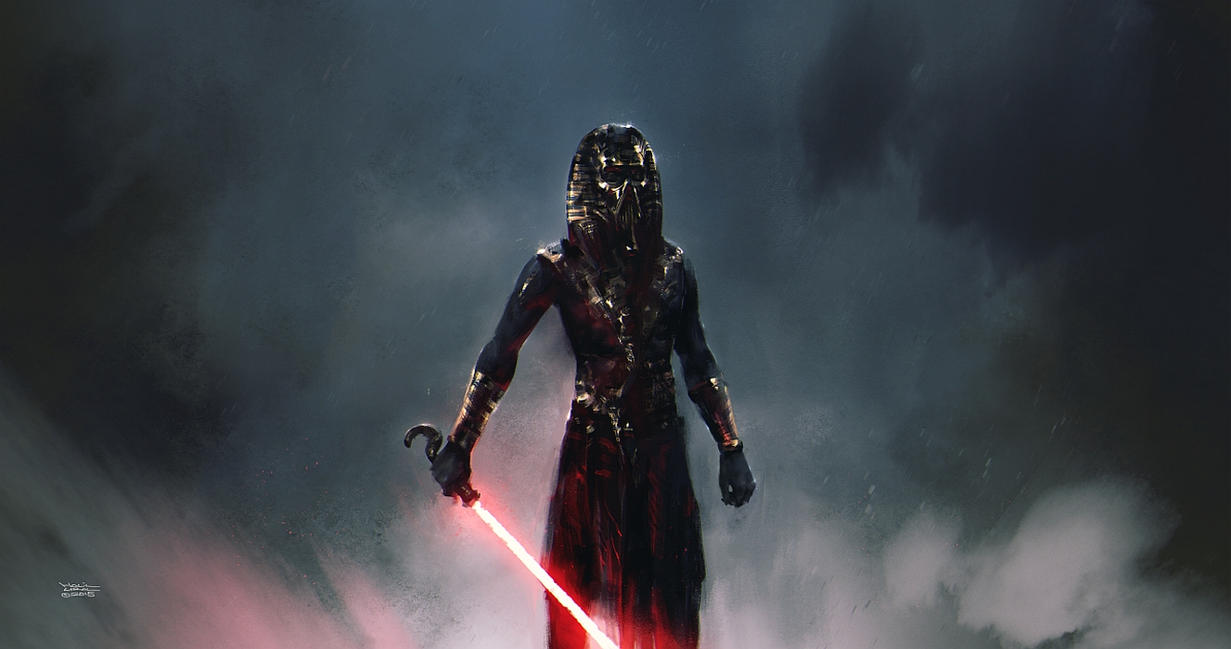
True Communion: An Introduction

There is no emotion, there is peace. There is no ignorance, there is knowledge. There is no passion, there is serenity. There is no chaos, there is harmony. There is no death, there is the Force. 

-The Jedi Code
Here we are at last.

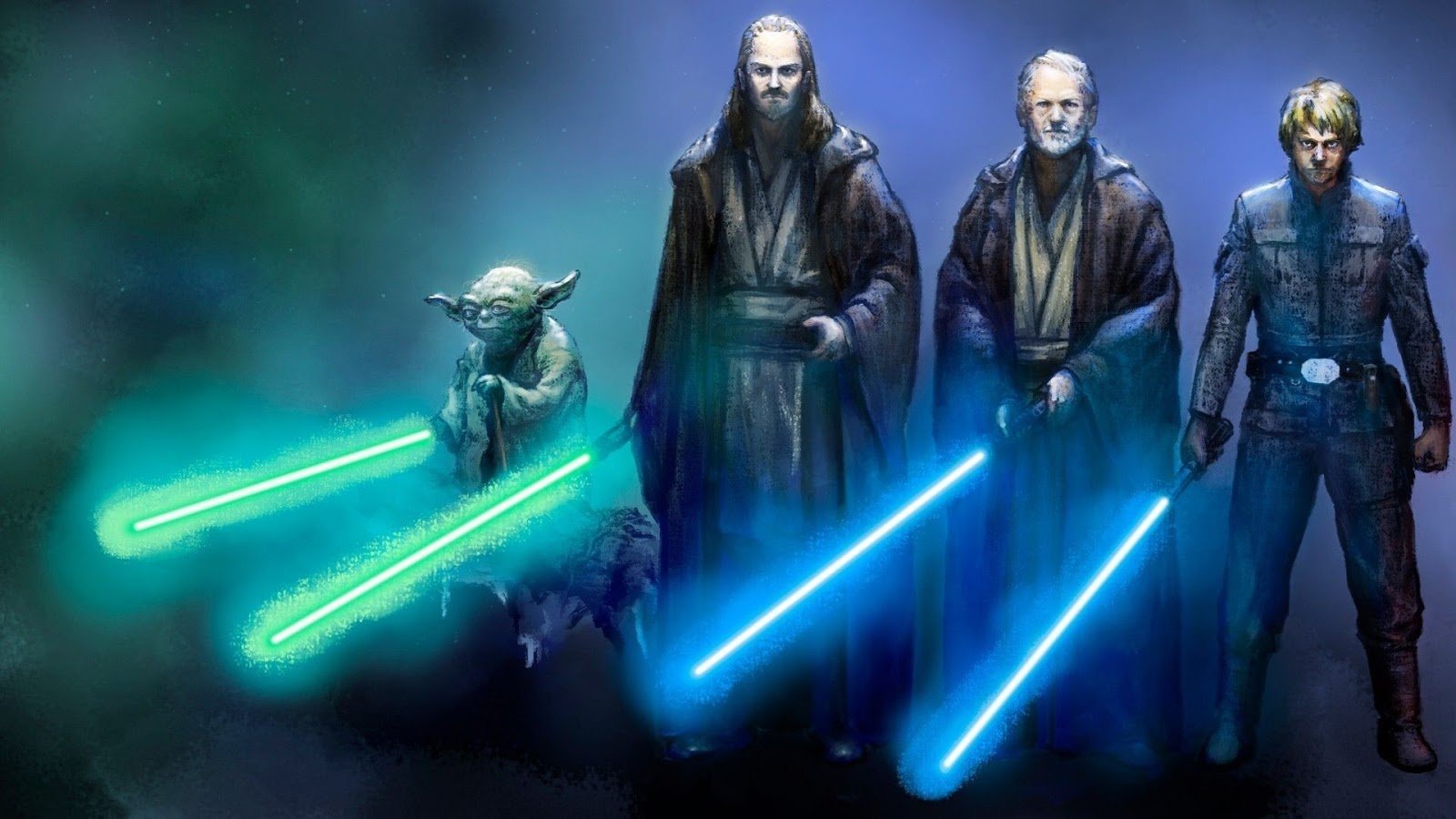
The Jedi are Star Wars. While one can make the case for the importance of characters like Han Solo and Princess Leia, by the Return of the Jedi, the exploration of the Jedi and their code came to dominate the Star Wars narrative, and main characters became defined by their “force sensitivity.” The prequels told the story of the Jedi, and by Rogue One, their philosophy had morphed into the dominate religion of the Star Wars galaxy.

I’ve had a few problems with this drift, though. First, the Jedi practice, as depicted in the Star Wars movies is essentially the only religion of the setting (with an honorable mention to the Sith, though they really accept the core premises of the Jedi code, and just invert them; they are to the Jedi what Satanists are to Christians). Furthermore, the Jedi philosophy, as depicted in A New Hope is some ancient, nigh-mythical lost religion, but if you can trip over Guardians of the Whills, force sensitive philosophers and outcast Jedi in every cantina, then when Obi-Wan Kenobi explained the Force to Luke, it was more like some preist explaining Christianity to you today, rather than some martial art master explaining the lost secrets of a bygone age.

I’ve tackled the problem of “no other religion” throughout this entire philosophy series: the heroes of Psi-Wars can choose from Neo-Rationalism, the Akashic Mysteries and the Divine Masks as their driving morality and beliefs, and I’d like to think I’ve made each sufficiently compelling that someone might be willing to follow them. True Communion, then, can retain something of an exotic nature.

Two problems remain, though. First, the Jedi philosophy is, as depicted by Star Wars, one exclusively practiced by “knights,” warrior-priests. Outside of the implications of the Guardians of the Whills (we hear very little about this offshoot in Rogue One, and both of those characters are also warriors), we never get a sense of how the common man feels about the Jedi philosophy or how he might express his devotion. Do people go to temples to worship? If so, how? Does “worship” even make sense? Or is all the devotion of the Star Wars galaxy to the Jedi philosophy really a devotion to the Jedi order and the hope that these space wizard-knights will return and save them?

Which brings us to problem number two: the Jedi are thematically an ancient order of heroes with messianic elements. They saved the day long ago and will someday return to save the day again. They resemble the once and future King Arthur, or the Assassins of Assasin’s Creed or the Solar Exalted of Exalted. Thus, the Jedi Order should be dead long enough to have faded into myth, but in fact, they faded away only a generation (in the first trilogy) or two (in the latest trilogy) ago.

What we need then is a broader and more ancient order. We need to get a sense of what it means to be a practitioner of this Jedi-like philosophy without actually being a space knight. What are its priests like? Do lay people go to temples? If so, what do they do there? We also need to end the order a much longer time ago and explain what happened to them in the meantime.

We also need to integrate Communion itself into all of this. The philosophy of True Communion is not the philosophy of the Jedi for the same reasons that the Force is not Communion. True Communion is a universal, divine, psychic gestalt that contains paths, archetypes, occult elements, avatar states and world-shattering miracles. The philosophy of True Communion, then, can and should have a more distinctly religious character, and explain why a Knight of Communion is so much more powerful with Communion than, say, a devotee of the Divine Masks.

Furthermore, the core theme of True Communion must be that it is right. The base assumption of the Jedi is that their vision is correct (They are “the good guys”), and that all right-thinking individuals back them. Most psi-wars players will expect something similar in Psi-Wars, and look to True Communion as the “Right faith.” If this is so, then why doesn’t everyone worship it? And if it isn’t so, in what ways might it be wrong? How might it exploit people’s good will? How might (say) the Akashic Mysteries or the Cult of the Mystic Tyrant be more right, if the GM wishes to go in that direction?

Finally, we must understand that this is an RPG. Star Wars depicts almost all Jedi as essentially the same (all are skilled with their lightsabers; all learn the same styles; all have the Jedi Mind Trick and telekinesis and precognitive dreams and the ability to “sense” things), which is fine for a film, but players will need to express their uniqueness and differentiate themselves from one another, and explore different themes within True Communion. Ideally, one should be able to play a game with nothing but the Knights of Communion and see each player play a different character, and still have a sense that they have more they can explore.

I would like to note that unlike the other philosophies, True Communion did not spring up in this iteration, but has been quietly in the works since Iteration 4, and I’ve discussed them at length before, so if these inspirations seem familiar, that’s why.

The Philosophical Inspiration: Advaita Vedanta and Nagarjuna’s “Emptiness”

One who sees all beings in the self alone, and the self of all beings, feels no hatred by virtue of that understanding. For the seer of oneness, who knows all beings to be the self, where is delusion and sorrow?
— Isha Upanishad 6-7
True Communion is, of course, a philosophy, but it’s an odd philosophy with deeply religious trappings. To get a glimpse of a similar sort of system, we have only to turn our eyes to Indian philosophy to find exactly such a sort of thing (though, I hasten to note, that most religions give rise to philosophy, as theologians invariably stray into the realms of philosophy when they attempt to precisely define what particular religious terms mean and what their ultimate implications are). We also look to India because the Jedi philosophy has deep “oriental mysticism as seen by Westerners from the 70s” themes, which, if you dig deep enough, has much of its roots in Indian religion and philosophy.

I might expect Buddhism to be a guiding light here, and I must give a nod towards Nagarjuna and his concept of emptiness: that things are not things, but interactions, which fits nicely with True Communion’s deeply community-based philosophy. I will also confess that I find Zen Buddhisms stereotypical take on how students must be taught (through koans and riddles and such) to be very appropriate for how True Communion should work, but I took the reasoning for this from Plato.

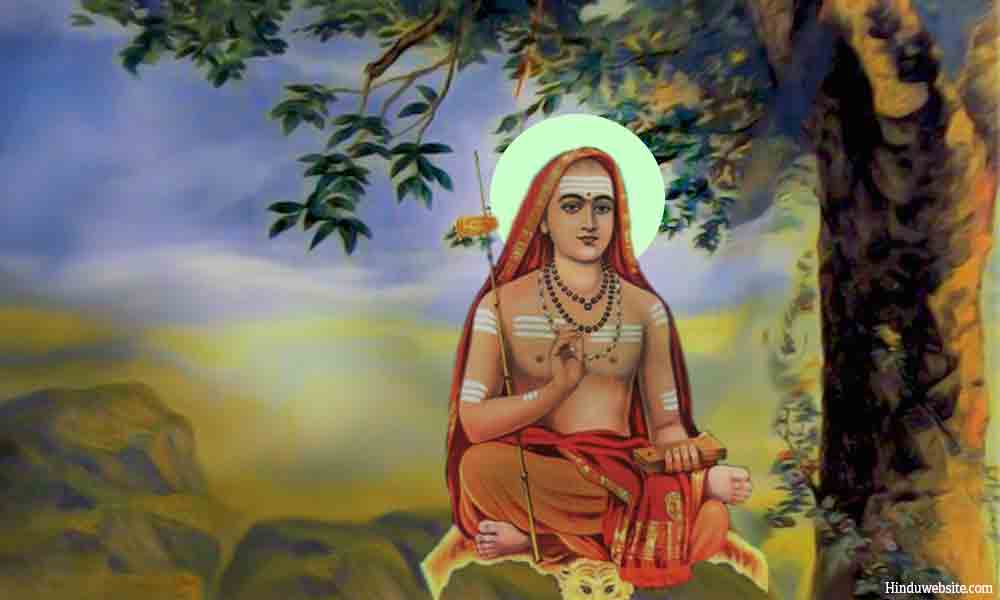
But for the meat of my philosophy, I found myself drawing more heavily from Hinduism. First, Hinduism is very grounded on an ancient religious tradition found in the Vedas. The philosophical tradition arose from that, and while the original traditions from which Hinduism draws could perhaps be described as polytheistic, the philosophical system that arises out of it is distinctly monotheistic, with a great cosmic god that pervades all things called “Brahman.” We in the West tend to have a rather anthropomorphic conception of God, but Brahman is closer to the gnostic “Monad” than to the Sunday school depiction of a bearded man in the sky (which, it must be said, isn’t really the Christian conception of God either, but nonetheless, I want to draw that distinction between anthropomorphic God and cosmic, ineffable God); that is, the God of Hinduism is pantheistic.

Hinduism, unlike Buddhism, accepts a “self,” called the “Atman.” This is not the self that you mean when you thump your chest and say “Me.” It is not the you that monologues in your own mind, or that perceives the world, but the “you” that hears the monologue, that perceives that you perceive. The Hindu devotion to meditation arises in part from attempting to pin down precisely what this “atman” is and what it isn’t (and, of course, from Buddhist influence, which seems to have put a greater emphasis on meditation in its earlier phase than Hinduism did, which seemed more interested in precisely defined religious ritual).

Many philosophies describe a duality between Brahman (the external world) and the Atman (that which perceives the external world). Advaita Vedanta disagrees with the dichotomy (the name literally means “Not-two”), and argues that just as Brahman suffuses all things, so too does it suffuse who you are at your very core. That means that as you come to understand yourself, you come to understand the cosmos. For me, this is the perfect metaphor for how I imagine True Communion: it is not the extinction of self, but the realization that “self” and “other” are synonymous. It is finding a bridge from the self to the rest of the world.

Hinduism and Buddhism both like to discuss the “cycle of life and rebirth” and how one can escape that and suffering in general, and the consensus seems to be that one must let go of this cycle by not becoming attached to things of the world. This ties strongly into the concepts mentioned above, and suggests an idealistic, rather than a materialistic, philosophy, which suits True Communion nicely.

Incidentally, if any of True Communion’s ideas sound “hippyish” to you, this may be the cause of it. Counter culture and the new age movement began to draw on both the ideas of psychic powers, volkish ideas of organic purity, and “Eastern Mysticism,” or older traditions that also borrowed from “Eastern Mysticism” (like Theosophy). There’s a reason the Jedi sound a lot like garbled Indian Gurus.

The Religious Inspiration: Judaism and Early Christianity in the Roman Empire

Neither shall they say, Lo here! or, lo there! for, behold, the kingdom of God is within you. -Luke 17:21
For my religious history, I chose the early Christian church and Judaism and I did this for several reasons. First, the Jedi are, despite claims to the contrary, profoundly influenced by Christian thought: their celibate “knights” draw on the tradition of the templars, and their vision of the world as filled with a constant conflict between “good” and “evil” is, in the very least, Manichean, but easily Christian too. The story even revolves around a prophesied messiah who will come and rid the universe of evil! But more importantly, I wanted to draw parallels with the Roman Empire, as much of Psi-Wars (and Star Wars) draws on that history.

Judaism, of course, have an ancient tradition that was already ancient before the Romans had even built Rome. When the Romans finally conquered Judea, they found themselves in possession of an unruly people who refused to give up their monotheistic ways to acknowledge the Gods of others or the Imperial cult. During this period, multiple traditions of Judaism competed with one another (of which Christianity was but one contender), and they especially contended for Roman converts. The ancient Abrahamic tradition was different and evocative, interesting and compelling, and steeped in particularly deep ideas during a period when Roman traditions and religions were fading into decadence and mere ceremony. Jews had to contend with curious foreigners trying to understand and borrow from their religion.

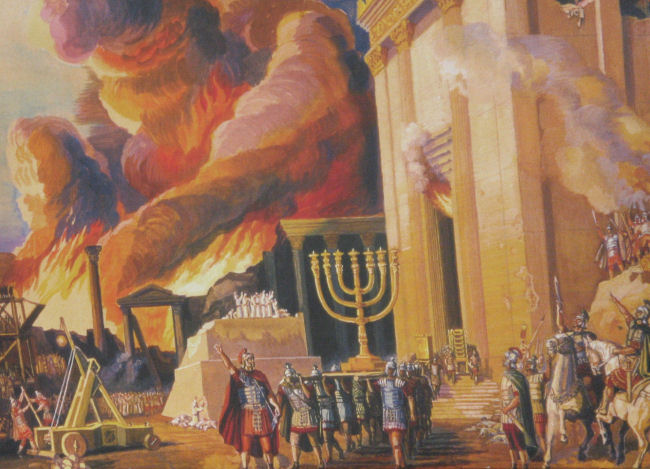
When Judea revolted against the Romans (with its “sicarii” zealots murdering Romans hashashin-style), Rome utterly crushed Jerusalem and the temple with it and scattered the Jewish people in the diaspora, which dramatically closed the debate on which brand of Judaism people would follow, as only two remained: Christianity, which had spread far beyond the borders of Judea already and aggressively sought to convert outsiders, and what would become Rabbinical Judaism, a form of Judaism adapted to life with a temple and that which struggled primarily to preserve the Jewish cultural identity in a world that seemed to hate them. Eventually, the Christian branch of Judaism would have its revenge by converting all the Empire to its faith and installing a Christian Emperor in Rome.

I wanted something similar for True Communion. I saw it as an originally alien faith that resulted, eventually, in two branches, one which sought to preserve the traditions of a culture and race that had a history of suffering at the hands of others, but whose ideas ended up taking the galaxy by storm. Where Christianity and Judaism have diverged fairly significantly, though, I saw these two as much closer to one another, so that players who learned from a human True Communion master might seek out an alien True Communion master to learn the “lost” half of that ancient and traditional faith.

Warrior Priests: The Ikko Ikki, Templars and the Shaolin Monks

Not the wind, not the flag; mind is moving.
-Koan 29
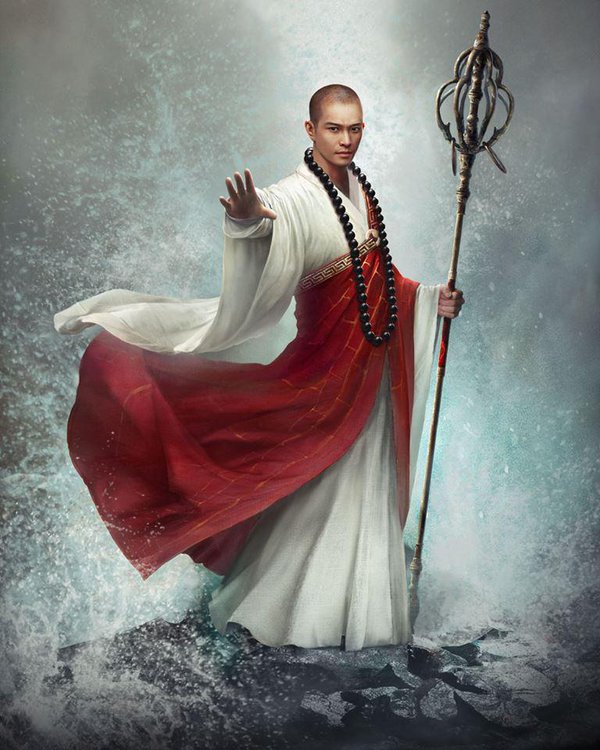
The Jedi are warrior monks, and this is what makes them so distinct from various other settings, though they certainly have a historical precedent: the Ikko Ikki, the Templars and the Shaolin monks were all also warrior monks.

The Ikko-Ikki were practitioners of Pure Land Buddhism, a form of Buddhism that didn’t require one to have enormous sums of money to go to a monastery and meditate for years; it’s quite a complex topic that I don’t entirely understand, but the core of it is that it has a strong appeal to the poor, and thus, in Japan during the Sengoku Jidai, it became very popular among the peasants and lower-level aristocracy. Other sects of Buddhism began to harass or even attack practitioners of Pure Land Buddhism, who responded in kind and began to fortify their temples and band together to defend themselves. Once they had, they began to notice they had real military potential, and became a force to be reckoned among the warring factions. The key component here, to me, is the common appeal of the religion, in contrast to the more aristocratic religions that might be around and how, when that religion is threatened, its defense starts from the ground up, with the poorest of the poor casting aside their tools to take up arms.

Something similar happened during the Crusades, but ultimately that war was won with the aristocracy, but the crusades are better understood as a mass, armed pilgrimage than as a real conquest. The “Holy Lands” were not held in the name of France or Germany or Italy or even the Church, but as their own thing. The Templars began (setting aside mythical origins) as a means to protect pilgrims on their passage into the holy land, and ended up as an arm of the state as well as an elite fighting force that defended the Holy Lands from external threats. They also evidently took on some strange customs from their time in the Holy Lands, and when they were destroyed, they fell into legend as a secretive conspiracy.

The Shaolin had a similar fate to the Templars. While they engaged in no crusade, they did rise rally in defense of a dying dynasty, and then resisted an “unrighteous” empire and, for their efforts, were destroyed. But their destruction spawned legends, secret conspiracies of resistance, and new martial traditions held in high esteem by the people. Like the templar, they faded into legend, and many common people hoped that in some way, they could be resurrected.

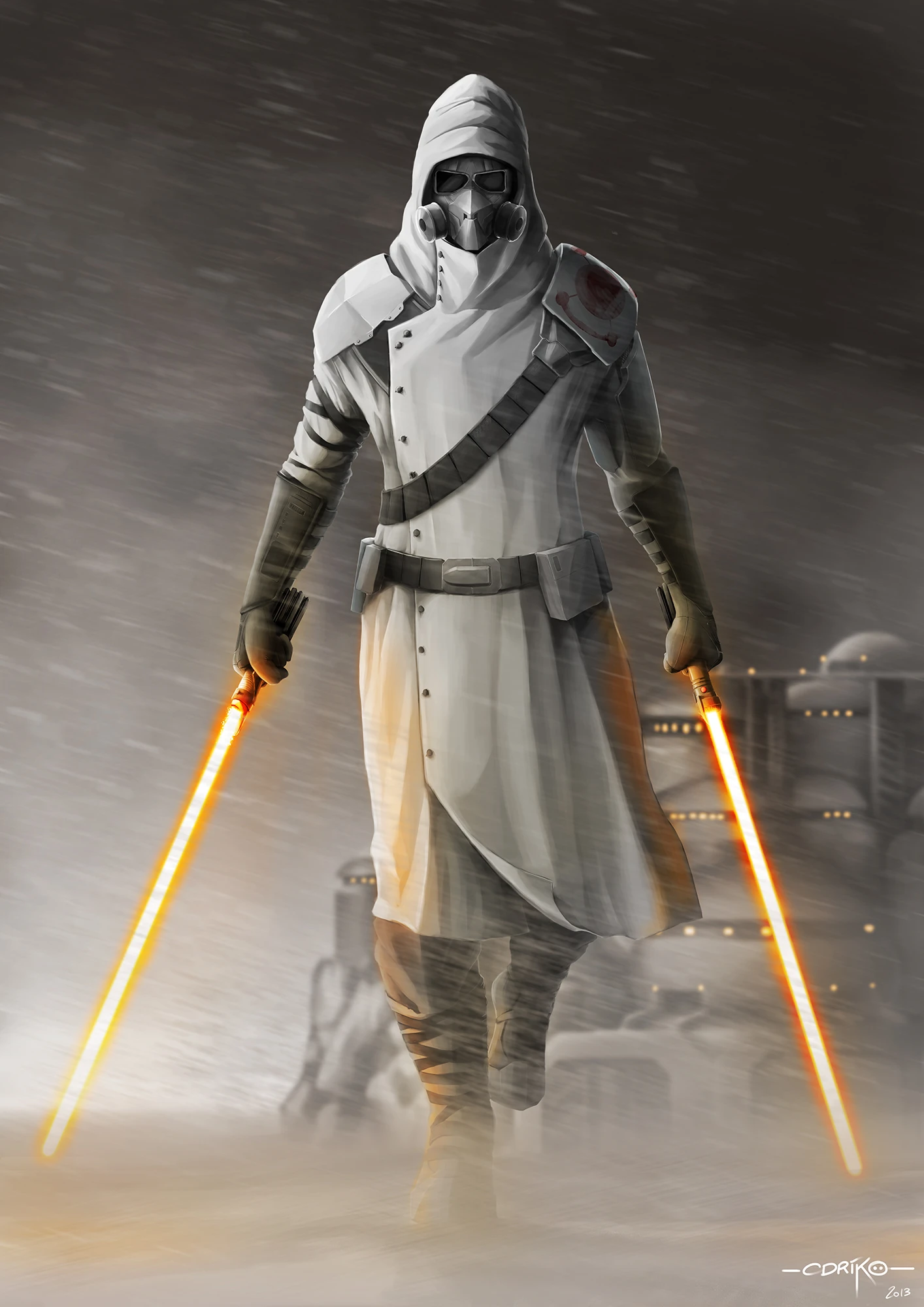
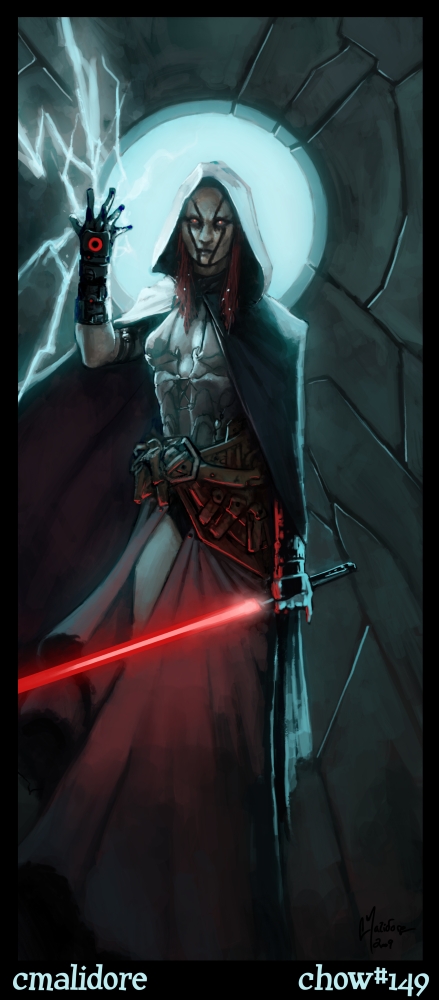
The Knights of Communion, our “space templars” draw from all three traditions. True Communion had a strong appeal to the common man whom the Akashics had always said were worth nothing; they offered the common man the chance at psychic power, and told him that he mattered. When the Alexian Empire moved against them, the common man rallied in defense. When the temple-worlds fell, the common man rose to retake them, and many “poor knights” set aside their titles to become these knights who would protect the common man, and who would assist in resisting the unrighteous tyranny of the Alexian Empire and, eventually, would even bring it down, but then be scattered and broken, becoming little more than legends. But like the Shaolin, their martial tradition would remain in scattered bits and pieces, and like the myths of the Templars, they would linger on as a conspiracy, waiting to return when they were needed.

What is True Communion?

So what, then, is True Communion?  True Communion began as an alien philosophy, one held firmly by a race that struggled against a hostile universe full of horrors and enslavement.  They used their philosophy to form deep bonds with one another and to protect themselves, to forge an identity that could withstand the persecutions they suffered.

As other races came into contact with the philosophy, they found its message and power compelling.  Humanity had their own philosophies in the form of Neo-Rationalism and the Akashic Mysteries, but both were elitist philosophies; True Communion spoke to everyone.  It took the galaxy by storm, undermining the carefully cultivated image of the Akashic Order and Neo-Rationalism, and when the followers of the philosophy freed the Temple Worlds of True Communion and formed the Knights of Communion (the “Space Templars”), True Communion came to be a force to reckon with and eventually brought down both the corrupt Alexian Dynasty and the Cult of Satra Temos.

True Communion remains out in the galaxy as a deeply meditative philosophy that teaches people to look within for answers and that says everyone has a place in the world.  The aliens who created it still practice it; many common men and aliens still practice it, in and outside the Empire, or quietly in the Alliance.  On the edges of space, the last remnants of the Knights of Communion remain, trying to piece together the lost lore of their ancient and powerful philosophy and waiting for when the Galaxy will need them which, given the great galactic invasion, the destruction wrought by the Cybernetic Union and the rise of the Empire, seems to be now!
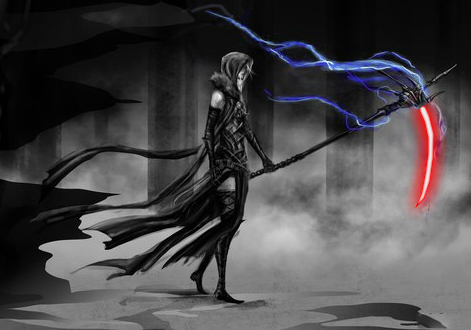

Patreon Special: Domen Khemet, the Ranathim Cult of Death

Last month, at the culmination of the Divine Masks, I offered my Patrons a poll to choose the fourth and last Cult of the Divine Masks: the Cult of Death.  Those poll results are in now, including Domen Khemet, a fully detailed version of the Cult, ready for play. The cult utilizes the Broken Communion miracles detailed in Tuesday’s patreon post about Broken Communion ghosts.  Further, it has a unique relationship with the Cult of the Mystic Tyrant, as Anthara, the founder of the Cult of the Mystic Tyrant once swore an oath to them that the later cult broke, so be sure to check those elements out too.

This post is available to all $3+ patrons, as it represents a preview.  The Patreon Post contains a discussion of the votes and my thoughts on them, as well as the completed cult.  If you’re a patron, check it out!  If you’re not, as usual, I’d love to have you.  Enjoy!

Transcendent Principles: The Truths of the Cult of the Mystical Tyrant

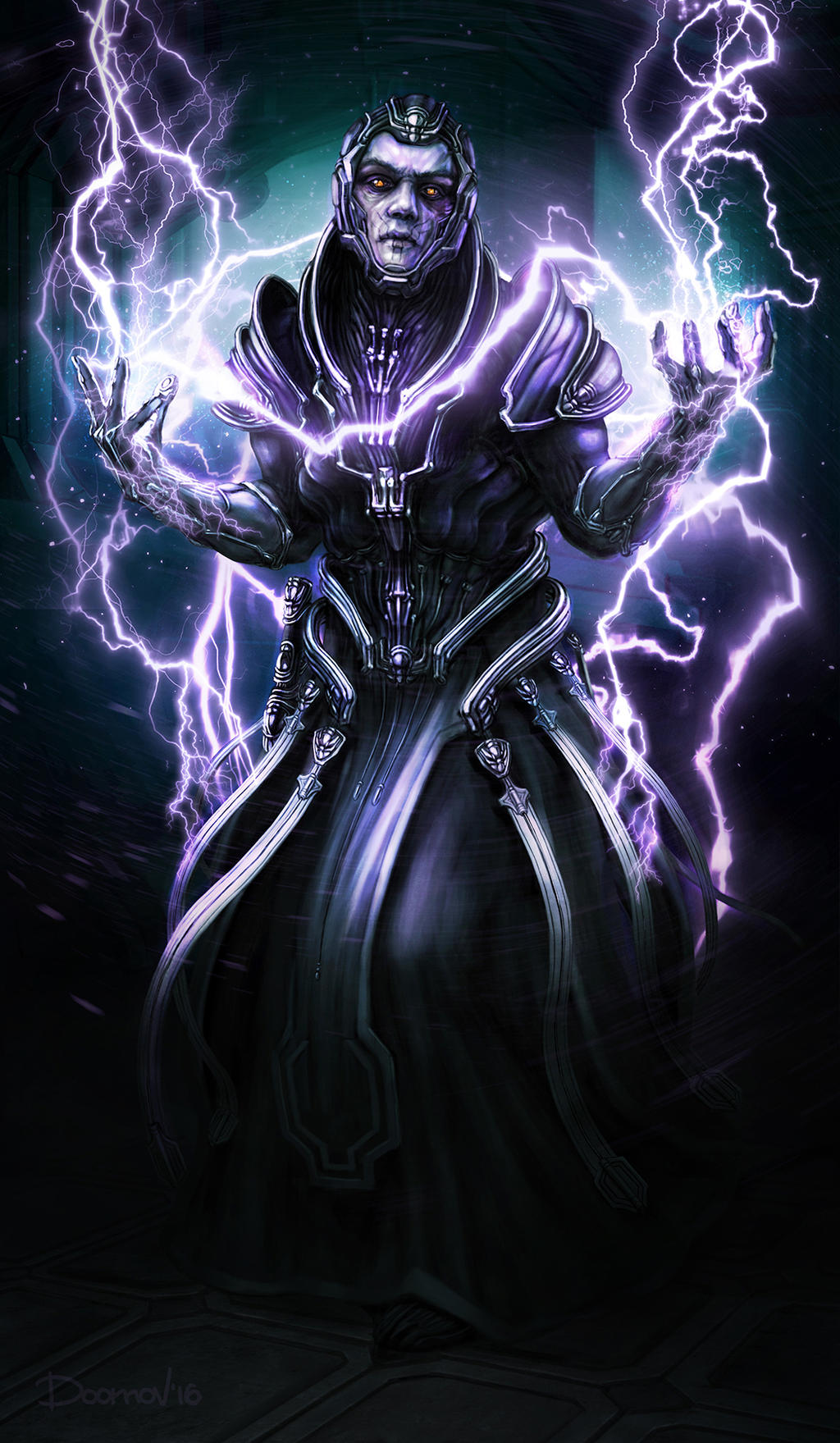
The Path of the Mystic Tyrant is a path of transcendence. Those who walk that path violate the norms of the world and show that new things, never thought possible before, can be made to be true through the will of the Tyrant. This allows those who follow the path of the Mystic Tyrant to achieve unparalleled power, but at a cost.

Transcendent Powers are a new power-set available only to followers of the Cult of the Mystic Tyrant. Characters with Transcendent Master or Illuminated may freely learn or create them; other characters may use a Communion Oath to learn a transcendent power, provided a master is willing to teach it to him.

Transcendent Powers consist of the principle and the powers. The principle represents the world-view that the Tyrannical Master has imposed upon the world and represents a “category” or “container” of individual abilities, similar to how a psionic power contains numerous abilities associated with it. To gain access to a principle, a character needs an appropriate Transcendent Principle perk, after which he may gain any associated Transcendent Powers. Characters may only gain the Transcendent Principle perk if they have the Transcendent Master or Illuminated trait, or learn it from someone who does.

Transcendent Powers represent the effects of internalizing the Transcendent Principle. The character so completely believes the vision and so thoroughly changes the world with it that he is fundamentally changed. Thus, characters do not use Transcendent Powers, they have Transcendent Powers. Transcendent Principles can also grant access to new miracles, typically the miracles of Broken Communion paths, or entirely new miracles that the character may invoke.

While beyond the scope of most Psi-Wars games, the GM can allow characters with Transcendent Master or Illuminated to invent new principles and powers, using the Philosophy skill. A new principle is an Amazing invention, while a new power associated with a principle the character already knows is an Average invention.

All Transcendent Powers come with a Transcendent Power modifier worth -10%. All Transcendent Powers come with drawbacks worth no more than a -5% nuisance. Additionally, Transcendent Powers have one of two additional limitations: the character must either have a Communion Oath, or their powers are vulnerable to Communion Miracles. Characters with a Communion Oath must stay true to their Oath, or lose their power immediately; restoring the power requires a week’s worth of adventuring or a minor quest to prove one’s restored dedication to the Oath. Alternatively, for characters without Communion Oaths (generally Transcendent Masters or Illuminated characters), the transcendent power may be countered through the use one of the following miracles:

Restore True Order

Reaction Required: Very Good

Learned Prayer Prerequisite: True Communion 11

Learned Prayer Cost: 19 points

The character taps into the consensus of natural reality embedded within True Communion and, with a touch, uses it to rip apart the tissue of lies and aberrations that makes up the Mystical Tyrant’s transcendent vision. Upon the completion of this prayer, the next time the character touches a target, he may choose to roll a quick contest of Meditation vs the target’s Will. If he succeeds, the target loses all of his Transcendent Powers for a number of minutes equal to his margin of victory; if he fails, the target loses all of his Transcendent powers for the next minute.

Alternately, the character may touch the subject of a Transcendent Power (typically a miracle gained via a Transcendent Principle) and disrupt that miracle, ending its effects on the subject.

Statistics: Neutralize (Cosmic, No Die Roll Required +100%; Divine -10%) [95]

Unleash Paradox

Reaction Required: Good

Learned Prayer Prerequisite: Broken Communion 9, (Broken Communion Path) Legendary Reputation 2.

Learned Prayer Cost: 11 points

Corruption: 12 points

The transcendent principle of the mystical tyrant threatens to unravel reality and feed Broken Communion. With a miracle, the character can unleash that potential. Upon invoking this miracle, the mystic must touch the target and roll a quick contest of Meditation vs the target’s will. If the mystic wins, the target suffers 3d corruption and loses access to their powers for a number of minutes equal to his margin of success. If the target wins, the miracle has no effect and fades.

Alternately, the character may touch the subject of a Transcendent Power (typically a miracle gained via a Transcendent Principle) and disrupt that miracle, ending its effects on the subject; this does not inflict corruption on either the target nor the character using the Transcendent Power.

Unleash Paradox can only be invoked by characters on a path to which the transcendent principle is vulnerable.

Statistics: Neutralize (Broken Path -25%, Link +10%) [43] + Innate Attack 3d (Fatigue; Accessibility: target must have a Transcendent Principle compatible with the character’s path -80%; Broken Path -25%; Corruption +0%; Link +10%; Malediction +100%; Reach, Melee -30%) [8]

The Principle of Amortality

Ever since Anthara made his devil’s bargain with the Ranathim Cult of Death, the Cult has sought to overcome and escape Death, and their whispered promises of the secrets of immortality have drawn many into the fold.

The Principle of Amortality represents the closest the Cult has come to true immortality. The principle argues that death is not real. The tyrant asserts his will, claiming that death is a choice made by fools who do not recognize any other option, or that the Tyrant, himself, is just too important or powerful to suffer the same fate as mere mortals. The principle goes beyond mere immortality, though, and contends that no afterlife exists and that ghosts aren’t real. For the masters of this principle, death does not exist.

Those who master this principle can harness the powers of Death for their own purposes, or walk unmolested through a supposed haunting or, most critically, achieve some measure of immortality.

Drawbacks: The powers of Amortality can be overcome by the Path of Death. Furthermore, all followers of the Path of Death immediately recognize anyone with the Transcendent Principle (Amortality) and react to them at -3. They know the contract between Anthara and the Cult of Death has been broken, and will seek to rectify it!

Inviolate Soul

23 points

Mortals fear the lingering souls of the dead that haunt the world of the living, but the Inviolate Soul of Amortality does not, for he knows that ghosts cannot exist, and therefore, cannot hurt him. Ghosts cannot approach within a yard of him, and cannot affect him, or those within a yard of him, with their powers. The character need not do anything to use this power: it is always true.

This power does not protect the character from non-ghost followers of the Path of Death.

Statistics: True Faith (Chosen One; Cosmic, no active use required +50%) [23]

Twisted Aura

43 points

Those who fear the dead claim that they can twist psionic energy, but the masters of this principle realize that the reverse is true: that twisted psionic energy creates the perception of ghosts. As proof, they can twist their own psionic energy, and teach others to do the same.

The character emanates an aura of twisted energy with a radius of 2 yards. Anyone who uses psionic powers within this region, or uses psionic powers on anyone in this region suffer a -2 to their psionic skill rolls and any failures of a psionic skill counts as a critical failure. The character automatically exempts his own powers from this effect, and may exempt others, as he wishes.

Statistics: Twisted Energy Generator (Advantageous; Selective Area +200%; Transcendent Power -10%) [43]

Perks of Amortality

Alien Path (Death as Dark Communion): You may access the Death path as though it was a Dark Communion path.

Signature Miracle (Corrupt Ground; Corrupt Ground (Enhanced)): You gain a +1 to reaction rolls to use your signature miracle; this perk is leveled and may be purchased up to 4 times.

Immortality

The most fabled power of Amortality is some form of immortality. Such a thing, however, might not be possible or, if it is, it may have been achieved by a previous master and this master still lives to this day. The following presents three possible forms of immortality, each associated with one of the transcendent masters of the Cult.

The Immortality of Anthara

Anthara made a pact with the Cult of Death to serve and honor their laws. As a result, Anthara always knew he would die, but was able to create his escape in the fine print of that agreement. While he could not live forever, according to legend, he mastered the art of reincarnation. Upon his death, he used his powerful telepathic powers to possess and infect his direct descendants with his own mind, and has continued to do so from generation to generation, with varied results. With the death of Ranagant and the ascendance of the Cult of Satra Temos, the majority of his lineage died, but some bastard children scattered throughout the galaxy remained vulnerable to his possession and, according to legend, bides his time and restores his strength until the Cult of Anthara can find him and restore him to his throne.

If the legends of Anthara’s immortality are true then the descendants of Anthara have the following traits:

Heir of Ranathim 9 points

Advantages: Bloodline (Anthara) [1], Racial Memory (Passive) [15]

Disadvantage: Duty (Puppet of Anthara; 6 or less; Involuntary) [-7]

New Traits

Bloodline (Anthara): This works like the Bloodline perk, but proves to genetic analysis that the character descends from Anthara.

Secret Miracle (Anthara’s Possession): The character has access to a unique miracle. See below.

Anthara’s Possession

Reaction Required: Excellent

Learned Prayer Prerequisite: Dark Communion 15, Mystic Tyrant Legendary Reputation 4.

Learned Prayer Cost: 32 points

Anthara has the ability to invoke Dark Communion to swap his mind with that of a direct descendent, or anyone else who has been explicitly prepared for as a host for his mind. Once this miracle has been invoked, it cannot fail unless the mystic who invokes it wills it to fail. However, the target must be close enough that Long-Distance modifiers do not reduce his Meditation skill to below 3 (typically “on the same planet” is enough). Once initiated, the process takes a week, during which time omens begin to haunt the target: he sees the face of Anthara replacing his in mirrors, he begins to dream of being Anthara, people begin to refer to him as Anthara, or omens associated with the Cult of Anthara manifest themselves. Those with Occultism can recognize that the character is cursed, while those with Hidden Lore (Communion) can recognize that the character will soon be possessed by Anthara. The possession can be prevented with the same countermeasures one uses against ghosts: exorcism, protective talismans, etc. The miracle can also be defeated by using appropriate counter-miracles, such as Restore True Order. Killing the mystic that invoked the miracle also ends the effects of the miracle.

If the miracle is not prevented from occurring, the mystic “swaps minds” with the target. He may choose to drop any skills or traits he has and replace them with those of his target. The possession is permanent, and as such, the character must pay for any improvements he gains.

Variations of this miracle may exist if other masters have perfected it. For example, a player character who learns the miracle would be able to possess his own descendants, rather than the descendants of Anthara.

Statistics: Possession (Assimilation +10%; Divine Path -15%; Ghostly Countermeasures -10%; Long Ranged 2 +100%; Mind-Swap +10%; Onset, 1 week or more -40%; Puppet Only -30%; Ranged +40%; Visible (Omens) -5%) [25]

The Immortality of Satra Temos

According to the lore of the Cult of Satra Temos, their founder never died. While Anthara had sworn an oath to Death, Satra Temos broke with the old ways and walked away from all of the old oaths of Anthara to forge a new reign of shadows and terror. He achieved a mastery of the Amortality principle, and transcended death by drawing life from Dark Communion itself.

If this legend is true, then Satra Temos has the following traits (and others might learn it as well). It also means that Satra Temos is still out there somewhere. The Cult may be obsessed with uncovering his location, which only the Knights of Communion may know, leading to yet more strife between those two organizations.

New Traits

Immortality of Satra Temos: 25 points

The character cannot be killed unless he is bodily destroyed, or he is killed, directly or indirectly, by an invocation of True Communion (such as Guide My Hand). He does not age, but he can only heal in places with High or Very High Sanctity, which means his seemingly dead body must be buried in a desecrated grave site.

Statistics: Unkillable 1 (Achilles Heel; True Communion Miracles -10%) [45]; Unaging [0]; Unhealing (Partial; Not In Locations with Dark Sanctity) [-20]

The Immortality of Revalis White

For his treachery, Revalis White was eventually killed by the Knights of Communion; this fact is beyond dispute. Yet, despite this, legends of his continued survival continue, that he managed turned his mastery of all three forms of Communion into the ability to transcend death by returning as a ghost. In this form, he was able to pass on his secrets and take revenge on those who had killed him.

If this legend is true, Revalis White may continue to guide his cult from beyond the grave. He might act as a mentor to promising masters of his cult, or as a terrifying, phantasmal final opponent to finally destroy the last remnants of this traitorous cult. It also means that those who follow him might be able to cheat death in the same way.

The following traits assume the use of Broken Communion ghosts; they might not be suitable to player characters; in which case, consider the perk version instead of the full version.

New Traits

Haunting Death: Perk; see Pyramid #3/69, page 6.

Immortality of Revalis White: 18 points

After you die, you are guaranteed to return as a Broken Communion ghost. Your point value does not change, but you may redesign your character based on your new racial template (and given its high cost, you may have to acquire new disadvantages or remove old advantages). While not required, consider replacing psionic powers with similar, ghostly power.

This form of immortality is subject to all the same limitations as any Transcendent Power, but if someone prevents your power from working or you violate your oath, this simply prevents you from returning as a ghost; it does not disrupt your ghostly state after the power has triggered, re-animating you.

Statistics: Extra Life (Reanimation -20%; Transcendent Power -10%) [18]

The Principle of Nihilism

Philosophies spend an inordinate amount of time trying to sort truth from deception, the real reality from the illusions of our wishful thinking. The Master of the Cult, however, has realized that no such thing exists. No truth is greater than any other truth, and that truth is fundamentally subjective. His truth might not be the same as your truth, but both are equally valid. Moreover, when one tries to get at any objective truth, one must necessarily simplify, and thus all “objective” truths are nothing less than the very wishful thinking, usually tinged with subjective beliefs, that the philosopher accuses others of having.

Masters of this principle can impose this subjectivity of truth onto the world (or, as they would put it, “reveal it to the world.”) They can strip the truth from things others hold to be self-evident, bring in confusion where others profess certainly, and enforce their own vision of the truth, even to the point of turning lies into truth.

Drawbacks: The Path of Madness understands the principle of Nihilism all-to-well, and strips the Mystic Tyrant of all truth, leaving only chaos and madness. The Path of Madness can defeat or overcome the Principle of Nihilism. Furthermore, Mystic Tyrants with the Principle of Nihilism make the world less certain around them. The GM can make any roll that relies on information (criminology rolls to find a culprit; an intelligence analysis roll to guess the intent of an enemy, etc) automatically fail, not for the Mystic Tyrant himself, but for those around him. The GM should do this no more than once per session.

Powers of Nihilism

Amorphous Conviction

21 points

The cultist has learned that the precept of objective truth is false, that all truth is subjective, and that the cultist may choose what they sincerely believe in. The result is a malleable set of internally held convictions: the Cultist will believe whatever is convenient for himself at the moment, which makes reading what he truly believes very difficult!

Any attempts to detect what the character truly believes automatically fail. This applies to attempts to uncover whether the character is lying, or what they truly believe, via the Body Language skill, Detect Lies skill, Empathy, Telepathy, or a Communion Miracle that detects the truth. The character may choose what the person attempting the detection learns. He may choose to reveal that he is lying, or that he is telling the truth, or that he believes he is telling the truth but has some doubts, etc.

Statistics: Resistant to Detect Lies (Immunity, Rare; Cosmic, applies to all forms of sensing deception +300%; Selective Effect +20%; Transcendent Power -10%) [21]

Shroud of Uncertainty

27 points

Psionic powers and Communion offer perfect knowledge of truths that the Cultist knows cannot be true, because nothing is true. The character and events taking placing within 2 yards of him apply a -5 to all attempts to see, detect or divine it with psionic- or communion-based powers, and this manifests and heightened uncertainty. Characters attempting to seek answers or to find things do not see “darkness,” but instead struggle to understand what they see, as they receive the sort of conflicting results typical of a very complicated situation or a simple failed roll. This makes the Cultists manipulation of their senses virtually impossible to detect!

Statistics: Obscure 5 (Divination, Clairsentience and Detect +40%, Defensive +50%, Stealthy +100%; Affects only Psionic or Communion powers -10%, Transcendent Power -10%) [27]

Unknowable Fate

18 point

Destiny represents the weight of the future dragging your character to an absolutely certain fate… but how can that be when the future cannot be known, and when no such thing as true destiny actually exists? The cultist who understands this becomes immune to destiny. No expenditures of impulse buy points from Destiny can affect him, whether it is used to purchase a successful use of a power against him, or to negate a success that the character had. Such characters also cannot have Destiny themselves.

Statistics: Static (Cosmic, any origin +50%; One ability, Destiny -80%; Transcendent Power -10%) [18]

Perks of Nihilism

Alien Path (Madness as Dark Communion): You may access the Madness path as though it was a Dark Communion path.

Signature Miracle (Dark Charisma, Mask of Madness, Fractured Reality): You gain a +1 to reaction rolls to use your signature miracle; this perk is leveled and may be purchased up to 4 times.

Secret Miracle (Truth from Lies): You may access the Truth from Lies miracle, below.

Truth from Lies

Reaction Required: Good

Learned Prayer Prerequisite: Dark Communion 7, Mystic Tyrant Legendary Reputation 2.

Learned Prayer Cost: 7 points

When it comes to sorting truth from lies, most people turn to real world events to tell them what is real and what isn’t, but how can one even trust the real world not to lie? The cultist can state a bald-faced lie and, conveniently, the world makes it true. After invoking this miracle, the GM may create a coincidence that makes a lie (specified by the player) true. The cultist has no direct control of how this occurs, and the GM is free to veto especially ridiculous ones (“I am immortal”), though generally the more absurd lies result in coincidences that make the lie technically true (“His birth name was ‘Immortal’”). Thus, this power is best used on subtle lies.

Statistics: Serendipity (Accessibility, only to make a stated lie true -20%; Cosmic, needn’t be a plausible coincidence, +50%; Transcendent Power -10%; Wishing +100%) [33]

The Principle of Autotheism

The Cult of the Mystic Tyrant claims that no Gods exist, that the supernatural, as a distinct thing from the physical world, does not exist. Instead, all supernatural or divine phenomenon can be explained by the inherent psionic nature of the world and the will of great men. “The divine” is a manifestation of men, not gods.

If no gods exist, the Cult may invent them, and when they do so, they invariably choose to be gods themselves, to declare themselves divine and worthy of worship. For them, Dark Communion is a mere extension of their own will. Their true potential comes rushing out in a torrent, and they may enact any miracle they wish at will. The price for this power is the need for worship and the danger that such hubris posses to the character.

Drawbacks: The powers of Autotheism can be canceled with any True Communion miracle that can overcome a Communion miracle, or with a minor blessing of the Exiled Master. Furthermore, once per session, weird effects occur around the character that tend to reveal an unholy nature to the character and may seriously inconvenience those around him, as though reality is slowly breaking down for everyone but the self-declared god.

Powers of Autotheism

Instant Miracle

9 points

As the Master understands that he is inherently divine, then he does not need to “communion with Communion” to access a miracle: he simply wills it to be, and it is! The character may ignore the -2 to rolls for instant miracles.

Statistics: Faster Prayers (See Pyramid #3/36 page 8; Transcendent Power -10%) [9]

Unholy Power

3 points per 5 ER

The character can draw power from the unholy energy of Dark Communion itself! The character has energy reserves that only charge so long as he is in a site of High or Very High Dark Communion Sanctity. While in such a location he regains his energy at a normal speed of 1 point every 15 minutes. Outside of a site of High or Very High Dark Communion Sanctity, the character loses these energy reserves at 1 point per second. These energy reserves may be spent on any psionic power.

Every 3 points spent on the trait produces 5 energy reserve points.

Statistics: Energy Reserves (Psi; Special Recharge, High or better Dark Sanctity, Energy Bleed -80%) [0.6/level]

Unholy Radiance

45 points

The master’s disdain for the sanctity of others is eclipsed only by his self-regard for his own inherent divinity. Wherever the character goes, he radiates divinity that allows him to treat the local Dark Sanctity level as one level higher than it normally is (thus, in normal circumstances, he behaves as though he were in a high Dark Communion Sanctity area, while he treats a low Dark Communion Sanctity area as normal, etc). This also means that he can never be in a “No Sanctity” area (he treats it as Low Sanctity).

Statistics: Dark Sanctity Generator (As Mana Generator, but for Dark Communion Sanctity Level; Transcendent Power -10%) [45]

Wild Radiance

20 points

The character does not rely on some external force for his miracles. He enacts them himself! As such, he does not need to rely on the uncertainty of Communion to afford him his miracles, he can simply dictate which miracle he wants! This enormous power, however, does not come without risks, for any wavering in confidence and connection in Communion can result in a spectacular lashback.

Once per hour, when the character invokes Communion, he may choose to use Wild Radiance and roll the reaction roll normally. Any neutral or better (10+) reaction allows the character to choose any miracle he wishes to invoke (regardless of the required reaction). Any poor or worse (9-) reaction counts as a disastrous reaction! If character rolls poor or worse reaction, this does not count as the use of Wild Radiance for the hour, but any additional attempts to use the power apply a -1 to the reaction roll when using this power (in addition to any other penalties to reaction rolls picked up as a result of the previous, disastrous reaction).

Statistics: Super Luck (Aspect, only Communion Reaction Rolls -40%; Fickle -20%; Nuisance Effect, Very Bad Reaction on failed Fickle check -10%; Transcendent Power -10%) [20]

Perks of Autotheism

Signature Miracle (Dark Majesty, Dark Power of the Id, Desecrate Ground, Greater Avatar of the Mystic Tyrant or Psychic Nova): You gain a +1 to reaction rolls to use your signature miracle; this perk is leveled and may be purchased up to 4 times.

Secret Miracle (Dictate Fate): You may access the Dictate Fate miracle, below.

Dictate Fate

Reaction Required: Very Good

Learned Prayer Prerequisite: Dark Communion 10

Learned Prayer Cost: 13 points

The character can use his godlike power to dictate the destiny of another. That character must be within a few yards (the better of Meditation or Will) yards of the character when the miracle is invoked. If so, the target automatically permanently gains either advantageous or disadvantageous Destiny (up to the invoker). The exact nature of the Destiny is up to the mystic; the most common use is to force the target onto a Path. This destiny remains unless the target is a player character who chooses not to pay points for it (in which case it fades at the GM’s discretion) or events conspire to grossly violate the destiny of the character.

Statistics: Afflictions (Advantage, Destiny 3 +150%; Alternative Enhancement, Disadvantage Destiny 3 +3%; Cosmic, No Die Roll Required +100%; Extended Duration, Permanent (Unless not paid for or events grossly violate Destiny) +150%; Malediction +100%;) [61]

The Transcendent Paths of the Cult of the Mystic Tyrant

The Cult of the Mystic Tyrant excels at enforcing its will upon an entire population and upon the very physics of the world. Thus, it should come as no surprise that they can force Communion itself into the shape that they wish, and that they regularly do so to create new paths.

The Cult of the Mystic Tyrant generally creates paths to serve its own purposes: to expand its power, to shape people’s destiny in such a way that suits them, or to grant themselves desired power. However, their mastery is imperfect, and they unintentionally create a backlash of destiny that can trap them down unwanted paths, or send someone’s destiny spiraling out of their control.

A Transcendent Path works exactly as a normal path and often mix and mingle elements of other paths to create a new cohesive whole. They have prerequisites, symbols, milestones and miracles, just as any path would. The drawback of a transcendent path can be found in its symbols and its milestones.

Most Transcendent paths have not one, but two opposing paths; this reflects the superiority of “natural” paths to “artificial” paths created by the Cult of the Mystic Tyrant. Transcendent Paths also have “corrupted” milestones, which reflect unintentional milestones creeping into their design as fate is exceptionally difficult to pin down. Transcendent Paths have normal milestones, which reflect the will of its creator, and one or more “Corrupted” milestones, which reflect how Destiny sees the true fate of the path; other than the themes involved, they are identical, and either can improve the Legendary Reptutation of the path-walker, and characters who fail to fulfill the milestone they face will find themselves ejected from the path.

Some transcendent paths have more of these problems than other. The Cult of Anthara’s ill-fated experiment with the “True King” path, which was meant to weld the best of the Exiled Master with the Mystic Tyrant to create a king that was truly beloved by all and always right, failed so spectacularly that nobody studies it to this day. Nonetheless, two of the more successful paths are listed below.

The Devoted Slave

Alternate Names: The Puppet; The Champion; The Abducted Goddess

By the time of the Cult of Satra Temos, the Cult of the Mystic Tyrant found the rebelliousness of Domen Sefelina and Domen Sonostra increasingly intolerable. They needed minions who would carry out their deeds, and they relied heavily on crime and slavery, two things the above mentioned Cults fought against fiercely.

They conceived of the Path of the Devoted Slave as an answer to the influence of the rebellious cults, but especially Domen Sefelina. It sought to turn rebelliousness into a failure, and loyal service to the Cult as a powerful reward. The result resonated better than the Cult expected, with many caught up in the romance of service to a dark power, and remains a viable path to this day. However, over time, the rebelliousness of its oppressed paths crept into the Path of the Devoted Slave: masters who treat their Devoted Slaves poorly find themselves uniquely vulnerable to adherents of this path.

The Path traditionally refers to its followers with feminine pronouns, primarily because this path was conceived of as an answer to the feminine path of the Beautiful Fool. It should not be seen as a primarily feminine path, however: the Cult regularly encourages its male servants to follow this path, and the followers of the path more often tend to be devoted warrior-champions or cunning spies than beautiful and seductive saboteurs.

The story told to Cultists who choose to follow this path is that it eventually leads to mastery; this is not a feature of the Path itself, as it focuses entirely on service and devotion to a master. To become a master, one will need to step off the path and enter into another path (typically the Path of the Mystic Tyrant). Those who cling to the Path of the Devoted Slave too long typically either die in the service of their master, or slay him.

Prerequisites

As with all paths, following the Path of the Devoted Slave requires an additional -5% pact modifier “Disciplines of Faith (Ritualism)”, representing how the character must spend every moment of his life carefully engaging in the symbolism of the Devoted Slave.

Furthermore, the Devoted Slave must have a minimum of -10 points worth of Duty to a single master. The details of the service very, and often exceed the minimum of -10. Fanaticism and/or Sense of Duty are common, but not strictly required.

Finally, a Devoted Slave is an exceptional physical specimen. She must have above average physical traits, which may be superior Appearance, superior physical attributes (ST, DX or HT) or High Pain Threshold. The character should have at least 50 points worth of such traits.

Symbols

Color: Drab brown or iron grey

Regalia: Immodest clothing, the mark of the master (a sigil, a brand, etc), the mark of slavery (slave collars, chains, manacles, gladiatorial armor, etc)

Tools: The lash; chains; gladiatorial weaponry; the force sword

Locations: A prison; a torture chamber; a gladiatorial arena; in the presence of the master.

Opposing Paths: The Mystic Tyrant (Dark Communion) and the Bound Princess (True Communion): The Mystic Tyrant rules over the Slave, who must always obey the will of her master and thus always fall under his sway. The Bound Princess represents a voluntary surrender into service to others, while the Slave is a corruption of that value. As such, the Princess can purge the nature of the service, purifying it into something transcendent.

Opposed Path: The Beautiful Fool (Dark Communion). The Cult of the Mystic Tyrant forged the path of the slave explicitly to undermine the power of the Beautiful Fool, to help draw their rival cult, Domen Sefelina, into their circle of influence. The slave manages to succeed at that by turning slavery from something abhorrent and unnatural into a natural destiny for those who walk the path.

Milestones

  • The Devoted Slave chooses to indulge in an unrighteous passion, such as revenge or debauchery. The Master warns her against this course of action. She ignores him, and as a direct result of her choices, she finds herself facing dread consequences. The Master rescues her at the last moment, and the Devoted Slave acknowledges his wisdom and swears loyalty to him.
  • The Master commands the Devoted Slave to undertake a task she finds morally questionable (one that might have her kill a former friend, or betray a former organization). Nonetheless, she chooses to obey her master, and sheds her previous morality in favor of fulfilling her Master’s wishes. As a result, she achieves a great victory and gains enlightenment, understanding why her master wished to do this, and advances her spiritual/psionic power as a result.
  • While in the service of her Master, the Devoted Slave achieves a great success and gains access to a great power (a conquest, a legendary artifact, etc). The Devoted Slave faces the choice of keeping the power for herself and betraying her master, or sacrificing it to her master. If she does the former, she will fail before her master’s might and lose her great power. If she sacrifices her newfound power to her master, he will magnify it and return it to her. Either way, she remains under his power.
  • The Devoted Slave’s master faces certain death. Only the sacrifice of the Devoted Slave can save him. Thus, she binds herself and sacrifices herself to Death, and in so doing, saves her master’s life.

Corrupted Milestones

  • The master lies to the devoted slave about something deeply important to the devoted slave. At first, the devoted slave believes her master. An outsider (a long-lost ally to the devoted slave, or an enemy to the master) reveals the lie to the devoted slave, and overcomes her objections with irrefutable proof, thus convincing her of the Master’s duplicity and gaining a measure of her loyalty. The master will not learn of this event until it’s too late to do something about it.
  • If the Master takes his Devoted Slave into his intimate confidence (that is, brings her closer to him than is merely required by their professional relationship), the Devoted Slave will then be able to learn a secret that could destroy both her Master and the power structure he uses to support his regime. She does so and is able to keep her knowledge successfully hidden from her master. Should she choose to reveal it to another, her master will never learn of the betrayal until too late.
  • After a disagreement between the Master and the Devoted Slave, if the Master expresses his dominance by punishing the Devoted Slave and reminding the Devoted Slave that she will forever be bound to him, the devoted slave will realize that her only recourse for freedom is the death of her master. Should the Devoted Slave choose to strike her Master down, she will succeed in killing him. In his death throes, he scars her in some way, but after his death, she is freed.

Associated Talents

Allure: [5/level] (Lesser Primordial Expertise). Found in GURPS Power-Ups 3: Talents, on page 6(and GURPS Fantasy).

Craftiness: [5/level] (Lesser Primordial Expertise). Found in GURPS Power-Ups 3: Talents, on page 9 (and GURPS Action and Psis).

Natural Athlete: [10/level] (Greater Primordial Expertise). Found in GURPS Power-Ups 3: Talents, on page 13.

Associated Powers

Slavish Beauty

Reaction Required: Neutral

Learned Prayer Prerequisite: Dark Communion 4, Legendary Reputation (The Devoted Slave) 1

Learned Prayer Cost: 3 points

The character embodies those features and traits that those who see her wish to possess and control; Slavish beauty might emphasize the sexual desirability of a character to someone of the opposite gender, while it might emphasize the usefulness of the character as a gladiator, spy or laborer. In all cases, Slavish Beauty has the downside that people who witness it tend to react in a specific way: they will assist the character in an effort to get something from the character, or find a way to possess her.

Statistics: Appearance (Trascendent, Glamour Will-5%, Divine, Path -25%, Nuisance effect: induces desire to possess character -10%) [12];

Wisdom of the Master

Reaction Required: Neutral

Learned Prerequisite: Dark Communion 5, Legendary Reputation (The Devoted Slave) 1

Learned Prayer Cost: 4 points.

The Devoted Slave acts as her master’s hand, which means she must know the will of her master. Through this miracle, she may gain telepathic communication with her master, no matter how far away he is, communicating her current circumstances to him, and receiving whatever advice, orders or wisdom he wishes to project back to her.

Statistics: Mindlink (Master; Cosmic, Interstellar Distance +50%; Divine Path -25%) [7] + Mind Reading (Accessibility, Projected Thoughts Only -20%; Accessibility: Master Only -80%; Link +10%; Divine Path -25%) [6] + Telesend (Accessibility: Master Only -80%; Divine Path -25%; Link +10%) [6];

The Master’s Power

Reaction Required: Neutral

Learned Prerequisite: Dark Communion 6, Legendary Reputation (The Devoted Slave) 1

Learned Prayer Cost: 5 points.

Once per day, the Devoted Slave can draw upon the power of her Master. She is flooded with his glory and can achieve impressive, though not impossible, feats. This grants the Devoted Slave a one-time Psionic Energy reserve of 24, enough to allow for Godlike Extra Effort up to 12 times the power of the character’s normal use of Extra-Effort. However, after the power has been used up, or an hour passes (whichever occurs first), the power is gone, and she may only access it to perform actions her master would approve of, and if she is in good standing with her master.

If this power is taken as a Learned Prayer, the Energy Reserve regenerate at a pace of one point per hour (thus, a full day to completely fill up again)

Statistics: Psionic Energy Reserves 24 (Divine Path -25%, Provided by Master -40%; Slow Recharge, 1 point/hour -20%, Nuisance: Can only be used when completely filled -10%) [24]

Strength from Pain

Reaction Required: Good

Learned Prayer Prerequisite: Dark Communion 7, Legendary Reputation (The Devoted Slave) 2

Learned Prayer Cost: 7 points

The master and his enemies often force the Devoted Slave through adversity and pain, but the Master knows that this is to strengthen his devoted slave. When faced with adversity, the Devoted Slave can reach deep into Communion and draw enormous physical strength from the wells of her own pain.

As Power of the Abyss (Enhanced) (Pyramid #3-36, page 11) but with the additional Path modifier, without DR 1, added High Pain Threshold, and it can only be activated when the Devoted Slave is in a crisis of some sort.

Statistics: Blessed 6 (Heroic Feats; Divine, Path -25%; Emergencies Only -30%) [27] + High Pain Threshold (Divine Path -25%, Emergencies Only -30%) [6];

Offering of Self

Reaction Required: Good

Learned Prerequisite: Dark Communion 8, Legendary Reputation (The Devoted Slave) 2

Learned Prayer Cost: 8 points.

By her nature, the Devoted Slave offers herself up to her master and to others to be used. By laying her hands upon another, she can take the wounds, afflictions and diseases of the other and bear it herself. In principle, this miracle is intended for the Master alone, but nothing prevents a Devoted Slave from using it on another.

Statistics: Healing (Cosmic, No Die Roll +100%; Divine Path -25%; Empathic -50%) [38]

Avatar Templates

Lesser Avatar of the Devoted Slave

Additional Point Cost: 0 points

The psion retains his own personality, but gains channels the skills associated with the Devoted Slave, becoming a physical specimen, mastering the art of seductive performance, and finding herself able to fade easily into the background and become whomever she needs to be to succed at her mission.

Statistics: In addition to the standard Lesser Avatar Template abilities, add the following traits: +3 Allure (Divine -0%) [15] and Optional Rule: Talent may exceed +4 [1]; +3 Craftiness (Divine -0%) [15] and Optional Rule: Talent may exceed +4 [1], +3 Natural Athlete (Divine -0%) [30] and Optional Rule: Talent may exceed +4 [1].

Greater Avatar of the Devoted Slave

Additional Point Cost: 12 points

The psion becomes the incarnation of the Devoted Slave. In addition to the typical, overwhelming power of any Communal Avatar, her aura and features blur into a terrifying, monstrously-beautiful visage, and she becomes an extension of her master. She is in constant contact with her master, who directly controls her actions (she has no say as to what she does). Additionally, she becomes physically far more powerful, gaining +2 ST, DX and HT (and, as a result, gains +1 Basic Speed and Basic Move) and gains +10 energy reserves, which allows her to gain two energy reserve points per turn!

Statistics: In addition to the standard Greater Avatar Template abilities, add the following traits: Appearance (Transcendent; Divine -0%, Universal +25%, Impressive, Glamour Will-5 -5%) [24], Terror (Divine -0%) [30]; Mindlink (Master; Cosmic, Interstellar Distance +50%; Divine Path -25%) [7]; +2 ST [20]; +2 DX [40]; +2 HT [20]; Mind Reading (Accessibility, Projected Thoughts Only -20%; Accessibility: Master Only -80%; Link +10%; Divine Path -25%) [6]; Telesend (Accessibility: Master Only -80%; Divine Path -25%; Link +10%) [6]; Psionic Energy Reserves 10 [30], Duty (to Master; Always; Involuntary; Extremely Hazardous) [-15], Slave Mentality (Directly Controlled) [-40].

The Prodigal Knight

Alternate Names: The Grey Knight; the Path of Infinite Paths; the Threshold Walker; the God of Thresholds; the God of Dawn and Dusk.

Revalis White remains a controversial figure among both the Cult of the Mystic Tyrant and the Knights of Communion in that he embodied the best of both philosophies and fundamentally betrayed both ideologies. Revalis preached a “path of infinite paths,” wherein he argued that enlightenment came from walking all paths and rejecting none. In so doing, he forged himself the path of the Prodigal Knight and his disciples followed him on this path-of-all-paths.

The Prodigal Knight accepts power and enlightnement from whatever source he can find it, which makes the path of the Prodigal Knight unique, in that it can be walked from any form of Communion: it may be a True Communion Path, a Dark Communion Path or a Broken Communion Path. If the walker of the path changes his form of Communion, this does not violate his Path! However, the nature of his miracles and their restrictions depend on the form of Communion he is currently attuned to: When using True Communion, he must adhere strictly to his morals; when using Dark Communion, his miracles are vulnerable to the miracles of Broken Communion; when he uses Broken Communion, his miracles all cause Corruption.

Prerequisites

As with all paths, following the Path of the Prodigal Knight requires an additional -5% pact modifier “Disciplines of Faith (Ritualism)”, representing how the character must spend every moment of his life carefully engaging in the symbolism of the Prodigal Knight.

Furthermore, the Prodigal Knight must have conflicting loyalties, or must explicitly have loyalties to none. Typically, this might manifest as enemies from two sides of a conflict, Duty of Sense of Duty to two opposing sides (or a Secret duty to a faction outside of the faction he serves), or Code of Honor, a Vow or some other self-imposed disadvantage that conflicts with the faction to which he belongs.

Symbols

Color: Grey or silver

Regalia: A hooded cloak; a mask; symbols from two clashing legacies

Tools: A force sword

Locations: Dusk or dawn; a repurposed historical site (such as a holy temple desecrated and claimed by an invader; a conquered capital, etc); a point where a character can have two feet, symbolically, in two different worlds (such as a doorway, with one foot “outside” and the other “inside.”); a road.

Opposing Paths: The Righteous Crusader (True Communion) and Madness (Broken Communion): The Righteous Crusader knows right from wrong and slays all of those who deviate. At his core, the Righteous Crusader exists to defeat the heresy of the Prodigal Knight. Madness is a risk that those who follow all paths always face, as they must internalize contradiction, and the result is that they become incomprehensible to others and, perhaps, even to themselves.

Opposed Path: The Mystic Tyrant (Dark Communion). The greatest weakness of the Mystic Tyrant is his refusal to accept the wisdom of others. The Prodigal Knight sees the value in the words of others tries to draw power from all sides, rather than just his own.

Milestones

  • The Moral Authority tasks the Prodigal Knight with overcoming some great crisis. On his quest, the Prodigal Knight discovers a forbidden secret, power or artifact that the moral authority has condemned. The Prodigal knight claims this forbidden power and uses it to overcome the great crisis.
  • The Enemies of the Moral Authority reveal to the Prodigal Knight the existence of forbidden secrets, powers or artifact that require morally abhorrent acts to gain and control. The Prodigal Knight acquires the forbidden power without violating his own moral code, revealing the flawed understanding of the Enemies of the Moral Authority.
  • The moral authority commands the Prodigal Knight to commit a morally abhorrent act, revealing the inherent hypocrisy within the moral authority. Rather than accept the command, the Prodigal Knight turns against the moral authority and destroys them.
  • The Prodigal Knight must contest with an opponent reminiscent of himself, but who lacks the moral flexibility of the Prodigal Knight, and thus the Prodigal Knight is able to use techniques that his opponent never would. Rather than destroy him, the Prodigal Knight spares his opponent.

Corrupted Milestones

  • The Prodigal Knight uncovers an important truth: He has gone mad. A forbidden power that he accepted tricked him when he accepted it, and has deluded him in some manner. At least one his previous milestones was a lie. Consumed by the forbidden power, the Prodigal Knight becomes a puppet to the dark power and metaphorically dies, or is destroyed by an enemy reminiscent of himself, but with less flexible morals.

Associated Talents

Truth Seeker: [5/level] (Lesser Primordial Expertise). Found in GURPS Power-Ups 3: Talents, on page 17.

Occultist: [10/level] (Greater Primordial Expertise). See section 2.

Associated Powers

Inured Mind

Reaction Required: Neutral

Learned Prerequisite: (Any) Communion 5; Legendary Reptuation (Prodigal Knight) 1.

Learned Prayer Cost: 4 points.

The Prodigal Knight, wisely or foolishly, fears nothing, as he has seen all things. With this blessing, the Prodigal Knight cannot be frightened, by anything, even soul-blasting terror. This power lasts for an hour, or until it protects the character from one fright check, whichever is longer.

Statistics: Unfazeable (Cosmic +50%, Divine Path -25%) [19]

Guide My Hand

Reaction Required: Good

Learned Prayer Prerequisite: (Any) Communion 7, Legendary Reputation (The Prodigal Knight) 2

Learned Prayer Cost: 7 points

As Guide My Hand (Pyramid #3-36, page 12) but with the additional Path modifier. This reflects the Prodigal Knights’s aptitude with all weapons! Remember, Weapon Masters have exceptional defaults!

Statistics: Weapon Master (All; Divine, Path -25%) [34]

Psychic Nova

Reaction Required: Good

Learned Prerequisite: (Any) Communion 7; Legendary Reputation (Prodigal Knight) 2.

Learned Prayer Cost: 7

Once per day, the Prodigal Knight can draw upon the power of Dark Communion. It floods him with power, allowing him to achieve exceedingly impressive, though not impossible, feats. This grants the Prodigal KNight a one-time Psionic Energy reserve of 24, enough to allow for Godlike Extra Effort up to 12 times the power of the character’s normal use of Extra-Effort… or whatever else the Psion likes. However, after the power has been used up, or an hour passes (whichever occurs first), the power is gone.

If this power is taken as a Learned Prayer, the Energy Reserve regenerate at a pace of one point per hour (thus, a full day to completely fill up again)

Statistics: Psionic Energy Reserves 24 (Divine Path -25%, Slow Recharge, 1 point/hour -20%, Nuisance: Can only be used when completely filled -10%) [33]

Aura of True Sight

Reaction Required: Very Good

Learned Prerequisite: (Any) Communion 10, Legendary Reputation (Prodigal Knight) 3.

Learned Prayer Cost: 14 points.

After making a successful Meditation roll, Communion allows the Prodigal Knight and his nearby disciples and allies to comprehend truth rather than to rely on the frail, faulty flesh of their eyes. In this state, the mystic and his allies can see invisible entities, and see through any illusion or deception. The Prodigal Knight may apply a -5 to his Meditation roll to expand the effect out to 4 yards away. On a failed meditation roll, the mystic can spend a point of fatigue (or psionic energy reserves) and try again on the next turn. This lasts for the remainder of combat, or an hour, whichever is shorter.

Statistics: Aura of True Sight (see Pyramid #3-19 page 10)

Dark Power of the Id

Reaction Required: Very Good

Learned Prayer Prerequisite: (Any) Communion 11, Legendary Reputation (The Prodigal Knight) 3

Learned Prayer Cost: 6 points

The Power of the Id flows through the Prodigal Knight, granting him access to any psychic ability! As a general or specific miracle, it grants the Prodigal Knight any psychic ability the GM sees fit and the skill to use, and it lasts for the duration of one particular task (that can be one roll, or one series of interrelated rolls at the GM’s discretion). As a general rule, the point-cost of the new ability should be no higher than about ¼ the point-value of the Prodigal Knights’ Communion (about 20 points at (Any) Communion 11, or 50 points at (Any) Communion 16, etc). As a learned prayer, once per day, the Prodigal Knight may substitute a psychic power worth up to ¼ the value of his (Any) Communion for his (Any) Communion, and may use that power at IQ.

Statistics: Wild Talent (Aspect, Psionic only -20%, Divine, path -25%) [11], as alternative ability, and Unusual Background (May use Dark Communion as basis for Psychic Wildcard Power) [5], as a static trait.

Avatar Templates

Lesser Avatar of the Prodigal Knight

Additional Point Cost: 0 points

The psion retains his own personality, but gains channels the skills associated with the Prodigal Knight. He becomes a fearless warrior, able to use any weapon and any technique, and he excels at getting to the heart of any mystery, whether he seeks to bring a crime to light, or seeks to uncover a forbidden secret.

Statistics: In addition to the standard Lesser Avatar Template abilities, add the following traits: +3 Occultist (Divine -0%) [30] and Optional Rule: Talent may exceed +4 [1], +3 Truth Seeker (Divine -0%) [15] and Optional Rule: Talent may exceed +4 [1], Fearless +3 [6], Guide My Hand [39].

Greater Avatar of the Prodigal Knight

Additional Point Cost: 28 points

The psion becomes the incarnation of the Prodigal Knight. In addition to the typical, overwhelming power of any Communal Avatar, his aura and features blur into a terrifying, monstrously-beautiful visage, he brims with occult power (Gaining +10 energy reserves, which allows him to regenerate two energy reserve points per turn), and he and everyone within 2 yards of him can see the world as it truly is. However, he finds himself unable to prevent himself from remarking on the flaws in others’ ideologies, or blatantly engaging in offensive behaviors to the ideologies of those around him.

Statistics: In addition to the standard Greater Avatar Template abilities, add the following traits: Appearance (Transcendent; Divine -0%, Universal +25%, Impressive, Glamour Will-5 -5%) [24], Terror (Divine -0%) [30], Aura of True Sight [70]; Psionic Energy Reserves 10 [30]; Odious Personal Habit -2 (Heresy) [-10].

Psionic Disciplines of the Cult of the Mystic Tyrant

The Cult of the Mystic Tyrant concerns itself with more than just warfare. Beyond its mastery of Dark Communion, It requires the subtlety and majesty of Telepathy to enforce its dominion and secrecy and thus teaches many of its members in the arts of hiding their own thoughts, in controlling the thoughts of others and in ferreting out traitors and destroying them.

Discipline of Kings: 8 points

Most of the Cult of the Mystic Tyrant has moved past the ritualistic rulership of the Cult of Anthara, but nonetheless found many of its psionic techniques useful, and folded in the style and approach of the Ranathim’s psionic leadership with their own brand of social manipulation.

The Discipline of Kings is taught to anyone the Cult wants to move into a leadership position, and most Masters have learned at least the basics of the style before they reached the rank of Master. It focuses on a domineering form of social manipulation, where the character’s sheer weight or presence can seize control of a room and hold the gaze of others and extract concessions through polite intimidation. It then augments it with telepathic abilities, namely Aspect and Suggestion, allowing the character to directly control others.

Most schools also work the expand the characters’ facility with telepathy and teach students general principles of diplomacy, law and administration, and some go even further and include more of the Cult of Anthara’s ritualism.

This is both a Psionic Style and a Civil Style. In addition to the normal benefits of Psionic Style Familiarity, the Style Familiarity for the Discipline of Kings grants the character a +1 to resist influence attempts from influence skills learned via this style.

Required Skills: Intimidation, Leadership, Philosophy (Mystical Tyranny), Politics, Public Speaking, Savoir-Faire (High Society)

Required Psionic Skills: Aspect

Additional Psionic Skills: Mind Shield, Suggestion,

Techniques: Aura Extension (Aspect), Dangerous Request (Savoir-Faire), Elevated Speech (Savoir-Faire), Expansion (Mind Shield), Hinting (Intimidation, Politics or Savoir-Faire), Independent (Suggestion), Pressed Attack (Suggestion)

Cinematic Techniques: Beguilement (Politics or Public Speaking), Power Gaze (Intimidation)

Perks: Avatar, Cloaked, Fearsome Stare, Haughty Sneer, Honest Face, High-Heeled Heroine, Penetrating Voice, Ping, Soft-Spoken, Style Adaption (Cult of Anthara).

Optional Traits: Charisma, Fashion Sense, Fearlessness, Indomitable, Telepathy Talent, Voice

Optional Skills: Administration, Brainwashing, Diplomacy, Law (Any), Leadership, Propaganda, Psychology, Strategy

The Discipline of Secrecy: 4 points

By far the most common of the Cult of the Mystic Tyrant disciplines, some masters insist that their slaves learn it as part of their induction into the Cult proper. The Cult is well-aware of how easily others break to torture or mental intrusion, and given True Communion’s facility with telepathy, see it as utterly imperative that their members be able to protect their minds.

The Discipline of Secrecy involves a deep dive into his psionics work, and how interrogation works, and how to defeat both. It involves no knowledge of anything sensitive to the Cult, and thus may be taught to junior members in safety, though it does make them more resistant to the Cult’s own inquisitors. Masters of the technique go beyond merely feigned innocence, careful double checking to see if their mind has been infiltrated and careful double-think that prevents a superficial mind-reading from learning of their true intentions, and begins to expand telepathic awareness and adds hostile techniques that can trap those who would read the target’s mind.

Required Skills: Acting, Expert Skill (Psionics), Mind Block

Additional Psionic Skills: Mind Shield

Cinematic Skills: Mental Strength

Techniques: Camouflaged Mind-Block, Notice Psi Use

Additional Psionic Techniques: Mind Trap

Perks: Bug Hunter, Honest Face, Personal Awareness, Special Exercise (Mental Strength for resisting Telerecieve only).

Optional Advantages: Hard to Subdue, High Pain Threshold, Perception, Will

Optional Skills: Electronics Operation (Security, Surveillance), Escape, Fast-Talk, Gesture, Observation, Search

The Discipline of Silence: 7 points

The Cult of the Mystic Tyrant demands secrecy. Even when it rules openly, it buries many of its true policy decisions, alliances and powers behind layers of secrecy so as best to monopolize power. It guarantees this secrecy through the use of some of its most dreaded slaves: the inquisitors.

An inquisitor must have a facility with Telepathy, and the Discipline of Silence gives detailed instruction in the art of mind-reading, especially probes. This is combined with interrogation skill and Detect Lies to perfectly learn whether or not someone has betrayed the Cult, or whether a particular target knows anything about the Cult. This is usually combined with training in investigative skills, so the inquisitor can determine whether there has been a breach.

Once a breach has been discovered, the inquisitor must silence those who know or who betrayed the Cult. The latter typically involves death, and many inquisitors study combat skills as part of a separate discipline, though they often learn infiltration techniques to get close to their prey. The former typically involves training in intimidation, mind wiping (to erase memories), and forgery techniques to either fabricate evidence that points the authorities in a different direction, or they learn to destroy evidence so nobody can prove the involvement of the Cult.

This is both a Psionic Style and a Civil style. Those who have the Style Familiarity Perk for the Discipline of Silence, in addition to gaining the usual benefits of Psionic Style Familiarity, gain a +1 to resist interrogation, lie detection and intimidation attempts by a fellow inquisitor.

Required Skills: Detect Lies, Expert Skill (Psionics), Interrogation, Intimidation, Shadowing

Required Psionic Skills: Telerecieve

Additional Psionic Skills: Instill Fear, Mental Surgery, Mind Clouding, Mind Wipe, Telepathy Sense, Telescan

Techniques: Bulk Compensation (Mind Clouding), Deep Probe (Telereceive), Group Scare (Instill Fear), Indirect (Group Scare), Mass Wipe (Mind Wipe), New Approach (Instill Fear, Telereceive), Notice Psi-Use, Quick-and-Dirty (Mental Surgery)

Cinematic Skills: Mental Strength

Perks: Fearsome Stare, Forgettable Face, Intimidation Factor, Soft-Spoken

Optional Traits: Craftiness, Eidetic Memory, Perception, Telepathy Talent, Zeroed

Optional Skills: Brainwashing, Electronics Operation (Media), Expert Skill (Conspiracy Theory), Forensics, Forgery, Holdout, Housekeeping, Intelligence Analysis, Observation, Psychology, Search, Smuggling, Stealth

New Traits

Perks
Soft-Spoken: See GURPS Social Engineering, page 79

Techniques

Beguilement

Hard

Default: Prerequisite Skill-5

Prerequisite: Voice and any of Diplomacy, Fast-Talk, Performance, Politics, Public Speaking, Sex Appeal or Singing; May not exceed default skill.

See Pyramid #3-54 “Social Engineering” page 6

Dangerous Request

Hard

Default: Savoir-Faire (High Society)-3

Prerequisite: Savoir-Faire (High Society); May not exceed default skill.

See Pyramid #3-54 “Social Engineering” page 5

Elevated Speech

Average

Default: Savoir-Faire (High Society)

Prerequisite: Savoir-Faire (High Society); May not exceed default skill+5.

See Pyramid #3-54 “Social Engineering” page 5

Hinting

Hard

Default: prerequisite skill

Prerequisite: Any Influence Skill; May not exceed default skill+6.

See GURPS Social Engineering page 81

Hinting

Hard

Default: prerequisite skill

Prerequisite: Any Influence Skill; May not exceed default skill+6.

See GURPS Social Engineering page 81

Notice Psi Use

Average

Default: Expert Skill (Psionics)

Prerequisite: Expert Skill (Psionics); May not exceed default skill+5.

You may replace Per or Per-Based Expert Skill (Psionics) with Per-based Notice Psi-Use when using the “Noticing Psi Use” rules from GURPS Psionic Powers from pages 11-12.

Patreon Poll: The Cult of the Emperor

It’s here!  For all of my $5+ patrons (Companions and better) I have the poll on the Cult of the Emperor.  In it, you’ll get to decide on the origins of the Emperor, where he first encountered the Cult of the Mystical Tyrant, how he put his personal stamp on it, who serves him (and whom he serves), and what his name and ultimate agenda really are.  There’s also additional questions about the Imperial Hand and the War Hero, the Emperor’s Mentor.

If you’re a Patron, check it out!  The poll will be running for one week.  I’d love to get your feedback.

Mystical Tyrant Schisms Part 3: The Cult of Revalis White

Revalis White, a human whose original name has been lost to history, served as a Knight of Communion shortly before the fall of that illustrious order. He believed in the teachings of True Communion, but found their pacifism intolerable when confronted with the evils he found throughout the Galaxy, especially the evils committed by Lucius Alexis and the atrocities committed daily in the far reaches of the Galaxy. His elders cautioned him to practice patience and to understand what Communion had in store for him, but he and his closest companion lost patience with the Order and left. He and his companion found something on the edges of the Galaxy, and returned, calling himself Revalis White and he had clearly learned teachings of the Cult of the Mystic Tyrant. He returned as the Prodigal Knight, and helped trigger the war against the Alexian Emperor, and then betrayed the Order, though he was unable to ensure their total destruction.

Revalis White, or “Thamet Revalis” had become a transcendant master during his journeys and happily taught his new path to those who would follow him. Unlike the other Cults of the Mystic Tyrant, he held none in his thrall as a slave. In his view, all could be and should be masters. He also did not reject morality; while he rejected the strict dogma of True Communion, he still wished practice virtue as he saw fit, righting injustices when he saw them, rather than when someone allowed him to. He believed strongly in personal responsibility, even if that takes one down dark paths. He argued that the mistake of True Communion was the same as the mistake of the Mystic Tyrant in only embracing one aspect of Communion. Instead, he tried to show his followers all facets of Communion, that the whole of that experience must be embraced and understood before one could truly become a Master of all Communion.

The Laws of Revalis White

Revalis White demands no strict obedience to harsh masters or convoluted, ancient laws. Instead, he argues that each member of the Cult should be their own masters and find their own moral code, their own moral compass, and impose the vision of that code both upon themselves and the world around them.

The result is that members of the Cult of Revalis White may take a Code of Honor (Worth at least -10 points) as a limitation for a Transcendent Principles (The Cult of Revalis White teaches no learned prayers: all who follow the path of Revalis should simply learn the ways of Communion). Those who take a Communion Oath perk generally take the Destiny (Suffer the karma of my own immorality); Mitigator, stay true to my own strict moral code -65%) disadvantage as their “divine wrath” disadvantage. This tends to manifest as the consequences the character most fears will arise from faltering in maintaining his code: family members might become endangered, or the empire he seeks to topple might strengthen its grip, etc.

The Revalis Disciplines as Mystic Tyrant Lens; +1 point

Revalis White taught the same basic principles as Satra Temos, but more thoroughly embraced the idea of creating your own morality. He seeks to teach all who follow his path how to become their own masters and, in fact, his cult borrows a great deal of their symbolism and teaching techniques of True Communion. The cult uses the Illumination Technique to more quickly teach students to become Transcendent masters in their own right. While they do not teach specific learned prayers as the other cults do (They prefer to teach Transcendent Principles), they do teach practitioners how to access all forms of Communion and how to deal with the difficulties of alternate forms of Sanctity. To many in the Cult of the Mystic Tyrant, the ability to adapt to any form of Communion is a powerful draw, even if they disagree with the rest of the Revalis’s disciplines.

Revalis argues that the cruel, selfish morality of the Cult of the Mystic Tyrant is unnecessary. What matters is personal morality. Thus, his optional disadvantages diverge from the rest of the Cult, in that he promotes both sides of the moral spectrum, and drives his followers to construct their own personal codes of honor.

Additional Required Skills: Teaching

Techniques: Illumination (Teaching), Moral Insight (Philosophy)

Perks: Communion Oath, Sanctity Compensation (True or Broken Communion), Style Adaption (True Communion), Technique Mastery (Comparative Philosophy, Moral Insight, Philosophical Argument), Twilight Communion (Dark/True Communion, Dark/Broken Communion)

Optional Disadvantages: Charitable, Code of Honor (Any), Sense of Duty (Any), Truthfulness

New Traits

Perks

Communion Oath: Provided the character has an appropriate disadvantage that is mitigated by following an oath, the character may purchase Learned Prayers directly, at full price, with an additional limitation based on an appropriate vow.

Twilight Communion: The character may freely trade out his Communion Trait for an alternate form of Communion after one hour of meditation and a successful meditation roll. While using the alternate form of Communion, he suffers both the limitation for his native form of Communion and the new form of Communion. For example, if a character who has Dark Communion uses Broken Communion, each use of Broken Communion causes Corruption (as per Broken Communion) and may be defeated by equivalent Communion Miracles (as per Dark Communion). The character’s learned prayers do not translate into new prayers in the new form of Communion. The effect ends after a 24 hour period. The character must specialize in what two forms of Communion he may switch between.

Techniques

Illumination

Hard

Default: Teaching-6;

Prerequisite: Illuminated (or Transcendent Master) and Teaching; May not exceed Teaching.

See GURPS Powers: the Weird page 7. If the Cult of the Mystic Tyrant does not have access to Illuminated, this technique may teach Transcendent Master instead.

Moral Insight

Average

Default: Philosophy;

Prerequisite: Philosophy; May not exceed Philosophy.

Whenever you find yourself in a moral quandry, if you attempt to live to the ideals of your philosophy, you may roll Moral Insight to gain an idea of what you should do, according to your philosophy.

The Masks of Revalis White

The Order of the Storm (The Order of Janus, Satemo Shedreh)

Revalis was never again able to infiltrate the Knights of Communion, so he turned his attention to the Akashic Order. The Order of the Storm has infiltrated the knightly orders of the Alliance, especially the Akashic Knights and the Freeguard Knights, and typically presents itself as a secret order-within-an-order formed by the most elite of the knights.

The Order of the Storm borrows from Akashic imagery of the Coming Storm, but argues that the Akashic Order doesn’t really understand the Coming Storm. They argue that it is not a great, monstrous evil, but an end of the need for the Akashic Order. It is, instead, the return of the messianic Revalis White, and that the “Storm” of the Coming Storm is the power of Dark Communion, which it teaches the knights to harness in the name of protecting the Alliance and humanity and slowly guiding them to the truth of embracing, rather than fighting, the Coming Storm.

The Order of the Storm has its own internal structure, similar to any order, and most knights never progress beyond initiates, though the top leadership is almost always given to Priests and High Priests of the conspiracy; the Cult of Revalis recruits the best of the knights as their apprentices. The Order of the Storm is extremely successful with the knights of House Daijin and Grimshaw, and the order has created a secondary order and additional mythology around Janus Daijin as the origininator of the Order and that his true secret was knowledge of Dark Communion. This version is called the Order of Janus or the Jainian Knights.

The Indigo Academy of Gifted Children (Kamaiko Ithina Lugi)

The Indigo Academy infiltrates the learning institutions of the Empire and Alliance alike, and seeks out psionically gifted children to induct into its conspiracy, which presents itself as a sort of “advanced placement” class, either a school within a school, or a separate academy for the teaching of psionic gifts. In the Alliance, it flatters the parents with praise of a child’s “true” ptoential, while also explaining that they can help deal with any unruliness the child might display (“just a manifestation of their untapped potential”). For imperial parents, they do the same, but then leverage the Empire’s dangerous intolerance of uncontrolled psions, and offers the parents protection (and might imply that they’ll reveal the child’s gifts to the authorities if they do not cooperate).

Ultimately, the Indigo Academy seeks to separate the children from their parents and indoctrinate them in the ways of the Cult of the Mystic Tyrant to create the perfect slaves and apprentices for the Cult. Failed students remain initiates and the Cult keeps tabs on them, but promising children climb the ranks until they become slaves to a Cult master, usually in their teens. Cult indoctrination tends to foment fanaticism in the slaves it produces, but if the child proves himself, the Cult of Revalis makes good on its promise to help the child fulfill their potential and raises them to the rank of Master. Many of the greatest masters of the Cult of Revalis White had their start as indigo children.

Symbolism of Revalis White

The Mask: Revalis White betrayed the order he served to save it, and he learned what he needed from his enemies. The Cult of Revalis encourages their cultists to understand that their identity is their own. By wearing a mask, they make their identity private and personal and can choose how they present themselves to the external world. Most such masks have military overtones, such as the masked helmets of a Maradonian knight.

The Color Grey or mixed imagery: The Cult of Revalis prefer to avoid the extremes of other schisms. They believe that truth can be best uncovered between two extremes, and draw power from the merging of two contrasting extremes. They often wear symbols that merge the imagery of two different factions, or wear symbols similar to the yin-yang symbol. They may also choose to wear grey, or bear colors representing two different sides (such as bearing two force swords, one red and one blue).

Twilight or The Gate: The Cult of Revalis likes to embody their embrace of “all sides” with the imagery of a man with a foot in two different worlds (Gates), or existing in two moments at once (Twilight), drawing power from both. They often create their most powerful miracles during the setting or rising of the local sun, and often haunt the gates of temples or on the borders of places with differing sanctity levels.

The Cult of Revalis White in the Galaxy

The ultimate fate of Revalis White is the murkiest of the fates of the various schisms of the Mystic Tyrant. As a traitor to both the ideals of Satra Temos and Knights of Communion, the most likely case is that he perished and his beliefs with him. He and the works of his followers remain a legand that attract both members of the Knights of Communion and the Cult of the Mystic Tyrant as he offered unique powers and strategies not available to purists of either sect. His ability to walk all paths makes him a tempting man to follow!

But what if Revalis White survived the fall of the old orders? His cult, if it worked with the other Schisms, offer the Cult of the Mystic Tyrant unique access to human thinking as well as the ideology of the Knights of Communion. They excel at infiltrating other philosophies and organizations. They likely see the Cult of Anthara as too dogmatic and more than a little racist, and the Cult of Satra Temos as unnecessarily cruel. They would see the vision of other schisms as too limited in their scope and view and preach a philosophy that real power is wherever you find it, and that real power can be found in compassion, patience and moral character as easily as in callousness and cold logic.

A Revalis Triumphant is not impossible to imagine. If Satra Temos replaced Anthara when the Ranathim Empire fell, then when the Knights of Communion broke the shadow empire of Satra Temos, Revalis becomes his natural successor. In such a case, the tenor of the Cult of the Mystic Tyrant changes significantly, as Revalis is unlikely to carry out a brutal war against the remnants of the Knights of Communion, and would embrace a much more rmoral and gentler Cult. If the GM wishes to have a heroic vision for the Cult of the Mystic Tyrant, this is by far the easiest approach!

Patreon Special: The Cult of the Mystic Tyrant Preview 2 and the Emperor Thus Far

I have a twofer for you today.  First, I’ve finished the Cult of the Mystic Tyrant, and put this up as a preview for all my fellow travelers ($3+ patrons).  This fills out the more character-focused parts of the cult, offering three psychic disciplines, two martial arts (including the Maelstrom form, a new force swordsmanship form), two new Paths unique to the Cult, and Transcendent Principles and Powers, the ways i which transcendent masters reshape Communion and the world to their whim.

Patrons ($3+) can check it out here.

Second, this Friday we’ll look at the fourth schism of the Cult of the Mystic Tyrant: the Imperial Schism.  The Emperor is not just a member of the Cult but a Transcendent Master and one of its more formative philosophers on par with Satra Temos (or is he?). His presence has created a new vision of the philosophy, and exactly what that vision will be will depend on you, dear reader. This vote will be open to all Companions ($5+ patrons), but in preparation for this vote, I’ve released the results of the previous imperial poll as a reminder. This is available to everyone.  Patron and reader alike.

You can check it out here.

As always, Patrons, I deeply thank you for your support.  Enjoy!

Mystical Tyrant Schisms part 2: The Cult of Satra Temos

The Cult of Satra Temos

In the age after the Ranathim Empire died, the Ranathim philosopher Satra Temos revitalized and re-imagined the Imperial Cult as a brutally cynical philosophy and stripped it down to its core of mastery over Dark Communion. He cast aside the religious trappings of the Divine Mask and preached a doctrine of secret dominion. He opened his philosophy to all races, bringing the Ranathim together with the other denizens of the Dark Arm, such as the slavers, the Gaunt and even humanity, eventually, and united them all under a banner of Dark Communion. The Cult of Satra Temos could not restore the Ranathim Empire, but it did rule the Dark Arm of the Galaxy in secret, through its puppet conspiracies, for centuries until a shadow war with the Knights of Communion shattered its grip on power.

It may still lurk in shadows today, slowly regathering the reigns to power in the Dark Arm of the Galaxy, or tainting the intelligentsia of the Empire.

The Laws of Satra Temos

Satra Temos borrowed the idea of Communion Oaths to empower his minions, but he allowed only one oath: Vow (Obey all commands from your master) [-15]. Those who take a Communion Oath perk generally take the Destiny (Exposed as Traitor); Mitigator, stay true to the Laws of Satra Temos -65%) disadvantage as their “divine wrath” disadvantage. Those who betray their master or the order tend to see their treacherous nature revealed wherever possible and suffer a traitor’s death unless they kill their master, in which case, their dark destiny ends immediately (but must be bought off by the player).

The Satra Temos Doctrines as Mystic Tyrant Lens; +0 points

The influence of Satra Temos on the Cult of the Mystic Tyrant is so complete that the default version of Mystic Tyranny is virtually identical to the teachings of the Cult of Satra Temos. To most cultists, these two forms are synonymous. As such, if a character does not specialize in a Cult, at the GM’s discretion, they can assume they are using the Satra Temos doctrines.

Nonetheless, the Cult of Satra Temos does offer a few differences from the standard rules. It makes use of Communion Oaths for its minions; while it generally uses these to grant access to Transcendantal Powers, it also has typical Communion Miracles that it teaches as Learned Prayers, either to those with Dark Communion or Communion Oaths. It also excels at hiding its own actions, using tradecraft, and can Zero those who serve it.

Signature Miracles: Dark Charisma, Dark Confidence, Moment of Dark Truth, Psionic Focus, Psychic Nova, Sense Dark Communion, Sense Passion, the Tao of Dark Communion, the Wisdom of Dark Communion

Perks: Communion Oath

Optional Traits: Craftiness, Zeroed

Optional Skills: Filch, Holdout, Observation, Shadowing, Smuggling, Urban Survival

New Traits

Perks

Communion Oath: Provided the character has an appropriate disadvantage that is mitigated by following an oath, the character may purchase Learned Prayers directly, at full price, with an additional limitation based on an appropriate vow.

The Masks of Satra Temos

The Black Dragon Brotherhood (Dodreku Ilafthe Hofti)

The Black Dragon Brotherhood is the boogie man of the criminal underworld. The lesser crime-bosses of the Galaxy fear crossing their paths with the black-clad assassins of the brotherhood and quickly back off of territory that bears the black dragon sigil. On the other hand, they believe, correctly, that the brotherhood has a preternatural ability for generating wealth and power and many seek to join in an alliance with it.

In reality, the Black Dragon Brotherhood isn’t a criminal organization so much as a conspiracy within the criminal world. It presents itself as an ancient association from before the destruction of Ranagant that worships some dark power of secrecy, prosperity and power. It recruits the upper lieutenants of criminal organizations, which it uses to spy on and influence criminal organizations, and it recruits talented smugglers, spies and assassins to enforce its will or to ensure its own prosperity. Via the Black Dragon Brotherhood, the Cult of Satra Temos ruled the Dark Arm as a secret criminal empire.

The Black Dragon Brotherhood has its own internal structure, but most of its ranks are courtesy ranks; the primary benefit to initiates (which includes most recruited crime-bosses) is the ability to tap into the wealth of knowledge and influence that the brotherhood has. Its agents, like its assassins and spies, tend to rise up the actual ranks of the organization and earn their way into the Cult itself after a time.

The Shadow Academy (Kamaiko Nadumet)

The Cult of Satra Temos actively recruited members from outside of the Ranathim, and it did this, in part, via the curiosity other races had for the Ranathim culture and occult knowledge. The Shadow Academy exploits that interest by infiltrating mystical circles (especially Zathare practitioners), antiquities dealers and archaeology deparments by offering distinguished members with information on secret places of power, long-lost relics and access to real mystical power.

The Shadow Academy tends to concern itself with collecting occult power, both to further fascinate potential recruits, and to offer that collected knowledge and power to the Cult as a whole. It also acts as a proving ground for skilled psions who have real potential to join the cult. As such, most initiates gain real access Dark Communion and its miracles, and tend to be clued into the existence of the larger Cult of the Mystic Tyrant more readily than other conspiracies.

Symbolism of Satra Temos

Fire: This represents the burning passion of the master, which purges all other desire to create illumination. The cultists of Satra Temos often perform their rites when surrounded by candles, braziers or before a great bonfire, and often plunge their hands into flame when trying to prove their determination

The Labyrinth: The Cult of Satra Temos sees the mind as a maze of twists and turns. Those who stand at its center have mastered their own minds. In addition to using them in initiation rites, they also stand at the center of labyrinths to call upon their miracles of Dark Communion.

The Psi-Sword: The Cult of Satra Temos was the first schism to take up arms to defend themselves, rather than relying on guards to do it for them. The creation of one’s own psi-sword, or the theft and repurposing of another’s psi-sword, is a sacred act for the Cultists of Satra Temos, representing taking command of one’s own fate.

The Cult of Satra Temos in the Galaxy

The Cult of Satra Temos is the default face of the Cult of the Mystic Tyrant. They represent the best example of a sinister, conspiratorial organization of Dark Communion-wielding warriors of ill-repute. If the GM uses this default stance, assuming the other Cults still exist, the Cultists of Satra Temos view the Cult of Anthara as reactionaries unwilling to keep up with the times, who have become so attached to ceremony and law that they have lost power. On the other hand, the Cult of Revalis represents a dangerous injection of “slave morality” into their midst, and is a heretic worth hunting down for his deceptions.

Alternate depictions are possible. The Knights of Communion supposedly defeated the Cult of Satra Temos in their shadow war. If this is true, then the old ways of Satra Temos died with them. They no longer exist, except in the form of relics and pretenders who want to take up that mantle. Their demise might explain the general chaos of the Dark Arm of the Galaxy, as their brutal politics might have been the only thing keeping the region together. Their works would be highly valuable to anyone trying to understand how this secretive group achieved the level of mastery that they did!

A weak but still existent Cult of Satra Temos might have lost the war with the Knights of Communion, but managed to hold on. In such a case, they likely represent little more than a broad criminal conspiracy that still lingers in the farthest reaches of the Dark Arm. They might imitate the tactics of the Knights of Communion: going into hiding and allowing their legend to build as they slowly, carefully and precisely rebuild their numbers and then their empire.

Cult of the Mystic Tyrant Schisms: the Cult of Anthara

Schisms of the Mystic Tyrant

The Cult of the Mystic Tyrant has changed many times over its long life, evolving from an imperial cult to its modern incarnation as a nihilistic philosophical doctrine, with its share of heretics and ideologues over time.

Each schism has its own take on the Mystic Tyrant philosophy, which acts as a lens on the original philosophy. Each is similar enough that Comparative Philosophy is unnecessary to use Philosophical Arguments against fellow adherents. Nonetheless, each has access to their own new skills, perks, etc, which can be layered atop the default version of Mystical Tyranny.

Each schism presented below has two optional “masks.” These represent conspiracies that the schism might use as a catspaw for advancing its own agenda and for recruiting while hiding its own presence or its true agenda. They do not present an exhaustive list, and schisms tend to borrow from one another, so a similar conspiracy might be found among other schisms.

The Cult of the Mystic Tyrant submits to no rules not of its own devising, and in their pursuit of transcendence, they redefine their relationship with the Path of the Mystic Tyrant. This takes the form of unique signature path symbolism, which they may use in addition to the noted path symbols. Those presented are optional ideas, and some schisms have successfully created unique paths!

This list of schisms is not necessarily exhaustive. Often, a Tyrant who achieves Trasncendent Masterhood ends up creating their own vision of Mystical Tyranny and thus creates their own schism. At the same time, some or all the schisms below might be historical footnotes, swept aside by more dominant sects or lost to the sands of time. The ultimate nature of the Cult of the Mystic Tyrant is up to the GM. This is critical, and this work will not define the actual composition of the Cult of the Mystic Tyrant so that its nature remains a murky mystery to the players in whatever campaign they join. Thus, each schism has suggestions for handling them, including default assumptions and alternate takes.

The Cult of Anthara and Domen Meret

The legendary Ranathim sacred emperor, Anthara, founded the Cult of the Mystic Tyrant. He used his connection to the Mystic Tyrant archetype to forge both an Empire and a religion, the Divine Masks, which served as a tool for controlling his people, and remains a powerful influence to this day. Within the system of the Divine Masks, the Ranathim Emperor wore the mantle of “Reluke Lithe,” literally the Divine Emperor, the “God who Ruled All Gods” and served as the ultimate authority of the Divine Masks system: Sefelina Midra married him, Kheme Lashafra whispered advice in his ear, and Thamet Sonostra slaughtered those who defied his will. Those who served as the priests to the divine emperor became the chiva, priests, of “Domen Meret,” or the Imperial Cult.

With the fall of that Empire, the Cult of Anthara fell out of favor and the philosophy of Satra Temos supplanted it. Nonetheless, the followers of the Divine Masks remember Domen Meret and still worship it. Indeed, a new “Emperor” has arisen on Sarai, the closest the Ranathim have to a homeworld after the death of Ranagant, who follows all the old rituals and wields all the old power. Whether his cult is just an empty, Divine Mask ritual, or a real facet of the Cult of the Mystic Tyrant remains a mystery (one left to the GM to solve!)

The Cult of Anthara is an exclusively Ranathim philosophy; it has very few alien followers and allows no aliens into the actual Cult itself as anything other than admirers or followers.

The Laws of Reluke Lithe

Like most Nadomen, Domen Meret has vows that the chiva can take to gain access to Learned Prayers. Those who take a Communion Oath perk generally take the Destiny (Suffer Humiliating Misfortune); Mitigator, stay true to the Laws of Domen Theret -65%) disadvantage as their “divine wrath” disadvantage. This tends to manifest as little tweaks of fate that ensure that the character’s failures are as humiliating as possible, as fate makes the character such a laughing stock that political and economic power stay forever beyond his reach.

Vow (Obey all commands from the Ranathim Emperor) [-15]

Vow (Obey the letter of all laws of the Divine Masks) [-10]

Vow (Never violate the letter of a deal) [-10]

The Superstitions of Reluke Lithe

The followers of Domen Meret are rarely superstitious. They serve as the foundation of the Cult of the Mystic Tyrant and so understand that Reluke Lithe is a metaphor for their own power. Nonetheless, they cultivate rumors of divine power that aren’t true, for their benefit, and often Ranathim followers of the Divine Masks take these superstitions seriously!

Reluke Lithe is not a being, but a mantle, and as such, even if you kill the Ranathim Emperor, another will always take his place in due time. The Cult of Anthara certainly pushes this idea, claiming that Anthara has the power to reincarnate and that he shall return (or that he already has and secretly works to restore his reign). Ranathim who take such claims seriously have Delusion (“Anthara will return”) either as a quirk or as a [-5] disadvantage; the latter are especially gullible to claims that he has returned and has a secret mission for them…

The Cult of Anthara worked very hard to convince his subjects of his divinity, and his acumen with Dark Communion certainly helped their case. Even today, many Ranathim worship the descendants of Anthara (or those who claim to be his descendants) as gods. They refuse to meet their gaze or to go against them in battle. If people find some ways to prove that their divinity is false (“See? He bleeds!”), they’ll find an excuse to explain it away (“He is but testing us!”) They have Delusion (“Anthara’s descendants are literally divine”) [-10].

If your ruler is a literal God-King, then his laws and edicts are the literal word of God! Some Ranathim continue to take the old laws of the Ranathim Empire very seriously, and carry a copy of Codex Anthara with them at all times, referring to it as one would a religious document. Delusion (“The Law of Anthara is Divine”) [-15] tends to manifest as a quirky form of Honesty, strictly enforced, and sometimes hostile to the local law of the land.

Domen Meret as Mystic Tyrant Lens; +4 points

The Cult of Anthara is far more exacting than the philosophy of Satra Temos. It requires detailed understanding of the Divine Mask system, as well as how to rule, layered atop the intense need for self-knowledge that the Mystic Tyrant philosophy is known for. Those who follow the path of Anthara must be both kings and philosophers.

However, it offers benefits to those who master all aspects of the Cult of Anthara; like all Divine Mask systems, it offers deeper insight into psionic abilities, especially Telepathy and Psychic Vampirism. Note that the Zathare and Navare esoteric styles can and do “borrow” the techniques and miracles of Domen Meret justnas they would with any Divine Mask cult. Indeed, most practitioners of Zathare feel that the wisdom of Domen Meret is the most coveted of all Nadomen.

Replace the Mystical Tyranny Required Skills with the following and add the following traits:

Required Skills: Hidden Lore (Communion), Meditation, Philosophy (Mystical Tyranny), Politics, Law (Ranathim Religious), Religious Ritual (Divine Masks), Theology (Divine Masks).

Additional Psionic Skills: Aspect, Drain IQ, Instill Terror, Mind Shield, Suggestion,

Techniques: Aura Extension (Aspect), Expansion (Mind Shield), Independent (Suggestion), Group Scare (Instill Terror), Mass Drain (Drain IQ), Pressed Attack (Suggestion)

Secret Technique: Empowering Drain (Drain IQ)

Signature Miracles: Curse, Dark Charisma, Dark Majesty, Dark Power of the Id, Desecrate Ground, Primordial Expertise (Intuitive Statesman, Occultist), Lesser Avatar of the Mystic Tyrant; Greater Avatar of the Mystic Tyrant, Wisdom of Dark Communion.

Perks: Avatar, Communion Oath, Demonic Contract Lawyer, I Know What You Mean, Intimidation Factor, Presence, Psychic Symbolism (Mystic Tyrant, Psychic Vampirism or Telepathy), Signature Miracle (any Domen Meret Signature Miracle), Symbolism Mastery (Mystic Tyrant), Secret Miracle (Voice of God), Social Vampire, The Buzz.

Optional Traits: Telepathy Talent.

New Traits

Perks

Communion Oath: Provided the character has an appropriate disadvantage that is mitigated by following an oath, the character may purchase Learned Prayers directly, at full price, with an additional limitation based on an appropriate vow.

Demonic Contract Lawyer: You always read the fine-print of an agreement, and you always word agreements as much in your favor as you can. When there is ever ambiguity in wording, assume the character has worded his side of the agreement as tightly as he could.

Presence: Pyramid #3-69, page 7

Psychic Symbolism: You may add the symbol bonuses and penalties from a specific Path to the skill rolls of a specific power.

Signature Miracle: Gain +1 to Communion Reaction rolls when calling on one specific Specified Miracle (Leveled, to a maximum of +4)

Symbolism Mastery: You may invoke 4 symbols for +4 to reaction rolls for your path, or +2 to a miracle outside of your path.

The Buzz: Pyramid #3-69, page 7

Miracles

Techniques

Empowering Drain

Hard

Default: Drain IQ-8;

Prerequisite: Drain IQ; May not exceed Drain IQ.

See Pyramid #3-97 “Strange Powers” page 9.

Electronic Repair (Psychotronics), Engineering (Psychotronics), Occultism

The Masks of Anthara

The Order of Hidden Knights (Nasatemo Khetar)

Sometimes called “Anthara’s Secret Army,” the Order of Hidden Knights is a Mask of Anthara that integrates itself into Ranathim military organizations, typically the Knights of Rage or mercenary groups or pirates. The Order of Hidden Knights preaches that when Anthara returns (or when his heirs are found), that he needs a “Hidden Army” to rise up and overthrow those who oppress the Ranathim people and to help restore the glory of that Empire, and that those who serve the Hidden Order will enjoy positions of power within the new Empire (the “Marete Navelor”). As such, the Hidden Order regularly plans seditious actions against both the slaver Empire and the human Empire.

The Order of Hidden Knights doesn’t focus on martial discipline or prowess like the Knights of Rage, though the order does offer training in force swordsmanship styles unique to the Cult of the Mystic Tyrant. Instead, it teaches its members the arts of strategy and leadership, and psionic and communion techniques that revolve around manipulating an opponent’s mind rather than defeating him in open battle. The typical Hidden Knight is an officer or a free agent, well-dressed and fashionable, rather than a dedicated fighting men, and often bring their own fighting men with them when called upon.

Most knights within the Hidden Order never rise above the rank of Initiate within the Cult and, indeed, have little idea of the existence of the Cult. Instead, they have their own hierarchy of leadership and prestige, with most members of the Cult of the Mystic Tyrant “relegated” to “mere” advisory or religious positions, though naturally the top leadership always seem to fall in line with the will of the High Priest after private discussions…

The Cult of Order (Domen Meri)

Anthara forged all the pacts and agreements that made the Divine Masks a possibility and so, technically, all cults owe allegiance to him and his order. The exact specifics are complicated and often involve fulfilling bargains on both ends, but the core of this premise and an understanding of the laws and treaties that tie all Divine Mask cults together serve as the seed for the Cult of Order.

The Cult of Order infiltrates Divine Mask cults and seduces priests and priestesses away from their proper worship with careful legal arguments paired with the promise of deeper understanding of Litheja, the Divine. At its strongest, the Cult of Order acts as de facto leadership over the whole of the Divine Mask system via quiet cooperation, as it allows leadership from various cults to rub shoulders during conspiratorial meetings. They set, or at least attempt to influence, the agenda for their own cults based on the dictates of the High Priest of the Cult of Order.

In return, the members of the Cult of Order receive deeper knowledge of Dark Communion and greater facility with it, which tends to naturally improve their ability to call upon their Dark Miracles and, in turn, means they tend to be slated for high positions within their own cult.

The Cult of Order tend to be less coy about the existence of the Cult of the Mystic Tyrant than most conspiratorial organizations. Initiates understand that they work with Domen Meret right away (though they may think of them as “just another cult within the Cult of Order” at first), though the Cult does tend to keep its more atheistic principles secret for all but the most “enlightened” of cultists.

Symbolism of Anthara

The Lash and Scepter: The Lash and Scepter, especially when held with the arms crossed over the body, is an ancient symbol of Anthara, representing his dominion over both masters (the scepter) and slaves (the lash). It remains the core symbol of the seal of Anthara to this day.

The Tetrahedron: The Cult of Anthara, as a public figure, embraced the building of great monuments, and their favorite was the three-sided pyramid. The tombs of the Ranathim kings lie buried beneath such pyramids, and the modern Cult still draws great power from the symbolism of the tetrahedron.

The Bones of Tyrants: The Cult of Anthara celebrate the descendants of Anthara, living or dead, and carefully place the bones of the dead in great tombs. Cultists may collect slivers of these bones and wear them in bags or amulets worn around their neck, or outright use those bones to empower their miracles.

The Cult of Anthara in the Galaxy

The GM has multiple options as to how to treat the Cult of Anthara. The default assumption is that it existed in the past, and served as a foundation from which the rest of the Cult of the Mystic Tyrant sprang, but today is largely irrelevant except as a conservative splinter of the Cult that lingers on in the Dark Arm. In this vision of the Cult of Anthara, its adherents see Satra Temos as a heretic who corrupted the purity of their rituals and see Revalis White as an even greater corruption, as he injected alien philosophical ideas into the purity of the Cult.

This needn’t be so. The Cult of Anthara could also be dead, a bygone thing that fell with the collapse of the Ranathim Empire. It’s techniques and secrets might be passed down in ancient texts, picked up by Cultists and Zathare practitioners alike, but beyond a story and a hope of restoring the Ranathim Empire, it no longer meaningfully exists. In this case the Emperor of Sarai is just a symbolic figurehead, and attempt to recapture that old glory that is doomed to failure.

On the other hand, the Cult of Anthara could still rule the Cult of the Mystic Tyrant as a whole. In such a case, the immortal soul of Anthara might still rule as the Secret Master of the Cult. The Cult of Satra Temos was a conspiratorial puppet meant to help him regain control of the Dark Arm of the Galaxy via their shadowy methods, but at the heart of the Cult, the true and secret heart, the inner circle all embrace the original Domen Meret rituals and answer to Anthara. The Cult of Revalis might be either a heretic who learned the truth and betrayed both the ancient and sinister regime of Anthara and the calcified morality of True Communion and forged his own path, making him a danger to all of the Cult, or he might have been yet another move by the cunning Anthara to insert his philosophy more deeply into the human realm.

Pharaoh Vader by Mr Dream