The Divine Masks: Cultural Context

Aliens ruled the galaxy long before humanity ever set foot on another planet. The race that ruled he galaxy in the epoch before the rise of man were the Ranathim, a race of beautiful psychic vampires driven by their insatiable appetites. They fought off foreign empires and conquered their own arm of the galaxy and then the galactic core and created a long era of ruthless, though cosmopolitan, rule.

The Ranathim, being innately psionic, have a tradition of psionic cults, and many of the most devout had already begun to touch upon the power of Communion (though, being psychic vampires, the Ranathim were limited to Dark and Broken Communion). Each cult had their own beliefs, and as the Empire conquered other cultures, those cultures tossed their psionic insights and morals into the vast melting pot of the Ranathim Empire, including True Communion, which wielded powers alien to the Ranathim. Rather than crush all dissent, the Ranathim Emperor created an “umbrella” philosophy, called the Annifem Lithe or more simply Anala, sometimes termed “the Nifemnic Mysteries,” the Divine Masks, or the Practices, which put forward that all people worshiped the same Gods, but the apparent differences could be explained by the fact that they worshiped aspects of the “true” Gods, that is, that the gods of all cultures were but masks over the true and unknowable divinity beneath. Those who worshiped the brutal and terrifying Ithin-Kor worshipped the same god as those who worshiped the ferocious war-god Thamet Sonostra. At the head of these many cults stood the Domen Meret, the imperial cult, which was the mask worn by the Mystic Tyrant.

The collapse of their home star into a blackhole by some unknown means shattered their empire, and the once proud Ranathim empire collapsed, leaving its people scattered and unprotected. New powers rose up, enslaving many Ranathim, or forcing them to flee or fight to keep what scraps of power they had left. Even so, their metaphysical system, Annifem Lithe, remained in place, as many non-Ranathim had adopted it and adapted their belief systems to its conceits.

As Annifem Lithe as a religious system faded in importance, the powerful symbolism and the effective occult imagery remained in place, and people, Ranathim or otherwise, began to study it for greater facility with psionic powers and, perhaps, to gain some measure of access to and control over Communion. This created a split in Anala between Anala Izathan, or “magical practices” and Anala Ichiva, or “religious practices”, but while the latter tends to be antagonistic towards the former’s wholesale appropriation of their sacred traditions, the metaphysics of both systems more-or-less agree.

Today, Annifem Lithe is mostly a curiosity. Aliens who practice strange, old cults or weird alien warlocks and witches who harrow their enemies with strange psionic “spells” both get accused, rightly or wrongly, of practicing Anala. Anala tend to frustrate imperials who try to impose their Neo-Rationalism on the inherently irrational and mystical values of Anala.

Ranathim Culture and Values

Primal instincts and insatiable desire drive the Ranathim and, in turn, their culture. Where other cultures might celebrate restraint, the Ranathim take it as a matter of course that all species wish to indulge their appetites, and so they celebrate their own decadence, and envy the decadence of others. When they wish to honor one another, they do so by indulging one another’s basest desires.

Unfortunately, this comes at a cost, which someone must bear, especially given the Ranathim’s vampiric nature. If one Ranathim is to enjoy a feast, upon whom is he feasting? Who must labor to indulge another, and who enjoys the benefits of those labors? For the Ranathim, life is a zero-sum game, with winners and losers. The winners enjoy the spoils of victory and become masters, or thamara, while the losers become their victims and slaves, or seva. This dichotomy between master and slave informs much of Ranathim culture, and thus they care a great deal about prestige. A Ranathim prince or princess would need to exercise their power, not just to gain access to that which they wanted, but to remind people of their power and, hopefully, to keep anyone from even trying to exploit them. By the same token, a Ranathim slave learns to abject themselves before their masters so as not to be beaten; those who served particularly well might gain the favor of their master and even find their freedom through service; an imperial slave was often more powerful than a free master! Thus, masters flaunt their power with rich jewelry and finery, while slaves bear marks that denote their close relationship to their master. The more richly dressed the slave, the more powerful the master!

For the Ranathim, mystical power is as real as physical power, and they see the two as intertwined. Ranathim with deep insights into the nature of psionic power command the fear and admiration of all Ranathim. Those who command the powers of Communion, of course, command the greatest respect, but reaching such levels of power and self-control requires intense discipline and a ritualistic lifestyle. When a Ranathim, caught up in the throes of channeling Dark Communion speaks a commandment, the Ranathim listen, in part because they hope to gain some measure of that same power, but also because the practitioners of Dark Communion are obviously thamara, powerful enough to crush you, so you must do what they say. Religious edict is typically the only lasting means of checking the rapacious hungers of the Ranathim race, and thus became the ultimate tool for the state.

Calling the Ranathim tolerant might be a stretch. They saw themselves as masters and other races as slaves. But they understood that power is power, and they practiced it in whatever form they could. They also had no delusions about who was powerful. Of course a mighty alien could best and enslave a Ranathim, and of course he would want to! The Ranathim would do the same in his position! Thus, if the Ranathim found themselves under the boot of another race, the wisest Ranathim would borrow from their traditions, seem to empower themselves, and then overthrow their oppressors. The Ranathim Empire enshrined this principle of respect for all forms of mystical power via its traditions of the Divine Masks.

The Divine Masks and the Galaxy

Annifem lithe once dominated the galaxy, but that was thousands of years ago, and today, most races largely considered a curiosity throughout most of the galaxy. It lacks the state sanction of Neo-Rationalism or the Akashic Mysteries and the wide-spread popularity of True Communion. It does inform the basic implicit cultural assumptions of many aliens in the galactic core and into the dark arm of the galaxy, and forms the basis for many existing cults, cabals and religions among more remote alien species. It also contains legitimately powerful psionic secrets, which intrigue imperial archeologists, who often learn of Anala to better understand the artifacts they dig up.

Anala Ichiva cults, or domen, remain popular in the dark arm of the galaxy, in the part of the galaxy where the Ranathim originated, and where their power was strongest. Aliens continue to worship as they did for centuries, and where their cults come under fire (which they often do, as outsiders tend to see them as subversive, bloody and frightening), they’re quick to go underground and take up arms. Anala Izathan, by contrast, is found in many places throughout the galaxy, often in spooky old shops in the underbelly of space stations or in creepy clubs set up by wealthy imperials who enjoy exploring the “occult” ideas of Anala. Anala Izathan has the most non-Ranathim practitioners, as it demands no rigorous worship, just a willingness to explore mystical ideas, and thus even psionically-talented humans might have a few Zathanis works in their libraries.

The Divine Masks: An Introduction

The driving force behind black magic is hunger for power” –Richard Cavendish, The Black Arts

Is Psi-Wars like Star Wars? Does it have Sith Alchemy? Because if you don’t have magic in it, it’s not Star Wars.” –GodBeastX, I think, and paraphrased, because I can’t find the comment anymore

Star Wars is space opera. It tries to invoke the same feel as fantasy stories, wild west stories and pulp exploration stories where the heroes stumble across a cannibalistic tribe featuring crazy witch doctors. Unfortunately, Star Wars doesn’t invoke this feel, which leads to one of my big complaints about it, in that, for the most part, it only has “the Force,” with the Sith vs the Jedi, and that’s it. We have no spooky space magic, no weird traditions, no alternate ideas.

This changes in the expanded setting because of course it does. It must! You cannot tell enough stories of adventure and exploration if you keep coming back to the same setting elements over and over again. And thus, we gained the Nightsisters, a witchy offshoot that comes from the same world as Darth Maul, Dathomir which, for my money is probably one of the single best additions made to the setting. We get a complete world with its own alternate culture, alternate magic system, its own races and social dynamics and its own aesthetic. Wonderful!

So far in Psi-Wars, we’ve only explored human philosophy, and we know that we’re getting close to the “Sith” philosophy of the Cult of the Mystic Tyrant and the “Jedi” philosophy of True Communion. So why insert this weird bastard child that nobody asked for? Doesn’t it violate the “Keep it simple” principle of Psi-Wars? What purpose does it serve.

The Divine Masks offer us that chance to explore something alien. We know what humanity looks like. Now we can tip-toe into the alien quarter and find their wild and ecstatic witch doctors and gyrating, orientalist dancers. The problem with the Cult of the Mystic Tyrant and True Communion is that they represent superior alien philosophy, the thought that (by base default assumptions) make a mockery of human philosophy. We need to represent alien “superstition,” one that is inferior or at least no better than human philosophy.

The Divine Masks also represents an occult tradition of psionics, one that wraps itself thoroughly in the mystical nature of psionics. It does not seek to explain psionics, only to embellish them. It embraces the imagery of communion without really understanding it. It sits at the feet of greater traditions like True Communion and the Cult of the Mystic Tyrant, but genuinely understands the basics, making it serve as a great “setting gateway.” An alien who follows the traditions of the Divine Masks will happily quote to you most of the stuff in the rules on Communion, at least the basic stuff on paths.

A final note: to emphasize its exotic nature, the Divine Masks uses a con-lang to create its terminology. I’ve chosen the Lithian language, a conlang by @ttekusariko. The idea here is not to pretentiously show off my cool new conlang (it’s not even mine! If you like it, give all glory to Mr. Ttekusariko!), but to have an internally consistent language that fits in with the naming scheme I choose for this race, and to be able to generate quotes that also fit with the language. It also emphasizes the exotic, alien nature of the philosophy. I will translate the terms, but please note that I’ve taken a little artistic license with my choice of words, that my mastery of the language is shaky at best, and that ttekusariko is still at work on the language, which means it might change between the writing of these posts and when you get to reading them, if you want to check my work.

The Historical Inspiration: Roman Syncretism

If the Akashic Mysteries are the Elusinian Mysteries, and Neo-Rationalism is “pagan philosophy” and Neo-Platonism, then the Nifmena traditions are the various “barbarian” cults that the Roman Empire tolerated, and even folded into their larger system.

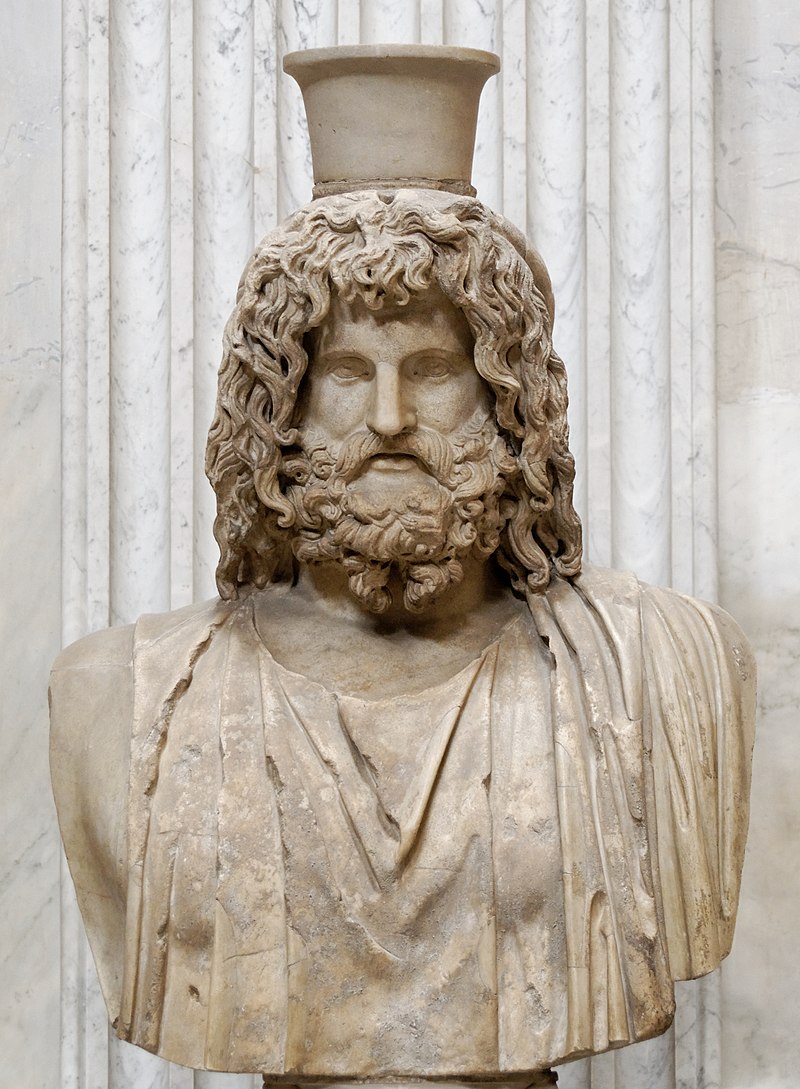
The Mediterranean civilization was already ancient by the time the Roman Empire came to dominate it. The Egyptians still worshiped Isis, Osiris and their many Gods, as did the Greeks, and the Persians, etc. Rome had learned an important lesson about religious tolerance (one it would later forget), in that it understood they shouldn’t stop on the cultures of the conquered, with some notable exceptions (the Jews, eventually). Instead, the Romans “appropriated” the cultures of others. The image above is Serapis, was an invention of the Ptolemaic dynasty to fuse Egyptian imagery of Osiris and Apis with Greek imagery of Hades, Demeter and Dionysus. The Romans took this a step further, noting that various gods were all facets of one another: Demeter was Ceres was Isis; Hermes was Mercury was Thoth and together were Hermes Trismegistus, which served as the foundation for hermetic magic.

The Greco-Roman world wasn’t the only, first, or last to fuse various deities into one. (Some forms of) Hinduism does something similar, arguing that all the various Gods of India are, ultimately, just facets of Brahman. Syncretism pops up in East Asia too, where various Daoist or Shinto “deities” fused with Buddhist imagery to create a new sort of conception of both. Wherever cultures have mixed in a sufficiently large degree, they begin to find parallels and conflate one religion with another, forming larger and greater communities, often with richer and more complex traditions as a result.

The Divine Masks follows a similar trend. The alien empire that conquered many worlds fused its own cults with those of other worlds and argued that they were all facets of the same thing and, like the Roman Empire, placed its own imperial cult at the pinnacle, planting the seeds for the Cult of the Mystic Tyrant to arise later. This is helped by the nature of Communion archetypes, which also argues that various divinities may well just be facets of a particular path.

Chaos Magick, the Occult and Neo-Paganism

You are a magpie of magic. A thief of tradition. You steal from other people’s cultures and beliefs to suit your own purposes.” –Papa Midnite, Constantine

The Divine Masks are an ancient tradition, one that dates back to before even the rise of humanity, let alone their Empire. The philosophies of humanity supplanted the alien philosophies that preceded them, but not completely. They still remain in older, more distant parts of the galaxy, and they still have a compelling power for cultures that object to mankind’s dominance and wish to return to their old ways. In this sense, they parallel Neo-Paganism, which is fundamentally an objection to the dominance of Christianity and an attempt to re-connect with one’s ancient roots. Here too, the tradition of the Divine Masks is either a continuous cult from ancient times, or an attempt to reconstruct that cult from days gone by in an attempt to regain one’s roots.

But at the same time, the tradition of the Divine Masks is an attempt at a single, cohesive cosmology that covers all psionics and all religion and tosses them into a single bag. This requires a rather expansive philosophical system, one that has become more academic than religious over time, and in a way completely unrelated to the actual religious practice. They explore the power of this religious imagery in a manner stripped of faith, for the pursuit of their own gains. Rather than heal with faith, they’ll heal with the imagery of faith, and the ritual of faith, and the words of faith, but they treat it as a system.

This creates a tension between those who believe, and those who attempt to manipulate in a coldly logical manner. Most occult systems, but especially post-modern occult systems like Chaos Magick follow a similar path. They largely dismiss faith and the fundamental mystical experience of becoming one with the divine, or trusting that the divine will make everything okay, and seeing religious practices as something of a science or an art, a system that can be manipulated and used. If a religious ritual allows one to boil a few grains of rice and say a special prayer/incantation over it to get more rice, then surely one can boil a few coins of gold and say a special incantation over it to get more gold!

Imagine if modern Wiccans and Vodouists, practicing their faith, came across a magician who thought their traditions were “neat” and co-opted them for his magical rituals. Imagine the tension this might create. The traditions of the Divine Masks has such practitioners who explore the metaphysics behind the various cults, as defined by the tradition of Divine Masks, and attempt to turn it into a cohesive occult system.

The Divine Masks as the RPG Religion

D&D drew considerable inspiration from the Greco-Roman world, and greatly simplified the idea of polytheism to create a simple system that allowed magical priests to align themselves with a specific power. This, of course, isn’t really how polytheism worked, which is a big catch-all that covers everything from animistic systems stuffed to the gills with small gods, to complex systems where the masses worshiped a pantheon of Gods, to systems where multiple religions were cast under a single umbrella. However, simplification works well, and in this case, while I’m trying to capture the complexity of the ancient world, in practice, most of the practitioners of the Divine Masks either act like wizards, who approach the system as one vast mystical tradition, or like clerics, who follow one single deity and gain power from that singular association.

But D&D isn’t the only, or even primary, source of RPG inspiration for the Divine Masks. Instead, Communion itself serves as inspiration. I use religion and philosophy as vehicles for interpreting the Communion system I’ve created, but we need at least one that follows the default interpretation, especially with a deep focus on the Paths. The Paths offer us modifiers similar to the GURPS Cabal modifiers, and the sort of devotion found Unknown Armies with its Avatars. The Divine Masks takes full advantage of these sources to create what I hope feels like a deeply occult system that rewards knowledge of how the various paths work. It also means that many of the cults might seem fairly obvious in their execution (the cult of the Beautiful Fool will tend to specialize in the miracles of the Beautiful Fool, etc).

What is the Tradition of the Divine Masks?

At its core, the Traditions of Divine Masks aren’t really a thing. It’s a story told by a long-dead empire in an effort to get everyone within that empire to get along. They created a cohesive metaphysics meant to explain, justify and empower the various cults that had gathered in that Empire.

When that Empire died, the culture behind those traditions remained. It created a system in which various followers of that culture could interact and allowed cults to remain on good terms with one another. Some followers of that culture began to fixate on the conceptual metaphysics behind the cults, however, they began to look at the story itself, rather than the purpose of the story, and explored it for its own sake, creating an occult system that they used to empower their psionic abilities.

The Divine Masks is also a vehicle for players to better understand and interact with the Paths of Communion, one of the more popular features of Communion, and given its inherent flexibility, it serves as a tradition that players interested in other philosophies can relatively easily bolt onto their chosen philosophy.

Patreon Post: The Divine Masks preview document

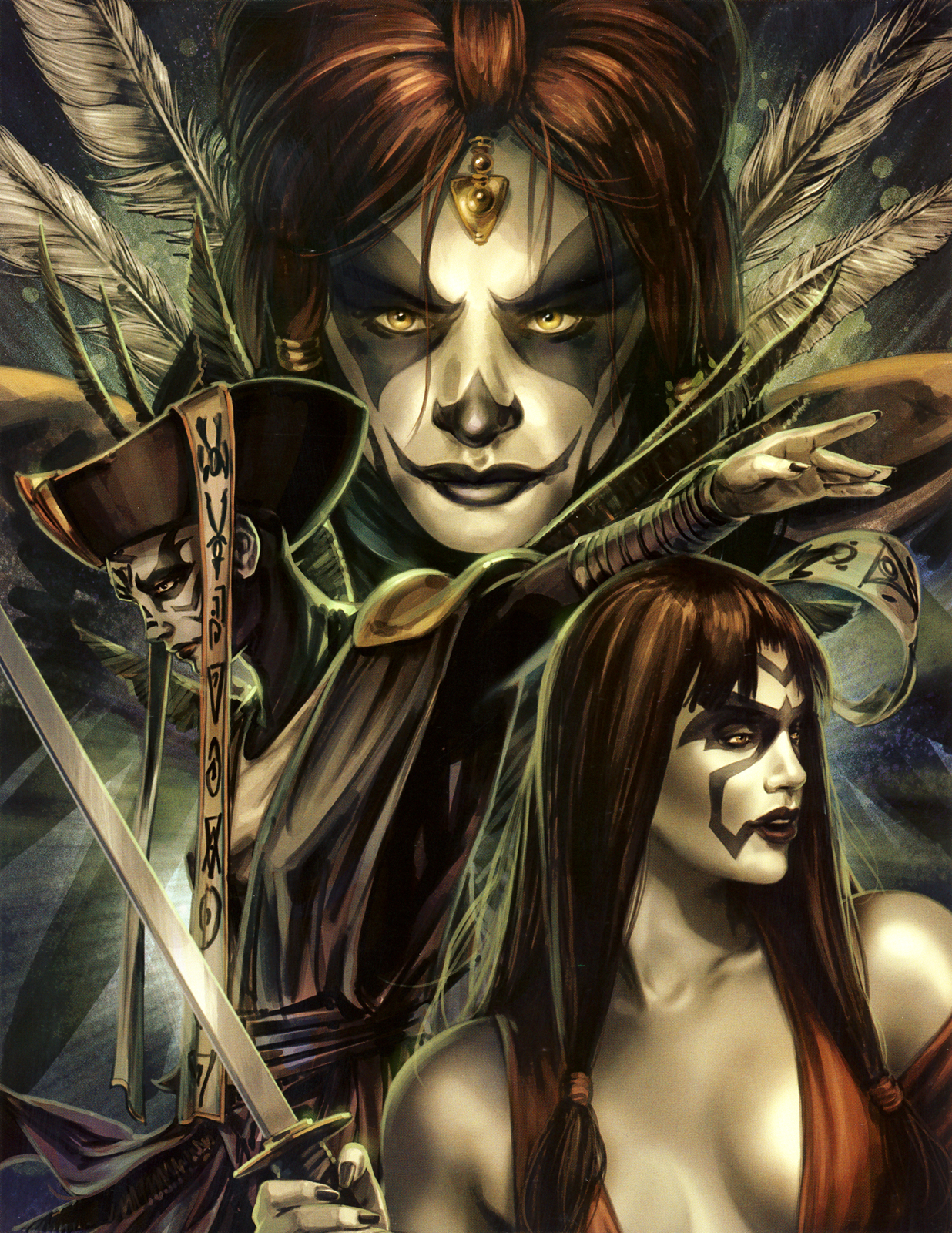
Mask of Madness by Chris Cold

The Divine Masks are the accumulation of psionic communion cults from an alien race named the “Ranathim” that once ruled an empire that spanned the galaxy long before humanity rose up to conquer it.  The scattered remains of their cults still lurk in dark places, on the edges of the galaxy and in disenfranchised communities bemoaning their fall from grace.  While most modern denizens of the Galaxy think of it as little more than a collection of superstitions, it served as the foundation from which the Cult of the Mystic Tyrant sprang, and continues to serve as the basis of belief for many alien cultures.

Today, I offer all $3+ patrons a preview of the Divine Masks.  If you’re a patron, check it out!  If you’re not a patron, as usual, I’d love to have you.

Support me on Patreon!

The Akashic Mysteries as Esoteric Skill

Many people believe in the Akashic Mysteries (via the Believer (Akashic Mysteries) quirk) and might study the Akashic Mysteries (Theology (Akashic Mysteries)) but few outside of the order are allowed to study the Akashic Mysteries as an esoteric style. The secrets of the Akashic Order is open only to those who take the proper vows and join the Order proper.

Anyone who joins the Akashic Order may study the Akashic Mysteries as a philosophical style. In practice, the Akashic Order reserves its “secret” knowledge only for characters who have undergone Akashic Initiation or Shadow Initiation. Priests and Knights can learn everything else (though most characters with ESP will become Oracles; by tradition, though, the Akashic Order does not teach its male members Prognostication).

The Akashic Order has access to the Oracle ability. This is not a secret, and it will willingly teach it to any ESPers who belong to the Order, including men, though women with Oracle are more traditional. Oracle can be used as a complimentary roll to gain a +2 to specific rolls (mainly Strategy, Bioengineering (Eugenics) and Diagnosis). Prognostication can do the same things, though this involves direct verification of the omens, and thus applies a +4 to any of the above! As such, characters who learn Oracle tend to learn it as a first step to learning Prognostication.

Akashic Oracles use their abilities to advise others. The most common forms of advice are on whom to marry, in which case the advice given generally focuses on what children will come from the union; how to fight; and how to find a cure to a disease.

Shadow Initiates learn secrets beyond those detailed in the Akashic Mysteries. For ideas, see the Devils of Persephone.

Akashic Mysteries 5 points

Required Skills: Meditation, Religious Ritual (Akashic Mysteries), Theology (Akashic Mysteries)

Additional Psionic Skills: Danger Sense, Oracle, Prognostication, Psychic Hunches

Secret Skills: Hidden Lore (Future History)

Techniques: Competitive Precognition (Prognostication), Deep Trance (Meditation), Directed (Prognostication), Marital Omens (Oracle), Medical Omens (Oracle), Strategic Omens (Oracle), Symbolic Future Lore (Theology),

Secret Techniques: Deep Time (Prognostication)

Perks: 20/20 Hindsight, Blind Psi, Ecstatic Psi (Dreaming Nymph), Exposition Sense, Inner Mastery, Know-It-All, Secret Knowledge (Future History), Secret Knowledge (Deep Time).

Optional Advantages: Clerical Investment (Akashic Mysteries), Destiny, Religious Rank (Akashic Mysteries), Security Clearance (Shadow Initiation)

Optional Disadvantages: Callous, Clueless, Code of Honor (Alliance Aristocratic), Disciplines of Faith (Monasticism), Fanaticism (Akashic Order), Hidebound, Nightmares, Obsession (“Stop the Coming Storm”), Sense of Duty (Akashic Order), Sense of Duty (Humanity)

Optional Skills:Area Knowledge (Persephone), Diagnosis, Bioengineering (Eugenics), Intimidation, Esoteric Medicine, Expert Skill (Political Science), Fortune Telling (Augury or Dream Interpretation), Naturalist, Pharmacy (Any),Physician, Poison, Politics, Savoir-Faire, Strategy.

New Perks

20/20 Hindsight: Pyramid #3/69 page 6.

Blind Psi: If the character has been blindfolded or otherwise deprived of sight for at least an hour, they may roll Will or Meditation. If successful, they gain +1 to all uses of their psionic talents. This is not cumulative with Sensory Deprivation (it is a form of sensory deprivation). Characters who have the Blind disadvantage may waive the roll.

Ecstatic Psi (Dreaming Nymph): See Psionic Powers page 19. Dreaming Nymph is a poisonous blossom native to Persephone and grows near or in its many caves that has a powerful hallucinatory, soporific and addictive quality, that also offers uncontrolled visions of the future that blur into the hallucinations. Some Oracles of the Akashic Mysteries have mastered the power of Dreaming Nymph and gain a +5, rather than a -5, while under its influence to use ESP (but still suffer a -5 to everything else).

Exposition Sense: See Psionic Powers page 42.

Inner Mastery: Characters may substitute Meditation for Will for Psionic Extra-Effort rolls.

Know-It-All: See Psionic Powers page 42

New Techniques

Competitive Precognition (Average)

Prerequisite: Prognostication.

Default: Prognostication; May not exceed Prognostication+4.

When engaged in a quick contest with another precog (see Dueling Precogs, GURPS Supers page 108), you may use your Competitive Precognition technique rather than your Prognostication skill. This technique does not require the expense of two fatigue to activate!

Deep Time (Hard)

Prerequisite: Prognostication.

Default: Prognostication-5; May not exceed Prognostication.

Precognition is limited to a single week. This technique violates that rule, allowing the character to search farther into the future (subject to the limitations noted in ESP in Action). Apply the “success by” rules from retrocognition as additional penalties for looking farther into the future: Looking 10 days ahead is -1, 100 days is -2, 3 years is -3, 30 years is -4, 300 years is -5, and so on. Thus, looking 300 years into the future is a -10. Note that the further into the future one looks, the less certain the future becomes!

Deep Trance (Hard)

Prerequisite: Meditation.

Default: Meditation-4; May not exceed Meditation.

The character meditates deeply for one hour and enters a trance. This trance either offers the same bonuses as Autohypnosis or +1 to all Psi skills plus an additional bonus equal to 1/3 of his margin of success, to a maximum of +5. He gains +4 if he’s using a sensory deprivation chamber, +2 for the Body Discipline perk, and may use Religious Ritual as a complementary roll.

Symbolic Time Lore (Hard)

Prerequisite: Theology (Akashic Mysteries).

Default: Theology (Akashic Mysteries); May not exceed Theology(Akashic Mysteries)+4.

Visions of the future often come with strange, symbolic visions that obscure the actual events at hand. The body of Akashic symbolism doubles as a means of interpreting the strange symbols that appear in visions in the future. If a character wishes to interpret his visions, he may roll Symbolic Time Lore for additional clarification.

New Skills

Bioengineering (Eugenics) (IQ/H)

Default: Biology-5 or Naturalist-6

Bioengineering (Eugenics) is a new skill whose primary purpose is to determine if two people would be genetically compatible. Akashic priests do this by checking records of lineage and guessing one’s lineage from looking at a character’s features. This latter is the more useful trait in Psi-Wars. Without performing a genetic test, the character can guess if another character belongs to a genetic line just by looking. This requires a Bioengineering (Eugenics)-4 roll, but the target’s Blood Purity adds +1 per level and Blood Impurity (if the character has any) adds -1 per level. A basic success will reveal whether or not the character has a Bloodline perk and what bloodline it is, as well as their Blood Purity level. Further margin of success can reveal additional information, such as additional Bloodline perks or what specific genetic power-ups the character took. At the GM’s discretion, a eugenicist can “discover” an unknown bloodline hidden in a character’s genetics, allowing the player to spend a point on that bloodline (or to take the Bloodline perk with a Blood Impurity of -1, for a total of 0 points).

Modifiers for detecting someone’s bloodline: -4 without records, +0 with records. +4 with a genetic test. +1 per level of Blood Purity or Blood Impurity.

Hidden Lore (Future History) (IQ/A)

Default: None

This skill covers the accumulated lore that the Akashic Order has collected about the many various possible futures and the nature of the Coming Storm. The character can roll Hidden Lore (Future History) to see if particular events have a meaningful impact on the future, what the outcome might be, or to recognize someone based on their impact on the future (for example, meeting an innocuous, if unruly teenager, and recognizing that he’s a serial killer in the future). Note that the libraries of the Akashic Order are incomplete and often contradictory, and even where they are accurate, the chaotic nature of time means that knowing future history is a pale substitute for actual Prognostication and Visions, but it can prove useful where the GM wishes it to be. Treat it like a precognitive version of Current Affairs!

New Powers

Oracle 14

Skill: Oracle (IQ/Hard)

The character has access to the Oracle ability (B72). The character may roll the Oracle skill to both detect and interpret omens. She may use Fortune-Telling as a complementary roll, and she may substitute Symbolic Time Lore (see above) for the Oracle skill for interpreting omens.

This is not a “secret” power (it does not require the expenditure of a perk), but it is not an ability often found outside of the Akashic Order. Apprentice Oracles often learn it as a stepping stone to Prognostication. At the GM’s discretion, players who invest points in Oracle may later trade out the points spent on Oracle and the Oracle skill for Prognostication and the Prognostication skill.

Statistics: Oracle (ESP -10%) [14]

Marital Omens (Average)

Prerequisite: Oracle

Default: Oracle-5; Cannot exceed Oracle

Oracle normally only looks for general omens. With Marital Omens, the character may explicitly seek the answer to a marital question, such as whom someone should marry, or whether a union will work out well. This technique does not require the expenditure of 2 fatigue.

Medical Omens (Average)

Prerequisite: Oracle

Default: Oracle-5; Cannot exceed Oracle.

As Marital Omens, but with regards to someone’s physical health and how best to cure a particular illness. This tends to be limited to whether or not someone will recover, or where one should go to seek the answer, and may be used as a psionic complementary roll for a Diagnosis roll (applying +2).

Strategic Omens (Average)

Prerequisite: Oracle

Default: Oracle-5; Cannot exceed Oracle

As Marital Omens, but in regards to the outcome of a battle. Success will tell the oracle whether the battle will be won or not, and perhaps some insights into how it might be won. This may be used as a psionic complementary roll for a Strategy roll (applying +2).


Akashic Symbolism and Ceremonies

Akashic Symoblism

The Akashic Record

According to initiates of the deepest Akashic Mysteries, a successful initiate finds the Akashic Record at the end of a long and harrowing astral journey. Most initiates describe them as a single tablet of glowing light that once touched, floods the mind with knowledge, but some describe it as an old woman, a statue of an old woman, or an aging book bound in human flesh. Artwork commonly depicts the Akashic Record as a glowing tablet held a loft by an Akashic Oracle, at the highest point of the artwork. The Akashic Record represent enlightenment, and the highest degree of initiation.

The Tree of Time and the Golden Path

Initiates of the Akashic Mysteries describe their astral journey as walking a winding maze until they reach the foot of a mountain that brings them to the road to the Akashic Record. When they look back down, they can see the fullness of time laid out before them. Some describe it as like a tangle of yarn, or a labyrinth, but the most common description is like a tree.

Those who learn the see the future describe a similar “maze” of branching possibilities. For example, when asked about whether or not a woman should accept a marriage proposal, Oracles actually see a myriad possible outcomes, including many possible outcomes if she says yes and if she says no. The near present has the least possibilities, and they’re very likely, the “thickest” branches, while those far away are the least possible and the most numerous, the “thinnest” branches.

The Akashic Order, thus, likes to describe time as a tree, with the present as the trunk, the roots as the past, and the branches as the possible future. The tree of time is ultimately the symbol of the Akashic Mysteries.

When walking the paths of the astral maze, many Akashic Initiates describe being guided by the golden light of the Akashic Record. This makes the preferred path “golden.” This has created the term of “the golden path” as the one true set of choices everyone must make to reach the enlightenment of the Golden Record. Many who follow the Akashic Mysteries like to have a great tree in a garden with golden ribbons hanging from its branches, to symbolize their dedication to following this “golden path.”

The Coming Storm

Beyond a particular point, no Akashic Oracle can see the future. She sees instead the writhing strands of chaotic impossibility. Beyond this point, precognition is impossible, the “Time Horizon.” This may just mean that every precognitive has limits, but the horizon refuses to move past a certain point: it comes swiftly and closes in on the current generation! And events that Akashics can see shortly preceding the Time Horizon depict awful slaughter, mayhem and carnage, though their exact nature varies, and who inflicts this carnage is invisible to the eyes of the Akashics (they can see the burning cities and the dead strewn about, but not who will destroy human civilization). Most have concluded that they cannot see the future beyond this because, for humanity, there is no future.

Within this writhing chaos, some Akashics can see gaps, and can peek at futures just beyond them. These tend to show humanity in a terrible state of subjugation or slow dissolution, but on one, beyond which the Akashic Record is visible, they see a safe and surviving humanity.

Akashic Oracles have a difficult time relating the horror of the Coming Storm (the first time an Oracle witnesses it, the GM might call for a Fright Check), and dislike talking about it. In iconography, artists like to depict it as a literal storm or as a burning tree; Akashics who have seen the Coming Storm prefer the burning tree, as they describe the Coming Storm as “devouring the tree of time,” but feel it might confuse the lay person. Within the temple on Persephone, an obscure wall has been painted entirely black and seems to move and writhe in the torchlight, and has the hellish imagery of skulls and slavery depicted on it; the Akashic Oracles claim the horror of this wall in a dark and foreboding passage comes to the closest to accurately depicting the Coming Storm.

Veils

The Akashic Oracle must isolate herself from the world to make the best possible predictions. Knowing the future, she must refrain from interacting with the world more than necessary lest her actions introduce unforeseen consequences, and she must not let worldly concerns distract her, lest they impact her visions.

The Akashic Order uses veils to symbolize this separation from the “supernatural,” or the silent places where visions take place, and the “real” world, where the rest of us live, and what the visions speak of. Those who enter an Akashic temple must pass through a silken veil, and those who will be initiated must pass through multiple veils, while the Akashic Oracle wears a veil while out in public, especially over her eyes.

The Veil symbolizes innocence and the dividing line between the supernatural and the physical. By wearing a veil, the Akashic Oracle denotes herself as connected to the “supernatural.”

The Devils of Persephone

The Devils of Persephone, important to the origins of the Akashic Mysteries, remain a potent symbol for the Akashic Mysteries. Akashic artwork depicts the Devils as standing between the supplicant and the tree of time, or haunting the labyrinth of time, stalking those who would reach the Akashic Record. They appear twisted or phantasmal creatures with black or shadowy skin, white eyes or no eyes at all, and great, fang-filled maws and long, hungry tongues. If an artwork depicts a point of light (a knight’s upraised force sword, or the Akashic Record itself), they recoil from that light as though in fear. They often decorate the facades of Akashic Temples, and statues of them stand before the veils of initiation. While outsiders interpret them as the monster, Akashic imagery treats them as guardians, as those who stand between the supplicant and the ultimate truths they seek, testing the worthy and devouring the unworthy.

The Symoblism of Time

The standard Akashic symbols tend to represent metaphors for time itself, explaining its shape, the needs of the Akashic Order and the ultimate lesson of the coming galactic calamity and the need for enlightenment and knowledge. The Akashic Order uses these symbols to teach the layman and to enlighten the initiate, but they have additional, more specific symbols.

The visions of oracles tend to be highly symbolic and confusing and often deeply personal. The Akashic Order has compiled entire libraries full of that imagery, to help explain the visions of their oracles, but they also drill these symbols into their initiates. They find that those steeped in the lore of that imagery are more likely to see that imagery in their visions, and thus these symbols create a language of interpretation that makes the visions easier to understand.

The Akashic Order often uses this imagery, in addition to the imagery noted above, in their Mystery Plays, in their ceremonies, and they’ve found their way into the heraldry of the Alliance.

Animals: Small adorable creatures, who often speak. Represent the poverty stricken, the weak, those who need to be protected; also represent the struggles of the common world, and often live in a harsh nature. For powerful, frightening animals, see the Great Beast.

Blood: Guilt, failure, the consequences of a past action catching up to one.

Blossoms: Any number of the poison blossoms of Persephone make their way into the symbolism of the Akashic Order. Their meaning varies from blossom to blossom, but generally symbolize love, innocence or the price of power.

Chains: Symbolize the bonds of vows, or connections between two people.

Darkness, the Void: Calamity, the Coming Storm, the Unknown.

Fire: Chaos, rapid change, the destruction of rightful rule; the Coming Storm.

Stars, Astronomical Phenomenon: A new journey, the need to travel, appointing a desired location.

Shadows: That which could be, but is not

The Blind Woman: Symbolizes oracles, oracular knowledge, or self-sacrifice

The Crown: Symbolizes rightful rule.

The Eye: Symbolizes knowledge, insight, psionic power, or the Akashic Record.

The Fool: Symbolizes innocent violation of rightful rule, an accidental (and possibly fortunate) violation of rules; can also symbolize another perspective.

The Force Sword: If vertical or held aloft, symbolizes a force driving away “Darkness.” If held horizontally or across the body, symbolizes righteous defense. If lowered (at a downward angle) but active, symbolizes restraint or control.

The Great Beast: Symbolizes slaughter, murder, war crime and violent violation of rightful rule.

The King: Symbolizes rightful rule.

The Knight: Symbolizes a powerful ally, someone that will defend or protect rightful rule.

The Lover: Symbolizes temptation away from one’s duty; a violation of the sacred.

The Mask: Usually two toned, with the left dark and the right bright. Symbolizes deception, or a hidden/masked nature, or something that cannot be known.

The Princess: Symbolizes a powerful victim or pawn, someone who others should sacrifice to gain safety or prosperity.

Akashic Ceremonies

The Akashic Mysteries use rituals to induce trances in themselves, to impress their followers, and because by following rigid protocols, they can slowly strengthen destiny to ensure that the future occurs as they predicted. All ceremonies require Religious Ritual (Akashic Mysteries). Such ceremonies may be performed by a priest or priestess of the order, but traditionally an Oracle is always present and the ceremony takes place under her authority, even if she plays no more than a symbolic role.

Supplication

Those who wish to ask a question of the Oracles of the Akashic Mysteries must submit their request in advance. For off-worlders, the Oracles prefer that the request be submitted before setting foot on the world. The Order decides which questions to take and on what schedule, and then notify those whose questions have been accepted.

When the supplicant, the one who has a question he wishes answered, arrives at the Akashic Temple, he is greeted by his companion, a member of the Temple who will accompany him at all times. He is ritually bathed, purified and dressed in preparation for meeting the oracle. Most temples encourage fasting. When the appointed time arrives, the companion gives the supplicant a ceremonial wafer dosed with a hallucinogen (traditionally Dream Nymph, but as that’s a dangerous poison, some temples use a more mild hallucinogen; see B440), and then guides him into the bowels beneath the temple where the Oracle awaits him. To reach her, he must pass through corridors full of symbolic imagery and at least one veil. The exact course depends on the message the temple wishes to give the supplicant (which may be political rather than mystical, something like “Look how powerful we are” or “Behold how much you need us”).

Finally, he stands before the Oracle. She usually sits upon a chair, tripod or throne, often in a room full of vapors. She gives a dramatic display in telling the supplicant the answer to his question (Performance or Religious Ritual). Usually, the temple divines the truth in advance, as the best precognition occurs in silent sensory deprivation chambers. Once the truth is known, the temple then usually decides what they want to tell the supplicant, and the Oracle focuses more on the impact of her performance than on how correct the answer is.

The real purpose of the entire affair is to put the supplicant on the right path. Thus, a man might ask “Who should I marry?” The order then turns their attention to his future and divines how they might answer his question in such a way to best help the Order. For example, if he tricks a local duchess into believing that he’s noble and marries her, he might have a miserable marriage and die to assassination, but their child would be an important hero in the future. And thus, they’ll couch the prophecy in revealing his “lost” aristocratic bloodline, in convincing him to rule, and in setting him on a path where he will meet the duchess, and gives him clues so as to recognize her as the woman he should marry.

Matchmaking and Marriage

Matchmaking is such a common question that the Oracles generally don’t accept such questions, and instead take a pro-active approach. A whole branch of the Akashic Order dedicates itself to keeping tabs on the bloodlines and eugenic traits of the various houses. These “Matchmakers” regularly go out and visit noble houses and consult on the viability of particular matches. These matchmakers tend to be low ranking members of the Akashic Order and might not even be psionic, and do not wear veils. They consult on the genetics of proposed matches and even propose matches to houses that seek them.

Oracles do investigate good matches. Generally, far-seeing oracles will have found particular people in the future that they wish to ensure will come into existence, and the oracle and matchmakers will work together to trace a bloodline lineage to the prophesied child, the Oracle working from the future backwards, and the matchmakers working from the present forward. Once the right matches have been found, the matchmakers will propose the matches and if that doesn’t work, the whole Akashic Order may begin to leverage their influence to push for a particular match. As such, traditionally, one accepted a proposed match from a matchmaker on principle, because one never knew when the entire Akashic Order would throw its weight behind the match.

The Akashic Order does not need to oversee wedding, but the nobility likes their stamp of approval, so a matchmaker will usually attend. They like to use the symbolism of the princess and the knight, the chains of the vow made between the two, and veiling the bride, to represent her innocence and purity. Sometimes, an Oracle will arrive to oversee the wedding, a veiled figure who stands apart from the proceedings as a silent witness. At the end of the ceremony, she might foretell the results of the marriage (usually highlighting the glamorous elements of their coming life, rather than pronouncing doom and gloom).

Note that in the modern Alliance, matchmakers and oracles still exist, but in far fewer numbers and without the influence they had before. Many disregard their advice (and bloodlines decay as a result) and even those who wish to consult with Akashic matchmakers are often unable to find any. “Traditional” Akashic weddings are rare

Judgment

The Akashic Oracles have their roots in psychic criminal investigation, and have a long tradition of predicting crime before it occurs. When an Akashic Oracle uncovers a crime that matters in the context of the Coming Storm, the order will duly note the prophecy and then move into action. The Akashic Order accepts the sovereignty of the aristocracy, and thus leaves it to them to practice law enforcement, but in extreme cases, the Akashic Order will turn up on a noble’s doorstep with a fully veiled and ceremonially garbed Oracle, who pronounces the wickedness of a particular person and demands a specific punishment. As always, the punishment is meant to not only prevent the crime, but to push the rest of society in a particular direction. At times in the past, the Akashic Order has even condemned the innocent because doing so had an important and beneficial impact on the future.

Initiation

Initiation greatly resembles supplication. It begins with a request, the arrival at the temple, the assigning of a companion, purification, ritual garments, the ceremonial wafer and then being guided into the bowels of the temple.

Thereupon it changes, depending on the level of initiation. The Akashic Order has three levels of initation. The first, lesser initiation or noble initiation, either initiates someone as a member of the Akashic Order, or inducts a noble into the “true” mysteries of the Akashic Order and “gives him his purpose.” Traditionally, all ruling nobles underwent the noble initiation, but in the Alliance few bother. Note that this step is not necessary to consider oneself a follower of the Akashic Mysteries; it is, instead, the “next step,” closer to a pilgrimage than a baptism, an optional step that shows intense devotion, or a mandatory step for those who wish to join the religious organization and gain Religious Rank.

The Greater Initiation, or the Akashic Initiation, is open only to precognitives who have undergone the lesser initiation and serve the Akashic Order. It reveals the Akashic Record to the initiate. This step makes one an Akashic Oracle, and is necessary to learn the how to read Deep Time.

The Final Initiation, also called the Shadow Initiation or the Dying, can only be undertaken by predestined oracles who have undergone the Akashic Initiation and have seen the Akashic Record or by someone the Shadow Council wants as their personal assistant. This inducts them into the Shadow Council, the ruling body of the Akashic Order.

A lesser initiate is guided past a veil and into a chamber full of imagery of the Devils of Persephone. There he must prove his worth. The initiate is questioned. The priest demands the initiate answer his name and purpose and then tests the initiates knowledge of Akashic Theology (a basic Theology test at between +0 to +4, usually questions about basic imagery). If the supplicant passes, he must sacrifice. The Priest tests the initiate’s conviction with a test of pain using a ceremonial variant of a neurolash. The target must pass a Will roll at between -0 to -4. Fanaticism applies its usual +3, while High Pain Threshold halves the penalty. If he passes, he makes a vow of secrecy to never reveal what he is shown in the initiation.

If the initiate passes, his companion guides him past the next set of veils, to a room with labyrinthine imagery. There, a priest or priestess reveals symbols pertinent to the initiate, most commonly a small symbolic chain, flowers, and tokens etched with more abstract symbols. Akashic Knights receive their force sword at this time. The priest or priestess accompanies these revelations with seemingly nonsensical pronouncements that, in fact, illustrate something of the initiate’s future, and how that future is symbolized in the symbols shown here.

Then the Companion guides the initiate past a third set of veils to a room where an oracle stands before an image of the Akashic Record. The Companion instructs the supplicant and she pronounces his purpose, the role he plays in the Akashic Mysteries. Then, the Companion instructs the initiate in the words and actions he must say and perform in the Akashic Mystery.

Finally, the Companion guides the initiate past the final set of veils, returning him to the chamber of Devils. There, he must speak the words and perform the ceremonial actions (Religious Ritual at +4) to be allowed out. If the character fails, the Companion couches him quietly until he gets it right, and then he’s allowed to leave.

The Akashic Initiation matches the Noble Initiation, but in place of an oracle, the third chamber has a sensory deprivation chamber or a pool in which the would-be oracle must float The previous steps only prepare her for the rigors of the true test, which begins now. Her companion guides her into the trance necessary to find the astral space in which the Labyrinth of Time resides, and the initiate must locate and read the Akashic Record. The exact rule for this are left up to the GM: it might be a roll of the Prognostication skill, or it might be Akashic Theology with a bonus from ESP talent, or the GM might play out a highly symbolic astral adventure. If the character fails to find the Akashic Record, most of the time, they’re lost in the labyrinth and never return, becoming comatose. A few simply retreat in terror from the experience, and any oracle can tell at a glance whether the character has read the Akashic Record.

The Final Initiation resembles the lesser initiation, except the third chamber is the Shadow Council Chamber itself, and the Shadow Initiate “never returns.” After introducing herself to her fellow Shadow Councilors, she is allowed to leave an enter via a secret passage that all Shadow Initiates use to enter the Shadow Council Chamber, and thus does not “return” to the original chamber as in the other two forms of initiation.

The Akashic Mystery

The Akashic Mystery is a mass ceremony held every 4 Persephone years. The Akashic Order invites attendees, who must be initiates in the Akashic Mystery. As with the supplication, each attendee receives a companion, is ritually purified, given a ceremonial wafer, etc, and then brought to a vast chamber.

An oracle conducts the Mystery. First, she reveals powerful symbols and speaks a prophecy for the coming four years using those symbols. Then she conducts a grand play in which all attendees must play out the role given to them during their initiation. They use the symbols given to them, perform the actions taught to them, and speak the words told to them during their initiation, as directed by their Companion and the Oracle. This grand play reminds them of the role they play, casts their lives as but parts in the grand Akashic Mystery, and gives them insights into what they must do for the coming period of four years.

Afterwords, the Akashic Order treats everyone to a grand feast; the Akashic Order accepts donations from the nobles attending, and most nobles make a point of trying to one up one another by bringing the greatest foods they can, or so it was during the height of the Akashic Order’s influence. Modern Akashic Mysteries are much more somber affairs.

Akashic Theology

The Principles of the Akashic Mysteries

  1. The ultimate fate of mankind our greatest concern.
  2. Mankind faces an existential crisis in the future (“The Coming Storm”)
  3. Humans with psionic powers are superior to humans without psionic powers.
  4. The Akashic Oracles have the ability to see that future and have found a way to avoid it (“The Golden Path”)
  5. The ends justify the means; any act, no matter how immoral, that helps avert the Coming Storm is a moral act.
  6. The Akashic Order, as the only ones who can see how to avoid the Coming Storm, must have the ultimate authority over all mankind.
  7. Everyone must play their part in the Akashic Mystery.

The Beliefs of the Akashic Mysteries

Those initiated in the Akashic Mysteries learn of the true shape of time. They see the many branching choices that extend before them, and that extend before all of mankind. In this way, they learn their purpose, and often that their purpose is full of a dreadful duty. They can turn away from it, condemning mankind to destruction, or they can embrace it and save mankind from the great calamity that awaits mankind and all the Galaxy: “the Coming Storm.”

The apocalyptic visions of the Coming Storm drives everything within the Akashic Order. It drives their secrecy, it drives their eugenic experiments, it drives their deceptive prophecies. The Akashic Order carefully controls the truth of the future, offering only what the masses need to know to avert the catastrophe.

The Akashic Mysteries aren’t a holistic philosophy. They are a precognitive imperative to save mankind. Everything else in the faith arises from those eschatological fears: the Akashic Mysteries exist to help mankind escape extinction. Beyond that, nothing matters to the Akashic Mysteries: one can believe whatever one wants, provided they serve the Akashic interest in saving mankind.

The Akashic Mysteries and the Hard Questions

Akashism and Good vs Evil

The Akashic Mysteries don’t make philosophical arguments about ethics, but they do have some implicit assumptions about morality. To the Akashic, the ultimate safety and prosperity of humanity is the ultimate good. They have looked upon the chaos of time and seen the suffering that awaits their descendants if they do not act, and anything done in the name of preventing the Coming Storm is moral.

The Akashic Order lies, steals and murders in the name of stopping the Coming Storm. It forces people to marry out of duty rather than love. It demands submission to authority. It wages war, slaughtering millions, because it seeks to save the lives of trillions. The mental calculus of the Akashic Order is that the greater good of the future justifies the lesser evils of today.

To enact this end, the Akashic Order preaches the virtues of purity, obedience, sacrifice and secrecy. All people must know their place: the common man must labor, the lord must lead, and the oracle must know. Each should do precisely their appointed task, because too much rebellion, too many questions, might throw the timeline off and force the Akashic Order to take drastic measures to bring it back into line. Everyone must obey the Akashic Order without question, because the Akashic Order often cannot explain why it does what it does. This even applies to members of the Akashic Order who belong in a hierarchy of secrecy, where those beneath have seen less of the Akashic Record than those at the top, and must act on their orders. Those orders often demand self-sacrifice, such as accepting death so that many may live. Finally, those within the order must remain silent about what they have learned, lest rumor and gossip spread the details of a dangerous prophecy, and people begin to act in such a way that breaks the prophecy

Akashism on the State and War

The Akashic Order needs the state to function. It helped forge the Eternal Empire precisely because it needed to exert wide influence. By taking control of as much of the Galaxy as they could, the Akashic Order could control the actions of millions of lives. They could create a careful stability that reduced the noise of excessive variables and make better, more long-term predictions without fear of chaos ripping apart their visions of the future. They could mandate laws that pushed mankind on the path that they needed.

The Akashic Order, in turn, gives legitimacy to the actions of the state. Why is a noble allowed to lead and a commoner must bow to him? Because the Akashic Order says so; because it creates a better universe; because it will avert the Coming Storm. In the Eternal Empire, even the Emperor himself was crowned by the Akashic Order. Today, the Akashic Order has been relegated to a secondary role; many in the Alliance no longer believe, or see it as an outdated philosophy to be followed only out of tradition (in the way an atheist American might celebrate Christmas, or enjoy a cathedral as a tourist destination). But a minority of the nobility remain devoutly loyal to the faith and seek to bolster its power. The Akashic Order must be enshrined in the state for it to truly work.

The Akashic Order definitely believes in justice but, here again, that justice revolves more around a carefully constructed socially order that pushes mankind towards defeating that ultimate threat. A serial killer causes a problem not because murder is wrong, but because too many dead people and general panic is antithetical to the Akashic goal. However, the Akashic Order prefers to engage in pre-emptive justice. They can see the serial killer before he strikes. They prefer to either stop him before he acts (though preferably in secret, with assassins or inquisitors or an obscure favor demanded of the aristocracy), or allow him to act for some reason and then use the terror he creates to further some goal, and then use his trial and execution, again, to further their objectives.

The Akashic Order prefers peace to war because peace tends to be stable and thus easier to predict. That said, the Akashic Order will not shrink from pushing war, especially war against aliens. The Akashic Order seeks to improve the lives of humanity, not of all sapient-kind. In the moral calculus of the Akashic Order, the death of aliens to save the lives of humans is an easy choice to make. Akashics are not racial purists by any means, they just tend to view everything through the lens of eventual human survival (if aliens will help with that, great! If not…)

Akashic views on Time and Destiny

The Akashic Mysteries are intimately tied with the concept of time and destiny. Understanding time is what they do. Most initiates of the Akashic Order have some level of precognition, and thus understand that, on some level, the future exists. The closer to the present the future is, the more “real” it gets, and the more certain. A character with danger sense who detects an incoming attack is certain that the attack really is coming. But as one moves further into the future, the more chaotic time gets.

Time is not “set,’ and the Akashic Order does not believe in a deterministic universe. They see the future as a tree with a million branching points, with the thick, obvious trunk representing the near future, with the billions of tiny twigs on the end of the tree representing all the possible distant futures. The Great Storm is like a terrible fire that consumes most of those distant twigs, with only a few visible escape routes, and the one the Akashic Order has selected is called “the Golden Path.”

Because the future can be shaped by all possible variables, the golden path is fragile, and it’s possible to move onto an entire “branch” of the future that pushes mankind onto an inevitable path of destruction (which, according to many who have left the Akashic Order after the death the of the last Emperor, occurred with the end of the Eternal Empire; according to them, mankind can no longer be saved). This, the Akashic Order must stop at all costs.

While the do not advertise this, deep initiates learn that the unchosen branches of the future still exist. The “weight” of the near future only seems certain because one is present in that moment. In fact, the possible choices of the past still exist, which means alternate possible “presents” can be said to exist. Generally, the Akashic initiates learn to disregard these “time shadows” but it poses the potential problem that messages the Akashic order gets from the future might no longer be relevant if that future has been largely averted!

The Akashic Order has a shadow council, the body that ultimately governs them, and it consists of the most powerful Akashic Oracles, past, present and future. The Shadow Council has largely remained unchanged since its inception, but as time has worn on, some of the “certain future councilors” of the Shadow Council have never come to be born, and offer increasingly irrelevant or incorrect advice. This effect grew sharply with the death of the last Emperor; some in the Akashic Order believe that these shadows act as signposts, explaining how the world should be, and that it’s possible to wrench the timeline back onto the right path by arranging the present as close to the increasingly incoherent demands of the Shadow Council as possible.

The Akashic Order has noticed that despite the chaos of the future, one can feed possibility back in on itself, to make choices that not only guide people onto the proper path, but that reinforces that path, making it more and more stable and certain, so that it can absorb minor deviations. The Akashic Order refers to this temporal inertia as “destiny,” and they work very hard to construct it: the Akashic Order wants more than just to make a knight into a hero, they want to ensure the right person is his enemy, is the person he rescues and romances, , that the right events occur to make his heroic rise as heroic as possible. If even one element falters, the rest ensures that our hero is caged in his heroism.

Destiny is never guaranteed, however. Stuffing so much energy and possibility into a single person or event can cause it to go dramatically wrong. The more Destiny someone has, the more powerful his choices. A minor player, such as some common chef, who chooses to abandon his job, or leave his wife for a mistress, in the broad scheme of things doesn’t matter that much. But if the hero in the example above decides to instead join his rival, or falls in love with the wicked princess, he can wreak great havoc. The more powerful a character’s destiny, the more distinct certain “alternative” options become. The Maradonian aristocracy have been stuffed full with destiny, and thus have powerful alternatives to their duty available to them. Thus, the Akashic Order watches the aristocracy closely, even today.

Akashism on Psionic Powers and Communion

The Akashic Mysteries doesn’t concern itself with a nuanced and precise cosmology or epistemology, and accepts the common view that the world is a physical thing and that the mind, psionic powers and “the supernatural” exist on a fundamentally different layer. They accept that “science” can affect psionic powers (psychotronics), but they still tend to approach psionic powers cautiously and have seen genetic engineering experiments to develop psionic powers go horribly wrong. As such, by default the Askashic Order seeks science as useful knowledge for the real world, but that the Akashic Mysteries are vital for understanding the psionic world.

Akashism acknowledges that genetics impact psionics. They see bloodlines that create psionic power as more pure and better than bloodlines that do not. For the Akashic practitioner, psionic power is not a matter of enlightenment, but genetic superiority, in much the same way that intelligence and physical strength are manifestations of genetic superiority.

Akashism failed to grasp Communion and the revelation of its existence shook the faith to its core. According to Akashism, one’s psionic powers derive from their genetics, and specific bloodlines can access specific powers. No person can access all psionic powers, certainly not just by communing with some vast gestalt or whatever it is that Communion is. To watch an Elegans master psychokinesis through meditation, as well as exhibit power and knowledge that he should not have cracked the very foundations upon which Akashism stood.

Akashics struggle with this, and have diverged on two paths. Most Akashics argue that Communion is a lie. They note that many follow the philosophy of Communion and never gain psionic powers or abilities beyond their genetic potential, and that it may be that there’s simply undiscovered bloodlines that are even purer than those created by the Akashic Order, and that these have mastered far greater psionic power. Those who hold this line of thinking seek out masters of Communion and try to marry into their bloodlines, hoping to find a way to “genetically unlock” Communion.

A minority accepts Communion, arguing that people once thought that psionic powers were but superstition until the Akashic Order and its antecedents mastered those powers. Now, the Akashic Order must master this greater understanding of Communion. They note that the way in which some aristocrats mystically embody the ideal of their ancestors looks a lot like paths, and that the Akashic Temples, where one can witness the Akashic Record, often seem to coincide with locations steeped in holy Communion energies. They argue that the Akashic Mysteries already use Communion, which explains the more mystical elements of the theology. This group seeks out masters of Communion to better learn Communion, and how they can use it to better divert the Coming Storm.

Akashics on Death, the Afterlife and the Purpose of Life

The Akashics make no explicit claim on the purpose of life: one is free to live the sort of life one wishes. However, the Akashics argue that one has a duty to one’s ancestors and descendants to help all of mankind to avoid the existential crisis known as the Coming Storm. In that context, everyone has a purpose.

The Akashic Order can see what actions one must undertake to assist in preventing the Coming Storm, and for the average Akashic, this is equivalent to one’s purpose in life. Many believes in the Akashic Mysteries will approach oracles to find out what that purpose is: who they must marry, what job they should take, what sort of person they should be. In response, the Akashic Oracle gives them commands on how they must live. The details vary: in many cases, the life of that individual makes no serious impact on the Coming Storm, so they Oracle gives the supplicant some generic, even uplifting advice. In others, that person plays a very specific role and must be given precise instructions or, in some extreme cases (as is often the case with nobility) must be assigned an oracle who constantly helps to guide the supplicant through the treacherous waters of their life.

To the Akashic, whether or not an afterlife exists isn’t relevant. They deal with the real world, and even in the real world, they often speak to people long dead or not yet born, as each uses precognition to look upon the actions of their descendants. Thus, in a very real way, to those initiated in the deeper secrets of the Akashic Mysteries, death isn’t a finality so much as a distance placed between two people. The Akashics can even see what would have happened if someone had lived, and thus can describe the “life” of a dead child to grieving parents, who have been separated from their child not by death, but by chance and the gulf of time that only the Akashics can bridge.

Thus, the best way to bridge that gulf of time is to matter to as many people as you can. A heroic ancestor who lives fully to his purpose, or who made a major impact upon history, becomes a point of interest to once and future Akashics. Such powerful individuals find that their actions resonate through the past and present. The Akashic Order encourages ancestor worship. They push the descendants of those great individuals to study their lives and try to imitate them, to draw on the power of those events to improve their own power. The life of a great ancestor can become the template of your own life, and empower you. In so doing, one can create a resonance that helps to break apart the Coming Storm in the future.

The Akashic Mysteries and other Philosophies

The Akashic Mysteries has no strong epistemological or metaphysical assumptions. If one wishes to believe in science or in the occult or in Communion, the Akashic Order doesn’t care. It concerns itself exclusively with time, and the moral imperative of protecting humanity from the Coming Crisis. Only when a philosophy violates that moral imperative does the Akashic Order bristle.

For example, the Akashic Order didn’t mind the philosophy of True Communion when it remained confined to the alien parts of the Galaxy. Only when it began to invade the human realm and make the common man question his place in subservience to the aristocracy, or the reality of the Coming Storm, did the Akashic Order begin to act. The Akashic Order doesn’t mind the principle or idea of Communion; some within its ranks even study it and attempt to understand how they can use it avert the Coming Storm. It’s the subversiveness of True Communion that the Akashic Order objects to.

Likewise, the Akashic Order doesn’t mind science or dislike Rationalism except when Neo-Rationalism’s empiricism and refusal to accept psionic phenomenon leads them to argue that the “Coming Storm” is just some fable made up by the Akashic Order to force people to obey them and to discard the rational in favor of irrational mysticism. Then the Akashic Order objects, strenuously.

Thus, if a philosophy acknowledges the importance of the Akashic mission, and, in the very least, does nothing to interfere with the Akashic Order, the Order accepts it, and may even study it. This has led some of its more far-flung members into speculative investigation of odd beliefs or philosophies, or recasting existing philosophies in a way that suits the Order.

Are the Akashic Mysteries Correct?

The default assumption of Psi-Wars is that the Akashic Mysteries are more-or-less correct, but that they failed, both to grasp the full extent of the great galactic calamity, and to prevent the great galactic calamity from occurring. Now, new measures need to be taken.

The incorrectness of the Akashic Mysteries have several possible degrees. The lightest is that they simply miscalculated; failing to account for Communion is a big oversight. It might be possible for them to return and find a new way golden path, a new set of prophecies that allow greater dynamism and resilience than the previous plan.

On the more extreme end, the critics of the Akashic Mysteries might be correct, and the “Coming Storm” was never real, and that such long term predictions of the future aren’t possible. The Akashics either deluded themselves with hallucinatory visions caused by intoxicants and sensory deprivation fusing nightmares with real precognition and their own minds trying to fill in the blanks. The “Great Storm” might be nothing but the darkness at the limits of one’s vision, and as one gets closer to the event, that darkness simply recedes. Alternatively, the Coming Storm never existed and the Akashics knew it, merely conceiving of it as a way to impose their power on the galaxy and create an empire.

The correctness of the Akashic Mysteries also has several possible degrees. The simplest is to say that they were right and remain correct: the Coming Storm is just over the horizon and represent the primary existential threat of the setting, a new element that a GM can inject into his campaign to add urgency beyond the war between Alliance and Empire. A stronger vision of the Akashic Order is possible. Given that they can see the future, couldn’t they see the eventual decadence of their own order? Couldn’t they see the failure of the Eternal Empire coming? Wouldn’t they have planned for it? What if this was their plan all along? This telling makes the Akashics a powerful conspiratorial force, but I suggest caution on this path: if the Akashics become completely infallible, then the players have no role to play in saving the Galaxy. A slightly better version might cast the Akashics as essentially correct, but lacking in the necessary power to avert the crisis. They manipulated the galaxy into this current state of crisis because only in this state is the redemption of the galaxy possible. But the fate of the galaxy now rests on a tipping edge, doomed to either fall into the abyss of annihiation, or to be rescued and, naturally, the Akashics know whow the ideal people to give the galaxy a fighting chance are…

Beyond this core concern, the correctness of the Akashic Order doesn’t really matter. The true nature of Communion or Psionic activity or of God or whether the universe is fundamentally material or not don’t really concern them. All that concerns them is the reality of the coming storm.

The Cultural Context of the Akashic Mysteries

The Akashic Mysteries deeply tied to the Maradon culture and its rise to Galactic dominion.  The roots of the Akashic Mysteries lie in the Maradon culture’s ancestral legacy of psionics, eugenics, and the discoveries made on the new world of Persephone.

Of the original three human worlds, Maradon had the strongest psionic culture. Their civilizatoin quickly discovered and thoroughly researched psychic phenomenon. They used precognition to uncover crime, telepathy to separate truth from a lie, and ergokinesis and psychokinesis to explore new physics. The eugenic experiments that eventually created the Maradonian aristocracy arose long before the formalization of the Akashic mysteries.

Because this early era had not yet perfected psionic eugenics (and their direct genetic tampering proved disastrous), the early psions of the Maradon Culture quickly became celebraties or power-brokers. If one wanted as many as three precognitives to uncover crime or predict the outcome of a business venture, one had to search far and wide, and either enslave the precognitive or give the precognitive whatever she wanted. Thus, psions quickly came to dominate the Maradon culture; eugenics and aristocratic bloodlines, over time, only cemented this power.

The Akashic Mysteries didn’t really get their start until Maradonian colonists settled the world of Persephone. There, vast networks of caverns hid within its volcanic islands and mountainous inlets, creating a complex “underworld.” And within this underworld, the colonists discovered “the devils of Persephone”, or the Kairoskia.

Time, and the Akashic Order, has obscured the early stories about the devils of Persephone, so that fact blurs with myth. They might be symbolic, a phenomenon uncovered by the colonists, or literal monsters, or a strange bloodline that arose on the planet. What seems clear is that the Kairoskia killed many colonists until they began sacrifice their maidens by sending them into the caverns. Those maidens eventually returned, having brokered some sort of understanding with the Kairoskia, and brought with them an understanding of deep time. They claimed to have “read the Akashic record,” and to have witnessed the shape of time.

Persephone began to produce the greatest precognitives in human space. People from across the local sector began to flock to Persephone to beg the Akashic Oracles for answers to their questions. The Akashic Oracles gave them the answers that they needed, but demanded high prices. They sought initiates into their order, demanded sacrifices and mysterious favors. Finally, Alexus Rex himself came to Persephone and demanded to know how to expand his dominion. The oracles greeted him and drew him deep into their caves. When he returned, oracles flanked him and Sissi Sabine stood at his side. He announced their engagement, the truth of the Oracles and described the prophecy the oracles had given him: they saw a “Coming Storm” that would tear apart the galaxy, and that only the Alexian bloodline could guide the galaxy through that storm safely.

Thereafter, the Akashic Order accompanied the Alexian fleet as it conquered the galaxy. They descended into their dreaming pods and consulted their shadow councils. They told the Maradonian elite where to fight, who to marry, and when to make allies. The Akashic Order guided the Maradon culture to dominion, shaped their aristocracy and set them on the path to eternity. Together, the Alexian bloodline and the Akashic Order created the “Eternal Empire.”

But the Eternal Empire couldn’t last forever. As time wore on, some within the Akashic Order took less interest in the “Golden Path” of the Akashic record and focused more on personal success and happiness. They began to make alliances with powerful nobles, describing what paths they could take for immediate gain, knowing that this slowly, bit by bit, pulled humanity off the Golden Path, but leaving it to future generations. Slowly, the Maradonian bloodlines began to lose their potency and the Empire its power.

Then the Akashic Order met the philosophy of True Communion. Their profound power allowed them to side-step destiny. They preached a vision of the world where no person was greater than another, that all people had potential. True Communion undercut the very principles upon which the Akashic Order were founded upon: the weight of destiny, the rarity of psionic power, the need for powerful authority. The lesser nobles and the common man took to this new, alien philosophy and founded the Knights of Communion.

At first, the Akashic Order refuse to tolerate this dissent. They saw it as a danger to their golden path. Knights loyal to the Akashic Order formed their own Order of Akashic Knights who openly fought against the Knights of Communion. Eventually, though, the Akashic Order lost control of their own degenerate members and the mad Emperor, Lucius Alexus, and all out war erupted with the Knights of Communion, a war that destroyed the Alexian bloodline and shattered the dreams of the Akashic Order.

In the fiery collapse of the “Eternal Empire,” the Akashic Order had no haven in the storm. The had no single bloodline they could ally with. The debts of the degenerate members came due and the timeline fractured into a million unnavigable paths. Some in the Akashic Order would side with one noble house, while another portion of the Akashic Order would side with another house. One side would win, and the other would blame the portion of the Order that backed him for giving him bad advice. Slowly but surely, the Maradonian elites lost faith in the Akashic Order. Some remained true, but the Akashic Order retreated back to Persephone while the aristocracy picked up the pieces of the Empire and welded it back together as the Federation.

The Akashic Order remained on Perspephone, in an archconservative part of the Federation that still believed in the old ways. The sight of a veiled girl flanked by robed defenders became a quaint reminder of a more superstitious past. Their loss of power meant that only those who believed fiercely in the need to protect the galaxy from the Coming Storm: the fires at the end of the Eternal Empire had purged the order of the unfaithful. The Akashic Order rededicated itself to its original purpose.

They foresaw the galactic invasion for what it was: the first rumbling of the Coming Storm. They tried to warn the Federation of the need to act, but they bickered instead. They foresaw the rise of the Emperor, and they warned the aristocracy to prepare. Some, like House Sabine and Grimshaw, did just that, and were ready for the Empire when it erupted. Suddenly, the old prophecies snap into clear focus and the Akashics of the modern era begin to wonder: is it possible to bring mankind back onto the golden path again? Perhaps the galaxy can yet be saved from the Coming Storm…

Akashic Culture and Values

The Order of the Akashic Mysteries are grounded in the culture and values of the Maradonian people. Thus, their basic preconceptions tend to be grounded in the same elitist prestige, value for innocence and purity and their sense of restraint that the rest of the Maradonian elites have.

The people of Maradon believe that some people are demonstrably better than other people. Their aristocracy are stronger, healthier, smarter and more attractive than the common man, and thus more suited to rule. Even if one disagrees with these assessments on subjective grounds, objectively the aristocracy have powers that mere mortals do not: they can see the future, shape your mind and toss around electricity. The rationalists might dismiss these as tricks, but the Maradonian people know better. Because the aristocracy has powers and insights that the common men do not, they obviously have the right to rule.

But this right to rule comes with an obligation. The reason the Maradonian elite have the right to rule comes because they’re the best suited to do the job right. Which means they must do the job right! This creates a compact between the ruled and the ruler, with each bound in turn by the other. The aristocrat must rule wisely and justly and use his power to expand not only his own wealth and happiness, but the wealth and happiness of all his people. This means that the elite must exercise restraint. He is not free to act as he sees fit. They should not use a wasteful, warlike or insulting solution where an elegant, peaceful and respectful solution could work just as well.

This fosters a paternal relationship between ruler and ruled. The elites shelter the common man from the dangers of the galaxy, and thus the elites begin to value the softness associated with a well-sheltered person. A delicate princess with flawless skin and long, long silken hair who has never faced an unkind word, to the Maradon people, is not a sign of indolent degeneracy, but a sign of the power of her protectors. To the Maradon people, the ideal world is an idyllic one, full of lush pastures and happy, fat commoners who never worry about war or theft.

The Akashic Order feels the same way. They see themselves and their self-appointed leaders, as the only elites capable of ruling the galaxy. Only the strongest, the fastest, the best can possibly do the job, and the Akashic already knows who the best are. However, a heavy hand on the timeline might have unexpected consequences, and if people become too aware of the realities of the hardships that they face, or the true content of prophecy, they might begin to act unpredictably. The Akashic Order wants people to be blindly obedient so that the Akashic order can move them to where they need to be with minimal danger to all, and this even applies to its own members. The Akashic Order is rigidly hierarchical, with the most prestigious and pure-blooded at the top of the Order; they exercise a restrained rule, seldom making appearances and making small, subtle moves, while they expect their followers to blindly obey and to pull back from the world, to make as little impact on it as possible, while also allowing to make as little impact upon them as possible (to best retain their objectivity).

Introduction to the Akashic Mysteries

Despite the many philosophical arguments that spring up around Star Wars, the real intent behind “the Force” was to discuss religion. Of course, the line between philosophy and religion blur quite a lot in the best of times, but for the second philosophy, I want to discuss theology and, especially, mysticism, rather than “pure” philosophy (whatever that means).

I noted with Neo-Rationalism that Star Wars combines sci-fi tropes with the beats of fantasy. It has far future technology combined with spooky, ancient mysticism. Neo-Rationalism allows us to handle science, so we need our mysticism, and that’s the Akashic Mysteries.

Why not just jump straight into Communion? For a few reasons. Exploration is a deeply important part of space opera, not in the same way that it is in Star Trek, but more like the sense of wonder one gets when encountering a new culture or a new people, as so often depicted on the pulp adventures that inspired Star Wars. I want Communion to have the mystique of a distant and remote faith, something exotic and strange.

Star Wars treats the Force as an exotic and strange faith, one with ancient roots that Luke eagerly wishes to adopt. But the rest of the Star Wars works treat it as the only faith in the galaxy. Luke’s excitement would thus be comparable to a farmboy discovering Jesus: it’s not actually all that exotic. Consider, instead, the first Europeans, who already have a culture steeped in a tension between atheistic science and theistic faith, encountering Buddhism or Daoism for the first time. These faiths and philosophies have deep ideas that might seem new and, at least in the case of Buddhism, took certain elements of Western culture by storm! To me, this better reflects the intent of the Force, and is thus what I want to do with Communion.

That means we need to steep our native, human culture in that tension between atheistic science (Neo-Rationalism) and mystical spiritualism (the Akashic Mysteries). We can see the Akashic Mysteries as the human alternative to the mysticism of Alien religions. In fact, you could ditch Communion and center your game on the secret truths of the Akashic Mysteries, if you wished! An important element of an RPG setting is not revealing the truth of that setting to the reader, but helping the reader create his own truth. But the default assumption is that the Akashic Mysteries represent a cultural foundation for the Galactic Federation that has since faded when faced with new realities and the superior philosophy of Communion, and only has enough of a presence remaining to allow those players who wish to defy convention to get that rebellious thrill of uncovering a subversive philosophy that is both morally and mystically superior.

So, welcome, initiate, into the Akashic Mysteries, which (and I probably should have led with this) are the next iteration of the Oracular Order which has become so central to the Alliance and the Federation.

The Dune Connection

No doubt someone will suggest that I’ve borrowed a lot of my ideas from Dune. To this accusation, I say “Guilty!” Dune definitely inspired Star Wars and is one of my favorite books (one that gets suprisingly short shrift in an era where everyone is looking for sci-fi ideas that they can turn into long-running TV-shows of movie franchises). I think it might be fair to describe Psi-Wars as “If the Empire of Dune got jumped in a back alley by Jedi and Sith.”

The Akashic Order are the Bene Gesserit. They see the future, they manipulate your genes, they lie, they cheat, they have an important plan for the future of mankind, but explaining it would endanger it. They have a witchy motiff, with women dressed in veils quietly conspiring to manipulate you into some particular action for some mysterious reason. This is intentional. I want my Akashic Order to feel familiar, and beyond Warhammer 40k, Dune is likely the best known space opera property other than Star Wars. It also very much evokes the sort of feel I want the Alliance to have, of stately nobility who constantly squabble with one another, and where the Bene Gesserit manipulate the Houses of Dune, so to do the Akashic Order manipulate the houses of the Alliance (and, before, the old Empire)

But Dune also has fantastic perspective on time which I want to pull into Psi-Wars, especially in the context of the Akashic Order (later, we’ll look at how the philosophy of Communion argues against their take on time). The vision Paul Atreides has of the flowing of uncountable paths before him and his struggle to navigate them, and then his hard choice of the only path, the “golden path” for humanity is the same choice I want to give the Akashic Order. I just want to expand that choice out beyond a single person, so that a group of players can decide how they want to face that problem.

A Quick Minority Report

Nisei Mk II, from Netrunner

I’ve liked the Minority Report ever since I first saw it, and it holds up very well over time. The story behind it, though, is intriguing. The original premise of a “Minority Report” was not a conflicting report, but one that build upon the previous two. In the film, they needed three precogs because they “worked like a hive mind,” but in the short story, the first precog would predict the future, then the second would predict how the first prediction changed the future, and then the third, the strongest, would predict the future based on how those two predictions changed the future.

This creates a more tenuous future than Dune does, where the very act of predicting the future makes an impact. That gives us an excuse to isolate our oracles from the world and to isolate the believers from the true prophecies, because if people truly knew their future, they could change their future, which might not be what the Akashic Order wants.

But the Minority Report also, to me, shows what early Maradon culture might have been like: finding the rare few psions in their midst and pushing them into state service. They might have created a justice system based around precognitives, put telepaths into law enforcement or political roles, and slowly built their society around the unique talents of psions. Only later, once psionics became more common due to eugenics, did we start to see a wide-spread philosophy about their place in society, one that kept them in the elevated position of aristocracy, in the form of the Akashic Mysteries.

The Old Ways: Greco-Roman Oracles and Mystery Religions

I tried to follow historical developments of the ancient world for the development of the history of Psi-wars, both because that’s how Star Wars works, and because history is filled with neat ideas that we can borrow. If Communion is Christianity, breaking like a storm on the Empire that eventually causes its downfall (if we believe Edward Gibbon), then the Akashic Mysteries are the pagan religions that dominated the Empire before that point.

I drew mainly from Greek religion when building the Akashic Mysteries (but, to be fair, so did the Romans). I’m confident everyone should be familiar with the Oracle of Delphi, with her mysterious and sometimes incoherent prophecies that needed to be “interpreted” by priests, and often how they had mutually contradictory interpretations that meant that no matter what happened, the Oracle was always right. That said, the actual prophecies took place deep below ground, with the (originally young, female and virginal) oracle sitting over what were probably volcanic fumes, getting high on them and then having a glossalia fit, if she wasn’t actually talking about what she saw. In principle, she was getting in touch with the divine, with Apollo, and that the fumes brought her “closer to God.”

To me, this speaks of sensory deprivation (deep beneath the ground) and intoxication to create a powerful trance, all of which have obvious connections to the psychic, which we often associate with both. The use of a virginal young woman (which, by the way, we see in the Minority Report and, arguably, in Dune) speaks of a desire to keep the oracle isolated and “beyond the material.” She has not yet been tainted by the physical and can have a profound spiritual connection.

But the Oracles aren’t really a religion so much as a manifestation of an existing religion, just as a temple is not the basis of a religion, but an institution of a larger faith. For an actual religious practice, I wanted to turn to the Mystery faiths of Ancient Greece.

This is both tricky and handy because we know so little about them. This makes gathering up details difficult, but it also means that few people will wag their finger at me for getting those details wrong. At their core, especially the Eleusinian Mysteries, the Mysteries seemed an initiation into deeper secrets. One would go into the ground (and once again we have subterranean imagery), learn of powerful images (“Symbols shown”) and participate in a ceremony or a play in which one learned of and embodied greater symbolism. Psychedelics might have been consumed (another parallel with the oracles).

In principle, most of the Mysteries turned on seeing/interacting with the divine. By going into the ground, one symbolically died; while “dead” one could learn and interact with the powerful imagery of the gods and become godlike for a time, and then “return” to the world. The Eleusinian Mysteries turn on the myth of Demeter and Persephone. In it, Persephone is taken to Hades (she is “killed”), while there, she falls in love with Hades (“comes to know Death”) and eats pomegranate seeds (“partakes of the divine”) and then is restored (“resurrected”) but is caught in a cycle of death and life. She has a role to play.

The Akashic Mysteries also expect people to play a role in their eventual Coming Storm. Each house, each aristocrat, needs to know where they belong and what they need to do. The Mysteries reveal to them that they can defeat “death” in the form of this great catastrophe, but they must play their role. If one believes the Akashic Mysteries, the very act of being noble gives one obligations and traps him in a ceremony, one played out in the Mysteries.

The Mysteries also have degrees of initiation, how close to the “truth” they can get. This fits nicely with need to hide the true future from people, for fear that too much knowledge would introduce new variables that would invalidate the previous prophecy. It also creates a natural heirarchy. The feminine imagery of the Eleusinian Mysteries also fits the feminine imagery of the Delphic Oracle, which fits the feminine imagery I want to invoke with the Akashic Mysteries.

(Which isn’t to say that Mysteries never had masculine imagery. The Orphic Mysteries, which document Orpheus’s descent into Hades to recover his wife, and his inability to recover her, his inability to defeat death for another while overcoming it himself, might make for an excellent masculine version of initiation)

The New Ways: Edgar Cayce, Theosophy and New Age Mysticism

The “Akashic Record” is not a new concept. In the 19th century, the Theosophists first spoke of this idea of a “book” or “record” that was “written in the astral” which contained all human thought and wisdom from the past and future. Later psychic thought would cement the idea with the name of the “Akashic Record,” which was borrowed from a Hindu word for “the sky,” as this was an era in which Hindu and Buddhist thought was taking the world by storm. I first ran into the term with Edgar Cayce, who claimed that his prophecies came from going into a trance and “reading from the Akashic Record.”

The Akashic Mysteries build on that concept. The deepest level of initiation involves being guided by a powerful trance (“Going into the Astral”) and seeing the “shape of history,” or the Akashic Record.

Beyond that, I mostly wanted the name. I think genuine psychic spookiness gets short-shrift from modern sci-fi fans. They like the idea of psionic abilities but dislike the New Age claptrap that used to be attached to it, but psychic ideas arose in a culture of New Age claptrap. I wanted to bring some of that claptrap back into the game, in part as a nod to where these things came from, but also to note that given Star Wars’ mysticism, we should keep some of the mystical elements of our psychic beliefs. I’ll return to this concept again, especially as I get into more psychic powers.

What are the Akashic Mysteries?

The Akashic Mysteries are the result of powerful psions who have mastered the art of truly deep trances that grant them insights into the mysteries of Time, so that they can see farther into the future and past than anyone else. There, they discovered some great crisis, and they’ve since sold their powers to others in exchange for favors that seek to guide all the galaxy on a path that will avoid this great and terrible crisis.

The Akashic Mysteries need to be mystical. They must use mysticism to understand something so mind-bending and powerful as the shape of time. They use mysticism to cloak their prophecies into the things people need to believe to make their ultimate prophecy work. Then, finally, they use the prestige and influence they’ve built up to anoint certain people, “better” people, as the undertakers of their great task.

The Akashic Mysteries must seep into every part of life, because the tenuous nature of the future means that all people must work together and prevent introducing too many unforeseen variables into the equation. As a part of this, the oracles, those who have seen the future, most remain apart and isolated, “spiritually pure and untouched by the world” to keep the timeline, and their own predictive powers, unsullied.

The Akashic Mysteries Preview Document

The Akashic Order dominated the Galaxy hand-in-hand with the Eternal Empire and the Alexian Dynasty, in a bid to protect the galaxy from some existential threat that only they could see.  In time, however, power corrupted them, and the Eternal Empire fell and the Alexian dynasty vanished, leaving only a hollow shell of the Akashic Order, laid low by their broken promises.

Today, the Akashic Order has been reduced to a vestigal organization that centers on their homeworld of Persephone, a cultural curiosity for the Alliance that still supports them, and a small band of devoted followers who do what they can to still fend off the “Coming Storm” that threatens to devour the galaxy.

Today, I offer a preview of this ancient theology to all $3+ Patrons. If you’re a patron, check it out!  If you’re not a patron, I’ll be unveiling the Akashic Order over the next three weeks (though, as usual, I’d love to have you).

Support me on Patreon!

Neo-Rational Organizations: Institutes and Salons

No single, overarching organization governs Neo-Rationalism; one can better think of Neo-Rationalism as a movement. Organizations form within that movement for the express purpose of exploring, expanding and teaching the ideas of Neo-Rationalism. Broadly speaking, these organizations break down into two categories: institutes, official organizations that teach Neo-Rationalism in a formal manner, and Salons, which teach Neo-Rationalism in an informal manner.

Neo-Rational Institutes

An Institute is any formal organization that offers explicit courses in Neo-Rationalism. Institutes have the financial backing of governments, major corporations or wealthy donors. They have explicit campuses where they practice Neo-Rationalism. They teach Neo-Rationalism formally, and often call themselves Academies or Universities. They offer explicit credentials (typically Laureates) to graduates or members of the Neo-Rational community who have accomplished great works. They also keep accomplished members on the payroll and sponsor expeditions and experiments meant to further the work of Neo-Rationalism and prove the words of the original Rationalist masters. When one speaks of “Neo-Rationalist Organizations,” one probably speaks of Institutes.

A sampling of Neo-Rational Institutes include:

The Royal Shinjura Academy of Sciences: The Shinjurai royal family explicitly supports the Royal Academy on their homeworld of Denjuku, and to this day it is the largest Neo-Rational institute in the galaxy. It serves as a living museum to the original Rationalist masters and even has tombs where their bodies lie to this day. Many Neo-Rationalists attempt to make a pilgrimage there at least once in their life, to walk among the places the original Rationalists walked, to better understand how they achieved their genius, though this has become more difficult in the past generation due to the political situation with the Alliance and the Empire. The Royal Academy teaches “standard” Neo-Rationalism, though it has some Cyber-Rational leanings. The current headmaster of the Royal Academy is the aging Tai-Lan Hawk on cybernetic life support, and the Royal Academy currently struggles with the growing influence of Zeb Lancaster, the now exiled former headmaster of the Royal Academy.

The Imperial Academy: The Emperor drew inspiration from the Royal Shinjurai Academy for his Imperial Academy, envisioning it as a place where he could begin to re-educate the citizenry of his Empire away from the superstition of the old Federation days. While not explicitly a Neo-Rationalist institution, Neo-Rationalism certainly flourishes in the Imperial Academy and throughout the Empire, especially in the Ministry of Science. Additional Neo-Rationalist institutes, mostly policy advocacy groups and research institutes, dot the Empire. While the Empire focuses primarily on standard Neo-Rationalism, Fringe Rationalism has gained a considerable foothold on the culture of the Empire, and many research projects of the Ministry of Science focus on psionic experiments. The most important Neo-Rationalist in the Empire is currently Ren Haversham, the Chair of Ethics at the Imperial Academy, who argues strenuously for the inherent rationality of humanity over all other species and seeks to uncover the historical origins of humanity, believing that the original wisdom of the human race, before it became watered down by Maradon, Shinjurai and Old Westerly culture, was the ultimate source of Rationality in the Galaxy.

The Terminal Cyber-Technical Institute: On the Cybernetic Union’s capital world of Terminal, the Union enshrined the existing Cyber-Technical institute, whose pro-robot agenda helped give rise to the Cybernetic Union, as the focal point for their mass re-education program. The Cyber-Technical Institute handles all re-education of humans into “purified” being as rational as the robots that govern them. Currently, the Cyber-Technical institute is a mess of Fringe- and Cyber-Rational ideology which have merged into a cult convinced that the ultimate robotic mind, the perfectional rational being, exists somewhere on the edges of the galaxy. The current headmistress of the Terminal Cyber-Technical Institute is a cyborg named Vaylen, one of the last humans to have any sort of governmental role in the Cybernetic Union’s government; she was the headmistress when the Cybernetic Union rose, but she’s a completely changed person, having endured massive, and mandatory, “refitting” by the head intelligence of the Cybernetic Union.

The Higher Thought Collective: On Jubilee station, the Traders blur the lines between formal and informal institute with their Higher Thought Collective. The Collective regularly offers laureates and has “official” administrative ranks, but they roam the station, loudly advocate for rationalism and hold classes wherever they see fit. The Higher Thought Collective prefers a more stripped down version of Neo-Rationalism and is the only famous Institute that explicitly teaches Folk-Rationalism. The current headmaster is the argumentative, cynical and sarcastic Rhee Kirakax.

Neo-Rational Salons

A Salon is an informal gathering of Neo-Rationalists where they can discuss and mentor one another in Neo-Rationalist teachings. This includes everything from reading circles to Neo-Rationalist cults. Salons crop up anywhere where a sufficient number of Neo-Rationalists gather, and typically serve as the lifeblood for more avante-garde Neo-Rationalist thought. They often seed Neo-Rational activism, advocate for donations to larger institutes and generally promote Neo-Rational thought throughout their community.

The very nature of a Neo-Rational salon never expands beyond a small, informal gathering, but some morph into major political clubs or cults of personality. A sampling of highly influential Neo-Rational Salons include:

The God-Slayer Movement: Dawkins Nigh, a highly effective psi-hunter, shook the Neo-Rational community with the publication of his work, the God-Slayer, which argued for the existence of psionic phenomenon and advocated for purging it as “an intrusion of the irrational onto a rational universe.” Properly a part of Fringe-Rationalism, his work has nonetheless attracted considerable attention in the Empire, and Imperial officials, especially from the Ministry of Science, regularly invite him to give talks, and small, unofficial groups attempting to emulate his works have popped up throughout Imperial space.

The Cult of Psycho-Social Analytics: The Royal Shinjurai Academy exiled Zeb Lancaster after a scandal involving inappropriate relations with several female students, but Zeb’s work on Psycho-Social Analytics continues to draw acclaim from his fans, who believe the scandal was manufactured by his political opponents to facilitate his removal. Zeb Lancaster remains in a palatial estate on a world near Denjuku where he accepts any who want to come and join his movement, or to be mentored by him personally. Most describe the experience as “exhilaratingly liberating,” and speak of the charismatic, mature and handsome Zeb Lancaster as “the Messiah of Neo-Rationalism.”

The Rational Brotherhood: Mari-No Kaku has split from her long lineage of Neo-Rationalism. She argues that modern Neo-Rationalism serves sophisticates and elites as a tool of self-aggrandizement, and that the truth of Rationalism challenges the status quo. She abandoned her post as a Chair of the Royal Shinjurai Academy to live among the laborers of the Denjuku undercity, where she advocates a return to the simplicity of Folk-Rationalism. She also argues that “The heart must mediate between the hand and the head,” arguing that without change, the population of Denjuku will rise up against the royal family, rhetoric that her enemies compare to the rhetoric of the Cybernetic Union.

Agendas of Neo-Rational Institutes

Ultimately, Neo-Rational organizations seek to further Neo-Rational understanding and to spread rational thought so that they can bring about an era of rational utopia. They tend to do this with their day to day activity, but specific agendas that might serve as the basis for adventure include:

  • Discovery! Investigation into long-lost rationalist texts have revealed new scientific principles that can be exploited to create a highly advanced weapon, armor or gadget that the institute can peddle to a powerful organization (such as the Empire) for additional influence or use themselves. They need to perfect this new technology in an isolated environment and keep their exact discovery a secret, lest others wrest it away from them.
  • A political decision hangs in the balance! Numerous Neo-Rational philosophers have weighed on in on this particular policy and know the best, most rational decisions to make on it, but, alas, aren’t in a position of power to influence policy makers. They must use agents to advocate, persuade and black mail these policy makers to ensure that the “right” decision is made.
  • Heresy! Irrational philosophies, or “incorrect” rational schisms have taken ahold of the population. While the institution works hard to correct the erring populace, the loudest advocates for this new philosophy must be silenced lest the whole population fall into the grips of this philosophical mistake! That can be a simple matter of explaining that error to the advocates, but stubborn advocates must be silenced in some manner.
  • A new star rises in Neo-Rationalist circles! Naturally, all the best and brightest institutions want him as their laureate! Each will approach the new philosopher to get a feel for them, to see if they’re a good fit, and to find out what they want, while doing their best to foil the efforts of other institutions to claim the new philosophical celebrity. Remember, given the high stakes politics that Neo-Rationalism engages in, this is more than just a matter of pride, but a matter of national security!

Neo-Rational Institutes as Opposition

Most Neo-Rational institutes don’t see security as a primary concern and, as civilian organizations, don’t rise above BAD -0. Some institutes have highly sensitive research material, in which case, they might have a BAD of -2, but never have a PSI-BAD worse than -0, unless they are a Fringe-Rationalist movement, in which case their PSI-BAD equals half BAD as normal.

Militant neo-rationalism certainly exists (see the God-Slayer movement and, increasingly, the Rational Brotherhood). Most such organizations are BAD -2, and act as ideological insurgencies.

Governmental Neo-Rational institutions, such as the Imperial Ministry of Science, are best handled by treating them as governmental institutions (see Ministries and Planetary Governments).

Serving in a Neo-Rationalist Institute

Academic Ranks

Formal Neo-Rationalist institutes have Academic ranks. Salons don’t have ranks at all, though they might have informal versions of the ranks below.

6: Headmaster

5: Chair, Honorary Chair

4: Dean

3: Professor

2: Fellow, Scholar, Associate Professor

1: Associate, Teacher, Researcher

0: Assistant

The head of a Neo-Rational organization is a headmaster, who answers to a board of stakeholders called “Chairs.” Chairs usually have associated titles, which represent what overall element they oversee, such as “the Chair of Neo-Rationalist Archaeology” or “the Chair of Destructive Skepticism,” but this is not necessarily so. Chairs tend to be either elected by the alumni, or are appointed by the board themselves when a vacancy opens up. The board together typically votes on who the Headmaster is, but in some cases, this is appointed from on high (such as in the Imperial Academy or the Shinjurai Royal Academy)

A Dean, like a Chair, governs an overall department. He has a more administrative role to play, and lacks the governing power of a Chair.

Associate Professors and Teachers all teach students. All such titles come with an accompanying subject (“A Combat Geometrics Assistant Professor).

Researchers focus on researching topics and expanding Neo-Rational knowledge. Scholars act as “free roaming” researchers, encouraged to leave the institute, to represent the institute, and to research what they think best.

Beneath Teachers and Researchers are assistants, who tend to have specific titles (Administrative Assistant, Teacher’s Assistant, Research Assistant, etc). Professors govern Researchers, Teachers and Scholars on a particular topic, or may act as any of the above, within the confines of his subject, and they have tenure, making them a firm part of the institute. All Deans are drawn from the ranks of professors, and Chairs often (but not necessarily!) are.

The ranks of “Fellow” and “Associate” are courtesy ranks granted to particularly impressive alumni who have a close connection to the institute, but do not directly govern it. Sometimes, for a particularly impressive alumni or laureate, an “honorary chair” position is offered, also a Courtesy Rank.

Favors of Neo-Rational Institute

Neo-Rational institutions can offer a wealth of favors to those who serve them, or who have favors with them. A sampling of the more important favors include:

Information (PR 15): One of the primary purposes of a Neo-Rational organization is to hold onto information, often obscure information. Any information favor is highly appropriate, and they can provide Consultation services with any associated Neo-Rational skill. Consultation requests should get a +1, as Neo-Rationalists are eager to offer their expertise.

Funding (PR 16): Neo-Rationalist organizations of all stripes tend to have access either to considerable grants, or to wealthy donors willing to back major expeditions. Neo-Rationalist organizations heavily favor expeditions that will expand Neo-Rationalism, especially “scientific” or archaeological expeditions.

Introduction (PR 18): Neo-Rationalists find it very important that their ideas be enshrined in governmental institutions, so they often make a concerted effort in bringing Neo-Rationalism to society’s elites, which means many Neo-Rationalists have access to powerful figures that they can introduce one to.

Invitation (PR 18): Neo-Rationalists often hold big, prestigious events such as Neo-Rational Conventions or Laureates, and will ensure that their friends and colleagues gain invitations.

Teaching (Services, PR 18): Neo-Rationalist organizations exist to spread rational thought. They will teach non-members the basics of their philosophy, and with a successful PR request, will offer deeper disciplines even to non-members.

Facilities (PR 18): Neo-Rationalist organizations have some of the best Research facilities in the Galaxy, and often have access to excellent Engineering facilities as well, for inventors, as well as a helpful, and thoroughly rational, staff of assistances.

Credentials: Official Neo-Rational institutes can put their stamp of approval on a particular Neo-Rationalist by throwing a Laureate ceremony for him and adding him to their roles. Only Neo-Rational institutes can grant the Credentialed perk. Use the AR modifiers for cash.

Neo-Rational Institute Character Considerations

Player Characters will rarely serve a Neo-Rational institute directly, as they serve more as background information, potential targets for heists, and interesting opponents.

Requirements: Characters serving a Neo-Rational Institute must have a minimum of Wealth (Comfortable) [20] and Academic Rank 0. Tenured professors have a Perk Tenure. Characters who belong to a Neo-Rational Salon or Movement need no additional considerations.

A Favor from a Neo-Rational institute is worth 1 point/rank. A Neo-Rational institute as a Patron is worth 15 points as a base. A Neo-Rational Institute as an Enemy is worth -15 points, and is typically only a Rival or a Watcher.