 |
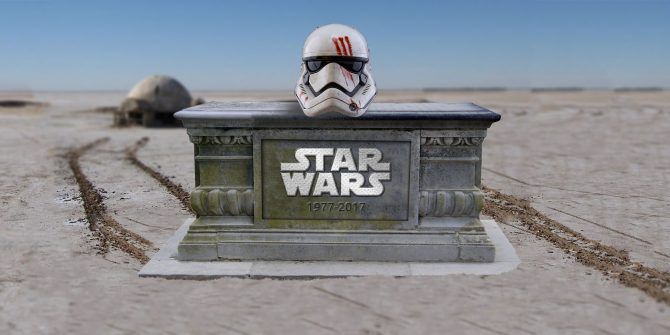
“You were the chosen one”? Or maybe “Strike me down
and I shall only become stronger.” |
Forgive the provocative title. My part of the internet bubble churns with much rage at the current incarnation of Star Wars, and especially at Kathleen Kennedy, at whose feet the perceived “Ruined Forever!” has been laid. There is much angst and schadenfreude over the failure of Solo, but Solo is the crux of what inspired me to write this, as it’s the first Star Wars movie in a long time that wasn’t an instant “yes,” though not the first Star Wars product in a long time that I had looked forward to, and then changed my mind about.
Then I put this post on ice, because I hesitate to post anything that sounds remotely political in this day and age as discourse is getting extremely divisive and it’s hard to please both sides (and there are sides here) when you say anything, and because I have better things I should be putting my attention towards (the next post is almost done, I promise!). But as news continues to evolve and the corporate narrative of “a few disgruntled trolls vs the Last Jedi” explodes to reveal that the Star Wars franchise is Not Okay, I wanted to get my two cents in, especially given how my blog seems to eat, drink and breath Star Wars.
I hope you forgive this opinion piece.
Star Wars: Ruined Forever
Solo has not done well, and
Grace Randolph of Beyond the Trailer sums up most of the arguments pretty succinctly in her video, (
she has further news on Kathleen Kennedy; she’s a great one, Ms. Randolph) so I won’t repeat it here. What I find interesting, and likely true, is her comparison to Batman V Superman/Justice League and the Last Jedi/Solo, in that the backlash of the first resulted in the failure of the second, regardless of the second’s merits. I’ve been watching this backlash build up for awhile, and not a day goes by where I don’t see a video popping up claiming that Star Wars is dead, or that the Last Jedi is a terrible movie, which clashes strongly with the perception I get from the news or from sites like Wikipedia to the point where I wonder how much of it is real and how much is manufactured, though more on that later.
I feel like the only fandom that hates their fandom more than Star Wars is, perhaps, Doctor Who, which is something I talked about all the way back in the inaugural post about Psi-Wars. This is, perhaps, just more of the same, but I wanted to tackle some of the arguments that I tend to see, to try to sift out some wheat from chaffe.
The New Star Wars Movies Suck! Unlike True Star Wars Films!
This is the general thrust of most arguments that I see floating around the internet: once upon a time, the Good King George Lucas reigned over a Golden Age of Star Wars, in which all the films were good, and then the wicked stepmother Kathleen Kennedy took over and ruined it forever. However, I must say, I find this black and white dichotomy more than a little weird, especially the calls for George Lucas to “come back” and fix his creation.
First off, most Star Wars movies suck, straight up. Look, here’s all the Star Wars movies I can find, in order of release, with opinions based on what seems to be the general perception of those who dislike the new franchise:
- Star Wars (A New Hope): Good
- The Star Wars Holiday Special: Not Good
- The Empire Strikes Back: Good
- Return of the Jedi: Good (though a lot of people at the time really hated the Ewoks)
- Caravan of Courage: an Ewok Adventure: Not Good
- Ewoks: Battle for Endor: Not Good
- The Phantom Menace: Not Good
- Attack of the Clones: Not Good (Saaaaand)
- Revenge of the Sith: Not Good
- Clone Wars: Not Good (Though I must confess I enjoyed the series)
- The Force Awakens: Good (but unoriginal)
- Rogue One: Good
- The Last Jedi: Not Good
- Solo: Not Good
Mileage may vary (I personally liked the Phantom Menace the most of the original trilogy; a lot of people like Revenge of the Sith, I think Clone Wars is underrated; a lot of people might toss everything new into the “bad” bin, while I think people forget the early negative opinions of RotJ, etc), but this seems to be the current internet consensus, and I count 5 good films and 9 bad films. Of the new films, half of them are “good,” and even if you press the most ardent Disney Star Wars hater, he’ll grudgingly admit that Rogue One “was sorta alright.” So the new stuff hasn’t been all bad, but this idea that Star Wars was good until Disney came along, is just absurd, as is the idea that Lucas “would fix it.” Lucas has an even worse hit/miss ratio than Kathleen Kennedy, and she’s his hand-picked successor, so no, I don’t think Lucas will “save Star Wars.”
Kathleen Kennedy Ruined Star Wars with Politics
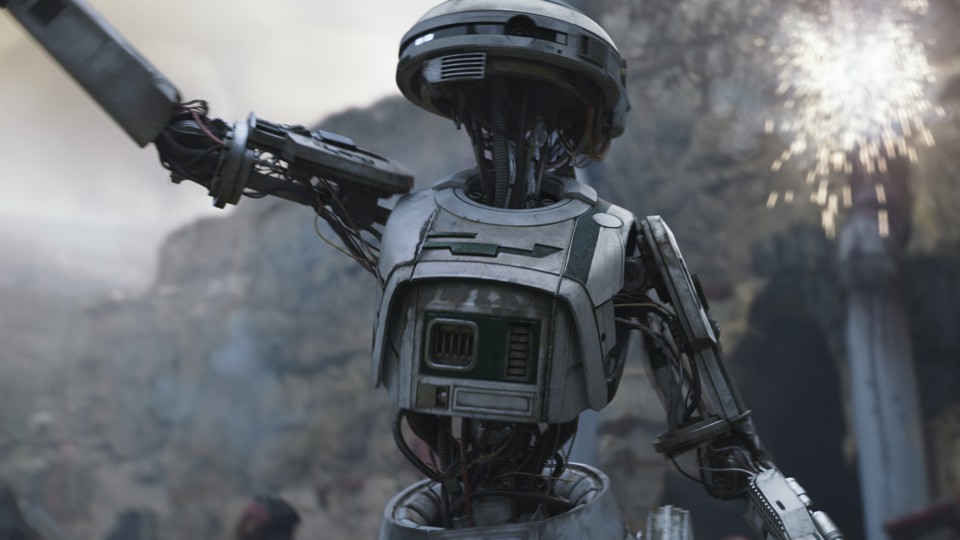 |
| The first woke robot of Star Wars |
The argument goes that Kathleen Kennedy, unlike George Lucas, has used Star Wars as a platform for injecting her own left-wing screed into Star Wars. To this, I say: Have you seen Star Wars?
George Lucas compared the Ewoks to the Vietnamese, heroically defying a technologically superior enemy. The US would be the Evil Empire in this analogy. And before you think he cooled down with age, he tossed in a “You’re with us or you’re against us” swipe at George W. Bush in Revenge of the Sith, which in the context doesn’t even make sense (“Only the Sith see in black and white!” oh really, Obi-Wan “The force has a light side and a dark side” Kenobi?).
Star Wars has always been the fever dream of a 1960s activist, only two things changed. First, George Lucas and Lucasfilms went from ardent hippy activist to more limousine liberal, which is one reason why Kathleen Kennedy is more worried about “representation” than rebellion. The other, I think, is a cultural shift: Hollywood’s Overton window has moved a lot more than most of the populace. I don’t think anyone minds the presence of “Strong Women” in Star Wars; Leia has been the prototypical “Strong Woman” of fiction for a long time, but now there’s a much stronger push for far, far more female representation in Star Wars, perhaps to the detriment of the male leads (Finn, at least, seems to suffer at the hands of the writer for no good reason that I can discern other than, perhaps, that the writers don’t actually understand comedy).
But I also want to come out and say that I don’t think it’s the politics that’s ruining Star Wars. I think it’s a manufactured excuse to justify bad films, and I’ll get more into that later. How much outcry do you remember about the Jedi Council being lead by a black man (Mace Windu)? He has his own comic book series, numerous books, features in video games and in the Clone Wars series, and there were some people arguing he should get his own film. What about female representation in Star Wars? Asoka Tano, a female character, was the break-out character of Clone Wars and nobody called her a Mary Sue, even when she became the Super Special Awesome Character of Awesome in Star Wars: Rebels. Who was your favorite character in Rogue One? Those of you who aren’t voting for a robot are probably voting for Chirrut Imwe (Donnie Yen!), who is Chinese. So this idea that “fans” are opposed to “inclusiveness” is nonsense.
It’s not the politics that’s ruining Star Wars.
Kathleen Kennedy hates the fans
I don’t feel that I have a responsibility to cater in some way [to those particular fans]… I would never just seize on saying, ‘Well, this is a franchise that’s appealed primarily to men for many, many years, and therefore I owe men something.'” – Kathleen Kennedy
This one I think is true, especially given that Kathleen Kennedy is on the record as disparaging a certain segment of the Star Wars fanbase (as well as other writers and directors). I find her defense, her attitude that she doesn’t “owe” fans something to be disingenuous. Of course, she doesn’t “owe” people something, she offers a product and you can pay for it or not: that’s business. But what she calls “fans,” I call her core market, and what she’s really saying is something along the lines of “I don’t feel the need to cater to my core market,” which is a daft thing to say in business.
I’m not saying that it’s wrong to try to branch out, but it’s generally not well advised to so do at the expense of your core supporters. For example, there’s nothing wrong with SJGames pushing a simplified version of GURPS that focuses on the dungeon crawling crowd: that’s SJGames branching out. But if they were to drop all support for GURPS to focus entirely on a new d20 clone, that would be a risky move at best. Star Wars has a core audience that is remarkably faithful, despite their complaints and criticisms, to the brand, and I don’t think it’s wise to antagonize that core audience just because they happen to be white and male.
That said, I don’t think that’s actually what’s going on. I think all the “politics” and fan-bashing and such is a smoke screen for poor management, and Kathleen Kennedy isn’t the only one doing it.
Rent Seeking and Circling the Wagons
“I know there’s a lot of controversy around this game, but c’mon, it’s Star Wars, I was never not going to buy it.” – Tech Deals
I first noticed this sort of behavior not with Disney, but with EA, especially the release of Battlefront 2 (If I’m honest, I find everything surrounding the business decisions that led up to the release of Battlefront 2 fascinating). First, EA gains sole access to the Star Wars IP when it comes to games, which is typical for EA: find something that people love, and monopolize it. So, if you want a Star Wars game, you must go through them. Second, create a game that looks good: appearance is the most important, because it helps with the hype train. Third, find a way to monetize the hell out of it, because you’ve got a Star Wars game, people have no choice but to pay, and then brag about it to your investors, to get more sweet investment capital. When the fans inevitably complain, divert them with empty promises that you’re “listening,” and then wrap yourself in a cloak of some form of morality. For example, they had a female lead character, and the actress acted as their spokesperson, which gave them the cover of “we’re supporting feminism;” to suggest that they’ve listened to the fans, they employed John Boyega, the actor who plays Finn, to talk about how much he liked the new Battlefront 2. When criticism arose, they painted it as the rantings of an unreasonable, entitled minority, and fended off criticism of lootboxes and such by wrapping themselves under the mantle of “Free market!” and “Innovation!” But in the end, everything circles around extracting cash from people, nothing else remained.
I think the same can be safely said of Disney’s handling of Star Wars. If Kathleen Kennedy were really such a feminist, then why has she hired only white, male directors? If she’s so racially tolerant, then why do black characters get such poor treatment in her films? If she hates the fans so much, why does she pepper so many of the Star Wars films with so much fan service? If she hates Star Wars, why are all the films coming out right now such slavish remakes of the original trilogy, or direct references to the original films? Why has she not yet branched out into something truly new?
I think the truth is that making really good fan-based franchises is hard. Of all the cinematic universes, only one has really been a success: Marvel, under Kevin Feige. All the rest have failed. There may be numerous reasons for this, but one take-away must be that it’s difficult, and Star Wars is going to be no different, because even the stuff most people currently agree is “good,” like Dave Filoni’s Rebels, or Rogue One, are still somewhat controversial (and largely seem to be considered good more in contrast with the things fans consider “Bad”), and the stuff most people agree is “bad,” like the prequels or even the Last Jedi, are equally contentious. If you’ll pardon the electoral analogy, it’s not really red vs blue but a sea of shades of purple and general discontent, and that’s hard for the best people to navigate, and Kathleen Kennedy seems to not be the best of people.
So instead, we get the easy outs. Ms. Kennedy just grabs directors and makes films, and when they become too different, she fires the directors and makes them “safer.” When people criticize her work, she falls back and hides under the mantle of morality: if you hate her movies, you’re part of an “the toxic fandom” and you’re a bigot and a bully. For me, this is a bridge too far, and really the core of this rant: you will never improve if you cannot take criticism.
I get criticized all the time, sometimes unreasonably in my opinion. There are people who want Psi-Wars to be something that, in my opinion, it was never intended to be. I see people who argue that it’s too like Star Wars, and that it’s not like Star Wars enough. I get people who say they would do things completely differently. But for me,
these are not attacks, but valuable feedback. Some I can use, some I cannot. They give me a sign of where things are going, how audiences are shifting, and what I could do better. Where are things too complicated? Where are they confusing? What could I be doing better? You have to pick and choose your criticism, and you cannot bow to what each and every person says, but feedback that is honest is feedback that is valuable. You cannot learn without it. Those who attack their critics will never improve.
This seems to be a trend, especially with poorly received films with strong female leads (Lady Ghostbusters, Oceans 8, the Star Wars franchise), but this is a mistake. For an example of a franchise that took criticism to heart, see the Thor: Ragnarok.
Making a Better Star Wars
It seems like there’s a shake-up already in the works, though not before we get Episode IX. What will happen? I don’t know, but weaker franchises than this have survived terrible treatment. Star Wars itself is probably predated only by Star Trek for a franchise beloved by fans but abandoned or mishandled by the entertainment industry. Star Wars endured all the years of neglect from RotJ to the prequels through books, comics and games, and it survived the prequels, and it will survive now: even if you don’t like the films, check out the new TV series or the animated series. While there are
precious few video games (because EA has seemingly forgotten how to make video games, and killed the lonely one Star Wars video game that was set to release), there’s still RPGs, books and comics being made, and some, I hear, are quite good.
Were it up to me, I’d encourage them to set aside this “Legends/Canon” split, or at least weaken it. The Marvel films drank deep of their comic weirdness and embraced their legacy; they didn’t precisely copy everything, but they understood they had a huge well to draw on and did, and as a result, each film, while formulaic, has something interesting enough to offer that audiences flock to theaters. By contrast, Star Wars fans feel like they’ve seen the films already (“The Force Awakens was just a New Hope reskinned; the Last Jedi was just the Empire Strikes Back reskinned, and Solo was so predictable that Red Letter Media
released a Solo Trailer reaction video before the trailer released, and then edited in the actual trailer afterwords, and got it spot on”), and while I’m not sure that’s entirely fair, that
perception makes going to the theater less of a priority, and that’s not what you want from your audiences. Imagine if Lucasfilm released a KOTOR Star Wars film, or one featuring Thrawn, Mara Jade, the Yuhzon Vong, the Hutt Cartel, Darth Nihilus (or really any Sith from the past), or worlds like Corriban, Ryloth, or Tython?
But what makes me saddest about watching and listening to people talk about Star Wars is that they seem to have forgotten what came before it. I’ve talked about how much Star Wars has borrowed from, for example,
Dune, Flash Gordon, Foundation, samurai films and many more. If you’re desperate for inspiration, why not draw from those films? Why not borrow from history and instead of using the First Order as a way of replacing the Empire, why not look at the fracturing of the Empire and its internal wars and its warlords and the efforts of the Republic to reconquer the galaxy with the struggle between their ideals and the hard realities of war. Want to be inclusive? Have General Leia in charge of everyone and put Gwendoline Christie in a role that doesn’t completely waste her talents. Bring in Thrawn as one of said warlords, and Mara Jade as your dark and terrible menace, the Emperor’s Hand that the Republic fears. Give a callout to the Jedi Academy series, with some of Luke’s students trying to help the Republic. Give us a Dune-like world with a warrior-people who follow a jedi-like creed (the Guardians of the Whills?) who must be talked into fighting back against the nearby warlords or against the sweeping pirate menace. You might even draw from Seven Samurai, by having seven heroic characters gathered to defend that one world. There’s such a rich tradition you can draw from, and it’s such a waste to see it lie fallow. People are forgetting their history.
What is killing Star Wars isn’t female leads, it’s not politics, it’s not toxic fandom, it’s just bad films and an inability to listen to criticism. It’s an institutional problem, one that seems fairly ingrained into Lucas Film at this point, so I don’t see it changing soon. But Star Wars is too beloved to die. It’ll just do what it did through the 90s and go quiescent for a time, at worst.
On the Demise of Psi-Wars
So given the rancor and frustration around Star Wars, do I fear for Psi-Wars?
No.
I’m honestly more worried about my time and flagging interest in the series, though my backers still seem firmly committed to the cause, and I’m rounding a corner on a particularly sticky issue. But even if Star Wars dies, which it won’t, I still wouldn’t worry about Psi-Wars because, despite much nudging and winking, it isn’t Star Wars. That rich tradition I mentioned above is something I definitely draw on for my work, and other works besides, and those works still live on. 40k continues to churn forward, Dune has a new movie in the making, the Metabarons has a new series focused on the Metabaron, a new season of Killjoys is on the horizon, we can expect to see a Guardians of the Galaxy 3 (assuming they survive the turmoil of the Infinity War!) and people still love pulpy Space Opera, even if they sometimes forget it’s more than just Star Wars.
So I’m still here, and I’ll still be here when all the turmoil has died down and this Star Wars mess has sorted itself out one way or another.

 Mailanka's Musing