2017: A Retrospective

This is my second year of blogging, and as is increasingly traditional, I wanted to look back over the year, to see what my progress looks like, to see what I thought worked and what didn’t, and what the next year has in store for us.

2017 Retrospective

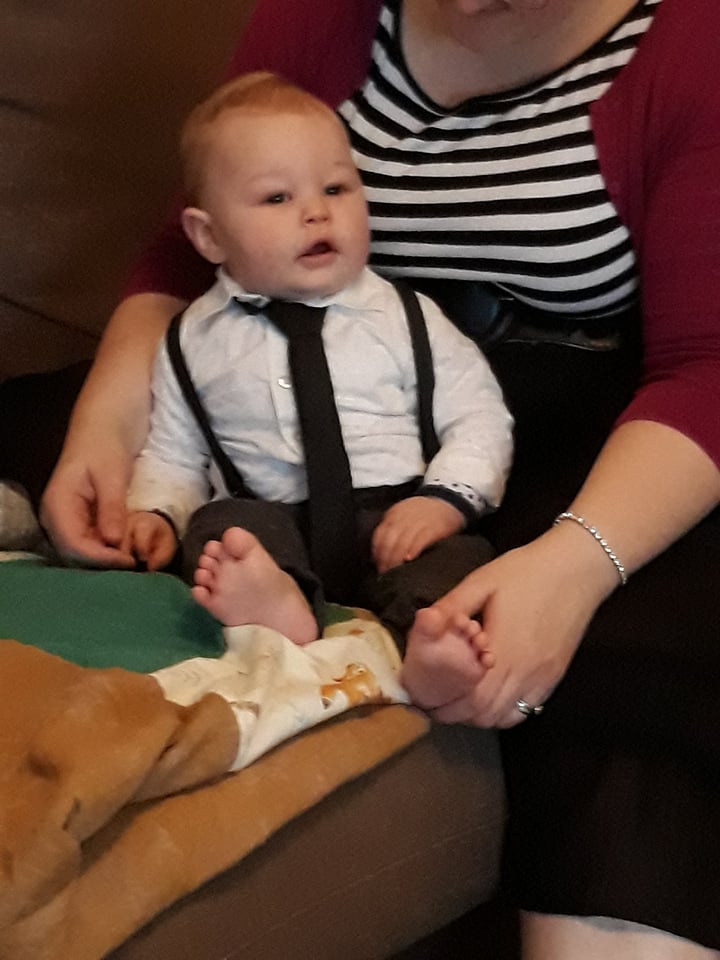
The biggest news of the year was, of course, the birth of my son!  He’s 8 months old now, and quite a handful, but he’s absolutely adorable and I wouldn’t trade him for the world.  Plus I can squarely blame problems with the blog on him!  Which is excellent.

By my count, I published 206 posts over 2017, which is an average of almost 4 posts a week.  Despite slowing down the past few months, I still seem to be at a hectic pace.

My views hit their all-time peak this year around summer, right in the heart of discussing the Alliance, and dropped off rapidly as I talked about Philosophy, both because I suspect it’s a rather esoteric topic and because I started posting less.  I still have what I would consider “healthy” numbers.

This year I also started my Patreon with the intent of funding art and, uh, getting paid!  My fanbase isn’t large (I currently stand at ~30 patrons), but they’re very devoted, and tend to give quite a bit more than the minimum.

I set out this year to complete Psi-Wars as a setting and that was a big fat failure, in the sense that I didn’t complete it.  The effort turned out to be more complex than I thought.  Perhaps I made it more complicated than necessary, but as a process, this works well for me. That said, I feel like this design process has focused more on releasing material quickly than really discussing how I did it.  I feel like it offers less to others than the first 5 iterations.  That said, I am pleased with the results!  I’ve started running a playtest, and it has the sort of richness I personally prefer from a game, and I think the setting contributes to that.  I also didn’t finish Iteration 5 as quickly as I thought I would, and, in fact, setting work is complicated stuff if you want to give players more than a superficial look at things.  In fact, I have a lot of readers asking for more material, because the stuff I’ve offered isn’t enough.  The lesson here? You can always have more depth, it’s just a matter of how long you want to spend writing.

I’ve also started Tinker Titan Rebel Spy, my Imperial playtest, to largely positive reviews.  Expect more Actual Play soon.

Happy New Year 2018 

The last couple of years have been very good to me, but I feel like all of my rushing about since my divorce has finally caught up with me and I need to stop and consolidate.  That’s true of Psi-Wars as well!
I expect to finish the design phase of Iteration 6 sometime in February or March.  The Cult of the Mystic Tyrant will finish in January, and we’ll tackle, at last, True Communion over February and into March.  That finishes Iteration 6, right?
Well, not quite.  First, the setting material is a little unwieldy.  I need to return to it and revise it, trimming out unnecessary things and expanding things that need greater attention.  But more than that, the core material from Iteration 5 and before needs to be revised too.  Most of my material has been offered as Patron Previews, but they include:
  • Revised Communion with additional miracles, greater attention to “ghosts” and new traits
  • Updated Psionics with additional Techniques and updated Anti-Psi
  • Updated technology
  • New Ships and simpler rules
Some of this still needs work, or to be completely rewritten, and I’m going to take some time to work through these.
I’ve also had interested readers who seem to be lost in Iteration 6.  That’s because I’m working hard to build material, but I need to make that material accessible. I find that where the Psi-Wars primer-as-table-of-contents was enough for pre-Iteration 6, people are interested in the setting, but don’t know how to get into it.  I need to create a simpler “setting primer” that should make it easier for players to get into, and better organize my material so readers can find what they want.  I do want to leave the original, simpler Iteration 5 material as an option for those who liked that arc: I see that as the true experiment for Psi-Wars, and Iteration 6 as the optional “pre-built setting”
I expect this will take a few months (say, by summer).  After that, we’ll start with what I’ll call Iteration 7.  The point of Iteration 6 has been to pain the setting in the broadest strokes.  We know what the main factions and ideologies are and how rebels fight.  You can apply these anywhere.   The next stage is to get more specific.  I will look at:
  • Aliens (including the already Patreon-specials Ranathim, Skairos and the Traders as well as the soon-to-be released Keleni)
  • The broad regions of space
  • Region-specific organizations
  • Planets (likely 5 or so per region of space)
Finally, I’m going to make some changes to Patreon.  I like the reward tiers well enough (though if Disciples fills up, I might introduce a $10 tier). No, I’m learning how I want to handle the funding I get.  First, I’ve started commissioning artwork.  I have a concept artist and now a professional artist who has agreed to draw, and most of my Patreon funding is going to that, but I’ve also had several readers suggest a wiki, which I might take the time to set up, but might be worth it.
My posting pace will continue at its slow pace.  I’ve re-evaluated my schedule and I have roughly four hours a week in which I can write, which is very tight. I might have to slow down even further, but we’ll see.  I suspect I won’t finish everything that I hope to this year, but we’ll continue to make progress and if I do finish, well, we’ll see where we get next year.
I want to thank everyone who’s been supporting me, all of my readers, all of the people who share my links, and especially to my patrons.  You make this sort of thing possible!

January

Oh right, my Patreon update!  I didn’t get to everything I wanted to this month, but that’s because one work took far more than I expected.  I have about 15k worth of material on “Broken Communion Ghosts” which will be available to $1+ Patrons (yes, it’s Psi-Wars specific, but the material in it will work in a Monster Hunters or Horror game too).   I also have, at last, the Imperial Schism of the Cult of the Mystic Tyrant.  I know I promised that last month, but it didn’t work out qua scheduling, and now I can guarantee it’ll come out, as I’ve already scheduled it.  I would like to released the Cult of Death results in January as well, but that still needs to be written.
See you guys next month!

The Alliance Summary and Retrospective

As usual, when I finish a major setting element, I work out the summary, the bit that would go in a simplified document so players can just jump straight in and play.

The Alliance took much longer than I thought.  In retrospect, I should have realized the additional complexity of what I was taking on.  Star Wars provides us with what amounts to the definitive space empire, the one which all other space empires tend to get measured.  It’s fairly detailed, and it’s not hard to expand upon the framework they built.  The rebellion, on the other hand, is something of a disaster as a setting element.  It has precious few details, and what details it has don’t always make sense.  Like sometimes it seems to have organization (Rebel Intelligence, Rebel Fleet Command), and other times seems to just be a rag-tag collection of small insurgencies.  It has access to huge ships, but no shipyards or territory to call it’s own.  It wants to be FARC, a small guerrilla band that loses itself in the jungle, while also being the Allied Forces of WW2!  And this is only what you can piece together on your own.  The various works on Star Wars just don’t go that much into the rebellion as an organization, more as a group of heroes.

Thus, I ended up throwing a lot of it away and starting from scratch.  This created two problems.  First, the Alliance amounts to the opposite of the Empire: lots of heterogeneous powers rather than one monolithic one, which means I’m essentially stopping to right up “all the military forces of the Galaxy that aren’t the Empire.” While the Alliance only occupies a small portion of the Galaxy, its worlds tend to be representative of any generic, non-alien world you might find, whether it’s officially affiliated with the Empire or not.  Thus, I ended up creating Planetary Governments and their associated organizations as well.

The Noble Houses, though, proved the most difficult but, I suspect, the richest.  Where a lot of material so far has been fairly generic, this necessarily gets specific.  I tried to write up a generic house, but such posts proved more useful as advice and rules for handling houses.  As with martial arts or philosophies, it’s just easier for me to show rather than tell, and that’s what I did.  But this means names, and more names, and titles, which means planets, and it means relics (which require names, and personalities, and historical events) and conflicts and politics.  You know, all the great stuff that really make a game come alive

I hope they work well, not just as fodder for politics and NPCs, but also as “splats” for players who want to be aristocratic and have it mean something.  That, more than anything else, has been what this cycle has been about.  This feeds into the Desiree (“Where do I come from? If I’m a princess, who do I want to marry?  What’s the context of my house right now?  What am I worried about?”) and Bjorn (“What totally sweet powers do I get?  What sets members of my house apart from members of other houses”).  I worry a bit about the Bretts (“Like it’s a rebellion, what more do you need to know? OMG politics?!”) but Willow will love it, I’m sure.  It did prove that working out historical details in advance helped, though it necessarily expanded that history.

I’ve noticed that the aristocracy has probably had the single greatest response from my players.  Back during the Imperial run, I offered to let my patrons make signature characters, and the response was very tepid, while people were suggesting aristocratic characters to me almost as soon as houses dropped. Why? Context.  Thus fair I’ve offered fairly generic tools.  You know what a fleet is roughly like, and how they operate, but one officer can sub in for another officer, which is part of the intent of the Empire.  Even so, the players have very little to grasp.  What makes an imperial character interesting?  What sort of roles might they play?  While with the aristocracy, this is clear. You can see the tensions between various houses, the sorts of roles one might play, and what each member might look like specifically.  This partly arises from the heterogeneous nature of the Alliance vs the homogeneous nature of the Empire, but I think if I want to grab players, when I revisit the Empire, I need to find a similar point of tension and context, so GMs and players can see what their imperial character plays out as without necessarily having to draw on Star Wars sources they already know (we don’t want every officer to be Thrawn, every imperial Space Knight to be Darth Vader, etc).

We’re almost finished with the first half of Iteration 6 (It only took 8 months!  I had a baby, alright?).  Next: Philosophy!

The Alliance: Summary

The Alliance claims to be the true heir to the Old Galactic Federation. The noble houses that ruled the Old Federation fled to humanity’s home in the galaxy, and managed to fend off the vengeful, grasping Empire long enough to solidify their power-base there. Now they form alliances with the enemies of the Empire, promote insurgency and rebuild their numbers in the hope of toppling the Empire and restoring freedom to the Galaxy. Freedom, of course, for the aristocracy.

The Alliance is a Control Rating 3 society, broadly speaking; It imposes reasonable taxes and limitations upon its people, with an eye towards promoting general well-being. The Alliance, however, favors its aristocracy with its laws. The Alliance is a Representative Democracy, allowing each world, house and corporation within the bonds of the Alliance to represent itself within the Senate (though, again, the aristocracy receive special privileges). In principle, each world, house and corporation within Alliance space is independently sovereign, and the Senate acts as unifying point where the members of the Alliance can come together to decide joint policy, though in practice the Senate does exercise some power over its member states.

The Alliance is a deeply conservative society, one that celebrates its aristocratic and religious roots and seeks to restore the golden age of yesteryear. It also values independence and freedom. Each world can stand on its own, and they stand together against the tyranny of the Empire. Most worlds fall under the direct sway of one of the major aristocratic houses, but most don’t mind, and even celebrate the aristocrat who rules them. Those who don’t, of course, find common cause with the Empire that seeks to liberate them from the elitism represented by the Alliance’s aristocracy.

Four highly influential houses within the Alliance include:

  • House Sabine: A royal house engineered by the Oracular Order to provide a pool of Espers to draw into their ranks and to serve as the consorts to House Alexus. They’re known for their exceptional beauty and fecundity, and the fact that they produce far more female than male children. They have a knack for ESP. The head of their house, the numinous Nova Sabine, Duchess of of Persephone currently serves as the speaker for the Senate.
  • House Grimshaw: Technically a cadet branch of the royal house of Daijin, the Grimshaw family rose to dominance during Shio Daijin’s ill-fated attempt to re-unite the Alexian Empire under his rule. The Oracular Order engineered house Daijin (and Grimshaw) to serve as purifiers of the noble houses, ensuring they stayed true to their purpose, and Grimshaw remains a deeply conservative house, often in opposition to Sabine’s more egalitarian politics. They have a talent for ergokinesis. Their head, Bale Grimshaw, Duke of Denjuku is considered the most powerful noble of the Alliance.
  • House Elegans: This knightly house lost all of their domains to the Empire, and have returned to the Alliance seeking allies in reclaiming them. The Oracular Order engineered them to be the left hand of Alexus, willing to explore new ideas and to violate social norms to achieve success; they’re a somewhat controversial and complex house, plagued with rumors of regicide and abandonment of the Oracular Order in favor of True Communion, all of which they hotly deny. They have a talent for emotion manipulation and empathy, and make for fearsome duelists (and created the Swift form of force swordsmanship). Their current head is the young Anna Elegans, Marchessa of the Tangled Expanse.
  • House Kain: The House of Kain is not a “true” Maradon House. Instead, the original warlord of Caliban, Lothar Kain, blocked a key route from the Maradon arm of the Galaxy to the galactic core. Rather than fight these exceptional warriors, Alexus offered them a place at his side. The Oracular Order tried to turn them into Alexus’ right hand, his faithful hounds that would devotedly follow his orders, but the House of Kain has always forged their own path, and remains a barely tolerated faction within the Federation and Alliance. They have no innate psionic potential and lack the blood purity of other houses, but they have a robust line and a tradition of excellent cybernetics. Their current head is Kento Kain, Archbaron of Caliban.

Playing an Alliance Charater

Cultural Lens: Alliance

Advantages: Galactic Common (Native) [0*]; Cultural Familiarity (Galactic Federation) [0*]; Characters may add Permit (Alliance; Blaster) [1] to their template options.

Disadvantages: You may choose the following disadvantages in addition to the options given in your template: Hidebound [-5], Intolerance (Empire) [-10], Sense of Duty (Homeworld or Alliance) [-5 or -10], Stubbornness [-5*].

*Only if this is your first language or cultural familiarity, otherwise normal costs apply.

Preferred Templates

Alliance characters tend to be Commandos (Militiamen), Diplomats, Fighter Aces (In aristocratic navies), Security Agents or Frontier Marshals (Constables), Spies and (more rarely) Assassins. Many aristocrats tend to be Diplomats, Officers or Space Knights.

Alliance characters tend to come from Humble Origins or Aristocrats. The former represent commoner characters, while the later represents members of the Alliance’s aristocracy, and require special considerations! Sequestered characters are not uncommon, as philosophical and religious orders remain common in the Alliance.

Template Lenses

Alliance Aristocrat +2 points

Alliance Aristocrats must take Legal Immunity (Alliance Aristocrat) [2].

Add the following optional traits: Courtesy Rank (Any) [1/level], History (H) IQ-1 [2], Title [1],

Alliance Constable (Security Agent Lens) 0 points

Advantages: Change Legal Enforcement Powers (Security Agent) [10] to Legal Enforcement Powers (Constable) [5]; Change Security Rank [0] to Law Enforcement Rank [0]. Increase optional Advantage points from 25 to 30.

Disadvantages: Change Duty to Security Agency to Duty to Law Enforcement Agency.

Alliance Marshal (Security Agent Lens) 0 points

Advantages: Change Legal Enforcement Powers (Security Agent) [10] to Legal Enforcement Powers (Alliance Marshal) [10]; Change Security Rank [0] to Law Enforcement Rank [0].

Disadvantages: Change Duty to Security Agency to Duty to Law Enforcement Agency.

Alliance Space Knight (Space Knight Lens) 0 points

Replace Psionic Abilities with one of the following packages:

  • Aristocratic Space Knight: Choose 25 points from House Psionic Powers.
  • Cybernetic Space Knight (House of Kain): Choose 25 points of cybernetic.

Alliance Power-Ups

Most Alliance characters take Experienced or Heroic as their power-ups. Aristocrats of a major house must take the Eugenic power-up associated with their house, but many elements within it are optional. Aristocrats often become Martial Artists or the Psionic power-up which, while not strictly necessary, represents an aristocrat who is more psionically powerful than his peers, or with greater flexibility than his bloodline would suggest. Alliance characters may also take the following power-ups or lenses:

Title 1 points

Aristocrats often have additional titles, or honorary titles. Some such titles might even find their way into the hands of particularly esteemed commoners. See the rules on Aristocracy below for ideas.

Statistics: Title [1];

Higher Purpose (Against Impossible Odds) 5 points

Any Alliance character may take this Higher Purpose variant!

Statistics: Higher Purpose (Against Impossible Odds) [5];

Servant (Lens; Any Template) 0 points

Rather than serve another organization, the character may serve a noble house instead.

Statistics: Servant Rank 0 [0];

Disadvantages: As part of your -50 template disadvantage points, you must take Duty (Noble House) [varies].

Esteemed Servant 20 points

The character not only serves one of the noble houses, he is among the most prestigious and honored of those servants. He may not be the right hand man of the ruling noble, but he’s one of his highly trusted and independent agents. Such characters are generally Assassins, Commandos, Diplomats, Space Knights, or Spies

Statistics: Servant Rank 4 [20];

Disadvantages: As part of your -50 template disadvantage points, you must take Duty (Noble House) [varies].

Alliance Traits

Code of Honor (Aristocratic): Always recognize and treat other nobles appropriate to their station; acknowledge and address the petitions of those who have declared fealty to you; always obey a call to arms from your liege or your nation; dress appropriately to your station and bear your heraldry with pride; if your honor has been affronted, you must demand a duel, and if you are challenged to a duel (by a fellow noble, of course), you must accept; you may not marry outside of the aristocracy. -10 points.

Legal Enforcement Powers (Constable): The character may arrest within his jurisdiction (if he has a warrant!), may engage in search and seizure (if he has a warrant) and may fire to kill, though such actions may result in an inquest. 5 points.

Legal Enforcement Powers (Inspector): The character may engage in search and seizure, provided he has a warrant, and may make arrests, provided he has a warrant, in any jurisdiction given to him by the Alliance Senate. He generally has “jurisdiction” within a given case rather than a particular world. He may not deploy lethal force except in self-defense, and even then, such actions will cause an inquest. 5 points.

Legal Enforcement Powers (Marshal): As with the Constable, but the character may make arrests anywhere throughout the Alliance, and cannot be impeded. 10 points.

Legal Immunity (Alliance Aristocrat): The character gains preferential treatment (treat CR as -1) and follows a unique set of laws (which both grant special privilege and additional duties). If the character violates an aristocratic law, he is tried by his fellow aristocracy. This is technically a 10 point advantage, but as it only applies within the limited confines of Alliance space, it has 1/5th the normal value. 2 points.

The Empire: Characters, and a Retrospective

(How am I doing, guys?)

I’ve written about the Empire for nearly 2 months and produced more than 70 pages of content (40k words).  Is it enough?  Is it too much?  Let me take a minute to think that through, discuss why I think my material is justified, and then to offer a summary of the whole thing, and a focus on building Imperial Characters.

My Target Audience

Back in the First Steps to a Setting, I described three sorts of people that I imagine might actually use Psi-Wars:
  • Star Wars fans open to something new
  • GURPS Sci-fi fans who want support for something Operatic
  • DF Fans who want to play something sci-fi-ish, but don’t want to do the work.
My design has generally pushed towards a conservative design of the Empire: any fan of Star Wars will readily recognize the Empire of Star Wars in here, but with only a few major differences: Black Ops (and a similar organization surely exists somewhere in the EU), the fact that the Senate still exists, and the nature of the Emperor himself. Everything else is fairly recognizable.
From there, I’ve tried to focus exclusively on elements that directly support gameplay where I can.  The result should be organizations that need no additional work to play with (helping the DF-types), offering insights into how such organizations might work (for the GURPS Sci-fi fans), and offering Star Wars something familiar, but not too familiar.
I’ve chosen for the familiar path to cut down on the need to explain things to my players.  You don’t need to read all 30 pages of the Psi-Wars Empire to get that it’s like the Star Wars Empire: “Oh, it has dreadnoughts instead of Star Destroyers and Typhoons instead of Tie Fighters, and the Emperor is a little different.  Right.  Got it.”  This means it lacks some creativity, but I don’t personally feel this is the place for deep creativity.  Players should be grounded in a familiar world, and the Empire very much represents that world.  This helps the “Brents” who just want to jump straight into the game and not “do homework” to play.
Most of the material focuses on organizations, what they can do for you, and how they might oppose you.  This makes them a great grab-bag for the “Bjorns” who want to know which organization they should join, and why.  Perhaps he’ll join Black Ops, play as a Black Op commando and get some great commando toys.  Or perhaps she’ll play as a Imperial Security Agent who genuinely believes in the Empire, and is working to root out corruption from her post as an attache to a Minister of Justice aboard a Dominion-class Patrol Cruiser.  It also helps the Rebel player who wants to know what interesting opponents the Empire can throw against him.
This focus on organizations also helps the “Desiree” player who wants to know which factions to join and what they might want.  However, the elements that I expect will most interest her come at the beginning, as I discuss what it feels like to be in the Empire.
The player who will likely enjoy Imperial material the least is likely the “Willow.” This material largely lacks rich lore, other than perhaps the true agenda of the Emperor, but the most fascinating elements are likely the secret cabal of evil space knights that surround him, which I haven’t touched upon yet.  Why?  Because I need to understand space knights first, so we’ll come back to them.
I also want this to be a grab-and-play sort of document for GMs, hence the inclusion of agendas (which amount to session seeds), and minions, who represent characters the GM can immediately throw at his players.
The net result is on the very small side of an SJGames supplement (on par with Boardroom and Curia) and smaller than the average Pyramid (which is about 40 pages long), unless we count gear.

Summary and Character Concerns

Ultimately, a setting document should serve its players, and the Imperial document is no exception.  We need both a quick reference (ideally no more than one A4) to explain this part of the setting to the players, and some elements that players can immediately use if they want to come from the Empire.  For that, I offer the following:

The Empire: Summary

The Empire is the heir to the Old Galactic Federation. It overthrew the old aristocracy to save the galaxy from an invading alien menace and to bring equality to all. Granted total power by his revolution, the Emperor now sits on his throne, the master of the galactic core and the military-industrial complex that runs it.

The Empire is a Control Rating 6 society; It taxes heavily, allows its agents to ignore human rights, and employs propaganda and secret police to keep the population under control. In principle, its “citizens” have more rights than its “residents,” but these rights can and are revokes at Imperial will. The Empire also pretends to be a continuation of the old Federation, and thus still has democratic institutions, like the Senate, in place, but the Emperor has gutted them of any real power.
Organizations within the Empire include:

  • The Imperial Ministries, which run the day-to-day bureaucracies of the Empire, and answer to the Chancellor
  • The Senate, which acts as a voting body/debate club and rubber-stamps the Emperor’s edicts. It is headed by the “elected” Chancellor.
  • Imperial Security, which answers to the Ministry of Justice and the Emperor’s Hand. It supplements local law enforcement with its own paramilitary security agents, and employs free-roaming “special agents” who investigate interstellar crimes.
  • Imperial Intelligence, which also answers directly to the Emperor’s Hand, and handles espionage and sedition coming form outside the Empire. Often employs “prisoner legions.”
  • The Imperial Navy, which answers to the Admiralty and the Grand Admiral, as well as the Ministry of Defense. They employ the mighty ships of the Empire and crush the Empire’s enemies.
  • Imperial Black Ops, a secret arm of the Imperial Navy full of commandos, experimental ships, and dangerous weapons of mass destruction, and answers directly to the Grand Admiral

Playing an Imperial Charater

Cultural Lens: Imperial

Advantages: Galactic Common (Native) [0*]; Cultural Familiarity (Galatic Federation) [0*]; May take Imperial Citizenship [1] or Looks Good in Uniform [1] from your template’s pool of optional points.

Disadvantages: You may choose the following disadvantages in addition to the options given in your template: Code of Honor (Imperial) [-15], Fanaticism (the Emperor) [-15], Greed [-15], Intolerance (Alien enemy, alien minority or rebel scum) all [-5], Overconfidence [-5}, Sense of Duty (Empire) [-10].

*Only if this is your first language or cultural familiarity, otherwise normal costs apply.

Preferred Templates

Imperial characters tend to be Commandos (Imperial Black Ops or, less common, the Imperial Navy), Diplomats (the Imperial Ministry), Fighter Aces (Imperial Navy or sometimes Imperial Black Ops), Officers (Any, but especially the Imperial Navy or Imperial Security), Security Agents (Imperial Security), and Spies (Imperial Intelligence).

Imperial characters tend to come from Humble Origins; they’re just kids who grew up on a farm or in some colony who joined up with the Empire to see the world and defeat the alien menace. Treat Senatorial characters as Aristocrats; being a senator is a Titlethat comes with a Statusof +2. Most aliens in the Empire will be Outcasts, but sometimes they can rise above Imperial prejudice and make something of themselves within Imperial ranks. Finally, those wealthy or lucky enough to be trained at the Imperial Academy may take the background below.

Suicide Soldiers: Characters who wish to play a prison soldieror a confidential informant for the Empire may take Duty(Imperial Intelligence, Involuntary, Extremely Hazardous, 15 or less) [-25]. Such characters are generally Assassins, Bounty Hunters or Con Artists.

New Imperial Background: Academy Trained 20 points

The revolution that brought the Emperor to his throne cast aside the aristocracy in favor or meritocracy, and the Imperial Academy, on the capital world, represents the pinnacle of that ideal. There, the finest officers, administrators and senators learned their trade before taking up their posts. In practice, though, the Academy fosters a deep devotion to the Imperial ideal, and fosters connections between its elites; most high-ranking politicians appoint fellow alumni or close friends they met at the academy over more competent outsiders.

Prerequisite: Imperial Citizenship [1].

Skills: Administration (A) IQ [2].

Additional Skills: Another 18 points chosen from among Carousing (HT/E), Current Affairs (Politics) (IQ/E), History (IQ/H), Intelligence Analysis (IQ/H), Law (Any) (IQ/H), Leadership (IQ/A), Propaganda (IQ/A), Public Speaking (IQ/A), Research (IQ/A), Savoir-Faire (Military) (IQ/E), or improve any lens skill by one level for 2 points, or two levels for 6 points.

Additional Traits: You may also spend your remaining lens points, or some of your template advantage points on Ally (Commando, Security Agent, Spy, 250 points, 6 or less) [3], Contact (Military officer, Minor minister, security agent, etc, skill 15, 18 or 21, 9 or less somewhat reliable) [2, 3 or 4], Contact Group (Ministry, Skill 15, 18 or 21, 6 or less, somewhat reliable) [5, 8, 10], Favor (See Contacts or Patrons) [varies], Patron (Minister or Admiral) [10 to 20], Administrative, Military, or Security Rank [5/level], Top Brass [1], Wealth (Comfortable) [10].

Optional Disadvantages:Add the following disadvantage options to your template: Code of Honor (Imperial) [-15], Delusion (“The Empire and its forces cannot lose) [-5], Easy to Read [-10], Enemy (Minister, Security Agent or Admiral, Rival, 9 or less) [-5 to -10], Fanaticism (the Emperor) [-15], Intolerance (Alien enemy, alien minority or rebel scum) all [-5], Overconfidence [-5}, Sense of Duty (Empire) [-10].

Imperial Power-Ups

Most imperial characters take Experienced or Magnate as their power-ups. Cybernetic and Heroic are not uncommon. Imperial characters may also take the following power-ups:

Attache 6 points
The Empire brims with ambitious upstarts willing to lay down their life for the next rising star, and a player character certainly qualities! An attache represents a talented individual who has devoted his or her life to the PC and accompanies them wherever they go.

Prerequisite: Rank (Any Imperial) 3+.

Statistics: Ally (150 points, 15 or less) [6]

Basic Bodyguard 5 points
The Imperial character has managed to accrue a band of five personally loyal security agents or soldiers, who are BAD 2.

Prerequisite: Rank (Any Imperial) 3+.

Statistics: Ally Group (BAD 2, 15 or less) [5]

Elite Bodyguard 12 points
The Imperial character has managed to accrue a band of five personally loyal paramilitary agents or commandos

Prerequisite: Rank (Any Imperial) 3+.

Statistics:Ally Group (BAD 5, 15 or less) [12]

Black Ops Commando (Commandos only) 25 points
The commando serves Black Ops directly, and enjoys superior organizational power and access to Black Ops secrets. Characters who take this power-up must take a Secret (Black Ops)[-10] as part of their disadvantage package!

Advantages:Military Rank 3 (Lieutenant) [15], Security Clearance (Black Ops) [10]. Add Gizmos (Imperial prototype technology) 1-3 [5 to 15] to Advantage options.

Imperial Special Agent (Security Agent only) 25 points
The security agent represents one of the elite of Imperial Security, and is granted near total dispensation to do as he pleases throughout the empire..

Advantages:Increase Security Rank to 4 [20]; Improve Legal Enforcement Powers (Security Agent) [10] to Legal Enforcement Powers (Special Agent) [15] for 5 points.

Imperial Secret Agent (Spy only) 35 points
The spy represents one of the elites of Imperial Security, and has total access to all Imperial secrets.

Advantages:Intelligence Rank 4 [20]; Security Clearance (Imperial) [15].

Imperial Traits

Code of Honor (Imperial): Be polite and honest (but only to fellow Imperial Citizens!); Die willingly for the glory of the Empire; Never abandon a fellow Imperial. Never question the orders of your superiors; Take pride in your kit and always keep it well-polished;

Citizenship (Imperial): The Empire represents the single most populous state within Psi-Wars, but it differentiates its inhabitants between “residents” and “citizens.” Citizens, in principle, have unique legal rights, including the right to vote and the right to generous social welfare benefits. In practice, though, the Empire can and does suspend these rights whenever it wishes. Thus, Citizenship grants a +1 reaction modifier to imperial officials when it comes to legal processes: a security agent is slightly less likelyto beat you in the street if you’re a citizen, as it might cause an outcry, than he would be if you’re just a resident.

Blogging, One Year On

In retrospect (ha!) I really should have posted this last week, but I wanted to be close to one year on the nose as I could.

Last year, I committed to running one blog post per week for the rest of the year.  The result should be 52 blog posts,  The actual result is nearly 5 times that, though not all of that has been GURPS as promised.  Still, it seems I more than exceeded my goal.

My approach was to try to write about something that I felt would regularly generate content (that is, to have a framework) and to “write forward,” to pad my post count by writing two or three posts in a row and arranging for their eventual release.  The result is that I always hit my deadline with loads of time to spare, so that pleases me.  It means this approach works.

What I didn’t do is post about half the stuff I wanted to.  It’s been all Psi-Wars all the time, and we’re not even done yet!  People don’t seem to mind, as my approach is multi-faceted, so even if you’re tired of non-stop Star Wars, the specifics of a given post might still appeal.  It also showed me a lot about the work involved in writing up a particular setting the way I’d like to.  But it’s also shown me just how much work you can get done once you commit to something.  I’ve generated some quality (by “my campaign notes” standards) material with a serious word-count associated with it.  I’ve also put my Nobilis campaign back on the map.  I think I’d like to continue this cycle of “4 posts a week for GURPS, one for some other campaign I want to get moving.”  This year, I’d like to see if I can breath some life into an old Lady Blackbird project I had.

I think the blog has been modestly well received.  My blog is pretty high up on the front page of SJGames when it comes to view numbers, though not nearly close to the big two of Gaming Ballistic or Ravens’n’Pennies (and likely Dungeon Fantastic, though I don’t think that has a thread on SJGames at all).  That suggests of “the other blogs” I’m doing pretty well. My views are fairly consistently neck-in-neck with the other big name to start this year, Let’s GURPS (and the reason for our mutual success is likely similar: Consistent publication!).  For my personal views, I went from having a high of ~400-500 views a month to sometimes having 400-500 views a day.  I’m not sure if that comes from the quality of my material or from more extensive advertising on my part.

Or the part of others.  I’ve received some traffic from aggregation sites, Reddit, 4chan and RPG.net where people, not me, have plugged my sight.  I feel honored by that, I must admit.  I’ve also seen a few people start up new campaigns inspired by my work.  That’s even greater praise for what I’m doing.  On the more critical side, I’ve had some complaints about my Psi-Wars material, but I think those criticisms have largely strengthened my work.  Early on, some people suggested I was brave for “showing how the sausage was made,” but I think the result is more people figuring how to build their own campaigns, and my own work becoming better, so I feel it’s been win win.

This year I released my first PDFs for Psi-Wars and I’ve been able to track their downloads.  I’m close to 75 downloads of the core PDF and nearly 200 downloads over all.  That says my material is definitely getting out there!

What’s also surprised me is where my views have gone.  Early on, I would try to predict what would be a big hit, or I would be especially proud of a particular piece, only to have something I ripped out in an hour completely dwarf everything else I’ve written.  My general articles tend to be the biggest draws, but sometimes I feel like what works and doesn’t is more determined by zeitgeist than anything I can do, or perhaps that I’m just a terrible judge of my own quality.  A selection of notably popular posts are:

  • Psi-Wars: Don’t Convert; Create! which likely gained popularity due to being one of my first posts, but it’s also a topic I see pop up in a few places, so people like to reference it.
  • The Riddle of Systems, a general gaming post that evidently spoke to a lot of people.
  • Rewriting Combat: Optional Rules likely earned a lot of views because it speaks very much to the sort of thing a lot of people need in their game.
  • Starfighter Tactics has had more than its fair share of views despite being something I tossed together larger as an after-thought because, I suspect, it addresses a hole in the GURPS system that a lot of people would like to see filled.
  • The Luke vs Vader Breakdown is fantastically popular, in my top ten of all time, despite being very specific.  Breakdowns seem evidently rather popular, and this one seems to touch one something a lot of people would like to see, and is also paired with a sense of nostalgia.
  • Rafari 2.1, one of my signature characters, is peculiarly popular.  Like, one of my top ten posts of all time.  He has no comments or +1s, just a ton of views, don’t know what that’s about.
  • Assassin 2.0, and Scavenger 2.0, both templates, are also peculiarly popular, in largely the same way.  Surprising, given how new they are, and their lack of artwork.  Perhaps people are using them for their characters?
  • Psi-Wars: Linguistics just came out and is already rocking nearly 400 views, which is shockingly quick growth.  As a fan of languages, that pleases me!
  • And last but definitely not least, the Psi-Wars Primer has not a single +1, but is the most viewed post of the year, and I regularly see traffic from it.  It’s proven an ideal touch-stone for people who want to jump into Psi-Wars late in the game.  This is probably my favorite post, as it’s the smartest one I think I could do.
If you have any thoughts on particularly beloved posts, dear reader, feel free to leave them in the comments below.
Going forward, I want to wrap up Psi-Wars (finally!).  I’m about half-way through Iteration 5, so I don’t expect it to take more than another 4-6 weeks. After that, I’d like to jump into Iteration 6, which will be a concrete setting, ready for play.  I might go on to an Iteration 7, wherein I put together some adventures and run them as a final playtest.  I’d like to be finished by summer.

Expansion Plans and Justifications

My original plan was to write for a single year to practice self-discipline.  My original intent, after writing a year of GURPS material, which I would enjoy, I’d dive into something more difficult: Writing blog posts about programming.  I already have such a blog, and with the sort of time and effort I’ve put into Mailanka’s Musing, I could write my own game or greatly expand my skillset, both of which have considerable economic rewards.  However, I’ve been impressed by the warmth of the response of the community and, in particular, the number of people who’ve said that my material is worth money.  If that’s so, I can certainly justify continuing to write at the pace I am “for free.”  And, in fact, if you’re really willing to spend your pennies on me, there’s some interesting things I can do, like commission artwork!  So, if you’re interested in furthering my writing, then by all means, check out my fully operational patreon!
Next, after tackling not-Star-Wars with Psi-Wars, I’d like to tackle not-Star-Trek with Heroes of the Galactic Frontier, which is actually a project I’ve already put considerable work.  Where Psi-Wars has been the conversion of largely existing material to create a facsimile of another setting, Heroes of the Galactic Frontier will be about building new campaign frameworks and about using design elements to give us precisely the gameplay we want.  It also won’t feature its own setting, but a more direct, toolkit approach for building your own setting (as a good Star Trek game needs to be able to conjure civilizations, space empires and planets whenever players go into a new star system and figure out what’s there)

Finally, I’d like to expand my look at the community: I happen to believe that the average gamer is more creative, more innovative and more interesting than he realizes, and there are a few fellow gamers and creators I’d like to highlight with interviews.  I’d like to see if I can drop one interview a month, to introduce the larger gaming world to you, and to help particularly creative gamers get their message out.

So, here’s to an interesting 2017!

Ending Iteration 4

Well, that was quite an iteration, wasn’t it?  While it was entirely focused on one thing, (“Powers”, and giving characters access to upgrades), it covered an enormous amount of ground.  I think you could make the case that it was 2-3 smaller iterations.  Psionic powers and Communion certainly took up a considerable amount of time, as did martial arts, and I’ve spent more time playtesting this iteration than nearly any other iteration.  In total, this full iteration has taken up nearly as much time as all of the rest of Psi-Wars put together.

Why is that?  Well, I suspect it comes from the fact that building powers is ultimately about building gameplay.  What I did this iteration is the equivalent to putting together all of those powers for D&D 4e, or the Charms of Exalted: They’re the meat of what players will fuss over when discussing the choices they make during their game, and what they’ll focus on with their experience.  After all, the Jedi is the soul of Star Wars, so the Space Knight will naturally be enormously important to many people who choose to play Psi-Wars, so they need to work very well, and the game needs to fit together.

The State of the Game

At the beginning of every Iteration, I say “And we could stop here,” and I always imagine my reader nodding his head with a small smile saying “Uh huh, yeah, sure, now just give me the next bit,” but this time, I think you may well actually nod and say “Yeah, actually, you could.”  This begins to feel like a sort of Star-Wars knock-off that people might actually play or enjoy.  I’ve noticed my friends talking about it with more interest, and a general rise in views, discussion, in a more picky way (“You should do this or that!” rather than “Good on ya, Mailanka!”).  Specific criticism tends to signal something that someone is actually using, or considering using.

Normally, at this time, I talk about what was a “big hit” over the past iteration, but it’s gone on so long that I’ve lost track of what worked and what didn’t, so I’ll just offer a few callouts.  The Psi-Wars Primer came out this Iteration, to address the fact that I often saw and I’ve a cycle of people starting at the beginning and working their way forward.  It’s not the highest rated of my post, but by far the most viewed, suggesting that it’s highly valuable (I also see a lot of traffic directed from it, meaning people are using it).  Interestingly, some people have even complained about it: I wanted to keep it trimmed and focused, but some people would rather have a single place where they can just find everything.  Thus, I’ve revised the primer based on their suggestions.

More highlights based on views: Building Minions, Criminal Minions, Robots Revised, Anti-Psi Styles, and Optional Combat rules were all exceedingly popular, judging from views, and usually people are more interested in sample characters than templates, but this time, templates, especially the Spy 4.0, had an overwhelmingly more views than characters or playtests.  While some of this (Building Minions, Optional Combat Rules) are fairly generic indications of how to go about doing something, a lot of the highly viewed material is very specific, which suggests to me that people are either using them as inspiration, borrowing them for their own games, or actually trying to play Psi-Wars.  That is, this iteration, especially towards the end, my audience is increasingly interested in things they can use rather than more theoretical discussions.

When it comes to likes, the most liked of my actual Psi-Wars posts is, by far, the Luke vs Darth Vader duel on Bespin, which (as of this writing) is at a staggering +12. Starfighter Tactics and Military Tactics earned a lot of commentary, much if it critical, namely in that commenters wanted more.  This suggests to me that there exists a great deal of interest in the more military aspects of Psi-Wars. My analysis of Force Swordsmanship earned a lot of attention, which surprised me.  The specifics of Psionic Powers or Communion didn’t earn as many views as others, though if someone hunts me down on the internet to tell me that they liked a thing from my blog, it’s usually the Paths. The two that stood out to me for views or likes were from my discussion of possible Psi-Wars powers, which suggests it was a well-received series.  The most  intriguing (based on views and likes) seemed to be the Mysterious Power of Psi-Wars and the Force as Space Magic.

My blog hit all time highs, reaching nearly 8000 views in July, over 9000 this month, and consistently hit over 7000 throughout the iteration.

Writing Psi-Wars 1: Heroes

The success of the Psi-Wars Primer tells me that people need documentation.  That makes sense.  For Psi-Wars to be useful, we need to be able to use it.  Psi-Wars should be more than just theory, but also something we can actually run, but in its current state, Psi-Wars seems very hard to run.
I’ve tried to handle it by releasing it on my website, but I’m dissatisfied with the results.  So, instead, I’d like to write it all out, which is something I’ve already mentioned.  I’ve been spending quite a lot of my time at this point doing so, as there’s a lot of notes to compile into a single place, and a lot of personal preferences to look at.  It’s also a chance to me to revisit some previous topics.

Character Creation

I’ve already shown the changes I’d like to make to the templates with the exception of the Frontier Marshall, who lacks power-ups beyond a new Detective upgrade.  I have a few additional ideas, but I need to ponder them further.  At first, this unsettled me, but I’ve accepted that Psi-Wars is an ongoing process.

Character Creation Cheat Sheet

All GURPS Frameworks contain lists of appropriate traits.  I’ve done the same, collecting the appropriate traits from GURPS Action, Iteration 3, and the most recent updates.  This also includes comments I’ve made.

Powers

This collates all of my psionic power notes, but also contains a complete rework of Psychokinesis to better adapt to how it has played out during the playtests.  This includes the new Contact TK perk, and an updated version of TK-Grab with additional techniques. I have also updated PK shield and EK shield to accommodate the changed DR rules.

Communion

Ah my, I hadn’t realized how much material I had here.  This is a very large section of the final document, I’m afraid.
The most sweeping change I’ve made is to reverse the order of power.  Before, Communion > Dark Communion > Broken Communion, but I’ve turned this around.  Dark Communion defeats Communion (selfishness tears apart the thin tissue of social contracts), but Broken Communion defeats Dark Communion (the consequences or selfishness are self-destruction and madness) and Communion defeats Broken Communion (psychosis must be healed with gentleness).  This mostly means the paths have new opposing paths.  I’ve done this because it felt right, as it seems to fulfill the “price” of Dark Communion better, and the “healing” role of Communion better.
The price of Greater avatars came down as well, because I realized I was pricing alternate forms incorrectly (I forgot to apply the 10% discount of the more expensive form).
For Communion itself, I’ve added a simplified system for handling Meditative Magic, ensuring that characters with Communion have a few energy points to play around with.
Dark Communion didn’t need any serious changes.  I’m already very happy with it.

I’ve clarified some of Broken Communion’s corruption rules and, while doing so, noted that Hite allowed characters to accrue corruption to gain energy points, so I’ve allowed that too, though at a smaller amount than they can get from Communion or Dark Communion, to keep the emphasis on the “power” of those two.

Martial Arts

So much material!  The big change here is to replace “Signature Move” with “Trademark Move.” The distinction served a purpose, but I think if confused people more than it helped them.  I’ve also re-instated an old house rule where Grip Mastery allows you to switch to either Defensive Grip or Reverse Grip, because many people seem to think that’s how it works already and it’s fairly intuitive.  Beyond that, I’ve included most all of them as written (in fact, as I put these words down, my martial arts are dropping).

Gear

Finally, a chance to integrate my Iteration 3 work back into Iteration 4 work. For the most part, basic gear remains the same, though I’ve separated out the surveillance bug from the homing beacon, rather than leaving them as a combined thing, which felt illogical in the Iteration 3 playtest.  I’ve also added the heavy fusion torch, as one of the mooks uses it.

Weapons and Armor

This sees some substantial updating, as Iteration 4 dealt heavily in weapons and armor, both in creating new weapons and armor, and in adding new options or alternate rules for said weapons and armor.

For armor, our alliance troopers have tactical vests, so we can easily make that a standard option.  The pirates present an interesting option as we wanted “older” hardsuits.  Of course, what we should really use is space armor, but for simplicity (because vacuum just doesn’t play enough of a role in Psi-Wars), we’ve declared that sealed is “good enough” for vacuum.  Still, we could still make something that’s conceptually similar, though, which we’ll call “blast armor” and “old hardsuit.”  Since the current hardsuits have the advanced option (lower weight for higher cost), we can simply remove that to find what our armor should be.

I conceive of a blast suit as very heavy armor that’s forward facing only.  The idea is that if you’re working with something dangerous, such as a torch or explosives, you need armor facing the source of danger, not something else.  Low tech says to “halve” the weight of a hit location that protects only half a location.  In practice, we’ll just work out the normal DR 60 version and apply half the upgrade to the full DR 100, which means we multiply final values by 1.25 rather than 1.5.  The result is an armor that weighs a full 50 lbs, but provides DR 100 to all attacks from the front, and costs a mere $5500.  If we want to create a “blast helmet,” then the front of the helmet (the face) needs extra protection and the skull needs less, which is counter-intuitive for a combatant, but works fine for a non-combatant.  The result are already existing helmets, but with their DR reversed.  I’m just not sure if this feels “too gimmicky,” but it should be no different than any other suit.

The old hardsuit is simple enough: the same armor as the standard combat hardsuit, but without the “advanced” option.  The result is a 40 lbs set of armor that costs $5000.  However, there’s a rule in the Environmental Suit rules that requires characters to cap their skill at Vacuum Suit skill (typical for real-world space suits) and suggests that particularly cumbersome suits might apply a further -1 to DX regardless of skill.  UT suits are sufficiently well-built that they don’t have this problem, but  I’d like something like that for my “older” armor.  I suggest a flat -10% to the cost (thereabouts), with the option of a perk or skill 15+ in vacuum suit automatically removing the penalty.  This makes old hardsuits cost $4500.  If we go ahead and give it a +1 to reaction modifiers, that gives is a total cost of $9500.  If we further add, say, 10% to the cost DR, following the standard trajectory, that adds 10% to the cost and weight.  So, if we wanted, we could make this “even heavier” for +$240 and +5 lbs. Let’s split the difference and give it +500 for no weight.  Not entirely fair, but we’re fudging  here.  And then, we have shiny, glossy, ornate, old-school armor that’s a little cumbersome if you don’t know how to use it.

For weapons, I see no need to make substantial changes except, perhaps, to incorporate theRyujin’s thoughts here.  In short, I’ve noticed a trend towards using “beam submachine guns” and a desire for “beam shotguns.”  The burst fire technique is probably a bit much, but we could move the “shotguns” to Beam Weapons (Projector), which isn’t much of a strength, and gives the lonely flamer some company.  We can also make everything default to each other at -2.  This, surprisingly, didn’t require much reworking of the templates (or martial arts)!

For grenades, I’ve done some shifting around, adding HEMP, an “explosive” that’s thermobarics mixed with actual shrapnel to make it competitive with the plasma grenade, and I’ve added EMP.  I’ve also expanded out to mines, after looking at commandos (which are basically smart limpet grenades using 100mm warheads).

Melee weapons have been heavily adapted after martial arts, and I’ve included those changes here too.

Personal Vehicles

Before, I included these as just part of the personal gear section, but I’m patterning this book on Action 1, and that means personal vehicles gets their own section.  Most of the vehicles are just copies of the ones I had noted in Iteration 3.
While it wasn’t part of this iteration, I’d like to expand our vehicles out a little bit, especially for personal stuff.  Right now, you just have grav bikes and grav cars, no grav scooter, or grav harley, or grav ferrari.  Why not?  These variations seem rather important to the Action system. Of course, Action can just draw on real world vehicles.  I can’t do that, and I don’t have a vehicles design system (yet?), so I have to make guesses… but that’s all anyone else would do anyway.  We want a grav ferrari to be to a grav car what a ferrari is to a sedan… so why not just adapt the grav car the same way the sedan is adapted?  Thus, I’ve added a sports grav bike, a sports grav car and a luxury grav car.  They’re just eyeballed, but they should provide some variety.

Robots

Cybernetics required no particular changes, though I wouldn’t mind expanding them to include the “Exotic” and “Advanced” ideas I had.  Perhaps I’ll get to it at a later time.  Robots, on the other hand, required substantial modifications. In addition to the DR issue, already tackled, I realized I had handled their modular abilities wrong.   The result is a massive rebalance of all of the robots to get them as close to 150 point as possible.
That, and Starships (which was a direct copy and paste, with a bit of light editing to obscure some of my more meta commentary), the first document is complete.

Writing Psi-Wars 2: Adventures

The bulk of Adventures is just an updated version of the Iteration 2 notes on using Action with TL 11^, with the Psi-in-Action notes from this Iteration.  I’ve removed the reference to the Psi-Wars tracer in favor of the surveillance bug and the homing beacon, but other than that, everything remains largely the same.
Combat is vastly more expanded, thanks to all the martial arts options and, I’ll be honest, I found all the new optional rules a little dizzying, but I’ve included the Combat Cheatsheet to make the transition easier for new players.
Then I ported in the Spaceship Combat from Iteration 3, and wrote in the Adversaries, which is probably the second largest element by word-count, plus a little discussion of setting material.  Adversaries remain largely the same as described, except for a reference to Old Armor in the Elite Ceremonial Guard, and Blast Armor on the Pirate Engineer and the Pirate Marauder.
And that’s it!

The Documents

Note that these documents are not laid out, that they have no art, and that they are not edited.  I present them “as is.”  You’re also not the first people to have them: Two persons from the forum asked for advanced copies, and one, William Craft, offered a few editing tips that I’ve included in my material: Mainly, he pointed out that, where possible, psions should rely on psi (that is, psychic danger sense rather than standard danger sense, specifically).  This makes them cheaper and thus more powerful, but more vulnerable to anti-psi countermeasures (and psi-hunters!), which is a sentiment I definitely agreed with.  There have, in fact, been quite a few little pieces of advice over the course of all this, though I can’t remember everyone’s name.  I know Kalzazz has had quite some input (though over this iteration more of it has been in pointing out that the things I designed were more rugged than I realized), and Neomoricus designed the improved primer.

If you read these documents and have some feedback, you can drop me a mail (the address is in the document).  I’d love to hear from you.  Also, feel free to share the documents!  I wrote these for people to use.

This completes Iteration 4.  I hope you enjoyed it.  Next week, we kick off Iteration 5: Psi-Wars as Generic Setting

The May Retrospective

In May, Douglas Cole issued a GURPS Day challenge, which was to get a new blogger on his roles.  I succeeded.  He also asked us to talk about how GURPS Day has influenced us, or if GURPS Day has improved our blog.

When it comes to numbers, the share of traffic directed to my site from Cole’s has actually decreased, at least as far as I can tell.  The metrics don’t show me everything, and Cole’s site has multiple possible urls, and so there might be a mess of them that are sufficiently low that they’ve fallen off the radar.  I’m not sure why this is so, but I suspect it’s a combination of a surge from traffic from other sites, while a general watering down of Cole’s site traffic (as the number of blogs increase, the chances of a click on my specific links drops), but it’s just a guess.
My traffic is up.  Way up.  When I started this, I had nearly 3000 views.  Last month, I had nearly 7000, and my numbers keep climbing.  It’s not clear how many are real views however.  I get huge surges of like 100 views in one minute that don’t actually track with any specific page or link, which says “Spiders!” to me.  Those spikes only account for about a quarter of my traffic, though, so I suspect I’m getting real growth.
I wanted to take this moment to pause and give a retrospective because it completes my “the Force As” series, which gives some insights into what people liked and what people didn’t.  My top viewed post was… the May GURPS Challenge!  Which logged nearly 250 views, and has +11 on it, making it my most popular and most talked about blog post, but not my most viewed (That’s currently my “Don’t Convert, Create!” post, which actually has enough views that it’s showing up in my top 5 overview.), which just goes to show that my most popular posts are when I don’t talk about Psi-Wars.  What lessons one might draw from this, I have chosen to studiously ignore.

The Stats

My top five blog posts, excluding the May GURPS Day Challenge post are:
  1. The Mysterious Power of Psi-Wars
  2. The Psionic Space Knight
  3. The Tao of Psi-Wars
  4. The Other Side of Space Magic
  5. Iteration 4: Cool Powers and Martial Arts
That’s a nice and interesting spread, suggesting that all 4 of my approaches drew interest (Divine Favor isn’t in the list, but it’s also the newest and needs some time for the community to really decide on). Psionic Powers seemed to interest people the most, given that the top two both came from that series.  I’m a little surprised (and pleased) to see that the Chi-version of the Force drew so many eyeballs (It was the most work, and I rather think it had some of the cooler designs), and I’m not surprised to see “the Other Side of Space-Magic” doing well.  It had several reshares and was mentioned in quite a few comments.  That particular version of the Dark Side of the Force seems particularly appealing to quite a few people.
The most +1ed were
  1. The Force as Space Magic
  2. The Other Side of Space Magic
  3. The Force as Chi
  4. The Faith of Psi-Wars
  5. The Mysterious Power of Psi-Wars
The above rankings are somewhat arbitrary: The Force as Space Magic topped out at +6, making it one of the most liked posts I’ve ever written.  The next three are all +4, and then there’s a mess of +3s, and I chose the most commented on.  Interesting, these are almost all theory articles, discussing the idea of these powers, rather than the specifics of their execution, with the exception, again, of the Other Side of Space Magic.  Here too, we see a broad array of interest, which doesn’t surprise me.  Everyone had an opinion on how to treat the Force, and I knew that going into it, which is why I didn’t sit down and say “This is so!”  but “This could be so.”  I hoped that some people would see my ideas, and run with it.
What I’ll find interesting is how the community will react once I’ve made my choice.  On the one hand, I can see a dwindling of interest (The more specific my work becomes, the less people can use it as a generic aid to their own work), or increased interest (the more detailed my work becomes, the more usable it is for people who want to simply run it without doing the work themselves).  Time will tell.
My biggest sources of traffic were:
  1. SJGames
  2. Dungeon Fantastic
  3. Google+
  4. Facebook
  5. Gaming Ballistic
Dungeon Fantastic shot up to the top of the charts.  Whenever that goes nuts, I like to dig around Peter’s site, to maybe see if he’s mentioned me or linked to me and that’s what’s driving the traffic, but no.  It seems it’s entirely coming from a sidebar he has which lists blogs.  That is, people are reading my stuff from his site because they think it’s interesting, and the traffic is coming from that site because a lot of people go to his site.
Google+ beat out Facebook again (there’s a huge spike in the android version of Google+, which I suppose means more people are reading me on mobile devices), but I think it also speaks to the strength of the Google+ gaming community.
But the winner is, as always, my thread on the SJGames forum.  I think the vast majority of my readership simply clicks through that when they want to read.  I do get a few direct searches… though one, sadly, was “effect of Gods Divine Favor on my life”.  I suspect that poor soul was disappointed by his click.  Or he’s not just religious, but also a Star Wars fan!  Who knows.

New Projects

In the course of inspiring the Gentleman Gamer, I was inspired in turn, and started up a new series on my currently defunct Nobilis game.  It seems to have an entirely different sort of readership, which doesn’t surprise me.  I’m not sure how my audience takes it, yet, but I will note that Kenneth Hite (yes that Kenneth Hite) left a comment on my blog.  I’d like to think I comported myself well in my return response and kept my fanboyishness to a minimum.

A Total Retrospective

I decided to start this blog 6 months ago.  I intended Psi-Wars to be “quick,” and it hasn’t been, and for that, I apologize, as it may give the impression that this stuff takes longer than it does.  I do have a love of theory and research, which I’m afraid have spilled out into my blog as I expose more of my process, and that has slowed stuff down.  I have, however, written nearly three months ahead (I have posts scheduled into September as of writing this post), so if you actually look at the time it took, remove the time taken from writing a bunch of unnecessary posts, I think I would be done and ready with my setting by now.  Six months from start to finish for a full “quick bash” campaign, complete with templates, new power frameworks, a new spaceship rule set, etc, isn’t so bad, I think.
Has it benefited me?  Yes.  I’ve enjoyed writing much more than I thought I would and it’s generated a lot of useful material, and it’s building a following and comments.  But better, it’s encouraged at least one other person to take up the torch as well.  I haven’t heard if this has helped crystalize any campaigns just yet, but I do see hints of it here and there in some comments.
I think it was a good direction to go.  It’s a shame that some of my other ideas have lain fallow, but we’ll get to them soon enough.

Iteration 3 Playtest Notes

By and large, I’m quite pleased with the results of that playtest.  Some of the highlights:

Iteration 3: My lord, that took me forever.  I probably had the least fun with this iteration, and I clearly see now, looking back on previous sci-fi games, that this is where I get stuck.  I’ve also noticed quite a response from my audience, and in retrospect that’s not a big surprise: it’s probably where you get stuck too.  Spaceships were probably the hardest bit, but cycling through every little detail, making sure nothing got lost was also very difficult, and the worst part, honestly, was working out that playtest and all the signature characters.  I think this will be the last time I go into that much detail.

I also probably condensed too much.  I’m writing this post in about the middle of March.  Iteration 1 took me about a week.  Iteration 2 took me about 3 weeks.  Iteration 3 took me about 6 weeks.  I could have easily stretched my posts out into 3 months (as you can see from all the data dumps), but instead I chose to condense them down into two months.  I learned a lot about my own motivation and attentiveness during this iteration.

Armor: The trooper armor was more than sufficiently tough to deal with most attacks.  The Heavy stood up to a barrage of Kendra’s fire without being virtually invincible, and Kendra’s heavy blaster pistols are close in strength to a full carbine.  While nobody actually hit dear Ferdinand in the armor, I suspect the higher DR would have certainly been noticeable.

I lack goggles!  That cannot stand!

Weapons: So, uh, it turns out that there are two sides to attacking a jedi in melee: You need to be able to parry without having your weapon destroyed, but you also need to attack without your weapon being destroyed.  The Neurolash Field Parry is a nice concept (though the Assault Trooper favored dodge over it), but it needs to be expanded and made even more effective:

Neurolash Field Mastery: You have learned to use the magnetic field charge (or whatever technobabble nonsense) of a neurolash weapon that you may both attack and parry a force sword without fearing its destruction.  A force sword wielder can still deliberately attack your weapon as normal.

Shields: Okay, I liked that they could block blasters.  It felt fine, it didn’t feel like it needed any special Precognitive Block to make it work, or that it was “unfair.”  I’m also not convinced it should apply a -2 to attacks, as you can see through it just fine (one of the perks of the Riot Shield, specifically mentioned in Ultra-Tech).  Still not clear on how “reflecting” the attack should work.  Can a sniper from a mile away hit you and then you hit him back with a basic DX roll?  And if the shield can just block a beam weapon attack and reflect it without precognitive block and doesn’t penalize your attack, wouldn’t everyone become a sword-and-board wielder?  I’m going to leave this for now: the next iteration will be martial arts and powers, which seems a perfect time to look into it.

Robots: The robots seemed to fit quite nicely.  The battle-bots were somewhat pathetic… but they allowed the troopers to shine a bit more in comparison, and how they fought had sufficient contrast with how the troopers fought (in particular, their lack of surprise or fear: Heartless Machine, a late addition in the iteration, was a good idea).  DD-6 was absolutely destructive and highlighted how powerful a non-mook robot can be.  She actually worked better than I thought she would.  Berserker on a robot, in particular, is terrifying.  I dread what a full-on Combat Android would be like.  It might be worth playtesting, because it might be too powerful for a Psi-Wars game.

Economics: I still feel like the typical character has too much money.  Even Leylana just ditched most of it into a robot.  What will PCs do with all that money?  On the other hand, I find modern games have a similar feeling.  After you’ve picked up your pistol, your clothes, your cell phone and perhaps a bullet-proof vest, the average city-based investigator or thief is basically done and doesn’t know what to do with the rest of their $20,000 starting budget.  Psi-Wars feels the same, so I’ll leave it.  The ships feel right too (I had originally given them $20 million, then dropped it to $10 million, then went back to $20 million).  Some of the penalty options don’t work (Bad Smell?)  so looking over them often felt a little frustrating, as what you want should give character and offer a potentially interesting element, but some of them feel too steep, or the sort of thing I would disallow as a GM.

Ships: Ships feel fine, of course, as they got a ton of work.  But I’m not sure about Hyperspace yet.  See, you always need to make a Navigation roll or you get lost.  That means the average Joe Spacetrucker with his Navigation of 10 or so is running into Stars half the time, even on the easiest hyperlanes!  The typical GURPS GM is saying “That’s nonsense, he gets a +4 for doing something that’s particularly easy,” and I think we should codify that.  Certain hyperjumps have been so thoroughly charted that even a child could navigate them.  Your ship carries standard charts that grant a +4 to navigate those areas.  I also feel like 30 minutes is too long.  The “Five minutes to escape” rule is pretty nice, but it only applies for charging the hyperdrive.  It should apply to navigation as well: It takes 5 minutes to come up with a navigation course.  You can increase the time: 10 minutes for a +1, 20 minutes for a +2, 40 minutes for a +3 and more than an hour for +4, and you generally cannot do better than that.  We might allow something like Mathematics (Pure) rolls to allow even longer rolls as someone works out the precise math and model of how navigation should work, blah blah, but then this starts to sound like Star Trek rather than Star Wars.  If you’re having that much trouble getting somewhere, get an NPC guide, or find a lost starchart.

Mooks: I need pilot mooks, and unique ways for them to fight, but I need to figure out how to differentiate wild and wooly pilots from by-the-book pilots and what have you.

Electronics: I liked how they played out.  The scenario played like a typical Action scenario, in that characters with the right tools/skills for the job made their skillsets work, and those without had to find alternate solutions.  Security and Surveillance seem to be king, but I expected as much.  Electronic Warfare is similarly powerful in a variety of wars, though it didn’t come up.  Communications strikes me as less valuable, though Hacking is probably quite useful.  It’s probably worth mentioning that Hacking might allow you to hack open doors or gain access to security feeds, etc.

The tracer hasn’t worked out as well as I would have expected.  I don’t mind tracers as tracers, but tracers doubling as bugs seems a bit odd.  You noticed in the playtest when I pointed out that a tracer could have been attacked to the camera feed to read it, and that seems counter-intuitive, not the sort of tactic a player would use, and that defeat the “simplicity” of the device.  Instead, it may be better to have tracers and sort of “omni-bugs” that act record both IO, video and audio (I think most players will grasp the difference between “bug” and “tracer” without finding it arcane)

Other Stuff: I’m sure there’s more that I could look at, or haven’t really checked, but I don’t have the time to go through each nuance and detail yet.  By and large, though, it feels like I have the basis to a pretty good setting/campaign.  The templates begin to come together, to feel sufficiently broad and also sufficiently competent

March Retrospective

Upfront, I want to say something, so that if people skip the rest, they at least get this bit: I don’t mind questions.  If I wanted my notes for myself, I wouldn’t publish them.  I want you to read them and to use them and I know the best way to use them is to ask about them, push the boundaries, try to figure out how they work.  Kalzazz on SJGames is forever complaining about my characters and templates and telling me how he would do things totally different.  The result is that I know he’s definitely inspired, and many of his complaints have solidified my designs.  I see some people apologizing for asking questions.  Don’t!  Feel free to ask.  I enjoy it.

Alright.

Normally these retrospectives coincide with the end of an iteration, but such is not the case this time around.  Our technological iteration continues apace, so I have no “Summary of the Iteration” for you. You’ll have to wait another month for that.

This has been an absolutely amazing month for views.  I broke all previous records twice, first on March 10th with the most views in a single day (219), and then again on the 31st, with a staggering 322 views.  This month also finally broke 3000 views for a total of nearly 3500 views!  I suspect that I’m getting more views because I’m posting more, but I had roughly as many posts in February and didn’t get nearly this many views.  It may well be the subject matter: I assumed people would be more interested in seeing templates that would actually allow them to sit down and play, but instead people seem more interested in getting Ultra-Tech and Spaceships to work for their sci-fi campaign.  I also suspect that I’m slowly building a viewer-base, by keeping those who started checking me out in January and February, and adding new people.

SJGames remains the top source of traffic, of course, and Google remains secondary (especially Google+, where the GURPS community continues to be exceedingly supportive). Douglas Cole has ascended to spot 3: His weekly blog-roll has definitely helped funnel traffic my way.  Coming in at 4th is Facebook, where people either are less interested in my material, or it’s simply less active there (given that I see more posts in general on the Google+ side of things, I think GURPS just has a stronger presence on Google+).  In fifth place is some site called “Feedly,” where I evidently have 15 loyal followers.  Dungeon Fantastic has fallen to 6th place.  I don’t believe it’s because less people go through there so much as these other sites have grown.

My top five viewed posts were:

  1. FTL Travel
  2. Weapons and Armor
  3. The Gear List
  4. Robots
  5. Spaceships

The popularity of Weapons and Armor and the Gear List doesn’t surprise me at all.  They represent the sort of thing I imagine most people most immediately want from a sci-fi campaign, especially in a section about technology “What gear can I get for my character?” Robots rather surprises me, as I saw a precipitous drop during my discussion about robots overall, but the generic discussion about robots seemed to please people more than my advice for modifying robots, or turning robots into grab-and-go templates, which did surprise me.  Similarly, FTL Travel and Spaceships were generic discussions about concepts, like Robots, and fared very well.  FTL is the most viewed post I’ve had since the Iteration 1 announcement post, to give you an idea of the scale of the popularity of that post.  I suppose it’s a topic a lot of people wrestle with.

My top five most liked posts were:

  1. FTL Travel
  2. The Gear List
  3. Weapons and Armor
  4. Spaceships
  5. Simplied Space Combat 1.2
I try not to put too much stock into +1s as they’re relatively random.  Someone might love the post, and then just not think to click +1.  On the other hand, not every view results in a happy person.  Perhaps people come back again and again to point and laugh, or to tremble in rage at how wrong I am, or whatever.  Thus, +1s are the closest I can come to seeing what people actually like or not.  Again, FTL travel tops the charts, and Gear and Weapon follow behind it, though they flip positions. This certainly suggests people generally like those elements.  Spaceships remains on the list, but Simplified Space Combat joins it.  Given how very new it is, that bodes well for its eventual view numbers (I suspect people might come back to reference it, or people will only discover it, say, today or tomorrow or what have you).  Robots had a +3, which suggests that its fate might be as “random” as the Gear List/Weapons Armor switch.  Also, I should note that a few people +1 my announcement posts, but never +1 the post itself.  So, again, it’s somewhat random.
My top five most discussed posts were: 
  1. The Gear List
  2. FTL Travel
  3. Weapons and Armor
  4. Simplified Space Combat 1.2
  5. Rewriting Space Combat
Comments are, of course, a place where I tend to interfere, as I’ll need to respond to comments, especially questions, so a high value might just mean I felt that I needed to talk more about a topic.  Also, why people make comments varies, but I can actually look at the comments to give you a feel for response.  They tend to vary between praise and questions, and most of the questions tend to be “Why did you do X?”  Rewriting Space Combat had some cautionary notes that were, of course, completely valid (hence the need for a Revising the Revision post), and FTL had some excited “Let me tell you about my own FTL!” which probably made me the happiest.  The real intent of the Psi Wars series is to help people turn their ideas of a sci-fi setting into a fully realized one.  Sometimes what I do is to offer material for that (“Here, use these rules to make your starfighters work right!”), sometimes it’s to show people how to make that material themselves (“Have you considered using Action or Monster Hunters as a base for your sci-fi campaign?”), but often it’s just to inspire (“If I can do it, you can do it too!”)
Personally, this mini-iteration on spaceships is perhaps the most important version of this that I’ve done yet.  A lot of people find spaceships troubling, especially for a space opera campaign (I want to note that this is only one version I have. Heroes of the Galactic Frontier has a More Star-Trek/FTL-inspired version, and I have yet another version I’m working on for Echoes In The Dark), but what matters more to me is showing you how I did it.  The best approach I can offer for doing these things is to cycle through the three following steps:
  1. Research
  2. Write
  3. Test
Rinse and repeat.  Every writer will tell you to do the same.  First, dig up as much material as you can on the topic, then synthesize it, then write out your new version, then test it, and then rewrite it based on the results of your testing, over and over if necessary.  The fact that I have two versions of simplified spaceship combat is important, because for my other systems I often had far more than that.  You will too, if you do something like this, and that’s okay, that’s normal.  Of course, you don’t need to write a complex journal about it, or create characters and give them a story.  I generally don’t. But you should at least walk through a mental experiment, poke at the sides, and then revise again.

My one real “disappointment” this month, in regard to this blog, is that I’ve been so busy that I’ve lost some of the lead time I’ve built up (I’ve got less than a month of lead time now), though I’m happy to report that I’ve already begun compiling my notes on Iteration 4: Cool Powers.  The reason that I’ve lost lead time is that I got married, and I’ve been doing more important things than blogging, like eating cake, dancing, moving, and honeymooning (or, I will honeymoon shortly).  I have no regrets! And, in fact, this is one of the reason I worked so hard on building up a lead, I just a lot of ground when I condensed a lot of this material into extensive data dumps.

Next month, we’ll round off the spaceship series with more gear, then I want to touch on scavengers, character-economics, stealth-in-space and how it relates to smugglers, then we’ll do a giant test of Iteration 3 and see how well everything works.  See you then!

Iteration 2 Retrospective

As promised, at the end of every Iteration, I post a summary of the iteration for those who want to just dive in without my droning on about the whys and wherefores. And so, here it is:

Looking Back

I expected Iteration 2 to be much better received than it is.  I’m not saying people disliked it, I just expected it to make a much bigger splash than iteration 1, and it didn’t.  I suppose in retrospect that makes sense.  People tend to be excited when something new happens, because something is more than nothing, but each iteration is only an improvement on the idea.

Overall, my views are down, but not by very much.  I think this is to be expected as well: Everyone tunes in when a new blog starts, and then a portion of them tune out when they realize the current content is not for them.  For example, one of my largest posts in the past year has been my announcement that I would start a blog.  Since then, I’ve been pretty consistently at about 2400-2600 views “a month” (blogger keeps a running tally).

Word is getting out, though.  Someone dropped a link to the blog on reddit, and I’ve managed to get onto a sight called “Feedly.”  Douglas Cole’s GURPS Day is starting to funnel traffic my way: He’s now neck-and-neck with Dungeon Fantastic for the amount of referral traffic I get. Incidentally, joining him for Melee Academy resulted in one of my more popular posts: Wu Wei.

Google+ remains a better option for me than Facebook, though I’m not sure why.  Most of my posts on facebook generate a small amount of traffic and get, perhaps, one like.  Google plus, however, inevitably results in a like or two, often more than five, and generally more traffic.  Given that facebook is supposedly more heavily trafficed, I find that odd.

Edit: Oh, I forgot my traditional break down.

The winner of the most liked character this time around was Dun Beltain.  He was also the most viewed.  The most liked template was the Space Knight, but it was also one of the least viewed.  The Spy was the most viewed.  The most liked post of this iteration was the first one: Adjusting the rules, of which I approve (I think it was the most innovative and broadly useful of the posts).  It was also the most viewed.  The second most viewed was the post on adjusting templates, which I also approve of.  When I spoke of expecting this to make a bigger splash than it did, I refer to those posts, and they certainly did make a splash… I was just surprised Iteration 1 seemed to generate more discussion and likes than Iteration 2.

Looking Forward

The next iteration is technology, because you can’t run a sci-fi game without carefully defining your tech.  This is the heaviest iteration I’ve done yet, and it took me the entire month to put it together.  I originally had it set up for nearly 4 months of posts, but I took a gamble and condensed it down into several data dumps, so we’re going to have a very busy two months!
  • Next week is all your basic technological concerns, from FTL to infrastructure to gear.
  • I’ll discuss robots, how they fit into the setting, and how to make use of the robot templates in Ultra-Tech to rapidly prototype your own robot companions
  • Then we get into ships.  And we go on and on about ships
    • First we playtest the space combat system, find its flaws and its strengths.
    • Then we rewrite the space combat system to better fit our vision
    • Then I discuss how to use, and modify, the various ships given in the GURPS Spaceships series for campaign
  • Then I discuss how the various choices I’ve made impact the game design and the templates, including introducing a few additional rules to cover more general technological concerns
  • Then I’ll rebuild the old templates (and introduce a few more!) and run one last playtest to see that it all works.
I hope you like Ultra-Tech as much as I do.