Psi-Wars Development Journal: it's just a Cultural Thing


I have a bad habit lately of not talking about what I’m doing with Psi-Wars.  This is partially because I’m busy with several different side-projects and I often get interrupted by kids and life in general, so I pick up a thing, make some progress on it, park it, and then come back to it later.  I also find that where Psi-Wars is right now, I benefit a lot from picking at small things, like little edits to a race (the Keleni, most recently) or adding some gear here and there. This doesn’t make for the exciting, focused sort of discussion like I had back back in the more “iterative” phase of Psi-Wars, and maybe I should find the discipline to return back to that, but in the meantime, this is working, so I stick with it.

But I wanted to at least add something to this blog, so people don’t get the sense that Psi-Wars is dead, so perhaps I should just do a journal whenever I run across something interesting, or I want to talk about what I’m working on.  For today, I wanted to bring up culture, especially day-to-day life.

With the coming Monster Hunter Psi-Wars game (which I’m far too slow on, frankly) set very deeply in the Umbral Rim, I’ve found myself trying to articulate what “Lithian” culture is like, but to really understand it, to explain how it’s different, I have to explain what it’s different from, which means tackling the core culture of Psi-Wars, which I’ve been calling “Galactic Culture” but that’s such a vague name I may change it to be “Federation Remnant” as it’s really the culture of the Empire and the Alliance, aka humanity (plus a few minor aliens that don’t have a culture of their own).  And man, did I underestimate the scale of that project.

I discussed in Iteration 5 the idea of social distancing mechanics, the idea that you can add a few small elements to show how unique and different something is, and I still stand by the value of that, but there’s an implicit assumption in that description, which is that everything you don’t describe is not worth describing.  In a lot of cases, this is true.  If I say “In the World of Darkness, set in Modern New York, vampires go to secret bars that serve blood instead of wine,” you implicitly understand what a bar is and what it looks like.  You expect it to be darkly lit, with some stools near a bar, perhaps some tables, perhaps some people playing pool, people standing or sitting and chatting while enjoying their drinks, and that there’s probably a bar tender you can talk to. I don’t need to tell you these things.  All I need to tell you is that there are secret vampire bars that serve blood, and you get the rest on your own, for free. Fantasy works this way too, to a slightly lesser extent.  If I say that the Kingdom of Luritania is a mediterranean kingdom where people wear togas and they have temples to Ishtar, the seductive warrior, Morrigan, the Witch-Queen of the Wilds, and Juno, the goddess of Hearth and Home, you have a bit of a view, and you might want to know more, but you can guess there are blacksmiths and that it looks something like a D&D-style polytheism and that there’s a king and princesses, etc.  We have a baseline we can work with, and thus we can note our divergences from that baseline.

Science Fiction, and I use that term loosely here to include space opera, lacks that assumed baseline, because there are so many possibilities that people can do.  When you go to sleep in a sci-fi setting, what are you sleeping in?  “A bed” you might say, but are you? I mean, it could be a cryopod, or this weird VR/Dreaming chamber, or on an “ultra-futon” on a spaceship bunk that responds to your comfort-needs directly. What do you eat? Just normal food? Or does the spaceship harvest spirulina and vat-grown protein mats and uses them to synthesize things that look like normal food? Or do people just munch of food-pills? Or do they have some sort of internally powered nanosymbiot system that somehow directly powers someone so they don’t need food anymore?  How do people keep time? Does our conception of time even make sense when we’re no longer tied to the astronomical objects, like the sun and the moon, on which literally all of our time-keeping mechanisms are based on?

These are the sorts of things I find people sometimes ask questions about, and what often trips me up in new sci-fi settings that I try to get into.  For example, I found Transhuman Space very frustrating in this regard, as it seemed to imply that the setting was vastly changed from what we knew today, but didn’t explain exactly how.  Do people still buy things with dollars in 2100? If I took a girl on a date to a diner, what would we eat? Do people even still date in THS? I don’t know.  I suppose in the long run it doesn’t much matter, as you can run it how you want, but I still find it disorienting to not be able to ground myself even in these basic assumptions.

With Psi-Wars, I mostly want to set the reader’s mind at ease.  The premise is that the culture is “basically 20th century earth, reskinned magically into space.” Obviously, they don’t use dollars, they use credits, but they come to the same. They use a clock much like ours, for some reason, and a dating system much like ours, for some reason (“I haven’t seen you in three standard years!”).  People meet at space port bars, go on dates, get married, have kids, and send those kids to space school.  Some of these might not be entirely realistic, but Psi-Wars isn’t an entirely realistic setting anyway.
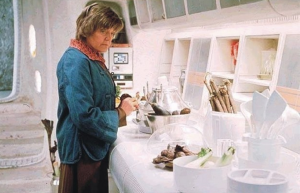
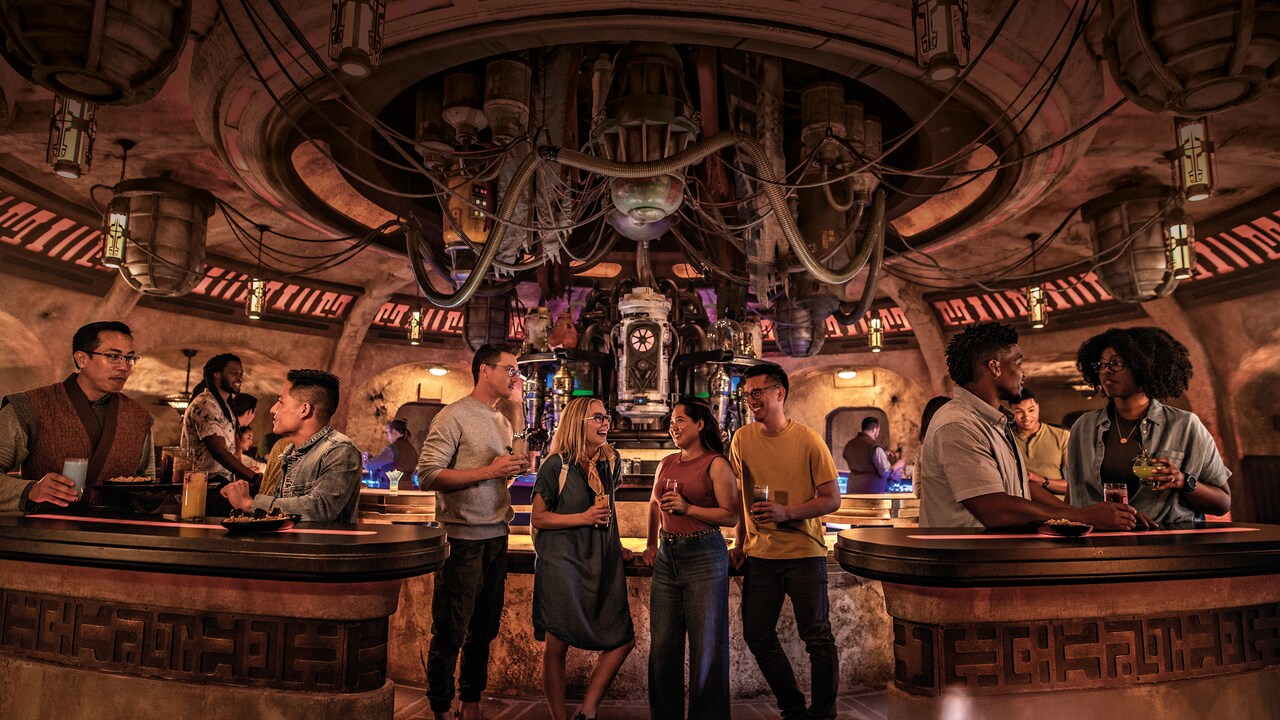
But I do find as I work on it, that there are lots of small things that pop up as necessarily different.  Like what your house looks like.  I don’t think anyone expects to walk into a Psi-Wars kitchen and see pots and pans.  They might expect to see some high tech gadgetry in there, as someone cooks some high tech food, like blue milk.  What does your bunk on a ship look like? When your pilot crew is done with their mission, and your wingman invites you to join the rest of the squadron playing a game.. what sort of game do you go play? If you want to flirt with a girl and take her on a date, where do you go?  If you guy to buy a blaster, what’s the shop like?  Even if we assume a minimum amount of detail or difference, there are still some questions that might have reasonable answers, and some of those answers will flow from the logic of the setting.

I had originally intended to set aside military tech to focus on “civilian tech” in this part of the tech cycle, and I’ve really found looking at these questions to be enormously useful in thinking about what sort of “civilian” tech there might be.  Of course, I have no plans to write up detailed descriptions of kitchen-tech, because nobody actually cares in an Action Game, and if you end up in a fight in a Psi-Wars kitchen, I trust your GM to be able to wing it (“Are there kitchen knives in here?” “Uh, sure!” “Do they have armor divisors?” “Uh… yeah, treat them as superfine.”), but do houses often have domestic robots? Probably!  Does Uncle Lars drive a repulsorlift car? Probably! If Uncle Lars decides to rip off a bank, can he do that? What does that look like? And when he’s trying to get away in his getaway repulsorlift car, how are the space cops going to stop him?

I also find that looking at “daily life” in Psi-Wars is helping to expand the idea of the “Humble Origins” background nicely.  I begin to see what sorts of jobs or background one might have in the setting, and these begin to collect into templates or lenses that I can offer, some of which are nice and fit neatly into mini-niches appropriate for “sidekick” templates that blur the line between an uninteresting NPC and an Action Hero, like a mechanic or a doctor.

So this exploration is providing unexpected dividends, but also taking more time than I expected or had hoped.  Thus, you’ll doubtless see some more cultural issues spilling out as I work on them, though hopefully I can keep the tedium to a minim.
Patreon Special: the Siege of Centauri Prime

My patrons voted on a Worked Example of an Ultra-Tech Framework setting for this month.  Sometime last year, I created a series on Ultra-Tech Frameworks, that is, how do you choose what technology you want for your setting.  

Today, I present the Siege of Centauri Prime, a worked example of a TL 10 setting, wherein the players play as students in a virtual high school who, when they’re not busy helping with their parents’ terraforming chores, sneak off to fight one another in drone battles with misappropriated terraforming drones.  This is not a full setting so much as a setting seed, and shows how one might go about choosing the basic technology for a setting, and then expanding on existing technological ideas to create nuanced gameplay (Mass Combat, in this case).
This is available to all Patrons ($1 is all I ask) as a thank you for their support.

Book Review: We Are Legion (We are Bob) and the Bobiverse Trilogy

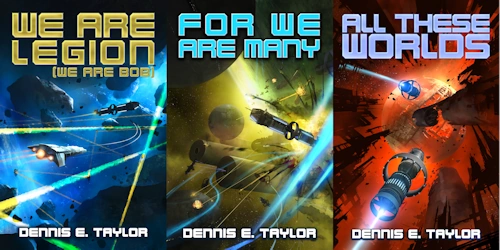
When I finally caved and joined Audible, it was to support Isaac Arthur’s SFIA youtube channel, as he covers topics I dearly love, and he highly recommended the Bobiverse Trilogy, so I thought I would check it out.

I must say, I quite enjoyed it.  It is not a series without flaws, by any means, and I understand this was the author (“From annoyed fan to professional writer” went one of his tag-lines, if I remember correctly) is a fairly new one.  All in all, I would say it’s quite a romp, a sort of popcorn sci-fi, each book fairly small and digestible (the entire trilogy clocks in just a little longer than the single Empire of Silence), and has a nice, hard edge for those who take their laws of physics very seriously.

I definitely recommend this series.

A Summary

We Are Legion follows Robert Johanssen, the eponymous “Bob,” who uses the money from the buyout of his successful tech-startup to sign a contract to be cryogenically frozen after his death. Then, while attending a sci-fi convention, is hit by a car and dies.
He then wakes up in the laboratory of a theocratic United States some two hundred years in the future, not as a human, but as an  uploaded copy of the original.  He has been selected as a candidate for the “Heaven” project, which will involve sending a probe out to another star system, where he is expected to build more copies of himself and rinse and repeat, while seeking good colony targets and returning to help bring humanity to the stars (the copying process gives the book its name).  Unfortunately, there is no small amount of competition, and Bob finds himself under attack from international espionage and then outright declarations of war which has apocalyptic results for the Earth.
Once in space, Bob needs to tackle the lingering reach of enemy human empires, help rehabilitate the Earth, seek out new worlds and new civilizations, help humanity reach the stars, uplift newly discovered sapient species, squabble with his clones, do his best to keep from going insane, and then uncover and wage war upon a horrifying race, the “Others” who see all other races as sources of food.

The Bad

The author is clearly a nerd, or at least knows the nerd target audience very well, and I find the work falls into some geek fallacies pretty quickly.  Bob often finds himself dealing with bullies or bully-like people, and we’re expected to root for him when he outwits of defeats them, but I find this very dissonant when the person being “bullied” is an interstellar battleship capable of orbital strikes.  We can chalk this up to the personality of Bob lingering within the digital copies, but what I find mind-blowing is that people would even try it.  We regularly see villainous personalities making threats or posturing against Bob, or making unreasonable or realistic threats against him, and at one point, he is the subject of bigotry and discrimination, and we are meant to sympathize, and given the response the book receives, quite a few people do.  I just found it absurd. Oh, sure, there’s always some punk who’s going to talk up to a Terminator and pick a fight with it, but I think most people would give it wide berth or, maybe, even worship it.
In general, I find the way a lot of characters behave in We are Legion and its sequels to be a tad unrealistic, namely in the author doesn’t, to me, feel like he has a good grasp of motivations.  People take over governments, or hate the Bobs, or cast him into exile, or demand his time and attention, and while these follow naturally from situations and previous actions, I think they fail to take into account, first, that Bob is often dealing with literally millions of people, and I would expect some diversity of opinion.
Two stark examples stand out to me.  First, Bob eventually offers the uploading technology to humanity, but they, with one sole exception, reject the technology.  Nobody wants to be uploaded, and they point out that all Bob seems to do is chores for humanity and wage wars.  Who would want that?  Folks, that’s what the military looks like, and we get people willing to join that all the time.  If, right now, you went out into the world and offered a million people the chance to become an interstellar battleship, I guarantee you that you’re going to get more than one person reluctantly agreeing.  You might not have a stampede, but there will be people who sign up.  And given the heroism and glamour of what Bob is doing, from exploring the stars to waging war on an alien menace to saving the lives of humanity, I would expect to have seen some hero-worship; people would want to be a part of all of that, but instead, we see Bob treated as an exile, selflessly and thanklessly working for humanity.
The second involves a military leader who becomes the main contact person between Bob and humanity, who regularly makes demands and argues with Bob, and rejects certain proposals that Bob makes, about how Bob wants to use his own resources.  The general’s angry reactions to Bob’s proposals becomes something of a running joke of the series, but I found it perplexing.  It would be like a US Aircraft carrier parked off of an island devastated by a natural disaster with only a small fragment of the original populace clinging to life and offering assistance, and then the captain of said aircraft carrier complaining that the representative of the survivors is mean.  Why does the captain care what the representative has to say?  He’s an adviser at best; every once in a while, Bob will threaten to pull stakes and walk if people don’t cooperate, but that sort of thing would have to seem pretty obvious to most people involved.  I would have expected a lot more toadying from the ambitious, rather than grandstanding: You would rather be seen as the captain’s best friend, rather than his task master.
The other irritation I had was how he tackled the concept of religion.  His theocratic masters were, of course, mustache-twirling villains, while Bob is a perfectly rational atheist.  I find this sort of attitude common among the futurist crowd, and I find it uncharitable.  The rise of the theocracy read like left-wing conspiracy theory, and no effort is made by the author to understand how such a thing could actually happen, and what sort of nuance we might have.
I rush to note that most of these can be explained away as expedients to getting to the better part of the plot, and that there are a few moments when the author seems to be highlighting that a lot of what he is showing has more to do with Bob’s attitudes than what is actually going on (For example, one of the Bobs questions another Bob’s handling of humanity, pointing out that they’re reacting out of fear).  The book, after all, is not about the rise and fall of the United States, or the nature of humanity.  It stood out to me more because I was going through the Dune series around the same time, which tackles these concepts in a far more nuanced way.  But still, they stood out to me, so I thought I would point them out.
My only remaining complaint is that it sort of… just ends.  The author seems to have decided to wrap it up, he tied off all the main plot points, has a final good-bye and he’s just done and moved on to the next trilogy.  It’s a touch perfunctory, and I found it a bit unsatisfying, but I didn’t especially mind it.

The Good

Right out of the gate, the book has an easy and jovial tone that makes it a delight to read.  Normally I just listen to my audiobooks when I have nothing better to do, such as walking between home and work, but with this trilogy, I found myself flipping it on just to see how it finished.
The Bobiverse trilogy absolutely brims with a love of science, technology, futurism and sci-fi.  It’s loaded with references, and a sense of wonder, as Bob’s clones discover new species, new worlds, new life, and discusses them in detail. The first book also includes quotes from sci-fi conventions discussing futurism, which expand a bit on some of the ideas that his series explores, though the latter do don’t do this, which is a bit of a shame.
I would can’t the series “Hard,” as it includes reactionless drives and FTL communication, but beyond those few conceits, it remains rigorously focused on science and explores their implications as well as it can.  It is absolutely a must read if you want to understand how GURPS Space Combat is intended to run, and it had the most fascinating space battle I’ve ever read in the first book, which involved long, slow trajectories, intense calculations and recalculations up until the instant of contact which led to a millisecond-scale exchange of ordinance.  The final battle of the series also touches on the sheer scale of power that a true interstellar war might have.
This may seem terse, compared to my complaints, but this is the bulk of what makes up the books, and its excellent.  It’s why you read them.  They definitely outway the bad, above.

But is it Psi-Wars?

Ha ha, no.  It’s got sapient,  uploaded brains running STL dreadnoughts to fight wars mostly decided by missiles and point defense when it isn’t discovering new life and new civilizations.  If you’re looking for books that I’ll borrow for Psi-Wars, this definitely isn’t one.  It is fantastic inspiration for Heroes of the Galactic Frontier, a Star-Trek-like that I would like very much to get to.  In fact, it very much reads like someone wanted to write Star Trek, but was irritated  by all of the unrealistic elements of Star Trek and so ditched all of them, and wove in a few interesting new concepts, like uploading consciousnesses and a little existential introspection on what cloning your consciousness means.