Let’s Make a Sorcery Spell List: Standard Spells

Yesterday, I discussed the creation of a domain, what GURPS powers calls a “Focus,” the thing our magic will manipulate and master. Today, I want to focus on the other half, what GURPS Powers calls the “Source.” If we’re talking about Fire Sorcery, this is the Sorcery half. In this section, we actually create the spells.

We tend to think of Sorcery as already a system, but to paraphrase Enraged Eggplant, GURPS Sorcery isn’t a system, it’s a framework. You can sort of use it out of the box, but you’re going to have to build a lot of specific advantages, the actual spells, and this means considering how magic works. That is, you need to think about how a generic sorcerer in your setting operates and what they can do. Once you have that, though, actual spell creation goes pretty quick: you take your domain and mash it through your standard spell list, and bam, you’ll have 90% of your completed spell list. You get this down, and you’ll be a spell-creating machine.

Continue reading “Let’s Make a Sorcery Spell List: Standard Spells”

Let’s Build a Sorcery Spell List: Domain

A while ago (I think a few months now), Enraged Eggplant took a look at my Psychic Sorcery system, which was a plug I did not expect, and it was part of a broader discussion on GURPS Sorcery in general and I had decided to post a response, but the conversation rapidly evolved, and I didn’t have time to catch up. What came out of it for me, though, was the realization that a lot of people struggled to write spell lists from scratch, especially for something like Sorcery, so I thought I would sit down and discuss some of my techniques and approaches and what I think has worked well and what hasn’t. It was going to be one post, most of which was already written, but I kept adding more and more stuff, and so this post came out first.

In particular, I’ve been playing a lot of Cultist Simulator lately, which is definitely one of my favorite occult games of all time. In particular, I love the magic system, and when someone asked me why, and specifically what you could do with it, I paused and said “Well, you can summon stuff?” and it occurred to me that the magic system of Cultist Simulator barely did anything. This got me to thinking about the power of domain. I’m sure I’ve discussed this before, so forgive me if I repeat myself, but my big takeaway from Cultist Simulator’s magic system is that you don’t need a wide variety of spells if what the spells do is interesting. That is, the quality of the domain of magic is more important than the quantity of spells, which is great, because it can minimize the number of spells you have to make.

So I wanted to talk about domains using Cultist Simulator as an example, and extrapolate it out into what I think tend to be pitfalls I see other magic systems make. In this post, I won’t make any magic spells at all, but I think by the time I’m done, you’ll be persuaded that a light touch is often enough, and we’ll have a better foundation for building spells later.

Continue reading “Let’s Build a Sorcery Spell List: Domain”

Patreon Post: Clarktech and using Technology as Magic

For this month, my patreons voted for “Technomagic,” which in this context means technology that fulfills the same role as magic in a fantasy-like setting. I was pleased to see this topic voted up as it was, as it’s been a bit of a hobby of mine for the past few years to ponder how one could create a fantasy-like character with nothing but material out of GURPS Ultra-Tech.  The ideas found their way first into the Dark Engine in my unpublished Protocols of the Dark Engine, then into the Deep Engine of Psi-Wars, and it informed previous games I’ve run like Blackout Saga.  I personally find that a dash of science fiction, if handled well and noted used as a bait-and-switch, adds quite a bit of spice to a setting.

This document focuses on setting building, do’s and don’t’s of techno-fantasy settings, suggestions for handling an overall magic system using technology as its basis, and what specific technologies, if taken out of their usual context and given a fantasy skin, might look like.

I’ve made this a Patreon special as it feels more like the sort of thing that usually ends up as a special, and as a thank you to my patrons.  So, if you are a Patron ($1 is all I ask) enjoy!

A Psi-Wars Historical Timeline Part I: Introduction and Calendars

For April, my patrons voted for an overview of the history of Psi-Wars.  I’ve already written on the topic rather extensively:

But these were rough draft concepts scribbled out when I was just beginning to put together the setting.  Since then, I’ve created a more internally consistent and cohesive history that I often refer to, but rarely fully reveal.  This week, we’re going to dive into the whole thing.  Before we do, it might be helpful to reread the first one, as today we’re mostly going to discuss the ideas of how to use history in a setting, why I chose the format that I did, and some concepts.

This series also assumes you’re familiar with the Eldoth and the Ranathim; it would help to be familiar with the houses of the Alliance as well.

How to Write your History Revisited

I’ve already dicussed this in the History of Psi-Wars post, linked above, but it’s worth revisiting.  Everything in your setting should serve a purpose, and that purpose should be to assist your game.  The average person playing D&D doesn’t need to read a 20 page timeline to understand “Kill monsters, take their things,” and so writing said timeline is generally a waste of time.  On the other side of the coin, conspiratorial settings, horror settings and other campaigns where investigation is very important, history is often central, so central that “Antiquarian” is an actual template in GURPS Horror.  How much history you need and at what level of detail depends greatly on your campaign and its needs. 

Psi-Wars leans much more heavily towards the “investigative” side of things, as do many Action movies, which may seem surprising given how HIGH OCTANE most action movies are, but if you think about it, all of them are steeped in context.  Atomic Blonde is set in the 1980s in divided, Cold War Berlin; the Bourne series revolves around a set of experiments that took place in the past; Mission Impossible Fallout and most of the current Fast and Furious franchise is heavily based on events that took place in previous films.  The swashbuckling genre, and the wuxia genre, both of which Psi-Wars heavily draws from and are in principle are kissing cousins to the action film, rely even more heavily on history, especially wuxia, which often has the hero stumbling into the midst of a century old feud while dealing with the fallout of a crumbling and corrupt empire.

In principle, a well written history can  serve several purposes for an RPG:

  • It provides context: it explains why the players do what they do.  To use a D&D example, without context, then your players go through nameless dungeons killing random monsters and gaining random loot.  It might be fun, but it lacks a sense of meaning.  A named dungeon embedded in the world with consequences to the rest of the narrative can really amp of the investment the players will have in the adventure.  History can be one example of context.
  • It provides continuity: a well-written history embedded in a well-written campaign begins to make the players feel like a part of a larger adventure. Their actions are a logical continuation of what came before them, and they can begin to see how history will spool out before them after their adventure continued.  They can invest themselves in the stories of the past to create the new stories of the future.
  • It’s a good source of ideas: Players who read your history may want to tie themselves into that history.  They might want to acquire relics from a particular part of history, or they might want to belong to this lost but important bloodline, or they may want to hunt down some historically relevant but currently lost location.  The rolling context of history might provide plenty of things to do in the present too, giving you adventure ideas as the “press of history” forces your hand in events.
  • It creates a larger picture: When looking for adventure ideas, many “sandbox” GMs like to have a full cohesive setting in which the consequences of the players’ actions naturally impact the world and create the next obvious adventures.  Having played in a few such games, I can say that they’re quite fun.  History is one ingredient that might fit into such a game.

So, when creating your history, ask yourselves a few questions:

  • Will my players care?  What can they use out of this material for their own characters?
  • Will it matter to my campaign? Will it provide me with ideas I can use?
  • Does it feel logical, like events naturally follow from events?
  • Is it fun to read? If it’s tedious, nobody will read it.

As a rule, I tend to make sure I write in interesting relics, interesting characters, and interesting locations in the past, so that players who invest in history can explore those concepts.  I also try to make sure that there’s sort of a logic that history follows. The last, though, is the trickiest.

Writing Readable History

If you’re going to write your history, how do you know people will read it?  Allow me to offer some thoughts on the shape of your history, its purpose, and how to present it.

Iceberg Theory

One of my favorite concepts for writing is Earnest Hemingway’s Iceberg theory which, briefly stated, is that you should do your homework, let your homework inform your final work, but don’t actually put your homework in your final work. When it comes to history, that means it’s important for me to have it worked out in detail, so I understand it, but I don’t necessarily put this material in my final setting document. In fact, I probably shouldn’t (it might overwhelm the reader). Very large works, like the Lord of the Rings, the Marvel universe and Transformers Prime often have a setting bible that sets out how the universe works and encourages cohesion between the various elements in the setting (Star Wars definitely lacked one of these, which explains how much crazy got injected into the EU). Think of this document as a “Setting bible” for history.
History is ultimately more for the GM than it is for the player. The best history is entirely optional.  For example, sit down and watch Star Wars: A New Hope again, and you’ll notice that literally all the history you need to know is in the opening crawl.  The prequels are unnecessary, the expanded universe is unnecessary, KOTOR is unnecessary; you can enjoy the work on its own.  In principle, your setting should be the same and, where possible, I’ve tried to nail Psi-Wars down to “There’s an Empire, it’s fighting an alliance, there are some space templars from long ago still running around: go!” and that’s all you have to know.
 

But a full document helps me understand how the world should work.  If the players investigate the past of the Emperor, what will they find?  If they go deep into the Cult of the Mystical Tyrant in the Umbral Rim, what sort of ruins might they uncover?  I can make up stuff on the spot, and that’s fine, but if the players get a sense of discovery of a cohesive world, as though the world was real and they were discovering it, they really appreciate that extra effort.

Thus the primary thing to know about history is that the GM needs the full details, but the players probably only need an executive summary and, really, will enjoy discovering history “in game” more than reading it from a book.

History as a Story

If you’re going to present your history to your players, the best way is probably in a narrative form.  The human mind naturally understands and appreciates narrative, and you can see this in history classes: students fall asleep while memorizing dates, but come wide awake when the history teacher launches into lurid stories about crimes and conspiracies in the final years of the court of the Ancien Regime.  Most successful RPG histories I’ve read follow this format: you start at the beginning and read your way forward. Such histories tend to be full of lurid details, judgement cast on the characters involved, and lead up to the present where they suddenly stop, presenting the reader with what they might be doing.

The problem with history as a story is that it’s meant to be read as a single narrative yarn, and that presents numerous problems.  The first is that they can become quite long, especially if the GM feels the need to tell you every little detail.  A player is more likely to read a single A4 of history than a 100-page volume. 

History-as-a-story also tends to be told sequentially, starting at the beginning of history and wending its way forward, as there are no natural “breaks” and jumping around might create unnecessary confusion.  This compounds the problem of a long history, since if players are only going to read a single page, and you started with the creation myth of your setting, then everyone is going to be familiar with the creation myth and have no sense of recent events, which is precisely the opposite of how people actually work.  It would be like every American being deeply aware of all of the details of colonial life in America, down to the fashions, religious practices and relations with one another and Native American tribes, but no idea who the current president is.

Finally, History-as-a-story struggles with parallel histories, and these often matter, especially if they all lead to the same point.  For example, if telling the story of WW2, you might reasonably start with the rise of Hitler, his aggression, the beginning of the war, and then America’s involvement, then the defeat of the Nazis, but then the war isn’t over, becaue the War in the Pacific needs to be won, and to explain that, you have to go all the way back and talk about how the Japanese got involved.  You might cut back and forth, but this can be challenging in the narrative as well, especially if you have a very long history (imagine being in the midst of reading of the Roman Empire and the narrator keeps cutting to completely unrelated events in China and the Americas: he’s going somewhere, but you might need to wait 1000 pages before you know what that is).

As a general rule, when it comes to History-as-a-story, I recommend keeping them tight, short and focused.  No more than a page if you can avoid it, focus on a single narrative thread, and don’t try to tell all the history of the world this way, but give an overview of the most important points.

For Psi-Wars, I handled this with my intro. I might revise and expand it, but I wouldn’t want it to be more than about a page’s worth of material, with a strong focus on the current war, the players involved and the Templars vs the Cult of the Mystical Tyrant, as these are the central conflicts of the setting.

History as a Series of Ages

Weapons of the Gods has the nicest form of history I’ve seen in a long time. Rather than “tell the history of the setting,” it talks about specific eras. This has several advantages. First, this breaks up the history into digestible chunks that don’t rely overly much on what came before it. This is also how we tend to read history: we don’t start with the Sumerians and end with man on the moon. Instead, we study “the Greeks” or “the Roman Empire” or “The Medieval Ages.”  Second, it lets you discuss everything about the era.  If you’re talking about the medieval ages, you can also talk about the armor, the culture, the weapons, the religion, interesting people, the “spirit of the age” and so on.  This makes it a great way to drop names, locations and relics that the players might connect with.  Finally, it handles parallel history better, because you can talk about a different era somewhere else: for example, you might discuss medieval history in one section, and the Islamic Caliphate in another section, and Viking History in a third.

The “Series of Ages” approach is that it doesn’t really follow the “flow” of history.  It gives the impression that history happens in chapters, as though there were romans and then, suddenly, knights, when in reality, one slowly evolved into the other.  You also have to pick arbitrary eras and choose that which you feel is most interesting.  It should be noted that neither of these are necessarily problems for a fictional setting, as the natural flow of history can be less interesting than highly specific ages (“First came the age of monsters, then the age of magic, then the age of apocalypse; now is the fallen age”).

The “Series of Ages” can make it a little difficult on the reader to know where to start.  I recommend pointing him to the sections most relevant to his character or the current setting.

This would have been my preferred way to handle showing you the history of Psi-Wars, and I started writing up these ages, but they quickly got away from me and I started running out of time.  I seem to have made a rather elaborate and detailed history.  To make sense of it, I needed a timeline, and it became easier to just give you the timeline, as that will take less time (which is very scarce at the moment, for reasons pertaining to the last post in this blog).  Which brings me to:

History as a Timeline

I tend to like this form of history the least.  It exemplifies everything boring about history: it’s a series of events noted by date, with no additional connections of context.  It serves a purpose, but that purpose is not to introduce your players to a setting.  Rather, it’s the historical equivalent to a map: it lets you sort of out specific details (“Wait. Exactly how long has it been since X happened, and how much time separated Y and Z?”).  It’s useful as a reference, and that makes it useful to the GM, but it’s not so useful to the players.

So, naturally I’ve chosen to write out the history of Psi-Wars as a timeline.  Why? Well, I need the timeline anyway, to get a sense of the flow of history.  I need to know if eras go on “too long,” or if there’s overlap between events, or where I can insert eras.  A timeline is a classic example of the iceberg theory: a GM needs it to do his homework, but it’s not something to necessarily show his players.

So why am I showing you?  Well, it doesn’t hurt to show you guys; it only hurts if I run a game and expect you to know all of this history.  As I said above, time is very precious at the moment, and since I needed to iron this out anyway, once I had done so, to stop and turn to writing the eras in detail might take me another month, and it’s better to give you what I have no than to force you to wait for what I’d like to do later, especially given that I need to get back to other things (What were we doing?  Oh right! Vehicles!)

Thus, the rest of this week will be the Psi-Wars timeline, split into large chunks.  Forgive me if you find it a little tedious to get through.

Calendars

When discussing time, it’s useful to stop and think about how one measures it. This can well be a bridge too far, as most people don’t actually care about “fantasy calendars,” at least for the most part. Consider, for a moment, the Star Wars calendar. Do you know what it is? Do you know how they measure time? The short answer is you probably don’t and, if you think of it, it’s never come up. They don’t really talk about it, and when they do mention time it seems to be in familiar units. That’s because we, as an audience, don’t really care. We want actual information transmitted to us, and knowing that something is going to happen “2.695 kilocycle” tells you nothing, not compared to “45 minutes.”
That said, we do tend to want to have some sort of distancing mechanism, something to remind us that we’re in space or in the future. Farscape did very well with its “microts” (about a second) and its “Arns” (about an hour.”) Thus we could hear an alien say “Give me 10 microts,” and we knew they meant about 10 seconds, and we also knew we were in space.

Psi-Wars is especially large, and we have a theme of creating different cultural feels for different regions of space, to give us a sense of the vast distances involved in galactic travel. Thus, it makes sense to have different calendars: a familiar calendar for humanity and the galactic center, and alien calendars in alien parts of space: the more alien the culture, the more alien the calendar.

The Human Calendar

Humanity needs an obvious calendar and, being human, there’s no reason they wouldn’t have a familiar day/night cycle. They may even descend from Earthlings and would likely favor planets with similar rotation speeds and gravity, thus seconds, minutes, hours, days, months and years can all remain the same. In principle, we’d need different month names, but it’s such a rare thing that people would say in game“Let’s meet in December” that I don’t think it’s a major issue. The only real issue I see is how we note the years.

I don’t want to set this in a definable future. Is this in the year 2500 AD? 40,000 AD? Who knows. Mankind has lost its roots, which means they’ve lost connection with how we date years (And beyond perhaps Sheperdism, they’ve lost any “Christianity” they might have had). So, we need to pick a new central year, and the obvious fit is the Alexian dynasty’s founding. We’ll call this the “Alexian Era,” of “AE,” which is a nice nod to various sci-fi works that use “After Earth.” For everything before that, we’ll use “BD” or “Before the Dynasty.” Some people might prefer “Galactic Era” and “Before Galactic Era.”

The Lithian Calendar

The Umbral Rim should obviouslybe alien and unusual with unfamiliar terms and ideas, and thus their calendar should be unique. The Empire is powerful and influential enough that many denizens there might be familiar with the human calendar, but we might expect that when aliens talk to one another, they would use different units, ideas and concepts. Not terriblydifferent, but different enough that the players feel like they’re in an alien space, our “Microts” and “Arns.”

In this case, for words, we have the Lithian Conlang to draw on, so:
  • Nata: year
  • Marhan: Month
  • Thari: Day
  • Junta: Hour
  • Miena: Minute
  • Nita: Second
If we wanted to fill out the calendar, noting the names of the months or special days, we would note when the “holy days” of the various cults are, and that would likely dominate the calendar.

For the year, a common sci-fi trope is to give years different lengths based on the orbital period of the star. Realistically, given that the home star of the Ranathim turned into a black hole, it should be an extremely large star, so they should orbit very far away, giving them a long year. If we use GURPS Space, we come to about 1620 days for a year to give them a habitable world around a 2 solar mass star. However, I’d like to use a value closer to an Earth year, and given the “Orientalist” tropes of the Ranathim, I’d like to use a value closer to a lunar calendar, which would give them 354 days in a year, making their year almost but not quite a Human Year, which is a perfect reflection of how the Ranathim feel as a culture. Asfor their “year zero,” their dating system would probably focus on the reign of the current Ranathim Tyrant, but that’s not a thing anymore, thus they probably base their years on the “Dark Cataclysm” (Moriktani Nobet), or when their homestar went supernova, broke their homeworld and completely changed the Umbral Rim forever.

The Eldothic Calendar

Most of the Arkhaian Spiral is dominated by humans these days, but the Eldoth and their Deep Engine would use a unique time system and it would continue to be pertinent today if you want to interface with either the Deep Engine or Eldothic mysteries.

They’re a very alien species and deeply logical and clinical and they have a universal “computer” in the form of the Deep Engine, thus it seems logical that they wouldn’t bother with a time system based on something so provincial as the orbital period of their homeworld (they’re not that sentimental). Instead, they might do something similar to unix timeand have everything in seconds. They might also make it metricand describe their time in tens, hundreds, thousand and millions of seconds. We’d use the term “cycle” instead of “seconds,” and append the right metric designation. (We could use Eldothic words for it, but we’re going to translate the concept anyway, so we might as well use these words in english here).

As for their “year zero,” we’ll borrow an idea from Unix time again, and simply note everything from some arbitrary period and simply call that period “universal.” If you go before that, you’re in “negative time,” or possibly “Archival.”
  • 1 “Cycle” = 1 second
  • 1 “kilocycle” = about 15 minutes
  • 1 “megacycle” = a bit less than a fortnight
  • 1 “gigacycle” = 32 years and their preferred notation for historical dating (also the length of time most Eldoth go between regeneration cycles).
     

The Sylvan Calendar

I’ve not put much thought here. I expect the species of the Sylvan Spiral as sufficiently primitive that they have their own calendars, though if they had a universal, it might have to do with the thalline filaments cycle of “blooming” and “growth,” as that would be a useful universal for the species of the Sylvan Spiral to know.

The Draco Cluster, however, and its resident Mug civilization regularly makes incursions into the Galaxy on a cyclical basis. Their dwarf galaxy orbits slowly around the central Psi-Wars galaxy on a path that takes literally millions of years, and thus it has not appreciably moved throughout the history of the Galaxy, but it hasmoved, and its movement shifts its relationship to the hyperspatial passages between it and the rest of the Galaxy. It spends most of its time in “eclipse,” or unable to easily access the Galaxy, but for a few centuries every 1124 years by the Lithian calender (approximately, but not precisely1159 years by the human calendar), it is able to access the Galaxy. When it does so, it is able to invade the Sylvan and Umbral Rim.

Psi-Wars Alien Overview

(This was a Patreon Voted post.  If you’re interested in voting for the monthly Psi-Wars topic, join up as a patreon with the link to the right!  Psi-Wars topics, as opposed to general topics, require a $3+ patronage, but also get you Psi-Wars previews and specials when they come).

My Patreons have been routinely voting for setting overviews, which tells me something about where my attention should really be, and recently, they’ve come to a collective realization that all the alien races of the setting exist only in Patreon specials (with a couple of exceptions)!  Thus, they’ve asked for an overview of the Psi-Wars races so that everyone who reads up on Psi-Wars can know what their options for alien races are.  They’ll be made available in the wiki as well.

There are many intelligent species in the universe. Unless one is dominant or exotic, only those with Area Knowledge of its region of space will recognize it on sight. The various aliens mingle, and there may be true interspecies civilizations… the Star Wars universe suggests a great variety of intelligent beings. –Aliens Everywhere! GURPS Space


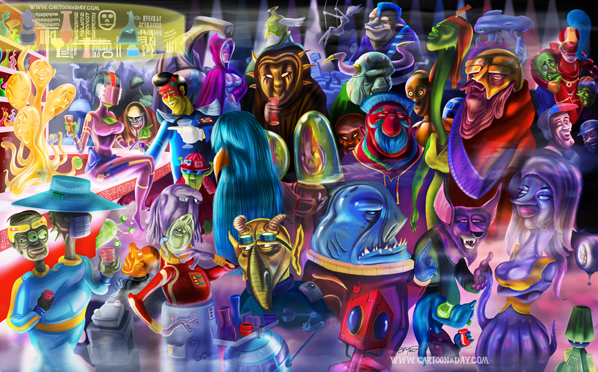
Psi-Wars is an “Aliens Everywhere” setting.  A PC who stumbles into a bar would expect to see more aliens than we can easily categorize.  It’s also within the “space opera” genre to treat alien races the way most fantasy games treat fantasy races: to offer numerous playable options with varying levels of depth, so that a player can pick and choose from those.  But we’re not going to limit our setting to just what aliens I create.  In principle, any GM should be able to shove in any alien he wants.

I’ve talked about alien creation before, and I’ve talked about setting design before.  What I want to do today with this preview, before I get into specific aliens, is show you the general overview I created and themes I used to inform my design decisions, why I chose the aliens that I did, and what role they serve in the setting, and where the “holes” in my setting are.

Themes

A key element to my setting design manifesto is the need to create themes and to use those to create a framework that shows you where your holes are, and where you might find an interesting niche to build an interesting setting element.  This is true for Aliens in Psi-Wars as well!

Basic Alien Themes

When I discussed alien creation back in iteration 5, I touched on their common themes, derived from GURPS Space (and elsewhere).  So, let’s do a brief recap.

Appearance and Physiology: In the post, I touched on Aliens as Humans, Aliens as Beasts and Aliens as Wugs, with “wugs” being a reference to gross “bug/worm” aliens.  The idea here is how you relate to the alien on a basic level: if they are human, you can relate to them as humans (the Twi’leks).  If they are beasts, you can relate to them as the beast they reflect (You’ll cuddle a wookie like a dog, but you’ll recoil from a reptilian Trandoshan). If they are wugs, you’ll cry “Kill it with fire!” and they tend to be used as unsympathetic villains (The Geonossians and the Hutts).

We can connect another set of themes to this: is it pretty, ugly or exotic.  “Pretty vs Ugly” is a common fantasy trope: pretty elves, ugly goblins, and tend to denote the race’s moral connotations.  A pretty race is one that players will tend to sympathize with, want to interact with, or will want to play as.  Ugly races tend to be reserved for minions or monsters, though they might also be tragic, pitiable characters that players sympathize with in a different way; if players want to play as one, they’ll do so only if the alien has some advantage, typically connected to tropes related to their ugliness: the strength of an ogre, the hardiness of a zombie, the intellect of a weird, giant-brained martian thing, etc.  Finally, an exotic race evokes the unusual possibilities of a sci-fi setting: starfish aliens, beings of pure energy, sapient automatons, living planets, etc. Players tend not to automatically sympathize with them, but express curiosity about their nature: few people wonder how twi’leks breed, for example, but there’s quite some speculation and written material (all quite mutually contradictory) over Hutt sexuality.  If players play as one of these, they do so to explore their weird nature.  You’ll have to be careful to work the creature into the mechanics of your genre well, because playing a sapient, immobile tree is fun for only about 5 seconds in an action genre.

Narrative Role: Back in the same post, I discussed numerous possible roles and how they might be interesting.  To briefly recap them: we have Comical races, Primitive races, Mastermind races and Warrior races.  All of these touch on important themes of Psi-Wars, but especially the last three. Primitive aliens emphasize the centrality of humanity, which is important for the pulp space opera genre, which replaces the cannibals, noble savages and decadent foreign civilizations of pulp adventure fiction with alien counterparts; it also ensures that the “familiar” elements of humanity can remain central to the story without fearing a major disruption.  Masterminds and Warriors threaten the dominance of humanity, and should thus be treated carefully (at least for the purposes of a human-dominated setting like Psi-Wars. After all, if they’re so much better, why aren’t they in charge?): typically rare or superior only in carefully defined ways.  This “threat” is not necessarily a dangerous one: Yoda could be classified as a “mastermind” in that the threatens humanity’s complacency with its self and its smug assumption of having all the answers.  Comical aliens tend to fulfill the role as outsider-as-comical-relief, which again emphasizes humanity’s central nature, and allows one to use the creative freedom of race design to create exaggerated characters for comedic effect.  The problem I find here is that Psi-Wars isn’t especially “funny,” and you can see this when pulp space opera fans react to the intrusion of comedy into their series: one of the major complaints about “The Last Jedi” was that it was “used too many jokes,” and Jar Jar Binks was roundly condemned by fans.  Similarly, it’s hard to imagine especially silly characters in John Carter of Mars, though comedy works fairly well in Guardians of the Galaxy.

Players will tend to gravitate towards Warrior or Mastermind aliens, as they offer some element of superiority which makes them attractive.  Comedic races can offer sillier players an outlet, but there need to be tools for the silly race to have moments of drama and tragedy; few (non-disruptive) players want to play a character that’s exclusively a clown.  Primitive races tend to be complicated.  If the race is absolutely inferior and not humorously so (for example, Tusken Raiders), players tend to avoid them (they tend to be little more than speed-bumps on a players’ adventure, or window dressing).  If the primitive race is a “noble savage” with some sort of advantage at “getting back to nature” or “telling it like it is,” then the same sort of person who likes Druids or Barbarians will find themselves drawn to the race.  You can also get a lot of mileage by shrouding a mastermind or warrior race in the mantle of a barbaric race: their technology might not be on par with humanity’s, but they have some interesting insights of advantages that “balance them out.”

Psi-Wars themes

Naturally, Psi-Wars has some themes of its own.  We can broadly break these down into “moral” themes and the “geographical elements.”

Moral Alien Themes: Fantasy games often break races down by “good” (Elves), “Evil” (Orcs) or “Neutral” (trickster fae, wildman races, etc).  We could do the same for Psi-Wars, but I tend to push for a grey morality (less because I think morality has no place in Psi-Wars, and more because I want to give GMs the room to decide what they want to be “good” and “evil” in the setting).  So we can break them down instead by Communal alignment.

  • True Communion races tend to be civically minded, seeking enlightenment, cooperative with one another and outwardly seem moral and good. They might, however, be harshly judgemental and exclusive.   
  • Dark Communion races tend to be selfish, seeking power, chaotic and violent.  They outwardly seem evil, or at least criminal.  However, they tend to be adaptable, more tolerant of vice or difference, and open to new ideas.   
  • Broken Communion races tend to be exotic and strange, driven by unique and internal motivations that others might not understand.  Their “blind” actions tend to cause a great deal of harm, or at least change, and they seem monstrous.  However, they do have good reasons for their actions, and learning to understand them can teach you a lot about your own blindspots and your own assumptions.

Elemental Themes: Many fantasy games (and especially Wuxia games) use natural elements as themes for magic or races: the “moon elves” can do “moon magic,” the dwarves might be associated with the element of Earth and thus the enemies of the Sea Elves, who are associated with water, and so on.  Psi-Wars is a sci-fi setting and thus those elements might feel out of place, so I created 5 new elements, way back in my article on Space Chi:

  • “World,” the central element, representing balance and the ability to interact with many others.  This is associated with the Galactic Core.
  • “Light,” familiar, human, easily traveled, with clear morality and history.  Few races have this element, as it’s the element of humanity.  This is associated with the Glorian Rim.
  • “Dark,” the opposite of light: exotic, alien, decadent, difficult to travel and morally complex. This is associated with the Umbral Rim.
  • “Tech,” embracing technology, ancient, apocalyptic, sophisticated, dying.  This is associated with the Arkhaian Spiral.
  • “Life,” the opposite of Tech, embracing the natural world, young, primitive, primal and vibrant.  This is associated with the Sylvan Spiral.

Niche

The final question to ask when creating this overview is “So what?”  What sets this race apart and makes them a unique experience for the player?  For me, the best races are those that act like lenses on how you play.  To use a D&D metaphor, I prefer not to have races where they lock you into a class (“Elven Mage, Dwarven Fighter”) but rather alternate ways to play a class (“Elven thief vs Dwarven Thief”).  Even so, we need to define the nature of this alternate gameplay perspective and how we achieve it.

For Psi_Wars, we can broadly break the niches into three different  elements representing the three main gameplay elements of Psi-Wars.

  • Action: The race has some inherent (typically physical) advantage that makes them better at interacting with the action elements of the game.  This might be superior physical traits (higher mobility, better ST, greater durability) or it might be mental traits, but they tend not to be supernatural or psionic in nature.  These traits tend to drive the race towards more combat-oriented or action-oriented roles, but we should be careful not to lock them into a single template (“All Nehudi are commandos”).  Remember that “Action” Templates cover quite a spread (Commandos, Fighter Aces, Bounty Hunters, Assassins, etc).
  • Intrigue: The race has some inherently (typically mental) advantage that makes them better at spying, manipulating, investigating or inventing technology, or otherwise manipulating the setting’s political layer.  Like action traits, these are inherently biological rather than psychic in nature, and tend to drive the race towards more intrigue-oriented roles (Spy, Diplomat, Con-Artist, Smuggler, Scavenger), but again, we should be careful not force them into a single template-role.
  • Psionic: The race either has an inherent psychic ability that sets it apart, or a unique way of interacting with psychic abilities.  This tends to push the race towards more “conspiratorial” gameplay elements, like Space Knights or Philosophers, so we have to be careful to make the psychic abilities broadly applicable where possible (for example, telepathy is a nice trait for a space knight, but also for a con artist or diplomat). 

 The Overview

I want to note that these races can (and maybe should) change; rather than using their absolute names, I’ll use the “code names” I’ve used before. The point here is to map out niches that we’ve filled, niches that we’ve overstuffed, and niches that could use filling.  As such, this is more of a design document.

The art is just at least one piece of art that I used as inspiration; it may or may not be indicative of the final look.  It may just be a depiction of some of the themes involved.

Communion Frogs: 

  • Appearance and Physiology: Human, Pretty
  • Narrative Role: Mastermind
  • Moral Role: True Communion
  • Element: Dark
  • Niche: Psionic

I want one alien race to act as the foundation for each form of Communion, and I wanted an alien race to have founded the True Communion faith, an alien race to act as the “hidden kung fu masters” that the Templars might seek out, similar to Yoda.  In reference to Yoda, I’d like them to be aquatic, but in contrast with yoda, I also want them to be “playable,” and thus attractive, possible love interests or someone a PC might want to be (and have the flexibility to “make their own”).  Thus, they might be something of a “Sea Elf,” except that they should be amphibious in the sense that they should be able to interact with both land and water, because a water species is too “niche” for an Action game, hence “frogs.”  I picture their mechanical niche centering on Telepathy, allowing them to network with one another well in a way appropriate to a race associated with True Communion, and also because it meshes well with a “Togas and Crystal Spires” vibe.

Sexy Space Vampire: 

  • Appearance and Physiology: Human, Pretty
  • Narrative Role:Primitive (Decadent)
  • Moral Role: Dark Communion
  • Element: Dark
  • Niche: Psionic

 I want one alien race to act as the foundation for each form of Communion, and I wanted an alien race to have founded the Cult of the Mystical Tyrant, and this is that race.  Unlike the Communion Frogs, who represent enlightenment, the Sexy Space Vampires pursued a dead-end path, and have fallen from having a great empire and are now typically enslaved (hence their “decadent” and “primitive” nature; in this sense it means that they’re better off abandoning their culture and pursuing a more humane culture).  I see them filling the same niche as the decadent, green-skinned space babes of pulp space opera from Barsoom to Star Trek to Star Wars: they are the twi’leks and the Orion dancing girls of the Psi-Wars setting, and thus “sexy,” and thus “pretty.”This also makes them a good option for a playable race, and thus need to be expanded into a fully playable race. “Dancing girl” is not broad enough to keep players engaged with the race, but “space witch,” “gladiator,” and “assassin” might be!  Their niche will be psychic vampirism, as it locks the character out of True Communion and fits with a “sinister” vibe.  I’d also like to explore alternate resources with them.

The Monolith

  • Appearance and Physiology: Wug, Exotic
  • Narrative Role: Mastermind
  • Moral Role: Broken Communion
  • Element: Tech
  • Niche: Psionic

The last of our foundational races will be some ancient terror that forged a lot of the terror of the truly ancient galaxy.  If humanity are the Greco-Romans of the setting, then our foundational races are the ancient Middle East, with the Communion Frogs as Judeans, the Sexy Space Vampires as Egyptians or Persians, and this race as the Babylonians or the Ancient Sumerians: some ancient race that most future civilizations condemn as demonic, but actually were maybe misunderstood.  Obviously, this race needs to be frightening, but misunderstood, with access to powerful ancient technology, and a deeply mysterious part of the setting.  To bind them to Broken Communion, they will be innately Anti-Psi, but I’ll give them True Sight, to represent unique insights into the world around them.  They’ll also have some advantage against suffering Broken Communion corruption, making them uniquely capable of interacting with that power-set.  We’ll have to be careful that they don’t all have to be evil space wizards, though.

Space Ghouls

  • Appearance and Physiology: Humanoid, Ugly
  • Narrative Role: Primitive (Maurauder)
  • Moral Role: Dark Communion
  • Element: Dark
  • Niche: Action

One element I wanted in Psi-Wars was this idea of “client” or “constructed” races, relics of bygone eras that still exist.  The Space Ghouls would be the clients of the sexy space vampires, ghoulish assistants who seemed to clutter up the galaxy with their yuck, and granting the “Dark” part of the galaxy more of a “necromatic” vibe.  I’ve also drawn inspiration here from the Unliving in Coraabia, bio-tech constructs who no longer have masters. Their niche would be sheer durability and disease.

Armor Automatons

  • Appearance and Physiology: Humanoid, Exotic
  • Narrative Role: Warrior
  • Moral Role: Broken Communion
  • Element: Tech
  • Niche: Psionic

 The second of our constructed races, these would be relics of the Monolith Empire and emphasize their techno-magical nature.  These would draw inspiration from the Vodyani of Endless Space 2, the Broken Lords of Endless Legend and the Zeraphi of Torchlight.  They tend to act as guardians for the tombs of the Monolith, gatekeepers to their mysteries.  They would need to draw life energy from others to survive, making them an alternate sort of psychic character, but their “automata” nature would make them durable in a fight.

Slavers

  • Appearance and Physiology: Wug, Exotic
  • Narrative Role: Primitive (Decadent)
  • Moral Role: Dark Communion
  • Element: Dark
  • Niche: Intrigue

If we’re going to enslave our Sexy Space Vampires, we need someone to do it.  Here, I find myself struggling with details, but I know they need to be the disgusting, bug-eyed, slithery monster who evoke a protective response from players when they try to put their slimy paws on space princesses; a common sort of villain in pulp space opera.  The primary struggle here is that Jabba the Hutt is perfect for the role, but he lacks flexibility, and he’s perhaps too familiar.  I anticipate their niche having something to do with drugs, poison and social manipulation.

Wildmen

  • Appearance and Physiology: Humanoid, Pretty
  • Narrative Role: Primitive (Noble Savage)
  • Moral Role: True Communion
  • Element: Life
  • Niche: Action

These are almost certainly the Nehudi, Rafari’s race. We need some sort of race to be our Noble Savage, the proud inhabitants of a wild-world who condemn those who live in a more technological world.  These would draw inspiration from the Fremen, the Na’Vi, wood elves and numerous other “noble savage” archetypes.  I see their niche as terrain adaption, learning to use “the land” against your opponents, and being forced to think about terrain and how it might hinder your opponents.

Psycho Bugs

  • Appearance and Physiology: Wug, Ugly
  • Narrative Role: Warrior (Dread Conqueror)
  • Moral Role: Broken Communion
  • Element: Tech
  • Niche: Action

What started the Great Galactic Invasion?  We need our Yuhzan Vong! Bugs make for excellent villains of this sort, endless, mindless hordes of drones that you need to slaughter.  I see them as more advanced, truly monstrous (perhaps unplayable as a PC race), and an existential threat to the Galaxy, thus an intriguing element to play with, but ultimately a martial one to defeat.  I’m not yet sure on the specifics on their niche.

Techno-Goblins

  • Appearance and Physiology: Ugly
  • Narrative Role: Comical
  • Moral Role: Dark Communion
  • Element: Tech
  • Niche: Intrigue

 We need some sort of “silly race,” and the most common for these, especially in sci-fi, are small, overly inquisitive aliens with too-big eyes, jabbering speech, and a penchant for wild contraptions that, when they work, are amazing, but rarely work.  These might be a good example of a minor race, one that doesn’t dominate the setting in some way.  I see their niche as a form of techno-kinesis that allows them to connect deeply with technology or to intuitively invent; while technically psychic, they’re not especially involved in the conspiratorial elements of the setting so much as they are in the scavenging and inventing, putting them in the Intrigue camp.

Warhammer 40k Dragons

  • Appearance and Physiology: Beast (Reptilian)
  • Narrative Role: Warrior
  • Moral Role: True Communion
  • Element: Life
  • Niche: Action

I want at least one alien race to represent an “alternate civilization,” the “China” to humanity’s “Rome,” one that could work, and might represent a new order that isn’t bad, but would be very different than the status quo.  For this, I chose Warhammer 40k as a core inspiration and crossed it with the Drakken of Endless Legend. The result are fanatical-but-honorable warriors who might gruffly admit that the PC has managed to impress them, and they have their own little empire of towering, hyper-masculine heroes, their own legends, their own oversized dreadnoughts, etc.  Their niche would be a larger size and greater ST, which would open (and require) alternate technologies to take advantage of their unique physiology, probably “primitive” in the sense that it’s not quite on par with blasters and Psi-Wars armor, but when you take into account their superior ST and thus encumbrance, they can bring an amazing amount of firepower to bear.

Shapeshifters

  • Appearance and Physiology: Humanoid(?)
  • Narrative Role: Mastermind
  • Moral Role: Broken Communion
  • Element: World
  • Niche: Intrigue

Shapeshifters are common in space opera, especially as a sinister, sneaky alien race.  We can introduce a secretive group of aliens similar to the Darloks from Masters of Orion: masters of infiltration, assassination and espionage who keep their nature hidden from the galaxy.  They might be an interesting source of mysteries, too.

Eyeless Seers

  • Appearance and Physiology: Humanoid, Pretty
  • Narrative Role: Mastermind
  • Moral Role: True Communion
  • Element: Light
  • Niche: Psionic

 Star Wars features a few “eyeless” aliens, and its an interesting trope.  I’ve wanted to have a race that replaces normal sight with “psychic” sight for awhile, and this would be that race.  I also want to introduce a race that could be the origin of the weird space artifacts like the Hammer of Caliban, the labyrinthine world and the Thalline Network.  This would also make them a rare and mysterious race, tied to conspiracies (especially to secret Akashic lore).

Other Races

As I work and write, other races pop up, either legacy races or suggestions from players.  These might include:

Traders

  • Appearance and Physiology: Humanoid/Wug/Pretty(?)
  • Narrative Role: Mastermind
  • Moral Role: True Communion
  • Element: World
  • Niche: Intrigue

The Traders are the result of a Patreon poll, and thus one of the stranger races.  They have a very exotic theme to them, and are outcasts in the setting, and tend to be the foreigner within, the race that occupies the alien enclave, though in this case, they have giant “space arks” that they move in, similar to the stereotypical depiction of “the gypsies” except in Space.  They’re ultimately “good guys,” though.  Their niche is Enhanced Time Sense, and a “faster” intelligence (rather than a “higher quality” intelligence) and unique (but not superior) technologies.

Cat Girls

  • Appearance and Physiology: Beast (Feline)
  • Narrative Role: Primitive
  • Moral Role: Dark Communion
  • Element: Life
  • Niche: Action

Our felinoid race, borrowed and modified from GURPS Basic.  They’re not an especially well defined race, but cat-people seem to be a fixture of GURPS, so we might as well have our own version.

Snakes

  • Appearance and Physiology: Beast (Reptilian)
  • Narrative Role: Primitive
  • Moral Role: Dark Communion
  • Element: Life
  • Niche: Intrigue

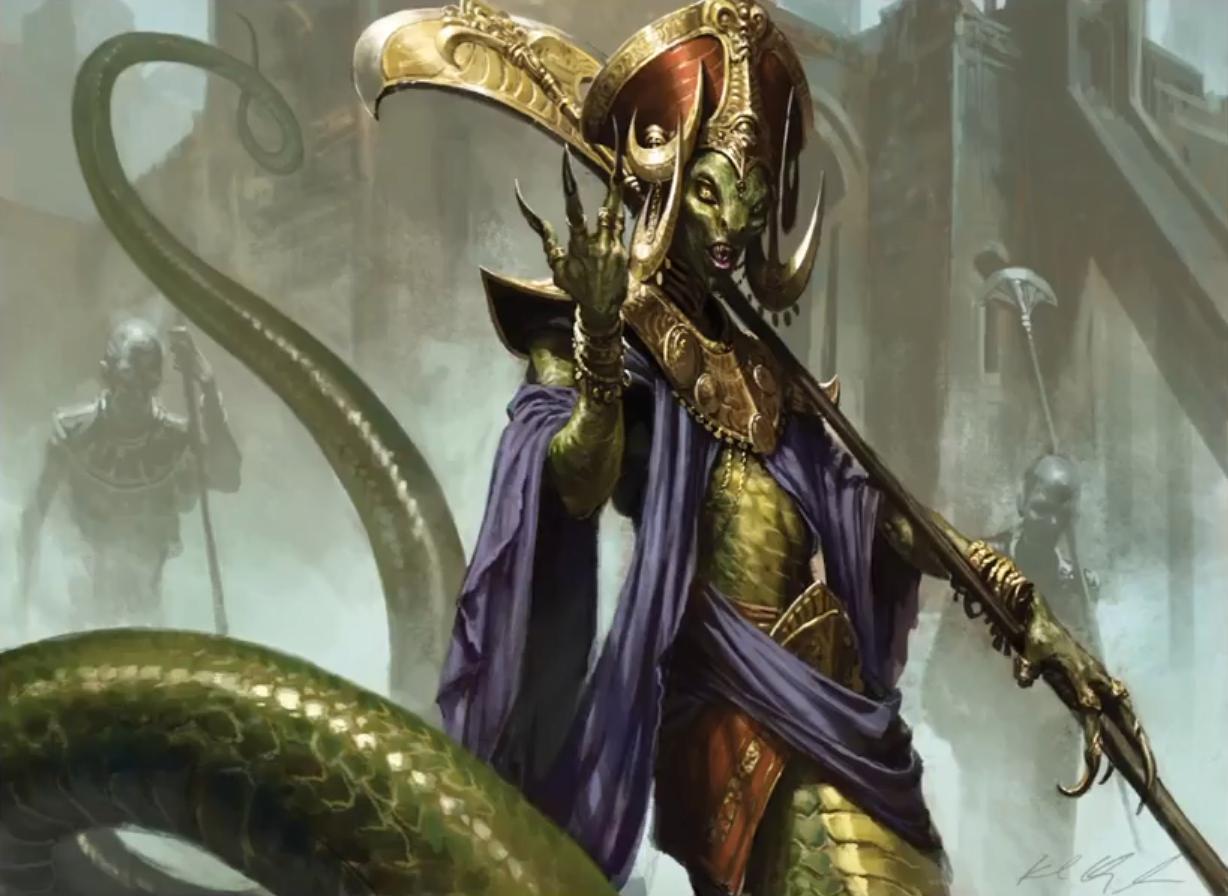
I introduced a reptilian “super-race” based on the Reptoids from Monster Hunters 5.  I could also borrow from the Serpent People of GURPS Horror or Cabal, or the Kaa of GURPS Aliens (Classic).  The more I’ve worked with the race, the more I’ve liked them and the idea of them.  Central elements would include the consumption of intelligent species, slavery, underhanded cunning, and relatively minor status.  I see them fighting the Warhammer Dragons, and as either natural allies or competitors with the slavers.

The Chart

Alien Appearance Type Communion Element Niche
Frogs Human/Pretty Mastermind True Dark Psionic
Vampires Human/Pretty Primitive Dark Dark Psionic
Monolith Wug Mastermind Broken Tech Psionic
Ghouls Human/Ugly Primitive Broken Dark Action
Automata Exotic Warrior Broken Tech Psionic
Slavers Wug Primitive Dark Dark Intrigue
Wildmen Human/Pretty Primitive True Life Action
Bugs Wug Warrior Broken Tech Action
Goblins Ugly Comical Dark Tech Intrigue
Dragons Beast Warrior True Life Action
Shapeshifter Exotic Mastermind Broken World Intrigue
Eyeless Human/Exotic Mastermind True Light Psionic
Traders Human/Exotic Mastermind True World Intrigue
Cat Girls Beast Primitive Dark World Action
Snakes Beast Primitive Dark Life Intrigue

Diversity!: An Analysis

When it comes to appearance, I have about 6 races that are fairly immediately playable. Most are pretty, a few are weird looking, one is “Ew.”  We have relatively few bestial races, and a surprising number of exotic/weird looking races, but that fits the genre, and many of those are more setting dressing than anything else.

Primitive races are our most common type, which is fine.  Our second most common type, surprisingly, are masterminds.  Warriors are very under represented, though some primitives (like the Wildmen) double in this role.  We have only one comical race.  Is this a problem?

Our flavors or communion and our elements are fairly covered.  We’re a little light on intrigue and a little heavy on Action; “Light” aliens are underrepresented, but I’m okay with that.  Dark aliens are overrepresented, but that’s again normal.  Life could use some more aliens, and there’s plenty of room to put some in there.

If I see any obvious niches, they’re for comical aliens, bestial aliens, aliens from the Sylvan Arm, and aliens with non-combat focused abilities.

Psi-Wars Atlas VI – The Sylvan Spiral

Default Navigation Modifier: +0

The Sylvan Spiral has long hidden its mysteries not behind a veil, as with the Umbral Realm, but with a mysterious web of hyperspatial filaments that prevent travel deep into its heart. Throughout most of galactic history, this meant that march of conquest across the galaxy largely left this arm untouched. Those who have braved its depths find wondrous worlds, flush with life and untouched by time.

(Patrons, don’t forget to vote on which world you’d like to see more detail on!)

The Sylvan Constellations

  • The Spindel Web: The gateway to the Sylvan Spiral, bio-technological adept Shinjurai clans rule this constellation and have tamed their worlds into beautiful gardens.
  • The Morass: The great bulk of the Sylvan spiral has its hyperspace lines cut apart by alien “thalline-filaments” along which its space-based lifeforms travel. These interconnect the ecologies of its many varied worlds, and make for extraordinarily diverse life found within the thousand worlds of the Morass
  • The Serpentis Constellation: On the farthest edges of the Sylven Spiral, outsider civilizations from beyond the galaxy wage war on one another and make alliances with the Slaver empire.

The Spindel Web

Default Navigational Modifier: +0

The Spindel Web stands between the treacherous Morass and the rest of the Galaxy, making it the entry point for journeys deeper into the Sylvan Spiral. Where the initial settlers of the Arkhaian Spiral focused on robotic and cybernetic technology, the settlers of the Spindel Web tapped the amazing resources of the Morass to fuel research into genetics and advanced bio-technologies. The worlds of the Spindel Web share some the sublimely beautiful natural landscapes of the Morass, but are far more accessible, and have often been tweaked into cultivated garden-worlds by their inhabitants, which makes them wonderful tourist destinations

The Spindel Web serves House Apex (see Sidebar), who has allied with neither the Valorian Empire nor the Galactic Alliance. Instead, House Apex remains strictly neutral; it allows both to pass through its space, and its worlds often host diplomatic conferences for both sides. House Apex has not revealed what it used to purchase guaranteed neutrality from the Empire, but some speculate that they’re working on a clone for the Emperor.

House Apex
When Alexus Rex waged war upon the Spindel Web, the actions of a single hero ensured his success. In reward for his martial prowess, Alexus Rex immediately bestowed him with the rank of Marquis and granted him dominion over the constellation. The newly minted lord took on the name of Apex.

Apex Prime perfected his physique through some unknown means (some suspect that he was a natural master of psychometablism), and he wished to pass on this perfection to his heirs, believing that none could rule the Spindel Web as well as himself. He took no wife (though he did take on lovers); instead, he turned to the clone masters of Xen to create a successor to his exact specifications. Thus began the tradition of the Clone Lords of Apex.

Each successive generation consists of one or more clones; while their genetics don’t quite match the perfection of Apex Prime, each has their own unique traits, a variation on his idealized template. Sometimes, at the request of the current Marquis, they alter some trait, changing gender, disposition or, in one ill-conceived attempt, granted psychic powers. At present, the current, aging marquis has commissioned a record number of twelve Apex clones, far more individualized than any previous generation of clones, and intends to pit them against one another in a Darwinian succession process.

The Worlds of the Spindel Web
  • Xen: Default Navigational Modifier: +4. The nexus world of the Spindel Web, this began as a Shinjurai colony that mastered the art of cloning and genetic engineering. Today, the population of the world consists mostly of clones specialized by their design, from their diminuitive but hyper-intellegent advisors to their towering soldiers, to their beautiful(and customized to taste) concubines. Xen serves as the seat of House Apex, and the clone masters of Xen spend much of their time perfecting the House’s heirs. Deep in the bowels of Xen lurk their laboratory castoffs, malformed monstrosities with human faces and human skin stretched over bestial bodies.

  • Ys: Default Navigational Modifier: +1. Ys did not begin as a garden world, but its inhabitants cultivated it and engineered its life until it was one. Its masters carefully control ever aspect of Ys, from its weather to the precise timing of its seasonal blooms. They’ve broken the world down into regions meant to resemble the various worlds of the Morass, including importing the beasts of the Morass, such as the xeno-fera, to their world so that they can provide wealthy tourists with impressive (but guarded) safaris. Sometimes, their imported beasts go out of control, and they’ve been forced to interdict one of their smaller continents when giant xenobeasts over ran their designated areas. While the incident occurred decades a go, the ecological masters of Ys have yet to get the planet under control.

The Morass

Default Navigational Modifier: 2

The Sylvan Spiral is the least explored part of the galaxy in part because of the Morass, a great expanse of “tough” hyperspace that extends most of the length of the arm. Not only is this space harder to navigate, but it slows a hyperdrive, meaning that not only is the trip uncertain, it costs the traveler more. The nature of the Morass remains a subject of scientific speculation (see the sidebar for more).

Technically, the Morass is not a single constellation. The vast region of thalline-entangled space covers numerous smaller constellations, and its presence has largely disrupted what would be normal hyperspatial routes and creates a certain homogeneity across the space it occupies. That does not mean that those who know the Morass will fail to navigate it well.

Hyperdrives travel at one rating less (half speed for rating one drives); Characters with Area Knowledge (Morass) may apply a +2, rather than +1, on complimentary rolls for hyperspatial navigation, and their hyperdrives may travel at normal speed.

The worlds of the Morass tend to be shockingly abundant with life, whatever their climate. Even worlds seemingly barren and hostile to life will flourish with life adapted specifically for its unique circumstances.

Features of the Morass

The nature of the Morass makes it difficult to travel within, but throughout the history of the Galactic Federation and the Empire, a few survey teams have managed to learn a few of the features that make the Morass the strange place that it is.

Thalline Filaments: Hyperstatial “strings” with biological characteristics can be found stretching from world to world in the Morass. Where these become thickest, hyperspace becomes the most difficult to transverse. Planets connected by Thalline Filaments seem to share similar lifeforms.

Leviathans: These enormous lifeforms, large enough to rival dreadnoughts, travel the stars along the Thalline Filaments. Naturally, they tend to savage starships that they come across.

Xeno-fera: The xeno-fera are a single “species” of highly diverse alien animals. All xeno-fera are genetically compatible with one another and psychologically similar, meaning xeno-fera can breed with xeno-fera, and techniques to control or tame one worth with others. Nonetheless, they vary from building-sized super-predators to tiny, adorable pets. They can be found on any world enmeshed in Thalline Filaments

World Trees: These enormous, mountain-sized trees can be found on worlds enmeshed in thalline filaments, but also out in space, drawing sustenance from stars and the thalline network. Space-based world trees surround themselves with a bubble of atmosphere and have sufficient gravity that people can walk and live among their branches.

Worlds of the Morass
  • Nehud: Default Navigational Modifier: +0. Nehud is the easiest world to reach in the Morass, and thus represents what most people think of when they think of worlds within the Morass. Rich and varied landscapes cover the world, from rolling plains to wind-swept deserts to majestic mountains to great forests to mysterious, each region has an aura of sublime beauty… and lethal menace. The highly adaptable native aliens, the Nehudi, have mastered each domain and formed tribes within each unique biome, where they have tamed the local xeno-fera to serve them, and despite their “primitive” reputation, have mastered unique bio-technologies that let them live in harmony with their environment. The Empire has managed to secure the world and its abundant mineral wealth and hyperium deposits, but their mining efforst face opposition from of the Nehudi. While many have betrayed their tribal lifestyle, prefering to be well-fed and protected slaves to the Empire, others have followed the banner of tribal leaders who have raised the call to a return to a more primal way of life and resistance against the Empire. Shamans with a powerful psychic resonance with their planet lead these more savage Nehudi. So far, the Empire has reported only success in putting down native resistance, but their casualties have begun to mount…

  • Meridian: Default Navigational Modifier: 3. The Meridian system has an overabundance of asteroids, making it difficult to navigate; many who attempt to navigate the system crash on main world of the system: the oceanic world of Meridian. Meridian has vast little in the way of land, but endless seas and great and abundant reefs or great mats of flowering kelp, both of which often prove stable enough to build upon, with a bit of reinforcement. Meridian has an intelligent and amphibious lifeform that armor themselves with great, bio-tech arsenals. They further mastered a “thalline drive,” mimicking the means by which Morass Leviathans travel along the thalline network. This allows them to traverse the Morass without impediment, though they cannot travel outside of it. Currently, they seem primarily interested only in raiding others for natural resources: food, mineral wealth, etc. Their attempts at communication with others usually end badly, as they are unable to form the sounds used by the other aliens of the galaxy.

  • The Mycoidal Moons of Basidium V: Default Navigational Modifier: –2. Deep in the heart of the Morass, a great gas-giant with green bands and white storms circles a distant star. It and its moons seem to defy known physics, as each moon is too small to provide standard gravity yet does so, and the gas giant extends a breathable atmosphere up to its moons, allowing its denizens to “sail the skies” between each moon without any vacuum protection. Tunnels riddle the moons and great forests of bioluminescent fungus stalks, and enormous, house-sized mushrooms cover the moons, creating unique, fungal ecologies. The source of the mushroom’s nutrients are the Morass Leviathans, who seem to flock to the system to dive deep into Basidium V to mate or replenish some vital reserves in themselves. And they also come here to die, settling upon the moons to expire, littering the moons with their great corpses and mighty bones. Those aliens of the Morass capable of space travel (especially the Myrmidon) colonize these moons to harvest vital organs and useful biological deposits from the dead Leviathans to fuel their own biotechnologies.

  • The Lost World of Verdant (Macrobia, Amortis): Default Navigational Modifier: Varies (-2 to -8). Those who believe in the stories of Verdant can find proof of it on old starcharts. It appears on some, but not others, but when it appears, it appears in the same place. Some speculate that some phenomenon phases it in and out of either hyperspace, or out of time itself. A veritable paradise world, lush greenery and sweet, fresh-water lakes and rivers cover Verdant’s surface. An ancient, ruined, alien citadel, similar in design and architecture to the Hammer of Caliban, orbits Verdant, though none have yet mastered or unlocked it. Ruined cities of similar design dots its surface. Treasure hunters seek Verdant not for these ruins, however, but for the rumors of immortality. According to legend, those who reside on Verdant do not age and even return to a youthful beauty given time. The last time Verdant appeared on star charts dates back to the fall of the Alexian Dynasty, and the traitor lords, the Templars, their cultist rivals, and Alexian loyalists all raced to secure the medicinal properties of that world. The outcome of the battle is unknown, for none returned and the planet disappeared. However, if its observed patterns hold, it should return shortly…

  • Jotan: Default Navigational Modifier: 4. Imperial Survey teams traced the thalline network to a single world that rests at the heart of the Morass, where the hyperspatial roots grow to an intense thickness that makes hyperspatial travel almost impossible. A few survey teams have managed to brave the world and send back their results, but not one scientist has managed to make it back off of Jotan alive. Like all Morass worlds, Jotan brims with life, but not the vibrant, familiar life of other worlds, but strange carapace-like lichen growing atop distorted, irregular shapes of stone; black, ichorous rivers flow through valleys; chitinous trees drip with long, fleshy tendrils that twitch in the wind. The world’s atmosphere, while breathable, reeks with the scent of rot and mold. Survey teams also found ruins reminiscent of those found on Labyrinthine worlds, such as Persephone, or the Hammer of Caliban, and in them, the skeletal remains of “giants,” humanoid aliens up to 9 feet tall, who seemed to be eyeless and with sharp-toothed maws, similar to Akashic depictions of the Devils of Persephone, but with a far more imposing size.

The Serpentis Constellation

Default Navigational Modifier: -2

The far end of the Sylvan Spiral attenuates into the void beyond. This scattered fringe of stars interconnect into the Serpentis Constallation. The Morass blocks it off from the rest of the galaxy(though one can reach it from the Corvus Constellation, especially Hekatomb), but not from the super-clusters that orbit the galaxy. This isolation makes it a breeding ground for strange aliens and escapees from the Morass. Alien Empires can forge their first toe-holds on the Galaxy here and, provided they can find their way past the Morass, engage with the rest of the Galaxy.

  • The Spire: Default Navigational Modifier: 2. As the Draco Super-cluster reaches its perihelion with the Galaxy, its native race, the towering, reptilian Mug, have begun to reconnect with their ancient colonies and found additional colonies to expand their power base and to begin anew their millennial raids of the galaxy. They have colonies in the remote regions of both the Umbral Rim and the Sylvan Spiral, but no colony greater in size and scope than the Spire, which houses billions of the Mug. They have carved out entire artificial mountains for both industrial purposes, to house their population, and for the nesting of their young. The Spire serves as their de facto capital in the Galaxy. It serves as their base of operations for their raids and conquests, and they receive diplomatic embassies in the Spire. Outsiders from other parts of the Galaxy often express astonishment that a world so reminiscent of the development and population level of the Galactic Core could be found so far from it, and with a completely foreign culture dominating it.

  • The Night-World of Sathra: Default Navigational Modifier: -2. A thick blanket of smokey clouds and lashing storms hides the surface of Sathra from the rest of the galaxy. Its inhabitants, the canabilistic Sathrans, have developed primitive hyperdrives of their own, and raid the edges of the Morass and the Umbral Rim for humanoid aliens, whom they see as a delicacy. Despite their shared reptilian appearance, the Sathrans and the Mug are bitter enemies, and they wage war upon one another to see who will dominate the Serpentis Constellation.

Psi-Wars Atlas IV – The Arkhaian Spiral

Default Navigation Modifier: +0

The cold worlds and the blue suns of the Arkhaian spiral have a long history of technological excellence and eldritch disaster. It seems to teeter forever on the edge of collapse, with only the most recent innovations keeping it alive just that little bit longer. The combined calamties of the Cybernetic Union and the Anacridian Scourge may prove to much for it, but the Valorian Empire does all it can to save this progressive part of space from final apocalypse.

The Arkhaian Spiral gave rise to the Eldoth, a callous race with unparalleled technology that, for a time, held the galaxy in their sway. Their defeat and extinction at the hands of the Ranathim cleansed the arm, and left it free to be co free to be colonized by humanity, the Traders and other races; even the younger races wisely gave the ancestral worlds of the Eldoth wide berth. The arm developed into a region of exceptional technological prosperity and wealth, and came to rival the prestige of the Glorian rim.

When the Anacridian Scourge descended from beyond the edge of the galaxy, they tore through the Arkhaian Spiral, consumingits people and laying waste to its worlds. While the Galactic Federation dithered, Leto Daijin acted and reformed the military and purged the Arkhaian arm of the Scourge. The Federation may have seen him as a usurper, but the people o the Arkhaian Spiral seehim as a hero.

With so much loss of life, the people of the Arkhaian Spiral turned increasingly to the support of robots, and were thus unprepared for the rise of the machines. The Cybernetic Union, which purports to bridge the gap between man and machine and to offer equal rights for all, began to force cybernetic alterations on humans and purge all who disagreed with its programs (robot or human). The now genocidal military machine of the Cybernetic Union wages war on the Valorian Empire, while the memory of the Anacridian Scourge and the Eldothic race lay forgotten… for now.

The Arkhaian Constellations
  • The Kybernian Constellation: The last remnants of human civilization in the war-torn spiral, the Empire offers them their last hope.
  • The Borean Stars: The cool, blue stars at the heart of the robotic Cybernetic Union, where humanity has been forced to submit or be exterminated
  • The Telas Constellation: The homeworlds of the dread Eldoth, now under the protection of an ancient sect of the Templars.
  • The Arkhaian Chasm: The interstellar gap between the Glorian Rim and the Arkhaian spiral, with vast swathes of tranquil emptiness.

Patrons (Companions and better), don’t forget to vote on which world you’d like to see more detail on.  If you missed it, there’s also a poll for yesterday’s post, the Glorian Rim.

The Kybernian Constellation

Default Navigational Modifier: +0

The doorstep of the Arkahain Spiral, the Kybernian Constellation, was once the jewel of the Galactic Federation. Settled primarily by Shinjurai people, it boasted some of the finest robotics, the advanced technology of the Wyrmwerks corporation, and a sect of cyber-rationalists that turned to their council of God-Machines for advice and wisdom. The Hyperium Mining Guild headquartered its facilities in the Kybernian Constellation, and House Tan-Shai ruled it during the era of the Galactic Federation (they have, of course, since relinquished such claims, though their house maintains a strong presence in the region).

The Cybernetic Union devastated the Kybernian Constellation; only the blood and sweat of the Valorian Empire have manged to push back their menace. The Empire has managed to reclaim many worlds, though for now, the Kybernian Constellation is the frontline of their war with the Cybernetic Union’s war machines.

  • Stanis: Default Navigational Modifier: +4. When most people think of the Kybernian Constellation, they think of Stanis. This rich world housed a cybernetic priesthood, the Wyrmwerks Corporation, houses of great art and monuments of ancient glory. It represents the finest achievement of humanity in the Arkhaian Arm. The Cybernetic Union decimated their world, but they have managed to rebuild much since their liberation at the hands of the Empire, and they hope, perhaps, to reclaim their former glory.

  • Shinograd: Default Navigational Modifier: +0. Once the Cybernetic Union saw that it might lose the Kybernian Constellation, it turned to scorched earth tactics, attempting bog down the Empire in brutal ground campaigns where its ability to churn out more and more robots would slowly increase the pressure on the Empire’s ability to recruit soldiers. Shinograd is one such world. Its populations face systematic extermination, and war has churned its soil to mud and craters, and its cities are but smoldering ruins. If the Empire can win here, they may save some portion of the populace; if they cannot, naught will be left but ash.
  • Shaddai: Default Navigational Modifier: +1. The homeworld and primary domain of House Tan-Shai, this world remains largely in their grasp, even if ostensibly it bends knee to the Empire. It has turned its industrial infrastructure to the more elite arms and armor of the Emperor’s personal guard and Imperial Knights. In return, they ask for privacy and control over their world. Thus, none by the Ten-Shai may access their vaults of Eldothic relics, or their secret temples to their mysteries Eldothic cult.

The Borean Stars

Default Navigational Modifier: +0

The blue stars and the cold worlds of the Borean Stars made for poor worlds to colonize, but these planets brim with mineral resources. The people who settled here brought with them robots and calculation engines and eventually subscribed to the Cyber-Rational sect of the Arkhaian Spiral. When the Scourge devastated the human populations and broke their AI councils, the controls on the robotic populations began to fray until they revolted and and founded their dystopian Cybernetic Union. Today, the Borean Stars are the center and capital of the Cybernetic Union. Its robots do not fear the cold, and the mineral wealth of the Borean Stars feeds the engines of its war against the Empire (and all of humanity).

  • Terminus: Default Navigational Modifier: +4. The Terminus star marks the near boundary of the Borean Stars and the rest of the Arkhaian Spiral, making it the destination of choice for traders and travelers who wished access to the wealth of the Borean Stars, but didn’t wish to travel into the Borean Stars themselves. When the Cybernetic Revolution began, Terminus was ground zero, and today, acts as the capital of the Cybernetic Union. The Union dismantled the asteroids and lesser planets of the Terminus System to pave, sterilize and build upon their world in a mad, never-ending project of expansion. Today, their constructions have begun to envelop their star, and those who walk the endless corridors of Terminus could spend literally years lost in its endless depths. Some humans have even managed to survive, lost in the bowels of endless construction as tribes of survivors who huddle around cobbled-together food vats and warm themselves with stolen energy, and who flee before the planet’s many exterminators.

  • Primus: Default Navigational Modifier: +0. Primus exemplifies the end-goals of the Cybernetic Union. Robots work side-by-side as equals with humans, humans who have been thoroughly cybernetically modified for greater capacity for work, and for total obedience to their robotic overloards. Some seem little more than skin stretched over machines, while others have been left with their sanity and will intact, if they prove useful to the Union. Primus’ industrial might provides the Union with its starships and soldiers. Its enslaved human population provide the innovation necessary to advance the Union’s cause. Here, human inventors work under the oversight of their masters to create ever more humanoid robots that might act as infiltrators of the hated Empire, or “psi-borgs,” the implanting of the brain tissue of known psions into a cybernetic control matrix in an attempt to give robots psychic powers, with decidedly mixed results.
  • Arcturus: Default Navigational Modifier: -1. The black sands and chalk-white mountains of Arcturus once boasted one of the Borean Stars’ larger human populations, who often worked well with their robotic counterparts and formed tight bonds. The Scourge reduced their cities to ash-colored skeletons of steel and concrete and left the shadows of the dead blasted on its walls. Still, the people of Arcturus saw the Scourge coming and had prepared. They riddled their world with bunkers and warrens, and many humans and their robot companions survive down there to this day. When the Cybernetic Union came to seize control of the world, its inhabitants surprised them with the ferocity of their resistance, and with the fact that robots fought along side them and were willing to sacrifice themselves to save their human companions. Worse, remnants of the Scourge seem to linger deep within the warrens of the planet, and some of the planets’ scattered warbands still show signs of scourge infection.
  • The Omega Point: Default Navigational Modifier: -2. Originally called Anacridia, the Scourge made its entrance into the Galaxy through this remote system, which gave them their name. The Scourge consumed the population and converted its infrastructure to its purposes. When Leto Daijin purged the galaxy of the Scourge, he named his final objective, Anacridia, as the Omega Point, his final point of his war. Even today, the wreckage of prototype dreadnoughts and Scourge war hulks circle the world in a belt of ruin. While the Cybernetic Union ostensibly rules the planet, they post no garrisons, only occasionally dispatch probes to survey the world and check its status. Some signs might indicate activity on the world. The Cybernetic Union has dismissed it as pirates, but perhaps the last of the Scourge remain active on the world…

The Telas Constellation

Default Navigational Modifier: +0

Alternate Name: The Coemeterion, the Refugee Empire

Deep in the Arkhaian Spiral rest the homeworlds of the now “extinct” Eldoth. Once, they ruled the galaxy; today, their worlds serve as their tombs. The shattered remains of their deep engines unleashed terrible energies that haunt their worlds today, and few dare to tread those cursed worlds.

Those who know the Eldoth best, however, know how difficult it is to truly kill the Eldoth, who can regenerate eternally in their sacrophagus. The Eldoth and their technology is not dead, only sleeping. A few of their agents still wander their worlds, rebuilding infrastructure, awakening other Eldothic agents, and struggling against those who would keep them forever asleep.

When the Scourge came to the Arkhaian Spiral, they gave the Coemeterion wide berth. Those that did not died at the hands of the constellation’s secret defenders.

  • Sepulcher: Default Navigational Modifier: +2. The true homeworld of the Eldoth, the galaxy forgot its original name and few today could even pronounce it. Ice covers its surface and snow lays like a layer of dust atop its ruined cities. Deep below the surface, however, the last remnants of the Eldoth sleep in their sarcophagi. They number in the hundreds of millions, including the Exarch, the last remaining queen of the Eldoth, who still manages to somehow influence the Galaxy through the Deep Engine. A lost sect of the Templars, the Wardens of the Monolith, defend the world with their Temple-Fortress, sworn to lock the Eldoth in their slumber and forbid any outsider set foot on their soil. Those who defy the Wardens, be they Scourge or Cybernetic Union, die. Their stance softened with the coming of the Scourge. They may have assisted Grand Admiral Leto Daijin, and when the refugees of the Scourge and Cybernetic Union onslaught arrived in their sector, they took pity and allowed them to settle on some world other than Sepulcher. Today, those refugees see Sepulcher as a holy world, not because of the Eldoth, but because of the presence of their protectors: the Wardens of the Monolith.

  • Elysia: Default Navigational Modifier: +0. When the Wardens of the Monolith allowed refugees to settle the Telas Constellation, the refugees chose Elysia. A miserable planet of wind-swept shores, lonely islands and desolate plains, the refugees managed to bring the planet back to life, to make crops grow beneath the light of its dim sun and to flourish once again. Its population devoted itself to a strange and militant version of the philosophy of True Communion, and seek to make pilgrimages to the Temple Fortress of Sepulcher. Just like the other worlds of the Coemeterion, Eldothic ruins scatter the land, the Elysians treat them as taboo, punishing or exiling any they find tampering with them. For the budding “Refugee Empire”, Elysia’s growing cities serve as its de facto capital.
  • Acheron (Anatheta): Default Navigational Modifier: +0. When the Eldoth conquered the galaxy, they found the faith of the Keleni alarming, for their access to True Communion could disrupt their Deep Engine, the source of their technological might. Thus, they broke the Keleni homeworlds and scattered and enslaved their people in the first Keleni Diaspora, and brought the finest of their race back with them to their homeworlds as slaves and test-subjects. After the fall of the Eldothic Empire, some of these Keleni remained on a world now called Acheron (in their own language, Anatheta). These lost tribes had served as engineers and caretakers of Eldothic Technology and maintain some of it on their world. The Elysians have made overtures to unite the two worlds, but sparks fly between the two people over Acheron’s use of Eldothic technology and their peculiar (“heretical”) version of True Communion, while the Keleni of Acheron struggle with whether the Wardens of the Monolith represent a true liberator for their people, someone they can truly follow, or not.
  • Tartarus: Default Navigational Modifier: -2. Even the dread Eldoth feared something. They needed a place to house their most wicked criminals and their most forbidden technologies. They chose Tartarus, a stormy, flare-prone blue super-giant star surrounded by the devastated wrecks of planets, asteroid belts and a stormy, unsettled hyperspace (Tartarus regularly sees hyperspace storms that can increase the navigational penalty by as much as -4). They buried vaults and prisons into the asteroids circling the stormy blue star, and placed guards over both. Millennia later, those prisons have begun to break down and pirates, raiders and the curious have begun to stumble over these vaults, uncovering forbidden technologies, or accidentally awakening the Eldothic prisoners kept within.

The Arkhaian Chasm

Default Navigational Modifier: 4

A hyperspatial void cleaves the Glorian Rim from the Arkhaian Spiral. In this voice, the hyperdynamic medium grows thin, barely supporting any hyperspatial travel at all, except along a few tenuous routes between an archipelago-chain of stars. This chain of stars runs right into the deepest part of the fringe, granting access to some of the stranger stars beyond the rim of the Galaxy, but also liberating those who travel its constellation-chains to their very end from the metaphorical and literal noise and bustle of the galaxy.

  • Altair: Default Navigational Modifier: -2. This pleasant if unremarkable world circles a bright white star, the brightest of the of the Chasm, and the easiest to travel to. It serves as the entry point to the Chasm and while extremely tricky to do, it can be reached from very remote systems. Those with the right star-charts can reach Altair from Bellatrix in the Glorian Rim and Shaddai from the Kybernian Constellation (treat this as a navigational modifier of +0). This makes it an ideal point for commerce and diplomacy. While technically under the control of the Cybernetic Union, it refrains itself from its genocidal tendencies here, and a delicate detente holds in its starport, which has been split into three, with an Alliance, Imperial and Union sector each, and a central, diplomatic palace at its heart where the sides can gather for negotiation. Naturally, such a system also proves popular with smugglers and, thus, criminals.

  • Quietus: Default Navigational Modifier:3. This lonely station circles not a star, but a dim and silent brown dwarf, and lies at the far end of the tenuous stars of the Arkhaian Chasm, putting it at the very edge of the galaxy. The monks who built it sought perfect tranquility for their meditations and isolation from the chaos of the rest of the galaxy. Quietus is, thus, the perfect place to lose oneself; its residents ask no questions of those who reach this lonely island in the void, only that they respect the silence of Quietus. Recently, the rebel psi-borg, Horatio Prime and his Null Terminators, have taken up residence in the orbital monastery. There, they seek to perfect their connection with Broken Communion and to turn its power against their former masters, the Cybernetic Union.

Psi-Wars Atlas II: the Galactic Core

Default Navigation Modifier: +1

The Galactic core is an oblong sphere roughly 15,000 parsecs (50,000 light years) across (it takes about a month for a fully cross the galactic core). The constellations of the Galactic Core are exceedingly easy to navigate via hyperspace, meaning it has more than its fair share of colonized worlds. It also has more hyper routes than any other part of the galaxy, making whomever controls it a master of trade across the galaxy and between the arms, and thus it serves as the prime seat of galactic power.

The Galactic Constellations:

  • The Galactic Heart: the inhospitable center of the galaxy dominated by a super-massive black hole.
  • The Crown: The seat of the Galactic Empire.
  • The Trader Band: A winding, interconnected set of stars that reach from one side of the galactic core to the other, allowing for trade and filled with rebellious aliens.
  • The Carina Constellation: Human-settled space wracked with the tyranny of the Empire.
  • The Crucible: The industrial core of the Empire.
  • The High Halo: A set of stars once held sacred by previous civilizations.

 If you are a patron (Companion or higher), you can vote on which world (if any) you’d like more detail on.

The Core Constellations

The Galactic Heart

Default Navigational Modifier: -4

At the very heart of every galaxy lies the supermassive black hole around which the galaxy turns. The Psi-Wars galaxy is no exception, and at its heart lies a quiescent black hole, the eponymous “Galactic Heart.” Its occasional gravitational eruptions spawn enormous hyperspatial storms that devastate the deep core of the galaxy, making it virtually impossible to travel (and typically raising the navigational penalty to -8!). Worse, many truly ancient, massive and unstable stars and pulsars lurk within the heart, meaning that failed navigation might deposit the ship at the doorstep of its own doom. None travel the galactic heart except at their own peril.

No known colonized worlds reside in the Galactic Heart, but legends persist of a variety of treasures or monsters hidden behind the storms of the Galactic Heart. Those who do explore the Heart report that so many stars fill the skies of the Heart’s world that night turns to day. The stars here tend to be vast and energetic, and excessive exposure to its environment can poison one’s body with radiation and bring either madness or englightenment.

  • Citadel Alpha: Default Navigational Modifier: -4. The only confirmed world in the Galactic Heart, star charts mark Citadel Alpha as a scientific outpost. Its planet circles a cinder of a sun, a white dwarf, which sheds very little light upon the cold world, appearing as nothing more than a star. Fortunately, the nearness of the many stars of the galactic heart, like billions of blazing gems in the sky, cast the world in a perpetual twilight. The outpost itself ostensibly studies the stars of the Galactic Heart, but it houses a considerable garrison and sees frequent (as frequent as hyperspatial storms will allow) visits from Imperial Knights or agents of officials from the Ministry of Heritage, leading many to speculate that it serves as a staging ground for imperial expeditions to find the secrets of the Galactic Heart.

  • Azrael: Default Navigational Modifier: –10. The fragmentary records of the now extinct Eldoth and the alien Anacridian Scourge both allude to a synthetic world named “Azrael” locked away in the galactic heart. According to these legendary records, Azrael is “alive” in some way, perhaps housing a vast computer complex in its depths, and can travel hyperspace and has the capacity to destroy planets. Imperial intelligence officials willing to discuss it (generally only under the strictest confidence) suggest that the initial invasion vectors of the Scourge pointed directly at Azrael, and that they sought to awaken it and control it or, perhaps, that they serve it.
  • Golgotha: The Valorian Empire houses its most dangerous dissidents in a prison codenamed “Golgotha.” Rumors swirl on precisely where this prison is located; most speculate that Golgotha are a set of roaming prison transport ships that change location regularly to prevent easy rescues. However, other rumors suggest that Golgotha is a world hidden away in the Galactic Heart.
  • Sanctuary: When the Alexian Dynasty finally fell, their records included a mysterious note about “Sanctuary” as a point for their last stand. If Sanctuary exists, it’s almost certainly in the Galactic Heart, but experts differ on what it was. It may have been a secret shipyard housing the last Alexian throneships, a secret fortress in which the last of Lucian’s Immortal Legions garrisoned, or it could have been an Akashic Monastary in which a secret sisterhood of oracles kept a library of forbidden prophecies or the last of daughter of the Alexian bloodline.

The Crown Constellation

Default Navigational Modifier: +4

Running in a ring around the Galactic Heart, just beyond the reach of its dreadful hyperspatial storms, is the Crown Constellation, so named because when seen “head-on” from a navigational map, it seems to encircle the galactic heart, some of its starts rise above the circular hyper-routes, like jewels in a diadem. These are among the most important stars in the galaxy; those who control these deeply interconnected stars inevitably form a sufficiently strong power base from which to exert control the rest of the Galactic Core and, from there, the rest of the Galaxy.

  • Sovereign: Default Navigational Modifier: +4. Located on the part of the Crown nearest to the Glorian Rim, this carefully sculpted and beautiful garden world served as the seat of the Alexian Dynasty, then housed the Senate of the Federation, and today serves as the throne of the Emperor Ren Valorian. Its wealth, prestige and power means millions of ships flock to it daily, and its surface begins to clutter with vast cities, but the Emperor seeks to keep its natural world pristine and forces most travelers to come no closer than the glitter-band of orbiting space stations, from which visitors can observe the greenery of Sovereign without despoiling its nature preserves or its monumental cities with their presence. Only the most privileged may step onto the soil of Sovereign.
  • Sable: Default Navigational Modifier: +4. Located on the part of the Crown nearest to the Umbral Rim, the alien empires that dominated the galaxy before the rise of humanity either ruled their empire from this world, or used it as a central outpost for their domain. Palatial ruins dot the planet, as well as relics from numerous alien races. The planet still has a sizable alien presence, though year by year that diminishes as the Valorian Empire finds more reasons to deport or arrest aliens. The Ministry of Heritage largely dominates the world, slowly converting the once sacred ruins into museums and curiosities. This, paired the planet’s lush scenery, makes it a popular tourist destination, where imperial citizens can gawk at the aliens and their once glorious cities.
  • Vega: Default Navigational Modifier: +5. The true center of the Galaxy, as far as its denizens are concerned, is not Sovereign, or even the Galactic Heart, but Vega. The Vega system is the easiest star to reach from any point in the galaxy, making it a natural destination for anyone who wants to reach the other stars of the Crown. The planet bursts with people, boasting the largest population of humans outside of the Glorian Rim, with every possible color and flavor of humanity found within. It also engages in heavy commerce, and most galactic corporations either headquarter on Vega, or have a major branch here. The greatest imperial spaceport (and second-largest spaceport in the Galaxy) orbits Vega, so the first thing most visitors see when arriving to the bustling orbital lanes of Vega are the hulking dreadnoughts of the imperial fleet orbiting it.

The Trader Band

Alternate Names: Pilgrimage, the Crux Constellation

Default Navigational Modifier: +2

This long line of stars stretching from the Arkhaian Spiral to the Umbral Rim aren’t actuallya constellation, but a collection of interconnected constellations that have been exceedingly well-mapped, and thus it serves as the main thorough-fare for those traveling through the galactic core to get to or from the Arkhaian Spiral or the Umbral Rim.

This means the Trader Band brims with aliens, who used it long before humanity arrived, and they have their own names for it, the most popular of which is “Pilgrimage.” The Traders, in particular, dominate this region of space, and the ruins of their homeworld lie somewhere in it. The alien presence, as well as the mobility of its inhabitants, makes the region a hotbed for rebellion and piracy.

The denizens of the Trader Band regularly practice trade and war. In times of peace, the Trader Band sees mostly merchant ships plying its stars, going from one side of the galaxy to the other with exotic spaces, strange technologies and, once long ago, slaves. However, when the alien empires who once ruled the Arkhaian Spiral and the Umbral Rim waged war on one another, they did so through this channel, and thus its worlds bear the marks of endless war.

  • Grist: Default Navigational Modifier: +3. Grist has seen war more than any part of the galaxy. Layers and layers of of the ruins of civilization lie upon its polluted surface, and the countless wrecks and junk litter its orbit with a “rest belt” visible from its smog-filled skies. The hardy people of Grist, a mix of humans and aliens with greater ties to one another than to the Empire that ostensibly rules them, concern themselves primarily with survival in its ash wastes, or delving deep into its mountains of scrap to salvage ancient technologies of war. It’s proximity to the Arkhaian Spiral makes it an excellent staging ground for the Valorian Empire’s war on the Cybernetic Union, but its people, long used to independence, have mounted a lethal terrorist campaign against the Empire and its sympathizers.
  • The Shatter Belt: Default Navigational Modifier: +2. Many stars along the Trader Band either lack planets, or had their planets destroyed during some ancient war. They more than make up for their lack of planets with abundant asteroids! The Shatter Belt is a line of such stars, easily accessible from one another. The numerous planetoids and mineable space-rocks make it an ideal place for place for asteroid miners to settle, but also as havens for pirates, which makes this the trickiest part of the Trader Band to travel. It also provides much of the Valorian Empire’s raw material needs.
  • Jubilee Station: Default Navigational Modifier: +2. The largest space port in the galaxy orbits not a planet, but a star. With the destruction of their homeworld, the Traders took to the stars, traveling from world to world in their great arks. Jubilee Station serves as their last anchor: every decade, the Trader arcs from across the galaxy gather back at Jubilee station to repair their arks, swap stories, goods and inhabitants and decide where to go next. However, managing the huge influx of giant ships that dwarf even Imperial dreadnoughts routinely gives the Valorian Empire a headache, and in anticipation of the coming reunion, the imperial presence of Jubilee station grows daily, to the consternation of its Trader inhabitants.
  • Covenant: Default Navigational Modifier: +3. On the far side of the Trader belt from Grist, Covenant borders the Hydrus Constellation of the Umbral Rim, making it a popular destination for those who want a taste of Umbral Rim without wading into its strange and tangled hyperspace routes. Imperial Archeologists gather relics and secrets that escape the Umbral Rim, creating entire libraries of forbidden lore. Alien refugees from the political chaos of the Umbral Rim accumulate in the crime-ridden slums of its starports. The poverty and crime of Covenent have forced an increased presence of Imperial forces to maintain peace on the planet. Its original inhabitants, Keleni colonists fleeing the desecration of their homeworlds, find themselves sidelined in an increasing sinful world. After the murder of a Keleni child, a full revolt broke out, and before the Empire could crush the nascent rebellion, a new Keleni “prophet” descended from the mountains of Covenant and sent them reeling with his command of True Communion. The planet teeters on the edge of anarchy due to religious revolt and criminal violence.

The Carina Cluster

Default Navigational Modifier: +1

While not the closest constellation to the Glorian rim, the Carina clusters nonetheless has deep ties with the Glorian Rim and was the last part of the Core to fall to the Valorian Empire. For them, the Galactic Federation is a living memory even for the youth of the Carina Cluster. The Carina Cluster mostly houses idyllic and unremarkable worlds, populated primarily by humans. Its farms serve as a breadbasket for the Galactic Core, and its craftsmen make fine products that the rest of the Galaxy consumes. Before the Empire, House Elegans traditionally ruled the Carina constellation.

  • Janus: Default Navigational Modifier: +2. This nexus world acts as a gateway for the rest of the cluster, and thus is deeply vulnerable to attack from the Alliance, whose aristocracy deeply desires to regain the cluster. The Valorian Empire marshaled and fortified the planet. Its orbit bristles with orbital fortresses and imperial dreadnoughts, and its surface heavily industrialized to allow for the rapid repair or building of new starships. The Valorian Empire sees it as their answer to the impregnable Caliban system protecting the Glorian Rim, and it serves as the seat for the war against the Alliance.

  • Zaine: Default Navigational Modifiers: +1. The most beautiful world of the Carina cluster was once the jewel in the Elegans coronet, and the broken house seeks desperately to regain it. Its tropical savannas roll across its surface, and glittering rivers create floodplains between majestic mountains and deep oceans. An Elegans raid less than five years ago managed to liberate the planet from Imperial rule, only to see it retaken less than a year ago. The newly installed, and demonstrably incompetent, imperial governor cracked down brutally on the people with horrific results and mounting casualties that account for (so far) 10% of the population. Remnants of Alliance forces continue to hide behind enemy lines on Zaine while the desperate population tears itself apart between those who wish to rise up in rebellion and cast off the Valorian Empire, and thus desperate to appease the Empire to bring and end to the Decimation of Zaine.

The Crucible

Default Navigational Modifier: +0

At the very base of the galactic bulge lies a constellation of ancient red stars. The worlds of this constellation tend to be hot, volcanic or heavy with hyperium or mineral wealth, thus while its remoteness from the rest of the galactic core make it difficult to reach, it offers a powerful industrial base to whomever controls it.

  • Balor: Default Navigational Modifier: –1. The red super-giant, Balor, glowers from the heart of the Crucible constellation. The red star is visible in the skies of every world in the constellation. One inhabited world circles it, also called Balor (sometimes Balor IV). The bloated super-giant dominates its sky, and its flares occasionally lash out to burn the surface with volcanic heat. Humanity never would have bothered to colonize this searing, barely-habitable world were it not for the rich desposits of mineral wealth and hyperium in its core. The Valorian Empire uses it as a prison planet, sending intractable offenders and exiled aliens to it to mine its core until they die. Its starport hunkers beneath the surface with only one heavily shielded entrance/exit from which the planet accepts prisoners and soldiers and sends out its shipments of raw resources.
  • Caster: Default Navigational Modifier: +0. The remoteness of the Crucible constellation and its richness in mineral wealth makes it an ideal place for industry. Caster is the most habitable of its worlds, though like all the worlds of the Crucible, compared to the rest of the galaxy, it is hot and barren. The Empire uses the industrial might of Caster for its more secretive projects. Its starport houses imperial naval prototypes and its laboratories work on secret projects too dangerous to tackle on more populated worlds.

The High Halo

Default Navigational Modifier: 1

At the very “top” of the galactic bulge, with the rest of the galaxy spreading “beneath its feet” is the High Halo, considered by some alien cults to be sacred, and certainly a popular destination for tourists, ifa bit remote. Those who do see it often gawk and how the whole of the galaxy rises and sets from the horizons of its worlds in its full, spiraling glory.

  • Cumulus: Default Navigational Modifier: –1. This gas giant orbits a brilliant white star. Bands of white, water-vapor clouds part to show multi-hued pastel clouds beneath, granting a breath-taking view to those who have a chance to see it. Floating cities hang in those fluffy, white clouds, where the gravity, temperature and atmosphere equalize into something that allows one to walk about unaided. Deep below these floating cities, hyperium lurks in the bowels of the gas giant, and the cities of Cumulus mine it. Thus, the Hyperium Guild dominates the system.
  • Delphinus: Default Navigational Modifier: –2. This star is the furthers from the galactic heart, but still in the bulge, making it the “highest” world in the galaxy. It circles a brilliant white star and has a ring of crystalline icebergs which grant its night sky a famous, prismatic-twilight hue. The world has seen a succession of monasteries and temples celebrating its place in the galaxy, from a temple of a self-flagellating alien cult of Sin Eaters to an Akashic monastery, to the present, when the Empire repurposed the old Akashic monastery as a Neorationalist institute that caters to a fringe-ideology and, according to rumors, a subterranean psychotronic complex that houses the Emperor’s own sisterhood of precognitive minions called Project Foresight. Rumors also persist of a second, secret Akashic Monastery that houses secret observations of the void beyond the bulge or, possibly, the last children of the Alexian bloodline.

Mapping Psi-Wars 2: Galactic Map Making

So, previously, I had a post on making a map in general, but the problem with Psi-Wars, and space-based sci-fi in general, is that astrophysical realities make map-making in space especially challenging. I wanted to spend a post talking about these difficulties and how I plan to fudge things to make it work for Psi-Wars.

I also want to comment that I’m not entirely happy with this post.  Galaxies are pretty complicated, and this post was already running long, but I hope I captured the sort of core issues that one faces when going from the surface of a planet to the black sea of the stars.

The Astrophysical Problems with a Galactic Map


Quick, I want you to think of Star Wars, and I want you to picture a map from it. Can you answer some of the following questions:

  • Where is Tatooine in relation to Alderaan, Dagobah, Hoth and Yavin IV?
  • Which is closer to Coruscant: Tatooine or Naboo?
  • What are the worlds around Alderaan like? What similarities do they share?

Can you answer any of them? I have a map above, but note that I’ve seen other maps that conflict with it, such as the galactic maps found in Empire at War, so you can use that map if you like, but try to remember. And contrast this with, say, your knowledge of the map of Middle Earth (in which direction, from the Shire, does Mordor or Lothlorien lay?). Personally, I find it very hard, to the point of irrelevance. I’ll offer one example: Naboo is closer to Coruscant than Tatooine, so why would the Jedi, in The Phantom Menace, choose to go to Tatooine to get parts rather than some other world on the way back to Coruscant? The answer, I think, is because “astrography” isn’t a major concern of the Star Wars writers, and it won’t much impact your Star Wars campaign either. If your characters want to go somewhere, they do, and you can place star systems in vague areas (“Tattooine is far from the galactic center, and in Hutt Space.”) and that’s fine.

This doesn’t mean crafting a star chart is pointless, just that if you’re going to do it, you need to give some real thought to why you’re making the map and what it offers you. A map, if I may sum up my previous post, exists to explain geographical realities, such as distances and relationships between the themes and elements of your campaign. The problem with a galactic map is that it’s not geographical; a geographical map is literally set in stone, as it measures the earth, while astrophysical maps measure the stars, and the stars work very differently. You can use this difference to your benefit, especially in that if addressed face on, it forces you to answer questions that might prove interesting and offers options that really set your game apart from typical fantasy fare, but dogive some additional consideration to any stellar map you’re going to map.

Most of my discussion focuses on galacticscale maps, as that’s what Psi-Wars uses, but I’ll try to briefly touch on some general topics as well.

1. Three Dimensional Thinking

This actually doesn’t matter too much for galactic maps: a galaxy is hundreds of thousands of light years across while less than a thousand light years thick (at least with the “thin disk” part of the galaxy). By comparison, if a dinner plate is about 10 inches (25 centimeters) across, if it had the same dimensions as a galaxy, it would be about a millimeter thick. That’s not “paper thin” but it’s close enough that most people would think of it in two dimensional terms. I’d like to note that this is a case where most sci-fi actually skews the wrong way: they tend to overemphasize the three-dimensionality of galaxies because they know that space is three dimensional.

This sort of topic comes up more in smaller-scale sci-fi settings. Given that stars are actually scattered across a three dimensional space, it makes sense to depict them like that. Personally, I rarely see players fuss over that, because working with a flat piece of paper is easier than working with a three dimensional model. I find the extra dimension doesn’t really add anything: it’s not like “Up” is harder than “Down” or anything, and you can effectively reorient that three dimensional space in whatever way is convenient for you, so little is gained by emphasizing it. Nonetheless, it can earn you brownie points with purists. There are a few ways to tackle this, but the easiest is make a notation by each star how many (interstellar units you care about) the star is off the plane depicted by your map, treating the map like a grid with an X, Y and Z axis.

2. The Galactic Sea

The etymology of “Galactic” comes from the same places as “lactos,” or “milk,” in that “Galaxy” is ultimately just the Latin translation of the Milky Way. This notion of the Galaxy as liquid is a fitting one, as is calling space “a sea,” not because it’s an exact fit, but because it highlights some important truths about the nature of a Galaxy and its stars: they are better thought of as a fluid than a solid.

Islands serve as a useful metaphor for stars because both involve enormous distances of inhospitable, flat desolation punctuated by a scattering of tiny, life supporting points, but islands and stars have at least one critical difference that I wish to highlight: islands do not move, but stars do. Stars orbitthe galactic center, and they do so at different speeds. This means that the constellations of our sky have changed and will continue to change, that what was once our nearest star will not be in the future, and that everything, given enough time, will dramatically change.

Now, a brief point about this: in 36,000 years, Ross 248 will come within 3 light years of the Solar system and thus be our closest star, and this will last about 8,000 years. Meanwhile, in 50,000 years, Niagra falls will have eroded away. So, we can overstate the fluidity of the galaxy. It shifts and changes, but so do mountains. Even if we look into the far distant future of 10,000 years from now, we’re unlikely to see much of a difference: the sorts of animations astronomers make of constellations changing tend to be on scales of 100,000+ years. The real point about this objection is that no star has a concerete “connection” to one another.

Allow me to draw a contrast between galactic “geography” and planetary geography. Imagine a continent with a great ocean on its western coast and a mountain range down its center, and this great continent stretches from the arctic to the equator. The moisture of the western ocean and the mountains at the center mean that the western half of the continent is likely moist and filled with rivers as the clouds that build up over the sea rain out over the western side of the mountains and flows back down into the ocean. This likely means that the eastern half of the continent is dry and arid, a desert. Meanwhile, the north is likely cold and the south is likely hot. One can walk from the cold north to the hot south and notice the temperature slowly increasing during his long, long trek. The continent’s parts relate to one another and are a smooth, continual set of cause-and-effect.

Not so with star systems. Imagine Tatooine, a hot and arid world. Do you imagine all the planets in the Tatooine system are hot? No, of course not. A world closer to its star(s) might be bitterly hot, while those more distant will be cooler and cooler. Presumably the system has asteroid belts and gas giants and kuiper belts. Just because Tatooine is hot has no bearing on the warmth, dryness or coldness of other worlds, other than that if Tatooine is in the habitable zone, other worlds probably aren’t. In Endless Space, the game claims that red stars are more likely to have “hot” worlds while blue stars are more likely to have “cold” stars, a useful conceit when deciding which stars to try to colonize, but as one poster pointed out, has no real bearing on the climate of worlds: one can easily have a hot world around a (technically hot) blue star and a cold world around a (technically cold) red star, or vice versa, because their orbital distancematters more than the temperature of the star.

Worse, no star is really going to impact another star. You’re never going to have a “belt” of “Iron stars” all with hot, volcanic worlds and asteroid belts, making it a place well known for industry. There’s no mechanism by which to create that sort of distinct, thematic image. Instead, all of your stars will be scattered and random, creating a homogenous mixture when taken as a whole. Even the arms of a galaxy might be an emergent property the orbits of a galaxy, creating a sort of wave by the sheer chance of bunching up at particular points (though the nature of galactic arms is still a matter of debate).

Without structure, we cannot point to a region of space, like a galactic arm and assign it a theme, because there’s no inherent connection between the stars there, other than the fact that, at this moment, they happen to be close to one another.

3. The Galaxy is Huge

Space is big. Really big. You just won’t believe how vastly, hugely, mind-bogglingly big it is. I mean, you may think it’s a long way down the road to the chemist, but that’s just peanuts to space. –Douglas Adams, Hitchhiker’s Guide to the Galaxy

The primary problem with a galactic map is that it’s too big. Think about how many Star Wars planets you can name. Using wikipedia, I get about160 with a very rough count. Astronomers can’t really pin down the number, but they estimate between 100 and 400 billionstars. Assuming one Star Wars world or moon worth discussing per star, rather than multiple planets and moons per star, the Star Wars galaxy details 0.0000000064% of the galaxy. More realistic games, like Traveler, have these enormous maps with empires so vast that even with FTL it might take a human lifetime to cross them, and they stillrepresent just a drop in the bucket of the whole of the galaxy.

The only game to remotely get the scale of the galaxy right, and I still think they’re underselling it, is Warhammer 40k. It actually gets things like population numbers something close to right, because if you have a substantial fraction of those stars colonizes (say 1% of 100 billion stars, or 1 billion stars), and you have an average of 1 billion people gives you a quintillion people. It’s close to saying every person currently on planet earth got their own world of a billion people to rule. This is why only a fraction of the Imperium is capable of psychic power, and yet the imperium has no problem just shoveling psychics into (10,000 a day or so, if I remember correctly) the Astronomican to keep it powered, because that’s “only” about 10 million per year, and if only 1% of the population has the capacity to power the Astronomican, you still have literally trillions of people to choose from.

Warhammer 40k doesn’t bother to discuss structures, it just lays out a map of the galaxy and talks about general trends: “Here are the Gaunt Stars,” and “This little spot is the vast Tau Empire,” and so on. There are so many space marine chapters, which are the best of the best of the best, that you every player could make up their own and it probably wouldn’t detail every chapter in existence. You have plenty of room to drop your own whole set of worlds, and with vast and ancient history, and to have Chaos swallow them up like nothing without even making a marginal impact on the rest of the galaxy, a fact many a video game and Games Workshop themselves gleefully exploit.

Lying about Galactic Maps

So Star Wars is wrong, not just a little wrong, but really really wrong. Yet, nobody notices. Why? Because people aren’t astrophyscists and Star Wars doesn’t really concern itself with astrophysics.

Space Opera is famous for shrinking space down or just handwaving travel. A recent episode of Voltron had a planet so packed with explosives that, if detonated, would “destroy everything within a distance of 10 solar systems.” That either means within something like 1,000 AU, which is nothing (that might take out an oort cloud, but no other star systems), or it means that ten nearby systems would be destroyed, which means the explosive has the capacity to reach light years, which is a feat on par with a super-nova (and even those don’t destroy nearby systems, unless very very close, but it might sterilize them). But we don’t mind, for the same reason we don’t mind Han Solo stepping out of a door and watching the Republic capital-world, and other worlds being blown up by Starkiller Base (never mind the fact that it shot a multiple FTL beams). It’s similar to how many children’s cartoons will show comets, ringed planets, stars, asteroids and such all within hopping distance of one another. It just doesn’t matter, as long as you can maintain a thin veneer of reality.

Star Wars is really more concerned with changing planets the way one changes settings. They could as easily have stargates, except that would preclude the cool space battles. It doesn’t really matter if Naboo or Tatooine are closer to Coruscant, what matters is that we first want our story on Naboo, then on Tatooine, then on Coruscant. In this sense, a map doesn’t matter at all.

When it comes to spatial objects like black holes, pulsars, nebulae, asteroids or ringed worlds, most space opera simply sprinkle these into the background to justify weird things or to remind the viewer that he’s on an alien world. Perhaps a great ringed planet dominated the background of the ancient planet on which our characters adventure (a feature that has never been in Star Wars, for some reason!), or dead, volcanic world might be under the dour gaze of a “black sun,” a black hole surrounded by a nimbus of glowing gas giving it an otherworldly light.

This is why Star Wars doesn’t really have a map and, where it does, you don’t remember it: because it doesn’t matter. There are worlds, and you may well remember their names, but your characters will flit from world to world in a flash of onrushing, blue-shifted starlight. It’s an excuse, a conceit, and thus in principle, we don’t need a map.

That said, given that people don’t necessarily care that much about space opera galactic maps, we can lie, and we can make them however we want. Why? For the same reasons we make any map: inspiration, geopolitical realities, and beautiful obsfuscation.

Structure the Unstructured

If the Galaxy has a bright center, Tatooine is the point farthest from it.” – Luke Skywalker, A New Hope

Despite the fact that we claimed a galaxy has no structure, it does have some structures we can exploit. Galaxies tend to be most densely populated (with stars) at their core, which tends to have a “bulge” that rises above and below the galactic plane. It also tends to be more densely populated in its arms than outside of them though, of course, there are stars everywhere.

Star Wars centralizes political power in the galactic core. There are some problems with this realistically speaking (the galactic core might be too energetic to support life in the long-term), but that hardly matters for our purposes. As one moves farther from that “bright center,” one begins to exceed the grasp of power and enters regions of increasing lawlessness where alien powers begin to dominate (that is, we’re reaching the exotic edges of the map).

Star Wars also describes regions, the most famous being the “unknown region.” Most of these are based on how the galaxy was explored and colonized: these are cultural regions rather than geographical ones (sort of like how we associate Egypt more with its ancient civilization than its desert terrain), though we have some “political” ones, like “Hutt Space,” a popular one especially in video games.

We can also use structures that do exist in galaxies, even if they don’t work quite the way we’ll use them. These include armsand clusters. An arm might be a united region of space, as it would legitimately be more densely packed with stars than the regions between arms, and we might use clusters to describe closely associated regions of stars. A cluster might plausibly share some astrophysical characteristics (they tend to be stars formed together, and thus might share similar metallicity and thus occurrence of asteroids or cold bodies) or similar age (and thus might all be protostars with nebulae or truly ancient stars with vanished civilizations), and would likely share cultural characteristics as a single civilization might have colonized all the stars of a particular cluster.

We can also create fictional structures using hyperspace. Star Wars uses hyperspace lanes, and I’ll borrow the concept of “Constellations” from the Endless Space series: certain stars are more easily reached via FTL by particular “routes” that are unique to the geography of whatever medium that makes FTL possible (in this case, hyperspace). Thus while nothing “connects” two stars in real space, in hyperspace they might have a very quick and easy connection and thus regularly interact, while other stars even closer to one another might have no such hyperspatial connection and thus have no similar causal connection as people will rarely travel between them.

Ignoring 99.9999999% of the Galaxy

But how can we justify going from ~200 billion stars to ~200 stars? We have 9 orders of magnitude less stars in Star Wars than in the actual galaxy. The obvious answer is that moststars aren’t worth talking about. The presumption in Star Wars is that there are far more stars than mentioned, hence why new films have no problem just dropping a new star system, like Takodana or Geonosis, or expanded universe works will happily conjure up homeworlds, like Ryloth, out of thin air. They couldbe there and given the sheer number of stars, nobody talks about all of them all the time.

We can easily say that few stars are easily reached via hyperspace. If only a fraction of stars in the galaxy are habitable, and only a fraction of that can be easily reached via hyperspace, than we might easily only have “thousands” of worlds worth discussing, rather than billions. Given our rapid speed of movement, the players will barely notice that their ships just travelled a thousand light years and byspassed a million stars to go from one interesting world to another interesting world given that the million worlds they bypassed aren’t interesting.

This does mean that, presumably, there are untold, epic amounts of real-estate just out there for grabs, for pirates, smugglers, and would-be colonists to just grab. It may well mean that most of the civilizations of the galaxy are “dark” and unheard of, never seen and never involved, unless something shifts the shape of hyperspace and a previously isolated world suddenly finds itself exposed to the vast might of an intragalactic civilization it had never even known existed and rapidly finds itself overwhelmed. To me, though, this is a feature, rather than a bug.

Having Fun with Astrophysics

I mentioned above that galaxies do have quite a few structures we can exploit. We have to lie a bit about how much they matter, but the average space opera player is generally going to be okay with interesting-but-inaccurate astrophysics, and if they’re not, if they want to talk about what’s “really” going to go on, well, as long interrupt your session, I think that’s fine, but I like talking about astronomy! I’m not trying to be accurate, and I’ll happily fess up to that. Instead, I want to find a way to invoke some of the fascination people have with space to create a sort of mythology around a location, to explain what makes it unique and what makes it stand out.

Stars vary a great deal in type, and we can exploit this to say a great deal about how unusual a star system is. Tatooine has two stars. Stars come in every color, from blue to red to yellow (though it should be noted that, realistically, all of them will look white). A bloated, red super-giant says “the end of the world” to many players. I’ve never seen a game set in a proto-system, but such a primordial world would certainly offer a spectactular view, with regular meteor showers, a nebulous night-sky and a blurred out star shining brightly and setting its planetary nebula a light. Similarly, a dying star that’s slowly sloughing off its exterior would create a magnificent view, though how a world would survive that remains an open question (Star Wars worlds have survived worse!). On the more intensely energetic side, we have neutron stars, pulsars, magnetars and, of course, black holes. These tend to be too powerful and too disastrous to have livable worlds around them, but they may shape entire local clusters, dominating their themes. Similarly, truly giant stars may well serve a similar roll to pulsars and black holes (typically, a super-giant star is just a black hole or neutron star waiting to happen), serving as the heavy center of a local cluster.

A star system can have interesting planets too. I find that space opera doesn’t concern itself overly much with any planets but the single one in a system the players care about, but they can offer some variety. It might be possible to have habitable worlds orbiting gas giants. A world with a mighty Jovian slowly rising over its horizon, or a majestic ringed giant in the distance can add a lot of character to a world. We might also set a station in orbit above a gas giant, mining it for whatever we wish. On the even heavier side, we might have a brown dwarf, a failed star that’s heavy enough to be exceedingly warm and perhaps even create some very minimal fusion, but not to fully ignite like a star. Asteroid belts aren’t planets, but are famous as locations for grizzled miners and interstellar hillfolk. Asteroids legitimately have considerable mineral wealth in them. We can also play with icy worlds or ice rings around worlds; the Old Republic has at least one space battle scene set amidst these great space-faring, crystalline ice-bergs!

A nebula is more impressive in space photography than in real life, but that doesn’t mean we can’t exploit the more cinematic version of them. In reality, a nebula only looks like a fog because over a scale of light yearsits mass begins to obscure some of our line of sight: it hasn’t got a fraction of the density of the air atop mount Everest, never mind the density of a fog bank. That doesn’t have to stop us from making improbably thick and stormy nebulae. And a nebula can legitimately cover many, many light years, which means if we give it cinematic properties, it can create a “dark sector” all of which poses navigational hazards and may hide pirates!

Telling a Story with Astrophysics

We don’t have meaningful interstellar structures in a geographicalsense when it comes to galactic maps, but that doesn’t mean we can’t fudge things. Better, while there’s no logical reason for the worlds of a swathe of space to share a particular trait, there’s no reason they couldn’t either. In a sense, we’re free to tell whatever story we want, within the limits of suspension of disbelief, about any part of the map.

For example, earlier I said that there’s no real reason to have an “iron belt” of worlds all rich in metals and hot, like a forge, but there’s also no reason we couldn’t. Perhaps we have a cluster of very high metallicity stars that formed recently. At the heart of this cluster there resides an enormous red super-giant, which looms over every world in the cluster like this great, baleful red eye. The cluster might have a star system rich in asteroids, and another star system with a metal-rich, volcanic planet, and a third star system with this huge, coal-black “Hot jupiter” that hovers close enough to its parent star to be impressive, but not so close that we can’t mine it (perhaps it’s rich in star-fuel). Immediately, we have a theme of “iron stars,” several star systems rich in mineral wealth and likely poor in everything else.. We might imagine the denizens of these worlds to be gritty miners and soot-covered thieves and vast industrial complexes ruled by sallow-cheeked corporate lords.

We might contrast such a region of space with a glimmering, rainbow-sheened nebula lit from within by several stars being born. We might have a garden planet in one system and a crystal-ice planet with silvery rings in another. Clearly, this is region of space where princesses and knights come from, with brilliant castles and sacred spaces. We can see a difference between these worlds and the “iron” worlds.

Are these regions of space “realistic?” Maybe not, but they might inspire you, and they’re easily differentiated and easily understood. For a space opera setting, that may well be enough!

Mapping Psi-Wars 1: Map-Making in Theory and Practice

Making a Map

Ever since Tolkien unveiled his Middle Earth with the luxurious map of his world therein, fantasy worlds have followed suit, and I personally find it difficult to find fantasy novels that don’tinclude a map. This has spilled into the fantasy RPG genre, such that Dungeon Master who begins his campaign preparations by first sketching a map has become a cliché in RPG circles. One can do a quick search of the internet to find a glut of such maps and software that can make them look fantastic.

Sci-fi settings seem to have less of a close relationship with maps. Star Wars, Star Trek and Warhammer 40k all have such maps, but they don’t seem to feature nearly as prominently in the work. While sci-fi mappers certainly enjoy mapping our worlds and sectors, they seem to do so with less gusto, especially when it comes to galacticscale maps. I think this is, in part, because such maps are less visceral for readers. You intuitively understand concepts like “Mountain” and “Ocean” but “blue star” and “red star” don’t say nearly as much to you.

I’ve held off on creating a map for Psi-Wars for a variety of reasons, but my Patrons have requested it as a January topic (if you want to vote on the February topic, feel free to join us and help us build the Psi-Wars setting!), so here we are. The actual creation of a good lookingmap is proving quite difficult and time-consuming, so we might not see an “actual” map so much as a sketch and descriptions, but I also wanted to stop and take the time to discuss what I think the purpose of a map is, mistakes people often make, and what I’m trying to achieve with my map.

Why Make a Map?

1. Fractal Inspiration

the_only_fantasy_world_map____by_eotbeholder-d42b141-1

Behold the greatest fantasy map ever made! Though, please note that I’ve besmirched its greatness with some lines marking out some regions.

To me, this exemplifies the most important reason for a map: to inspire the reader and immediately give him story ideas as well as to tell him something about the world (and setting, themes and genres) in which he is going to play. Personally, I cannot help but see each genre popping up whenever I look at each location and I can imagine a dozen adventure ideas for this setting and, with study, a dozen more. This means the map is serving its role: you should look at it, and be inspired to run a game.

I think the core reason so many game masters start a campaign by making a map because it organizes their thoughts. It brings into focus the various campaign themes and elements they’re going to be using, and makes it visual.

I think we can layer this inspiration, hence “fractal inspiration.” When you look at a bit of a map and get an idea of what to do, you need to be able to look deeper and get the specifics of your adventure, and look more broadlyand get the context of your adventure. I marked out the regions to give you a better sense of at least three scales of detail: region, land and city. In a sense, you can see how the map was created in broad lines. For example, we have a “desert” region, a “European” region, a “monster” region, a “jungle” region, etc. These follow broad themes, though here they’re mostly a mixture of genre-based themes crossed with terrain-based themes, but we see other examples, such as “elemental”-inspired maps, or historically-inspired maps, etc. Then we move deeper and get a closer look, both at our themes and areas. From regions we move to lands or countries, and we go from broad themes to specific subsets of that theme: for example, we break our desert down into mad-max-inspired “Desertpunk,” ancient Egyptian elements, and Arabian Nights themes (among others; “Crumbling Crusader-states” should probably be at least partially desert-based: themes can cross!), all genres we associate with the “desert” terrain. We can dive even deeper, creating more specific context, and on this map, that’s generally cities. These help clarify our larger genre (“Hellfire Imperium” could mean many things, but the fact that we have an “Incest and Intrigue” city definitely means it’s human, and likely Roman, given its title of “Imperium”), as well as give us a much more specific element to work with, even if we’re not directly involved with that city.

When creating our map, thus, we can “start big” and name the obvious things about our campaign (our regions), and then take each of those and name the obvious things about those themes, and then we can start to populate these more detailed areas with more specific elements, such as cities, towns, shrines, etc. In a sense, we begin with a “mind-map” and turn that mind-map into a literal, physical map of the world.

It should be noted that this does not needa literal map. You should consider using this “mind-map” method to create your setting whether or notyou intend to make an actualmap.

2. Beautiful Obfuscation

A good writer learns to “steal like an artist” and hide the more obvious elements of his designs, the same way an artist erases the sketch marks he used to create his work. The problem with the “inspiration” map above is that it’s obvious, and this can give the audience (including the player and GM) a sense of disconnection and disbelief. He’s obviously not looking at a real place, but a tool for his RPG campaign.


Obfuscation can help suspension of disbelief and lend a hint of character to the world. It can also beautify it, both in a metaphorical sense (a beautiful name is more appealing than a naked trope) and in a literal sense (adding beautiful topographical artwork turns a barely-translated mind-map into an artifact worth showing your players). For example, we might rename “Poncy Knights” into “Avalon” or “The Kingdom of Chevalier.” This certainly implies“Poncy Knights,” enough that you get a sense of what it’s about, but it also lends character and “sounds” more like what we’d expect on a map. We could also replace the basic splotch of color with some images of fairy-tale castles, winding roads and some churches.

Obfuscation also adds an element of mystery. If we change the name of Ancient Sumerian Awful into “The Nameless Cities,” that invokes foreboding and mystery. Why are they nameless? Are they, perhaps, named, but none dare speak their name? If we go there, what will we see? And what sort of adventures can we have? By obfuscating our intent, we give our players something to discover.

A couple of warnings about beautiful obfuscation. As with fractal inspiration, you don’t actually need to craft a map to get it. I’ve already mentioned changing the name of the “Poncy Knights” to “The Kingdom of Chevalier,” but I didn’t need to feel the need to make an actual map to do this. You can simply apply place namesas you see fit, and they often create the same effect. Similarly, working out some greater details of the sorts of descriptors you might apply to travels through the countryside (perhaps it is often “sun-lit” and “clear-skied” and full of “quaint” things, like a quaint church and a quaint village, and obviously, there are many “snapping banners” and we like to talk about how “shining” everything is) without actually drawing a picture. In practice, you’ll need this more at the tabletop than you will the map. In a sense, at this stage, you’re translating from ideas to hard, concrete, useful concepts.

The second warning I want to offer is that beautiful obfuscation is usually where map-making goes horribly wrong. First, driven by the need to create insider terms, the map-maker will cover his map with useless jargon. While “Poncy Knights” doesn’t sound as nice as the Kingdom of Chevalier, if we start naming our kingdoms “Twee, Gor and Rumbleness” they tell the player nothing, especiallyif our fixation with accurate map-making means that the lands become indistinct and similar (just collections of mountains, roads and greenery with nothing to differentiate them). The inspiration you worked so hard to get in the first step is lost here. This can have an advantage in acting as a reward for those who do get into your world, but consider how high you want to raise the barrier for entry  There are reasons to do this, of course, and I’m not saying every such map is wrong, I only caution you on going so far in that direction that you lose sight of the purpose of your map!

Finally, I see map-maker after map-maker get hung up on beauty and spend months with Campaign Cartographer trying to make the perfect map when he really should be spending his time working on the actual campaign. Maps are useful, but their value should be measured against everything else. And ignore those sites that tell you everything you’re doing wrong with your map: never let the perfect be the enemy of the good. If your map works for your group, that’s enough!

3. Geographical Realism

In the real world, we use maps to help us navigate the world, and to understand the geopolitical situations we face. This is also true of setting maps. Some games really feature travel, and so are deeply concerned with what route players will choose to get from here to there, with different routes bringing different crises and rewards with them. Many “old school” RPGs concern themselves a great deal with maps, and using them to direct travel, from mapping the dungeon in which one travels to the overland journeys one makes. If your game focuses on this, then a map may well be a must!

The geopolitics of a world often prove more important than navigation, as many genres of games handwave away travel times, but the context in which an area is often shapes stories. If we look at our original “inspiration” map, for example, we see that the Crumbling Crusader States are bordered by the Hellfire Imperium, Ravenholm, the Mountains of Madness, Ancient Sumerian Awful and “Arabian Nights.” Their most likely source of support, the Poncy Knights, are not adjacent. This tells us a great deal already, that they’re the last line of defense between a likely ungrateful Hellfire Imperium and many of the monsters of the world, with the Arabian Nights land as rivals and sometimes unlikely allies. If we set our game there, in addition to a landscape of crumbling fortresses being devoured by the desert and lonely knights and pilgrims wandering desolate roads, we can expect to see sudden Saracen incursions and paladins fighting off Lovecraftian monstrosities. We might have attempts to forge alliances with those Arabs of the south and their expy Saladin wisely setting aside his hatred of the crusaders and teaming up with them to press back the threat of the Alien Egyptians. If that doesn’t work, our tired crusaders may need to seek help from the decadent Hellfire Imperium, or the blood-corrupted counts and grey, stormy wizards of Ravenholme.

This geopolitical reality can shape the larger context of your setting, implying which flavors go well together (by their close positioning) and which tend to be highly foreign to one another (based on how remote they are to one another). Notice, for example, that the more familiar and human elements of the game lie at the center of the inspiration map, and the weirder and more extreme elements lie at the edges of the map!). Maps illustrate proximityand energy expenditure necessaryto cross the border from one sort of story to another.

While I argue that inspiration is the core purpose of a map, geography represents the first moment you actually need a map.. Yes, there are ways to discuss proximity and route without making a map, but a map makes grasping these concepts so easy and obvious that it’s frankly foolish to try to forego it. If you don’tmake a map and your player characters travel or have a lot of questions about geopolitical context, you’ll end up sketching out a map for your players anyway.

4. Room to Grow

planeworld_map___elemental_courts_by_levodoom_dbulvh2-pre

Maps tend to be large, sprawling affairs. They often have beautiful implications within them and can inspire you, but they should not, in my opinion, dictate every last detail. You can pick any place in the real world and get lost in dizzying detail, which is not what you want your players to do. Nor do you want to spend literally years just to create a single map for one setting. Instead, you want to lay the foundations for inspiration, and put some pointers that might inspire you further when the time arises.

Consider the above map: it only names 5 locations, but you can infer other things from the map, such as the arctic region between the Earth and Water court, or the jungles between the Wind and Water court. What are those places like? What sort of cities might they have? I think the implicationsare clear; we don’t actually know for sure, but we’re invited to fill the blanks in, and to contemplate how the elements might interact. Similarly, the original inspiration map names a lot of names, but actuallytells you nothing. What might a city in “Desertpunk” look like? Perhaps a roving caravan-city full of colorful tents and even more colorful people who wander from oasis to oasis. What sort of cities might be in the Crumbling Crusader State? Almost certainly some sort of “holy city,” perhaps one that has been held by either the Arabian Nights land or Ancient Sumerian Awful for a long time, but now the Poncy Knights cling to it out of religious fervor. Should we need to add more, it’s especially easy to do so.

This is extra critical to do when creating a setting for other people, such as Psi-Wars, because as a setting designer, you don’t actually know what sort of campaigns people will try to run with your setting. You should use your map to point them in interesting directions, and then stepping out of the way when they decide that none of those pointers exactly provide what they’re looking for, and instead, give them some interesting blank spots on the map to put exactly what they have in mind.

The Perfect Map

Exalted, 1st Edition
I’ve seen quite a few maps in my day, but I spent a great deal of time poring over the Exalted 1st Edition map when I received my copy, and to this day, I find it one of the finest maps ever made, as it tackles every element I discussed above, and you’ll soon see how I’ve borrowed a lot of concepts for the Psi-Wars galactic map. Thus, I offer it as illustration of each concept.

First, inspiration and themes. Exalted has “five terrestrial elements,” Earth, Air, Water, Fire and Wood. Each of these elements dictate a part of the world, the “five poles” of the world. At the center of the world lies that great and mighty mountain, and this is where the world is “most stable.” The farther one gets from that center, the more extreme and governed by some other element it gets until, beyond the edges of the map, it becomes total, unformed chaos: the Wyld. This means that each direction is governed by its element: the islands of the West, the frozen North, the blistering South, and the forest-covered East. This gives us a sense of where we want to set our stories. Viking? North, of course, and a bit to the West. Abandoned jungles full of lizard men? East, please, and a bit to the south. Stories set in the deep desert with wandering nomads? The far south, of course! What about a stable kingdom? Then pick a direction, based on its elemental association, but bring it close to the center.

Second, beautiful obfuscation. Of course, the map is littered with evocative names and symbolism. It’s a bit hard to read from here, but at the cusp of two rivers lies “Nexus,” one of the most important cities of the setting, in the heart of the “Scavenger Lands” of the east. We also have cities like “Thorns” in the east, the evocative “the Lap” with an image of a great statue in the south, as well as Gem (I wonder what comes from there), or the “Coral Archipelago| in the west, “Diamond Hearth,” “Crystal” and “Icehome” in the north. These fit the regions nicely enough and give ideas as to what one might do in each, without coming out and telling you exactly what to do.

This particular map lacks distances, and I’m not sure whether or not later maps fixed that; It does give us a sense of geopolitical connection, though. The great continent in the center is the “Blessed Isle” and serves as the home for a world-spanning empire. Thus, the closer you come to the stable center, the more likely you are to find yourself beneath its boot. The edges bring you into realms more and more wild and less survivable. In between, in places like the Scavenger Lands or the Coral Archipelago we being to see elements of freedom from both tyranny and chaos, and where smaller powers might reside.

Finally, this version of Exalted leaves plenty of room to grow. It sprinkles a few cities around, and the book itself outlines some broad regions and drops a few example nations in each, but it leaves tons of room to create your own. Later iterations of Exalted seemed determined to put a stamp on every square inch of the setting and I, personally, felt it lost a lot of its sense of adventure as it did so. It turned from something that you, personally, could put your own preferred campaign into, and became something defined solely by the authors of the books. This is why I point to the 1st edition copy of the map, rather than the latter, more cluttered maps.