Wiki Update: the (Remaining) Cults of the Divine Masks

This year, we work on the Arkhaian, so naturally my first major wiki update is about the Umbral Rim. It just keeps drawing me in! This will be an ongoing issue, because the old parts of the setting linger on my mind, unfinished bits inspired by other parts I’m working on. In particular, I sat down over Christmas break to wind up an important part of the Umbral Rim that I didn’t want to leave lying about. My ambition proved greater than the speed of my keyboard, but I did finish something.

To briefly sum up, the following pages have been updated or added to the Psi-Wars Wiki:

Seeing that altogether, it does seem ambitious that I had hoped to do more. And, in fact, I actually have some unpublished material, so I’ve been productive.

Now, for a more detailed discussion and design notes, see you after the jump!

Continue reading “Wiki Update: the (Remaining) Cults of the Divine Masks”

The Curse of the Slavers

So we have a broader idea of how Slavers might manipulate people, and how they might fight in ways unique to themselves, and we’ve created some variety, so we can differentiate some of our villainous Slavers from one another. We might have a Slavery Bounty Hunter, or a Slaver Gladiator, or a Slaver merchant. But in Psi-Wars, if you want a truly badass villain, you need to dip into the pool of kewl powerz. Ranathim have their force sword forms, their various Dark Communion cults, and their psychic vampirism. Krokuta have their drug powers. I think if we gave Slavers a similar set of unique abilities, or at least some thought into what sort of powers they might have, we can go a long way to making them more interesting and varied as villains.

Continue reading “The Curse of the Slavers”

On the Villainy of the Slavers

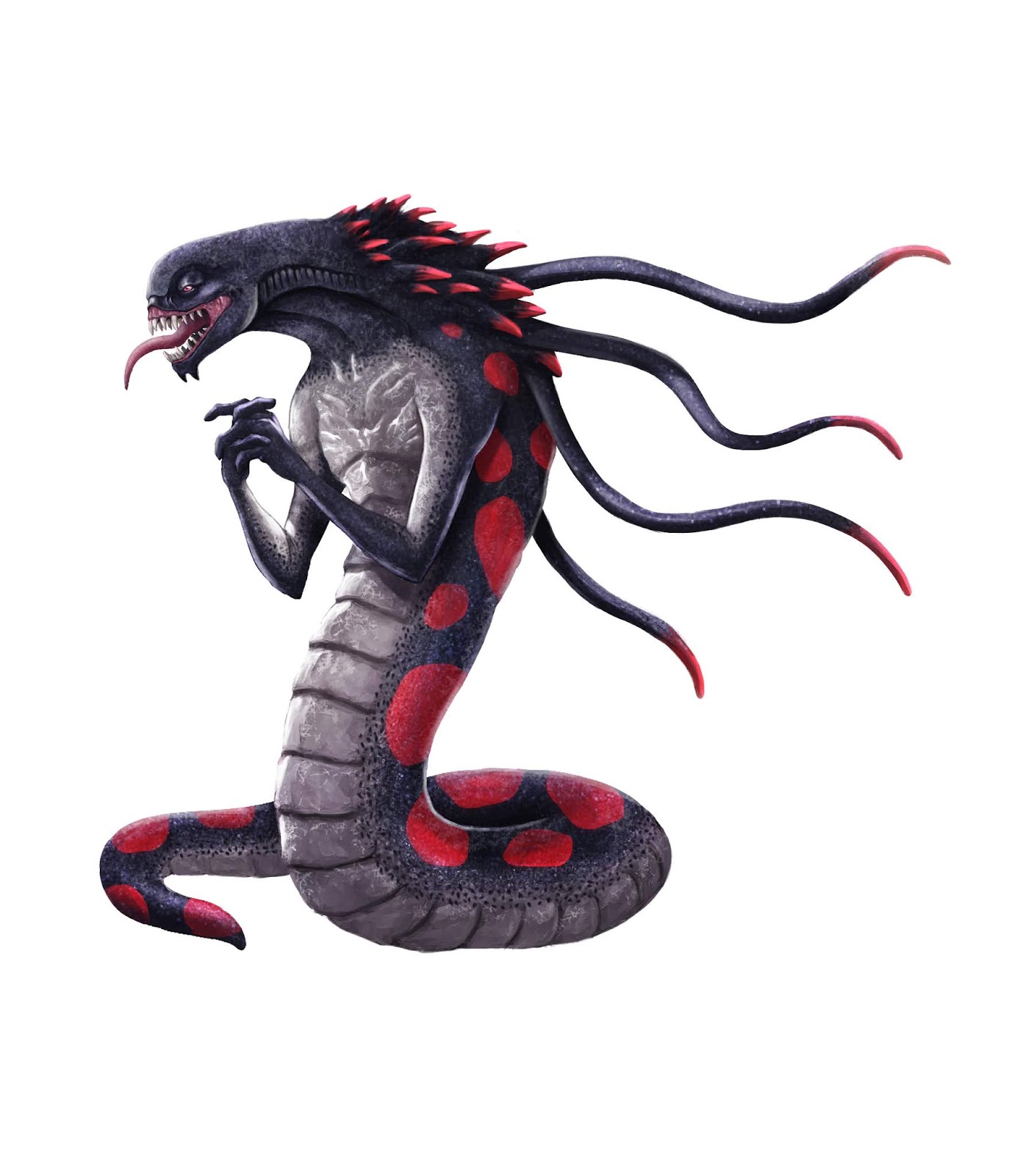
The closest I’ve come to statting up an “evil race” in Psi-Wars are the Slavers, aka the Temkorathim, of the Umbral Rim. Of course, I try to maintain careful moral neutrality when designing a setting, because I never know how a particular GM will want to use a particular setting element and I don’t want to predetermine too much of how their campaign will work, but certain features of the Slavers make them difficult as a PC race. First, they are exceptionally unusual physiologically and psychologically, which makes it difficult to outline how a player might handle one. Second, I designed them to be as repulsive as possible. One of the design goals of the Umbral Rim was to have it feature a nasty alien who would clutch at the screaming damsel while the square-jawed space-opera hero would square often against the hideous monster, so their purpose in the setting is to be that monster. So while I try to maintain that neutrality, I generally write their material with an aim of “How can I help GMs use these guys as nasty baddies in their game” rather than “How can I make this more fun for PCs.”

I’ve seen a lot of people call them “the Psi-Wars Hutt” and that’s absolutely true. Hutts are fantastic, and Jabba with Leia at his feet is legendary for a reason; it’s not just that Carrie Fisher looked amazing in a chainmail bikini, it’s the contrast between her and a disgusting monster. I absolutely wanted that, combined with the Slavers of Rifts, who have a similar vibe (and are often contrasted with the pretty girl for a similar reason). They are definitely the “ugly bastard” of the Psi-Wars setting. But I have a problem with Hutts in that they don’t make a lot of physiological sense, and it’s hard to imagine them as anything other than weird worm things sitting on palanquins. This is because they got their inspiration from the God Emperor of Dune (Yet another example of a disgusting worm monster whose desire for The Girl triggered the handsome hero to lash out and defeat the monster, except that God King was something of a deconstruction of that trope), but Leto Atreides was a one-off creature, not intended as an alien species, so I wanted a different physiology for Slavers that made them work better in a variety of roles, and I feel like I succeeded at that.

But I find when actually running Psi-Wars, as in the Wanderers of Dhim, I don’t actually use them that much in the game as big bads. They certainly exist, but they tend to lurk in the background, menacing from a distance. To be fair, the “Big bads” of Dhim tend to be monsters or massive scale “Forces of nature” events, such as a full invasion, or swarms of temkor worms, or a giant matra ogre assault. But as I move towards more personal antagonists, I notice I reach for Ranathim and Krokuta a lot. Ranathim, of course, are beautiful, tragic, romantic characters who make for awesome love interests and direct opposition. They want to drain your love interest’s energy; they’re prettier than you, they’re ruled by passions, they have a wide array of cool martial arts or intriguing psychic powers. It makes sense for them to face in you in direct combat, while also manipulating things from behind the scenes. Krokuta are, alas, dumber, but they’re meant as my equivalent to Space Orcs. Their unique relationship with drugs means I have a bunch of interesting variations I can use right out of the gate (some of which can make them a more cunning villain), and with the release of their martial art, I have a real sense of what makes them terrifying. They have a cool, if brutish, aesthetic, that I can use.

While I’m trying to make pretty heavy use of Slavers on Dhim (in a lots of ways, the story turns on the struggle between the Ranthim and the Slavers over who will ultimately control Dhim and its destiny), I find I don’t often use them as villains, or I struggle with how I would introduce a very personal villain. What makes Slavers like Golgo or the Great Kuvu or Sanatai the Poisonous unique and particularly threatening? I find they tend to hang out in the background and I drop hints of their involvement, but there’s little in the sense of dread or awe in actually facing one. This isn’t necessarily a problem: Ming the Merciless is probably the archetype for the wicked Space Opera bad guy, and he usually sends someone else to fight the hero and then flees when the hero kicks their butt. A Slaver can be the same, that’s fine. But even so, I’ve found myself pondering the specifics of how a Slaver villain would work, and what specifically makes them interesting as villains. I thought I’d get some of this written out somewhere, and where better than my own blog?

This post will focus more on the mental and social aspects of Slaver villainy. Their physicality probably needs its own post. Slavers seem an especially manipulative sort of villain, and that’s what I want to focus on today.

Continue reading “On the Villainy of the Slavers”

Wiki Update: Lithian Culture and the Thuluvida Deck

Well, it’s out. I’ve been quiet because I’ve been finishing off the monstrously large Lithian culture document. It’s so big I had to break it into three parts. You can check it out here.

I also have a special treat for Backers. All Fellow Travellers ($3+) backers can pick up their Thuluvida decks on their respective backer site. This consists of rules for running Thuluvida, Lithian rune-casting, as a form of fortune telling, or as a gambling game played in Lithian cafes and temples, or perhaps both at once! It comes with two variant decks, in case you want to use it in your games.

It’s my intention to release some designer notes on the Lithian culture document, but that might have to wait. In the meantime, enjoy the wiki article and the decks!

Backer Update: Khedu the Hunter Released!

A couple of months ago, I issued a poll for the “Fifth Slaver Cartel.” Last month I released the poll results. Today, I release the actual cartel.

Khedu was interesting, especially given how aggressively social he turned out to be. He has a (dishonest) philosophy of “Slavery Apologetics” that I worked out in some detail, but I didn’t bother to include it because I’m not sure how much detail you actually need on “Khedu brainwashes his slaves using vile techniques.” But if there’s interest, I can put some additional detail in it. Khedu also uses really sweet custom power-armor. I didn’t bother to stat up that armor, or Khedu himself, because none of the other slavers got such an extensive write-up, but as I write out more bounty hunters, I might give him a full write-up too.

I had originally intended 5 underlings, but I ran out of steam at three. I’m not really excited by the idea of a slaver privateer, not enough to give him a full write up (plus I feel like that would really ask for some details on a ship), and I’m struggling with creating a slave-catcher bounty hunter underling that is sufficiently distinct from Khedu himself. So I stuck with the standard three, which does tend to push things in a more courtly direction, but still, I think you’ll like it.

The astute may notice a reference and some lenses for a “Liaison Theory” and “Shinjurai Companions.” What’s that? Well, stay tuned, dear backer! It’s a preview for the next backer post!

Finally, I’ve written up a small change for Hordokai, replacing Krull, the Warlord of Dhim, with Grimluk, the Black Krokuta, who has a more “Uruk-Hai” feel that I originally wanted from Hordokai, but evidently forgot.

All of this has been codified into a single work, the Book of Hunger, which includes all nine Slaver Cartels. It’s available to all $3+ backers.

Wiki Highlight: Slaver Cartels

 I’ve been hard at work on the Umbral Rim and the organizations, technology and monsters native there. I’ve finally worked out detail on the Slaver Empire and the sort of organizations the Slavers, aka the Temkorathim, naturally form, which I call “Slaver Cartels.”  I’ve described them in detail on the wiki.

For Backers, I’ve offered up additional details for four sample Cartels, the ones described in the wiki entry itself.  I may eventually release these to the wiki as well, but I feel like the wiki has enough of an information overload and I’m not sure how necessary this level of detail is. But in any case, as a thank you to all $3+ Backers (Fellow Travelers) I have uploaded the Book of Hunger

The Lithian Aristocracy

Slaver;
Drawn by Kriz Villacis, owned by Daniel Dover

The winner for the “Template of the Month” turned out to be the Aristocratic background lens, which came as no real surprise.  I had hoped to also get a template done, but that looks to not be in the cards, as working out aristocratic elements took up a lot of time. I did a later snap poll for which aristocracies people wanted to see worked out, and the Shinjurai royalty won, but “Ranathim Aristocrats” did better than I expected.

Everything even touching the Umbral Rim needs special attention to emphasize how foreign and unique it is, while still retaining a measure of cohesiveness.  In many ways, the Umbral Rim is the “dark mirror” of the Glorian Rim, so just as the Maradonian Houses have a great deal of detail, so too do the nobles of the Umbral Rim need some additional detail and cultural context, especially when it comes to their titles, given the shared “Lithian” language between the inhabitants of that part of the galaxy.

This is the first part of a two part series.  Today, we look at the state of “aristocracy” withing the Umbral Rim today, dominated as it is by warlords, potentates, slavers and criminal cartels.  This mostly looks at titles and how they tend to get used.  Tomorrow, we’ll dive into explicit Ranathim aristocrats who have lineages that date back to the Ranathim Tyranny and how they have maintained their power over the intervening centuries since their empire fell.

Lithian Aristocracy

In contrast to the well-defined titles of the Glorian Rim, the Umbral Rim has an anarchic collection of systems, honors and titles. The most common and well-used system are Lithian titles, from the bygone era of the Ranathim Tyranny, when their mystical tyrants entrenched certain offices and honors into the culture of the Umbral Rim. Back then, the Tyrant could give someone a title and the populace respected and honored that title. Today, these titles are mostly empty words.

No “fixed” aristocracy exists within the Umbral Rim. With a few highly notable exceptions, no ancient lineages trail back to the bygone days of the Ranathim Tyranny with their ancestral titles. Instead, minor potentates and warlords rule a single world or a handful of star systems and take on an ancient title to bolster their legitimacy. These titles matter less than the actual power of the man wearing the title. Nonetheless, those who claim and keepespecially prestigious titles tend to impress the populace around them and thus gain additional ascribed(rather than imputedstatus).

The notable exception are the Mithanna, or the Peerage. In the ancestral days of Ozamanthim, he gathered about him a few powerful families, or Mithna (“Peers” or a “House”) and bound them into his service with Dark Communion oaths. These demanded the fealty of the Mithna, but offered in return real power in both a physical and metaphysical sense. Those who violated their oaths found their riches and favors vanish as Dark Communion punished them, but those that kept their oaths flourished. These oaths and their power passed from generation to generation, and the Mithannaremain remarkably powerful and influential to this day. They are the closest the Ranathim have to a true aristocracy, but they retain their position not due to a respect for tradition, but because their oaths have given their ancestors and themselves considerable wealth and power, thus cementing their rulership over the worlds around them.

Lithian Titles

In the Umbral Rim, anyone can claim a title. If they can convince enough people to use the title, then it sticks and the rest of high society begins to refer to them by this title. In a few cases, especially on the recently liberated world of Sarai, a powerful ruler will bestow titles upon especially useful servants and require all their subjects to honor the title. As with all aristocratic titles, these titles are Courtesy Titles [1]with no real weight, but offer a +1 reaction modifier to anyone impressed by titles, and the opportunity to purchase additional Ascribedstatus. In the case of Lithian titles, to claim the title, the character must purchasea minimum ascribed status and may purchase a maximum ascribed status; use the beststatus of all listed titles.

Lithian titles precede the character’s name (when used thus, the first name is usually dropped), or can be used in place of the character’s name; eg “Presenting Thamet Metria”.

Minor Titles

Ganjithim
President, Financier, Merchant Prince

Ascribed Status:+0 to +2

This is a relatively new title, borrowed from a term meaning the heads of prestigious financial institutions, trading institutions. Modern members of the Lithian culture use the to refer to the heads of powerful corporations or Trader Guildfleets, and non-Ranathim often take it upon themselves when they rule a world or region of space primarily through economic means (or want to be seen as ruling through economic, rather than military, means). Slavers often take on this title.

Khaturim
Officer, Warlord

Ascribed Status:+0 to +2

The original tyranny gave this title to high-ranking military officers, and it remains a popular martial title. Powerful rulers might bestow the title onto their highest ranking knights or to their generals, while petty warlords or potentates often take it onto themselves.

Satemo

Knight or Ronin.

Ascribed Status:+0 to +1

A “Satemo” is any fighting man highly skilled in the force sword. This title is often given to elite bodyguards or agents. Ascribed statusdepends on who they serve. If they serve a reputable lord (of the Thametrank) this will be noted in their title.

Shefet or Shefem
Courtier, handmaiden

Ascribed Status:+0 to +1

Originally, this term referred to the ceremonial courtierswho performed a highly specific role in the ceremonial pageantry of the Cult of the Mystical Tyrant. Today, the title is generally bestowed upon especially important bureaucrats, courtiers or servants to a more powerful lord. Slavers often take on this title.

Thamara

Master, Mistress

Ascribed Status:+1

This ancient term once referred to anyone who owned a slave, though its use has changed over time, increasing to owning several slaves, or to owning an especially prestigious slave. Today, the term is more commonly associated with the Cult of the Mystical Tyrant and has thus become a bit of a taboo to use openly. When used, it generally refers exclusively to someone with a greatnumber of slaves, or a specifically unique and prestigious slave, in which case the additional context is given in the title, ie “Thamara of the 7thSlave Legion of Rath,” similar to the Maradonian “Lord” title. Non-Ranathim rarely take this title, though recently more Slavers have been adopting it.

Major Titles

Thamet
Lord, Lady

Ascribed Status:+1to +3

Literally “lord,” this title refers to actualaristocrats. Members of Mithna, or the Ranathim peerage, often take on the title, though rarely others might as well, or might have it bestowed upon them by a powerful ruler, though given the influence of the Mithna, most Lithians tread carefully with this title. It covers all the specific titles that the Glorian rim uses, and thus one cannot rely on the title alone to gauge how much prestige the Thametactually has. Unlike other titles, this is almost never taken on by non-Ranathim.

Fitrem or Fitres
Prince or Princess

Ascribed Status:+3

Literally “Prince” and “Princess,” these refer to heirs or children of a tyrant. It still sees this use on Sarai, but more recently, many have taken on the title if they rule a world or a few worlds, but do not wish to style themselves as kings. In such a chase, their children often gain the Thamettitle, usually with ascribed status 2. The children of a Shef Thamet or Mierastrafrom the Mithnamight also take this title.

Mierastra or Miashan
King or Queen

Ascribed Status:+4

The original tyrant styled himself Mierastra Lithe, but no modern ruler dares take on this name out of respect (and fear) of the Cult of the Mystical Tyrant (though some Lithians will quietly refer to Emperor Valorian as the Mierastra Lithe). Instead, powerful rulers or worlds or a series of worlds refer to themselves as simply “Mierastra.” Technically, Miashanrefers to the consort of the Mierastra, but powerful female rulers sometimes favor it over Mierastra. Sarai has a Mierastraand a Miashan, as does Moros.

Non-Titles

Denizens of the Umbral Rim often refer to certain people with titles that aren’t Courtesy Titles, but rather ranks, roles or a broader term. These terms can be used liketitles in the spoken word, but carry no additional ascribed status (but may have Social Regard).

Chiva: Priest.The rulers of cults and the practitioners of Ranathim healing arts are often referred to as Chiva.

Zathare: Warlock, sorcerer. Powerful practitioners or psychics might be referred to respectfully (or fearfully) as Zathare.

Mithna: Peer, House. The term Mithnais ancient, and refers to a family of those oathbound to Ozamanthim and his descendants. In return for their oaths, they gained a certain measure of power over Dark Communion that ensured their financial and political power. Collectively, they are referred to as the Mithanna. Lithian-speakers sometimes refer to a member of a Mithnawith the title Mithna, even though this technically incorrect (a modern colloqualism). They might also use the term Mithannato refer to a nebulous, secretive, conspiratorial force that ruins their lives, similar to real-world usages of “the Man.”