Status as Pulling Rank

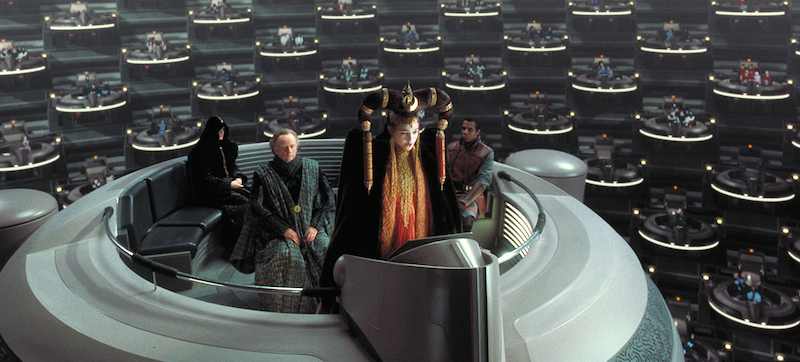
Social Engineering brought up some interesting points regarding Status that might be pertinent to Psi-Wars.  Action doesn’t deal with status, but Action operates in a meritocratic world with a flat society, where major political figures might make a point of getting a photoshoot at McDonalds to show that they are “one of the people,” while Star Wars features princesses, counts and knights.  We can make the case that Star Wars, itself, is largely meritocratic, but given the presence, already, of princesses and aristocracy in Psi-Wars, why not play out what it would look like?

My primary problem with Status in Psi-Wars is that I don’t know what it would do.  Status, by itself, just sits there like a reaction modifier lump that often doesn’t even act as a reaction modifier: a street punk might not care that you’re a princess.  My solution thus far was to grant people a “Title” perk, which allowed them to gain a +1 from people who care about such things.

But if we want to embrace the full scope of status and what it offers, it might be worth thinking about what it offers and how we can represent that in Psi-Wars.  What I’d like to do is make it as “concrete” as Pulling Rank, making it a sort of a specific “Social Rank.”  Let’s see if that works!

Status as Social Rank

Status greater than 0 means you are a member of the ruling class in your culture. Your family may be hereditary nobles (e.g., Plantagenet, Windsor), successful businessmen or politicians (Rockefeller, Kennedy), or some other type of big shots  – B28

What exactly is Status?  It means you represent the elite of your society.  It suggests power.  Status is imputed via Rank and Wealth, which means high ranking and wealthy members of  society are higher in status than those who are poor or do not belong to major organizations.  This, in turn, creates influence in the sense that you think they can do more for you.  If you could persuade someone to “owe you a favor,” would you rather it was your local wino, or someone like Bill Gates or Hillary Clinton?  The latter two have the wealth and power to make any favor they owe you much farther reaching, therefore, you might be more willing to do for them, in the hopes of impressing them.  The reverse is true too: You would rather offend a wino than a wealthy Secretary of State, because the latter can make your life much worse.
Rank and Wealth do not come with reaction modifiers except via imputed status.  The status, here, represents the influence one gains by being wealthy and powerful.
Ascribed status is a little trickier to discuss than imputed status.  However, the basic premise is the same: status implies power.  In an aristocracy, those with titles typically have access to powerful officials, special laws and legitimacy that those without titles simply lack.  For example, an aristocrat might be tried in a different court than a commoner, allowed into the presence of the king, and seen as a generally more worthy person.  Given a choice between having your product endorsed by a nobleman or a wealthy commoner, someone might choose a nobleman.  This might seem weird, but the same sort of thing happens in our society: People would rather see their product endorsed by a celebrity or athlete than by a wealthy-but-unknown businessmen.  The celebrity is better known and lends more legitimacy to the product than a no-name-but-powerful man.  In this sense, ascribed status doesn’t reflect power so much as carry power with it: If you can claim a title and get everyone to back your claim, that title itself gives you power.
In both cases, Status represents how important you are to society as a whole.  People seek to curry favor with you because, in a broad, abstract way, you are more powerful than someone without status.  This mirrors how Action handles Rank; Rather than worry about who you directly command, it uses Pulling Rank as an abstraction of your power in an organization.  We can use Status to represent an abstraction of your power in society.

The Rules: Pulling Social Rank

In Pulling Rank, a character must have Rank 0, must be in good standing with the organization (having all appropriate disadvantages).  “Social Rank” doesn’t have the latter requirements, so I’m going to suggest that you need Status 1 at a minimum to Pull Social Rank.
Pulling Rank suggests that Charisma, Reputation, appropriate skills, and Smooth Operator might all apply.  We can certainly keep this: Reputation definitely applies.  I’d also add Social Regard and Social Stigma, as a Status 3 slave is going to have a harder time Pulling Social Rank.  I’d add use Savoir-Faire instead of Administration as your skill roll, not just because a more polite request is going to get what you want, but Savoir-Faire also includes knowing what you can get away with, meaning you’re less likely to even make a request that wouldn’t be granted (the same reasoning behind Administration acting as a complementary roll).
What’s the roll for Pulling Social Rank?  There might be as many as ten levels of status (with the Emperor being at the top), which suggests, if we kept it in line with our organization rules, treating it as a 30-point patron, but I’m going to suggest treating social status as a 20-point patron.  That makes it slightly worse than standard Pulling Rank from Action 1, but is consistent with a “standard organization” for Psi-Wars.  It also makes lower levels of status more immediately useful.
Thus, Status 1 succeeds on a 3 or less, Status 2 on a 5 or less, and so on.
What can Pulling Social Rank get you?  Anything the GM thinks is reasonable, but typically Social Privilege.  That is, people are more willing to work for you (Hireling), invite you to major social affairs, or offer introductions to other VIPs.   You might make the case for special legal benefits (Bailout), and higher levels of trust (Cash, Information and Funding), but I would argue that these are generally gained via other avenues. That is, society doesn’t say “What?  A princess in prison?  Get her out!” or “Sure, you’re a duke, so can have lots of money!”  Instead, when making Pulling Rank rolls using your actual rank, or when trying to do something where your position might add a bonus, consider treating your request as a complementary roll.  Critical success is worth +4, Success is +2, Failure is -1, and Critical Failure is -2.
Status still behaves like a social modifier under specific circumstances determined by the GM, typically the difference between status levels under conditions where that matters (A powerful princess barging in on a king is going to be less badly treated than a peasant doing the same).  A character can only benefit from either his reaction modifier or the complementary modifier, not both.

Lower Status?

I don’t see a need for additional penalties or problems associated with lower status beyond what they already impose.  The reaction modifier and being unable to access Pulling Social Rank is sufficient.

Gaining Status

For Psi-Wars, I would use Imputed Status as a standard.  That is, apply all the normal rules for Wealth and Rank (provided the rank can reasonably grant Status: being a mob boss probably won’t get you invited to the Cotillion Ball) to a maximum of +6 like normal.
The Title perk allows someone access to ascribed status, which costs the usual 5/level.  We’ll treat it as 4 simple levels:
  • For lesser nobles (Lords, Ladies, Knights, minor titles like “Baronet”), gain +1 status.
  • For greater nobles (Barons, Counts, Viscounts, Marquis, etc), gain +2 status.
  • For royal nobles (Prince, princess, duke), gain +3 status.
  • For ruling nobles (Kings, Emperors, archdukes), gain +4 status.

Character Considerations

Status only really matters for two backgrounds: Aristocrat and Outcast.

Aristocrat 20 points

You have a title. You either descend from noble blood, or you have been lifted up to the position of noble as a reward for your heroic deeds. You have a minimum title of something similar to Lord, Lady or Knight.
Advantages: Title [1] and Status +1 [5], Wealth (Comfortable) [10]
Skills: Savoir-Faire (E) IQ [1]
Additional Skills: Choose another 8 points from Carousing (E) HT [2], Connoisseur (Any), Leadership, Politics or Public Speaking all (A) IQ [2], Current Affairs (High Culture, Politics) (E) IQ+1 [2] Law (Galactic) (H) IQ-1 [2], or Dancing (A) DX [2], or improve Savoir-Faire to IQ+1 [2] for +1 point, or improve any lens skill by one level for 2 points; or improve any lens skill by two levels for 6 points.
Social Traits:You may also spend any left over points, or your template advantage points on Contact (Wealthy friend, fellow noble, politican, skill 12, 15 or 8, 9 or less, somewhat reliable) [1, 2 or 3], Contact Group (Politicians or Nobles) (Skill 12, 15 or 18, 9 or less) [5, 10, 15), Fashion Sense [5], Favor [varies], Haughty Sneer [1], High Heeled Heroine [1], Honest Face [1], Sartorial Integrity [1], improve Status up to +4 [5/level] or gain additional Wealth [varies].
Optional Disadvantages: Add the following disadvantage options to your template: Bully [-10*], Callous [-5], Jealousy [-10], Overconfidence [-5*], Selfish [-5*], Unfit orVery Unfit [-5 or -10].

Outcast 20 points

Because of bad life choices, your race, or your poverty, you struggle to survive on the edges of galactic society.
Skills: Streetwise (A) IQ [2].
Additional Skills: Another 18 points chosen from Beam Weapons (Pistol), Brawling or Knife all (E) DX+1 [2], Filch (A) DX [2], Pickpocket (H) DX-1 [2], Area Knowledge (Planet or important starport) or Savoir-Faire (Mafia) both (E) IQ+1 [2], Gambling, Holdout or Smuggling all (A) IQ [2], Carousing (E) HT+1 [2], Running (A) HT [2], Scrounging (E) Per+1 [2], Observation or Urban Survival both (A) Per [2], or Intimidation (A) Will [2]; 2 more points in any lens skill to raise it by one level; or 6 more points to raise it by two.

Additional Traits: You may spend any leftover points, or template advantage points on Contact (Fence, Fixer, Smuggler, trusted friend etc; Appropriate skill at 12, 15 or 18, 9 or less, somewhat reliable) [1, 2 or 3], or Contact Group (Gang, pirates, minority clan, skill-12, 15 or 18, 9 or less, somewhat reliable) [5, 10 or 15], Cultural Familiarity (Native to Homeworld or minority), Language (Native to homeworld or minority) [2-6], or Street Smart [5/level]

Disadvantages: You must take a minimum of -5 points worth of following disadvantages as part of your -50 points: Social Stigma (Criminal, Second-Class Citizen or Minority) [-5 to -10] or Status -1 to -2 [-5 to -10]. You may add the following disadvantages to your template disadvantages: Greed [-15*], Obsession (Regain former standing) [-5], Sense of Duty (Your minority) [-10] and Wealth (Struggling or Poor) [-10 or -15].

Designing Organizations

Building Organizations

The two books together give us plenty of ideas as to how we might build an organization.  We need to simplify, though.  In a Psi-Wars scenario, PCs are largely concerned about the following:
  • How much rank is there (How large is the organization?)
  • How much does it cost as a Patron or an Enemy?
  • How much BAD does it typically apply
  • What sort of minions will I face/can it supply me?
  • How much wealth does it have?
  • What is required to join?
  • What cool tricks will it teach me?
  • What sorts of benefits can it offer should I pull rank?
The first five all essentially boil down to the same thing: How big is the organization?  I’d like to combine BAD, contact skills, difficulty of getting in, difficulty of persuading people away, the cost of the Patron/Enemy and how many ranks you have all into one single thing.  If you know one, you know the rest.
Patron cost and rank already have an obvious relation.  If I leave the cost of rank at 5/level, then Rank 4 means something else in a 10 point organization than in a 30 point organization.  That means if the highest rank for one organization is rank 6, and for another is rank 10, we might expect both to command equal levels of power in their organizations.  That is, maximum rank is maximum rank and offers the same chance of success.  Page 6 of Social Engineering: Pulling Rank has a handy table for us.  A 10-point patron’s rank 6 is roughly on par with a 20-point patron’s rank 8, and a 30-point patron’s rank 10. Action has the 15-point patron as its standard, judging from Pulling Rank difficulties.  This suggests that the Psi-Wars standard is a little larger than the Pulling Rank standard, but it will do.
What does size get you here?  Well, if we use “Complements of the Boss” then a “small” organization is worth +1 on complementary rolls, a standard organization is worth +2, and a large organization is worth +3.  Furthermore, when it comes to Muscle or Cavalry (page 19 of Pulling Rank), small organizations send 5 guys, medium 10, and large 15.  Maximum funding is also determined by organization size. Beyond that and it becomes mostly a matter of GM discretion.
How do be fold BAD into organization size?  Well, it becomes immediately obvious that this might not be the best idea.  The Nahudi warriors are likely a small organization full of skill-18 warriors, while the Empire is a vast organization full of skill-12 soldiers.  It does seem to make sense that different groups have different BAD levels, and things like loyalty, difficulties breaking in and minion strength might be tied together for ease of play, but that just means that organizations should simply have a “BAD” rating.
Pulling Rank ties maximum available wealth to Patron cost, as does Boardroom and Curia, and Boardroom and Curia ties BAD (at least for infiltration) to wealth level.  This might be a good indication of BAD.  We might expect Struggling Organizations to be BAD 0, Average to be BAD 2, Comfortable to be BAD 5 and Wealthy to be BAD 8, but obviously these can be shifted around (the Nehudi are probably not very wealthy, but have some fairly BAD warriors).
The rest of the elements that players care about from an organization largely come from what type of organization it is.  Boardroom and Curia has plenty, but we need to pare them down to size.  For that, I’d like to turn to GURPS Space.

Rank?

Before I do that, I want to stop and take a quick look at rank.  What does it actually mean? Social Engineering discusses the arithmetic of rank, but often rank has nothing to do with direct command of inferiors, but it always has something to do with the general respect an organization offers you.  For example, your rank in a monastary might have to do more with your spiritual command than the number of monks you control or command.
If we’re going to create a variety of organizations, we need a variety of rank-titles to populate our various ranks, and I’d like to offer a few observations.  First, while ranks might be thoroughly codified, they might not have any actual title.  For example, in the US Civil Service, there are no less than 15 pay grades that corrospond to US military ranks, but the actual title might vary from organization to organization, or you might have no formal title at all!  That said, we can draw some broad conclusions about what ranks tend to look like.  I should also note that rank structures and heirarchies are often very arbitrary, redundant and strange, and thus hard to fit into the smartly defined GURPS rank heirarchy.  Any examples I offer are meant more as inspirations than hard facts, are certainly open to interpretation and represent a couple hours of research into often very arcane systems, and thus unlikely to be accurate.
Rank 0 is typically your first, “enlisted” rank, with little actual priviledge and very few responsibilities.  This is someone who might call upon the organization for help, but typically is commanded, rather than issues commands.  For the military, this might be a private, but for a commercial organization, it might be “sales” or just “employee”
Rank 1-3 are generally non-commissioned ranks.  They represent advanced enlisted ranks, and tend to be focused on leadership tasks that focus directly on the rank and file, and tend to be leadership on the “front lines” or where the action takes place.  For a military example, this is typically a sergeant, but a commercial organization focused on sales might have “Sales team lead” or some such title.  This role often assists administrative ranks.
Rank 3-4 represent “Company”-level or administrative ranks.  They interface between the rank-and-file and the high level management, passing commands down from on high and situation reports from down below.  The lieutenant is a classic example of such a rank, but a “store manager” might be one for a commercial venture, as he needs to tend to the basic unit in an administrative fashion, but might sometimes get “stuck in” with the day-to-day.  These also represent characters who might enjoy special privileges outside of the normal structure, like field agents, high-level commandos or diplomats or other characters who enjoy act as individual agents but enjoy considerable organizational support.
Rank 5-6 represent the pinnacle to a small-scale organization, like criminal gangs, tribes, small ventures, etc.  These tend to be Field Officers or Regional Command.  They’re separated from day-to-day concerns, generally, and focus more on administrative concerns.  If they deal with day-to-day affairs, they represent highly competent specialists, like corporate trouble shooters and the like, usually leading a team of elites.
Rank 7-8 represent the pinnacle to most organizations.  They’re universally removed from rank-and-file concerns and typically control an organization that spans several star systems at a minimum.  This is your General Officer.
Rank 9+ represent the pinnacle of any possible organization in Psi-Wars and only covers the largest of all possible organizations and are utterly removed from day-to-day concerns and often never see anything below the regional scale.  They concern themselves with grand theaters at the smallest, and are generally out of scope for most games.  I won’t reference such ranks in my examples below, as I leave them to you to fill in as necessary.

GURPS Space

GURPS Space has a mess of suggestions starting on page 202 in regards to organizations.  Not all of them will be relevant to Psi-Wars, and many that are might not be interesting to players (There’s probably a postal service, but we don’t care much about from the perspective of the PCs). Let’s look through a few.

Diplomatic Corps

I initially dismissed the diplomatic core as irrelevant to Psi-Wars, as this was a game about action, but no less than two characters in Star Wars focus strongly on diplomacy (Leia and Padme), while the Jedi themselves often acted as diplomats.  Furthermore, the description in the book on diplomats offers an intriguing glimpse into how the Empire might use diplomats:

A powerful empire with no real rivals would have diplomats who act more like viceroys, bossing local rulers around on behalf of the all-powerful emperor.  

Which reminds me that an Empire is not the same thing as a Dictatorship: an empire controls the internal and external politics of another nation.  Thus, we’d expect the empire to manipulate and control the Space Elves, or whomever, often via viceroys rather than direct governance.

This suggests the Diplomatic Corps as sort of a stand-in for larger governance and politics, which fits Star Wars, where Padme behaves sometimes as an ambassador and sometimes as a senator (in a sense, she must be both, as she represents her people to the rest of the Galaxy).

This makes it an advocacy and government organization.  Thus, it typically grants Funding, Introduction, Invitation and Authorization favors, and provides contacts with Administration, Influence skills, Propaganda, Current Affairs, Law and Politics.

Specifically, we might allow such an organization to offer:

  • Entry Clearance (SEPR 13, similar to Base Access from Action 1), 
  • Consultation (SEPR 15, Treat it as access to a Contact with the appropriate skill), 
  • Files (SEPR 15, as Files from Action 1, generally regarding political assessments, personnel dossiers, etc)
  • Cash (SEPR 16, similar to Cash from Action 1, but multiply values by 2.5) 
  • Funding (SEPR 16: $500k for small organizations, $50 million for standard organizations, and $5 billion for large organizations), 
  • Bailout (SEPR 17, same as Bailout from Action 1, but in this case is covered by Legal Immunity), 
  • Introduction and Invitation (SEPR 18, Unique form of Entry Clearance, largely to social events).
  • Facilities (SEPR 18-19, As facilities for Action, but in this case provides top-notch dining, entertainment or propaganda. Small organizations add +2 to applicable skill and reaction, normal organizations apply +4 to applicable skill and reactions, and vast organizations apply +4 to reaction and +6 to skill, representing the best money can possibly buy).
  • Shipping and Transportation (SEPR 19, similar to Transportation from Action 1, but represents the superior accomodations and discretion offered to administrative VIPs or diplomats.  Discrete shipping requires Legal Immunity).
Prerequisites for membership to such an organization might include low-frequency Duty, Legal Immunity, low-level Security Clearance, and possibly Claim to Hospitality, for less formal diplomatic organizations.

Ranks
Diplomatic and civil service ranks are scattered and vary highly from group to group.  Furthermore, being a diplomat, specifically, is more of a function of having Legal Immunity and authority to represent your country to another, rather than any specific rank. The title “Ambassador” is usually assigned to the head of an entire embassy and said person is considered to be

Rank 0-2 have numerous names and typically vary from function to function, especially in a civil service.  In a service strictly concerned with foreign affairs, such characters are typically attaches, and have a variety of roles (“technical attache” “security attache” and so on).  At the lowest levels, these characters rarely have Legal Immunity, and even at high levels, only a more limited degree of Legal Immunity.

Rank 2-4 tend to concern themselves with administration tasks, and hence usually have a title like “3rd Secretary” or “Assistant Minister”.  Diplomats might start around this level, having title like “Ambassador,” “Counselor”, “Diplomat” or “Envoy.”

Rank 5-6 tend to be your ultimate levels of diplomatic rank and include titles like “Minister.” For actual ambassadors, they might retain the titles of lower levels if their embassy is simply larger or has higher status, but they might gain loftier titles, like “Special Envoy,” “High Counselor” or “Viceroy” especially if they govern other ambassadors. For civil servants, rank 5 might have titles like “Comptroller”, “Coordinator,” and “Regional Director” while rank 6 might have put “Assistant”, “Deputy” or “Vice” in front of said title (“Deputy Regional Director” or “Vice Coordinator”).  Small organizations might push this down to rank 3-4.

Ranks 7-8 tend to fall outside the direct purview of diplomats and into full cabinet-level positions within the government. Rank 8 tends to include titles like Secretary, Director, Administrator, Chairman, while rank 7 tends to put “Assistant, Deputy or Vice” in front of them.

 The Navy

And the broader military.  This obviously matters, because it fights the wars of Psi-Wars.  Even so, I find Star-Wars leans overly much on the military.  For example, we regularly see Stormtroopers, who are supposed to be the Imperial elite, acting as policemen, which is weird.  On the other hand, we see almost nothing of the rebel military, which is equally odd.  Even so, I expect many players will want to either belong to some major military organization, or fight against one.

The Navy is a military organization, and might be a government organization, broadly speaking.  That means it offers Violence and Authorization.  It tends to offer soldiers rather than contacts, but if it offers contacts, they’ll typically have Administration, Law and Politics.  They offer favors like fundint, authorization, and violence.

Specifically, we might allow such an organization to offer:

  • Entry Clearance (SEPR 13, similar to Base Access from Action 1), 
  • Consultation (SEPR 15, Treat it as access to a Contact with the appropriate skill), 
  • Files (SEPR 15, as Files from Action 1, generally regarding military units, personnel dossiers, etc)
  • Gear (SEPR 16, as Replacement Gear from Action 1, whatever equipment is appropriate to a military, up to and including starships)
  • Evacuation and Treatment (SEPR 17, as medevac from Action 1), 
  • Facilities (SEPR 18-19, As facilities for Action, but in this case provides top-notch military planning facilties. Small organizations add +2 to applicable skill and reaction, normal organizations apply +4 to applicable skill and reactions, and vast organizations apply +4 to reaction and +6 to skill, representing the best money can possibly buy).
  • Fire Support, the Cavalry (SEPR 19, as Fire Support and SWAT from Action, but dependent on the sort of equipment/typical NPCs the organization offers).
Prerequisites for membership to a military organization usually requires high frequency Duty.

Ranks
Military ranks tend to be highly specific and well-documented.  For reference:

Rank General Obersvations Army Navy
0 Enlisted Private Recruit
1 Enlisted Corporal Seaman
2 NCO Sergeant Petty Officer
3 NCO/Company Officer Chief Master Sergeant, Lieutenant Chief Petty Officer/Ensign
4 Company Officer Captain Lieutenant
5 Field Officer Major Commander
6 Field Officer Colonel Captain
7 General Officer Major General Rear Admiral
8 General Officer General Admiral

The Patrol and Security Agencies

I’d argue that these two can be combined into a single element that’s largely absent from Star Wars.  We know there must be port authorities for the smuggler to dodge, or some sort of space cop who tries to arrest people like Jabba the Hutt (without cops, you don’t have skulking criminals, you have warlords).  Psi-Wars, with its evident focus on lawmen vs criminals, definitely needs this sort of organization as a separate entity from the military, which suggests new sorts of ships, new sorts of troops, and so on, some of which we’ve already touched on.  For our purposes, include Spy agencies in here.  They often do different things, but from the perspective of Boardroom and Curia, there’s little difference between the NSA and the CIA.
These are typically Enforcement and Investigative organizations, usually associated with the Government.  They tend to offer contacts with influence skills, combat skills, administration, politics and law, and a bevy of investigative skills, including Criminology, Forensics, Intelligence Analysis, Observation, Search and Streetwise.  They offer favors like authorization, minions, covert activity and information.

Specifically, we might allow such an organization to offer:

  • Entry Clearance (SEPR 13, similar to Base Access from Action 1), 
  • License and Warrant (SEPR 13, similar to Warrant from Action 1, either temporary or long-term rights to do something specific). 
  • Consultation (SEPR 15, Treat it as access to a Contact with the appropriate skill), 
  • Files or Records Search(SEPR 15, as Files from Action 1, generally regarding arrest records, secret documents, biometric databases, etc)
  • Cash (SEPR 16, similar to Cash from Action 1, but multiply values by 2.5) 
  • Gear (SEPR 16, as replacement gear)
  • Evacuation and Treatment (SEPR 17, as medevac from Action 1), 
  • Facilities (SEPR 18-19, As facilities for Action, but in this case provides top-notch surveillance or forensics facilities. Small organizations add +2 to applicable skill and reaction, normal organizations apply +4 to applicable skill and reactions, and vast organizations apply +4 to reaction and +6 to skill, representing the best money can possibly buy).
  • Muscle, the Cavarly (SEPR 19, as Backup and SWAT from Action, but dependent on the sort of equipment/typical NPCs the organization offers).
Prerequisites for membership to a secrity organization usually requires high frequency Duty and necessarily Legal Enforcement Powers. Some variants might offer Security Clearance.

Official Intelligence Agencies offer all of the above, plus additional options:

  • Cover Up (SEPR 14; This is limited to either normal/huge organizations, or organizations with BAD 5+/Comfortable wealth)
  • Disappearance (SEPR 14, as Disappearance from Action 1)
  • False ID (SEPR 14, as False ID from Action 1)
  • Insertation/Extraction (SEPR 14, as Insertion/Extraction from Action 1)
  • Safe House (SEPR 15, as Safe House from Action 1)
  • Technical Means (SEPR 15; This is limited to either normal/huge organizations, or organizations with BAD 5+/Comfortable wealth)
  • Bailout (SEPR 17, same as Bailout from Action 1, but in this case is covered by Legal Immunity), 
Prerequisites for membership to an intelligence organization usually requires high frequency Duty. Security Clearance, and sometimes high levels of Legal Enforcement Powers
Ranks:
Ranks in a security or intelligence organization are often hard to pin down.  Alphabet Agencies typically have a wide variety of low-level ranks, while police forces often use military-style ranks.  Higher level ranks tend to blend into administrative ranks.
Rank 0 for police tend to be “Trooper” or “Officer” or “Deputy” or “Constable”

Rank 1 for police tend to be “Detective” or “Inspector”

Rank 2 for police tend to be “Sergeant”

Rank 3-4 for police tend to be “Lieutenant”. “Deputy Inspector” or “Major”. For Security/Intelligence Agencies, we get agents: Junior Agents, Field Agent, Special Agent.

Rank 5-6: For police, we cap out at our organizational size: Rank 5 might be Chief Inspector, or Deputy Chief-of-Police, while Rank 6 might be Chief-of-Police or Commissioner.  Intelligence and security agencies tend to see “Special Agent In Charge” or “Regional Director” at this level.

Rank 7-8 tend to resemble administrative ranks, as we get into Directors and Commissioners and Administrators and Secretaries at this level.

Corporations

While I doubt players will often want to serve corporations, they’re almost certainly a major player in the setting.  Dune features the CHOOM company, and Star Wars has quite a few manufacturing companies or trade federations that serve a vital role in driving the plot.  In Psi-Wars, players might break into corporations, or seek their assistance, or try to gain access to their prime resources.
A corporation is, obviously, Commercial, but I would argue that it’s also an Advocacy organization.  That’s why you see Trade-Federation types sitting down with Senators for dinner, and why they come across as seamy, at least in Star Wars and most cyberpunk settings.  Given Psi-Wars’ focus on conspiracies and crime, it seems our corporations might be a touch shady and ready to engage in regulatory capture.  That means they typically provide contacts with Influence Skills, Propaganda, Current Affairs, Law, Connoisseur and Merchant.
News organizations might be a subset of Corporations.  Star Wars doesn’t feature reporters, but it’s not entirely clear why not.  FTL might be too slow for immediate telecasting of events on other worlds, but everyone in the empire will eventually need reports of what’s going on.  Consider treating them as Investigative Corporations.  They’ll usually have more focus on Advocacy and Investigation, so they might offer contacts with skills like Observation, Search, Streetwise, Intelligence Analysis, Propaganda, Current Affairs, and various Influence skills.  They offer favors like Material Aid, Transportation, funding, introductions, invitations, etc.

Mercenary Companies

Mercenaries (and pirates!) definitely fit into Psi-Wars.  The typical bounty hunter from Star Wars is little more than a mercenary, and in a game about war, groups will definitely run around offering their services to the highest bidder.

A mercenary company is typically just a small military organization that just provides contacts with combat skills.

The Organization

What a terrible name in the context of everything else we’re discussing here!  In any case, Star Wars definitely has criminal organizations in the form of the Hutt Cartel, and Psi-Wars will definitely want to follow suit, what with my criminal minions and pirates.
Criminal organizations are, of course, Criminal, and that’s probably enough for most… but you might consider using the criminal tag for other organizations.  Heavily mercantile syndicates might act like Corporations, while highly militarized ones might be Mercenaries, and secretive ones might be Secret.  In any case, criminal organizations always offer thugs and contacts with Streetwise.  They offer favors like Covert Activity and minions.

Specifically, we might allow such an organization to offer:

  • Consultation (SEPR 15, Treat it as access to a Contact with the appropriate skill), 
  • Cash (SEPR 16, similar to Cash from Action 1, but multiply values by 2.5) 
  • Muscle (SEPR 19, as Backup from Action, but dependent on the sort of equipment/typical NPCs the organization offers).
  • False ID (SEPR 14, as False ID from Action 1)
  • Insertation/Extraction (SEPR 14, as Insertion/Extraction from Action 1)
  • Safe House (SEPR 15, as Safe House from Action 1)
  • Bailout (SEPR 17, same as Bailout from Action 1, provided the criminals have their some lawyers or judges in their pocket)/
Criminal organizations tend to expect some level of Duty from their membership, and Social Stigma (Criminal Record) is common, but not necessarily required.

Ranks:
Criminal organizations tend to be less formal with ranks, and how their ranks work vary greatly from group to group.  I offer the Mafia and the Yakuza as examples below.
Rank 0 tends to be for “associates” (Mafia) or Shatei (Little Brothers), your low-level initiates or those who wish to be initiated.  These serve the organization, often directly, but from the perspective of the organization, they don’t “truly belong.”  These are the drug dealers, the gang-bangers, etc.

Rank 1-2 is reserved for Soldiers (Mafia) and Kyodai (Big Brothers), those who have been initiated and are genuinely part of the organization: made men, if you will.  They tend to command respect from associates, who want to be them.

Rank 3-4 might be your capos or lieutenants, who run whole gangs at the behest of a larger boss.  In a larger organization, these might be rank 5-6, and run planets at the behest of a larger cartel boss.

Rank 5-6: Given that most organized crime doesn’t exceed a planetary scale, I’ve limited this to the highest ranks for organized crime.  This tends to be your boss or oyabun and his right-hand men and closest advisors.  For an interstellar syndicate, this might be pushed up to rank 7-8.

Scientific Foundations

Star Wars doesn’t really focus on research and depicts a very static society, but it does display (slow) progress, such as the development of the Death Star, or the creation of Clone Troopers and so on.  It’s not that Star Wars never progresses, it’s that the progress is very incremental, and that the universe seems to go through cycles of renewal and collapse.  Thus a foundation investigating or expanding technology certainly fits into the design of Psi-Wars, but primarily as targets for infiltration or heists.
Such organizations are typically Research organizations and offer contacts with a specific skill appropriate to their focus, typically an Expert Skill or some other Academic skill, typically at high levels.  They typically offer favors like superior facilities or healing or information.

Religious Organizations

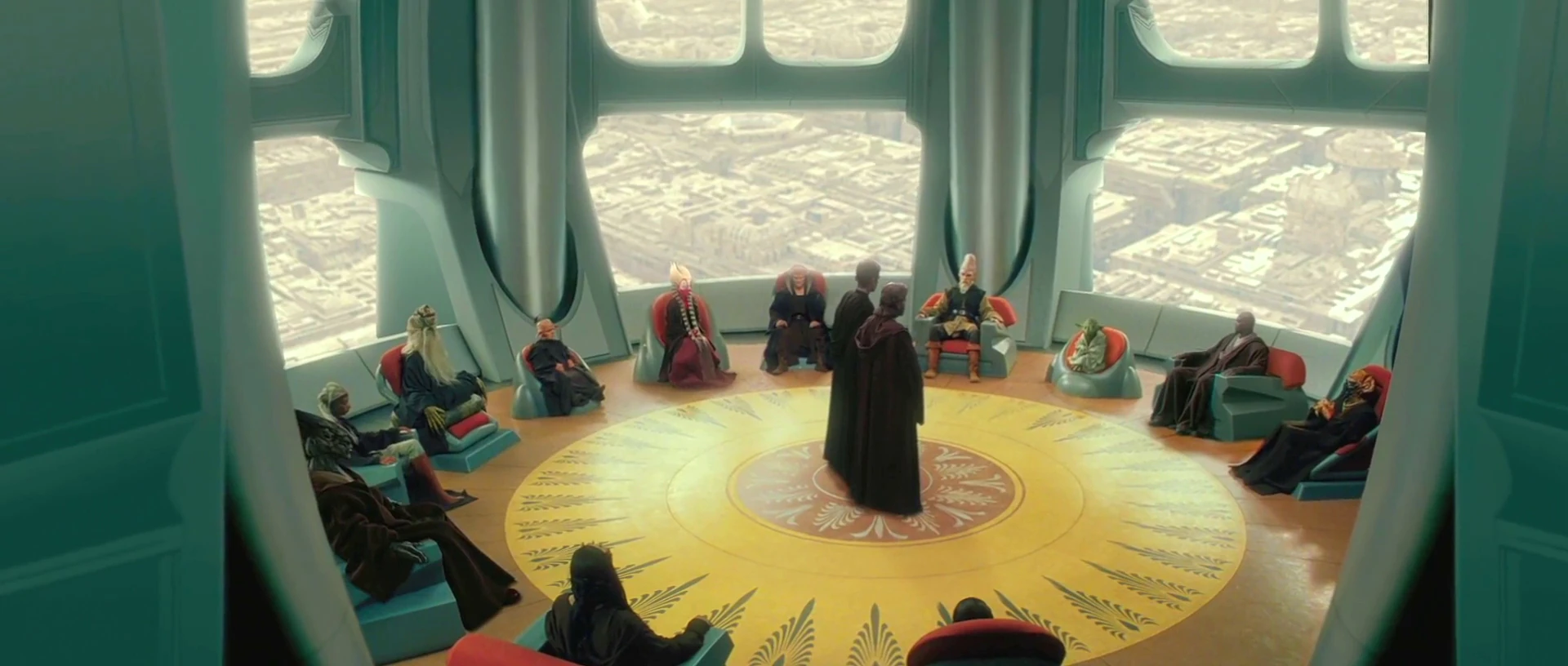
Not depicted in GURPS Space, but nonetheless vital to both Psi-Wars and Star Wars, is the religious  society.  The Jedi Order is definitely such an organization, and Psi-Wars can use those as a place to slot in interesting Psionic Styles.
Such organizations are obviously religious.  If we’re going to include the ability to teach characters cool martial arts, they should also be focused on teaching.  Such an organization would provide contacts with Theology (or Philosophy!) and Religious Ritual, as well as Area Knowledge, Public Speaking and Teaching. 
Similar Occult societies might exist, if their focus on Psionic styles and such had a slightly different flavor.  They might offer Hidden Lore and Occultism.  Obviously, this can and will mix and mingle with the Religious benefits above.
All of the above will typically offer benefits like greater information, better gear (relics), access to holy spots, introductions and invitations to special events.

Specifically, we might allow such an organization to offer:

  • Entry Clearance (SEPR 13, similar to Base Access from Action 1), 
  • License and Warrant (SEPR 13, similar to Warrant from Action 1, either temporary or long-term rights to do something specific). 
  • Consultation (SEPR 15, Treat it as access to a Contact with the appropriate skill, usually with an eye towards instruction) 
  • Files (SEPR 15, as Files from Action 1, generally ancient documents or training manuals)
  • Gear (SEPR 16, as replacement gear, but typically relics or appropriate religious equipment)
  • Treatment (SEPR 17, as medevac from Action 1, using psionic power to heal someone.), 
  • Facilities (SEPR 18-19, As facilities for Action, but in this case provides high or very high sanctity locations)
  • Introduction and Invitation (SEPR 18, Unique form of Entry Clearance, largely to social or religious events).
Prerequisites for membership to such an organization might include some level of Duty, Clerical Investment, and often Disciplines of Faith.

Ranks
Religious ranks tend to be less formal than those of major institutions, but this can vary depending on how formal a religious organization is!  I offer as three examples, the Catholic faith, where rank definitely impacts how many people your organization tends to, and two strands of Buddhism, Tibetan and Japanese Zen Buddhism, which tend to focus more on ones advancement/knowledge of the faith as well as inner enlightenment.

Rank 0: This represents those who have not yet been fully initiated into the institution of the faith, but definitely work with/for the faith as an institution.  For the Catholic faith, this might include Lay clergy, clerks, or even deacons.  For Zen buddhism, this might include the Joza, a monk-in-training.

Rank 1: This represents someone definitely initiated into the faith.  For the Catholic faith, this might be a Deacon.  For Zen Buddhism, this might include the Zagen (monk).

Rank 2: This represents someone who has full authority to act on the behalf of the faith, or a high level assstant.  For Catholics, this might be Priests/Pastors or Assistant Priests, or high-level Deaconds.  For Zen Buddhism, this might be the Susho (head monk) or Osho (A priest, teacher or “technologist of spirit”).

Rank 3: This represents someone who is an independent master of their faith and can command others while serving his clergy.  For the catholic faith, this is definitely a Priest/Pastor, while in Zen Buddhism thismight be a Dai-Osho (a “resident priest” at a temple).

Rank 4: This is a high level master of the faith, one who can command Rank-3 characters, or who has special privileges.  In the catholic faith, this might be an archpriest or a dead, and in Zen Buddhism this might be a Kyoshi (an instructor)

Rank 5: This is someone who commands a small-scale organization or a division of an organization.  In the catholic faith, this might be an abbot (commanding a monastary) or a vicar.  In Zen buddhism, this might be a “Daikyoshi”, a senior instructor.

Rank 6: Is the highest level of a small-scale religion: an Abbot in both Zen and Tibetan Buddhism, and a Bishop in the Catholic faith.

Rank 7: Is limited to faiths with considerable organization, and typically represents priviledged versions of rank 6 characters: the archbishop, the cardinal, the patriarch, the Panchen Lama.

Rank 8: Typically heads the religious organization: the Pope and the Dalai Lama.

Secret Organizations

Secret Organizations deserve special mention, as conspiracies seem to abound in both Action and Star Wars.  Nearly any of the above might be secret in addition to their normal benefits (the Jedi Order eventually became a secret Religious organization, and the Sith Order always was; Secret agencies might be secret investigative organizations; subtle criminals might be secret criminal organizations, and so on).  In Boardroom and Curia, this typically just means they react madly to outsiders.  A clearer way to treat them would be to increase their BAD by one level, as a benefit gained from their secrecy.
Secret groups also typically offer covert benefits.

Pulling Rank in Psi-Wars

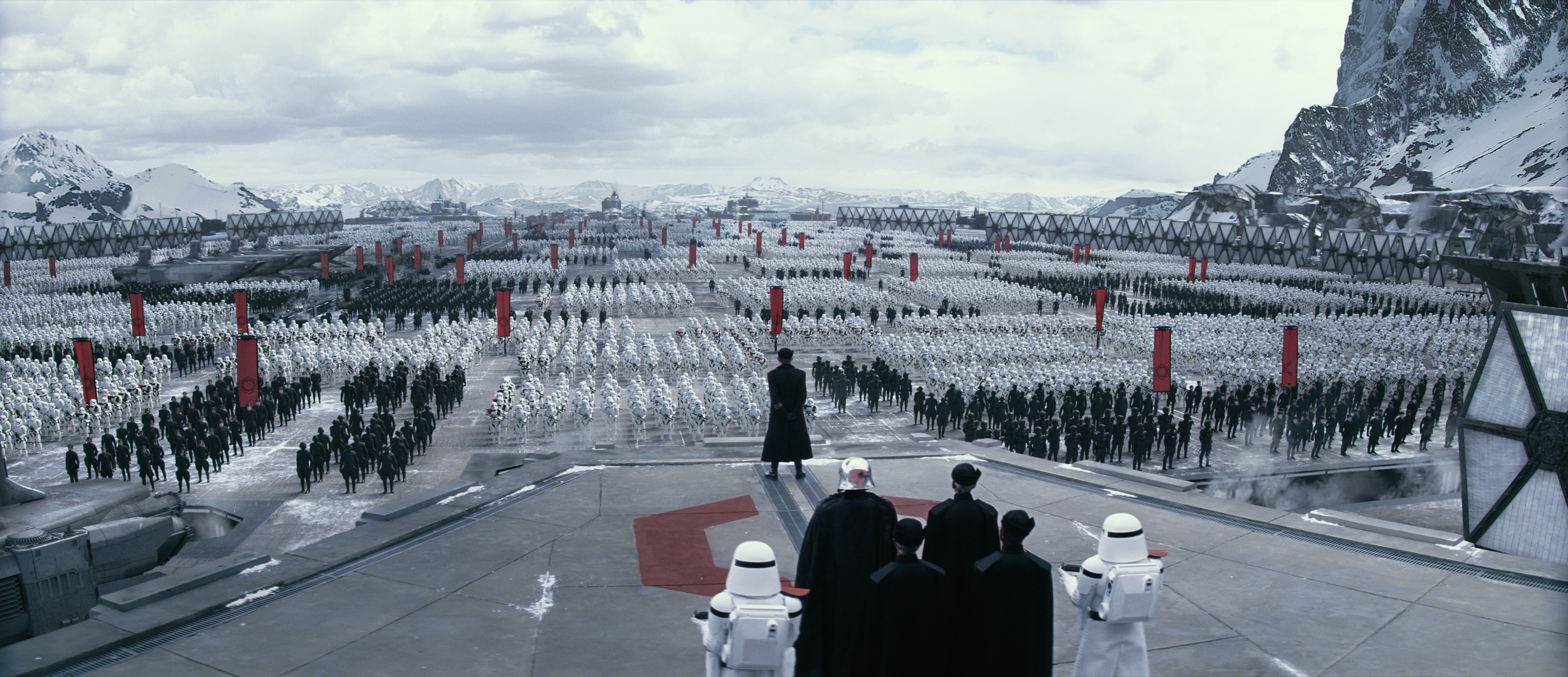
The next step in looking at our Social Engineering rules is to take a deeper look at Organizations.  This would be the bit where I would first try to argue against Organizations, but I cannot. First, Pulling Rank is right there in GURPS Action.  It’s a fundamental element of how Action plays (and, in fact, largely spawned later works on the topic).  I’d need a really good, Star Wars-backed reason to remove it, only Star Wars itself is largely about organizations.  One might describe Star Wars as a battle between the heroic Rebellion (an organization) and the sinister Empire (an organization) while plucky heroes seek the last remnants of the Jedi Order (an organization) for help.  Unlike your typical murder-hobo game, and rather like most modern action thrillers, the characters’ actions largely take place in a larger context of a conflict between organizations, and often involves interacting with organizations (like the Hutt Cartel, or the Galactic Senate).

Thus, Psi-Wars is necessarily a game that features organizations as one of its foundations.  This is convenient for us, though, because you may have noticed that organizations serve as natural containers for things like martial arts, cultural distancing mechanisms. military doctrines, and opposing minions.  We might say things like “The empire fights differently than the rebel alliance,”  or “The Order of True Communion offers a different understanding of Communion than the Oracular Monks”.  In all these cases, we were already talking about organizations.  Now, we can talk about them in more detail.

As I look into this in more detail, I’ll be primarily using three books: GURPS Action 1, and its section on Pulling Rank, then GURPS Social Engineering: Pulling Rank, for an even deeper look at that, and then Boardroom and Curia, for a look at building organizations from the ground up.  Finally, I’ll be using GURPS Space for some thoughts on what sorts of organizations to populate my setting with.

GURPS Action 1 and Pulling Rank

GURPS Action 1 introduced me to the idea of pulling rank, which made rank much, much more concrete to me.  Since Psi-Wars uses Action rules as straight as possible, then naturally, we should include these as well.  So how does it currently work?
GURPS Action 1 includes Rank 0-8, and allows bonuses for using your Adminstration skill, having the Smooth Operator Talent (no bonus for Charisma, despite such a reference in GURPS Social Engineering!), and then various additional modifiers.  Success offers a variety of examples of assistance, much of which is highly specific to Action, such as cash amounts, the sort of backup you might get, or references to helicopters and SWAT teams.
All of that is fine, but we’ve added a few additional caveats, such as Intuitive Statesman adding its benefit, and we might expect some slightly different benefits one can gain from Pulling Rank.   We might also have different rank levels, as Social Engineering suggests that ranks might run all the way up to 12(!) for a galactic organization. Finally, we know back from Psi-Wars and Economics in Iteration 3 that we’ll need organizations to have their own wealth level

Social Engineering: Pulling Rank and Boardroom and Curia

“Hey, I wanted to use Communion, but I had to modify it, because I don’t own as many books as you.”
A Ladder, paraphrased.

Right!  I have a rather extensive collection of books and I regularly reference them but do not publish anything in them, because I want to encourage you to buy them, but this can make Psi-Wars rather difficult to run.  Ideally, I think you should be able to get away with just GURPS, GURPS Action 2, Ultra-Tech, Psionic Powers, Spaceships and Martial Arts, which is already a rather extensive collection (but the sort of collection a lot of GURPS gamers have).  If I start running around asking you to have more obscure books, it might cause a problem. Nonetheless, Social Engineering: Pulling Rank and Boardroom and Curia are pretty key to understanding and building organizations, so I’ll have to find some compromise point between using (and encouraging you to use) the tools available to me, and in requiring you to add yet more works to your library.

So what’s in these books?

Pulling Rank

Pulling Rank discusses, first, variant rank prices. I’d like to avoid this.  Action and everything else prices Rank at 5/level, which is nice, simple and easy and doesn’t require extensive fiddling.  That said, it also has rules for various Patron costs interact with 5-point Ranks.  Social Engineering suggested mini-societies and macro-societies, which we can extrapolate into small organizations that cap out at Rank 6 and large organizations that cap out at Rank 10, and then work out what levels of rank buy you.

The rules for calling on assistance add new optional skills (which might be specific per organization), Charisma is returned, and Reputation is added, if the organization adds formal reputation.

Finally, Pulling Rank looks at the sort of assistance an organization can provide.  This strikes me as the most interesting.  It varies from organization size to the sort of organization it is.

Thus, Pulling Rank allows us to customize our organizations: We can have variant organization sizes, variant skills to call on their assistance, and unique benefits for accessing organizations.

Boardroom and Curia

Boardroom and Curia is more about designing organizations themselves.  A lot of this falls outside of the scope of what matters for Psi-Wars, as our characters aren’t conspirators or movers and shakers who conjure up and manipulate whole organizations so much as people who fight with a backdrop of organizations.  That said, Boardroom and Curia has some interesting advice.
When it comes to Orgnaization Stats, TL is obviously TL 11^ and wealth definitely matters. It represents how much money an organization can offer you, and how much you have to have to join is (That is, it will raise you to that minimum level should you join).  Contact Skill is hard to peg down, but they recommend later in the book of allowing organizations to provide NPCs with combat stats equal to their contact skill-3.  This captures what we’ve been doing for Minions all along: Contact skill 12 = skill 9, Contact-skill 15 = skill 12, and so on.  Member Traits represent some interesting options and minimums a character who joins the organization might have.  This mostly encourages us to think about traits we might associate with the organization, if any.  Costs and Values includes a lot of irrelevant information that I would rather bake into the Patron Value.  The Empire is big, the Alliance is smaller, that’s all that really matters, though I suppose Resource Value might change some based on wealth.  Social Attributes are very interesting, as they provide a basis to look at what sort of Pulling Rank benefits an organization might provide. Control Rating and Loyalty have to do with trying to manipulate or control members of the organization.  I’d rather bury this behind BAD.  Then we have rank, which covers how much rank an organization has, and what sort, income range which is again more detail than we need, reputation which we probably won’t need to discuss (obviously, our Jedi Order has a better reputation than the Empire, but I’m skeptical of the need to reflect that in play), and Notes, which is a tiny little section full of great little ideas, like cool technologies or techniques you can access, or membership requirements, or other organizations, and so on.  All worth considering: mostly fluff, but useful fluff!

When it comes to Organization in play, everything in Facing an Organization looks like something that should be covered by BAD.  That is, rather than worrying about specific loyalty or the difficulty of infiltrating an organization, just determine the BAD of an organization and use that.  Note that this can and should vary: Trying to corrupt or infiltrate the Emperor’s Elite is an entirely different matter than getting past the worst two imperial troopers stationed alone in an imperial backwater.   The section on Pulling Rank is golden and we’ll use it at the basis for determining what an organization can do.  Reaction Time is not interesting to us (Aid shows up when the GM says, usually either immediately or “in the nick of time). Starting and Running an organization do not interest us.  That’s not what the PCs generally do.

For the rest, I’m afraid, you’ll have to tune in tomorrow.  It turned out to be more than I could handle in a single post.

Psi-Wars Linguistics

Whoa, lady, I only speak two languages, English and bad English.-Korben Dallas, the Fifth Element

In a campaign, language diversity has two main functions. It provides an obstacle; when explorers encounter a new race, they may not be able to communicate. It also is a source of color; a nonhuman, or a human from a different culture, may have an accent, or a strange way of phrasing things.
-Bill Stoddard, GURPS Fantasy, page 66 

Nobody gives a damn that the alien is speaking twi’lek, except for description. The times where language mattered in Star Wars can be limited to one time in the entire series. C3PO wasted his points on buying 6 million forms of communication.
-Raoul Roulaux, Gentleman Gamer

Raoul is largely right about Star Wars and language.  Where Star Trek or Game of Thrones have internally consistent and largely speakable languages, Star Wars has a series of funny sounds that only sounds like an alien language.  The point of language in Star Wars is like all the other distancing mechanisms in Star Wars: to provide the window dressing of space opera. We expect aliens to speak alien (it would be “unrealistic” for them to speak English), so they jabber on in alien-sounding gibberish.
That doesn’t mean we have to do the same in Psi-Wars, of course.  Language serves a purpose, as Bill Stoddard points out.  Moreover, Psi-Wars is based on Action, and Action definitely features language (though often in largely the same way that Star Wars does: It’s important that the Middle Eastern terrorist shout things that sound Arabic, to be “realistic” but it’s not that important that he’s speaking comprehensible Arabic).  Finally, the reasons Star Wars has funny languages remain important.  We still need aliens to sound alien, we still need exotic things to sound exotic, and we still need to give the impression of a sweeping galaxy.

The Point(s) of Language in Psi-Wars

Raoul does us a favor by playing the role of the Brent, demanding that we justify the existence of languages.  He rightly points out (in a larger discussion) that in the Old Republic, aliens just speak whatever aliens speak and everyone just understands them.  It provides color and flavor, but is otherwise meaningless.  Why does he argue so vociferously against it?  Because it costs points.
If we’re going to include languages as languages and charge players points for them, then we need to justify the expense beyond “It’s realistic.”  After all, 4 points in a language is 4 points you could have spent on Force Swordsmanship or another skill level in TK-Grab!  If it’s just for color, what’s the point?
Raoul challenges us to re-examine our assumptions.  If he’s right, they should cost nothing (no more than a perk).  If we can find a purpose or a point to them, though, they can can justify a point cost for them.  We need to understand what language brings to a game.

Language as Challenge

As Bill Stoddard points out, people who don’t speak your language present a challenge.  It becomes imperative to bridge that difference and understand what is going on.  This sort of linguistic puzzle has been the focus on several Star Trek episodes… which highlights how bad a fit that is for Psi-Wars.  In Psi-Wars, we want to blow stuff up not hassle over linguistics, so this is largely not the reason to have language in the game.  Quite the opposite, Star Wars includes protocol droids precisely to get around this sort of problem, so we can have alien-sounding aliens, know what they’re talking about, then get back to blowing stuff up.
Even so, both Action and Psi-Wars take an approach to language-as-challenge that might be worth exploring.  A typical Action scenario doesn’t present static scenarios to overcome, like a straight-up linguistic puzzle, but a broader challenge that the PCs use their unique skills to navigate.  For example, the heroes might need to find and capture a terrorist in a Iraqi village.  If the players don’t speak the language, they can resort to other means to find him, but if they do, then new options open up to them.  They can talk to the villagers, connect with them, and then ask where the terrorist is.  It’s a more peaceful solution.
If we approach language as a puzzle, then we’re doomed to fail, because that violates the themes and templates of Psi-Wars.  If we view it as a tool with which to solve a problem, then it becomes more interesting.  The point of a Diplomat is not to solve linguistic puzzles, but to connect peacefully with natives who don’t speak galactic common.  The ideal here would be what you see in the Gumshoe system: You never need a language to continue the plot, but if you have a language, you can get more information or resources that might help you later down the line (such as overhear some alien gossip, or interact more directly and productively with aliens).

Language as Color

Language tells us that we’re somewhere new, but it does so in a specific way.  If we’re in places named Buenos Aires or Santiago or Santa Cruz, we know where we are: South America, or at least someplace Spanish speaking.  We also know, if we apply foreigner-simplifying Action-movie logic, that people around here are poor, Catholic and there’s a lot of drug cartels.  On the other hand, if we’re hanging out with people named things like Al-Ghazali or Ibn Battuta, that we’re (again, simplifying) talking to Muslims, probably in a land of sand and camels, to whom hospitality is sacred and modesty (especially in women) is important.
Language is a core element of culture.  It’s how a culture speaks and thinks and how they relate to the things around them.  You can definitely overstate the Whorf-Sapir hypothesis, but language does shape how we think, and the languages of others comes to shape how we think of them.
The oversimplifications offered above might be offensive in the real world, but they’re useful in a space opera setting where players need to get a handle on how the world works.  The real world doesn’t feature “warrior races” but it’s handy if you can simplify a sci-fi race down to one, at least for an initial grasp of the species.  One of the things we can use to build, and signal this cultural color is language.
First, language can name things in a consistent way.  We want odd, alien-sounding names for worlds and aliens and the things associated with them.  Just as the Japanese don’t have knights with swords but samuai with katanas, we expect our aliens to have the same (Klingons with Bat’leth).  Alien languages can provide both a resource for interesting sounding names, and a way to consistently align them with a single cultural group.  Consider the two Star Wars locations of Nar Hutta and Nar Shaddaa.  If you guessed both were found in the same rough stretch of space, you’d be right!  By using a Nar X-a construction, they imply similarity that leads to the realization that they might come from a similar culture.
Second, language can act as a marker of a culture.  If you see someone speaking Huttese, you know he’s probably from Hutt space, and thus associated with the same sort of culture as Nar Hutta or Nar Shaddaa.  If you come across an alien ruins with Ancient Alexian on them, you know it probably has something to do with the Alexian dynasty and its associated tropes. In this sense, language serves as color both for the setting and for your character.  Purchasing languages signals our interest in that sub-culture and group.  If you purchase Old Alexian as a language, then you want Alexia to matter, and when Alexian elements come up,  your character is especially well equipped to deal with them.  Language, in this case,  unlocks a piece of the world.  Just like knowing Spanish means going to South America is a better experience for you, or knowing Japanese means you have greater appreciation for Japanese culture, so too would your character knowing a Psi-Wars language tie him more deeply into a culture and region of space.

The Languages of Psi-Wars

We’re not in a place to really settle down and pick and choose some specific languages, but we can discuss what we want them to do and how we’ll use them.

Galactic Basic

Also known as “Common” in most Fantasy games, this language is the lingua franca of the campaign.  There’s always someone somewhere who speaks it.  It’s also our measure of familiarity.  When you’re in “home space” everyone speaks common (just like when you’re in the US, everyone speaks English), but when you go to strange hinterlands in the rim, less and less people speak Common (but someone always does).
In Psi-Wars, Galactic Basic will use English… or German, if you’re in Germany, or Icelandic if you’re in Iceland, Portugese if you’re in Brazil, etc.  The words here should be familiar to us, and easily parsable.
That’s not to say that they have to be perfectly familiar.  Sci-fi has along tradition of using unusual names for a particular concept (“Communion” for an interstellar subconscious psychic gestalt), or mashing words together to explain a new concept, sometimes as two separate words (“Force blade”  or ” lightsaber”) or sometimes just pieces of words jammed together (“plasteel”  or “duratanium”  or “nutri-pack”)
If we choose to include multiple languages, Galactic Basic should be assumed as the standard “free” native language, unless a player chooses something else (like the deliberately want to be unable to speak the language.

Alien Accents

Even if a culture speaks Galactic Basic (ie English), they might still speak it in an unusual or distinctive way, in the same way that a fellow from Brooklyn or south of the Dixie line is, stereotypically betrayed by his accent which carries with it a set of stereotypes (which is precisely the sort of thing we want to exploit for our cultures). Accents are a feature, unless you can fake one well enough to fool a local, in which case its a perk.

If you wish to describe the accent in such a way that players will instantly recognize it, consider some of the following ideas:

Alternate Words: Many accents use different words for common items, though usually mutually recognizable, like the difference between “Apartment” or “Flat,” or “Elevator” or “Lift.”  A culture might refer to starships as “Hypercraft” and grav vehicles as “Contras” and call all forms of medicine “Stims,”  etc.

Alternate Word-Order: English is a “Subject-Verb-Object” language, that is, we say “She loves him.”  You can get a lot of mileage by messing with that order (Much mileage from this Yoda does get).  The most common in the world is actually Subject-Object-Verb,” “She him loves”!

Odd Phrasing: Without changing anything in the grammar or vocabulary of the language, you can include some unusual-but-correct choices.  For example, sci-fi authors love to play with contractions, where a race (or robots) will refuse to say “Can’t” when they could say “Cannot.”  This is particularly noticeable when someone says “Let us” rather than “Let’s,”  as in “Let us suppose…”  Another idea, more common in foreign languages (particularly in DUtch), is the common use of diminuitives, which in English by adding an -y sound or an “-ikins” suffix, such as “Hand me the wrenchikins.”  Finally, some languages lack “articles” like “the” or “a,” especially Slavic languages (resulting in the stereotypical Russian accent where characters say things like “You give me money, I give you gun.”). Dropping articles, or sprinkling too many in (“The self went to the park to walk the path and hang out with the friend.”) can make an accent sound unusual.

Odd Pronunciation: English has a few unusual sounds, or a few points of contention.  One is whether or not the accent is rhotic, or whether or not they pronounce the “r” on the end of words.  American English is rhotic (“Otherrrr“), while stereotypical English English is not (“Othah“), while some accents will put rs were none belong (“Idear” instead of “Idea”).  English also uses a “th” sound, which is actually very rare linguistically.  Some accents might instead replace it with a “d”, “z” or “t” sound, or all of the above (“Give me de ting dat’s ova deya”).

As usual, less is more when it comes to accents.  Whatever you define, you have to do.  If you like doing accents, knock yourself out.  Star Wars gets considerably mileage out of the “elegant, Imperial” British accent and the rough, rebellious American accent, and the crazy accent of types like Yoda.

Alien Dialects

We need the incoherent jibberings of our alien groups.  They should name exotic places and things, and they should be internally consistent, though we don’t need to know actual details beyond a naming scheme and perhaps a few phrases.
For the actual sounds and characters of a new language, Star Wars just ripped off real-world languages, like Quechua and Tibetan, for some interesting sounds and that was it.  We could do something similar: Take psuedo-latin and psuedo-japanese and psuedo-chinese and use it to name worlds and things, though I find it problematic to use real-world languages. Setting aside the implications of saying “Japanese is alien but English isn’t,”  what if Japanese people start playing the game in Japanese?
We could also make up our own language.  Numerous conlanging resources exist to help you build your own, internally consistent language, if you wish.

I’ve never done a conlang. Life’s too short, and my players wouldn’t enjoy it; they aren’t linguistics hobbyists. –Bill Stoddard

Fine, but other people have.  If you’re looking for a language to pillage, numerous languages exist, each with their own character and level of completeness. FrathWiki has one such set of lists of constructed languages.  If all you need is a consistent structure of sounds, here’s 10 “naming languages” you can use.  Here’s a few more to look at.
  • Navi, from the film Avatar
  • Viridian, an attempt at a Lovecraftian language
  • Clofabosin, a language inspired by generic drug names
  • Barsoomian, inspired by the works of Edgar Rice Burroughs
  • Kelen, a language without verbs
  • Verdurian, an imperial language by the guy who gave us the Language Construction Kit
  • High Valerian, if we need a not-Latin language.
  • Tel Mithrim, an internet knock-off of Tolkien’s elven language, if you want something elfish without going full Tolkien
  • Kiitra, a sci-fi alien language that caught my attention
The point of using these languages should be to collect coherent names, naming guides, and perhaps a few interesting phrases.  We’re not playing Star Trek, so we don’t want an emphasis on actually speaking the language.  If Psi-Wars were a swashbuckling game, it’s enough that your musketeer has a french name and sometimes says “Mon ami” sometimes.
If we used Kelen for one of our races, we might use some of the following words:
  • Japerno (blade) might be what they call force blades, or their own special version of force blades.
  • They might come from the world of Jamara (Home)
  • They might call themselves the Makiri (the family) and worry about Antaxoni (the ways, or the traditions, that make them who they are), and they might call those who are not of their race, but very close friends, loved ones and allies, the Mapuskiri (chosen family), which gives someone a sense of belonging with them, but also means that there’s always a conceptual divide between “us” and “them.”
We don’t need many words, but just a sprinkling of them gives us a sense of culture and identity.

Flavors of Alien Dialects

If we’re going to have foreign languages, what purpose do they serve
Regional Common-Language: We’re familiar with English being a “common language” the world over, but that wasn’t always true, and individual regions of our world have their own trade languages, either historically or currently.  Spanish is a trade language for much of the Americas south of the US, Mandarin Chinese is the trade language of the Sinosphere, and Arabic is the trade language of the Middle East.  We could imagine regions of the galaxy where a non-Basic trade language dominates, like Huttese in Hutt-Space.  By giving different regions different trade languages, we emphasize their uniqueness and particular culture.
Dead Language: Few real-world languages have the mystique of famous dead languages, like ancient Egyptian, Sumerian, Latin, Aramaic, etc.  Star Wars has its own “dead” languages, like the language of the Sith.  Given the importance of history in Psi-Wars (and hunting ancient texts for lost relics), we should expect to have a few dead languages that characters can learn, to assist them in their search for a particular set of cool relics.
Minority dialects: Often when a people integrates into a larger polity, they retain their own culture.  Jews are particularly famous for this.  Star Wars is very cosmopolitan setting, where jawas regularly rub elbows with Wookies on worlds neither is native to.  Thus, we might expect to see certain alien races that cling to their own language while on another world.  Perhaps the Felinoids have their own dialect despite being scattered to the stars by the various problems that have befallen them.  Most speak Galactic Basic, but among one another, they speak Felinoid.  If you can also speak Felinoid… you’re in!
Isolates: Sometimes, we want a species that the rest of us can’t talk to.  Ewoks represent this.  The real world has plenty of “linguistic isolates” that seem to have no connection to other languages around them.  Examples include Ancient Sumerian and the surprisingly rich and complex Korean.  These might reflect one or two sorts of themes.  Either the language is very isolated by high status enough that people want to learn it (say, you’re planet is famous for very cool technology, so people are willing to learn your language to do business, so you don’t feel the need to learn their language), or you’re a barbaric species so far outside of the civilized sphere that you’ve never been educated in Galactic Basic.  In both cases, an isolate represents a conundrum and a problem; learning it unlocks access to a unique element of the setting.
The Black Tongue: Many fantasy settings feature monstrous languages, harsh languages that belong to monster species, like orcs or necromancers.  In the real world, action movies sometimes give this treatment to Russian or German, making them sound harsher and more guttural than they actually are.  Learning the language of a menace gives you the ability to decode their intentions.

High Prestige Language: While your common tongue is usually high prestige enough, some languages gain a reputation for being better than the best.  In our world, French often has this reputation as the epitome of elegance.  Before that, when France was the common tongue of European nobility, Latin was the better-than-you language.  Learning this language would certainly give you a +1 reaction from people who cared about such things, and may be required for a display of Status.  A high prestige way of pronouncing a language (“Received Pronunciation”) might be a unique Accent perk.

Standard Prestige Language: Tradesmen and blue-collar types often have their own language, or at least their own accent and way of approaching a language.  It’s not high status, sometimes even mocked as rustic, but it’s homey and comfortable, the language that a people relaxes into when at home.  Most such speakers will know the common tongue at least at accented or broken, and feel much better if you’re willing to speak to them in their language.  This often isn’t worth learning as an outsider, but it’s nice to have to show where you come from.  A standard, common way of speaking might be a unique Accent, though most characters will speak a common language in the standard accent for free.  Instead, a unique accent might represent a homey, folksy way of speaking.
Low Prestige Language: Some languages, fairly or otherwise, have a reputation of being spoken by reprobates, savages or the poverty stricken.  It might be the language of a conquered people, or disenfranchised minority with a reputation (fair or otherwise) for criminal activity, or a weird hodge-podge pidgin by the various minorities who have slowly fused into one vast cultural underbelly.  The language, or a similar Accent, won’t grant you must prestige, but it might prove your “cred” when trying to convince the disenfranchised that you’re not one of the oppressive elites.

Naming

Ultimately, whatever you choose as a language or accent for your culture, the thing that needs to come out of it, more than anything, is a naming scheme.  You don’t want people to name their characters “Bob” or “Fred,” but they don’t know what they should be naming their characters.  Coming up with a list of names or a set of rules for naming characters will go a long way to helping players get a linguistic feel for the setting, even if they’re not conscious of it (for example, some names “sound” more Star Wars than others, like Jen Vandarian sounds more “Star Wars” than “Jonathon Fitzgerald,” “John Crowfoot” or “Diamond McZazzle”
Thus far, my psi-wars names are real-world names (ideally popular in the 70s) that have been simplified down to a few syllables, usually just one for men, or two (ending with a vowel sound) for women.  A last name usually complements the first name for a total of 3-4 syllables if spoken aloud (Thus “Sapho Day” and “Dun Walker” but not “Dun Day”  The last names often just straight up words or longer names simplified.
Male Names: Alder, Ander, Daver, Dun, Jace, Jen, Jenner, Kento, Ren, Sapho, Tam, Temmer, Timo, Van, Ven, Zander
Female Names: Ayella, Betha, Crysta, Eliya, Jenna, Jessa, Leyana, Nica, Sandraya, Shay, Shella, Thea, Therina. Verona. Zee.
Last Names: Caul, Day. Hunter, Jade. Kane, Lane. Lo. Moor. Quintino, Sin. Talipher, Taller, Walker

Conclusion

I’m all for languages, but I think languages are really fun.  For Psi-Wars, I want to include them as distancing mechanics, for when we get away from the Core.  Learning a language shouldn’t be necessary to achieving success in an adventure (and a diplomacy-bot should be enough for most linguistic needs), but it should assist you in lots of small ways in unlocking certain culture groups or gaining access to bonus information or granting reaction modifiers among certain groups, or some element of all three.  We can also use them for consist naming schemes and for “alien sounding words,” but for those purposes, I recommend ripping off existing languages (especially conlangs).
If we want to further explore ways to create a variety of interconnected languages that are easier to learn (which might be too complex for Psi-Wars, but noted nonetheless), we might use the suggestions in Pyramid #3-16, “Languages, Cultures and the Common Tongue”

Character Considerations

Linguistics will identify a language and the family to which it belongs. Accent covers specific ways of speaking. Language, obviously, covers what languages the character can speak (with Language Talent making it cheaper to buy a variety of languages)

Socially Engineering Psi-Wars: Distancing Mechanisms

The GM’s most important trick in this kind of campaign
is distancing mechanisms: situations, customs, or objects that
are alien and perplexing, both to the PCs and to the players.
It’s best if they aren’t just random weirdness. Not only is it
“playing fair” to come up with logical reasons, working out
the implications of a premise can suggest additional weird
elements, deepening the effect. A campaign of this sort is a
riddle for the players; when they start anticipating the consequences of their characters’ actions, they’ve answered the riddle. At that point – and not before – it’s appropriate for them to buy Cultural Familiarity, freeing their characters of skill
penalties for not knowing how things work.
-Bill Stoddard, GURPS Social Engineering

 This singular paragraph will be the core of most of what I’m doing during this iteration, so let me parse what Mr. Stoddard is talking about.

An alien race, or a strange setting, should feel alien or strange, and that means not everything should work the way it does in our ordinary world.  The whole point of science fiction and fantasy is to visit and explore new and unusual worlds.  They might have a sense of familiarity, but to have a sense of authenticity, something should be alien about them. There should be some element (a mechanism) that helps separate (distance) this “exotic world” from the “ordinary world” that players are more familiar with.

Ideally, these mechanics should logically flow from the nature of the world the players find themselves in. In Dune for example, the natives, the Fremen, have completely blue eyes, obsess over water and worship the sand worms.  This makes sense, though, because the planet is a desert and spice, which causes blue eyes, is one of the few sources of nutrients on the planet.  Once someone understands the logic that underlies the culture of the Fremen makes perfect, internally consistent sense.

These distancing mechanisms represent the hurdle to socializing with another culture.  That is, they are the crux of why you have a -3 for socializing with someone with whom you do not share Cultural Familiarity.  Once you understand the logic of the culture, you have bridged the “distance” and you may purchase Cultural Familiarity.

Star Wars and Distancing Mechanism

Star Wars absolutely brims with distancing mechanics, trying to remind you at every turn that, yes, you’re in a sci-fi world full of aliens and crazy stuff.

Blue Milk
Galactic Basic
Holochess
Jedi Order and Rebel Alliance
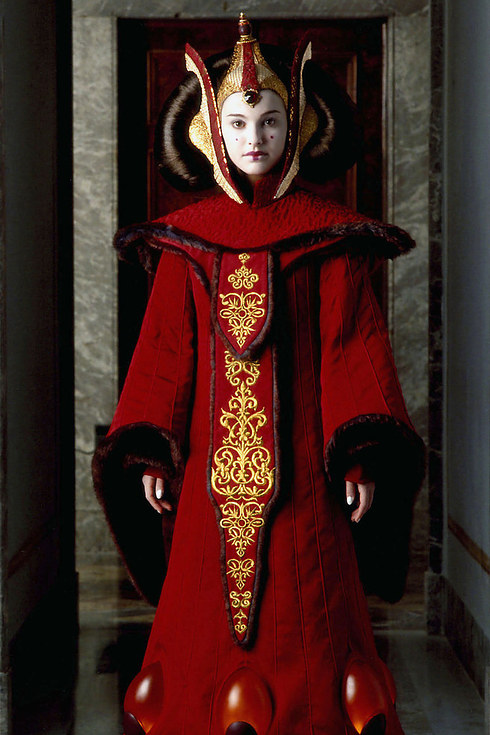
Padme’s Fashion
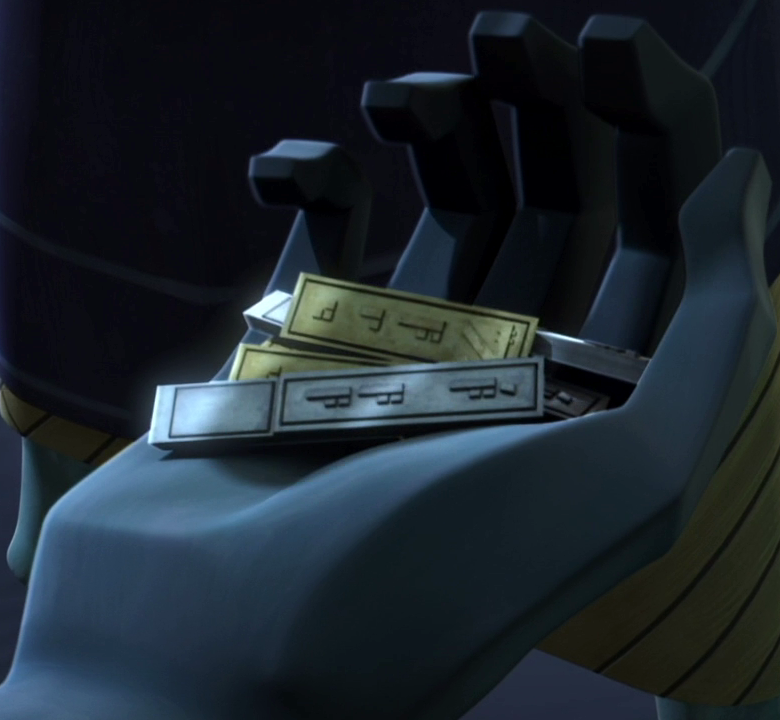
Credits
Cantina Band
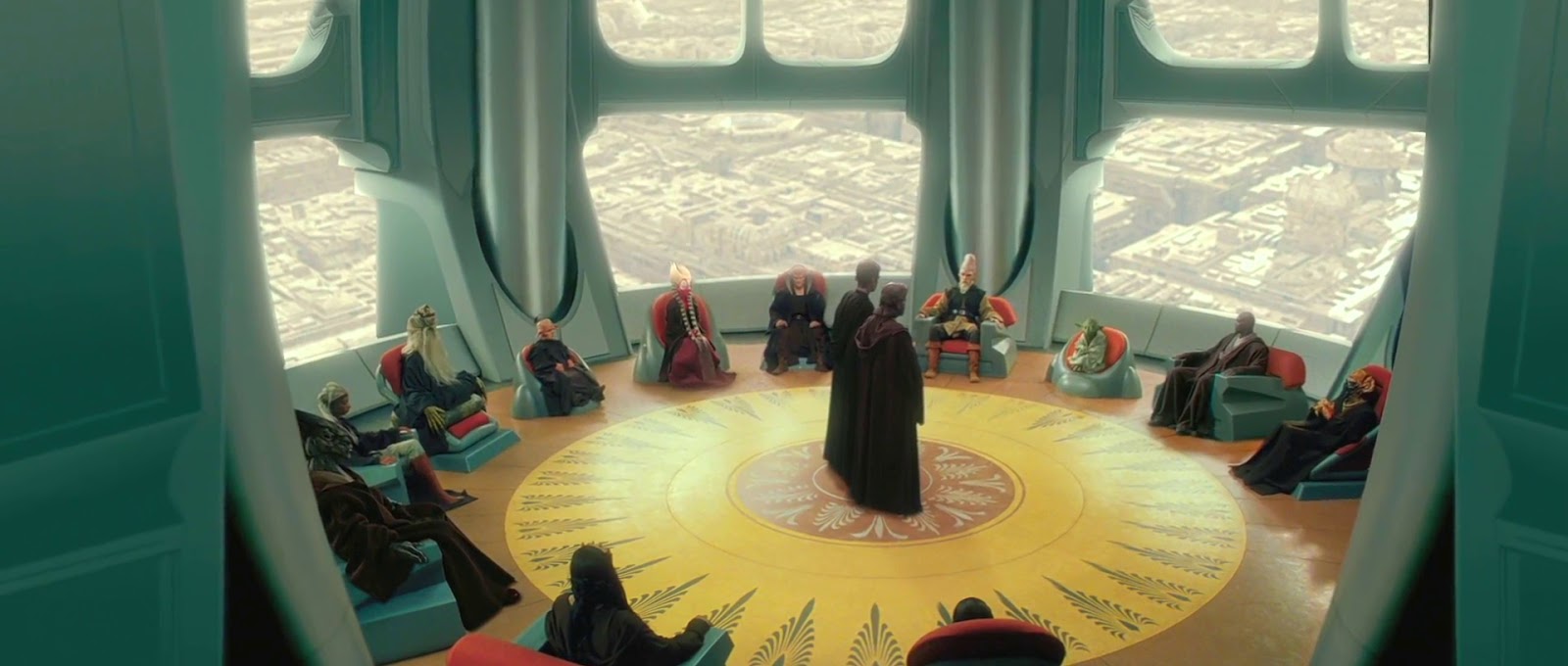
The Jedi Order
Mon Calamari Ballet “Squid Lake”

The above are just a few ways that Star Wars goes out of its way to show you that you’re in an alien world.  It has unique symbolism, fashion, cuisine, entertainment, economics, religions and customs.

But Star Wars plays fast and loose with distancing mechanisms.  On the one hand, it wants to remind you that you’re in an alien world.  On the other hand, it doesn’t want to alienate you.  The point of Star Wars is to tell a familiar story in a familiar setting, while bearing the tropes of familiar stories.  Padme might look weird, but she’s a princess and we know what that is.  The Jedi Order might seem strange and unusual (even the word Jedi is unusual), but they remind us of samurai.  The Caninta band is full of aliens playing weird music… but they’re a band playing in a bar, which is something we understand.  Even the most alien thing I’ve seen in Star Wars, squid lake, is an obvious play on Swan Lake.

Star Wars doesn’t invite you to explore the nuances of things, especially not in the movies (the expanded universe begins to resemble a more cohesive sci-fi universe though, for good or for ill).  It’s classic space opera in the sense that it knows it needs to look the part of sci-fi, but it doesn’t need to be sci-fi.  It needs to tell you a story you already know, only in spaaaace.  In this sense, what Star Wars offers aren’t distancing mechanism, they’re window dressing.  You’ll see this come up again and again, especially when we get to aliens, organizations and especially language.

Psi-Wars and Distancing Mechanisms

Did you know that the Twi’lek first got their name from the West End Games Star Wars RPG?  Let’s ponder what that means: One of the most identifiable races in Star Wars has never had their name spoken on the silver screen, and they only received their name from an RPG.  Why would this be? 
The goal of the Star Wars movie is to have fast-moving action.  George Lucas needs to show Jabba’s cruelty, so does it by throwing a dancing girl to a terrible monster.  But he can’t have just any dancing girl, it needs to be an alien dancing girl, so we slap some tentacles on a girl’s head, paint her green, and call her Oola.  Done.  You don’t need more than that.  Oola doesn’t need a big backstory or her own language or a homeworld or a rich culture full of ancient traditions.  She just needs to look alien, and so she does.
The goal of an RPG is different.  Someone will ask to play an alien.  Someone will ask to play someone like Oola.  They’ll want to be, say, a former slave turned jedi, who escaped the tyranny of someone like Jabba. But what are they called?  Where do they come from?  What do they eat?  Are they, just, like people with tentacle heads?  Why are they always slaves?  Are they always slaves?  A player needs context, and that means they need more detail than a movie has.
Thus Psi-Wars must part from the example given by Star Wars.  We cannot “simply through tentacle-headed girls into our game.” Or rather, we can, of course, but that’s something we’d do in all the previous iterations.  Now that we’ve turned our attention to actual setting building, we should build a setting!
The lesson from Star Wars is that our setting shouldn’t be too alien.  The point of a Twi’lek, even in the West End RPG, is not that she’s a bizarrely alien creature that we cannot begin to understand, but that she’s a space elf or a space hobbit or whatever, and that she has distinctive traits.  Some of those traits will be mechanical: perhaps Twi’leks are more graceful than humans (+1 DX) and the women are hotter (Attractive).  But some of them will be cultural.  They might have their own religion, their own language, their own traditions and their own situation.
The point in Psi-Wars for iteration 5 is to build pieces of these things.  Up until now, we’ve just been tossing whatever in.  “The Alexian Dynasty!” (what is that?  Who cares!  It’s a thing), or M’elena’s or Rafari’s race (“What are they?  Just grab a biotech template and call them aliens.  Who cares!  It’s a thing!”).  Now we want additional cultural details, but for now, let’s worry about them in the abstract.  The common refrain for setting design is “come up with three things.” So, for Rafari’s race, we might give them… a unique language, a unique tradition, a unique religion.  Which?  Well, if we have a grab bag of ideas already, or ideas on how to build those, we can set about making them.  We don’t need to make them completely alien or bizarre, but we should set our cultures, our races, apart from “the ordinary world”

The Distancing Mechanisms of Psi-Wars

This is going to take me a few days, so let’s sketch out how I’m going to do this while getting some ideas for distancing mechanisms for the cultures of Psi-Wars.
  • Linguistics: The languages of Psi-Wars
  • Economics: The money, resources and cuisine of Psi-Wars
  • Art: The fashion, entertainment, peformances, games and music of Psi-Wars
  • Religion: A look at the philosophies and theologies of Psi-Wars
  • Tradition: What makes a culture distinct?  Often it’s just what they do, day to day
Each element will be its own post.  I’ll discuss them in abstract, talking about what each element means and how to construct or use them in your own setting.  In Iteration 6, I’ll define these more concretely (“THIS is a race in Psi-Wars, and their cultural elements are these“), but one of the elements of both Psi-Wars and Star Wars is that they’re in a huge galaxy with more aliens and worlds and cultures than we can possibly define, thus this iteration serves a vital purpose in preparing us to wing any new race that pops up in the game.

Real World Cultures and Distancing Mechanisms

Rome elects to rip-off Greek culture
I’ve often referenced real-world cultures as examples of cultures that might be distant from, for example, an American audience  I’ll often reference non-American cultures, whether modern or historical, as I continue this process, and I’m not alone in doing so. Lots of sci-fi likes to rip off foreign cultures or bits of history when designing an alien culture.  Star Wars itself is particularly rife with examples.
I personally feel there’s nothing necessarily wrong with this, but it presents two problems.  First, by painting another real world culture as “alien and inhuman” you make it difficult for people from that culture to relate to it.  More importantly, though, it betrays a failure to understand the reasons behind cultural incidences.  The Japanese aren’t fundamentally different from Americans, for example; both are human and likely to respond in similar ways to a given stimulus.  What makes one culture different from another is more about circumstance than character.  If you understand the circumstances that give rise to a particular culture, you can find the pattern repeated throughout history and throughout the world, and then express that repetition in your sci-fi culture.
For example, if we discuss “Japanese culture,” we might talk about ninja, samurai, geisha, katana duels and crossroads, etc.  But the image of the samurai in armor and the ninja are both from the Sengoku Jidai, the warring states period.  Geisha, the modern katana and duels at crossroads with two kimono-clad samurai is more Edo period.  These two periods represent different circumstances and thus slightly different cultures.  Another element that we often associate with the Japanese is this very formalized, almost rituatlistic form of government, but this is most strongly seen in the Heian period. (To over-simplify) The period began when Japan was impressed with the Tang dynasty and sought to imitate their powerful, centralized government and consolidated power in the supposedly half-divine Emperor, who descended from Amaterasu.  Over time, the Japanese grew disenchanted with Chinese-style rule (What worked for China wouldn’t necessarily work for Japan), and the general, the Shogun, had grown in de facto power enough that he effectively ruled Japan, but they drew their legitimacy from the Emperor and his court, who were left with entirely ritual purpose.  They became an increasingly important religiously, and fixated on improving their mastery of ritual (and thus their use to the court).  The net effect was a flowering of literature, poetry and culture.
This concept of a largely ceremonial monarch, who engages in ritual leadership while real, mortal power resides in the hands of some other party, is hardly unique to Japan!  It’s arguably the point of all constitutional monarchies, where legitimacy is derived from a monarch who acts as little more than a ritual rubber stamp on the policies proposed by a parliament.  More explicitly religious ritual-monarchs can be found in Ancient Egypt and Ancient Sumeria, or the last days of the Merovingian dynasty in France, where half-divine kings would act as living exemplars of God, or divinely-mandated rulers, and as their power diminished, they were kept to maintain the legitimacy of whatever power actually ruled behind the throne.  One book I read, Spirit Possession and Exorcism by Patrick McNamara, proposed that these “semi-divine rulers” entered into a trance-like state while making judgments, and that the rituals themselves weren’t necessarily a sham to lull the populace into believing that the false king still ruled, but that the deep ritual traditions allowed the king to enter an altered state where he, supposedly, made better decisions, a sort of Oracle-King, communing with God while upon the throne.
If we find that idea interesting, we could use it in Psi-Wars.  Perhaps an alien race on a powerful and important planet has a long and powerful psionic tradition and have learned to imbue their ruler with real power by putting him in trance-like states.  The Empire has taken over the world, but hasn’t moved against the king.  Instead, they have coerced him into legitimizing them as his “faithful and trusted servants,”and they intercept all petitions to the king and “handle the paperwork for him,” ruling the planet outright while allowing the fiction of this ceremonial king.  However, the king does have a legitimate and powerful connection with Communion, and so you have this silent supernatural/political struggle between Emperor and Oracle-King.
Is that “Japanese?”  Is it “Egyptian?”  Is it “Merovingian?”  It’s a little of all of them.  It’s extrapolating a known phenomenon, working backwards to its source, filing the serial numbers off and applying it to our world.  In short, it does to history and culture what Psi-Wars does to Star Wars.  I highly encourage the practice.  Yes, it involves studying history and cultures, but that’s its own reward!

Psi-Wars and Social Engineering 2: Social Engineering Analyzed

Just as I did with GURPS Action 2, it’s worth going over each page of Social Engineering to see if there’s anything that leaps out at me as useful, and taking some notes as I go.  I’ve summarized my notes below, for the tl;dr crowd.

Summary

Understanding our alien worlds require us to create distancing mechanics, unique things that define aliens as other.

We need a reference society, the human-focused “Galactic Core” culture.

We need to better define Rank, including how many levels of it we have, what it grants us, and how it interacts with organizations

We should consider revisiting Status, perhaps even returning it to Psi-Wars.

If we wish to include Social Regard or Social Stigma, it might be worth defining what they are and how one gets them.

Social Engineering contains some rules on how aliens might work differently, though most “Communion-compatible” aliens are essentially human in their psychology, with only cultural differences separating them from humans.

The rules for diplomacy and perhaps some elements of administrative or legislative politics are fairly central to a hypothetical Diplomat template, though they need to be matched with working Action traits (in the same way that the Officer takes Mass Combat traits and makes them useful in a generic
Action game)

Check out the distraction mechanics.

Chapter 1: Social Relations in a Campaign

Cinematic Social Interaction

Easy Marks is a good option for Psi-Wars and Action, but it seems to by-and-large include it. Most social rolls just call for a roll, adjusted by BAD as usual. A few exceptions exist, mostly in Banter, but we could ignore them for mooks.

Speaking Freely isn’t currently pertinent as Psi-Wars doesn’t use Status, which might be something worth revisiting. Even if we added it, though, it’s simpler to ignore the differences.

Cinematic Traits aren’t pertinent, as Psi-Wars doesn’t use Wildcard Skills, though you’re free to change that.

Backgrounds

The Supporting Cast is just commentary on Allies (I highly agree that allies, enemies and dependents should have speaking parts! I find it weird when I’m playing with someone to whom all characters other than perhaps the big villain and the PCs never say anything except in a narrated “He says he’s unhappy” sort of way)

Customs of the Country is vital. The point of a sci-fi game is to explore exotic new locals. Star Wars has a very generic universe, but stops to take the time to show you weird aliens and lets you listen to their crazy music or participate in their crazy games (podracing). We’ll discuss this more later.

Plot Support

Most of this chapter is advice, and this section is no different. Note that all three things here, “finding a mission,” “supplying motives” and “carrying out a mission” are thoroughly covered by Action 2!

Social Themes

A variety here might prove to be interesting.

Buying and Selling is potentiallyinteresting. It’s not the main focus of the game, but smugglers might find it interesting, and it might be worth noting a rule somewhere where characters can get products or services cheaper. Note that Star Wars literally has a mercantile negotiation scene in it, even if it lacks details (“and fifteen thousand when we get to Alderaan.” fifteen thousand what?)

Politics might also be pertinent. It certainly mattered in the prequels, and also bored people to tears. I personally think, like in Action, this should be relegated to behind the scenes, an explanation as to whythe heroes do what they do, rather than something they do directly, but it might be worth looking at in broad terms.

Love and Marriage isn’t that important in Action, nor does it typically help our heroes in Star Wars. Romance certainly happens in both! But it’s incidental to the core of gameplay. That is, Psi-Wars is not a game of getting the girl to fall in love with you. That just happens by itself over the course of rescuing her, or getting frozen in carbonite, or whatever.

Idleness is interesting, not from the perspective of actually running a Psi-Wars game where characters “just hang out” but given the alien nature of the world, having a few alien diversions might be nice.

Exotic Worlds

Ah, here we go.

The GM’s most important trick in this kind of campaign
is distancing mechanisms: situations, customs, or objects that are alien and perplexing, both to the PCs and to the players.

Star Wars brims with this, from kooky hologram chess to weird, alien music played with weird, alien instruments to blue milk on a moisture farm to random mentions of “Galactic Senates” to weird names like Alderaan and Mos Eisley and chattering aliens with incomphrehensible languages, or discussions of how Tusken Raiders are a “superstitious people” who right single file “to hide their numbers.”

Star Wars is weird and exotic. It has the exact “distancing” mechanisms described above.
This whole section is a discussion of Cultural Familiarity, but that’s an extremely important trait here, not in the sense that we should charge more for it, or that we should really penalize people who don’t have it, but that you can bury a lot of interesting stuff behind the label “Cultural Familiarity.”
GURPS Action doesn’t talk a lot about it, but that doesn’t mean it isn’t there. It’s in two templates (the Faceman and the Investigator) and shows up in the list of appropriate traits. But Action already knows what the cultural familiarities are, because we’re familiar with them. To use Action Movie simplifications, if one goes to the Middle East, everyone speaks Arabic, is Muslim, wears veils, the women are particularly modest and hospitality is sacred. If one goes to Japan, everyone speaks Japanese, bows upon greeting one another, takes off their shoes in their house, and take honor verious seriously. If one goes to South America, everyone speaks Spanish (or Portuguese), they’re all catholic, etc.

For Psi-Wars, we’d want something similar, places with cohesive cultures that might be familiar to the denizens of Psi-Wars, but not to us, as players. We have to balance, though, between the impulse for richly designed and cohesive cultures, and the desire to just leap in and play. I’ll favor the latter for Psi-Wars, but that doesn’t mean we should have noculture.

The Reference Society

The other big one. If we have an Exotic World, we also need “home,” a place where our players feel comfortable. For Psi-Wars, that will be what I’ve been calling “the Core,” the center of the Galaxy and galactic power, where the Empire resides and where the Alliance wants to reside. It’s primarily peopled by humans, who have familiarculture. They’ll do things like hold a door open for a lady, wear clothes, eat while sitting at a table, watch space TV, etc. It should have a few crazy things, the distancing mechanics mentioned above, but they should be minimal: they don’t watch football, but space football; they don’t eat ham and green beans, but space ham and space beans, etc. Here, the distance is “minimal” while the farther from the “center” you go, the weirder it should get. Beyond the fringe of the galaxy should be worlds of weird wonder and terror. Thus, Psi-Wars embraces the pulpy aesthete of exploration.

Chapter 2: A Place to Stand

Social Position

The bulk of this discusses Wealth, Rank and Status. Wealth we’ve already tackled, so it isn’t particularlyimportant to go over again.

Rank

First, I want to point your attention to Converging Rank, because this will definitely come up in Psi-Wars. All organizations are fractal. That is, a sergeant runs a 10 man squad, and 5 squads serve in a platoon, and 5 platoons serve in a company, and so on. That means that platoon lieutenant is the boss of all the squads, but the sergeants are each boss over their own squad. Eventually, if you get high enough, you’ve slipped out of your military organization and into your overarching organization. This might be most clearly seen in the Force Awakens and the tense relationship between Huxley and Kylo Ren. Huxley is the top of his military heirarchy, and Kylo Ren is at the top of his (very small but super-important) religious organization. Both answer directly to Snoke. The Empire of Psi-Wars will be made up of a variety of smaller organizations.

Let’s talk the Arithmetic of Rank in regards to the scale of Psi-Wars. Rank 8 “governs an entire army.” Rank 9, then, would govern 5 armies. So, perhaps, someone who commands all of NATO or a vast army of about 1,000,000 people. Rank 10 might represent a general who commands all the armies of the world (about 5,000,000 soldiers, though, in fact, there are nations with armies nearly this large). Rank 11 might govern all the armies of 5 fully-populated worlds. In reality, we might expect there to be outposts and lesser colonies, so we might guess more like 10 star systems, or a small region of space. Rank 12 might govern all the armies over about 50 star systems, or a major region of the galaxy (or a pathetically small one, depending on how common populated worlds are). Rank 13 might represent someone who governs the armies of the galaxy, if we break the galaxy up into 5 parts.

The scale of an interstellar civilization is potentially staggering, particularly an old one like the Star Wars galaxy. Warhammer 40k comes pretty close to hitting on what that would actually look like. To dig into it more would require whipping out GURPS Space and making some hard decisions about how common worlds are, but as this is a generic setting iteration, I leave that to the individual GM to decide, for now.

Instead, I pose this question: What do you do with rank heirarchies in such a sprawling organization? If you have 12 ranks, you get some vast distance between the common grunt and the people who command them, but that’s not what Star Wars shows. Star Was collapses all of that down to remarkably small levels. In the Force Awakens, Huxley himself is giving a speech to the First Order, who seem to fit conveniently on a small moon, and then they fire a blast that destroys some five worlds, thus “ending the New Republic.” This is not a vast, sprawling galactic civilization with billions of worlds, each of which house billions of people. In fact, thinking of such a setting is a struggle for the mind, which is one of the things that, for me, makes sci-fi fun!

So what do we do? That’s a question I’ll leave to you for now. Action limits people to Rank 5, and it has upper limits for how much power someone can bring. If someone represents the Imperial Fleet as a 12-rank structure, can you go to Rank 8? And if so, can you reasonably ask for a full fleet of dreadnoughts to drop on your opponent? Is that practical or interesting? Do we limit people to the same Rank 0-5, and the fleet can go to 12, but a Rank 5 character can only call for local elements (like some assistancefrom a single dreadnought?) Or do we say that the whole fleet is squashed down to rank 8 to make it easier to rub elbows with grand admirals, and our “vast galaxy” is shrunk down to a more gameable level? That’s a question I leave to you, for now.

The Rank chapter also suggests alternate rank costs and alternate sorts of organizations. The former doesn’t interest me because I want to hew closely to GURPS Action and the standard GURPS rules where possible. That said, it’s interesting to note that there are multiple ways to get to “5 points.” It might be worth reviewing while we design whether rank 5 in the Imperial Fleet is as worthwhile as Rank 5 in a pirate fleet, or in the Order of True Communion. For example, the Imperial Fleet has Nominal Heirarchial Position (1), Chain of Command (1), Access to Large resources (2), Dominance (0) and Legitimacy (2) for about 6 points per level. A priest of a forbidden order of True Communion has a Nominal Heirarchy (1), no chain of command, access to typical resources (mostly training, secret temples, etc) (1), Special Assets (visions into the future, super-powered masters who can help you out, etc) (1) and perhapsLegitimacy (2), but in the sense of serving society rather than the emperor. That’s only 4 points, but if we argue that the Imperial Navy lacks legitimacy, that people will rush to help a priest but only does what the naval officer demands out of fear of death, then the Imperial Fleet is only 4/rank. Balance!

Page 51-52 talks more about rank, but most of it is just the rules from which Pulling Rank are derived. The section on “Variant Rank and Its Benefits” present an interesting guide for offering different benefits for different types of rank. Legitimacy doesn’toffer such a benefits, but it couldoffer bonus status, which brings us to a problem, in that we don’t have status. Free Social Regard might be an interesting alternative.

Status

Which brings us to the next pickle: Status.

So far, I’ve neglected Status because it doesn’t show up in GURPS Action. This makes sense: the kid from the streets rubs elbow with the disgraced politician, and neither worries about the status of the other. Nobody cares that Dominic Torreto is from the streets, or that Bond isn’t. For that matter, Kingsmen proves how pointless status and class is in your typical action movie. You need to be able to walk the walk, but where your family came from doesn’t matter.

But GURPS Action takes place in a classless meritocracy. In our world, you’d hire a programmer from the streets as quickly as you would the programmer son of a nobleman, so long as they could code. But is Psi-Wars a classless meritocracy? Star Wars certainly isn’t! It features princesses and counts and emperors! That doesn’t sound like a classless meritocracy… except on Naboo, “Princess” is an elected position (?) and Leia Organa was the daughter of a senator, not a king. So… what is it?
That’s up to us to decide, of course, because it’s Psi-Warsnot Star Wars. But what does it add?
In a lot of ways, Status is a self-serving system. You only need Status if other people have Status. It creates a distance between people. If you want to talk to a Status 4 person and you have Status 1, you’re at -3 to reaction rolls. He’s not impressed by you, but you’re impressed by him. Why? 

Because he access to power, via wealth, good friends or connections to the government. In a sense, if one has high rank and wealth, one already has Status… which is why those two things give you imputed status!

Status also grants some additional benefits, mainly found on page 26 and 59. First, you get a reaction bonus equal to the difference of your status, if you have more status, or a penalty if you have less status. This latter is waived if we use cinematic social rules.

The second is “similar to the benefits of rank, but more diffuse”: You can take command, lend your legitimacy to a campaign (including your own election), and use it to gain easier admission to things. This last is interesting, but involves a complex system that I worry nobody could work out fast enough, but the principle seems sound: A princess has an easier time getting invited to the great party than some jerk from the streets.

If the benefits of status are “similar to the benefits of rank,” why not simplify that entire system into something akin to pulling rank? Someone with Status +1 can make a request for information or a minor favor and succeed rarely, while someone with Status +8 would almost always get what he asked for. That might be an idea worth exploring further.

If we did add Status, we’d have to decide what sort and how much. Noble positions are usually ascribed, so something like a title would grant static status based on one’s position. Or we could use Achievement for elected princesses and former slaves who later become dark lords of the sith. We would also need to decide on the range of status, though I would use our decisions on rank as a guide.

Other Social Traits

Reputation is already fairly well established, though it might be worthwhile to offer some examples. I also say a suggestion somewhere for institutionalized reputation, such as medals offered to officers.
Social Regard and Social Stigma are interesting too, but also going to be culture specific. The Priests of True Communion might be Venerated, while the priests of the Death Cult might be Feared. We’ve already established that Robots are Subjugated, as are slaves, and we have alien Minorities and Criminal Records. If we make Status a thing, Disowned might be useful. Even with our deeply defined religions, unless those matter day-to-day, Excommunication is worthless, unlessit carries some kind of supernatural weight. Uneducated might be appropriate for some alien races, such as the equivalent to Ewoks. Monster might be appropriate for certain sufficiently horrific alien races (the Psi-Wars equivalent to a Xenomorph)

For further traits, Claim to Hospitality, Legal Enforcement Powers and Security Clearance already have representations in Action and thus have a place in Psi-Wars. Clerical Investment might be pertinent if we have true “religions of Communion,” and might act as a prerequisite for joining a religious order. Legal Immunity might apply to Diplomats.

Making an Impression

Most of this discussion covers familiar topics, like Charisma or Voice, etc. These work the way one expects and need no further definition for Psi-Wars.

Visible Status and Cost of Livingis well-worth a read. If we want to benefit from status, we must display status… but how? What are the rules of fashion for psi-wars? Do men wear suits (or simple, modest wear that doesn’t really show status in a flagrant way)? Or do the nobility dress up like ridiculous peacocks, or something in between? We need space opera fashion. It’s not something we need to tackle right now, but something we need to keep in mind.

Finally, we have a section on Giving Offense, which could be summed up as a paragraph on Odious Personal Habits. It might be nice to note what some common ones might be.

Chapter 3: Face to Face

Here we have the core of our social engineering rules, as most people will see it.
Most of these aren’t relevant for Action. Or, better said, most of them have already been covered by action and do not need to be revisited, though you’re free to do so.

Exotic Social Traits

This, however, is very pertinent, given the presence of aliens in Psi-Wars
Appearance does require some discussion. It should be noted that Star Wars has aliens with essentially human psychology. That is, a sexy female space alien has the same sort of traits we’d expect from a sexy human woman, rather than an especially shiny carapace of her her well-shaped thorax, bristling with succulent egg-sacs. Psi-Wars supports this with how Communion works. That is, a space elf and a space goblin see the world the way we do. They understand the same archetypes and they respond roughly the same way to things. They might reinterpret things, but this is cultural. There are aliens that do not work this way, but they fall outside of Communion, having an alien psychology, and are covered by the archetype of The Other. This doesn’t mean they’re all monstrous, but rather than ourCommunion views them as monstrous.

Perception and Communication is interesting, mainly for racial design. If we’re going to apply a +2 to body language rolls for characters with Infravision, then that should apply to characters using Infravision visors.

In fact, this applies broadly. When it comes to Bridging the Gap, we can ignore different mentalities, though if we feel the need to look at them anyway, apply a -2, which can be overcome with a technique if we wanted that level of detail. Only “Other” alien races would fall under worse penalties.
Racial Reputationsdefinitely apply, given the overwhelming influence of the galactic core on how other races are viewed.

Chapter 4: The Organization Man

Most of this is also already covered by GURPS Action, mainly in the form of Pulling Rank, nor not particularly relevant.

Organizational Skillspresents an interesting alternative to Administration as the prime complementary skill. For example, Philosophy or Theology might matter more for our Communion-focused organizations.

Going Through Channels is also interesting, mainly to remind us not to be jerks when a player asks for something that’s completely reasonable to ask for.

Blackmail is something notcovered by Action, though it seems like the sort of thing that would be. Perhaps it’s best left as is, as it requires no special traits (other than dealing well with Secrets), but it’s an interesting topic to look over, and it doesn’t require any simplification to work well with a game. Feel free to add it!

Chapter 5: Moving the Masses

Most of the stuff that matters here, Action has already simplified and covered, with the exception of Statusand various stuff associated with Politics. Status I’ve already touched on, but Politics is worth looking at.

Politics, of course, matters in the same way that Mass Combat matters: It provides a context to what people are doing. Psi-Wars heroes don’t generally fret about the legal meanderings of passing a bill. Instead, they’re the ones that break into offices, find out a politician’s secret agenda, and then rush to rescue someone before they’re assassinated in an effort to prevent them from speaking out in support of a bill, etc. Even if the Action character is, herself, a politician, she’s an action politician, and the political stuff gets swept under the rug.
If we look at it the same way we did mass combat, we might ferret out a few ideas for how things work.

Administrative Politicswill be typical of how most organizations run things, if it matters. The Imperial Fleet is ultimately a bureaucracy, for example. They’ll tend to favor policies that help them expand in scope, and that don’t go against the current status quo (that is, they oppose change). The most pertinent skills are Writing, Administrationand Law, though I think I’d make Administrationthe most important, just for simplicity.

Electoral Politics would be typical of the old republic or the alliance. These tend to favor high status, public personas and ruthless uses of Propaganda. Politics is your key skill here, with assists from Propaganda, PublicSpeakingand ExpertSkill(PoliticalScience) helping out. This is a more dynamic politics, though it can quickly resort to a popularity contest, where image matters more than substance. Thus, such politicians would seek to bolster their image. This is obvious in modern politics, but it was certainly true of the Roman Republic as well!

Revolutionary Politicsare violent responses to totalitarianism, thus common in Psi-Wars. Such “mob” politics are maniplated with Politicsprimarily, but also Propaganda and Psychology. I think I would include Public Speakingtoo.

Totalitarianismcomes down to influencing the dictator. The sidebar on 64 suggests that all dictatorships have massive propaganda efforts, secret police and death camps. If we want our Empire to fit this mold, we should have them as well.

Alliances and Diplomacyis the raison d’etre for the Diplomat. If we want to roll this out, then the skills that matter are Diplomacy,Intelligence Analysis, Pyshcologyand perhapsFast-Talk. Lawalso matters for working out the exact details of the agreement.

Chapter 6: From Persuasion to Force

Action already covers all of this in the simplified Banter section except for Creating a Distraction, which might be worth revisiting in a simplified form. The rules listed here Social Engineering will work well enough for Psi-Wars, though.


Psi-Wars and GURPS Social Engineering

For my next trick, I’d like to look at GURPS Social Engineering and its associated products, like Pulling Rank.

Normally, this would be the part where I argue against its inclusion, because each new element we add has a cost.  We need to write it all out, work out the details, fold it into our game design, and then our players need to learn it. And, in fact, GURPS Action already has a lot of social rules, so why bother with Social Engineering?

Because Social Engineering is a very different book than books like Mass Combat.  It more closely resembles GURPS Martial Arts or Thaumatology in that it’s a list of ideas that we can take or leave as we wish.  In fact, GURPS Action already uses some material from Social Engineering (Pulling Rank is derived and simplified from it, for sure).

Moreover, GURPS Action’s social rules don’t cover enough.  It assumes Earth at TL 8, while we’re tackling a galaxy far far away at TL 11^.  We need to think about aliens and strange customs and the impact of galaxy-spanning organizations on the interactions between individuals.  We don’t necessarily need to incorporate ever element from GURPS Social Engineer, but we should, at least, consider them, and get an idea of what might need to change, and what is fine as it is.

Naked GURPS Action: What we already have

As stated before, GURPS Action already has a lot of social mechanics.  Let’s take a quick look through there and see what’s already in place before we move on to actually looking at how GURPS Social Engineering works.

Pulling Rank

This is probably the most important part of “social engineering” in GURPS Action, and it shows up right there in book 1.  The Officer already has some elements from here, and I’ve already made a few adjustments.  Obviously, Pulling Rank needs to change considerably.  The benefits that one can get from asking a TL 11^ space empire are vastly different from what one can get from a TL 8 government (for example, we don’t get helicopter flybys!).  Moreover, what organizations we can ask and how they interact is worth looking at.  I’ll look at this later, though, as I think this deserves a much deeper look than a post or two.  And, indeed, it has its own book, with an additional follow-up book, Boardrooms and Curia!
Important skills and traits here are Smooth Operator (and Intuitive Statesmen!) and Administration.

Social Engineering

Starting on page 15 of Action 2 we have Social Engineering, which discusses how to bribe, manipulate, interrogate and interview people.  It also discusses “word on the street” and how to deal with contacts.  In brief, Social Engineering in Action focuses on rapidly persuading someone, or getting information.  That’s its sole focus.  It has one last optional point in Fitting In which is just generally getting along with others from your organization.
Important skills and traits for this are typical influence skills: Savoir-Faire, Streetwise, Intimidation, Sex-Appeal, Fast-Talk and Diplomacy. Connoisseur, Gambling, Dancing, Carousing, Merchant, Public Speaking, Interrogation, Psychology, and Detect Lies all also make an appearance.

Deception

Starting on page 26, this mostly covers hiding evidence more than anything else.  For more social manipulation, Impersonation and psy-ops discuss manipulating people directly.  The main focus here is fooling others into believing what you want them to believe, allowing you to get away with some kind of clever scheme. Important skills and traits here are typically Disguise, Fast-Talk, Acting, Propaganda and Psychology.

Banter

Finally, on page 35, we have a discussion on Social Engineering in combat.  The point here is to distract, frighten or enrage opponents.  Psychology is your prime skill here, but Fast-Talk and Intimidation make appearances as well.

Social Engineering in Action

So what we have here are five basic goals:
  • Manipulate an organization to get some sort of assistance
  • Manipulate people directly to get them to do what you want
  • Manipulate people to get pertinent information from them
  • Fool people so you can get away with some scheme
  • Manipulate people in combat, either to distract them or to drive them off completely.
All social engineering here is driven towards the goal of finishing the mission.  You look for information to solve the mystery, then get people or organizations to help you succeed at the mission, through either trickery or combat (which is supported by social banter).
What we don’t see here is detailed politics, romance, hassling with legal troubles, mercantile negotiation, etc.  Any Social Engineering we apply in Psi-Wars support similar goals (which isn’t to say that you can’t add, say, romantic mercantile negotiations into your games, but that Psi-Wars, like Action, shouldn’t support it out of the box)