On the "Erasing" of the Sequel Trilogy

I like to pay attention to corporate boardroom drama, because I find management successes and failures to be profoundly interesting, likely because I’m a computer programmer by trade, and “automating procedures” is what I do, and studying how companies fail or succeed at these things are interesting.  So one of my side hobbies has been tracking the management, and mismanagement, or Star Wars since Disney bought it.  I’m more interested in the tales of woe from behind the scenes (such as the stories behind why nearly every director for a Star Wars film has been fired before completion, leading to often expensive reshoots and reworks), and it’s not just Star Wars that interests me, but studying up on the stories behind (for example) the Snyder Cut has been very interesting to me as well.

This means I sometimes delve into the rumor-monger parts of Youtube, as that’s where you’ll get these stories, as what comes out in official memoirs is always carefully sanitized.  My preferred channel here is Midnight’s Edge, as they tend to be fairly professional and look into the parts I’m most interested in, which is the management stories themselves.  There are others, such as Doomcock above, who prefer to focus more on bashing on what they perceive as failures of the franchise, and condemning what they feel are bad narrative choices or “abusing the audience.” To be clear, I think that’s happened, and I think there’s an interesting discussion to be had about the creator/audience interactions on platforms like twitter, and how they go sour, and how the platform itself interferes with those discussions, but that’s not the core topic that interests me.

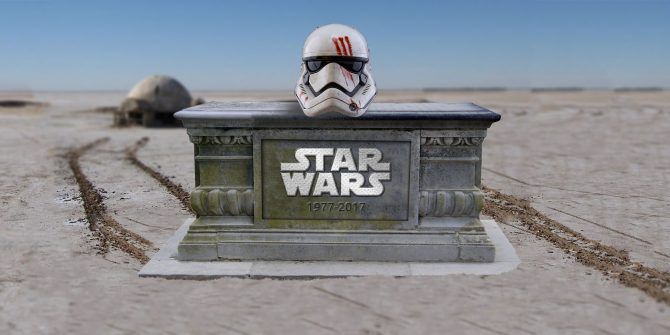
However, recently, something has happened that I find remarkable.  Doomcock, who reports rumors, that he claims to get from inside sources have suggested that Disney might be preparing to “erase the sequel trilogy from canon.”  Midnight’s edge hears similar rumblings, but they report it in a more nuanced way.  This is not remarkable, as rumor outlets like this are always reporting the demise of their hated foe, Kathleen Kennedy. What is remarkable is how much traction it’s getting, when “mainstream” Star Wars commentators, like trades or Eckhart’s Ladder, start responding to these rumors, and not to “their own sources” but effectively just to Doomcock’s report.  That is, we’re getting papers reporting on someone reporting on rumors.

So the first thing I want to say before I go further is to make sure it’s clear what the state of this is: some guy who likes to talk crap about Disney’s Star Wars discussed an unconfirmed rumor he heard from a source who may or may not be lying that Disney is considering erasing the Sequel trilogy, and people are talking about that guy.  There is nothing, nothing, confirmed about this.  I’ll let you decide for yourself what this says about the state of modern journalism that it’s getting picked up some widely.

Nonetheless, given that it’s hip to talk about, and it touches on several themes important to why I do Psi-Wars, I thought I’d talk about it a bit myself, and what it says about audiences and how you can translate that to your own games.

Seeking Legitimization

Someone once quipped something like “America used to be a nation of people who solved problems; now we’re a nation that petitions management to solve problems for us.”  I don’t know how it happened; I suspect the internet and “slacktivism” has something to do with it, but a lot of people seem fixated on “official” things, like Star Wars, and to ignore everything that falls outside of that purview.
The reason Doomcock is reporting on this is because his audience is desperate to hear it, and they’re desperate to hear it because they hate what Kathleen Kennedy has done with Star Wars and they want that frustration legitimized by Disney itself. By issuing a formal statement like “Kathleen Kennedy has been fired because she ruined Star Wars” and/or “We’re removing the sequel trilogy from canon,” it will make this particular fan base feel justified.  They’ve largely been maligned by people like Rian Johnson and certain media trades as “Trolls and bots” whose opinions somehow don’t count, and that has incensed them and they need to have that “wrong” rectified.
I don’t see it happening, and I don’t see why it’s necessary.  This goes back to the core reason behind my call to “Don’t Convert, Create.”  A lot of “conversion” happens because people see established properties, like Warhammer 40k, Star Trek, Star Wars and others as “legitimate” and their own work as “illegitimate” and they seek the legitimacy of the establishment. By converting a setting to an RPG, it gives them this illusion of control over that establishmed property: “In my Star Wars setting, I’ll do it right and X will actually be Y.” You see this a lot in fan fiction.  There are a lot of problems with this, but to me, the greatest problem is this idea that your own ideas are illegitimate, and that only established properties, specific established properties, actually “count.”
Corporations love this, of course.  It’s all the rage right now to pick up a property, lambast any similar properties you don’t own as inferior, and then tell whatever story you want to tell with that particular property, and then criticize those who criticize it as “entitled” or whatever. This creates a perception that their story is the only “real” source from which you can get your enjoyment, so love it or hate it, you must fork over your dollars.  This is a good tactic, if you’re a big corporation, but it’s not one that you, as a consumer, should be buying into.
If you don’t like the stories of a property, then stop consuming it.  If you liked DS9 and Star Trek: TNG, but you hate Star Trek: Discovery, then stop torturing yourself with Discovery and go back and watch reruns of that show that was great. If you want something new, something fresh, go look around and look more broadly than Star Trek: check out Farscape or Andromeda.  The same applies to Star Wars: I prefer the Mandalorian and the Clone Wars to the Last Jedi and I couldn’t make myself sit through Resistance or the Rise of Skywalker… so after a good college try, I stopped and moved on to the things that interested me.
Furthermore, there are hundreds and hundreds of outlets out there trying their hardest to create the product that you want, but are overshadowed by these big, corporate properties.  There are dozens of indie RPGs, or niche computer games, or sci-fi authors that feel the same way as you do about X, whatever X is, and are trying to cater to you, but if you’re busy yelling at Kathleen Kennedy, you might miss them and what they’re doing.  Imagine how frustrating it would be if you were in their shoes, saying “Oh yeah, I too wish Star Wars had a more mature political environment like Game of Thrones, so I wrote this book, but nobody will read it because they would rather complain about Star Wars.” So, why don’t you go explore those and invest in the authors and properties who reward your investment while discarding those you feel don’t?
And once you do that, once you escape the walled garden of a corporate property, you’ll discover, first, how derivative the corporate property is (not that this is necessarily a bad thing, but let’s not pretend that Star Wars or Star Trek are the most innovative or original properties in the world), and how wonderfully full of ideas the world actually is.  You can start to synthesize those ideas into your own world and setting, and you might even find you have an amazing product when you do.  Literally every product you love got its start doing something like this. And you can really tell the quality difference between someone who paints by numbers vs someone who dives into the depths of a thousand interesting sources and then collects them into one thing.  

Your work is legitimate. Your complaints about an established property are legitimate. You don’t need anyone else to tell you that, or to admit it to you. People who insist on it are putting their hopes and dreams in the hands of someone else, which is a recipe for misery.  So don’t do it.

On Creative Evolution

Now, with that out of the way, let’s return to what I suspect is going on inside Lucasfilm and how it relates to you.  In truth, the Sequel trilogy certainly choked; whether you believe it did so at TLJ (as I do) or RoS (as the trades are grudgingly beginning to admit), the sales of Star Wars films and their merchandising have disappointed Disney.  What hasn’t disappointed Disney was the reception of the Mandalorian!  Those toys took off like crazy (everyone wants a piece of Baby Yoda), and you can tell from what’s making headlines in Star Wars news that the Sequel trilogy is out, and the Mandalorian is hip.  I hear constantly about stars trying to get a role in Mandalorian Season 2, but crickets about the next set of Star Wars movies.
So, imagine for a moment that you’re writing the Mandalorian Season 2, or a new animated series, or the Obi-Wan series: what is your focus? Is it on the sequel trilogy? Probably not.  Here’s what I suspect your likely sources are: the original trilogy, the prequels (especially if your work is set in an older period), the works from the Expanded Universe (to be strip-mined for ideas), and broader works of fiction (again, to be strip-mined for ideas). And you’re going to write what you need for your show.  If you’re discussing the Mandalorian, you might want to focus on stuff that also dealt with Mandalorians, like the EU’s discussion of “the Great Hunt,” or maybe you’d borrow from Predator because an episode where the hunter is hunted might be interesting, or you might take him on an adventure off to a distant land, based on some pirate story like Treasure Island; you might reference Ord Mandel, as they talked about it in the Empire Strikes Back in reference to a Bounty Hunter, so maybe it’s a place a bounty hunter should visit, etc.  That’s where your focus will be: pulling material that will help you create the best work you can from the hear and now.
The Sequel Trilogy helps you very little.  First, it’s set in the future, so at best it’s something you work your way towards. You can’t introduce Snoke or Kylo Ren in the Mandalorian, because those characters are in the far future from where the Mandalorian is.  Even if you were going to, what will you introduce? The sequel trilogy had a problem (one that was not of Kathleen Kennedy’s making) in that it chose explicitly to retreat the original trilogy. It gave us a new Empire and a new Rebellion, new Jedi and new Sith, which created this perception of this being a “second rate original trilogy,” a copy rather than an original.  They did this because they saw the prequels as “risky,” and retreading the original trilogy as “safe,” and it worked: it filled seats in a theater.  But for the long term you’re left with a problem.  Now, if you want to tell a new story about imperials fighting rebels with only a few force users valiantly defending the rebellion while a dread and dangerous force user stalks our heroes, where are you going to tell it? In the original trilogy era, of course.  It’s all already there.  What benefit is there to telling it in the sequel era? What do you gain? Nothing.  The prequels (and other settings like KOTOR) have the benefit of supporting other sorts of stories.  And that’s really what you want out of a future setting: it should allow you to tell new sorts of stories that you couldn’t tell in the modern era.
Worse, the sequel trilogy have the emergent quality of invalidating the original trilogy.  To create an empire and a rebellion, you must undo the heroic and righteous New Republic that Luke, Leia and Han sacrificed so much to build.  So if you want to write something between the OT and the ST, you have to write about how the heroes of the OT totally screwed everything up, and I don’t think that’s a story Star Wars fans want to read, or Star Wars writers want to write.
So here’s what happens: you write the story you want to write, now, and in the present.  You don’t consider the sequel trilogy because you’re not writing in that era (and you don’t really want to anyway) and because it doesn’t offer you anything interesting that you don’t already have. And you’ll let your story go where it necessarily needs go to. And in so doing, you’ll start to devise setting changes that support the story that you’re trying to tell, and that will inform the development of the setting.  If the evolution of the setting towards the First Order and the Resistance supports future Mandalorian episodes, then those elements will get included, but I don’t see that happening.  There’s very little interesting in the sequel trilogy that would make for a better Mandalorian episode or for an interesting 5 seasons of an animated show.

Not Erased, but perhaps Forgotten

What naturally emerges from this process is that material that isn’t useful slowly gets winnowed out.  If the sequel trilogy serves no purpose to the story you write, you won’t use it, and if nobody uses it, it’ll slowly get replaced by things people do use.  You don’t need to make a sweeping statement about how you’re not going to use it, and it’s not even useful to do so: it would alienate the talented people that worked on it, and it might be that you do want to use some of it.
What will happen, inevitably, as this process continues is that the Sequel Trilogy, where it isn’t useful, will fade into memory, in the same way that the Christmas Special and the Ewok films did.  Nobody came along and declared them “Non canon!” but people just ignore them.  They’re relevant primarily as trivia.
And yet… In the first episode of the Mandalorian, a bounty mark mentions “Life Day” which is a reference to the Christmas Special.  As I mentioned above, if it’s useful, people will use it. “Life Day” is a holiday, and if you need the mention of a holiday in Star Wars, why not that one? It’s a nice nod.  Even for things that nobody likes, that people wish would just go away, there are still neat ideas you can mine.
Audiences, including your players, tend to form a “head canon,” the things that stand out to them and make sense.  They begin to treat something as “standard” and other things as irrelevant.  For example, there is never once a mention of “the light side” in the original trilogy.  In fact, the Jedi and the force is much more subtle in the original trilogy than in the prequels or the sequels.  The original depiction of the force had “the Force” which was in balance, and “the Dark Side” which represented a disbalance in the force.  Luke “bringing balance to the force” was about exising the Dark Side.  But we don’t treat it like that anymore.  Now, we talk about a “light side and a dark side,” like a yin and a yang, and balance was eliminating both too much light and too much dark. The idea of the “Grey Jedi” as a truly balanced person was introduced slowly, as a logical conclusion of this thought process.  The creators didn’t will it, they didn’t force it on the audience, the audience came to that conclusion and the creators accepted it.
This happens subtly and I  predict it will happen with the sequel trilogy.  There are elements that I think even the detractors of the sequel trilogy like, or just assume are part of Star Wars now. These include (among others):
  • There’s an imperial remnant called the First Order somewhere out there
  • There are other dark side users out there plotting
  • Leia and Han have a force sensitive child named Ben Solo
  • Stormtroopers aren’t clones, and they can decide to go rogue; they can have personalities.
  • Jakku
  • The advanced look of the First Order and the new X-wings
Most of these were put forward by the Force Awakens which, to my eye, excited Star Wars fans the most.  J. J. Abrams is very good at creating an interesting and engaging mystery box, and most of the objections to the sequel trilogy arise from objections to how those mystery box elements were treated (and the way the ST invalidates much of the OT). I predict, just like how Life Day from the Christmas Special, you’ll see these elements slipping into Star Wars canon because they’re useful and because everyone assumes they were always true. They might not be alone: the First Order might be one of many imperial remnants, we will certainly see a variety of new worlds, we might see new Dark Siders emerge, who may or many not compete with Snoke (who may or may not appear in the continuing Star Wars sagas).
This finally brings us back to you and your players: if I were you, I’d watch for these sorts of Head Canons popping up.  Players assume things work a certain way and will begin to operate that way.  This may or may not be true based on the material you’ve created, but you need to be careful about correcting “head canon.”  It can create hostility.  In a very real sense, the audience and creator cooperate to create the shared story between the two of them.  It’s an illusion that the audience is passive: how they receive it can and should shape how the creator continues to create.  And this is never more true than for an RPG.
So anyway, in conclusion, I think this whole rumor is a tempest in a teapot and safely ignored.  The “erasure” of the sequel trilogy, if it occurs, will be piecemeal and slow, a natural evolution of the needs of current Star Wars creators. It will not completely erase the ST, as there are some useful elements in there, but I predict not enough to keep it whole in the long term.  I don’t think you’ll ever get a grand, sweeping statement of the non-canonicity of the sequel trilogy, but even if you hate the sequel trilogy, you really don’t need it.  Just consume the things you like, and ignore the things you don’t.

May the 4th Be With You!

Ahh, it’s that one day of the year when us Star Wars geeks get really annoying and think we’re cute!  Given the day, I wanted to take a moment to reflect on the current state of Star Wars for myself.

Personally, I’m fascinated by the current era of Star Wars, but for all the wrong reasons.  I like digging into politics and management stories, especially when they fail, and the behind-the-scenes stuff on Lucasfilm lately has read like a disaster investigation, but for management.  It seems the power-struggle is, in fact, still on-going, with some weird (shady?) things going on in the background.

So it should come as no surprise that the Star Wars community is, shall we say, pretty divided over the current state of Star Wars.  One common refrain I hear is “Star Wars is dead to me.”  I think that’s a mistake.  It’s certainly not dead for me. In a lot of ways, Star Wars is more alive for me than it has ever been before.  To my ear, that refrain sounds like when a new edition of an RPG comes out, and you dislike it, so you throw out all your old books.  The old works are still around. Just because you don’t like the new stuff doesn’t mean the old stuff got retroactively worse.

I will never be the guy who tells you to like something out of brand loyalty.  I think if you didn’t like the Last Jedi or Rise of Skywalker or anything that’s come from Kathleen Kennedy’s Lucasfilm, that’s your right, and you should acknowledge your experience.  There is an entire world of interesting space opera and pulp adventures that I can recommend to you instead.  But at the same time, I don’t think you should throw the baby out with the bathwater.

I’ve really enjoyed the Mandalorian.  I’ve really enjoyed Rebels.  I’ve really enjoyed Clone Wars, and its latest season (with the exception of one episode which, while fun, you could have missed and not realized you had done so; for the “last season ever,” I don’t think you have room to waste on a literal filler episode; the fact that you’re spending time on money on a wasted episode makes the episodes or moment you didn’t do but could have seem all the more galling).  Jedi: Fallen Order is actually really good!  I’m actually increasingly curious about the other Streaming Star Wars offerings.

But for me, what’s really jumped out at me hasn’t been the galaxy of the future, but the galaxy of long, long ago.  As a kid, I had skipped the EU as bad knock-off of the real thing. This was a mistake.  It’s got some great stuff! I’ve been hunting for “space opera pulp that feels like Star Wars, but isn’t the familiar Star Wars” and it turns out what I was looking for was… Star Wars!  A lot of the Old Republic stuff is especially good.  I’ve gone through the Dawn of the Jedi, the Old Republic Comics (including, especially, the Knight of the Old Republic comic, which is some of the best stuff I’ve read, even if the art has varied wildly in quality over that series).  I finally sat down and beat KOTOR (I’m still trying to get through KOTOR2, which I suspect I’ll enjoy more, but I keep running into technical difficulties) and while Star Wars: the Old Republic is held back by its insistence on copying Warcraft mechanics, the stories in it, and the worlds it shows you, are magnificent.

I think what writing Psi-Wars has helped me do is liberate my mind from the confines of the original trilogy and get a better feel for what Lucas was trying to do in the first place.  When I was a kid, a lot of my friends liked West End Games Star Wars, but for me, back in the early 90s, it was too bound to the trilogy.  All you could be were knock-off characters of the trilogy, and all you could do were knock-off things of the trilogy. The trilogy dominated everything and it was hard to figure out how to be creative.

But now that I’ve explored what inspired Star Wars to begin with and seen other people dive into new and interesting directions in Star Wars (especially in the Old Republic, the Prequels, Clone Wars and Rebels), and now that I’ve done it myself with Psi-Wars, I think I could do it with Star Wars.  If I were pressed to run a Star Wars RPG, I could easily whip up an innovative set of star systems with unique cultures and underworlds and exciting new bounty hunters or criminal cartels, and create a totally new Star Wars adventure.  Or I could draw on the broader material of Star Wars.  The ideal would be a synthesis of both: the familiar (to remind you that it’s Star Wars) interwoven with the novel (to keep you from being bored). Given a choice, I’d rather run Psi-Wars, but mostly for similar reasons that I prefer DF over D&D: I like how GURPS runs, and I feel like I have more explicit freedom from my players when I’m running “my own thing.” But I could do Star Wars, which is something I couldn’t really do before.

So I suppose, in the End, I’m pretty okay with the current world of Star Wars. Sure, a lot of stuff is burning down right now, but that’s often what it looks like when an era is ending.  The Star Wars community is passionate, which means passions run high, but at the end of the day, you can go to marvel streaming comics and get every Star Wars comic ever released (or close to). You have an unbelievable amount of Star Wars available to you at your fingertips on Disney+.  You have a ton of Star Wars games that go on sale every May the 4th every year. And if you tire of official Star Wars, I can show you dozens of interesting settings and worlds that will scratch that space opera itch.  It’s a bumpy ride, but that doesn’t mean that there isn’t a ton of stuff to enjoy. You just might need to leave the guided tour to find a lot of it.

I wanted to immortalize these words

Every one of these (Star Wars) movies is a particularly hard nut to crack. There’s no source material. We don’t have (Star Wars) comic books. We don’t have 800-page (Star Wars) novels. We don’t have anything other than passionate storytellers who get together and talk about what the next iteration might be.” —Kathleen Kennedy

Solo: The Best New Star Wars Film You Haven't Seen

So, Solo: A Star Wars story is finally out for rent, and I finally took the time to sit down and watch it.  I didn’t have the chance to do so when it came out in movie theaters (more on why, and what it means, later) but I wanted to see it, and having seen it, I want to give my thoughts on it and, I hope, clear up some of the air around it, in case you haven’t seen it, heard it was bad, and were avoiding it for some reason.

The TL; DR is that it’s good, definitely worth your money to rent, but it isn’t flawless, and I suspect you already know what the flaws are and, if you haven’t seen it, it’s because of those flaws.

The Good

I went into Solo expecting a train wreck, and got one, but not in the way I expected (there’s a literal train wreck in the film).  Instead, I found a charming film with a wonderfully quick pace, delightful characters, fascinating call-backs and, at its edges, a mystery.
At some point, rumors swirled that Alden Ehrenreich needed an acting coach.  Either this was total BS or that acting coach really earned his money, because Alden Ahrenreich was one of the best things about the film.  While nobody can catch the lightning of Harrison Ford in a bottle. Alden did an excellent job, and I came out of the film loving his interpretation of Han Solo.  He’s charming and flawed, a man hiding his desperation behind a smooth smile and promises to “fix it.”
In fact, the whole movie feels like an excellent capture of the spirit of Star Wars, especially the spirit that Han Solo represented: the gritty underbelly full of grey morality and murky loyalties.  The Star Wars of Luke Skywalker has a Light Side and a Dark Side, but Han Solo knows better, he knows that the world is a constantly swirling mixture of both, which is one of the things that makes Han Solo such a great character: he is a walking challenge to the simplicity of Jedi ideology.  And while we do see a lightsaber ignite at one point in the film, it is the only time, and it is not meaningful, just an Easter Egg for the Clone Wars faithful.
I found the movie chock full of references, some astonishing, like a reference to Teras Kasi of all things.  Kasdan really knows his stuff!  I think you could really study the film and peel out some of its deeper references if you cared to.  I know I found several, sat up and said “Oh, that’s an X!” enough that my wife fixed me with an annoyed look at one point. I would only ding it on one, in that its pretty front and center and bewildering if you’ve only watched the films.  Personally, I think easter eggs should be rewards for those who dive deep into the lore, rather than moments that require homework to understand.
The movie was fun.  I have a pretty short attention span, a problem I struggle with, but I indulge it when it comes to my entertainment, and it makes it very difficult for me to sit through movies (I prefer shorter formats, especially 20-minutes shows or cartoons) unless I’m in a theater.  A really engaging film can keep me in my seat, though.  The Force Awakens did that (for its flaws, it has excellent pacing), and so did Solo.  I couldn’t finish the Last Jedi at home, by contrast.  It felt like a slog.

But… Politics!

One of the reasons this show got so badly reviewed, especially by fans, is a hangover from the Last Jedi and the perception of “politics,” this idea that the Star Wars films have begun to drive home some toxic ideology.
Let us take that as granted for a moment, that Star Wars has been infiltrated by sinister feminists.  We can even offer proof: every single Star Wars film in the new series has been headlined by Strong, Interdependent Female characters.  The male characters are generally comic relief, villains, or proven to be wrong.  If someone will betray someone, it is a man betraying a woman.  There is usually someone in the film who will offer up some feminist aphorism, and she will be right, and the male character will need to learn from her.
Solo violates all of these things . It is headlined by a male character.  While he is certainly humorous, he is decidedly the hero, and he is right.  At least one female (or “female”) character is used as comic relief and, more than that, she is presented as a caricature of feminism.  There is a woman who needs to be rescued (even if she won’t accept it) and a woman betrays the male hero.
I think the problem of feminism in Star Wars is overstated. There is definitely a feminist streak there if you look for it, but as in all cases where people run around dropping anvils, the problem is rarely the message (previous examples include “Drugs are bad” and “Save the environment”), but how the message is handled.  
It has taken me some time to sort through my feelings on the Last Jedi, and I’m not sure I’ll post them, because if I did, I think you’d end up with a really long post on me complaining about a wide variety of flaws about player empowerment, how not to depict characters, pacing, world building, and so much more, but I think between the Last Jedi and the gaslighting that a lot of media outlets and people involved in the making of the film have engaged in have really soured a lot of people on Star Wars in general, and they want blood.  They want Kathleen Kennedy and her crew to suffer, and they attack anything they make, regardless of its quality.  I’ve seen some of the people who rightly ding the Last Jedi also go on rants about how the revival of the Clone Wars “is a trap,” and how Resistance must be terrible, and how Solo must be terrible.  I am here to tell you that it’s not true.  One bad film should not condemn an entire franchise, and if the people who didn’t give us what we want shift to giving us what we want, we should reward that, not punish it.
Solo walks back a lot of the strident politics of previous films; it always embraces much more of the expanded universe and gives fans what they want, and it’s a fun, good film.  You should see it, and don’t let its detractors dissuade you. I’m not saying you can’t dislike it, because you totally can, just dislike it on its own merits, please.
As for the flaws I mentioned:

The Bad

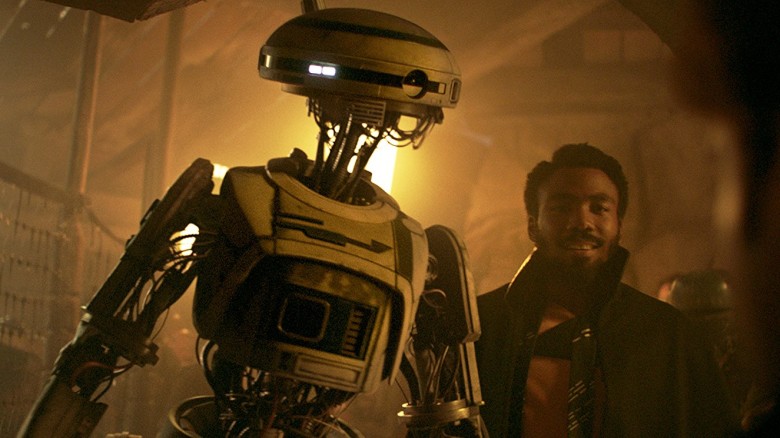
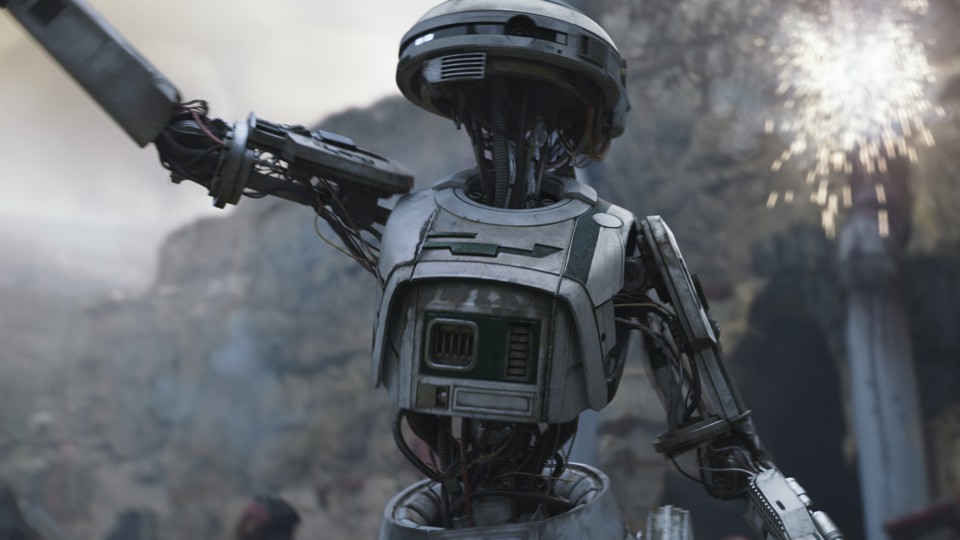
The Tonal Dissonance of L337

This was a film that stopped halfway through and reshot half the film.  This generated a lot of drama and, apparently, created a lot of backstage spite.  And if you watch the film, you can sort of see some of these scars, where a reshoot was slipped in to cover over a “mistake” by Lord and Miller, to bring it back to more of the vision of Kasdan or Kathleen Kennedy.  I don’t think I could pick out all the points, and I wouldn’t mind watching a documentary on it, because it’s fascinating, but I personally suspect most of it centered on L337.
Some of what follows will be mild spoilers, as she (“she”) is ultimately a fairly minor character, but if you don’t want to be spoiled, just skip to the next section.
So, we sort of have a tale of Two L337s.  On the one hand, you have this crazy, broken droid who hasn’t hard her memory wiped in years.  She delusionally believes that Lando is in love with her while a character smiles on indulgently, like a child was babbling on about how she has a crush on her teacher.  At one point, she removes a restraining bolt from a robot, and when it asks what it should do, she says “I don’t know, start a rebellion or something.” She’s a casual and silly robot who is rude and spouts stuff about equality and demands that people get out of her seat.  On the other hand, we see her at the beginning of the film trying to free robots and start a revolution.  We see her destruction and it is treated as the grave death of a wise and beloved character, with Lando revealing his deep and abiding affection for her in his willingness to face death to save her.  
It makes no sense.  Either she is tragic and serious or she is a joke.  She is either delusional or she isn’t.  She’s either trying to start rebellions or she’s starting them by accident. Maybe they were trying to give us a second perspective, creating bissociation between the perception of a crazy bot and the reality of a true relationship between herself and Lando, but if so, they didn’t sell it well.  It feels like two visions of the same character clashing.  I suspect that this is so, and we’re seeing the ground zero of a creative clash, and it does weaken the movie.  Not terribly much, but it does.

You don’t need to see it

I think the critics of the current direction of Star Wars would like to believe that they are the cause of Solo’s demise, and I think they and general dissatisfaction with the Last Jedi do contribute (I think you can draw lots of parallels with the DCEU: Batman v Superman is to the Justice League what the Last Jedi is to Solo), but I think this is the much bigger reason.  I think Solo promised to tell you a story you already knew.  Did you know that Solo did the Kessel Run in 12 parsecs? I bet you did!  Did you know that Solo grew up on Corellia?  I bet you did!  Did you know that Solo won the Millenium Falcon from Lando in a card game? I bet you did!
This is the real reason I didn’t see it in theaters.  I had limited time and a choice between this and Deadpool 2.  I chose Deadpool 2.  Even looking back, I do not regret that choice.  Solo told me a bunch of stuff I already knew, which is a broader sin committed by the new direction of the franchise over and over again.  Better franchises, like Marvel, create must see moments.  Are you going to see Avengers: Infinity Wars 2?  Of course you are, because you want to see how it ends!  Are you going to see Captain Marvel?  Of course you are, because you want to know how it ties into the rest, and it promises to feel and look different.  You don’t know what the story is, and you’re kind of curious.
What about Star Wars: Episode IX? I’m gonna guess it’s going to be a repeat of a lot of Return of the Jedi, though probably one without a slinky slave outfit. Is there really anything there that you haven’t seen before?  If you had to choose right now between Avengers: Infinity Wars 2 and Episode IX, which would you choose?
Solo really suffers from this.  It’s a fine film, but it’s not an essential film.  I think if Disney should learn anything from their debacle, it’s this: you need to take risks, you need to show us something new, you need to make your film essential.  I get a sense that a lot of the would-be directors of Star Wars chafe under the limitations of Star Wars, so I say unleash them!  One of the great things about the Old Republic (what fragments of it remain under EA’s mismanagement) is precisely that it unleashed creators to do what they want!  Why are we not seeing films set in the Unknown Region?  Why are we not seeing films set in a different future?  For all their flaws, the Prequels gave us new stories in a very new spin on the setting.  It took the Clone Wars to really resuscitate the prequels, but it has given us a fascinating new era to explore.  The latest material all feels like retreads. And I think that’s what’s keeping people away.

Is it Psi-Wars?

I don’t really like to end on a sour note, so let me stop and talk about the fact that it’s a heist and that it’s an action film.  This, like Rogue One, has very strong Psi-Wars DNA in it, perhaps because the Jedi played such a small role in both.  The inclusion of hyperspace fuel made me flinch, because it diminishes the originality of my hyperium fuel, but I suppose I’ll live.  The more creators stop and dwell on the workings of the Star Wars universe, the more it will come to resemble elements of Psi-Wars, because both are solutions to similar problems.  You can see another similarity in the use of “Hyperspace Lanes” in the expanded universe.
I imagine most Psi-Wars games will play a lot like Solo, precisely because both are so Action-like.  Both Solo and Rogue One have an eclectic band of characters working together, in the same spot, to get at some thing, only to be betrayed or outed, and to have a last desperate struggle to survive.  They’re very gameable, more so than than the “trilogy” side of the franchise.  If you want something to mine for Star-Wars-like stories, Solo is definitely there for you.

Empire-Class Dreadnought 2.0 – Inspirations

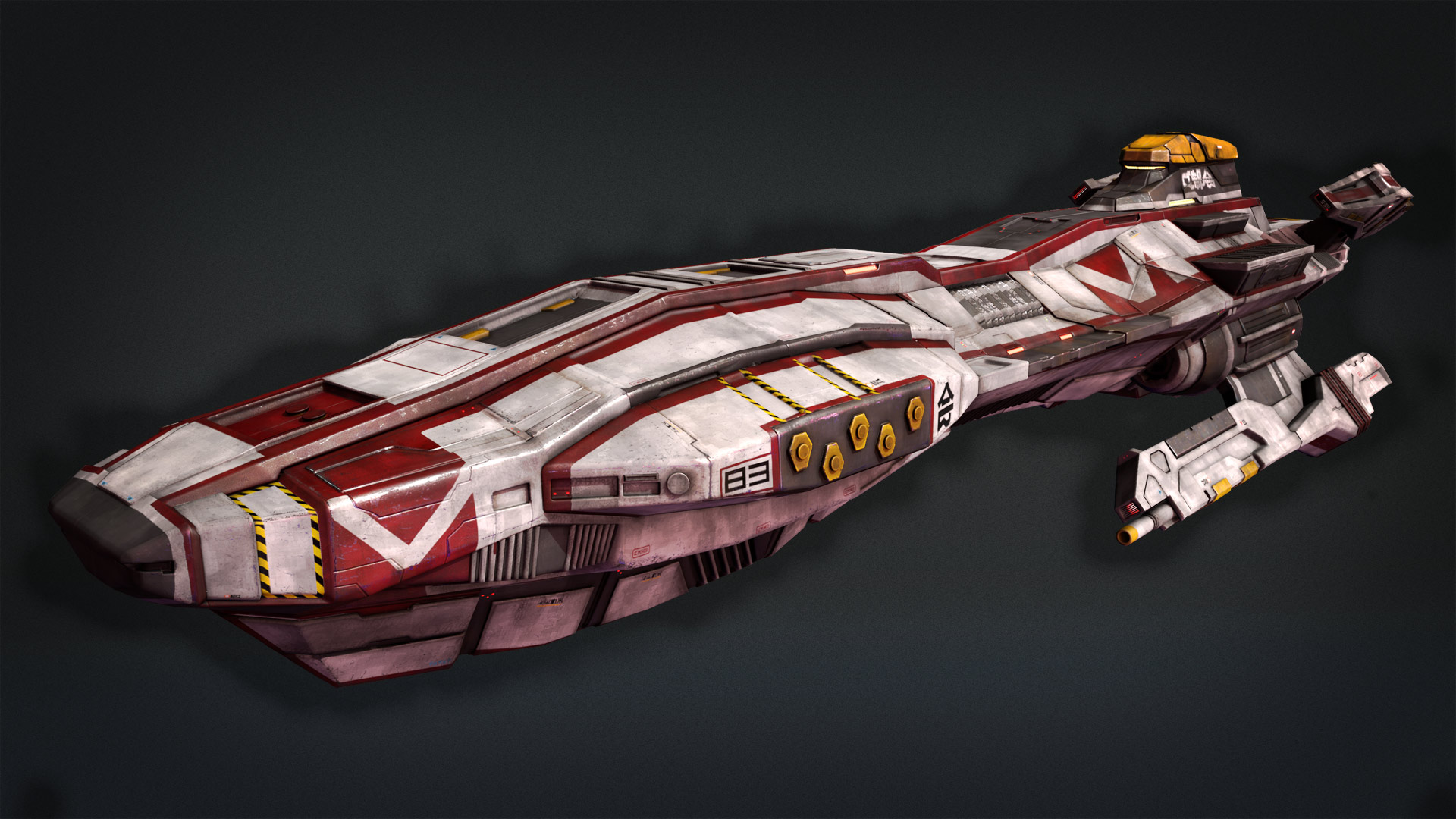
So, for my playtest, I’ve completed a new version of the Starhawk and the Typhoon, two vehicles already available in GURPS Spaceships 4.  For the third “iconic” Psi-Wars vehicle, I have chosen the Empire-Class Dreadnought from GURPS Spaceships 3.  The Empire-Class has served as our primary “imperial” warship, the dread conqueror and the powerhouse to beat.  It has showed up in playtests and in Tinker Titan Rebel Spy, my short-lived Psi-Wars campaign.

The Empire-Class Dreadnought isn’t too bad as far as GURPS Spaceships creations go.  It lacks major issues and, in fact, taught me a lot about spaceship design.  It has perhaps an unrealistically large hangar, and it lacks missiles and armor, which tend to be the mainstays for more realistic ships, but it makes up for it with superb firepower, including an astonishing spinal cannon and very powerful force screen.  This makes it both a terrifying threat, a planet-conquering troop-transport, and a cinematically satisfying opponent to take on, as once you defeat or bypass its screens, even a relatively small fighter can take it out with a well-placed torpedo.

With the recreation of Vehicles in 4e, the goal now is to rebuild it in Vehicles, but also to re-imagine it from the ground up, rather than just “converting” the existing ship.  To do that, I want to dive into what it is, what inspired it, and what role it serves in its fleet.

The core Empire-Class Inspiration: the Star Destroyer

The obvious inspiration for the Empire-Class dreadnought is, of course, the Imperial Star Destroyer, which is probably the most iconic spaceship of Star Wars, maybe falling behind the Death Star and X-Wing, but I bet it’s close.  The great, looming behemoth that stormed onto the screen in a New Hope and then kept going and going fired the imagination then and now.
While I spend a lot of time complaining about Star Wars vehicles here, I need to give it some praise.  First, the wedge-shape design is actually pretty smart when you understand firing arcs.  We like to think of a turret as able to “fire in any direction,” but that’s really not true.  On a tank or a similar vehicle, yes, but as soon as you have two turrets, they start to interfere with one another.  If you picture a “long” tank with two turrets side-by-side, it quick becomes clear that you cannot fire both forward or both backward, but you might be able to fire both “broadside,” and we see that with battleships.  However,  you could stagger the turrets, so that one was slightly higher then the other, in which case, one has a less limited arc than the other, and both can “fire forward,” increasing the number of arcs you can fire in.  The Star Destroyer seems a study in this principle, its wedge design meant to facilitate the “stacking” of turrets so that the maximum number of them can “fire forward” absolutely demolishing anything directly before it.
The Nebula-Class Star Destroyer;
What a Star Destroyer with a less prominent bridge might look like

The problems with the Star Destroyer are pretty well documented.  The core problems mostly focus on its space opera origins, and how it pretends to be a naval vessel.  It has this enormous superstructure that seems to serve no purpose: in the real world, we use the castle to elevate sensors higher so we can see over the horizon, but this is unnecessary on a spaceship.  Similarly, all its weapons are on the top” of the ship, and none on the bottom, which makes sense for a naval vessel, but not on a spaceship.  It also has this great, enormous window where the bridge is, making it a prime target: in principle, this should be replaced with sensors and the “bridge” buried in the ship, but for me and the space opera nature of Psi-Wars, that’s a bridge too far.  I want to see my heroic commodore standing astride his bridge looking out upon the battle.

A bigger problem for me is the size of the Star Destroyer.  These monsters start at a mile long and each film introduces yet larger incarnations.  This is not unrealistic: a galactic empire should have the industrial capacity to manufacture millions of mile-long ships without a problem.  We might even expect to see such warships in a realistic setting: Revelation Space features mile-long warships, as one needs that much mass to get a ship  up to near light speed.  No, my objection here is that I don’t really know what all that space is used for.  Star Destroyers have relatively wimpy collections of starfighters at only ~72 (that’s about three squadrons; the modern and much smaller Nimitz-class carrier has up to 90 fighters, and modern fighters are much bigger than TIE fighters, so why does a mile-long Star Destroyer have so few)?  It carries a substantial number of troops ( about 10,000) but not nearly enough transport capacity to get them all down quickly.  It seems to have huge engines, and that’s what I would expect to take up most of the space: generators, engines and hyperdrive, but Star Wars has shown that hyperdrives can be quite small, so unless it’s mostly a giant troop transport, I don’t understand what purpose is served by being a mile long.  People have complained that Psi-Wars ships are “too small” compared to Star Wars, but honestly, that’s because a million ton ship is “big” by any other setting’s standard, from Dreadnought to EVE.
The lack of point defense on a Star Destroyer is, perhaps, excusable in Star Wars, but it really isn’t in Psi-Wars, where the presence of isomeric (aka nuclear) torpedoes will destroy a ship, they need some kind of defense against missile attack!  Fighter cover counts for a lot, but it should be able to defend itself as well.

Real-World Inspirations

The obvious inspiration for the Imperial Star Destroyer and, by extension, the Empire-Class Dreadnought, is the WW2 battleship, but I would argue that this is incorrect.  The battleship was a focused ship: it was all about armor and firepower and nothing else.  The Empire-Class is about firepower, speed and fighter transport.  As lightly armored as it is, it’s more of a battlecruiser than it is a battleship, and its role as carrier makes it a puzzling hybrid, but not an unprecedented one.
After WW2 proved that battleships were dead, the US Navy intended to phase out battleships entirely, but the Marine corps objected.  They had seen how useful a battleship sitting off of a coast could be. A battleship in this context might be seen as floating artillery support, which is vital for any military advance, especially one as fraught as an amphibious assault.  So, the Navy conceived of a hybrid meant to fulfill both the role of battleship and carrier, a “battlecarrier” if you will, and the logic of it remains sound: the front of the vehicle would be all firepower, laying down that artillery support for an amphibious assault, while its rear acted as a landing platform, allowing it to launch close air support for said amphibious assault.  Unfortunately for the marines, the project was canned.
Fortunately for us, such vehicles still exist, and we call them “aircraft cruisers,” such as the Kiev-Class aircraft carrier.  Most such vehicles are probably better described as “helicopter carriers” as they don’t really launch much in the way of F-14 Tomcats or other exciting vehicles that one might make a movie about.
The other real-world vehicle I would cite as an inspiration are the Nimitz- and Ford-Class carriers, not because their mission profile matches that of the Empire-Class dreadnought, but because they are the largest and most impressive naval vessels the planet has ever seen.  They are gargantuan, called “Super-carriers,” they displace twice the tonnage of an Iowa-Class battleship.  The presence of a single super-carrier can redefine local politics, and they act like floating mobile bases.  I see a similar role for an Empire-Class Dreadnought: once it orbits your world, it begins to bend the politics of your world into its orbit from its sheer firepower and presence.

Other Fictional Inspirations

If I had to look elsewhere in the Star Wars universe for better inspiration for the Empire-Class Dreadnought, I would look no farther than the Venator-Class Star Destroyer or “Attack Cruiser” which fits its mission description better. Where the Star Destroyer has some nebulous hangar in its bottom, the Venator has an explicit and obvious launch deck, which fits its role as dual attack/carrier better in that we can see that it’s part carrier.
Beyond Star Wars, I struggle a bit, as the role of the Empire-Class dreadnought is to be, you know, the Capital Ship, so in principle any capital ship will do, but I do draw inspiration from the Cruisers from Strike Suit Zero, not because they’re especially appropriate, but because of how they interact with fighters.  While it’s very difficult for a fighter to single-handedly destroy one, the turrets and various weakpoints remain vulnerable to fighter attack.  While this does not necessarily make “good sense” from a realistic military perspective, it makes a lot of sense from a gaming perspective.
I also find myself looking into the games Dreadnought and EVE for additional inspiration (EVE especially uses real-world stats, which makes conversion a snap).  I’ve been advised to look into Fractured Space, and I may well do that.  These don’t really inform the design of the Empire-class Dreadnought, but they may well inform the design of other vehicles.

Empire-Class Dreadnought Mission Profile

The Empire-Class Dreadnought is the centerpiece of the Imperial Navy.  Its primary purpose is to project imperial power from any point in space to worlds.  As a result, it needs a very fast, very powerful hyperdrive, and sufficient fuel to make multiple sequential jumps if necessary, allowing it to respond quickly to crisis.  Once it arrives at a world, it must be able to quickly establish orbital dominance.  It uses several wings of fighters and bombers as well as its own capital-ship killing firepower to do this.  It can then position itself for orbital bombardment and planetary invasion.  It must carry at least a brigade/legion worth of soldiers and support vehicles, as well as close air support wings, and firepower with sufficient reach to attack a planet from at least low (100 mile) orbit. 
Once entrenched in its orbital supremacy, it must be able to act as a command post for ground and orbital operations.  This requires a large FTL communication array, allowing it to act as a hub for an FTL relay (it will often be beyond the core imperial infrastructure), and extensive scanners and communicators able to coordinate everything in orbit around a world.
It must be capable of acting independently for very long periods of time. This means it needs considerable fuel reserves (both for its jumps and for its fighter complement) and sufficient food onboard for months.  It will use a standard Fusion reactor, given their decade-long fuel supply.
The primary weaknesses of the Empire-Class dreadnought are light armor and relatively slow speed.  “Slow” is only in real space and only in comparison to corvettes: it should be quick enough to out maneuver most other capital ships.  As for armor, it will sacrifice armor for speed (both hyperspatial and in real-space) and supplement its armor with a force screen and point defense capable of turning aside a capital-scale isomeric torpedo assault.

Starhawk 2.1 – Inspirations

As with the Typhoon, the Starhawk is a vehicle you can just “plug and play,” and is found in GURPS Spaceships 4. And like with the Typhoon, we need to convert it into our new system and, while doing that, why not make the Starhawk our own? And so, I’d like to take a moment to ponder the Starhawk, its design, its inspirations, its mission, and what a semi-original take on it might look like.

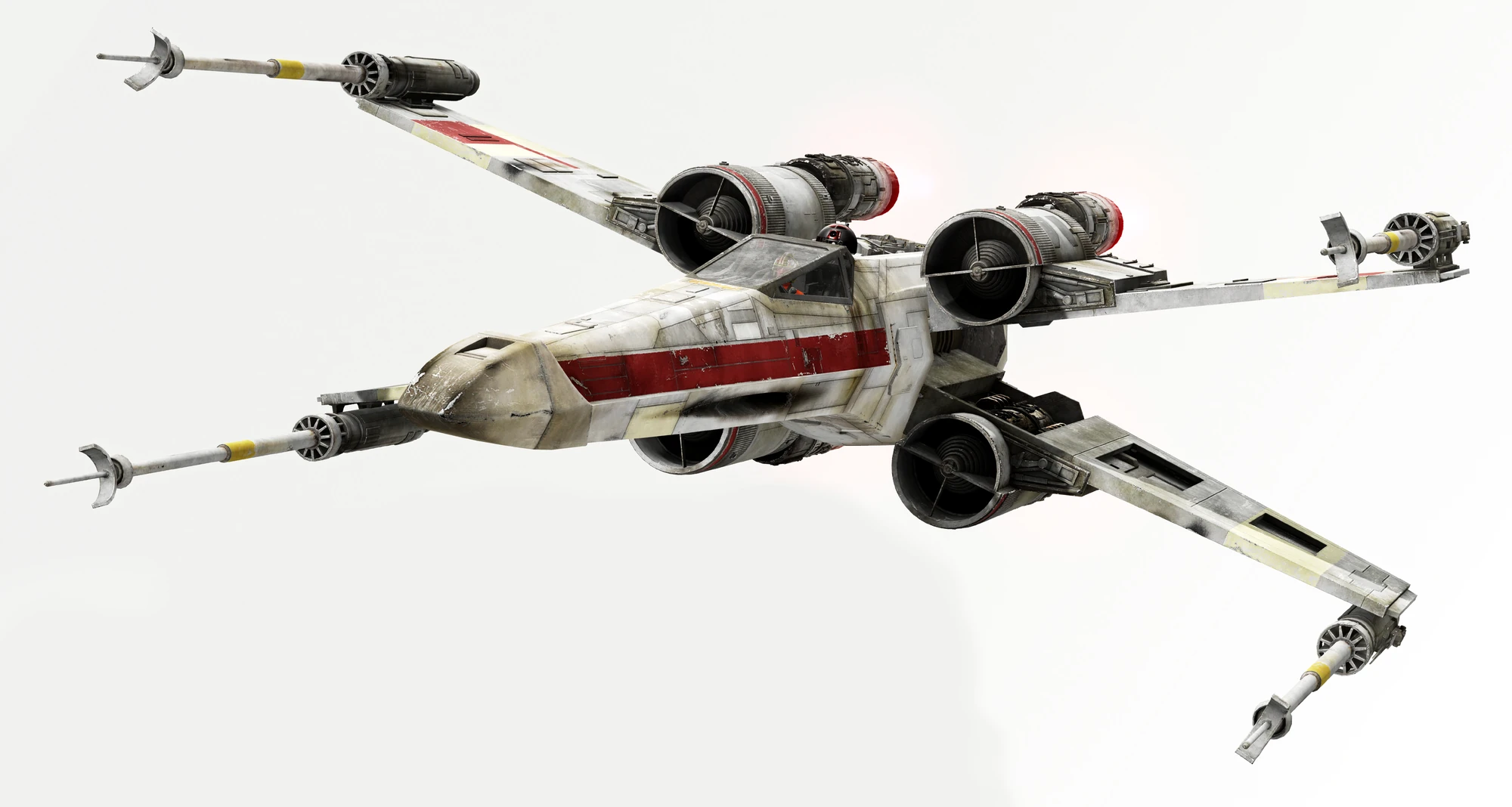
The Starhawk, as written in GURPS Spaceships 4, is a pretty good vehicle. It has no obvious flaws or errata that I can see. It has plenty of maneuverability, firepower and durability, and accurately reflects its inspiration, which is obviously the X-wing. It handled well in my playtests, and I expect it to be as popular in Psi-Wars as its inspiration was in Star Wars. The only realproblems I can see with the design is that it has wings (despite not needing them), and that it can’t “move” its wings the way an X-wing can, so it really only has one “mode” of flight (perhaps it can move its wings, but this makes no mechanical difference to the vehicle). It’s also a complicated beast to manage, as you need to play with the power points of beg your tech-bot to boost the system. This seemsmore feature than bug, an intention of the design, but it’s a feature that might not translate well to our new design. The gun is also a problem: GURPS SS has a sort of “maximum reasonable gun” for a given SM, but our vehicles don’t have to follow that, and a single high ROF gun is definitely cheaper and lighter than 4 weapons with ROF 1 that have the same damage.

Most of these problems can be addressed with a simple conversion. Our new system does require wings, and allows for variable wing geometries, and there are ways to handle power-points and such. The gun we’ll have to either accept or change and thus fundamentally change the design of the vehicle.

The X-Wing

The Starhawk is clearlyinspired by the X-Wing, which I would argue is the most iconic of the Star Wars fighters, and may be the most iconic sci-fi starfighter of all time (though probably not the most iconic starship: the Enterprise, Millennial Falcon and the Death Star probably beat it out). It’s very popular, but that doesn’t mean it can’t use some improvements.

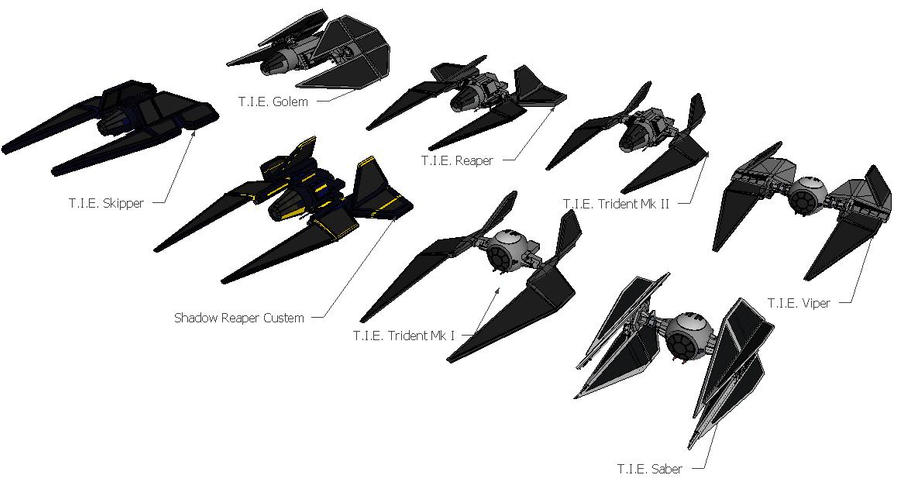
The single biggest concern that I have for the X-wing is precisely howiconic it is. When doing my homework for TIE fighters, I had only to google up “alternate TIE fighters” to get a bevy of ideas and artwork for new TIE fighters, but with X-Wings I had no such luck. There are, of course, a variety of models, but they all look and perfrom virtually the same. A few specific details might change here and there, but the core elements of “moveable wings that can form an X” and the pointed nose and the astromech all remain. This leaves me with a conundrum: either I copy an iconic Star Wars fighter, which I think damages Psi-Wars as an “original setting” or I make serious changes to the fighter that threaten its “Star Wars-ness.” This, I think, will be the trickiest and most contentious part of the design.

The other issue worth raising are the guns and their placement. Fighters use to place their guns on their wings mainly to get around their propeller, and it required them to make concessions. For example, they needed to make their guns converge on some point in front of the fighter, which limited how far away, and how close, they could shoot. It’s not clear to me at all why one would needto mount your guns like that. Such a mounting might help dissipate heat while using the wings as a sort of radiator, but frankly you could do that with a body-mounted cannon too, and such a weapon would fire directly along the center-line of the craft allowing greater range, and a single high ROF cannon is more economical than multiple low ROF cannons.

Another quibble: the X-wing has four, pod-mounted engines. Pod-mounted engines are, of course, real things and offer interesting options, like preventing your vehicle from being catastrophically destroyed when one of its engines are destroyed, so this is fine. However, the new trilogy has things that looklike pod-mounted engines, but evidently aren’t, as the engine is mounted on the main body, in the back (you can clearly see this in the Last Jedi when Poe Dameron accelerates at the Dreadnought). What, then, are those things on the wings? Why are they there?

The X-wing has a few non-obvious features, such as cargo space for the pilot. It’s not much more than survival supplies, and you see Luke pulling gear out if it in the Empire Strikes Back, but it’s an interesting option. Paired with its hyperdrive and its life-support, it’s a vehicle that one could travel the galaxy in. I’m not sure why you needa fighter that can hyperjump on its own (what’s the point of a carrier, then?), but it says something interesting about the long-range nature of the X-wing.

I must also admit to being in love with the idea of an astro-mech. The purpose of it isn’t entirely obvious in the movies, but the astromech handles the navigation of hyperspace andit acts as a second crew member. In my research, I discovered that many fighters have two crew members, typically a pilot and a crewman (“Goose” from Top Gun is the latter). This crewman can handle things like sensors, ECM, comms, etc, which frees up the pilot to just focus on flying and fighting, and I suspect our astromech fulfills a similar role.

All the rest makes a considerable amount of sense, from the deflector screens to the cockpit design and even the ejection system (assuming that it doesn’t just spit you out into space without a vacc suit…). There’s a reason its a popular craft: it looks cool, and it makes sense, more or less.

The Starhawk Inspirations

This article by Popular Science compares the X-wing to the Supermarine Spitfire: both have exceptionally thin wings, high speed and maneuverability and multiple guns. The spitfire had four guns per wing. I did some research into whypeople would mount so many guns on wings, and it turns out its because these light machine guns needed to make up for their lack of killing power when it came to shooting down other fights. Why not just mount autocannons, then? The answer is: they didn’t have them at the time, for whatever reason. Once their manufacturing capacity caught up to demand, spitfires began to sport 20mm autocannons.

Other sources compa

re the X-Wing to the P40 Wildcat, and prefers to compare Star Wars to the pacific theater than to the Battle of Britain. Compared to the Zero, the P40 was less maneuverable, but more robust and generally more broadly capable. This is an apt comparison, as we would generally expect one to want to be in an X-wing rather than a TIE-fighter. Where a TIE fighter is a mook ship that does one thing and does it well, the X-wing is a robust jack-of-all-trades fighter that gives it flexibility and robustness more appropriate to a hero-fighter, and needs to use that flexibility, paired with team-work, to defeat the more specialized TIE fighter.

For more modern examples, the article above compares the X-Wing to the F-16. They argue that an X-Wing is a combination of fighter and strike craft, and I think this is accurate. While the Y-Wing was clearly the “heavy fighter/bomber” craft, the X-wing could supplement it if necessary, thanks to its proton torpedoes. We often see this sort of fighter which fulfills multiple roles, and the X-wing seems an iconic example, and that makes it a sort of ideal “player” ship.

But for me, the best modern metaphor for an X-Wing is the F-14 Tomcat, and not just because I watched Top Gun recently. It’s a carrier-capable fighter with variable sweep wings and a second crewmember. Sound familiar? The complexity of flying the craft and camaraderie between tech-bot and pilot on a Starhawk would match that of the crew of an F-14.

When it comes to fiction, I find it hard to find a good example of an X-wing-type ship outside of Star Wars. The Old Republic has their Talon/Liberator class fighter and Wing Commander has its Hellcat, and really, if you look around, you can find any “typical heroic fighter” in any story. That’s what the Starhawk ultimately is: a fighter for a hero to engage in any sort of space adventure. This is why it has a hyperdrive and why it has a compartment for supplies and why it can be super-maneuverable but also super-tough, etc etc etc. In a sense, I find this its greatest weakness thematically, and why it’s hard to find parallels: the X-wing is distinct in appearance, but indistinct in mission. The X-wing is either “okay” at everything, in which case it’s like a Hellcat from WC3, or it’s “the best” at everything, in which case, why do you have other fighters? Star Wars needn’t make compromises on its designs, but we do and the question is wherewe make those compromises.

Another big problem I face is how to take such a visually distinct vehicle and create another that captures the spirit of the X-wing while still being original, and the best craft I can find for inspiration in that regard is, of all things, the U-Wing of Rogue One. Like the X-wing, it has four engines and variable wings, but it has two, which sweep forward and back. With the wings fully swept back, we might have a “delta-swept wings” and maximize your speed. Classically, with lateral wings, we have maximum maneuverability, but we can make them forward-swept “high agility” wings like the wings of a hawk (our namesake) for our maximum maneuverability, and we can bring the wings against the fuselage for maximum compactness when on the carrier. A neat trick. Thus, if we take the back half of the U-wing, replace the front-half with a sleeker, fighter-like design, and shrink the entire vehicle down to a one-man fighter rather than a full transport, then I think we have a vehicle that captures the dynamics of the X-wing without looking like an x-wing.

The Starhawk 2.1 Mission Profile

Our design should reflect the intended usage of the Starhawk, and thus, we need to know what that intended usage is.

If we argue that the Starhawk is an Alliance ship, then the Alliance is governed by elites who want to excel at battle, who want to participate in all engagements, and who want to survive. A pilot becomes the equivalent of a well-armored knight.

What we get is a multi-role fighter, something that must be quick enough to act as an interceptor, agile enough to act as a dog-fighter, and with sufficient armament to be a strike fighter, and sufficient durability to keep its pilot alive. The one thing such a ship wouldn’t have is a cheap price-tag, but it represents a vehicle where its designers beton quality over quantity. The complexity of the craft favors experienced/elite pilots who know how to manage the variable sweep and how to handle a wide array of missions, which also favors a “quality, elite aristocracy” over the masses of combatants.

The hyperdrive is an unusual choice, but it says a few things about the mission. First, it means the fighter is not reliant on a carrier. It might use a carrier, especially for longer jumps, but it extends a carrier’s reach considerably, and a squadron of planet-based fighters could join a larger fleet ad hoc and make a strike with them without worrying whether there was enough room on a carrier. This suits the “ad hoc” nature of Alliance defenses, as local planetary defenders need only have a Starhawk on hand to join the fight, provided the fight isn’t half a galaxy away. Further, paired with internal rations and 5-day life-support, the craft can act as a personal transport vehicle in a way a Typhoon cannot. If you have a Starhawk, you can access the stars, whether to fight for a good cause, to become a mercenary, or to become a pirate.

The Typhoon 2.0 – Thoughts and Inspirations

Since I began Psi-Wars, I’ve been using existingships as much as possible. Why? Because that’s why they exist! If you want to sit down and just play, you grab a blaster from GURPS Ultra-Tech, a template from GURPS Space and a starship from GURPS Spaceships and you play. But now that we have a new, updated vehicle system, and a new paradigm for handling spaceships, why not build my own? Or, at least, adapt the old ideas to the new system and, as usual, branch out in my own direction as necessary. Shortly, I’d like to use these ships as a test bed for any new dogfighting system, so I need to start with something.

Why not the Typhoon?  It represents a knock-off of the iconic Tie-Fighter, though one tailored to the conceits of GURPS Spaceships. It’s been central to all my previous dogfighting examples, and so definitely has a place here. But the Typhoon, as written, in GURPS Spaceships 4, has a few problems. For one thing, it has two fusion reactors when, at most, it needs only one. The second is that it’s heavily armored, which may work well for GURPS Spaceships, but will definitely not fly in our new system, where starfighters work like actual fighters, and tons of heavy armor would make it drop out of the sky!

So, we need to build a new Typhoon. The real intent of this design is not necessarily to give us a final version of the Empire’s primary starfighter, but to give us something we can play with when fixing the dogfighting system for Psi-Wars. It also gives me a chance to meditate upon the Typhoon and its inspirations from Star Wars and from the real world.

The TIE-Fighter

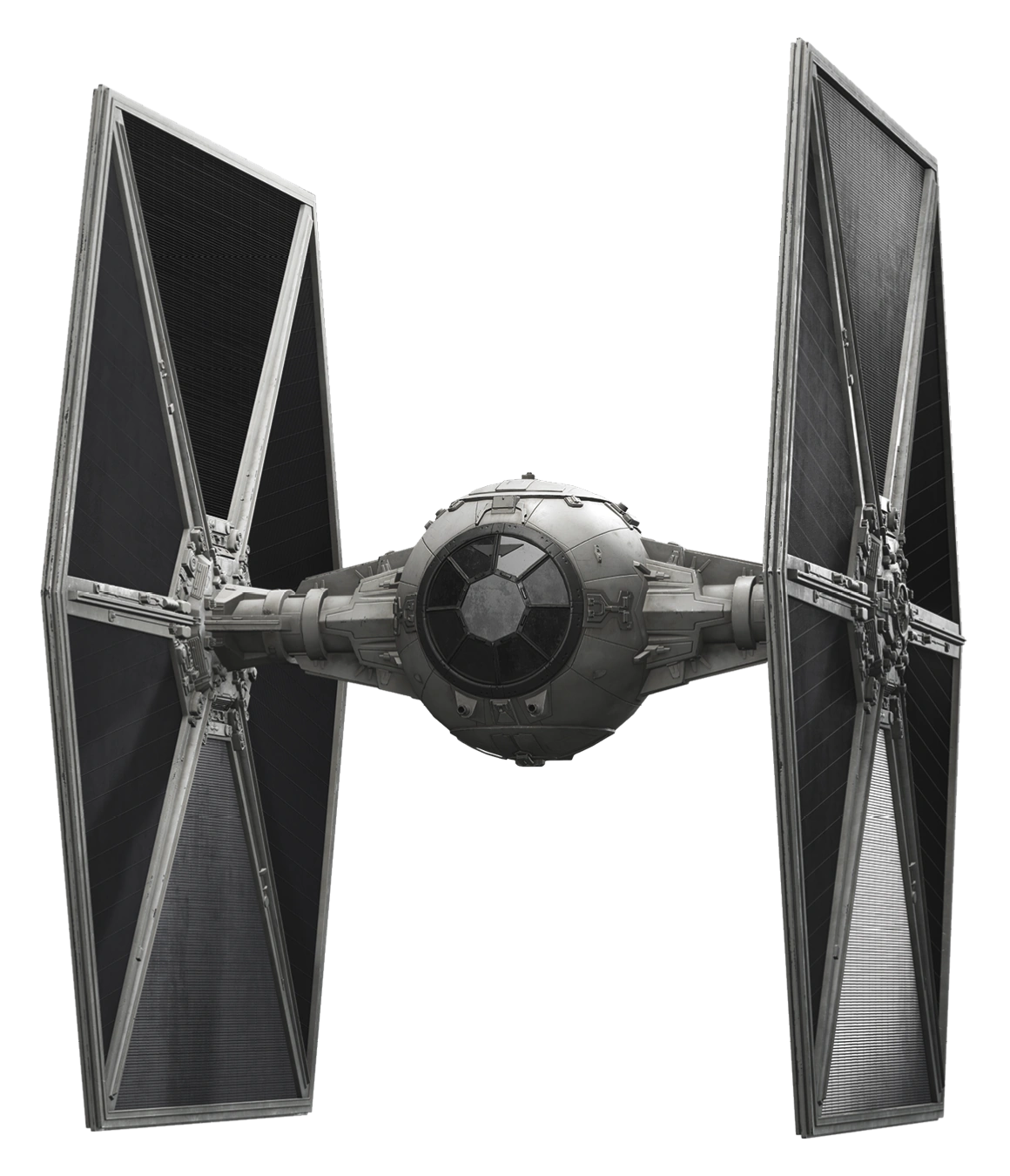
The TIE fighter is probablythe second-most iconic starfighter in popular media, eclipsing all other starfighters but the X-wing. Nonetheless, I have some serious issues with the design, and I am not the only one. Generation Tech pretty handily captures the glaring flaws with them in this video. Let’s discuss what makes them work, and what I would change.

The core premise of a TIE fighter is pretty good. It’s a cheap, bare-bones fighter that’s essentially engines with mounted cannons. This is why I chose it first: it’s probably the simplest fighter to design for Psi-Wars. It lacks hyperdrive, force screen and even life support (at least, according to the Complete Guide to Vehicles that I have). This is its strength, what makes it good. 

Nonetheless, it has serious issues.

The first major issue are the solar panels. They frankly make no sense and I think they exist primarily to excuse their distinctive appearance in typical Star Wars fashion of “cool design first, fancy explanation second.” I can sort of see the reasoning behind them: solar panels remove the need for any generator or battery or, if we’re talking reactionless engine, fuel. They’re self-powering, which makes them very cheap, which is supposedly the idea. In practice, they present an enormous target, solar power isn’t nearly that efficient, and I’d rather give my ships fuel-using plasma thrusters.

The second glaring issue is their cockpit design. If you look at modern fighters, they have a “bubble” canopy. This allows them to look in a full 360 degrees around them, and to look above. A TIE’s cockpit gives them tunnel vision (and even if it didn’t, those ridiculous wings would). An ideal design would be a fully armored cockpit with cameras and holographic internal display, or barring that, make the entire bubble transparent, but these would both ruin the aesthetic. Nonetheless, we’d want a much fuller field of view, if possible.

I don’t actually mind the lack of force screen, the lack of life-support or the evidently light armor. All of this says “disposable fighter” meant to attack in swarms, and speaks to the industrial might of the Empire. I do mind that their pilots are portrayed as the “best of the best,” because one clearly would not put his ace pilots in these things, as that would be suicide. I’m also not convinced that they’re making their fighters “as cheap as possible” so much as ruthlessly removing everything that isn’t strictly necessary. They clearly have decent electronics (they have the equivalent to radar tracking systems in their video games), and likely top-of-the-line designs, but they’re meantto be mass-produced and mass-piloted. These are not machines for the “best of the best.”

I have a few structural quibbles. Frankly, they need landing gear. This notion that they launch from racks is rigid, lacks resilience and just looks terrible. Their guns are also unrealistic. If you dig into the Visual Guide on Star Wars vehicles, you’ll find that their guns are about as long as your arm, yet are depicted as as dangerous as the guns on an X-wing, which are great spears longer than a person. Size-wise, as far as GURPS is concerned, the latter is far more likely.
So, to me, a “better” TIE-fighter would simply have a generator, have wings that helped it fly (possibly nonsense in Star Wars, but sensible in a hyperdynamic universe like Psi-Wars), a cockpit that gave a wider view, and would be deliberately used as a mook ship.  The empire has endless resources, both in the forms of materiel and personnel.  They can afford to mass-produce both fighters and pilots and send them at their enemies in waves.  I would definitely retain the purity of form: all speed and firepower and agility and nothing else.

The Typhoon Inspirations

This article by Popular Science argues that the Messerschmitt Bf 109 inspired the TIE fighter. This fighter was mass-produced and while clearly inferior to their British counterparts, nonetheless had a certain amount of “German engineering excellence” and relied on mass production to beat out their British rivals which, of course, they failed to do.

Personally, though, I see the Japanese Zero as a more worthy inspiration for the Typhoon. Like the TIE-Fighter, it’s a fighter stripped down to its essentials. I also see the Typhoon as something of an elegant ship. Yes, it’s mass produced, and yes, it’s inferior to its more robust opponents, but it has an elegance that one can appreciate if handled correctly. Put a Typhoon in the hands of an average pilot and give him 20 allies, and it’ll do fine, but put it in the hands of a master and it might surprise you. It’ll never be the best fighter, but it might earn some admiration.

They suggest various MiG aircraft as a more modern equivalent and that’s fair. They’re a good “bad guy” craft, and MiGs have been quite competitive with western aircraft for a long time, as well as presenting some decent technological challenges. They’re also very widely produced, the sort of fighter one might meet in droves. Personally, I see this sort of “second-stringer” fighter reserved for other factions in the setting, but the Typhoon should, by no means, by the “best of the best.” For a modern fighter, I think I would compare it to the Su-35, which probably holds the title for “good try” when it comes to a 5th generation fighter, with greater emphasis on dogfighting capability and being cheaper than its rivals, while still having a solid electronic suite and remaining competitive with the best that its enemies have to offer (the F-35).

For fictional counterparts, I’m a fan of the Wing Commander universe, and I would compare it to the Hornet: a technologically competent ship that’s high on speed and maneuverability, but light on firepower. That said, I’m quite taken with the Kilrathi “Dralthi” design with its forward swept wings: yes, this presents a large target and cuts down on the pilot’s visibility, but not nearly as badly as the TIE-fighter design does, while still retaining that menacing aesthetic. The Sith fighter from Star Wars legends has a similar sort of profile, and actually addresses quite a few complaints I have about the TIE fighter.

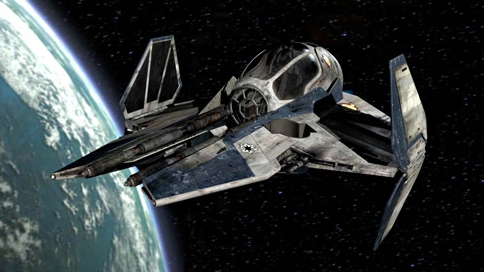
If we look back at Star Wars itself, and the various complaints leveled against it, an even better contender emerges in the form of the Eta-2 Actis-class interceptor. It’s cockpit resembles the TIE-fighter, except it provides far more lateral visibility, thanks to the more generous canopy, and the lower wing profile. Like the TIE-fighter, it’s a bare-bones craft, with basically nothing more than the requisite engines, cockpit and cannons. Those cannons are also more likely to be “GURPS accurate,” as they’re far larger than the “heavy blaster” look of the original TIE-fighter, more like smaller tank cannons, which is closer to what we might expect. Its wings even look as though they mightcarry hardpoints, allowing for missile fire.

The Typhoon 2.0 Mission Profile

A ship should ultimately be designed around its mission. How does the Empire intend to use their vehicle? And how does it fit their military doctrine?

The Empire is a professional army “of the people.” In contrast to the aristocratic Alliance, they rely not on elite, trained-for-birth aristocratic warriors, but on professionally trained every-men. They also count on speed of attack and sheer numbers. They want to shock-and-awe their opponents into submission with a blitzkrieg attack that completely overwhelms their opponent. They prefer to do this with giant dreadnoughts, when it comes to space battles, but they can also do it with a great cloud of fighters!

These fighters would need to be easy enough of that a pilot could be quickly trained to pilot one. They are not the “best of the best,” but the space-equivalent of a soldier put through boot camp, handed a rifle and pointed at the enemy. They survive through strength of numbers and the superiority of their weapons, such as they are. These fighters also need to be light enough, small enough, that many can be mounted in the strange, dual-purpose “battlecarrier” dreadnoughts. Finally, they need to balance quality with quantity, with their quality focused on “defeating the enemy” rather than “keeping the pilot alive.” thus, they should focus on firepower, numbers and speed over survivability.

The Typhoon itself would be perform several missions. Its primary purpose would be space superiority fighter: It is meant to deploy from a dreadnought and clear space of any enemy fighters to keep the dreadnought alive and allow any heavier vehicles, like bombers, to perform their mission. They also need to be able to engage in interception. The Empire will often need to defend or interdict worlds, and a single dreadnought cannot be everywhere, but its fighters greatly extend its reach. Thus, if the dreadnought detects an enemy, it must be able to scramble its fighters quickly, and send them off on missions thousands of miles away in very short order. Finally, the fighter would probably engage in “beyond the horizon reconnaissance” using its speed to check out spots that the dreadnought cannot quickly reach, and a wing of them might act as an escort, either for prestige or legitimate protection.

All of this suggests a fast, well-armed ship with a fairly modest amount of fuel. It will rarely need to spend days away from its carrier, likely hours at most. It is a tightly bound ship, more like a “carrier” fighter than a “ground-based” fighter.

On the Demise of Star Wars

“You were the chosen one”? Or maybe “Strike me down
and I shall only become stronger.”

Forgive the provocative title.  My part of the internet bubble churns with much rage at the current incarnation of Star Wars, and especially at Kathleen Kennedy, at whose feet the perceived “Ruined Forever!” has been laid.  There is much angst and schadenfreude over the failure of Solo, but Solo is the crux of what inspired me to write this, as it’s the first Star Wars movie in a long time that wasn’t an instant “yes,” though not the first Star Wars product in a long time that I had looked forward to, and then changed my mind about.

Then I put this post on ice, because I hesitate to post anything that sounds remotely political in this day and age as discourse is getting extremely divisive and it’s hard to please both sides (and there are sides here) when you say anything, and because I have better things I should be putting my attention towards (the next post is almost done, I promise!). But as news continues to evolve and the corporate narrative of “a few disgruntled trolls vs the Last Jedi” explodes to reveal that the Star Wars franchise is Not Okay, I wanted to get my two cents in, especially given how my blog seems to eat, drink and breath Star Wars.

I hope you forgive this opinion piece.

Star Wars: Ruined Forever

Solo has not done well, and Grace Randolph of Beyond the Trailer sums up most of the arguments pretty succinctly in her video, (she has further news on Kathleen Kennedy; she’s a great one, Ms. Randolph) so I won’t repeat it here.  What I find interesting, and likely true, is her comparison to Batman V Superman/Justice League and the Last Jedi/Solo, in that the backlash of the first resulted in the failure of the second, regardless of the second’s merits.  I’ve been watching this backlash build up for awhile, and not a day goes by where I don’t see a video popping up claiming that Star Wars is dead, or that the Last Jedi is a terrible movie, which clashes strongly with the perception I get from the news or from sites like Wikipedia to the point where I wonder how much of it is real and how much is manufactured, though more on that later.
I feel like the only fandom that hates their fandom more than Star Wars is, perhaps, Doctor Who, which is something I talked about all the way back in the inaugural post about Psi-Wars.  This is, perhaps, just more of the same, but I wanted to tackle some of the arguments that I tend to see, to try to sift out some wheat from chaffe.

The New Star Wars Movies Suck!  Unlike True Star Wars Films!

This is the general thrust of most arguments that I see floating around the internet: once upon a time, the Good King George Lucas reigned over a Golden Age of Star Wars, in which all the films were good, and then the wicked stepmother Kathleen Kennedy took over and ruined it forever.  However, I must say, I find this black and white dichotomy more than a little weird, especially the calls for George Lucas to “come back” and fix his creation.
First off, most Star Wars movies suck, straight up.  Look, here’s all the Star Wars movies I can find, in order of release, with opinions based on what seems to be the general perception of those who dislike the new franchise:
  • Star Wars (A New Hope): Good
  • The Star Wars Holiday Special: Not Good
  • The Empire Strikes Back: Good
  • Return of the Jedi: Good (though a lot of people at the time really hated the Ewoks)
  • Caravan of Courage: an Ewok Adventure: Not Good
  • Ewoks: Battle for Endor: Not Good
  • The Phantom Menace: Not Good
  • Attack of the Clones: Not Good (Saaaaand)
  • Revenge of the Sith: Not Good
  • Clone Wars: Not Good (Though I must confess I enjoyed the series)
  • The Force Awakens: Good (but unoriginal)
  • Rogue One: Good
  • The Last Jedi: Not Good
  • Solo: Not Good
Mileage may vary (I personally liked the Phantom Menace the most of the original trilogy; a lot of people like Revenge of the Sith, I think Clone Wars is underrated; a lot of people might toss everything new into the “bad” bin, while I think people forget the early negative opinions of RotJ, etc), but this seems to be the current internet consensus, and I count 5 good films and 9 bad films.  Of the new films, half of them are “good,” and even if you press the most ardent Disney Star Wars hater, he’ll grudgingly admit that Rogue One “was sorta alright.” So the new stuff hasn’t been all bad, but this idea that Star Wars was good until Disney came along, is just absurd, as is the idea that Lucas “would fix it.”  Lucas has an even worse hit/miss ratio than Kathleen Kennedy, and she’s his hand-picked successor, so no, I don’t think Lucas will “save Star Wars.”

Kathleen Kennedy Ruined Star Wars with Politics

The first woke robot of Star Wars
The argument goes that Kathleen Kennedy, unlike George Lucas, has used Star Wars as a platform for injecting her own left-wing screed into Star Wars.  To this, I say: Have you seen Star Wars?
George Lucas compared the Ewoks to the Vietnamese, heroically defying a technologically superior enemy.  The US would be the Evil Empire in this analogy.  And before you think he cooled down with age, he tossed in a “You’re with us or you’re against us” swipe at George W. Bush in Revenge of the Sith, which in the context doesn’t even make sense (“Only the Sith see in black and white!” oh really, Obi-Wan “The force has a light side and a dark side” Kenobi?).
Star Wars has always been the fever dream of a 1960s activist, only two things changed.  First, George Lucas and Lucasfilms went from ardent hippy activist to more limousine liberal, which is one reason why Kathleen Kennedy is more worried about “representation” than rebellion.  The other, I think, is a cultural shift: Hollywood’s Overton window has moved a lot more than most of the populace.  I don’t think anyone minds the presence of “Strong Women” in Star Wars; Leia has been the prototypical “Strong Woman” of fiction for a long time, but now there’s a much stronger push for far, far more female representation in Star Wars, perhaps to the detriment of the male leads (Finn, at least, seems to suffer at the hands of the writer for no good reason that I can discern other than, perhaps, that the writers don’t actually understand comedy).

But I also want to come out and say that I don’t think it’s the politics that’s ruining Star Wars.  I think it’s a manufactured excuse to justify bad films, and I’ll get more into that later.  How much outcry do you remember about the Jedi Council being lead by a black man (Mace Windu)?  He has his own comic book series, numerous books, features in video games and in the Clone Wars series, and there were some people arguing he should get his own film.  What about female representation in Star Wars? Asoka Tano, a female character, was the break-out character of Clone Wars and nobody called her a Mary Sue, even when she became the Super Special Awesome Character of Awesome in Star Wars: Rebels.  Who was your favorite character in Rogue One? Those of you who aren’t voting for a robot are probably voting for Chirrut Imwe (Donnie Yen!), who is Chinese.  So this idea that “fans” are opposed to “inclusiveness” is nonsense.

It’s not the politics that’s ruining Star Wars.

Kathleen Kennedy hates the fans

 I don’t feel that I have a responsibility to cater in some way [to those particular fans]… I would never just seize on saying, ‘Well, this is a franchise that’s appealed primarily to men for many, many years, and therefore I owe men something.'” – Kathleen Kennedy

This one I think is true, especially given that Kathleen Kennedy is on the record as disparaging a certain segment of the Star Wars fanbase (as well as other writers and directors).  I find her defense, her attitude that she doesn’t “owe” fans something to be disingenuous.  Of course, she doesn’t “owe” people something, she offers a product and you can pay for it or not: that’s business.  But what she calls “fans,” I call her core market, and what she’s really saying is something along the lines of “I don’t feel the need to cater to my core market,” which is a daft thing to say in business.
I’m not saying that it’s wrong to try to branch out, but it’s generally not well advised to so do at the expense of your core supporters.  For example, there’s nothing wrong with SJGames pushing a simplified version of GURPS that focuses on the dungeon crawling crowd: that’s SJGames branching out.  But if they were to drop all support for GURPS to focus entirely on a new d20 clone, that would be a risky move at best.  Star Wars has a core audience that is remarkably faithful, despite their complaints and criticisms, to the brand, and I don’t think it’s wise to antagonize that core audience just because they happen to be white and male.  
That said, I don’t think that’s actually what’s going on.  I think all the “politics” and fan-bashing and such is a smoke screen for poor management, and Kathleen Kennedy isn’t the only one doing it.

Rent Seeking and Circling the Wagons 

“I know there’s a lot of controversy around this game, but c’mon, it’s Star Wars, I was never not going to buy it.” – Tech Deals

I first noticed this sort of behavior not with Disney, but with EA, especially the release of Battlefront 2 (If I’m honest, I find everything surrounding the business decisions that led up to the release of Battlefront 2 fascinating).  First, EA gains sole access to the Star Wars IP when it comes to games, which is typical for EA: find something that people love, and monopolize it.  So, if you want a Star Wars game, you must go through them.  Second, create a game that looks good: appearance is the most important, because it helps with the hype train.  Third, find a way to monetize the hell out of it, because you’ve got a Star Wars game, people have no choice but to pay, and then brag about it to your investors, to get more sweet investment capital.  When the fans inevitably complain, divert them with empty promises that you’re “listening,” and then wrap yourself in a cloak of some form of morality.  For example, they had a female lead character, and the actress acted as their spokesperson, which gave them the cover of “we’re supporting feminism;” to suggest that they’ve listened to the fans, they employed John Boyega, the actor who plays Finn, to talk about how much he liked the new Battlefront 2.  When criticism arose, they painted it as the rantings of an unreasonable, entitled minority, and fended off criticism of lootboxes and such by wrapping themselves under the mantle of “Free market!” and “Innovation!” But in the end, everything circles around extracting cash from people, nothing else remained.
I think the same can be safely said of Disney’s handling of Star Wars.  If Kathleen Kennedy were really such a feminist, then why has she hired only white, male directors?  If she’s so racially tolerant, then why do black characters get such poor treatment in her films?  If she hates the fans so much, why does she pepper so many of the Star Wars films with so much fan service?  If she hates Star Wars, why are all the films coming out right now such slavish remakes of the original trilogy, or direct references to the original films? Why has she not yet branched out into something truly new?
I think the truth is that making really good fan-based franchises is hard.  Of all the cinematic universes, only one has really been a success: Marvel, under Kevin Feige.  All the rest have failed.  There may be numerous reasons for this, but one take-away must be that it’s difficult, and Star Wars is going to be no different, because even the stuff most people currently agree is “good,” like Dave Filoni’s Rebels, or Rogue One, are still somewhat controversial (and largely seem to be considered good more in contrast with the things fans consider “Bad”), and the stuff most people agree is “bad,” like the prequels or even the Last Jedi, are equally contentious.  If you’ll pardon the electoral analogy, it’s not really red vs blue but a sea of shades of purple and general discontent, and that’s hard for the best people to navigate, and Kathleen Kennedy seems to not be the best of people.
So instead, we get the easy outs.  Ms. Kennedy just grabs directors and makes films, and when they become too different, she fires the directors and makes them “safer.”  When people criticize her work, she falls back and hides under the mantle of morality: if you hate her movies, you’re part of an “the toxic fandom” and you’re a bigot and a bully.  For me, this is a bridge too far, and really the core of this rant: you will never improve if you cannot take criticism.
I get criticized all the time, sometimes unreasonably in my opinion.  There are people who want Psi-Wars to be something that, in my opinion, it was never intended to be.  I see people who argue that it’s too like Star Wars, and that it’s not like Star Wars enough.  I get people who say they would do things completely differently.  But for me, these are not attacks, but valuable feedback.  Some I can use, some I cannot.  They give me a sign of where things are going, how audiences are shifting, and what I could do better.  Where are things too complicated? Where are they confusing?  What could I be doing better?  You have to pick and choose your criticism, and you cannot bow to what each and every person says, but feedback that is honest is feedback that is valuable.  You cannot learn without it.  Those who attack their critics will never improve.

This seems to be a trend, especially with poorly received films with strong female leads (Lady Ghostbusters, Oceans 8, the Star Wars franchise), but this is a mistake.  For an example of a franchise that took criticism to heart, see the Thor: Ragnarok.

Making a Better Star Wars

It seems like there’s a shake-up already in the works, though not before we get Episode IX.  What will happen? I don’t know, but weaker franchises than this have survived terrible treatment.  Star Wars itself is probably predated only by Star Trek for a franchise beloved by fans but abandoned or mishandled by the entertainment industry.  Star Wars endured all the years of neglect from RotJ to the prequels through books, comics and games, and it survived the prequels, and it will survive now: even if you don’t like the films, check out the new TV series or the animated series.  While there are precious few video games (because EA has seemingly forgotten how to make video games, and killed the lonely one Star Wars video game that was set to release), there’s still RPGs, books and comics being made, and some, I hear, are quite good.
Were it up to me, I’d encourage them to set aside this “Legends/Canon” split, or at least weaken it.  The Marvel films drank deep of their comic weirdness and embraced their legacy; they didn’t precisely copy everything, but they understood they had a huge well to draw on and did, and as a result, each film, while formulaic, has something interesting enough to offer that audiences flock to theaters.  By contrast, Star Wars fans feel like they’ve seen the films already (“The Force Awakens was just a New Hope reskinned; the Last Jedi was just the Empire Strikes Back reskinned, and Solo was so predictable that Red Letter Media released a Solo Trailer reaction video before the trailer released, and then edited in the actual trailer afterwords, and got it spot on”), and while I’m not sure that’s entirely fair, that perception makes going to the theater less of a priority, and that’s not what you want from your audiences.  Imagine if Lucasfilm released a KOTOR Star Wars film, or one featuring Thrawn, Mara Jade, the Yuhzon Vong, the Hutt Cartel, Darth Nihilus (or really any Sith from the past), or worlds like Corriban, Ryloth, or Tython?
But what makes me saddest about watching and listening to people talk about Star Wars is that they seem to have forgotten what came before it.  I’ve talked about how much Star Wars has borrowed from, for example, Dune, Flash Gordon, Foundation, samurai films and many more.  If you’re desperate for inspiration, why not draw from those films?  Why not borrow from history and instead of using the First Order as a way of replacing the Empire, why not look at the fracturing of the Empire and its internal wars and its warlords and the efforts of the Republic to reconquer the galaxy with the struggle between their ideals and the hard realities of war.  Want to be inclusive? Have General Leia in charge of everyone and put Gwendoline Christie in a role that doesn’t completely waste her talents.  Bring in Thrawn as one of said warlords, and Mara Jade as your dark and terrible menace, the Emperor’s Hand that the Republic fears.  Give a callout to the Jedi Academy series, with some of Luke’s students trying to help the Republic.  Give us a Dune-like world with a warrior-people who follow a jedi-like creed (the Guardians of the Whills?) who must be talked into fighting back against the nearby warlords or against the sweeping pirate menace. You might even draw from Seven Samurai, by having seven heroic characters gathered to defend that one world. There’s such a rich tradition you can draw from, and it’s such a waste to see it lie fallow.  People are forgetting their history.
What is killing Star Wars isn’t female leads, it’s not politics, it’s not toxic fandom, it’s just bad films and an inability to listen to criticism.  It’s an institutional problem, one that seems fairly ingrained into Lucas Film at this point, so I don’t see it changing soon.  But Star Wars is too beloved to die.  It’ll just do what it did through the 90s and go quiescent for a time, at worst.

On the Demise of Psi-Wars

So given the rancor and frustration around Star Wars, do I fear for Psi-Wars?
No.
I’m honestly more worried about my time and flagging interest in the series, though my backers still seem firmly committed to the cause, and I’m rounding a corner on a particularly sticky issue.  But even if Star Wars dies, which it won’t, I still wouldn’t worry about Psi-Wars because, despite much nudging and winking, it isn’t Star Wars.  That rich tradition I mentioned above is something I definitely draw on for my work, and other works besides, and those works still live on. 40k continues to churn forward, Dune has a new movie in the making, the Metabarons has a new series focused on the Metabaron, a new season of Killjoys is on the horizon, we can expect to see a Guardians of the Galaxy 3 (assuming they survive the turmoil of the Infinity War!) and people still love pulpy Space Opera, even if they sometimes forget it’s more than just Star Wars.
So I’m still here, and I’ll still be here when all the turmoil has died down and this Star Wars mess has sorted itself out one way or another.

A Spoilerless Review of Rogue One

I’ve been excited for the release of Rogue One, because I am (as I’m sure you’ve noticed by now) a Star Wars fan, but also because the new turn of the films promises to reinvigorate a beloved, childhood franchise and return the energy and goodwill that the prequels lost.

The Force Awakens managed to do that by carefully hewing to the beats of the original trilogy, and thus while you can overstate its lack of originality, it doesn’t feel like something new.  Rogue One, however, promised to be something new, or at least it seemed to be. To me, that suggested that this was the real test of the new franchise: Can Disney stand on its own two feet when making a Star Wars film?

In a word, yes.

Is it a fun film?

My wife frowns when I start to pick apart the deeper context and narrative nuance of a film.  For her, what matters is whether or not it’s fun, which is fair.  The average viewer, I think, isn’t that concerned with deeper nuance as long as the film thoroughly entertains them.  Did Rogue One hit the mark there?
Hmmm.
If you go back and watch the Force Awakens, it’s two hours of pure cinematic bliss.  Sure, it might be derivative, but it’s so watchable!  I find when I turn it on (it’s on Netflix) I rapidly get lost in it in a way that I seldom do with most films (I have a short, ADHD-addled attention-span).  I don’t think Rogue One fulfills that.  It breaks up into movements, and I find the transitions between those movements a little stiff.  That is, there are moments where the film takes you out of the flow, so if I were watching it at home, at those points I might stop it and flit to something else.  So, less than perfect in this regard.
Is it spectacular?  Really grand and amazing-looking films can be delightful to watch, and on this point, Rogue One hits it out of the ballpark.  You have only to watch the trailer to see the grandeur and awe conjured by Rogue One.  We see the Death Star in its full, terrifying scale.  We see its destructive power.  We get to see Darth Vader yet again, and he’s as impressive as we could possibly want.  We see a magnificent space battle set-piece.
Will we love the characters?  Maybe.  I personally found Chirrut Imwe to be a fun character, and K-2SO regularly drew laughter from the audience, but Captain Andor pushed towards being deliberately unlikable.  I enjoy dark horses like him, but my wife and my friend gave him a thumb down.  Given the power of his lines in the trailer, I found myself disappointed by Orson Krennic.  He’s fine but forgettable.  The main character too, Jyn, is there.  The actress is fine, charismatic and rather attractive, but the character doesn’t jump off the screen and demand your attention.
Is it nerdtastic?  Oh my, yes.  It addresses many points that nerds tended to raise, and also introduced more casual viewers to concepts that they might not be familiar with, like kyber krystals, as well as introducing us to genuinely new and awe-inspiring elements, like the holy planet of Jedah.  It pushes straight into a New Hope in a way that will make you want to pull out the old film to watch it again to see how seamlessly it connects and it gives the new film a sense of urgency.  This devotion to the old films creates a weird problem, though, in that they need to bring back old characters and they do so with CGI, and the result tips into the uncanny valley.  The one old character who works was Darth Vader.  The moment I heard James Earl Jones’ voice, a tingle shot up my spine.
So is it fun?  Fun is probably the wrong word.  The movie is dark.  It features no super-heroic jedi or dramatic rescues.  Instead, we watch characters die and see the desperate struggle of the alliance against a horrifying weapon.  This is a film about heroic sacrifice rather than heroic victory, and represents the darkest moment of the rebellion.  It becomes easy to see why Tarkin, in a New Hope, thinks he’s almost crushed the Rebellion, because he has. The result is that this is by far the best Imperial film, probably eclipsing even the Empire Strike’s Back for sheer Imperial bad-assness.  It also features a great deal of messy, chaotic combat, more typical of war than the sanitized, choreographed duels of the prequels.

Is it a Good Film?

The quality of the movie usually determines whether or not people will have fun. Sure, lofty critics might have a different opinion about a film than the audience, but the two line up more often than they realize.
The plot itself is relatively straightforward and creates the sense of urgency necessary for an action film like this.  The Empire has devised a weapon of mass destruction and will use it to crush the rebellion unless the rebellion can grab those plans before it’s too late.  The result is a fast-paced and hectic film that rarely slows down (though it does at times).  However, in my opinion, it also introduces a few chekov’s guns (Jyn’s necklace) that it does nothing with.  Why?  That seems wasted. 
More broadly, the film neatly stitches in elements necessary for the larger shared universe, like new locations and the emphasis on kyber crystals, which will surely be a plot point for later films in the franchise.  It also carefully ties into older films, though it also undermines the prequels.  At one point, Bail Organa mentions Obi-Wan and says that he “served him well during the clone wars,” which is an exact quote from a New Hope (and thus spoils nothing), but also violates the prequels, where Obi-Wan never served Bail Organa.  On the other hand, the movie does reference Mustafar, or seems to (it’s the one planet where no subtitle announces the planet’s name).  The problems noted above might be addressed in later films, but Rogue One also ties itself off with a bow.  It doesn’t seem meant to give us additional prequel movies.  Rather, it has told its story, and it’s done.
The characters, though, are fairly thin.  The film lacks major conflict.  Jyn Erso goes from being agnostic on the rebellion to being devoted to it, but there’s no real moment of conversion, it just sort of happens.  Likewise, Captain Andor goes from being a jerk to being somewhat less of a jerk, but again, no moment of conversion.  Finally, we see a bunch of characters that seem cool, like Chirrut Imwe and his ally, Baze Malbus and their interaction regarding faith, but it’s fairly thin.  They’re in the movie, they have a couple of cool action scenes, and that’s largely it.  The villain is probably the most memorable of the characters, and I feel his acting failed to reach the lofty heights of Peter Cushing or James Earl Jones, leaving him an ultimately forgettable villain.
The setting is where Rogue One shines.  The movie lavishes details on new locations, like the richly beautiful Jedah or (forgive me, my memory fails me) the asteroid marketplace shown briefly at the beginning.  It delves deeper into the rebellion, breathing more life into that group as an organization, and it shows the bitter, behind-the-scenes politicking of the Empire.  It brings the galactic civil war to life in a way that even the original films didn’t really do.  Rogue One is the sort of film that I expect fans of the universe will be discussing for a very long time, as it introduces a lot of fascinating ideas into the mix.
A brief note on the music, though.  They clearly had someone new composing the music for Rogue One and he hasn’t found his voice.  The music obviously isn’t John Williams, but at the same time, it sort of is.  I found myself listening to it, and hearing snatches of familiar music which then sort of wander away from it in a way that I found emotionally confusing rather than invigorating.  The soundtrack isn’t very good, because it’s not John Williams, but it also isn’t this Michael Giacchino guy either.  It’s a weird hybrid that somehow manages to be the worst of both.
Ultimately, I would argue that Rogue One is a work-horse film that draws its inspiration from better films, but definitely draws you into the greater Star Wars mythology and inspires you with its magnificent imagery.  That’s where it’s strongest.