A Zero-Template Retrospective

 And that’s it for my Zero-Template Challenge.  I hope you liked it, but judging from the comments and the responses on my discord, you did.

Let’s touch on the specific races.

Karkadann

They seem good, a nice addition, and people were impressed by how much you could do with just a few features.  I think they highlight the core benefit of this challenge: it forces you to think about what makes your race different rather than pre-spending points somewhere (a DX +2 race with Combat Reflexes is probably much less interesting to a player than the Karkadann).  Someone also expressed surprise at the amount of lore; that’s a lot easier to do when you have a lot of lore to draw on (world-building tends to snowball after awhile).
So they’re in.  I’ll work out some additional details.  I don’t think they’ll remain as a zero-template race, but most of the changes will be to either exaggerate particular elements or to give them a little more obvious physiology.

Vithani

Uh, these were passionately received.  It resulted in a lot of very heated commentary, not against them, not against one another, just the sort of commentary I often see when passions run high.  People really liked this race a lot.  It got comments, it got people planning characters, it got deep discussions about their proper place in the universe, what symbolism they needed to be a part of, etc.
They’re definitely going in, and like the Karkadann, they’ll get some adjustment… though less than I initially thought!  I will probably price things more fairly (Low Pressure Lungs should give points back, given how rarely it will benefit them, unless they also get some sort of extremely short-term vacuum support, which they might get, I don’t know).  I’m rather inclined to at least keep Night-Adapted Vision; I might keep Ultravision too; people weren’t too bothered by it, but I feel like it’s the sort of thing a GM or PC would forget.  There might be some ways to tone it down, though.
Aura is popular, so we’ll keep it.  I may reword their destiny, and give them back Dreamer.
I think the big lesson of the Vithani, other than sexy aliens with good art are popular, is that you can probably get a lot more mileage out of Power-Ups 9 than you think.  If the attributes are reworked for one specific race, it can create a very different sort of experience for that race.  I don’t think I’d use it that much in Psi-Wars unless it’s for a race that has a very different mode of existence, but it would be fascinating to approach a truly alien species in a more “hard sci-fi” game, especially a race that, say, has a very different form of intelligence. If you’re looking for crazy inspiration for how to make a race play in a different way, consider looking though PU9.

The Herne

They got a more positive response than I thought, with a lot of discussion around the feasibility of the seasonal traits. Based on that discussion, I don’t think I’ll bring the Herne into the game.
First, a sapient race on Arcadius is already iffy.  I want that world to be a bit fey-touched, so people tell stories and they may experience things, but there’s little actual concrete evidence of a race, and it might be something like sapient psychic deer or something causing all the commotion. Introducing the Herne would break that.  That’s not necessarily a problem, we can discard this idea of a strange world and just replace it with a strange race (and anyway, the Labyrinth is already rather like this), but when you combine it with the second, it becomes clear this is more trouble than it’s worth.
The bigger problem is obviously the seasonality.  But why? It’s parasitic design, and my choices for fixing it generally amount to removing it, which suggests its a bad idea.  Let me explain.
Someone pointed out that one reason you’d want to play this race is to have a shifting toolbox, which I definitely agree with and was one of the comments that made me go “Aha!”  You want, as a Herne player, to be forced between multiple different modes; like if you have a social or combat mode, and you’re in social mode and partaking in a heist, then you want to try to talk your way through. If you suddenly find yourself in combat mode, you’ll shift to fighting instead.  An external force controls how you interact, and this is interesting.  But it can be troublesome, and so you might want to have some measure of control, but if you can control it, it ceases to function like a shifting toolbox: if you’re in social mode but would rather fight, you just change back to combat mode and fight.  Then the interesting element is removed as just a small, weird speed bump to doing what you want.  If you want to have some player agency in their mode, some ability to influence it, but you don’t want them to just flip between two modes, you might give them a variety of modes and let them shift between one or two, but most of their modes are locked out a time.  That gives them the flexibility to shift a little without losing the strange, mercurial nature of the character.
But it gets a lot more complex. The player needs to know a bunch of rules, the GM needs to know a bunch of rules, I need to write a bunch of rules, and what benefit is all of this complexity? The player is constantly bugging the GM to tell him about a season on a remote world and then sighing and telling the players that he cannot do the thing because it’s the wrong season.  The rest of the players have no connection to this, and the only reason the GM knows this at all is because ONE SINGLE PLAYER decided to play as the Herne.  I do believe this is that the kids these days call Parasitic Design. So the solution is either to remove it as irrelevant or make it relevant to everyone.
One of my rules at work is “if it hurts, do it more.” I think this applies, in a sense, to gameplay.  If it matters at all, then everyone should have an opportunity to interface with it. It should affect everyone’s gameplay. It might not affect them directly, and it might not be something they even know about, but they should be able to capitalize on knowledge of it, if they want, without a major investment.  A good example of this is the Deep Engine: it’s a secret that only certain sorcerers can directly access.  That said, even if you’re not a sorcerer who is in the know, it’s also a great source of bad guys, monsters, dungeons, etc.  You can run across Deep Engine Sites, for example, so its existence and knowledge is useful to the GM for more than just that once sorcerer.
So what if the Herne were influenced not by the season of Arcadius, but by the galactic season? In the Great Book of Destiny, I refer to these as Hours, and they would tie into Fortune-Telling, what sort of Destinies people could get, and might be something that other people could hang sorceries or other powers on. The Herne, then, would be tied to something that’s useful for the GM to know for reasons other than just the Herne.  
Of course, this also sounds more like something the Vithani should be associated with than a race on Arcadius, and I wanted the third “Master” race of the Umbral Rim to have something akin to this, as this is a great thing to hang an “occulted system” on, if certain modifiers or available spells change based on a mysterious arrangement of stars or other things and you have to learn to read those and see how they interact with other elements of the game.  This third “Master” race was also set at the fringe of the Umbral Rim, which is where the Vithani are, and so we start to see some connections.  I’m not saying the Vithani are the third master race, but they might come from the same region, and a picture starts to emerge of a particular region of the Umbral Rim and its history and relationship with the early Ranathim Tyranny. 
Such a system becomes something integrated into the rest of the game, and greater complexity is much less of a problem, because knowing that complexity is rewarding to more than just the Herne player. But it also ceases to be something I’d associate with the Herne and Arcadius.  We could change it instead to be something more a reaction to the ambient temperature of the world, which starts to borrow on ideas form World-Walking, which is your available options depend on the nature of the world you’re on, which is interesting for a world-hopping campaign, but then again the Herne lose their unusual connection to an unusual world.
So either way I see it, while this mechanic might be perfectly fine, I feel like the Herne are the wrong place to put it.  So we’ll park it, park the race and see if we can cannibalize the ideas for a different race or set of systems.

The Rejects

The Blue-Skinned Arctic Monkeys saw some positive responses.  Infravision, blue skin and being naturally accustomed to colder weather is interesting enough to make someone stand out.  They’re not especially interesting to play, but they’re also not just a reorientation of points.  Humans aren’t especially interesting to play, and this race is about that interesting. I’ll think about this one. Psi-Wars doesn’t have a lot of arctic content, but we can also borrow ideas from here for a “hot-blooded” race too.
The Gasping Maga-Pillars had more interest than I expected, but mostly discussions of alternate forms. I think there are some interesting ideas here, but few of them have anything to do with the actual design here and more the ideas they inspire. The Sylvan Spiral Needs Races Badly, but this one isn’t it.
The Deep-Song Triton-Men got a laugh.  This one felt more like vented frustration with the challenge than a genuinely interesting race.
The Void-Dancers got more interest than I expected.  I think we can afford to have a vacuum-native race somewhere, but it feels more like a background element unless they have means by which they can interact with the rest of the part in a more face-to-face manner without always being in armor.
That said, always being in armor is actually an interesting racial concept. The Arkhaians sort of do this already, but there’s room for more, something like the Breen, the Vorlon or one of the earlier conceptions of the Mandalorians.  As I commented before, I’m trying hard to get people out of their armor, but a race that is always in its armor is distinct, depending on what the armor is like.  It’s not something I really touched on much, but a race native to a very different gas mixture might have something like that. I still wouldn’t call it a feature, though, but a disadvantage.

The Challenge

I had fun.  It generated a lot of discussion and seemed to inspire a lot.  It also told me there’s a lot of hunger for minor races, regardless of their point cost.  A proposed variation on the challenge is a race worth no more than +/- 5 points, with no more than an absolute value of 10 points in traits, advantages, disadvantages etc.  I will note that I often found features to be more sweeping than perks or 5 point traits so you’ll still find it a fairly limiting challenge.
It did get me thinking about how much of my racial templates are largely cosmetic features, things like “Horns and fangs and teeth and tails.” I wonder if it would be worth a sidebar discussion about removing those traits, or ignoring them, for greater simplicity. It’s a rather fine-grained accounting to worry about minor levels of night vision of +1 crushing damage from a headbutt, even though these are certainly advantages.
The Zero-Template Challenge: The Rejects

 No, this isn’t about a race called “the Rejects.” I came up with a bunch of races that didn’t make the cut because I couldn’t quite make them work. I thought I’d lay them out and discuss some of the ideas that I rejected, because they might prove fruitful to you, dear reader, or they might inspire something with a looser set of restrictions than this fairly harsh challenge.

The Arctic Monkey

Features: Blue Skin [0]; Digitigrade [0]; Infravision [0]; Tail [0] Temperature Range (5° to 60°) [0]
So this was my first scratched-pad example that popped into my head.  Most of it works fine, and it even makes sense: this is a race native to a very cold environment and there are likely to be large temperature gradients, so it has learned to “see” by that temperature gradient. IR vision arguably has less problems with it than Ultravision does, so it could even prove to be a useful, if blurry, feature to have.
I have an issue with temperature range, though. A recurring theme you’ll see throughout this series is that features look like disadvantages in the wrong context. It’s not to say they’re poorly balanced, but if you have a tightly defined set of assumptions about play, the more someone veers outside of that, the more of a problem they will have.  This race isn’t too bad: they’re mostly going to complain that you need to turn the heating down to the point where humans (Ranathim, Keleni, Karkadann, Mogwai…) start rubbing their arms and complaining that it’s cold (Asrathi, Gaunt and Traders, in their space suits, might not mind, though). In an adventure, though, they’re going to suffer a lot more in the heat. For example, in 90° requires an HT roll every 30 minutes to not lose one FP; the Arctic Monkey would need the same, but would lose 2 FP every time they failed the roll, and would start to lose fatigue at reasonable temperatures, like 70°.  This isn’t so bad, not untenable, and balanced by the fact that they’d be fine when Ranathim are questioning their wardrobe choices.  But it does encourage us to ponder a question:
Who cares?
When’s the last time you played Psi-Wars and made people roll HT for the heat?  I’ve run 4 games now, and only one was ever in an environment where characters might be concerned about heat. Much of a game is going to take place climate controlled environments, and characters have access to climate controlled armor.  And I’ve been fighting to get people out of armor.  If we made a race of sultry Ice Queens, or truly weird and horrifying creatures from beneath the ice, how are you going to know if they’re covered up all the time?  Worse, when it does come up, nobody is going to remember, because it comes up so rarely!
There’s a few things we can do to fix this, if we really wanted to focus on it.  First, let’s change how this temperature thing works.  I quite like the mechanics of Low-Pressure Lungs, as it’s easier to remember bands than it is to remember specific numbers. Humans risk losing 1 fatigue every 30 minutes when t’s below 35°, or above 80° (though we can simplify this latter number to 90°).  They suffer a penalty to HT to resist this loss at -10° and lose one additional fatigue for all exertions after it hits 90° and 2 additional fatigue at over 120°.  If we wanted to “shift” our arctic aliens one band colder, that would mean they would be fine likely from about -10° to 35° (45°, rather than 55°); we might say they don’t start suffering HT penalties for the cost until -60°, and they suffer the increased fatigue cost from 35° to 80° (55° band rather than 30° band) and then +2 additional fatigue from 90° to 120° and they start to burn after 120°.  Is that a feature? Well, I think technically what you’re looking at is a slightly reduced comfort band (a quirk) and a slightly increased “hot” band (maybe a weird variation of Temperature Tolerance as a perk?), so probably a feature, and it’s easier to remember: if it’s normal for a human, it’s hot for an Arctic Monkey, and if it’s hot for a human, it’s double-hot for an arctic monkey, and it’s Cold for a human, it’s normal for an Arctic Monkey, et cetera, you get the idea.
Next, I’d want to make the player of the Arctic Monkey think about temperature a lot. I’d give them technology that depends on low temperatures (quantum computers? Superconductors?) or some sort of benefit from natural ambient cold, as opposed to climate-controlled cold (or at least some reason to take the armor off and be subject to natural environmental conditions), and possibly some ability to adjust temperature (Cryokinesis).
That brings us to the second problem with this design: it doesn’t really do anything interesting. You’re hot everywhere, and you see in IR you look funny. A funny look is already “enough” for a visual medium, but for a game, we want a funny mechanic to emphasize our alien nature.  The proposals for making temperature more important would help, though.
I think if I turned this into a final race, I’d keep the blue skin, the lowered temperature band rather than the weird temperature tolerance, the IR vision and ditch the digitigrade and tail.  Add some temperature mechanic gameplay and I think we’d be alright.  I think blue-skinned, red-eyed people with white-or-black hair would be great.  Put them in the Arkhaian and make them allies of the Empire, perhaps with one achieving great success in the Imperial Navy, I dunno.

The Gasping Maggo-Pillar

Features: Born Biter 1 [0]; Light Exoskeleton [0]; High Pressure Lungs [0]; No Legs (Slithers) [0]; Potential Form [0].
Most of my flailing about with Zero-Template races was an effort to find a truly bizarre and physiologically strange race that I could do for zero points and fit into the Sylvan Spiral.  The zero point No Legs options seemed promising, so I started with Slithers.
“Slithers” would imply something like a naga: the race would still have a head and two arms, but would have a serpentine tail.  However, that also implies a degree of flexibility, or possibly a constriction attack, etc, all of which would cost points, so that was out. Rolls would almost be better, with something like a robot that has a humanoid torso and head atop a ball-structure that it moves around on, but that’s not an alien, that’s a robot.  
What else could reasonably limit the flexibility of a slitherer?  Well, what if we gave it an exoskeleton? Worms are still highly flexible, but maggots might not be. Can you have a 0-point exoskeleton? Here’s what Space has to say:

On small insects (a rigid exoskeleton) is not much different from skin

Hmmm. Okay. Maybe. But it also doesn’t cover the costs of much.  If a light exoskeleton justified buying DR and allowed you to avoid sunburn, it’s a perk, right? Plus I think most people would imagine at least a DR 1. And in any case, a man-sized maggot is going to be horrifying.  That means a disad, and we can’t do that.  What sort of slithering insectoid can we have? Oh, what about a caterpillar? Why must I always go with maggots? Ugh, anyway. They don’t really slither so much as have lots and lots of legs, but I think we could arguable wave the difference; it might be a slithering thing that looks like a colorful caterpillar and have nice, soft fuzzy bits that make people go “Aww, I don’t feel the immediate urge to murder it.”
Born Biter is more me playing with whatever features I could jam on, and High Pressure Lungs might be, I dunno, it comes from a dense jungle world rich in oxygen (explaining its large size). The X-pressure Lungs are another good example of “features that feel like disadvantages” because I’ve never seen a Psi-Wars game take place in an environment with high atmospheric pressure.  At least you can sort of justify Low-Pressure Lungs by claiming that an asteroid has Trace atmosphere, you can treat it as Very Thin (You’ll still suffocate, but you can walk around without a space suit on), and a moon might have Very Thin atmosphere, which you can breath like Thin, so it’s plausible that it will come up, but it’s implausible that high pressure worlds will come up unless we went out of our way to make them, likely the world the race is from, making them a “Dryad” race that never wants to leave its “Tree.”  So, it’s neat, but I’d ditch it.
Finally, if we’re talking a magg… caterpillar, then we’re talking about a larval form. Template Toolkits 2 has an interesting feature called potential form. It means that the character can make a one-way transformation at some point.  Our maggot caterpillar can become a horrifying beautiful fly-demon butterfly.  This means we can push our complex, expensive template down the line.
But why stop at one thing it can become? One interesting concept might be a race with more than two genders. How would that work? I don’t know, we could do some research.  There are options like all three need to be involved (very exotic), or you run into things that are all able to breed, but the result of their breeding creates different things (an X and a Y always result in more Xs and Ys, but a Z and an X might result in a Z or a Y, and a Z and a Y might result in a Z or an X).  I seem to remember reading about actual animals that have this sort of construction.  But we might also imagine our race a bit like an ant: after it hits maturity, it morphs into one of the “Castes” of the hive and is permanently in that state: warrior, worker, queen, etc.  So we could give the player a choice of templates to choose from once they mature.
This is neat, but I’m not sure how nice this is when it comes to gameplay. In practice, you’re just delaying your choice of alien race, and then choosing one later on. If you knew up front that you wanted to play a maggo-pillar queen why not, just, play a maggo-pillar queen right off the bat?  There’s some narrative tension to be gained from the change, especially if the player has no control (“Let’s roll to see what you become”) but whatever benefits you get are lost once the change has happened (and a random change has, uh, some potential downsides as far as player experience is concerned).
I think a more interesting mechanic might be a race that can change its form at will.  Perhaps they cocoon for a day, and when they come out, they’re in an upgraded form that can only last for so long before they tire, sleep and revert to their original form. This becomes like an intense, physical form of spell-preparation, where you know what you want, what you plan, and you build for it, but once you’re set, you’re committed.  But only for awhile, and then you can play with something else.
This concept arguably encroaches on the schticks of the Vikuthim or the Ithin-Kor, but I think there’s enough room for multiple shape-changing bug-things, given different bug forms.
Incidentally, one concept I toyed with and discarded was this, from Template Toolkits 2:

If a race has a mouth, as most biological races do, and its parts offer more extensibility, flexibility, and opposability than do human mouthparts (e.g., a parrot’s beak and tongue), this can be pressed into service as an arm, usually Short and with No Physical Attack

“Is that maggo-pillar holding a blaster in its mouth? Can it shoot like that? Oh he just threw the safety with his side mandible. He’s… gargling something threatening around the gun, I think we better listen to… whatever it is he’s saying.”
If I had points, I’d be so tempted to have an armless maggo-pillar with a crazy flexible mouth that has the sort of precision and dexterity to pick locks, fire blasters, type on a computer (leaving wet, sticky keys), etc.

The Deep-Song Walrus-Man

Features: Doesn’t Breath (Gills) [0]; Semi-Aquatic [0]; Subsonic Speech [0]
Did you know a Tritonoid morphology is a feature? You can be a fish with a man’s body for zero points.  Of course, this is useless in most Psi-Wars games, because the action generally doesn’t take place in the water.  Doesn’t Breath (Gills) isn’t such a problem: we can give the character some sort of water-breathing apparatus to walk around in the air. But being unable to walk on land is a problem.  Semi-Aquatic allows it, though.  The character would have a lower half of not a fish, but a seal: walking its four flipper-legs.  Well, waddling.  It would average a ground-move of 1. But hey, water-move of 5!  Finally, subsonic speech is a feature if it’s the only thing you can do. Does that give you Subsonic hearing [5] or [0] for free? I don’t know. I hope not the latter.
The problem? Nobody would play this thing. This is the prime example of “feature as free disadvantage.” You swap water for air, but air comes up a lot more than water.  You swap sea for land, but land comes up more than sea.  You swap the subsonic for the sonic, but that just means you can talk to the Menhiri and nobody else.  Good job! It’s possible you can’t even hear humans!
There’s some interesting ideas in a race that breaths a different medium than humans do. It’s not the end of the world to give them a breathing apparatus, like the Kel Dor from Star Wars, and it just becomes part of their aesthetic. But this does mean that they have a vulnerability nobody else does (their gas mask) and how often will this be reversed, so that they’ll be in an environment where they can breath, but nobody else can? We could introduce such environments, but then we’re introducing such environments and it’s another thing to track. It’s also another reason for everyone to be in armor all the time.  I’d also want the character to get something out of their unique atmosphere. Water, thus, is a more plausible option.
But I can’t see the rest working.  There’s no hook to intrigue a player other than “Water!” and it’s more hassle than it’s worth.

The Void Dancer

Secondary Characteristics: SM +1 [0]; 
Features: Doesn’t Breath (Anaerobic) [0]; Native Gravity 0g [0]; Native Pressure 0 atm [0]; Signals (Vague) [0]
So it seems possible to have “Doesn’t breath” without needing any air at all (again, Template Toolkit 2), and you seem to be able to define your own native pressure and gravity. Zero-G natives are certainly acceptable. Is 0 atm permissible? Can you be “native” to vacuum?  That might seem like “vacuum support” for free, but we can suggest that the race would really struggle in atmosphere: if we treated as “Trace Pressure Lungs” then they would treat Very Thin as Dense (breathable, but with difficulty), Thin as Very Dense (It could potentially visit a Vithani girlfriend, but it would need a resperator) and Normal atmosphere as crushingly heavy Super Dense. That seems plausible.
Signals (Vague) is from Template Toolkits 2: the race is able to flash a light or change color in a way to communicate with others of its kind, but it does so in a way that’s not as good as proper speech.  This makes it a feature, and explains how they can “talk” in space.  
What it in effect means is that our gangly, strange void-walker would need to be in a space suit to be in a normal environment, but could skitter about free outside of the ship.  That’s… not the worst mechanic.  Vacuum happens, so its traits don’t completely isolate it from the game.  However, I don’t really see a sufficient upside to make it an intriguing character, and most void-based characters or races aren’t built like this.  We might expect instead a race that had Doesn’t Breath of either the Oxygen Storage variety or it just straight-up doesn’t need to breath, and Vacuum support, so it can enter a spaceship just fine without a suit.  We might also expect some form of space-based propulsion, so it can maneuver around in space too.
The idea of a space-based race seems fine to me, it’s just not something I’d do with features.

The Zero-Template Challenge: The Herne, the Forest-Walkers

Rumors and whispers had long swirled through the colonist population of Arcadius that the world was inhabited. Finally, when Sovereign fell, the Herne revealed themselves and spoke in flawless Galactic Common: “Our season has come.” They sought and gained a seat on the Alliance Senate and the recognition of the Viscontess of Arcadius.  Now, their hunters serve as rangers and footman in her forces, and they’ve even begun to travel the stars.

The Herne tower over most humans at 7′ to 9′, but with no more mass, giving them a long, stretched-out appearance.  Their long arms end with three-fingered hands, and their lean, digitigrade legs end in slender hooves. A long, thin tail sways sinuously behind them.  They have long faces with flat nose that ends in a triangular, moist rhinarium and have narrow mouths which, combined, give them the appearance of a very flat muzzle.  Their large eyes take in everything with a patient gaze, and their ears are long and end in square tips. The Herne, like humans, are mostly covered in skin, but all Herne have a tuft of fur on the tip of their tail, and many males have shaggy hair on the bottom of their legs and their forearms and a thick ruff over their head and completely covering their neck, like a great mane. Females have less hair, with just enough atop their head to resemble a short, cute “pixie” cut of hair.

Herne coloration varies with the seasons.  In summer, their hair takes on a rich, golden hue similar to the color of Arcadian foliage, and their skin deepens to a rich and dappled mohagony. A Herne in the grip of its summer colors is sometimes called a Goldback Herne.  By winter, as the snows begin to fall, their hair turns silver and their skin fades to a dappled ivory. A Herne in the grip of its summer colors is sometimes called a Silverback Herne. The specifics vary from Herne to Herne: some grow darker in summer or lighter in winter, and the nature of their dappling and patterns vary, but the seasonal nature remains a constant, and their seasonality is deeply tied to the conditions on Arcadius.

The seasons of Arcadius change more than just the coloration of the Herne.  Their personalities change with it.  By summer, they grow congenial and gather together in great groups.  For them, summer is a time of merriment and holiday, and the celebrate the abundance of Arcadius.  As cold of winter chills their world, though, they grow taciturn, territorial and isolationist, scattering out over their world.  Many Herne are naturally psychic as well, and this seasonality affects their powers.  By summer, their powers benefit one another, while by winter, they become nightmarish warriors and dangerous hunters.

The Herne have become an unremarkable sight on Arcadius, but they remain novel in the Alliance.  The arrival of the Arcadian Viscontess with her lanky, alien bodyguard causes quite a stir every year at Atrium still. But their hunters have begun to spread and participate in the wars of the Alliance.  The first Herne recently fell in battle against the Empire.  Exactly why they chose this time to reveal themselves is unknown, but the truth likely lies in their religion and its connections to Arcadius.

Herne

1 point

Secondary Characteristics: SM +1 [0]

Perks: Limited Camouflage (Woodland) [1]; Hooves [1] (note that in Psi-Wars, hooves have a reduced point value); 
Features: Digitigrade [0]; Tail [0];
Quirks: External Mood Influencer (Arcadian Seasons; Congenial in summer; Territorial in Winter) [-1]

Herne Traits

SM +1 has no cost.  It’s a good way to represent a very tall and lanky creature, at least if you don’t back it up with any ST.  The rest, I think, is pretty self-explanatory.
For additional traits, we might give the males horns or antlers as an optional trait, and the possibility of a prehensile tail might be nice.  Higher Basic Move is also realistic, or Enhanced Move (Ground).
The Herne should be allowed to buy seasonal abilities, especially psionic abilities. 
  • Tactile TK 4 (Winter Only) [16]; Aspect 5 (Summer Only;alternate ability) [3]

  • Sensory Control 1 (Winter Only) [28]; Visions (Full; Summer Only;

    Alternative Ability) [3]

  • Cure 2 (Summer Only) [21]; Steal Life 1 (Winter Only, Alternative Ability) [4];

 
These are purchased with  Accessibility, only during Arcadian (Season) -20%, and the second, cheaper trait should be taken as an alternative ability to the first.
Which ability is active actually has to do with complex biological rhythms and hormonal levels; these can be affected by specific drugs or with the Body Control skill.  A character who has Body Control or access to the proper meds can attempt to rebalance his system towards the right seasonal polarity.  This is impossible at the “height” of the season, but during the “autumn” or “spring” it’s relatively easy to do.  The GM can assign penalties based on how “far” away from the other season the character currently is, with +0 for the midpoint of seasons and -10 at as far into the season as the GM is willing to allow the change; if I worked out a specific calendar, I could give more exact modifiers.  Once the change has happened, all related chances come with it (for example, a Summer Herne who shifts to Winter becomes territorial, and gains access to all his Winter powers, but loses all Summer powers).  This change takes about thirty minutes to enact, and lasts for a day before it reverts to the closest season.

Herne may also take seasonal disadvantages; these have a -80% limitation on them; this is not the same as Split Personality; they’re more like two sides of the same person, and will not suddenly flip in times of stress.

A Woodlands Commentary

Sorry about the lack of art.  I can see them so clearly in my head and I went looking for them, but I couldn’t find what I wanted.
This one was quite a journey! I had a pretty good idea up front for what I wanted for the Vithani and the Karkadann.  For the third one, I wanted to play with how weird I could get the physiology.  Of course, the reality is most weird physiology has traits necessarily associated with them.  Go look at the Template Toolkits Morphology page to see what I mean!  There are some things you can do, if you stretch, but at some point, you need funny traits.
I didn’t really hit on a theme until I found the External Mood Influencer and it cited seasons as one such example, and I thought “Hey, an animal that changes its fur, and personality, with the seasons!”  The rest flowed from there, and what resulted was a strange… skin-deer… thing.  I had originally wanted something for the Sylvan Spiral, but this feels more at home on Arcadius, with its golden forests and strange, magical landscapes.  I always wanted Arcadius to have strangely intelligent life, but I pictured something more like a sapient, psychic deer than a humanoid that happened to look somewhat inspired by deer. 
 
I also want it sternly noted that I’m making up a lot of this lore as I go.  I’ve noticed people taking what I’ve written as fully realized races. These are rough drafts.  Seriously, before they ended up as posts, they were little outlines of traits and some two word notes on appearance and a couple of pictures I found on pinterest. So if people say “I think this would fit better somewhere here,” that’s fine. This one in particular is, in my opinion, rough around the edges.
If I made them official, they’d need things like Parabolic Hearing and Discriminatory (or at least Acute) Smell, higher Basic Move (or maybe just Enhanced Ground Speed), possibly higher HT, and maybe a bit more ST, though they’d need some disads to balance that out (Hidebound?).
Should I make them official? I’m not sure.  The core mechanical twist of “your capabilities change with the seasons” is neat, but I’m not sure people would enjoy the play quite so much.  Because you’re talking months, you’re going to be locked into a single mode for most of a particular arc.  If the plot to assassinate Nova Sabine happen in Arcadian Summer, then you’re cheerful and happy and you’ve got nice, cleric powers, and that’s it. The rest of your points are wasted.  If the next arc about delving into the labyrinth to uncover the Labyrinthine cult that arranged the assassination attempt happens to fall in Arcadian Winter, then you’re a warlock and that’s just how it is.  The ability to swap in and out makes it a bit more interesting and a bit more controlled, but there are limits. This does give the GM some tools, allowing the player flexibility in one arc, and limiting them more tightly in the next, but I’m not sure it’ll give a pleasing counterplay.  I rather think a Day/Night cycle would be more interesting, as you can just wait a few hours to shift to the mode you want, and your enemies might try to ambush you in the wrong mode (in the same way that they might ambush people when they’re asleep). But I dunno, what do you think, would you want to play as one?

The Zero-Template Challenge: The Vithani, the Star-Children of the Umbral Fringe


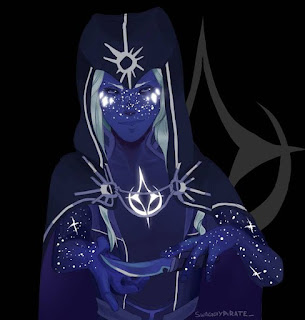
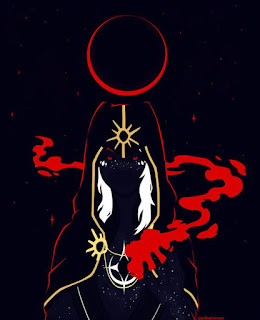
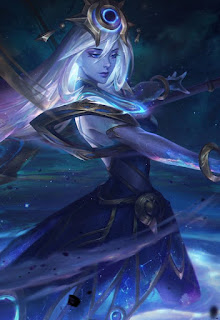
Few humans have even heard of the Vithani, and fewer still have laid eyes upon a Vithani slave, much less enjoyed their company. The brutal slavers of the Umbral Rim covet them, but since the Dark Cataclysm cut their world off from the rest of the galaxy, they’ve had to make do with the population of the Vithani that remain in the galaxy, and their fragile biology paired with their fraught personal lives means they tend to meet untimely ends, and their number slowly, but steadily, dwindles.

The Vithani share the same humanoid body-plan that most humanoids of the galaxy, but with a slighter build and more gracile features. They have remarkable coloration, however, with inky black skin, freckled with patterns of small diamond or square “spots” of white, white lips and long, white hair.  Some have different colors, and they may have a deep violet and very dark blue skin, or they might have a bright magenta coloration to their hair, spots and lips, or a vivid, neon-blue or brilliant crimson hue.  These spots sometimes chart out recognizable patterns, like stars in the night sky, hence their nickname of Star-Children.

The Vithani come from a star within the globular cluster just beyond the Umbral Rim.  Their world has very thin air and retains little light even by day, when their star appears to be but the brightest of a great collection of vivid, beautiful stars. They have evolved to see by this starlight, and stripped of starlight or sunlight, they are blind, and the full sunlight of more daylight worlds can blind them.  They have evolved to breath the refined, celestial air of their world, and they labor under the thicker air that blankets most worlds.

Their relationship with the stars does not end with their appearance and their ability to see so well by starlight: it shapes their very lives! The Vithani have an intensely strong relationship with fate and fortune, and it is written in the stars, and in their stars. Almost all Vithani have a Destiny of some kind, and when it affects them, it affects them much more keenly than it affects other races. They mastered astrology to better understand how the shape of the stars affected their lives. This can make them powerful if their astrologies point to fortunate destinies, but it spells their doom when the stars are misaligned.

Finally, while many describe the Vithani as “magical” or “naturally psychic,” this isn’t exactly true. Instead, the have a unique relationship with psionic abilities: all Vithani that are strong-willed and beautiful are also naturally powerful with psychic abilities; Vithani that are weak-willed and ugly have little facility with psychic power. Those who have studied them are not sure why these things correlate, and have only noted that they do.

The explorers of the First Tyranny found a navigable hyperspatial route to the Vithani cluster and discovered their world.  The Vithani themselves had not yet discovered star travel, but were technological enough to forestall any Ranathim invasion and held off the Tyranny, who turned to a strategy of trade and espionage until they unlocked the secret of Vithani astrology.  With that stolen secret, they learned the fates of the Vithani and struck at the darkest hour of the race, easily conquering them.  The rarified princes and princess of the Star-Children became the slaves of the Ranathim, and so it remained until the Dark Cataclysm rewrote the hyperspatial map of the Umbral Rim, and cut off all contact with the Vithani cluster.  The Vithani slaves left in the Umbral Rim like to think the natives isolated in their cluster have long since thrown off their masters and live free lives.

Today, the Vithani can mostly be found as rare treasures held in the collections of wealthy slavers.  Free Vithani do roam the galaxy, either having liberated themselves, or descended from those slaves who escaped and set up small, isolated colonies on remote moons with thin, gauzy atmospheres. When they travel, they often pass themselves off as rare cousins of the Keleni, to whom they bear a passing resemblance, when they bother to explain themselves at all.  Generally, like all Vithani, they are compelled to follow their fate and lead interesting lives of danger and adventure.

Vithani

0 points

Features: Alternate Attribute (Aura) [0]; Gracile 1 [0]; Night-Adapted Vision 5 [0]; Low-Pressure Lungs [0]; Rule Option (Extreme Destiny) [0]; Taboo Traits (Appearance, Charisma, Smooth Operator, Will), Ultravision [0]

Vithani Features

Gracile means they’re 5% taller than normal, though I’d be tempted to just make them 5% lighter than normal.  Their Night-Adapted Vision paired with their natural Ultra-Vision means they can see between -7 and -5 darkness penalties with no penalty. However, their Ultravision means they cannot see at all without ultraviolet light, so they must be outside under starlight to see, or have UV “black lights” to see. Low-Pressure lungs means they treat thin atmosphere as normal, and normal atmosphere as Dense (which functionally means they are a perpetual -1 to HT in normal atmosphere).
For common traits, I’d recommend at least Allure as a common Talent, but likely some supernatural talents (Devotion, perhaps) as well. Craftiness might fit them too.  Smooth Operator, though, is forbidden (You’ll see why in a bit).  Distinctive Feature might also be a good way of reflecting an especially unique “constellation.”

Rules Option (Extreme Destiny)

Vithani can always buy Destiny, or have Destiny imposed on them by the GM if they have Point Debt, etc.  Vithani must pay 5 more points per level of Destiny (Trivial Destiny is a 5 point advantage) or gets back 5 more points per level of disadvantageous Destiny.
Vithani always use the Impulse Buy variant of Destiny, and they get 1 Impulse Buy point per 5/points of Destiny (thus, their version of Greater Destiny [20] gives them 4 Impulse Buy points, rather than 3).  They should always have the option of using those Impulse Buy points, and if I fully expanded this race, I’d work out a suggested list of what they should be able to do with them.
The GM should always be able to use “Villain Points” against the Vithani, with one VP per 5 points of Disadvantageous Destiny they have (thus, the GM would have 4 VP to use against a Vithani who had a Greater Destiny [-20]).
If using the Great Book of Destiny, the Vithani can purchase a Mark of (the Hour) as a perk (“the Primal Mark” or “The Mark of Glory” etc).  This reflects itself in the spots on the Vithani, which is recognizable to others who know the marks (Hidden Lore (Vithani)?). The Vithani with the mark may always buy a Destiny associated with that particular Hour, and the GM can convert any point debt into a disadvantageous Destny, but only one associated with that particular Hour.  Thus, the Mark sets what broad sort of Destiny the Vithani has.  The GM might also allow the Mark of (the Path) for a similar role for Path-based Destines.

Alternate Attribute (Aura)

Hooboy, here we go.  This might be a little over-the-top, but I wanted to tinker with Alternate Attributes.  This is a worked example of Charisma as an independent attribute (Alternate Abilities page 25), combined with Will and Christopher Rice’s the Fifth Attribute. Here are the rules:
Aura costs 10/level.  It replaces the function of Will, and all Social Skills (that is, any skill that falls under Smooth Operator), Psionic Skills, Chi Skills and Enthrallment Skills fall under Aura.  Aura determines the character’s appearance:
  • Aura 6 or less: Hideous
  • Aura 7-8: Ugly
  • Aura 9: Unattractive
  • Aura 10: Average Appearance
  • Aura 11-12: Attractive
  • Aura 13: Beautiful
  • Aura 14: Very Beautiful
  • Aura 15+: Transcendent
Vishani appearance works a bit like Charisma: it should apply its base reaction bonus against a target even if they can’t be seen, but it applies its higher bonus like normal (ie men will react to a female Vishani with Aura 13 at +4 rather than +2, but if they cannot see her, they react at +2). Vishani may choose to define their Aura as Impressive or Androgynous if they wish, but once defined, it should remain that way.
Vishani have FP equal to half (rounded up) their HT.  They have Aura Points equal to half (rounded up) of their Aura.  Aura points can be spent only on psychic powers, like Energy Reserves (Psi). Aura points may be purchased independently at 3/level, and they recover at the same rate as FP (but recover independently).
When using a Psi-Wars template with a Vishani, their Aura starts at 10, and all points spent on Will, Charisma or Smooth Operator should be converted to Aura, and every 10 points increases their Aura by one level.
Okay, so here’s the logic.  If we treat Charisma as an Attribute, then it should clearly handle all social skills.  But that should only be worth about 5/level unless we decide it should be worth more than that (the 10/level suggested by Alternate Attributes), but to round it out, Alternate Attributes suggests bundling it with Will, which we’ve done. It might even be necessary to move more skills over to it, in which case we can pull Psionic, Chi and Enthrallment skills over.  Enthrallment makes sense to me (it’s basically a social skill), but Psionic and Chi aren’t strictly necessary if that seems over the top to you, as Will is already extremely powerful with both Psionic (extra effort) and Chi (power-blow) skills.
As for appearance, this might be my way of getting them to look pretty without actually buying appearance.  But here’s the logic: Alternate Attributes suggests a +1 to Reactions per level of the Charisma attribute and -1 to Reactions per negative level.  This functions the same, except it reskins it as appearance, rather than raw charisma.
All told, I think all the results balance out. Their AP is a bit high, but they lose some more generalized FP to get it, so that seems fair.  It might be a bit cheap, but this makes IQ a bit expensive so I think it evens out in the end.

Great Notes Of Destiny!

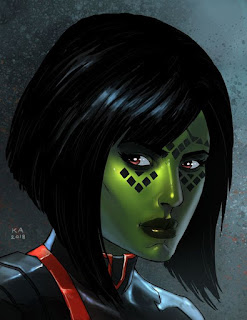
When I started the Vishani, I knew I wanted a race for the Umbral Rim, and I knew I wanted them to be another option for slaves (because how often can you see a Ranathim dancing girl or Ranathim gladiator before wanting to see something else?) and I wanted them to mess around with Destiny, which has some underutilized aspects that I wanted to highlight. My first thoughts were the Vithaani of Tales of the Solar Patrol (hence the name) and I thought about “the red men of the Umbral Rim” actually, but then I pondered the Orion Slave Girls, and then that got me to thinking about the Mirialan of Star Wars, so I had the idea of “Green with black marks” and then I was looking at Ultravision and Low Pressure Lungs and thought “What an ideal combination!” but that meant stars and that meant this particular look.
I worry that they look a bit like the Keleni, as both have darker and/or blue skin with light and pale hair.  Both half “elfish” vibes too, and tend to think a lot about destiny and such.  So maybe it’s too similar, or maybe it’s a bit “Togruta vs Twi’lek” and “Sea elf vs Star elf,” I dunno.
If I kept them as a major race, I might ditch Aura. It’s somewhat complicated and adds quite a wrinkle to the game. It’s easier to just say they’re all Attractive and be done with it.  That said, it does create a somewhat unique incentive structure, and it might be neat to think about a fifth attribute for other races as well!
This highlights how often Features often turn into straight-up zero-point disadvantages in the wrong situation.  Given the nature of Psi-Wars, though Low-Pressure Lungs should be at least a quirk, but I do like the idea of them: you need to be a bit breathless to meet them.  I’d also go with a full 10-point version of Ultravision, because they idea of them being blind without UV light would probably be too harsh for most players, but I’d keep some level of Night-Adapted Vision.  I might give them Obvious at some level, if they “black-light glow” in the dark. I’d also consider -1 ST and raise their Gracile to 2 (in case they weren’t already Keleni enough). I also had originally given them Dreamer as a quirk, and it might be worth keeping for them.
I like them, though.  They’re a pretty pure expression of the feature-based race, and get a lot of utility that hangs together thematically, so I’m rather proud of them.  I wouldn’t mind seeing them as part of the Psi-Wars canon. What do you think?

The Zero-Template Challenge: The Karkadann, the Withering Satraps of the Arkhaian


The Karkadann are among the oldest aliens known among the Arkhaian reaches, and for a time, were considered by archaeologists to be a candidate for the progenitor of the lost “Monolith” civilization that dominated the galactic core millennia before the Alexian crusades, but it has since been proven they were but a client race of that elder race, and one of the heirs to that culture.

The Karakadann evolved on a hellish world, the Eclipse World of Dann deep in the Arkahaian Spiral. A red star rages and roils at the center of their star system, bathing their world in burning, cleansing radiation that would make it impossible for life to take hold were it not for an odd orbital coincidence: their world is close enough to its star to be tidally locked, and a large moon rests between Dann and its star, fixed at a lagrange point. This moon casts a considerable, permanent “shadow” on the world, a narrow one that’s completely radiation free, and then a fainter “shadow” from which life is partially shielded from radiation.  Life took hold in those shadows, evolving to survive that harsh radiation and push farther out into the insidious glare of their hateful parent star. Their world is filled with live evolved to survive the intense radiation, such as the white kudzu of Dann.  

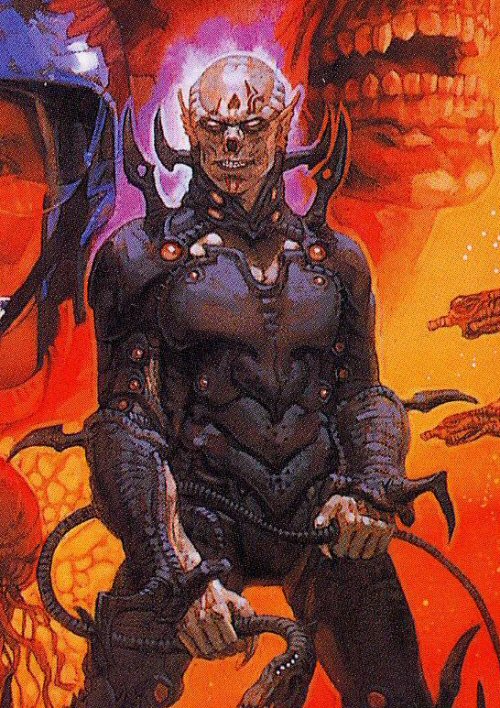
The Karkadann resemble humanity, with a body plan unremarkable among humanoids of the galaxy.  They are hairless and have flat faces with slits in place of a nose and holes where their ears would be, though this does not seem to have negatively impacted either sense. They have rugose skin, typically white, grey or deep brown in color, marked with naturally occurring striping or geometric patterns in red, black or white, including a characteristic stripe running over the top of their head present in all members of the race. A secondary lens covers their eyes, obscuring their irises and pupils with a film of milky white or, less common, black or red.

The Karkadann, like all life on Dann, have unique adaptions to the hostile, irradiated environment. Under the constant assualt of radiation, their genomes evolved to rapidly reconstitute themselves, but the sheer bulk of reconstitution results in genetic errors: mutation.  When these mutations are benign or even beneficial, their immune system leaves them, but when they become cancerous, their immune system  isolates and destroys the cells and all nearby cells, just be sure.  Aggressive errors can result in a runaway biological war raging within the Karkadann body that destroys the cancerous body part.  This results in the Withering, where a part of the Karkadann’s body goes through intense pain and then suddenly loses all feeling and withers away, like a dead leaf on a branch, and then falls away.  Fortunately, Karkadann physiology is very tolerant of cybernetic implants, allowing them to replace lost body parts this way.  A side-effect of the Withering is that the Karkadann do not age the way other humanoids do: if they can keep replacing their body parts, they can potentially live forever, though in practice after a few hundred years, the Withering takes their brains and they finally die.

The Karkadann genome poses another, societal problem.  Even if they do not experience the Withering, they may experience mutation.  Unfortunate Karkadann exposed to radiation may begin to develop strange features, such as claws or additional limbs, additional eyes, bony spurs, or even psychic powers. These mutations come with personality changes and slow, inevitable devolution.  In some ways, the Withering is kinder, as it lets the Karkadann die, while mutation slowly turns it into a monster. The far reaches of the Arkhaian Spiral is haunted by Karkadann marauders, mutated into gibbering cannibals and running ships with open fission drives to further power their mutations.

Proper, civilized Karkadann rule the Technocracy of Dann, a minor empire found between the Refugee Empire of the Telas Constellation and the Cybernetic Union of the Borean Stars. It has endured since before the Alexian Crusades: during this ancient time it ruled a vast swathe of the Arkhaian, purchased cybernetics from the Traders and the Shinjurai merchant princes, and wielded what Eldothic technology their masters had left them with.  They remained unconquered throughout the Alexian Dynasty and had cordial, if distant, relations with the Galactic Federation.  The Scourge greatly diminished it, though, and scattered entire fleets far from where regular medical intervention could prevent the spread of mutation. Today, a much smaller Technocracy remains ostensibly independent and allows representatives from the Cybernetic Union and the Alliance both in its court, but it sides most often with the Cybernetic Union.  Roving remnant fleets filled with mutated Karkadann haunt the Telas Constellation and the Akrhaian Gap, spreading fear wherever they go.

Karkadann

0 points

Perks: Robust Vision [1]

Quirks: Insensitive [-1]

Features: Hairless [0]; Night Adapted Vision 2 [0]; Optional Rule (Mutations) [0]; Rule Exclusion (Cyber-Psychosis) [0]; Robust 1 [0]; The Withering [0]; 

Karkadann Notes

Robust Vision is meant to represent their strange eyes, and fits the horrifying illumination of the setting.  Night-Adapted Vision seems appropriate for the twilight they constantly inhabit on their native world, and means they’d get nice, moody lighting in their artificial environments, like the Ranathim.  Robust means they’re 5% shorter than they would normally be for their ST.

The Withering

This is a variation of Not Subject To Ageing. Machines, rather than losing attributes to age, lose HT from lack of maintenance.  We could apply a similar mechanic here: rather than losing attributes, the GM applies an equivalent amount of point loss in things like One Arm or One Eye or Blind.  Of course, this just gives them an excuse to invest in Cybernetics to replace the lost body parts, which ties into one of their other features.
Of course, Psi-Wars doesn’t care about aging, so it’s even more of an irrelevant trait.  Still, it adds flavor. Realistically, though, if I wrote out the race completely, I would include the Withering as a unique Psi-Wars sickness that afflicts only the Karkadann.

Rule Exclusion (Cyberpsychosis)

So, Psi-Wars has some optional rules regarding corruption and cybernetics.  These rules are meant to offer optional flavor: characters who get a lot of cybernetics quickly, rather than experiencing cybernetic rejection, might develop weird flaws or disadvantages as some of their humanity is lost. This isn’t a proper disadvantage so much as an excuse to go into point debt for your cybernetics, or to change your character around after they get a lot of cybernetics.
Given that cyberpsychosis is an optional rule that does not affect any gameplay, it’s fair to exclude the Karkadann from using the rule as a feature rather than a perk. This exclusion represents a feature-level version of the Low Rejection Threshold perk.

Optional Rule (Mutations)

I don’t deal much with radiation in Psi-Wars, but realistically it should be everywhere. With my new rules on Sicknesses in Psi-Wars, though, I was able to fold radiation in as a simple sickness.  So there’s two ways you can handle this:
  • If using normal radiation rules, Karkadann do not take Radiation “Damage.” Instead, for every point of Radiation they would gain, they instead get Corruption. At 25 Corruption, they gain Freakishness 1 [-1].
  • If using the Psi-Wars illness rules, if they would get Radiation Sickness, they instead get Freakishness 1 [-1]; if they would get Severe Radiation Sickness they get Freakishness 5 [-5].
Freakishness is from After the End’s section on Mutations.  After a Karkadann has gained Freakishness, they may freely purchase any mutation that has their total Freakishness Level or less; their total mutations should not exceed their Freakishness level. So a character with Freakishness 1 could purchase Toothsome, while a character who had Freakishness 5 might take Red Sight and Thick Hide.  They don’t have to buy them right away, but are free to do so at any time.
This is justified as a Feature because a point of Corruption is equivalent to a point of Fatigue (25 points of both fatigue and corruption are the equivalent to one character point), which is worse than a point of rad or toxic damage as far as GURPS seems to price innate attacks, and 25 points of Corruption is the equivalent to one lost point, and Freakishness is -1 point.  The freakishness levels of Radiation Sickness and Severe Radiation Sickness is based on my rules for Corruption and Psychic Diseases.
If we made them a proper, official race, we’d need to work out a list of acceptable mutations.  After the End is a good starting place, but the costs would need to be adjusted for Psi-Wars. Still, it works in a pinch!

Withering Thoughts

I like the Karkadann, and they were one of the first things I thought of when I speculated on a templateless race.  Originally, they were physiologically more unique: digitigrade, a weird form of vision, different standard temperature range, etc, but once I hit on the idea of mutation mechanics, I thought it better to shift them back towards something more human, for several reasons. First, mutation is more obvious when the baseline is thoroughly humanoid (“That mutant glurg has tentacles!” “Don’t all glurg have tentacles?” “They have six, this one has seven!”).  Second, and this is a general rule you’ll see repeated: the more you mess and muddle with the physiology, the more you veer into proper, point-costing traits. So we shifted back towards “mostly human.”
I like them, but they risk looking too much like the Tan-Shai. Their imagery reminds me a lot of how I tend to picture the Tan-shai.  But I do often muse on what happened to all the other races during the Eldothic Union.  They didn’t all die like the Menhiri or the Archonians, did they? So having one survivor race is a nice touch, but it will always conflict with the niche of the Tan-Shai.  Removing their noses, giving them rugose skin and making them shorter and stockier helps a lot, though. They can be the “chaos dwarves” to the strange, eldritch Tan-Shai “elf.”
Mutation and Radiation is a bit of work and might not fit into every campaign, but they fight nicely into the “apocalyptic” themes of the Arkhaian.  It also has a nice interplay with the Blades of Acheron, when I get back into them.
If I made them official, would I keep them as this zero-point template? I dunno.  Their rugose skin cries out for DR 1 at least.  I might upgrade their Insensitive to full Callous, to make their behavior more pronounced for the player. +1 ST might be nice, perhaps with another level or so of Robust, so their more “broad” than “short.” I could consider Bulky Frame, but that might be a “common quirk” rather than a racial one. I would consider Nightvision 2 rather than Night-Adapted Vision, because most players prefer the former to the latter, in my experience: the ability to see well in the dark is definitely easier than the GM needing to remember that the Karkadann is at -2 to vision under normal conditions. They definitely wouldn’t have higher HT or Radiation Resistance, though! 
All that said, I think this race, more than the others I’ve created, could work as-written, and I think it’s the best example of what Lord Buss is talking about.  They have some traits, yes, but most of what makes them interesting is this interplay with cybernetics and radiation. It makes them a strange race without making the strangeness an unusual combination of expensive traits, but simple rule switches that are thrown for this specific race.

The Zero Template Race Challenge

…(A race) which has culture and “common advantages/disadvantages” and maybe unique technology…but without having a template at all. That would also solve the weird situation with humans being the only “normal” race, without a template, when all races in the setting are different, but not all have enough biological difference to require different templates… The point is that a race can have no template and not be just humans-with-a-different-paint-job, but be meaningfully different. — Lord Buss

I’ve had to butcher and stitch together the quote a bit, as it was scattered across a conversation and in a specific, Psi-Wars context, so my apologies if some of the meaning is lost, but it inspired me, and I wanted to share my thoughts on it.  First, I want to talk about what I think Lord Buss is asking for and where there are problems with it, but after establishing those constraints, I want to attempt to explore the surprisingly interesting puzzle that his request poses.

First, let’s narrow down the request itself, and the intent of the request.  First, the core idea here is to have an alien race that is alien but has no defined template, as none is needed. I don’t believe the idea is to just ignore the requirements of a template.  The idea here is to create a race that doesn’t need a template, despite obviously being alien.  He proposes to get around this constraint by offering up associated elements that aren’t part of the template itself. For example, a faerie race might all have Magery, but some might have the option of buying Wild Mana Generator.  Similarly, a race might have access to language and culture and technology that the rest of the galaxy doesn’t (or, at least, doesn’t commonly use).  Finally, you could associate them with “mechanically irrelevant features” such as wildly coloration, hairlessness, three genders, etc.

This request is not for a zero-point template.  A zero-point template might allow for, for example, DX+4 and IQ-4, which certainly a violation of the spirit of the request.  Zero-point templates can be quite complex!  It’s not asking for low complexity, or low absolute cost zero-point templates: a race that all has a perk and a quirk would violate the request too.  Finally, they can’t even have features. Features require a template too, they’re just the most extreme example of “low absolute cost zero-point templates.” The request is for a race that has no template, but is clearly alien.

The intent of the request seems aimed at normalizing humanity.  The point is that the races of Psi-Wars tend to be positive in cost, often quite expensive, and humans are not.  This creates a weird situation where the galactic average ST or IQ or HT is higher than the human norm. By having at least a few races that are mechanically identical to humans out of the gate, you bring that average back closer to humanity. It might also be about reducing mechanical complexity. After all, what Lord Buss describes isn’t really that far from a zabrak or a twi’lek: the humanoid races of Star Wars mostly amount to “person-with-a-paint-job.” There’s no reason to make every race a deep investment in system mechanics.  Finally, it would also simplify the race creation process, making the race design a lot cheaper for the GM, which would allow a proliferation of races.

So, can it be done?

Can You Make Races Without Templates?

No, it cannot be done.
The problem here is how exacting GURPS demands Race Templates be. A lot of what Lord Buss is describing as “things you can do without a template” are, in fact, things you need a template to do.  For example, if you made blue skinned, black-eyed, digitigrade, hairless humanoids with tails who were able to withstand the deep cold of their native arctic environment, then they have some degree of temperature tolerance.  You could set their native temperature at a lower level, so they’re fine in arctic weather, but dying of the heat at room temperature, but that, along with hairlessness, tails, inky black eyes, night-adapted vision, etc, are all features. By definition, if the race is different from humanity at all, in any way, they need to have a template, even if that template has only features.
There is, in fact, one templateless race that I can find: the Vithaani, from GURPS: Tales of the Solar Patrol, Page 18.  But if you read their entry, it’s obvious why they have no template:

The humans of Mars are genetically identical to Earth humans, and interbreeding is possible.

They don’t need a racial template because they’re not a race; they’re human.
Having humans with unique technology, language and culture is not a race, it’s a culture. So if we have templateless, humanoid “aliens” with a strange set of technology, what you really have is a different human subgroup, not a different race.
But what about unique traits that the race can buy? Well, that sort of kicks the mechanical requirements down the road a bit: you’re still a member of a mechanically complex race, you just get to pick and choose from a menu that dictates the specific nature of how weird you are.  But while this might actually go a long way to making a race feel fairly unique, it’s not actually an example of templateless design.  What you’ve really done is given them Racial Gifts as a feature. From GURPS Power-Ups 2: Perks, page 12
Racial Gifts
This is strictly a racial perk.
You can buy a specific set of exotic and/or supernatural advantages that are allowed but not mandatory for your race, but off-limits for most other races in your setting… The GM lists the optional advantages  and  decides whether you can buy them in play. He might waive this perk for a race whose extra options aren’t all that remarkable – or require one perk per advantage for powerful, rare abilities.
I tend not to bother with a Racial Gifts perk often, though perhaps I should, but most of the powers races can access in the setting can be accessed via other means.  Keleni Telepathy or Ranathim Blood-Sense are just fairly specific and flavorful examples of psychic powers that any character in the setting can by after hopping over some extraordinarily low hurdles. But they’re still features. 

So this sounds like something of a definitional argument, but it is true: you can’t define a race without a template, because races by definition have templates, and any substantial biological and psychological differences would necessarily be defined by traits, even if they happened to be zero-point traits.

It’s a Bad Idea Anyway

Furthermore, I wouldn’t design a race this way even if I had the option, though optional traits later down the line do address some of my complaints about it.
First, I don’t really accept the need to “normalize humanity.” In a realistic sci-fi setting, I get it.  In G-Verse, I tried to find ways to make humans seem especially dextrous, playful and enduring compared to most other races, as these do seem to be some major differences we have from the rest of the biological kingdom: if we met a race of sapient velociraptors or cetaceans, our fine manual dexterity, tendency to turn everything into a joke, and the ability to engage in persistence hunting would set us apart.  This prevents all the other races with “all races are cooler than humanity.” It creates an environment in which humans are somewhere in the middle of the evolutionary bellcurve, rather than in a weirdly low spot compared to all the totally cool races running around.
But there’s a few problems with this approach in Psi-Wars. First, it assumes racial templates and and do go negative, which I’ve generally avoided. I’ve noticed that even in DF, there are no negative templates. I think campaign framework designers have tended to avoid this because it raises ugly questions about disadvantage limits and how they’d interact with templates.  I’ve followed this practice in Psi-Wars.  This, of course, isn’t a showstopper for normalizing: if people are interested in seeing negative-cost races in Psi-Wars, I’ll see what I can do! But it is a reason I haven’t done it.
Second, Psi-Wars is Space Opera, and the point of Space Opera is to go “Lookit how cool that is.”  If you meet an alien space princess, the fact that she’s alien is cool, and we traditionally express that coolness in positive cost: her race is magical, or her race are all beautiful, or they’re immortal, etc.  “Coolness” doesn’t have to necessarily be advantageous, but in the brutal heroic-adventuring-logic of space opera, it usually is. “Your species is capable of parthenogenesis, but only during the winter seasons of your world? That’s so cool!” is the sort of thing one utters in scifi rooted in xenobiology, not one rooted in punching alien warlords in the jaw to rescue the alien space princess from his evil clutches.
Finally, players who choose a race are going to want to see that race impact their play. I tend to prefer races that act like a theme atop a mode.  I don’t like it when, say, all elves are wizards and all wizards (who are twinky) are elves.  But if you have a game where elves, dwarves and orcs are all viable as fighter, wizard and thief, that’s great, provided they each play differently, and that difference is going to be a mechanical one that’s going to need details in a template that explains those differences. And chances are that will affect point cost.

But Let’s Do It Anyway!

You knew this was coming, right? Obviously, I wasn’t just going to write a post to rag on one of my readers.  I’m writing this because the puzzle intrigues me.  If you’re like me, it intrigues you too, and you’re thinking “But actually you could X or maybe you could Y” and make this work.  Shouldn’t it be possible to create some sort of thematically interesting race with at least a minimal sort of traits? How much can you do with as little as possible? It’s a bit like a haiku: while the actual, literal request is by definition impossible, the spirit of the request creates intriguing constraints that might make for an interesting mental exercise.
So allow me to create an amended version of it: how alien can you make a race without resorting to large, absolute costs? Let’s set some ground rules. We must be able to include Features. For convenience, let’s allow Perks and Quirks too, but let’s set a hard limit of no more than 5, and a soft limit of no more than one of each: you can do more but we’ll squint at you. The most elegant version has no quirks or perks at all. This means the template is no more complex than a generic character who already has a template: it’s just setting up to 5 quirks and perks for you.  You might even say being a member of such a race is a quirk or perk (In the spirit of that, I think we can allow a +1 or -1 point cost).  There can be no advantages, disadvantages, nor any attribute or secondary characteristic changes.  Everything is only features, perks and quirks, and the latter too are highly restricted.
Can you make an alien race this way? I think you can!  I think it’d be a lot of fun.
Let’s lay some additional ground rules.
Lord Buss also requested that the race be of “minor importance.” This caused some discussion about whether it’s permissible to add a “major race” into the setting “so late.” I think, of course, that it is. We can make major changes at any time.  But I think it’s also beside the point, because a Game Master who likes Psi-Wars isn’t going to want to introduce major, setting-sweeping changes. They’re going to want to introduce a new world, or a new constellation, or maybe even a new fringe cluster, but they’re not going to want to redefine the Empire, right? So they’re probably going to want to make a minor race, so it’s more interesting, in this experiment, to do what they’d do. So, they must not be of galaxy-shaking importance. They should be minor races that can be pretty easily isolated.
I also don’t want a boring race.  I still want to see them as a theme over the mode of the character. If you want to play one of these guys as a bounty hunter or a space knight, I want it to feel different from playing a human somehow.  I don’t think the original request was ever really about “the race shouldn’t be different” just that it shouldn’t have a wildly different template, that it should extract its distinctness from a minimalistic set of design considerations.
I’ve also had a lot of requests for moar alienz! Psi-Wars is an Aliens Everywhere setting, and yet everyone keeps playing the same races.  That’s fine in the sense that most D&D people play elves, dwarves and orcs and rarely catfolk or coleopterans, but a Space Port bar should be brimming with high weirdness.  What is some of that weirdness like?  Certain parts of the galaxy beg for additional races, like the fantasy-esque Umbral Rim, or the intriguing biologies of the Sylvan Spiral, or the Arkhaian which should have at least some aliens in it, but is very sparsely detailed because I’ve been focused on other things.
So, let’s see if I can cobble together a few of these minimalist aliens and stick them in the Psi-Wars setting.

A Toolkit

Oh, you want to try too? Well here’s some tips and tools to get you started, beyond the obvious GURPS Space.
For perks and quirks, I recommend using GURPS Power-Ups 2: Perks and GURPS Power-Ups 6: Quirks as good, go-to resources for those to elements.
GURPS Template Toolkits 2: Races has a depth of detail that only Bill Stoddard can achieve, and that makes it especially useful for us, as most of our work won’t actually be in the template, but thinking about everything around the template, so it will be a useful book for us to explore (especially for thinking about alien mindsets and quirks). But it also has an extensive discussion on Features on page 12, and a few new features, including Gracile and Robust on page 14. Hit the index if you want more, though note that the “Metatrait Like” section lists zero-point metatraits, which might go beyond what we’re looking for here and verge into “high absolute cost zero-point templates.” Winged Hexapod, for example, might violate the spirit of this challenge.
Pyramid #3/35: Aliens has a rich variety of resources to play with.
  • Alien Disadvantages will give you too much difference for the constraints of this experiment, but might be a good source of quirks, if you’re looking for a more subtle version of these.
  • Making Something Alien and Alien Starting Conditions might offer inspiration for how to think about your race.  After all, the first problem will be trying to come up with a way to make your race unique and different for nearly zero points.
And you might think about what sort of power-ups or technologies that might make your minor alien race interesting. In particular, I recommend talents as power-ups, as saying “this race tends to be good at X” is a good way of pushing someone in a particular direction: not all dwarves are miners, but dwarves tend to be good at mining, so Pickax Penchant might be common, but not required.  So, consider looking at GURPS Power-Ups 3: Talents, not as part of the template, but one of the things to put as an optional trait that might offer a lot of firm definition.

The Zero Template Race Challenge

It’s a catchy name, even if it isn’t the most accurate name (The Feature Creature Feature?), but I wouldn’t start this unless I had some material already outlined.  This will be a short, self-contained series of “Zero Template Races” with an eye towards Psi-Wars.
Haven’t spent a few days working on this already, let me just say upfront that my experience with it is that you shouldn’t build races this way.  You’ll quickly see that we run into interesting ideas that would be a lot more interesting with at least one advantage or disadvantage tossed into the mix, especially physiological advantages (like “Hoof” or “Flexible”).  The second thing I notice is that some contortions I have to go through to make such a race interesting would often be simpler with just a single trait.  There’s also a broad collection of really neat ideas that become arbitrarily limited.
I’ve also discovered Features can be far, far more sweeping in their changes to a character than perks or quirks typically are, which is interesting.
That said, this was a great experience for me, and I highly recommend it. It forces you to think about races in a minimalistic way, which is a nice way of thinking of them for Psi-Wars, as the result is almost invariably extremely human, and I strongly advocate looking for ways to make a race more interesting than +X to stat A and +Y to stat B, and this forces you to think about how your race is different in a way that’s not just slapping a couple of advantages or trait modifiers on a human chassis and calling it creative.
I’ve got three races to show. They’ll be rough mechanical sketches, on par with Iteration 5 races, rather than the fully realized races of Iteration 7.  Should they generate enough interest, I’ll clean them up (they might move away from their zero-template origins) and make them “Psi-Wars official.”