"Hey, I didn't know I needed that!"

 So, I finished the third session of Undercity Noir a week early, as one of the players couldn’t make it on the normal day.  We finally met the client and his girlfriend, and the introduction is finally finished, and the players have been released into the world.  But an interesting thing happened during the negotiation: “I didn’t know (X) was such an important skill!”

GURPS has this at the best of times: because it has so many skills, people can easily overlook them. However, these characters were built from templates, and I checked, and all the traits they were asking for were present. And one of the characters had all of them, because he followed his template closely and so he just had them without realizing they would be so useful, and the result was a rather amusing moment where the Bounty Hunter sighed and started to explain to the Con-Artist how to do her job. But in a sense, it fit.  So this felt more like players realizing certain skills had more value than they realized, not that they didn’t realize they were options.

Will

I think they realized this was important, given how many successfully resisted the Keleni Telepathy of the femme fatale, but I just want to point out to anyone poking at Psi-Wars that Will is very useful in a psionic game.  I know, seems obvious, but I’ve had it come up in previous playtests.  I’m not saying you should jack your Will up to 20 on every character, but I am saying you’d get your points worth if you did.

Psychology

So this was the core trait that surprised people.  I had set up meeting the contact as a mini-action scenario (as I like to run the first few sessions as sort of a preparation of how the game will actually play out) and so when it came time to collect all the clues and plan how best to negotiate with the target, I noted that Psychology was one of the skills they could use for this, which I thought made sense, and also caused quite a scramble. Which surprised me, because Psychology is one of the most popular skills in my games, but I sense most players come at this from a different context.

I tend to build my games as very NPC heavy, with layers and layers of intrigue and mystery.  I do this for several reasons, but a lot of it comes down to the fact that I cut my narrative teeth on anime, romances and dramas.  I just like large casts of colorful NPCs with detailed and nuanced motivations.  And in particular, in a Heist, there’s a major clash of personalities.  It’s not just “the cops” that are coming after you, but a specific detective; there are rival gangs, and they have specific leaders; there’s always some new guy added to the crew after the fact, and you need to assess if a good fit; there’s the target of the heist, who has a specific personality and blindspots.  Having psychology allows you to construct a profile, to learn the context of why people do what they do. If you combine it with Empathy or Body Language, you know what they are feeling and why. So with players familiar with my games, it seems to come up a lot. I’m not saying it’s a must have, just that people knew to my games seem surprised at how useful it is.

Holdout

This might actually be missing from some templates, but this came up very quickly, and it makes sense. A lot of previous playtests have been about soldiers or space knights who walk around in full armor, but this is in a city with lots of Imperial Security, lots of camera, lots of angry gangsters.  Carrying a holdout blaster or a force sword into a club carries a lot more risks, and rewards, than it does in most games.  So this has been quite a schooling for me in how holdout works.

Observation

I see some people complain about Observation.  When do you use it? When don’t you? For some of them, it feels redundant if you have Perception.  But to me, Observation is about picking out details discretely. It’s also about picking out pertinent elements of something, such as when you “case a joint.” It’s also cheaper than Perception, so to me it’s always been a no-brainer, but I’m surprised by the number of people who don’t have it in my group.

Running, Climbing and Jumping

It didn’t come up in this session, but like with Psychology, I think a lot of players skip these.  After all, your ability to run really comes down to your Basic Move, Climbing seems pretty niche, and Jumping can default to DX if strictly necessary, so in the intense prioritizing that most PCs will do, while Acrobatics gets a vigorous nod, these parkour skills get less of one.  When is it going to come up, after all?
In Action, they come up all the time.  Action is about chase scenes, and chase scenes use these skills. Sure you can drive too, but there’s always a point when you’ll want to run.  This didn’t actually come up this session, but the previous session and I think I already mentioned it in my thoughts on that session, as this pleased the player who took them, and they really made a difference: the Bounty Hunter who had minimal investment couldn’t keep up, but the Assassin with maximum parkour not only caught up to the target, despite having a very late start, he managed to cut her off before the Bounty Hunter arrived. That tickled him pink.  I mention this more because if you’re a budding Action player, be aware of the value of parkour skills!
I think if I finish my Cinematic Chase Framework, that’ll help people more intuitively integrate chase scenes, as there’s a lot of details in chase scenes that can get lost in the “Look just roll Running until it’s obvious who will win.” Getting a little help in creating the sort of dynamic chase scenes we see in action movies will make the utility of Climbing, Jumping and Acrobatics in chase scenes more obvious.

Thoughts on Campaign Framework Skills

I’ll leave you with one last observation I’ve had with people interfacing with campaign frameworks in general.  In my experience, most GURPS players learn to tune out the garbage and focus on what matters. GURPS itself encourages this, because you can’t even use Beam Weapons in a fantasy game, or Magery in a “Hard” Sci-Fi game.  Thus learning to filter the useful from the useless is a very important skill in a veteran GURPS player.
But part of the process of creating a Campaign Framework is pre-filtering the skills that exist, and adding additional utility to the skills that remain. Once this happens, another element of GURPS starts to rear its head: its emphasis of subtle utility. GURPS has a tendency to narrow down and focus on all the possible things a skill (or advantage) can do, and then emphasize those.  For example, in a typical White Wolf game, Brawl is the skill you use to punch people, and Medicine is the skill you use to heal people.  GURPS, by contrast, introduces a ton of nitty gritty techniques for Brawl and differentiates it into three different skills to determine exactly how you fight; Medicine breaks out into Diagnosis, Physician, Surgery, etc, and one begins to realize the power of knowing exactly what’s gone wrong with someone’s health, how to prescribe exactly the right dose, and how and when to use surgery to fix issues.  GURPS brings these nuanced details into view a lot better than other games, which can take some people by surprise, as they tend to dismiss a lot of GURPS skills as one-note or niche when it turns out, especially in a Campaign Framework, they can have a lot of value. This is not meant as a defense of the GURPS skill system (it can be exhausting to work with sometimes), just as an observation of what I notice happens with players when they interact with the details of a Campaign Framework.

More Kronos Musings: Geography

Now that we know something of its history, what does it look like today? I generally don’t like “island worlds” though on some level it’s unavoidable. Most games can’t handle one fully detailed world (Earth) and even your most far ranging fantasy games rarely escape a single continent. Still, we can add a few more details than just “one city.” Nonetheless, let’s start with one city.

The Shield Spire, Grand Nexus and the Pit

The Spires of Kronos are gargantuan structures built by the Eldoth themselves. They have a mile square base, and extend up into the atmosphere to about 20 miles in height, and extend down into the crust to an unknown depth (at least 20 miles down). They’re extraordinarily resilient, but not indestructible. They contain the machinery of the Deep Engine within them; they are some of the largest such Deep Engine sites known, and Kronos has the most such Deep Engine Sites known in the Galaxy. These spires remain largely inaccessible today, though some groups have managed to unlock a portion of a few different spires.

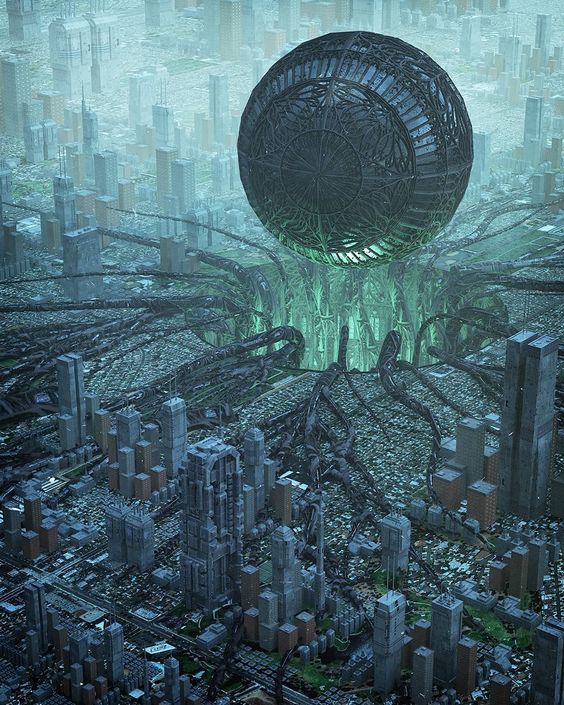
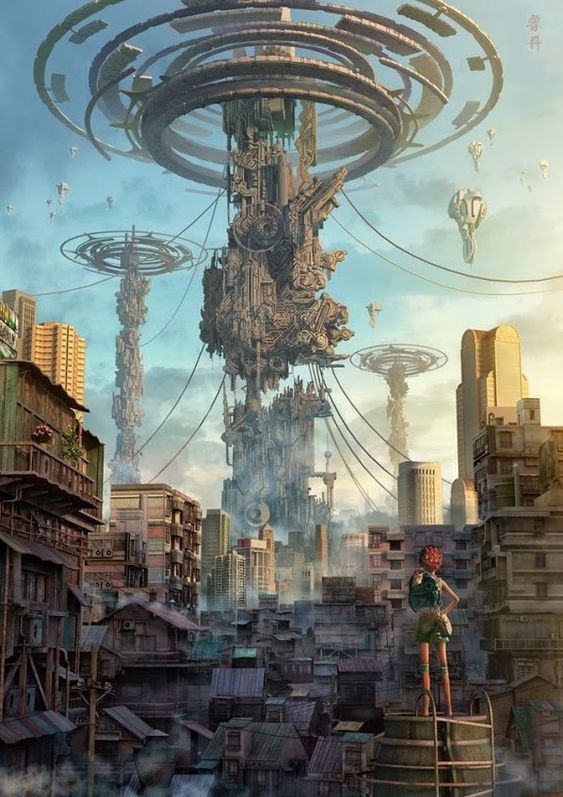
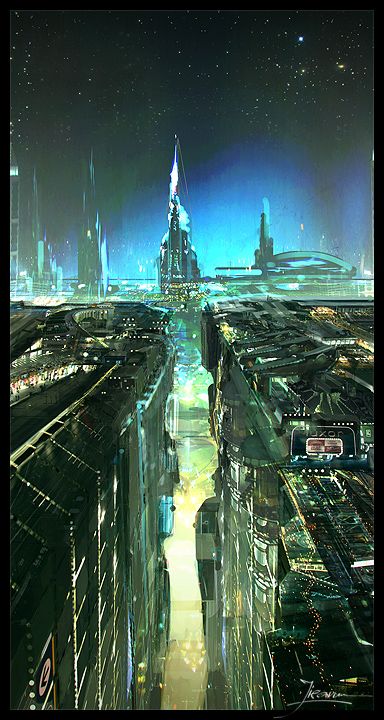
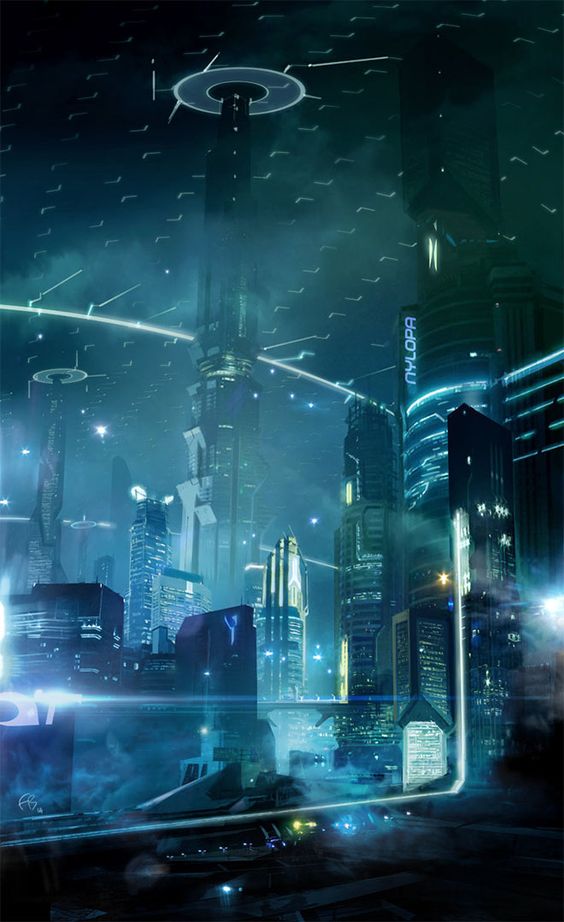
The Shield Spire is the most well-known of the spires. It is so named because of the “shields” that surround it. The Shield Spire is located at the 30th parallel above the equator, at the prime meridian. The Eldoth designed the area to be a primary base of operations, and it remains the central “capital” of the world.  The area immediately around the spire, out to a distance of 5 miles in radius, was originally a clear area.  Over the millennia, a city sprang up around the spire of high rises, temples and grand palaces, including the cathedral-sized factory complex of House Mistral and the current imperial headquarters, the imperial security ministry building and the governor’s palace.  This area is known as Grand Nexus, and is the capital of Kronos, housing about 3 million people. It’s dark, neon-lit night skyline dominated by the vast structure of the spire is perhaps the most iconic image of Kronos.
Arrayed around the spire are five vast, hexagonal “shields,” from which the spire gets its name. Each of these shields measures 10 miles to a side, and is constructed of a mixture of alien metals and ultra-advanced concrete 100 feet thick. The shields are elevated above the planet’s surface at a height of 20 stories (10 stories of which is just the structure of the shield itself).  Contrary to popular depictions, these are not domes meant to keep out the elements; they are bunkers meant to resist orbital assault, with most of their defensive structure aimed upwards, at the sky.  In fact, several of the shields have had sections of their walls demolished to allow easier access to the bunker within with no ill effect. Past the much thinner walls or doors on the sides of the shields, one enters the bunker itself, which his an inverted pyramid that extends into thThe Shield Spire is the most well-known of the spires. It is so named because of the “shields” that surround it. The Shield Spire is located at the 30th parallel above the equator, at the prime meridian. The Eldoth designed the area to be a primary base of operations, and it remains the central “capital” of the world.  The area immediately around the spire, out to a distance of 5 miles in radius, was originally a clear area.  Over the millennia, a city sprang up around the spire of high rises, temples and grand palaces, including the cathedral-sized factory complex of House Mistral and the current imperial headquarters, the imperial security ministry building and the governor’s palace.  This area is known as Grand Nexus, and is the capital of Kronos, housing about 3 million people. It’s dark, neon-lit night skyline dominated by the vast structure of the spire is perhaps the most iconic image of Kronos.

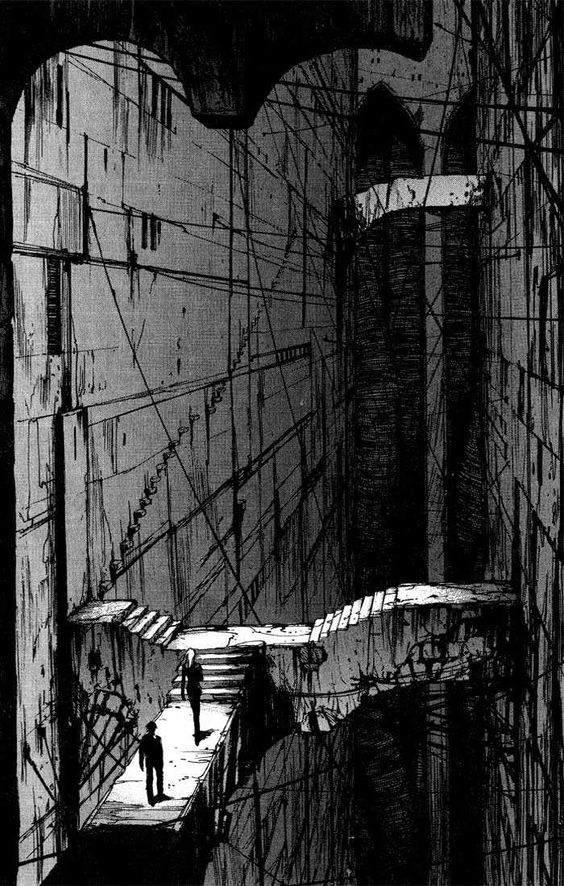
The interior of the shield consists of “blocks” that are twenty stories tall and about 80 yards long and wide. The blocks is unique, and may be set aside as office space, living space or machinery.  Each “block” can be treated as its own building with its own internal structure: the top-most structures tend to have interior gardens, flowing fountains and decent lighting, while those lower down consist of bare concrete corridors with interspersed metal doorways and dorm-sized rooms. In some places, the “block” may be absent, creating a vast open area or a yawning void in which people might construct monuments, or gardens, or they may fall into disrepair and become great, gulfs of darkness.  Between these “blocks” are large, 20-yard wide corridors that form a grid; these corridors extend the entire length and width of the shield, and extend all the way from one 20-story “floor” to the next 20-story “floor.”  Those who enter the Shield from “street level” can look up all the way up to the barrier of the shield above. Lights usually hang on the underside of the floor above, as to the interior transport trams.

One travels about the interior of a shield, or from one shield to another, either on foot, walking down the great corridors, or they take a train.  The trains are attached to the roof of the floor “below” the current floor, and generally reached via a staircase to a catwalk that leads to the “subfloor” train. To get from one floor to another, one takes either a staircase, or an elevator. A few high-speed elevators reach the whole structure, but these are reserved for emergency use by the authorities, with per vertice of the hexagon, located halfway between the vertice and the center of the hexagon, with one more emergency elevator at the center of the hexagon.  Other elevators handle a maximum of 10 floors and one must travel from one elevator to another to make their way the full distance from the top to the bottom.
Not every shield is fully occupied.  The primary occupied shields are the so-called “northern shield,” which sits north-east of the avenue that stretches from the Pit to Grand Nexus, and the “southern shield” which lies on the southern side of the same avenue.  The Southern Pit, sometimes called “the South Side” is home to many secondary industries and a vast working population of cheap laborers.  It has the largest alien population of the region, and seethes with crime. The north shield, or “the North Side” has a more (though not exclusively) human population and tends towards middle class, or lower-classes working in the service sector and aspiring towards Imperial Citizenship.  It has a fairly strict law enforcement presence, with numerous checkpoints to maintain the peace.   These two shields have the largest populations, each with around a billion people. There’s also the “Far Shield” which is on the other side of Grand Nexus from the two “main shields” which mostly consists of industry that serviced House Mistral and the pit on the far side, which is still actively mining.  Today, much of the shield has been decommissioned or has been taken over as an exclusively imperial part of the city, and houses no more than a million people.  Given its spaciousness and the grandness of much of its design, those who live in the shield are the envy of the other shields.

Between each shield is a great avenue a mile wide.  Originally, these were kept clear: a straight avenue of concrete and alien metal that led directly between the shields to the Spire. Today, they have become cluttered with “sprawl,” as people have built houses or shops up against the walls of the shields, between which roads and traffic wends their way.  The main avenue between the Pit and Grand Nexus is frequently used as a commercial district and home to the so-called Night Market, where local merchants and street food vendors will open stalls at night, when the night shields the planet from the dangerous solar flares of the Star of Kronos.

At the far end of each of the five avenues, away from Grand Nexus, lies a great shaft.  Each is ten miles across, and goes all the way down to the planet’s core.  Most of these pits have collapsed in on themselves, or begun to fill up with water, but two remain active.  The most active one, simply called the Pit, is ringed with a great, eye-shaped spire that rises up above the rest of the city to the second largest structure in the area.  This is the Starport of Kronos.  It houses numerous ship repair and maintenance facilities, and given the enormous size of the pit, it can house even imperial dreadnoughts.  The depths are still used for mining the planetary core, and the ores found in the core are brought directly up and placed on waiting cargo ship sin the Pit.  Between the deepest depths and the starport, one can find impromptu housing structures built into abandoned mines. These low-level living quarters and communities extend for a depth of about one hundred miles, and those nearest the pit have reasonably good air quality, despite the fumes from the mining below, given their open access to the atmosphere above.  As cargo vessels travel up and down the shaft to access ores, they often see children swinging their legs on the balconies of their shoddy homes, watching the traffic go up and down and enjoying what light spills down the shaft.  The population in the mine shafts are a fluid group, interacting with the miners below and the starfarers above; those who are fleeing from other worlds often find themselves hiding in the depths of the Pit.  This is a very anarchic part of Kronos, as the denizens of the pit belong to no “official” community, and the tunnels are too convoluted for the Empire to readily assert their dominion.  Thus far, as long as groups don’t interfere with the operation of the space port above or the mining below, they’re left to their own devices.  The Empire estimates that upwards of 100 million people live in the Pit.

Beyond the shafts and the shields lies the sprawl.  This consists of homesteads, apartments buildings, communities and townships that have grown up on the continent around the Shield Spire.  These tend to be less densely packed: people may have a house with direct access to a road, or even a lawn or a garden. Travel in the sprawl is generally by repulsorcar, and communities cluster around urban centers with tall buildings: essentially, the sprawl consists of endless smaller cities that have all grown together, but see themselves as distinct from the Spire itself, which they call “the City.”  The Sprawl collectively has about 100 million people in it.

The total sum of Grand Nexus, the Shields, the Pit and the Sprawl comes to about 3 billion people, the majority of which live in the shields or the Pit.

The Other Spires

The Shield Spire is but one of twelve spires, spaced equally across the globe of Kronos.  Each governs a unique and distinct region of the world.
The Dead Spire: The northernmost spire, it was damaged heavily during an orbital bombardment and created a region of intense twisted psionic energy.  The ruins of past civilizations remain there, haunted by psionic ghosts and malevolent presences.  The only living being there are either scavengers, darting in to salvage some part of a broken civilization, and an outpost of imperial scientists, who are studying the strange pyschic phenomenon around the broken spire and its ruins.
The Jungle Spire: On a distant, southern continent, the Eldoth may have attempted to create a region of sustainable agriculture: the ruins of hydropnic plants and greenhouses can be found beneath the overgrown foliage of the region.  The spire, still humming at the center of the verdant continent, evidently does something to the fertility of the region, and things that grow their grow to towering and dangerous proprotions. The Ranathim Tyranny noted the fertility of the region and transplanted some of their favorite plants to the region, especially some of the more dangerous plants of Hekatomb.  The continent has become an emerald nightmare, but farmers to eke out what they can from the lush soil at the edges of the region.
The Sea Spire: Despite the reputation of Kronos as an entirely urban world, it has geographic features like seas and oceans.  The most prominent sea has a great spire jutting out of its center, around which what must have once been floating citysteads remain, great metal drums miles in diamter that slowly float around the ocean like great artifical island-ships.  The ocean itself has darkened with pollution, but the spire keeps the algae and plant life of the ocean alive, even if no biological fish swim its depths.  That doesn’t mean nothing swims its depths, though: dark shadows sometimes move in its greatest depths and send sensor systems on the fritz; the current theory by imperial researchers is that oceanic warmachines of bygone eras still move in those depths.
The Storm Spire: Another of the shattered spires, this one lies to the south-west of the shield spire.  Like the Dead Spire, it too was shattered in an ancient war, and the energies released in its shattering roiled up the atmosphere around it: a continent-sized hurricane raged around the spire after it died, and that hurricane rages still today, with the spire at its eye.  Worse, the region is haunted with twisted psionic energy, and giant shadows shuffle about within the tempest, barely visible from the outside. The rain that falls in the stormhas black particles in the raindrops that sicken and twist those exposed to it. The eternal storm wrecks the weather of the rest of the planet and makes weather control nearly impossible.  Worse, the storm sometimes migrates slightly spreading its black rain to other parts of the world.  Grand Nexus in particular needs to remain alert, and issues warnings whenever “the Black Rain” gets too close.

More Kronos Musings: History

 So, quite some time ago, I announced a playtest, a heist; we did a poll, and Kronos won out.  I expect it did so because it’s an interesting, alien world set in the midst of an otherwise human dominated part of space, and that’s pretty much all we knew about it at the time.  I believe I’ve made some musings on it before, but let’s do another iterative cycle on it, where I simply walk through some basic logic, and what I need to make it an interesting heist location.

I was originally going to post the whole thing at once, but it turned out to be way too big for me to handle, so here it is in the first chunk.

What is Kronos? Why is Kronos?

So, let’s start with why Kronos even ended up in the Psi-Wars atlas.  One of the things that irritates me about a lot of space history is the timelessness of it.  Star Wars is the worst, of course, with Coruscant being a big, urban capital world for basically all of galactic history, at least as far back as the Old Republic.  This would be like deciding that Rome was the capital of the world for all time, when it wasn’t even the capital of Rome for the entire history of the Roman empire! Things move, they change, and they get left behind.  I wanted to express that, and to acknowledge the slow shift in power from the alien empires that made up the early history of the Psi-Wars galaxy.  Once upon a time, the power of the galaxy lay centered more towards the “eastern” half of the galactic core, around Kronos, between the Umbral Rim of the Ranathim, and the Arkhaian Spiral of the Eldoth.  Then came the Alexian Crusades and the conquest of the galaxy by humanity, and the center of power shifted to the “West” of the galactic core, closer to the Glorian Rim of humanity, and Sovereign.  This makes Kronos “the old capital.”
So, in a sense, Kronos has always been a historical world.  It’s had a few name changes, from Chronos (time) to Cronus (the titan, the king of the bygone age) to Kronos (an aptly confusing blend of the two), all meant to represent this notion of Kronos as a world deeply embedded in the history of the setting.  Thus, it’s most distinguishing feature is that it featured strongly in, and retains features of, previous eras, making it something of a time capsule world.
But I don’t want to go too far in that direction.  We often freeze locations in history based on a preferred narrative perspective.  I think Egypt suffers the most from it: when we discuss Egypt, most people immediately think of the pyramids, mummies, great monuments to bygone eras, the nile, palm trees, etc.  But this was _but one moment in time_ and from a very long time ago, once that was trumpeted wildly in the early 20th century, a moment in time that has set a lot of the tone of pop culture. But Egypt has been many, many things since, from a seat of Greek power to the breadbasket of the Roman empire, to one of the most important regions for Christianity to a seat of power of the Muslim world, home to Saladin and the Ismaili sect that later spawned the Hashashin, to the home of the Mamluks, and I could go on and on. I wanted Kronos to feel like that: it was not some world frozen in a single era, but one that had accumulated history, like layers of dust, over the eons, and you could see all of them every day, such as being in Egypt, with the pyramids at your back, a coptic church before you, and hearing the Islamic call to prayer.

The History of Kronos

The polls quickly established the idea of an alien race defeated (mostly) exterminated by the Eldoth.  The community came up with the Menhiri, a race of stony giants with fantastic memory that used to keep the histories of the galaxy before their destruction.  With their death, much of the history of the so-called primordial era, the era that pre-dates the Eldoth, was lost.
When did the Eldoth take over? Well, we know the Menhiri were lost pretty early on, and the Eldoth were looking for a base of operation: they had fought a war against some great galactic menace, and were seeking to prevent its resurgence.  Controlling a world near the Galactic Heart would keep them near Azrael, and it would act as a staging ground for the rest of their wars on the galaxy.  We also know the Keleni interacted with the Menhiri, which suggests there was some overlap between the two races.
If we look at our Galactic History,  this took place sometime between 4400 and 3200 “BD.” The Keleni colonizations took place between 3600 BD and 3200 BD.  This suggests that the earliest the Eldoth could have conquered Kronos, assuming the Keleni contacted the Menhiri on their homeworld, was 3600.  The Monolith War that kicked the Eldoth off of Kronos took place between 3100 and 3000 BD, which suggests the Eldoth had about 500 to 600 years at most, to perform their genocide and their transformation of the planet into a massive urbanscape.  A most likely scenario would be that the Eldoth and the Menhiri co-existed for quite some time, and the massive presence and threat was already building around Kronos when the first Keleni stepped foot on it, likely early scouts and explorers, before the Keleni colonizations took off in earnest.  We might give the Keleni a hundred years of contact before the conquest (setting the conquest at 3500), then less than 50 years to complete the extermination process (3450). Is 100 years enough time finish paving a world and building a Deep Engine on it? Well, it hardly matters, we could easily give them 200 years of construction on the planet to complete their fortification of the world (so, 3250, or just before they began to conquer the Keleni worlds).  That suggests the Keleni would have known their own destruction could have been imminent, so perhaps all of this took place slightly later than I’m speculating, but that means Eldothic control of the world wasn’t that long.
The Eldoth fougth the Ranathim between 3100 BD and 3000 BD. My guess is Kronos would have held out for a good long time, but its fall would have precipitated the disintegration of Eldothic defenses.  So, Kronos probably fell by 3050 BD.
With the Eldoth gone, we shift to a new era for Kronos.  Now firmly in the hands of the Ranathim Tyranny, it becomes a place of prestige. The Sumerians had a title, the King of Kish, often used by Kings who ruled from someplace other than Kish; it spoke to the central importance of Kish. The Ranathim Tyrants might have seen Kronos as similarly prestigious: “the Ranathim Mystical Tyrant, Master of the Nine Races of the Umbral Rim and King of Kronos.”
 
It certainly is not the capital of the Tyranny; that would remain on Styx, the Ranathim homeworld.  However, this newly conquered world is very central to the trade of the galactic center and sits adjacent to the Trader Band; the very reasons the Eldoth chose it remain valid, and thus it remains important. Plus it is a “conquered capital” and thus a prestigious location.  The Ranathim Tyranny would want to remind every ship passing through the region of the greatness of the Tyranny. This implies great, monumental architecture, magnificent temples and glory to the Ranathim Empire, all funded by the wealth of taxes and tolls from the flood of trade flowing through its ports.
But Kronos offers the Ranathim something else intriguing.  It is the largest infrastructural contribution to the Eldothic Deep Engine this close to the Ranathim strongholds of the Umbral Rim.  This makes it an ideal location to study the technology of the Eldoth and to learn their “occult practices.” If the “magpie tradition” of Zathare sorcery began anywhere, it would be on Kronos.
The Ranathim Tyranny would have held Kronos for about 2000 years. The first Tyranny likely would have taken it as a place of prestige, and then suspicion as the first heretical scholars of the Deep Engine began to explore the technologies of the Eldoth, which likely would have led to inquistorial purges, but the collapse of the first Tyranny would have led to greater acceptance and experimentation with the technology.  Zathare would almost certainly have its origins here, as would the psuedo-House of Mithna Zatharos.
Then the second Tyranny fell, and we move into a murky epoch, the so-called Third Tyranny.  This was a splintered era, with rival warlords vying for control and legitimacy.  With its central location, extensive infrastructure and occult potency, Kronos would have been the capital of one of these mini-Tyrannies.  I mentioned “the Witch-King of Kronos” before.  That was certainly a thing, and these Witch Kings would have belonged to Mithna Zatharos.
This era also sees the first furtive steps of humanity into the stars.  The Westerly would have made their way here, but I think the Shinjurai played a greater role on Kronos (they do have more of an affinity for urban worlds, after all).  The Traders and the Shinjurai merchant princes would have controlled trade along the Trader Band, which would have been the lifeblood of Kronos, and thus this little stellar empire.  This suggests a delicate arrangement of power, with the occult power balanced against the technological prowess and trading acumen of the Shinjurai and the Traders to create a potent central state.
Then came the Alexian Crusades.  I imagine Kronos would have put up a hell of a fight.  It was likely one of the strongest Ranathim enclaves outside of the Umbral Rim, thanks to their occult power and considerable wealth.I tend to see its conquest as the last major conquest that sealed the fate of the galactic core.  After its defeat, only then would Alexus Rex be crowned by the Akashic Order to be Emperor of the Galaxy on Sovereign.
During the Dynasty, Kronos and its alien heritage would need to be kept under tight control.  It’s also a very central world, so it would need to be held by a great house, a Ducal house.  Also, given the fact that it’s so deep in the Galactic Core, whatever house that ruled there would have certainly been destroyed today by the Emperor.  I have a name for that House, as I’ve been using it to reference “some extinct ducal house” for awhile: House Mistral.  What are they like? I dunno, it’s not important.  I have some musings on them being very fit, athletic, attractive and with a focus on TK (Aerokinesis, Tactile TK, Super Jump and PK Shield, perhaps), but nothing that’s important; I often see Mistral as one of those names I sling around with no real details so someone else can fit in the details themselves, if they want.
I suspect over the course of the Dynasty, it would have remained low key.  The Dynasty would not want it overshadow the new galactic capital of Sovereign, so its impact on the galaxy would be intentionally diminished, with policies meant to impoverish or weaken it. This would also serve to “time capsule” it somewhat: if you’re already on the world, you’ll be hard pressed to scrape together the money to meaningfully move offworld, and if you’re not on Kronos, you wouldn’t want to go.  So it would languish, its culture more-or-less developing in isolation based on what had already come before, with little cultural input from the Dynasty, other than what it gained from the osmosis of cultural bombardment.  It’s still well-placed for trade, so we likely see a flourishing black market at this time.
Once the Dynasty fell, however, house Mistral would have been well-placed to seize control, making it one of the major contenders of the interregnum.  This would certainly launch Kronos back into interstellar prominence, and free trade along the Trader Band, unbridled by antagonistic policies, would restore its reputation for wealth and prestige.  This would almost certainly have remained during the Federation, where liberal and open-handed policies would see more and more aliens return and its unique version of a Shinjurai culture flourishing. It would return to one of the gems of the Crown constellation. It would likely see a flood of immigration too, and gentrification. Given its central location and its reputation for alien communities, aliens likely would rush in.  I suspect this is the era that we start to see a lot of Asrathi communities forming on Kronos.
 
Then, finally, the Empire.  Kronos poses problems to the Empire: it generates a lot of money, but it has a strong alien tradition and has picked up some occult and criminal traditions. This puts the Empire in a bind: on the one hand, left to its own devices, Kronos generates huge revenue, but is also a source of chaotic, criminal alien ideas that threaten to destabilize imperial ideology.  The Empire wants to control that trade while also taming its alien population, pushing them underground (perhaps literally).  It also faces a world likely unpersuaded by its ideology.  The aliens of Kronos see no appeal in an empire biased towards humanity and away from them, and they’ve been doing things their own way for literally thousands of years.  Their baked in criminality and diverse ways makes a total crackdown difficult, so the Empire would likely seek to control traffic to and from the world, and then otherwise interface with local power structures to see that the Emperor’s edicts are enforced on the population.
So, based on history, what is Kronos?
  • A once mighty library of galactic history, destroyed
  • A planetary fortress from which a dark and foreboding empire once exerted control over the galactic core.
  • A once prestigious location filled with the monuments of an ancient, alien empire
  • A center for a growing academic tradition of psychic sorcery and the mastery of ancient alien technology
  • A center for commerce and trade in the “eastern” half of the galaxy.
  • A cultural isolate in a sea of human culture.
  • A festering pool of crime and poverty thanks to literal centuries of neglect by elites.